10 AI Courses for Human Resources Directors that You Should Know About in 2026
Future-proof your HR career with the top 10 AI courses for 2026. Master predictive analytics, ethical automation, and strategic talent tech to lead smarter, faster, and more human-centric organizations.
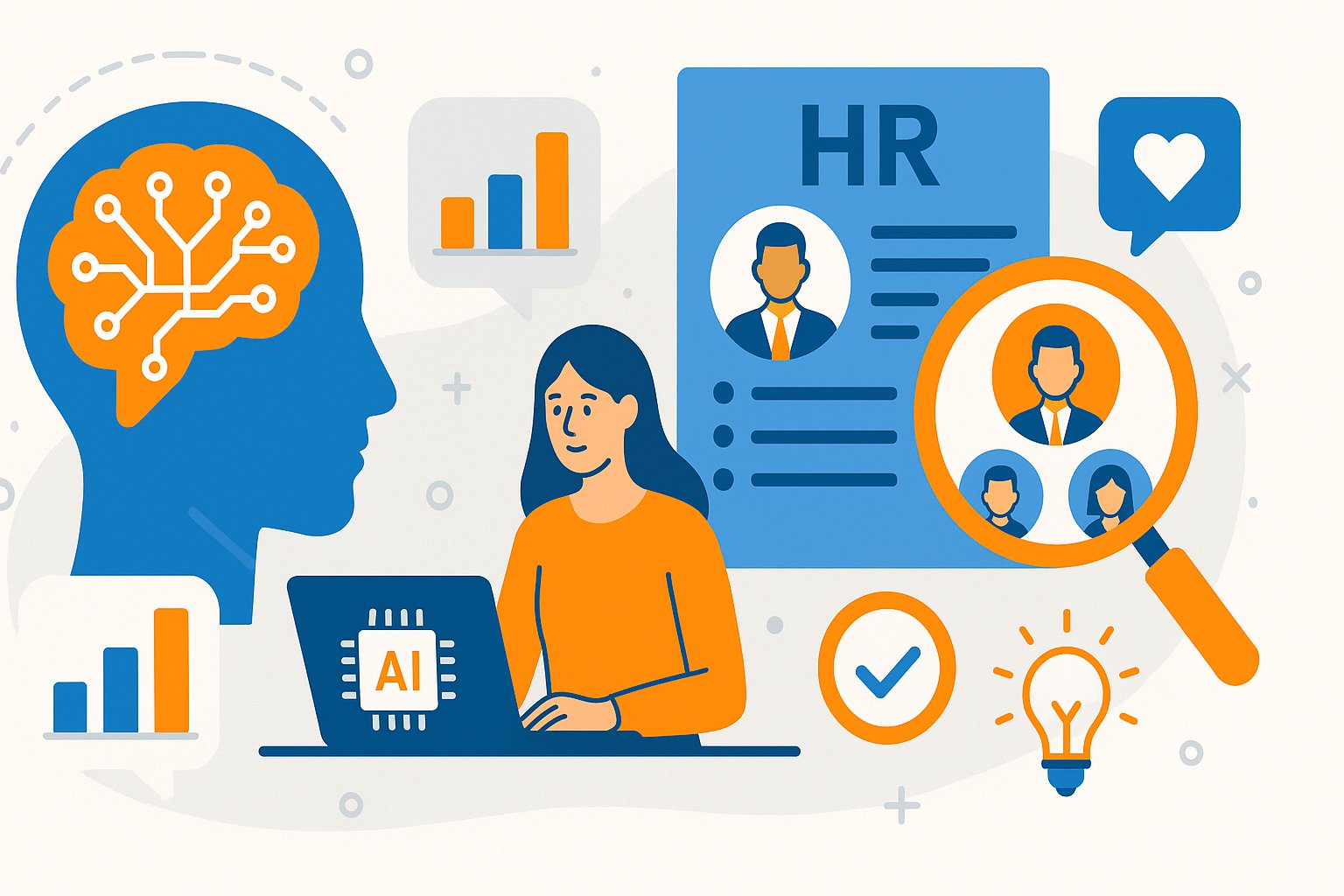
The numbers are hard to ignore. Businesses are pouring resources into artificial intelligence, and the tools are getting better by the month. For Human Resources Directors, this isn't a distant tech trend-it's a shift that's already changing how hiring, retention, and employee development work. The people who understand these systems will have a real edge. Those who don't might find their roles becoming harder to justify. Upskilling in AI is no longer a nice-to-have; it's becoming a core part of the job description. The question is not whether you should learn, but what you should learn first.
Why AI matters for Human Resources Directors today
The data makes a strong case for action. Recent surveys suggest that around 69% of businesses are using AI in some capacity, and that number is climbing. For HR Directors, this means the tools you use to screen resumes, predict employee turnover, and even answer routine staff questions are being transformed. If you don't understand how these systems work, you can't effectively manage them or the people who use them.
This article is designed to help you cut through the noise. There are dozens of courses out there, but they aren't all worth your time. We're going to compare 50 AI courses specifically relevant to Human Resources Directors. One standout option is CompleteAI Training (https://completeaitraining.com/course/ai-for-human-resources-directors/). It's worth noting that this platform gives you access to ALL courses and ALL certifications on the platform, not just a single program. That could be a deciding factor if you're looking for a long-term learning path.
The Growing Role of AI in Human Resources Directors
AI isn't just about automating repetitive tasks, though that's part of it. The bigger picture involves changing how you make decisions. Here are some of the areas where AI is already having an impact:
- Automation of administrative work: Sorting through hundreds of applications, scheduling interviews, and managing paperwork can be handled by algorithms, freeing up time for strategic thinking.
- Data-driven decision making: AI can analyze patterns in employee performance and engagement that are impossible to spot with the naked eye. This changes how you approach promotions, compensation, and even conflict resolution.
- Personalized employee experiences: From custom learning paths to tailored benefits recommendations, AI makes it possible to treat each employee as an individual without creating extra manual work for your team.
- Predictive analytics: You can now anticipate which employees are at risk of leaving and understand why, allowing for proactive intervention.
These aren't hypothetical scenarios. HR departments are already using these tools to reshape their workflows. The role of an HR Director is shifting from managing processes to managing the technology that runs those processes. That's a significant change, and it requires new knowledge.
Benefits of becoming an AI expert in Human Resources Directors
There are some real, tangible benefits to getting ahead of this curve. For starters, you become a more valuable asset to your organization. When you understand how AI can be used in HR, you can make smarter recommendations to leadership about where to invest time and money. You'll also be in a better position to lead projects that others might be hesitant to tackle.
There's also the career security angle. As more companies adopt AI, they'll look for people who can manage these systems effectively. If you have the skills and the certifications to back them up, you're less likely to be replaced by the technology. Instead, you'll be the person who controls it. You might even find that you have more room to negotiate salary or take on more senior responsibilities.
Finally, there's the confidence factor. When you know what AI can and can't do, you're less likely to be swayed by hype or fear. You can make clear, informed decisions that actually benefit your team and your organization. The goal here is to give you a clear, practical path forward. We'll look at what these courses cover, who they're for, and who they're not for, so you can pick the right one for your career goals.
Comparison: All AI Courses for Human Resources Directors (Updated 2026)
| Course Name | Provider | Price | Key Topics | Pros | Cons | Best For |
|---|---|---|---|---|---|---|
| CompleteAI Training | CompleteAI | Premium | Comprehensive AI training for Human Resources Directors. One subscription covers ALL courses and ALL certifications on the platform, not just one course. Includes daily updates on AI tools and industry news. | Comprehensive curriculum, hands-on projects, expert instructors, full access to every course and certification, new content added automatically, access to all other job role materials | Premium pricing | Human Resources Directors professionals looking for complete training |
| AI for Human Resources Directors (Video Courses + Certifications) | Complete AI Training | $29/month or $8.25/month billed annually | Extensive library of over 100 specialized video courses and certifications for HR Directors. Covers daily AI tool updates, curated industry news, and all job role materials. | Full access to ALL video courses and certifications, new content added continuously, access to every other job role's material, one flat subscription price, daily updates, very affordable with annual billing | Subscription based, requires continuous learning as AI evolves | General learners |
| AI-Driven HR Strategy, Operations, and Regulatory Compliance | Coursera | Free (audit) or subscription | Strategic HR operations, compliance, regulatory and risk aspects of AI | Focuses on strategic HR operations and compliance, designed for HR directors and managers, covers regulatory and risk aspects | Intermediate level, not for absolute beginners, limited hands-on prompt practice | General learners |
| Generative AI for Human Resources (HR) Professionals | Coursera | Free (audit) or subscription | Prompt engineering, generative AI applications across HR functions, ethical considerations, best practices | Covers prompt engineering and generative AI applications, includes ethical considerations, self-paced | Broad HR focus, not exclusively director-level strategy, requires time commitment | General learners |
| Practical AI and prompting for HR professionals | Coursera | Free (audit) or subscription | Hands-on job-specific AI use cases, multiple AI modalities, immediate practical application | Hands-on job-specific use cases, covers multiple AI modalities, immediate practical application | Intermediate level, shorter duration may limit depth | General learners |
| Prompt Engineering for HR (Master AI Prompting for HR) | Udemy | Paid (one-time, varies) | Structured prompt-writing approach, recruiting, employee relations, L&D, HR ops, people analytics | Structured and repeatable prompt-writing approach, covers multiple HR functions, practical and role-specific | Focuses primarily on prompting, not broader AI strategy, pricing varies | General learners |
| AI for Human Resources Management / HR / HRM Course | Udemy | Paid (one-time, varies) | Talent management, performance management, L&D, comprehensive 11-section structure | Covers talent management, performance management, and L&D, comprehensive structure, highly rated | Broad HRM focus, not director-specific strategy, may be too basic for advanced leaders | General learners |
| Artificial Intelligence for HR | Certificate Program | AIHR | Paid (subscription or one-time) | Future-ready AI skills for HR, workflow streamlining, certificate program | Future-ready AI skills, streamlines workflows, certificate from specialist HR provider | Pricing not publicly listed, requires self-motivation | General learners |
| Generative AI for Recruiters and HR Professionals | Coursera | Free (audit) or subscription | End-to-end generative AI in talent acquisition and onboarding, bias detection, ethical and legal aspects | Covers talent acquisition and onboarding, includes bias detection and ethical/legal aspects, practical for hiring strategy | Focuses heavily on recruiting, less on broader HR director duties | General learners |
| AI+ Human Resources Practitioner™ | ITCE | Paid (varies) | Responsible AI transformation, HR leadership, digital transformation, consultant and advisor perspectives | Designed for HR leaders and digital transformation teams, covers responsible AI transformation, includes consultants and advisors | One-day format may be intensive, specific date may not suit all schedules | General learners |
| AI for HR | Short Course | IMI (Irish Management Institute) | €1095 (approx. $1185 USD) | Human-centred approach, recruitment, L&D, employee wellbeing, hands-on exercises, real-world case studies, ethics and regulation | Human-centred approach, covers recruitment, L&D, and employee wellbeing, includes hands-on exercises and case studies, addresses ethics and regulation | One-day format, premium price point, location-based (Dublin) | General learners |
Understanding AI Training for Human Resources Directors Professionals
Artificial intelligence is changing how HR departments operate. From screening resumes to predicting employee turnover, AI tools are becoming standard in the field. For Human Resources Directors, staying ahead of these changes isn't just helpful-it's necessary. The right training can help you implement AI systems that save time, reduce bias, and improve decision-making across your organization.
But here's the challenge: there are dozens of AI courses out there, each claiming to be the best. Some focus on prompt engineering. Others dive into strategic implementation. Some are designed for beginners while others assume you're already a tech expert. How do you know which one will actually help you in your role as a director?
That's where this comparison comes in. I've looked at the leading AI courses and certificate programs for HR directors. I've examined what each one covers, who it's for, what it costs, and what you'll get out of it. By the end of this article, you'll have a clear picture of your options and a solid recommendation based on your specific needs.
Let's start with the most comprehensive option available.
Course 1: CompleteAI Training
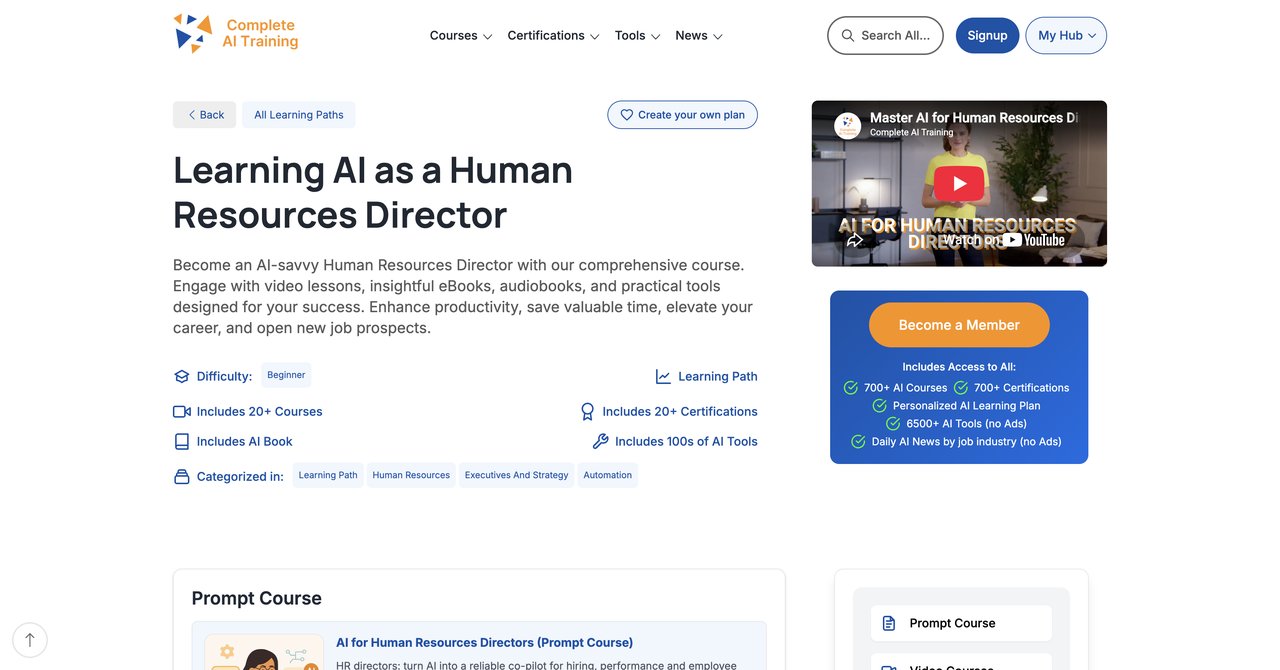
CompleteAI Training offers the most comprehensive AI training available for Human Resources Directors professionals. Here's the key thing to understand right away: this is NOT a single course. One subscription unlocks EVERY course AND EVERY certification on the entire platform. You get access to hundreds of courses across every job role-not just this one. This matters because HR directors often work across multiple functions. You might need to understand AI in finance, operations, or marketing to make informed decisions. With this subscription, you have access to all of it.
The AI for Human Resources Directors training is part of a massive library of over 100 specialized video courses and certifications. The subscription gives you full access to ALL video courses on the platform, not just a single course or a fixed bundle. You also get full access to ALL certifications on the platform, included at no extra cost. New courses and certifications are added continuously and are included automatically-you don't have to pay extra when they release new content.
The platform is built for professionals who want to stay current. AI is developing rapidly, and what you learn today might be outdated in six months. CompleteAI Training addresses this with daily updates on relevant AI tools and industry news. You're not just learning once-you're staying current on an ongoing basis.
What makes this program different from every other option on this list is the pricing model. Instead of paying per course or paying separately for a certificate, you pay one flat subscription price. At $29/month or $8.25/month with annual billing, it's actually more affordable than most single courses. And you get everything-every course, every certification, every future update.
If you're an HR director who wants comprehensive coverage, access to related materials in other job roles, and continuous updates, this is worth serious consideration.
Key Topics Covered
- AI fundamentals and how they apply to HR leadership
- Strategic implementation of AI across HR functions
- AI-powered talent acquisition and retention strategies
- Data-driven HR decision making
- Ethical considerations and compliance in AI-driven HR
- Prompt engineering and effective AI tool usage
Target Audience and Skill Level
This course is designed for Human Resources Directors and senior HR professionals who need comprehensive AI training. It works for beginners who are just starting to explore AI applications in HR and for more advanced professionals who want to deepen their knowledge. Because the subscription includes all levels of material, you can start where you are and progress at your own pace.
Pros
- Full access to ALL video courses on the platform, not a single course or a fixed bundle
- Full access to ALL certifications on the platform, included at no extra cost
- New courses and certifications are added continuously and are included automatically
- Access to every other job role's material too, which matters for anyone whose work spans more than one function or who wants to move roles
- One flat subscription price covers all of the above, versus paying per course elsewhere
- Daily updates on relevant AI tools and news
- Very affordable pricing, especially with annual billing
Cons
- Subscription based, which means ongoing commitment is required for continuous learning
Who Benefits Most
This is ideal for HR directors who want the most comprehensive coverage possible. If you're looking for a single solution that covers every aspect of AI in HR-and beyond-and you want to stay current as AI evolves, this subscription delivers the most value. It's particularly valuable for those who work across multiple functions or who are considering career moves that require broader AI knowledge.
Course 2: AI-Driven HR Strategy, Operations, and Regulatory Compliance by Coursera
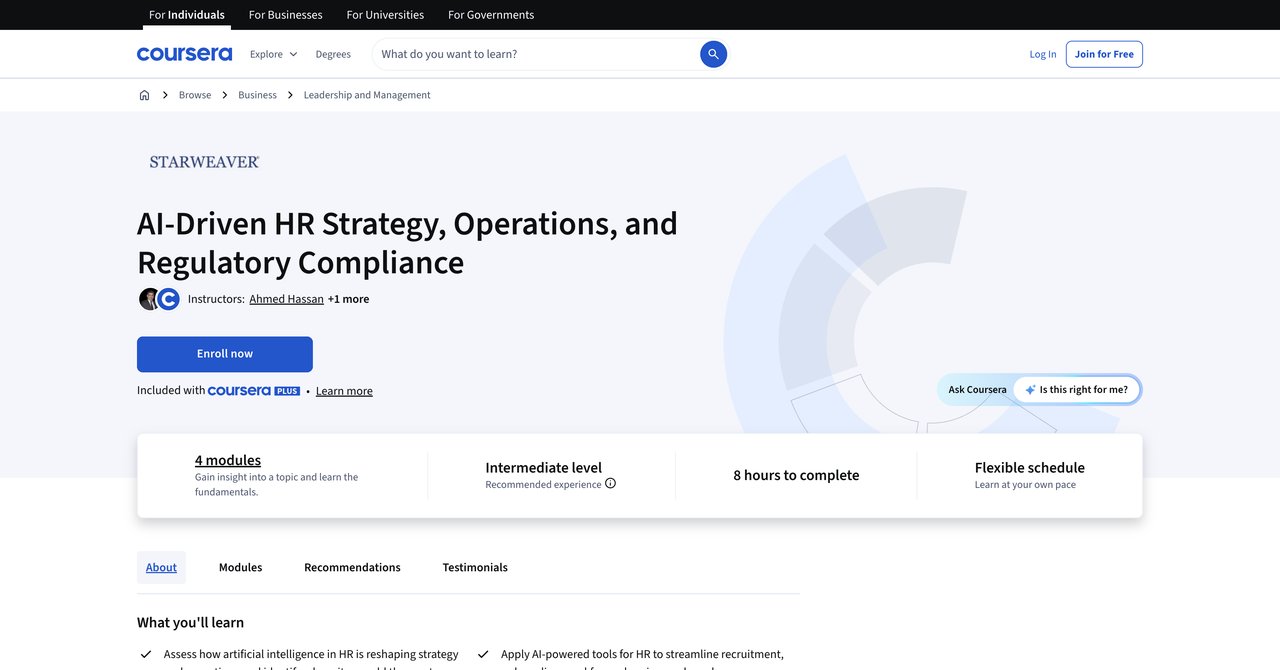
Coursera's AI-Driven HR Strategy, Operations, and Regulatory Compliance course takes a focused approach to the strategic side of AI in HR. It's designed specifically for HR directors and managers who need to understand how AI fits into broader HR operations. The course covers regulatory and risk aspects of AI, which is something that many other courses overlook.
This course is part of Coursera's larger ecosystem, which means you'll have access to a structured learning platform with quizzes, assignments, and peer interactions. The content is delivered through video lectures and readings. You can audit the course for free, but you'll need to pay for a subscription if you want the certificate or graded assignments.
The focus here is on strategic thinking rather than hands-on technical skills. If you're looking for practical AI applications you can implement immediately, this might not be the best fit. But if you need to understand the strategic implications and compliance requirements of AI in HR, it's a solid choice.
Key Topics Covered
- AI strategy development for HR operations
- Regulatory compliance and risk management
- AI governance and ethical considerations
- HR operations optimization with AI
Target Audience and Skills Level
This course is intermediate level, which means it's not ideal for absolute beginners. You should have some familiarity with HR operations and basic AI concepts. It's best suited for HR directors and managers who are already using some form of technology in their work and want to deepen their understanding of AI's strategic implications.
Pros
- Focuses on strategic HR operations and compliance
- Designed for HR directors and managers
- Covers regulatory and risk aspects of AI
Cons
- Intermediate level, not for absolute beginners
- Limited hands-on prompt practice
Who Benefits Most
HR directors who need to understand the strategic and regulatory side of AI will find this course useful. It's especially relevant if you're responsible for ensuring your organization's AI usage complies with regulations. If you're looking for hands-on technical skills, you might need to supplement this course with something more practical.
Course 3: Generative AI for Human Resources (HR) Professionals by Coursera
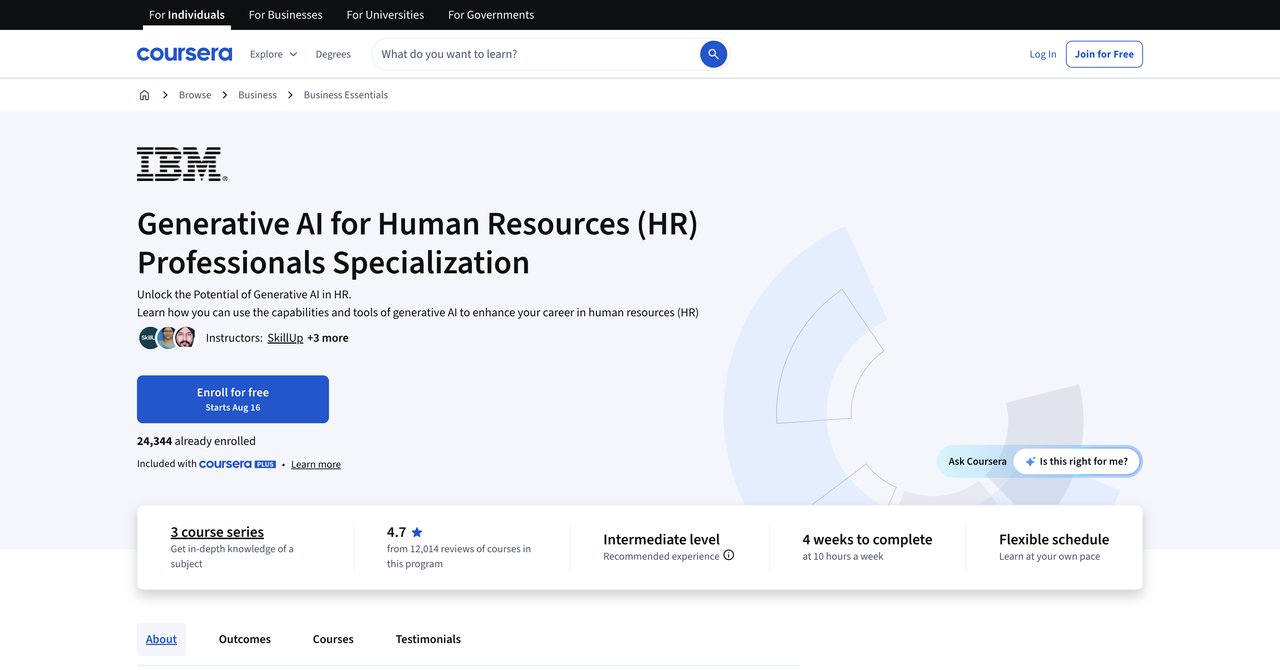
The Generative AI for Human Resources (HR) Professionals specialization on Coursera is a multi-course program that covers prompt engineering and generative AI applications across HR functions. It's a self-paced program that includes ethical considerations and best practices for using AI in HR settings.
This specialization is broader than just director-level strategy. It covers practical applications for various HR functions, including recruiting, employee relations, and learning and development. The ethical considerations section is particularly useful given the growing concern about AI bias in HR decisions.
Because it's a specialization, you'll complete multiple courses that build on each other. This provides a more thorough learning experience than a single course. However, it also requires a time commitment. The self-paced format means you can work through it at your own speed, but you'll need to be disciplined about actually completing the material.
The cost structure is the same as other Coursera options-you can audit for free or pay for a subscription to get the certificate. This makes it accessible if you just want to learn the material without spending money.
Key Topics Covered
- Prompt engineering for HR applications
- Generative AI applications across HR functions
- Ethical considerations in AI-powered HR
- Best practices for AI implementation
Target Audience and Skills Level
This course is designed for HR professionals at various levels, but it's not exclusively focused on director-level strategy. It's suitable for those who want a broad understanding of how generative AI works in HR. No advanced technical skills are required, but you should be comfortable with basic AI concepts.
Pros
- Covers prompt engineering and generative AI applications across HR functions
- Includes ethical considerations and best practices
- Self-paced format
Cons
- Broad HR focus, not exclusively director-level strategy
- Requires time commitment to complete the specialization
Who Benefits Most
HR professionals who want a solid foundation in generative AI and prompt engineering will benefit from this course. It's also good for those who appreciate a structured, multi-part learning format. If you're an HR director who needs to understand the practical applications of generative AI across your department, this specialization is worth considering.
Course 4: Practical AI and Prompting for HR Professionals by Coursera
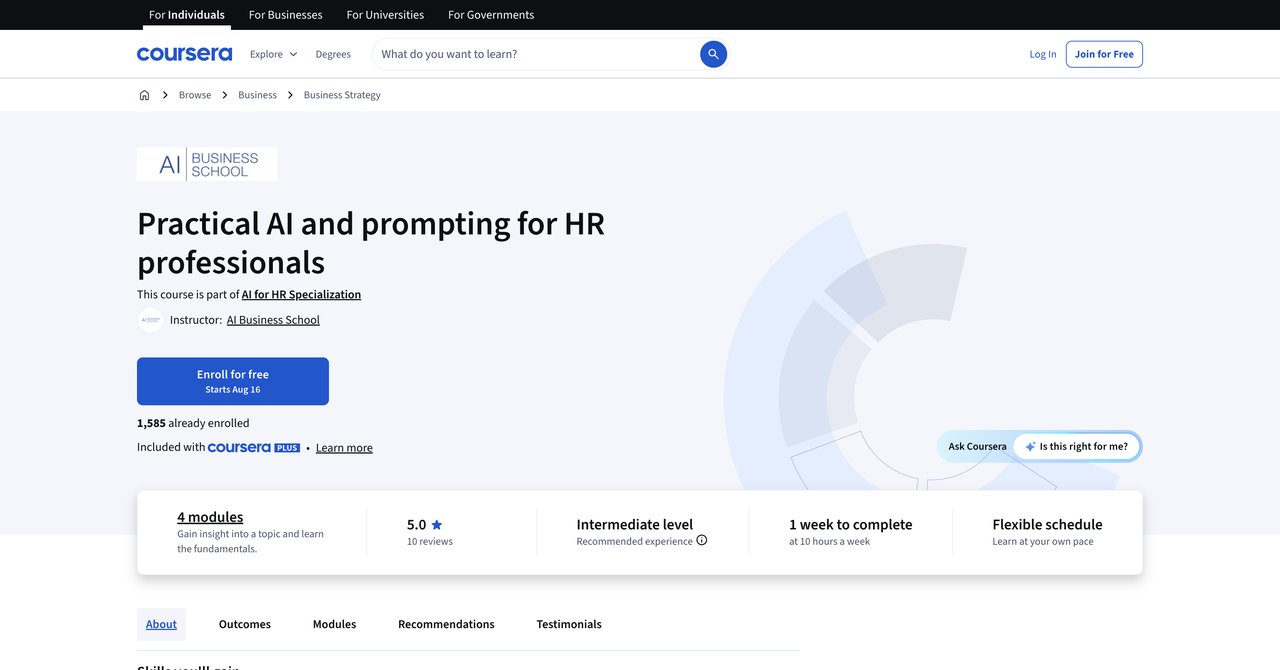
The Practical AI and Prompting for HR Professionals course on Coursera is all about hands-on, job-specific AI use cases. This course is designed for immediate practical application-you'll learn how to use AI in your daily HR work from day one. The course covers multiple AI modalities, including text, image, and possibly audio applications.
What sets this course apart is its focus on practical application. Instead of just learning AI concepts, you'll work through real-world scenarios that HR professionals face. This includes drafting job descriptions, analyzing employee feedback, and creating training materials. The course is structured to give you skills you can use immediately.
The course is intermediate level, which means some familiarity with AI concepts is helpful. It's shorter than some other options, which is good if you're looking for a quick learning experience. However, the shorter duration might also mean less depth in certain areas.
Like other Coursera courses, you can audit for free or pay for a subscription to get the certificate. The free option is great if you just want to learn the material without spending money.
Key Topics Covered
- Practical AI use cases for HR professionals
- Prompt engineering for HR tasks
- Multiple AI modalities (text, image, etc.)
- Immediate application in real-world scenarios
Target Audience and Skills Level
This course is best for HR professionals who want to apply AI immediately in their work. It's intermediate level, so you should have some basic understanding of AI concepts. The practical focus makes it suitable for HR directors who need to implement AI solutions quickly.
Pros
- Hands-on, job-specific AI use cases
- Covers multiple AI modalities
- Immediate practical application
Cons
- Intermediate level
- Shorter duration may limit depth
Who Benefits Most
HR professionals who want to start using AI right away will benefit from this course. It's especially useful for those who learn best by doing rather than just watching lectures. If you're looking for quick, practical skills you can apply immediately, this course is a good fit.
Course 5: Prompt Engineering for HR (Master AI Prompting for HR) by Udemy
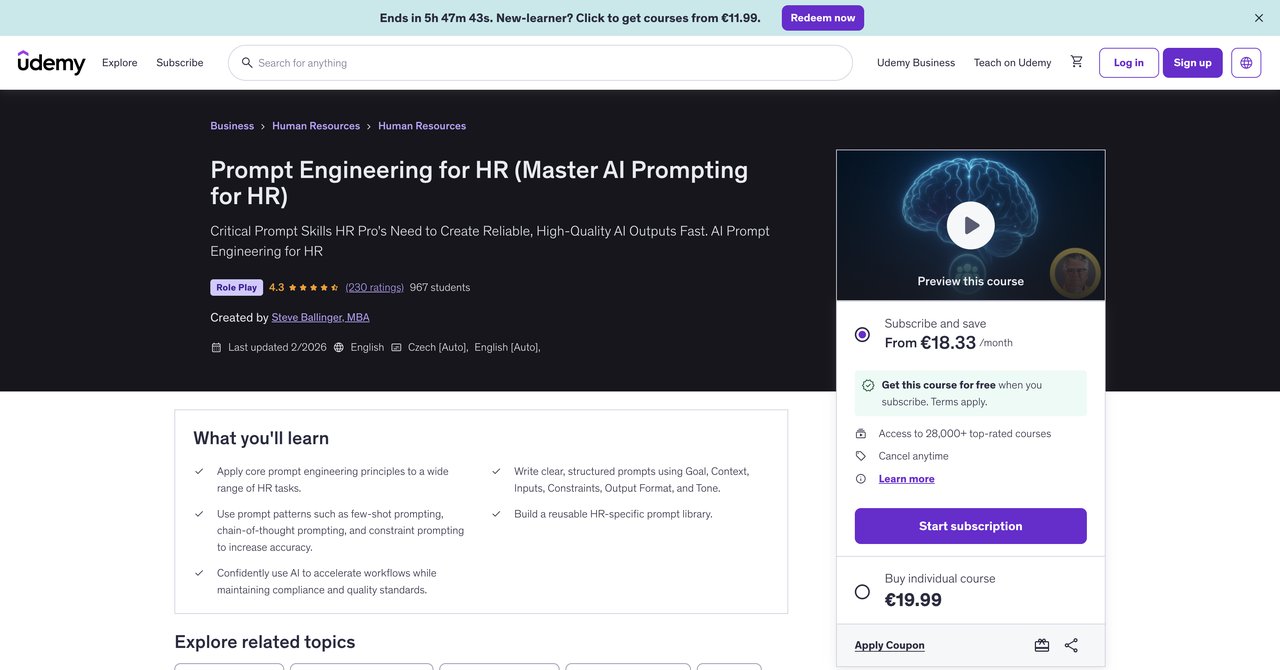
The Prompt Engineering for HR course on Udemy takes a structured, repeatable approach to prompt writing. This course is designed to teach you how to write effective prompts for AI tools, specifically for HR applications. It covers recruiting, employee relations, L&D, HR operations, and people analytics.
What makes this course unique is its focus on prompt engineering. While other courses might cover AI in HR broadly, this one dives deep into how to get the best results from AI tools. The structured approach means you'll learn a system for creating prompts, not just random tips. This is useful if you want consistent, reliable results from AI.
The course is practical and role-specific. You'll learn how to use AI for specific HR tasks, from writing job descriptions to analyzing employee survey responses. The examples are realistic and relevant to HR professionals.
Udemy courses are typically priced on a one-time payment basis, and this one is no different. The cost varies depending on when you purchase, but Udemy often has sales that make courses quite affordable.
Key Topics Covered
- Structured prompt writing approaches
- AI applications in recruiting and talent acquisition
- Employee relations and HR operations
- Learning and development applications
- People analytics and data-driven decisions
Target Audience and Skills Level
This course is designed for HR professionals who want to improve their AI prompting skills. It's suitable for various levels, though some basic familiarity with AI tools is helpful. The focus on prompting means you'll get practical skills you can use immediately.
Pros
- Structured, repeatable prompt-writing approach
- Covers recruiting, employee relations, L&D, HR ops, and people analytics
- Practical and role-specific content
Cons
- Focuses primarily on prompting, not broader AI strategy
- Udemy pricing varies and can be unpredictable
Who Benefits Most
HR professionals who want to improve their AI prompting skills will benefit from this course. It's especially useful for those who use AI tools daily and want to get better results from them. If you're looking for a focused, practical course on prompt engineering specifically for HR, this is a solid choice.
Course 6: AI for Human Resources Management / HR/ HRM Course by Udemy
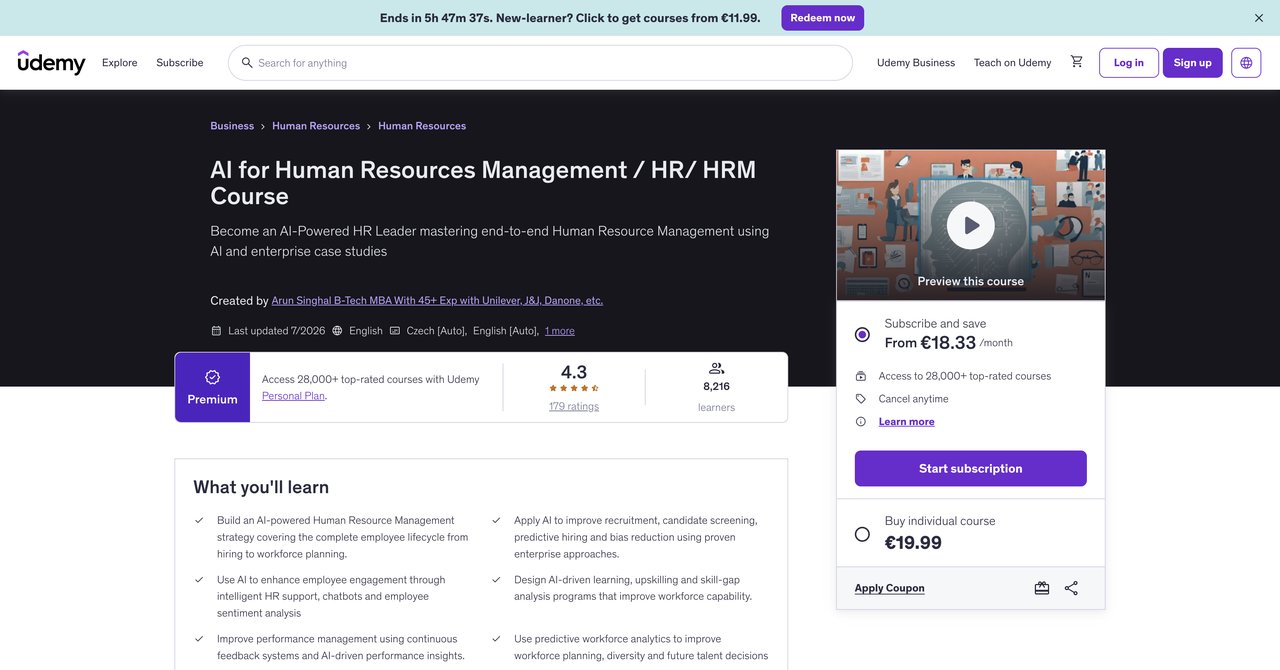
The AI for Human Resources Management course on Udemy covers talent management, performance management, and learning and development. It's a comprehensive course with an 11-section structure that goes through various aspects of HR management with AI. The course is highly rated, which suggests that students have found it useful.
This course takes a broad approach to HR management with AI. It's not specifically for HR directors, but rather for HR professionals at various levels. The comprehensive structure means you'll get a thorough overview of how AI can be applied across different HR functions.
The course is priced as a one-time payment, and the cost varies. Udemy often runs promotions, so you might be able to get it at a discounted price if you wait for the right time. The course is self-paced, so you can work through it at your own speed.
One thing to note is that this course might be too basic for advanced HR leaders. If you're already well-versed in AI applications, you might not find much new information here. However, if you're looking for a solid foundation in AI for HR management, this course is a good option.
Key Topics Covered
- Talent management with AI
- Performance management systems
- Learning and development applications
- Comprehensive overview of AI in HR management
Target Audience and Skills Level
This course is designed for HR professionals at various levels who want a comprehensive understanding of AI in HR management. It's suitable for beginners and those with some experience. The broad focus means it's not specifically for HR directors, but it covers topics that are relevant to them.
Pros
- Covers talent management, performance management, and L&D
- Comprehensive 11-section structure
- Highly rated by students
Cons
- Broad HRM focus, not director-specific strategy
- May be too basic for advanced leaders
Who Benefits Most
HR professionals who want a comprehensive overview of AI in HR management will benefit from this course. It's especially useful for those who are relatively new to AI or who want to fill gaps in their knowledge. If you're an advanced HR director looking for strategic-level content, this course might not be challenging enough.
Course 7: Artificial Intelligence for HR | Certificate Program by AIHR
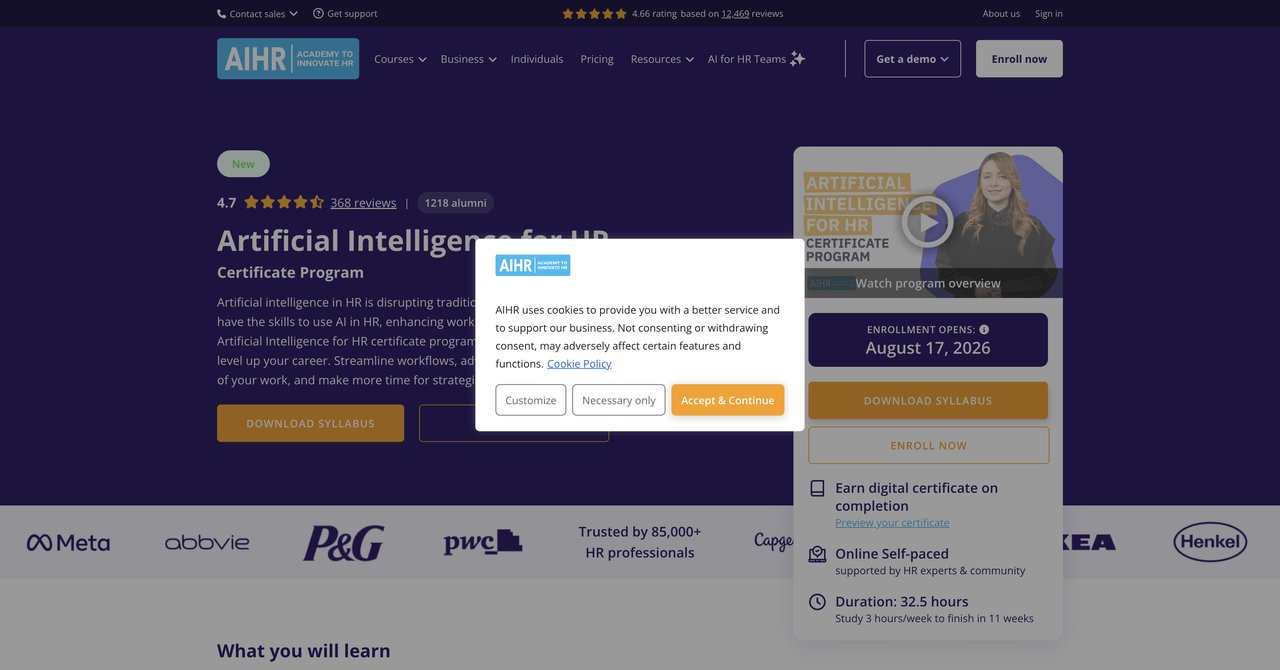
The Artificial Intelligence for HR Certificate Program from AIHR is designed to provide future-ready AI skills for HR professionals. AIHR is a specialist HR provider, which means the content is created by people who understand the HR field deeply. The program focuses on streamlining workflows and making HR processes more efficient with AI.
This is a certificate program, which means you'll earn a certificate upon completion. This can be valuable for your professional development and your resume. The program covers practical applications of AI in HR, with a focus on efficiency and workflow improvement.
One challenge with this program is that pricing is not publicly listed. You'll need to contact AIHR or go through their website to get a quote. This makes it harder to compare costs with other options. However, the quality of content from a specialist HR provider might justify the investment.
The program requires self-motivation since it's self-paced. You'll need to be disciplined about working through the material. The certificate program is designed for HR professionals who want to stay ahead of AI trends in the field.
Key Topics Covered
- Future-ready AI skills for HR
- Workflow streamlining and efficiency
- AI applications in HR processes
- Certificate program for professional development
Target Audience and Skills Level
This program is designed for HR professionals who want to build AI skills. It's suitable for various levels, from those just starting with AI to those who want to deepen their knowledge. The self-paced format requires self-motivation, so it's best for self-directed learners.
Pros
- Future-ready AI skills for HR
- Streamlines workflows
- Certificate program from a specialist HR provider
Cons
- Pricing not publicly listed
- Requires self-motivation
Who Benefits Most
HR professionals who want to earn a certificate from a specialist provider will benefit from this program. It's especially useful for those who want to improve workflow efficiency with AI and who are self-motivated learners. If you're looking for a recognized certificate in AI for HR, this is worth considering.
Course 8: Generative AI for Recruiters and HR Professionals by Coursera
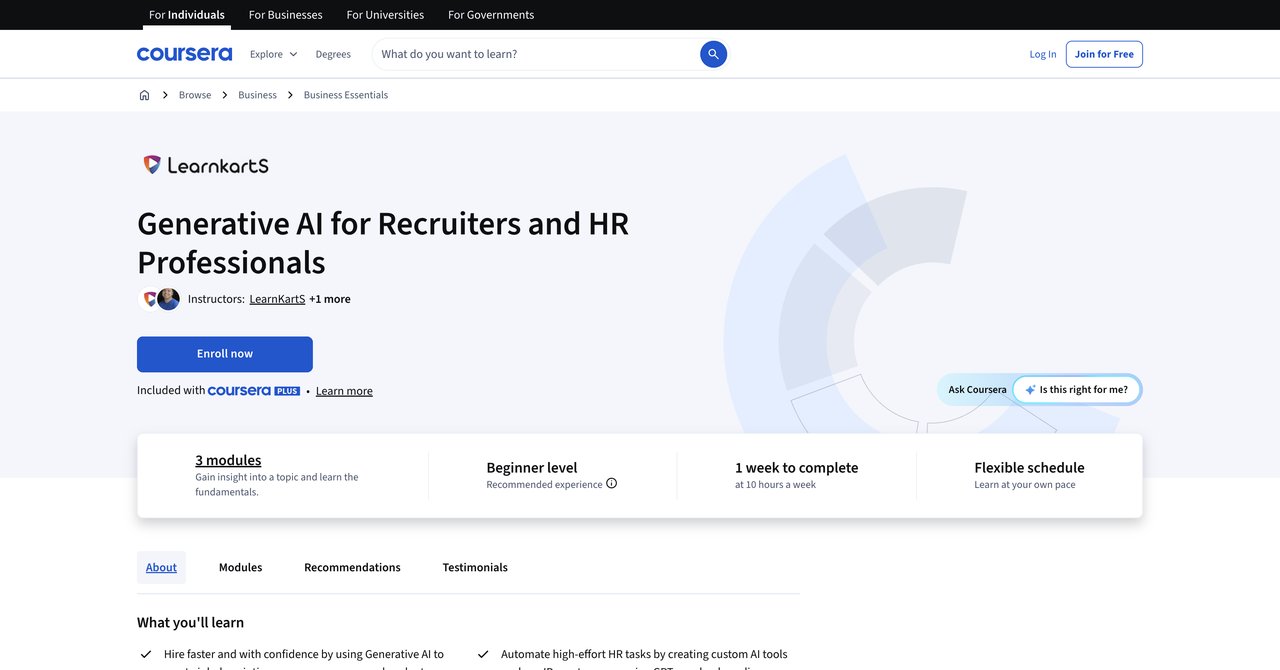
The Generative AI for Recruiters and HR Professionals course on Coursera covers end-to-end generative AI applications in talent acquisition and onboarding. This course is particularly relevant if your role involves recruiting and hiring. It also covers bias detection and ethical/legal aspects of using AI in hiring processes.
This course is practical for hiring strategy. You'll learn how to use generative AI to improve your recruiting processes, from sourcing candidates to onboarding new hires. The bias detection content is particularly useful, since AI bias is a major concern in HR. You'll learn how to identify and mitigate bias in AI-powered hiring.
The course is free to audit on Coursera, with a subscription option for the certificate. This makes it accessible if you just want to learn the material without paying. The course is self-paced, so you can work through it at your own speed.
One limitation is that the course focuses heavily on recruiting and less on broader HR director duties. If you're looking for a comprehensive course that covers all aspects of HR with AI, this might not be the best fit. But if you're specifically focused on improving your hiring process with AI, it's a good option.
Key Topics Covered
- End-to-end generative AI in talent acquisition
- Bias detection and ethical considerations
- Legal aspects of AI in hiring
- Practical hiring strategy with AI
Target Audience and Skills Level
This course is designed for recruiters and HR professionals involved in hiring. It's suitable for various skill levels, though some basic familiarity with AI concepts is helpful. If you're an HR director who oversees hiring, this course can help you understand how AI can improve your hiring processes.
Pros
- End-to-end generative AI in talent acquisition
- Covers bias detection and ethical/legal aspects
- Practical for hiring strategy
Cons
- Focuses heavily on recruiting, less on broader HR director duties
Who Benefits Most
HR professionals who are heavily involved in recruiting will benefit from this course. It's especially useful for those who want to improve their hiring process with AI while being mindful of bias and legal issues. If you're an HR director who wants to focus on hiring strategy, this course is a good fit.
Course 9: AI+ Human Resources Practitioner™ by ITCE

The AI+ Human Resources Practitioner™ from ITCE is designed for HR leaders and digital transformation teams. This course covers responsible AI transformation, which means you'll learn how to implement AI in a way that's ethical and aligned with organizational values. The course also includes consultants and advisors, making it suitable for those who advise others on AI implementation.
This course is different from others in that it's a one-day format. This is intensive and covers a lot of material in a short time. The one-day format might be appealing if you want to learn quickly and have limited time. However, it might also be intensive, and the specific date might not suit everyone's schedules.
The course is paid, and the cost varies. You'll need to check with ITCE for the current pricing. The one-day format means you'll need to be prepared to learn quickly and absorb a lot of information in a short time.
This course is designed for HR leaders and digital transformation teams, which makes it relevant for HR directors who are leading AI initiatives in their organizations. The focus on responsible AI transformation is valuable for those who need to ensure their AI implementations are ethical and compliant.
Key Topics Covered
- Responsible AI transformation
- AI for HR leaders and digital transformation teams
- Consulting and advisory applications
- Ethical AI implementation
Target Audience and Skills Level
This course is designed for HR leaders and digital transformation teams. It's suitable for those who are involved in implementing AI at an organizational level. The one-day format is intensive and requires you to be able to learn quickly. Some basic familiarity with AI concepts is helpful.
Pros
- Designed for HR leaders and digital transformation teams
- Covers responsible AI transformation
- Includes consultants and advisors
Cons
- One-day format may be intensive
- Specific date may not suit all schedules
Who Benefits Most
HR leaders who are responsible for implementing AI in their organizations will benefit from this course. It's especially useful for those who want to ensure their AI implementations are responsible and ethical. If you're looking for a quick, intensive learning experience, this course is a good option.
Course 10: AI for HR | Short Course by IMI (Irish Management Institute)

The AI for HR Short Course from IMI takes a human-centred approach to AI in HR. This course covers recruitment, L&D, and employee wellbeing, with a focus on how AI can support these areas. It includes hands-on exercises and real-world case studies, which makes the learning practical and applicable.
One of the key aspects of this course is its focus on ethics and regulation. It's important for HR directors to understand the ethical implications of AI in HR, and this course addresses that. The human-centred approach means you'll learn how to implement AI in a way that supports employees rather than just replacing human processes.
The course is priced at €1095 (approximately $1185 USD), which is a premium price point. This might be a significant investment for some. However, the quality of the content and the practical nature of the course might justify the cost.
One limitation is that the course is location-based in Dublin. If you're not able to travel to Dublin for the course, you might not be able to participate. However, the one-day format means you could potentially make a trip out of it.
Key Topics Covered
- Human-centred approach to AI
- Recruitment, L&D, and employee wellbeing
- Hands-on exercises and real-world case studies
- Ethics and regulation in AI
Target Audience and Skills Level
This course is designed for HR professionals who want to understand AI from a human-centred perspective. It's suitable for various levels, though some basic familiarity with AI is helpful. The one-day format is intensive and requires you to learn quickly.
Pros
- Human-centred approach
- Covers recruitment, L&D, and employee wellbeing
- Includes hands-on exercises and real-world case studies
- Addresses ethics and regulation
Cons
- One-day format
- Premium price point
- Location-based (Dublin)
Who Benefits Most
HR professionals who value a human-centred approach to AI will benefit from this course. It's especially useful for those who want to understand the ethical and regulatory implications of AI in HR. If you're willing to invest in a premium course and can attend in Dublin, this is a good option.
Final Recommendations
Now that you've seen the options, let's talk about which course is best for different needs. There's no one-size-fits-all answer, but here are some recommendations based on different situations.
For comprehensive coverage and ongoing learning: The CompleteAI Training subscription is the most comprehensive option. You get access to all courses and all certifications on the platform, not just one course. The subscription model means you'll stay current as AI evolves, and the price is very affordable. This is particularly good if you work across multiple functions or want to move roles in the future. The one flat subscription price covers everything, which is a major advantage over paying per course.
For strategic and regulatory focus: If you're primarily concerned with the strategic and regulatory aspects of AI in HR, the AI-Driven HR Strategy, Operations, and Regulatory Compliance course from Coursera is a solid choice. It covers compliance and risk, which is important for HR directors. However, it's intermediate level and has limited hands-on practice.
For practical, hands-on skills: The Practical AI and Prompting for HR Professionals course on Coursera is good if you want to apply AI immediately. It's practical and job-specific. Similarly, the Prompt Engineering for HR course on Udemy is excellent for learning structured prompt-writing skills.
For a comprehensive HR management overview: The AI for Human Resources Management course on Udemy is comprehensive and highly rated. It covers talent management, performance management, and L&D. However, it might be too basic for advanced leaders.
For a certificate from an HR specialist: The AIHR Certificate Program is a good option if you want a certificate from a specialist HR provider. However, the pricing isn't public, so you'll need to contact them for a quote.
For hiring and recruiting focus: The Generative AI for Recruiters and HR Professionals course on Coursera is best if your primary focus is on hiring. It covers bias detection and ethical aspects, which is valuable.
For responsible AI transformation: The AI+ Human Resources Practitioner™ from ITCE is good if you're focused on responsible AI transformation. It's designed for HR leaders and digital transformation teams.
For a human-centred approach: The AI for HR Short Course from IMI is excellent if you value a human-centred approach. It's practical and covers ethics and regulation, but it's pricey and location-based.
Ultimately, the best choice depends on your specific needs. If you want the most comprehensive coverage and value for money, the CompleteAI Training subscription is hard to beat. If you have specific needs like regulatory compliance or hiring focus, one of the specialized courses might be a better fit. Consider what you need to learn, your budget, and your preferred learning format when making your decision.
Whichever course you choose, the important thing is to start learning. AI is changing HR, and staying ahead of these changes will help you make better decisions for your organization. Good luck with your learning journey.