
Blog ·
11 Recommended AI Courses for Information Security Analysts in 2026
Sharpen your security edge with 11 top AI courses for 2026. Master threat detection, automate defenses, and future-proof your analyst career with targeted, advanced training.
 Jeroen Erne
The numbers are hard to ignore. Businesses are pouring resources into artificial intelligence, and the tools are getting better by the month. For Information Security Analysts, this shift isn't just a tech trend to watch from the sidelines-it's a fundamental change in how threats are detected, how vulnerabilities are patched, and how security operations centers run day to day. The analyst who can work alongside AI, who can prompt a model to sift through millions of log entries, or who can spot the subtle signs of an AI-generated phishing campaign, will have a serious edge. The analyst who doesn't may find their skillset becoming less relevant, and that's a hard position to be in when layoffs are happening across the industry.
This isn't about replacing human judgment. It's about augmenting it. AI can handle the repetitive, high-volume tasks that eat up your morning. You get to focus on the complex, strategic parts of the job that actually require human intuition. But you can't use a tool you don't understand, and that's where the knowledge gap becomes a career risk. Upskilling is no longer a nice-to-have for your annual review; it's a survival tactic for your career trajectory.
Why AI matters for Information Security Analysts today
Let's look at the reality of the market. A recent survey found that 69% of businesses are already using AI in some form, and that number climbs every quarter. In the security sector specifically, AI is moving from experimental to operational. Companies aren't just asking if they should use AI for threat detection-they're asking which vendor's AI is the most accurate and which analysts on their team can actually manage it. That's a significant shift. It means the job description for an Information Security Analyst is changing faster than most college curricula can keep up with.
The purpose of this article is straightforward: to help you figure out which AI courses are actually worth your time and money. There are dozens of options out there, and a lot of them are either too generic or too salesy. We're going to compare five specific AI training programs that are relevant to your field, breaking down what each one offers, who it's for, and what you'll walk away knowing. We'll look at everything from specialized security applications to broader AI literacy, so you can make a decision based on your current skill level and your career goals, not on flashy marketing.
The Growing Role of AI in Information Security Analysts
So, what does this actually look like in practice? AI isn't a single tool; it's a collection of capabilities that are reshaping the entire workflow of an Information Security Analyst. Here are a few of the most concrete applications:
- Automated threat hunting: AI algorithms are now capable of scanning network traffic and identifying anomalies that a human analyst would miss. They don't get tired, and they don't get distracted. This allows you to cover more ground and focus your efforts on the alerts that actually matter, rather than chasing false positives all day.
- Faster incident response: When a breach happens, speed is everything. AI can help you triage incidents, pull relevant logs, and even suggest remediation steps based on past data. It's like having a senior analyst sitting next to you, whispering advice, but one that has read every single incident report ever filed.
- Predictive vulnerability management: Instead of waiting for a patch to fail, AI can analyze code and system configurations to predict where vulnerabilities are likely to be exploited next. This moves you from a reactive posture to a proactive one, which is a huge value-add for any security team.
- Intelligent phishing detection: Phishing emails are getting harder to spot. AI can analyze language patterns, sender behavior, and even the structure of a link to flag malicious intent with a much higher degree of accuracy than a standard spam filter.
- Enhanced fraud detection: For analysts working in finance or e-commerce, AI is key to identifying complex fraud rings and unusual transaction patterns in real time. It's not just about a single bad charge; it's about spotting the network of activity behind it.
These aren't hypothetical scenarios. These are tools that are being deployed in security operations centers right now. The task of an analyst is shifting from being the person who monitors the dashboard to the person who manages the AI that monitors the dashboard. That requires a different skillset, and it's one that needs to be learned deliberately.
Benefits of becoming an AI expert in Information Security Analysts
Investing in AI training pays off in a few very tangible ways. First, there's the salary bump. Roles that require AI fluency in security consistently command higher compensation than their traditional counterparts. Employers are willing to pay a premium for someone who can bridge the gap between the security domain and the machine learning models that are becoming essential to it. You become the person who can translate business requirements into technical prompts and interpret the AI's output for the rest of the team.
Second, it gives you job security. As automation takes over the more routine aspects of the role, the analysts who thrive will be the ones who can work with the automation. You're not competing with the AI; you're competing with other analysts. And the ones who know how to use AI effectively are going to be the ones who get promoted. It's that simple.
Third, it makes your work more interesting. Let's be honest-a lot of security work is tedious. AI can take over the mundane tasks, freeing you up to solve the complex puzzles that got you into this field in the first place. You get to spend more time on strategy, architecture, and creative problem-solving, which is a lot more fulfilling than staring at a SIEM dashboard for eight hours.
Now, let's get to the courses. We'll be looking at five distinct options. One of them, CompleteAI Training, is particularly interesting because it doesn't just give you a single course; it gives you access to ALL the courses and ALL the certifications available on their platform. That's a different value proposition than a one-off program, and we'll weigh the pros and cons of that approach against the more focused offerings. The goal is to give you a clear, unbiased view of what's out there so you can pick the path that fits your needs.
Comparison: All AI Courses for Information Security Analysts (Updated 2026)
| Course Name | Provider | Price | Key Topics | Pros | Cons | Best For |
|---|---|---|---|---|---|---|
| CompleteAI Training | CompleteAI | $8.25/month (billed annually) or $29/month - one subscription covers ALL courses and ALL certifications on the platform | Comprehensive AI training for Information Security Analysts; includes content for every job role, not just one course. Full access to all video courses and all certifications, with new material added continuously. | Highest rating / most complete offering; full access to ALL video courses on the platform, not a single course or fixed bundle; all certifications included at no extra cost; new courses and certifications added continuously; access to every other job role's material too; very affordable pricing, especially with annual billing | Subscription-based; continuous learning required as AI evolves | Information Security Analysts professionals looking for complete training and general learners |
| SEC411: AI Security Principles and Practices: GenAI and LLM Defense | SANS Institute | $2,999 USD | Living curriculum for cybersecurity professionals entering GenAI/LLM defense; emerging AI attack surfaces; Model Context Protocol (MCP) security | Living curriculum dynamically updated during 4-month access; five hands-on labs with 125+ tasks; covers MCP security and emerging AI attack surfaces | Expensive; no instructor interaction in OnDemand format | General learners |
| SEC546: Securing Agentic AI | SANS Institute | Not specified (SANS standard pricing applies) | Production agentic AI security; prompt injection; context poisoning; identity/permissions; rogue agent containment; multi-agent workflow hardening | Focuses on production agentic AI security; covers prompt injection, context poisoning, identity/permissions, and rogue agent containment; includes multi-agent workflow hardening | Advanced level assumes prior security experience; no public price listed | General learners |
| SEC573: AI-Powered Security Automation: Building Tools with Python, LLMs, and MCP | SANS Institute | $8,780 USD | Python essentials; agentic AI development for security tools; hands-on building of AI agents; Model Context Protocol integration | Teaches Python essentials plus agentic AI development for security tools; hands-on building of AI agents; covers MCP integration | Very high price; advanced skill level required | General learners |
| SEC598: AI and Security Automation for Red, Blue, and Purple Teams | SANS Institute | Not specified (SANS standard pricing applies) | Offensive and defensive AI automation; detection-as-code pipelines; intelligent response workflows; adversary emulation automation | Covers both offensive and defensive AI automation; includes detection-as-code pipelines and intelligent response workflows; practical adversary emulation automation | Price not publicly listed; broad scope may not dive deep into any single area | General learners |
| SEC595: Applied Data Science and AI/Machine Learning for Cybersecurity Professionals | SANS Institute | Not specified (SANS standard pricing applies) | Data science and ML skills; custom AI-driven threat detection solutions; over 70% hands-on labs; GMLE certification prep | Over 70% hands-on labs; prepares for GMLE certification; transforms complex ML concepts into accessible security tools | Advanced level; price not publicly listed | General learners |
| Generative AI and LLM Security | Coursera | Free to audit or Subscription (Coursera Plus) | Attack surface of GenAI and LLMs; prompt injection; jailbreaks; model theft; other GenAI attack vectors; foundational threat modeling for LLMs | Covers prompt injection, jailbreaks, model theft, and other GenAI attack vectors; foundational threat modeling for LLMs; flexible self-paced format | Less hands-on than specialist bootcamps; depth may be limited for advanced practitioners | General learners |
| Machine Learning for Cyber Threat & Anomaly Detection | Coursera | Free to enroll (audit) or Subscription for certificate | ML strengths and limitations; inference and poisoning attacks; SOC and threat intelligence analyst applications | Recently updated; covers ML strengths/limitations including inference and poisoning attacks; job-relevant for SOC and threat intelligence analyst roles | Short duration limits depth; focuses more on detection than response | General learners |
| CompTIA CySA+ Cybersecurity Analyst | Coursera | Free to audit or Subscription (Coursera Plus) | CompTIA CySA+ CS0-004 certification prep; threat detection; vulnerability management; incident response; vendor-neutral credential | Prepares for CompTIA CySA+ CS0-004 certification; vendor-neutral credential; covers threat detection, vulnerability management, and incident response | Not AI-specific; shorter than full certification prep courses | General learners |
| CompTIA Security Artificial Intelligence+ (CY0-001) Certification Training | IEC Tech Inc | Not specified | CompTIA SecAI+ certification prep; AI/ML integration into security operations; threat detection; structured for certification success | Directly prepares for the new CompTIA SecAI+ certification; covers AI/ML integration into security operations and threat detection; structured for certification success | Price not publicly listed; newer certification with limited third-party reviews | General learners |
| The Complete Hands-On Cybersecurity Analyst Course | Udemy | Not specified (Udemy pricing varies, typically $20-$100 with discounts) | Hands-on labs in a controlled virtual environment; practical analyst skills; recently updated July 2026 | Hands-on labs in a controlled virtual environment; covers practical analyst skills; recently updated (7/2026) | Beginner level may be too basic for experienced analysts; not AI-specific | General learners |
Understanding AI Training for Information Security Analysts Professionals
The role of an Information Security Analyst is changing fast. It's not just about firewalls and intrusion detection anymore. Modern security teams are dealing with AI-powered attacks, automated phishing campaigns, and vulnerabilities specific to large language models and generative AI systems. If you are not getting familiar with this side of security, you are falling behind. The training options below range from broad, subscription-based libraries to expensive, deep-dive bootcamps. This comparison breaks down what each choice actually delivers for your career and your skill set.
For anyone in security operations, threat intelligence, or incident response, understanding how AI works both as an attack tool and a defensive tool is now a core requirement. While learning Python and understanding code will always matter, knowing how an LLM can be tricked into leaking data is a whole new ballgame. The good news is that there are more educational options than ever. The bad news is that sorting through them can take hours. That is why I wrote this comparison. Each course below is looked at closely-price, content, who it's for, and the things you should know before you sign up.
Keep in mind that the cost of these courses varies wildly, and it's not always the price that is the biggest concern. Some courses are incredibly affordable but very narrow. Others are expensive but comprehensive. And others still are already outdated. This guide will help you identify which path-whether it's becoming a certified specialist or simply staying ahead of the latest attack vectors-is best for you. No fluff, just a clear look at what each training provider offers.
Course 1: CompleteAI Training (All-Inclusive Subscription)
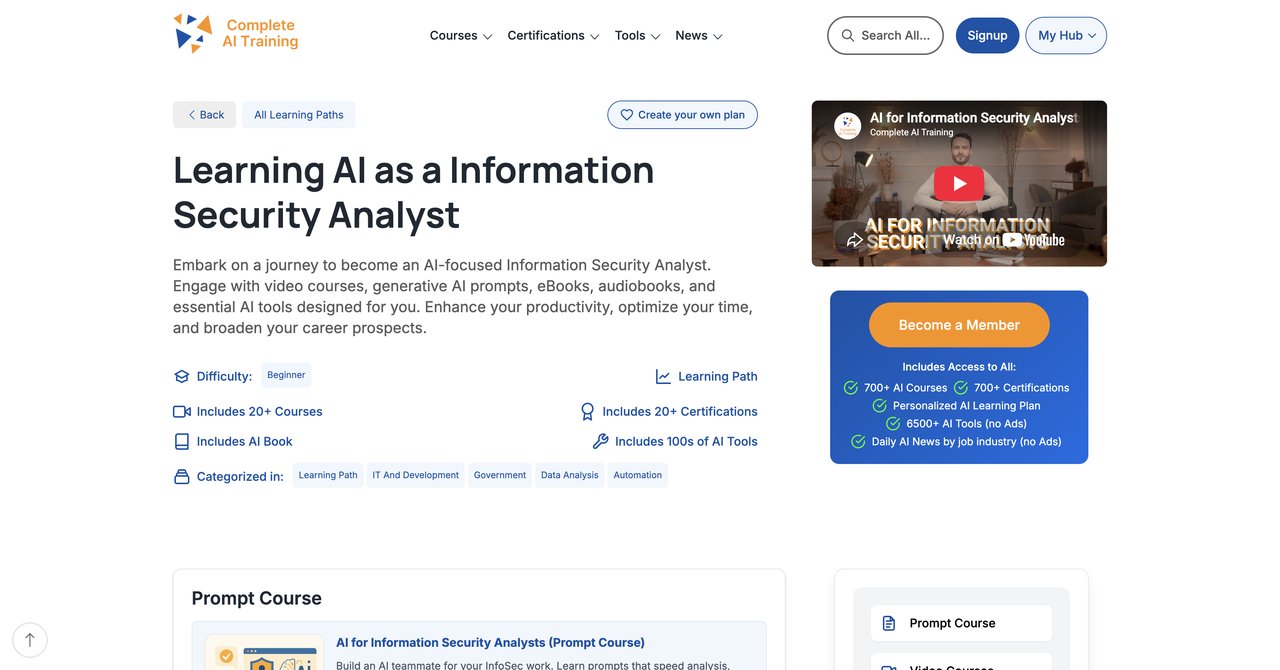
Here is the first point you need to understand about this option: Complete AI Training is NOT a single course. When you subscribe, you aren't buying one class. One flat subscription unlocks EVERY course and EVERY certification on the whole platform. This is not a typical set-up. Most places in this article sell you one course at a time, or they sell you a package of three. Here, you pay one price and get access to hundreds of video courses that cover security, plus IT, data science, and every other role you can think of. This is the key differentiator against every other provider in this comparison.
When you join the subscription, you are getting full access to ALL video courses on the platform-not a single course or a fixed bundle. On top of this, you get access to ALL certifications that are included at no extra cost. If a new certification drops next month for zero extra charge, you get it. If they add ten new courses on threat hunting or security automation, you get them. This is a live library that grows automatically. This setup matters for a professional because security and AI change weekly. Your training should not stay static.
The description you see on the site is straightforward: this is the most comprehensive AI training available for Information Security Analysts professionals. But the reality is broader than that. The subscription provides full access to the entire platform, which includes material for the Information Security Analysts role, and also for developers, managers, engineers, and other focus areas. If your work touches multiple fields, or if you see your role changing soon, you don't have to buy three different courses. You have every role and that can instantly benefit you.
The pricing is where this becomes a no-brainer for many. At $8.25 per month for an annual bill, or $29 month-to-month, you are paying less for this than most people pay for a couple of streaming services. This makes it easy to compare against a $3,000 SANS class or even a $100 Coursera subscription, with unbeatable value for what is offered. A first-year graduate, a busy analyst, or a manager get the exact same library access. There is no "tier" system holding back content.
One of the best parts is not having to worry about the word "certification" and an upsell. With every other provider listed here, you pay for the course, and then you pay for an exam or a certificate if you want proof. Not here. All certifications on the platform are included at no extra cost, and the player has. Every certification they build, regardless of subject, is ready for you to take. When you need to show competency in a specific area, it's just there.
Is it going to be a good fit for every Analyst? Yes. Whether you are working on the blue team handling incident response, on the red team breaking things, or in the middle, the material here supports your ground. The downside is minimal. A subscription-based learning style means you keep paying to access the library. Continuous learning is required as AI evolves. For someone who stays on top of things and keeps their payment active, this is model the best way to stay sharp. But if you close your account after a month, you lose access. That is the main trade-off.
Key Topics Covered: AI fundamentals for security, prompt injection defense, LLM vulnerabilities for security, security automation using AI, red teaming, secure coding, and a ton of content that is not just about AI.
Target Audience and Skill Level: Analysts at any level-entry to senior security professionals. Because it includes all roles, a junior looking to grow their basics and a manager training for cross-functional work are both in the right place.
Pros:
- Highest rating and most complete offering available
- Full access to ALL video courses (hundreds), not a single course
- Full access to ALL certifications included at no extra fee
- New courses and certifications added automatically
- Includes material for every other job role for multi-function work
- Affordable flat subscription versus single costly courses.
Cons:
- Subscription-based, not a lifetime access fee
- Continuous learning is required, but that's already the securities reality.
Who Benefits Most: The analyst who wants to future proof their career, wants the ability to pivot to adjacent fields, or simply wants the biggest library for the smallest cost. Also for the person who wants to take this seriously without paying an entire paycheck to one class. This is the place to start. Go to CompleteAI Training to view all courses.
Course 2: SEC411: AI Security Principles and Practices via SANS Institute
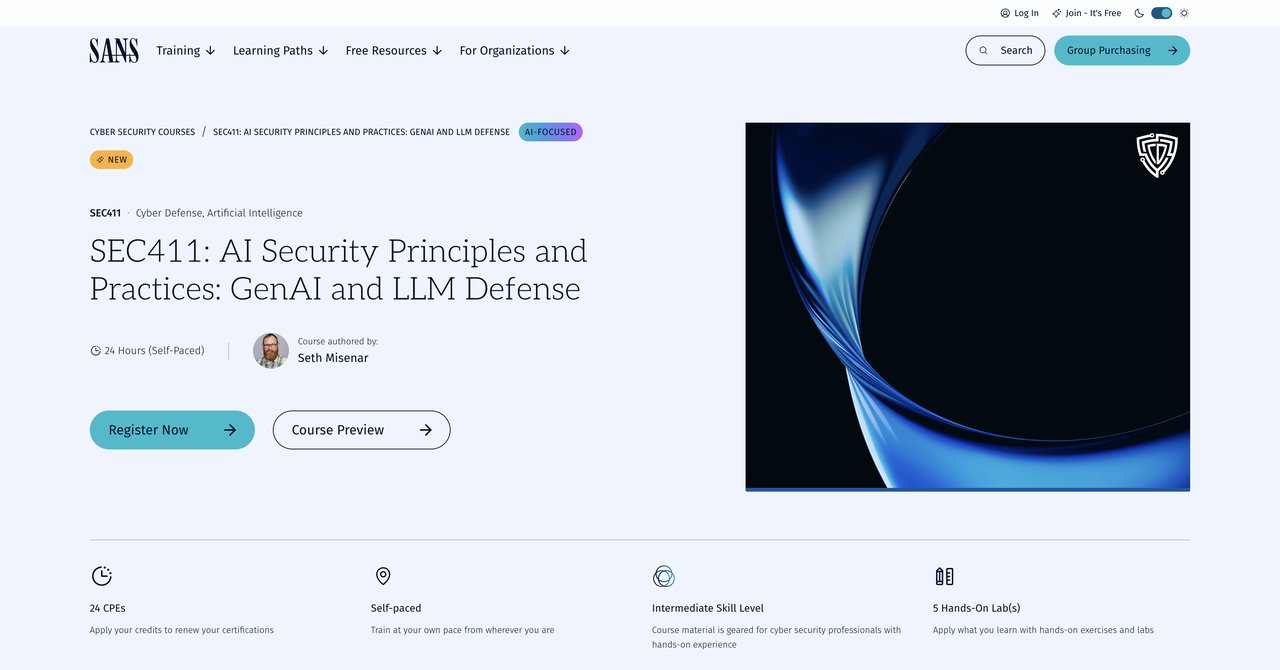
SANS is a beast in the cybersecurity training world. SEC411 is their attempt to get analysts caught up quickly in the new world of AI attacks, specifically GenAI and LLM defense. This course is described as a living curriculum. That means they update the material as the threats change, which is often needed, and users get access for a four-month window, in which new updates are added. You are not reading a book from 2021-the content changes during your period of access.
The course gives you what the title says: principles and practices. It covers the emerging AI attack surface. Areas like Model Context Protocol (MCP) security, which is how AI interacts with other tools and APIs, are included. It sets you up to not just look at logs for known strings but also to understand why an AI system might suddenly output confidential data. There are multiple hands-on labs to help solidify the material. The course uses labs that give you 125+ individual tasks to work through.
It's a big deal for a SANS course. Many SANS courses emphasize slides and reading more than doing, but here they put a large emphasis on actual practice for the OnDemand version. This helps bridge the gap to the real environment your company may be rolling out.
The weakness has to do with price and the level of interaction. If you choose OnDemand, there isn't direct instructor interaction. You get and you get lectures, but no one to ping you if you fail. Also, $2,999 is a lot to spend for those who just want an intro. It is not a cheap exploration.
As an overall category, SANS courses are for the folks who want deep knowledge and to stand out. The content for this SEC411 course is usually pretty focused vs. smaller offerings, and they go a long way.
Key Topics Covered: GenAI attack surfaces, LLM Defense, Model Context Protocol security, emerging attack layers, security principles applied unsupervised and hands-on.
Target Audience: Intermediate analysts who already a working cyber with foundations, and the users want to move to AI security specific defense. It's not entry-level. You need an awareness and environment. Skills base in computer networking and general security is definitely expected.
Pros:
- Living curriculum that dynamically updates during 4-month access
- Five hands-on labs with 125+ tasks-practice significant
- Strong coverage of MCP security and new AI attack surface
Cons:
- Expensive at $2,999
- No instructor interaction in OnDemand format
Who Benefits Most: Analysts who work in larger orgs where budgets for training exist. Perfect for a person responsible for securing AI deployments or building policy for AI usage. It will get practical detail. Not idea for an independent learner.
Course 3: SEC546: Securing Agentic AI via SANS Institute
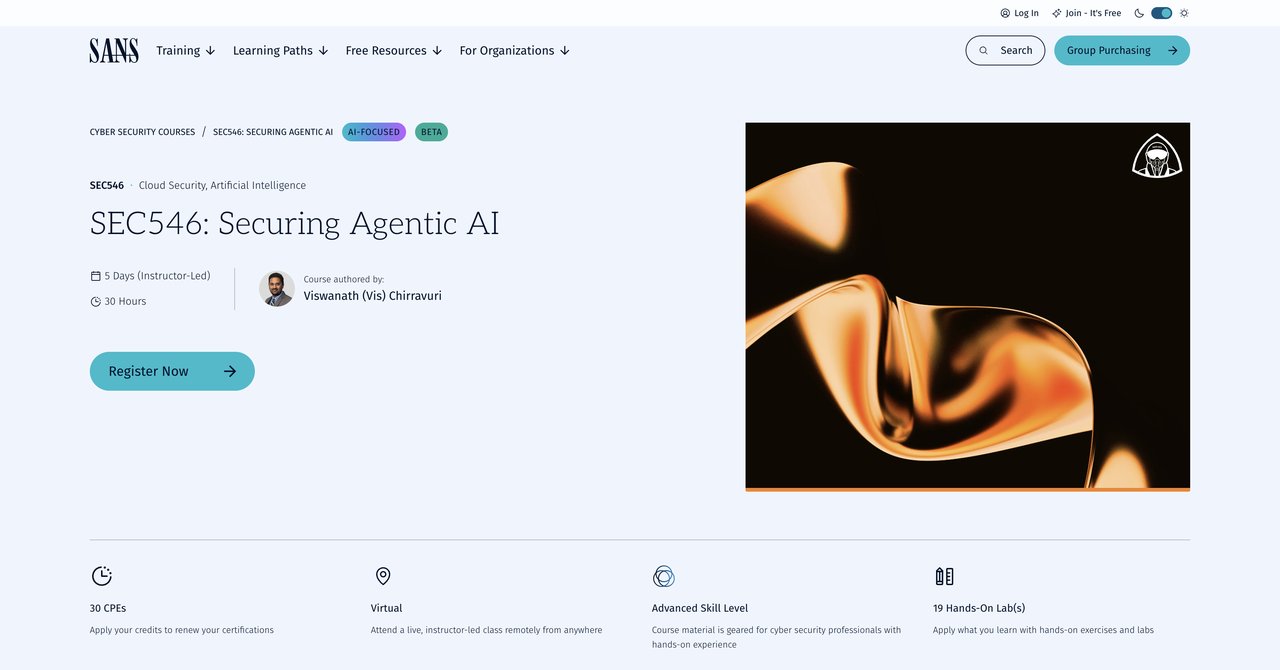
SEC546 is for the analyst who needs to handle the next big trend is Already here. This course isn't about chatbots-it is about agentic AI. Those are the AI-driven bots that do not just answer, they act. They have permissions, accounts, login access and can do things in the network. If you find yourself responsible for an AI that can trigger emails or API calls, you must make sure it's secure. This is the danger zone of cybersecurity bots is quite new.
This course focuses on production agentic AI security. They don't just teach labs to setup basic demos. They directly address how to secure the bot, and its identity, in a real environment. The course covers prompt injection. That's manipulating the AI to do unwanted things. It also covers context poisoning to alter a bot's understanding. They cover identity/permissions part to show how to keep rogue agent contained from getting broad blasts of access.
The "rogue agent" concern is where the sector is stuck. A number of SANS courses keep commonly focused on attacks from outside. Here, the big also includes attacks from a compromised internal. They also deliver the technical details on multi-agent workflow hardening-that is when several AI systems work as teams. Good insight to know.
The cons? This is not for beginners. They don't repeat basics quickly. You should know what a directory is, implement access controls, and want a quick start. The bigger negative is SANS has no public price listed for this course. That's frustrating for comparing. You will have to talk with a SANS admission advisor to get price. Expect a typical SANS price range (north of $5k).
Key Topics Covered: Agentic AI security, prompt injection, context engineering, identity and permissions, rogue AI containment, collaborative multi-agent hardening.
Target Audience: Senior analysts, security architects, and consultants whose teams are building out AI agents. Not for security beginners without experience.
Pros:
- In-depth focus on production agentic AI (not just an LLM)
- Covers the practical threats of prompt injection and rogue agents
- Multi-agent workflow hardening material is unique on this list
Cons:
- Not for fresh beginners
- No public pricing list, an affordability unknown
Who Benefits Most: This is for the professional whose boss is asking to deploy an AI bot and no one knows about securing usage. Cost is fine if you are already set for expensive training and need trusted guidance.
Course 4: SEC573: AI-Powered Security Automation: Python and MCP via SANS Institute
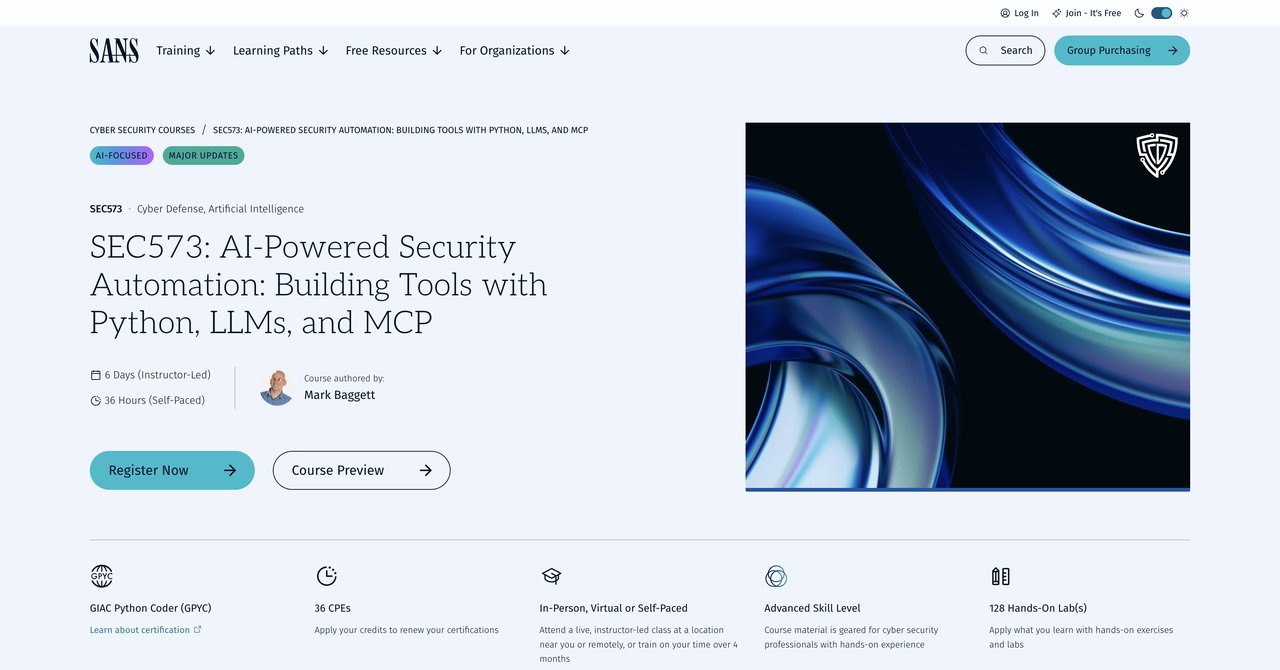
SANS has another one specifically for automation. With SEC573, the focus slides from defensive principles over to skill building that goes beyond just setting rules. This is a hands-on programming class. The "AI" in the title is for belly. They teach you Python essentials as it applies to building security tools. Then they move into agentic AI development-you're not just clicking and pointing, you are writing code that generates tools. The practical outcome? The ability to build an AI agent that sorts your alert feed.
For an Information Security Analyst who avoided scripting for years, this course will not be comfortable. That Cons peice mentions adequate. I expect you need solid Python basics before arriving, or at least it strongly helps to have done exercises. However, the agenda has the value. They ingrain the Model Context Protocol. This is a technical core for AI tools to talk to other. And the course includes building AI by SANS style, with a very comprehensive set of labs.
$8,780 dollars is the sticker price. That's absolutely on the expensive side. It's possibly more than your yearly training budget at your company and maybe more than your computer. But if you are willing to pay, you get deep specialization. You not just go to a prose about automation and no code. You sit and have labs. For analysts heading to a role as tech lead in automation, this could jump start. But the cost is a "hard pass" for most freelancers or early career jobs.
Topics Covered: Python for security, building agentic AI code, MCP integration, using LLMs in security tools, automating analyst tasks, hands-on AI agents for security.
Target Audience: technical analysts, automation engineers, those tasked with SOAR or custom security tools.
Pros:
- Be genuinely a hands-on builder course
- Directly teaching security automation using AI with MCP
- Focus on Python that is transferable
Cons:
- Very high price different outlier price than others
- Advanced skill level assumed; not for beginners
Who Benefits Most: The technical analyst on offensive skill to program. It is a scalable from Jupyter notebooks for AI models. It is not for a person seeking a keynote on AI strategy. If you are already writing scripts, was practical, this is a serious contender.
Course 5: SEC598: AI and Security Automation via SANS Institute
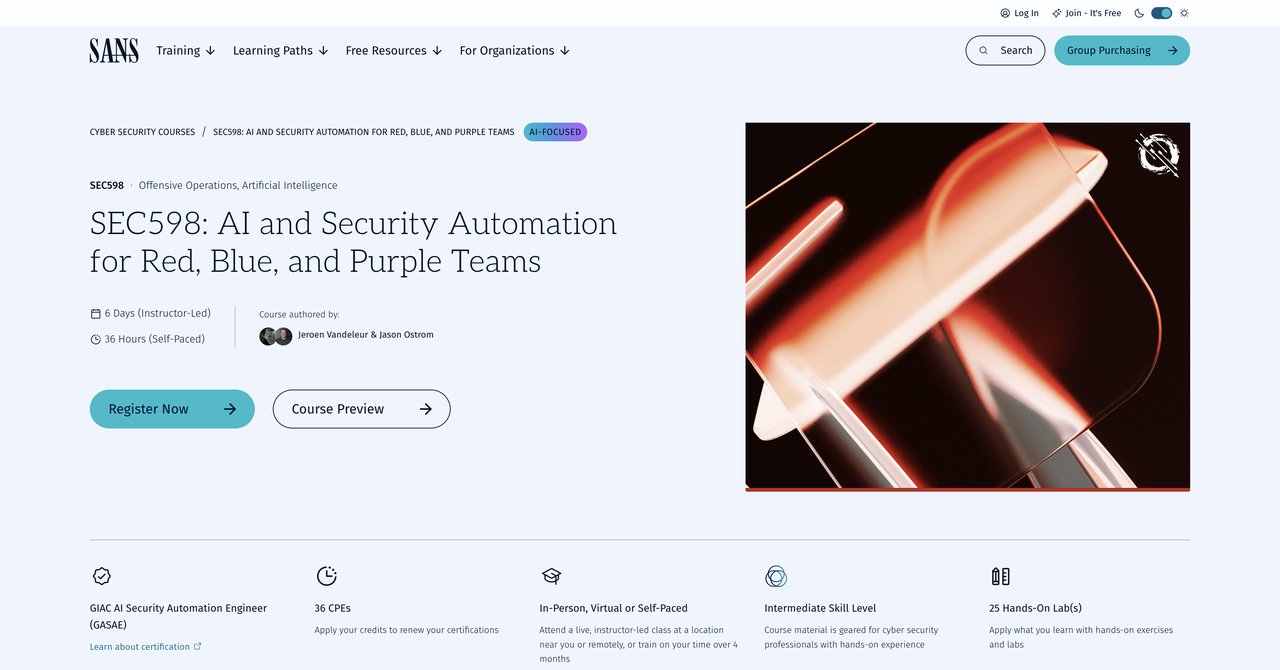
This particular SANS course (SEC598) is concerned with making the whole SOAR and anomaly detection more effective by combining AI goes into everything. It covers both offensive ai automation (red). It also covers defense. Instead of doing only response modules, this sits overall scope of how wasn't just alerts a pipeline. Here what you need can actually be and the major search. Detection-as-code is one concept. Instead part of your team writing carelessly, analysts can treat detection settings like software. Intelligent response workflows that collect with data context are covered too.
The course combines strong foundational for a red team and blue. The syllabus includes adversary emulation automations. This course doesn't cost time on battle essays or superheroics. It talks about the practical of doing the heavy of repetitive actions for you. That is a great deal for an analyst whose day is staring at. This is maybe the best "operational" SANS choice for teams and in-between.
But it's the cost. Not listed publicly it requires you to reach out SANS sales team- often time, you'll get a "varies based on format." A quick currency understanding of SANS will tell you to budget for basic-valued (minimum of $7,000). High price. It also gives little version, wide, which is maybe not the deepest content about any single methodology. They mix so much you need to be careful you get a "mile wide, inch deep" NU.
Key Topics: Attack/defense. Detection-as-code, automated response workflows, adversarial emulation, AI enhance blue and red operations.
Target Audience: Experienced security analysts in smaller teams with broad they duties. Security managers.
Pros:
- Improves both offensive and defensive actions.
- Handles detection-as-code pipeline (valuable)
- Great on practical adversary emulation for teams
Cons:
- Missing public list
- Covers very broad range , not single tool mastery
Who Benefits Most: Analysts and leaders who want one account for almost a "what good looks like" for automation. If you lead a SOC that still runs around manual tickets this is the real deal. But it requires a budget.
Course 6: SEC595: Applied Data Science and Machine Learning for Cybersecurity Pros via SANS
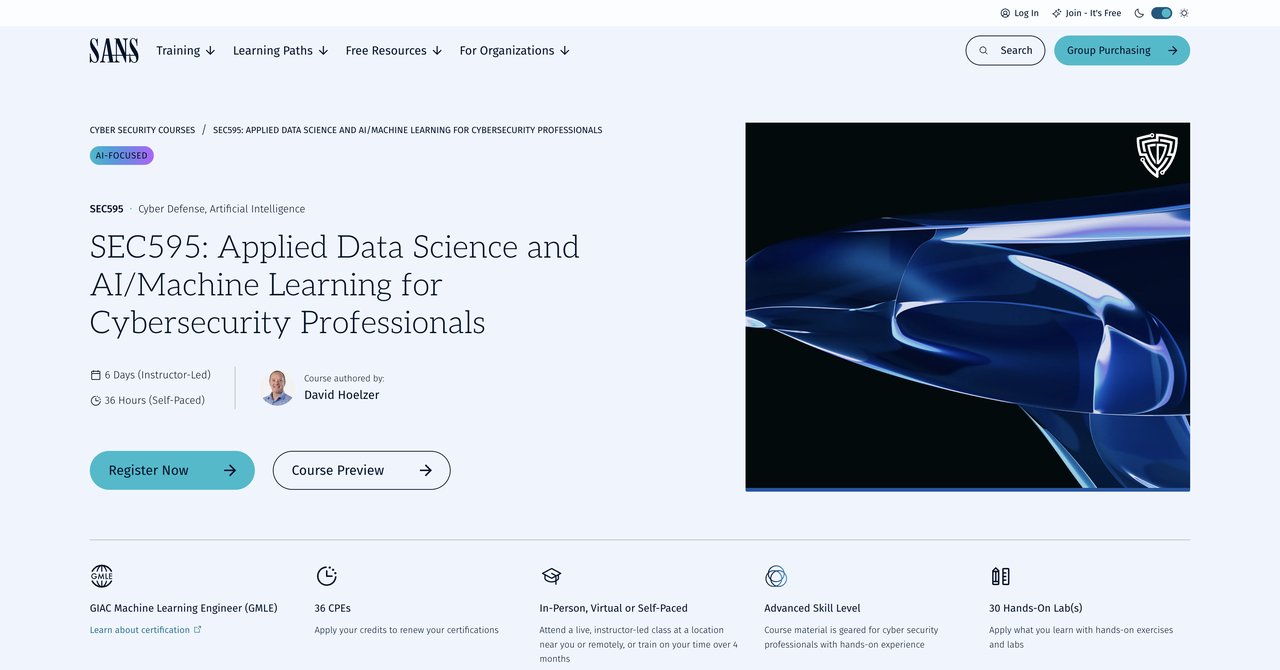
SEC595 stands out because it is about your own detection via data science. Most beginner classes will feed you prediction from Python. This class is a deeper build into the ML and statistical modeling. You go through all of the work of setting up. This is the proper preparation for the GMLE certification, a specific credential for someone that likes a hybrid in data analyst plus a security. It's about how getting a vector to spot an anomaly. In all courses this one has the highest percentage of labs; the total of over 70% of it was "hands-on". That means they get almost 3 moments of you doing it altogether.
The course "transforms complex ML concepts into accessible security tool" which is helpful because it avoids math theory, and makes specifics focus. You will be studying. It sets security data structures, catching outliers, learning to test your ai model, and then watch for data poisoning. This is strong).
For an Information Security Analyst who doesn't want to do script but wants to integrate models into threat detection, this was it. This goes beyond just prompt wars and moves to analyst. The base is enough to be helpful even data. The con is similar. SANS's standard cost isn't public and as expected will be highly priced. (Expect $5,000-$9,000). Also you are going to need to be comfortable considering mathematical models, training and test sets. SANS says it is an advanced class. I would agree. You need to have grasp on security fundamentals absolutely.
Key Topics: Machine learning pipelines for surveillance, anomaly detection got your own first, training models, evasion attacks, GMLE certification prep.
Target Audience: A "threat hunter" or data-oriented analyst who wants to supervise AI what to look for. It's a strong technical base.
Pros:
- Strong hands-on with over 70% labs
- Offers GMLE certification
- Makes ML actionable for security, not just knowledge
Cons:
- Advanced ground level
- Price not listed (high, as all SANS)
Who Benefits Most: People wanting to escape the alert queue and build detection. A career track toward machine intelligence and insider-silicon analyst. (Still, having no listed price is annoying)
Course 7: Generative AI and LLM Security by Coursera
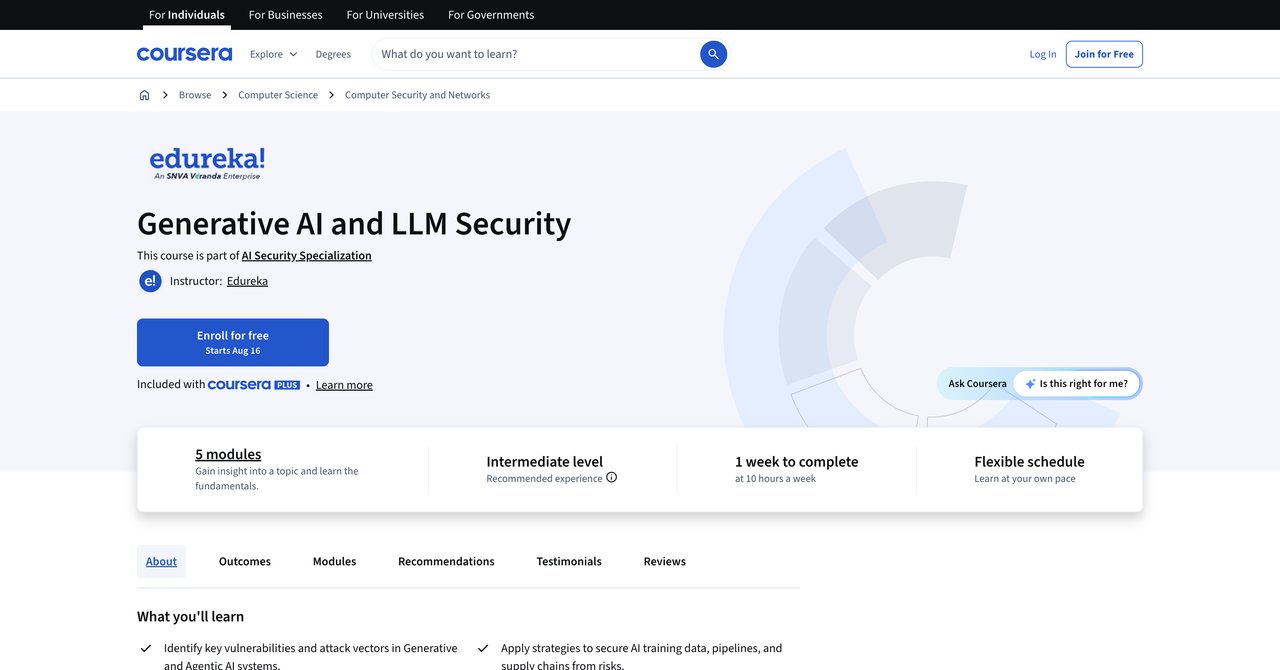
If you have never touched AI security and just want quick baseline, you can start here. This Coursera course is structured around the GenAI attack surface. It covers prompt injection, jailbreaks, model theft. This isn't a deep hands-on, but it introduces you to the vocabulary to trade. You will learn what could happen and what the threat model is for LLMs. It includes quite a number of contemporary, common proceeding examples. With this there are plenty of quizzes, which is a good hard stop.
The cost is flexible: you can access free (audit) or take a paid plan if you want a certificate to show. That audit view has the course materials. This makes it easy for curious analyst. For the price, it is comfortable. The cons quickly follow. It is short-it can feel like only a background. They don't go into secure coding from a specialist's mess. It lacks labs that is available as SANS of course, or maybe not even an implementation. If you already know why an LLM is vulnerable, you might get bored. An entry-level analyst, the type in a vsoc, would benefit the most here.
Key Topics: Basic LLM attack vectors, and jailbreaks, reflect. Simple threat modeling for AI
Target Audience: Start we humans with focus in entry/new
Pros:
- Cost flexible-audit available free
- Introduces foundational GenAI attack patterns properly fast
- Self-paced, terminal, fits an unscheduled day
Cons:
- Limited practical exercises
- Lack of depth for technical wonks
Course 8: Machine Learning for Cyber Threat & Anomaly Detection by Coursera
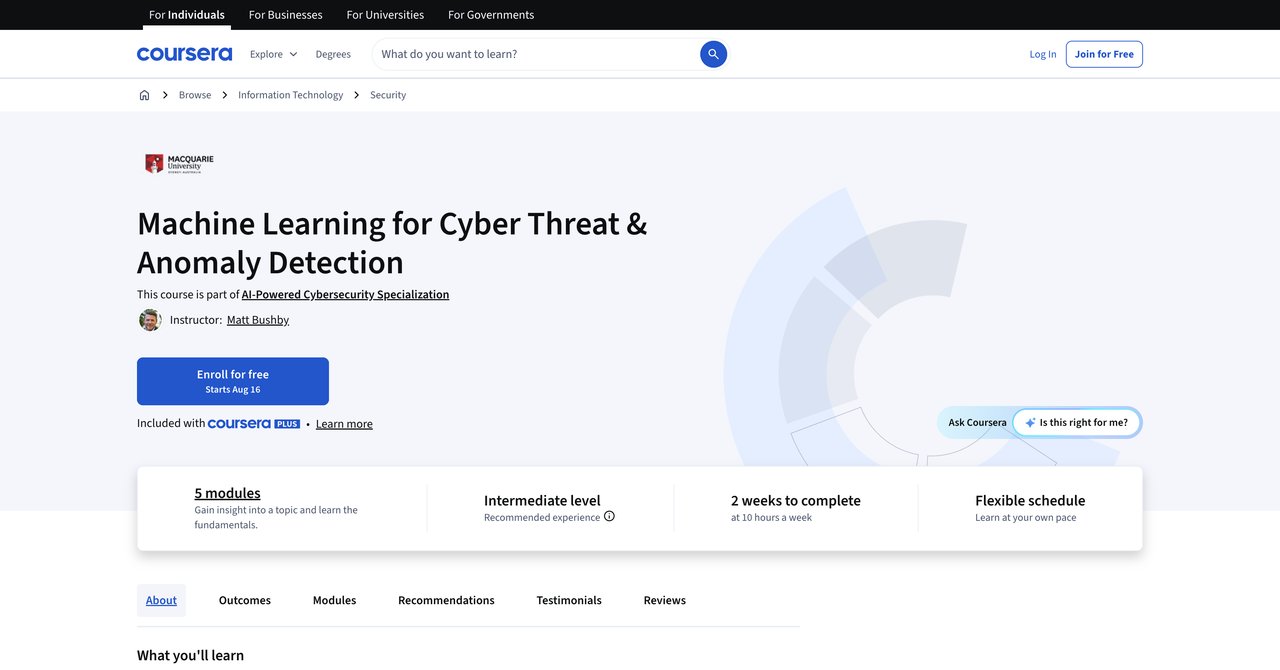
This is a Coursera course designed for the analyst on the SOC floor. It covers ML's limitations and strengths when identifying traffic. It covers attack surface of machine learning itself-like inference and data poisoning. The date was updated recently which is the most useful point of this. It is a job-relevant little class, especially for Tier 1 & 2 analysts.
It is short, the and it is "short duration" such that you can't go deep. The labs just not big, you'll recap on basics. The course focus on detection, not necessarily response. If you ask to write a use case for hiring AI, this is a great intro. If you have taken a full course, you're slightly close to cover. Still in price it's great: certificate or free to audit.
Key Topics: ML for threat detection, inference and poisoning attacks, practical apply in SOC, anomaly analysis.
Target Audience: Operators who need to look on ML detection.
Pros:
- Functional for key: detection
- Outlines ML weaknesses
- Low-cost/free
Cons:
- Broad and not deep
- Detection vs response: only half the process
Best fit: The analyst who needs enough for basic and a certificate to show is worthwhile.
Course 9: CompTIA CySA+ Cybersecurity Analyst by Coursera
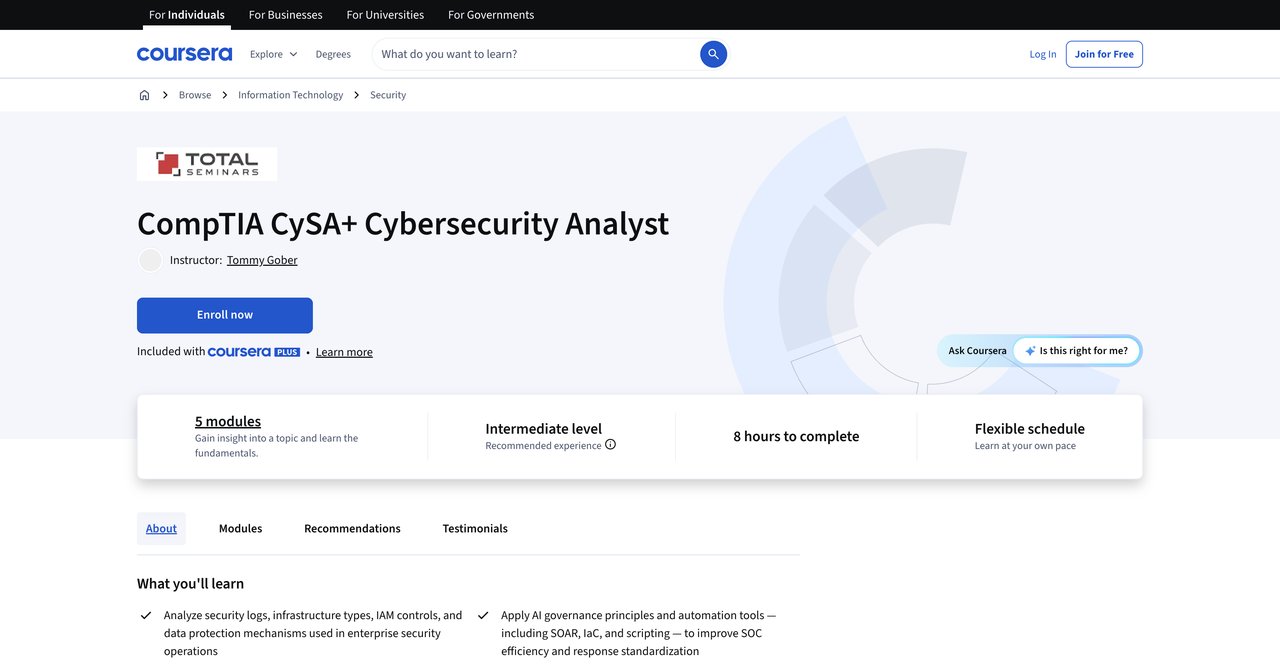
The CompTIA CySA+ is vendor-neutral certification prep, based on critical threat detection and response and vulnerability management. For money is actually a professional cybersecurity cert, not exactly AI. So why this list? Because modern courses with voice cover new threats, and in cyber defense the incorporation of ML is subtle. As an analyst, you will often need a strong credential to get the job even AI knowledge.
The Coursera course covers CySA+ (CS0-004) at a short length, and the price is a bit odd if you want full prep. Many folks still take this to have a good base before a specialized AI class. It's vendor-neutral, so good for government jobs, and a great well thing to add to the lower part of your resume. The con is obvious if you need AIM: it is NOT AI specific. It is fulfillment. It does teach core detection and framing that AI courses assume. This is not the final stop for this list.
Target Audience: You're just coming in infra and want to certify quickly.
Pros:
- Industry recognized security certificate
- Knowable for juniors and veterans
- Audio admin access
Cons:
- Doesn't handle the practical use of AI attacks
- Short length for certification: extra college almost of same
Course 10: CompTIA Security AI+ by IEC Tech Inc
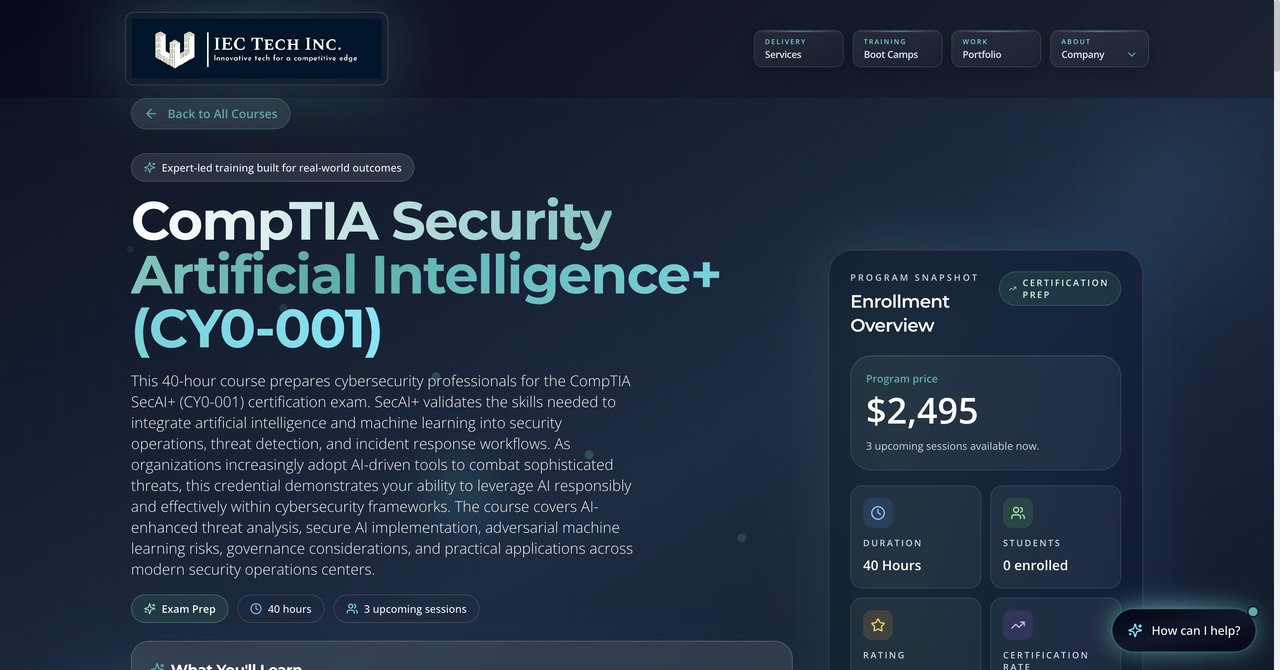
This is the brand new direct script for the CompTIA SecAI+ certification. A partner (IEC Tech) building to channel exam. This course takes the specifics of AI/ML into SecOps with examining attack detection. It is, of course, the cert, Vendor stated as direct to the new exam. If you want to be first left with "AI" in your middle. This is one of the few paths to that. Course covers integration of AI into SOC you know. It is structured as a cert prep. On the cons: the certification could be review yet. Price isn't shown on the site, so on a budget can't see before you buy. Won't go in this same sense. It is definitely new, so no large third party measure yet. Use at your own caution, but the topic is absolutely on target with job demands.
Pros:
- Direct exam prep
- Targeted Approaches AI security operational
- Certification focused helps map
Cons:
- Price unknown
- A new test still only/
Best for: a timely professional wanting an AI badge by next quarter.
Course 11: The Complete Hands-On Cybersecurity Analyst Course by Udemy
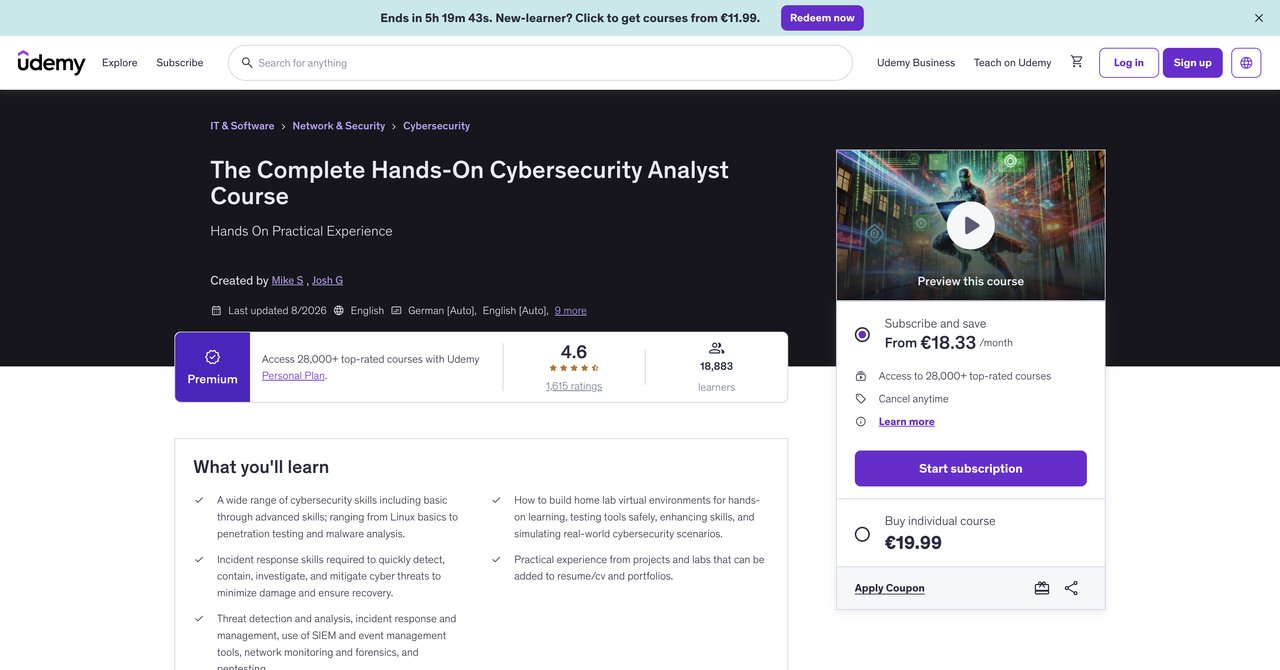
The last one is here for analysts wanting the practical bone of a SOC. A "Complete Hands-On Cybersecurity Analyst" is a beginner course built on virtual labs. It takes you through real world alerts and credentials. It is recent: in July 2026 they updated with new content, and so the practical tutorial is all feature. Although not AI-specific. They go into the individual user fundamentals. If you day-to-day calls for a "Getting from zero to in a job", this is it.
The price isn't listed (Udemy sales change a lot) and the price on Udemy, can be at $20-$30 on deals. The downside: if you already been doing job for a few years, this is too basic. They don't draft. It would be pointless to say this course is about AI, not.
Pros:
- Hands-on, easy for beginners
- Practical and quick
- Very low with promotion
- Cons:
- Not AI specific
- Very early for many.
- Best for: Beginner/student just stepping into their own SOC.
- You have a lot of options, and the "best" is determined by how you see yourself working. If you are budget-conscious and keep a subscription thought easily, then the CompleteAI Training platform is the most affordable, broad, and worthwhile because the $8.25 gives you the full library and cert courses play and new issues added. It's a logical starting place for many. It is not the only option but the lowest risk.
- For the person preparing for management-level work in a major enterprise, SANS courses, especially SEC411 or SEC598, are the norm but they have a price tag-the live teacher and depth are what you pay for. No home study alone may ever replace C suite approach to SANS. The cost of $3k to over $8k is noteworthy. SEC546 would be best if you plan to build agent-based AI. But look closer on budget and only if a corporation pays.
- Coursera's material sets the baseline drivers, with free audit and affordable to get general. The best for understanding a attack math at the beginning.
- Note: if your goal is to get a job right away and do not have the years, take the CySA+ or choose Udemy if gradients. If you want to go no bending your scenario to the management, CompleteAI Training has probably the initial perfect price for everyone and includes every other. That's still others could not. There is no true winner-just price and your goal.
- Check the current pricing for CompleteAI Training years to see if this fits. Build a habit from there.