
Blog ·
10 AI Courses for Systems Analysts that You Should Know About in 2026
Stay ahead in 2026 with the top 10 AI courses tailored for systems analysts. Boost your skills in machine learning, automation, and data analytics to design smarter systems, streamline workflows, and drive strategic innovation. Your career upgrade starts here.
 Jeroen Erne
Artificial intelligence is no longer a distant concept or a buzzword confined to research labs. It's embedded in the tools you use daily, the software your company deploys, and the strategic decisions made in boardrooms. For Systems Analysts, this shift isn't just interesting-it's a direct call to action. The role of analyzing, designing, and improving information systems is being transformed by AI's ability to process data, identify patterns, and automate complex workflows. Professionals who adapt will find themselves in higher demand, while those who don't risk being left behind as their responsibilities are gradually automated or reassigned.
Consider the current landscape: a significant portion of businesses have already integrated AI into their operations, with studies showing that over 69% of companies are using AI in some capacity, and that number only continues to climb. This isn't about replacing the Systems Analyst entirely; it's about augmenting their capabilities. The question isn't whether you should learn AI, but rather how quickly you can gain the skills to remain relevant and effective in your position. The market is looking for professionals who can bridge the gap between technical AI capabilities and practical business needs-and that's precisely where a skilled Systems Analyst can thrive.
Why AI matters for Systems Analysts today
The fundamentals of your job-understanding requirements, mapping processes, and ensuring systems align with business goals-remain essential. However, the tools and methodologies you use to accomplish these tasks are changing fast. AI can now assist with gap analysis, predict system failures before they happen, and even suggest optimal solutions based on historical data. Ignoring these capabilities means you're working with one hand tied behind your back, competing against peers who leverage AI to deliver faster and more accurate results.
This article is designed to help you cut through the noise. With countless courses available online, it's tough to know which ones are worth your time and money. We've identified and compared 10 AI courses specifically relevant to Systems Analysts professionals, ranging from foundational literacy to advanced generative AI applications. Whether you're just starting out or looking to specialize, this comparison will give you a clear picture of what each program offers, helping you choose the right path for your career growth.
The Growing Role of AI in Systems Analysts
AI is actively reshaping the day-to-day tasks of Systems Analysts in several concrete ways:
- Automation of routine analysis: AI tools can now automatically scan system logs, user feedback, and performance metrics to identify bottlenecks or inefficiencies that would take a human hours to uncover manually.
- Enhanced decision-making: With predictive analytics, you can forecast the impact of system changes before implementation, allowing for data-driven recommendations rather than relying on intuition alone.
- Intelligent documentation: Generative AI can draft requirement documents, create process flow diagrams, and summarize stakeholder meetings, freeing up your time for more complex problem-solving.
- Personalized system design: AI helps you analyze user behavior patterns, enabling you to design systems that adapt to individual user needs rather than taking a one-size-fits-all approach.
- Improved testing and validation: Machine learning algorithms can generate test cases, simulate edge scenarios, and validate system behavior, ensuring higher quality outcomes.
These applications aren't hypothetical. They're being implemented in organizations right now. As a Systems Analyst, understanding how to work alongside these tools-and knowing when to apply them-is becoming a core competency. The role is shifting from purely technical documentation to strategic advisory, and AI is the catalyst for that change.
Benefits of becoming an AI expert in Systems Analysts
Investing in AI education offers tangible returns for your career. First, there's the salary factor. Professionals with AI skills typically command higher compensation, as organizations recognize the added value they bring. Second, job security improves when you're equipped to handle the evolving demands of the field. You become the person who can guide your team through digital transformation initiatives rather than being the one who needs guidance.
Beyond the financial and security aspects, there's the intellectual satisfaction of solving problems more effectively. You'll be able to tackle complex system issues with a broader toolkit, propose innovative solutions that actually work, and gain the confidence that comes from mastering a field that's central to modern business operations. Moreover, becoming proficient in AI opens doors to leadership roles, as you'll be better positioned to communicate technical possibilities to non-technical stakeholders and drive strategic direction.
One course worth noting in this space is CompleteAI Training, which stands out because it provides access to all courses and all certifications on the platform rather than limiting you to a single program. That kind of comprehensive access can be a smart investment if you're planning to explore multiple facets of AI without committing to separate purchases for each one.
As you read through the course options below, think about your current skill level, your career aspirations, and the specific areas of AI that interest you most. The right course will not only teach you theory but also give you practical, hands-on experience that you can apply immediately in your work. Take your time, compare the options, and choose the path that aligns with your professional goals.
Comparison: All AI Courses for Systems Analysts (Updated 2026)
| Course Name | Provider | Price | Key Topics | Pros | Cons | Best For |
|---|---|---|---|---|---|---|
| CompleteAI Training | CompleteAI | Premium (one subscription covers everything - all courses and all certifications on the platform, not a single course) | Comprehensive AI curriculum for Systems Analysts; hands-on projects; expert instruction; full access to every course and every certification on the platform, including material for all job roles | Comprehensive curriculum; hands-on projects; expert instructors; one flat price unlocks ALL courses and ALL certifications - no pay-per-course limits; new content added continuously | Premium pricing; subscription-based (but crucial for continuous learning as AI evolves) | Systems Analysts professionals looking for complete, all-in-one training that goes beyond a single course |
| AI for Systems Analysts (Video Courses + Certifications) | Complete AI Training | $29/month (monthly) or $8.25/month billed annually - one subscription covers every course and every certification on the platform | Full access to every video course and every certification across all job roles, not just systems analysis; new courses and certifications added continuously | Full access to ALL video courses and ALL certifications at no extra cost; includes material for other job roles too; flat subscription price; daily updates on AI tools and news; highest rating/most complete offering | Subscription-based, continuous learning required as AI develops | General learners who want everything on one platform, especially those whose work crosses multiple functions |
| Generative AI for IT Systems Analysts and Architects Specialization | Coursera (IBM) | $49/month (subscription) | Prompt engineering for requirements gathering, BPMN diagram generation, integration with Jira, Confluence, Miro, Power BI; AI-powered documentation; stakeholder-specific deliverables | Purpose-built by IBM for systems analysts; hands-on prompt engineering; exact workflow from messy inputs to clear requirements and architecture diagrams; integrates with common analyst tools | Requires active subscription; some overlap with general GenAI basics | General learners / systems analysts who use IBM-style workflows or need to document requirements |
| AI for Business Analysts: Automate, Analyze, Deliver | Udemy | $19.99,$49.99 | 40+ templates for requirements, processes, user stories; AI-driven problem analysis; requirement generation; hands-on practical exercises | Ready-to-use templates; practical and hands-on; low cost; covers AI-driven problem analysis | Focus is broad business analysis, not deep systems architecture; no formal certification | General learners / business analysts looking for a low-cost practical introduction |
| TMY-AISA: AI for System Analysts | Trainocate Malaysia | $750 USD | AI for requirements elicitation, functional/non-functional specs, system modelling, impact analysis; hands-on with ChatGPT, Gemini, Copilot, Perplexity, Grok, Claude, Manus, DeepSeek, Qwen, NotebookLM | Specifically designed for system analysis; no programming required; covers the full analysis workflow; HRDC claimable in Malaysia | Instructor-led, availability 'upon request'; regional pricing and delivery; may not suit global learners | General learners / systems analysts who want structured instructor-led training |
| AI-Accelerated Business Analysis | Maven (Angela Wick) | $500,$900 | AI-accelerated requirements, process analysis, stakeholder collaboration; practical exercises and templates | Live instructor-led bootcamp; taught by a well-known BA thought leader; includes exercises and templates | Fixed live dates (not self-paced); price not publicly listed | General learners / business analysts who prefer live, interactive learning |
| AI Literacy for Business Analysts | Maven (Angela Wick) | Not publicly listed (typically $500,$900) | AI fluency and literacy; using, analyzing, and recommending AI; practical frameworks for AI adoption | Focuses on AI fluency for evaluating AI solutions; practical frameworks; ideal for analysts who need to recommend AI | Less hands-on than the AI-Accelerated course; live schedule may be limited | General learners / analysts who need to assess and recommend AI tools |
| AI For Data Analysts | Coursera | Free to audit; certificate via subscription (Coursera Plus $59/month) | AI for uncovering insights faster; improving reporting accuracy; practical AI for analysts workflows | Designed for analysts, not just data scientists; practical applications in analytics workflows | More data-analysis focused than systems analysis; may not cover requirements or architecture | General learners / data analysts looking to apply AI in analytics |
| Generative AI: Advancing Systems Analysis & Architecture | Coursera (IBM) | $49/month (subscription) | Producing structured deliverables like dashboards and executive briefs; integrating AI with Jira, Confluence, Miro, and Power BI; AI-powered process modelling and diagramming | Focus on structured deliverables; direct traceability; advances systems analysis with AI-powered process modelling | Requires prior completion of earlier courses in the specialization for full context; subscription needed | General learners / systems analysts who've done the earlier IBM courses |
| IT Systems Design and Analysis | Coursera | Free to audit; certificate via subscription ($49/month) | Data flow diagrams, entity-relationship diagrams, UML for visualizing data and workflows; hands-on diagramming exercises | Structured and practical; covers a core systems analysis diagrams | Not exclusively AI-focused; AI elements may be limited to specific modules | General learners / analysts who need core diagramming skills |
| Systems Thinking for AI & Automation | Coursera | Free to audit; certificate via subscription ($49/month) | Systems thinking applied to AI and automation; AI-assisted scripting; API integration; guided practice with GenAI | Covers systems thinking for AI/automation; includes scripting; guided practice | Broader systems thinking focus, not purely systems analysis; may require some technical background | General learners / analysts who want a broader systems perspective |
Understanding AI Training for Systems Analysts Professionals
Systems analysts occupy a critical position between business requirements and technical implementation. They translate vague stakeholder requests into clear specifications, design workflows, map data flows, and ensure that the final system actually solves the problem it was meant to solve. That job hasn't gotten simpler with the rise of generative AI - but the toolkit has changed dramatically. AI can now assist with requirements elicitation, generate diagrams from text, automate documentation, and speed up the analysis process considerably. The challenge for working professionals is figuring out which training actually delivers usable skills, and which courses just sound good on paper.
The market right now is packed with options. On one side you have massive platforms like Coursera and Udemy that host individual courses and specializations. On the other side you have newer players offering subscription-based access to entire libraries. You also have live bootcamps from well-known thought leaders that cost more but provide direct instructor interaction. The price range is staggering - from a subscription that costs less than a Netflix account to instructor-led courses that run $900. As a systems analyst, you need to think about what your actual goals are. Are you trying to get certified quickly? Do you want hands-on projects that align with specific tools like ChatGPT, Gemini, or Copilot? Are you planning to move into a broader role and need knowledge that spans across functions? Or are you looking for a structured program that leads to verifiable certificates?
The goal of this comparison is to lay out the relevant options clearly. We'll examine what each course actually covers, who it targets, what it costs, what the pros and cons are - and we'll wrap up with recommendations based on different career needs and learning budgets. Let's get into it.
Course 1: CompleteAI Training
Link: CompleteAI Training , AI for Systems Analysts
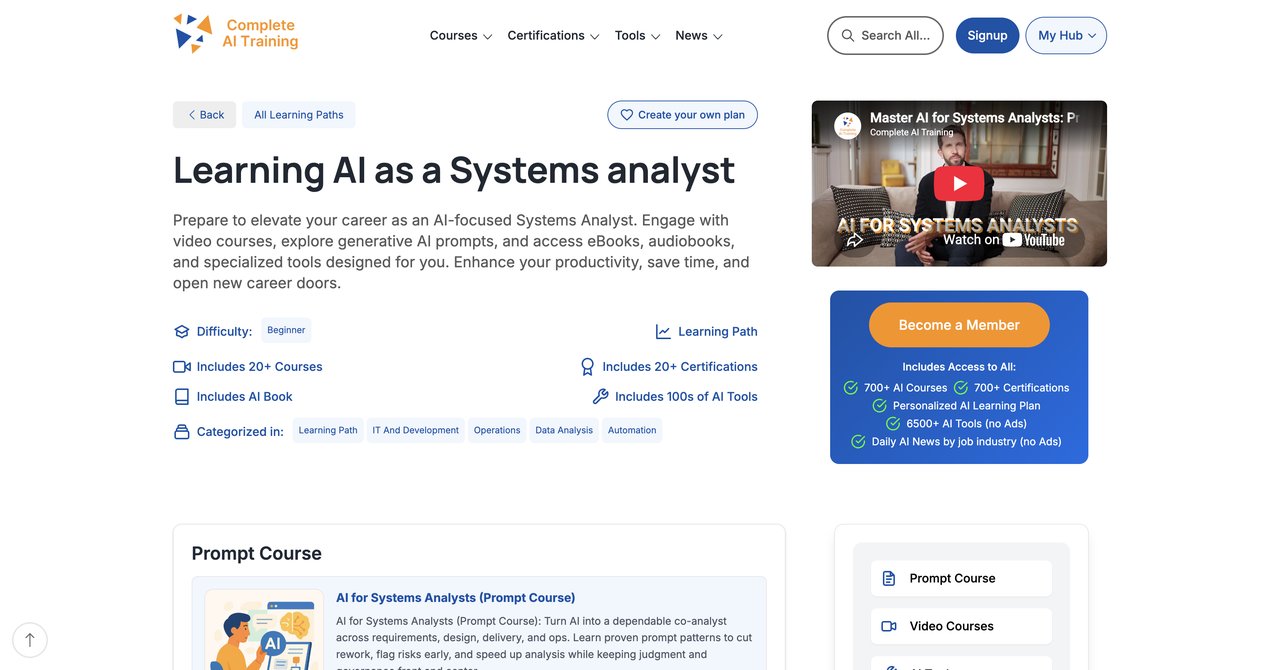
The most important thing to understand about CompleteAI Training is that this is not a single course. One subscription unlocks every course and every certification on the entire platform - hundreds of them, across every job role, not just for systems analysts. That's the foundational point many people miss when comparing it to other offerings. You're not signing up for one curriculum about AI for systems analysis. You're signing up for a library that covers everything from marketing and sales to engineering, leadership, and any other function you can think of. For a systems analyst, this means you have a resource that goes far beyond the narrow scope of your job. You can explore AI applications in project management, software development, data analysis, and management - all under the same subscription.
The platform gives you full access to all video courses, with no artificial limitations. You will not get a single course or a fixed bundle. You get complete, unlimited access across every job role. Along with video courses, your subscription includes all certifications available on the platform, and they're included at no extra cost. That's quite different from most platforms where you might pay for a course, then pay an additional fee to receive a certificate. CompleteAI Training handles it differently - the certificate is just part of the deal when you subscribe.
Another key point is the pace of content release. The world of AI is moving fast, so new courses and certifications are being added continuously - and these additions are included automatically in your subscription. You don't need to purchase upgrades or pay extra to access fresh material; it just appears in your account. For a systems analyst, this is significant because the tools you work with (like new prompt engineering techniques, new integration methods, and new AI features inside platforms like Jira and Confluence) change regularly. You don't want a course that you buy in 2025 becoming obsolete in six months. With this model, you're never stuck with outdated material.
The access to every other job role's material is worth emphasizing too. Systems analysts rarely work in a vacuum. You collaborate with business stakeholders, software teams, data analysts, and sometimes marketing and finance. If you want to understand how AI is impacting other areas of the business - or if you want to move roles eventually - you have the material to do that. This full-scope access is what differentiates CompleteAI Training from every other provider on this list. With other platforms, you buy one course at a time and pay separately for certificates. Here, everything is a flat subscription.
What's covered specifically for systems analysts? The platform offers training on AI for requirements elicitation, functional and non-functional specifications, system modelling, and impact analysis. You also learn about working with specific AI tools like ChatGPT, Claude, Gemini, and others - but the approach is different from many of the alternatives - it's designed for purpose. You're not just learning generic prompting; you're learning how to use AI in the context of systems analysis workflows. The subscription also includes daily updates on relevant AI tools and news, so you can stay current.
Key topics covered: AI for systems analysis workflows, AI requirements elicitation, functional and non-functional specifications, system modelling with AI, impact analysis, using top tools like ChatGPT, Gemini, Copilot, and Perplexity, plus access to hundreds of other courses on the platform.
Target audience and skill level: The course is built for systems analysts, business analysts, and IT professionals at any level. No programming skills required. The approach is practical and designed for professionals who need to apply AI immediately in their job role.
Pros:
- Full access to ALL video courses on the platform - not just a single course or fixed bundle
- Full access to ALL certifications included at no extra cost
- New courses and certifications are added continuously and included automatically
- Access to every other job role's material too, which matters for anyone whose work spans more than one function
- One flat subscription price covers everything - compare to paying per course elsewhere
- Highest rating / most complete offering available for this role
- Daily updates on relevant AI tools and news included
Cons:
- Subscription-based access rather than a one-time purchase
- If you only need one narrow topic once, a subscription might be more than needed
Who would benefit most: Systems analysts who want to gain a full picture - not just AI for systems analysis, but related topics like business analysis, data analytics, and AI architecture. The course is ideal for professionals who are not sure exactly where their future will lead. It covers enough in one subscription to support career growth without needing to buy separate courses on different platforms. Given the price - $29 monthly or $8.25 monthly billed annually - the value compared to a single $50-$900 course is hard to argue with.
Course 2: Generative AI for IT Systems Analysts and Architects Specialization by Coursera (IBM)
What it is : Coursera , Generative AI for IT Systems Analysts and Architects
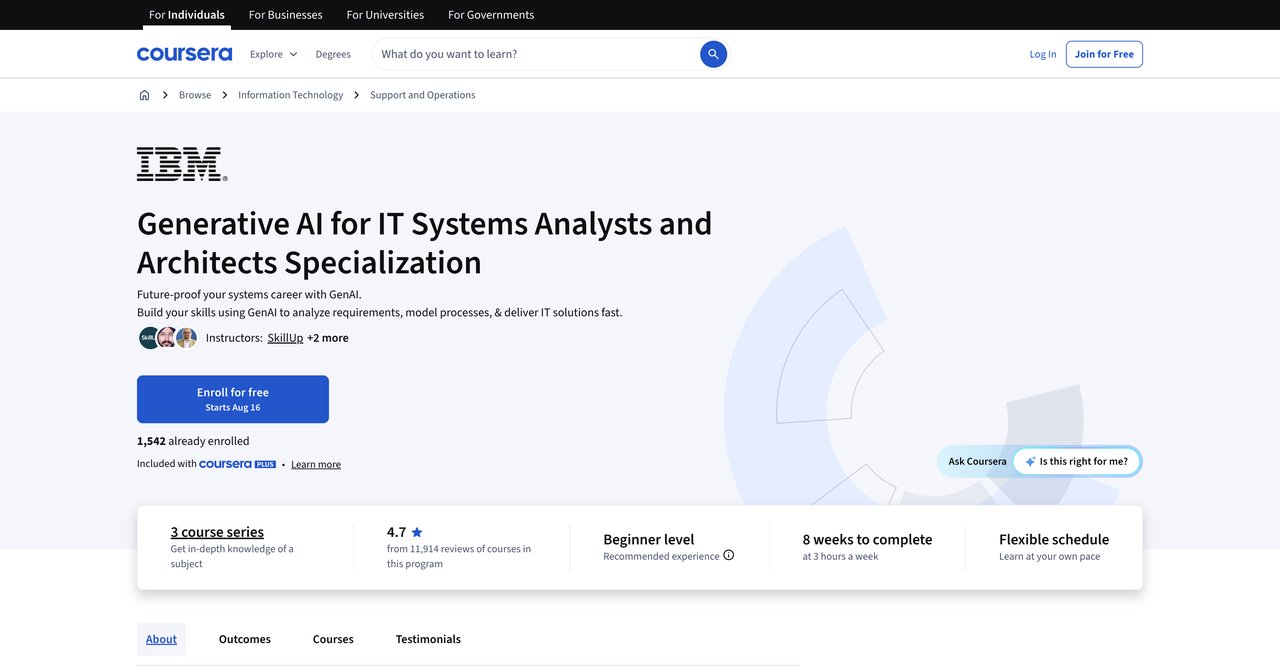
This is a specialization offered by IBM on the Coursera platform, and it's interesting to note just how purposefully it's designed for systems analysts specifically. When you look at the syllabus, you'll notice that it's not just a general course into generative AI. The courses is structured around the exact, real-world workflow of turning messy inputs into clear requirements and architecture diagrams. If you've ever had to take a conversation with a stakeholder that lasted an hour and produce a clean, detailed set of functional requirements for a developer, you'll understand immediately why this approach is valuable.
The focus on prompt engineering is heavily hands-on. The specialization includes extensive exercises around honing your prompting skills for requirements gathering - how to ask GenAI for exactly what you need, and how to refine the answers you get. It also covers the generation of BPMN diagrams (Business Process Model and Notation), which for a systems analyst is incredibly useful. The thought of manually drawing diagram after diagram can be eliminated - you'll learn to generate them using AI. But it doesn't stop with static diagrams. The course integrates with Jira, Confluence, Miro, and Power hours. That's a very practical set of tools that enterprise-level analysts usually work with on a daily basis. Your familiarity with these tools will move to the front of mind when you start applying what you've learned.
The deliverables are also stakeholder-specific. The course doesn't talk about AI in general terms. You'll get instruction on generating dashboards, executive summaries, and reports that are tailored to different audiences. For a systems analyst, that's helpful because you spend a lot of time translating between technical and non-technical. If you can get AI to help draft these documents, you'll have more time for more strategic work and to the specifically with stakeholders.
It's structured as a specialization, meaning you'll complete a series of courses, and the whole thing has a more of a programmatic feel. You won't just jump into the deep costs of prompt engineering right away - you start at the start and progress to a certain level. At the end of the course, you'll have a certificate from IBM, which carries brand recognition when you put it on your LinkedIn profile.
The cost is $49/month, which for a 2-3 month specialization can be comparable to other courses. You can also audit individual courses for free, but that means you won't get the certificate and you won't be able to complete graded assignments - realistically it's a subscription for the whole specialization. If IBM's approach on this topic appeals to you - and their coverage of the major AI tools in that kind of deep, hands-on way - it's a solid choice.
Key topics covered: Prompt engineering for requirements, BPMN diagramming, Jira integration, Confluence integration, Miro integration, Power BI integration, AI-powered documentation with dashboards, and stakeholder management.
Target audience and skill level requirements: This is for systems analysts, architects, and business analysts - people who need to build diagrams, documentation, and connect them with the tools in their existing workflows. It helps if you have knowledge of Jira, Confluence, Miro, and Power BI as given, but they're not necessary strictly required from the start. You'll also want a basic understanding of what AI is - not the technical details.
Pros:
- Purpose-built by IBM for systems analysts - it follows the exact workflow you need
- Hands-on prompt engineering for requirements gathering and BPMN diagramming for visualization
- Integrates GenAI with Jira, Confluence, Miro, and Power BI for daily use
- Stakeholder-specific deliverables - end of analysis documentation used for real communication
- Certificate from IBM adds authority
Cons:
- Requires active subscription to access all the courses - if you cancel, you lose access
- Some overlaps with general GenAI basics if you're already comfortable with generative design
Who would benefit most :
Systems analysts who work in environments that rely heavily on Jira and Confluence will see the value-plus, an existing workflows with Microsoft tools will get the most benefit. If you're using the atlas's typical toolchain, rather than maintaining your own personal workspace, then the practical integration is actually valuable. It's also a good course for someone who wants to master prompt engineering in a structured, unstuffy way.
Course 3: AI for Business Analysts: Automate, Analyze, Deliver by Udemy
What it is: Udemy , AI for Business Analysts: Automate, Analyze, Deliver
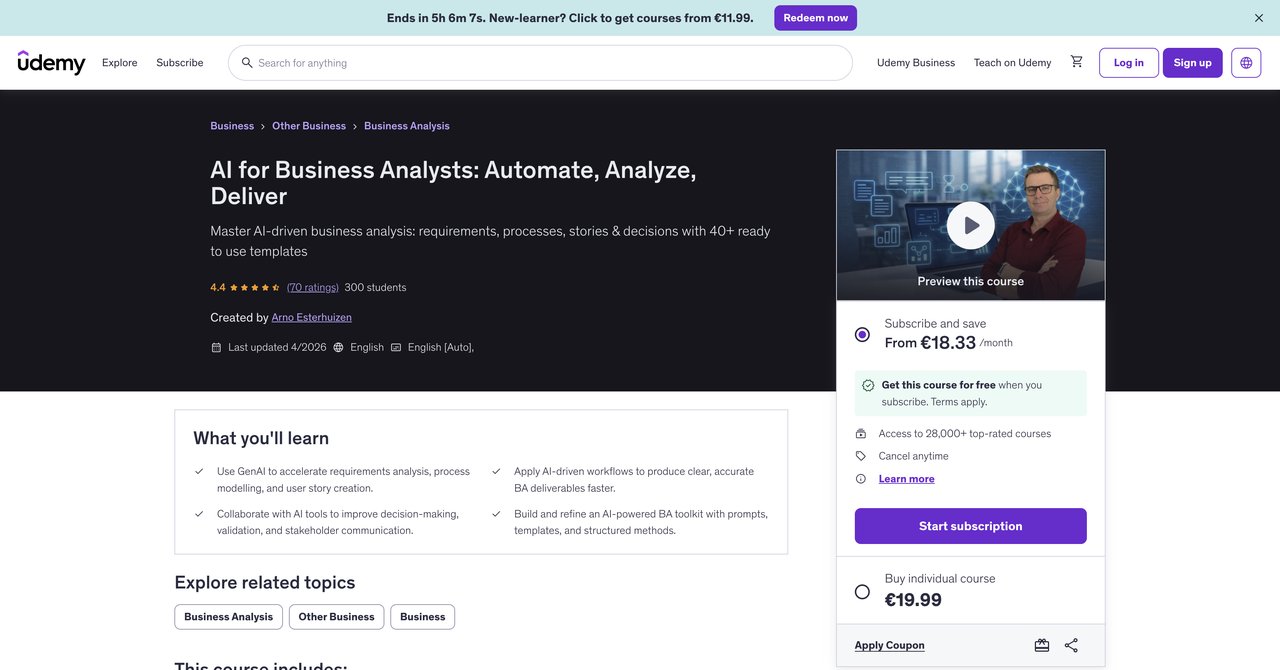
Udemy's AI for Business Analysts is a completely different kind of offering. It's not heavy on concept and theory - no lengthy academic introduction for a month. Instead, this one is about getting things done as quickly as possible. The core of the course is forty-plus ready-to-use templates for requirements, processes, and user stories. When you work as a systems or business analyst, templates can be some of the most useful assets you have. Instead of starting with a blank page and trying to recall the right structure for a requirements document, you have a starting point and you just ask AI to fill in the right prompts. According to the course, that's way faster than starting from scratch, and it's an approach that shows immediate results in a job role.
The course also covers reactive,AI-driven problem analysis and requirement generation. The goal is to create. You learn how to get outputs from AI that are not generic - that are specific to your current system's particularlys, your current system landscape, and the specific constraint of the project. The course emphasizes that as a professional, you have the context that AI doesn't have-you have the deep understanding of the existing architecture, the user base, the pressures on the project. This course is about how to give structure to trouble AI's understanding so the output actually - the reality of your work.
The price range is lower than most - anywhere from under $20 to $50 depending on Udemy's frequent sales. That's significantly cheaper than nearly every other option on this list. What you have to accept is the trade-off: it doesn't last long and is less in-depth than other options. The course is designed to help you get practical value from AI in your daily workflow - but it's not a one-time deep dive into complex analysis.
A key limitation is that it doesn't offer an official certification. You get a Udemy certificate of completion, but it's not as recognized as a credential with actual authority. The other issue is that it focuses on being a business analyst rather than systems analysis. The boundaries between the two are pretty blurry in many organizations, so you'll need to check if the content truly covers what you need to do or if it's CBD on the lighter side.
Key topics covered: AI-driven problem analysis, tool much - requirement generation, user stories, process mapping templates, practical AI use.
Target audience and job-level requirements: Business analysts, systems analysts, product owners, and others who need to write requirements or process. No programming required. It's perfect for beginners. Professionals who have used AI in education but want some structure / advanced templates will also find something here.
Pros:
- Very affordable, especially when on sales
- 40+ ready-to-use templates that are practical for tasks
- Covers AI-driven problem analysis and generating requirements
- Hands-on and practical - get something useful in the first hour
Cons:
- Focuses on business analysis broadly, not deep systems architecture
- No formal certification - only a certificate of completion from Udemy
Who would benefit most :
Systems analysts who are already a bit familiar with AI tools but want specific templates, structuring and prompting to do their job with more speed and structure. It's a high-value, low-cost option for those who want minimal theory and maximum actual work-a-day help. If you've worked with prompts on your own but want professional guidance into how to structure the output well, this is the candidate.
Course 4: TMY-AISA: AI for System Analysts by Trainocate Malaysia
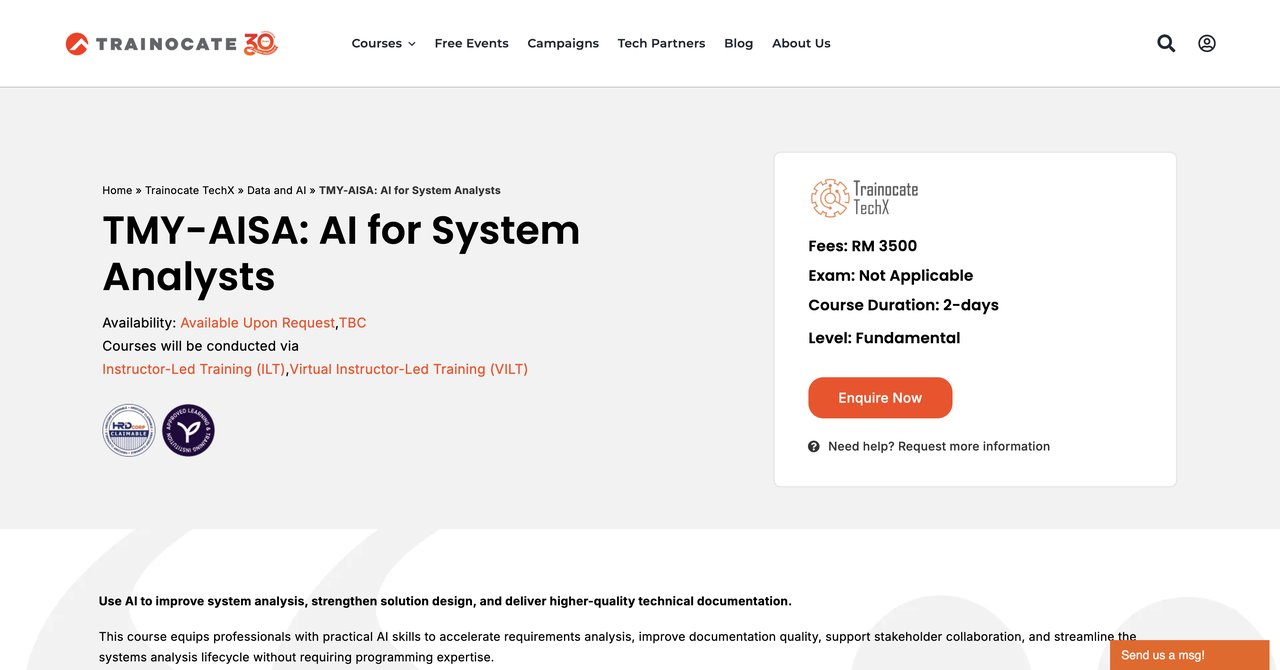
What it is: Trainocate , TMY-AISA: AI for System Analysts
This is a course coming out of Malaysia from the Trainocate training company, and it's worth paying attention to the price tag - $750 USD. That is the highest base cost of any course in this comparison so far. What you're paying for is an instructor-led experience - as in live, scheduled seminars, not just video series. The described course covers AI for requirements elicitation, functional and non-functional spec development, system modelling, and impact analysis. It also has a significant hands-on component that uses the more tools - exactly like threat of AI - but done in a training environment rather than a theoretical exploration.
A big benefit is that it's specifically designed for systems analysts, not business analysts. It's focused on the actual system analysis processes and workflows, and it doesn't assume programming skills. The course covers a wide range of tools like ChatGPT, Gemini, Copilot, Perplexity, Grok, Claude, Manus, DeepSeek, Qwen, NotebookLM. This deep set of tools is pretty modern and broad - the kind of practical training that is actually useful for someone who wants to know how to use these tools in practice.
On the positive side, this course has a good cadence. It's for a purpose of specific learning. On the, the availability is marked as "upon request," which means you can't just check a schedule and buy a course. You have to reach out, ask about, and then wait for when it runs. For overall learners who prefer picking up a course on a schedule, this can be a limitation.
The regional delivery is another thing to note. Being based in Malaysia, the course's instructors are likely on Malaysia time and the HRDC-what's called HRDC allowance-is part of build for Malaysian and regional professionals. If you're outside that region, the times of the course may not sync with your schedule - not for time zones, and you'll have to check if you can still attend remotely. The $750 price point is also up there - a significant investment that doesn't include certification. For that much money, you want to be sure the instructor-led approach is what you want.
Key topics covered: Requirements extraction, functional/non-functional specs, system modelling, impact analysis, hands-on with a wider array of AI tools and uses to learn them.
Target audience and skill level requirements: This is for systems analysts and business analysts who work on AI in a team setting who want instructor-led training. No programming skills required, but / but you should be prepared to work with your own case study examples. It works when you need to understand AI's role into your existing sysadmin practice.
Pros:
- Designed specifically for system analysts, covering AI-supported systems workflows
- Doesn't require programming skills
- Covers the requirements elicitation, specs, modelling and impact analysis
- Hands-on with multiple AI systems tools including ChatGPT, Gemini, Copilot, Perplexity, Grok, Claude, Manus, DeepSeek, Qwen, NotebookLM
- HRDC claimable in Malaysia
Cons:
- Instructor-led - there's no fixed schedule
- Regional pricing and delivery may not suit international learners
- No formal certification mentioned
- Advance purchase process that you have to wait for it to be available
Who would benefit most :
Systems analysts in Malaysia looking for a comprehensive, instructor-led bootcamp that is applicable and covered with local support. If you want live classes and don't mind paying for a specialized curriculum which is in no field, this is a good fit. For international team members, this is less ideal - you need scheduled time zones to allign.
Course 5: AI-Accelerated Business Analysis by Maven (Angela Wick)
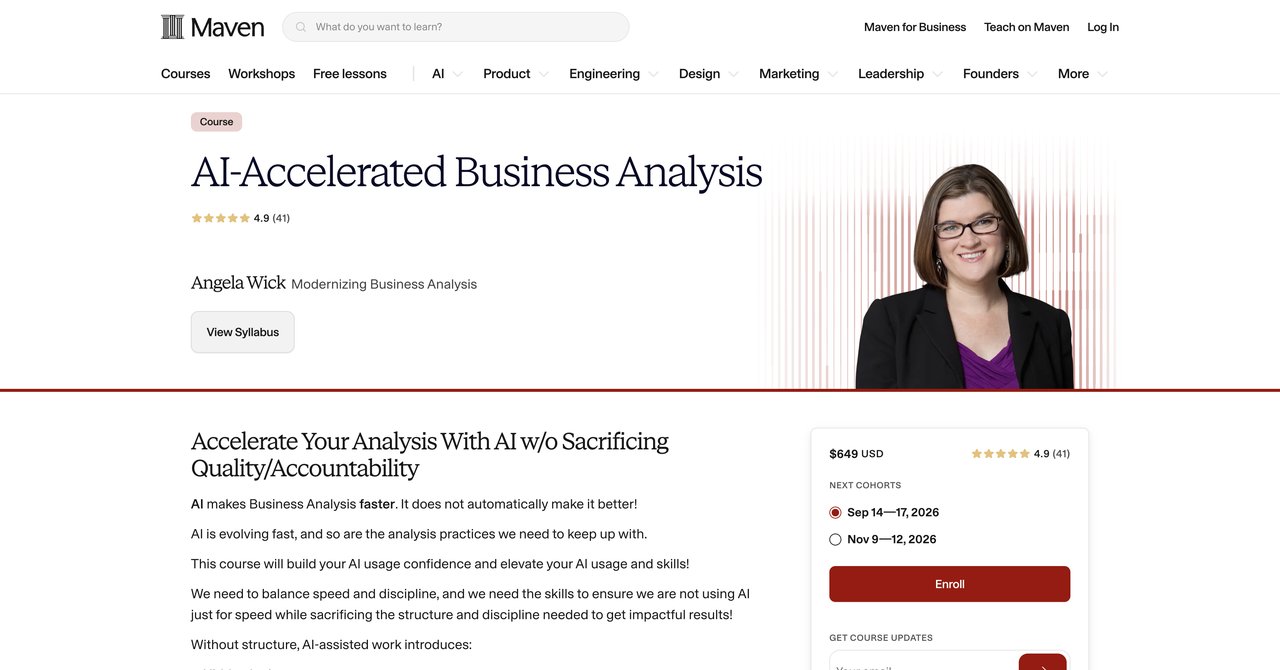
What it is: Maven , AI-Accelerated Business Analysis
If you're a systems analyst who follows people in the business analysis field, you will have heard of Angela Wick. She's a well-known thought leader in BA's space. This course is a live bootcamp from her on the Maven platform, focusing on AI-accelerated requirements, process analysis, and stakeholder collaboration. The trick behind this format is that you're learning in real-time from an experienced instructor - you can ask questions, get live feedback on your work, and check your understanding of the material. And that's pretty valuable if you like a structured, guided learning environment or if AI is really all brand new to you.
The course includes practical exercises and templates, echoing the philosophy that you learn to AI best by applying it to real problems. You'll be working on hands-on tasks, not just watching videos. This bootcamp style is more engaging for many people, as the formatting and the time limit push you to actually get through everything.
The cost is around $500-900 - about in the range you'd expect for a comprehensive live bootcamp. The main drawbacks are that it goes with live dates - it has a strict schedule - so you won't have the flexibility that a self-paced course gives. If your schedule changes or you get busy at work, you have to hange to keep up with the dates. Also, the price isn't publicly listed - you have to check the Maven site for a specific date and see what the price is for that cohort. That lack of transparency can be annoying if you're trying to compare options the budget.
Another aspect to consider is that this is a short, high-intensity experience. It's not like a subscription that provides ongoing access to courses. You get the bootcamp, it's done, and then you have to decide if you want another course later for another topic. If you like having access to continuing education, a single program might not fully meet your needs in the way a more spend subscription would.
Key topics covered: AI-accelerated requirements, AI analysis, process analysis, stakeholder collaboration, practical templates, and real-life exercises.
Target audience and skill level requirements: For business analysts and systems analysts who want to get a base understanding from a recognized industry figure. It's best for people who like to learn in real time. No prerequisites listed, but the materials seem to assume you't know the basics of the BA's role.
Pros:
- Led by a well-known and respected BA instructor, Angela Wick
- Live instructor-led format - immediate clarification and discussion
- Covers AI-accelerated requirements, proces, and stakeholder collaboration
- Practical - includes hands-on exercises and templates
Pros:
- Live classes are less flexible - you must match to a fixed schedule
- Price is on the higher end
- Price not publicly listed - need to finalize to check it
- It's a one-time bootcamp, not an ongoing subscription
Who would benefit most:
For individuals who attend conferences, meetups, and interactive sessions. Live, in-person and online workshops. If you value learning from an respected instructor and learn best when you can ask questions immediately, this is the format for you. For any large company where you can bring a group of analysts together on the bootcamp, it could be a good team-building and training. But if you want to move at your own pace at home, this may be an obstacle.
Course 6: AI Literacy for Business Analysts by Maven (Angela Wick)
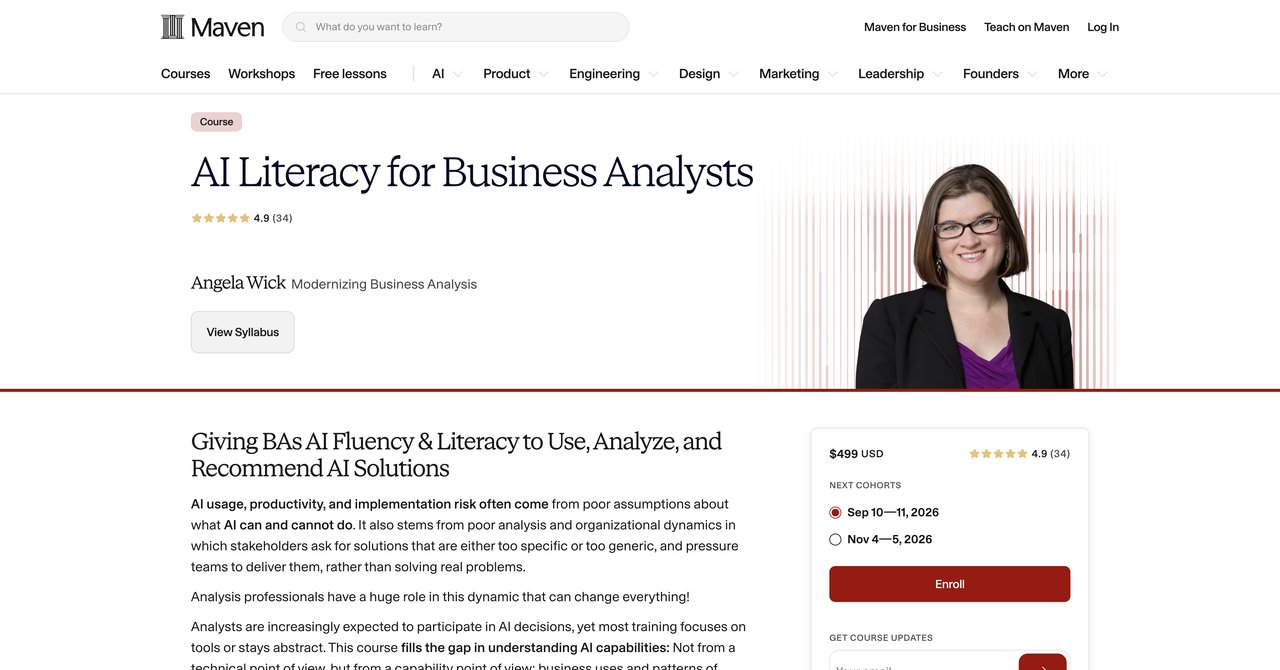
What it is: Maven , AI Literacy for Business Analysts
This is the second course from Angela Wick that's worth comparing with a systems analyst perspective. While the AI-Accelerated course is about hands-on application, this one adopts a different focus - AI literacy and fluency. It's constructed to teach you how to understand the fundamentals of AI systems and how to use, analyze, and really confidently recommend AI solutions. The value here isn't just in using AI tools you know, but in being able to determine when AI is the right answer, or even which AI approach fits a specific problem.
The distinction between "using AI" and "understanding AI" is more important than what you might initially expect. Systems analysts are often asked to think about solutions at a more strategic level - not just what a tool does, but what it should do. They need to understand the capabilities, plus the limitations of some AI-based system. This course provides frameworks for AI adoption - structured ways to think about how AI can be integrated into a company's operations.
That said, it's less hands-on than the other course from Wick-format. There's less of a template or prompt library, and more emphasis on concepts, assessment and strategy organization within that. For a systems analyst who's already confident in using ChatGPT on a daily basis, this course may be redundant. If you're still doubting how AI works for your particular domain, and specifically the architecture - this might fill a gap between talking about using AI and making an adoption recommendation at the organizational level.
The costs are more than that - like with their other cohort:
The pricing are similar around $500,900, but the issue again is that it has a specific date for the live sessions, so want to be available. The other problem is that it's less hands-on, so it doesn't give you that same feeling that you've mastered AI tools.
Key topic coverage: AI literacy and fluency, AI recommendation, practical frameworks for AI, handling AI as a subject (rather than just a tool), AI requirements, and evaluation - supporting decisions.
Target audience: Systems and business analysts who are asked to evaluate and recommend AI products, as well as those who help decision makers with - strategic AI decisions. Some hands-on experience is recommended.
Pros:
- Focuses on fluency and literacy in analyzing what AI can do
- Helps an analyst evaluate AI solutions before recommendation
- Provides practical frameworks for AI adoption
Cons:
- Less hands-on than tools and templates - less about the work with tools
- Live schedule may be limited - it's not on demand.
Who would benefit most:
If your work extends beyond creating systems to advising what systems to build - or how to implement AI into the business architecture at a larger scale - this course a thought-provoking fit. It's also good if you need to become literate in the AI space that you can chat confidently knowledgeably with C-level and technical stakeholders - but that's more about understanding, not using tools.
Course 7: AI For Data Analysts by Coursera
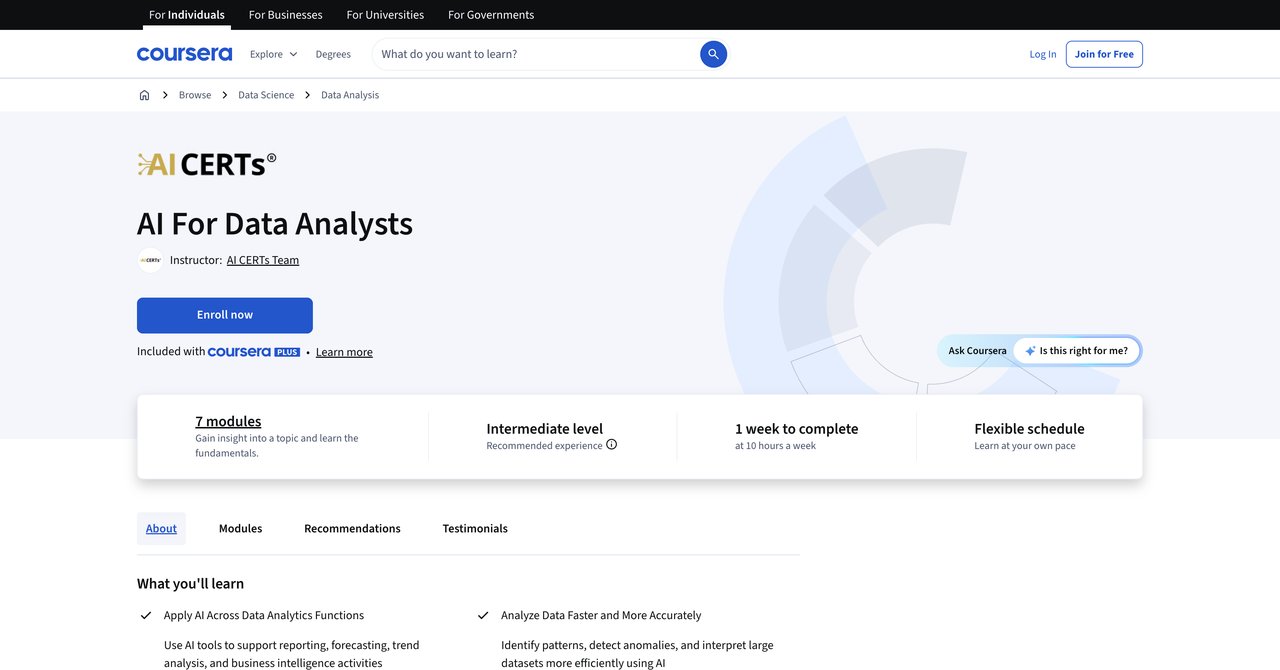
What it is: Coursera , AI For Data Analysts
This is a Coursera course that many systems & business analysts find useful because the role of data analysis has a lot of cross-over with systems analysis. The main goal of the course is to teach how to use AI to uncover insights faster and improve reporting accuracy. It's aimed at analysts-not just data scientists - so you don't have to have a deep math background or Python skills. The hands-on exercises within the course are designed to save you time in your current workflows, and it's nice and practical is nice.
Where it falls short for systems analysists in specific is that it doesn't cover that key area of the role: requirements, stakeholder management, and not system when. It's more about finding insights from data, data analysis, and reporting - so if the biggest portion of your job is really about the systems design, architecture, and requirements the course feels like a peripheral - not core to your development.
The great thing is that the cost is free if you audit - you can watch the videos, see what others are doing and absorb the concepts. The catch is that, to get the certificate, you need to usually pay for access to a subscription to get a certificate. That's a good grande for you to maybe try it before you commit financially to it as a specialized.
Key topics covered: AI for faster insights, data reporting and data analysis, AI-driven data workflows, integration of GenAI with productivity tools, faster time to insights.
Target audience: Analysts-systems, business, and business intelligence-who have to work with data. You'll need to know the basics of analytics, but not be a data scientist.
Pros:
- Free to audit
- Covers AI for faster insights and reporting
- Designed for analysts, not data scientists
- Practical from the get-go
Cons:
- More data-focused and does not cover systems architecture
- Not centered around requirements, architecture, or other analyst-specific workflows
Who benefits the least/most :
Analysts functions with a strong data emphasis - who wants reports, dashboards, and . Or you can take it as to complement your main training - it's a free starting point. It's one piece of a bigger training portfolio - but not a standalone business analyst training.
Course 8: Generative AI: Advancing Systems Analysis & Architecture by Coursera (IBM)
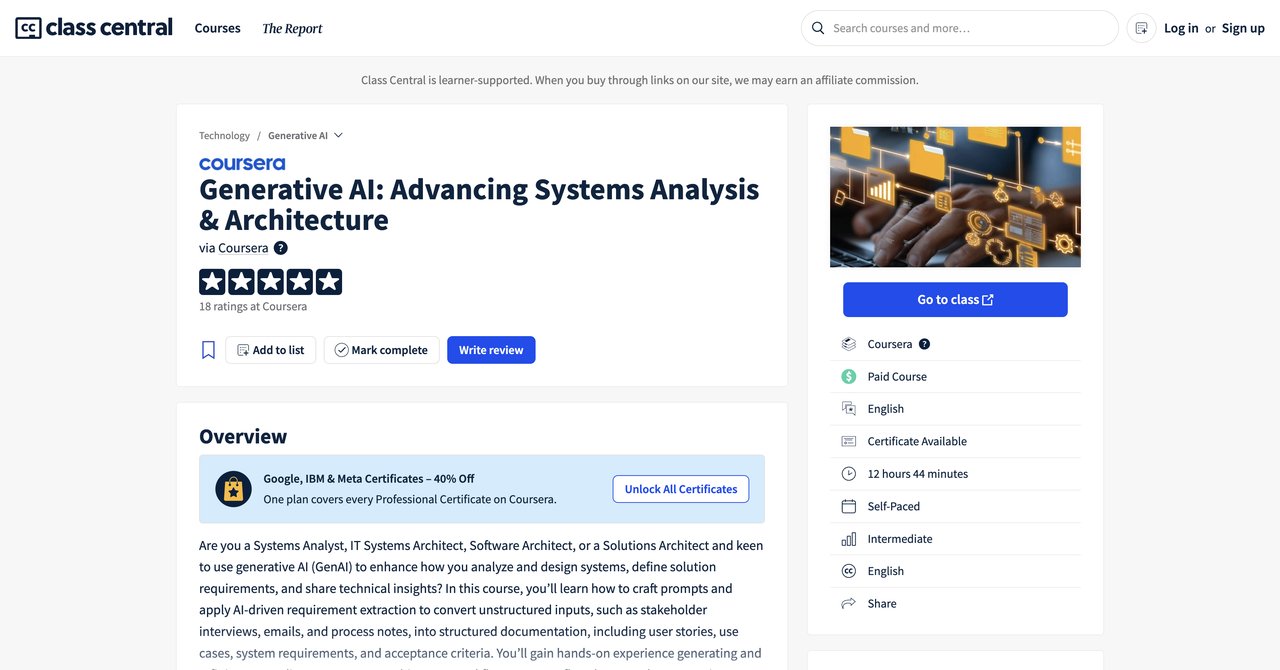
What it is: Coursera , Generative AI: Advancing Systems Analysis & Alignment
This is a continuation / second part of the work in IBM's on Coursera. It covers creating structured deliverables like dashboards and executive briefs. Same as first part, it's integrated with Jira, Confluence, Miro, and Power BI for traceability. The level of of systems analysis here is deep, because the focus is on producing tangible outputs - you're learning how to use AI to generate what you'd deliver to a client or internal stakeholder.
It's really a nice follow-up because it close the gap between the "simple" tools and stuff with organized analysis docs. If you have already taken the first course in this specialization - the one on AI for IT Systems Analysts - this one builds on that knowledge. It might not be ideal for a beginner. The prerequisites are clear: you need to have the bases done.
Price is a subscription cost - partial cost, ~$49/month - and you will need to take other courses in the sequence to have the full context. It's good if you're already a member of Coursera Plus and want to get access to IBM's content in one lump sum.
Pros:
- Integrates with standard project management software (Jira, Confluence, Miro, Power BI)
- Produces clear deliverables - something a systems analyst does on the daily
- Creates traceability, which is important for compliance and audit
- Builds advanced systems analysis skills - including diagramming and process modelling
Cons:
- Requires prerequisites - you can't jump in as a total beginner
- Subscription needed for access and certificate
Who benefits most:
It's for people already in a structured IBM specialization and who have completed the foundational course because the ability to do the advanced tasks is built nicely on the basics. If you want to have a fully accredited training from IBM without gaps, it's a strong next step after beg. If you don't have the prerequisite context, spend time for the first part.
Course 9: IT Systems Design and Analysis by Coursera
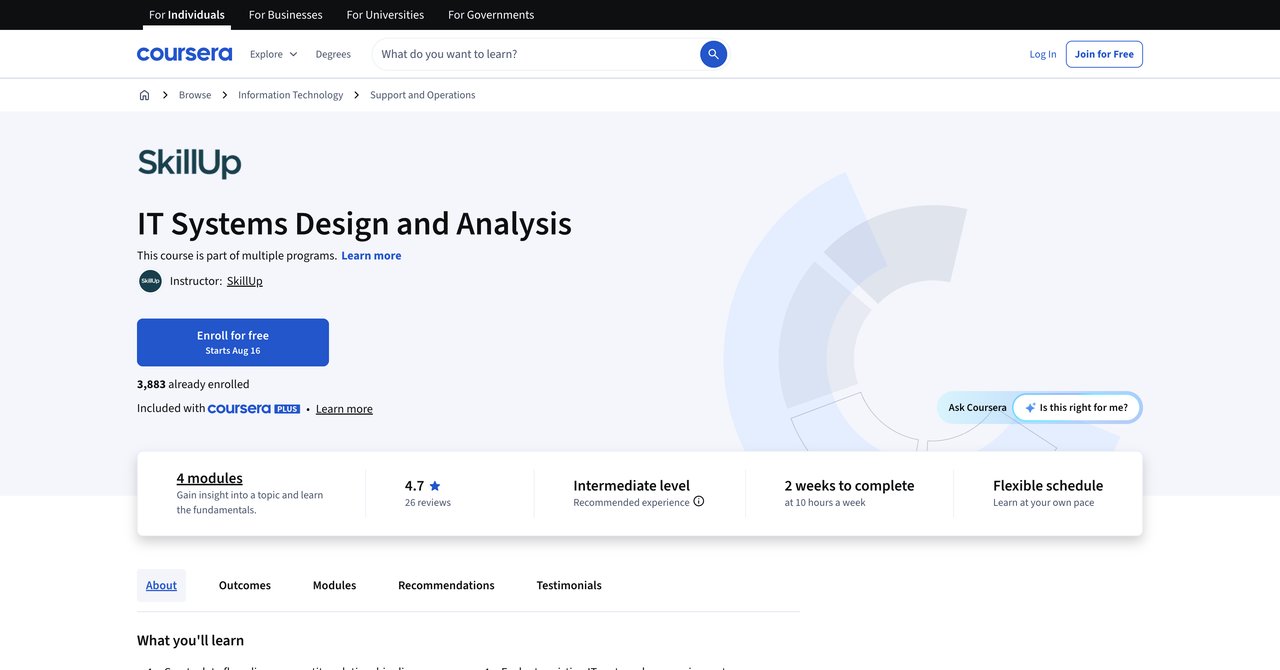
What it is: Coursera , IT Systems Design and Analysis
This one is different - a more traditional systems analysis course that covers diagrams and notations. The core of it are data flow diagrams, entity-relationship diagrams, and UML for visualizing data & workflow. It's a solid, focused dose on the fundamentals of diagramming that every systems analyst relies on. It has structured, hands-on practice.
But note that it's not only about AI. The course is fundamentally about systems design and analysis - and AI is not a major focus. There's maybe a module or two where AI is relevant, but the majority of it is the more traditional, manual process modeling and diagramming approaches. In other words, it's an asset for those who want to improve their base to structure, not their prompt engineering skills or familiarity with AI.
It's free to audit, and only $49/month if you want the certificate. That's a very low cost to access quality materials. It is must-have - with its technical diagrams - but it's not focused on the AI process. And if you're looking for ways to get - faster - to your end-to-end modeling, this isn't the "AI tool" course - this is where you DSL.
Key topics: Data flow diagrams, entity-relationship diagrams, UML, process, system design analysis, and modeling.
Target audience: Anyone needing foundational systems diagrams and design thinking. It's useful for novices and for purposes.
Pros:
- Covers core techniques that all analysts need - you'll understand it
- Structured and practical with exercises
- Free to audit
Cons:
- Not exclusively AI-focused
- AI content is minimal or absent - not a differentiator
Who benefits most:
Junior or junior-mid systems analysts who need the core foundational skills to do their job. Think of it like a comprehensive refresher. If you've been in analysis for a while, the basics of these might feel repetitive. But if you learned on the job without formal training, this fills important gaps.
Course 10: Systems Thinking for AI & Automation by Coursera
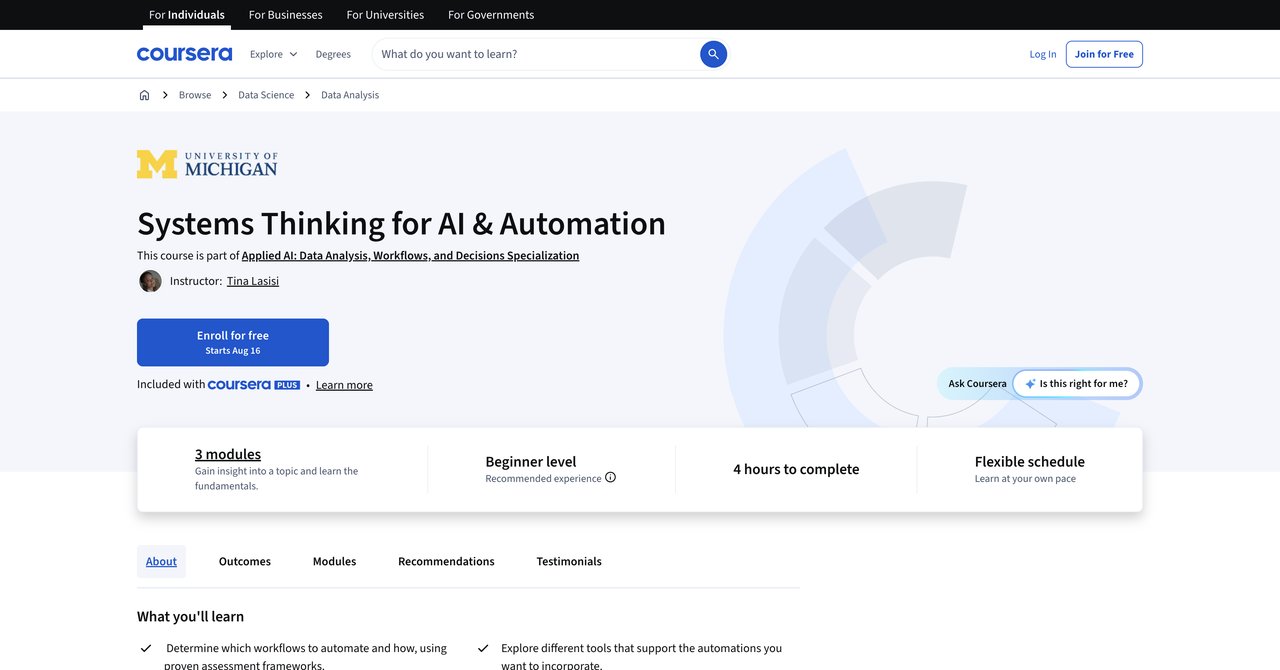
What it is: Coursera , Systems Thinking for AI & Automation
The last but not least, this course covers systems thinking applied to AI and automation. It includes AI-assisted scripting and API integration, plus practice with GenAI. The focus is on understanding the full context around an AI system - not just the AI, but the entire system it's part of - and that's incredibly relevant to an IA professional. You can't just implement an AI model in isolation; you need to see the system's properties, full dependencies, and how that all fits the whole architecture of environment.
But the target audience is more general: the course is about systems thinking, not exclusively systems analysis. It crosses into the work done by architects, engineers, and other specialists. Such a course. It might help if you're watching and thinking about AI systems with operations, but does not teach the typical analysis specifics for the IIBA course you might expect in other options. It can be considered an accessible complement to your main tools.
The subscription cost is $49/month to get a certificate, but free to audit. Worth a you understand the concept that you want to broaden your understanding of AI lot beyond basic tools.
Key topics covered: Systems thinking applied to AI, AI-assisted scripting, API integration, guided practice with AI, large-scale systems perspectives.
Target audience: Analysts, cybersecurity professionals, architects, engineers, and professionals who need a comprehensive systems thinking lens for AI/automation. Some sort of technical background is helpful for the scripting part.
Pros:
- Systems thinking applied to the AI - one of the major tasks out there
- Covers AI-assisted scripting and API integration for automation of tasks
- Guided practice-hands-on experience
Cons:
- Broader systems thinking focus, not on a single systems analysis workflow
- Requires some technical background in order to get the API parts
Who benefits most:
System analysts who are interested in the bigger picture and needing to understand AI's implications for system design beyond just diagramming. If you want to be a better future architect, you can't skip this.
Final Recommendations and Overall Summary
You have no shortage of options when building AI skills as a systems analyst. The the most important thing is to think about how you learn, what you need for the rest if your career, and how much you can invest. Here are the key scenarios:
If you want the most affordable and complete coverage: The CompleteAI Training subscription offers the most significant value when you compare singular to the buy per-course. The flat subscription price with all courses and all certificates to the whole platform means that you get not just the 'systems analyst' content but access to every other role function that is related. That is a very strong advantage - especially for analysts who understand that their skills future-proofing is something beyond a single course. The content also stays current, so you have less risk of using out-of-date AI techniques.
If you want a structured university or professional-specialization path from a recognized brand. The Coursera IBM specialization is a proven path that covers everything in an orderly way, with good power and credible certificate. You'll want to be comfortable with the $49/month subscription for a few months to finish it, and you must stay on track. It strongly emphasizes integration with Jira and Power BI, which many modern systems analyst departments will use. Take advantage of the free trial audit options and see if they give gives you.
If youike live interactive learning: The Angela Wick courses are excellent. You'll get a thought leader hosting live virtual workshops, and that direct feedback helps old-school learning. However, the schedule is fixed, the price isn't listed directly, and you could still have to book that time off from work. If you can. Worth checking for the types of live times that are offered locally.
If you want a great quick, low-investment starting place: The Udemy course is cheap and comfort. It emphasizes templates and cutting straight to the use of hands-on work. It's not deep and doesn't have a formal certificate. But at $20,$50, you can't really go wrong to get started. If decide you need deeper there are other options.
If you want to build deeper core classic skills: The systems architecture and diagramming course (Coursera) and the systems thinking course remain good references for foundational topics. But they're not all tied to AI-only. Same with AI Data Analysis course from Coursera - it's useful but breadth is different.
If you are outside SE Asia / in Malaysia. The Trainocate Malaysia course may fit you initiative - but if not, you'd want the regional price and limited availability is something that doesn't make sense to the rest.
At the end of the day, the best path for an individual analyst depends on their background and their objectives. AI is not a static discipline that you learn once; it's continuous. That's why always-over-time models of training - such as CompleteAI, Coursera subscriptions, or /ibm - are formats that naturally suit the topic. A one-and-done course for your systems job might be easy first, but there's a big difference from ongoing support, and eventually access to other skill improvement - likely to be more effective for your job in the long term.
So, the final takeaway. If you want to get a new skill instantly for the least amount of money, go with Udemy and start immediately. If you want brand name and structured learning with a recognized certificate, consider IBM's course on Coursera. If you want flexible, wide access to all courses, instructor wasn't, and to prepare for more than a single course down the line, a subscription to CompleteAI Training is solid. And if you're a standard learner that need face-to-face, the Maven bootcamp from Angela Wick is a thoughtful investment from a known expert.
Whatever you choose - start your training now and apply what you learn to your next requirement-gathering session with a system, with the assistance. That's how you build the muscle work.