
Blog ·
10 Best AI Courses for Chief Digital Officers (CDOs) to Future-Proof Your Career in 2026
Master AI strategy in 2026. Explore 10 curated courses for CDOs to lead digital transformation, design resilient roadmaps, and drive measurable innovation—without coding.
 Jeroen Erne
The role of the Chief Digital Officer has never been more demanding. AI is moving from experimental projects into core business operations, and senior digital leaders are expected to keep up. But here is the reality: most CDOs were trained before AI became a board-level priority. Skills that got you promoted a few years ago won't be enough for what comes next. Companies are invested in AI-driven transformation, and they look to their CDO to lead those efforts with confidence and judgment, not just enthusiasm.
Against this backdrop, professional development becomes an urgent decision. When you hold a senior title, learning is different. You don't need to become a machine learning engineer. You need to understand strategy, governance, and practical implementation, plus know enough technical detail to challenge your teams with informed questions. With hundreds of courses and certifications on the market, figuring out which ones actually fit that billing can become a project in itself. This article is meant to solve that challenge. We will compare 11 AI courses and programs aimed at Chief Digital Officers and senior AI leaders, looking at their focus, reputational weight, and what they actually offer. One of the included programs, CompleteAI Training - AI for Chief Digital Officers (CDOs), deserves a special note - in this case, you're not just getting access to one course. The platform gives you access to ALL its courses and ALL certifications, which changes the value calculation considerably.
Why AI matters for Chief Digital Officers (CDOs) today
The numbers make this clear. Surveys consistently report that around 69% of businesses are using AI in some capacity, and that percentage has grown steadily. But adoption is only the beginning. The challenge for digital leaders is that AI is no longer a side project managed by a small technical team. It touches customer experience, supply chains, marketing spend, human. If a CDO can't speak with confidence about AI, they're missing a central part of the transformation story they need to tell their board.
The purpose of this article is to give Chief Digital Officers a practical framework for choosing courses that matter. Whether you're looking for a rigorous certificate from a top university or a more flexible self-paced format, the options on the table cover different needs. Rather than expecting you to click through every school website and compare 100 different course descriptions, this piece filters down to what matters most for someone already operating at the executive level.
The Growing Role of AI in Chief Digital Officers (CDOs)
AI isn't just showing up in one corner of the business. Consider what actually happens when AI gets applied properly:
- Automation of operational workflows: Copying and manual process roles are being redefined, which shifts how digital teams are structured.
- Decision support: Smart leaders use AI to weigh scenarios and forecast outcomes; they don't rely on instinct alone.
- Personalization at scale: Customer expectations have centered around tailored experiences in the real estate industry, from service delivery to marketing messages.
- Data governance: AI makes data quality and ethical guardrails more urgent, since outputs are only as reliable as the inputs.
- Cost reductions: Optimizing operations with predictive models has a direct impact on budgets.
These applications transform how a CDO spends their week. More time goes into setting policies, asking better questions, and challenging assumptions. Less time goes into approving individual projects. That's a different job than it was five years ago, and a good course should speak to that reality.
Benefits of becoming an AI expert in Chief Digital Officers (CDOs)
For someone at the executive level, the payoff of getting certified in AI goes beyond skills on a resume. There's a credibility factor. When you've completed a rigorous program, you can stand before a skeptical engineering team and hold your ground. You also get better at spotting unsupported claims either from external vendors or from internal teams that push their own limited solutions.
There's also a practical career benefit. The market for digital leadership is crowded, but AI-literate executives are not. As difficult as it is to quantify exactly how much, the anecdotal picture is clear: organizations are willing to pay for leadership that reduces risk and captures value from AI. Better decision-making leads to fewer failed deliveries, more informed budgets, and more realistic timelines. Those are the achievements that matter to a board of directors.
A certification also builds a network. Many of these programs are designed for small cohorts of senior professionals. That means you're learning from faculty but also from your peers - people facing the same issues in different industries.
Finally, continuous learning in AI changes how you think about the future. Instead of reacting to reports, you can anticipate trends and build strategy around what's likely to happen next. That's the kind of leadership that makes a CDO and an effective executive in any future state. The courses reviewed below vary in style, price and time commitment, but every one of them is aimed at this audience. The next step is finding the right fit for your schedule and your ambitions.
Comparison: All AI Courses for Chief Digital Officers (CDOs) (Updated 2026)
| Course Name | Provider | Price | Key Topics | Pros | Cons | Best For |
|---|---|---|---|---|---|---|
| CompleteAI Training for Chief Digital Officers (CDOs) | CompleteAI | Premium (Subscription covers ALL courses and ALL certifications on the platform - not just one course) | Comprehensive AI curriculum covering strategy, implementation, hands-on projects, and role-specific applications for CDOs; includes full access to every course and certification on the platform, plus daily AI tool updates and curated news. One subscription covers everything. | Most comprehensive offering; hands-on projects; expert instructors; full platform access to ALL video courses and ALL certifications; new content added continuously; also includes material for every other job role, which helps with cross-functional work or career changes; very affordable for the scope, especially with annual billing | Premium pricing; subscription model - you keep learning as AI keeps moving | CDO professionals who want complete, in-depth training with full platform access and certifications |
| AI for Chief Digital Officers (CDOs) , Video Courses + Certifications (Subscription) | Complete AI Training | $29/month or $8.25/month (billed annually) - one subscription covers ALL video courses and ALL certifications, not a single course | Full access to ALL video courses and ALL certifications on the platform; daily AI tool updates; curated AI news for CDOs; new courses and certifications added automatically; includes material for every other job role too | Highest rating / most complete offering; very affordable, especially with annual billing; all certifications included at no extra cost; ideal for those who work across multiple functions | Subscription-based, so you need to keep up as the field develops | General learners and CDOs who want comprehensive, continuously updated content |
| Chief Digital Officer (CDO) Certificate | MIT Professional Education | $34,500 USD | 12-month blended program covering digital transformation, innovation, data leadership, agentic AI, and applied generative AI | Covers full digital transformation spectrum; includes cutting-edge AI modules; strong network and resources from MIT | Very premium price; requires a serious 12-month commitment | General learners - senior leaders wanting a top-tier credential |
| Chief AI Officer Program , Executive Education | University of Chicago Booth School of Business | $28,000 USD | AI adoption for C-suite; technical and organizational strategy; C-suite leadership and communication; scaling AI initiatives across the enterprise | Covers both technical and organizational side; strong focus on leadership communication; helps with scaling AI across the whole company | Very high price; application required; significant time commitment | General learners at C-suite level |
| Chief Data and AI Officer Programme | Imperial College London , Imperial Lifelong Learning | £9,000 GBP (approximately $11,150 USD) | 7-month program covering executive leadership, data strategy, enterprise data architecture, governance, and applied generative and agentic AI | Blends leadership with data/AI strategy; good depth on architecture and governance; practical gen AI and agentic AI coverage | Focus is narrower (data/AI, not broad digital strategy); a big time commitment | General learners focused on data and AI leadership |
| Chief Technology and AI Officer (AI-CTO) Program | University of Waterloo (WatSPEED) with upGrad | Not specified | 25-week program: strategic, financial, and organizational fluency; board-level communication; revenue, risk, and ROI; live interactive online sessions | Strong on speaking the language of the board; live interactive format; covers financial and organizational fluency | Focus is technology leadership rather than pure digital strategy; needs 4,6 hours per week | General learners in senior tech/leadership roles |
| Chief Data and AI Officer Program | University of Michigan Ross School of Business | Not specified | 5-month program: leadership influence in an AI-powered landscape; decision-making with precision and foresight; senior executive strategy | Built for senior executives; top-tier business school brand; focuses on leading with precision in AI landscape | Focus is narrower (data/AI so not broader digital); limited public details on curriculum | General learners at senior leadership level |
| Chief Information and Digital Officer (CIDO) Certificate | Carnegie Mellon University , Heinz College | Not specified | Preparing executives to lead modern digital enterprises; AI, data, and organizational transformation | Designed for digital leadership roles; strong focus on AI, data, and transformation; comes from a top-ranked tech school | Website doesn't list duration or price; limited public information | General learners interested in executive digital leadership |
| Chief AI Officer Program | Duke University , Fuqua School of Business | Not specified | Advanced program for C-suite and senior leaders: transformation simulations, governance workshops, applied capstone project, responsible AI at scale | Includes simulations, workshops, and a capstone; earn a Duke Executive Education certificate; strong on leading AI responsibly | Limited details on website; duration and price not listed | General learners in senior leadership |
| AI for Executives: AI for Business Decision Making | Coursera | Free | Quick (6 hours) non-technical course; building an executive AI roadmap with governance for better decision-making | Free and easy to access; non-technical; covers practical AI roadmap and governance | Very short duration; might be too basic if you already have AI knowledge | General learners who need a quick introduction |
| The Chief AI Officer's Handbook | Coursera (Packt) | Free | Strategic thinking combined with practical applications; how to integrate AI into business growth | Free; blends strategy with real-world application; helpful for business growth | Duration and specific content are unknown; likely more introductory | General learners new to the topic |
Understanding AI Training for Chief Digital Officers (CDOs) Professionals
The role of the Chief Digital Officer has become one of the most complex positions in modern business. You are responsible for digital transformation, technology strategy, data governance, and increasingly, artificial intelligence implementation. The challenge is that AI changes so quickly that traditional academic programs often lag behind what practitioners actually need. At the same time, the job demands more than just technical knowledge-you need commercial judgment, leadership skills, and the credibility to present AI initiatives to boards and investors.
This comparison looks at the main educational options available for CDOs and senior digital leaders who want to build or sharpen their AI expertise. Some are expensive executive education programs from well-known universities. Others are online platforms that offer more flexible, practical training. Prices range from free to over $34,000, and the time commitment ranges from a few hours to a full year.
Before you decide, consider what you actually need. Are you looking for legitimacy and a prestigious name to add to your LinkedIn profile? Or do you need the hands-on skills to make decisions about AI implementation tomorrow morning? Both are valid approaches, but they lead to very different choices. The right decision depends on your prior knowledge, the gaps in your current skills, the budget your employer is willing to commit, and how quickly you need to see results.
Course 1: CompleteAI Training - AI for Chief Digital Officers (CDOs)
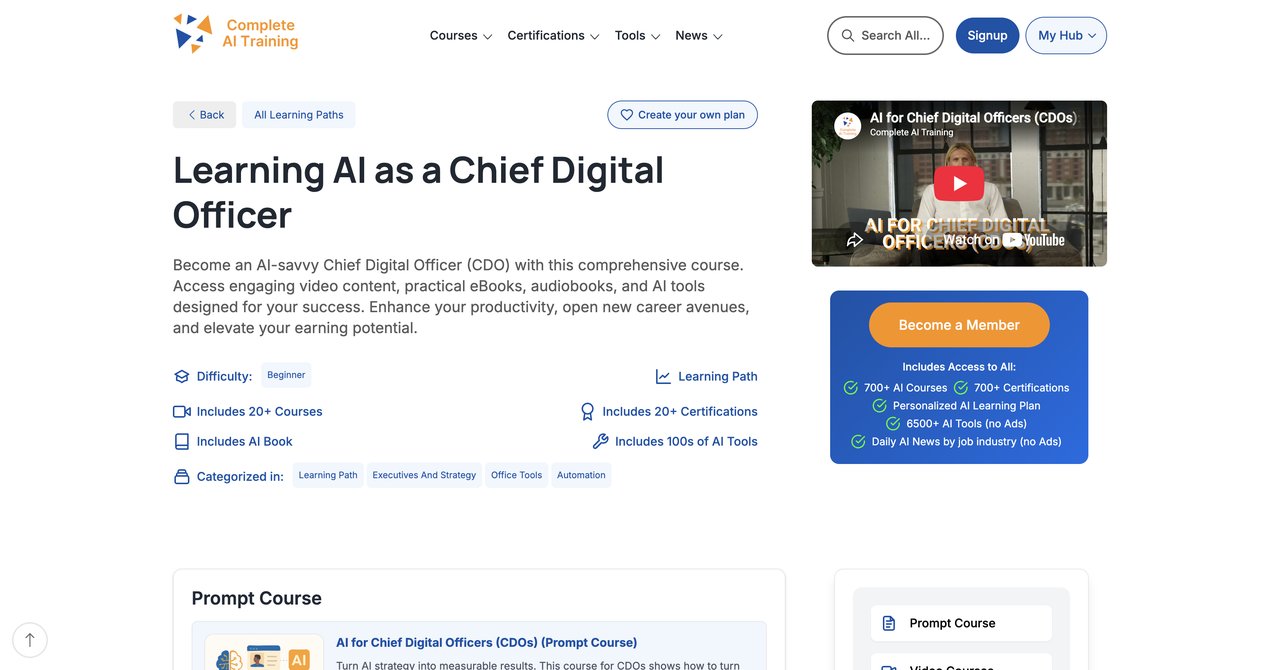
CompleteAI Training is not a standalone course. One subscription gives you access to every course and every certification that exists on their entire platform-hundreds of them, covering all job roles, not just the CDO track. That is their central differentiator against every other provider in this comparison. You are not buying a single, fixed curriculum with an extra charge for a certificate later. The flat subscription price covers everything on the platform, past, present, and future.
This matters more than you might think at first glance. For people in positions like yours, the effective scope of work constantly crosses over into related areas anyway. You may need a refresher on marketing analytics one month, then a deep-dive into data engineering fundamentals the next. With CompleteAI Training, you never have to pause and ask HR or finance to approve another training budget request to get the material you need. It is already included in the single price you already paid.
There is an immense practical advantage with this setup. Many executive job functions are overloaded with competing priorities. There is evolving generation of AI tools, legislation, and the need to plan around new technical developments. With access to everything, you can jump into whatever topic happens to hit the headlines that week without worrying about whether the syllabus covers it.
Subscriptions to CompleteAI Training cost $29 per month, which comes down to $8.25 per month if you prefer to pay a year up front. Compare this to the other options in this article, which cost several thousands dollars and, in one case, tens of thousands. That is a significant gap in price accessibility.
The platform is highly rated. Its teaching style is focused heavily on practical application-getting things done and knowing what works in a real business environment. You can move into the topics you need, at speed, without committing to a rigid timed coursework schedule.
Because new courses and certifications are added continuously, the subscription future-proofs itself. As new AI tools are released, learnings get updated and incorporated. Often the training providers don't just build the courses; they update them with the latest demonstration of what works in the field. If a CDO is concerned about the difference between static classroom learning and the reality of modern AI market, this flexibility matters.
Target audience: This is best suited for CDOs and other executives who need to stay current with AI skills but also appreciate flexibility in access. Also, it is good for practitioners whose current role involves several responsibilities outside of their core job title-and who want to maintain a broader skill set or have plans to move across different functions and roles in the future. It works for management, seasoned professionals, newbies, or those who want to switch. It's also good for staff members who need regular access to high-quality reference material over an extended period.
Key topics covered:
- AI essentials from the fundamental concepts to advanced applied practice.
- Generative AI, chatbots, AI agents, and prompt engineering applied to business scenarios.
- AI strategy in the specific context of digital transformation.
- Data literacy and the basics of Data Analytics for those who do not come from a deep technical background.
- Governance and ethics of AI in the enterprise.
- Regularly updated content on the latest AI tools (ChatGPT, Claude, Gemini etc.) and how to accelerate business with them.
Target audience and skill level: The level of material spans from beginner level to advanced. A CDO is likely to spend most time with the intermediate and advanced applied materials, but could rely on the beginner courses to bring other less experienced people in the organization up to speed if you choose to distribute access to your team. The subscription is designed to serve the entire organization, including those who are not directly in technical roles.
Pros:
- Highest rating / most complete offering for the price
- Extensive range of AI courses and certifications, specifically determined for CDOs
- Full access to ALL video courses on the platform, not just one course
- Full access to ALL certifications on the platform, included at no extra cost
- New courses and certifications are added all the time and are part of your subscription automatically
- Access to every other job role's material too, which matters for cross-functional work or for a career pivot
- Affordable pricing, especially with the annual billing option
Cons:
- This is an ongoing subscription, so it requires a continuous learning mindset as AI evolves
- It doesn't offer a "brand name" university label like MIT or Chicago Booth would give you
Who would benefit most from this course: The CDO or CDO or IT leader with strong experience who wants a cost-effective but wide, comprehensive AI education that grows with future developments. This type of learning is ideal for those who prefer self-directed learning, in short bursts, without waiting for a specific semester to begin. If your need is to get you and your team up to speed quickly without breaking the budget, this is potentially your best fit.
Course 2: Chief Digital Officer (CDO) Certificate by MIT Professional Education
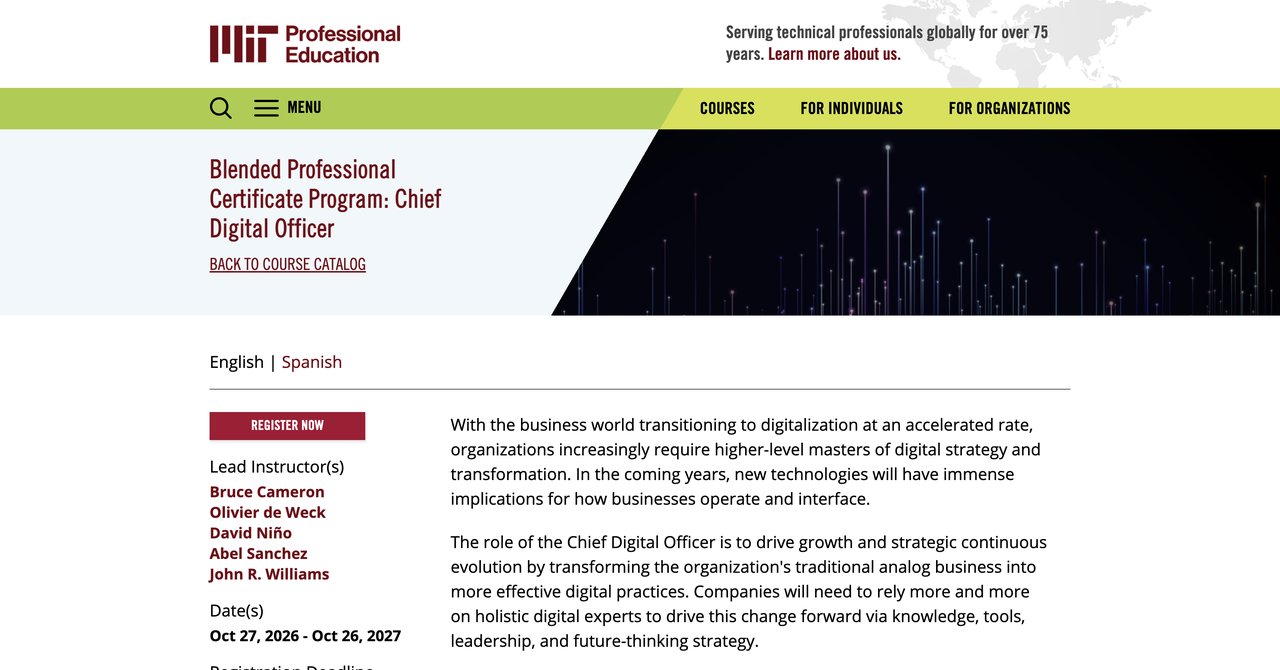
The MIT certificate program is a 12-month blended program that covers the whole spectrum of digital transformation, including innovation, data leadership, and digital strategy. They specifically included a module on agentic AI and applied generative AI, which is a good sign that they are updating curriculum to meet the current market. The program uses a blended format, so with some online elements and some in-person experiences. This is a significant time factor, but it is not just a series of videos they send you - it's truly an educational experience.
Click here to see the program details on the MIT Professional Education page.
MIT's network and resources are part of the selling point. Being able to interact with other senior leaders and the corporate network that MIT provides are positives for many execs. They also are using the latest knowledge from research labs, which is unusual among the programs. The tuition is premium at $34,500 USD, so this is an investment decision. The 12-month commitment is a serious planning issue for someone who already has a heavy workload.
Key topics covered:
- Digital business model innovation.
- Data leadership and the future of data.
- Agentic AI and applied generative AI for enterprises.
- Leading organizational change in the digital era.
- Data governance, cloud computing, and core tech strategy.
Target audience and skill level requirements: This program is for senior leaders already in a CDO role or C-suite executives who have direct responsibility for setting the digital roadmap in mid to large companies. It requires at least a moderate level of familiarity with business technology issues-newcomers can also succeed if they are strong on leadership, but the depth of discussion assumes a certain intimate understanding.
Pros:
- Covers full digital transformation spectrum, not just components.
- Includes modules on agentic AI and applied generative AI.
- Access to MIT's network and resources, which can be a lifecycle career asset.
Cons:
- High price point that requires strong executive sponsorship.
- Requires a significant time commitment over 12 months, which may be a stretch for many CDOs.
Who would benefit most: from executives who are at the top of the ladder, are expected to drive enterprise-level transformation, and want a mix of real alumni network and knowledge from MIT faculty. It's not for those looking for a fast/quick answer. But those who are basing their multi-year strategy would gain a strong credential.
Course 3: Chief AI Officer Program - Executive Education by The University of Chicago Booth School of Business
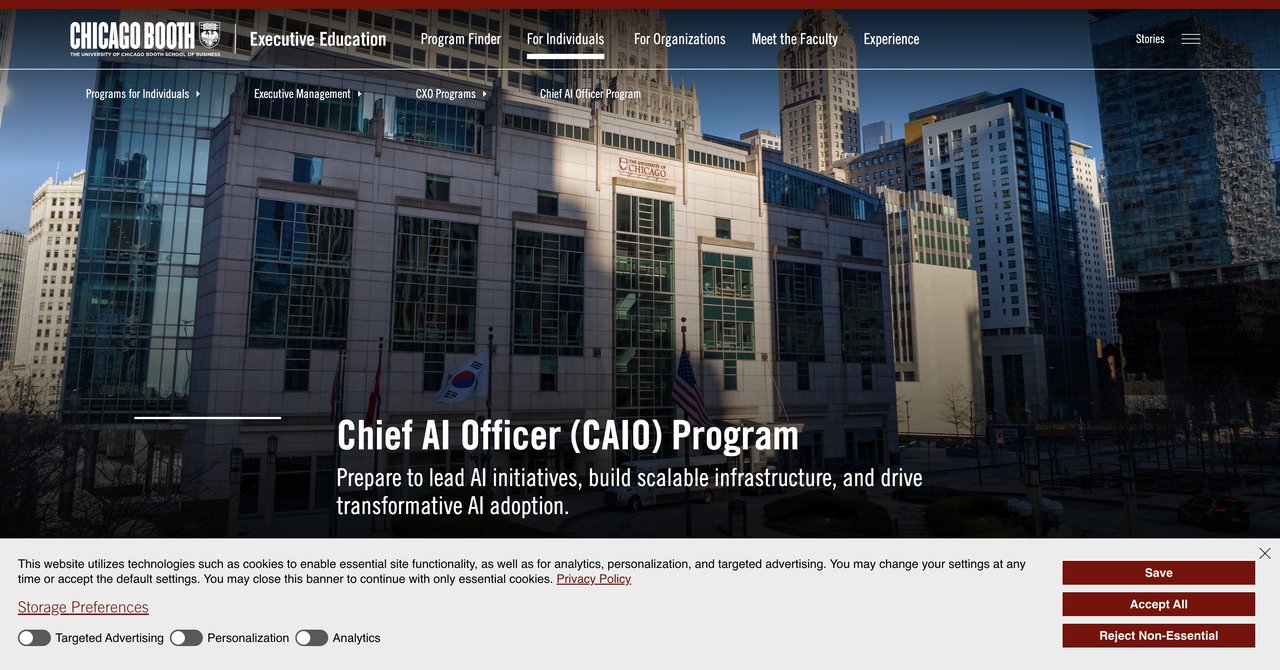
The Chicago Booth program approaches AI from a business management perspective rather than purely engineering. It teaches CDOs and other C-suite leaders not just on how AI works, but about what the organization needs to become to use it well. The course covers AI adoption from the perspectives of strategy and project management, but includes some content around change management and how to handle the human element. It also focuses on scaling AI initiatives across an enterprise, which is a huge pain point for many who have tried to get past the pilot stage.
Explore the University of Chicago Booth CAIO Program
It is an advanced program, not for beginners. It probably expects some degree of technical knowledge, but it is more about establishing the vision and culture. Since Chicago Booth is one of the top business schools in the U.S., you get access to their methods and business research. The cost is $28,000 USD, which positions it just under MIT, but still substantial. There is also an application and selection, which can take some time, and the price point will still need to be sponsored by organization.
Key topics covered:
- Technical strategy for adopting AI.
- Organizational strategy and change management.
- Architecture: what your business needs to look like to support it.
- C-suite leadership and communication: how to speak with peers, board, and peers.
- Scaling AI in existing business models.
Target audience and skill level requirements: Executives new to the AI space but responsible for AI, digital, or advanced business transformation. Also could be a good option for those who are moving from a digital role into an AI-focused role because it clearly examines the structural side.
Pros:
- Covers technical and organizational strategy in one program.
- Includes C-suite leadership and communication, which is often ignored.
- Focuses on scaling and delivering, not just piloting.
Cons:
- Very high price point.
- Requires an application and a significant, continuous time commitment (usually 1 week on campus plus follow up).
Who would benefit most: Those wanting a well-rounded, financially and organizationally anchored executive program for AI-specific, with brand name from US business school. Elevation to a position where the company is clear about AI as a revenue center more than a technology tab.
Course 4: Chief Data and AI Officer Programme by Imperial College London - Imperial Lifelong Learning
Running for seven months, this program from Imperial College London is focused on the intersection of data leadership and AI. It links executive education to traditional data responsibilities like architecture, operations, and governance, then adds in modern applied generative AI and agentic systems. It is perhaps the best fit for a CDO whose role is heavily weighted toward the data-intensive parts of the job, like information architecture and accountability for analytics.
See the Imperial College London programme details
The coursework emphasizes applied generative AI and agentic AI. There is a combination of live sessions and topics around data governance and architecture, so you aren't just playing with tools but aligning them with a normalized data store. The cost is £9,000 GBP (which is about $11,150 USD at this time). This is a more medium price point compared to U.S. top options but not exactly small.
Key topics covered:
- Enterprise data architecture and the integration of new AI tools.
- Data governance and principles, privacy, regulation.
- Applied generative AI and agentic systems in the enterprise.
- Executive leadership in data and AI strategies.
Target audience and skill level requirements: The ideal audience is a CDO whose organization is data-hungry, with a foundational understanding of data management and some technology practice. This is not really a general management structure. It is a program that gets very specific about data. A CDO in a strong data-heavy or regulated industry (like health, finance, government) will benefit.
Pros:
- Combines executive leadership with data and AI strategy specifically.
- Covers enterprise data architecture and governance-often forgotten in other programs.
- Includes applied generative and agentic AI with details.
Cons:
- Focuses on data and AI, not broader digital transformation (Marketing, customer digital)
- Requires significant time commitment over seven months.
Who would benefit most: Chief Data Officers or CDOs who have a core mandate for data governance and strategy and want an academic backing to support what they are already implementing in that arena. particularly if they want to be in a position with strong retention.
Course 5: Chief Technology and AI Officer (AI-CTO) Program by University of Waterloo (WatSPEED) with upGrad
This 25-week program reframes AI leadership with a large emphasis on the commercial and financial side of technology. They want you to be "boardroom fluent." The curriculum teaches you how to speak about revenue, risk, and ROI in a way that gets the financing support to move AI investments. Because it was built in partnership with upGrad, that has a strong platform, it also uses a mix of on-demand learning and live, interactive sessions.
See the program page for the University of Waterloo here.
The focus on weekly hours (4-6) makes it doable for a busy professional, though it still asks a weekly commitment. It's a step more about business than the machine learning algorithms themselves. This can help if you find yourself too much in technology and not enough in the commercial side. The issue is they don't list exact price, so it is not possible to compare directly without contacting them, and the focus is on CTO/CDO who is leading technology-driven strategy, not just transformation alone.
Key topics covered:
- Board-level communication, analyzing outcomes.
- Strategic, financial, and organizational fluency.
- Using financial modeling to prioritize AI opportunities.
- Live tools for managing innovation and AI risk in organization.
Target audience: This is for CDOs who are expected to be close to the technology (technology C-level) and who want to present business cases, get a budget, and report to the board. It is also useful for CTOs moving into a dual role.
Pros:
- Focus on board-level communication, rare.
- Covers strategic, financial, and organizational aspects deeply.
- Live interactive online sessions give direct feedback from instructors.
Cons:
- Focus very intensely on technology leadership, not general digital marketing or transformation.
- Requires a predictable weekly commitment of 4-6 hours for 25 weeks.
Who would benefit most: A CDO or CTO who is more confident in the actual technology, but knows they need a level up in communications, financial evaluation, and organizational politics. Good for making your case for resources.
Course 6: Chief Data and AI Officer Program by University of Michigan Ross School of Business
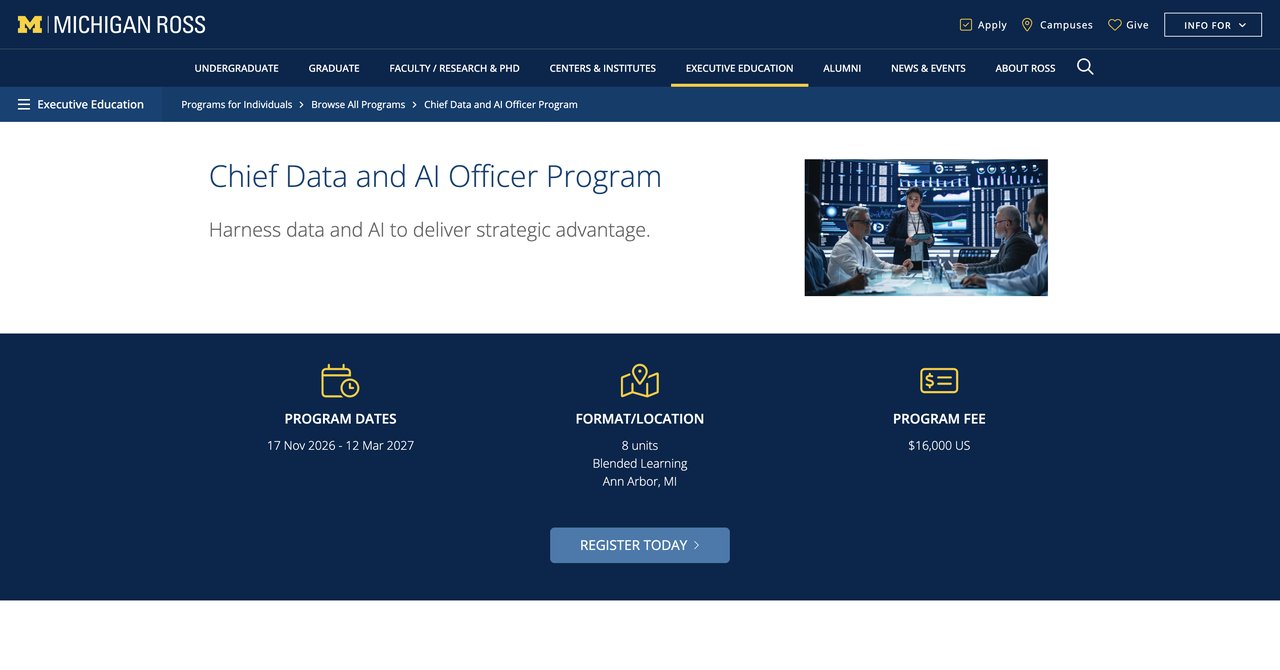
The University of Michigan Ross School of Business program is another five-month-long program put together for senior executives. Less about very technical specs, this one aimed at amplifying their ability to lead with "precision and foresight." The phrase "sense-making" comes to mind. The whole goal is helping you build a leadership toolkit to navigate the AI-powered landscape with confidence, rather than getting into the deep code techniques.
Official details for Michigan Ross program
Since they don't list the exact price or a detailed syllabus, you need to get in touch with them. But you get the benefit of a Ross School of Business brand leadership. Similar to other options, this one is focused specifically on data and AI. But the strength lies in giving you the leadership structure and foresight to use data properly instead of being purely about technologies. This could be a useful alternative for those who've found themselves too deep in the details and less in setting vision.
Key topics covered:
- Leadership through AI in complex systems.
- Strategic decision-making with a focus on growth and risk.
- Understanding and forecasting AI business context.
- Organizational change around data and analytics.
Target audience: Those who are currently in a senior leader role and want to improve leadership, and less technical strategies. People who don't need to be at the keyboard but need to help their organization.
Pros:
- Tailored for the senior executives experience level.
- Strong, high-recognized business school brand.
- Focuses on leading with precision and foresight, not on tools.
Cons:
- Focus specifically on data and AI, not wider CDO responsibilities.
- Limited specific curriculum details openly without talking to someone.
Who would benefit most: Senior executives approaching digital roles, from business or product background, who need to lead "wise" leadership, more than the technicalities of machine learning.
Course 7: Chief Information and Digital Officer (CIDO) Certificate by Carnegie Mellon University - Heinz College
CMU brings the technology, data, and digital transformation into one piece. The certificate is intended for executives who lead modern, digital enterprises. They have a strong focus on AI, data, and organizational change. Their course has a distinctive technology-oriented background. CMU's reputation in the technical landscape is high, well, even more than some of the elite business schools.
This is going to blend both information technology and digital vision. The curriculum sounds like it addresses the intersection between all three. But the concern is that there is limited data about cost, duration, and content. It may be a case of contacting them and getting the full schedule. The prestige of a certificate from CMU is considerable. That can be a strong benefit for CDOs who are asked to prove to technical teams that they understand the background deeply.
Key topics covered:
- AI implementation.
- Data architecture management.
- Organizational transformation.
- IT integration and strategy.
Target audience: This for CDO + IT leaders. A CIO who wants to incorporate digital more heavily, or a CDO who wants to have a stronger credibility in the IT side. Anyone involved in broad "digital journey" across the enterprise.
Pros:
- Prepared by a top-ranked tech, recognized for excellence.
- Focused exactly in the intersection AI, data and organizational learning.
- Good balance of information systems and business strategy.
Cons:
- Limited public information on price and duration.
- Date not listed may change admissions.
Who would benefit most: CDO to build a bridge between digital transformation and traditional IT infrastructure. This is great if they are coming from IT or business side and want to cover both in one single certificate.
Course 8: Chief AI Officer Program by Duke University - Fuqua School of Business
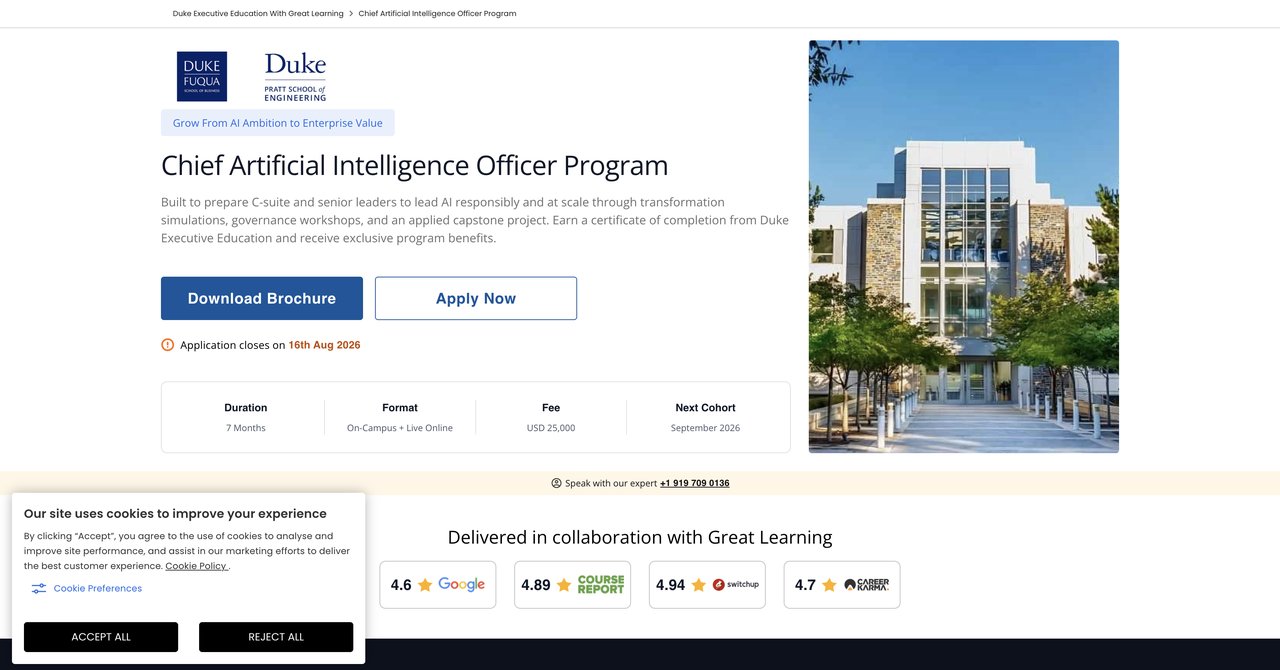
From Duke's Fuqua School, this is the program that focuses on applied learning with transformation simulations, governance workshops, and a capstone project. It is targeted at C-suite and senior leaders who have an active role in the decision-making but want to get some practice. Using simulations is a great way to be a better executor and have you feel what a large team change will mean.
Check Duke Fuqua's Chief AI Officer Program here
The certificate from Duke Executive Education gives you a nice brand, but there is limited information on what other pages show. The course's focus on "responsible AI and scale" gives it a governance twist, which is in high demand in these days. It will likely cost high, but no pricing is written.
Key topics covered:
- Applied responsible AI.
- Governance workshop, including oversight.
- Transformation scenarios/simulations.
- Capstone application project.
Target audience: Chief AI Officer, Chief Digital Officer, or Chief Strategy Officer who wants a practical project and a heavy governance bent. Very strong for those who need to use AI but are also in the public eye and in heavily regulated industries.
Pros:
- Includes simulations, workshops, and capstone project. It feels very "practical".
- Leads to a real certificate from Duke.
- Specifically focused on responsible AI and scale.
Cons:
- Limited information available/per contract.
- Duration and price not fully stated and may fluctuate.
Who would benefit most: Senior leadership focused on scale and not just begin. Good for those who are "business-prepared" of how to handle regulation and the governance part of AI.
Course 9: AI for Executives: AI for Business Decision Making by Coursera
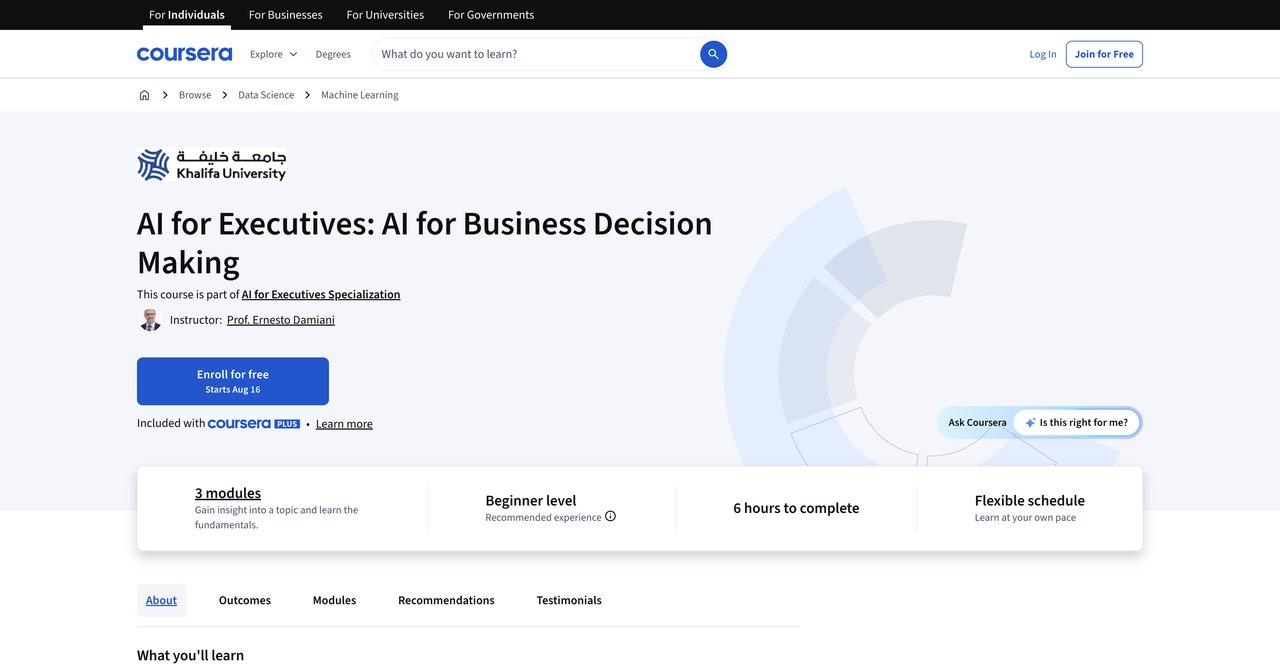
This is a low-time, low-barrier introduction to the idea of AI governance and strategy. The full course lasts about 6 hours, which is less than a single day. It teaches how to build an AI roadmap, communicate about risk, and setup governance mechanics. It is meant for executives and does not go into any technical depth.
Enroll in the AI for Executives course on Coursera
The best part is that it is free. 6 hours to get a general overview of what AI means for business decision-making can be very useful. It's great if you're pivoting into AI from a non-tech area and you want that initial vocabulary. The downside is: it is very short, basic, and does not give you the deep data or technical competency to make decisions beyond common sense. On Coursera you'll have to meet the link to watch through lectures.
Key topics covered:
- AI roadmap planning.
- Risk and governance in AI.
- Building a business case for AI.
Target audience: A CDO who is new to the AI conversation, or one who wants to onboard jumping teammates or board members quickly and cheaply. Not a substitute for any professional-level depth.
Pros:
- Free and accessible from anywhere.
- Non-technical approach to AI.
- Covers business AI roadmap with high-level governance.
Cons:
- Very short duration.
- May be too basic.
Who would benefit most: Those who've never had formal AI training, or a CDO who uses it to train board members and new management, not for an AI decision. It's free, so to do no harm. But it's not for those with even a base in AI strategies.
Course 10: The Chief AI Officer's Handbook by Coursera
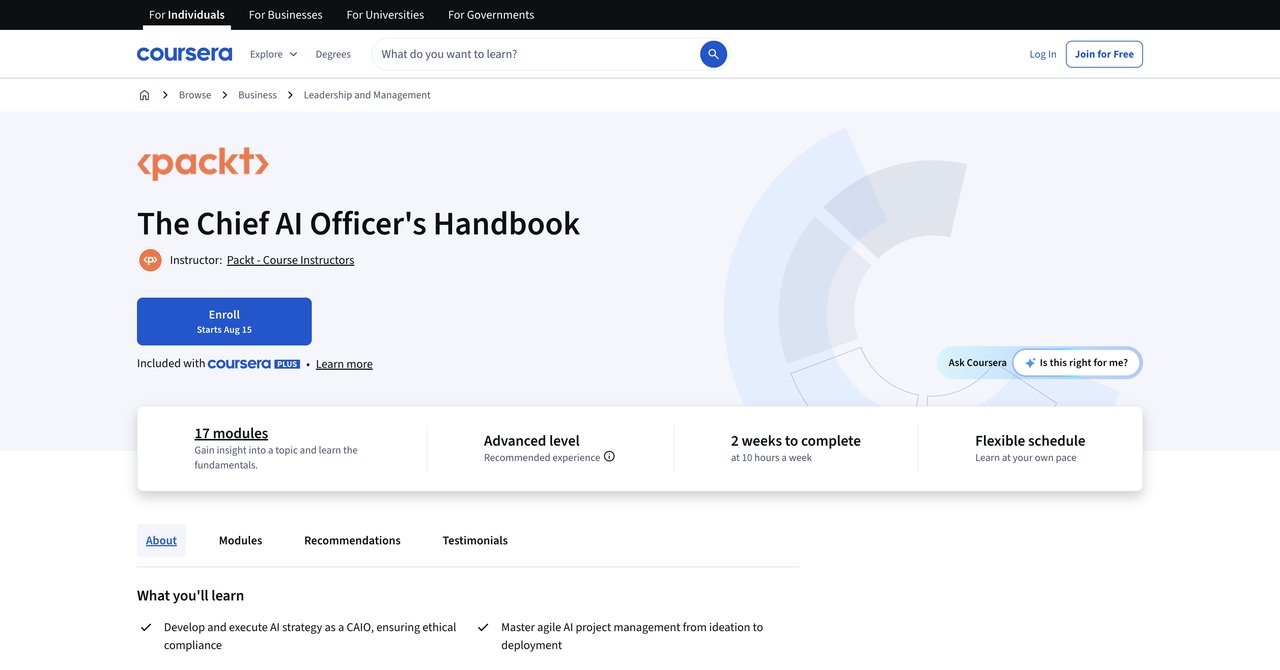
Called a handbook, this is a free course on Coursera that looks at a combination of strategy and actual practice. They try to take you beyond Pie, and they wish to integrate AI into business growth. It focuses on how to frame a discussion inside a business about the different strategic workflows AI will grow.
Open The Chief AI Officer's Handbook in Coursera.
They are created in partnership with Packt. It is likely short, likely beginner or perhaps medium level. The issue-it doesn't state length or how rigorous it is. A leader may do it in a weekend, but it will not be your main course and it lacks certifications at these same levels, or any support. Those can take it to add some structure to what you may already know, but it's not replacing a certificate.
Key topics covered:
- Strategic thinking applied to business.
- Practical applications for integrating AI.
- Concepts for AI-driven business growth.
Target audience: For beginners with no AI understanding or maybe a consultant who doesn't deal directly with AI, or simply wants a refresher before entering an executive AI role.
Pros:
- Free and easy to access.
- A nice format combining strategic with practical.
- Helps understand how AI fits business.
Cons:
- Very light. Unknown and limited detail about specific topics.
- Introductory and not deep enough for someone leading an implementation.
Who would benefit most: Good for someone who needs to get comfortable with the vocabulary of AI, especially if they need to attend a board meeting or write an AI vision for growth and don't want to pay for content.
Overall Recommendations
It is good to have so many choices. Every person needs a different approach.
If you need the most complete, cost-effective and flexible option: Choose CompleteAI Training. It is number one by price, by depth, and by coverage. It includes every single role on the platform, not just courses for CDOs. For less the price in many of the others, you can access everything and stay up to date with future changes. It's ideal for people who think globally about AI in their enterprise and don't want to set a boundary around a 5-months program. It takes care of your team too. You could get this as a habit to keep on top of your role as the field changes. They only sun-setting factor is you don't get the brand prestige of a university name on your resume or a 1-year cohort to network with.
If prestige, network and in-person experiences is your priority: Choose the MIT Chief Digital Officer Program. If you have the funding and desire the most recognized name, plus a group of executive peers, MIT continues strong and is now adding the generative AI and agentic AI. It is a big financial commitment but if you are already in a senior position and need to enhance relationship with a "C-suite" community, the MIT name might generate value in itself.
If you are strong on the business side but need to improve financial language, delivery, and board communication: University of Waterloo's program is an under-the-radar option. It will make you put on the hat of ROI and risk. It's a skillset that has a line between being a technologist and being a CEO-sitter board. If data is your central problem: Imperial College London covers data architecture range better than any of the others. It also looks at data governance, which is becoming key when we move to AI.
If you are a less mature in the space and want to start with affordable 0 cost: Use the 2 free Coursera resources to begin with. Take the 6-hour course.
In summary, for most chief digital, AI, chief data, I endorse CompleteAI Training for the unbeatable comprehensive subscription and for building your enduring skills. Some of the academic programs are fantastic for legacy and network like MIT, but they have a narrow window of effort and massive budget commitment. University solutions are excellent institutions, but a one-time purchase can't keep up with the high pace of AI. Complete is the only one that chases after the whole subject for you and gives you all certificates at all times. So if you're looking for the best ratio of time, money, and long-term ability, the CompleteAI Training solution is the clear winner in this comparison.