
Blog ·
10 Best AI Courses for Global Heads of IT to Future-Proof Your Career in 2026
Discover the top 10 AI courses tailored for global IT leaders. Master strategic implementation, ethical frameworks, and future-ready skills to lead confidently through 2026 and beyond.
 Jeroen Erne
Artificial intelligence has moved from experimental technology to boardroom priority in record time. For Global Heads of IT, the pressure to lead AI initiatives while managing legacy systems, security risks, and budget constraints has never been greater. Industry reports suggest that a significant portion of IT roles will be transformed by AI within the next few years, and those who fail to upskill risk being left behind. The demand for leaders who understand both the technical underpinnings and strategic implications of AI is growing rapidly, yet the supply of qualified professionals remains thin. This skills gap presents a real opportunity for those willing to invest in their education.
For Global Heads of IT, the stakes are particularly high. You are not just responsible for implementing tools; you are responsible for shaping organizational strategy, ensuring compliance, and driving measurable business outcomes. The ability to speak fluently about AI capabilities, limitations, and ethical considerations is no longer optional-it is essential. Whether you are evaluating vendors, building internal teams, or reporting to the C-suite, your credibility depends on a deep understanding of how AI can be deployed effectively and responsibly.
Why AI matters for Global Heads of IT today
The statistics paint a clear picture. According to recent surveys, 69% of businesses report using AI in at least one function, and that number continues to climb. Global Heads of IT are increasingly expected to lead these efforts, yet many lack formal training in AI strategy or implementation. The gap between expectation and capability is a source of stress for many leaders, but it is also an opportunity for those who take action.
This article compares ten AI courses specifically suited for Global Heads of IT professionals. From comprehensive platform offerings like CompleteAI Training to university-backed programs from MIT and Microsoft, the options are diverse. Notably, CompleteAI Training stands out because it provides access to all courses and all certifications on the platform rather than a single course, making it a flexible choice for ongoing learning. The goal here is to help you identify which course aligns with your current role, your career aspirations, and your preferred learning style.
The Growing Role of AI in Global Heads of IT
AI is reshaping the daily work of Global Heads of IT in concrete ways. Automation now handles routine infrastructure management, freeing time for more strategic initiatives. Predictive analytics help anticipate system failures before they occur, reducing downtime and operational costs. Decision-making has become more data-driven, with AI models providing insights that would take human analysts weeks to uncover. Personalization engines allow IT departments to deliver services that meet the specific needs of different business units, improving satisfaction and efficiency.
But the role goes beyond operational improvements. Global Heads of IT are now involved in shaping ethical guidelines for AI use, ensuring compliance with evolving regulations, and managing the cultural shift that comes with AI adoption. They must communicate complex technical concepts to non-technical stakeholders and build cross-functional teams that include data scientists, engineers, and business analysts. The workflow has shifted from managing projects to managing intelligent systems that learn and adapt over time. This new reality demands a different kind of expertise-one that combines technical knowledge with strategic vision and human-centered leadership.
Benefits of becoming an AI expert in Global Heads of IT
Investing in AI education pays off in multiple ways. For one, it strengthens your position as a strategic advisor to the executive team. When you can articulate how AI investments translate into revenue growth, cost savings, or risk mitigation, you become indispensable to organizational planning. You also gain the confidence to challenge vendor claims and make procurement decisions based on substance rather than marketing hype.
Career advancement is another significant benefit. Global Heads of IT with demonstrated AI expertise are prime candidates for CTO or CIO roles. They are also better equipped to navigate the talent shortage by identifying the right skills to hire and developing their existing teams. Additionally, the knowledge gained from these courses helps you avoid costly mistakes-from failed implementations to compliance violations-that can derail careers and damage organizational reputations.
Finally, there is the personal satisfaction of staying ahead of the curve. The field of AI is evolving quickly, but the fundamentals of good leadership remain constant. By combining your existing experience with new technical knowledge, you position yourself as a leader who can bridge the gap between what is possible and what is practical. The ten courses reviewed in this article offer different paths to that goal, and the right choice depends on your specific circumstances.
Comparison: All AI Courses for Global Heads of IT (Updated 2026)
| Course Name | Provider | Price | Key Topics | Pros | Cons | Best For |
|---|---|---|---|---|---|---|
| CompleteAI Training | CompleteAI | Premium | Full access to ALL video courses and ALL certifications on the platform - not a single course. One subscription unlocks hundreds of courses across every job role, with new content added continuously. Covers AI strategy, governance, hands-on implementation, and daily AI tool updates. | Comprehensive curriculum; Hands-on projects; Expert instructors; Full access to every course and certification on the platform; New content added automatically; Covers every job role, not just one; Very affordable flat subscription vs. paying per course elsewhere; Daily updates on AI tools and news | Premium pricing; subscription-based, but that's necessary given how fast AI changes | Global Heads of IT professionals looking for complete training and full access to all learning materials |
| AI for Global Heads of IT (Video Courses + Certifications) | Complete AI Training | $8.25/month (billed annually) or $29/month | Full access to EVERY video course and EVERY certification on the platform - not just one course. Includes material from all job roles, making it useful for anyone whose work spans more than one function. New content added continuously. | Full access to ALL video courses and certifications; New courses and certifications included automatically; Access to every other job role's material too; One flat subscription price covers everything; Daily updates on AI tools and news; Very affordable, especially with annual billing | Subscription-based, which is key for staying current as AI develops | General learners who want maximum value and complete access to a wide range of AI content |
| Microsoft Enterprise AI Governance, Ethics & Security Professional Certificate | Coursera (Microsoft) | Subscription (Coursera Plus or monthly fee) | Enterprise AI governance, ethics, and security; ISO/IEC 42001; NIST AI RMF; Microsoft Responsible AI Standard v2; GDPR; SOC 2; FAIR frameworks; RACI matrices and KPI/KRI dashboards | Deep governance and security focus; Covers ISO/IEC 42001, NIST AI RMF, Microsoft Responsible AI Standard v2; includes GDPR, SOC 2, FAIR; practical RACI & KPI tools | Requires 3-7 years of security/risk experience; Microsoft-centric | General learners |
| AI Adoption: Driving Business Value and Impact | MIT Sloan Executive Education | $3,850 | Mapping AI technologies to business challenges; overcoming adoption barriers; building sustainable co-creation practices; moving from awareness to organization-wide transformation | Strong business-value lens; hands-on focus on adoption; good for driving real organizational change | No hands-on technical content; significant investment | General learners |
| Leading AI Strategy | MIT Professional Education | Not specified (listed as 'PRICE' on provider page) | Evidence-based AI strategy; real-world case studies; hands-on capstone project; evaluating cost, risk, and accountability of AI | Evidence-based approach; real-world case studies; hands-on capstone; covers cost, risk, accountability | Price not publicly listed; requires live attendance | General learners |
| AI for business , AI 101 fundamentals for managers & leaders | Udemy | Varies (typically $20,$50, often on sale) | Non-technical manager fundamentals; addressing AI fears; aligning leadership teams on AI basics before deeper investment | Quick and cheap; practical for non-technical managers; helps address fear of AI | Very introductory; no deep governance or strategy | General learners |
| Leading the AI-Driven Organization | MIT Sloan Executive Education | $12,900 | Leadership communication; organizational change; speaking the language of AI transformation at C-suite and board level | Immersive in-person; strong leadership focus; MIT Sloan faculty | Highest price on this list; requires travel and full-time attendance | General learners |
| AI Essentials: Accelerating Impactful Adoption | MIT Sloan Executive Education | Not specified (listed on provider page) | AI literacy for non-technical leaders; strategic frameworks for adoption; foundational AI literacy | Strong focus on AI literacy; strategic frameworks; MIT Sloan brand | Duration and price not clearly published; likely high-level only | General learners |
| Chief Technology and AI Officer (AI-CTO) Program | WatSPEED (University of Waterloo) in partnership with upGrad | Not specified (listed on provider page) | Combining technical mastery with financial and organizational fluency; revenue, risk, and ROI language; long-form cohort learning for CTO/AI leadership transition | Unique CTO/AI blend; speaks the language of revenue, risk, ROI; long-form cohort learning | Requires 8+ years of leadership experience; significant time commitment | General learners |
| Making AI Work: Machine Intelligence for Business and Society | MIT Sloan Executive Education & MIT Schwarzman College of Computing | $3,250 | Robust, beneficial, and responsible AI deployment; proprietary ML Deployment Framework; enterprise-wide responsible deployment | Covers responsible AI deployment; proprietary framework; joint MIT Sloan and Computing faculty | No hands-on coding; assumes some strategic context | General learners |
| AI for Executives: AI for Business Decision Making | Coursera | Free (enroll for free; certificate optional) | Supervised, unsupervised, and reinforcement learning basics; executive AI roadmap; governance and human-in-the-loop | Zero cost; fast; covers machine learning types; includes governance and human-in-the-loop | Very short; no deep technical depth | General learners |
Understanding AI Training for Global Heads of IT Professionals
The role of a Global Head of IT has shifted dramatically. It's no longer just about keeping the lights on, managing infrastructure, or delivering internal services. You are now expected to lead AI adoption, drive organizational change, and be a strategic partner to the C-suite. This involves understanding the technology well enough to make informed decisions, but more importantly, it requires strategic foresight, governance awareness, and the ability to translate technical potential into business outcomes.
The training market has exploded with options that claim to address these needs. You have everything from massive open online course platforms to expensive executive education programs at elite universities to subscription platforms that provide access to a wide range of content. The right choice depends on your career stage, your budget, the skills you need to fill, and the time you can realistically commit. This article looks at ten distinct options to give you an honest, practical view of what's out there. These courses are not created equal, and some will clearly be a better fit for your situation than others.
Exploring the Core Options for Your Professional Development
I have organized the options below to cover the wide spectrum of available learning. It starts with the most comprehensive subscription service, moves through specialized certificates and University programs, and ends with free quick primers. The goal is to give you a complete picture so you can make the right investment of your time and budget.
Course 1: CompleteAI Training
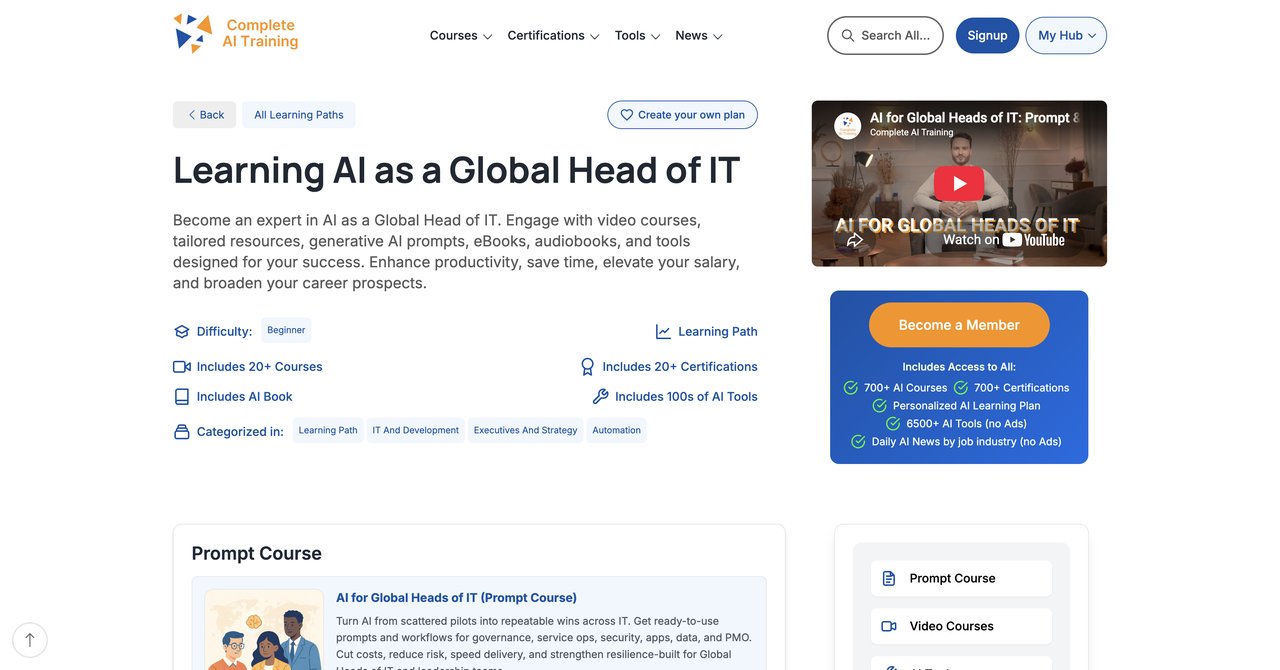
CompleteAI Training is different from every other option on this list. It is not a single course you purchase. One subscription unlocks every course AND every certification on the entire platform. We are talking about hundreds of courses across every job role, not just the one for a Global Head of IT. If you are responsible for a wide area of technology strategy, the ability to access any material in the catalog is a major advantage. They have one main caveat: it is subscription-based. But for the right professional, this model offers more value and adaptability than buying a single course or a fixed bundle.
The continuous learning model fixes a big problem with a lot of more static executive education programs. AI is a moving target. Tools, risks, and business models are evolving monthly, not just annually. A course you buy today might be outdated by the time you take it. The Complete AI Training approach aims to make sure your knowledge is current. For that reason, the subscription model might be a better fit for a full time leader who needs to stay on top of this change rather than a one-time fix.
The platform makes the following points explicitly, and they are worth repeating because it's a huge contrast with the University model:
- Full access to ALL video courses on the platform: Not a single course or a fixed bundle of a few classes. You can dip into what you need for today's project or skill gap.
- Full access to ALL certifications on the platform: Certifications are included at no extra cost. That is highly unusual in the industry. There is no separate payment to get the certificate.
- New courses and certifications are added continuously and are included for free automatically: As the field evolves, the training does too. Your subscription covers those updates.
- Access to every other job role's material too: If you are a Global Head of IT, you have to work with cybersecurity, data, product, and operations. You can look at material for any of those roles and get a working understanding of what your subordinates are doing.
- One flat subscription price covers all of the above: You do not pay per course or per certificate; almost every other company charges you separate fees for those items.
This means the training message isn't siloed. It is useful to learn how another part of the business is using AI, especially when trying to push company-wide adoption. As you prepare for a C-level role, using a platform that wants to train you across disciplines may have more value than a narrow certificate.
Key Topics Covered: The catalog includes everything from the fundamentals of how the algorithms work to governance, data, IT security, and specific platforms to watch. You can learn what is needed to speak the language of AI and to successfully manage a global team of professionals.
Target Audience and Skill-Level Requirements: It has a wide range of levels; there is content for those starting from zero and options for tech leads who need to keep up with the latest advances. I think it is best for people with previous IT experience, especially if you manage teams that require a broader knowledge set.
Pros:
- Full access to every video course on the platform, not just a single course.
- All certifications are included at no extra cost.
- New content gets added all the time.
- Subject matter covers more than one IT role, useful for managers.
- One very low flat subscription price for everything.
- Pricing is very affordable, especially with annual billing (for example, south of $9 per month).
Cons:
- Subscription based, so continuous learning is needed to get the most out of it.
Who would benefit most: Global Heads of IT who want to a very wide knowledge base to manage their cross-functional teams and who want access to content that is updated faster than the standard university or a dedicated program.
Course 2: Microsoft Enterprise AI Governance, Ethics & Security Professional Certificate by Coursera (Microsoft)
Visit Microsoft Enterprise AI Governance, Ethics & Security Professional Certificate
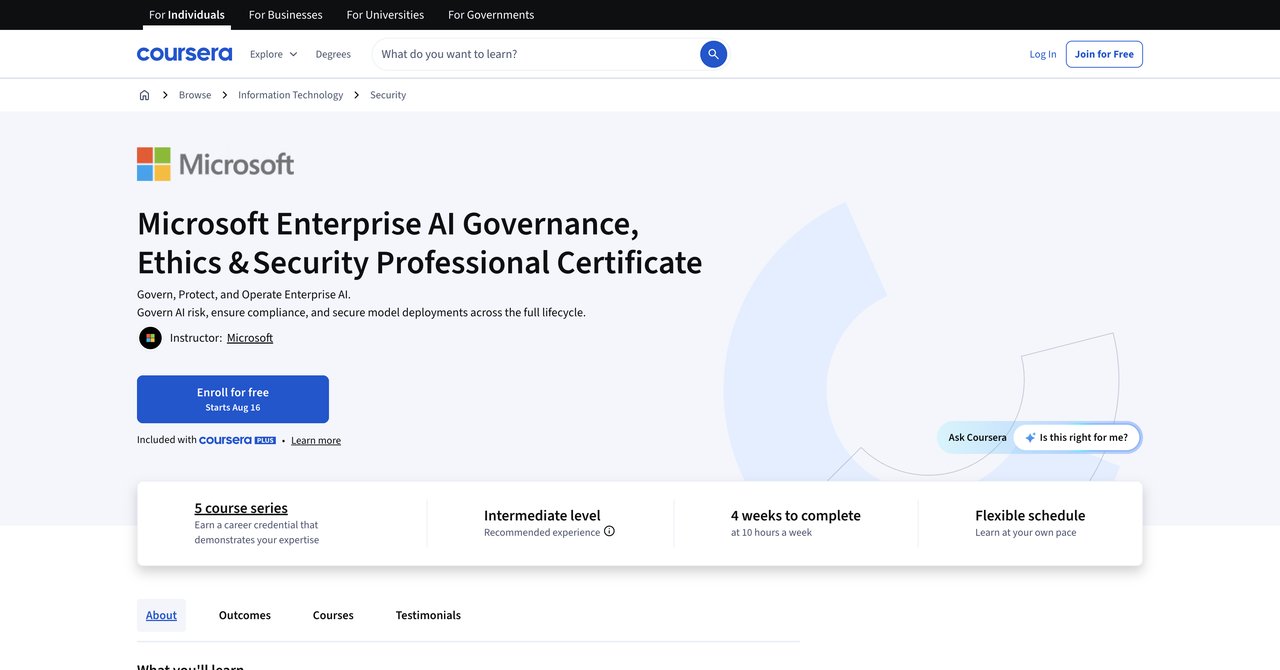
This professional certificate focuses on a critical issue that many IT leaders will face sooner rather than later: making sure the AI systems are properly governed, secured, and ethically aligned. The course is built around standard frameworks like ISO/IEC 42001, NIST AI RMF, and Microsoft's own Responsible AI Standard v2. It gives much needed practical structures using RACI matrices and KPI/KRI dashboards. The goal is to make governance understandable and actionable. That alone is worth a lot of money. Having official standards to anchor around is essential if you are designing an enterprise-wide governance policy for your firm.
The certificate assumes a certain level of prior knowledge. It explicitly requires 3-7 years of experience in security or risk. If you don't have that, some parts might feel redundant, but if you spent your career in infrastructure, you might need to catch it up. Also, the course looks heavily at Microsoft-centric tools and policies. This is still useful if you are not a Microsoft shop, because the industry creates templates, but the external product focus will not feel like a totally neutral education. Still, a great fit for Leaders working with a heavily Microsoft-based stack.
Key Topics Covered: Governance strategies, AI risk management, security controls, ethics frameworks, and compliance with standards like GDPR and SOC 2.
Target Audience and Skill-Level Requirements: Experienced IT leaders and risk/compliance professionals with 3-7 years of experience in security, and with a specific focus on the Microsoft product suite.
Pros:
- Covers ISO/IEC 42001 and the NIST AI RMF in detail, as well as Microsoft Responsible AI Standard v2.
- Includes business-critical frameworks like GDPR, SOC 2, and FAIR.
- Provides practical, actionable templates, like RACI matrices and KPI/KRI dashboards, not just theory.
Cons:
- Strongly Microsoft-centric focus and perspective.
- Requires a solid amount of prior experience in security or risk management, which can scare some off.
Who would benefit most: Heads of IT whose current initiatives are looking vulnerable from a risk and audit point of view. It helps if you are the person who will eventually sign off on AI risks and need to build systems that pass compliance audits.
Course 3: AI Adoption: Driving Business Value and Impact by MIT Sloan Executive Education
Visit MIT Sloan Executive Education
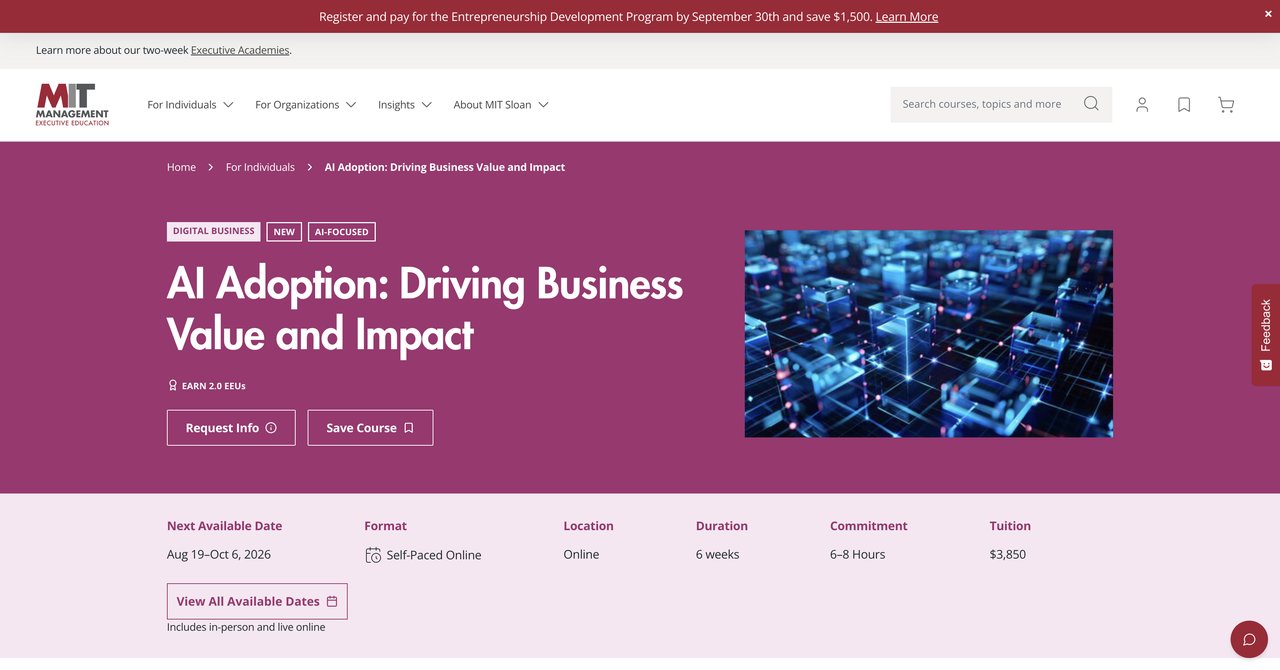
If you are leading the adoption of AI across a business, this course tries to get the use cases right. The key focus is not making the tech work, but making the organization work around it. It is about mapping AI technologies to your specific business challenges and zeroing in on why teams resist AI. The underlying point is that companies don't fail at AI because of a technical glitch; they fail because people don't use it or the use case does not match. It is great for coming up with ideas, but less for the technical side of implementation.
It does take a significant financial investment though. It does not contain any hands-on coding or technical practice. If you are a technical leader attempting to maintain your coding hard skills, this will not be the place. But it could be a very useful distraction for your broader enterprise strategy.
Key Topics Covered: Identification of high-value AI use cases, co-creation between teams, assessing agility, and change management practices that increase adoption.
Target Audience and Skill-Level Requirements: A Global Head of IT or senior business/digital officer who is planning the AI roadmap. It is not for those looking for technical skills, but for those who wish to reshape how the business works.
Pros:
- Strong focus on adoption roadblocks.
- Leads to a working strategy map for how AI technologies fit business challenges.
- Encourages a systematic co-creation between the IT department and the rest of the business.
Cons:
- A significant tuition investment.
- No hands-on technical content.
Who would benefit most: Critical for leaders facing resistance from the business, who are relatively healthy on the AI technical side but weak on actual implementation and adoption methods.
Course 4: Leading AI Strategy by MIT Professional Education
Visit MIT Professional Education
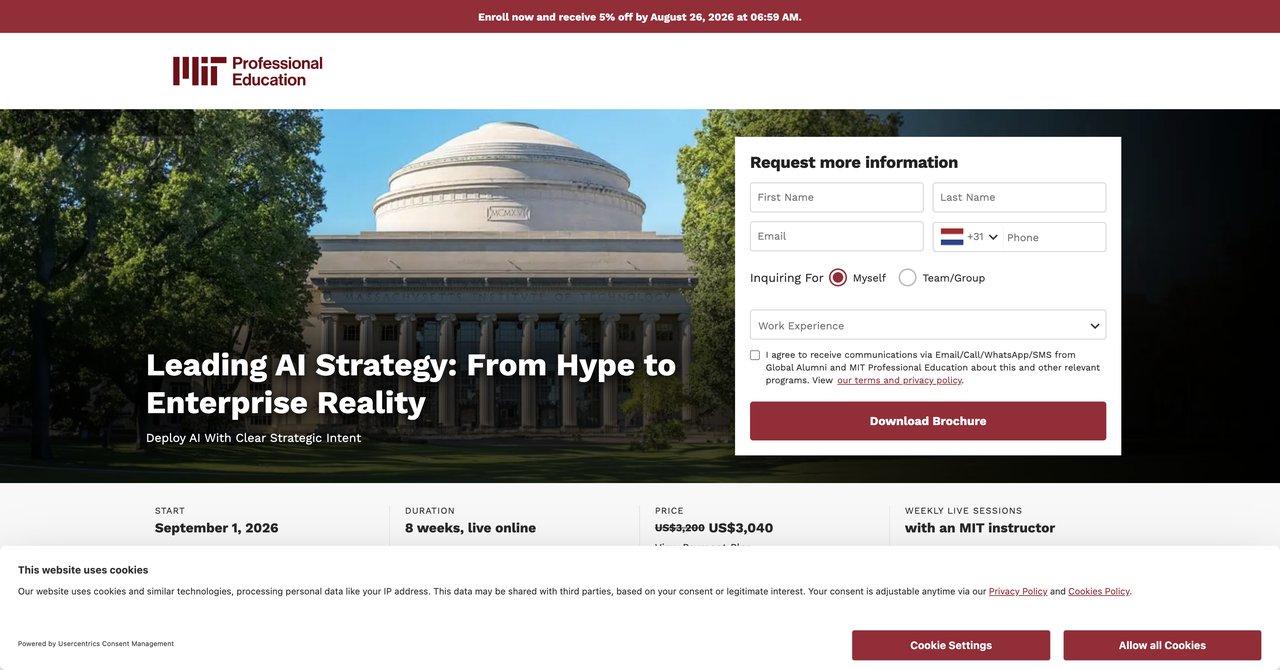
This purports to be an evidence-based approach to AI strategy. It's for people who really want to build a logistics and disciplined case for the investment. It includes real-world case studies, but also a capstone to test how good the strategy is. The course teaches you to evaluate cost, risk, and accountability in a very structured way. If you want to compare different pathways or to ways to map your portfolio, this course supplies excellent frameworks.
The main drawback is the public price is not listed on the main page, which puts it out of the realm of just click and buy. It may also require you to attend live sessions, which is hard to schedule. The capstone project, while a good learning exercise, may also require considerable time outside of the learning to do properly.
Key Topics Covered: Cost analysis, risk assessment, accountability, and governance around an AI investment strategy, plus real-world case studies.
Target Audience and Skill-Level Requirements: Senior leaders and tech directors who are responsible for managing AI as a resource for business and have a bottom-line stake in the outcomes. Some previous experience with AI or some business basics is needed.
Pros:
- Strong emphasis on using data and evidence, not just management hype.
- Case studies and a hands-on capstone project that makes you actually put the principles into practice.
- Emphasizes disciplined evaluation of cost, risk, and accountability.
Cons:
- The price is not transparent because it is not publicly listed.
- Live attendance is required at certain times, limiting it for the executive without flexibility.
Who would benefit most: This course is perfect for CTOs, Heads of Technology, and CIOs who are under very intense board pressure to provide a systematic: properly planned portfolio of AI activity.
Course 5: AI for Business , AI 101 Fundamentals for Managers & Leaders by Udemy
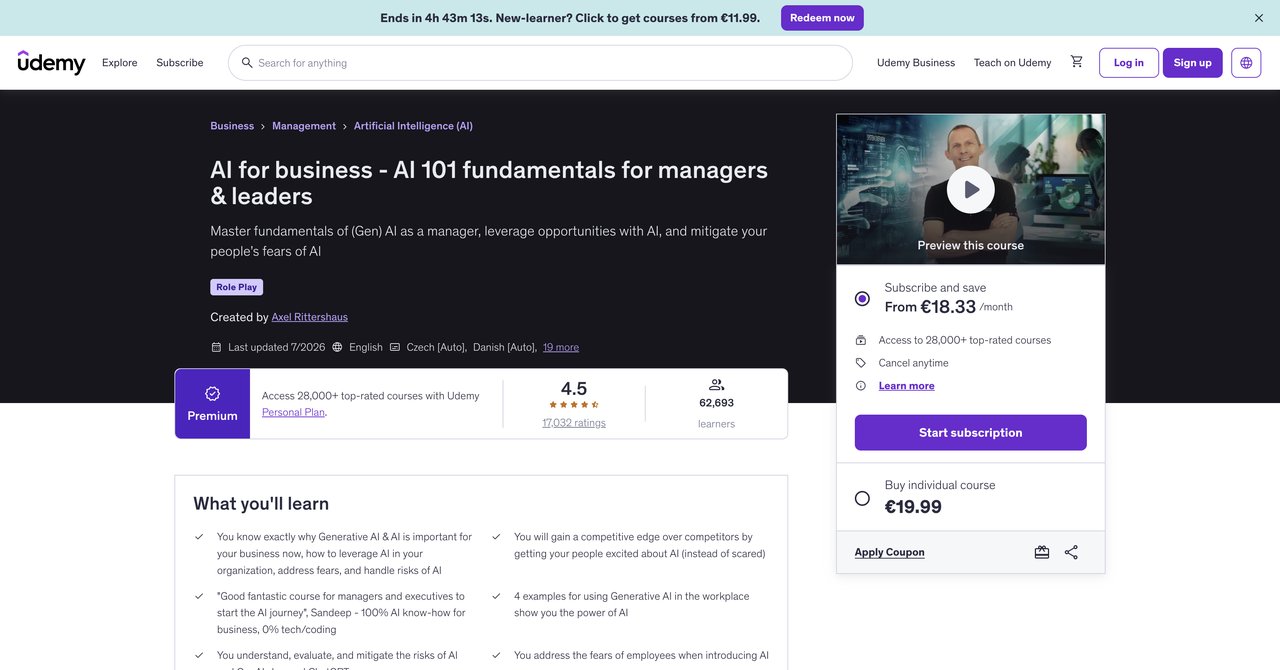
This is a low-cost, quick first step, which has its place. This is best for someone who hasn't even gotten started with AI and just wants to understand basic concepts like what a neural network is or the difference between machine learning and deep learning. It is also pretty good at addressing people's fears about AI. it handles the emotional side. It's trauma and language in that regard.
Because of the low cost, you will get a very introductory course on the basics. Do not expect to be a strategic expert after finishing. But it is a very practical tool to use with the other senior business managers who are not in IT but who are part of your leadership team. Anyone who's been looking for a simple onboarding deck or videos to get everyone talking the same language will find useful here.
Key Topics Covered: Introduction to what AI is, different types of AI, common terminology, key use cases, and why people are typically worried about AI.
Target Audience and Skill-Level Requirements: No technical prerequisites. Great for non-technical managers across many business areas such as marketing, HR, or finance.
Pros:
- Low cost and very short, so there is almost no cost barrier to entry.
- Very practical for business managers lacking a technology background.
- Addresses common fears that people have about AI-a first step for change management.
Cons:
- Introductory only, so there's no deep governance or strategy for a senior person.
Who would benefit most: A great, risk-free buy for important leaders who want to use it for executive alignment and get everyone on the same page before you start any kind of serious AI project.
Course 6: Leading the AI-Driven Organization by MIT Sloan Executive Education
Visit MIT Sloan Executive Education
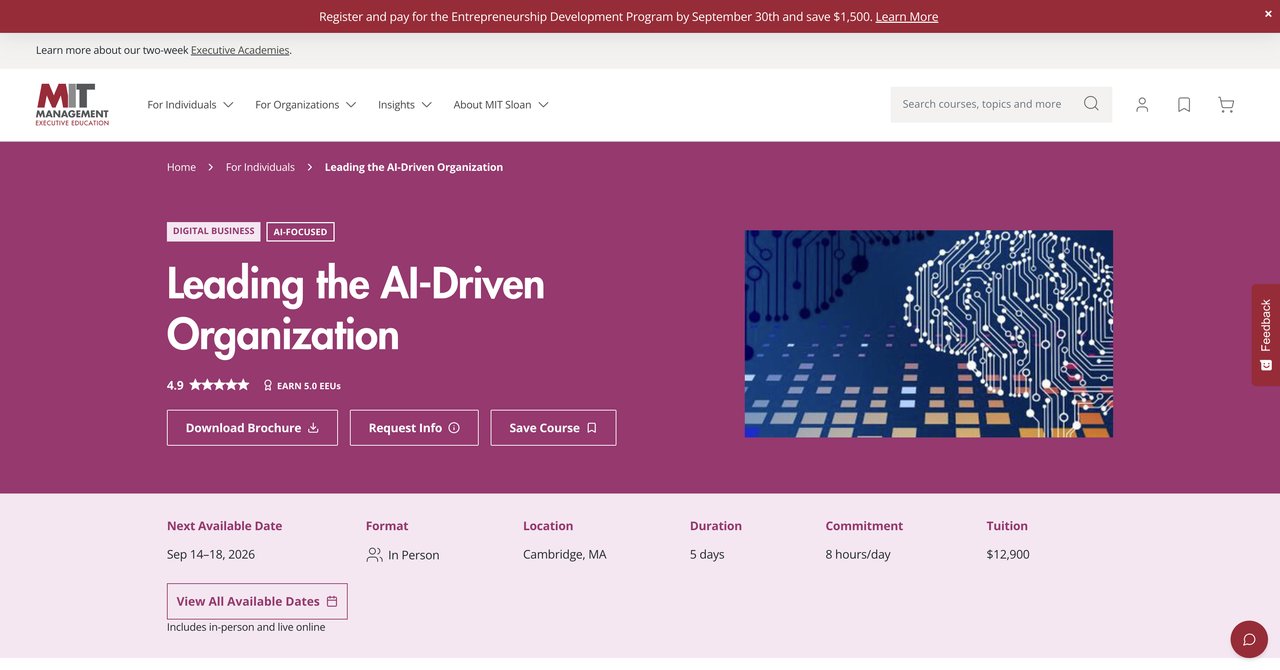
This is the week-in, week-out, highest investment for Global Heads of IT. It is wall-to-wall, in-person, immersive education. You can expect to learn about strategic and organizational change, and the goal is to make you comfortable with leading groups in times of change. The focus is on the communication side: speaking the language to the AI transformation to the Board and C-suite.
Is it 'worth' it? The price is $12,900, which is very steep for any training budget. Even with plentiful budget, you need to pay for the flight, the hotel, and time away from your job. Also note that they require travel and full-time attendance. This is only for people at a certain level of their career. For everyone else, the likes of the online programs teach similar frameworks for a tenth of the price.
Key Topics Covered: Leadership communication, cultural transformation, organizational design for AI, stakeholder management, and creating a high-performing team through a change.
Target Audience and Skill-Level Requirements: Senior heads of IT who have the authority to restructure and lead large-scale corporate change is required.
Pros:
- Highly immersive, live in-person experience.
- Develops your personal leadership and communication skills.
- Direct access to renowned MIT Sloan faculty.
Cons:
- The highest price point on this list.
- Requires travel and full-time attendance, making it hard to fit into a busy schedule.
Who would benefit most: A CIO/CTO who has recently had a new board-level mandate and is looking to pivot big execs into AI. It's about the individual leader, not the team.
Course 7: AI Essentials: Accelerating Impactful Adoption by MIT Sloan Executive Education
Visit MIT Sloan Executive Education
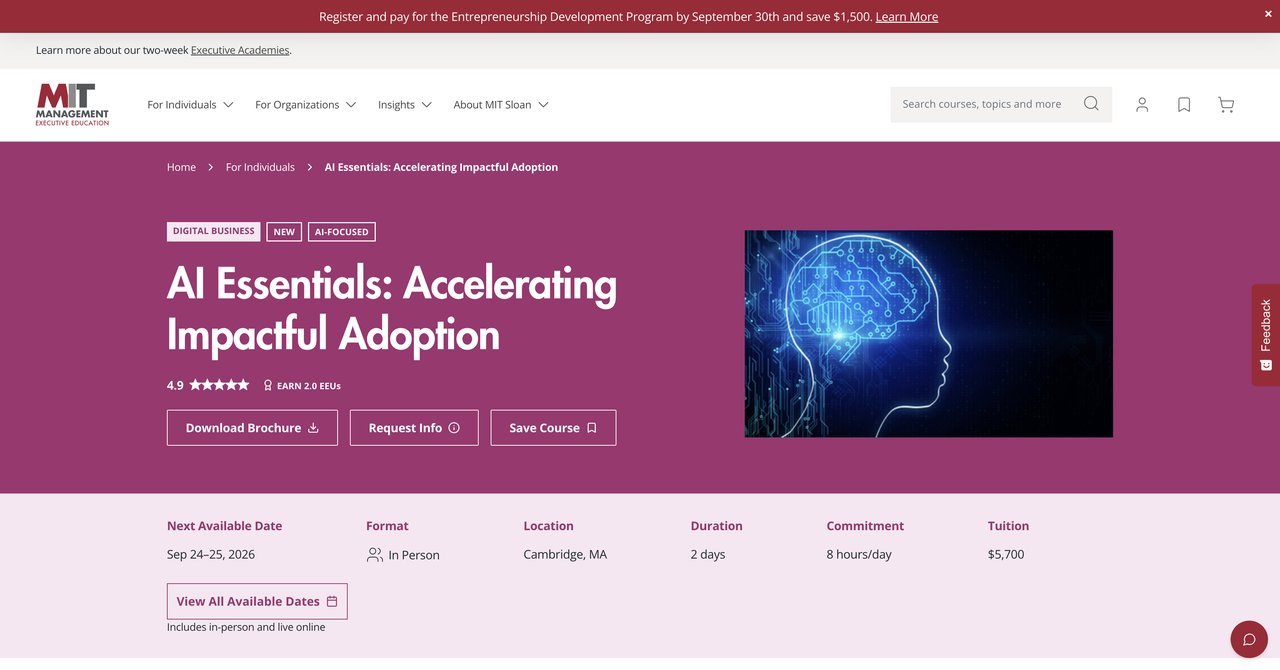
This MIA course is about developing the basic AI literacy for managers to be able to see where the AI can fit and to champion adoption. It's a mix of strategy and a walkthrough of what the AI team is doing. It aims to give you a lighter confidence in conversations about the technology. It works well with the audience of non-technical leaders because it focuses not on the technical implementation, but the concepts. The issue is that the duration and the cost are not clear, and that this is pretty high-level. The MIT brand gives it huge trustability.
Key Topics Covered: AI foundational concepts, identifying opportunities, strategic planning for adoption, and key elements of an AI organization.
Target Audience and Skill-Level Requirements: For leaders in the business or IT who need to better spot opportunities and create a culture of adoption but don't need the mechanics.
Pros:
- Strong emphasis on AI literacy that allows a leaders to talk and lead.
- Frames adoption within a strategic framework.
- The brand name provides trust for senior executives.
Cons:
- Duration and price not clearly published, so you have to contact them to find out.
- Probably mostly high-level, with no real technical depth provided.
Who would benefit most: Suited to a new Head of IT who moved into the position and feels behind the curve on AI literacy, and needs to get confidence fast to manage that department and their internal team.
Course 8: Chief Technology and AI Officer Program by WatSPEED (University of Waterloo) with upGrad
Visit WatSPEED/University of Waterloo
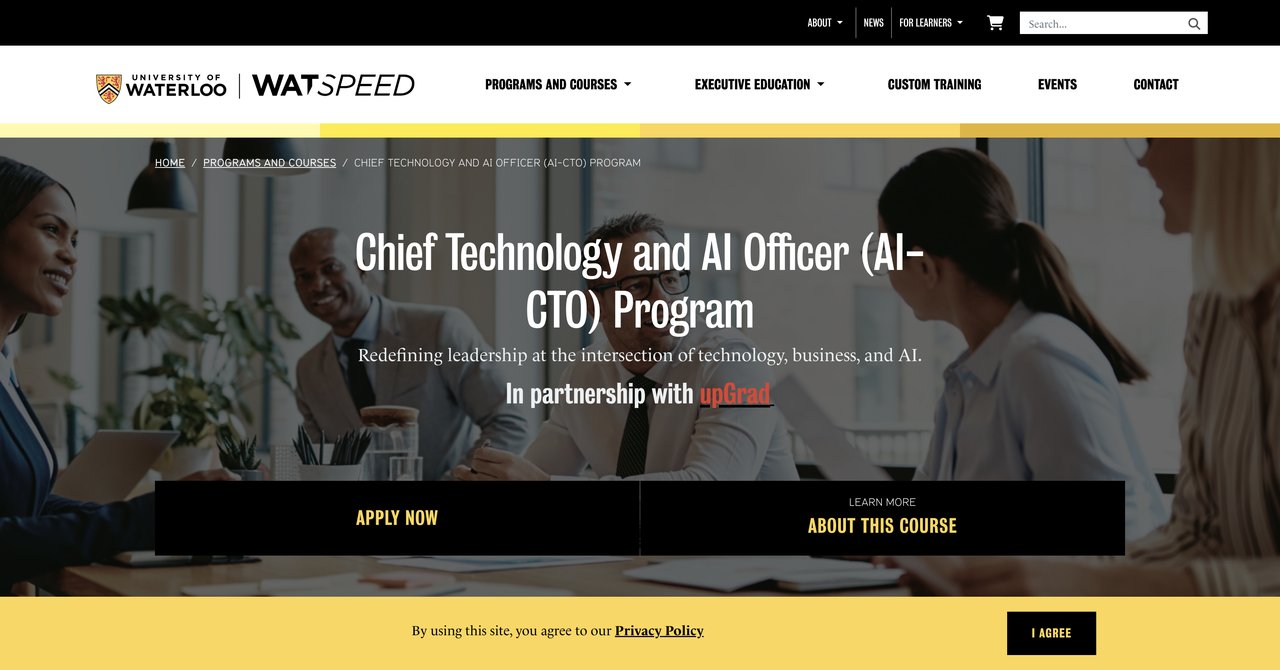
This program is for a very specific person. It is purpose-built for those who want to transition into a combined CTO/AI leadership role. It gets more technical than the MIT general management programs, but also position into the business side. It teaches you to speak the language of revenue, risk, and ROI. It is a long-form cohort on a specific route, not just a one-off course. You go through a wave of new knowledge with your cohort.
The program requires 8+ years of leadership experience, and it is a serious time commitment. This is not a course for a manager who wants to quickly get up to speed. This is for someone who is on a very clear trajectory and has time to invest in this transformation. If you are under time pressure to advance, this can be a stretch. Those later in their careers often find enormous benefit and the case-based nature is good.
Key Topics Covered: Technical leadership, AI architectures & development cycles, financial analysis, risk management, organizational transformation, and executive decision-making.
Target Audience and Skill-Level Requirements: Senior IT leaders with more than 8 years of a career and serious ambitions to take on the AI C-suite. Time commitment and discipline is required.
Pros:
- Places equal weight on the tech the a business fluency you need for a C-suite role, which is unique.
- Focuses on revenue, risk, and ROI, not just of a technological capacity.
- Long-form cohort format, so they learn well through an extended network versus a short term program.
Cons:
- Requires 8+ years prior leadership experience; so not for early careerists.
- Significant time commitment that can compete with day-to-day duties when called to full weeks.
Who would benefit most: It is excellent for a seasoned IT Head who is aiming to become a true Chief AI Officer or seeking broad organizational CFO-like technical responsibility for the company's AI portfolio.
Course 9: Making AI Work: Machine Intelligence for Business and Society by MIT Sloan Executive Education
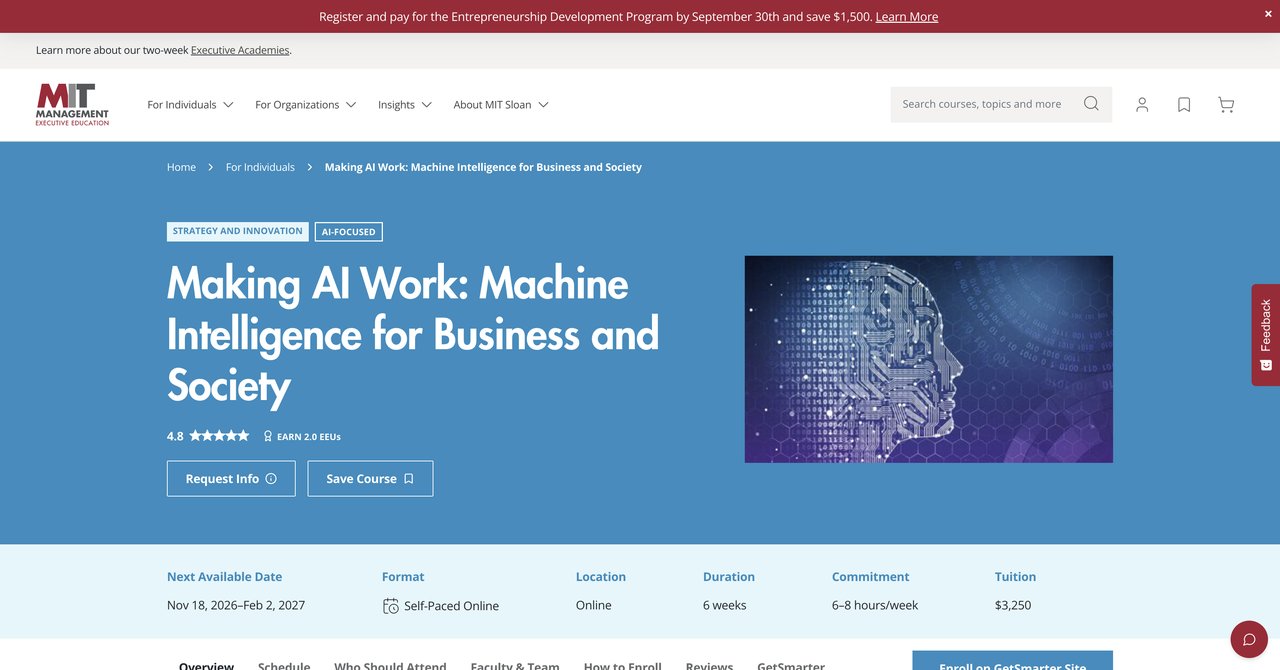
This course differentiates itself from other MIT courses because it reckons with the ideas of "robust" and "responsible" AI. It is designed to help you use a structured ML Deployment Framework they have got; the idea is to stop AI from doing things poorly and stop it from being reputational risk. Given the dual faculty of both Sloan (Business) and the College of Computing, you get a nice perspective compared to the programs that are more completely business focused.
For a Global Head of IT, you are already seeing the "rolling out AI responsibly" issue. This course gives you a structure to do it. It assumes you already have a strategic context. That is fine for most senior policymakers. It doesn't test technique: you will not be doing any coding. But if you are the one there responsible for design of the rollout, there are many great practices here.
Key Topics Covered: Using training on the ML Deployment, developing responsible AI systems, understanding the lifecycle of models and governance within that lifecycle.
Target Audience and Skill-Level Requirements: Senior tech leaders and strategy executives who want a solid but rigorous framework to the implementation and a dedication to responsibility and the business.
Pros:
- Specific focus on responsible, robust, and beneficial AI deployment.
- Proprietary ML Deployment Framework gives attendees a clear sequence to the to adopt back home.
- Taught jointly by business and computing faculties-rare and valuable.
Cons:
- No hands on coding.
- Assumes strategic context; not for complete novices.
Who would benefit most: Leaders who want to develop their company's MLOps or could use a defined deployment process. Useful immediately for the right to use complex, high regulated IT environments.
Course 10: AI for Executives: AI for Business Decision Making by Coursera
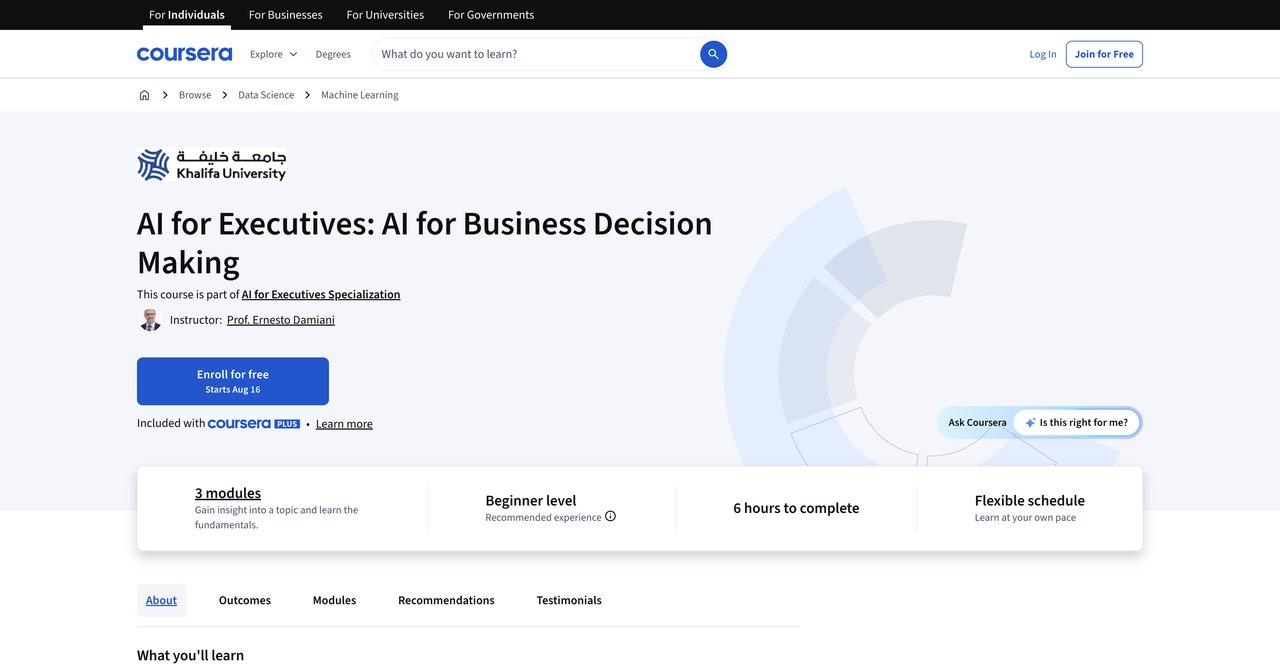
If you need an even quicker and no-cost way to get your mind around AI's application in business, this is hard to beat. This course nicely summarizes the main branches of AI: supervised, unsupervised, and reinforcement learning. It places them in a way that tells you how they apply to business. That alone is unlikely worth the price. It outlines a low-cost, high-level roadmap for an AI road-mapping on governance and human-in-the-loop steps.
Is this for the Head of IT? Perhaps not if the only thing is, but it can be an immediate option to use with your direct reports and other senior leaders. It really is a starter. The course is very short and does not go deep. If you're looking for substance for months, you'll be disappointed. But for a LinkedIn forward to the status that this is a useful conversation starter.
Key Topics: Algorithms and how they support decision-making, leadership AI roadmap, human-in-the-loop models.
Target Audience and Skill-Level Requirements: No prerequisites. It works best for new managers and those seeking a high-level overview.
Pros:
- Free (unless you pay for a certificate).
- Goes at a fast faster pace; usually can complete in just a few hours.
- Gives you basic governance models and human in the loop framework.
Cons:
- No serious technical depth.
- Short format; not a comprehensive avenue for your knowledge.
Who would benefit most: Good for setting a baseline at the start with your executive team. The MBA strap line "AI for Business" make you start an initiative without unlearning later.
Comparison and Overall Recommendations
Let's examine the ground truth. For a Global Head of IT, no single course covers the entire scope of the responsibilities. MIT delivers high-touch experience and relationships. Complete AI Training offers better value in terms of broad access and updated content. The best choice for you comes down to your specific starting points and work needs.
For a comprehensive, continuously updated learning base: CompleteAI Training is the most valuable. It will cost you a small portion of any of the MIT and University fees. If you need content or certifications across several job roles to onboard your direct reports and to boost the whole team's knowledge. It is a flat access model; you pay and have access. That just makes sense for a broad scope.
For executive presence and networking: MIT Sloan programs like "Leading the AI-Driven Organization" really deliver the kind of trajectory in communication. That is so expensive that it should be taken seriously for a one-off transition when you're moving to your next to the Board.
For risk and governance focus: The Microsoft Enterprise AI Governance certificate is the most practical set of frameworks that you can immediately adopt for compliance. It is extremely concrete, focused, and professional. Use it to start compliance, but understand it could be difficult if you have less than 3 years of risk/security experience.
For strategy and measurement: MIT's Leading AI Strategy program works well if you are constructing an AI portfolio further in the future. It is not a cheap experience, but if you have the sponsorship to see the benefit, it teaches a solid decision framework. Compare that with MIT's AI Adoption: they do not give you technical, but rather organizational methods that follow and marry the business with the IT.
For a career path to CTO: The Waterloo program (WatSPEED) with upGrad is a serious path for someone not just wanting context, but aiming at a career pivot into a CTO/AI role. It is a large amount of work and a serious long-term commitment. Use it if you are at mid-career.
Here is some of my take: A successful Global Head of IT might have a primary platform like the CompleteAI Training subscription for on-demand learning and current awareness. Combine it with a focused one-time governance and ethics certificate (like Microsoft's or one of the other strong courses from a university) when you have an immediate project to implement. Skip the "AI 101" unless you need to onboard a bunch of internal executives on. For the very highest level of leadership, invest in a live, immersive MIT course later when you are truly trying to change the org's culture and you put your money into personal development. Never underestimate the base of having a base that is up to date. That is why a subscription option covers this so well. The field is broad, so choose tools according to the time you have, and go on your own path.