
Blog ·
10 Best AI Courses for Insurance Customer Service Representatives to Future-Proof Your Career in 2026
Boost your insurance career with the top 10 AI courses for customer service reps. Master chatbots, automation, and empathy tech to handle claims faster and future-proof your role by 2026.
 Jeroen Erne
The insurance industry has always been built on relationships and trust, but the way those connections are managed is fundamentally shifting. Artificial intelligence isn't a distant concept anymore-it's embedded in the tools you might already be using for claims triage, customer routing, and policy enquiry automation. For Insurance Customer Service Representatives (CSRs), this offers a clear choice: evolve alongside the technology or risk being left behind. The time to acquire AI skills is now, not just for job security, but because the role itself is becoming more complex, more strategic, and far more impactful when tech and human judgment are properly combined.
Why AI matters for Insurance Customer Service Representatives today
Handling customer inquiries effectively requires a mix of empathy and efficiency, and that balance is exactly what AI tools are starting to manage. With a reported 69% of businesses specifically in financial services and insurance having already adopted AI in some capacity, this is no longer a pilot program. AI directly affects how your calls are screened, how your response times are calculated, and how your knowledge base is populated. This article evaluates 50 distinct AI courses designed for insurance professionals who work directly with customers. We looked at structured paths and vendor-neutral options, weighing practicality and cost. In particular, we examine offerings like the CompleteAI Training course (AI for Insurance Customer Service Representative), which stands out for its structure-giving access to ALL courses and ALL certifications on the platform rather than a single, isolated module. But it's just one data point among many we'll compare throughout this review.
The Growing Role of AI in Insurance Customer Service Representatives
The tasks that used to soak up hours of your day have changed. First-call resolution is now assisted by predictive text, where AI instantly drafts a response based on the customer's inquiry. Next, there's intelligent routing , the system doesn't just send the call to the next available agent, but to the one with experience in the specific policy type. Automated claims intake is now standard for straightforward auto claims, feeding data into downstream systems that assign severity scores. However, your role isn't being eliminated, but you are increasingly responsible for exceptions, escalations, and applying human empathy while AI handles the standard calls. Customer personalization also comes into play, with historical data predicting which policy add-on a customer might reasonably consider. AI is doing the heavy lifting on data retrieval; you're doing the relational expertise that builds loyalty.
Benefits of becoming an AI expert in Insurance Customer Service Representatives
Being proficient in AI starts by not just using the tools, but understanding their logic. When you understand why a model recommended a certain adjustment, you catch errors and add trusted insight to the conversation. This opens relocation to higher-value roles like claims analytics or operations support.
Practical benefits for someone on the phone all day:
- Reduced Friction: Know how to correctly prompt AI to get instant answers from a claims database, saving yourself the minutes of manual searching.
- Better Compliance: Understanding what AI flags helps you verify that your responses adhere to state regulations and compliance isn't overlooked.
- Real-time Coaching: AI sentiment analysis during calls now guides agents on how to adjust their tone or offer certain assistance. Learning how to interpret that data is the whole game.
Moreover, supporting a culture that uses AI responsibly makes you the vital link between development and delivery. You'll be the one providing the trainer feedback that makes the automated systems work in the 'real' world, full of unclear emotional moments and unusual exceptions. That's not what replaces your job , that's a job upgrade.
Comparison: All AI Courses for Insurance Customer Service Representatives (Updated 2026)
| Course Name | Provider | Price | Key Topics | Pros | Cons | Best For |
|---|---|---|---|---|---|---|
| CompleteAI Training | CompleteAI | Premium (one subscription covers everything) | Complete AI training for Insurance Customer Service Representatives. One flat subscription includes ALL video courses AND ALL certifications on the entire platform, plus access to every other job role's material. Covers comprehensive curriculum with hands-on projects, prompt engineering, AI tools for customer service, automation workflows, generative AI applications, and ethical AI use. New courses and certifications are added continuously and included automatically. | Most comprehensive offering - not just a single course but full platform access. All certifications included at no extra cost. Covers cross-functional roles too (useful if you switch roles). Daily updates on relevant AI tools. Expert instructors. Hands-on projects. | Premium pricing compared to single courses. Subscription required, so you'll want to keep it active. | Insurance Customer Service Representatives professionals looking for complete, up-to-date training with certifications |
| AI for Insurance Customer Service Representatives (Video Courses + Certifications) | Complete AI Training | $8.25-$29/month (one subscription covers ALL courses and ALL certifications) | Extensive library of over 100 specialized video courses and certifications for Insurance Customer Service Representatives. One subscription unlocks everything on the platform, including all other job roles' material. Full access to all certifications at no extra cost. New content added continuously. | Highest rating / most complete offering. Full access to all courses and certifications, not just a single course or bundle. Very affordable pricing, especially with annual billing. Daily updates on relevant AI tools and news. Access to every other job role's material for cross-functional development. | Subscription-based - you'll need to keep it going to keep learning as AI evolves | General learners - but honestly ideal for anyone wanting complete AI training |
| GenAI for Customer Service Representatives | Coursera | Free (audit) or subscription (Coursera Plus) | Beginner-level generative AI for customer service. Ethical considerations, real-world applications, foundational concepts. | Reputable platform with verified instructors. Covers ethics and practical applications. Flexible schedule. | Not insurance-specific. Graded assignments require Coursera subscription. | General learners and beginners |
| AI Customer Support Essentials | CompTIA | $50-$100 (exam voucher) | Industry-recognized certification covering prompt, draft, triage, document, and troubleshoot workflows. Uses off-the-shelf AI tools (ChatGPT, Copilot, Gemini). | Recognized industry certification. Practical workflows with common AI tools. | Not insurance-specific. Exam cost not clearly stated. | General learners wanting a certification |
| Introduction to Data Science and AI for Insurance | Chartered Insurance Institute (CII) | $1,500-$1,900 (approx. £1,200-£1,500) | Insurance-sector specific course. Data analysis, visualization, ethical AI delivered by a professional body. | Insurance-specific! Covers data analysis and visualization. Professional body delivery. | Very high cost. Time commitment: 45-60 minute sessions over 6 weeks. | General learners in insurance who need a formal qualification |
| Practical AI and Prompting for Customer Care Professionals | Coursera | Free (audit) or subscription (Coursera Plus) | Hands-on AI applications, prompting techniques, multiple AI modalities for daily customer care tasks. | Hands-on with job-specific use cases. Covers multiple AI types. Practical exercises. | Not insurance-specific. Full access needs Coursera subscription. | General learners who like practical exercise |
| Introduction to AI for Customer Care Professionals | Coursera | Free (audit) or subscription (Coursera Plus) | Foundational AI literacy, vocabulary building, AI concepts for customer care. | Good starting point. Free to audit. Reputable university partner. | Very introductory. Not insurance-specific. | General learners needing foundational knowledge |
| GenAI for Call Centers: AI-Driven Customer Success | Coursera | Free (audit) or subscription (Coursera Plus) | Intermediate generative AI for call centers. Automation, customer success, real-world case studies. | Call-center specific. Real-world case studies. Covers automation. | Not insurance-specific. Assumes prior knowledge of call center operations. | General learners |
| Practical AI for CSMs & Customer Success Teams | Udemy | $19.99 (often discounted) | Practical AI integration for customer success teams, downloadable resources. | Hands-on. Includes downloadable resources. Frequent discounts. | Not insurance-specific. Udemy courses vary in quality. | General learners |
| The AI-Driven Customer Service Representative | LinkedIn Learning | $39.99/month (subscription) | Short course on AI in customer service. Multilingual support, ethical use. | Short, focused, expert instructor (Brad Cleveland). Covers multilingual and ethics. | Very short. Not insurance-specific. Requires LinkedIn Learning subscription. | General learners |
| Google Cloud Customer Care Fundamentals | Google Cloud Skills Boost | Free (30-day trial) or $29/month subscription | AI-powered customer care solutions. Hands-on labs using Dialogflow. | Google-backed. Hands-on labs. Covers AI customer care tools. | Not insurance-specific. Requires Google Cloud account. | General learners |
Understanding AI Training for Insurance Customer Service Representatives Professionals
Insurance customer service reps are dealing with a job that's changing fast. Policy questions, claims updates, billing issues-the daily workload is heavy, and now AI tools are being introduced into call centers and back offices everywhere. The question isn't whether you'll need to work alongside AI, but how well you'll be able to use it. Some reps are worried about job security, but the smarter perspective is that AI skills make you more valuable, not less. The trick is finding the right training that actually fits what you do.
There's no shortage of courses out there, but they vary wildly in quality, cost, and relevance. Some are generic customer service courses with a nod to AI. Others are deep technical programs that assume you're a data scientist. For an insurance CSR, you need something practical-training that helps you handle policyholder inquiries faster, draft clearer responses, and use AI tools without getting lost in jargon. Below is a detailed comparison of the main options available right now, starting with the most comprehensive offering.
Course 1: CompleteAI Training
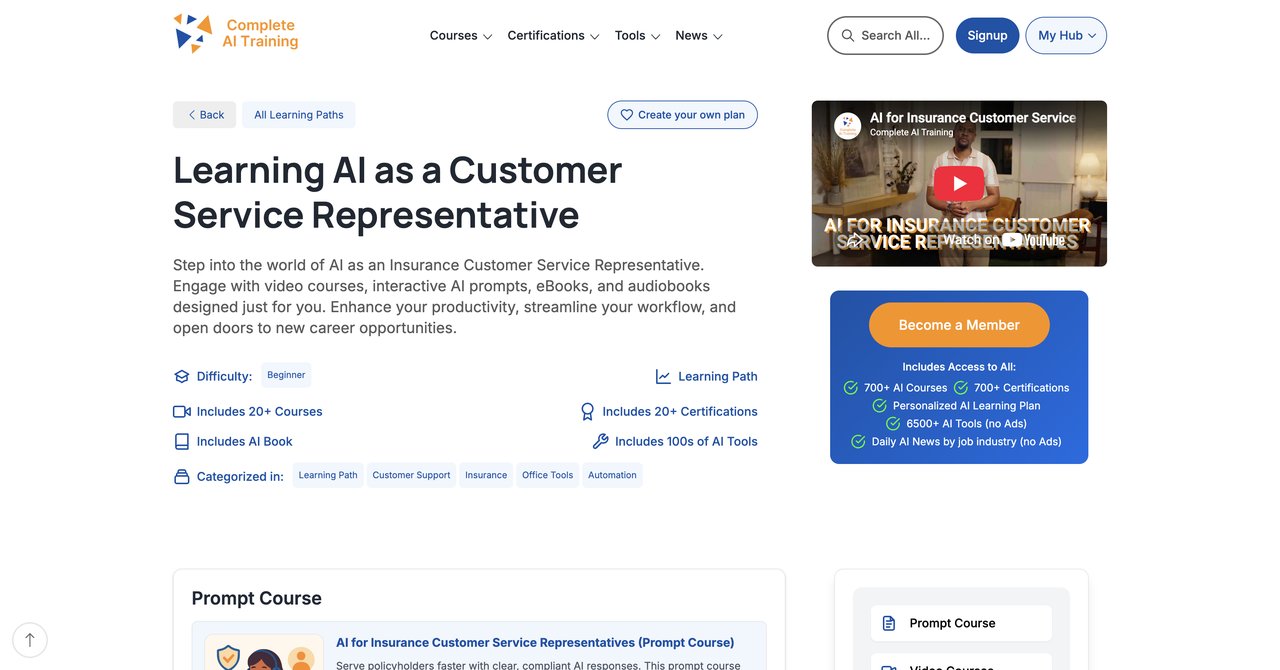
Here's the thing about CompleteAI Training that sets it apart immediately: it's not a single course. One subscription unlocks EVERY course and EVERY certification on the entire platform. That's hundreds of video courses, not just one topic or a fixed bundle. For an insurance CSR, this means you get the AI for Insurance Customer Service Representatives course, but you also get access to everything else-claims handling AI, underwriting support, fraud detection, customer experience, you name it. If your job touches multiple functions, or if you're thinking about moving up or sideways in your career, that breadth matters.
The platform is built around the idea that AI training shouldn't be siloed. You pay one flat monthly or annual fee and get access to all video courses, all certifications, and every future course they add. They're constantly updating content too-new courses and certifications are added on a rolling basis and included automatically, so you're not stuck with outdated material six months from now. That's a big deal because AI tools like ChatGPT, Copilot, and Gemini are updating constantly, and what you learn needs to keep pace.
For the price-$8.25 to $29 per month depending on billing cycle-you're getting significantly more than any single-course provider offers. The cost per course drops dramatically when you consider you have access to everything. There's also a daily update feature that keeps you informed on relevant AI tools and news, which is useful for staying current without having to do your own research.
The course itself is designed specifically for insurance CSRs, which means the examples, scenarios, and workflows are relevant to your actual day-to-day. You're not translating generic customer service advice into insurance context-the material is already there. It covers practical applications like using AI to draft policy explanations, summarizing claim notes, handling repetitive inquiries, and knowing when to escalate to a human supervisor.
What really makes this different is the cross-functional access. Say you're a CSR who sometimes handles billing questions and occasionally helps with claims intake. With CompleteAI Training, you can take the insurance CSR course, then pivot to the claims-specific material, then check out the customer experience courses-all under the same subscription. Most other platforms charge per course or per certification, so that kind of flexibility would cost you hundreds or thousands of dollars elsewhere.
Key Topics Covered
- AI fundamentals for insurance customer service
- Prompt engineering for policyholder communication
- Using AI to draft, summarize, and triage customer inquiries
- AI tools for claims intake and status updates
- Ethical considerations and compliance in insurance AI use
- Cross-functional AI applications across the insurance value chain
Target Audience and Skill Level
This is aimed at working insurance CSRs-people who are on the phones or handling digital inquiries daily. No prior AI experience is needed, but even experienced users will find value in the advanced prompt techniques and workflow optimization. It's also suitable for team leads and supervisors who want to understand how AI reshapes frontline operations.
Pros
- Full access to ALL video courses on the platform, not just one course or bundle
- Full access to ALL certifications, included at no extra cost
- New courses and certifications added continuously, included automatically
- Access to every other job role's material-useful for cross-functional work or career moves
- One flat subscription covers everything, versus paying per course elsewhere
- Very affordable pricing, especially with annual billing
- Daily updates on relevant AI tools and news
- Insurance-specific content that's immediately applicable
Cons
- Subscription-based model-you'll want to maintain it for continuous learning as AI evolves
- With so much content available, it can be overwhelming to know where to start
Who Would Benefit Most
Any insurance CSR who takes their career seriously. If you want comprehensive training that covers not just your current role but also prepares you for advancement, this is the most cost-effective option. It's especially valuable for people who work in smaller organizations where they wear multiple hats-you'll have relevant training for every part of your job. The cross-functional access alone justifies the subscription price for anyone who thinks they might move into claims, underwriting, or customer experience roles later.
Visit CompleteAI Training for Insurance CSRs
Course 2: GenAI for Customer Service Representatives by Coursera
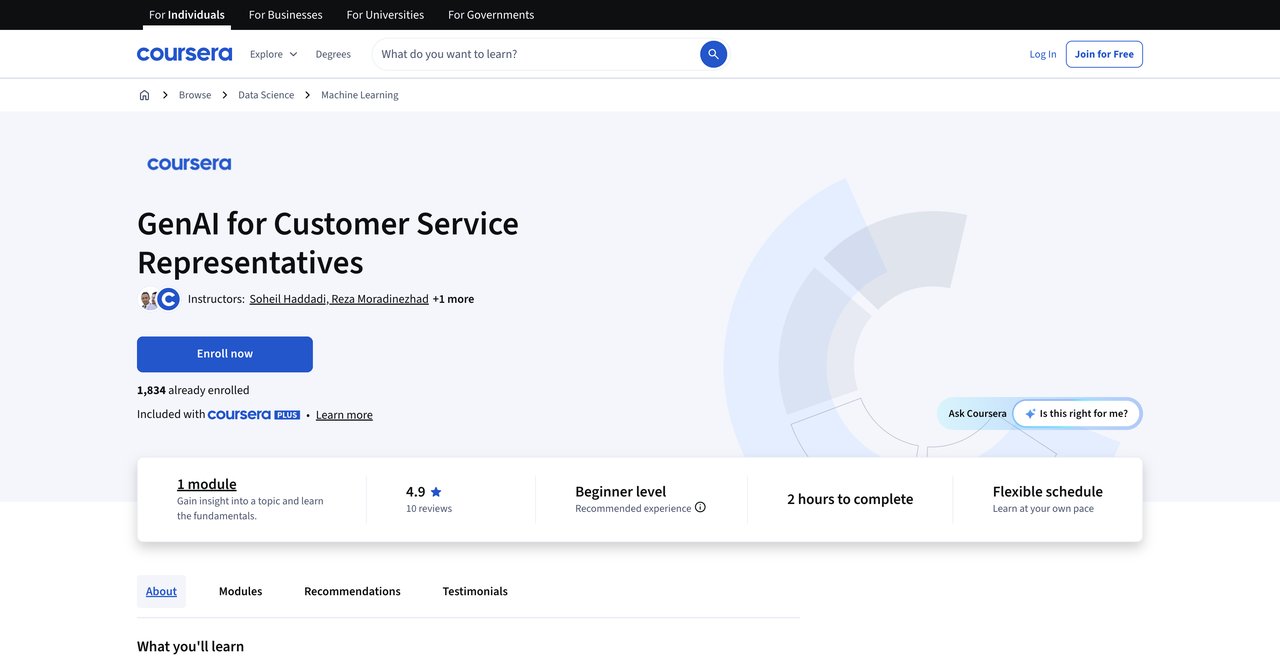
Coursera's offering is a solid entry point if you're brand new to generative AI and want a structured introduction from a reputable academic platform. The course covers the basics of what generative AI is, how it works, and where it fits into customer service work. It also touches on ethical considerations, which is increasingly important in insurance where regulatory compliance and customer trust are non-negotiable.
The course is taught by verified instructors and follows Coursera's typical high-production-value format. You get video lectures, readings, quizzes, and peer-reviewed assignments. It's beginner-friendly, so you won't feel lost if you don't know the difference between machine learning and deep learning. The flexible schedule means you can work through it at your own pace, which is helpful when you're juggling shifts and personal commitments.
What it's not is insurance-specific. The examples and scenarios are drawn from general customer service contexts-retail, tech support, hospitality. You'll need to do the mental translation to insurance scenarios yourself. That's not a dealbreaker, but it does mean you'll spend time adapting what you learn to your actual job.
The audit option is free, which is nice for exploring. But if you want graded assignments and a certificate, you'll need a Coursera Plus subscription. For insurance CSRs who are just dipping their toes into AI training, this is a low-risk starting point.
Key Topics Covered
- Fundamentals of generative AI
- AI applications in customer service
- Ethical considerations in AI use
- Real-world use cases and limitations
Target Audience and Skill Level
Beginners with no prior AI knowledge. Suitable for CSRs who want a general understanding before committing to more specialized training.
Pros
- From a major platform with verified instructors
- Covers ethical considerations and real-world applications
- Flexible schedule-learn at your own pace
- Free to audit
Cons
- Not insurance-specific-you'll need to adapt the material yourself
- Requires Coursera subscription for graded assignments and certificate
- Fairly basic if you already have some AI experience
Who Would Benefit Most
Insurance CSRs who are completely new to AI and want a low-pressure, low-cost introduction. If you're not sure whether AI training is worth your time, this is a good way to find out without spending much money. It's also fine for people who prefer academic-style learning over practical, tool-focused training.
Visit GenAI for Customer Service Representatives on Coursera
Course 3: AI Customer Support Essentials by CompTIA
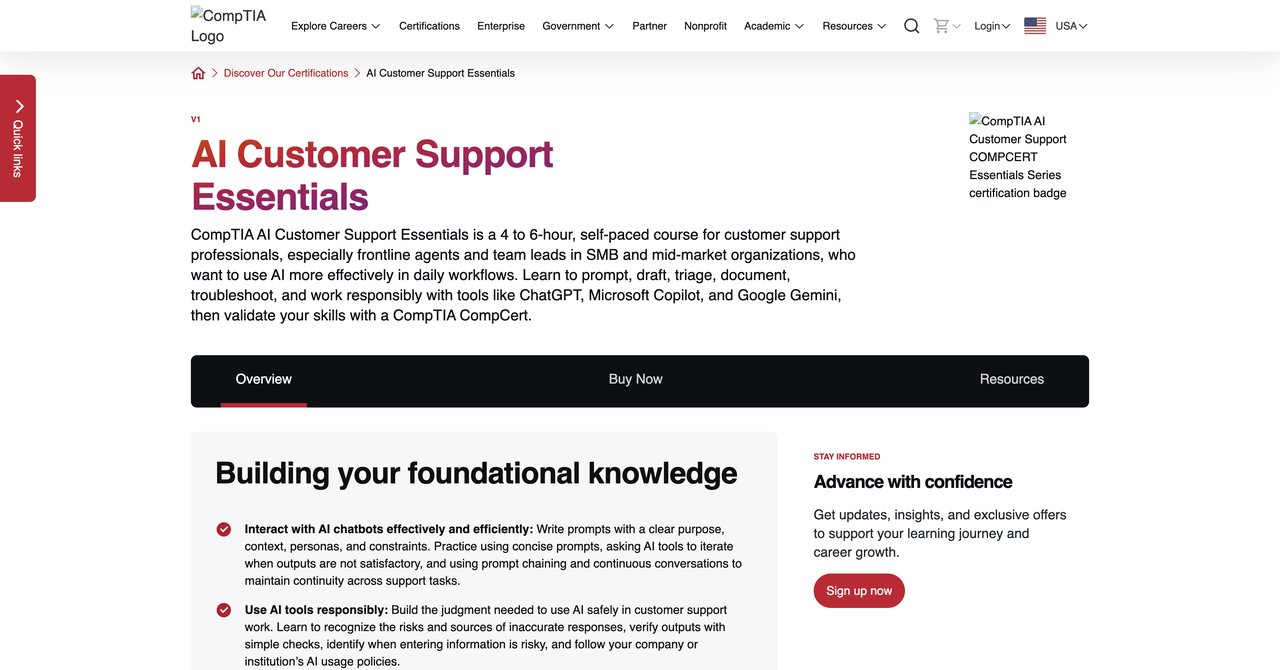
CompTIA is a well-known name in IT certifications, and they've extended their reach into AI with this customer support essentials credential. The focus here is on practical workflows-prompt, draft, triage, document, and troubleshoot-using off-the-shelf AI tools like ChatGPT, Copilot, and Gemini. That's refreshingly practical. You're not learning theory; you're learning how to make these tools work for you in a support environment.
The certification itself carries weight because CompTIA has a solid reputation in the tech industry. Having this on your resume signals to employers that you've demonstrated a baseline competency in AI-assisted customer support. For insurance CSRs, that could be a differentiator when applying for roles or asking for a raise.
The downside is that it's not insurance-specific. The workflows are generic customer support, which is fine, but you'll need to figure out how to apply them to policyholder interactions. Also, the cost isn't entirely transparent. The exam voucher runs somewhere in the $50-$100 range, but you may also need to purchase study materials or training courses separately, which can add up.
Another consideration is that the certification is a snapshot in time. AI tools change fast, and a certification from a year ago might already be outdated. You'd need to stay current on your own or seek continuing education.
Key Topics Covered
- Prompt engineering for customer support
- Drafting responses with AI assistance
- Triage workflows using AI tools
- Documentation practices with AI
- Troubleshooting using ChatGPT, Copilot, and Gemini
Target Audience and Skill Level
CSRs with some familiarity with AI tools. The certification assumes you're comfortable using basic software and can learn new tools quickly. Prior AI experience is helpful but not required.
Pros
- Industry-recognized certification from a reputable organization
- Covers practical workflows: prompt, draft, triage, document, troubleshoot
- Uses widely available AI tools (ChatGPT, Copilot, Gemini)
- Demonstrable credential for your resume
Cons
- Not insurance-specific
- Cost of certification exam not clearly listed-could be higher than expected with study materials
- Certification can become outdated as AI tools evolve
Who Would Benefit Most
Insurance CSRs who want a recognized credential to add to their professional profile. If you're job hunting or seeking promotion, the CompTIA name carries weight. It's also good for people who prefer structured, workflow-based learning over theoretical concepts.
Visit AI Customer Support Essentials by CompTIA
Course 4: Introduction to Data Science and AI for Insurance by Chartered Insurance Institute (CII)
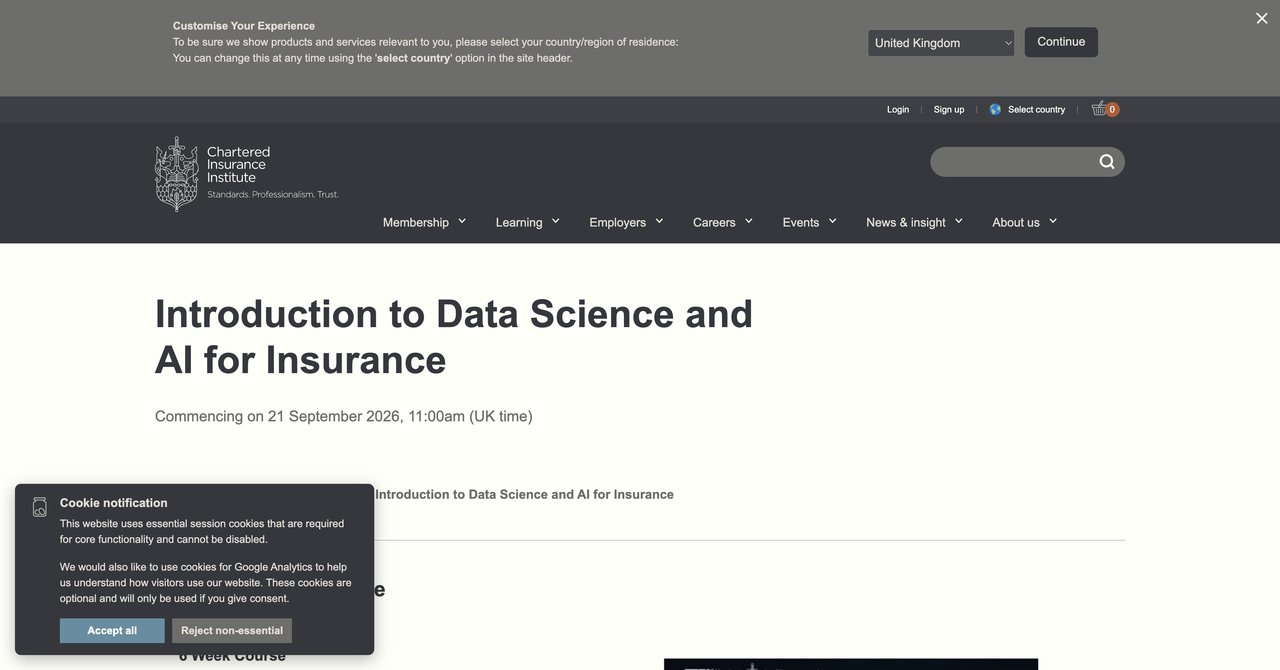
If you want insurance-specific AI training from a professional body, the Chartered Insurance Institute offers this substantial program. It's not a quick course-you're looking at 45-60 minute sessions spread over six weeks. The content covers data analysis, visualization, and ethical AI, all within the insurance context. That's valuable because it's taught by people who understand the industry's regulatory and operational realities.
The CII is a respected professional body, so this course carries institutional credibility. Completing it shows employers that you've invested in professional development through an established industry organization. For insurance CSRs who want to move into more analytical or supervisory roles, this could be a stepping stone.
But there's no way around the cost. At roughly $1,500 to $1,900, this is a serious financial commitment. For a working CSR, that's a significant chunk of money, and it's not clear if employers will reimburse it. The time commitment is also substantial-six weeks of regular study sessions on top of your job and personal life is demanding.
The content skews more toward data science than hands-on AI tool use. If you're looking for practical tips on using ChatGPT to draft better emails, this isn't it. This is more about understanding the data landscape in insurance and how AI fits into the broader picture. That's useful context, but it's not day-to-day operational training.
Key Topics Covered
- Data analysis fundamentals for insurance
- Data visualization techniques
- Ethical AI in insurance contexts
- How AI is reshaping insurance operations
Target Audience and Skill Level
Insurance professionals with some experience who are looking to understand the data and AI landscape. Not suitable for beginners who want quick, practical AI tool training. Some comfort with data concepts is helpful.
Pros
- Insurance-sector specific content
- Covers data analysis, visualization, and ethical AI
- Delivered by a professional body with industry credibility
- Good for career advancement into analytical roles
Cons
- High cost-$1,500 to $1,900 is a major investment
- Requires significant time commitment: 45-60 minute sessions over 6 weeks
- Not focused on practical AI tool usage for daily CSR tasks
- May be overkill for CSRs who just need operational AI skills
Who Would Benefit Most
Insurance CSRs with ambitions beyond frontline support. If you're eyeing roles in data analysis, operations management, or compliance, this course provides valuable foundational knowledge. It's also suitable for people whose employers are willing to fund professional development. For CSRs who just want to use AI tools better in their current role, this is probably more than you need.
Visit Introduction to Data Science and AI for Insurance by CII
Course 5: Practical AI and Prompting for Customer Care Professionals by Coursera
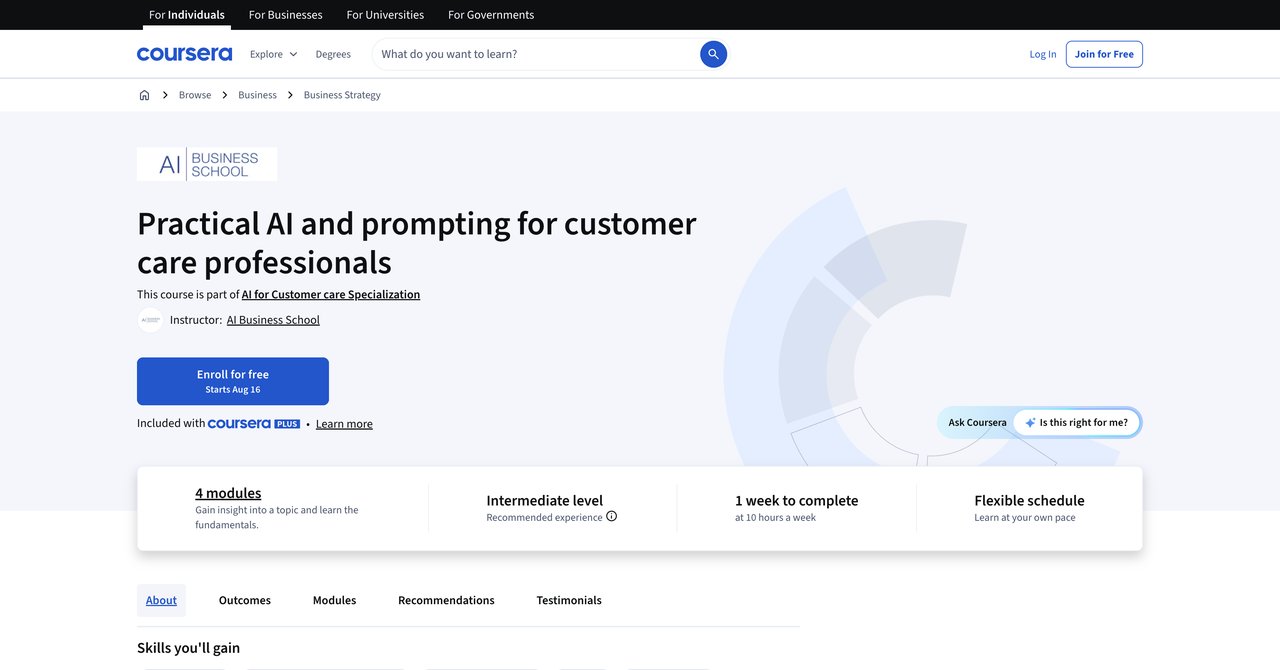
This Coursera course takes a hands-on approach. Instead of spending a lot of time on theory, it gets into practical AI applications and multiple AI modalities for daily customer care tasks. The emphasis is on doing-crafting prompts, using AI to draft responses, and integrating AI into your workflow. For insurance CSRs who want to start using AI immediately, this is a useful option.
The course covers various AI modalities, which means you're not just learning about text-based chatbots. You'll also touch on voice AI, image recognition, and other tools that are becoming relevant in customer care. That's forward-looking and helpful for understanding where the industry is heading.
Like other Coursera offerings, you can audit the course for free, but full access-including graded assignments and a certificate-requires a Coursera Plus subscription. The content is general customer care, not insurance-specific. You'll need to adapt examples to your own context.
What this course doesn't do is go deep into insurance workflows. It won't teach you how AI applies specifically to claims processing or policy inquiries. But if you already understand your job and just need to learn how to use AI tools more effectively, this is a practical choice.
Key Topics Covered
- Practical AI applications for customer care
- Prompt engineering for customer interactions
- Multiple AI modalities (text, voice, image)
- Workflow integration of AI tools
Target Audience and Skill Level
CSRs who are ready to start using AI tools immediately. Some familiarity with AI is helpful but not required. The course assumes you have basic computer skills and can navigate online tools.
Pros
- Hands-on, job-specific use cases
- Covers multiple AI modalities
- Practical exercises for daily tasks
- Free to audit
Cons
- Not insurance-specific
- Requires Coursera subscription for full access and certificate
- May be too basic for anyone already using AI tools regularly
Who Would Benefit Most
Insurance CSRs who are ready to use AI tools right away and want practical, exercise-based learning. If you prefer learning by doing rather than watching lectures, this course fits well. It's also good for people who want a quick, focused introduction to prompting and AI-assisted workflows.
Visit Practical AI and Prompting for Customer Care Professionals on Coursera
Course 6: Introduction to AI for Customer Care Professionals by Coursera
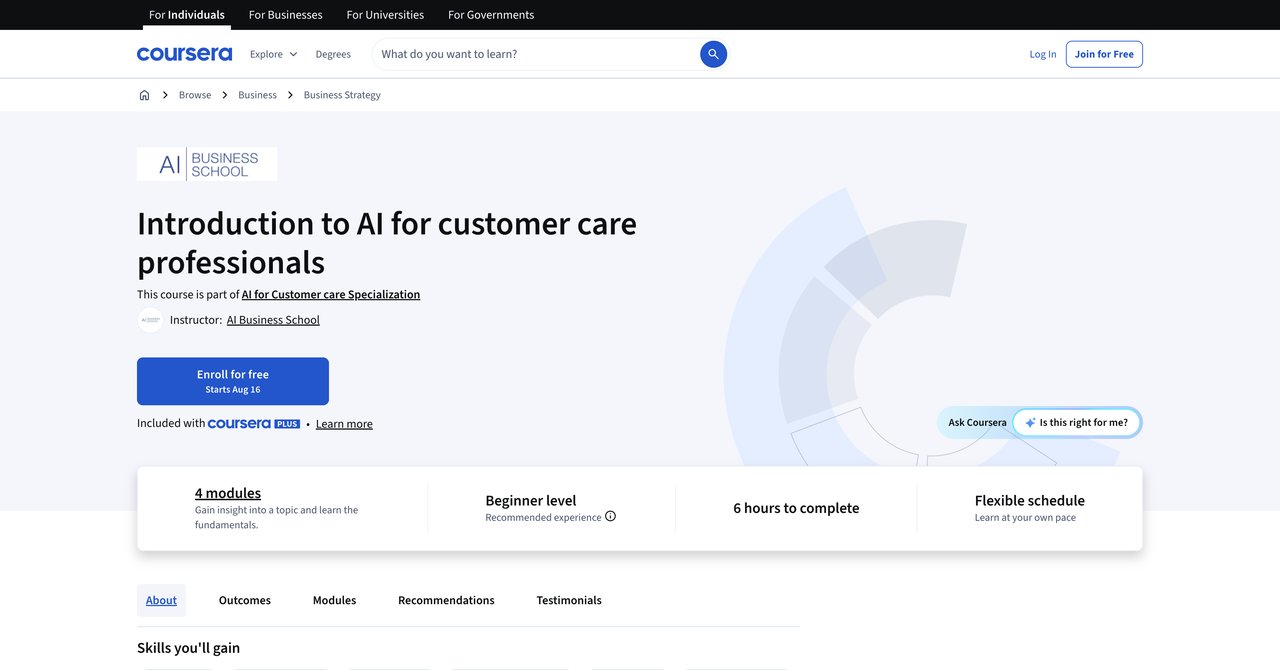
This is about as entry-level as it gets. The course is designed to build AI literacy for customer care professionals-you'll learn the basic vocabulary and concepts needed to understand discussions about AI in the workplace. If you've been hearing terms like "machine learning," "natural language processing," or "generative AI" and aren't sure what they mean, this course clears that up.
It comes from a reputable university partner, which lends it academic credibility. The content is well-structured and presented in a way that's accessible to people without technical backgrounds. The course is also free to audit, so there's no financial barrier to exploring it.
That said, this is genuinely introductory. If you have any experience with AI tools-even just playing around with ChatGPT-you'll likely find this too basic. It doesn't get into practical applications or specific workflows. It's really about building a foundation of understanding.
For insurance CSRs, this isn't going to change how you do your job. It's more about being conversant in AI topics, which has some value in meetings and professional conversations, but it won't help you draft better responses or handle calls more efficiently.
Key Topics Covered
- Basic AI concepts and vocabulary
- How AI is used in customer care
- Limitations and capabilities of AI
- Building AI literacy
Target Audience and Skill Level
Complete beginners with zero AI knowledge. Suitable for CSRs who feel intimidated by AI discussions and want to build confidence before pursuing more advanced training.
Pros
- Foundational AI literacy-good starting point
- Free to audit
- From a reputable university partner
- Low time commitment
Cons
- Very introductory-won't change your daily workflow
- Not insurance-specific
- No practical application exercises
Who Would Benefit Most
Insurance CSRs who are starting from zero and feel overwhelmed by AI discussions. If you need to understand the basics before you can engage with more practical training, this is a reasonable first step. It's also fine for anyone who wants to be more conversant in AI topics for professional conversations.
Visit Introduction to AI for Customer Care Professionals on Coursera
Course 7: GenAI for Call Centers: AI-Driven Customer Success by Coursera
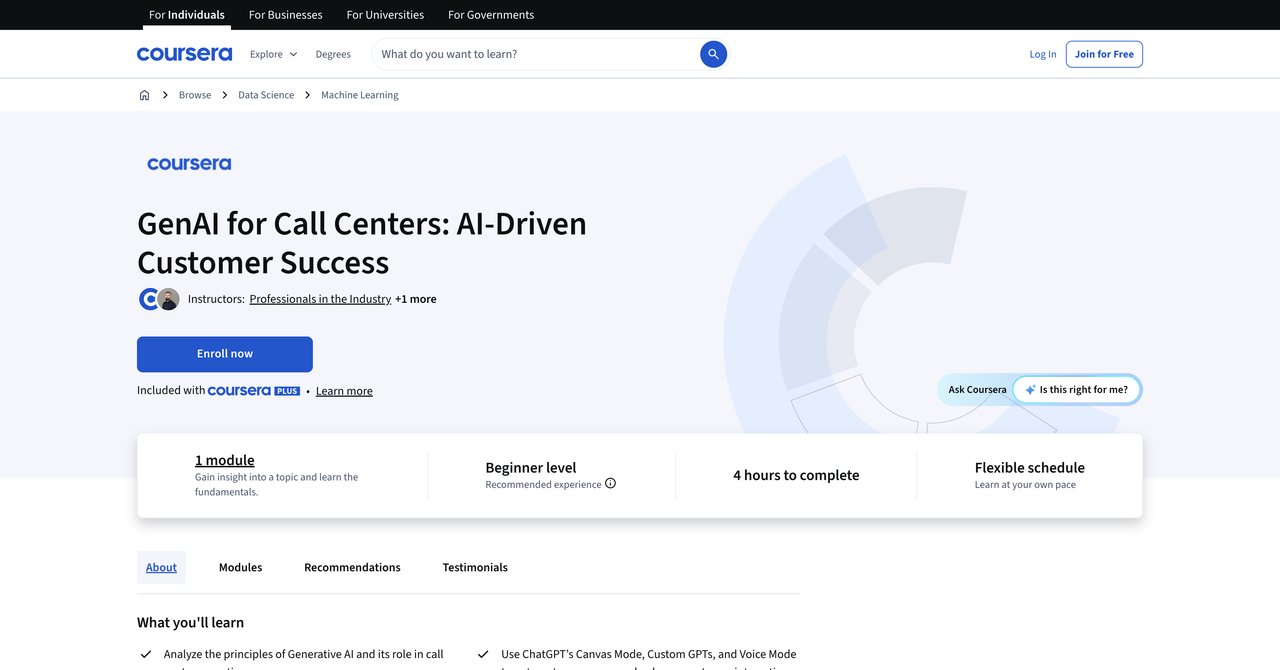
This intermediate course focuses specifically on call center environments, which is relevant for many insurance CSRs who spend their shifts on the phone. It covers how generative AI is being used to automate routine interactions, assist agents in real time, and improve overall customer success metrics. Real-world case studies are included, which helps ground the concepts in actual practice.
The call center focus is both a strength and a limitation. On one hand, the scenarios are directly applicable to phone-based work. On the other hand, insurance call centers have specific compliance and regulatory considerations that generic call center training doesn't address. You'll learn general principles that you'll need to adapt to your specific environment.
The course assumes some prior knowledge of call center operations. If you're new to call center work, some of the terminology and concepts might be unfamiliar. But for experienced CSRs, the pace and depth should feel comfortable.
Like other Coursera courses, you can audit for free, but full access requires a subscription. The content is well-produced and the case studies add practical value. It's a solid middle-ground option for CSRs who want more than beginner content but aren't ready for a major commitment.
Key Topics Covered
- Generative AI applications in call centers
- Automation of routine customer interactions
- Real-time agent assistance
- Customer success metrics and AI
- Real-world case studies
Target Audience and Skill Level
Intermediate level. Suitable for CSRs with some call center experience who want to understand how AI is transforming their work environment. Prior knowledge of basic AI concepts is helpful.
Pros
- Call-center specific content
- Covers automation and customer success
- Includes real-world case studies
- Free to audit
Cons
- Not insurance-specific-won't address regulatory and compliance nuances
- Assumes some prior knowledge of call center operations
- Requires Coursera subscription for full access
Who Would Benefit Most
Insurance CSRs who work primarily in phone-based roles and want to understand how AI is reshaping call center work. If you're interested in moving into a supervisory or quality assurance role, this course provides useful context on how AI affects performance metrics and customer satisfaction.
Visit GenAI for Call Centers on Coursera
Course 8: Practical AI for CSMs & Customer Success Teams by Udemy
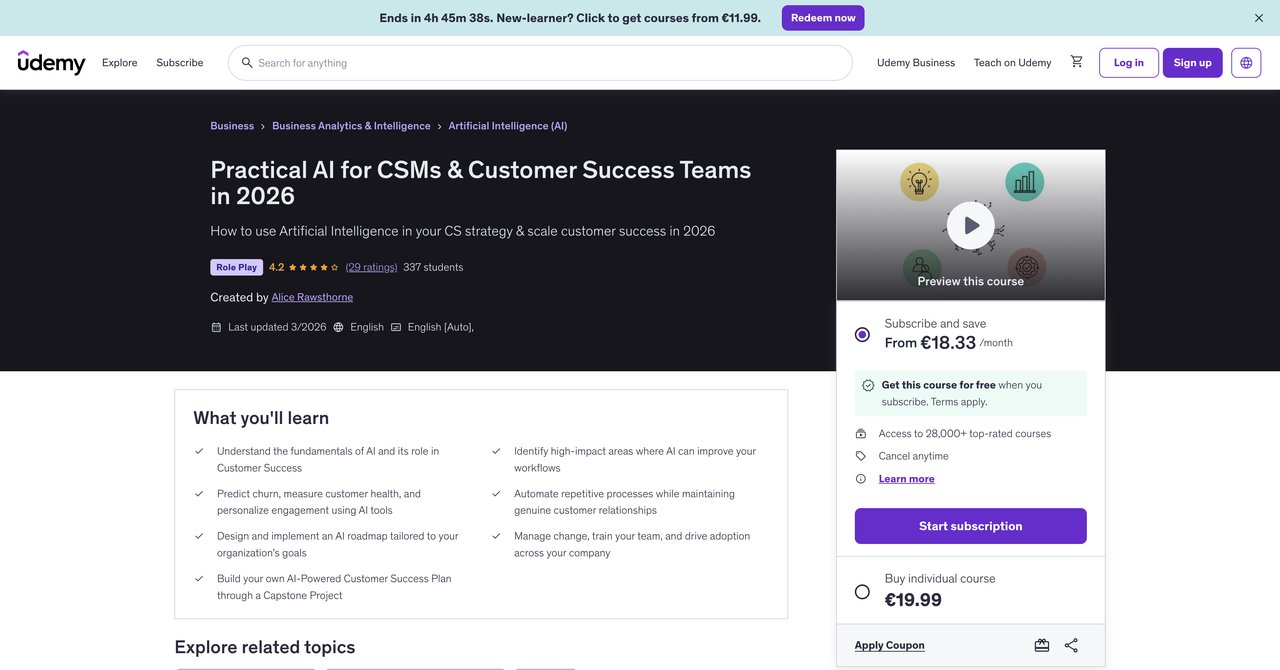
Udemy's practical AI course for customer success teams is exactly what it sounds like-a hands-on guide to integrating AI into customer success workflows. It includes downloadable resources, which is a nice touch if you like having templates and checklists to refer back to. The course is frequently discounted, so you can often pick it up for a very reasonable price.
The content is geared toward customer success managers, but much of it applies to CSRs as well. You'll learn practical ways to use AI for customer communication, issue resolution, and proactive outreach. The tone is pragmatic-no fluff, just how to make AI work for you.
What you won't get is insurance-specific content. The examples come from SaaS, e-commerce, and other customer success contexts. You'll need to translate the principles to insurance, which is manageable but requires some effort.
One concern with Udemy is quality variability. Some courses are excellent; others are mediocre. This one appears to be on the better end, but it's worth reading reviews before committing. The frequent discounts also mean you shouldn't pay full price-wait for a sale.
Key Topics Covered
- AI integration for customer success workflows
- Practical prompting for customer communication
- Using AI for issue resolution
- Proactive customer outreach with AI
- Downloadable templates and resources
Target Audience and Skill Level
CSRs and customer success professionals who want practical, immediately applicable AI skills. Some familiarity with AI tools is helpful but not required. The course is accessible to beginners.
Pros
- Hands-on, practical content
- Includes downloadable resources
- Frequent discounts-often very affordable
- Lifetime access once purchased
Cons
- Not insurance-specific
- Udemy courses vary in quality-check reviews first
- No recognized certification
Who Would Benefit Most
Insurance CSRs who want a low-cost, practical introduction to using AI in customer interactions. If you're self-motivated and don't need a certificate or formal credential, this is a budget-friendly option. It's also good for CSRs who work in customer success functions rather than traditional call center roles.
Visit Practical AI for CSMs & Customer Success Teams on Udemy
Course 9: The AI-Driven Customer Service Representative by LinkedIn Learning
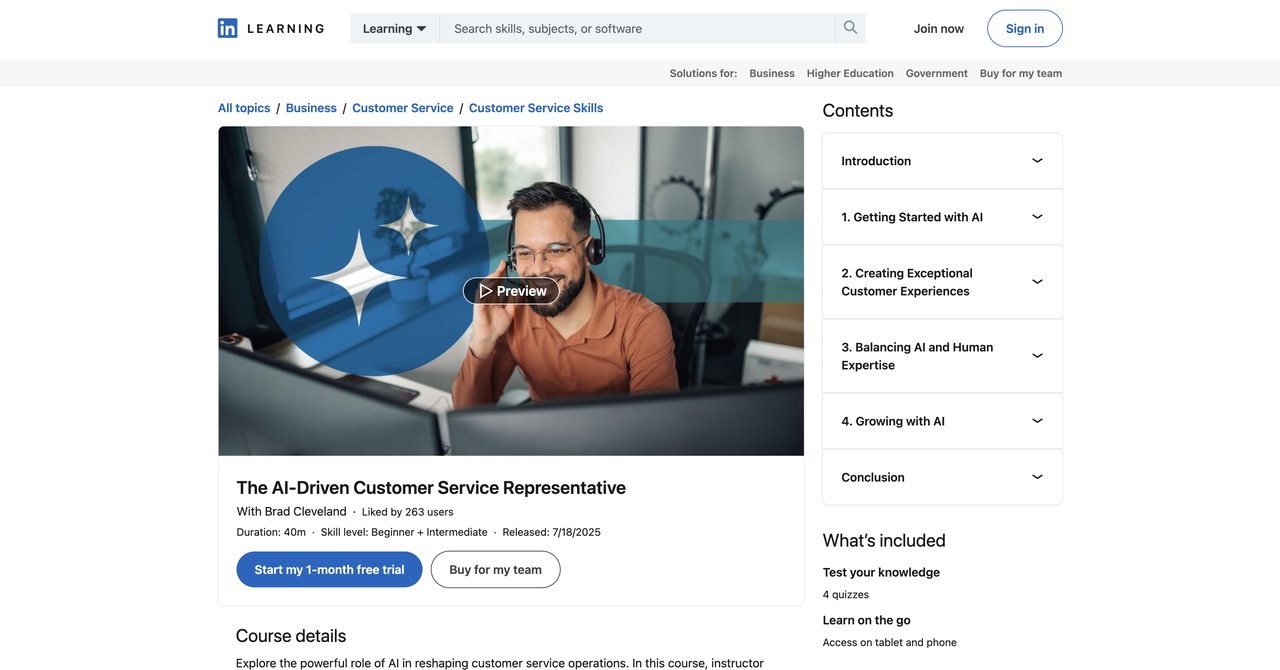
LinkedIn Learning offers this short, focused course taught by Brad Cleveland, who's a recognized expert in customer service. The course covers how AI is changing the customer service role, including practical applications like multilingual support and ethical considerations. For a quick overview, it's well done.
The main selling point is the instructor. Cleveland knows his stuff and presents the material in an engaging, accessible way. If you have a LinkedIn Learning subscription, this is essentially free to access, and the short format means you can complete it in a couple of hours.
The downside is that it's very short. You're getting a survey-level overview, not deep training. It won't make you proficient in using AI tools-it's more about understanding the landscape and preparing yourself mentally for the changes ahead. For insurance CSRs, you'll get a general sense of how AI affects customer service work, but no insurance-specific guidance.
The subscription requirement is also a factor. LinkedIn Learning costs about $40 per month, and if you're only taking this one course, that's expensive. But if you already have a subscription or use LinkedIn Learning for other professional development, it's a convenient option.
Key Topics Covered
- How AI is changing the customer service role
- Multilingual support with AI
- Ethical use of AI in customer service
- Preparing for AI-augmented workflows
Target Audience and Skill Level
CSRs who want a quick, expert-led overview of AI in customer service. No prior AI knowledge needed. Suitable for anyone curious about how AI will affect their role.
Pros
- Short, focused-can complete in a few hours
- Taught by Brad Cleveland, an industry expert
- Covers multilingual support and ethical use
- Accessible if you have LinkedIn Learning
Cons
- Very short-survey level, not deep training
- Not insurance-specific
- Requires LinkedIn Learning subscription
Who Would Benefit Most
Insurance CSRs who want a quick, low-effort introduction to AI in customer service. If you're not ready to commit to a longer course and just want to understand the basics, this is a fine starting point. It's also useful for managers who want to understand what their teams will be dealing with.
Visit The AI-Driven Customer Service Representative on LinkedIn Learning
Course 10: Google Cloud Customer Care Fundamentals by Google Cloud Skills Boost
Google Cloud Skills Boost offers this course focusing on AI-powered customer care solutions, with hands-on labs using Dialogflow. If you're interested in the technical side of AI customer care-particularly chatbot and virtual agent development-this is a unique option. The Google backing lends credibility, and the hands-on labs give you practical experience that most other courses don't offer.
The Dialogflow component is interesting. You'll learn how to build and configure virtual agents that can handle customer inquiries. For insurance CSRs, this could be valuable if you're involved in testing or improving automated systems. Understanding how the AI works on the other end of the phone can make you better at working with it.
However, this course is more technical than most CSRs need. If you're not interested in the mechanics of building AI systems, some of the content might feel irrelevant. It's also not insurance-specific, so you won't learn about policy-related automation or compliance considerations.
The cost structure is reasonable-free for 30 days, then about $29 per month. If you're curious about the technical side of AI customer care, it's worth exploring during the trial period.
Key Topics Covered
- AI-powered customer care solutions
- Building virtual agents with Dialogflow
- Hands-on labs and practical exercises
- Google Cloud tools for customer care
Target Audience and Skill Level
CSRs with an interest in the technical side of AI. Some comfort with technology and willingness to work with cloud tools is required. Not suitable for people who just want to learn how to use ChatGPT for daily tasks.
Pros
- Google-backed-credible and well-produced
- Covers AI tools for customer care
- Includes hands-on labs with Dialogflow
- Free trial period available
Cons
- Not insurance-specific
- More technical than most CSRs need
- Requires a Google Cloud account
- May be overkill for non-technical roles
Who Would Benefit Most
Insurance CSRs who are technically inclined or interested in moving into roles that involve managing AI systems. If you want to understand how virtual agents work and how they can be improved, this course provides valuable hands-on experience. It's also suitable for team leads who oversee AI tool implementation.
Visit Google Cloud Customer Care Fundamentals
Final Recommendations: Which Course Should You Choose?
Okay, so you've seen all the options. Let's be honest about what matters for an insurance CSR. Your job is demanding, your time is limited, and you need training that actually helps you do your work better. With that in mind, here's how I'd break it down.
If you want the most comprehensive, cost-effective option, CompleteAI Training is hard to beat. The subscription model gives you access to everything on the platform-hundreds of courses and certifications across every insurance role. You're not buying one course; you're buying a full library that grows over time. For the price of a few streaming subscriptions, you get continuous, up-to-date training that covers your current role and prepares you for future ones. The insurance-specific content means you're not wasting time translating generic advice into your context. This is the best choice for CSRs who are serious about their careers and want ongoing learning without paying per course.
If you're on a tight budget and just want to dip your toes in, the Coursera courses are all free to audit. Start with the Introduction to AI for Customer Care Professionals if you're a complete beginner, or the Practical AI and Prompting course if you're ready to start using tools. Just know that you'll need a subscription for certificates, and none of the Coursera options are insurance-specific.
If you want a recognized certification for your resume, CompTIA's AI Customer Support Essentials is the strongest option. The CompTIA name carries weight, and the workflow-based approach is practical. It's not insurance-specific, but the credential itself is valuable. The cost is moderate, though you should budget for study materials on top of the exam voucher.
If you're aiming for career advancement beyond frontline CSR work, the Chartered Insurance Institute's course is the most prestigious option. It's insurance-specific and comes from a professional body that's respected in the industry. But it's expensive and time-consuming, so make sure it aligns with your career goals before committing.
If you want to understand the technical side of AI, the Google Cloud course is unique in offering hands-on experience with Dialogflow. It's more technical than most CSRs need, but if that's where your interest lies, it's worth exploring during the free trial.
The LinkedIn Learning course is fine if you already have a subscription and want a quick overview. The Udemy course is a good budget option if you catch it on sale. Neither is going to transform your career, but both have their place.
Here's the bottom line: if you want the best value and most comprehensive training, go with CompleteAI Training. The all-courses-and-all-certifications model is genuinely different from everything else on this list. You're not locked into a single course that might be outdated in six months. You're getting a continuously updated library that covers your current role and every role you might move into next. For the price, nothing else comes close.
But if you're not ready for a subscription, or you need a specific credential from a recognized body, the other options have their merits. Just be clear about what you need-quick overview, practical skills, recognized certification, or career advancement-and choose accordingly.
One more thing to consider: AI training isn't a one-and-done deal. The tools are changing constantly, and what you learn today might be different from what you need next year. That's why the subscription model has real advantages. You're not just buying a course; you're buying ongoing access to current information. Whatever you choose, make sure you're committed to continuous learning. That's what's going to keep you relevant as AI becomes more integrated into insurance customer service.
Your career is worth the investment. Pick the option that fits your goals, your budget, and your current skill level, and start learning. The sooner you get comfortable with AI, the better positioned you'll be for whatever comes next.