10 Best AI Courses for Transportation Managers to Future-Proof Your Career in 2026
Master AI for logistics and stay ahead in 2026. Discover ten top courses covering predictive analytics, autonomous fleets, and smart routing—essential skills to boost efficiency and secure your career as a transportation manager.

Artificial intelligence is no longer a distant concept discussed in tech conferences or science fiction novels. It is here, it is operational, and it is quietly reshaping how entire industries function. For transportation managers, the shift is happening right now, not somewhere in the distant future. Companies are deploying AI to optimize delivery routes, predict fleet maintenance needs, and manage complex supply chains with a speed and accuracy that humans alone cannot match. The numbers tell a clear story: a recent survey found that 69% of businesses are already using AI in some capacity, and the transportation and logistics sector is among the most active adopters.
For the transportation manager, this creates a very real fork in the road. On one side, there is the path of continuing with familiar processes and hoping the wave of AI adoption doesn't disrupt the status quo. On the other side is the path of upskilling, learning how to work with these new tools, and positioning yourself as the person who can bridge the gap between traditional operations and intelligent automation. The job market is starting to reflect this too. Hiring managers are increasingly looking for candidates who understand AI concepts, can interpret data-driven insights, and know how to apply them to real-world transportation challenges. The professionals who take the time to learn these skills are not just future-proofing their careers; they are actively positioning themselves for the roles that are being created as AI becomes more embedded in daily operations.
This article exists for one reason: to help you find the right AI training. With so many courses available online, it is hard to know which ones actually deliver practical value for someone in your position. A generic AI course might teach you the theory, but it might not show you how to apply it to fleet management, route optimization, or supply chain coordination. That is why we have looked at the options and compared five specific AI courses that are relevant to transportation managers. We will break down what each one covers, how it fits into your busy schedule, and what you can expect to walk away with. One of the courses we will examine is CompleteAI Training, which stands out because it does not just give you a single course. Instead, it gives you access to all courses and all certifications on the platform, which is a different approach than most other providers.
Why AI matters for Transportation Managers today
The transportation industry runs on efficiency. Every decision, from which route a driver takes to when a vehicle gets serviced, has a direct impact on the bottom line. AI is changing how these decisions are made. Instead of relying on gut feeling or past experience alone, managers can now use AI to analyze patterns in traffic data, predict fuel consumption, and even anticipate when a truck is likely to break down before it actually happens. This is not about replacing the human judgment; it is about enhancing it with better information.
Adoption is already underway. A 2024 survey found that 69% of businesses are using AI in some form, and the transportation sector is among the leaders. Companies are using machine learning to optimize delivery schedules, computer vision to inspect vehicles, and predictive analytics to manage warehouse inventory. The result is that transportation managers who understand these technologies are becoming increasingly valuable to their employers. They are the ones who can ask the right questions, evaluate AI proposals, and implement solutions that actually work.
This is where the article comes in. The purpose here is to help you identify the best AI courses for your specific needs as a transportation manager. Not all AI training is created equal, and you need to know which ones will give you the most relevant skills for your day-to-day work.
The Growing Role of AI in Transportation Managers
AI is not just a single tool; it is a set of technologies that are being applied across many different parts of the transportation field. Here are some of the specific areas where AI is making a real difference:
- Route optimization: AI algorithms analyze traffic patterns, weather conditions, and delivery windows to suggest the most efficient routes in real time. This helps reduce fuel costs and improves on-time delivery rates.
- Predictive maintenance: By analyzing data from vehicle sensors, AI can predict when a truck or machine is likely to fail, allowing you to schedule maintenance before a breakdown happens and avoid expensive downtime.
- Demand forecasting: AI models can look at historical shipping data, market trends, and even seasonal patterns to predict future demand for transportation services. This helps with planning capacity and staffing.
- Warehouse automation: AI-powered robots and systems are increasingly used to sort packages, manage inventory, and move goods within warehouses, reducing the physical strain on human workers.
- Personalized customer experiences: AI can help you provide better updates to customers, predict their needs, and offer more accurate delivery windows, which improves overall satisfaction.
These applications are not just theoretical. They are being implemented right now by companies of all sizes. This means the workflows and tasks that transportation managers handle every day are changing. The manager who used to spend hours on the phone coordinating drivers now uses a dashboard that updates automatically. The manager who relied on spreadsheets to track inventory now uses an AI system that flags potential shortages before they happen. The role is not disappearing, but it is definitely evolving. Learning AI is about learning how to work alongside these tools effectively.
Benefits of becoming an AI expert in Transportation Managers
There are some clear, practical benefits for a transportation manager who takes the time to learn AI skills. First, there is the career advantage. Being able to put AI knowledge on your resume makes you stand out in a crowded job market. It shows you are forward-thinking and can handle the technical side of the industry. That can lead to more opportunities for promotion or new job offers.
Second, there is the efficiency gain. When you understand how AI works, you can use it to make your own job easier. You will know how to interpret the data it gives you, how to spot when the system is making a mistake, and how to integrate it into your existing processes. This can reduce the stress of managing a complex operation and free up your time for more strategic thinking.
Finally, there is the strategic value. Transportation managers who understand AI are better equipped to make long-term decisions about technology investments, vendor selection, and process changes. You will not just be a manager who uses AI; you will be the person who helps guide your organization's AI strategy. That is a valuable position to be in.
In the sections that follow, we will look at five specific AI courses that are relevant to your work as a transportation manager, including the Complete AI Training option, which offers full access to all its courses and certifications. We will look at what each course offers, what you will learn, and how it fits into your career goals.
Comparison: All AI Courses for Transportation Managers (Updated 2026)
| Course Name | Provider | Price | Key Topics | Pros | Cons | Best For |
|---|---|---|---|---|---|---|
| CompleteAI Training | CompleteAI | Premium (one subscription covers everything) | Comprehensive AI training for Transportation Managers. One subscription unlocks ALL video courses and ALL certifications on the platform, including access to every other job role's material. New courses and certifications are added continuously and are included automatically. Covers daily updates on the latest AI tools and curated industry news. | Full access to ALL video courses on the platform, not a single course or a fixed bundle. Full access to ALL certifications included at no extra cost. New courses and certifications added continuously and included automatically. Access to every other job role's material too. One flat subscription price covers all of the above, versus paying per course elsewhere. Very affordable pricing, especially with annual billing. Daily updates on relevant AI tools and news. | Subscription based, crucial for continuous learning as AI is developing continuously. | Transportation Managers professionals looking for complete training and ongoing access to all content. |
| AI for Transportation Managers (Video Courses + Certifications) | Complete AI Training | $29/month or $8.25/month billed annually | Complete AI Training provides an extensive library of over 100 specialized video courses and certifications tailored specifically for Transportation Managers. One subscription unlocks ALL video courses and ALL certifications on the platform, including access to every other job role's material. New courses and certifications are added continuously and are included automatically. This is a subscription-based platform, not a single course, offering comprehensive AI education with daily updates on the latest AI tools and curated industry news. | Full access to ALL video courses on the platform, not a single course or a fixed bundle. Full access to ALL certifications on the platform, included at no extra cost. New courses and certifications are added continuously and are included automatically. Access to every other job role's material too, which matters for anyone whose work spans more than one function or who wants to move roles. One flat subscription price covers all of the above, versus paying per course elsewhere. Very affordable pricing, especially with annual billing. Daily updates on relevant AI tools and news. | Subscription based, crucial for continuous learning as AI is developing continuously. | General learners |
| AI for Transportation: From Concepts to Implementation | MIT Learn | $100 | Real-world AI applications in transportation, including platform crowding prediction and bus schedule improvement. Emphasizes data quality and human judgment alongside algorithms. No coding required. | Covers real-world applications like platform crowding prediction and bus schedule improvement. Emphasizes data quality and human judgment alongside algorithms. Self-paced and requires no coding. | Short duration may limit depth. Single-week format may not suit those wanting extended case studies. | General learners |
| AI and Sustainability: Transportation | MIT Learn | $100 | Using AI for greener transportation, including route and schedule planning, predicting rider demand, and understanding airport delays. Self-paced and accessible. | Focuses on using AI for greener transportation, including route and schedule planning. Covers predicting rider demand and understanding airport delays. Self-paced and accessible. | Narrow focus on sustainability may not cover broader operational AI use cases. Limited duration. | General learners |
| Generative AI for Transportation Analyst and Managers | Udemy | Subscription or one-time purchase (varies; check site) | 1000+ prompts specifically for transport planning, covering zero-shot, one-shot, and few-shot prompting techniques. Tailored for logistics managers and analysts. | Includes 1000+ prompts specifically for transport planning. Covers zero-shot, one-shot, and few-shot prompting techniques. Tailored for logistics managers and analysts. | Short course length may not cover advanced AI concepts. Limited to prompt engineering rather than broader AI applications. | General learners |
| The AI-Driven Supply Chain Manager | LinkedIn Learning | Subscription (LinkedIn Learning) | AI for inventory management, logistics streamlining, and cost reduction. Taught by industry expert Daniel Stanton. | Concise and practical. Covers AI for inventory management, logistics streamlining, and cost reduction. Taught by industry expert Daniel Stanton. | Very short duration limits depth. Focused on supply chain broadly rather than transportation-specific nuances. | General learners |
| Professional Certificate in Artificial Intelligence (Logistics) | Singapore Institute of Purchasing and Materials Management (SIPMM) | Unknown (contact provider) | Practical logistics AI including freight operations, shipment visibility, and route optimization. Includes cold chain control and logistics risk management. Offers a professional certificate and CoC opportunity. | Focuses on practical logistics AI including freight operations, shipment visibility, and route optimization. Includes cold chain control and logistics risk management. Offers professional certificate and CoC opportunity. | Requires in-person or virtual attendance on a fixed schedule. Pricing not publicly listed. | General learners |
| Generative AI Application for Supply Chain Professionals | Supply Chain and Logistics Institute (Georgia Tech) | Unknown (contact provider) | Ethical AI use and good vs. bad GenAI practices, including route optimization and emerging use cases. From a leading logistics institute. | Covers ethical AI use and good vs. bad GenAI practices. Includes route optimization and emerging use cases. From a leading logistics institute. | Duration and pricing not publicly listed. May require contacting provider for enrollment details. | General learners |
| AI in Transportation: Route Demand Analysis | Stanmore UK | £140 (Fast Track) or £90 (Standard Mode) - approximately $178 or $114 USD | Machine learning for route optimization, deep learning for traffic prediction, and GIS in route analysis. Includes real-world case studies and practical exercises. | Covers machine learning for route optimization, deep learning for traffic prediction, and GIS in route analysis. Includes real-world case studies and practical exercises. Ideal for logistics managers and planners. | Focused specifically on route demand, not broader transportation management topics. Provider is less well-known than major platforms. | General learners |
| Graduate Certificate in AI for Urban Transportation Systems | Stanmore UK | £140 (Fast-track) or £90 (Standard mode) - approximately $178 or $90 USD | Urban transportation AI applications. Online and flexible. Admission open for 2026. | Focuses on urban transportation AI applications. Online and flexible. Admission open for 2026. | Limited information on curriculum specifics. Less established provider compared to major universities. | General learners |
| The AI-Driven Supply Chain: Advanced Training for Next-Gen Leaders | MIT Center for Transportation and Logistics | $6,000 | Comprehensive framework for AI-driven supply chain leadership. Developed from MIT's elite Supply Chain Management Master's program. | Developed from MIT's elite Supply Chain Management Master's program. Intensive in-person format. Provides a comprehensive framework for AI-driven supply chain leadership. | High cost. Requires on-campus attendance in Cambridge, MA. Limited to one week. | General learners |
Understanding AI Training for Transportation Managers Professionals
Transportation managers are under constant pressure to optimize routes, control costs, improve delivery times, and make sense of massive amounts of operational data. AI is increasingly the tool that separates good logistics operations from great ones. But knowing which AI course to invest in can be just as challenging as the job itself. The options range from affordable subscription platforms to expensive university certificates, and everything in between.
This guide breaks down ten AI courses designed for transportation managers, from complete beginners to seasoned professionals looking for advanced training. I have looked at the content, the price, the format, and the real-world applicability of each option. Whether you are looking for a quick overview or a deep dive into machine learning, there is something here for you. The goal is to give you a clear picture of what each course offers, what it costs, and who it is actually for, so you can make the best choice for your career and your budget.
Course 1: CompleteAI Training
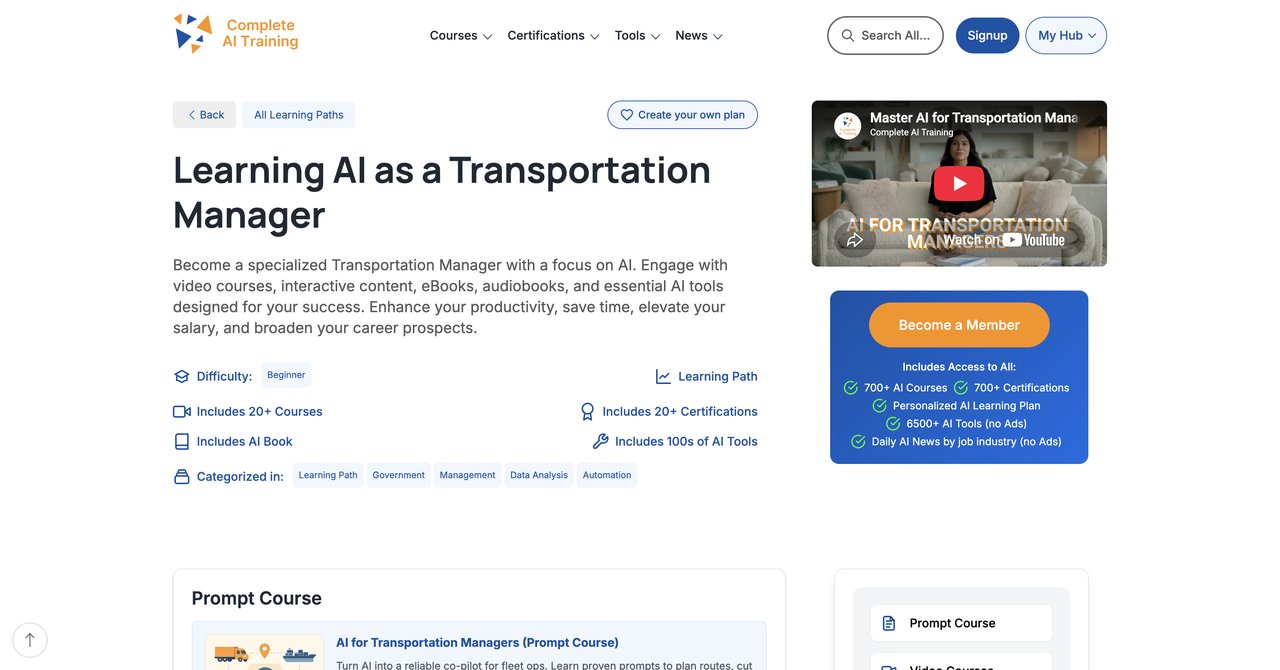
CompleteAI Training is not a single course. It is a full subscription platform that gives you access to every single video course and every single certification the platform offers. With one flat subscription price, you get everything, including all the material for every other job role on the platform, not just transportation managers. This is a completely different model from the other options in this list, where you typically pay per course or per certificate.
This platform is built for continuous learning, which is essential because AI is developing so quickly. The subscription includes over 100 specialized video courses and certifications, and new ones are added all the time. If you are a transportation manager whose work overlaps with supply chain, logistics, or operations, having access to all of that material is a major advantage. You are not locked into a single topic, and you can move between roles or functions without buying new courses.
The pricing is simple: $29 per month, or $8.25 per month if you pay annually. That is a fraction of the cost of most individual courses, and it covers everything on the platform. They also send daily updates on AI tools and curated industry news, which keeps you current even after you finish a course. For transportation managers who want to stay ahead of the curve without constantly paying for new courses, this is a solid option.
Key Topics Covered:
- AI fundamentals and practical applications
- Transportation-specific AI use cases
- Prompt engineering and generative AI
- Data-driven decision making
- Continuous updates on new AI tools and news
Target Audience and Skill Level: This is suitable for all levels, from beginners to advanced professionals. The platform offers courses that cover the basics, as well as more complex topics for those who want to go deeper. Because you get access to all job role material, it is also great for people who work across multiple functions.
Pros:
- Full access to ALL video courses on the platform, not a single course or a fixed bundle
- Full access to ALL certifications on the platform, included at no extra cost
- New courses and certifications are added continuously and are included automatically
- Access to every other job role's material too, which matters for anyone whose work spans more than one function or who wants to move roles
- One flat subscription price covers all of the above, versus paying per course elsewhere
- Very affordable pricing, especially with annual billing
- Daily updates on relevant AI tools and news
Cons:
- Subscription based, crucial for continuous learning as AI is developing continuously
Who Would Benefit Most: This is best for transportation managers who want a broad, ongoing education in AI without breaking the bank. If you like to learn at your own pace and want to explore topics outside of your immediate job description, this platform gives you that freedom. It is also great for those who value having the latest information and want a single source for all their AI learning needs.
Course 2: AI for Transportation: From Concepts to Implementation by MIT Learn
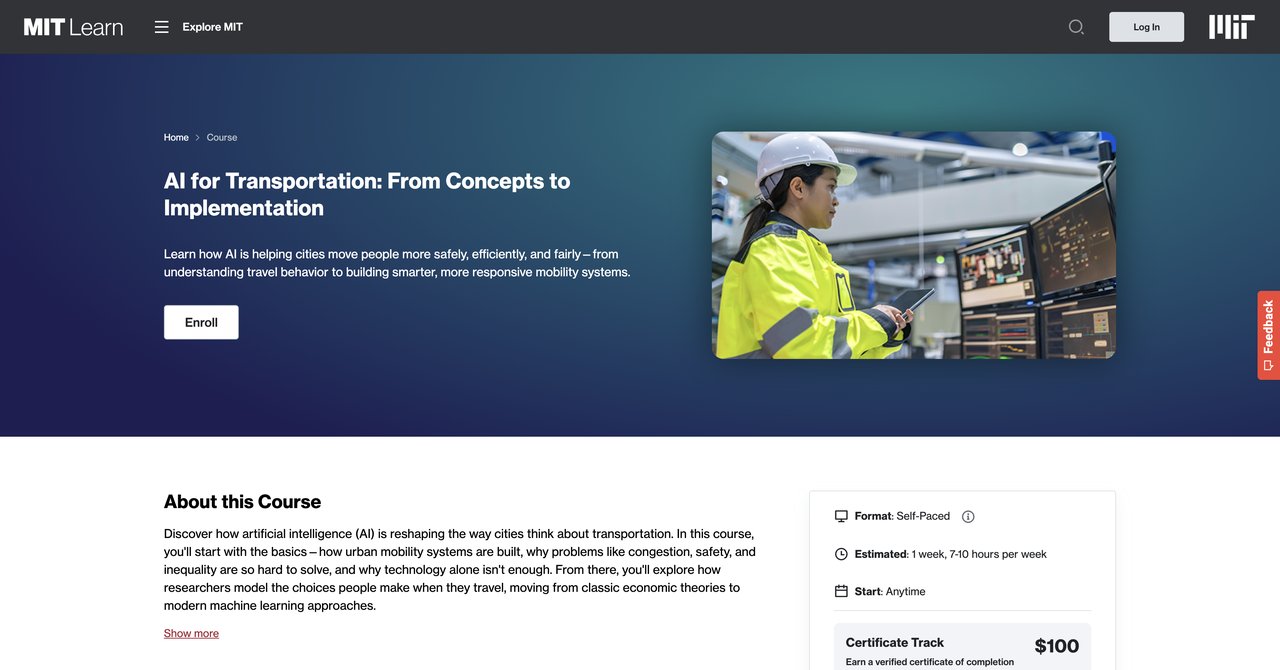
MIT Learn offers a self-paced beginner course that looks at real-world AI applications in transportation. The focus is on practical scenarios like platform crowding prediction and bus schedule improvement, which makes the content relatable to people who work in transit and logistics. It does not require any coding, which makes it more accessible to managers who are not technical.
The course emphasizes data quality and human judgment, which is a strong point. Many AI courses focus only on the algorithms, but this one reminds you that good data and human oversight are just as important. It is a short course, so it won't take up a huge amount of your time, but it also means the topics are not explored in great depth.
This is a good starting point for someone who is new to AI and wants to see how it is being used in transportation. The $100 price tag is reasonable, and the MIT name carries some weight. However, if you are looking for a comprehensive program, this is more of an introduction than a full training.
Key Topics Covered:
- Platform crowding prediction
- Bus schedule improvement
- Data quality and human judgment in AI
- Real-world AI applications in transportation
For Audience and Skill Level: This is a beginner course. It is designed for people who have no coding experience and want to understand the basics of AI in a transportation context. It is also good for transit managers, urban planners, and logistics professionals who want to see how AI can be used in their field.
Pros:
- Covers real-world applications like platform crowding prediction and bus schedule improvement
- Emphasizes data quality and human judgment alongside algorithms
- Self-paced and requires no coding
Cons:
- Short duration may limit depth
- Single-week format may not suit those wanting extended case studies
Who Would Benefit Most: This course is ideal for someone who is curious about AI but has no technical background. If you work in public transit or urban transportation and want to understand how AI can solve specific problems, this is a gentle introduction that won't overwhelm you. It is also good for managers who need to speak intelligently about AI with their teams.
Course 3: AI and Sustainability: Transportation by MIT Learn
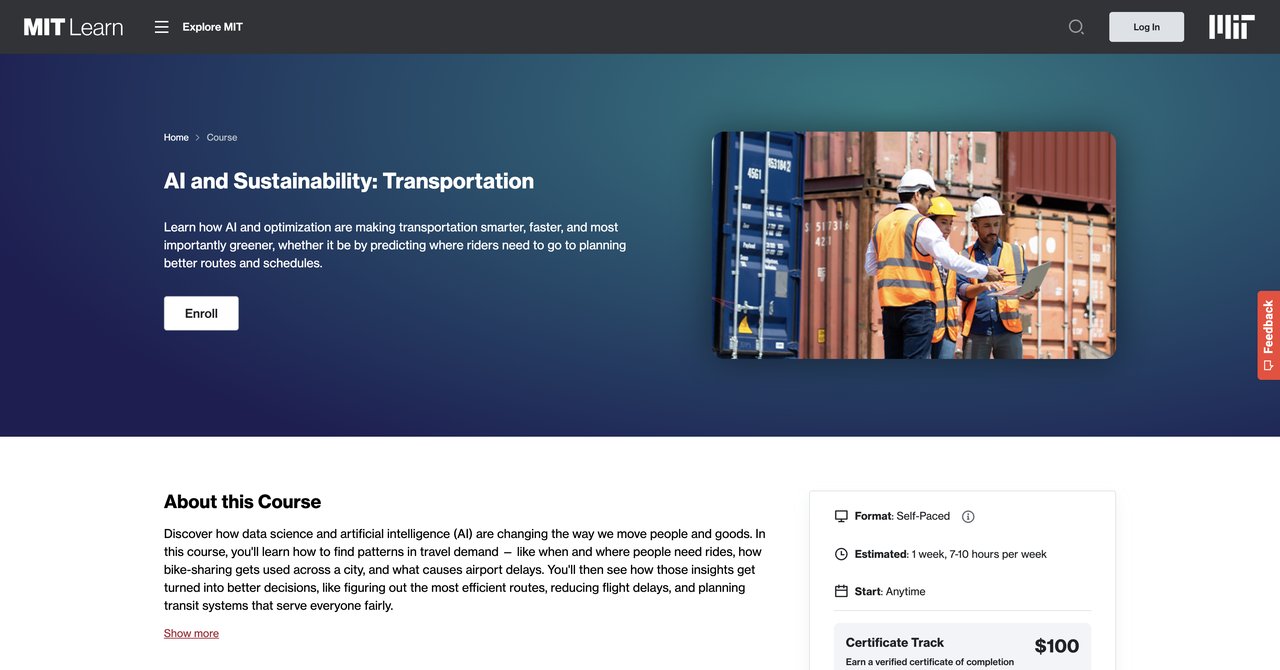
This is another beginner-level course from MIT Learn, and it focuses on the intersection of AI and sustainability in transportation. The course covers route and schedule planning with a focus on reducing emissions, predicting rider demand, and understanding airport delays. It is a self-paced course that is accessible to those without a technical background.
The sustainability angle is a differentiator. Many courses cover AI for efficiency or cost reduction, but this one looks at how AI can make transportation greener. That is becoming an important topic for many organizations, as they face pressure to reduce their carbon footprint. The course is well-structured and the content is relevant to the current challenges in the industry.
The downside is that the focus is quite narrow. If you are looking for a general AI course that covers a wide range of transportation topics, this one may feel too specific. It is also a short course, so the depth is limited. But for a specific need, it is a good option at a $100 price point.
Key Topics Covered:
- Route and schedule planning for sustainability
- Predicting rider demand
- Understanding airport delays
- Green transportation and AI
Target Audience and Skill Level: This is a beginner course, and it is designed for people who are interested in sustainability and AI. It requires no coding, and it is suitable for transportation managers, sustainability officers, and public sector employees.
Pros:
- Focuses on using AI for greener transportation, including route and schedule planning
- Covers predicting rider demand and understanding airport delays
- Self-paced and accessible
Cons:
- Narrow focus on sustainability may not cover broader operational AI use cases
- Limited duration
Who Would Benefit Most: This course is for transportation professionals who have a specific interest in sustainability and want to use AI to make their operations greener. It is also a good fit for anyone working in government or public transport who is responsible for environmental goals.
Course 4: Generative AI for Transportation Analyst and Managers by Udemy
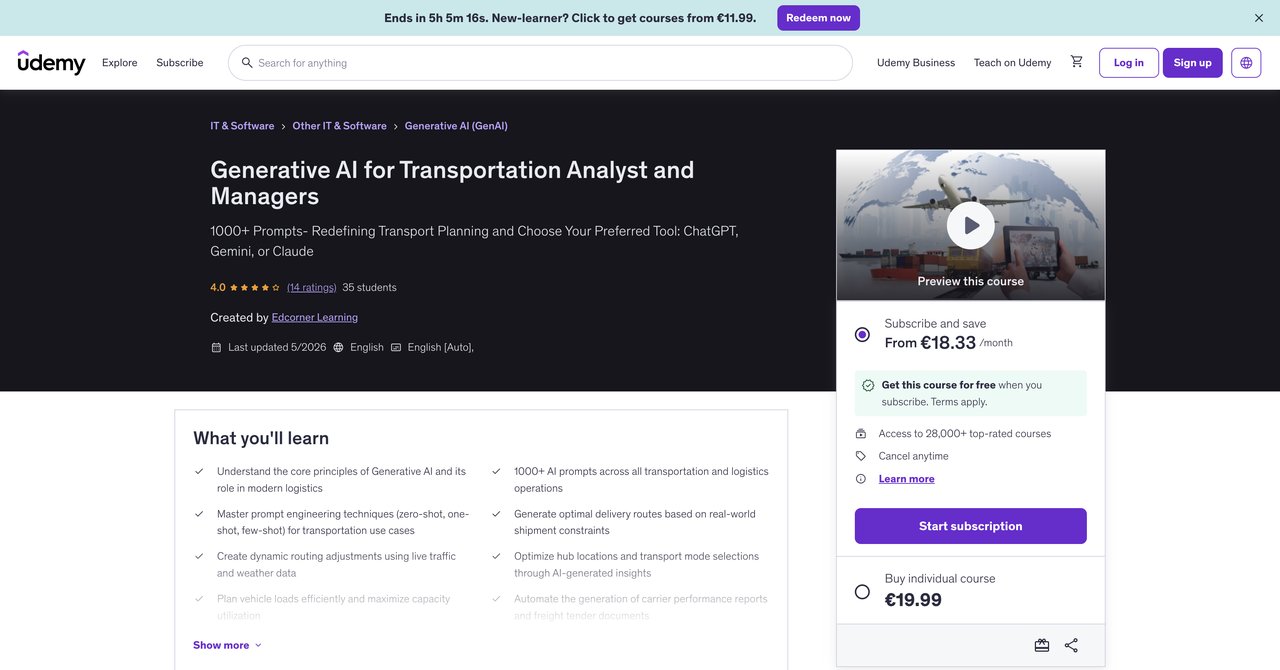
Udemy offers this course focused on generative AI for transportation analysts and managers. It includes over 1000 prompts specifically for transport planning, which is a practical resource that you can use immediately. The course covers zero-shot, one-shot, and few-shot prompting techniques, which are important skills for getting useful outputs from large language models.
This course is tailored for logistics managers and analysts who want to use AI in their daily work. It is a beginner course, but it focuses on prompt engineering rather than the broader AI applications. That means it is more about how to talk to AI tools than about the underlying technology. It is a practical skill, but it is not a comprehensive AI education.
The course is relatively short, which is both a pro and a con. It is a quick way to learn how to use generative AI, but it does not go deep into other aspects of AI. The price is also variable, depending on Udemy's pricing model, but it is generally affordable. If you want to improve your prompt writing skills, this is a useful course.
Key Topics Covered:
- 1000+ prompts for transport planning
- Zero-shot, one-shot, and few-shot prompting techniques
- Generative AI applications in logistics
- Practical use of large language models
For Audience and Skill Level: This is a beginner course for logistics managers, transportation analysts, and anyone who wants to use generative AI in their work. It is not for people who want to understand the underlying AI technology, but for those who want to use the tools.
Pros:
- Includes 1000+ prompts specifically for transport planning
- Covers zero-shot, one-shot, and few-shot prompting techniques
- Tailored for logistics managers and analysts
Cons:
- Short course length may not cover advanced AI concepts
- Limited to prompt engineering rather than broader AI applications
Who Would Benefit Most: This is for the transportation manager who wants to get comfortable with tools like ChatGPT and start using them in their daily work. If you want to learn how to write better prompts to get better answers, this course will help you do that quickly.
Course 5: The AI-Driven Supply Chain Manager by LinkedIn Learning
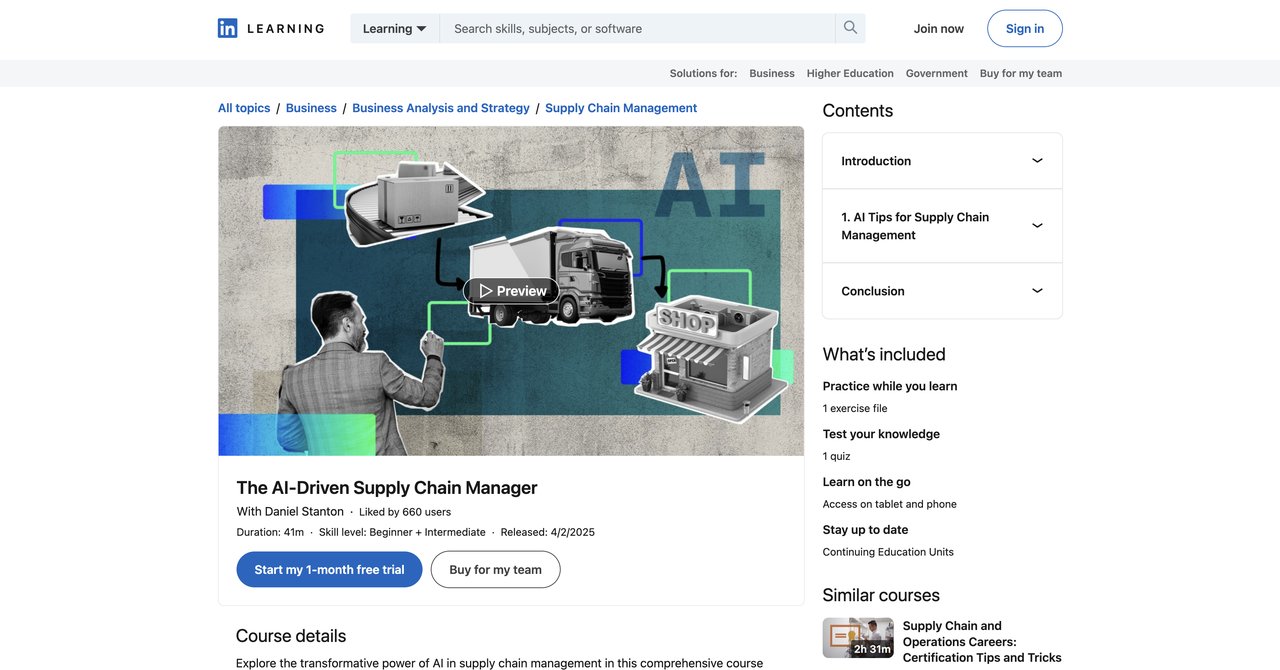
LinkedIn Learning offers this concise course taught by Daniel Stanton, who is known in the supply chain space. The course covers AI for inventory management, logistics streamlining, and cost reduction. It is designed to be practical and to the point, so you can get value from it in a short amount of time.
Since it is on LinkedIn Learning, it is part of a subscription service. If you already have a LinkedIn Learning subscription, this course is essentially free. If not, you would need to subscribe to the platform. The course is very short, which makes it easy to fit into a busy schedule, but it also means the content is not very deep.
The course is focused on the supply chain broadly, rather than transportation specifically. That is not a problem if you work in logistics, but it may not be enough if you are looking for transportation-specific content. It is a good introduction, but it is not a comprehensive program.
Key Topics Covered:
- AI for inventory management
- Logistics streamlining
- Cost reduction
- Practical AI applications in supply chain
For Audience and Skill Level: This is a beginner course for supply chain managers, logistics professionals, and transportation managers who want a quick overview of AI. It requires no technical skills.
Pros:
- Concise and practical
- Covers AI for inventory management, logistics streamlining, and cost reduction
- Taught by industry expert Daniel Stanton
Cons:
- Very short duration limits depth
- Focused on supply chain broadly rather than transportation-specific nuances
Who Would Benefit Most: This is for the busy professional who wants a quick introduction to AI in supply chain management. If you have an hour to spare and want to understand the basics, this is a good course. It is also a good starting point if you are considering a more in-depth program.
Visit LinkedIn Learning Course
Course 6: Professional Certificate in Artificial Intelligence (Logistics) by SIPMM
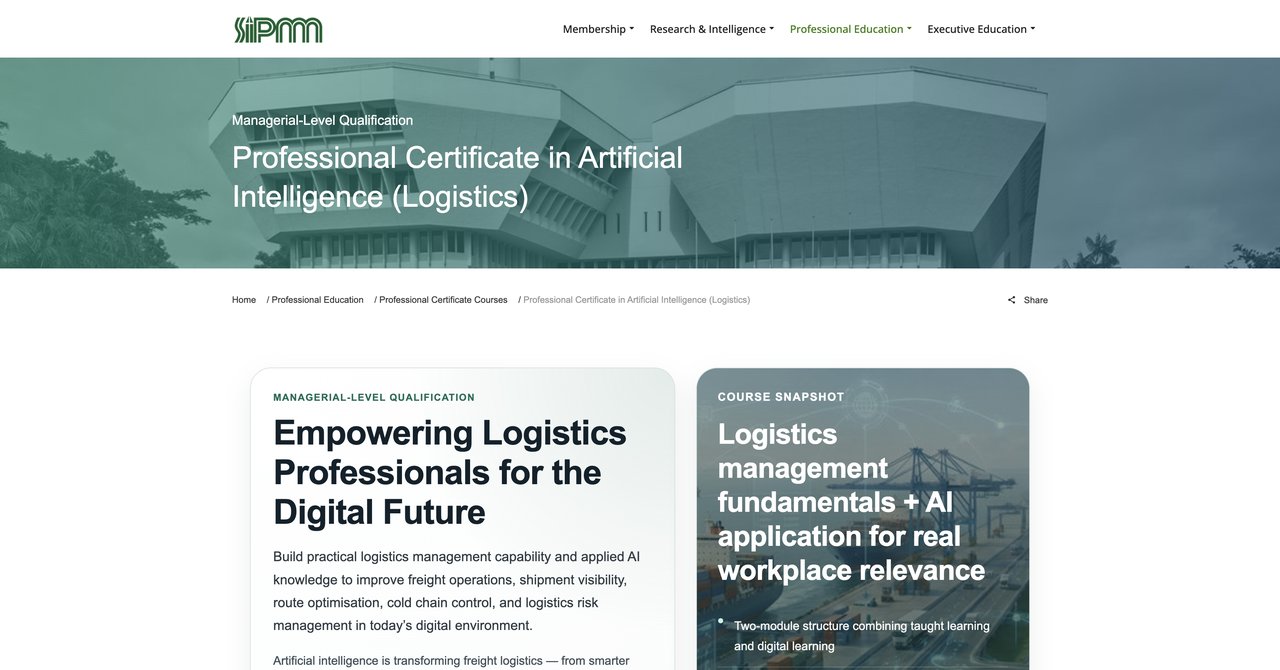
The Singapore Institute of Purchasing and Materials Management (SIPMM) offers a professional certificate in AI for logistics. This is an intermediate-level course that covers practical logistics AI, including freight operations, shipment visibility, and route optimization. It also includes cold chain control and logistics risk management, which are specialized topics that are not covered in many other courses.
This course offers a professional certificate and a CoC opportunity, which can be valuable for career advancement. The course is structured for working professionals, but it requires in-person or virtual attendance on a fixed schedule. That means you have to be available at specific times, which can be a challenge for busy managers.
The price is not publicly listed, so you have to contact the provider for that information. That is a bit of a hurdle, but the certificate is recognized in the industry. If you are looking for a formal certification in logistics AI, this is a strong option, especially if you are based in Asia or work with companies there.
Key Topics Covered:
- Freight operations
- Shipment visibility
- Route optimization
- Cold chain control
- Logistics risk management
For Audience and Skill Level: This is an intermediate course for logistics managers, supply chain professionals, and transportation managers who want a formal certificate. It is best for those who already have some experience in the field.
Pros:
- Focuses on practical logistics AI including freight operations, shipment visibility, and route optimization
- Includes cold chain control and logistics risk management
- Offers professional certificate and CoC opportunity
Cons:
- Requires in-person or virtual attendance on a fixed schedule
- Pricing not publicly listed
Who Would Benefit Most: This is for a logistics professional who wants a recognized certificate and is willing to commit to a structured schedule. If you are looking for a more formal qualification, this is a good fit. It is also good for those who want to specialize in cold chain or risk management.
Course 7: Generative AI Application for Supply Chain Professionals by Georgia Tech
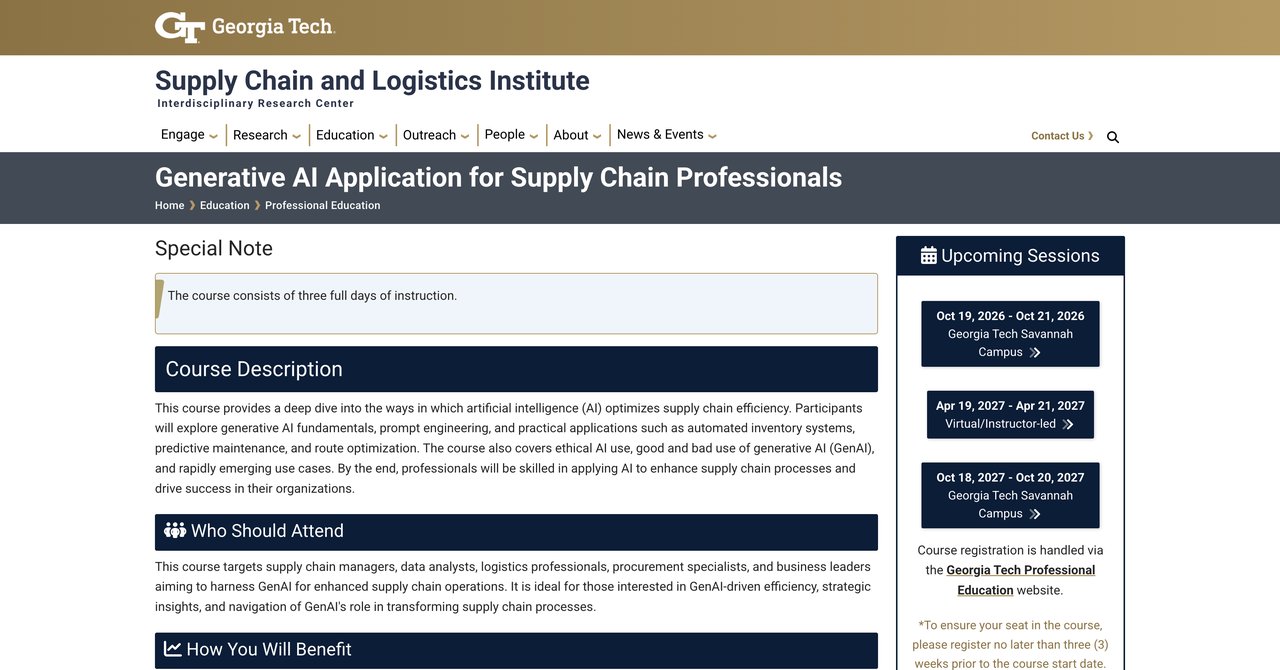
The Supply Chain and Logistics Institute at Georgia Tech offers an intermediate course on generative AI for supply chain professionals. This course covers ethical AI use and good vs. bad GenAI practices, which is a unique angle. It also includes route optimization and emerging use cases, and it is from a leading logistics institute, which adds credibility.
The course is designed for professionals who already have some understanding of supply chain and want to learn how to apply generative AI. It is not a beginner course, so you should have some familiarity with the concepts. The course covers both the technical and the ethical side of AI, which is important for managers who are responsible for the decisions.
The duration and pricing are not publicly listed, so you have to contact the provider for that information. This can be a bit of a hurdle, but it is common for professional courses from universities. If you are looking for a course that covers the ethical implications of AI, this is a good choice.
Key Topics Covered:
- Ethical AI use
- Good vs. bad GenAI practices
- Route optimization
- Emerging use cases in supply chain
For Audience and Skill Level: This is an intermediate course for supply chain managers, logistics directors, and transportation professionals who want to understand generative AI at a deeper level. It is not for beginners.
Pros:
- Covers ethical AI use and good vs. bad GenAI practices
- Includes route optimization and emerging use cases
- From a leading logistics institute
Cons:
- Duration and pricing not publicly listed
- May require contacting provider for enrollment details
Who Would Benefit Most: This course is best for a supply chain manager who is already using AI or is about to start implementing AI solutions. If you want to understand the ethical considerations and best practices, this is a valuable course. It is also good for those who want a course from a well-known institute.
Course 8: AI in Transportation: Route Demand Analysis by Stanmore UK
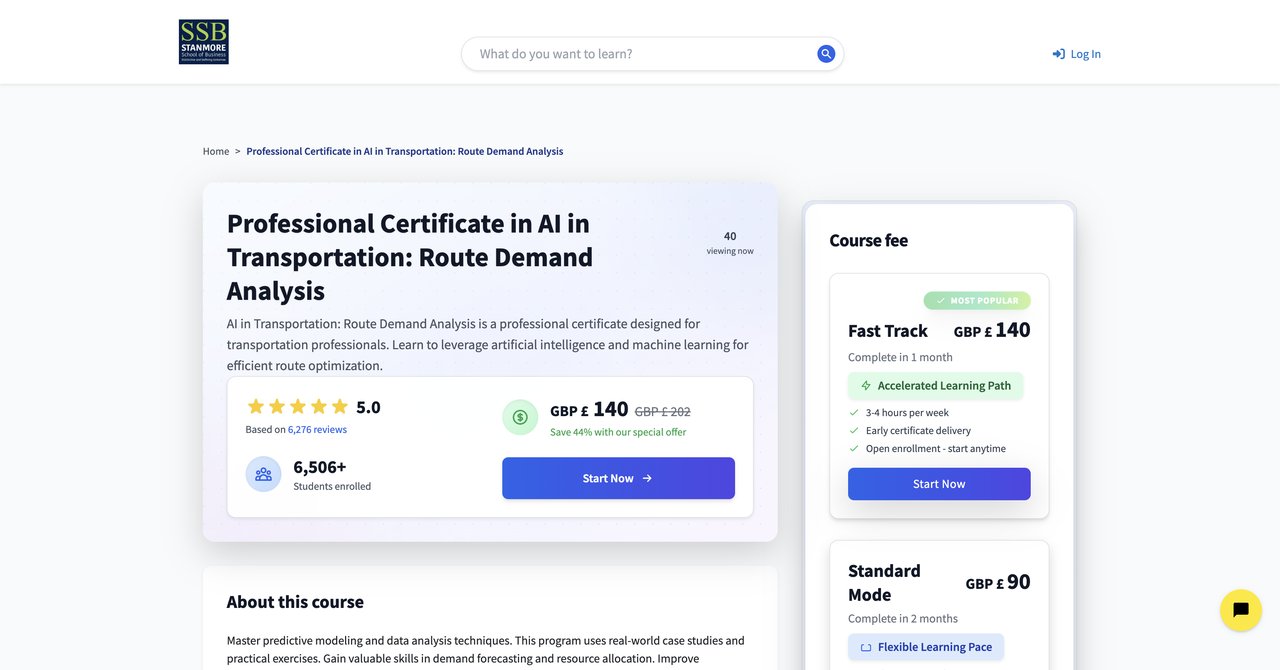
Stanmore UK offers an intermediate course on AI in transportation, specifically focusing on route demand analysis. The course covers machine learning for route optimization, deep learning for traffic prediction, and GIS in route analysis. It includes real-world case studies and practical exercises, which make it very hands-on.
The course is ideal for logistics managers and planners who want to get into the technical side of AI. It is more technical than some of the other options, but it is still accessible to those who are not data scientists. The price is £140 for the fast track or £90 for standard mode, which is about $178 or $114 USD. That is a reasonable price for the content.
The main limitation is that the course is focused specifically on route demand, so it does not cover other areas of transportation management. The provider is also less well-known than major platforms, but the content is solid. If you want to specialize in route analysis, this is a good course.
Key Topics Covered:
- Machine learning for route optimization
- Deep learning for traffic prediction
- GIS in route analysis
- Real-world case studies
For Audience and Skill Level: This is an intermediate course for logistics managers, transportation planners, and analysts who want to learn specific AI techniques for route analysis. Some familiarity with data is helpful.
Pros:
- Covers machine learning for route optimization, deep learning for traffic prediction, and GIS in route analysis
- Includes real-world case studies and practical exercises
- Ideal for logistics managers and planners
Cons:
- Focused specifically on route demand, not broader transportation management topics
- Provider is less well-known than major platforms
Who Would Benefit Most: This course is for the transportation professional who wants to get into the technical side of route analysis. If you are a logistics manager who wants to understand how to optimize routes using AI, this is a practical course that gives you the skills you need.
Course 9: Graduate Certificate in AI for Urban Transportation Systems by Stanmore UK
Stanmore UK also offers a graduate certificate in AI for urban transportation systems. This course focuses on urban transportation AI applications and is delivered online, which makes it flexible for working professionals. The admission is open for 2026, so it is a future option for those who are planning ahead.
The course is at an intermediate level and is designed for those who want to understand AI in the context of urban transportation. It is online and flexible, which is a big plus for people who cannot attend in-person classes. The price is £140 for the fast-track or £90 for standard mode, which is about $178 or $90 USD.
The main downside is that there is limited information on the curriculum specifics, and the provider is less established than major universities. However, the content is relevant for those working in urban transport. If you are interested in urban transportation and want a certificate, this is worth considering.
Key Topics Covered:
- Urban transportation AI applications
- AI for city planning
- Transportation systems analysis
For Audience and Skill Level: This is an intermediate course for urban planners, transportation engineers, and managers who work in city transportation. It is for those who want to specialize in urban systems.
Pros:
- Focuses on urban transportation AI applications
- Online and flexible
- Admission open for 2026
Cons:
- Limited information on curriculum specifics
- Less established provider compared to major universities
Who Would Benefit Most: This is for someone who works in urban transportation and wants a certificate in AI. If you are a city planner or a transportation engineer, this course is a good fit. It is also good for those who want the flexibility of an online course.
Course 10: The AI-Driven Supply Chain: Advanced Training for Next-Gen Leaders by MIT CTL
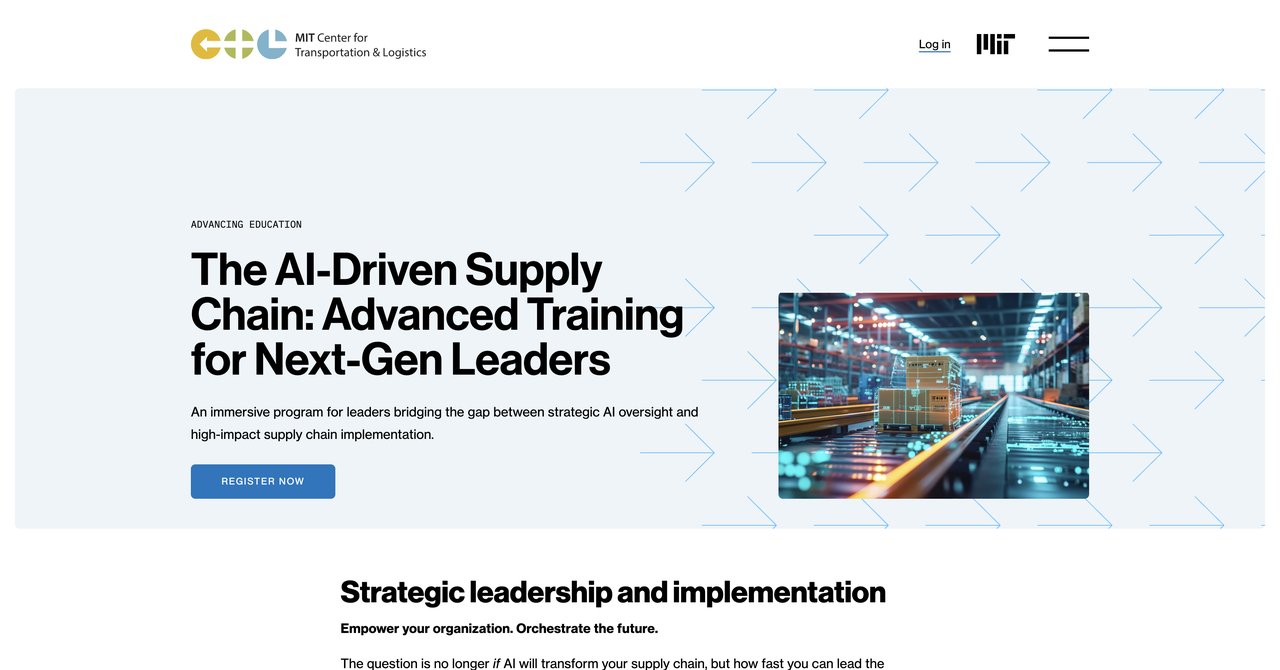
This is the most advanced and expensive option on the list. MIT Center for Transportation and Logistics offers an intensive on-campus course that is developed from MIT's elite Supply Chain Management Master's program. It provides a comprehensive framework for AI-driven supply chain leadership. The course is designed for next-gen leaders who want to take their skills to the highest level.
The course is in-person in Cambridge, MA, and it is a one-week intensive. The cost is $6,000, which is a significant investment. However, for a manager who wants to move into a senior leadership role, this course offers a level of prestige and depth that is hard to match. You are learning from one of the best institutions in the world.
The main downside is the high cost and the need to attend in person. This is not for everyone. But if you have the budget and the time, this course is a great way to get a comprehensive education in AI-driven supply chain.
Key Topics Covered:
- AI-driven supply chain leadership
- Comprehensive framework for AI implementation
- Strategic decision-making with AI
For Audience and Skill Level: This is an advanced course for senior managers, directors, and executives who want to lead AI initiatives in their organization. It requires a high level of experience.
Pros:
- Developed from MIT's elite Supply Chain Management Master's program
- Intensive in-person format
- Provides a comprehensive framework for AI-driven supply chain leadership
Cons:
- High cost
- Requires on-campus attendance in Cambridge, MA
- Limited to one week
Who Would Benefit Most: This is for the senior leader who wants to invest in their career and gain a comprehensive understanding of AI in supply chain. If you are a director or an executive, and you have the budget, this course is a great option. It is also good for those who want to network with other leaders in the field.
Final Recommendations
When you are looking at all of these courses, the best choice depends on your career stage, your budget, and your specific needs. There is no single best course for everyone, but there are some clear recommendations based on different situations.
If you are a transportation manager who wants a comprehensive, ongoing education in AI, the CompleteAI Training subscription is the most practical choice. It gives you access to a lot of courses and certifications for a very low price, and it covers a wide range of topics. It is not just about transportation, but also about all the other areas that you may need as you move up in your career. The subscription model means you are always up to date with the latest AI tools, which is crucial in this fast-moving field. If you are on a budget, this is the best value.
If you are looking for a quick introduction to AI in transportation, the MIT Learn courses are a good start. They are affordable and self-paced, and they give you a basic understanding of how AI is used in the field. The sustainability course is a good choice if you have a specific interest in green transportation.
For those who want to get into the technical side of AI, the Stanmore UK course on route demand analysis is a good option. It is more specific and gives you hands-on experience with machine learning and GIS. The course from Georgia Tech is also good for those who want to understand the ethical side of AI.
If you are looking for a formal certificate, the SIPMM course is a good option, especially if you are in Asia. It covers practical logistics and includes a certificate. The Stanmore UK graduate certificate is also an option for those interested in urban transportation.
Finally, if you are a senior leader with a big budget, the MIT CTL course is the best option. It is expensive, but it offers a comprehensive and prestigious education that is hard to beat. It is a significant investment, but it can help you take your career to the next level.
In the end, the right course for you is the one that fits your goals and your situation. If you are just starting out, a beginner course is a good first step. If you are a manager, you might want a comprehensive platform. If you are a leader, you might want a certificate or a university program. Take a look at your needs and make a choice that will help you grow in your career.
You might also like

Marketing: AI trends to focus on - Brand safety and measurement overtake content volume