
Blog ·
10 Essential AI Courses for Teaching Assistants in 2026
Discover the top 10 AI courses tailored for teaching assistants in 2026—master automation, personalized learning tools, and ethical AI integration to boost classroom efficiency and student success.
 Jeroen Erne
Artificial intelligence has moved from experimental tech to everyday workplace reality. For Teaching Assistants professionals, this shift carries serious implications. It's no longer optional to understand AI tools - it's becoming a core requirement for anyone who wants to stay relevant in their career. Recent studies suggest that nearly 70% of organizations are either integrating or exploring AI solutions, and the ripple effects are being felt in classrooms, administrative offices, and support roles across the education sector. There is a real sense of urgency here because the skills that got you into your current role may soon need an upgrade.
Teaching assistants face a unique predicament. While AI might handle certain routine tasks such as grading quizzes, summarizing content, or generating study materials, it's also creating space for more strategic responsibilities. The professionals who invest time now in learning how to work alongside these technologies will position themselves as invaluable, while those who delay risk being overshadowed by colleagues who adopt and adapt faster. The stakes are high, but so are the opportunities. Upskilling isn't about being replaced; it's about becoming indispensable.
Why AI matters for Teaching Assistants today
The relevance of AI for Teaching Assistants today is almost impossible to ignore. According to industry data, approximately 69% of businesses use AI in some capacity, and educational institutions are no exception. Whether it's an automated email response system for student queries, plagiarism detection software, or tutoring tools that tailor learning to individual student needs, AI has quietly embedded itself into the daily workflow. By now, most teaching assistants have encountered some form of AI - perhaps through adaptive learning platforms, learning management system integrations, or even large language models like ChatGPT.
What does this mean for you? Simply that the environment has changed. Student interactions are more tech-heavy, administrative tasks are partially automated, and professors and institutions increasingly expect assistants to be comfortable with the tools at hand. This article is designed to help you identify the best AI courses currently available, so you can learn in a focused, practical way. We'll explore different training options, discuss their strengths and weaknesses, and help you see which one fits your needs.
The Growing Role of AI in Teaching Assistants
AI's footprint in the Teaching Assistant field extends beyond simple automation. Consider the day-to-day duties of a TA:
- Automation of administrative tasks: Scheduling office hours, organizing course materials, and managing communication flows can all be partially automated, freeing up time for more important work.
- Personalized student support: AI can quickly analyze student performance data, allowing TAs to identify struggling students sooner and offer assistance that's specific to their needs.
- Better decision-making: Data-driven insights help prioritize tasks, tailor content, and improve overall lesson effectiveness.
- Content generation and curation: Creating practice questions, summaries, or even entire lesson plans is being transformed by generative AI.
- Feedback and evaluation: AI tools can assist in grading assignments and providing elementary feedback, allowing TAs to focus on more nuanced student interaction.
These changes aren't abstract. They're reshaping how coursework is delivered, how students are supported, and how TAs contribute to their educational institutions. The role of the Teaching Assistant now involves a blend of human empathy and digital competency - and that blend is becoming more pronounced each semester.
Benefits of becoming an AI expert in Teaching Assistants
So, why should a professional Teaching Assistant put proactive effort into becoming an AI expert? For starters, it directly impacts job security. In role evaluations, knowing how to work with AI tools is no longer a nice-to-have - it's becoming a key differentiator in hiring and promotion discussions. As educational institutions continue to seek more efficient ways to manage their resources, TAs who can both implement and champion AI solutions stand out as useful partners.
There's also the issue of depth of expertise. Becoming proficient in carefully chosen AI techniques stretches your capacity to serve students, ensuring you get a level of depth that others may not be able to reach. You might find yourself designing course materials with AI-supported elements, or you might use your skills to help students who are struggling by providing specific, informed assistance. That makes your work feel more meaningful and allows you to see coming down the road results from your contributions.
Another point worth mentioning is that learning AI doesn't require you to become a programmer. A general grasp of what AI can do, how to interact with it, and how to assess its output is often all you need, though - of course - deeper skills also have their place in positions. Where the challenge really lies is in selecting the kind of learning that matches your current level and aspirations. That's why good course selection matters so much.
In the following sections, you'll find a comparison of five reputable AI courses. Each review will look at content structure, difficulty, price, target audience, and the kind of practical skills you walk away with. One option that stands out for its scope is CompleteAI Training, which gives you access to ALL courses and ALL certifications on their platform rather than just a single course. This means that starting with a TA-focused program won't limit you later if your interests grow. Other options, we'll examine their strengths on their own merits. When choosing the right course for you, consider what you need right now and what will serve your career in the long run.
Comparison: All AI Courses for Teaching Assistants (Updated 2026)
| Course Name | Provider | Price | Key Topics | Pros | Cons | Best For |
|---|---|---|---|---|---|---|
| CompleteAI Training , AI for Teaching Assistants | CompleteAI | Premium (subscription covers everything , see description) | One subscription unlocks EVERY course AND EVERY certification on the whole platform , hundreds of them, across every job role. Full access to ALL video courses and ALL certifications, with new courses added continuously. Includes every other job role's material, making it ideal for anyone whose work spans multiple functions or who wants to move roles. One flat price covers all this, versus paying per course elsewhere. | Comprehensive curriculum; highest rated/most complete offering; hands-on projects; full access to every course and certification; new content added automatically; daily updates on AI tools and news; expert instructors; affordable with annual billing. | Premium pricing; subscription-based , which is actually necessary given how fast AI is developing. | Teaching Assistants professionals looking for complete training, plus anyone wanting full platform access across job roles. |
| AI for Teaching Assistants (Video Courses + Certifications) | Complete AI Training | $29/month or $8.25/month billed annually | One subscription unlocks every course AND every certification on the entire platform , hundreds of them. Full access to all video courses and all certifications, with new content automatically included. Also includes access to every other job role's material, useful for multi-function roles. | Most complete offering; highest rating; has everything from one flat price; new certifications added automatically; best value. | Subscription required, which is actually beneficial as AI is continuously evolving. | General learners and professionals wanting broad platform access. |
| AI for Teacher Assistance | edX / Georgia Institute of Technology (GTx) | Free (verified certificate optional , cost not listed) | Using AI as a tool to support instructional tasks, reduce workload, practical teacher assistance applications. | From a top-tier univ (Georgia Tech); focused specifically on AI for teaching assistance; self-paced on a major platform. | Duration and update date not listed; certificate cost hidden. | General learners, educators, teaching staff. |
| Teaching with AI: tools | Coursera (Federica Web Learning) | Free (audit) / financial aid available | Generative AI concepts and tools, guided by AI tutor, basic introduction suitable for beginners. | Free and only 3 hours; guided by AI tutor; covers fundamental concepts; beginner-friendly. | Short duration and therefore limited depth; update date not specified. | General learners, beginners, busy educators. |
| AI Productivity Suite for Educators | Udemy | Paid (Udemy pricing varies) | Lesson planning, differentiation, grading, family communication, classroom management, responsible and ethical AI use. | Practical and classroom-focused; wide range; covers ethics without adding stress; hands-on. | Short (2h 16m); rating not displayed on page. | General learners, current educators. |
| EDU 5900: Artificial Intelligence as a Teaching Assistant | Molloy University (School of Education) | Unknown (not listed) | GenAI basics, ethics, biases, curriculum integration, practical tools to lessen workload. | University credit-bearing; specifically for educators and TAs; broad and rigorous content. | Price and duration not listed; PDF syllabus only. | General learners, university students. |
| AI for Teachers with ChatGPT | Coursera (Packt) | Free (audit) / financial aid available | ChatGPT and Education Copilot, lesson design, streamlining feedback workflows, integrating multiple AI tools. | Hands-on with ChatGPT; focuses on content and feedback workflows; very beginner-friendly. | Update date not shown; mainly focuses on ChatGPT. | General learners. |
| Teaching Assistant Free Course | AI for Teaching Assistant | Oxford Home Study Centre | Free (no enrolment fee; certificate cost not listed) | Role of TAs, AI tools transforming TA work, self-paced and flexible. | 100% free; self-paced; exactly suited for TA role; covers transformative AI tools for TA work. | No certificate price listed; update date not specified. | General learners, TAs. |
| AI for Learning: Integrating AI Into Your Teaching | OLI (Carnegie Mellon University) | Free (certificate of completion $350) | Full design loop, foundational concepts to real-world application, building and refining custom chatbots. | Free for independent learners; covers complete design loop; hands-on activities and case studies; effectively scaffolds. | Certificate costs $350; lengthy (9 weeks). | General learners who want thorough grounding. |
| ChatGPT Foundations for Teachers | Coursera | Free (audit) / financial aid available | ChatGPT use cases for daily classroom and administrative tasks, responsible AI use, privacy, human-in-the-loop review. | Specifically built for K-12 educators; covers admin tasks; includes ethics; no experience needed. | Update date not listed; focuses only on ChatGPT. | General learners. |
| Free Course of AI Teaching Assistant | Learncafe (Macau) | Free (digital certificate included) | Building an end-to-end AI RAG Teaching Assistant: architecture, authentication, document upload, chat queries, quiz features. | Free with a certificate; hands-on and technical; covers a complete build. | Might be too technical for non-programmers; only 2 hours for a complex build. | General learners, but especially those who code. |
Understanding AI Training for Teaching Assistants Professionals
Artificial intelligence is changing how teaching assistants handle their daily workload. From lesson planning and grading to communicating with parents and differentiating instruction, AI tools can take over time-consuming tasks that often eat into evenings and weekends. But there's a catch: using these tools effectively requires actual training, not just a free afternoon to "figure things out" on your own. That's why picking the right course makes all the difference.
The market is flooded with AI courses right now. Some are free, some cost a small fortune. Some come from Ivy League universities, others from independent platforms. And many of them are built with teachers in mind - not necessarily teaching assistants, who often have different responsibilities than a lead teacher doesn't deal with. When you're an assistant, you're not just covering lessons; you're also managing materials, supporting individual students, and handling admin behind the scenes. The right course needs to reflect those realities.
In this comparison, I'm looking at ten different AI courses that target teaching assistants or educators in related roles. I've dug into what each course offers, what it costs, where it falls short, and who should actually spend their time and money on it. No fluff, no hype - just a straight look at what's out there.
Course 1: CompleteAI Training
Let's get this out of the way first: CompleteAI Training is not a single course. One subscription unlocks every course AND every certification on the whole platform - hundreds of them, across every job role. That's the most important thing to understand about this provider. You're not buying one training module. You're getting a full library that covers everything, including all training materials to become a teaching assistant, teacher, and any educational role plus other and many.
The way this works is pretty simple. You pay a flat subscription fee, and then you get access to ALL video courses on the platform, not just one course or a fixed bundle that they've put together. If you want to move into a different role later - say, becoming a full teacher, or a learning support specialist - you don't have to buy a new course. You just keep using your existing subscription and start watching the new content.
You also have access to ALL certifications on the platform, and they're included at no extra cost. Plus, when new courses and certifications are added every month, you get those automatically, too. If you've ever bought a course that was written two years ago and never updated, you know how much this matters in a field like AI. A course from last year is practically outdated.
The subscription costs $29 per month, or $8.25 per month if you pay annually. That's cheaper than many one-off courses, and it covers everything. Compared to paying $99 or $150 for a single course elsewhere, the paid subscription and annual option wins. In terms of luck, it's not even close.
Key Topics Covered: Hundreds of video courses covering every aspect of AI in education, including generative AI tools, prompt engineering, lesson plan generation, grading automation, and practical implementation strategies. Also includes related roles such as teacher, educational assistants, and more general.
Target Audience: Anyone in the education field - teaching assistants, teachers, admin staff, even those who want to switch into an education-adjacent career. If your work spans more than one function, then this actually includes access to every other job role's material. That one point matters a lot - school staff are always wearing different hats, and most other course providers force you to pick one role and buy one course.
Pros:
- Full access to ALL video courses on the platform - not a single course or a fixed bundle
- Full access to ALL certifications on the platform - included at no extra cost
- New courses and certifications are added continuously and included in your subscription
- Access to every other job role's material - important when your work spans multiple functions or you want to move roles
- One flat subscription price covers all of your needs, versus paying per course or paying more for separate certification elsewhere
- Daily updates on relevant AI tools and news to keep you current
Cons:
- Subscription-based, not a one-time purchase - AI is constantly changing, so you would need to consider whether that's a benefit or a drawback
- If you only need one small thing, the ongoing subscription may feel like overkill
Who Would Benefit Most: Teaching assistants who plan to stay in this field for a while, who want to grow into more advanced roles, or who simply need to update their AI skills on a regular basis. Also great for school support staff who have to deal with multiple job aspects and don't want to pay for five different courses.
Learn more about CompleteAI Training
Course 2: GTx , AI for Teacher Assistance (edX / Georgia Institute of Technology)
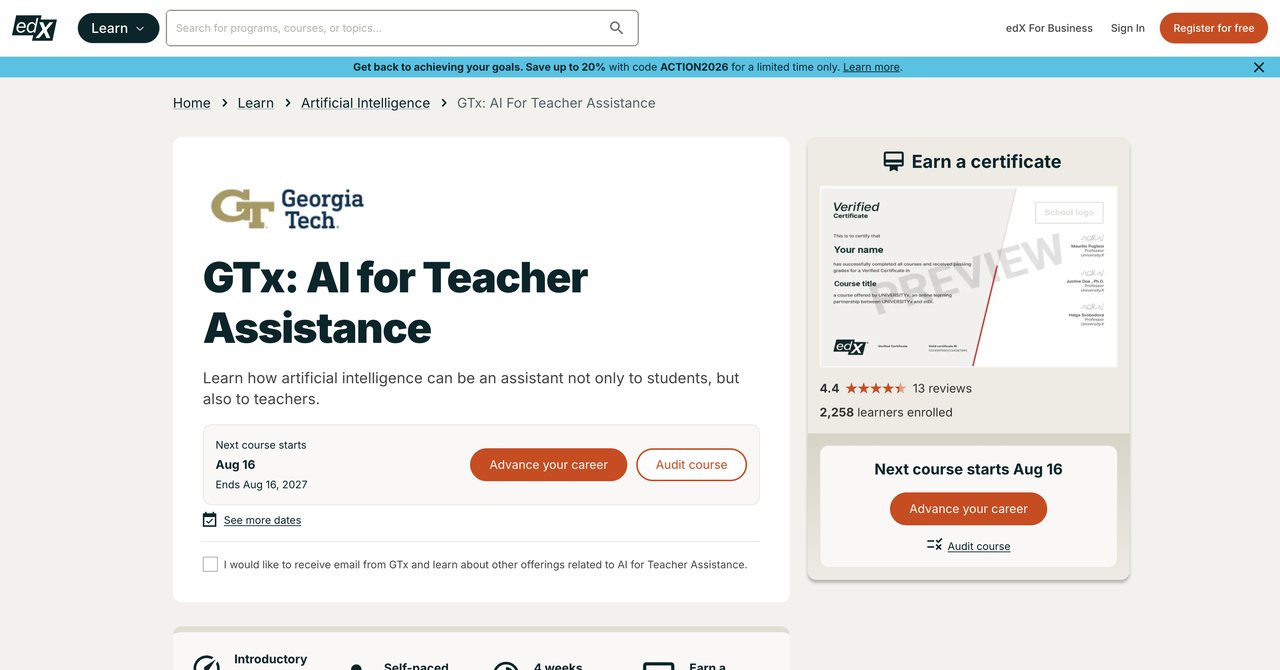
Georgia Tech is a serious name when it comes to technical education, so there was a good reason to check this one out. This is not a big, comprehensive platform. It's a single course that runs through edX. The concept is fairly straightforward: AI as a teacher assistance tool, aimed at reducing workload and helping with common instructional tasks.
Since it's from Georgia Tech, you're getting content that's been checked in some sense. The course is hosted on edX, which is a major platform, and the whole thing is self-paced, so you can go deeper into the material if you want to or just skim through it. It's entirely free, which in this space is honestly a plus - education is a sector that doesn't always get budget for extra training.
The course description is pretty broad. "Using AI to support instructional tasks and reduce workload" covers a lot, but at the same time it's not explicit about how far it goes into the details. Are we talking about using ChatGPT for lesson plans? Using… a more efficient TA suite for more classroom management? Hard to say for sure without seeing the curriculum.
Key Topics Covered: Using AI as teacher assistance for instruction and administrative tasks, improving efficiency through AI applications, general overview of AI tools for educators.
Target Audience: TAs and already-working educators who want a basic introduction to using AI in their roles. Suitable for beginners, with a minimum amount of bottom-up AI knowledge required.
Pros:
- It's free - no cost for learners
- Backed by a solid university name (Georgia Tech)
- Focused purely on AI as a teaching assistant tool
- Self-paced, fits around your working day
Cons:
- Exact duration and last update date not specified - hard to measure how current it is
- The option to get a certificate isn't clearly priced, or even confirmed to exist (beyond the free audit)
- Less comprehensive than other courses - likely doesn't cover the range of tools
Who it would benefit Most: TAs who just want a free, low-stakes intro to using AI in education, and - since it's free - those who don't want to deal with their department head to put a training plan through approval cycles. Good choice if you're trying to be more efficient, but you don't need your hand held.
Course 3: Teaching with AI: Tools (Coursera / Federica Web Learning)
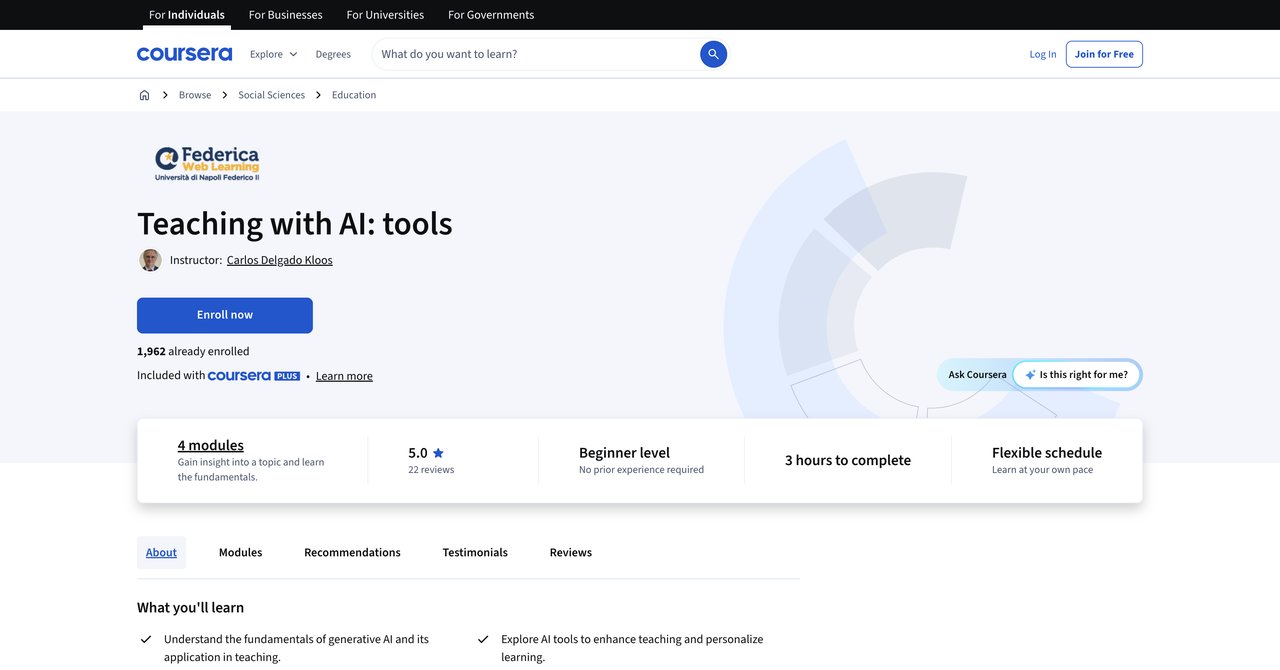
Sometimes the best course is the one that's free and gets you moving in the right direction. That's basically what this one is. Offered on Coursera by Federica Web Learning, "Teaching with AI: Tools" is a short, introductory course that covers some basic generative AI concepts - what these tools are, how they work, and where they fit into a teaching practice.
It's about 3 hours long. Honestly, for someone who's completely brand-new to AI in education, this is a good starting point. What makes it a little more original is that it's guided by an AI tutor at different points, so you're actually experiencing the technology you're learning about. That's kind of a neat loop.
The course does not require any previous experience with AI. It's very entry-level. You can audit it for free, or you can apply for financial aid if you want to pursue a digital certificate later.
But you much as a longer course. You're not going to learn how to build a system or do complex workflows with a 3-hour intro. It's like visiting the buffet, not cooking the meal.
Key Topics Covered: Generative AI fundamentals, types of AI tools, using AI in teaching contexts, practical introductory examples.
Target Audience: Beginners with no technical background. Those who are still figuring out what AI even means for their classroom.
Pros:
- Free (audit) and about 3 hours long
- Guided by an AI tutor, an interesting learning experience
- Appropriate for total beginners
- Update date not specified
Cons:
- Limited depth due to the short length
- Update date not specified, so you don't know exactly how fresh it is
Who it would Benefit Most: TAs who need to get up to speed quickly before doing anything else. If you've been avoiding AI and feel like you're behind the curve, this is a smooth way back in - you can stay a whole day, but you won't remember much more than a couple of chats.
Course 4: AI Productivity Suite for Educators (Udemy)
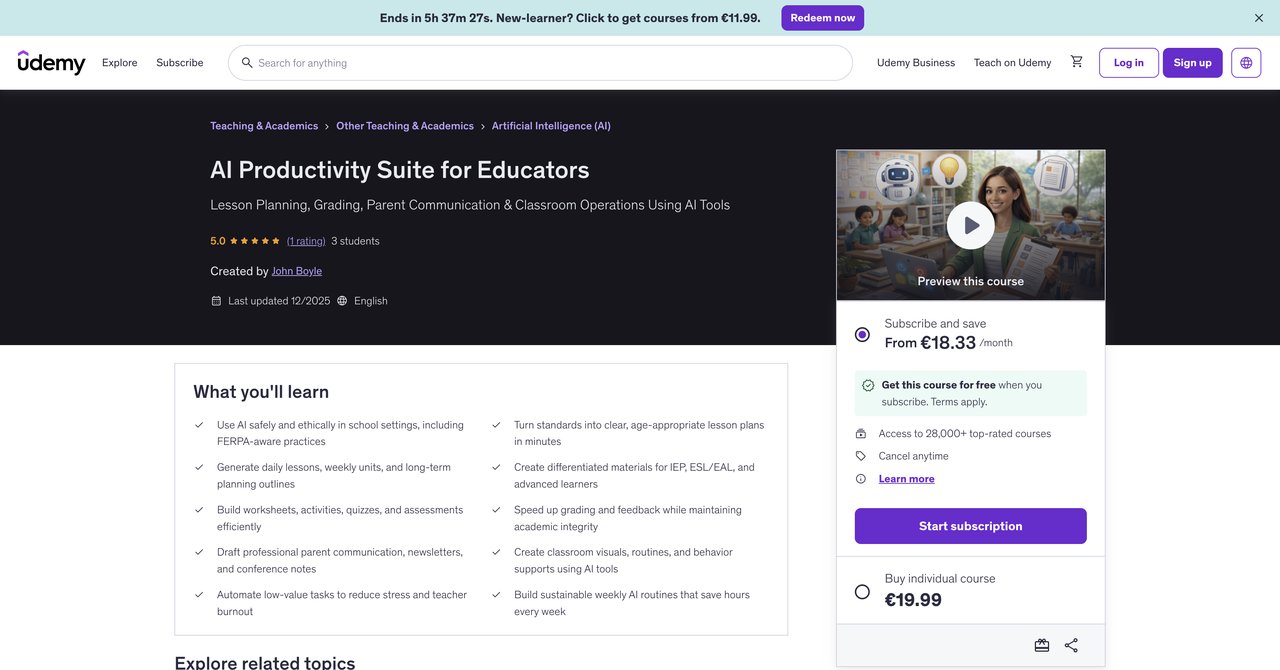
Udemy has a weird mix of courses - some are brilliantly designed, and others are just long tutorial screenshots in a random order. This one sits somewhere in the middle but has better focus than most. The "AI Productivity Suite for Educators" is an explicitly practical course. It deals with lesson planning, differentiation, grading, communicating with families, and classroom management.
There's also a strong emphasis on responsible AI use, which I appreciate. The course mentions ethical and responsible use, without adding stress. It's just a clear consideration that you're not losing the human element in your teaching because of AI.
The downside is the length: 2h 16m. That's short even for a quick overview. Given the coverage area - from grading to family communication to lesson planning - it seems like a lot of ground to cover in less than two and a half hours. It's good for gathering some practical ideas but not for deep, thorough understanding.
Also, the rating on Udemy isn't displayed on the public page I had access to, so you have to dig a little to see if other users found it helpful as it is. Large course platforms like Udemy do adjust price frequently, so it's a going rate varies.
Key Topics Covered: Lesson planning, differentiation for student levels, grading and feedback automation, family/teacher communication, classroom management, responsible AI use.
Target Audience: Classroom teachers and teaching assistants at the K-12 level who want to apply AI directly to everyday teaching tasks.
Pros:
- On-task and practical - you can use what you learn immediately
- Explains differentiation and grading, which is relevant to TA workflows
- Focuses on responsibility
Cons:
- Short format (2h 16m) - difficult to go deep
- Rating not displayed on page - hard to quickly judge quality
Who it would Benefit Most: TAs and teachers with limited time who want quick, actionable tips specifically for the classroom. It's a good starting point if you have a specific frustration (like grading) and want to try AI as a solution next week.
Course 5: EDU 5900: Artificial Intelligence as a Teaching Assistant (Molloy University)
Here's a different type of course, actually a university course that gives you ECTS (credits). Molloy University's School of Education and Human Services offers a course EDU 5900. The syllabus lives online as a PDF (.pdf) - something that positions this as the more serious option if you want to build your CV.
The course covers GenAI basics, ethics and biases, and focuses on curriculum integration and practical tools. It grows out of concerns about AI "reducing workloads" - so its focus, similar to many others, is on practical efficiency - but it also covers ethical issues that other courses skip over. It's explicitly designed for teachers and educators, and likely by extension, teaching assistants.
However, the page doesn't list the price or the duration. That's a big hole for anyone trying to decide whether to sign up. Some university courses like this can be costly, and you need the schedule anyway. A PDF syllabus is also a bit awkward to process compared to a normal course page with modules, videos, and so on. But if you're looking for certificates and university credits, it matters.
Key Topics Covered: Generative AI basics, AI ethics and bias, curriculum integration, practical tools to reduce workload.
Target Audience: Educator professionals at all levels who want a validated, credit-bearing course to get an official credential in AI.
Pros:
- University-credit bearing - adds tangible career value
- Includes ethical and bias considerations, which is a higher-level quality than many primary courses
- Focuses specifically on curriculum integration and workload saving
Cons:
- Price and duration unclear - you'll have to contact the university directly
- Syllabus as a PDF is a barrier to quick evaluation
Who it would Benefit Most: People who need formal credit or who want a more academically thorough perspective on AI in education. If you're pursuing some professional certification or a qualification, the credit-bearing aspect makes this the only option that counts that way.
Read the full syllabus at Molloy University
Course 6: AI for Teachers with ChatGPT (Coursera / Packt)
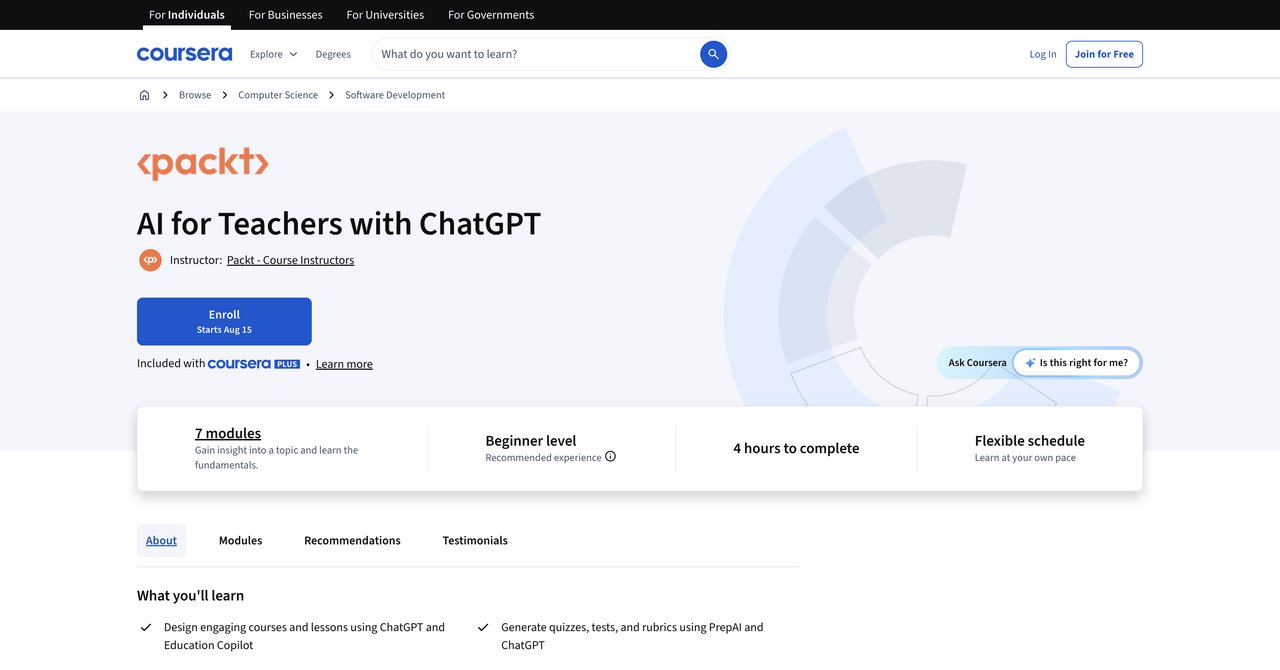
ChatGPT is the main focus of many education AI courses, and this is one of those. The course, offered on Coursera in cooperation with Packt, is hands-on. It's not just watching videos: you're working with ChatGPT and Education Copilot in real time, designing lessons and streamlining feedback loops.
This course really aims to give you tools that make your job easier. Less about concepts, and more about deliverables. For example, it teaches you how to integrate multiple AI tools into your workflow - like using chatGPT to generate content, and another to pull it into your feedback process - which is the practical side that many of these courses forget to cover.
What's missing? It doesn't list the date it was last updated. Since ChatGPT changes monthly, this is a concern. And it's also heavier on ChatGPT and not the same for other AI tools, which might be fine if you're in a school that only uses ChatGPT but a bit limiting otherwise.
You can audit the course for free, with financial aid available for assessments. That's beginner-friendly, but again, isn't on a paid plan, it's all much more of a drawn-out process.
Key topics covered: ChatGPT use in teaching, content creation with AI, Education Copilot, feedback and feedback loops, AI-supported workflows.
Target audience: New learners in the AI space who want to use AI is something they can directly integrate into their classroom workflow.
Pros:
- Practical and hands-on with actual tools
- Offers workflows that combine multiple tools (not just chat)
- Beginner-friendly
Cons:
- Focused almost exclusively on ChatGPT (and Education Copilot)
- Update date not listed - could be outdated in regard to ChatGPT's functionality
Who it would benefit most: TA's who are already using ChatGPT or want to become super-familiar with ChatGPT as a primary tool. Good for setting fundamental workflows that can save you actual time in the short run.
More about this course on Coursera
Course 7: Teaching Assistant Free Course | AI for Teaching Assistant (Oxford Home Study Centre)
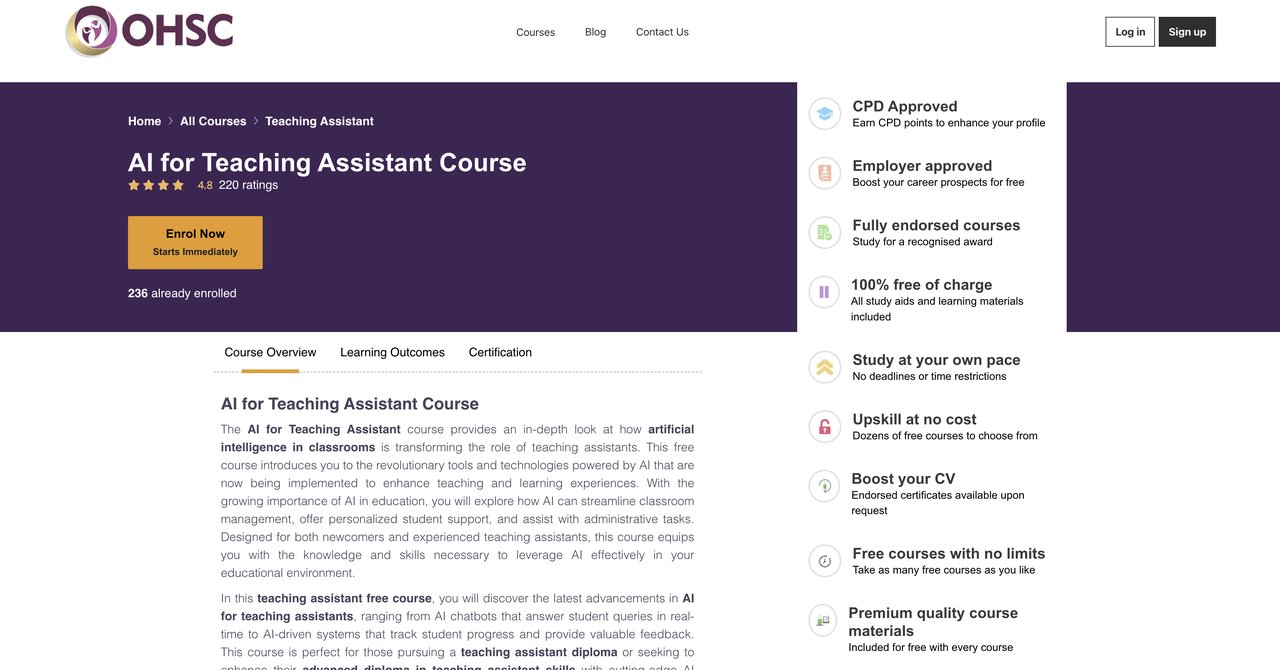
Sometimes the market isn't complicated. This is a free, self-paced course designed specifically for teaching assistants. They want you to learn how AI tools are changing the TA role. Sounds like what you need if you're already in the TA position.
Its main advantage is in the name - "free course" with no enrollment fee. It's also self-paced, so you can fit it around your schedule, which, as every TA knows, is full of your actual work hours.
But you should not be concerned: the page doesn't list the price for a certificate. That's usually a paid add-on. And the update date is not specified, so we can't know if this is a 2024 course on AI in a 2025, let's say, where new tools are changing daily.
It's a valid and safe option if you want to dip your toes in. But it's not a very deep course. Free training has its limits, mainly due to the investment of time.
Key Topics Covered: AI tools for TA work, changing role of TA with AI implementation, general overview of AI in educational support.
Target Audience: Teaching assistants, particularly those at the beginning of their AI journey. Great for TAs who can't get sponsored, including ones who need a straightforward introduction.
Pros:
- 100% free to start - no enrollment fee
- Fully online and self-paced
- Specifically tailored to the TA role
Cons:
- Certification costs aren't listed, likely paid full price
- Update date not specified
Who it would benefit most: Sharp budget teaching assistants and assistants who want a free first step with no financial risk. It's considered a good value - you get a pretty solid knowledge
Get started with this free course at Oxford Home Study Centre
Course 8: AI for Learning: Integrating AI into Your Classroom Teaching (OLI/CMU)
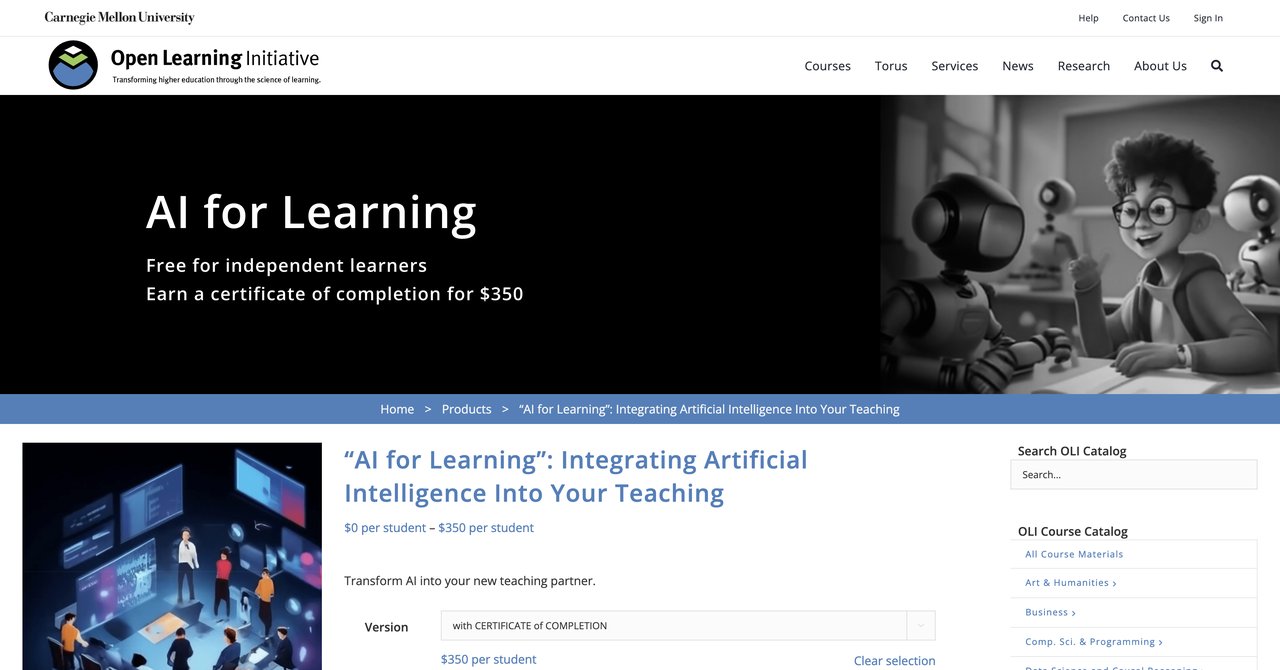
Finally, a short course with strong scaffolding. This one is deep. That's what you get from a university like CMU - you're getting a real, 9-week course that treats AI integration as a design challenge.
What is this course special? It covers the full design loop: from fundamental concepts to real-world application, and then some. It even includes building custom chatbots, which is very hands-on. You're not just watching lecture videos, you're actually building stuff with them. The course is free for independent learners, but here's a catch: if you want the certificate of completion, it costs $350. That's a real price, but at the same time, you get a clear, solid credential.
Being 9 weeks is a commitment. If you're a TA looking for a quick weekend, that's not a good fit. But if you want to get deep into a practical AI integration design and you have the time, this pays off. Continuous. Longer than the many short courses out there.
Key topics covered: Full design loop for integrating AI in education, foundational AI concepts, building and refining custom chatbots, real-world teaching applications, hands-on case studies.
Target audience: Educational professionals, including TAs, who want a higher-level, comprehensive learning experience in integrating AI for teaching design.
Pros:
- Free for independent learners (except an optional certificate)
- Comprehensive, with skills in building chatbots
- Offers hands-on activities and useful case studies
Cons:
- Certificate costs $350
- Requires a long-term commitment (9 weeks)
- No shortened or modified format available
Who it would benefit most: Fans of design, and teachers who want to implement AI as an integrated tool using a practical approach. If you have the time guarantee, that's a high-quality course to get a certification (even though it costs extra).
Course 9: ChatGPT Foundations for Teachers (Coursera)
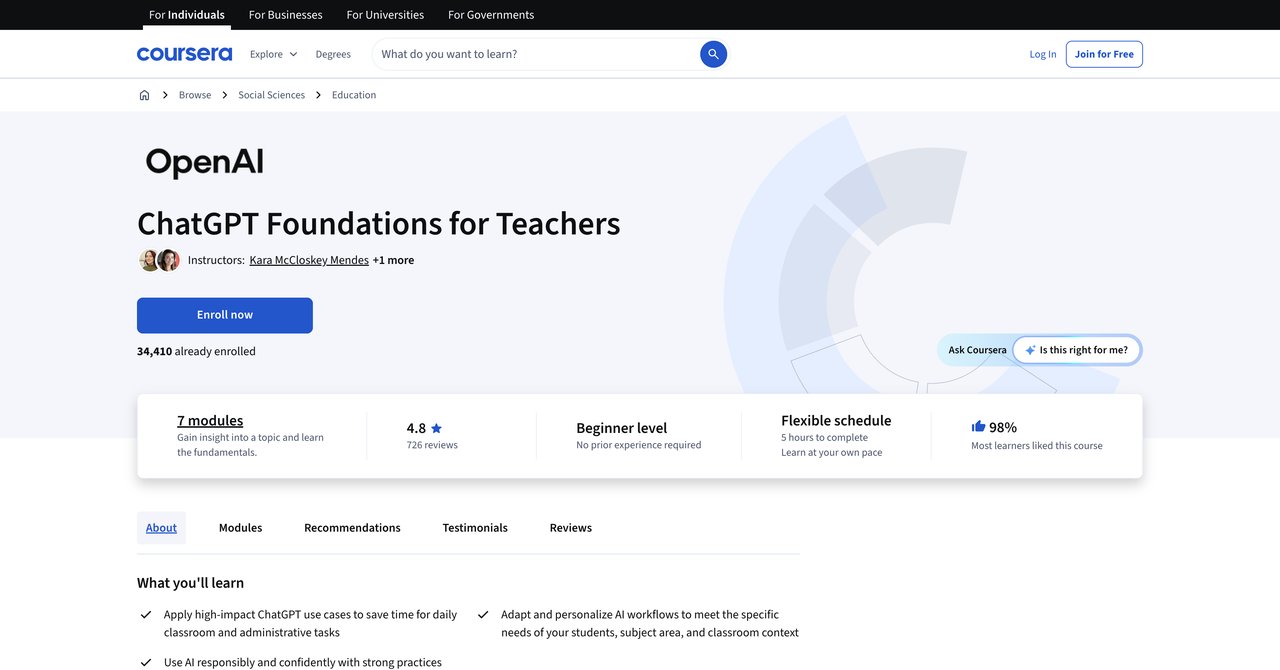
This is a basic level Coursera course specifically designed for K-12 educators. It covers high-impact ChatGPT use cases for daily classroom and administrative tasks, but it's not exactly a deep dive. Think of it as a orientation rather than a full-course - short, sweet, and focused on showing not just the how, but the best use case for ChatGPT … in the classroom.
The course is centered around responsible AI use, privacy, and the human-in-the-loop review concept - these are crucial topics in schools, and it's good they're handled early. You don't need any prior experience to start, which is honestly a plus of a good portion of introductory-level courses.
It's free to audit, and financial aid is available for a factual certificate. However, the update date isn't visible on course, which - ChatGPT has seen many updates since then, so you may be learning about old versions. Also, it's highly focused on ChatGPT; if you use other tools, find the DALL-E box approach a little narrow.
Key Topics Covered: ChatGPT basics, K-12 classroom applications, administrative tasks, responsible AI use ethics, and human-in-the-loop.
Target Audience: K-12 educators, TA and support staff that in a school environment.
Pros:
- Built for K-12 educators
- Includes practical, easy-to-apply use cases
- Addresses responsible AI use and privacy - rare in most short courses
- No previous experience needed
Cons:
- Update date not listed - it would be a concern because of GPT changing
- Focused on ChatGPT only, excluding other AI tools
Who it would benefit most: K-12 TAs and early-career educators who want a good, basic understanding of ChatGPT's roles and ethical issues. It's not a deep, deep module but a short, proper course.
Course 10: Free Course of AI Teaching Assistant (Learacafe / Macau)
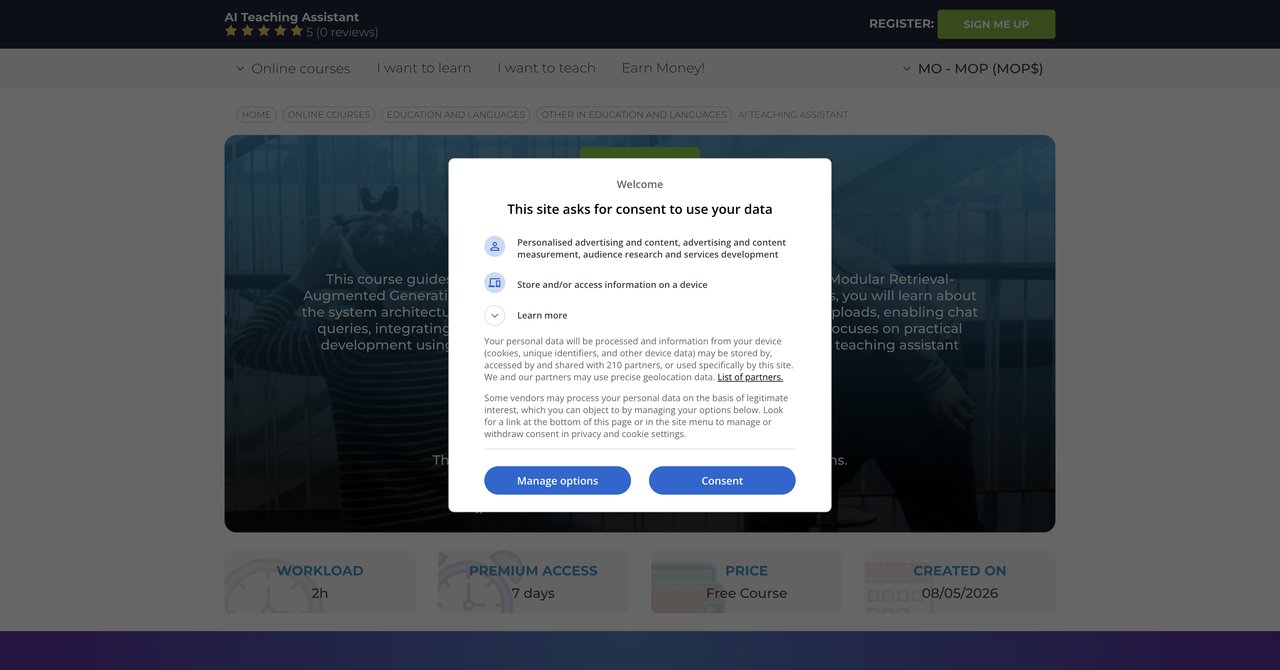
The last one in this list is perhaps the most technical of them all. Offered by Liberal Arts (Macau), it's a free course that includes a hands-on technical build of an end-to-end AI Guide Teaching Assistant. This is a RAG (Retrieval-Augmented Generation) assistant, and the course will walk you through its architecture, authentication, document upload, chat queries and quiz features.
This is totally different from educators who want to use ChatGPT, this is a technical development course. You will not just be using AI to plan your lessons; you're building the AI software itself. This is a great if you have some programming background, but it's potentially intimidating for people who are just looking for applications.
The good side: it's completely free, and you get a digital certificate, which is pretty rare. But the likely audience is also really specific: teaching assistants but with a technical pro. Also, at just 2 hours, it's a fast pace, which means you don't spend hours in a class, but if you understand AI quickly, it's okay.
Key Topics Covered: Building an AI Teaching Assistant using RAG, system architecture, authentication, document upload, chat interfaces, quiz features.
Target Audience: TAs with technical backgrounds or and software engineers who have teaching-related projects.
Pros:
- Free, digital certificate included
- Hands-on technical build - you will learn by doing a real-life project
- Covers modern patterns like authentication and RAG (book technology)
Cons:
- Technical setup is heavy for non-programmers
- 2 hours is very fast for such a complex story
Who it would benefit most: If you're a TA or teacher who also does tech projects (or quickly learns), this is a great chance to build a real AI tool from scratch. But if you're not a developer, this is not your starting point.
Get the free course at Learncafe
Summary and Recommendations
So that's a lot of courses to choose from. Let's try to make it simple.
If you want the most complete and future-proof option - and if you plan to keep growing in the field - then CompleteAI Training's subscription is the clearest choice for professionals you see. That subscription gives you hundreds of courses, hundreds of certifications, updates, and every job role, so you're not stuck with a single paid course. The price in the annual basis is fair, and you don't have to buy yet more courses next year. It's more like a learning platform. That's is the highest-rated offer available.
If you just want free options - and you feel 100% positive about learning something on your own, Georgia Tech's course (GTx) is a great free starting point. But if it's not the most dynamic, you can try it without budget.
If you prefer a free certificate but also want to learn technical things - the Learncafe course is free and on a whole, but as a technical nature, it's niche. Most beginners should not start there unless they like coding.
If you're a programmer but not a teacher - same course. If you want a simple, hands-on with ChatGPT, take Packt's course.
If you a university certified course - Molloy's EDU 5900 is the university route. But you need to contact them for pricing and scheduling. It's the only one that provides credits, but it's also the most complicated to fit in.
If you're looking for a free certificate no matter what - Oxford Home Study Centre has a free course, but the certificate will probably cost you. A certificate is often the final reason people avoid taking a course, because the cost is needed.
If you want everything: practical, e-learning, design module - also a free one that requires commitment. CMU's offering is comprehensive, but it costs more (both time and money) and is the best for someone ready to enter a longer course of study for a 9-week period.
In the end, the choice between you is whether you want a general suite of AI skills (CompleteAI Training), or a single area (ChatGPT in specific, for example). The right answer depends on your current level, the time you have, and your budget. CompleteAI Training is my pick for seasoned professionals who need it all, because it's the only subscription that includes everything listed. But if you're just starting free, or you have a specific use case such as or building an app, some might be a better fit.
Whatever you pick, just start. AI is going to be a bigger part of the classroom every year, and TA who is learning how AI can remove busywork - who learns how to use it ethically - will be the ones who can focus on what matters: the students.