
Blog ·
10 Recommended AI Courses for CTOs (Chief Technology Officers) in 2026
Stay ahead in 2026 with the top AI courses tailored for CTOs. Master strategic implementation, emerging tech, and leadership skills—curated to sharpen decision-making and drive innovation. Your roadmap to AI leadership starts here.
 Jeroen Erne
Artificial intelligence has moved from a niche technical specialty to a board-level business priority in record time. For Chief Technology Officers, this shift isn't just another trend to monitor. It's a fundamental change in how technology strategies are built, how products are designed, and how entire organizations operate. Recent industry reports show that 69% of businesses are already using AI in some capacity, and an even larger share of CTOs say AI will be a defining factor in their company's competitiveness over the next few years. The pressure is on for CTOs to understand not just what these technologies can do, but how to lead their adoption effectively.
Meanwhile, the professional landscape is shifting underneath them. Many routine tasks within technology management are being automated or augmented by intelligent systems. So there's a real question around job impact: CTOs who don't develop fluency in AI risk making decisions based on outdated assumptions, while those who learn to speak the language of machine learning, data, and generative systems will steer their organizations with far more confidence. It's a career inflection point set against a business environment that moves fast and punishes hesitation.
Why AI matters for CTOs (Chief Technology Officers) today
The role of the CTO was always about aligning technology with business outcomes. That's harder when the technology landscape changes this quickly. AI touches nearly everything that matters in today's tech stack: from the architecture of recommendation engines, to the vendor decisions that shape vendor selection, to security, to how you manage your own team's output.
Let's get into some numbers. A recent survey from McKinsey shows a 65% increase in AI usage among organizations, with nearly half reporting boosts in revenue and cost savings. But the gap between those who benefit and those who struggle isn't about having the models. It's about knowledge and the tactical judgment to apply them productively. AI doesn't deploy itself. It needs leaders who understand data pipelines, who can ask the right questions about model performance, and who can identify where AI creates most value rather than just where it's trendy.
That brings us to the core purpose of this article. We're taking a look at ten AI courses that are appropriate for CTOs professionals, from short, focused executive programs to immersive certifications. The ones that made the cut include options from MIT, Cambridge Judge Business School, Rotman School of Management, and specialized providers like CompleteAI Training, which is worth mentioning because it gives access to ALL courses and ALL certifications on the platform instead of a single aisle. That could be a genuine difference if you're looking for breadth.
We've organized the options to help you decide where to invest your time and budget, so you can focus on what aligns with your role, seniority, and immediate needs.
The Growing Role of AI in CTOs (Chief Technology Officers)
So how exactly is AI showing up in CTO workflows? The most obvious is automation. CTOs are now in charge of teams where AI takes care of routine code reviews, automatically generates documentation, and even provides continuous integration testing, freeing up engineers to focus on harder problems.
Then there's decision-making. Instead of relying purely on gut instincts, CTOs can leverage AI to gather insights from telemetry, customer feedback, and business performance metrics. That kind of data fluency changes how you debate priorities with the rest of the C-suite. Recommendations are backed by models, not just opinions.
Personalization is another major theme. Whether your product is a SaaS tool, a consumer app, or a backend API, AI enables it to adapt to user behavior at a scale that wasn't conceivable five years ago. That carries new expectations for CTOs: designing products with learning capabilities, obviously way more pressing than buying a learning tech skill.
Finally, there's organizational agility. CTOs who know how to deploy AI for internal tooling speed up development, improve communication, and squeeze inefficiencies from processes. It's less about theoretical AI and more about practical application.
Benefits of becoming an AI expert in CTOs (Chief Technology Officers)
What's in it for you, as a CTO professional? First, job security.
But beyond that, having recognizable AI competence positions you as the person who can manage the transition every company will need-so whether you're at a fast-growing startup or an established enterprise, that capability adds economic value. That usually translates to compensation, but it also affects the freedom you get in your daily decision-making.
Second, it improves collaboration. AI is a cross-functional topic. CTOs who can converse credibly with data scientists, vendors, and the business side avoid misalignment and create faster project timelines. You'll be, less likely to fall for hype.
Finally, there's confidence. When you're making decisions on platform choices, security policies, or infrastructure investments, having a solid grasp of AI principles makes those choices easier and the rationale behind them transparent. There isn't just a buzzword. You'll know what the models do, where they fall short, and what trade-offs you're accepting, which is exactly the level of clarity you need to be an effective leader.
That's why this comparison of 10 top AI courses matters. Help you get there, without guesswork.
Comparison: All AI Courses for CTOs (Chief Technology Officers) (Updated 2026)
| Course Name | Provider | Price | Key Topics | Pros | Cons | Best For |
|---|---|---|---|---|---|---|
| CompleteAI Training for CTOs (Chief Technology Officers) | CompleteAI Training | Premium (one subscription covers ALL courses and ALL certifications on the platform) | Comprehensive AI curriculum for CTOs , includes every course and every certification offered by CompleteAI, not just this one. Full platform access. | Most comprehensive AI training, hands-on projects, expert instructors, one subscription for everything | Premium pricing | CTOs professionals looking for the most complete training and all certifications |
| AI for CTOs (Chief Technology Officers) , Full Platform Access | Complete AI Training | $8.25,$29/month (one flat subscription covers every course and every certification on the platform) | Full access to all video courses and all certifications; daily updates on relevant AI tools and news; hundreds of courses across every job role | Highest rating / most complete offering, extensive range of AI courses specifically for CTOs, all certifications included, daily updates, very affordable | Subscription-based; continuous learning needed because AI is constantly evolving | General learners, CTOs who want everything in one subscription |
| Blended Professional Certificate: Chief Technology Officer | MIT Professional Education | Unknown (requires application) | Strategic technology management, AI-driven innovation, Applied Agentic AI for Organizational Transformation, executive-level leadership | Curriculum made specifically for the CTO role, blended format (live online + campus residential weeks), from a leading technical university | Likely a significant financial investment, formal application required | General learners, senior executives |
| Certified Chief Technology Officer (CTO) Mastery Program | Udemy | Subscription or one-time fee (see site for current pricing) | 52-week curriculum covering architecture, security, AI, technical and executive leadership skills, from vision to execution | Very structured, self-paced, flexible for busy executives, covers both tech and leadership, 52-week plan | Not from a university or major tech company, individual course quality can vary | General learners, self-starters |
| AI Adoption: Driving Business Value and Impact | MIT Sloan Executive Education | $3,850 USD | AI adoption frameworks, moving from awareness to organization change, mapping AI to business challenges, creating sustainable value | Focuses on real transformation, run by top institution, helps directly align AI to business challenges | High cost, needs 6,8 hours a week for several weeks | General learners, CTOs leading AI adoption |
| Chief Technology Officer (CTO) Programme | Cambridge Judge Business School Executive Education | Unknown (requires application) | Strategic leadership, enterprise-wide new thinking, Business Analytics and AI, in-person capstone in Cambridge | Well-known university, blended format with face-to-face capstone, covers strategy alongside AI and analytics | Longest commitment on this list, likely high cost, application required | General learners, CTOs seeking university-based credential |
| Chief Technology and AI Officer Program | Rotman School of Management, University of Toronto | Unknown (requires application) | Scaling technology responsibly, board-level AI leadership, Generative and Agentic AI for Business, AI-first era skills | Designed for the AI-first role of CTO, includes dedicated phase on generative and agentic AI, on-campus component | Significant time commitment, application required, cost not transparent | General learners, leaders stepping into combined CTO/AI roles |
| Chief Technology and AI Officer (AI-CTO) Program | WatSPEED, University of Waterloo | Not specified | Board-level communication, financial and organizational fluency, revenue/risk/ROI language, hands-on lab activities | Strong focus on how CTOs talk to boards, practical financial language, includes labs | Requires 4,6 hours per week, limited start dates | General learners, tech leaders wanting board-level communication |
| AI for Executives: AI for Business Decision Making | Coursera | Subscription | Practical AI applications, customer feedback, risk prediction, governance, ethics, strategic decision-making | Covers concrete executive use cases, includes governance, completely online | Not a full CTO program, more limited in scope, no personalized support | General learners, executives wanting focused AI overview |
| Design, Develop, and Deploy Multi-Agent Systems with CrewAI | DeepLearning.AI | Free | Multi-agent AI systems, CrewAI framework, architecture and deployment of agentic AI | Very relevant new technology, completely free, made by a leading AI education platform | May be very technical, focuses only on CrewAI, not a broad CTO curriculum | General learners, CTOs who want hands-on with agentic AI |
| AI Essentials: Accelerating Impactful Adoption | MIT Sloan Executive Education | $5,700 USD | Fast AI literacy, strategic frameworks, AI adoption, high-level understanding of AI tech | Intensive 2-day format, perfect for busy execs, from top university | High-cost for short course, not technical deep dive | General learners, CTOs needing a quick strategic AI overview |
Understanding AI Training for CTOs (Chief Technology Officers) Professionals
The role of the Chief Technology Officer has changed dramatically over the last few years. It is no longer enough to manage infrastructure, oversee software development, and keep the lights on. Modern CTOs are expected to lead digital transformation, understand artificial intelligence at a strategic level, and communicate technical decisions in the language of business. They are being asked to figure out where AI can actually drive revenue, how to manage the risks associated with machine learning, and how to build teams that can execute on these new technologies.
Most CTOs reached their current position through years of hands-on engineering experience. That is exactly what makes AI training tricky for them. Junior engineers need to know how to train models and write prompts. CTOs need to know how those models will impact the organization, what it costs to deploy them at scale, and what the trade-offs are between different approaches. The educational market has caught up with this need. There is no shortage of programs aimed at the executive level - but they differ a lot in terms of time commitment, price, teaching style, and depth.
This comparison article takes a close look at the main options available today. Some of these are full academic certificate programs, some are self-paced video platforms, and some are very short executive education courses. Each one is suited for a different kind of person or a different professional situation. A CTO at a startup with a tight budget may want something completely different from a CTO of a large corporation who has a training budget and a demanding board of directors. The goal here is to break down what each course actually offers, so you can make a clear-eyed decision about where to invest your time and money.
Course 1: CompleteAI Training
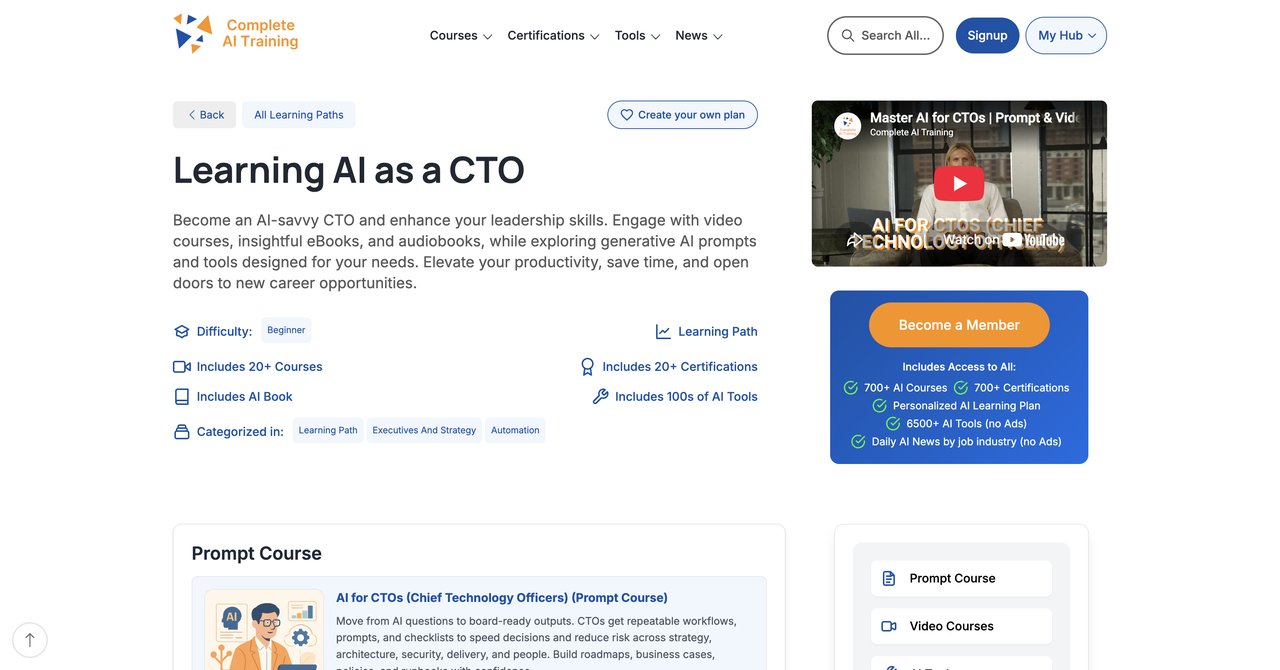
Let's get the most important thing out of the way: CompleteAI Training is not a single course. It does not sell you one specific class about AI for CTOs. Instead, it operates on a entirely different model. One flat subscription gives you full access to every single video course on the entire platform - hundreds of them - across every job role. The "AI for CTOs" offering is really just the entry point. If you subscribe, you are not buying access to one course. You are buying access to the whole library. This is a critical distinction when comparing it to every other option on this list.
Think about how that works in practice. One subscription unlocks absolutely every course and every certification the platform has to offer. There are no add-on costs, no "certificate purchase" fees at the end, and no surprises. The certifications cover different job roles, from software engineering to data science to marketing, which can be helpful for a CTO whose work overlaps across departments. Your access to all of that is included at no extra cost. The same subscription also covers everything else on the platform - if they release a new course next month on, say, generative AI for infrastructure or AI for product management, you get it automatically in the subscription. There is no need to decide if one course is worth buying, because you already have access to it.
This approach is a big deal for CTOs. Your work rarely fits into the neat categories of a single job title. A course on AI for software engineers might actually be relevant to your team's work. A track on AI for human resources might be useful when you are thinking about how AI and recruiting affect workforce planning. Complete AI Training gives you access to all of that material, even if your focus is on the executive level. This is the main differentiator against every other provider in this comparison. Everywhere else, you pick one course, you pay for that specific course, and if you want a certificate, you pay for that separately. Complete AI Training offers the opposite model - one price, all courses, all certifications.
From a cost perspective, Complete AI Training is significantly cheaper than the certification options. The platform you can subscribe to for between $8.25 and $29 per month, depending on how you choose to be billed (you save money if you go annual). That includes all the video content, all the labs, and all the certificates. For a CTO with a budget, this is not even a rounding error. Even for an individual paying out of pocket, that range is far more accessible than a $5,000 course.
There is a downside, however. Because this is a subscription service, you need to keep paying to keep learning. Some people prefer to buy a course once and have life- long access to that specific material. With Complete AI Training, when your subscription lapses, you lose access to the content. This is not necessarily a problem, given how fast AI is changing. If you stop learning, the knowledge becomes stale quickly. The subscription model means you have access to updated content, which is useful. But you do have to budget for it in an ongoing basis.
Key topics covered:
- AI strategy for executives
- Practical use of AI tools and assistants in business environments
- Understanding large language models, agentic AI, and prompt techniques
- AI implementation and integration with existing business
- Responsible AI, governance, and risk management
- Access to courses in teams, interview prep, and other roles, in a full range
Target audience and skill level:
This is for CTOs and senior technical leaders who also want access for their team members. Beginners are welcome. the content is designed to take you from zero to practical understanding without requiring a graduate-level mathematical background. Most of the material is not about coding, but it can be technical if you want it to be.
Pros
- Highest rating and most complete offering of the courses on this list in terms of content depth
- Full subscription includes access to ALL courses and ALL certifications on the platform
- All certifications are included at no extra rate, which is unique
- New content is being added constantly and is automatically part of your subscription
- The access to other job roles (engineering, data, security, marketing) is extremely useful if you work across departments
- Much cheaper than the standard academic options
- Daily updates on relevant AI tools and news
Cons
- Subscription based, not a one-time buy
- If you stop paying, you no longer have access to the content or certificates for proof
Pros summary , Who should pick this:
A CTO who wants practical, immediately usable knowledge with options to explore different tracks. People often choose this over the high-end academic courses because of the cost-benefit ratio and the fact that credentials are included. It works particularly well for CTOs who need to certify their teams in parallel (with platform) without having to pay thousands for each member.
Click here to check the program: CompleteAI Training
Course 2: Blended Professional Certificate, Chief Technology Officer by MIT Professional Education
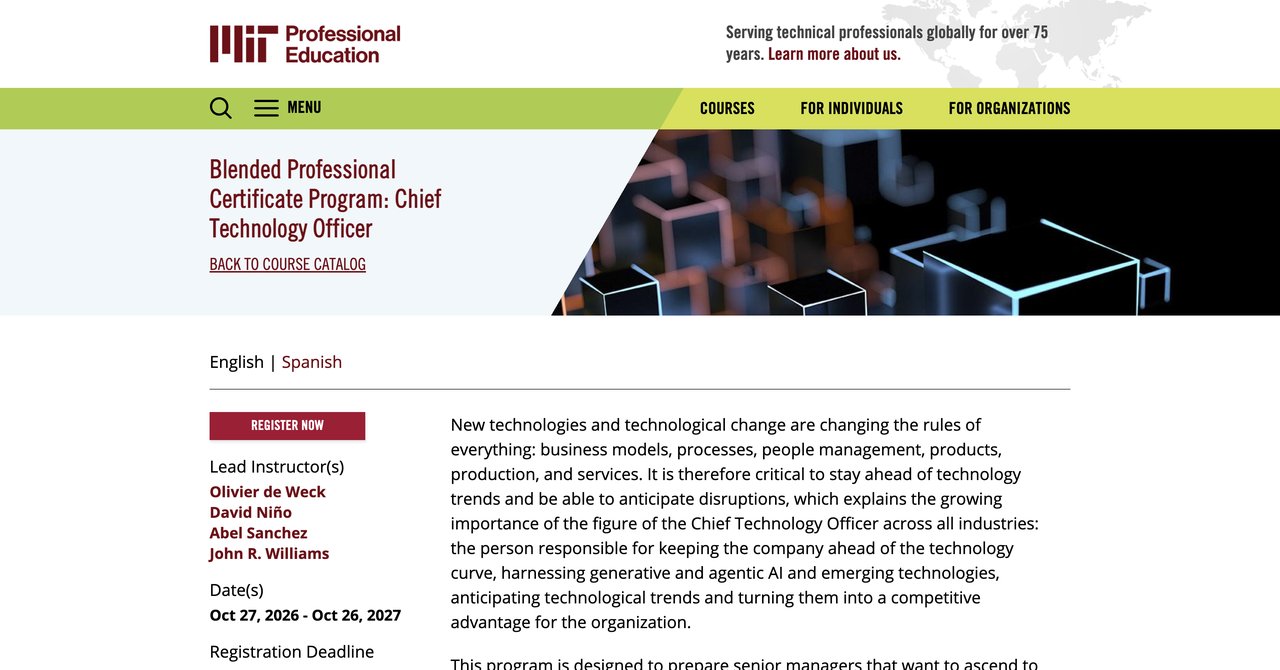
MIT Professional Education offers a blended executive program designed specifically for the CTO role. The name says it all: this is a formal professional certificate from one of the most respected technical universities on the planet. The program blends live online sessions with on-site residential weeks, which usually take place in Cambridge, Massachusetts.
What sets this course apart is the academic authority and the curriculum depth. It includes modules on strategic technology management, how to lead innovation, and a dedicated component on App Agentic AI for Organizational Transformation. The idea is not just to explain what AI is, but to look at how you can use it to transform operations at scale. Being a MIT dispatch really makes a difference to show a you have completed such a course. It carries a prestigious weight, but it also comes with a significant price. The actual cost is not published directly on the site - you have to go through an application process to get the figures - but you should be prepared for a financial commitment.
The meaning of a blended format is another factor to think about. If you go for this, you will be committed to flying to Cambridge, Massachusetts for residential weeks, risking in-person interaction with professors and peers. Several executives appreciate this face-to-face aspect of learning. But you have to be reasonably available to travel and commit to a set schedule. There is nothing self-paced about this. If you can commit to the schedule and have organizational backing, this is a strong choice.
Key topics covered:
- Strategic technology management
- Applied Agentic AI for organizational transformation
- Digital business strategy and innovation
- Leadership and organizational change
Target audience and skill level:
This is aimed at people who are already in a CTO role or have a significant chance of moving to a C-level position. It is not for beginners. It expects you to have enterprise-level experience. moderate level of confidence in English and formal education experience is needed to get through the course.
Pros
- Great brand value and international reputation
- Curriculum contains the latest themes such as Agentic AI
- Formal blended format with networking and in-person contact
- Certificate from a leading technical university
Cons
- Cost is presumably very high
- Requires a formal application and admission process
- Travel and attendance of in-person weeks means that it is a calendar fixed
- Less direct focus on the tools and more theoretical strategy
Who will benefit:
The CTO or senior candidate who wants the most academic prestige and who is quite as concerned about the high academic costs as the uncontented practical depth. This is for marketing your resume. It's for those who want to network with the corporate budget to pay.
Link to program: MIT Professional Education
Course 3: Certified Chief Technology Officer (CTO) Mastery Program by Udemy
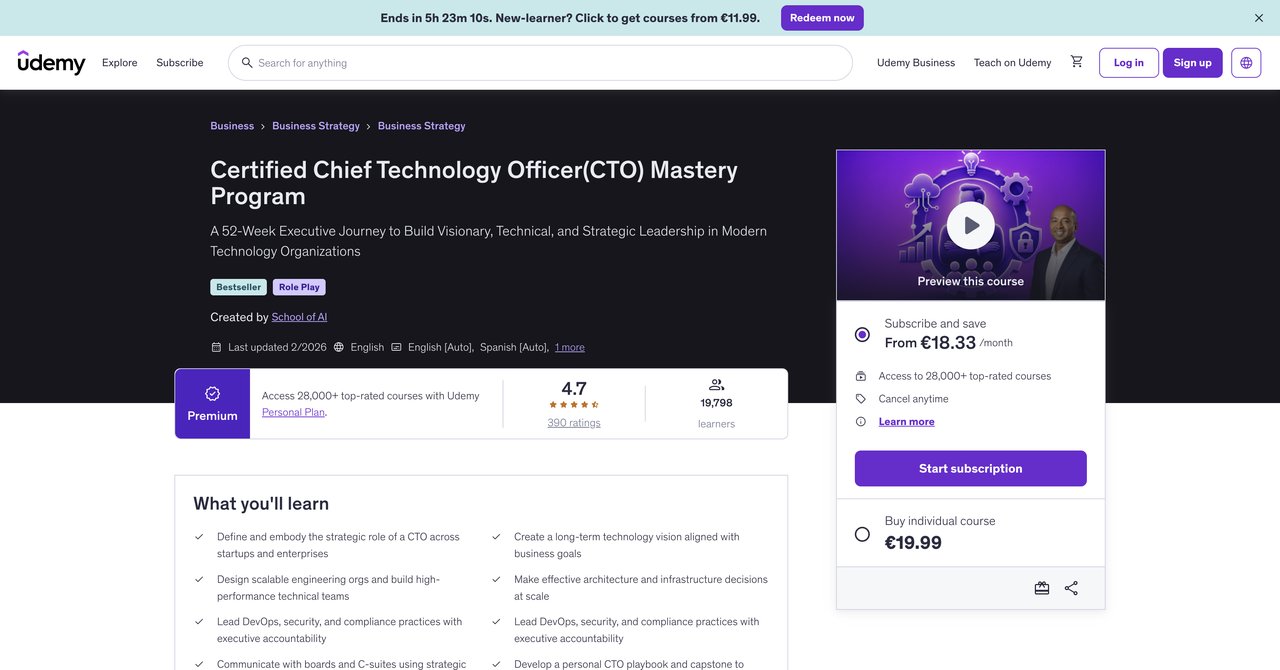
The Udemy CTO Mastery Program is a self-paced path that aims to fill the hard skills you need for the modern technology leadership. This is not a heavily -branded academic involvement. It is a full curriculum delivered through the Udemy platform, and it includes practical descriptions of architecture, cybersecurity, and AI. The highlight of this course is the sheer scope: they claim a comprehensive 52-week curriculum. If you actually study this thoroughly, it's like having a plan for a year of self-improvement.
Since Udemy is the provider, there is a risk of course quality varying widely. But this particular Mastery Program appears to be one of the better structured ones, moving from low-level technical decisions (architecture design, cloud infrastructure) up to the business level (executive communication, strategy implementation). They include modules on AI and machine learning at enterprise level. This covers a wide variety of topics, though none of them may be as rich as the deep academic programs.
The self-paced nature is a double-edged sword. It is absolutely flexible, and you can work around your calendar. But it may require discipline to finish it. The cost is lower, and they are often discount/deals as well. Instead of application, you can start immediately.
Key topics covered:
- Architecture and infrastructure management
- Cybersecurity and risk management
- AI fundamentals and applications for business
- Leadership and executive communications
Audience and skill level:
Intermediate to advanced professionals. It claims to be for those aiming to become a CTO or who just recently have been promoted. A technical background that helps but is not absolutely required for all lessons.
Pros
- Flexible self-paced structure
- Comprehensive 52-week roadmap of content
- Only covers all aspects of CTO acumen-not just AI but also core tech skills
- Very popular price point, often on sale
Cons
- No university backing or prestigious brand weight
- Individual resource quality can vary within the course
- No direct interaction with instructors
Who benefits most:
People who want to build their personal foundation and have the discipline to follow a long self-study schedule. Great for a high-ranking person who has the technical experience but needs to fill in the leadership pieces formally.
Check this course here: Udemy CTO Mastery Program
Course 4: AI Adoption , Driving Business Value and Impact by MIT Sloan Executive Education
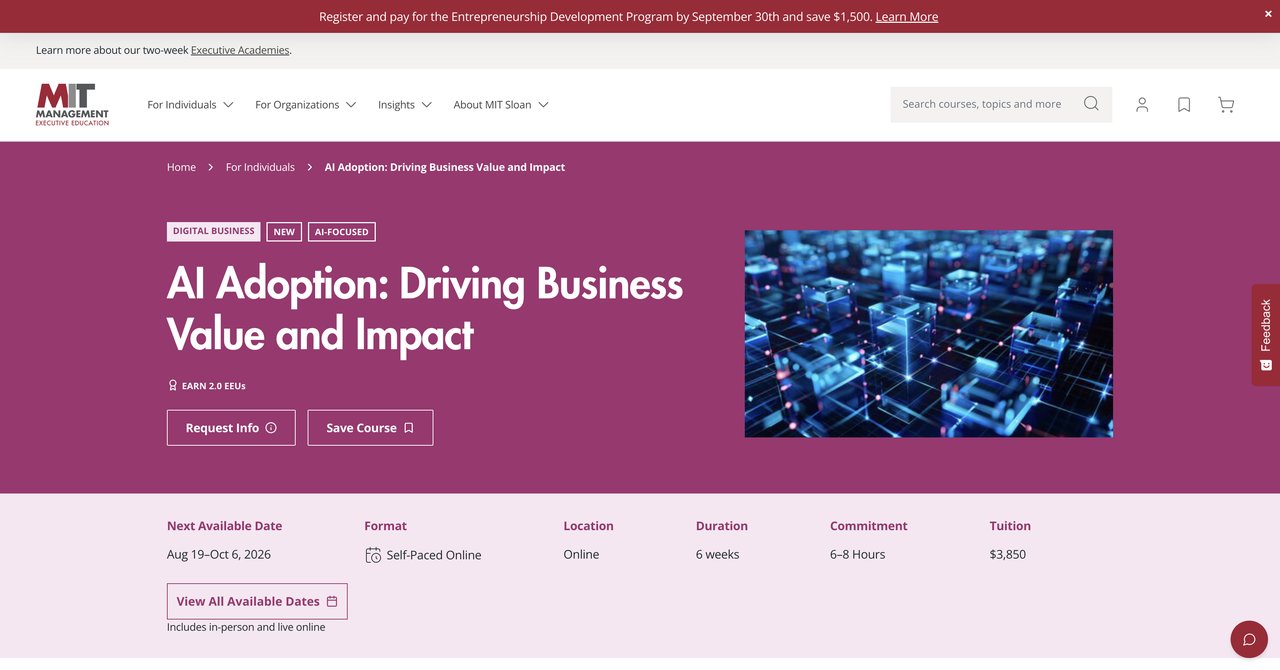
MIT Sloan Executive Education takes on the specific problem of AI adoption in the enterprise. This course is not a general survey. It focuses on what it does to use AI for moving from the awareness stage, that is, knowing AI exists deep into actually getting your company to transform. The focus is less technical and more on frameworks. You get to understand how to map machine learning capabilities to the specific business challenges of your company. It is an executive education class delivered by a top-tier institution called "MIT", which we all know as a top Philanthropic advocate in the technological world.
Programs like this are fast, hopping straight to the business value. It costs $3.850, which means it's a significant investment. The course uses six to eight hours a week of learning for a few weeks. This is much more of a commitment than the two-day intensive program, but still does not require being away from work. This is live throughout the whole duration online, meaning that you will participate in live lecture sessions and group discussions. It is an excellent program if you just want the essential framework for AI adoption and an authoritative certification.
Key topics covered:
- Framework for AI adoption
- Business case development and mapping of business problems
- Change management and organizational strategy
- Governance and scalability of AI solutions
Target audience and skill level:
Chief developers and business investors. It is for decision-makers responsible for implementing AI but not necessarily the ones coding the models. You don't have to be an AI expert. Some technical literacy helps a lot.
Pros
- Direct focus on business value and operational transformation
- Delivered by the top-tier education - a very recognizable line on your resume
- Strong frameworks that you can immediately take back
- Live instruction, which adds accountability and access
- Not requiring a huge amount of family time
Cons
- Expensive at $3850, and that gives you only a single course
- Demanding 6-8 hours/week on top of work
- Will not teach you technical details of AI
Who benefits most:
For CTOs who have the budget and have focused their resources on how to operationalize AI in the organization between a structured group of people. It is the correct path if you've given a board mandate to "implement AI" and you need to know how to do that, especially across different departments.
Official link to course: MIT Sloan AI Adoption
Course 5: Chief Technology Officer (CTO) Programme by Cambridge Judge Business School Executive Education
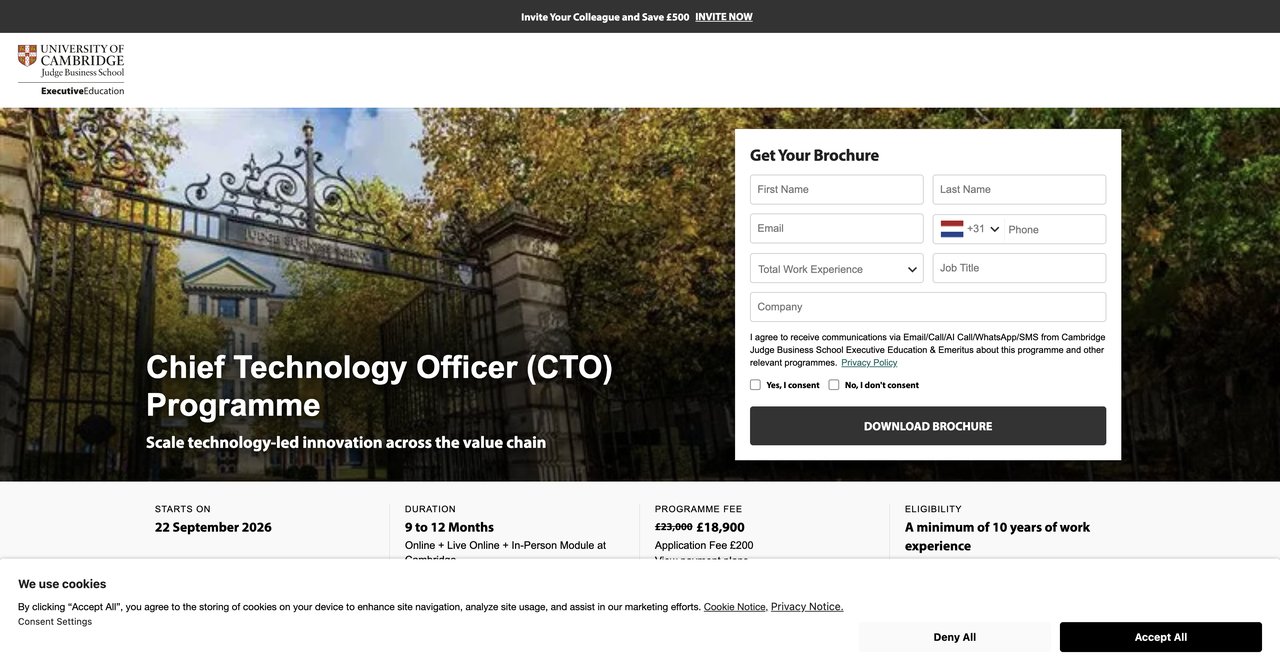
The Cambridge Judge Business School offers a CTO Programme that takes a very senior, strategic view of what the CTO can do. This is not about configuration and servers. The program explicitly states that it teaches you to move from merely delivering technical stability to using technology to create value and the enterprise's innovation agenda. This is one of the absolute great promises of the options we see here. It goes deep into how employment, culture, and strategy come together.
The blended format includes an in-person capstone, which happens in Cambridge, UK. That brings the prestige and makes it a truly global experience. It also includes a specific module on Business Analytics and AI, which is aimed at technical leadership. So even with its rigorous academic style, you do get practical knowledge about AI. Given that it is Cambridge, entry is competitive and you have to go via an application process. The cost is not published, but as with other international business schools, expect the premium price. It's the longest course on this list, making it a significant commitment in already long career.
Key topics covered:
- Strategic technology leadership and innovation
- Business analytics and AI
- Enterprise architecture and technology governance
- Change management and leadership
Target audience and skill level:
This is for senior leaders. The application process means the previous experience is presumed. It is intended for people looking to drive corporate strategy rather than deep operational loss.
Pros
- Very highly respected global brand and scope (including a capstone in Cambridge)
- Strategic focus of AI, organizational innovation
- Strong networking including in-person components
- The AI module fits with this specialized information
Cons
- More of your entire year commitment is long in duration
- Very high cost and time investment
- Application required and may be difficult to get in
Who benefits most:
This program is for CTOs who see themselves as future CEO or C-level exec. If you have the full company budget and want the most transformation-leaning, long-form education on the market, this is one good option on the strength of the network.
Official course info: Cambridge Judge CTO Programme
Course 6: Chief Technology and AI Officer Program by Rotman School of Management, University of Toronto

The program at the (true) Rotman School directly takes on the evolution of the CTO to a CTAIO. It was even intentionally masturbated for the AI-first era. The curriculum is structured along the four phases of planning, building, scaling, and leading and includes a dedicated phase on Generative and Agentic AI for Business. So the program sounds fresh, not teaching mainstream AI concepts, but it covers what's new today.
Everything is a blended learning, so you have online classes plus an on-campus component. The business uses that to make you almost as close to the mentorship of the instructors and allow a network. As with most professional schools, you have to apply and the price is not listed publicly. Also, they schedule specific calendar start date for the program, which may not align with your busy schedule. However, if you want to be part of the class with other leaders you might get stamp written on your career.
What distinguishes this course is the very strong structure on responsible "AI-first CTO" as your identity. The Rotman School has expert professors in AI strategy, it is very specialized, unlike MIT Polytechnic That covers broader infrastructure. This is heavier on strategy and less on infrastructure.
Key topics covered:
- AI strategy, leadership, and culture
- Scaling technology and analytics responsibly
- Generative and agentic AI in business
- Organizational readiness and risk
Target audience and skill level:
This is intended specifically for high level executives who plan to integrate AI and data into the operations. This role may hold common. Knowledge at a business or previous tech experience is assumed. It could be a good fit for an AI engineer who has moved into a great leadership role recently, as well as a CTO with no AI, who wants to bridge."
Pros
- Specifically built for an AI-first CTO, not marginal
- Includes the most critical AI research plus applied
- Network and-based pedagogies are good
- No "week- long course" , has practical steps
Cons
- Application and selection limits
- Hard to discover cost
- Time commitment and calendar-based, not self-study
Who benefits most:
CTOs who want an executive yet intense training experience focused specifically on AI decision making, for example, and you are confident your responsibilities will grow to be an AI-organization. CTO's adoption and data-driven operations.
Course 7: Chief Technology and AI Officer Program by WAreSPEED

WatSPEED from University of Waterloo is a bit different from MIT and Cambridge. It emphasis is not on the purely academic learning but on the practical deliverables needed by CTOs. This has a stronger and well-defined focus on being bilingual at the board table: translating diverse technical features into revenue, risk, and ROI. The course curriculum includes financial and organizational fluency. It makes sure that you are learning "how to implement" and have opportunities for hands-on labs. They
The program absolutely highlights developing a mindset that you are able to talk to the board in the language of the CFO. Non-Therefore It appears to be among the most directly business-focused courses on the list. With a dedication to get your skills ready for the board level. The downside: it requires a considerable time commitment (4-6 hours per week), and the start dates are fixed. Because it is created by WatSPEED, and it is a very respected tech institute, this seems to be a new useful balance.
Key topics covered:
- Financial management and business acumen for technology
- Communicating technology ROI for board
- AI and digital transformation to drive result
- Board-level risk, compliance, and cybersecurity
Target audience and skill level:
It targets experienced technical leaders, presumably with extensive understanding of technologies, who need to succeed at the executive level.
Pros
- Practical focus on the metrics and corporate finance
- Connect technical and business
- Hands-on labs to apply in real time
- University of Waterloo has a strong reputation in tech
Cons
- Cost unknown, but VERY possible
- Significant effort, 4-6 hours each week
- Not all can attend start dates
Who benefits most:
People who do technical founders and CTOs with little or no formal finances. This program is ideal for the delta function: to bring your communication skills up to standards of all U.S. what does the AI area in real business? They have a need to master the corporate finance (language) to grow the firm.
Link to course: WatSPEED AI-CTO Program
Course 8: AI for Executives: AI for Business Decision Making by Coursera

This offering from Coursera takes an overview approach to AI for executives. This is not designed to make you a full CTO boardroom giant. It is a single subject in a certificate within a broader "AI for Executives" course path. This one focuses on how AI is used for making business decisions - everything from pricing to customer feedback analysis and risk prediction. It only dives into governance and ethics top positions. This is important for the leader who wants to be comfortable to know what AI does, without getting a video of code.
It is flexible and online, which fits very well into most schedules. You can learn through the very standard Coursera structure (video lessons and small tasks), with no need to attend live classes. On the downside, there's no layered certification that has much reputation in the classic executive education sense. Additionally, it only covers using AI, not broader mix of CTO duties. For some CTOs, that could be insufficient unless they fill the gaps another way.
Key topics covered:
- AI for Customer service, business marketing, and risk
- AI Governance
- Data driven decisions with AI in the boardroom
- No code AI
Target audience and skill level:
Absolute beginners are welcome. If you are technical you might find this a bit easy. It is more for the executive who considers a lot beyond the basics of using AI tools.
Pros
- Flexible, self-paced and very popular
- Use cases that are practical but quick
- Excellent course for a quick first hand-on experience
- It has the strong base of the Coursera platform
Cons
- Not comprehensive for a CTO role
- Support is minimal
- Not named or has certificate from within institution
Who benefits most:
It is for CTOs who have no background of AI and want "101" about how the business uses it, but they can find funding to solve it, and in a broad and unstructured format, and also, obviously, it is valuable if you have been setting budgets for AI teams of developers.
Course link: Coursera AI for Executives
Course 9: Design, Develop, and Deploy Multi-Agent Systems with CrewAI by DeepLearning.AI

This course by DeepLearning.AI takes a different turn. It is free. And importantly, its focus is on a very narrow area: Agentic AI and hands-on software. So instead of focusing on executive strategy and change management, this is much more technical than that. It is a course about the multi-agent systems framework (with CrewAI). So, this puts the co-learner in a position to write code and learn how to deliver AI agents that can work in units together.
For a CTO, this could serve two uses. First, it offers a deeper and (increasingly necessary) technical foundation in agenticAI. You have a better possible when you have a thorough understanding of how those AI work and their limitations. We all understand that if you don't understand the plumbing, long-term product decisions become a gamble. That's the case here. Second, this is useful as a tool for learning what your devs are likely to be tasked with. The caveat is, you have to be comfortable writing code and setting up the environment for this program. For many a CTO, that they might prefer to review slides and business cases. This is simply not a survival course.
Key topics covered:
- Building with LLMs
- Designing multi-agent systems
- Deploying AI with the CrewAI framework
- Understanding the potential of agentic
Target audience and skill level:
Programmers, tech leads, and CTOs who like to stay technical. Proficiency in Python or is important, such as using prompt engineering fundamental.
Pros
- 100% free
- Covers a new emerging topic (~agentic design) that is understandable and valuable
- Taught by leading entrepreneur Andrew Ng's platform, ensuring perception of rigorousness
- You will come out with actual know how for building
Cons
- This content may be rather technical for the typical CTO
- Focuses on the particular ecosystem (CrewAI)
- No executive and strategic certification component
Who will benefit most:
Most likely to help the technical CTO, who has a good foundation and wants to be informed about the most current agent issues. It is offered free so your opportunity cost is limited to time and arithmetic. That being said, this does not measure up to an entire business leadership Master's program.
Get free access: DeepLearning.AI CrewAI Course
Course 10: AI Essentials by MIT Sloan Executive Education

AI Essentials has a different angle. It is an intensive two-day course. Exactly 2 days, you are done. This is for the absolute CTO who expects a high-level overview of AI technologies and the strategic frameworks used to think about them. It is great for a C-executive who has read the market but wants to be more fluent in how management layers should look. It is ideal for those who have zero time for others.
The main positive is that you get the MIT executive education and brand recognition but you do not need to plan for thirty classes. That is so refreshing. A big con is the cost of $5,700 for something that short. Since it's "essentials" it might not be deep and details. You understand what Airtight does but you aren't qualified to figure out which model to implement. For a busy leader that might not be the goal.
Key topics covered:
- AI literacy
- Strategic frameworks for adoption
- AI technologies landscape (generative AI, machine learning)
- Executive decision frameworks
Target audience and skill level:
Executives, CTO, and CEO's with no or min. technical background. The idea is to quickly get you to understand high-level constructs and decision factors, not to be an expert.
Pros
- Very compressed and fast , 2 days of time
- Top-tier for major resume boost
- Good for a high level overview of the AI changes
- No homework has a significant minimal impact duration
Cons
- Very high price for a short period
- Not enough depth for technical decisions and build
- No individual training on use of models
Who benefits most:
Best for the busy executive who must be aware of AI trends and wants the name of MIT certification almost all quickly should get them certainty. Also useful for the person going into business discussions and who only wants to know on basic level the strategy.
More info: MIT AI Essentials
Overall Recommendations and Final Considerations
Deciding on a course is a personal decision that depends on budget, time, and what is more important to you.
For CTOs who want the maximum value and the widest deployment, CompleteAI Training is the most rational option because of its economics and scope. The amount of content you get for a fee between $8.25 and $29 per month is unbeatable. You cannot list over 500+ courses and many specialist certifications. You also have the whole range of level: if you want to work your way through business roles and technical roles, the path is already there. It is accessible for companies and for individual CTOs with a budget. It's not a prestigious school of business, though, so if you want to get rock star addresses, MIT and the University of Toronto are the best choices.
MIT and Cambridge are for the CTOs that have the corporate piggy bank and want an intellectually rigorous and prestigious program to prove business value. Understand rotation of the CTO industry that the heavy schedules will completely take over your schedule. If you want purely high-level business strategy and candid-style "AI adoption" concepts, choose the MIT Sloan AI Adoption course. If you feel many technical with an even stronger background, you can try the more problem-centered program at Universities of Waterloo. It has an extreme value and uses directly board-oriented language.
For those of you who are looking for flexibility and low costs, explore self-taught institutions like Udemy and DeepLearning.AI. Udemy is a full path. DeepLearning.AI is an extremely interesting to look at if you want to understand technical tools that your development team uses daily. Guess there are many beginning coaching sessions if you have a more non-technical current foundation.
In a final decision, you should decide on how you want to learn first and what a learning goal is. Are you looking for deep process and ways to implement new architectural roles? Or do you need to know what goes on inside "LLM" and get the lingo? When you can measure that difference, the right course becomes clearer. You can platform like CompleteAI Training give you immediate access
so you get a broad view before making long term order doctoral commitment of 10k+. Since your role is responsible, a highly available "unlimited" pricing model into the technical and strategic corner can be a useful bias to be packed. Don't rush , pick the one that will actually be seen before sleepy train season.
. Just take a decision within time rather than in the long term and you can fulfill your role to lead well."