
Blog ·
10 Recommended AI Courses for Film Composers in 2026
Discover 10 top AI courses tailored for film composers in 2026, covering tools like synthetic orchestras, adaptive scoring, and workflow integration to elevate your craft and career.
 Jeroen Erne
The film scoring industry is changing faster than most working composers realize. What used to be a craft built entirely on orchestral knowledge, harmonic theory, and sheer musical instinct now sits at an intersection with artificial intelligence. AI tools can generate orchestral mockups in seconds, analyze reference tracks for tempo and key, and even suggest harmonic progressions that fit a director's brief. For film composers, this isn't a distant future scenario-it's happening right now. The question is whether you're going to be one of the professionals who adapts or one of those who gets left behind.
Consider the numbers. A recent industry survey found that 69% of businesses already use AI in some form, and the creative sectors are no exception. Music production software now ships with AI-powered features as standard. Streaming platforms use algorithms to recommend scores to directors. Even major studios are experimenting with AI-assisted composition tools for temp tracks and pre-visualization. For film composers, the job market is becoming more competitive, and the skill set that got you work five years ago may not be enough for the next five. Upskilling in AI isn't just a nice-to-have-it's becoming a professional necessity.
Why AI matters for Film Composers today
Here's the reality: artificial intelligence is already embedded in the tools you use daily. That virtual instrument that sounds remarkably realistic? It's powered by machine learning. That plugin that automatically balances your mix? AI. The software that separates stems or cleans up audio? AI again. But the applications go much deeper than that. AI can now analyze a film's emotional arc and suggest musical themes that align with character development. It can generate variations on a motif you've written, saving you hours of sketching. It can even help you communicate ideas to directors by creating instant demos that capture the mood of a scene.
For film composers, the professionals who understand these tools aren't just faster-they're more creative. They can experiment with more ideas in less time, they can offer directors a wider range of options, and they can take on more projects without burning out. The purpose of this article is straightforward: to help you identify the best AI courses available, so you can build these skills without wasting time or money on programs that don't deliver real value.
The Growing Role of AI in Film Composers
AI is showing up in film scoring workflows in ways that are both subtle and profound. Here are some of the key applications:
- Automated orchestration: AI tools can take a simple piano sketch and generate a full orchestral arrangement, complete with appropriate voicings and instrumental combinations.
- Intelligent mixing and mastering: Machine learning algorithms can analyze your mix and suggest adjustments to achieve a more cinematic sound, saving hours of manual tweaking.
- Creative ideation: Generative AI can produce melodic fragments, chord progressions, and rhythmic patterns that spark new ideas when you're stuck on a scene.
- Reference analysis: AI can analyze existing film scores to identify tempo, key, instrumentation, and emotional characteristics, helping you match a director's reference tracks more precisely.
- Workflow automation: From file management to session setup, AI can handle repetitive tasks so you can focus on the creative work.
- Personalized sound design: AI systems can learn your compositional style and generate suggestions that fit your unique voice, rather than generic templates.
These aren't hypothetical possibilities-they're tools that exist today. The workflow of a film composer is being reshaped around them, and the composers who learn to work alongside these tools are finding they can produce more, stress less, and deliver better results to their clients.
Benefits of becoming an AI expert in Film Composers
So what's in it for you, specifically? Becoming proficient in AI as a film composer opens up several significant advantages. First, there's the efficiency factor. When you can generate realistic orchestral mockups in minutes instead of hours, you can take on more projects or spend that saved time refining the musical details that truly matter. Second, there's the creative edge. AI tools can push you in directions you might not have explored on your own, helping you break out of creative ruts and develop a more distinctive voice.
There's also the business angle. Clients are starting to ask about AI capabilities. Directors and producers want to know if you can deliver quick iterations, provide multiple musical options, and work within tighter timelines. Being able to say yes to those requests positions you as a forward-thinking professional rather than someone who's stuck in old workflows. And let's be honest-there's also job security in this. As AI becomes more prevalent, the composers who understand it will be the ones leading the industry, while those who resist may find themselves competing with cheaper, faster AI-generated alternatives.
This article compares 10 AI courses specifically relevant to film composers, ranging from comprehensive platform subscriptions to university-level programs. One notable option is CompleteAI Training, which stands out because it gives you access to ALL courses and ALL certifications on the platform rather than just a single course-a practical choice if you're looking to explore multiple aspects of AI without committing to separate purchases. The other nine courses each bring something different to the table, from Berklee's established music programs to Stanford's academic rigor. By the end of this comparison, you'll have a clear picture of which option fits your experience level, your budget, and your career goals.
Comparison: All AI Courses for Film Composers (Updated 2026)
| Course Name | Provider | Price | Key Topics | Pros | Cons | Best For |
|---|---|---|---|---|---|---|
| CompleteAI Training
https://completeaitraining.com/course/ai-for-film-composers/ |
CompleteAI | Premium (One subscription covers everything , all courses AND all certifications, not a single course) | Comprehensive AI training for film composers , includes ALL courses and ALL certifications on the platform, covering AI tools, workflows, and practical applications for film scoring. One flat price gives access to the entire library, including hundreds of courses across every job role, with new content added continuously. | Comprehensive curriculum; Hands-on projects; Expert instructors; Full access to every course and certification at no extra cost; New content added automatically; Covers other job roles too | Premium pricing; subscription-based, which requires ongoing commitment but ensures you stay current as AI evolves | Film Composers professionals looking for complete, all-in-one training |
| AI for Film Composers
https://completeaitraining.com/course/ai-for-film-composers/ |
Complete AI Training | $29/month or $8.25/month billed annually | One subscription unlocks every course and every certification on the platform , hundreds across every job role. Includes all AI courses and certifications for film composers and every other role, with new content added continuously. Also covers daily updates on relevant AI tools and news. | Full access to ALL video courses, not a single course or fixed bundle; all certifications included at no extra cost; new courses added automatically; access to other job roles' material; affordable with annual billing | Subscription-based , you need to keep paying to keep access, but that's also how they keep content current | General learners, composers who want everything in one place |
| AI in Music: Composition, Production, and Analysis
https://online.berklee.edu/courses/ai-in-music-composition-production-and-analysis |
Berklee Online | $1,575 | AI tools for music composition, production, and analysis; hands-on practice with AI music tools; Music Information Retrieval (MIR) for rhythm and harmony analysis; ethical and legal implications of AI music | Hands-on with real AI music tools; covers MIR; includes ethical and legal considerations | Expensive; requires undergraduate-level time commitment | General learners who want a structured, academic introduction |
| Scoring Technology
https://online.berklee.edu/courses/scoring-technology |
Berklee Online | $1,575 | Professional DAW-based scoring workflows; orchestral mockups; scoring-to-picture; hybrid orchestration and mixing tools , the technology stack AI tools integrate with | Builds professional DAW workflows; covers orchestral mockups and scoring-to-picture; includes hybrid orchestration and mixing tools | Not AI-specific; expensive | General learners who need to master the tech behind scoring before adding AI |
| AI for Audio and Music
https://www.coursera.org/learn/ai-for-audio-and-music |
Coursera | Subscription (Coursera Plus or single course fee) | AI for creation, editing, mixing, and production; practical, hands-on approach designed for musicians, producers, and sound designers | Beginner-friendly and practical; covers AI across the whole audio workflow; aimed at music professionals | Not film-scoring specific; depth might be limited for advanced composers | General learners and music producers new to AI |
| Composition + AI: Hybrid Music Creation
https://www.domestika.org/en/courses/6482-composition-ai-hybrid-music-creation |
Domestika | $10-$20 (typical Domestika pricing) | Expressive composition with AI tools like Suno Studio and ChordSeqAI; modal interchange; motif reuse; keeping the composer's personal voice central | Focuses on expressive composition; teaches practical techniques like modal interchange; affordable and short | Short duration; only covers specific tools | General learners who want a quick, focused introduction |
| Film Scoring - Part 1 - Techniques For The Modern Composer
https://www.udemy.com/course/film-scoring/ |
Udemy | $20-$100 (varies) | Composition techniques for scoring to picture; working with directors; building a film composer portfolio | Covers scoring-to-picture techniques; includes director collaboration; practical portfolio-building | Not AI-focused; beginner-level only | General learners who want a solid foundation in traditional film scoring |
| Composing Film Music
https://utrechtsummerschool.nl/courses/art-music/composing-film-music |
Utrecht Summer School | $1,220 course fee + $610 optional housing (total approx. $1,830) | Intensive in-person experience; communication with directors, editors, and sound designers; requires DAW proficiency (Cubase, Logic, etc.) | Intensive, hands-on in-person format; covers the full collaborative process with directors and editors | Expensive; not AI-specific; requires travel and housing | General learners who can attend in person |
| Learn Film Scoring: 30 Day Film Composer Course (2026)
https://thirtydayfilmcomposer.com/ |
Thirty Day Film Composer | $149 founding member price (rises to $299) | Complete scoring process from analysis to delivery; orchestration, production, mixing, and mastering; structured method for real productions | Step-by-step complete process; covers orchestration, production, mixing, and mastering; structured for real productions | Not AI-specific; reflects a single instructor's perspective | General learners who want a full traditional scoring workflow |
| Stanford Music 356 / CS 470
https://ccrma.stanford.edu/courses/356-winter-2026/ |
Stanford University (CCRMA) | Stanford tuition applies (not specified) | 'Critical making' approach balancing AI, HCI, and music; aesthetic and ethical dimensions of AI music; hands-on software system building | Critical and hands-on; explores ethical and aesthetic questions; build your own software tools | Requires Stanford enrollment; highly academic; not practical for most working film composers | General learners and academics interested in the deeper questions |
| Certified Professional in AI Music Composition for Film Scoring
https://www.stanmoreuk.com/Course/Details/86120 |
Stanmore UK | $113 (Standard) / $176 (Fast Track) (approx. converted) | AI music fundamentals; generative models; AI-assisted orchestration; film scoring principles; copyright and ethics; portfolio development | Covers core AI music concepts, generative models, orchestration, and film scoring; includes copyright, ethics, and portfolio work | Smaller provider with less brand recognition; self-paced without instructor feedback | General learners who want an affordable, structured self-paced option |
Understanding AI Training for Film Composers Professionals
The craft of film scoring is changing fast. It's not just about writing great melodies anymore-you also need to know how to work with AI tools that can generate orchestral sketches, assist with mixing, or even create entire cues from a text prompt. For working composers, the question isn't whether to learn this stuff. It's where to start without wasting money on courses that don't fit your workflow or skill level.
There's a lot of options out there. Some are full university courses that cost over a thousand dollars. Others are cheap short classes that focus on one specific tool. And then there are subscription platforms that give you access to everything for a monthly fee. Each approach has its strengths and weaknesses, and what works for one composer might be a poor fit for another.
This comparison breaks down the main options currently available for film composers who want to get serious about AI. I've looked at pricing, curriculum depth, practical value, and who each course is actually trying to serve. Some of these are AI-specific. Some are traditional scoring courses that don't mention AI at all but still matter because they build the foundational skills you'd want before layering AI on top.
Let me be upfront about one thing: I'm going to cover CompleteAI Training first because it's the most comprehensive option on the list, but I'll give every course a fair shake. The right choice depends on your budget, your experience level, and whether you need a structured curriculum or just want to pick up specific skills.
Course 1: CompleteAI Training
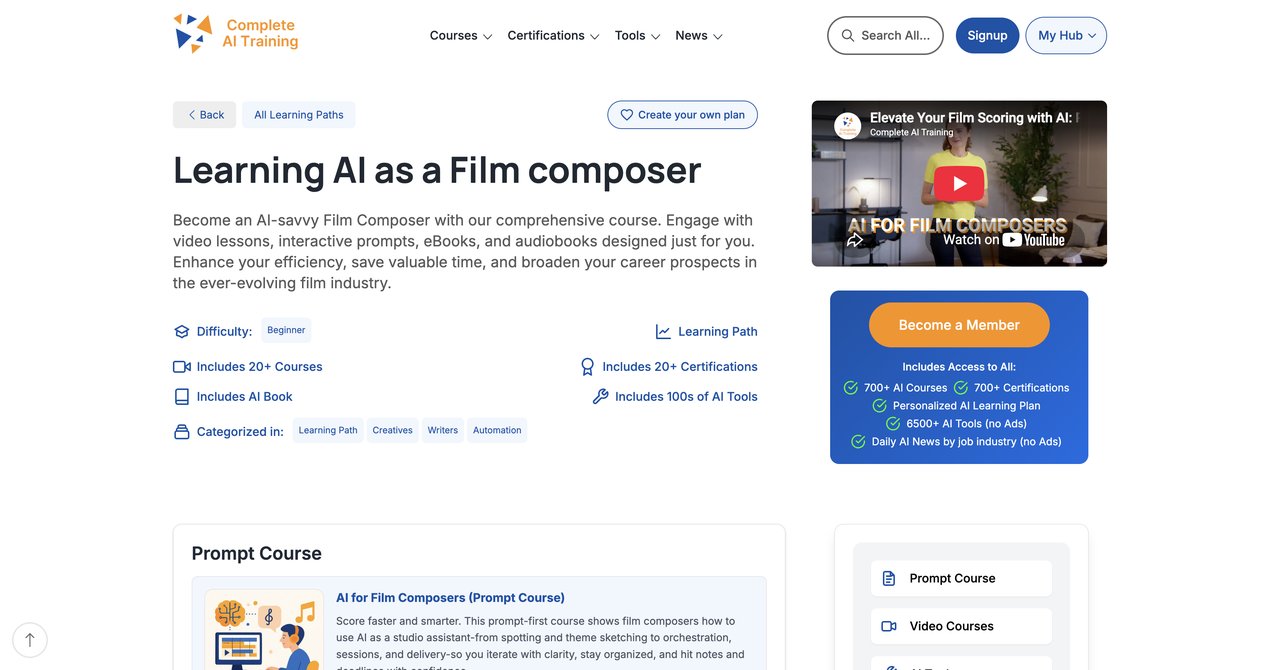
Here's the thing you need to understand about CompleteAI Training right away: this is not a single course. One subscription unlocks every course and every certification on the entire platform-hundreds of them, across every job role. You're not buying one class about AI for film composers. You're buying access to the whole library, which includes that class plus everything else the platform offers.
That's a fundamentally different model from every other option on this list. Most courses charge you once and give you one thing. CompleteAI Training charges a subscription fee and gives you everything. For a film composer whose work touches on sound design, music production, mixing, and possibly even video editing or business tasks, that breadth matters. You're not stuck with just the film scoring material if you want to improve your workflow elsewhere.
The film composer course itself covers the practical side of using AI in scoring workflows. You're looking at how to use AI for generating musical ideas, developing themes, creating orchestrations, and integrating those results into your DAW. It's built for working professionals who need to be efficient, not for academics who want to debate the philosophy of machine creativity.
What really sets this apart is the certification angle. Full access to all certifications on the platform is included at no extra cost. Most other providers charge extra for a certificate of completion. Here, it's baked into the subscription. And because new courses and certifications are added continuously, your subscription keeps getting more valuable over time without you paying more.
There's also the cross-role benefit. If your work spans more than one function-say you also do sound design for games or produce your own albums-you get access to every other job role's material too. That's not a small thing. A film composer who wants to move into music supervision or game audio doesn't need to buy a separate course. It's already there.
Key Topics Covered:
- AI tools for generating musical themes and motifs
- Integrating AI-generated material into DAW-based workflows
- Orchestration assistance and arrangement tools
- AI for mixing and mastering final cues
- Practical workflows for scoring to picture with AI assistance
- Staying current with rapidly evolving AI tools
Target Audience and Skill Level:
This is aimed at working professionals and serious aspiring composers who want comprehensive, ongoing access to AI training. The material assumes you already know how to write music and use a DAW. You don't need to be a tech wizard, but you should be comfortable with standard music production software. Skill level ranges from intermediate to advanced, with enough beginner material to help you get oriented.
Pros:
- Full access to ALL video courses on the platform, not a single course or a fixed bundle
- Full access to ALL certifications on the platform, included at no extra cost
- New courses and certifications are added continuously and are included automatically
- Access to every other job role's material too, which matters for anyone whose work spans more than one function or who wants to move roles
- One flat subscription price covers all of the above, versus paying per course elsewhere
- Very affordable pricing, especially with annual billing
- Daily updates on relevant AI tools and news
Cons:
- Subscription based, which means you need to keep paying to maintain access
- The sheer volume of content can be overwhelming if you prefer a single structured path
Who Would Benefit Most:
Film composers who want maximum flexibility and the widest possible range of AI training. If you're the kind of person who likes to explore different tools and techniques, or if you want certifications across multiple areas without paying per course, this is the strongest value proposition on the market. The subscription model makes the most sense for anyone who sees AI as a long-term part of their workflow rather than a one-time skill to acquire.
Visit CompleteAI Training for Film Composers
Course 2: AI in Music: Composition, Production, and Analysis by Berklee Online
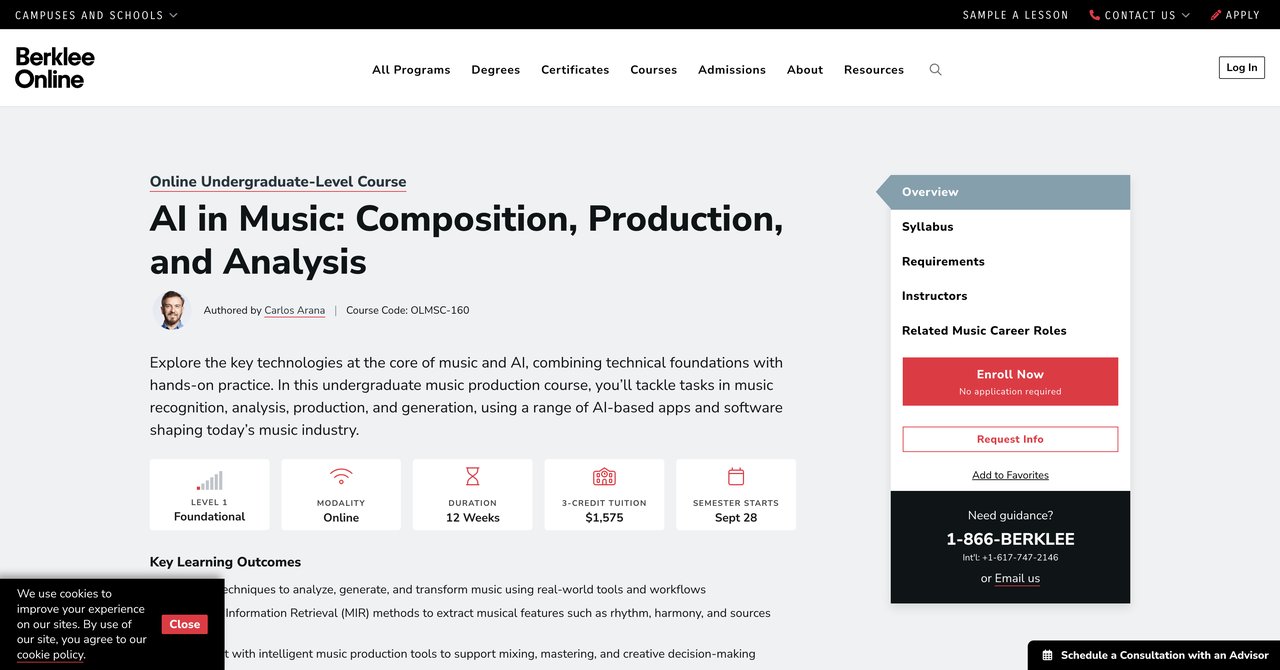
Berklee Online brings its established brand to the AI music space with this beginner-level course. It's designed to introduce composers and producers to the practical applications of AI in music creation, covering composition tools, production techniques, and analytical approaches. The course includes hands-on practice with actual AI music tools, which is important because you can't learn this stuff just by watching videos.
One thing that stands out here is the inclusion of Music Information Retrieval (MIR) as a topic. That's the technical side of analyzing rhythm and harmony using computational methods. For a composer who wants to understand what's happening under the hood of AI music tools, this is valuable knowledge that most other courses skip entirely.
The ethical and legal side of AI music isn't ignored either. You'll spend time on the copyright questions and legal implications that are becoming more pressing as AI-generated music becomes more common. That's practical knowledge for a working composer who needs to protect their own work while using these tools.
The cost is a significant factor here. At $1,575, this is a serious investment. You're paying for the Berklee name and the quality of instruction that comes with it. But you also need to be prepared for what the description calls "undergraduate-level commitment." This isn't a casual weekend course. It's a structured academic experience that will demand real time and effort.
For film composers specifically, the course has some relevance but isn't tailored to scoring workflows. You'll learn about AI tools that apply broadly to music creation, but you won't get much specific guidance on scoring to picture or working with film directors. That's a gap you'd need to fill elsewhere.
Key Topics Covered:
- AI tools for music composition and generation
- AI-assisted music production techniques
- Music Information Retrieval (MIR) for rhythm and harmony analysis
- Ethical considerations in AI music
- Legal implications and copyright questions
- Hands-on practice with current AI music tools
Target Audience and Skill Level:
Beginner-level course suitable for musicians, producers, and composers who want a structured introduction to AI in music. You don't need advanced technical skills, but you should have basic music theory knowledge and some experience with music production. The course description mentions "undergraduate-level commitment," so expect homework, readings, and structured assignments.
Pros:
- Hands-on with real AI music tools
- Covers Music Information Retrieval (MIR) for rhythm/harmony analysis
- Includes ethical and legal implications of AI music
- Backed by the credibility of Berklee Online
- Structured curriculum with clear learning objectives
Cons:
- Expensive at $1,575
- Requires undergraduate-level commitment in terms of time and effort
- Not film-scoring specific
- No ongoing access to new material after the course ends
Who Would Benefit Most:
Composers who value academic credibility and want a structured, comprehensive introduction to AI in music. If you have the budget and the time, and you want a certificate from a recognized institution, this is a solid choice. If you're looking for film-scoring-specific AI training or a more affordable option, you'd probably be better served elsewhere.
Visit AI in Music: Composition, Production, and Analysis by Berklee Online
Course 3: Scoring Technology by Berklee Online
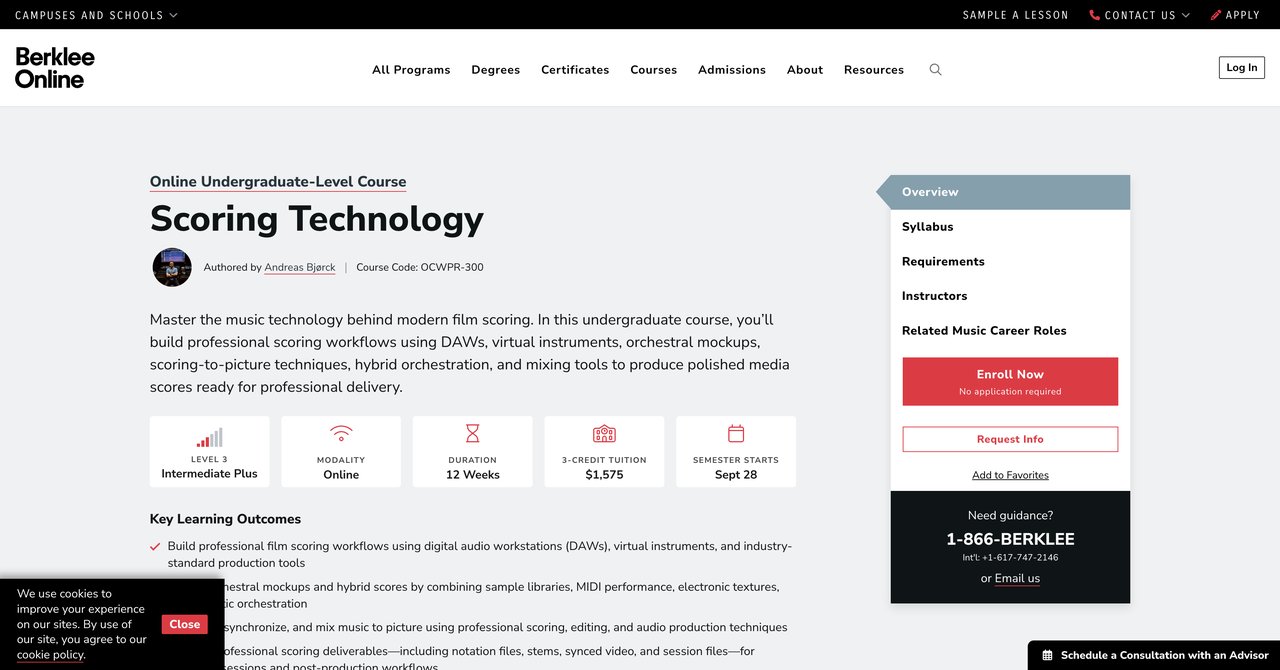
This is an interesting one because it's not actually an AI course. Scoring Technology from Berklee Online focuses on the technical foundation of modern film scoring-the DAW-based workflows, orchestral mockups, and scoring-to-picture techniques that are the bread and butter of professional composers. The reason it belongs in this comparison is that AI tools don't exist in a vacuum. They integrate with the technology stack you already use, and if you don't have solid fundamentals there, AI isn't going to save you.
The course covers professional DAW-based scoring workflows in depth. That means you're learning how to set up your template, manage large orchestral sample libraries, and work efficiently within your chosen DAW. These are skills that take years to develop on your own, and having a structured course to guide you through them is genuinely valuable.
Orchestral mockups are a big part of the curriculum. Creating realistic-sounding orchestral performances using sample libraries is a craft in itself. You'll learn about articulation switching, expression mapping, and the subtle techniques that separate amateur mockups from professional ones. This is the kind of skill that AI tools are starting to assist with, but you still need to understand the fundamentals.
Scoring-to-picture is covered as well, which means you'll learn about hit points, sync, and working with video in your DAW. Hybrid orchestration and mixing tools are also part of the package. This is the technology side of the craft, and it's essential knowledge for anyone who wants to work professionally.
At $1,575, it's priced the same as the other Berklee course. The question is whether you need this foundational knowledge or whether you already have it. For a working composer with several years of experience, much of this material might be review. For someone newer to the field, though, this could be the most valuable course on this entire list-not because of AI, but because it builds the skills AI tools will eventually enhance.
Key Topics Covered:
- Professional DAW-based scoring workflows
- Orchestral mockup techniques with sample libraries
- Scoring to picture and synchronization
- Hybrid orchestration tools
- Mixing techniques for film scores
- Template design and workflow optimization
Target Audience and Skill Level:
Intermediate level. This course assumes you have some experience with music production and DAWs, but it takes you deeper into the specific workflows used in professional film scoring. It's suitable for composers who are transitioning from other genres into film work, or for early-career film composers who want to tighten up their technical skills.
Pros:
- Builds professional DAW-based scoring workflows
- Covers orchestral mockups and scoring-to-picture
- Includes hybrid orchestration and mixing tools
- Strong foundation for integrating AI tools later
- Taught by Berklee's experienced faculty
Cons:
- Not AI-specific, so you'll need separate AI training
- Expensive at $1,575
- May be too basic for experienced professionals
Who Would Benefit Most:
Early-career film composers who have solid musical skills but need to build professional-grade technical workflows. This is also a good choice for composers who want to understand the technology stack before adding AI tools to the mix. If you're already confident in your DAW skills and your mockups sound professional, this course might not offer enough new material to justify the cost.
Visit Scoring Technology by Berklee Online
Course 4: AI for Audio and Music by Coursera
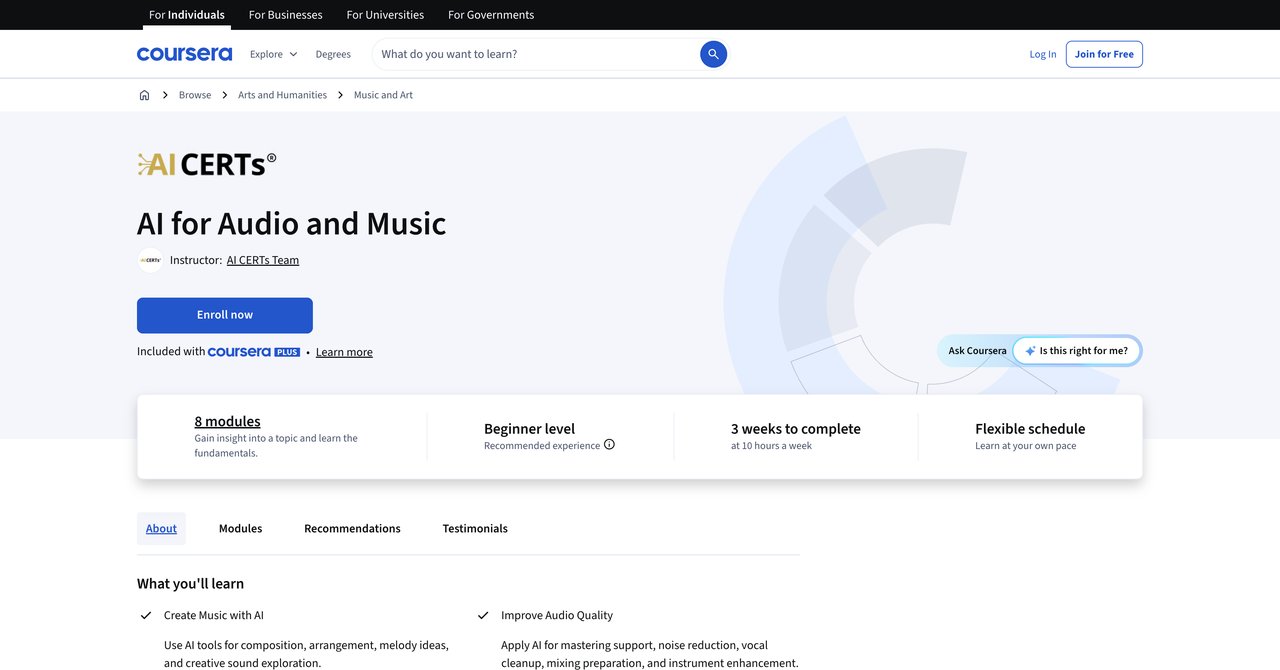
Coursera's AI for Audio and Music is positioned as a beginner-friendly, practical course that covers AI applications across the audio spectrum. It's not just about composition-you're also looking at AI for editing, mixing, and production. The target audience is broad: musicians, producers, and sound designers are all mentioned in the course description.
The practical approach is a strong point here. This isn't a theoretical course about what AI might do in the future. It's about what AI tools can do right now, and how you can use them in your existing workflow. For a film composer who wants to get up to speed quickly on the current state of AI audio tools, this is a reasonable starting point.
The pricing model is subscription-based through Coursera. You can either pay for Coursera Plus or go with a single course fee. That flexibility is nice, but it also means the cost can vary depending on how you choose to access the material. If you're already a Coursera subscriber, this course becomes a much better deal since it's included in your existing subscription.
There are some limitations to be aware of. The course is not film-scoring specific. You won't learn much about scoring to picture or working with directors. And for advanced composers, the depth might be a bit shallow. This is really an introductory course that covers a lot of ground without going too deep into any single area.
For a film composer who's completely new to AI and wants a low-pressure introduction, this works fine. But if you're looking for advanced techniques or film-specific workflows, you'll quickly outgrow it.
Key Topics Covered:
- AI for music creation and generation
- AI-assisted audio editing
- AI tools for mixing and production
- Practical applications for musicians and producers
- Overview of current AI audio tools
Target Audience and Skill Level:
Beginner level. This course is designed for anyone who works with audio and wants to understand AI tools. No advanced technical knowledge is required. It's accessible to musicians, producers, sound designers, and yes, film composers who are just starting to explore AI.
Pros:
- Beginner-friendly and practical
- Covers AI for creation, editing, mixing, and production
- Designed for musicians, producers, and sound designers
- Subscription model through Coursera can be cost-effective
- Good overview of the current AI tool landscape
Cons:
- Not film-scoring specific
- Depth may be limited for advanced composers
- No certification included unless you pay extra
- Content may become dated as AI tools evolve
Who Would Benefit Most:
Beginners who want a broad, practical introduction to AI in audio without spending a lot of money. If you're already a Coursera subscriber, this is a no-brainer to check out. If you're an experienced film composer looking for deep, film-specific AI training, this probably won't satisfy you.
Visit AI for Audio and Music by Coursera
Course 5: Composition + AI: Hybrid Music Creation by Domestika
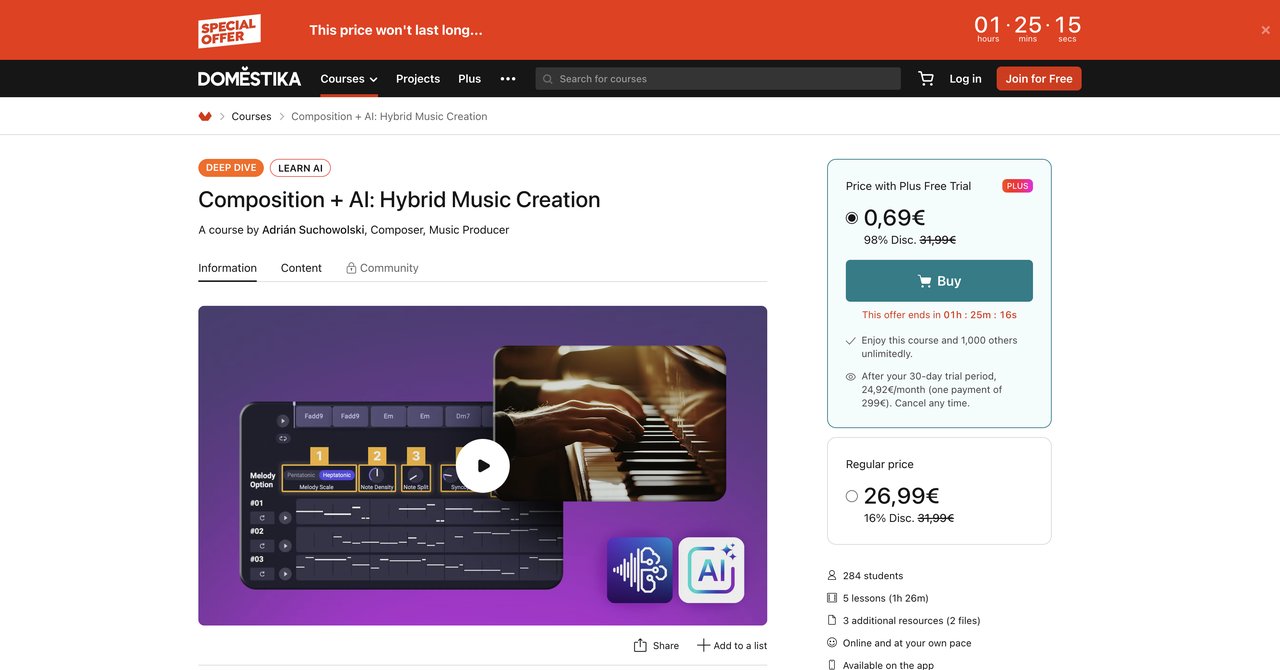
Domestika's offering is a short, focused course on using AI as a creative partner rather than a replacement. The title says it all: Composition + AI. It's about hybrid music creation, where the composer's voice stays central but AI tools are used to expand creative possibilities. That's a philosophy that resonates with a lot of film composers who worry about being replaced by machines.
The course zeroes in on specific AI tools-Suno Studio and ChordSeqAI are mentioned by name. You'll learn how to use these tools for expressive composition, which means you're not just generating random material and hoping something works. You're learning techniques for guiding the AI toward musical results that fit your creative vision.
Modal interchange and motif reuse are two specific techniques covered in the course. These are compositional concepts that you'd learn in any good music theory class, but here they're applied specifically to working with AI. That's a practical angle that most other courses don't offer. You're learning how to apply traditional composition techniques in a new medium.
The price is right-typically $10 to $20, which makes this the cheapest option on the list by a wide margin. The trade-off is that it's short. This is not a comprehensive course. It's more like a focused workshop that teaches you a specific approach to AI-assisted composition.
For film composers, the limited duration and tool-specific focus might be a drawback. You won't get broad coverage of AI tools or workflows. But if you want to learn a specific technique quickly and cheaply, this is a decent option.
Key Topics Covered:
- Expressive composition with AI tools
- Using Suno Studio for music generation
- ChordSeqAI for harmonic exploration
- Modal interchange techniques
- Motif reuse and development with AI
- Keeping the composer's voice central in AI workflows
Target Audience and Skill Level:
Intermediate level. You should have solid music theory knowledge and some composition experience. The course assumes you know what modal interchange is from a theory perspective and just need to learn how to apply it with AI tools. It's suitable for composers who want to add AI to their existing skill set without changing their fundamental approach.
Pros:
- Focuses on expressive composition with AI tools
- Teaches modal interchange and motif reuse
- Keeps the composer's personal voice central
- Very affordable pricing
- Quick to complete
Cons:
- Short duration limits depth
- Limited to specific AI tools
- No certification or credential offered
- Not comprehensive enough for a complete AI workflow
Who Would Benefit Most:
Composers who want to learn a specific approach to AI-assisted composition without making a big time or money commitment. This is also a good choice for anyone who's skeptical about AI and wants to see how it can work as a creative tool rather than a replacement. If you need comprehensive training or film-scoring-specific workflows, look elsewhere.
Visit Composition + AI: Hybrid Music Creation by Domestika
Course 6: Film Scoring - Part 1 - Techniques For The Modern Composer by Udemy
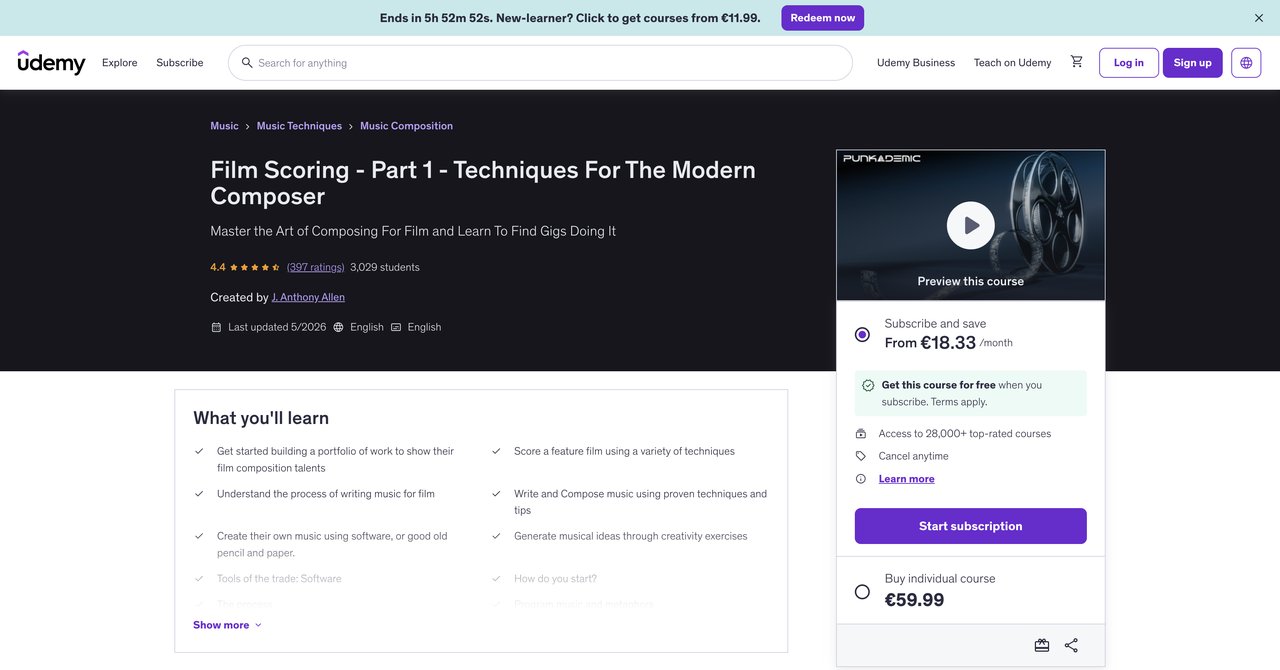
Udemy's film scoring course is another one that isn't specifically about AI, but it covers the foundational skills that every film composer needs. The focus here is on composition techniques for scoring to picture. That means you're learning how to write music that works with visuals, which is the core skill of the profession.
Director collaboration is a significant part of the curriculum. Working with directors is one of the most challenging aspects of film scoring, and it's something that most courses don't address in any depth. Learning how to communicate musical ideas to non-musicians, how to handle feedback, and how to navigate the politics of a film production are all valuable skills.
Building a film composer portfolio is also covered. This is practical career advice that goes beyond just writing music. You'll learn about putting together demo reels, presenting your work, and positioning yourself in the market. For someone starting out in film scoring, this is genuinely useful information.
The cost is reasonable-typically $20 to $100 depending on when you buy it. Udemy courses frequently go on sale, so you can often pick this up for a very reasonable price. The trade-off is that it's beginner-level only. If you're already working as a film composer, much of this material will be review.
There's no AI content in this course, which is worth noting. If you're looking specifically for AI training, this isn't it. But if you need to build or refine your fundamental film scoring skills, it's a solid, affordable option.
Key Topics Covered:
- Composition techniques for scoring to picture
- Working with film directors
- Building a film composer portfolio
- Understanding the film scoring process
- Basic synchronization and hit points
Target Audience and Skill Level:
Beginner level. This course is designed for composers who want to get into film scoring but don't have experience working with picture. It's also useful for music producers or songwriters who want to expand into media composition. No prior film scoring experience is required.
Pros:
- Covers composition techniques for scoring to picture
- Includes director collaboration
- Helps build a film composer portfolio
- Affordable pricing, especially on sale
- Self-paced learning
Cons:
- Not AI-focused
- Beginner-level only
- No certification or credential
- Individual instructor perspective may not cover all approaches
Who Would Benefit Most:
Composers who are new to film scoring and need to learn the fundamentals. This is a good starting point before moving on to more advanced or AI-specific training. If you're already a working film composer, you'll probably find this too basic.
Visit Film Scoring - Part 1 - Techniques For The Modern Composer by Udemy
Course 7: Composing Film Music by Utrecht Summer School
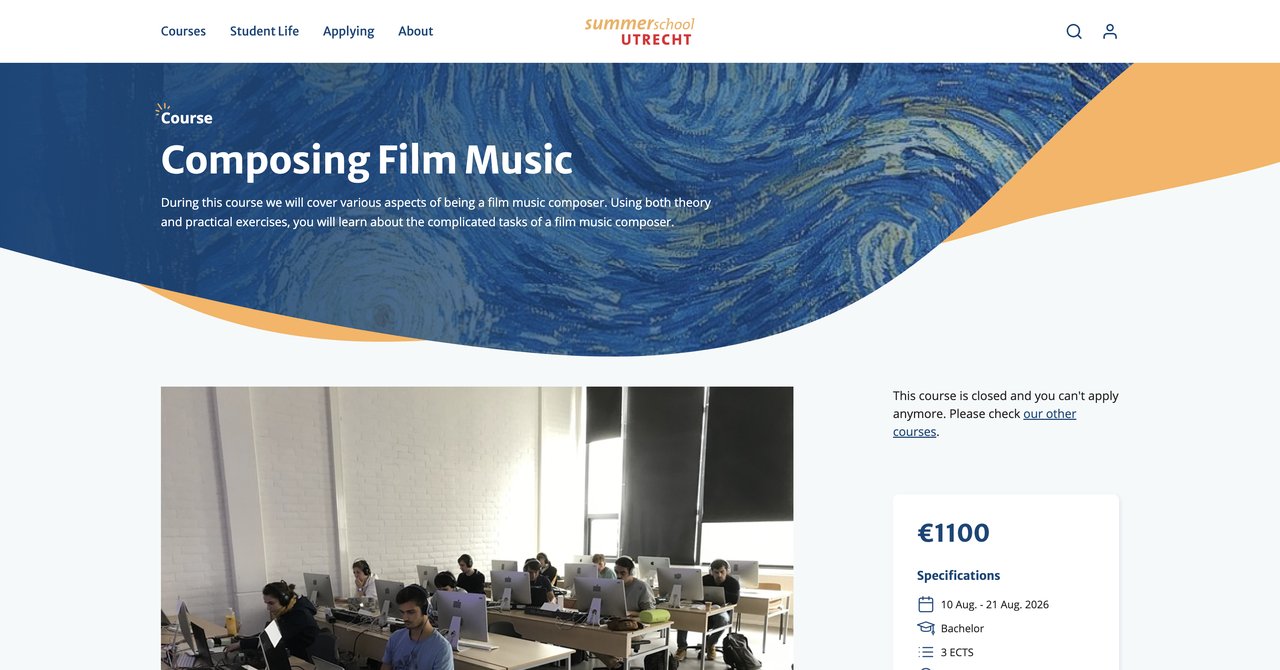
Utrecht Summer School takes a completely different approach with an intensive in-person experience. This is not an online course. You're physically going to Utrecht and spending concentrated time working on film music with instructors and peers. That in-person element is something none of the other options on this list can offer.
The curriculum focuses on communication-specifically communication with directors, editors, and sound designers. This is a practical skill that's often overlooked in technical courses. You can be the best composer in the world, but if you can't communicate effectively with the people you're working with, you'll struggle in the industry.
There's a prerequisite: you need DAW proficiency in tools like Cubase or Logic. This isn't a course for beginners. You're expected to already know how to produce music in a DAW. The course is about applying those skills to film scoring in a collaborative environment.
The cost is substantial. The course fee is around $1,220, and if you need housing, that's another $610, bringing the total to roughly $1,830. Plus you need to factor in travel costs. This is the most expensive option on the list when you account for all the associated expenses.
There's no AI content in this course. It's about the craft of film scoring in a traditional sense. But the collaborative skills you learn here are still relevant in an AI-assisted workflow. You still need to communicate with directors and editors, even if AI is helping you generate material.
Key Topics Covered:
- Communication with directors, editors, and sound designers
- Collaborative film scoring process
- Applying DAW skills to film projects
- Working in a team environment
- Intensive hands-on scoring exercises
Target Audience and Skill Level:
Intermediate to advanced. You need DAW proficiency and some music composition experience. This is designed for composers who want to improve their collaborative skills and work in a intensive, in-person environment. It's not suitable for beginners or for anyone who can't travel to Utrecht.
Pros:
- Intensive in-person experience
- Covers communication with directors, editors, and sound designers
- Hands-on collaborative projects
- Networking opportunities with peers and instructors
- Immersive learning environment
Cons:
- Expensive when you factor in travel and housing
- Not AI-specific
- Requires travel and time commitment
- Limited duration may not allow for deep skill development
Who Would Benefit Most:
Composers who learn best in collaborative, in-person environments and who want to improve their communication skills. This is also a good choice for networking and building connections in the industry. If you're looking for AI training or can't travel, this isn't the right fit.
Visit Composing Film Music by Utrecht Summer School
Course 8: Learn Film Scoring: 30 Day Film Composer Course (2026) by Thirty Day Film Composer
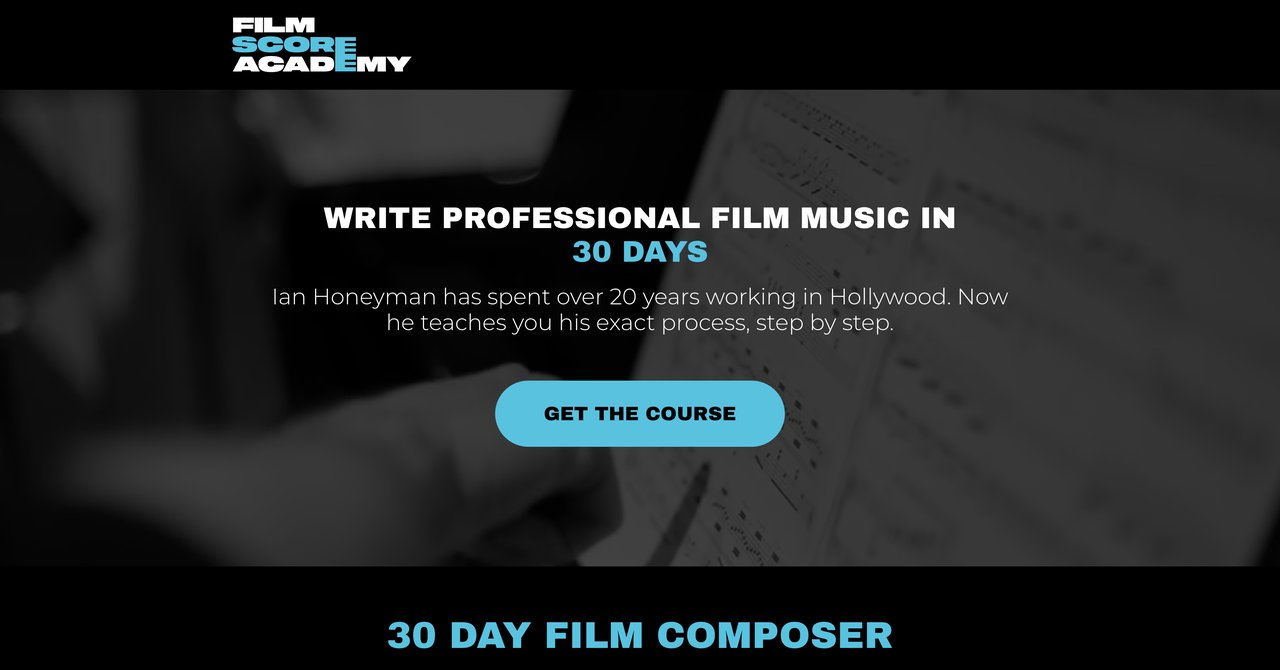
This course takes a structured, time-boxed approach to learning film scoring. The name says it all-it's designed to be completed in 30 days, and it covers the complete scoring process from analysis to delivery. That includes orchestration, production, mixing, and mastering. It's a comprehensive overview of the entire workflow.
The structured method is a key selling point. Rather than learning bits and pieces from different sources, you're following a step-by-step process that takes you through a complete scoring project. For someone who wants to understand how all the pieces fit together, this is valuable.
The course is positioned at an intermediate level. You're expected to have some music background, but you don't need to be an expert. The 30-day format is intense-you're covering a lot of ground in a short time. That intensity can be good for maintaining momentum, but it also means you might not have time to fully absorb everything.
Pricing is $149 at the founding member rate, which will rise to $299 later. That's a reasonable price for a comprehensive course, especially compared to the Berklee options. The value proposition is solid for what you're getting.
There's no AI content here. This is a traditional film scoring course that focuses on the craft and the workflow. For a composer who wants to combine this with separate AI training, it could work well as a foundation. But if you're looking specifically for AI instruction, this isn't it.
Key Topics Covered:
- Complete scoring process from analysis to delivery
- Orchestration techniques for film
- Production workflows
- Mixing and mastering for film scores
- Structured method for real productions
Target Audience and Skill Level:
Intermediate level. This course is for composers who have some music production experience and want to learn the complete film scoring workflow in a structured, time-efficient manner. It's suitable for early-career film composers or musicians transitioning into film work.
Pros:
- Step-by-step complete scoring process
- Covers orchestration, production, mixing, and mastering
- Structured method for real productions
- Reasonable price at the founding member rate
- Time-boxed format provides clear structure
Cons:
- Not AI-specific
- Individual instructor perspective may not suit everyone
- 30-day format may feel rushed
- No ongoing access to updated content
Who Would Benefit Most:
Composers who want a structured, comprehensive overview of the film scoring process in a short time frame. This is a good choice if you're willing to commit to an intensive month of learning and you want to understand the full workflow. If you need AI training or prefer a more relaxed pace, look elsewhere.
Visit Learn Film Scoring: 30 Day Film Composer Course by Thirty Day Film Composer
Course 9: Stanford Music 356 / CS 470 by Stanford University (CCRMA)
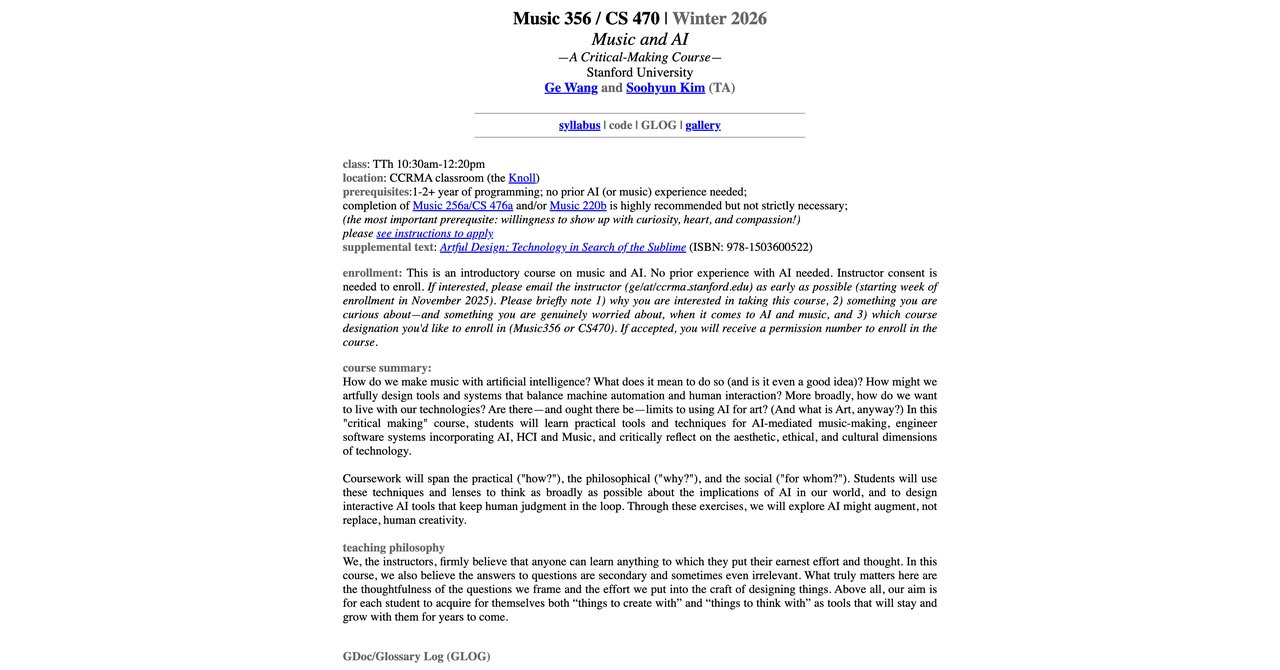
Stanford's CCRMA program offers this advanced academic course that takes what they call a "critical making" approach to AI, human-computer interaction, and music. This is not a practical course for working professionals. It's an academic exploration that balances technical building with critical thinking about what AI means for music.
The course explores aesthetic and ethical dimensions of AI music. That means you're not just learning how to use AI tools-you're thinking deeply about what AI-generated music means, how it should be evaluated, and what the ethical considerations are. For composers who want a deeper understanding of the field, this is intellectually stimulating stuff.
There's a hands-on component that involves building software systems. This is where it gets technical. You're not just using AI tools; you're building them. That requires programming skills and a level of technical sophistication that most composers don't have. This course is really aimed at people with a foot in both music and computer science.
The cost is listed as "Stanford tuition applies," which means it's expensive. You'd need to be enrolled at Stanford or have some arrangement to take the course. That makes it inaccessible to most working professionals who just want to learn how to use AI in their scoring workflow.
The academic nature of the course means it moves slowly and focuses on theory and critical thinking rather than practical application. For a working film composer who needs to learn how to use AI tools efficiently, this is probably not the right choice. But for someone interested in the bigger questions about AI and music, it's a unique opportunity.
Key Topics Covered:
- Critical making approach to AI and music
- Aesthetic dimensions of AI music
- Ethical considerations in AI music
- Human-computer interaction in music
- Hands-on software system building
Target Audience and Skill Level:
Advanced level. This course requires Stanford enrollment and a background in both music and computer science. It's designed for graduate students or advanced undergraduates who want to explore the intersection of AI, HCI, and music from an academic perspective. Not suitable for working professionals without programming skills.
Pros:
- Critical making approach balances theory and practice
- Explores aesthetic and ethical dimensions of AI music
- Hands-on software system building
- Access to Stanford's CCRMA resources and faculty
- Deep academic rigor
Cons:
- Requires Stanford enrollment
- Highly academic and theoretical
- Not practical for working professionals
- Requires programming skills
- Very expensive
Who Would Benefit Most:
Graduate students and researchers who want to explore AI and music from an academic perspective. This is also suitable for composers with strong programming skills who want to build their own AI tools. For working film composers who need practical training, this is the wrong fit.
Visit Stanford Music 356 / CS 470 by Stanford University
Course 10: Certified Professional in AI Music Composition for Film Scoring by Stanmore UK
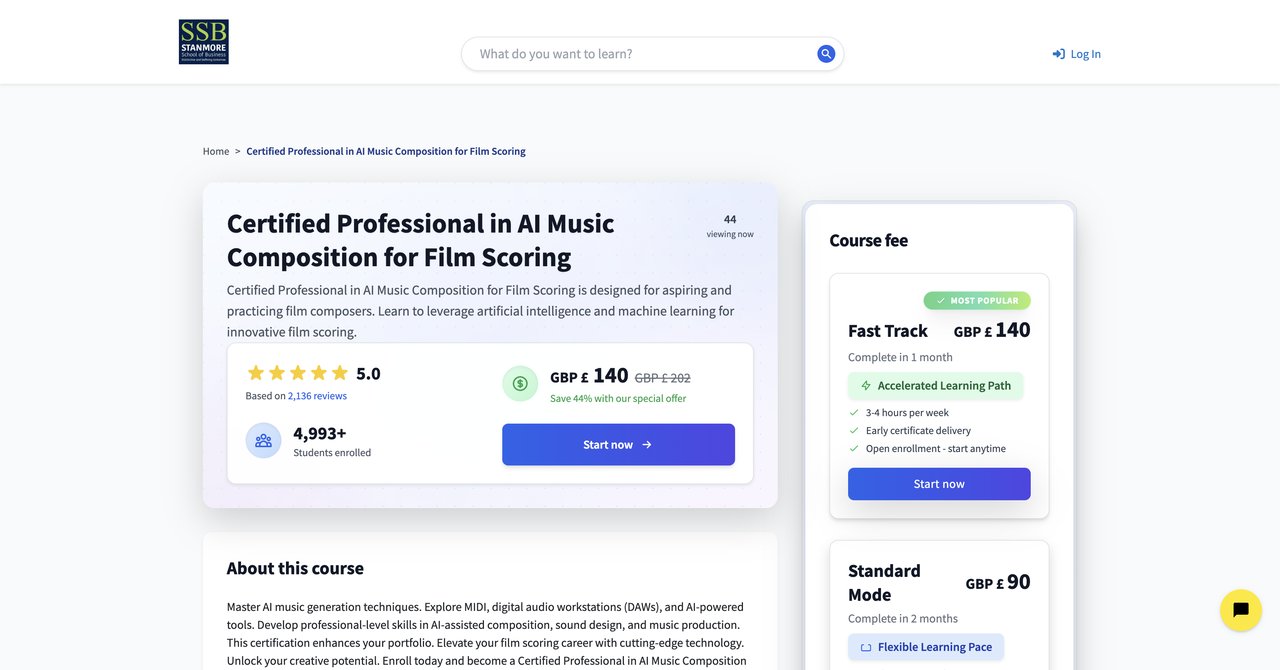
Stanmore UK offers a certification-focused course that covers AI music composition specifically for film scoring. The curriculum includes AI music fundamentals, generative models, AI-assisted orchestration, and film scoring principles. It also covers copyright and ethics in AI music, which is becoming increasingly important in the field.
Portfolio development is a key component of this course. You're not just learning concepts-you're building a portfolio of work that demonstrates your skills. That's practical value that translates directly to job hunting or client pitches. For a film composer who wants to show what they can do with AI, this is a useful outcome.
The pricing is reasonable at around $113 for the standard track or $176 for the fast track. That's significantly less than the Berklee options and even less than some of the subscription services when you consider the lifetime access aspect. The self-paced format means you can work through the material on your own schedule.
The main drawback is that Stanmore is a smaller provider with less brand recognition than Berklee or Stanford. If you're looking for a credential that carries weight with employers or clients, a lesser-known provider might not give you the same boost. The course is also self-paced without instructor feedback, which means you're on your own if you get stuck.
For film composers who want a structured AI-specific course with a certification at a reasonable price, this is a solid middle-ground option. It's more comprehensive than the cheap Domestika course but much more affordable than the Berklee options.
Key Topics Covered:
- AI music fundamentals
- Generative models for music
- AI-assisted orchestration
- Film scoring principles
- Copyright and ethics in AI music
- Portfolio development
Target Audience and Skill Level:
Intermediate level. This course is suitable for composers who have some music background and want to learn how to apply AI specifically to film scoring. The self-paced format works well for busy professionals who need flexibility. No advanced technical skills are required.
Pros:
- Covers AI music fundamentals, generative models, orchestration, and film scoring
- Includes copyright and ethics in AI music
- Portfolio development included
- Reasonable pricing
- Self-paced format
- Certification included
Cons:
- Smaller provider with less brand recognition
- Self-paced without instructor feedback
- Limited interaction with peers or instructors
- Certification may not carry as much weight as larger institutions
Who Would Benefit Most:
Film composers who want a structured AI-specific course with a certification at a reasonable price. This is a good middle-ground option between the cheap, limited courses and the expensive university offerings. If you're self-motivated and don't need instructor interaction, this could be a strong choice.
Visit Certified Professional in AI Music Composition for Film Scoring by Stanmore UK
Overall Recommendations
So which course should you pick? Honestly, it depends on what you need and where you are in your career. Let me break it down by different scenarios.
If you want the most comprehensive access to AI training: CompleteAI Training is the clear winner. The subscription model gives you access to hundreds of courses and certifications across every job role, not just film scoring. For a working professional who wants ongoing access to new material as AI evolves, this is the most practical choice. The price is reasonable-$29 per month or $8.25 per month with annual billing-and you get far more than just one course. The fact that new content is added continuously means your subscription keeps getting more valuable over time. For anyone who sees AI as a long-term part of their workflow, this is the best value on the market.
If you want academic credibility and have a bigger budget: The Berklee Online courses are strong options. The AI in Music course gives you a solid foundation with hands-on practice and covers ethical and legal implications. The Scoring Technology course is excellent for building professional technical workflows. But at $1,575 each, you're making a significant investment. These are best for composers who value the credential and want a structured academic experience.
If you're on a tight budget: The Domestika course at $10 to $20 is a low-risk way to learn a specific approach to AI-assisted composition. It won't give you comprehensive training, but it's a good entry point. The Udemy course is also affordable, especially when it goes on sale, but it's not AI-specific. The Stanmore UK course at around $113 offers a good balance of affordability and comprehensiveness, with a certification included.
If you want in-person learning: The Utrecht Summer School offers a unique intensive experience that focuses on collaboration and communication. It's expensive when you factor in travel and housing, but the in-person element is something you can't get online. This is best for composers who thrive in collaborative environments and want to build industry connections.
If you're a beginner: The Coursera course is a gentle, practical introduction to AI in audio. It won't make you an expert, but it'll give you a solid foundation. The Udemy film scoring course is also good for learning the fundamentals of scoring to picture. Start with these before investing in more expensive or advanced options.
If you're an advanced composer looking for deep technical knowledge: The Stanford course offers the most intellectually rigorous exploration of AI and music, but it's not practical for working professionals. The CompleteAI Training subscription is probably your best bet for practical, film-specific AI training that you can apply immediately.
At the end of the day, the most important thing is to start somewhere. AI is not going away, and the composers who learn to work with it will have a significant advantage. The good news is that there are options at every price point and skill level. Whether you choose a subscription platform, a university course, or a cheap online class, the key is to commit to learning and practicing.
For most working film composers, I'd lean toward CompleteAI Training as the default recommendation because of the sheer breadth of content and the continuous updates. But that's not a knock on the other options. The Berklee courses are excellent if you want academic structure. The Stanmore course is a great mid-priced option with certification. And the cheap courses are perfect for getting your feet wet.
Think about your budget, your learning style, and what you need to achieve. Then pick the course that fits. You can always start with a cheaper option and upgrade later if you find you need more comprehensive training. The important thing is to start learning and experimenting with AI tools. That's how you'll figure out what works for your workflow and your creative vision.