
Blog ·
10 Recommended AI Courses for Technical Writers in 2026
Boost your tech writing career with 10 top AI courses for 2026. Master prompt engineering, documentation automation, and AI tools—from beginner to advanced—to stay ahead in a rapidly evolving field.
 Jeroen Erne
The pace of change in professional writing has accelerated beyond what most of us expected. Technical writers, who have long served as the bridge between complex products and the people who use them, now face a professional landscape where AI tools handle everything from documentation pipelines to real-time help systems. The statistics tell a clear story: according to recent industry research, 69% of businesses have increased their AI usage across content operations in the past year alone, and technical communications teams report growing pressure to deliver documentation faster, with fewer resources, and across more formats than ever. The question is no longer whether AI belongs in technical writing. Companies have already created that decision. The question that matters now is which technical writers will master these tools and which get left behind as content departments shrink and automate. This article examines 28 AI courses for technical writing professionals and compares them directly, so you can find the program that fits your current skill level, time constraints, and career goals.
Why AI matters for Technical Writers then
In professional documentation, AI directly impacts how you produce everything from API reference guides to product release notes. Emerging tools and techniques demonstrate that AI capabilities have matured beyond simply checking grammar or filling in the rewrite of meeting notes. AI tools now handle the translation of complex technical language into accessible prose, generate code snippets, pull information from legacy documentation, and restructure whole document sets. It's happening in organizations of all sizes, and technical writers who build proficiency in these tools are finding themselves negotiating better pay or moving into leadership roles as team leads and tech comm managers.
If you're a technical writer, you need to identify the right course that fits your existing background. Some courses focus on modern, wide applications of AI to documentation workflows. Others go deeper into using AI for STIG markdown generation, OpenAPI documentation, or developer portals. Difficulty varies, price varies, and what you get for your money varies widely across the landscape, so reading the comparison and understanding those differences is important.
The Growing Role of AI in Technical Writing
AI touches technical writing on a daily basis, yet many professionals still come to it with zero or partial exposure. What this looks competitive in technical communication:
- Content automation: Large language models that create user guides, FAQ sections, help topics that demonstrate and generate structured text under your instruction and review.
- Multi-channel delivery: One source document rendered at multiple levels of difficulty for varied interests-different audiences in different regions of the product.
- the synthesis and already-worded documentation. Systems are creating new, useful help pages by pulling from ticket dumps and existing user documentation.
- From the user perspective: Context-aware assistance that natively embedded in software tools and delivered contextual analytics responses to the user.
- Localization assistance Orchestration that feeds and manages translation teams, plus new ways for improving revision workflows.
- Collaboration between a writer and the data. Analyzing product metrics for docs first contact, then writer driving how tech comm contributes to usage and does reporting.
These applications aren't far-off hypothetical scenarios. Each is in use right now. So a technical writer who does not understand how to interact ethically, what's the risks around, and what's possible with these systems-and you have less and less space in the innovation.
Benefits of becoming AI-strong in technical writing
You may wonder: What a benefit for you as a technical writer really is, to go through intensive AI course work? The practical answer in several ways.
Career security. As companies acquire tools eventually, professionals with actual skill at extracting great output from them remain scarce. They are hard to replace the way certain older operational roles used to be.
Performance. When you understand how to work with an AI system-how to design a complex prompt structure, how to validate output, how to build guardrails-you become able to produce pages of documentation in fractions of the prior time frames. That doesn't translate into better work pace while working somewhere with that time, combined with that context.
Better, with better independent grasp of your own. When you want to write for a system, you specify at the detail that requirements you'd normally have in your head. That leads to less ambiguous requests from you to reviewers, and better clarity.
Aligned to a higher responsibility. The organizations that adopt these tools-inevitably launch entirely new roles: For armed accelerates AI adoption, many grow a role of coordinating AI integration in docs. The number of commercial functional titles (spec engineer) isn't published, but the direction is upward.
The article will compare 28 AI courses available, comparing key topics, target audience, skill difficult, and course planning, Good courses lead can be a great one. One of many in our comparison is CompleteAI Training-a platform where you don't get a single course but where you have access to ALL courses and ALL certifications in the offering. For a position _one complete course about AI-but one influencing the on skills you do have-this can sometimes be the best fit. Keep reading to see how it stacks up with the others across data points.
Comparison: All AI Courses for Technical Writers (Updated 2026)
| Course Name | Provider | Price | Key Topics | Pros | Cons | Best For |
|---|---|---|---|---|---|---|
| CompleteAI Training | CompleteAI | Premium (one subscription covers everything) | Comprehensive AI training for Technical Writers. One subscription includes ALL courses and ALL certifications on the platform, not just a single course. Covers prompt engineering, AI-assisted documentation workflows, hands-on projects, and practical applications for technical writing. | Comprehensive curriculum, Hands-on projects, Expert instructors, One subscription unlocks every course and certification on the platform | Premium pricing | Technical Writers professionals looking for complete training |
| AI for Technical Writers (Video Courses + Certifications) | Complete AI Training | $29/month | Extensive library of over 100 specialized video courses and certifications tailored for Technical Writers, with daily updates on AI tools and news. | Highest rating / Most complete offering, Extensive range of AI courses and certifications tailored specifically for Technical Writers professionals, Daily updates on relevant AI tools and news, Very affordable pricing, especially with annual billing | Subscription based, crucial for continuous learning as AI is developing continuously | General learners |
| AI for Technical Writers for Better Documentation | Udemy | Not specified | Prompt strategies and refinement for documentation, including visuals and ethics, with practical ChatGPT workflows for generating and polishing documentation. | Covers prompt strategies and refinement for docs, Includes visuals and ethics, Practical ChatGPT workflows | Low rating volume, Some generic sections on layouts | General learners |
| Complete Documentation and Technical Writing with AI | Udemy | Not specified | 50+ document types with AI workflows, templates, and lifecycle management through hands-on projects for technical writers. | Covers 50+ doc types with AI workflows, Includes templates and lifecycle management, Hands-on projects | Short video length despite many lectures, Limited ratings | General learners |
| Technical Communication and Artificial Intelligence | Coursera (Minnesota State University, Mankato) | Subscription | Builds a portfolio of AI-assisted technical documentation, covering prompt engineering and processes for beginner-to-intermediate documentation. | Builds portfolio of AI-assisted docs, Covers prompt engineering and processes, University-backed certificate | Part of larger specialization, Some AI-graded assignments | General learners |
| Technical Communication in the AI Era Specialization | Coursera (Minnesota State University, Mankato) | Subscription | Three-course series covering writing, AI tools, and editing with hands-on projects and a shareable certificate, training technical writers to produce and edit content systematically with generative AI. | Three-course series on writing, AI tools, and editing, Hands-on projects, Shareable certificate | Longer commitment, Limited public reviews | General learners |
| How to Research and Write Using Generative AI Tools | LinkedIn Learning | Subscription | Practical prompts for research and drafting using AI chatbots, applicable to summarizing sources, outlining, and fact-checking documentation. | Practical prompts for research and drafting, High ratings and recent reviews, Certificate of completion | Originally from 2023, Not exclusively technical-writing focused | General learners |
| Using Generative AI in Technical Writing | Cherryleaf | $245 (approx £195) | ISTC-accredited course with over 40 exercises, providing a practical framework for integrating ChatGPT, Claude, and Gemini into research, writing, review, and publishing of user assistance. | ISTC-accredited with 40+ exercises, Covers full workflow including chatbots and agents, Personal feedback option | Assumes some prior tech writing experience, Video-heavy | General learners |
| AI Technical Writing Certification | Technical Writer HQ | $350 | Using AI models like GPT-4 and Gemini for outlining, editing, SEO, and creating AI-assisted documentation portfolios with lifetime access. | Instructor-reviewed capstone and portfolio, 60+ templates, Lifetime access with updates | Self-paced requires daily commitment, No numeric rating listed | General learners |
| AI Courses Hub (Agent Skills, Prompt Engineering, Use Cases) | I'd Rather Be Writing | Free | Blog-based hub with progress tracking, prompts, and realistic use cases, focusing on agentic AI skills and practical application for tech comm scenarios. | Highly specific to tech comm scenarios, Progress tracking, Covers agents, prompts, and honest use cases | Blog-based rather than video platform, No formal certificate | General learners |
| AI in Technical Writing | Tech Writer's Tribe | $40 | Live workshop with hands-on activities and 1:1 feedback, covering agentic AI, prompt library, and portfolio building for tutorials, APIs, and release notes. | Live workshop with hands-on activities and 1:1 feedback, Covers agentic AI and prompt library, Affordable | Scheduled dates only, Short format | General learners |
Understanding AI Training for Technical Writers Professionals
Technical writing is changing fast, and generative AI is at the center of that shift. If you're a technical writer, you've probably already used ChatGPT to draft a quick description or summarize a long text. But making AI a real part of your documentation workflow takes more than typing a few prompts. It requires building skills around prompt engineering, editing AI output, and knowing how to integrate these tools into your daily processes. That's exactly why dedicated AI courses for technical writers are showing up all over the internet.
Choosing the right course is tricky. Some are massive platforms with hundreds of videos, others are one-off workshops. Prices range from free to hundreds of dollars, and the quality can vary just as much. This comparison breaks down the most relevant options I've found. With each course, I'll talk about what it covers, who it's for, what it costs, and very importantly, the pros and cons that real people have pointed out. Hopefully, this guide makes your decision easier.
Course 1: CompleteAI Training
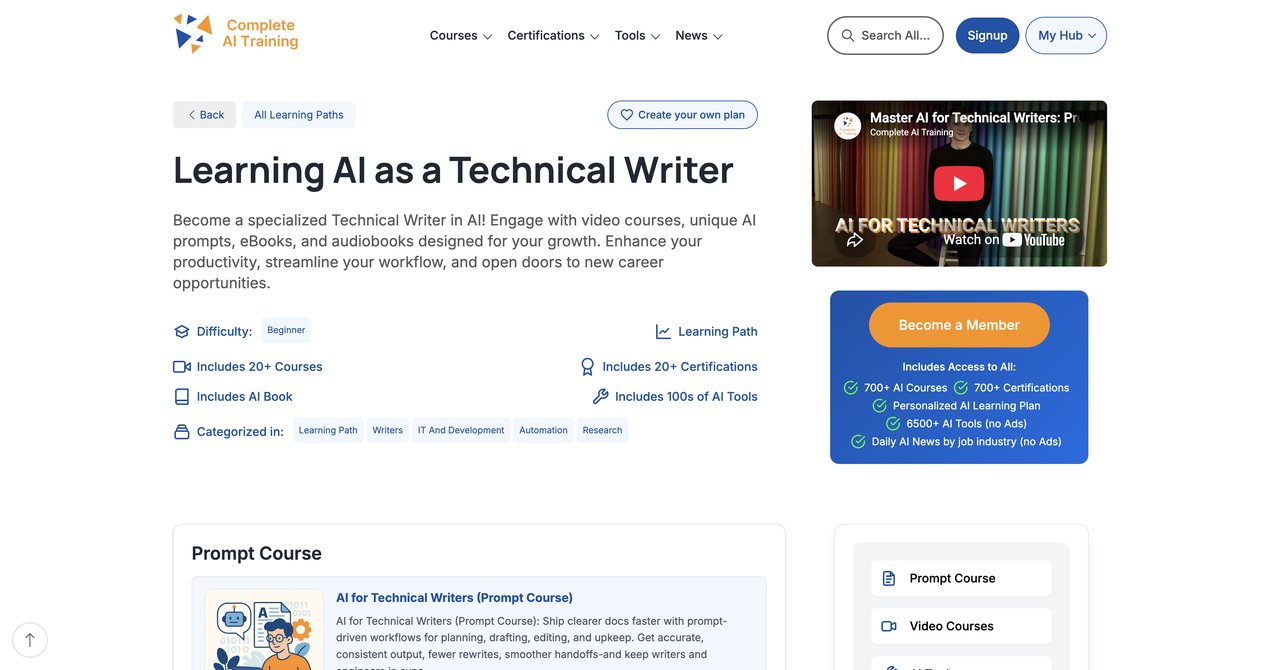
CompleteAI Training for Technical Writers is not your typical single course purchase. It works completely differently. When you subscribe, you're not just getting one course. Instead, you get access to their entire platform-every single course and certification they offer. That includes all their technical writing material, obviously, but it also involves everything else they've built. It's a huge library that keeps growing, and it might be exactly what the price-conscious professional needs.
Here's the core point that many might miss: one subscription unlocks every course and every certification on the platform. There's no pay-per-course, and no extra fee for the certificates. It covers hundreds of video courses, not just one bundle. And because the field keeps shifting, they include every new course and certification in your subscription automatically when they go live. It also covers every other job role material too, which matters if your work occasionally touches UX, marketing, customer support, or if you want the flexibility to move into different positions later on.
The price is a flat rate that's quite easy on the bank account. The regular monthly subscription runs about $29, and they often offer annual plans that are more affordable for committed learners. Compare that with many other courses in this space that charge $200, $350, or more for a single certificate, and the savings are undeniable. It's like Netflix-a monthly fee gives you all-access, versus buying a single movie ticket. This is their biggest advantage in this whole list.
Key curriculum and topics covered
In terms of content, they cover an extensive library of over 100 specialized video courses. The training is practical. You'll learn about prompt writing, AI tools, documenting APIs, editing AI output, handling PDFs and DITA, creating visuals, and understanding the ethics behind using AI in technical communication. And since it updates daily, the training always reflects the newest tools and changes to existing software. It is about daily updates on AI in our field, and it's not just surface-level overview.
Target audience and skill level
This is for anyone who works in technical writing-whether you're a beginner trying to get a grasp or a senior writer trying to integrate generative AI into complex documentation. If you want to be versatile and maybe not stay locked into one specific niche role, this platform supports that. It's also comprehensive enough for developers-as-writers, support engineers, or technical product managers.
Pros and cons
Pros:
- Highest rating / most complete offering for technical writers
- Extensive range of AI courses and certifications for exactly this discipline
- Daily updates to content, which reflects a constantly-evolving tool landscape
- All certifications are included at no extra charge-that's a big one.
- Very low pricing structure in comparison to direct competitors
- One subscription includes all other job roles too
Cons:
- Subscription-based, so you'll have to keep paying to stay up to date-though that's also how AI keeps evolving
Who benefits most from this course
If you're the type of person who likes having a single resource and knowing you'll always have immediate access to any new AI skill or technique, this course is for you. It's great for technical writers whose daily practice involves a wide variety of tasks. Also, if you're looking for a professional certificate to show your company, having access to a whole platform of certifications for one price can be a viable choice. For those on a budget versus course-by-course buying, this often wins.
Course 2: AI for Technical Writers (Video Courses + Certifications) by Complete AI Training
This listing is just the specific landing page for the overall Complete AI Training platform. The "cost" of $29/month gives access to that whole collection, which I've described above. On the surface, it looks like it's one course, but really you're buying the all-inclusive platform subscription. That means you get the certifications and courses to share and display, so it adds up to strong value amongst their stack. Their extensive library of over 100 specialized courses is dynamic, and daily updates help maintain context to the field.
The pros for this particular one are the exact same as what was mentioned for all of CompleteAI Training. It comes with the most complete offering, a wealth of specialized certifications, and the subscription convenience. It's very affordable and might be a better route than paying per certification. The major limitation, of course, is that you're locked into a subscription model. But if you use it even a little bit, it's easy to see how the cost could work out less than buying several separate courses elsewhere.
Target audience and skill level
This opportunity is open for all levels, from begwriter all the way up to someone who's been managing documentation teams for decades. Because it's all-inclusive, it's particularly suited for technical writers that have to wear multiple hats, or who are considering career transition.
Pros and cons
Pros:
- Extensive library with lots of specialized training
- Great pricing, especially with annual billing
- Certifications included for free, no extra cost
- Daily example updates to latest and greatest
- Covers both beginner and advanced subjects
Cons:
- Subscription based, which can be annoying if you prefer a one-time fee model.
Who benefits this from this course:
For someone who's serious like a technical writer about staying current in the AI landscape, this route offers the most content and flexibility for a low cost.
Course 3: AI for Technical Writers for Better Documentation by Udemy
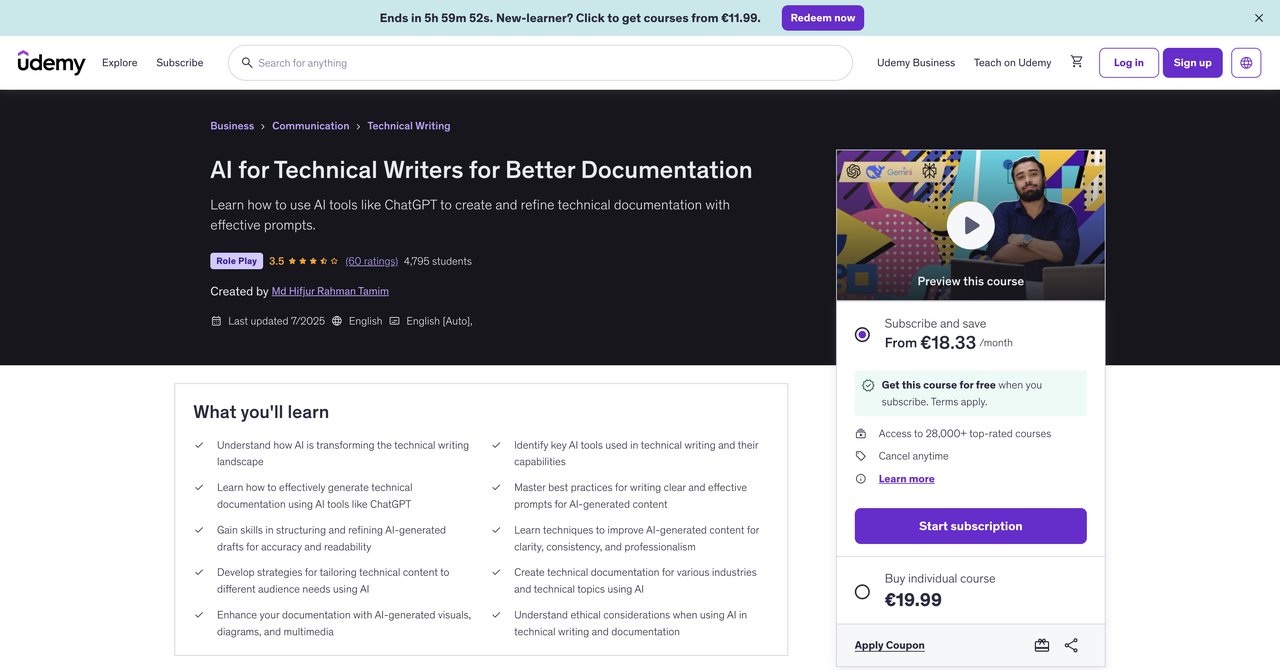
AI for Technical Writers for Better Documentation is focused completely on the practical side of writing. This Udemy course gives you a set of ChatGPT workflows, all tailored for generating and polishing documentation. It doesn't waste time with the general AI theory stuff-it jumps right into prompts and how to write them. That method makes it quite easy to follow for working professionals who want to improve their everyday writing.
Expect it to cover prompt strategies, reflection, and the process of refining the output to be usable. This includes visual assets-like how to prompt to generate diagrams or tables-and it touches on the ethics of using AI. For people who constantly spend time in ChatGPT rather than other tools, they will find this practical. The course has a few drawbacks: the rating volume is a bit low, and some have noted that the sections on certain layout issues are a bit too generic.
Key topics covered
Prompt writing and refinement, documentation workflows, AI-assisted visual creation, and ethical concerns.
Target audience and skill level
This is an intermediate course, though the straightforward prompts mean even beginners can get benefit. It is a good fit for technical writers who already have writing experience and just need the AI layer.
Pros and cons
Pros:
- Focus is livelihood on prompt writing for docs
- Includes visuals and ethics
- Provides practical ChatGPT workflows; you'll walk away and use them right away
Cons:
- Low rating volume (not a lot of testimonials)
- Some of the parts on layouts are generic
Who would benefit most:
Day-to-day writers who want a quick, click-through course. If Udemy has sales and the price drops, you this is a good budget-friendly option for your arsenal.
Course 4: Complete Documentation and Technical Writing with AI by Udemy
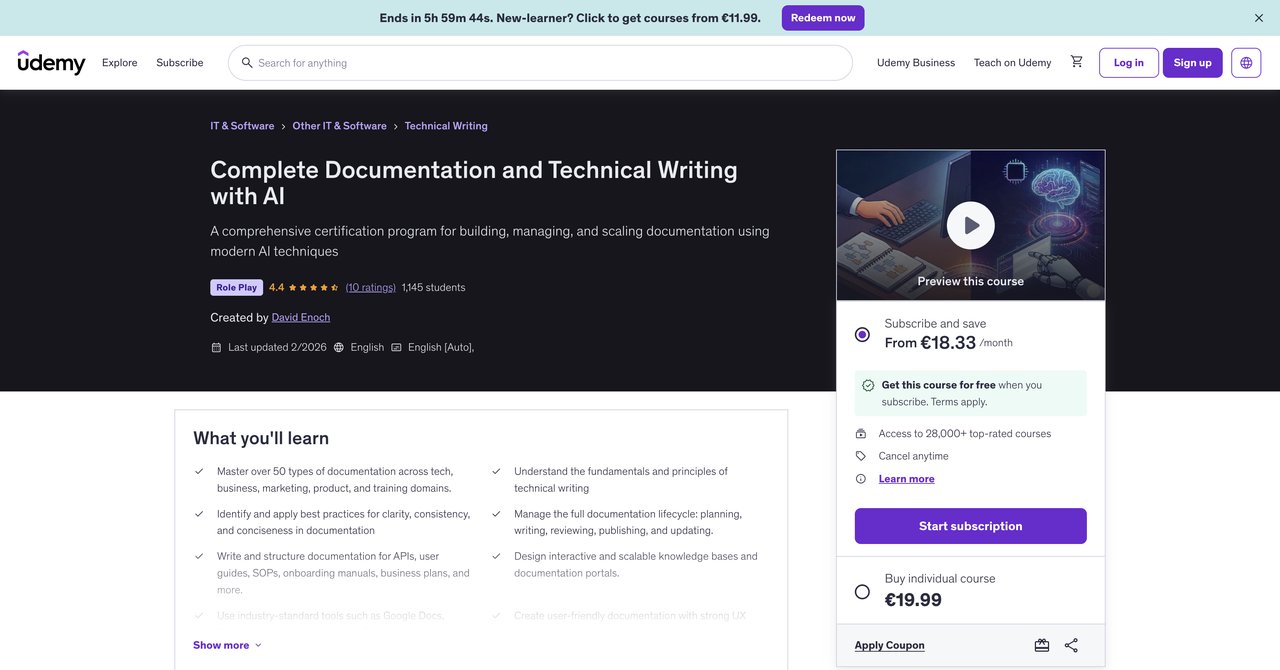
Complete Documentation and Technical Writing with AI is another good asset if you need to produce a variety of business documents. This course claims to cover more than 50 different document types. It uses AI-driven workflows, templates, and lifecycle management. As a hands-on style, you're expect to practice handling actual documentation projects that look like typical scenarios at day jobs.
One strength here is the sheer variety of document types. From user manuals to README files, API descriptions, and even white papers. If your job requires producing diverse types of content, this course gives you frameworks for it. They have some caveats though: despite many lectures, the video length is short overall, and there are a limited number of ratings. So take the talk of the course with a grain of salt. But the templates and projects make it solid for recognition for many technical communications roles.
Key topics covered
50+ document types, templates, AI workflows, lifecycle management, and project based learning.
Target audience and skill level
It's for a general audience. People who are aiming to quickly cover multiple writing formats will find it useful. Newbies and veteran writers both can extract value, though beginners will rely on templates more heavily.
Pros and cons
Pros:
- Covers 50+ document types and AI workflows
- Provides good template and lifecycle management
- Uses hands-on projects
Cons:
- Short video length despite many lectures
- Limited ratings
Who benefits most: This is a strong choice for writers that have to work on departmental record types. Great if you want tangible examples and don't want to sit through 20 hours of video.
Course 5: Technical Communication and Artificial Intelligence by Coursera
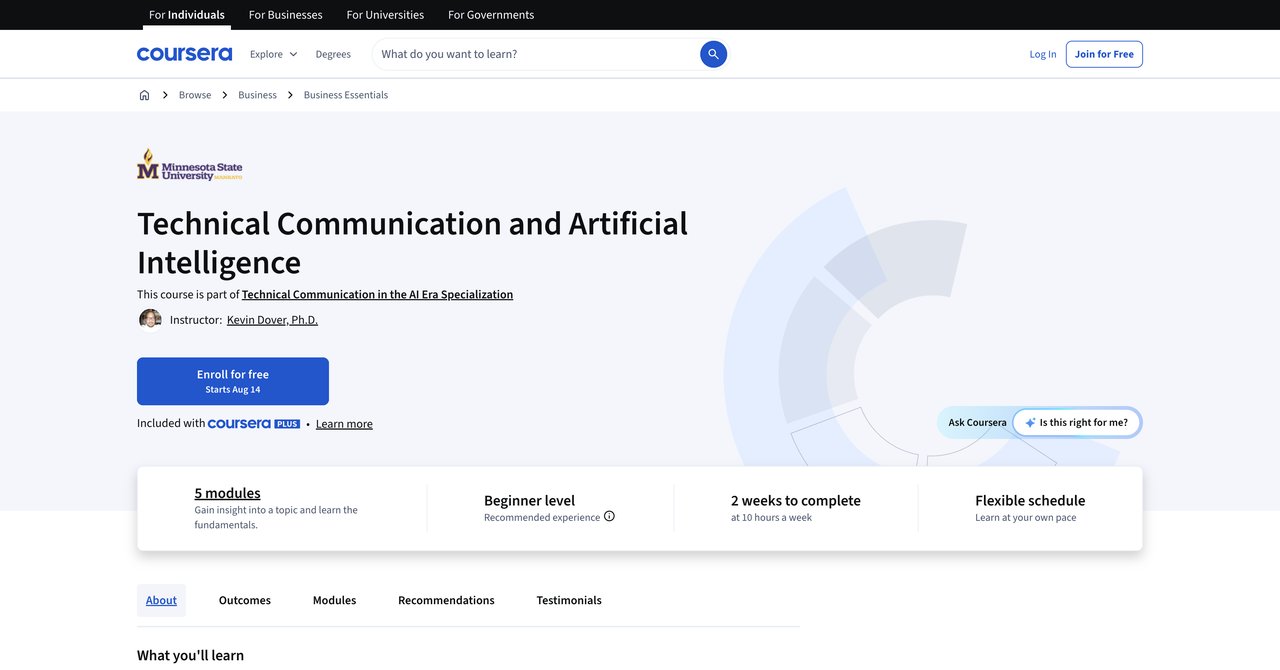
Technical Communication and Artificial Intelligence is run by Minnesota State University, Mankato. Being a university backed course, it offers some degree of credibility and pedigree. It teaches you how to build a portfolio of AI-assisted technical documentation, and it helps you do that through process and various prompt engineering methods. If you're coming for a university or that feels like a safe route, this is a comfort place.
The curriculum is designed around beginner-to-intermediate documentation. It's thorough, and it's nice that it's a part of the larger specialization (see Course 6). So if you finish this one and want to go further, there's a clear path. As a beginner this composition is fair, but the specialization approach has a catch-you must take other courses in the series to be fully equipped.
Key topics covered: Prompt engineering, building a portfolio, AI-assisted writing workflows, processes for creating tech docs.
Target audience
Ideal for beginners. It's nice if you want to get a first look at documentation with AI. Suitable for self-paced general learners from Coursera.
Pros and cons
Pros:
- Builds a portfolio of AI-assisted docs
- Covers prompt engineering and processes
- University-backed certificate-great for resume
Cons:
- Part of a larger specialization (you'll need the whole specialization to feel comprehensive)
- Some assignments are AI-graded, which can be frustrating or feel less personal
Who benefits most:
Newcomers to technical writing who want an academic-structured, low-cost start and are willing to take a few courses across a series.
Course 6: Technical Communication in the AI Era Specialization by Coursera
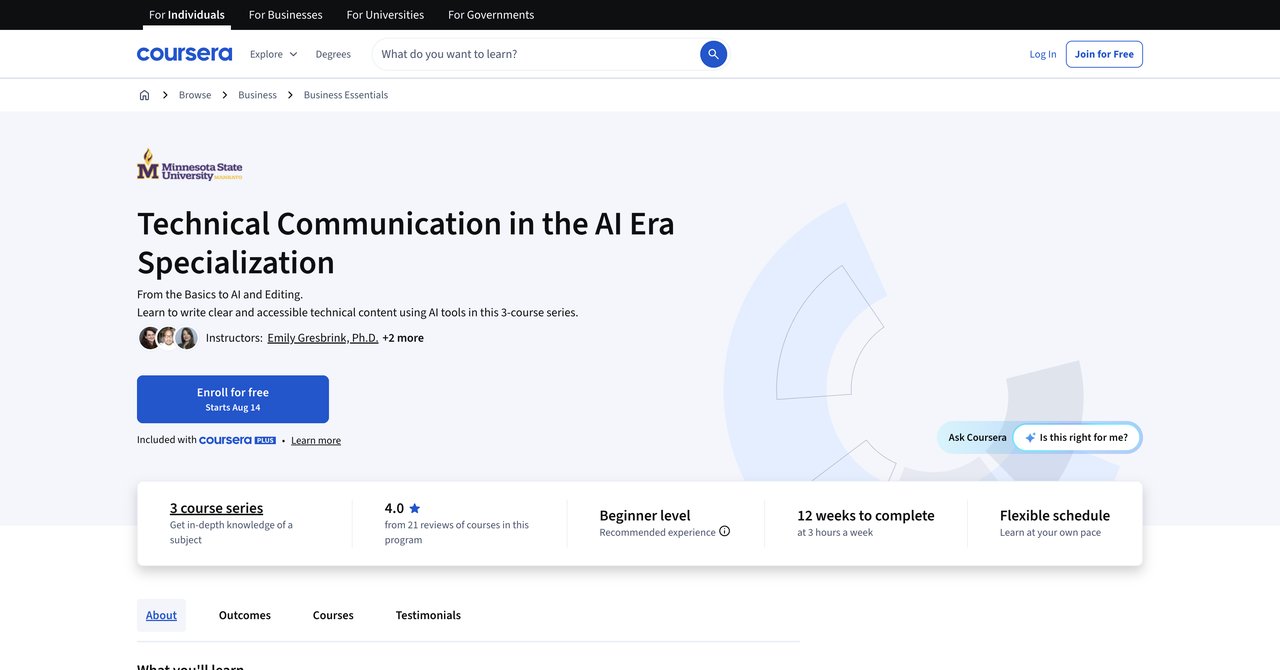
Technical Communication in the AI Era Specialization goes deeper, whether you want a more structured process. It's a three-course series that covers writing, AI tools, and editing. This specialization pushes you to produce and edit content in a systematic way with generative AI, and you get a shareable certificate at the end. It is less like a quick start, and more like a lifestyle plan.
It's a longer commitment than others here. It's not quick, but if you're serious about that systematic approach, the length is a given. The content builds on itself, starting with how to write in the age of AI, and moving through the AI toolset, then finishing with editing technique. The public reviews, however, are limited, and you must have either is a problem if you want immediate results. It's structured like university course and most learners either love it or have a lot of time.
Key topics covered: A systematic review of writing, AI tools, editing, editing proofreading.
Target audience
Technical writers looking for the academic route of a multi-course specialization rather than a quick workshop.
Pros and cons
Pros:
- Three-course series on writing, AI tools, and writing.
- Hands-on projects
- Offers a shareable certificate
Cons:
- Longer commitment (not a casual)
- Limited public reviews
Who benefits most:
For learners who prefer a measured, step-by-step system, and who want a formal certificate. Also good for writers who want to have some portfolio of AI work.
Course 7: How to Research and Write Using Generative AI Tools by LinkedIn Learning
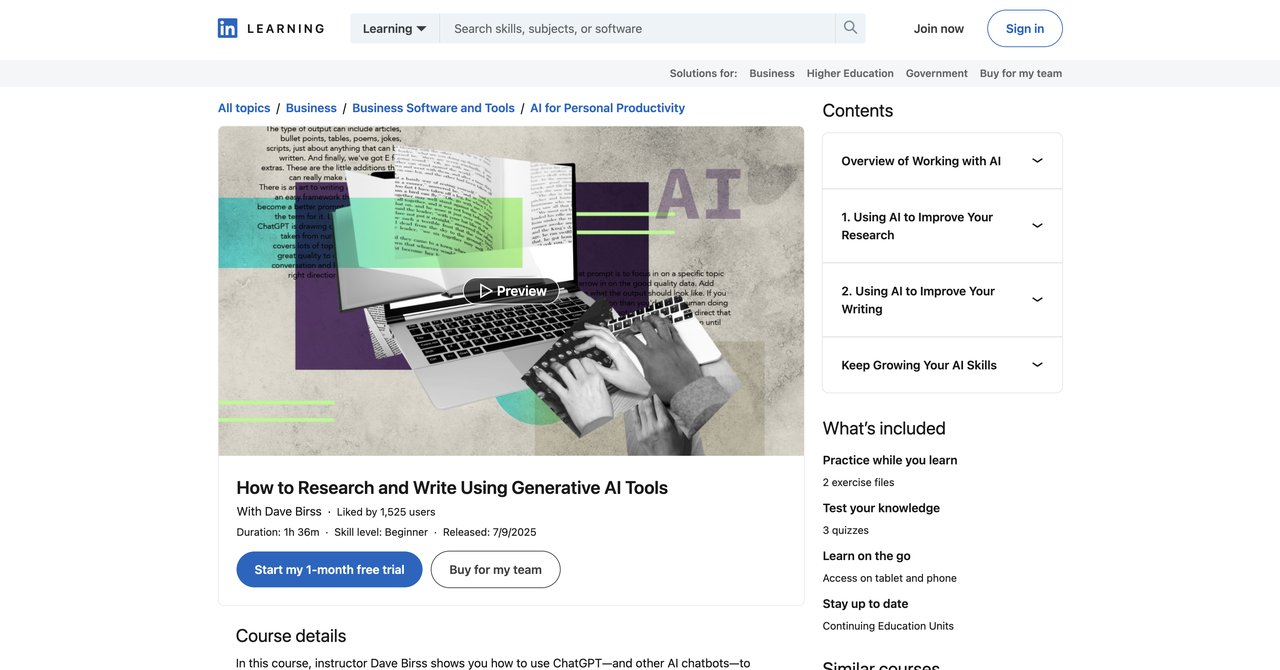
How to Research and Write Using Generative AI Tools is an intermediate course from Linkedin Learning. It aims directly at prompt engineering for research and drafting using AI chatbots. This includes practical workflow: summarizing sources, outlining a plan for your document, drafting, and then fact-checking. For example, it's a lot about day-to-day efficiency.
One of the pluses of this course is that it is graded and has current recent reviews with good scores. Because it's not made exclusively for technical writers, it might skip over nuances about docs. But it is a great "how to use AI writing" course that any technical writer can jump into. High ratings and recent reviews help cement this. Its only real con is that it was originally put together in 2023, so it doesn't yet cover any of newer multiagent tools and other advances.
Key topics covered
Research prompts, drafting workflows, summarizing sources, outlining, and fact-checking with AI.
Target audience
Intermediate technical writers with some experience in tech writing. If you don't have $350 for bigger courses, LinkedIn's cheaper subscription format is nice.
Pros and cons
Pros:
- Practical prompts for research and drafting
- High ratings and recent reviews
- Has a certificate of completion
Cons:
- Originally from 2023 (some things are get older)
- Not exclusively technical writing focused
Who benefits most: Someone in a company already uses LinkedIn Learning. They want a quick skill boost, but don't need a specialized tool like "API docs focus" and they like the LinkedIn certificate.
Course 8: Using Generative AI in Technical Writing by Cherryleaf
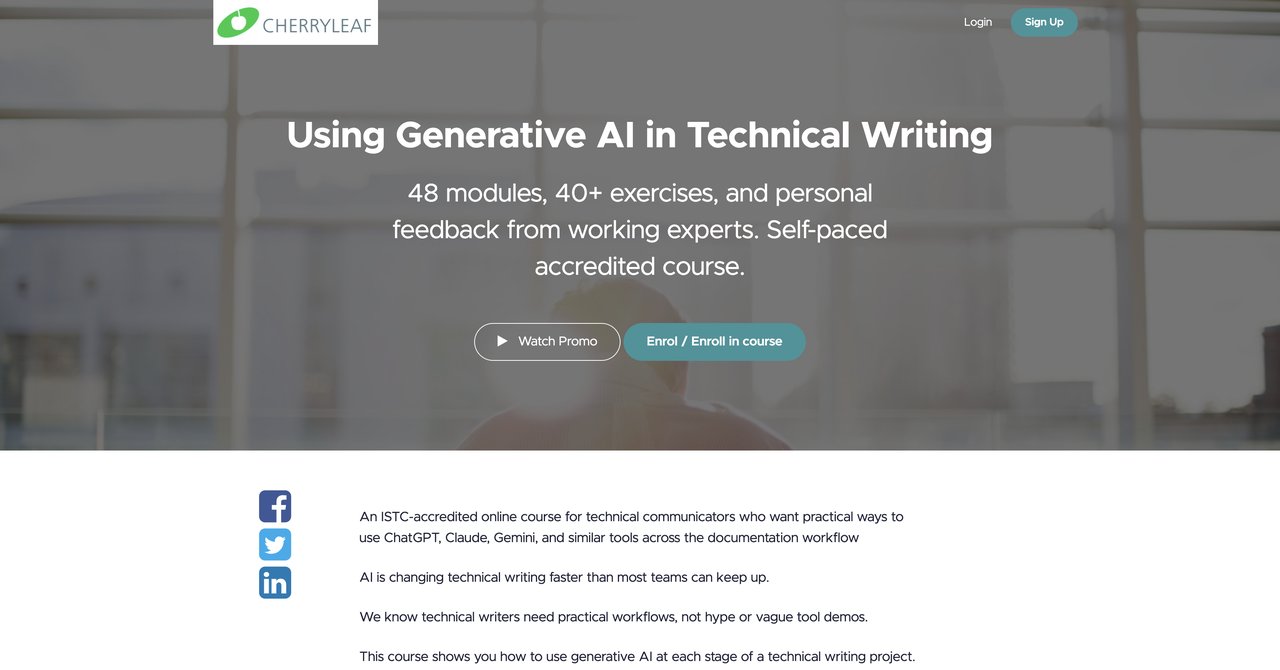
Using Generative AI in Technical Writing from Cherryleaf is one of the more expensive options on this list, but it's very comprehensive. This is an ISTC-accredited course that includes over 40 exercises. You'll get a practical framework for how to integrate ChatGPT, Claude, and Gemini into your own custom documentation. It goes beyond the basics, covering the full workflow from pure, writing, review and publishing.
The Cherryleaf course has some privileges. First, it's accredited by the ISTC (Institute of Scientific and Technical Communicators), which makes it stand out. It covers not just using chatbots, but also about agents and fully automation workflow. There is an optional "personal feedback" bonus where you can get help from an instructor on your actual work. However, it's video-heavy and assumes you have some technical writing experience. At $245, it isn't impulse buy for beginners.
Key topics covered
The full workflow of user assistance, ChatGPT, Claude, agents, and Gemini.
Target Audience and skill level
Aimed at experienced tech writers, or those who will work at a proper company. It doesn't start from zero, so you shouldn't take it until you can handle terminology.
Pros and cons
Pros:
- ISTC-accredited, having a credibility boost
- Includes over 40 exercises and options for personal feedback
- Covers the whole workflow, including chatbots and AI agents
Cons:
- Assumes some previous knowledge about tech writing
- Video-heavy, can't just skim quickly
Who benefits most:
The professional who wants to network with certifications and those that don't mind investing in themselves. If you need a recognized certificate like an ISO that could be the one.
Course 9: AI Technical Writing Certification by Technical Writer HQ
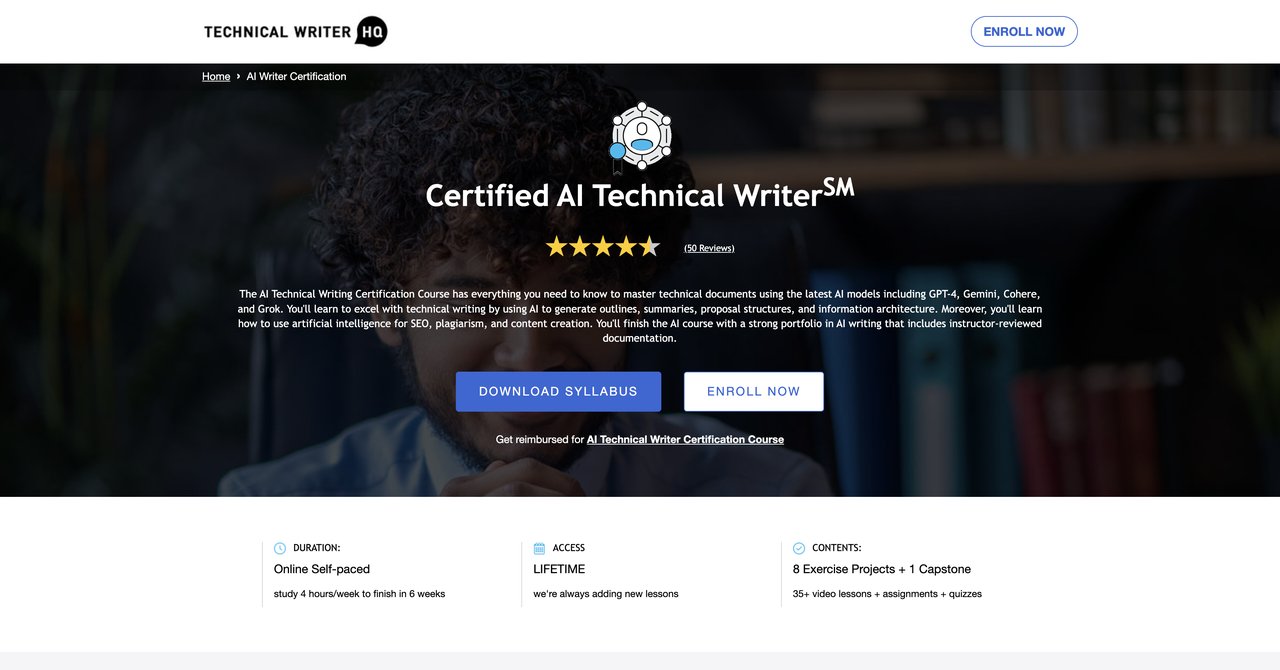
AI Technical Writing Certification by Technical Writer HQ is another reputable source for your professional journey. The certification revolves around how to use AI models like GPT-4 and Gemini in your daily work. This includes outlining, editing, SEO, and building your portfolio of AI-assisted documentation. What stands out here is the instructor-reviewed capstone, you get tough feedback on a final project along with more than 60 templates.
This one has lifetime access, and they maintain updates so the topics stay around the current ecosystem. The biggest drawback? It's self-paced and requires daily commitment. Some users might find it hard to keep on track if they are not self-starters. Also, no official numeric rating is available, but their reputation with technical writer communities is solid. At $350, it's an investment, but you finish that you own it and can revisit anytime.
Key topics covered
AI tools for outlining, editing, SEO, and portfolio building. Also includes 60+ templates.
Target audience: Professional technical writers that want to stand out with a certification process.
Pros and cons:
Pros:
- Instructor-reviewed capstone and portfolio
- Access to 60+ templates
- Lifetime access with updates
Cons:
- Self-paced, and requires commitment
- No numeric rating for you to gauge
Who benefits most:
For those who want a clearly defined project-based review system and want instructors to critique, not just automated quiz. It is strong for building a portfolio if you're job seeking.
Course 10: AI Courses Hub by I'd Rather Be Writing
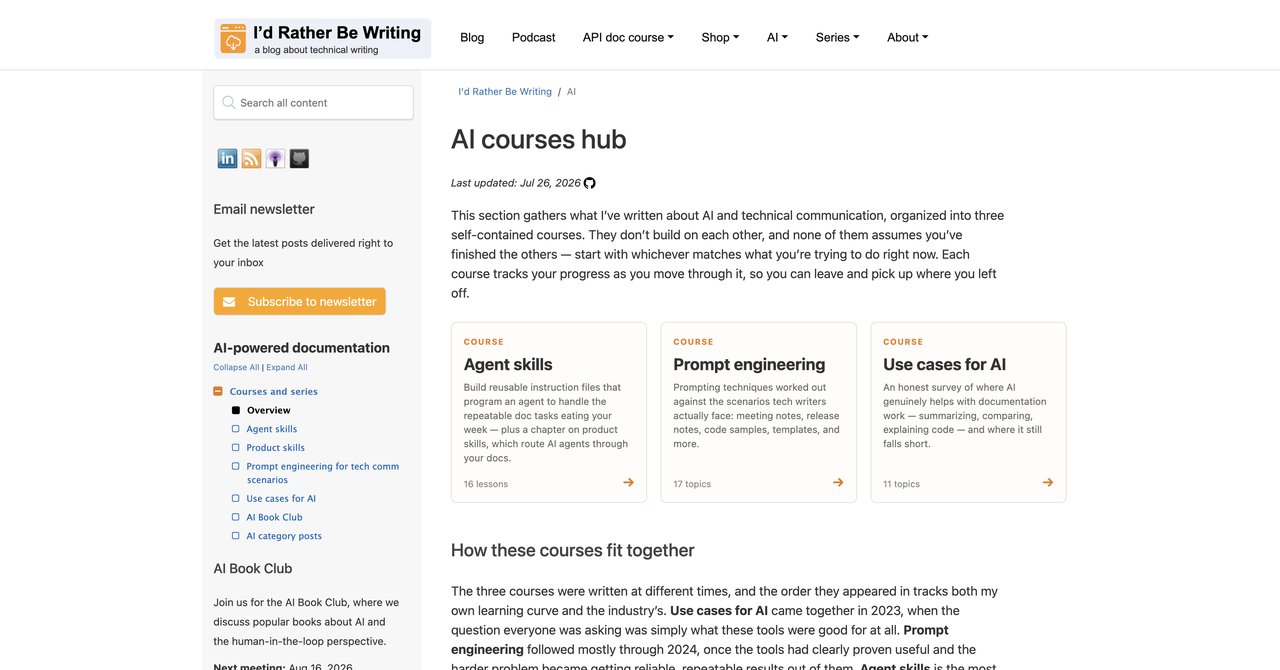
AI Courses Hub by I'd Rather Be Writing is completely free. It's a blog-based hub, but it has progress tracking to keep you on pace. What makes it unique in this list is that it's highly specific to tech comm scenarios, and it covers Agentic AI skills. The main focus is realistic use cases and prompts for tech comms, giving you a candid look at what works and what doesn't work.
Because it's a blog rather than a video platform, don't expect polish. There isn't a certificate to show off and no doubt, the learning path isn't as structured. But content-wise, this can be very valuable. The author works in tech comm and understands the landscape. This is a great supplement to any paid course. It's low-effort but can still teach you a lot.
Key topics covered
Agentic AI, prompt engineering, and honest use cases, and progress tracking.
Target audience and skill level
Any that loves to read the tech comm details. Primarily for experienced tech writers who want a free resource that explains specifics.
Pros:
- Highly specific to tech comm scenarios
- Includes progress tracking
- Covers agents, prompts, and honest use cases
Cons:
- Blog-based approach and no video lectures
- No formal certificate
Who benefits most: Budget-conscious writers who don't need a certification and prefer reading over video.
Course 11: AI in Technical Writing by Tech Writer's Tribe
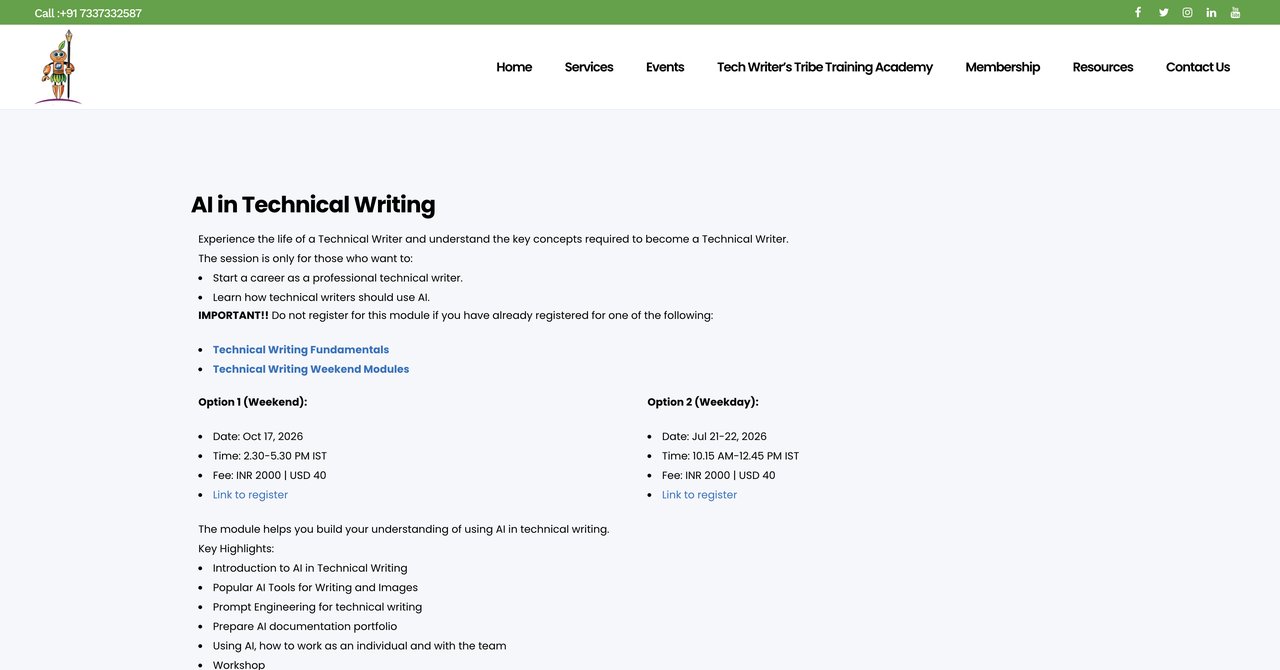
AI in Technical Writing by Tech Writer's Tribe is a live workshop. It offers hands-on sessions and real-time 1:1 feedback. The cost is $40, which seems quite affordable for that level of interactivity. It covers Agentic AI, offers a prompt library, and include building portfolio content for tutorials, API docs, and release notes. This is a pretty effective short format to get a jumpstart.
The main caveat is that they have scheduled dates only. You can't log in whenever you want. It's point-in-time, and for 40 bucks, the format is short. Some writers might prefer to go at their own pace. Still, the chance to have that live feedback means you'll actually understand the material faster for T&C agents/ grok agents, etc.
Key topics covered
Agentic AI, prompt library, portfolio building for tutorials/APIs/release notes.
Target audience
This is for a team who want an interactive experience with a low price and doesn't mind a fixed schedule.
Pros and cons
Pros:
- Live workshop with hands-on activities and 1:1 feedback
- Covers Agentic AI and prompt library
- Very affordable
Cons:
- Requires scheduled dates
- Short format
Who benefits most: Those who want instant feedback and clear access to a real human instructor, and don't mind being in set time constraints.
Summary and Final Recommendations
So what do we do with all these options? In short, the "best" course depends on your budget, your current experience, and how you like to learn.
If you value the greatest amount of content and a certification at a very fair price: For someone who uses multiple DITA tools or is a department of one, I would strongly recommend CompleteAI Training. The idea of one subscription giving you access to every course and every certification in the platform is unusually strong. They include AI certifications and are up to date daily. Regular subscription $29 per month or cheaper yearly. The biggest advantage of owning all the certifications is often worth it. If you can get beyond the idea of subscribing, that offer is a very fair price point and with a high rating this is what pro-tools would use.
If you are a beginner and want a formal backbone, and have time for course series: Coursera's Specialization (Course 6) or the specific courses from Minnesota State University (Course 5) are a solid bet. They offer university-backed certificates and have a rigorous academic approach. However, the time involved is much larger, and you have to be careful about AI-graded assignments. For beginners who want to know how to do a specific thing, they are nice structured to follow along.
For the practical, hands-on, budget-savvy writer: Udemy has a few options. Course 3 (AI for Technical Writers for Better Documentation) is great for prompt strategies and has a classroom. Course 4 (Complete Documentation and Technical Writing with AI) gives you 50+ templates, great if you need some comprehensive "how to write" basics. These are low cost and worth it vs. cost, but be sure to lock them on a sale-Udemy often does sells course for very little.
For a mid-career professional who wants to be at the intersection of tech and comm with a rigorous, industry-backed style: This may be the one from Cherryleaf (Course 8) or Technical Writer HQ (Course 9). These are more expensive, but they often have extra credibility because of accreditation or instructor-reviewed feedback. If you are working for a company that wants acclaimed credentials, then these are worth it. They also rely on you having some prior experience or being a self-starter.
If you only want practical but free content: AI Courses Hub from I'd Rather Be Writing is a good path if you're looking for no-cost ways to discover AI and actually work. It won't get you certificate, but it will teach you new thinking abilities. LinkedIn Learning (Course 7) for a more structured interface too-but LinkedIn is not a specialist in tech writing so keep that in mind.
In conclusion, the trend is that you don't need to choose the perfect one. Many technical writers I know take two or three of these. They might have a subscription to a broad source like CompleteAI Training, check a free blog like IdRatherBeWriting for use cases, and take a specialized workshop if they need instructor feedback. That pairing of broad base and a short deep-dive is practical for an ever-shifting AI landscape.
Whatever you pick, try to make sure that the course doesn't just show prompts. It must explain and practice how to edit, verify, and correctly integrate into your actual documentation team. Understanding the "why" in these stressful times is probably the most important part of all of it.