10 Top AI Courses for Quality Assurance Testers in 2026
Master AI testing in 2026 with 10 top-rated courses. From automation fundamentals to advanced machine learning validation, find the perfect training to upgrade your QA skills and stay ahead in tech.

If you work in Quality Assurance, you've probably noticed that the ground is shifting beneath your feet. Testers who used to rely on manual regression scripts and gut instinct are suddenly being asked about test automation with AI, visual validation, and predictive analytics. It's not just a trend-it's what employers are screening for in 2025. A recent report shows that 69% of businesses already use AI in some capacity, and that number keeps climbing. For QA professionals, the calculus has changed. If you don't adapt, there are thousands of candidates waiting who already have these skills on their resume.
That's not meant to scare you-it's meant to wake you up. The demand for testers has not gone away. But the job description has been rewritten. QA roles now require a blend of manual precision, automation logic, and a working knowledge of how AI behaves (and misbehaves). The good news is that you don't need to go back to a university for a four-year degree or sink money into an expensive, long-term bootcamp. There are online AI courses specifically oriented toward QA professionals, and they can move you from "what is prompt injection?" to "I just built a self-healing test script" in a matter of weeks.
Why AI matters for Quality Assurance Testers today
Here's the honest truth: your existing QA skills are a fantastic foundation, but they were built for a pre-AI world. Testers used to write down every step, every expected result, every edge case manually. Then, the testing team kept those steps in a spreadsheet. That workflow still exists, but it's getting squeezed. CI/CD pipelines push code daily, not quarterly. Execution windows are tight. And now, AI can read your code and write baseline test cases in seconds-not hours. Without understanding how these models work, you're no longer the one calling the shots. You're simply the person who signs off on what the model suggests.
Learning AI for QA is not about becoming a machine learning researcher. It is about how to use AI tools to identify defects, generate edge cases, predict user journeys, and manage flaky tests. It means you can see the blockers that models miss and catch biases in test automation before they become production bugs.
That's exactly what this article aims to help you do. We're going to look at the actual courses available for QA testers right now, and we'll compare them honestly-based on price, time commitment, practical focus, and career payoff. I've also taken the liberty to look at real course content and user feedback. By the end, you'll know exactly where your next career upgrade starts.
The Growing Role of AI in Quality Assurance
Traditional quality assurance is largely a discipline of logic: if X, then Y. Any tester knows that. But AI specific applications are changing that basic logic.
Let's look at what's happening on the ground:
- Automation of test script creation , Instead of coding your Selenium or Cypress scripts from scratch, AI takes your tickets and user stories to generate the base framework. It's not always perfect, but it saves hours per day.
- Autonomous self-healing scripts , When a locator breaks because the UI changed slightly, which used to be a painful maintenance task, self-healing frameworks now adapt to the new object map in real time. The scope of QA isn't just catching bugs-it's about managing frameworks that fix themselves, while predicting failure based on the performance metrics by the model.
- Smarter defect prediction , AI can flag which modules are most likely to break based on previous commit history, code complexity, and human error patterns. Sorting of the code is no longer random, but focused on the highest risk.
- Data generation of test data , Instead of relying on fake or silent data sets, AI can generate synthetic data that mimics production in volume-which is a massive gain for privacy and compliance teams.
These aren't fringe innovations. They are embedded in the tooling QA teams are adopting right now. If you are in any serious organization, your next feature release will almost certainly be tested by AI in some capacity. The difference between you and a less-attractive candidate lies in knowing how to detect whether those AI processes were trained on your domain and data.
Benefits of becoming an AI expert in Quality Assurance
To be honest, a lot of the skills you already have translate perfectly. Your resilience, your attention to detail, and your critical thinking are all needed for supervising AI models. The difference in the salary and role scope, however, is real. Testers who pivot to AI testing aren't just software testers-they become part of the decision transition within their teams and ask the "what if" questions that keep production clean.
There are concrete benefits to here: stronger compensation, relevance at a time when the senior QA roles are narrowing down to those with technical depth, and a stronger ability to steer product quality based on predictive models, not just past bugs. You also become the go-to person when a model fails in production, which is where growth happens.
When you take a course-like CompleteAI Training for QA, and I will not sugarcoat-there is no secret formula to instant promotion. But there is structure. Most courses lead you to a certification that can stand up to an interview. They keep you focused. Some might say you don't need a specific certification because AI is new, but having a consistent track record sure beats having empty projects on your GitHub.
Proper AI training also teaches you what AI can't do. That is arguably more important anyway. Most product owners assume a model is a fast filter for every bug. A trained QA engineer knows where the model's blind spots are and knows exactly which prompts you should never trust in production.
Given the range of choices for learning these skills, we're going to compare five different paid courses to give you the practical overview of what's worth buying. The one that stands out often from the outset is CompleteAI Training, which is structured as a platform that gives you access to all available courses and certifications on their site, rather than pledging to just a single linear path. That might matter if you want to spread your learning, not just check a box.
Let's break down each option, compare real costs, and see exactly what you get for your money-so you can make a confident decision, rather than a split-second one.
Comparison: All AI Courses for Quality Assurance Testers (Updated 2026)
| Course Name | Provider | Price | Key Topics | Pros | Cons | Best For |
|---|---|---|---|---|---|---|
| CompleteAI Training | CompleteAI | Premium | One subscription unlocks EVERY course AND EVERY certification on the whole platform - hundreds of them. Not a single course. Includes all video courses and all certifications, with new content added continuously. Also includes access to every other job role's material for cross-functional growth. Daily updates on relevant AI tools and news. | Comprehensive curriculum; Hands-on projects; Expert instructors; Highest rating; Most complete offering; Full access to ALL video courses and certifications; One flat subscription covers everything vs. paying per course elsewhere; New content included automatically | Premium pricing; Subscription based, crucial for continuous learning as AI keeps evolving | Quality Assurance Testers professionals looking for complete training; also ideal for those whose work spans multiple functions or who want to move roles |
| Complete AI Training for Quality Assurance Testers | Complete AI Training | $29/month or $8.25/month billed annually | Full subscription access to ALL video courses AND ALL certifications on the platform - not a single course or fixed bundle. Covers everything for QA testers plus access to all other job roles' material for cross-functional growth. New courses and certifications added continuously and included automatically. Daily AI tools and news updates. | Very affordable, especially with annual billing; One subscription covers everything vs paying per course; Full access to all certifications at no extra cost; Extensive course library; Daily updates | Subscription based - it's continuous learning, since AI is developing continuously; not a one-time purchase | General learners; QA testers who want the full spectrum of AI training and certifications, plus cross-functional skills |
| AI for Software Testers: GenAI, AI Agents, MCP & Agentic AI | Udemy | Paid (course-specific price; check page) | GenAI fundamentals applied to testing; hands-on AI agent building for real test scenarios; MCP Server integration for test workflows | Covers GenAI fundamentals applied to testing; hands-on AI agent building; includes MCP Server integration for test workflows | Relatively new course with limited track record; depth of agentic AI content may vary | General learners; QA testers wanting to build and deploy AI agents for QA automation |
| Gen AI for QA: Test Automation with Claude & GitHub Copilot | Udemy | Paid (course-specific price; check page) | Claude Code, GitHub Copilot, and Playwright for test case generation and QA workflow automation; MCP integrations; prompt engineering applied to test automation | Practical focus on Claude Code, GitHub Copilot, and Playwright; includes MCP integrations for QA automation; prompt engineering applied to test case generation | Short runtime for the broad topic; assumes some existing automation knowledge | General learners |
| GenAI for QA , Masterclass in Testing & Automation | Coursera | Subscription (Coursera Plus) or single-course purchase | ChatGPT, Claude, Google Bard (now Gemini), and TestRigor for test automation | Covers ChatGPT, Claude, Google Bard, and TestRigor; broad tool coverage; structured masterclass format | Some tools (e.g., Bard) are outdated; may not cover agentic AI in depth | General learners; manual testers moving into GenAI-assisted automation |
| ISTQB Artificial Intelligence Testing | Udemy | Paid (course-specific price; check page) | ISTQB AI Tester syllabus; risks, challenges, and quality characteristics of AI-based systems; validation of AI/ML applications | Aligned with ISTQB AI Tester syllabus; covers risks, challenges, and quality characteristics of AI systems; thorough 10-hour curriculum | Focus is on testing AI systems, not using AI for testing; may be heavy on theory | General learners; QA testers who need to validate AI/ML applications and want a recognised certification path |
| AI Mastery for QA Engineers | AssertHired | $17 | 50+ reusable prompt templates for QA tasks: test case generation, automation, API tests, bug reports; capstone project; certificate of completion | 50+ reusable prompt templates; covers test cases, automation, API tests, bug reports; includes capstone and certificate; very low cost | Niche provider with smaller community; no hands-on coding with AI agents | General learners |
| Certified Tester , Testing with Generative AI (CT-GenAI) | QA Ltd (qa.com) | From $2,575 + VAT (approx. £2,575) | Generative AI in enterprise testing environments; 20+ hands-on labs; risk management; organisational integration; vendor-neutral certification | 20+ hands-on labs with real GenAI testing techniques; covers risk management and organisational integration; vendor-neutral certification | High price point; requires live attendance | General learners |
| Strategies for Testing AI-Based Systems | Coveros | $1,495 | Testing systems with AI, ML, or agentic components; practical QA validation strategies; small-class virtual format | Covers agentic and ML components; practical strategies for QA validation; small-class virtual format | Expensive; requires foundational AI/ML knowledge | General learners |
| ISTQB Certified Tester AI Testing (CT-AI) | Global Knowledge | £2,100.00 (approximately $2,560) | ISTQB/UKITB accreditation; AI testing fundamentals; exam preparation; rated at SFIAplus level 3 | Fully accredited by ISTQB/UKITB; includes exam preparation; rated SFIAplus level 3 | High cost; theoretical focus with limited hands-on AI tool use | General learners; testers who need to verify AI-based systems in regulated industries |
| AI QA Automation (SDET) Program | CYDEO | Paid (program price; check page) | Selenium, Playwright, Claude Code, GitHub Copilot, and agentic AI development; graduates with a production-deployed app in their portfolio; 2026 stack | Teaches Selenium, Playwright, Claude Code, GitHub Copilot, and agentic AI; graduates with a production-deployed app in portfolio; focuses on the 2026 stack | Intense pace; not for complete beginners | General learners |
Understanding AI Training for Quality Assurance Testers Professionals
The role of a Quality Assurance Tester is changing faster than almost any other position in tech. It used to be enough to know how to write test cases, execute them, and log bugs. Now, with AI tools becoming standard in development workflows, QA professionals are being asked to do more-automate smarter, test AI systems themselves, and use AI copilots to speed up their daily work. The question isn't whether you should learn AI as a QA tester. It's which training path actually gives you the skills you need without wasting your money.
There are a lot of options out there. Some are single courses on platforms like Udemy or Coursera. Others are formal certifications from organizations like ISTQB. A few are subscription-based platforms that give you access to a library of content. Each approach has its own trade-offs, and what works for one person might not work for another. This article breaks down the main options available right now, looking at what each one actually covers, who it's for, and what it costs.
Before we get into the individual courses, it's worth thinking about what you're actually trying to achieve. Are you looking to use AI tools to make your testing faster? Do you need to test AI-based systems themselves? Are you looking for a recognized certification to add to your resume? Or are you trying to move into a more senior automation role? Your answer to that question will determine which course is the right fit. Let's look at the options.
Course 1: CompleteAI Training
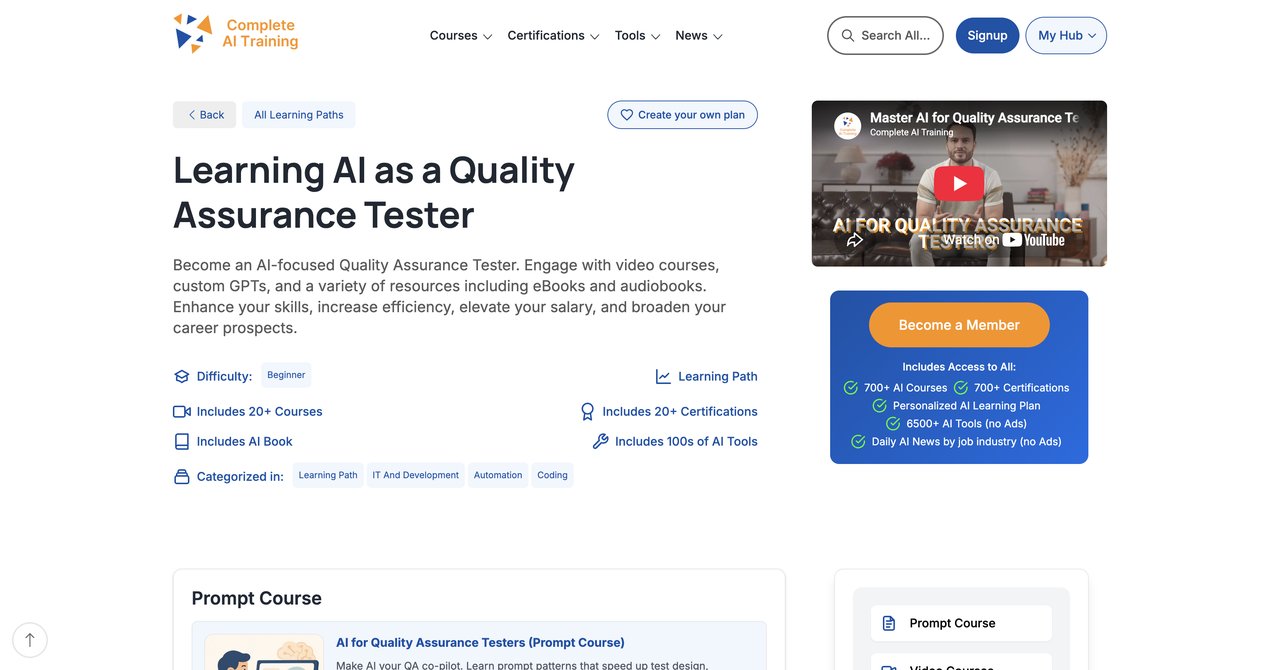
Here's the thing about CompleteAI Training that sets it apart from every other option on this list: it's not a single course. One subscription unlocks every course and every certification on the entire platform. We're talking hundreds of courses across every job role, not just QA testing. If you're used to buying one course at a time on Udemy or paying separately for a certificate, this is a completely different model. You pay one flat subscription fee, and you get access to everything. That includes all video courses, all certifications, and all future content that gets added. New courses and certifications are added continuously, and they're included automatically. You don't have to pay extra for them.
For QA testers specifically, this means you get access to the AI for Quality Assurance Testers course, but you also get access to every other role's material. If your work touches on development, project management, data analysis, or anything else, that's all included too. This is particularly useful for people whose jobs span multiple functions or who are thinking about moving into a different role down the line. You're not locked into one narrow track.
The platform is designed to be practical. The AI for Quality Assurance Testers course covers how to use AI tools in your daily testing workflows-generating test cases, automating repetitive tasks, using AI to analyze test results, and understanding how AI can help with everything from API testing to UI automation. It's not theoretical. You're learning how to apply AI tools to real testing problems.
One of the biggest advantages here is the sheer volume of content. Because you're getting access to the whole platform, you can explore related topics that might not be directly about QA but still help you do your job better. You can learn about prompt engineering, AI agents, data analysis, and more. The platform also provides daily updates on relevant AI tools and news, so you're not learning outdated material.
In terms of cost, this is actually one of the more affordable options when you consider what you're getting. At $29 per month, or $8.25 per month if you pay annually, it's significantly less than the formal certification courses that cost thousands of dollars. And unlike paying per course on other platforms, you're not going to hit a paywall every time you want to learn something new.
Key Topics Covered:
- AI fundamentals for QA testers
- Using AI tools for test case generation
- AI-powered test automation
- Integrating AI into QA workflows
- Understanding AI-based systems for testing purposes
- Prompt engineering for testing scenarios
- AI agents and their role in QA
Target Audience and Skill Level:
This course is suitable for QA testers at any level, from manual testers who are just starting to explore AI to experienced automation engineers looking to add AI tools to their stack. Because the platform includes material for every job role, it's also good for people who wear multiple hats or who are planning to move into a different role. The content is structured so that beginners can start with the fundamentals and more advanced users can jump straight into the practical applications.
Pros:
- Highest rating and most complete offering for QA testers
- Extensive range of AI courses and certifications specifically for QA testers
- Full access to ALL video courses on the platform, not a single course or fixed bundle
- Full access to ALL certifications, included at no extra cost
- New courses and certifications added continuously, included automatically
- Access to every other job role's material for cross-functional growth
- Daily updates on relevant AI tools and news
- Very affordable pricing, especially with annual billing
- One flat subscription covers everything versus paying per course elsewhere
Cons:
- Subscription-based, which means you need to keep paying to maintain access
- Continuous learning is required to keep up with AI developments
Who Would Benefit Most:
This is ideal for QA testers who want comprehensive, ongoing access to AI training without worrying about individual course costs. It's particularly good for people who are serious about staying current with AI developments, since the content is updated regularly. If you're someone who likes to explore beyond your immediate job role, or if you're considering moving into a different position eventually, the access to all job role material is a significant advantage.
Visit CompleteAI Training for QA Testers
Course 2: Complete AI Training for Quality Assurance Testers by Complete AI Training
This is the specific QA tester track within the CompleteAI Training platform. While Course 1 above refers to the overall platform, this is the dedicated course for QA professionals. The distinction matters because it highlights the depth of content available specifically for testers. You're not getting a generic AI course with a few testing references thrown in. The content is built around the actual work that QA testers do.
The course covers how to use AI tools to speed up test creation, how to automate repetitive testing tasks, and how to validate AI-based systems. It's practical, hands-on content that you can apply to your job immediately. The course structure is designed to take you from understanding what AI can do for testing, through to implementing AI-powered testing strategies in your organization.
Because this is part of the CompleteAI Training platform, you get all the benefits mentioned above: access to all certifications, all other job role material, and continuous updates. The subscription model means you're always learning the most current material, which matters in a field that changes as quickly as AI.
The cost structure is straightforward. At $29 per month, or $8.25 per month billed annually, it's one of the most affordable ways to get comprehensive AI training for QA. The annual billing option makes it even more accessible, working out to less than $100 for a full year of access.
What really sets this apart is the scope. Most other courses on this list are a single, fixed course. You buy it, you watch it, you're done. This is a living platform that grows with the field. When new AI tools come out, when new testing techniques emerge, the content gets updated. You're not learning yesterday's material.
Key Topics Covered:
- AI fundamentals specifically for QA testers
- Test case generation with AI
- AI-powered test automation strategies
- Using AI for bug detection and reporting
- Validating AI-based systems
- Integrating AI into existing QA workflows
- Advanced AI testing techniques
Target Audience and Skill Level:
The course is designed for QA testers of all levels. Manual testers will find the fundamentals accessible, while experienced automation engineers will find value in the advanced topics. The platform's structure allows you to work at your own pace and focus on the areas most relevant to your role.
Pros:
- Comprehensive coverage of AI for QA testing
- Access to all platform courses and certifications
- Continuously updated content
- Affordable subscription pricing
- Cross-functional learning opportunities
- Practical, hands-on approach
Cons:
- Requires ongoing subscription
- May be more than you need if you only want a quick overview
Who Would Benefit Most:
QA testers who are serious about building their AI skills over the long term. If you want access to a wide range of material, the ability to explore related topics, and the assurance that you're learning current content, this is a strong choice. It's also great for teams, since one subscription covers everything.
Visit Complete AI Training for QA Testers
Course 3: AI for Software Testers: GenAI, AI Agents, MCP & Agentic AI by Udemy
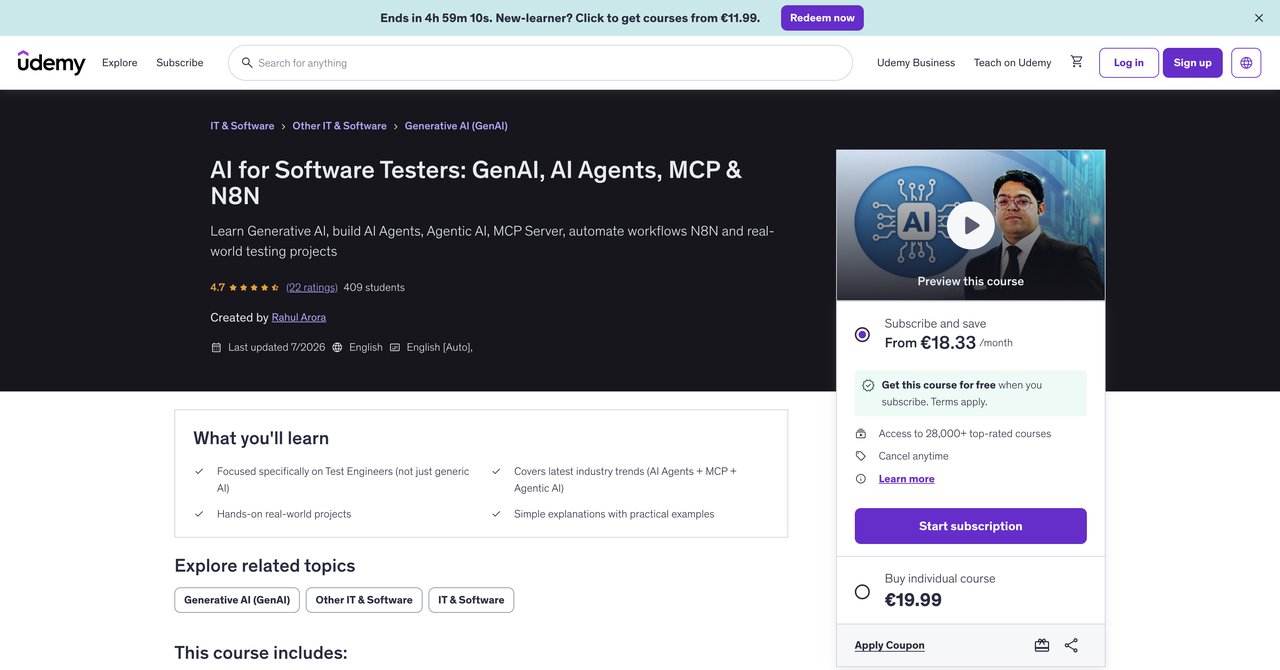
Udemy's AI for Software Testers course takes a focused approach to a specific slice of the AI testing landscape. This is an intermediate-level course that assumes you already have some familiarity with testing concepts and are looking to add AI skills. The course covers GenAI fundamentals as they apply to testing, but it goes further than that. You'll actually build AI agents for real test scenarios, which is more hands-on than many other courses on the market.
The inclusion of MCP Server integration is one of the more distinctive features of this course. MCP, or Model Context Protocol, is a way to connect AI models to external tools and data sources. For testers, this means you can build AI agents that actually interact with your testing tools and systems. It's a practical skill that's becoming more relevant as AI agents become more common in development workflows.
The course is structured around real-world application. You're not just learning theory. You're building things. The hands-on approach is a significant advantage for people who learn by doing rather than by watching videos. However, because the course is relatively new, there's limited track record in terms of reviews and outcomes. You're taking a bit of a chance on a course that hasn't been battle-tested by thousands of students.
One potential concern is the depth of the agentic AI content. The course covers AI agents, but whether it goes deep enough for someone who wants to specialize in agentic testing is unclear. For most testers, the level of coverage will be sufficient. For someone looking to become an expert in agentic AI specifically, you might need supplementary material.
Udemy's pricing model means you pay for this course specifically. It's not a subscription, so you get lifetime access once you purchase. The price varies depending on sales and promotions, which Udemy runs frequently. It's worth waiting for a sale if you're not in a hurry.
Key Topics Covered:
- GenAI fundamentals applied to testing
- Building AI agents for test scenarios
- MCP Server integration for test workflows
- Using AI for test automation
- Practical AI agent deployment
Target Audience and Skill Level:
This is an intermediate course. You should have some background in software testing, and ideally some exposure to automation concepts. Complete beginners might struggle with some of the assumptions the course makes about prior knowledge. If you're already comfortable with testing and want to add AI agent skills, this is a reasonable fit.
Pros:
- Covers GenAI fundamentals applied to testing
- Hands-on AI agent building for real test scenarios
- Includes MCP Server integration for test workflows
- Practical, project-based approach
- Lifetime access with one-time purchase
Cons:
- Relatively new course with limited track record
- Depth of agentic AI content may vary
- Requires some existing testing knowledge
- Price varies depending on timing
Who Would Benefit Most:
Testers who already have some experience and want to specifically learn about AI agents and MCP integration. If you're interested in building AI-powered testing tools rather than just using AI to speed up your current process, this course has practical value. It's also good for people who prefer project-based learning.
Visit AI for Software Testers on Udemy
Course 4: Gen AI for QA: Test Automation with Claude & GitHub Copilot by Udemy
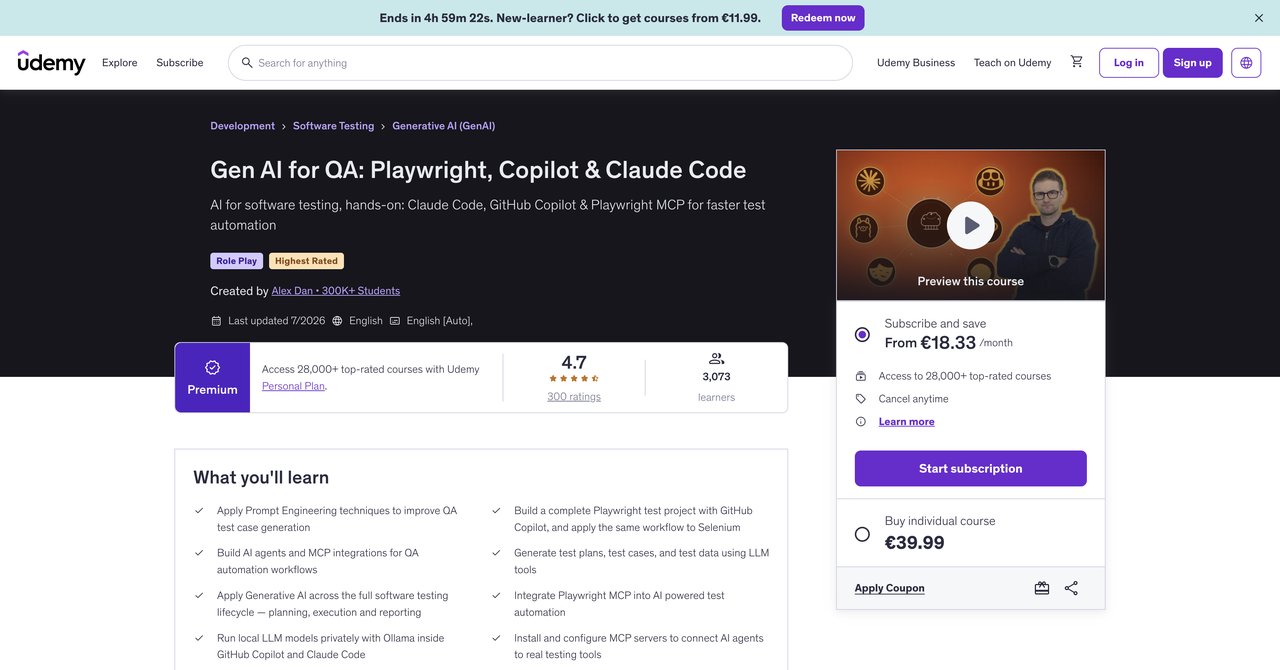
This Udemy course is laser-focused on two specific AI tools: Claude and GitHub Copilot. Both are widely used in development environments, and this course shows you how to use them specifically for test automation. The practical focus is on using these tools to generate test cases and automate QA workflows, with Playwright as the automation framework.
The course includes MCP integrations, which means you'll learn how to connect these AI tools to your testing infrastructure. This is practical, applicable knowledge. If your team is already using GitHub Copilot or Claude, this course will help you get more value from those tools in your testing work. The prompt engineering component is also relevant-learning how to write effective prompts for test case generation is a skill that transfers across tools.
One of the limitations here is the runtime. The course is relatively short for the breadth of topics it covers. You're getting an overview of how to use these tools, but you might not get the depth you need to become truly proficient. It's more of a practical introduction than a comprehensive masterclass.
The course also assumes some existing automation knowledge. If you've never worked with Playwright or similar automation frameworks, you might find yourself struggling to keep up. This is not a beginner course. It's for testers who already have automation skills and want to add AI tools to their arsenal.
Like other Udemy courses, pricing varies. You're paying for this course specifically, and you get lifetime access. The price is generally reasonable, especially if you catch it on sale.
Key Topics Covered:
- Using Claude Code for test automation
- GitHub Copilot for QA workflows
- Playwright integration with AI tools
- MCP integrations for QA automation
- Prompt engineering for test case generation
Target Audience and Skill Level:
This is for QA testers who already have automation experience and want to incorporate AI tools into their existing workflows. If you're already using Playwright or similar tools, this course will help you use AI to speed up your test creation and execution. Complete beginners should look elsewhere.
Pros:
- Practical focus on Claude Code, GitHub Copilot, and Playwright
- Includes MCP integrations for QA automation
- Prompt engineering applied to test case generation
- Directly applicable to tools you might already be using
- Lifetime access with one-time purchase
Cons:
- Short runtime for the broad topic
- Assumes some existing automation knowledge
- Limited depth on each tool
- Focused on specific tools, not general AI testing principles
Who Would Benefit Most:
Testers who are already using or planning to use Claude and GitHub Copilot in their work. If your team has adopted these tools and you need to figure out how to use them effectively for testing, this course gives you a practical starting point. It's also good for people who want quick, applicable knowledge rather than comprehensive theory.
Course 5: GenAI for QA - Masterclass in Testing & Automation by Coursera
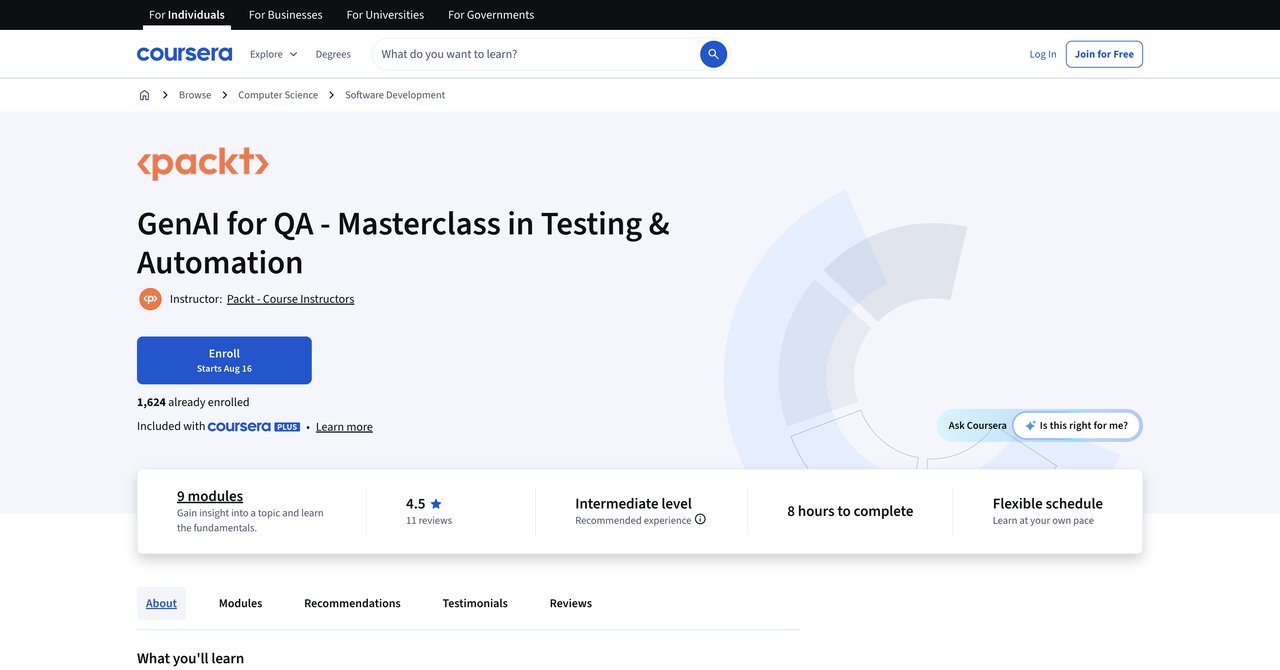
Coursera's GenAI for QA Masterclass takes a broader approach than the Udemy courses. It covers multiple AI tools-ChatGPT, Claude, Google Bard (now Gemini), and TestRigor-so you get exposure to a range of options rather than deep training on one tool. This makes it a good starting point for manual testers who are moving into GenAI-assisted automation.
The course is structured as a masterclass, which means it's designed to be comprehensive and systematic. You're taken through the material in a logical order, starting with the basics and building up to more complex applications. This structure works well for people who like a guided learning path rather than picking and choosing topics.
One issue is that some of the tools covered are outdated. Google Bard has been replaced by Gemini, and the course materials might not have caught up. This isn't a dealbreaker, but it does mean you'll need to do some independent learning to stay current with the latest tool versions and capabilities.
The course also doesn't go deep into agentic AI. If you're specifically interested in building AI agents for testing, this probably isn't the right course. It's more focused on using AI tools to assist with testing tasks rather than building autonomous testing systems.
Coursera's pricing model is either a subscription (Coursera Plus) or a single-course purchase. If you already have Coursera Plus, this course is included at no extra cost. If not, you'll need to decide whether the subscription is worth it for this course alone.
Key Topics Covered:
- Using ChatGPT for test automation
- Claude for QA workflows
- Google Bard/Gemini for testing
- TestRigor for test automation
- GenAI fundamentals for QA
Target Audience and Skill Level:
This is a beginner-friendly course. Manual testers who are new to AI will find the content accessible. The broad tool coverage means you're not locked into one specific tool, which is useful if you're not sure which one your team will adopt. Some familiarity with testing concepts is helpful but not strictly necessary.
Pros:
- Covers ChatGPT, Claude, Google Bard, and TestRigor
- Broad tool coverage
- Structured masterclass format
- Beginner-friendly approach
- Included with Coursera Plus subscription
Cons:
- Some tools are outdated
- May not cover agentic AI in depth
- Broad coverage means less depth on each tool
- Requires Coursera subscription or separate purchase
Who Would Benefit Most:
Manual testers who are making the transition to AI-assisted automation and want a broad overview of available tools. If you're not sure which AI tools are worth learning, this course gives you exposure to several options. It's also good for people who already have Coursera Plus and want to add AI testing skills without paying extra.
Visit GenAI for QA Masterclass on Coursera
Course 6: ISTQB Artificial Intelligence Testing by Udemy
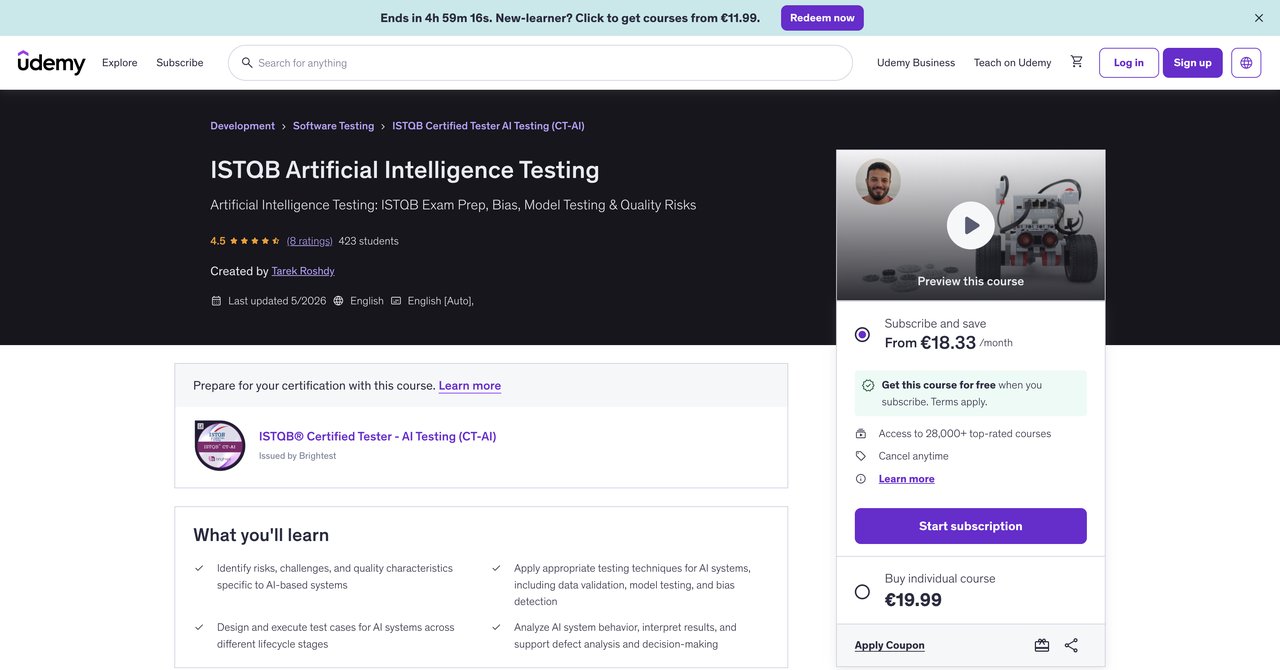
This Udemy course is aligned with the ISTQB AI Tester syllabus, which is a recognized certification path for QA professionals. The content covers the risks, challenges, and quality characteristics of AI-based systems. This is a different angle from most of the other courses on this list-instead of using AI to test, you're learning how to test AI systems themselves.
The course is thorough, with a 10-hour curriculum that covers the material in depth. If you're working on projects that involve AI or ML components, this course gives you the foundational knowledge you need to validate those systems effectively. The alignment with ISTQB standards also means the content is structured and comprehensive.
One thing to be aware of: this course focuses on testing AI systems, not using AI for testing. If your goal is to learn how to use AI tools to speed up your testing work, this isn't the right course. But if you're responsible for validating AI-based products, this is directly relevant.
The course can also be theory-heavy. While there are practical elements, a significant portion of the content is conceptual. This is necessary for understanding AI systems, but it means you won't come away with as many hands-on skills as you would from a more practical course.
For testers who want a recognized certification path, this course is a stepping stone to the ISTQB AI Tester certification. The certification itself requires passing an exam, and this course prepares you for that. It's a worthwhile investment if certification matters for your career.
Key Topics Covered:
- ISTQB AI Tester syllabus content
- Risks and challenges of AI-based systems
- Quality characteristics of AI systems
- Testing strategies for AI/ML applications
- Validation techniques for AI systems
Target Audience and Skill Level:
This course is for QA testers who need to validate AI/ML applications. It's suitable for both manual and automation testers, though some familiarity with testing concepts is assumed. The course is also relevant for testers in regulated industries where certifying AI systems is a requirement.
Pros:
- Aligned with ISTQB AI Tester syllabus
- Covers risks, challenges, and quality characteristics of AI-based systems
- Thorough 10-hour curriculum
- Path to recognized certification
- Relevant for regulated industries
Cons:
- Focus is on testing AI systems, not using AI for testing
- May be heavy on theory
- Less hands-on than practical courses
- Certification requires separate exam
Who Would Benefit Most:
QA testers working on projects that involve AI or ML components, particularly in regulated industries where certification matters. If you need to validate AI systems and want a recognized credential, this course is a solid foundation. It's less relevant if your main goal is using AI tools to speed up your testing work.
Visit ISTQB AI Testing on Udemy
Course 7: AI Mastery for QA Engineers by AssertHired
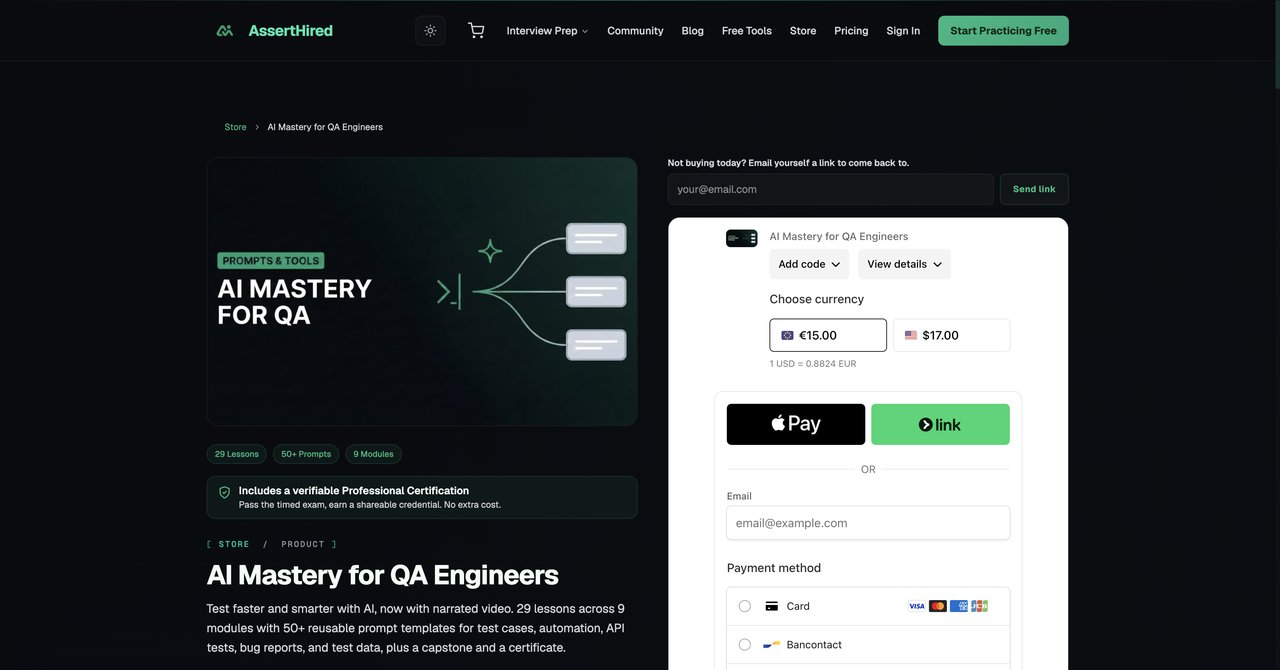
AssertHired's AI Mastery for QA Engineers is the budget option on this list at just $17. For that price, you get 50+ reusable prompt templates for QA tasks. These templates cover test case generation, automation, API tests, and bug reports. It's a practical resource that you can start using immediately in your work.
The course includes a capstone project, which gives you the opportunity to apply what you've learned in a realistic scenario. You also get a certificate of completion, which is nice to have even if it doesn't carry the weight of an ISTQB certification.
The main limitation here is the scope. This isn't a comprehensive training program. It's a collection of practical resources that will help you use AI tools more effectively in your testing work. If you're looking for deep knowledge about AI testing principles or hands-on experience building AI agents, this won't provide that.
The provider is also relatively niche, with a smaller community than platforms like Udemy or Coursera. This means less peer support and fewer reviews to reference when deciding whether the course is right for you. However, the low price point reduces the risk of trying it out.
For the price, this is a reasonable option for testers who want practical, immediately applicable resources without a significant investment. The prompt templates alone are worth the cost if you're regularly using AI tools for test-related tasks.
Key Topics Covered:
- Reusable prompt templates for QA tasks
- Test case generation with AI
- AI for test automation
- API testing with AI
- Bug report generation
Target Audience and Skill Level:
This is suitable for QA testers at any level who want practical AI resources at a low cost. The prompt templates are useful for both manual and automation testers. No prior AI knowledge is required, though some testing experience is assumed.
Pros:
- 50+ reusable prompt templates
- Covers test cases, automation, API tests, bug reports
- Includes capstone and certificate
- Very low cost
- Immediately applicable resources
Cons:
- Niche provider with smaller community
- No hands-on coding with AI agents
- Limited depth compared to comprehensive courses
- Certificate has limited recognition
Who Would Benefit Most:
QA testers who want practical, low-cost resources for using AI in their daily work. If you're already using AI tools and just need better prompts and templates, this is a good value. It's less suitable for people who want comprehensive training or certification.
Visit AI Mastery for QA Engineers
Course 8: Certified Tester - Testing with Generative AI (CT-GenAI) by QA Ltd
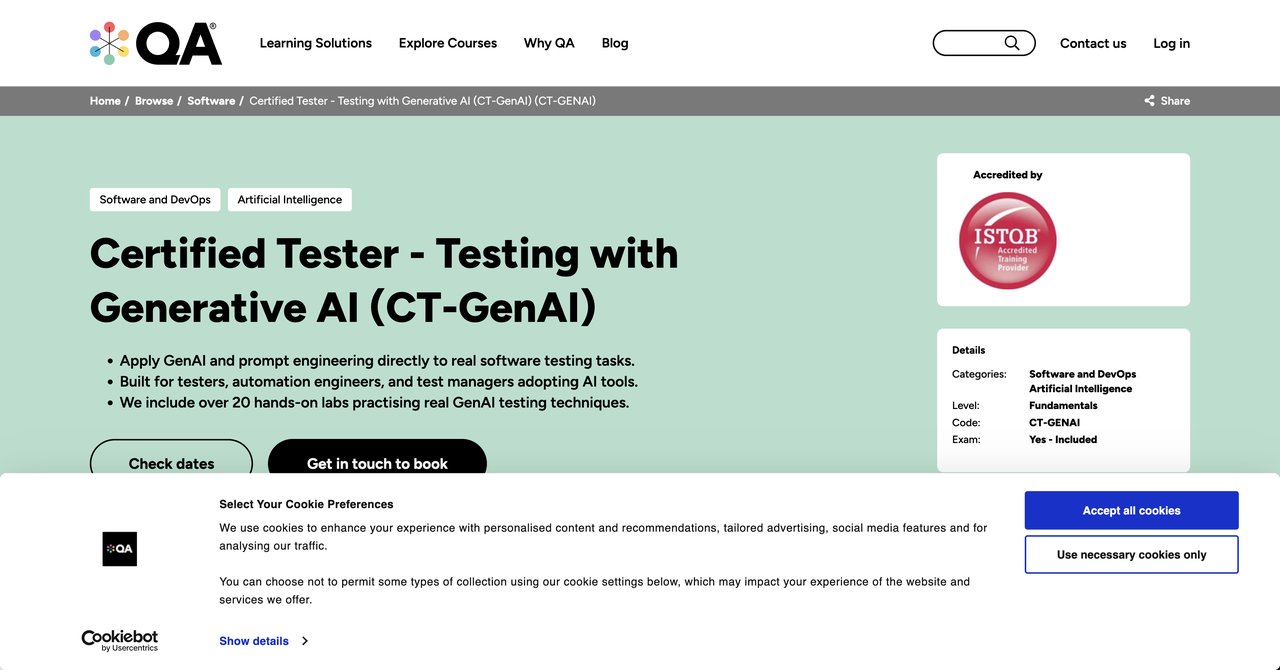
QA Ltd's CT-GenAI certification is a formal, instructor-led program for testers who are adopting GenAI in enterprise environments. This is not a self-paced online course. It's a structured certification with live instruction, which means you're getting real-time feedback and the ability to ask questions as you learn.
The course includes 20+ hands-on labs, which is a significant amount of practical work. You're not just watching videos or reading materials. You're actually doing the work, applying GenAI testing techniques to real scenarios. This hands-on approach is valuable for retaining the material and building confidence.
The course also covers risk management and organisational integration. This is more than just technical skills-it's about understanding how to implement GenAI testing in an enterprise context. This makes it relevant for test leads and managers who need to think about the bigger picture.
The certification is vendor-neutral, which means the skills you learn are applicable regardless of which AI tools your organization uses. This is a significant advantage over courses that focus on specific tools like Claude or GitHub Copilot.
The main drawback is the cost. At approximately $2,575 plus VAT, this is one of the most expensive options on this list. The live attendance requirement also means you need to be available at specific times, which might not work for everyone's schedule.
Key Topics Covered:
- 20+ hands-on labs with real GenAI testing techniques
- Risk management for GenAI testing
- Organisational integration of GenAI testing
- Vendor-neutral GenAI testing principles
- Enterprise-level implementation strategies
Target Audience and Skill Level:
This certification is designed for testers who are implementing GenAI testing in enterprise environments. It's suitable for test leads, managers, and senior testers who need to understand both the technical and organisational aspects of GenAI adoption. Some prior testing experience is expected.
Pros:
- 20+ hands-on labs with real GenAI testing techniques
- Covers risk management and organisational integration
- Vendor-neutral certification
- Instructor-led format with real-time feedback
- Recognized enterprise credential
Cons:
- High price point
- Requires live attendance
- May be more than individual testers need
- Limited availability depending on location
Who Would Benefit Most:
Test leads and managers who are responsible for implementing GenAI testing in their organizations. The focus on risk management and organisational integration makes this particularly relevant for people who need to think beyond their own testing tasks. Individual testers might find the cost hard to justify unless their employer is paying.
Course 9: Strategies for Testing AI-Based Systems by Coveros

Coveros offers a course specifically for testers who need to validate systems with AI, ML, or agentic components. This is a specialized area that requires different testing strategies than traditional software. The course covers both agentic and ML components, providing practical strategies for QA validation.
The course is delivered in a small-class virtual format, which means you get more personalized attention than you would in a large online course. The small class size also means more opportunities for discussion and asking questions specific to your situation.
The focus here is on practical strategies. You're learning how to actually test AI-based systems, not just understanding the theory. This includes things like test data requirements, validation approaches, and how to handle the non-deterministic nature of AI systems.
The cost is $1,495, which puts it in the mid-to-high range. It's less expensive than the QA Ltd certification but significantly more than the self-paced courses. The small-class format justifies some of the cost, but it's still a significant investment for individual testers.
The course requires some foundational AI/ML knowledge. If you're completely new to AI concepts, you might struggle with some of the material. This is not a beginner course-it's for testers who already understand AI basics and need to develop testing strategies for AI systems.
Key Topics Covered:
- Covers agentic and ML components
- Practical strategies for QA validation
- Test data requirements for AI systems
- Validation approaches for non-deterministic systems
- Small-class virtual format with personalized attention
Target Audience and Skill Level:
This course is for testers who need to validate systems with AI, ML, or agentic components. It requires foundational AI/ML knowledge, so it's not suitable for complete beginners. It's particularly relevant for testers working on AI products or features.
Pros:
- Covers agentic and ML components
- Practical strategies for QA validation
- Small-class virtual format
- Personalized attention and discussion
- Focused on a specialized area
Cons:
- Expensive
- Requires foundational AI/ML knowledge
- Limited availability due to class size
- Not focused on using AI for testing
Who Would Benefit Most:
Testers who work on AI-based products and need specialized strategies for validating these systems. If your organization is building AI or ML features, this course gives you the specific knowledge you need. It's less relevant for testers who want to use AI tools to speed up their testing of traditional software.
Visit Strategies for Testing AI-Based Systems
Course 10: ISTQB Certified Tester AI Testing (CT-AI) by Global Knowledge
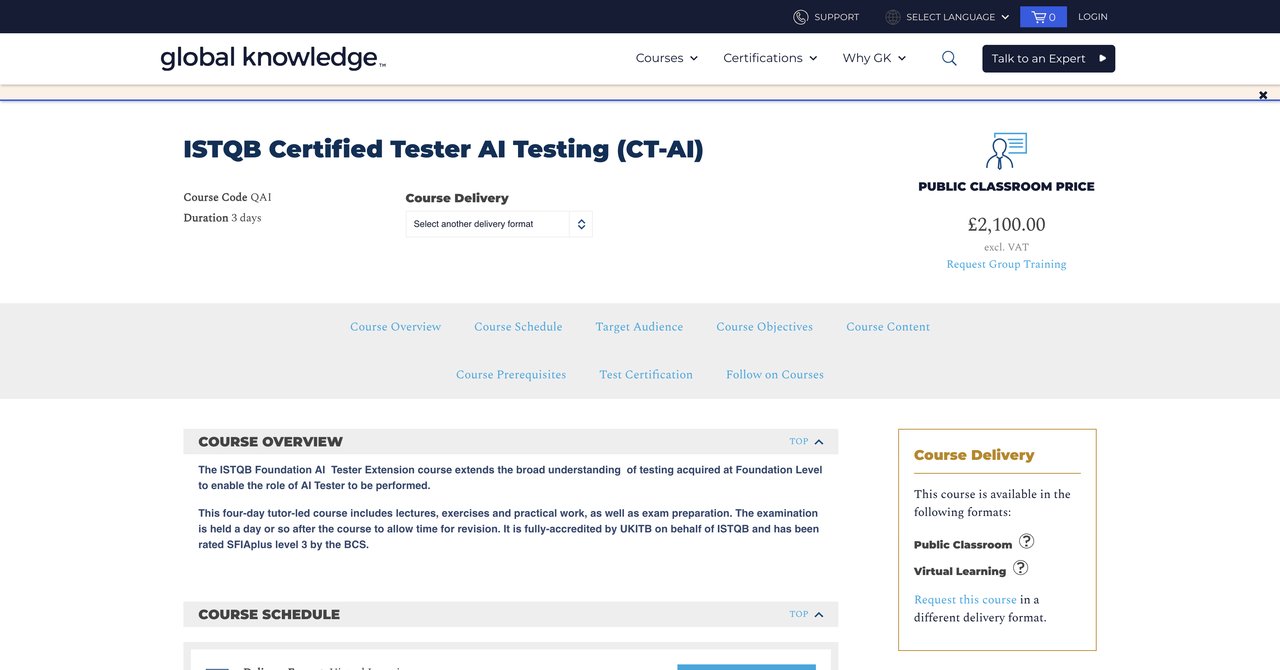
Global Knowledge offers the ISTQB Certified Tester AI Testing (CT-AI) certification, which is fully accredited by ISTQB/UKITB. This is a formal certification path that includes exam preparation as part of the course. The certification is rated SFIAplus level 3, which gives it recognized credibility in the industry.
This certification is particularly relevant for testers in regulated industries where formal credentials matter. If you're working in finance, healthcare, or other sectors with strict compliance requirements, having an ISTQB certification can be important for career advancement.
The course covers the ISTQB AI Tester syllabus, which includes understanding AI systems, testing strategies, and quality characteristics. The content is comprehensive and structured, following the established ISTQB framework. This ensures you're learning industry-standard material.
The cost is approximately £2,100 (around $2,560), which puts it in the high range. This includes exam preparation, but you'll still need to pay for the exam itself separately. The total investment is significant, so this is a decision that should be made carefully.
One limitation is that the course is theoretical in focus, with limited hands-on AI tool use. You're learning about testing AI systems, but you're not spending much time actually using AI tools. This is a knowledge-based certification rather than a practical skills course.
Key Topics Covered:
- Fully accredited by ISTQB/UKITB
- Includes exam preparation
- Rated SFIAplus level 3
- ISTQB AI Tester syllabus content
- Testing strategies for AI systems
Target Audience and Skill Level:
This certification is for testers who need to verify AI-based systems in regulated industries. It's suitable for testers at various levels, though some testing experience is helpful. The formal certification path is particularly valuable for people who need recognized credentials for career advancement.
Pros:
- Fully accredited by ISTQB/UKITB
- Includes exam preparation
- Rated SFIAplus level 3
- Recognized industry credential
- Comprehensive syllabus coverage
Cons:
- High cost
- Theoretical focus with limited hands-on AI tool use
- Exam fee not included
- May be more than needed for non-regulated industries
Who Would Benefit Most:
Testers in regulated industries who need formal certification to validate AI systems. The ISTQB credential carries weight with employers and clients, making it valuable for career advancement. It's less suitable for testers who want practical skills for using AI tools in their daily work.
Visit ISTQB CT-AI Certification
Course 11: AI QA Automation (SDET) Program by CYDEO
CYDEO's AI QA Automation (SDET) Program is an intensive training program that covers a wide range of tools and technologies. The curriculum includes Selenium, Playwright, Claude Code, GitHub Copilot, and agentic AI development. This is a comprehensive program designed to take you from where you are now to being able to work as an SDET with AI skills.
One of the standout features of this program is the capstone project. You graduate with a production-deployed app in your portfolio, which is a significant advantage when you're job hunting. Employers want to see real work, and this program gives you that.
The program focuses on what the provider calls the "2026 stack," meaning the tools and technologies that are expected to be in demand in the coming years. This forward-looking approach is valuable in a field that changes as quickly as AI and testing.
The intensity of the program is a double-edged sword. You'll learn a lot in a relatively short time, but the pace can be challenging. This is not a program for complete beginners. You need some background in testing or development to keep up with the material.
Pricing is not listed on the website, so you'll need to contact CYDEO for current rates. Based on the comprehensiveness of the program, it's likely to be in the mid-to-high range, though potentially less than the formal certification courses.
Key Topics Covered:
- Teaches Selenium, Playwright, Claude Code, GitHub Copilot, and agentic AI
- Graduates with a production-deployed app in portfolio
- Focuses on the 2026 stack
- Comprehensive SDET training
- Agentic AI development
Target Audience and Skill Level:
This program is for testers who want to move into SDET roles with AI skills. It requires some existing knowledge of testing or development. The intensive pace makes it suitable for people who can dedicate significant time to learning, possibly as part of a career transition.
Pros:
- Teaches Selenium, Playwright, Claude Code, GitHub Copilot, and agentic AI
- Graduates with a production-deployed app in portfolio
- Focuses on the 2026 stack
- Comprehensive curriculum
- Practical, project-based approach
Cons:
- Intense pace
- Not for complete beginners
- Pricing not transparent on website
- Requires significant time commitment
Who Would Benefit Most:
Testers who are serious about moving into SDET roles and want comprehensive training that includes both traditional automation tools and AI technologies. The portfolio project is a major advantage for job seekers. This is less suitable for people who just want to learn a few AI tips to apply to their current testing work.
Visit AI QA Automation SDET Program
Final Recommendations
After looking at all these options, the right choice depends heavily on your specific situation. Let's break it down by what you might be looking for.
If you want comprehensive, ongoing access to AI training: CompleteAI Training is the clear winner here. The subscription model gives you access to hundreds of courses and certifications for one flat fee. You're not limited to a single course or a fixed bundle. New content is added continuously and included automatically. The access to every other job role's material is also valuable if your work spans multiple functions or you're thinking about moving roles. At $29 per month, or $8.25 per month with annual billing, it's also one of the most affordable options when you consider the volume of content. The main consideration is whether you'll actually use the subscription consistently. If you're the kind of person who learns best with ongoing access to a library of resources, this is the best value.
If you want a recognized certification: The ISTQB options from Udemy and Global Knowledge are the paths to pursue. The Udemy course is more affordable and gives you the foundational knowledge. The Global Knowledge option is more expensive but includes exam preparation and is fully accredited. The QA Ltd CT-GenAI certification is also worth considering if you want a vendor-neutral certification focused specifically on GenAI testing. These options are particularly valuable in regulated industries where formal credentials matter.
If you want practical skills for using AI tools in testing: The Udemy courses on Claude, GitHub Copilot, and Playwright are directly applicable. The AI for Software Testers course adds AI agent building and MCP integration, which are increasingly relevant skills. The AssertHired course offers practical prompt templates at a very low cost. These options are good if you're already using or planning to use specific AI tools and need to figure out how to apply them to testing.
If you need to test AI systems themselves: The ISTQB AI Testing course and the Coveros course are the most relevant. These teach you how to validate AI-based systems, which is a different skill set from using AI to test traditional software. The Coveros course is more practical and hands-on, while the ISTQB course is more theoretical and certification-focused.
If you want to move into an SDET role: The CYDEO program is the most comprehensive option, with the production-deployed app portfolio being a major advantage. The CompleteAI Training platform also covers SDET-related material as part of its broader library, which could be a more flexible and affordable alternative.
If you're on a tight budget: The AssertHired course at $17 is the cheapest option, and the prompt templates alone are useful. CompleteAI Training's annual billing at $8.25 per month is also very affordable for the volume of content you get. The Udemy courses are worth watching for sales, which happen frequently.
One honest observation: the market for AI training for QA testers is still maturing. Many courses are new and don't have extensive track records. The tools themselves are changing rapidly, which means any course content can become outdated quickly. This is where the subscription model of CompleteAI Training has an advantage-you're not stuck with outdated material. The daily updates and continuous addition of new courses mean you're always learning current content.
For most QA testers, the practical approach is probably a combination. Start with a comprehensive platform like CompleteAI Training to build your foundation and get access to ongoing updates. Then, if you need a specific certification for career reasons, add that on top. The certification courses are expensive, so it's worth being strategic about which ones actually matter for your career goals.
At the end of the day, the best course is the one you'll actually complete and apply to your work. Consider your learning style, your budget, and your career goals. All of these options can help you build AI skills as a QA tester. The key is to pick one and get started.