
Blog ·
10 Top AI Courses for Tax Analysts in 2026
Master AI tax tech in 2026 with our curated list of ten top courses, covering automation, data analytics, and compliance to sharpen your skills and future-proof your career.
 Jeroen Erne
The tax profession is standing at a crossroads. Artificial intelligence has moved from experimental technology to everyday business tool, and the firms that adopt it are pulling ahead. For tax analysts, this shift carries both risk and opportunity. The risk is real: routine tasks like data entry, basic return preparation, and initial document review are increasingly automated. The opportunity is just as real: analysts who learn to work with AI systems are becoming more valuable, not less. The Bureau of Labor Statistics projects the employment of tax examiners and collectors to decline by 4% from 2023 to 2033, a trend directly tied to automation. But for those who upskill, the picture looks entirely different. A tax analyst who can manage AI tools, interpret their outputs, and handle the complex judgment calls that machines still can't make becomes an asset that no firm wants to lose.
Why AI matters for Tax Analysts today
AI adoption in tax is happening faster than most professionals realize. Recent surveys show that 69% of businesses are using AI in some form, and tax departments are among the most active adopters. The technology is being used for everything from automated data extraction and audit support to real-time compliance monitoring. For Tax Analysts, this means the nature of the job is shifting. The work that used to take hours of manual review now takes minutes with AI assistance. The professionals who understand these tools aren't just keeping their jobs-they're getting promoted, taking on more interesting work, and earning more. According to industry data, tax professionals with AI skills can command salaries that are 20-30% higher than their peers without them.
This article examines ten AI courses designed specifically for Tax Analysts professionals. We've looked at what each course covers, who it's for, and what you'll actually walk away with. Some are comprehensive certifications, others are focused modules, and one-CompleteAI Training's AI for Tax Analysts course-gives you access to ALL courses and ALL certifications on the platform rather than just a single course, which might be worth considering if you're planning to develop a wide range of AI skills. Our goal is to help you identify which course fits your current skill level, your career goals, and your budget.
The Growing Role of AI in Tax Analysts
AI is being applied across nearly every aspect of the tax profession. Let's look at what's actually happening in the field:
- Automated data extraction: AI systems can pull information from financial documents, receipts, and bank statements with high accuracy, reducing the manual data entry that used to consume hours of an analyst's day.
- Risk assessment and audit selection: Machine learning models analyze historical tax data to identify patterns and flag potential compliance issues before they become problems. Tax analysts are using these tools to prioritize which returns need closer examination.
- Tax planning scenarios: AI can run thousands of "what-if" scenarios in minutes, helping analysts and their clients evaluate different tax strategies and their potential outcomes.
- Regulatory compliance tracking: Tax laws change frequently. AI systems monitor regulatory updates and alert analysts to changes that affect their clients or organizations.
- Document review and contract analysis: AI tools read and analyze contracts, identifying tax implications that would take a human analyst hours to find.
- Fraud detection: Advanced algorithms detect unusual patterns in tax filings that might indicate fraud, allowing analysts to focus their attention on the most significant cases.
These applications are reshaping how tax work gets done. The analyst who can use these tools effectively is doing more interesting work, providing more value to clients, and spending less time on the repetitive tasks that used to fill their day.
Benefits of becoming an AI expert in Tax Analysts
There are concrete reasons to invest in AI skills as a Tax Analyst. First, there's job security. As automation takes over routine tasks, the analysts who remain valuable are those who can work alongside AI systems. Second, there's career advancement. Firms are looking for people who can lead their AI initiatives, not just use the tools. Third, there's salary growth. The data is clear that AI skills command a premium in the tax profession.
There's also the practical benefit of doing better work. AI tools can handle the repetitive, time-consuming aspects of tax analysis, freeing you to focus on the complex judgment calls that require human insight. You'll be able to serve more clients, provide more thorough analysis, and catch issues that you might have missed before. The courses we're about to compare-from CompleteAI Training's practical approach to Coursera's specialization series and the University of Limerick's academic module-all aim to give Tax Analysts the skills they need to work effectively with AI. The choice comes down to your learning style, your career goals, and how much time you want to invest.
Comparison: All AI Courses for Tax Analysts (Updated 2026)
| Course Name | Provider | Price | Key Topics | Pros | Cons | Best For |
|---|---|---|---|---|---|---|
| CompleteAI Training | CompleteAI | Premium (one subscription covers ALL courses and ALL certifications on the platform, not just this one) | Comprehensive AI training for Tax Analysts professionals. One subscription unlocks every course and every certification on the platform - hundreds of them, across every job role. Includes daily updates on the latest AI tools and curated AI industry news relevant to Tax Analysts. | Comprehensive curriculum; Hands-on projects; Expert instructors; Full access to all video courses and certifications; New courses added continuously; Access to material for other job roles; Daily updates on AI tools and news | Premium pricing; Subscription-based (necessary given how fast AI is changing) | Tax Analysts professionals looking for complete, ongoing training |
| AI for Tax Analysts (Video Courses + Certifications) | Complete AI Training | $29/month or $8.25/month billed annually - one flat subscription covers everything | Library of over 100 specialized video courses and certifications for Tax Analysts. One subscription unlocks every course and every certification on the platform. Includes daily updates on AI tools and curated industry news. | Full access to ALL video courses and ALL certifications; New courses added automatically; Includes material for every job role; Very affordable, especially with annual billing; Highest rated / most complete offering | Subscription-based - you need to keep it active to stay current | General learners; anyone wanting complete, continuous AI education |
| Tax Analyst with AI Skills | Coursera | Subscription (Coursera Plus, ~$59/month) or free to audit | Built for entry-level tax analysts; covers ONESOURCE, Excel workpapers, ChatGPT for tax drafting, federal/state compliance workflows at CB1 level | Directly maps to daily tax analyst tasks; Covers workpapers, book-to-tax reconciliation, compliance filings; AI skills woven in; Free to audit | Requires Coursera subscription for graded assignments; Beginner focus may be too basic for experienced analysts | General learners |
| AI for Tax Preparers: Practical Course for Tax Season Workflows | Coursiv | Not specified (typically subscription or one-time fee; check site) | Season-specific playbooks for client intake, missing-document requests, review checklists | Highly practical, season-specific playbooks; Covers client intake, missing-document requests, review checklists; Strong learner base (1M+) | Not a formal certification; Focused on US tax season workflows | General learners |
| AI for Tax Advisors: Smarter Filing and Compliance | Catch Wisdom | $55 (discounted from $110) | Full tax lifecycle - data prep, automated filing, predictive planning | Covers full tax lifecycle; Certificate in 7 languages; Mobile compatible | Self-paced with no instructor interaction; Price is for certificate, content may be partially free | General learners |
| Professional Certificate in Tax & Technology | Vrije Universiteit Amsterdam (VU Law Academy) | €2,105 (approx. $2,300 USD) | Direct and indirect tax with technology; no prior tech knowledge required | Academic rigor from a top European university; Covers both direct and indirect tax with technology; No prior tech knowledge required | Expensive; Academic pace may be slow for practitioners; Content released in stages | General learners |
| Digital Tools & Data Management | Coursera (part of Tax Analyst with AI Skills Specialization) | Free to audit; subscription for certificate | OJSFC prompt framework for tax; verifying AI outputs before entering workpapers | Teaches the OJSFC prompt framework for tax; Verifies AI outputs before entering workpapers; Free to audit | Only a single course in a larger specialization; Requires other courses for full context | General learners |
| Tax Operations | Coursera (part of Tax Analyst with AI Skills Specialization) | Free to audit (or subscription for certificate) | MACRS, Section 179, bonus depreciation; book-to-tax differences in ONESOURCE; practical fixed-asset schedules | Hands-on with MACRS, Section 179, bonus depreciation; Reconciles book-to-tax differences in ONESOURCE; Practical fixed-asset schedules | Requires the full specialization for a certificate; Assumes some Excel familiarity | General learners |
| Tax Filing & Compliance | Coursera (part of Tax Analyst with AI Skills Specialization) | Free to audit (or subscription for certificate) | Mapping book amounts to ONESOURCE return fields; federal and state tax terminology; how law changes affect return inputs | Maps book amounts to ONESOURCE return fields; Covers federal and state tax terminology; Explains how law changes affect return inputs | Part of a specialization; not a standalone certificate | General learners |
| AI Applications for Accountants 2026 Certificate Series | Lambers, Inc. | Not specified (check site; typically paid) | ChatGPT and Claude for advanced tax law interpretation; strategic decision-making; 10-course series | Explores ChatGPT and Claude for advanced tax law interpretation; Supports strategic decision-making; 10-course series for depth | Price not listed; Broader accounting focus, not tax-specific | General learners |
| Data Analytics for Tax - Module TX6051 | University of Limerick | €2,353 (EU fee) (approx. $2,600 USD) | Hands-on data analysis and visualization for tax; forecasting, risk management, strategic decisions | University-accredited micro-credential; Hands-on data analysis and visualization for tax; Focuses on forecasting, risk management, and strategic decisions | Expensive; Scheduled start (November 2026) not fully self-paced | General learners |
Understanding AI Training for Tax Analysts Professionals
Tax analysis has always required a blend of technical knowledge and practical application. Now, with AI tools becoming standard in tax software and workflows, professionals in this field need to know how to work alongside these systems effectively. The right training can mean the difference between using AI as a basic helper and using it to handle complex compliance, research, and planning tasks with confidence.
There are many options out there, ranging from subscription platforms with hundreds of courses to single, university-accredited modules. Some focus on practical, day-to-day tasks like preparing workpapers, while others take a more academic approach to tax technology. The choice depends on your experience level, your budget, and what you actually want to achieve-whether that's getting certified, learning a specific tool, or just getting more efficient at your current job.
This comparison breaks down the main AI training courses available for tax analysts, looking at what each one offers, who it's for, and where it falls short. We'll start with the most comprehensive option, then move through the others so you can see how they stack up against each other.
Course 1: CompleteAI Training , AI for Tax Analysts
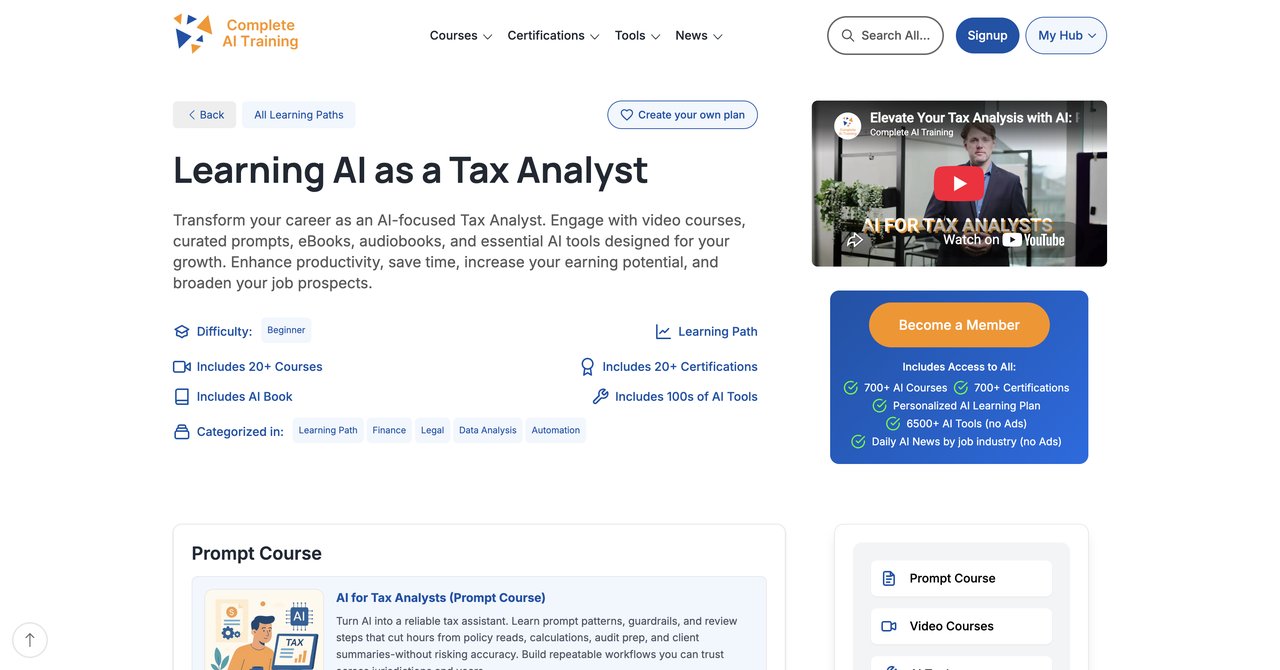
CompleteAI Training is not a single course. It's a full platform subscription that gives you access to every single video course and every certification they offer-hundreds of them, covering all job roles, not just tax. That's the key difference between this and every other option on this list. Where most providers sell you one course and then charge extra for a certificate, this platform works on a flat subscription model that includes everything.
The AI for Tax Analysts course is part of this larger library, but the real value is in what else you get. You can access material for other roles like accounting, legal, and operations, which matters if your work spans multiple functions or if you're thinking about moving roles later. The platform adds new courses and certifications continuously, and they're included automatically with your subscription. There's no paying per course or per certificate here.
Each video course is designed to be practical and focused on real job tasks. The platform also sends daily updates on AI tools and industry news, so you stay current without having to do your own research. For someone working in tax, that means you're not just learning a static skill-you're keeping up with how AI is changing the field in real time.
The subscription is $29 per month, or $8.25 per month if you pay annually. That's a significant difference from paying $50, $100, or even $2,000 for a single course elsewhere. The annual plan is particularly good value for the amount of content you're getting access to.
For tax analysts who want to learn AI comprehensively without paying per course or per certification, this platform is the strongest option. The fact that you can also explore other job roles-like finance, HR, or supply chain-makes it useful for anyone who sees their career moving beyond tax alone.
Key Topics Covered:
- AI tools and prompt engineering for tax workflows
- Using AI for tax research, document analysis, and drafting
- Automation of repetitive tasks like data extraction and reconciliation
- AI for compliance, tax planning, and audit support
- All other job role AI training on the platform
Target Audience and Skill Level Requirements:
This is for tax analysts at any level-from entry-level to senior professionals. There's no prior AI knowledge required, and the content is structured to be accessible for beginners while still having depth for advanced users. If you're in a role that touches multiple functions, this is especially useful.
Pros:
- Full access to ALL video courses on the platform, not a single course or a fixed bundle
- Full access to ALL certifications on the platform, included at no extra cost
- New courses and certifications are added continuously and are included automatically
- Access to every other job role's material too, which matters for anyone whose work spans more than one function or who wants to move roles
- One flat subscription price covers all of the above, versus paying per course elsewhere
- Daily updates on relevant AI tools and news
- Very affordable pricing, especially with annual billing
Cons:
- Subscription based, crucial for continuous learning as AI is developing continuously
Who Would Benefit Most:
Tax analysts who want the most comprehensive AI education available, at a price that's hard to beat. This is for anyone who doesn't want to pick and choose between courses or certifications-they want access to everything and the flexibility to learn across multiple areas.
Visit CompleteAI Training for AI for Tax Analysts →
Course 2: Tax Analyst with AI Skills by Coursera
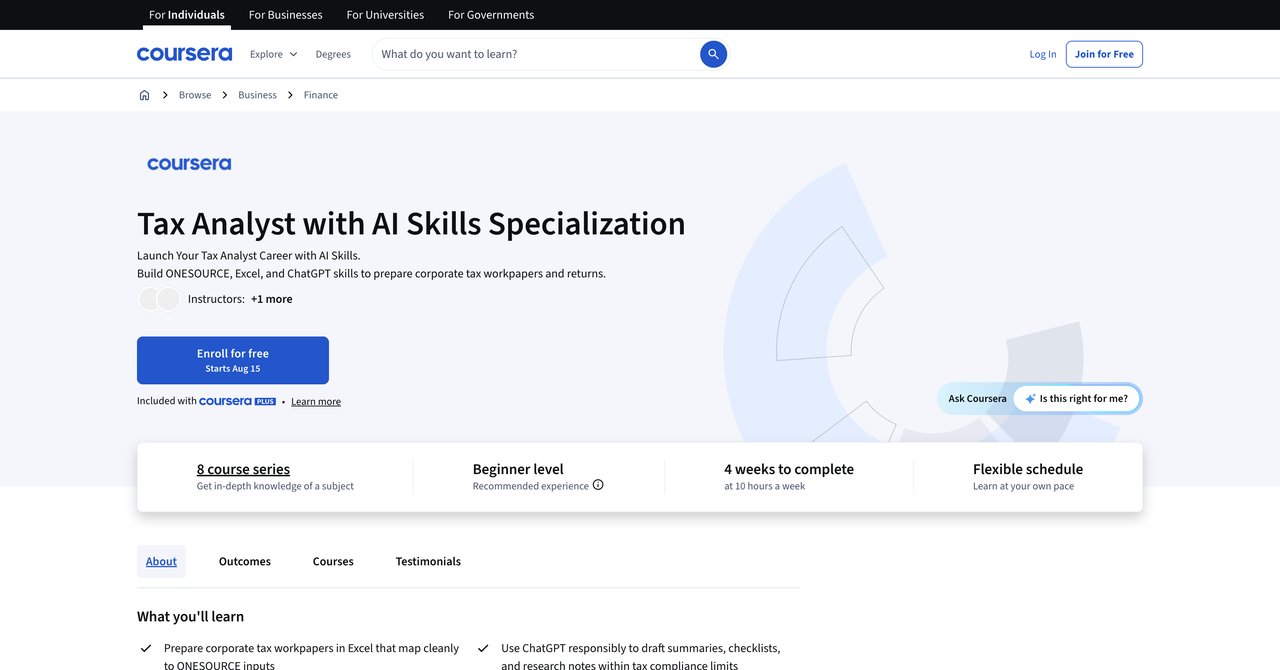
Coursera's specialization for tax analysts is built for people just starting out in the field. It covers ONESOURCE, Excel workpapers, and ChatGPT for tax drafting, and it walks through federal and state compliance workflows at the CB1 level. The course is structured as a specialization, meaning you have to complete several courses to get the full certificate.
The content is directly mapped to the daily tasks of a tax analyst, which makes it practical for someone who's learning the ropes. It includes workpapers, book-to-tax reconciliation, and compliance filings, with AI skills woven into the lessons. The specialization is broken down into individual courses like Digital Tools & Data Management, Tax Operations, and Tax Filing & Compliance, each of which can be audited for free.
The free audit option is a big plus if you're not sure about committing. You can watch all the videos and read the materials without paying anything. However, you won't get access to graded assignments or the certificate unless you subscribe to Coursera Plus, which runs about $59 per month.
The main limitation is the beginner focus. If you've been working as a tax analyst for several years, you might find a lot of this too basic. It's designed for entry-level roles, and it shows in the depth of the content. The specialization also requires you to complete all courses to get the full certificate, which takes time and a subscription.
For someone just starting out in tax and wanting to build a foundation with AI, this is a solid choice. But for more experienced analysts, it might not offer enough depth.
Key Topics Covered:
- ONESOURCE for tax compliance
- Excel workpapers and book-to-tax reconciliation
- ChatGPT for tax drafting and communication
- Federal and state compliance workflows
- MACRS, Section 179, and bonus depreciation
Target Audience and Skill Level Requirements:
Entry-level tax analysts or people transitioning into tax roles. Some Excel familiarity is helpful, but the course doesn't require prior AI knowledge. It's not designed for experienced analysts looking for advanced AI applications.
Pros:
- Directly maps to daily tasks of a tax analyst
- Covers workpapers, book-to-tax reconciliation, and compliance filings
- AI skills woven in
- Free to audit
Cons:
- Requires Coursera subscription for graded assignments
- Beginner focus may be too basic for experienced analysts
Who Would Benefit Most:
People new to tax analysis who want a structured, recognized introduction to the role, with AI included. If you're already doing this job and need more advanced AI skills, this might not be the right fit.
Visit Tax Analyst with AI Skills on Coursera →
Course 3: AI for Tax Preparers: Practical Course for Tax Season Workflows by Coursiv
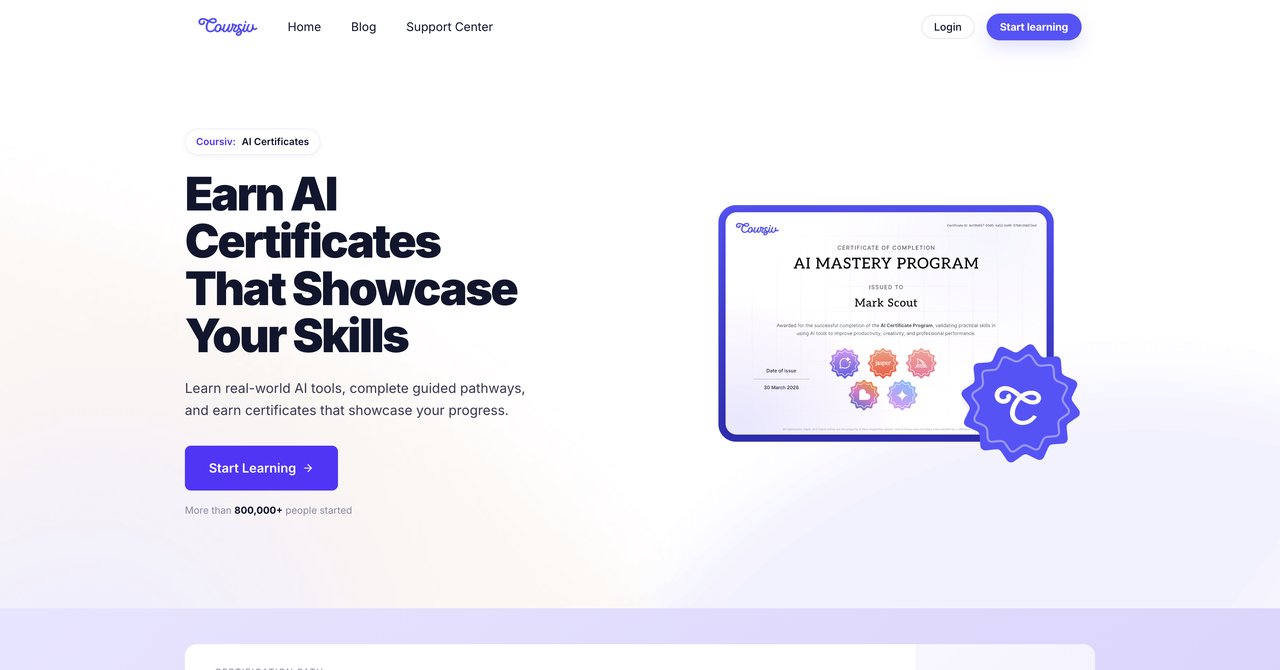
Coursiv's course is all about practical, season-specific playbooks. It's designed to help you get through tax season more efficiently, covering client intake, missing-document requests, and review checklists. With over a million learners, it's got a strong following, which suggests it's hitting a real need.
The course is highly practical. It's not about theory or academic concepts-it's about what you do when a client comes in with incomplete paperwork, or when you're juggling multiple returns and need to keep things organized. The playbooks are the kind of thing you can apply the same day you learn them.
That said, the course is focused on US tax season workflows. If you're outside the US or you work in a different tax system, this might not be as useful. Also, it's not a formal certification. You're not getting a credential that you can put on your resume-you're getting skills that make you better at your job.
The cost isn't listed upfront, which is a bit annoying. Coursiv typically uses a subscription or one-time fee model, but you'd need to check the site for the current price. The lack of transparency on cost is a small downside.
For US-based tax preparers who want practical, actionable AI workflows for tax season, this is a great option. It's less about career advancement and more about getting the job done efficiently.
Key Topics Covered:
- Client intake processes with AI
- Missing-document requests automation
- Review checklists for tax returns
- Season-specific workflow optimization
Target Audience and Skill Level Requirements:
Tax preparers and analysts who work in the US tax system. No prior AI knowledge is needed, and the content is designed to be immediately applicable. It's not for someone looking for a formal certification or academic rigor.
Pros:
- Highly practical, season-specific playbooks
- Covers client intake, missing-document requests, and review checklists
- Strong learner base (1M+)
Cons:
- Not a formal certification
- Focused on US tax season workflows
Who Would Benefit Most:
Tax preparers who want to get through tax season faster and with less stress. If you're already experienced and just want to add AI to your workflow, this is a good choice.
Visit AI for Tax Preparers on Coursiv →
Course 4: AI for Tax Advisors: Smarter Filing and Compliance by Catch Wisdom
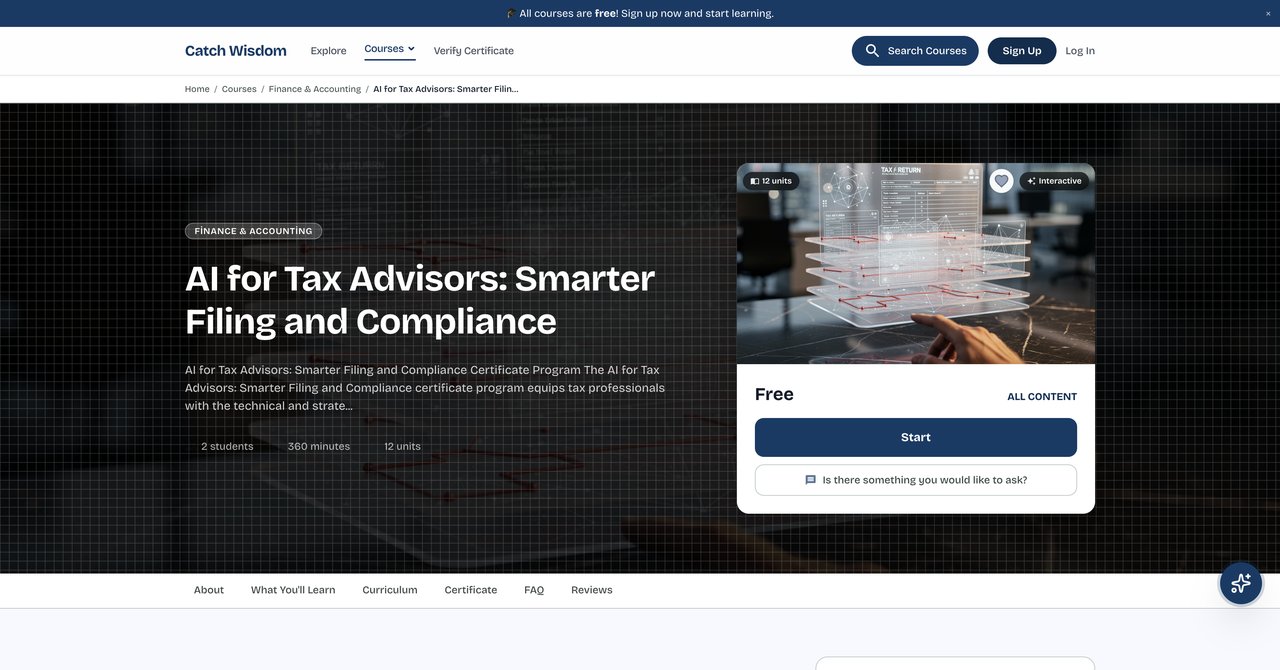
Catch Wisdom's course covers the full tax lifecycle, from data preparation to automated filing and predictive planning. It's a broad overview of how AI can be applied at each stage of the tax process. The course is self-paced, which gives you flexibility, and it's mobile compatible so you can work through it on your phone or tablet.
One of the standout features is the certificate, which is available in 7 languages. That's useful if you work in a multilingual environment or if you're looking to add a credential that's recognized internationally. The price is $55, discounted from $110, which is a reasonable cost for what you get.
The course is self-paced with no instructor interaction. That means if you get stuck or have questions, you're on your own. For some people, that's fine. For others, it's a real limitation, especially if you're new to AI concepts.
Another thing to note is that the price is for the certificate. The content might be partially free. You should check to see what you're actually paying for before you commit.
This course is a good middle-ground option. It's more comprehensive than the Coursiv course but less structured than a university program. It's suitable for tax advisors who want a broad overview of AI applications across the tax lifecycle.
Key Topics Covered:
- Data preparation for tax filing
- Automated filing processes
- Predictive tax planning
- AI for compliance
Target Audience and Skill Level Requirements:
Tax advisors and analysts who want a broad, practical overview of AI in tax. No specific prior knowledge is required, but some experience with tax workflows will help you get more out of the content.
Pros:
- Covers full tax lifecycle
- Certificate in 7 languages
- Mobile compatible
Cons:
- Self-paced with no instructor interaction
- Price is for certificate, content may be partially free
Who Would Benefit Most:
Tax advisors who need a flexible, self-paced course that covers the entire tax process with AI. It's a good option if you want a certificate but don't need instructor support.
Visit AI for Tax Advisors on Catch Wisdom →
Course 5: Professional Certificate in Tax & Technology by Vrije Universiteit Amsterdam (VU Law Academy)
The VU Law Academy offers a professional certificate that brings academic rigor to tax and technology. It's from a top European university, which carries weight in terms of credibility. The course covers both direct and indirect tax with technology, and it doesn't require prior tech knowledge, making it accessible to tax professionals who haven't worked with technology before.
The content is structured to give you a solid foundation in how technology and tax intersect. You'll look at how AI and other tools are changing tax compliance, planning, and reporting. The academic pace is thorough, which is good if you want to understand the underlying concepts, but it can be slow for practitioners who need to apply things quickly.
One of the biggest drawbacks is the price. At €2,105 (around $2,300 USD), this is a significant investment. You need to be sure that the credential is worth it for your career. The content is also released in stages, so you can't work through it all at your own pace.
For someone who values academic credibility and wants a formal certificate from a recognized institution, this is a strong option. But for practitioners who need practical, immediate skills, the pace and price might be hard to justify.
Key Topics Covered:
- Direct and indirect tax with technology
- AI applications in tax compliance
- Technology for tax planning
- Data management for tax
Target Audience and Skill Level Requirements:
Tax professionals who want an academic credential from a top university. No prior tech knowledge is required, but the course is more theoretical and less practical than some other options.
Pros:
- Academic rigor from a top European university
- Covers both direct and indirect tax with technology
- No prior tech knowledge required
Cons:
- Expensive
- Academic pace may be slow for practitioners
- Content released in stages
Who Would Benefit Most:
Professionals who value academic credibility and want a formal certificate from a recognized institution. It's also good for those who need to understand the theory behind tax technology, not just the practical applications.
Visit VU Law Academy Professional Certificate →
Course 6: Digital Tools & Data Management by Coursera (part of Tax Analyst with AI Skills Specialization)
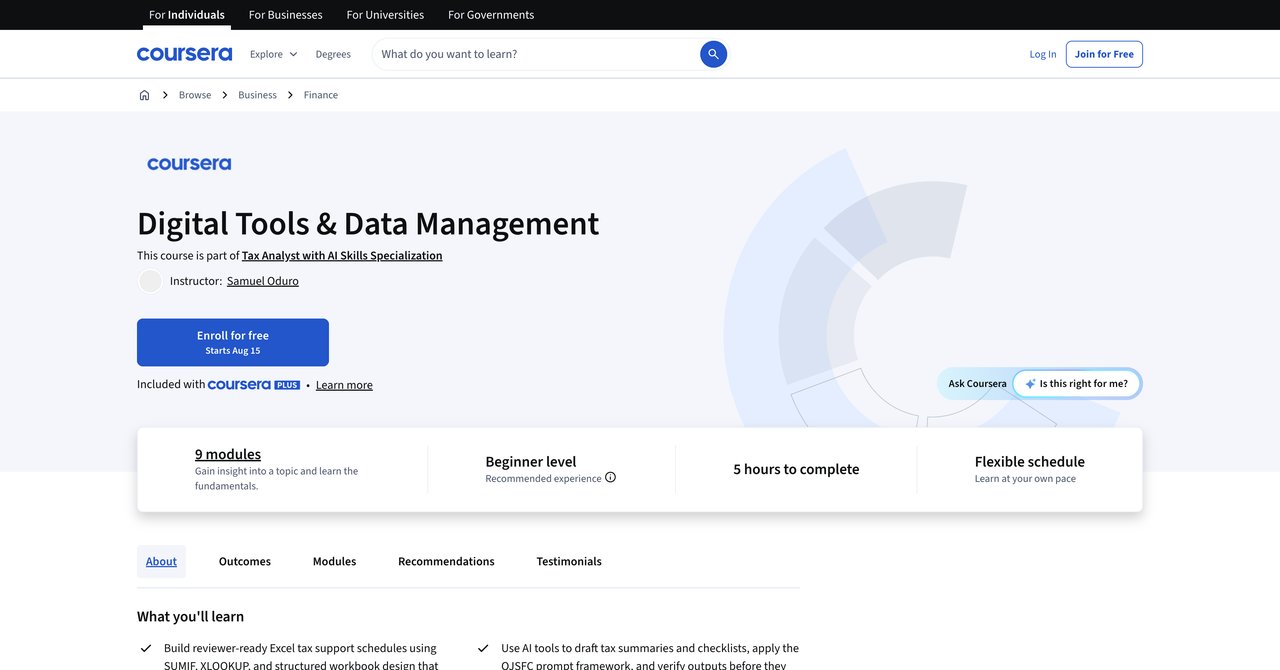
This is a single course within the larger Tax Analyst with AI Skills specialization on Coursera. It focuses on teaching the OJSFC prompt framework for tax, which is a structured approach to using AI for tax-related tasks. The course also covers how to verify AI outputs before entering them into workpapers, which is a practical skill that's often overlooked.
The course is free to audit, which means you can access all the content without paying. That's a great way to learn the material without a financial commitment. However, you won't get the certificate or access to graded assignments unless you're subscribed to Coursera Plus.
The main limitation is that it's just one course. It's designed to be part of a larger specialization, so you might not get the full context or a complete picture of AI for tax analysts. You'd need to complete the other courses in the specialization to get a certificate, which means you're paying for the subscription anyway.
For someone who wants to learn the OJSFC prompt framework specifically and doesn't need a certificate, this is a good, free option. But if you want a comprehensive education, this is just a piece of the puzzle.
Key Topics Covered:
- OJSFC prompt framework for tax
- Verifying AI outputs for workpapers
- AI for tax analysis
Target Audience and Skill Level Requirements:
Tax analysts who want to learn a specific AI framework. No prior knowledge is required, but the course assumes you're working with tax data and workpapers.
Pros:
- Teaches the OJSFC prompt framework for tax
- Verifies AI outputs before entering workpapers
- Free to audit
Cons:
- Only a single course in a larger specialization
- Requires other courses for full context
Who Would Benefit Most:
Tax analysts who want to learn the OJSFC framework without paying anything. It's also good for those who are already subscribed to Coursera Plus and want to take this as part of their learning.
Visit Digital Tools & Data Management on Coursera →
Course 7: Tax Operations by Coursera (part of Tax Analyst with AI Skills Specialization)
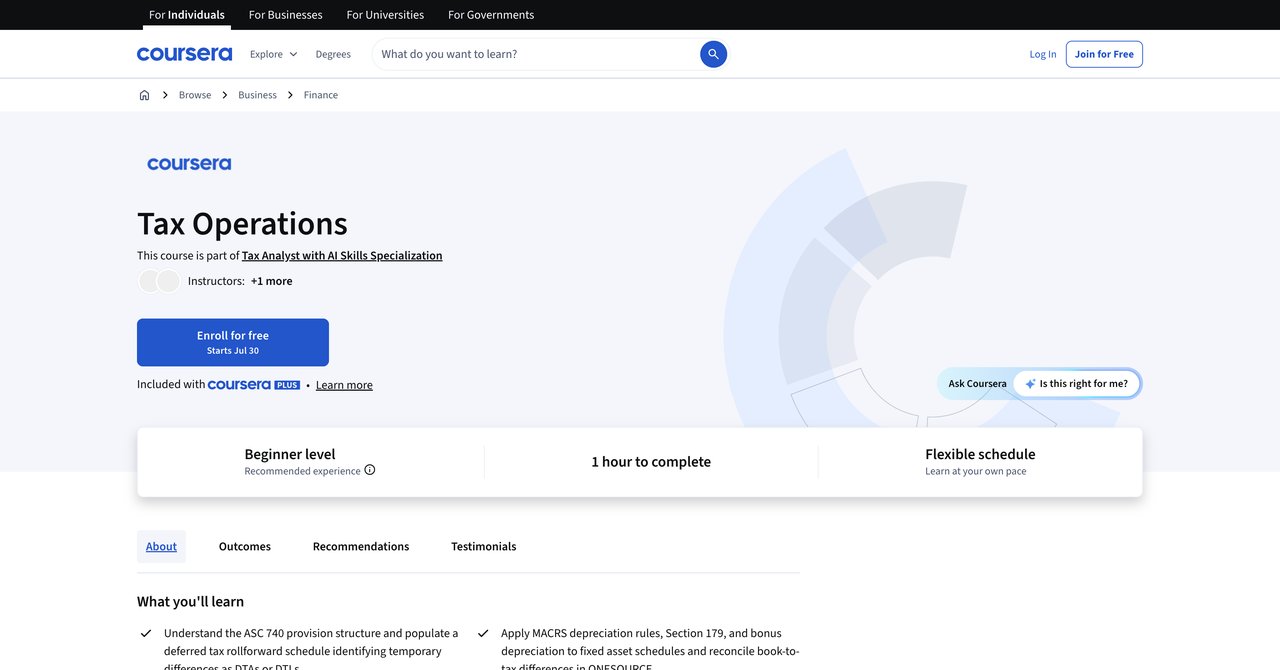
This course is hands-on with tax operations, specifically covering MACRS, Section 179, and bonus depreciation. It focuses on reconciling book-to-tax differences in ONESOURCE and creating practical fixed-asset schedules. The content is directly applicable to the day-to-day work of a tax analyst.
The course is free to audit, so you can access the content without paying. But again, you need a subscription for the certificate and graded assignments. It's part of the Tax Analyst with AI Skills specialization, so it's not a standalone certificate.
The practical focus is a strong point. You're not just learning theory-you're working with the actual tools and schedules that tax analysts use. However, it assumes some Excel familiarity. If you're not comfortable with Excel, you might struggle with some of the exercises.
This is a good course for those who want to get hands-on with tax operations and AI. But it's not a complete education on its own. You'd need to take the other courses in the specialization to get a full picture.
Key Topics Covered:
- MACRS, Section 179, and bonus depreciation
- Reconciling book-to-tax differences in ONESOURCE
- Practical fixed-asset schedules
Target Audience and Skill Level Requirements:
Tax analysts who need to work with fixed assets and book-to-tax reconciliation. Some Excel familiarity is required. It's part of a specialization, so it's not a standalone certificate.
Pros:
- Hands-on with MACRO, Section 179, bonus depreciation
- Reconciles book-to-tax differences in ONESOURCE
- Practical fixed-asset schedules
Cons:
- Requires the full specialization for a certificate
- Assumes some Excel familiarity
Who Would Benefit Most:
Tax analysts who want to improve their skills with fixed assets and book-to-tax reconciliation, and who are already working within a Coursera specialization.
Visit Tax Operations on Coursera →
Course 8: Tax Filing & Compliance by Coursera (part of Tax Analyst with AI Skills Specialization)
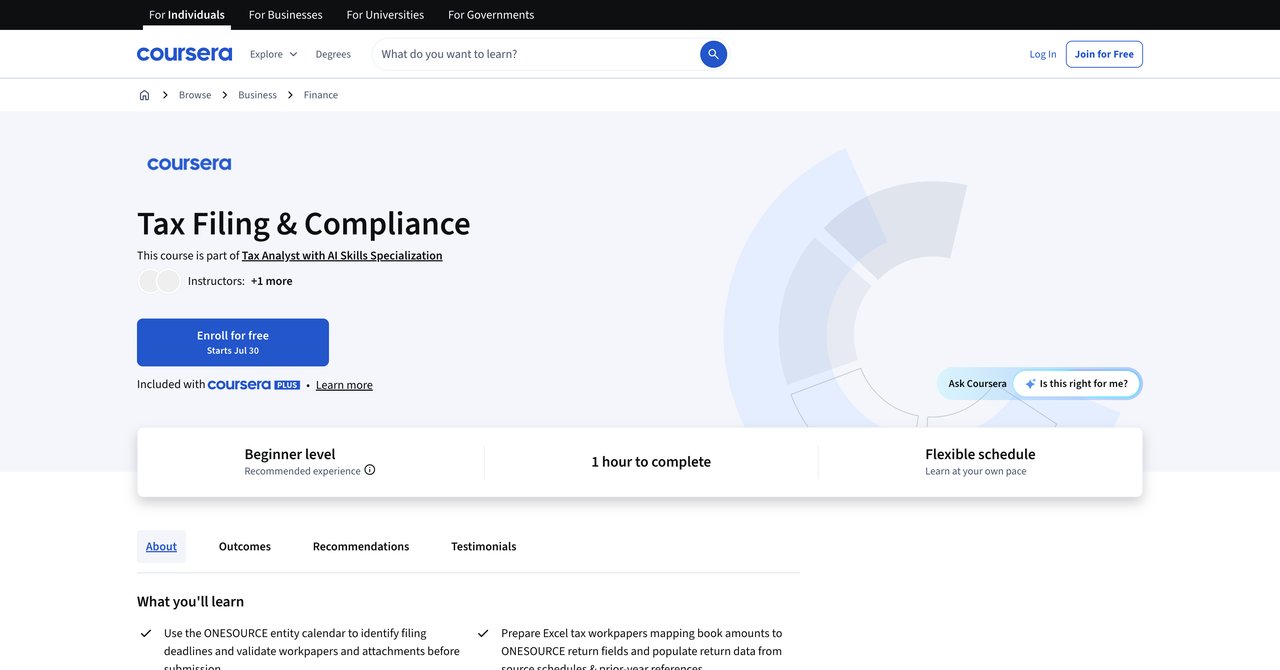
This course focuses on mapping book amounts to ONESOURCE return fields. It covers federal and state tax terminology and explains how law changes affect return inputs. The content is designed to help you understand how AI can be used in the filing and compliance process.
It's free to audit, but you need a subscription for the certificate. Like the other courses in the specialization, it's not a standalone certificate. You need to complete the full specialization to get the credential.
The course is practical in the sense that it directly relates to the filing process. But it's also part of a larger program, so it's not a complete education on its own. If you're just looking for this specific piece, it's fine, but you'll need more to get a full understanding of AI for tax.
For those who want to understand how AI fits into the filing and compliance side of tax, this is a useful course. But it's not the most comprehensive option available.
Key Topics Covered:
- Mapping book amounts to ONESOURCE return fields
- Federal and state tax terminology
- How law changes affect return inputs
Target Audience and Skill Level Requirements:
Tax analysts who work with filing and compliance. No prior AI knowledge is required, but some familiarity with tax return is helpful.
Pros:
- Maps book amounts to ONESOURCE return fields
- Covers federal and state tax terminology
- Explains how law changes affect return inputs
Cons:
- Part of a specialization; not a standalone certificate
Who Would Benefit Most:
Tax analysts who want to improve their understanding of AI in the filing process, especially those already working with the Coursera specialization.
Visit Tax Filing & Compliance on Coursera →
Course 9: AI Applications for Accountants 2026 Certificate Series by Lambers, Inc.
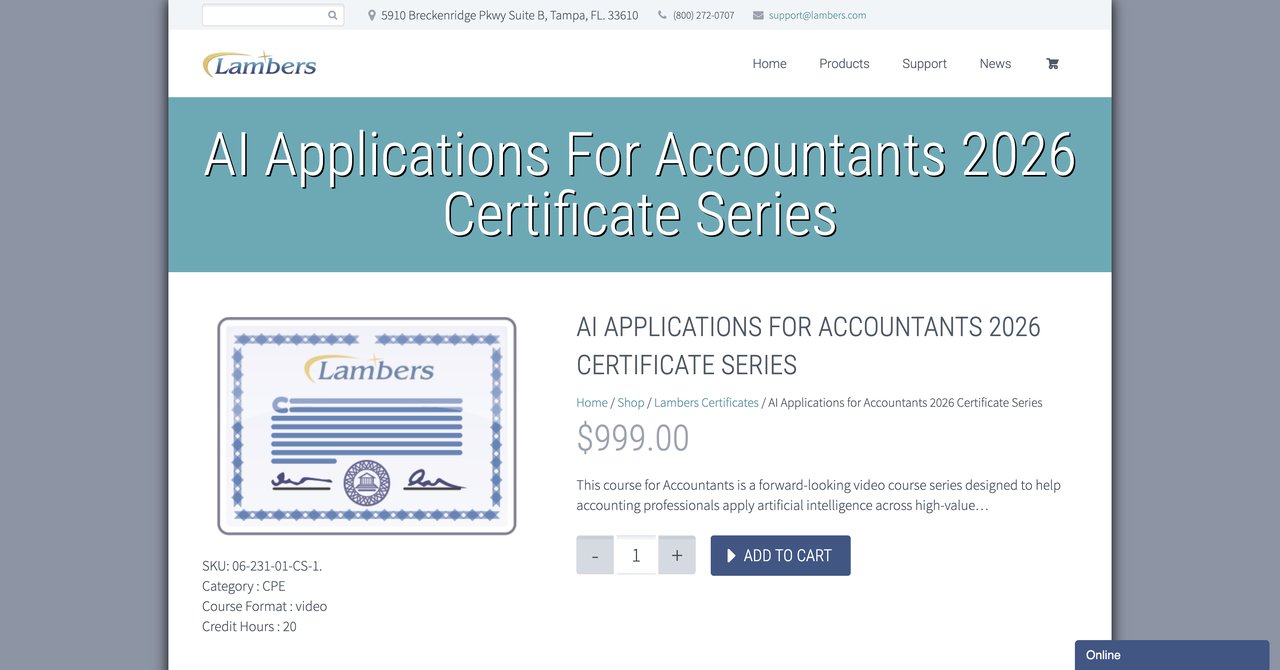
Lambers, Inc. offers a 10-course series that explores AI applications for accountants. It focuses on using ChatGPT and Claude for advanced tax law interpretation, which is useful for those who need to handle complex tax issues. The series is designed to support strategic decision-making, not just routine tasks.
The series is deep, with 10 courses covering different aspects of AI in accounting and tax. It's not just a quick overview-it's a comprehensive program that takes time to complete. The focus on ChatGPT and Claude is practical, as these are the tools most professionals are using right now.
One of the biggest issues is that the price isn't listed on the site. You'd need to contact them to get a quote, which is a bit of a hassle. It's also broader in accounting focus, so it's not tax-specific. If you're a tax analyst who wants to focus solely on tax, this might be too broad.
For accountants who want a deep dive into AI applications, this is a solid option. But for tax analysts specifically, the broader focus might not be the best fit.
Key Topics Covered:
- ChatGPT and Claude for tax law interpretation
- AI for strategic decision-making
- 10-course series for depth
Target Audience and Skill Level Requirements:
Accountants and tax professionals who want a deep, comprehensive education in AI. Some experience with tax or accounting is recommended, as the content is advanced.
Pros:
- Explores ChatGPT and Claude for advanced tax law interpretation
- Supports strategic decision-making
- 10-course series for depth
Cons:
- Price not listed
- Broader accounting focus, not tax-specific
Who Would Benefit Most:
Accountants who want a comprehensive, advanced AI education. It's less suitable for tax analysts who want a focused, tax-specific course.
Visit Lambers AI Applications for Accountants →
Course 10: Data Analytics for Tax - Module TX6051 by University of Limerick
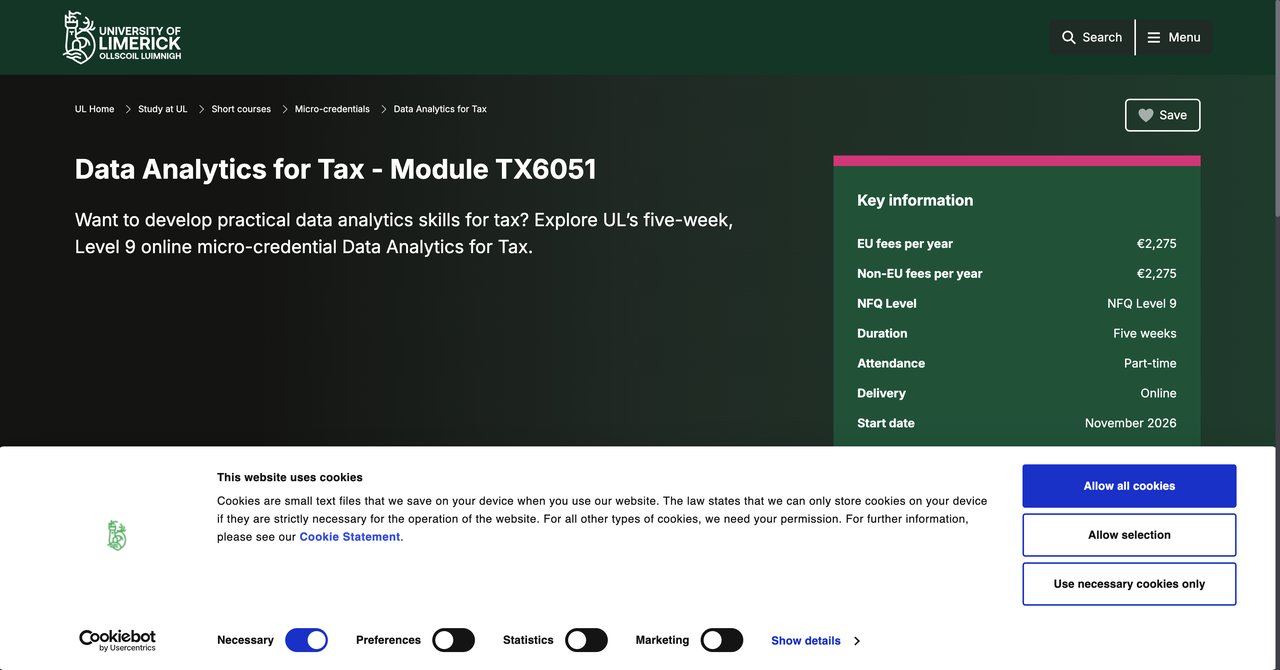
The University of Limerick offers a university-accredited micro-credential in data analytics for tax. This is a hands-on course that focuses on data analysis and visualization for tax purposes. It covers forecasting, risk management, and strategic decisions, making it more advanced than some of the other options.
The course is expensive, at €2,353 (around $2,600 USD) for EU students. That's a significant investment, but you're getting a university-accredited credential. The course is scheduled to start in November 2026, which means it's not fully self-paced. You need to be available to start at that time.
The hands-on approach is a strong point. You're not just learning theory-you're working with data and visualization tools. The focus on forecasting and risk management is useful for tax analysts who want to move into more strategic roles.
However, the price and the scheduled start date are barriers for some. If you need to learn quickly or you're not ready to commit that much money, this might not be the best option.
Key Topics Covered:
- Hands-on data analysis and visualization for tax
- Forecasting for tax
- Risk management and strategic decisions
Target Audience and Skill Level Requirements:
Tax professionals who want a university-accredited credential in data analytics. Some experience with data analysis is helpful, but not required. The course is scheduled, so you need to be able to start at the scheduled time.
Pros:
- University-accredited micro-credential
- Hands-on data analysis and visualization for tax
- Focuses on forecasting, risk management, and strategic decisions
Cons:
- Expensive
- Scheduled start (November 2026) not fully self-paced
Who Would Benefit Most:
Tax analysts who want a formal academic credential in data analytics. It's for those who are willing to invest money and wait for the scheduled start date.
Visit Data Analytics for Tax at University of Limerick →
Final Recommendations: Which Course Should You Choose?
There's no single best course for every tax analyst. The right choice depends on your experience level, your budget, and what you want to achieve. Here's a breakdown of the options and who they're best for.
For the most comprehensive, cost-effective option: CompleteAI Training is the clear winner. The flat subscription price gives you access to every course and every certification on the platform-hundreds of them-for $29/month or $8.25/month on annual billing. You're not just getting one course; you're getting an entire library that includes tax-specific content and material for other job roles. That's especially useful if your work spans multiple functions or if you want to move roles later. The daily updates on AI tools and news are a bonus that keeps you current. The only real downside is that it's a subscription, but that's actually a benefit given how fast AI is changing.
For entry-level tax analysts: The Coursera Tax Analyst with AI Skills specialization is a good starting point. It's structured, covers the basics of ONESOURCE and workpapers, and includes AI skills. The free audit option is a great way to try it before you commit to the subscription. However, it's beginner-focused, so experienced analysts might find it too basic.
For practical, season-specific workflows: The Coursiv course for tax preparers is the most practical option. It's all about getting you through tax season more efficiently, with playbooks for client intake, missing documents, and review checklists. It's not a formal certification, but it's very useful for day-to-day work.
For a broad, flexible overview: The Catch Wisdom course covers the full tax lifecycle and offers a certificate in 7 languages. It's self-paced and mobile-compatible, which makes it flexible. But it lacks instructor interaction, and the content might be partially free, so check what you're paying for.
For academic rigor: The VU Law Academy and University of Limerick courses are the most academically credible. They're expensive and not self-paced, but they offer formal credentials from recognized institutions. If you need a university-backed certificate for your career, these are the ones to consider.
For advanced AI in accounting: The Lambers series is deep and covers advanced AI tools like ChatGPT and Claude for tax law interpretation. But it's broader than tax, and the price isn't listed, which is a drawback.
In summary, if you want the best value and the most complete education, CompleteAI Training is the best choice. It's hard to beat the price and the sheer volume of content. For those with specific needs-like entry-level training, US season workflows, or academic credentials-the other courses have their place. But for most tax analysts who want to stay current with AI, the subscription model that covers everything is the most practical and cost-effective.