
Blog ·
10 Top AI Courses for Vice Presidents of Strategy in 2026
Sharpen your strategic edge with 2026’s top AI courses for VPs. Master generative AI, data-driven decision-making, and ethical implementation to lead enterprise transformation and outpace competitors.
 Jeroen Erne
The numbers are hard to ignore. AI adoption has moved from experimental pilot projects to boardroom strategy in just a few years. For Vice Presidents of Strategy, this shift isn't just a technology update-it's a fundamental change in how strategic decisions get made. A recent survey shows that 69% of businesses now use AI in at least one function, and that number climbs every quarter. Meanwhile, the World Economic Forum projects that AI will replace 85 million jobs by 2025 while creating 97 million new ones. For strategy leaders, the question isn't whether AI will reshape their profession. It's whether they'll be the ones doing the reshaping or watching from the sidelines as others take the lead.
That's why upskilling has become an urgent priority for Vice Presidents of Strategy. The role has always demanded seeing around corners, spotting patterns in complex markets, and translating data into direction. AI amplifies all of those capabilities-but only if you know how to use it properly. The gap between executives who understand AI and those who don't is widening quickly, and it shows up in everything from credibility with their teams to the quality of their strategic recommendations.
Why AI matters for Vice Presidents of Strategy today
Strategy work has traditionally relied on experience, intuition, and manual analysis. AI changes that foundation. When you can process years of market data in seconds, run scenario planning across hundreds of variables, and identify customer behavior patterns that would take a human team months to spot, the strategic questions you can ask become more ambitious and more precise.
Consider what the adoption numbers actually mean. Gartner reports that 79% of corporate strategists expect AI to be critical to their success within two years. And this isn't just about doing the same work faster. It's about doing different work entirely. AI opens up strategic possibilities that weren't feasible before-real-time market sensing, predictive competitive analysis, dynamic resource allocation, and personalized strategy development at scale.
This article helps Vice Presidents of Strategy professionals identify the best AI courses to build these skills. We'll compare five courses in this field, including CompleteAI Training, which stands out because it gives access to all courses and all certifications on the platform rather than a single course. The goal is to help you find the training that fits your current skill level, your schedule, and your career ambitions.
The Growing Role of AI in Vice Presidents of Strategy
AI has moved from being a topic you discuss in quarterly tech reviews to something that touches nearly every part of the strategy function. Here's where it's showing up most:
- Automated market intelligence: AI tools continuously scan competitor moves, customer sentiment, and industry trends, giving you real-time insight instead of waiting for quarterly reports.
- Decision support systems: AI models can simulate thousands of strategic scenarios, showing you the likely outcomes of different choices before you commit resources.
- Predictive analytics: Instead of looking at what happened, you can see what's likely to happen next. This changes how you think about market entry, product launches, and resource allocation.
- Personalized strategy communication: AI helps you translate complex strategic plans into tailored messages for different stakeholders, from the board to frontline teams.
- Risk assessment: Machine learning models can identify risks and opportunities that traditional analysis misses, giving you a more complete picture of your competitive position.
- Resource optimization: AI-driven tools help you allocate budget and talent where they'll have the greatest strategic impact.
These applications aren't theoretical. Strategy teams at major corporations are already using AI to cut their analysis time by 70% or more. The workflow is changing-what used to take a team of analysts two weeks to prepare, a single strategist can now produce in a day. That doesn't mean analysts are obsolete. It means their work shifts from gathering data to interpreting it, asking better questions, and connecting insights to business decisions.
Benefits of becoming an AI expert in Vice Presidents of Strategy
For a Vice President of Strategy, building AI expertise delivers benefits that go beyond just learning a new skill. It changes how you operate and how others see you.
First, it makes you more effective in your current role. You'll make decisions with better information, spot opportunities earlier, and respond to market shifts faster. The quality of your strategic recommendations improves because you're working with richer, more current data and more sophisticated analysis tools.
Second, it differentiates you in the job market. When boards and CEOs look for strategy leaders, they're increasingly asking about AI fluency. A candidate who can show they've invested in AI training and can apply it to real strategic challenges has a clear advantage over someone who's still relying on traditional methods.
Third, it positions you for what comes next. The VP of Strategy role is evolving. Those who understand AI will likely move into broader leadership positions, taking on responsibilities that span data, technology, and business strategy. Those who don't risk being passed over for roles that now expect AI competence as a baseline requirement.
Fourth, it helps you build and lead better teams. When you understand AI capabilities and limitations, you can hire the right people, ask the right questions, and integrate AI tools into your team's workflow in ways that actually work.
The AI courses landscape for strategy professionals is growing, with options ranging from introductory overviews to deep technical programs. This article will compare five courses to help you decide which one fits your needs. We'll look at the curriculum, the practical skills you'll gain, and how each course positions you for the strategic work ahead.
Comparison: All AI Courses for Vice Presidents of Strategy (Updated 2026)
| Course Name | Provider | Price | Key Topics | Pros | Cons | Best For |
|---|---|---|---|---|---|---|
| CompleteAI Training for Vice Presidents of Strategy | CompleteAI | Premium (subscription: $29/month or $8.25/month billed annually) | Comprehensive AI curriculum covering strategy, operations, and leadership; hands-on projects; expert instruction. Subscription includes ALL video courses and ALL certifications on the platform-hundreds across every job role-plus daily AI tool updates and curated industry news. | Full access to all video courses and certifications, not just one course; new content added continuously; covers other job roles too; one flat subscription covers everything; highest rating; very affordable with annual billing; daily updates on AI tools and news | Subscription-based model; continuous learning required as AI evolves | Vice Presidents of Strategy professionals looking for complete, ongoing training; general learners |
| AI for Vice Presidents of Strategy (Video Courses + Certifications) | Complete AI Training | $29/month or $8.25/month (billed annually) | Full access to all video courses and certifications on the platform; covers AI strategy, tools, and applications for strategy roles; includes content for other job functions as well | Most complete offering; includes all certifications at no extra cost; new content added automatically; affordable with annual billing; daily AI news and tool updates | Subscription-based; requires ongoing commitment | General learners and professionals wanting broad, continuous AI training |
| Leading AI Strategy: From Hype to Enterprise Reality | MIT Professional Education | Not specified | 8-week live online intermediate course; separating AI hype from operational reality; embedding AI into corporate strategy and organizational design; evidence-based, systems-oriented approach; real-world case studies; hands-on capstone project | Evidence-based and systems-oriented; real-world case studies; designed for strategy and decision-making roles | Price not publicly listed; requires live attendance at scheduled sessions | General learners |
| AI Strategy and Decision Making | Wharton Online | $1,350 | 4-week self-paced course; decision-framing exercises and simulations; producing an AI Decision Framing Brief or Decision Support Toolkit; evaluating AI proposals without technical implementation | Self-paced; produces work-ready deliverables; explicitly targets leaders evaluating AI proposals | Only four modules; no live faculty interaction | General learners |
| Deploying AI for Strategic Impact | MIT xPRO & MIT CSAIL | $3,950 | 9-week course; cost-performance trade-offs; scaling implications of AI systems; comparing generative AI models for business suitability | Covers cost-performance trade-offs and scaling; compares generative AI models; co-developed with MIT CSAIL | Significant time commitment; technical depth may exceed pure strategy needs | General learners |
| Strategy in the Age of AI | Columbia Business School Executive Education | $12,600 | 5-day in-person executive retreat in NYC; reshaping competitive positioning and business models around AI; includes 5 CIBE credits | In-person networking with peers; designed for decision-makers; CIBE credits | Very high price; requires travel to NYC; foundational AI knowledge assumed | General learners |
| Leading the AI-Driven Organization | MIT Sloan Executive Education | $12,900 | 5-day intensive course; managing teams delivering AI initiatives; leadership and change-management focus | Focuses on managing AI initiative teams; strong leadership and change-management angle; next cohort September 2026 | Premium price; full-day commitment for a full week | General learners |
| AI Strategy and Leadership Program: Driving Data and Organizational Transformation | MIT xPRO | Not specified | 12-week online and live online course; combining leadership development with AI implementation strategy; designed for senior technology leaders | Combines leadership with AI strategy; designed for senior leaders; longer format for deep dives | Price not listed; sustained 12-week commitment required | General learners |
| Strategy, Powered Through AI | University of St.Gallen (IFB-HSG) | CHF 2,900 (approx. $3,200) | 2-day on-campus program plus self-study; integrating AI into planning, budgeting, and roadmapping; hands-on use of ChatGPT, Perplexity, and other tools | Hands-on use of AI tools; designed for strategy heads; compact and practical | Short format; requires travel to Switzerland | General learners |
| Entrepreneurial Guide to AI Strategy for Business Leaders | Udemy | Typically $20-$100 (often on sale) | Entry-level course; evaluating business operations; identifying high-value AI opportunities; structured AI strategy framework aligned with business growth | Low-cost entry point; structured framework; focuses on identifying AI opportunities | Quality varies; no formal accreditation or faculty interaction | General learners |
| Digital Strategy in the Era of AI Certificate (full pathway) | Wharton Online | $1,350 per course; bundled rate for full certificate | Credentialed pathway covering broader digital strategy plus AI; self-paced flexibility; includes decision-making frameworks; requires multiple courses for certification | Recognized Wharton credential; covers broader digital strategy; self-paced flexibility | Requires multiple courses for full certificate; individual course is short | General learners |
Understanding AI Training for Vice Presidents of Strategy Professionals
If you are a Vice President of Strategy, the AI conversation has probably landed on your desk with considerable force. You are not being asked to write code or deploy models, but you are being asked to make decisions about where AI fits into the business, how much to invest, and what the competitive response should be. The problem is that most AI training is built for engineers or data scientists, not for people whose job is to think about market positioning, resource allocation, and long-term planning.
That gap is why a specific category of training has emerged for strategy leaders. These courses range from low-cost self-paced introductions to intensive executive retreats that cost more than a car. Some are designed to be completed in a weekend, while others stretch across months. The right choice depends on your budget, your schedule, and how deep you need to go. But the first step is understanding what is actually out there and what each option does well.
What follows is a detailed look at the most relevant programs for VPs of Strategy. I have tried to be honest about the trade-offs, because there is no single best option for everyone. Some of these are university programs with prestigious names attached, while one is a subscription platform that gives you access to everything at once. Each has a place.
Course 1: CompleteAI Training
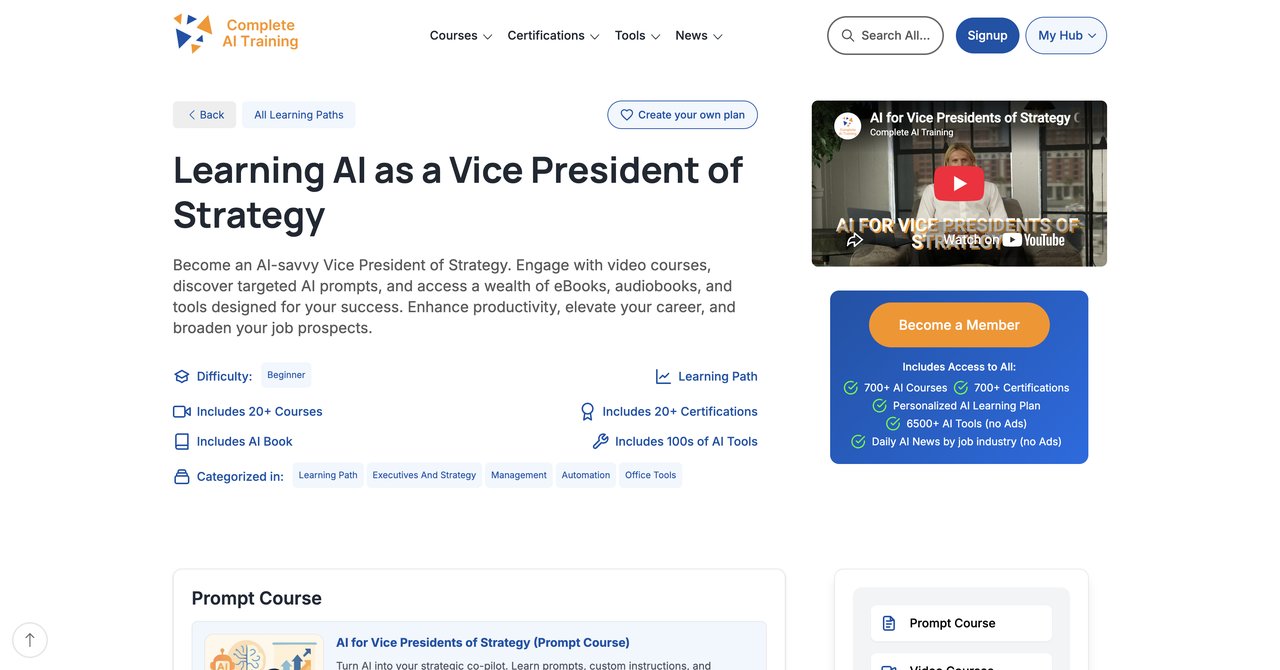
CompleteAI Training is not a single course. One subscription unlocks every course and every certification on the whole platform, hundreds of them, across every job role, not just this one. That is the key differentiator, and it is worth saying again: when you subscribe, you are not buying one program for Vice Presidents of Strategy. You are buying the entire library of AI training content, including all existing certifications and every future one that gets added.
The platform is built around a subscription model that costs $29 per month, or $8.25 per month if you pay annually. That price includes full access to all video courses, all certifications, and daily updates on AI tools and industry news. The content is continuously updated, which matters because AI is moving fast. If you subscribe in January, the material you see in June will be different, and you will not have to pay extra for it.
What makes this platform particularly interesting for a VP of Strategy is that your work does not exist in a silo. You need to understand how AI affects finance, marketing, operations, HR, and product development. Because CompleteAI Training gives you access to every job role's material, you can cross-train into those areas without buying separate courses. If you are thinking about moving into a COO role or a CEO role later, the content is already there waiting for you.
The certifications are included at no extra cost, which is a significant advantage over the other options in this comparison. Most providers charge separately for a certificate or bundle it into the course price. Here, you can earn as many certifications as you want for the same flat fee. New courses and certifications are added continuously, and they are included automatically.
The platform is designed for people who want to learn at their own pace. There are no live sessions to attend, no travel requirements, and no fixed schedule. You can work through the content in the order that makes sense for your current priorities. If you need to understand a specific topic quickly, you can jump to that module and come back to the rest later.
Key Topics Covered:
- AI fundamentals for business leaders, not just technical concepts
- Strategic planning with AI, including scenario planning and forecasting
- Competitive analysis in an AI-driven market
- Organizational design and change management for AI adoption
- Risk assessment and ethical considerations in AI strategy
- Budgeting and ROI modeling for AI initiatives
- Cross-functional AI applications across all departments
Target Audience and Skill Level Requirements:
This is aimed at professionals who need to understand AI from a strategic perspective, regardless of their technical background. There are no prerequisites for technical knowledge. The content is structured so that you can start with the basics and work up to more complex topics. Because you have access to all job role materials, it also works well for people who are already in leadership and need to understand how AI affects every part of the business.
Pros:
- Full access to ALL video courses on the platform, not a single course or a fixed bundle
- Full access to ALL certifications on the platform, included at no extra cost
- New courses and certifications are added continuously and are included automatically
- Access to every other job role's material too, which matters for anyone whose work spans more than one function or who wants to move roles
- One flat subscription price covers all of the above, versus paying per course elsewhere
- Very affordable pricing, especially with annual billing
- Daily updates on relevant AI tools and curated industry news
- Highest rating and most complete offering compared to single-course providers
Cons:
- Subscription-based, which means ongoing cost if you want continued access
- Self-paced, so you need to be motivated to actually work through the material
Who Would Benefit Most:
This is the best fit for a VP of Strategy who wants comprehensive coverage without paying university-level prices. It is also ideal for someone who knows their work will require them to understand AI across multiple business functions, not just their own. The subscription model makes it practical for ongoing learning, which is important because AI is not a one-time training topic. If you want to keep up with the field over time without paying for a new course every few months, this is the most efficient way to do it.
Visit CompleteAI Training for Vice Presidents of Strategy
Course 2: Leading AI Strategy: From Hype to Enterprise Reality by MIT Professional Education
This is an 8-week live online course from MIT Professional Education. It is designed for leaders who have to separate the hype around AI from what actually works in enterprise settings. The course takes an evidence-based approach, which means you are not getting theoretical ideas about what AI could do, but rather examples of what it is actually doing in organizations.
The course runs at an intermediate level, so you should have some basic familiarity with AI concepts before you start. It is not a beginner course. The curriculum is structured around real-world case studies, and you will complete a hands-on capstone project that applies the concepts to your own organization. The systems-oriented approach is a distinctive feature, because it looks at how AI fits into the broader organizational system, not just as a standalone technology.
One important consideration is that this is a live online course. You need to attend scheduled sessions, which means you need to have time in your calendar for the duration of the course. The price is not publicly listed, which is a bit of a red flag, but you can get that information by contacting MIT directly.
Key Topics Covered:
- Separating AI hype from practical application
- Embedding AI into corporate strategy and organizational design
- Evidence-based AI integration methods
- Real-world case studies of AI adoption
- Hands-on capstone project
Target Audience and Skill Level Requirements:
This is aimed at strategy and decision-making roles who need to understand AI at a level that allows them to make informed decisions. The intermediate level means you should be comfortable with basic AI terminology and concepts before enrolling. If you are brand new to AI, you might find the pace challenging.
Pros:
- Evidence-based, systems-oriented approach to AI integration
- Real-world case studies and hands-on capstone project
- Designed specifically for strategy and decision-making roles
- MIT brand name carries weight on a resume
Cons:
- Price not publicly listed, making it hard to budget
- Requires live attendance at scheduled sessions, so less flexibility
- 8-week format requires sustained commitment
Who Would Benefit Most:
This is best for a VP of Strategy who wants a rigorous, evidence-based approach and is comfortable with a structured learning format. The live sessions are good if you learn better in a classroom-like environment and want interaction with instructors. It is a solid choice if you need to understand AI strategy in depth and you are not constrained by a tight budget.
Visit Leading AI Strategy by MIT Professional Education
Course 3: AI Strategy and Decision Making by Wharton Online
Wharton's course is a 4-week, self-paced program that costs $1,350. The focus here is on decision-making frameworks. The course teaches you how to evaluate AI proposals without needing to understand the technical details of how the AI works. That is a useful skill for a VP of Strategy who gets pitched by internal teams and external vendors on a regular basis.
You will work through decision-framing exercises and simulations. The program includes a capstone deliverable that is designed to be work-ready. You will produce either an AI Decision Framing Brief or a Decision Support Toolkit that you can take back to your organization. This is a practical, hands-on output that you can use immediately.
The self-paced format is a major advantage if you have a busy schedule. You can work through the material when you have time, and you are not tied to a specific schedule. However, the course is only four modules long, so the depth is limited compared to longer programs. There is no live faculty interaction, which means you are working through the material on your own.
Key Topics Covered:
- Decision-framing exercises for AI evaluation
- Simulations for AI decision-making
- Creating an AI Decision Framing Brief
- Building a Decision Support Toolkit
- Evaluating AI proposals without technical implementation
Target Audience and Skill Level Requirements:
This is targeted at leaders who need to evaluate AI opportunities but are not responsible for building or implementing the technology. There are no specific technical prerequisites, but a general understanding of business strategy is assumed. The course is suitable for a range of experience levels, though it is probably most useful for those who are relatively new to AI strategy.
Pros:
- Self-paced with decision-framing exercises and simulations
- Produces work-ready deliverables
- Explicitly targets leaders evaluating AI proposals
- Reasonable price compared to other university offerings
Cons:
- Only four modules, which limits depth
- No live faculty interaction
- Shorter format may not be enough for complex strategic questions
Who Would Benefit Most:
This is a good fit for a VP of Strategy who needs a practical framework for evaluating AI proposals and wants to produce a usable deliverable. It is also good if you are on a moderate budget and you need flexibility in your schedule. The course is not going to make you an AI expert, but it will give you a solid decision-making framework.
Visit AI Strategy and Decision Making by Wharton Online
Course 4: Deploying AI for Strategic Impact by MIT xPRO & MIT CSAIL
This course from MIT xPRO and MIT CSAIL is a 9-week program that costs $3,950. It focuses on the operational aspects of deploying AI systems, specifically the cost-performance trade-offs and scaling implications. The course is co-developed with MIT CSAIL, which is one of the leading AI research labs in the world, so the content is grounded in serious technical expertise.
One of the distinctive features is that the course compares generative AI models for business suitability. This is useful if you are trying to figure out which AI models are actually appropriate for different business use cases. The course covers the practical realities of AI deployment, including the costs that are often overlooked in strategy discussions.
The 9-week format is a significant time commitment. You need to be able to dedicate time each week to the coursework. The technical depth of the course may be more than a pure strategy professional needs, but it is useful if you want to understand the operational constraints that will affect your strategic plans.
Key Topics Covered:
- Cost-performance trade-offs in AI systems
- Scaling implications of AI deployment
- Comparison of generative AI models for business
- Practical AI deployment strategies
- Operational constraints in AI adoption
Target Audience and Skill Level Requirements:
This is aimed at leaders who need to understand the operational side of AI deployment. It is also good for those who are making decisions about AI investments and need to understand the cost implications. The course has some technical content, but it is designed for business leaders, not engineers. A basic understanding of AI concepts is helpful but not mandatory.
Pros:
- Covers cost-performance trade-offs and scaling implications
- Compares generative AI models for business suitability
- Co-developed with MIT CSAIL, which is a strong technical credential
- Practical focus on deployment issues
Cons:
- Significant time commitment over 9 weeks
- Technical depth may exceed pure strategy needs
- Price is on the higher end
Who Would Benefit Most:
This course is best for a VP of Strategy who needs to understand the operational and financial implications of AI deployment. It is particularly useful if you are making decisions about AI investments and need to understand the cost structures and scaling challenges. If you are working closely with technical teams, this course will help you speak their language more effectively.
Visit Deploying AI for Strategic Impact by MIT xPRO
Course 5: Strategy in the Age of AI by Columbia Business School Executive Education
Columbia Business School offers an intensive 5-day in-person executive retreat in New York City. The price is $12,600, which makes it one of the most expensive options on this list. The course is designed for decision-makers who want to reshape their competitive positioning and business models around AI. The focus is on strategy, not technical implementation.
The in-person format is a big deal. You get to network with other decision-makers in a way that you just cannot replicate online. The program includes 5 CIBE credits, which are continuing education credits that may be relevant for some professionals. The course assumes a foundational knowledge of AI, so it is not for beginners.
The cost and the travel requirement are the two biggest barriers. You need to get to New York City and spend a full week there. The price also means that you need to be able to justify the expense to your organization, which is easier if you are in a senior role with a training budget.
Key Topics Covered:
- Reshaping competitive positioning around AI
- Business model innovation with AI
- Strategic AI implementation
- Leadership in the age of AI
- Networking with peer decision-makers
Target Audience and Skill Level Requirements:
This is aimed at senior decision-makers who are responsible for setting the strategic direction of their organizations. It is designed for people who already understand the basics of AI and want to move to a more strategic level. The course assumes foundational AI knowledge, so if you are a beginner, you will need to catch up on the basics first.
Pros:
- In-person networking with peer decision-makers
- Designed for decision-makers, not developers
- 5 CIBE credits
- Intensive format allows for deep focus
Cons:
- Very high price
- Requires travel to NYC
- Foundational AI knowledge is assumed
- Only 5 days, which is short for deep learning
Who Would Benefit Most:
This is best for senior executives who want a high-level strategic perspective and value in-person networking. If you are looking for a credential from a top business school and you have the budget for it, this is a strong option. The in-person format is particularly valuable if you are looking to build a peer network of other executives who are dealing with the same challenges.
Visit Strategy in the Age of AI by Columbia Business School
Course 6: Leading the AI-Driven Organization by MIT Sloan Executive Education
MIT Sloan Executive Education offers this 5-day intensive course at $12,900. The focus is on managing teams that are delivering AI initiatives. This is not about the technical side of AI, but rather about leadership and change management. The course is designed to help you lead your organization through the transformation that AI brings.
The strong leadership angle is what sets this course apart. It is not just about AI strategy, but about how to manage people through significant organizational change. The course has a next cohort in September 2026, so you need to plan ahead if you want to attend. The price is premium, and the full-day commitment for a full week is significant.
This course is best for someone who is already comfortable with the basics of AI and needs to focus on the organizational and leadership aspects. The change-management angle is particularly relevant for VPs of Strategy who are responsible for helping their organizations adapt to AI.
Key Topics Covered:
- Managing teams delivering AI initiatives
- Leadership in AI-driven organizations
- Change management for AI adoption
- Organizational design for AI
- Building AI-ready teams
Target Audience and Skill Level Requirements:
This is aimed at senior leaders who are responsible for managing teams and driving organizational change. It is particularly relevant for those who are in the process of implementing AI initiatives and need to manage the human side of that change. A basic understanding of AI is assumed, and the course focuses on leadership rather than technical skills.
Pros:
- Focuses on managing AI initiative teams
- Strong leadership and change-management angle
- MIT Sloan credential
- Relevant for those managing AI adoption
Cons:
- Premium price
- Full-day commitment for a full week
- Next cohort is not until September 2026
Who Would Benefit Most:
This is best for a VP of Strategy who is actively leading AI initiatives and needs to manage teams through the change. If you are already comfortable with the strategic side of AI and need to focus on the leadership and organizational aspects, this course is a good fit. The price is high, but the focus on change management is valuable for those who are in the middle of an AI transformation.
Visit Leading the AI-Driven Organization by MIT Sloan
Course 7: AI Strategy and Leadership Program: Driving Data and Organizational Transformation by MIT xPRO
This is a 12-week program from MIT xPRO that combines leadership development with AI implementation strategy. The course is designed for senior technology leaders who need to understand both the strategic and organizational aspects of AI. The longer format allows for a deeper exploration of the topics compared to the shorter courses.
The course is online and live, which means you need to attend scheduled sessions. The 12-week commitment is significant, so you need to be able to dedicate time each week. The price is not publicly listed, which makes it hard to compare with other options. You will need to contact MIT xPRO directly to get pricing information.
The combination of leadership development and AI strategy is the main strength of this program. It is not just about the technology, but about how to lead an organization through AI adoption. This makes it relevant for VPs who are expected to be both strategic and organizational leaders.
Key Topics Covered:
- Leadership development for AI
- AI implementation strategy
- Data-driven organizational transformation
- Managing AI initiatives
- Strategic AI leadership
Target Audience and Skill Level Requirements:
This is aimed at senior technology leaders, including VPs of Strategy who are involved in AI initiatives. The course is designed for those who have some experience with AI and are looking to move into a more strategic leadership role. The 12-week format requires a sustained commitment.
Pros:
- Combines leadership with AI strategy
- Designed for senior leaders
- Longer format for deep dives
- MIT xPRO credential
Cons:
- Price not listed, making comparison difficult
- Sustained 12-week commitment required
- Live sessions require schedule flexibility
Who Would Benefit Most:
This is best for a VP of Strategy who wants a comprehensive program that covers both leadership and AI implementation. If you have the time to commit to a 12-week program, you will get a deeper understanding of the strategic and organizational aspects of AI. The program is particularly relevant for those who are expected to lead AI adoption across their organization.
Visit AI Strategy and Leadership Program by MIT xPRO
Course 8: Strategy, Powered Through AI by University of St.Gallen (IFB-HSG)
The University of St.Gallen offers a 2-day on-campus program plus self-study for CEOs, COOs, and heads of strategy. The cost is CHF 2,900, which is approximately $3,200. The course focuses on integrating AI into planning, budgeting, and roadmapping. It is a practical course that includes hands-on use of AI tools like ChatGPT and Perplexity.
The compact format is both a strength and a weakness. It is efficient, and you can learn a lot in a short time, but the depth is limited. The course is designed for strategy heads who want to apply AI to their daily work rather than getting a deep academic understanding. The hands-on component is a big plus because you get to use the tools yourself.
The requirement to travel to Switzerland is a significant barrier for many people. If you are not based in Europe, the travel costs and time will add to the overall expense. The course is practical and focused on immediate application, which is good for those who want to see results quickly.
Key Topics Covered:
- Integrating AI into planning and budgeting
- AI in roadmapping
- Hands-on use of ChatGPT, Perplexity, and other tools
- Practical AI strategy for strategy heads
- Compact and practical AI applications
Target Audience and Skill Level Requirements:
This is aimed at CEOs, COOs, and heads of strategy who want to use AI in their daily work. It is designed for those who are looking for practical applications rather than theoretical knowledge. No technical prerequisites are required, but a general understanding of strategy is assumed.
Pros:
- Hands-on use of AI tools
- Designed for strategy heads
- Compact and practical format
- Affordable compared to other university programs
Cons:
- Short format limits depth
- Requires travel to Switzerland
- Not a comprehensive program
Who Would Benefit Most:
This is best for a VP of Strategy who wants a practical, hands-on introduction to using AI tools in their work. If you are based in Europe or are willing to travel, the compact format is efficient. The course is particularly useful if you want to see how AI can be applied to your planning and budgeting processes immediately.
Visit Strategy, Powered Through AI by University of St.Gallen
Course 9: Entrepreneurial Guide to AI Strategy for Business Leaders by Udemy
This is a budget-friendly course from Udemy that typically costs between $20 and $100, depending on sales. The course is an entry-level introduction to evaluating business operations and identifying high-value AI opportunities. It uses a structured AI strategy framework that is aligned with business growth.
The main advantage of this course is the price. It is accessible to almost anyone, which makes it a good starting point if you are new to AI strategy and want to understand the basics without a significant financial commitment. The course is self-paced, so you can work through it when you have time.
The downside is that quality varies significantly on Udemy. This course is not accredited, and there is no faculty interaction. You are essentially working through the material on your own. The depth is also limited compared to more expensive options, but it is a good entry point.
Key Topics Covered:
- Evaluating business operations for AI opportunities
- Identifying high-value AI opportunities
- Structured AI strategy framework
- AI for business growth
- Entry-level AI strategy concepts
Target Audience and Skill Level Requirements:
This is aimed at business leaders who are new to AI and want a low-cost introduction. It is suitable for anyone who needs to understand the basics of AI strategy without a technical background. The course is entry-level, so no prerequisites are required.
Pros:
- Low-cost entry point
- Structured AI strategy framework
- Focuses on identifying AI opportunities
- Self-paced and flexible
Cons:
- Quality varies
- No formal accreditation
- No faculty interaction
- Limited depth compared to other options
Who Would Benefit Most:
This is best for a VP of Strategy who is new to AI and wants to understand the basics without spending a lot of money. It is also good for those who want to test the waters before investing in a more expensive course. If you are on a tight budget, this is a reasonable starting point.
Visit Entrepreneurial Guide to AI Strategy on Udemy
Course 10: Digital Strategy in the Era of AI Certificate (full pathway) by Wharton Online
Wharton Online also offers a broader certificate pathway called Digital Strategy in the Era of AI. This is a credentialed pathway that covers broader digital strategy in addition to AI. The cost is $1,350 per course, with a bundled rate for the full certificate. This is a more comprehensive option than the single AI Strategy and Decision Making course.
The certificate is designed to provide a recognized Wharton credential. It covers broader digital strategy, which is useful for VPs of Strategy who need to understand AI in the context of overall digital transformation. The self-paced format gives you flexibility, and the decision-making frameworks are a key component.
However, the certificate requires multiple courses to complete, which means a significant time and financial commitment. Each individual course is short, so you need to plan to take several courses to get the full certificate. The self-paced format is an advantage, but it also means you need to be self-disciplined.
Key Topics Covered:
- Digital strategy in the context of AI
- AI decision-making frameworks
- Broader digital transformation
- Strategic AI implementation
- Wharton credential
Target Audience and Skill Level Requirements:
This is aimed at leaders who want a recognized credential in digital strategy and AI. It is suitable for those who need a broader understanding of digital transformation, not just AI alone. The course is self-paced, so it works for those with busy schedules. No specific technical prerequisites are required.
Pros:
- Recognized Wharton credential
- Covers broader digital strategy
- Self-paced flexibility
- Decision-making frameworks included
Cons:
- Requires multiple courses for full certificate
- Individual course is short
- Cost can add up if you take multiple courses
Who Would Benefit Most:
This is best for a VP of Strategy who wants a recognized credential and needs to understand AI in the context of broader digital strategy. If you are looking for a formal certification that carries the Wharton name, this is a good option. The self-paced format is convenient, but you need to be prepared to commit to multiple courses to get the full benefit.
Visit Digital Strategy in the Era of AI at Wharton Online
Final Recommendations
After looking at all these courses, the best choice really depends on your specific situation. There is no universal answer, and you need to think about your budget, your schedule, and your career goals.
If you want the most comprehensive coverage for a low price, CompleteAI Training is the strongest option. The subscription gives you access to all video courses and all certifications on the platform, which is a value proposition that no other provider can match. You are not buying one course; you are buying the entire platform. For a VP of Strategy who needs to understand AI across multiple functions, this is a practical and affordable choice. The daily updates and continuous additions also mean you can stay current without paying extra.
If you are looking for a prestigious university credential and you have the budget, the Columbia Business School and MIT Sloan options are worth considering. They are expensive, but they offer in-person networking and a strong brand name. The Columbia course is best if you want to focus on competitive strategy, while the MIT Sloan course is better if you want to focus on leadership and change management.
For those who need a moderate-priced university option, Wharton Online and MIT xPRO offer good value. Wharton is self-paced and practical, while MIT xPRO is more technical and focuses on deployment issues. Both are solid options but they are more limited in scope.
If you are on a tight budget, the Udemy course is a reasonable starting point. It is not comprehensive, but it will give you a basic framework for a low cost. The St.Gallen course is also a good option if you are based in Europe and want a practical, hands-on approach.
In summary, the best option for most VPs of Strategy is probably CompleteAI Training because of the value and the comprehensive coverage. But if you need a specific credential or you prefer in-person learning, the university courses are worth the investment. Take the time to think about what you really need and choose accordingly.