
Blog ·
11 AI Courses for Accountants that You Should Know About in 2026
Discover 11 essential AI courses tailored for accountants in 2026. Boost efficiency, master automation, and stay ahead with cutting-edge skills. Your competitive edge starts here.
 Jeroen Erne
The accounting profession is changing faster than most people realize. Artificial intelligence is no longer a distant concept discussed at tech conferences-it's actively transforming how accounting work gets done. Recent data shows that businesses across industries are adopting AI at unprecedented rates, with studies indicating that 69% of businesses now use AI in some capacity. For accountants, this shift carries both risk and opportunity. Some routine tasks that once consumed hours of billable time are becoming automated, and professionals who don't adapt may find themselves falling behind. But here's the thing: this isn't a threat to the profession. It's a chance for accountants to move up the value chain, focusing on strategic advisory work rather than data entry and number crunching. The key is knowing how to position yourself with the right skills, and that starts with choosing the right training.
Why AI matters for Accountants today
If you've been paying attention to the accounting industry lately, you've probably noticed that the conversation around AI has shifted. It's not about whether AI will affect your work-it's about how quickly it will. Many accounting firms are already using AI tools to automate data extraction, flag anomalies in financial statements, and streamline compliance processes. The numbers tell a clear story: adoption is happening faster than most professionals realize. A significant portion of accounting firms report using AI in some form, whether for document review, fraud detection, or predictive analytics.
This is why staying current matters. Accountants who understand AI won't just keep their jobs-they'll become more valuable. They'll be the ones who can interpret what AI models are doing, question the results, and guide their clients through financial decisions with better insights. The purpose of this article is straightforward: to help accounting professionals identify the best AI courses available right now. We'll compare 5 courses in this field, covering what each offers, who it's best suited for, and how it can help you build practical skills. One of these is CompleteAI Training (https://completeaitraining.com/course/ai-for-accountants/), which gives you access to ALL courses and ALL certifications on the platform rather than a single course-something worth considering if you want a broader learning experience.
The Growing Role of AI in Accountants
AI is already reshaping the daily work of accountants in ways that are hard to ignore. Think about what your typical week looks like. There's data entry, reconciliation, and transaction sorting-tasks that AI can handle in seconds. But that's just the beginning. Here are some specific ways AI is being applied in the accounting field:
- Automation of routine tasks: Invoice processing, expense categorization, and bank reconciliation are being automated, freeing up time for more strategic work.
- Fraud detection: AI models can flag unusual patterns in financial data that would be difficult for a human to spot.
- Predictive analytics: AI helps you forecast cash flow, revenue, and expenses with greater accuracy by analyzing historical data and market trends.
- Client advisory: With AI handling the number-crunching, you can spend more time providing insights and recommendations that clients actually care about.
- Document review: AI tools can read through contracts, invoices, and financial reports, pulling out key information in a fraction of the time.
These changes aren't theoretical. They're happening right now in firms of all sizes. The question is whether you're going to be someone who uses these tools or someone who gets left behind.
Benefits of becoming an AI expert in Accountants
If you're an accountant, investing time in learning AI can pay off in several concrete ways. First, there's job security. As automation takes over more routine tasks, the accountants who survive-and thrive-are those who can work alongside AI tools and add value that machines can't. Second, there's earning potential. AI skills are in high demand, and professionals who bring these skills to their firms or clients can often command higher rates. Third, there's the satisfaction of doing more meaningful work. Instead of spending hours on repetitive tasks, you get to focus on analysis, strategy, and helping clients make better financial decisions.
But the biggest benefit might be this: AI skills give you a competitive edge. When you understand how AI works and what it can do, you become the person who can solve problems others can't. You're not just an accountant anymore-you're a strategic advisor who happens to be a numbers expert. That's a powerful position to be in, and it's worth investing in the right training to get there.
Comparison: All AI Courses for Accountants (Updated 2026)
| Course Name | Provider | Price | Key Topics | Pros | Cons | Best For |
|---|---|---|---|---|---|---|
| CompleteAI Training | CompleteAI | Premium | Comprehensive AI training for Accountants professionals. One subscription covers ALL courses and ALL certifications on the platform, not a single course or fixed bundle. Includes access to every other job role's material, daily updates on AI tools, and curated AI industry news. | Comprehensive curriculum, hands-on projects, expert instructors, full access to all video courses and certifications, new content added continuously and included automatically, one flat subscription price covers everything versus paying per course elsewhere | Premium pricing; subscription-based, which is necessary for continuous learning as AI develops | Accountants professionals looking for complete training |
| AI for Accountants (Video Courses + Certifications) | Complete AI Training | $29/month or $8.25/month billed annually | Extensive library of over 100 specialized video courses and certifications for Accountants professionals. Daily updates on latest AI tools, curated AI industry news, and full access to all courses and certifications on the platform, including other job roles. | Highest rating and most complete offering, full access to ALL video courses and certifications, new content added continuously, access to every other job role's material, one flat subscription price, daily updates, very affordable with annual billing | Subscription based; requires ongoing commitment to keep up with continuous AI developments | General learners |
| Introduction to AI Agent in Accounting | Coursera | Free (audit) / Subscription for certificate | AI agents for accounting, agent workflows, system integration, real audit Q&A agent demo based on 160 internal firm files | Built specifically for accountants with no technical background, uses a real audit Q&A agent demo, covers agent workflows and system integration | Narrow focus on AI agents rather than broad AI tooling, requires Coursera subscription for graded assessments | General learners |
| AI For Accounting Pros: Financial Statement Analysis & Audit | Udemy | Typically $20-$100 | Automating journal entries with ChatGPT, financial statement analysis, audit applications, 13 sections and 34 lectures | Hands-on and practical, covers automating journal entries with ChatGPT, expert-led with 13 sections and 34 lectures | Short duration limits depth, no formal CPE credits mentioned | General learners |
| ChatGPT and AI for Accountants | Coursera (Packt) | Free (audit) / Subscription for certificate | Integrating AI into daily accounting practice, practical ChatGPT applications | Tailored to integrating AI into daily accounting practice, covers practical ChatGPT applications, from a recognized publisher (Packt) | Course length and module details not clearly listed, may overlap with generic ChatGPT content | General learners |
| AI for Accountants 2026 | AccountingTools (CPE) | Typically $50-$150 | Technologies driving AI adoption, practical methodologies for decision-making and strategic planning | CPE credit available, explains technologies driving AI adoption, practical methodologies for decision-making and strategic planning | Overview level, not deep technical, requires enrollment and online exam for certificate | General learners |
| Accounting Workflow Automation with Excel and AI | Coursera | Free (audit) / Subscription for certificate | AI-powered invoice processing with OCR, advanced Excel templates for financial analysis | Builds AI-powered invoice processing with OCR, creates advanced Excel templates for financial analysis, recently updated | Short duration, focuses on Excel-centric workflows rather than broader AI tools | General learners |
| AI Accounting & Auditing Certificate Training | Becker | $212.00 | Four expert-led on-demand courses, hands-on modules with Excel and Microsoft Copilot, certificate and badge for LinkedIn, 9.0 CPE credits | Four expert-led on-demand courses, includes hands-on modules with Excel and Microsoft Copilot, certificate and badge for LinkedIn, 9.0 CPE credits | Priced higher than typical online courses, requires Becker CPE subscription for individual courses without badge | General learners |
| AI for Accountants | Udemy | Typically $20-$100 | AI tools for accountants, bookkeepers, and accounting students, time-saving techniques, stress reduction | Hands-on and practical, designed for accountants, bookkeepers, and accounting students, focuses on saving time and reducing stress | Last updated 2025, may lack newest AI features, duration not specified | General learners |
| Claude Fundamentals for Accountants (2026 Update) | LearnFormula (CPE QAS) | Typically $50-$150 | Claude AI for document and spreadsheet analysis, Microsoft 365 integrations, practical prompting techniques | Covers Claude specifically, including document/spreadsheet analysis and Microsoft 365 integrations, includes practical prompting techniques, CPE QAS credit | Focused solely on Claude, not multi-tool, requires basic accounting and Microsoft Office knowledge | General learners |
| Certificate in AI Fluency - Aug 2026 Group 1 | Chartered Accountants Australia and New Zealand (CA ANZ) | $2,271.82 (AUD) - approximately $1,500 USD | GenAI application, strategic planning, governance frameworks, expert-led workshops over six weeks | Structured learning journey with expert-led workshops, covers GenAI application, strategic planning, and governance frameworks, finalist for Best Capability Building Program | High price point, requires commitment over six weeks, limited to CA ANZ members or those eligible | General learners |
| AI Wise for Accountants & Bookkeepers | AI Wise Training | $297 (Track only; requires AI Wise Core credential) | Client data boundaries, regulatory rules, ROCI governance, certification exam and digital badge | Role-specific track for accountants and bookkeepers, covers client data boundaries, regulatory rules, and ROCI governance, includes certification exam and digital badge | Requires prerequisite AI Wise Core credential, additional cost if not bundled | General learners |
Understanding AI Training for Accountants Professionals
The accounting profession is changing fast, and AI tools are no longer optional for professionals who want to stay competitive. From automating routine data entry and journal entries to analyzing massive datasets for audit insights, AI is becoming a core part of modern accounting work. The challenge for many accountants is knowing where to start, which tools matter most, and how to balance continuing professional education requirements with practical skill-building.
There are now dozens of AI courses available, covering everything from basic ChatGPT prompting to advanced agent workflows and CPE-accredited strategy programs. Comparing costs, depth, and teaching styles can get overwhelming quickly. This article breaks down the leading options in 2026, helping you find the best fit for your specific role, budget, and career stage, whether you are an entry-level bookkeeper or a partner at a major firm.
Course 1: CompleteAI Training
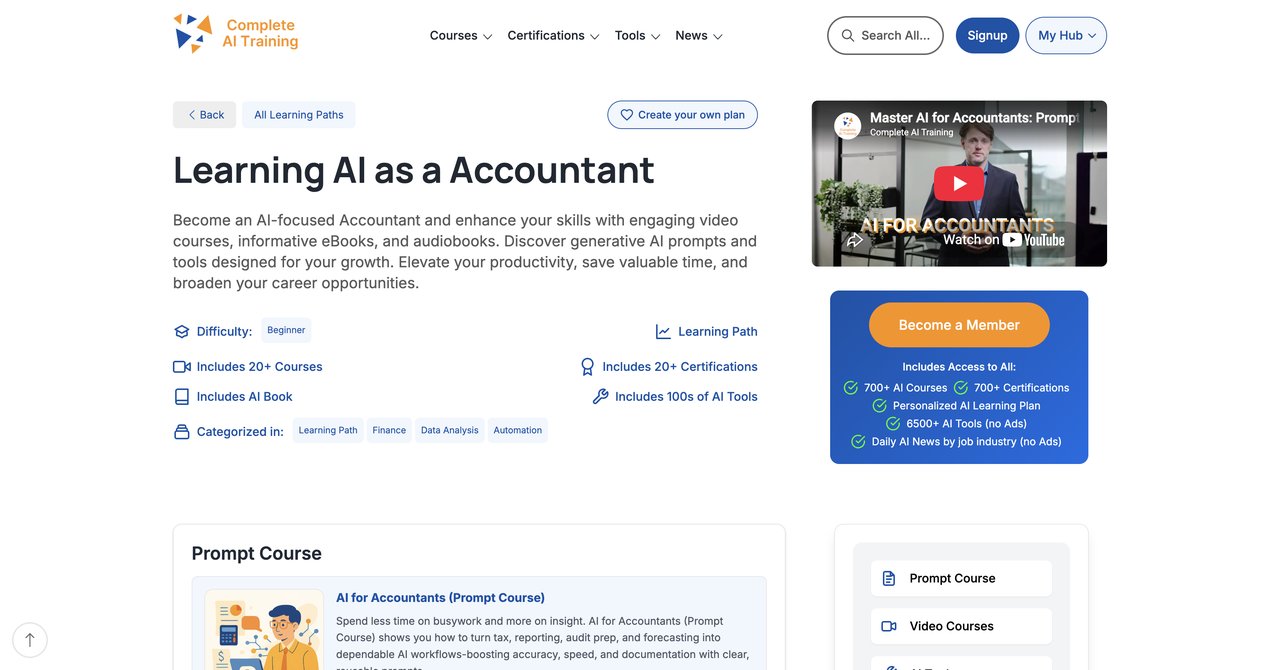
Start with the crucial fact about CompleteAI Training: it's not a single course. One flat subscription gives you access to every course and every certification on the whole platform. This includes hundreds of specialized video courses and credentials for accountants, not just one limited program. It also includes all material for every other job role on the platform, so if your work spans multiple functions, this becomes the most versatile option. For the price of a streaming service subscription, you get a constantly growing library rather than paying per course like most competitors. Check their full course catalog here: https://completeaitraining.com/course/ai-for-accountants/.
The key differentiator is structure. Most other providers sell a single course with a single fee, and you pay extra if you want a certificate. CompleteAI Training opens up everything at once. You get all their video courses for accounting professionals, all certifications included at no extra cost, and daily updates on new AI tools and news that matters to you. New courses and certifications are added continuously, and they are automatically included in your subscription. You never have to worry about missing out on a new topic because it wasn't included in a package that was designed months ago.
For accountants, the practical benefits are substantial. The platform goes beyond generic ChatGPT training and covers specialized workflows in bookkeeping, financial analysis, audit preparation, tax compliance, and more. The courses are updated regularly, which matters given how quickly AI changes. The daily news and tool updates are useful when you are implementing AI in your daily work and want to stay ahead without having to find a wall yourself. The all-access subscription also covers content for other job roles like HR, marketing, and operations, which is useful for accountants who work closely with other departments or are looking to move into a broader role.
Key topics covered through the platform's extensive library include automation of repetitive accounting tasks, using ChatGPT and Claude for complex spreadsheet analysis, financial modeling, audit sampling, fraud detection, budgeting and forecasting, and creating dynamic presentations and reports for clients and stakeholders. You also learn prompt engineering for accounting-specific usage, AI governance and data privacy considerations that matter for accounting standards, and how to integrate various AI tools into Excel and QuickBooks workflows.
Target audience is broad. It works for beginners who have never used AI and for advanced professionals who need to keep up with the latest models and agent workflows. There are no strict prerequisites, though familiarity with basic accounting principles helps you get the most out of the role-specific examples. The platform is particularly strong for professionals who want to self-learn at their own pace without being locked into a single curriculum. The subscription model is best for those who want consistent, ongoing learning over several months of year-long career development.
Pros:
- Highest rating and most complete content library available for accountants
- Full access to ALL video courses on the platform, not a single course or a fixed bundle
- Full access to ALL certifications on the platform, included at no extra cost
- New courses and certifications are added continuously and are included automatically
- Access to every other job role's material too, which matters for any cross-functional work
- One flat subscription price covers all of the above, versus paying per course elsewhere
- Daily updates on relevant AI tools and news for the accounting field
- Very affordable pricing, especially with annual billing
Cons:
- Subscription-based, so you need to keep paying to maintain access
- Some users may prefer one-off payment for a complete course without recurring fees
Who would benefit most: This is the best option for accountants who want a comprehensive AI education that keeps expanding. If you're interested in multiple aspects of AI in accounting, plan to use AI for a range of tasks or want to transition from one area to another. It saves you from buying multiple, expensive Coursera or Udemy courses. You get everything for one price, so you always have access to new material as it comes out. Anyone serious about leveraging AI with a long-term career view should look at completeaitraining.com.
Course 2: Introduction to AI Agent in Accounting by Coursera
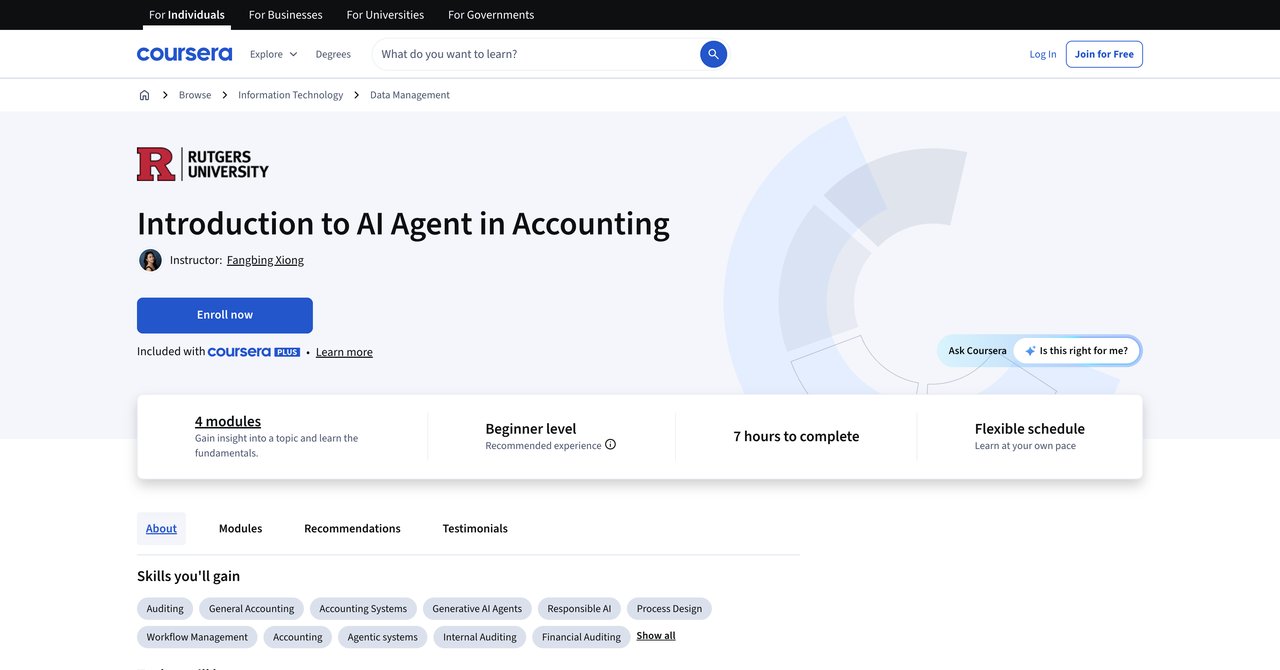
This short Coursera course is built specifically for accountants who don't a technical background. It uses a real audit Q&A agent demo built on 160 internal firm files to demonstrate how to build agent workflows over proprietary data. The focus is on AI agents, which are an interesting trend compared with simple chat prompts. You get a taste of system integration without needing to write code. It's a nice introduction for those who want to scratch the surface of what's possible with agent-based workflows rather than learning general AI prompting.
This course takes only basic knowledge. The description says "introduction", and that's accurate. You'll walk through the foundational concepts of AI agents, why they differ from traditional manual processes, and how they can attach to existing systems within a firm. The real-world example is a strong point since many courses are generic and don't relate to you. You can audit the course for free, but you get a certificate only if you pay for the Coursera subscription.
Key topics covered:
Agent workflows and core concepts, system integration basics, practical demo construction using internal document sets, and position with real audit benitti.
Target audience: For accountants and auditors at smaller firms who want to understand the new agent-based AI paradigm and how it can apply to audit and compliance workflows.
Pros:
- Specifically made for accountants with no technical background
- Uses a real working demo based on actual firm data
- Covers agent workflows and integration concepts that are not commonly in beginner courses
Cons:
- Narrow focus on AI agents, not broad AI tooling like general automation or spreadsheets
- Graded assessments require Coursera's paid subscription
- Short format, so high-level, not an active deep-dive
Who benefits: Accountants looking to understand what this new "agent" trend means without jumping into programming. Best for firms thinking about implementing internal AI agents for document searching and knowledge management.
Link to this course: https://www.coursera.org/learn/intro-to-ai-agent-in-accounting
Course 3: AI for Accounting Pros: Financial Statement Analysis & Audit by Udemy
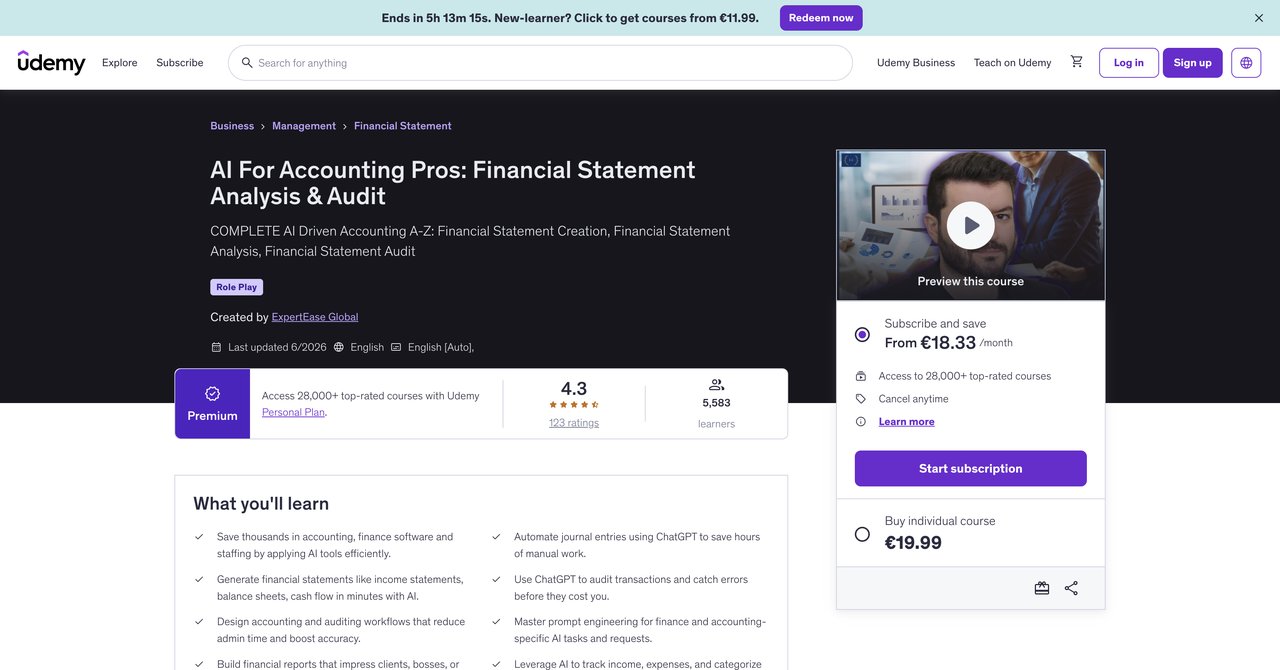
Udemy has a very hands-on course that helps you automate journal entries with ChatGPT and accelerates financial statement analysis. The course has 13 sections and 34 lectures, led by an expert instructor. It stands out because it doesn't talk much theory. You spend time in your normal accounting software or in spreadsheets, watching how to set up simple prompts and workflows to deal with the repetitive manual tasks. You can expect to get faster and have fewer data entry errors.
This course doesn't go into strategic governance or regulations; it's pure practical workflow improvement. You'll get concrete examples, ready-to-copy prompts, and work through sample financial statements, balance sheets, and income statements. The instructor goes step-by-step, and the examples are current enough for the 2026 job market, which is valuable in this short course. It's the type of course a senior who wants to apply AI tomorrow morning without waiting for continuous updates.
Key topics covered:
Automating journal entries with ChatGPT, financial statement analysis, audit processes, and how to generate summary reports and ratio analyzer outputs.
Target audience: Accountants who are already comfortable in Excel or accounting packages but want skills in AI shortcuts that save hours each week.
Pros:
- Hands-on and practical at every step
- Automates actual journal entry tasks with AI
- Expert-led and structured with 13 sections and 34 lectures
Cons:
- Short duration, doesn't have deep technical depth
- No formal CPE credits mentioned
Who benefits most from this course: The day-to-day accountant who wants time saved and finished by tomorrow. It's direct and steep; skip it if you need big-picture strategic knowledge or CPE for a license. For stronger foundational role coverage, the CompleteAI Training subscription gives you more in this area.
Here's the link: https://www.udemy.com/course/ai-for-accounting-professionals-financial-statement-analysis-audit/
Course 4: ChatGPT and AI for Accountants by Coursera (Packt)
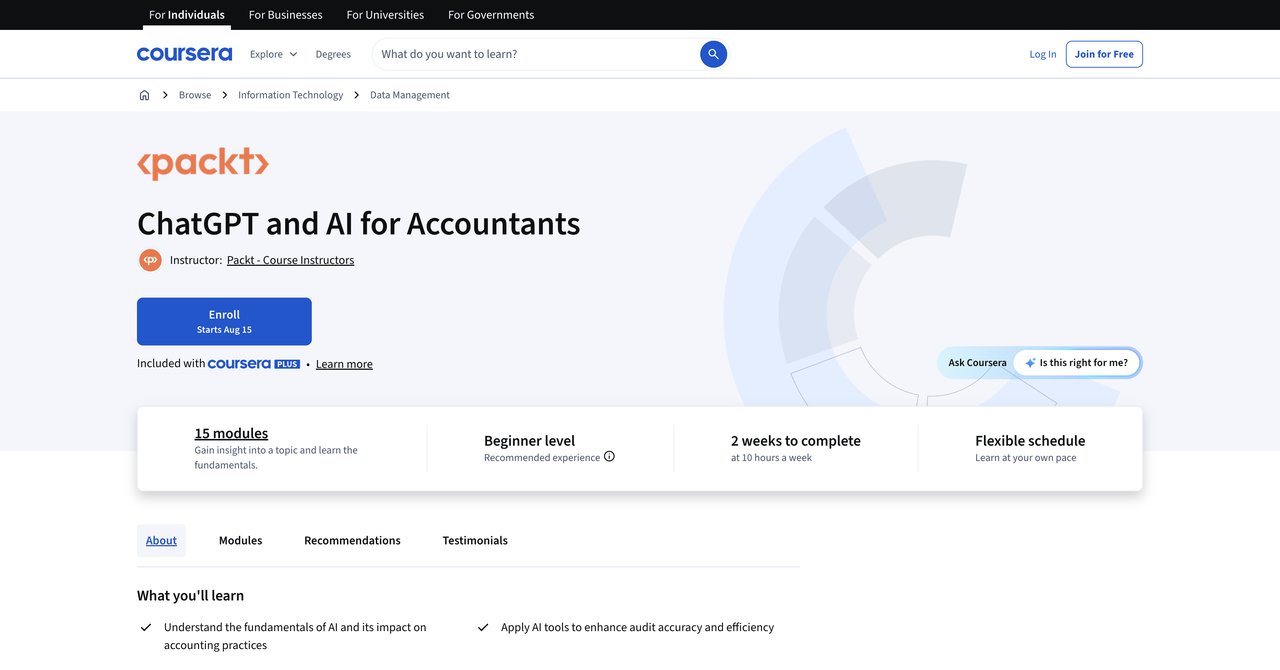
This Packt-published Coursera course focuses on integrating AI into daily accounting practice, with an emphasis on practical ChatGPT applications. It's from a recognizable name in the educational publishing world, so you can expect a certain quality and production level. It's a curated course that takes you through real accounting scenarios in which ChatGPT serves as a productive assistant. You'll learn relevant prompts useful to accounting, including many budget and actual report examples.
The course is still on the beginner-friendly side but assumes that you understand the fundamentals of accounting. You won't need to be a technical programmer; most students are accountants or bookkeepers. The course feels a bit shorter than the broad offerings. The basic content is from Packt, but it's a roll-up, so you might get overlapping generic ChatGPT prompts from other courses if you took one of those tal. It fits well as an introduction to ChatGPT for your firm, but it lacks a comprehensive multi-tool kind of view.
Key topics covered: getting hands-on with ChatGPT in accounting work, drafting reports and summaries, data extraction, and writing email or client communication material that is standard in the field.
Target audience: Accountants and bookkeepers who want a structured way to use ChatGPT for their daily tasks.
Pros:
- Tailored to integrating AI into daily practice, not just theory
- Hands-on look at ChatGPT in accounting-specific use cases
- From Packt, so quality is solid
Cons:
- Course length and module details not clearly available on the listing
- May feel repetitive if you are already familiar with generic ChatGPT usage
Who benefits most: Accountants wanting a very low-stakes introduction to ChatGPT. A good starter if you aren't ready to pay much or pay nothing for the free audit. However, if you already use ChatGPT commonly, the content might not be new to you. For more comprehensive training, check what CompleteAI Training offers at the link above.
Link to the course: https://www.coursera.org/learn/packt-chatgpt-and-ai-for-accountants
Course 5: AI for Accountants 2026 by AccountingTools (CPE)
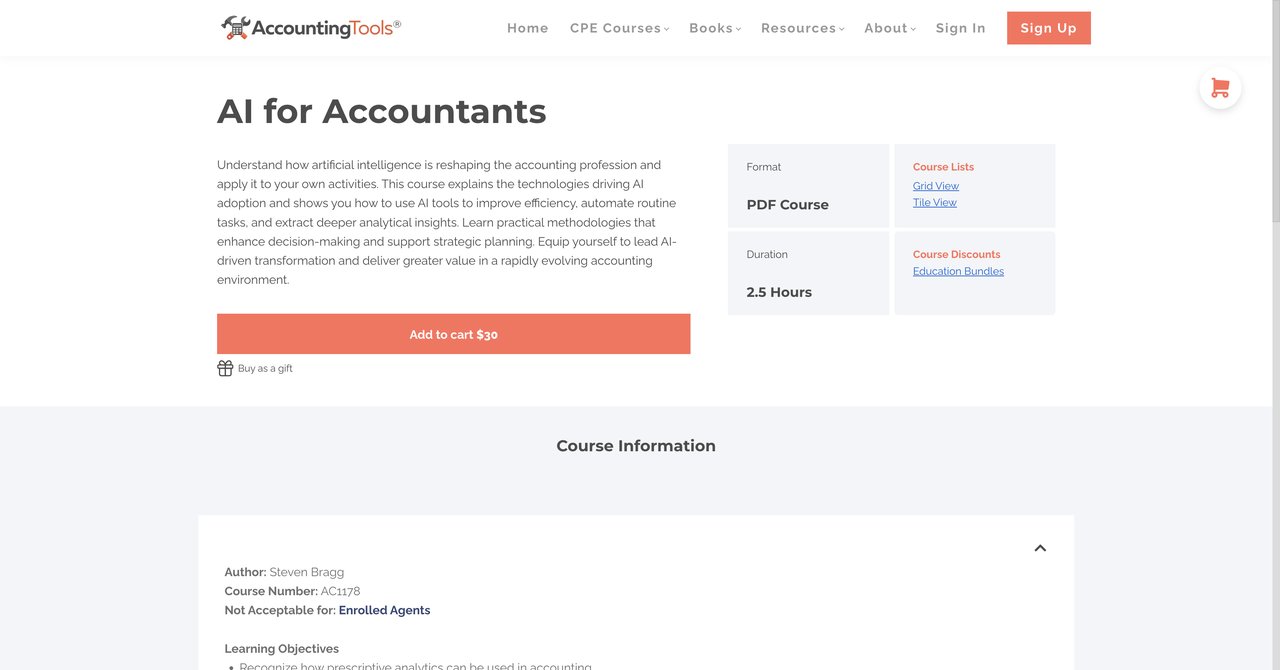
AccountingTools sells a CPE-accredited course that explains the technology driving AI and provides practical methodologies for decision-making and strategic planning. If you need continuing professional education (CPE) credit in AI, this is a proper choice. It's less about "how to press in chat" and more about what you should do to build an AI roadmap. The focus is on using AI decisions within the accounting function, aligning AI with business strategy, and typical use cases like reporting and automation.
The course costs around $50 to $150 and it's an overview level, not deep technical. It must fit into a CPE box, thus it spreads to the needed competencies. Good if you're partner-level or senior finance person who needs to evaluate AI solutions at the vendor level. It's not a sandbox; they don't typically give you hours on prompt building. You take a clear path to the exam and the official credit.
Key topics covered: work at the current state of AI technologies, the ROI model for AI, structured decision making, and the strategic planning of AI in a company's finance department.
Target audience: Senior accountants, accounting managers, and controllers who need to select AI tools or to propose budgets for adoption.
Pros:
- CPE credit available, which is essential for license renewal
- Explains the technology landscape to make strategic choices
- Practical methodologies for decision and planning
Cons:
- Overview level, not deep technical or tool-specific
- Requires paid enrollment and online exam for certificate
Who benefits the most: Professionals who need CPE plus a high-level yet strategic viewpoint of AI. If you don't care about CPE, this course might feel too generic compared to hands-on alternatives.
Link: https://cpe.accountingtools.com/course/ai-for-accountants-2026
Course 6: Accounting Workflow Automation with Excel and AI by Coursera
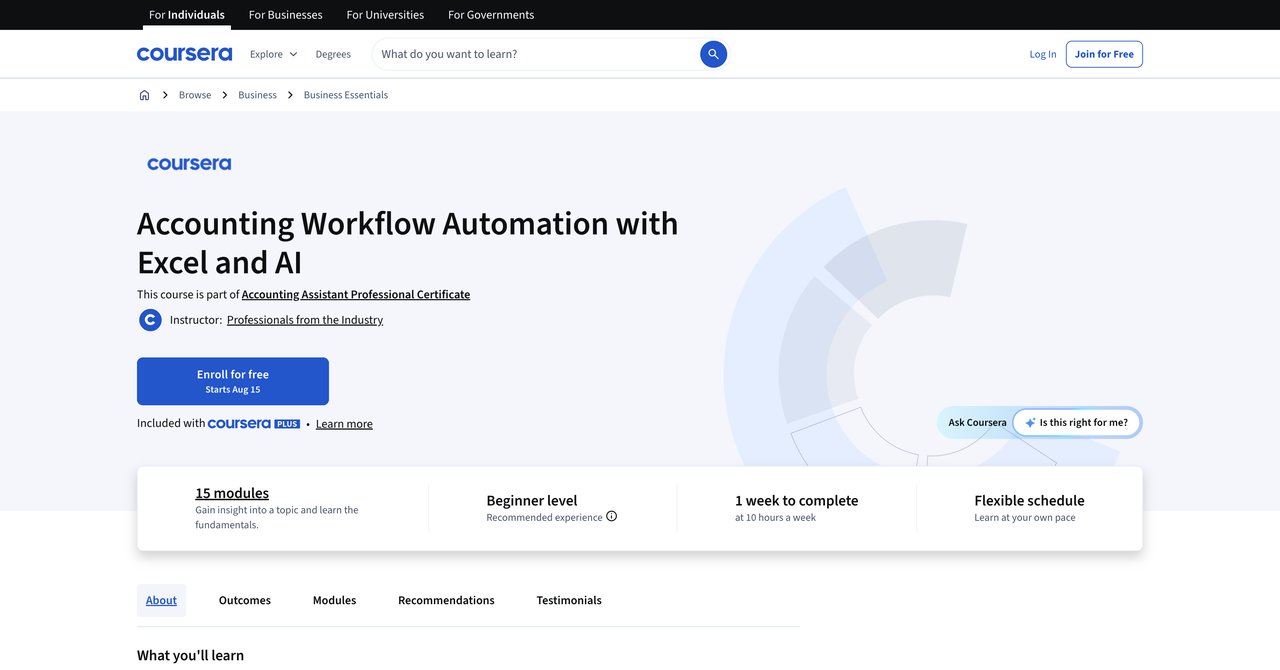
This course focuses specifically on Excel work and AI. You will learn to build AI-powered invoice processing with OCR (Optical Character Recognition) and then create advanced Excel templates that speed up financial analysis. If you rely on Excel daily, this course is very tangible. It's updated recently and feels modern for 2026. The fact that it includes OCR means that you're ready to actually digitize and process invoices.
It does focus mainly on Excel-centric workflows, not broader AI tools. For accountants that are younger, from the middle market, where Excel is still what dominates, this type of specialization is great. They're honestly regarding the main use cases: receiving invoices and summarizing a dimensional analysis. Not asking you about strategy, but doing better with the tools that are in front of them. Short duration and coursera structure are what you have to fit into.
Key topics covered: OCR invoice processing, AI in Excel, advanced templates building, and using AI in a financial statements workflow.
Target audience: Accounting analysts and bookkeepers who do a large part of their work with Excel and need to automate manual data extraction.
Pros:
- Practical skill with OCR invoice processing to save time
- Creates advanced Excel templates that can be reused
- Recently updated and relevant
Cons:
- Short duration, doesn't cover deep broader AI landscape
- Focus is on Excel-centric work, not industry workflows or AI strategy
Who benefits most: The accountant who wants to use new AI features in their daily Excel workflow ASAP. This works as you are a data worker in an accounting function.
Check it out here: https://www.coursera.org/learn/accounting-workflow-automation-with-excel-and-ai
Course 7: AI Accounting & Auditing Certificate Training by Becker
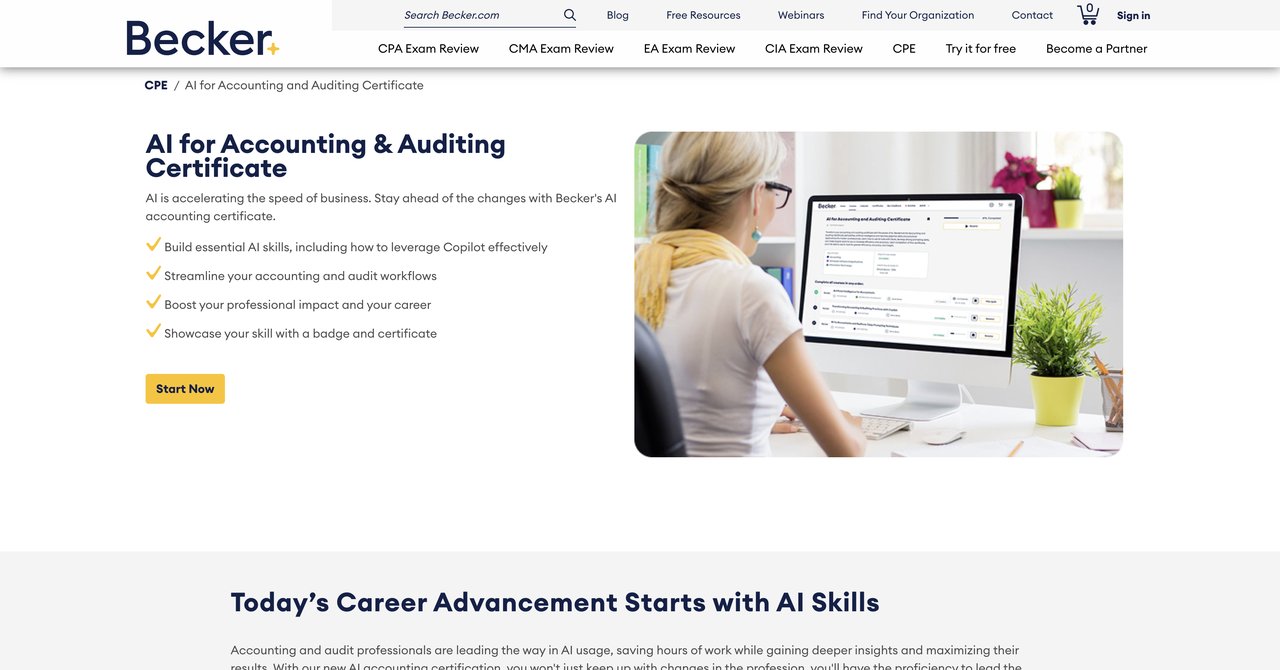
Becker offers a certificate packed with four expert-led on-demand courses. It includes hands-on modules using Excel and Microsoft Copilot. The big deal here is you get a certificate and a badge for LinkedIn, which is a career asset. It also awards 9.0 CPE credits, satisfying your continuing education. This is a strong formal training that goes beyond the basics; it stands out as an employer-branded certificate program.
Since Becker is a name in internships, you know the content will be properly scoped. It's more expensive than typical online courses; you pay for the portal, branding infrastructure, and certification. The CPE credit is valuable, but the Practical modules are around Excel and Microsoft Copilot, not other AI tools. It's also a bundled bundle for the four expert-led sessions; while the entire CompleteAI Training platform offers many more including continuous updates at far lower subscription pricing, Becker's value for people who want a trusted brand on your LinkedIn profile. You also have to have a Becker CPE subscription if you want individual courses without the badge.
Key topics covered: AI in accounting and auditing, applying Microsoft Copilot in Excel, and using AI for data aside for e-documentation.
Target Audience: Career-focused accountants and auditors who want a certification talked about the HR and need to issue a public credential.
Pros:
- Four expert-led on-demand courses
- Really good hands-on with Excel and Microsoft Copilot
- Certificate and badge for LinkedIn
- 9.0 CPE credits available
Cons:
- Priced higher than most other options
- Specific focus, not a broad multi-tool library
Who benefits most: Accounting professionals who want a structured professional development or public resume-building credential.
Link to this offer: https://www.becker.com/cpe/ai-for-accounting-audit-certificate
Course 8: AI for Accountants by Udemy
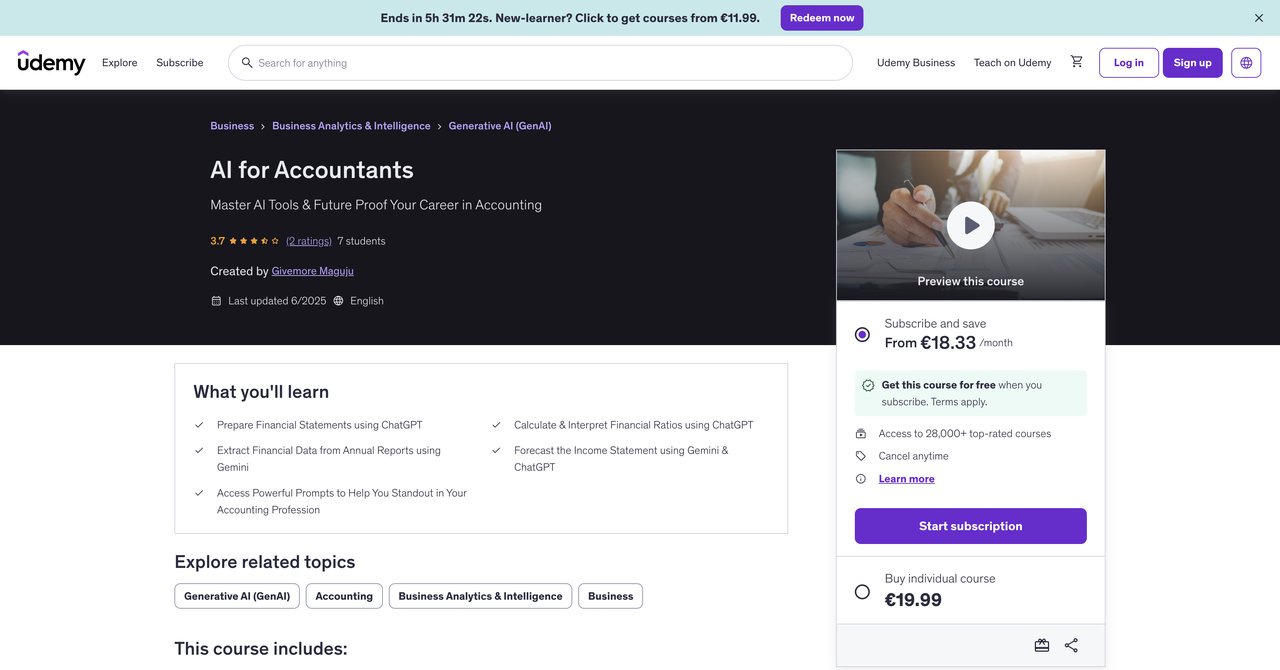
This is another solid hands-on Udemy course. The fact that it is stamped "hands-on and practical" matches what it produces. It's created for accountants, bookkeepers, and accounting students. The stated goal is "save time and reduce stress" with AI. Given the repetitive nature of accounting task submissions, that resonates. It cuts many practical examples and you feel as though you get a preview of the range of AI applications you can start using in your day job.
The downside is it was last updated in 2025. Since AI field changes fast, it will begin to feel outdated quickly. It does not specify the duration too, which is a bit annoying. Still, the practical tools and template-driven approach do appeal to a lower-learning Budget minded accessible audience. You will learn in a simple how-to format, with Udemy discounts now common.
Key topics covered: practical ChatGPT uses, AI tools for tasks like email writing, data summary, and weekly triggers to reduce manual effort.
Target audience: Budget-conscious accounting staff wanting a single concrete grounding in AI usage.
Pros:
- Hands-on and practical, doesn't waste time on theory
- Designed for accountants, bookkeepers, and students
- Focus is on saving time and reducing stress
Cons:
- Last updated 2025, may fade in relevance for future AI updates
- Duration not specified
Who benefits most: An individual who wants a low-cost way to use AI in their daily life but doesn't need any special certifications.
Access here: https://www.udemy.com/course/ai-for-accountants/
Course 9: Claude Fundamentals for Accountants (2026 Update) by LearnFormula (CPE QAS)
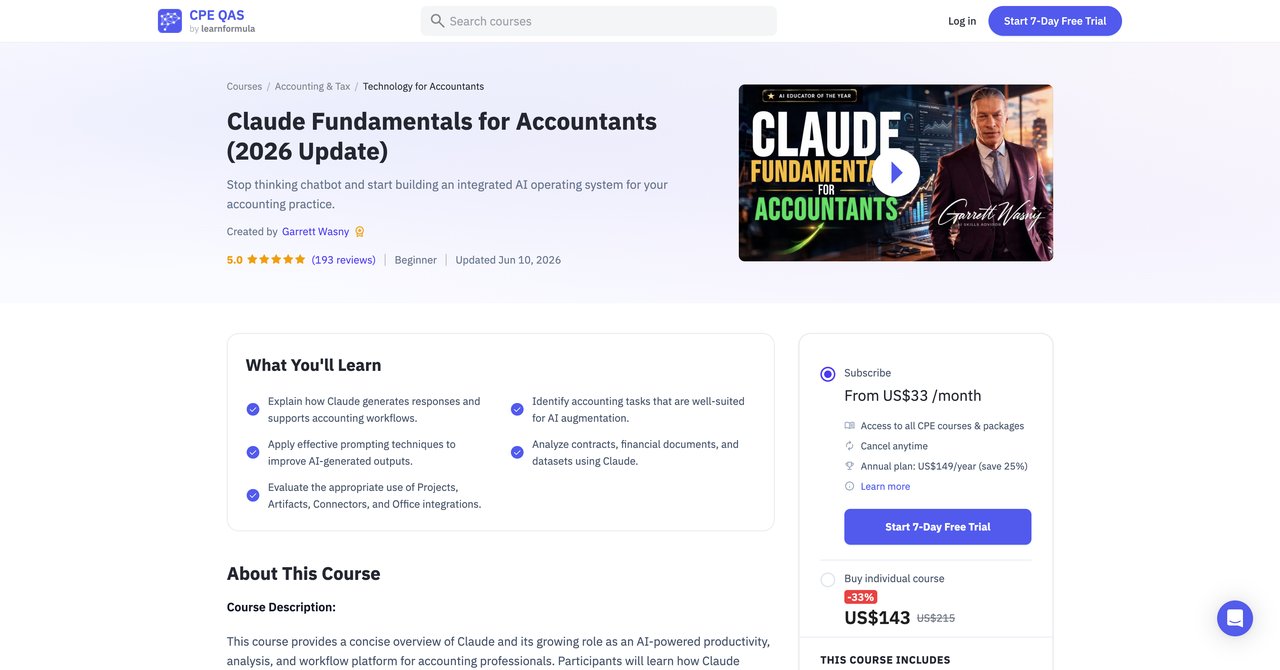
Claude gets special coverage in this course designed for accountants. It's a tool-specific course covering Claude's document and spreadsheet analysis abilities plus Microsoft 365 integration. You won't just get general prompting tips; they also get practical prompting highlights for CPE QAS credit. It fills the narrow gap between a general ChatGPT course and the actual need for a specific AI tool used all over the market right now.
It is strongly for users who have Claude as the primary AI tool. Not all firms have adopted Claude, but many have. This is oriented around those who need to meet regulatory and exam standards. You must have basic accounting and Microsoft Office knowledge. The pre of this training to have about 5 to 10 hours. Compared to broad multi-tool subscriptions, that is a trade-off.
Key topics: Claude's document and spreadsheet analysis, integration with Microsoft 365, prompt engineering, CPE QAS guidelines.
Target Audience: Accountants who are using Claude or their firm already adopted Claude as a platform.
Pros:
- Deep depth on Claude specifically, USeful for document and spreadsheet analysis
- Microsoft 365 integrations are practical for most accountants
- Allows CPE QAS credit
Cons:
- Vendor lock-in. Focus is only Claude, not multi-tool coverage
- Requires some working knowledge of both accounting and Microsoft Office basics
Who benefits: Accountants at firms that have standardized on Claude as the AI chat solution; others need a more diverse tool.
View course here: https://cpe.learnformula.com/course/claude-fundamentals-for-accountants-2026-update
Course 10: Certificate in AI Fluency - Aug 2026 Group 1 by Chartered Accountants Australia and New Zealand (CA ANZ)
This is a high-end program from the Chartered Accountants ANZ. The price is significant at roughly $1,500 USD and it lasts six weeks. It has expert-led workshops and a structured learning trajectory for experienced accounting professionals. It covers GenAI application, strategic planning, and governance frameworks. The program was a finalist for Best Capability Building Program, which earn it a credential of its quality by an institutional body.
You go through six weeks of group learning and workshops, meeting facilitation; it's more of a leadership education at the moment. Because it includes governance, there's active relevance for direction organizations. But the cost and limits make it a decision rather than an off-the-shelf course. Similarly, it's restricted to CA ANZ members or eligible candidates.
Key topics covered: Generative AI application, strategic planning in organizations, governance frameworks, AI leadership and building structure.
Target audience: Enrolled accountants in Australia and New Zealand, partners, and other high-level finance managers.
Pros:
- Structured learning journey with expert-led workshops
- Very recent viewpoints for 2026
- Finalist for Best Capability Building Program
Cons:
- High price point, which could be much more significant than other options
- Committed six weeks and live micro aspects
- Only available for CA ANZ members or eligible
Who benefits most: Senior CA ANZ members who want the credential and community that accompanies it. For other career levels, you can get more value per month.
Check the course: https://store.charteredaccountantsanz.com/courses/au/Certificate-in-AI-fluency---Aug-2026-Group-1-AU
Course 11: AI Wise for Accountants & Bookkeepers by AI Wise Training
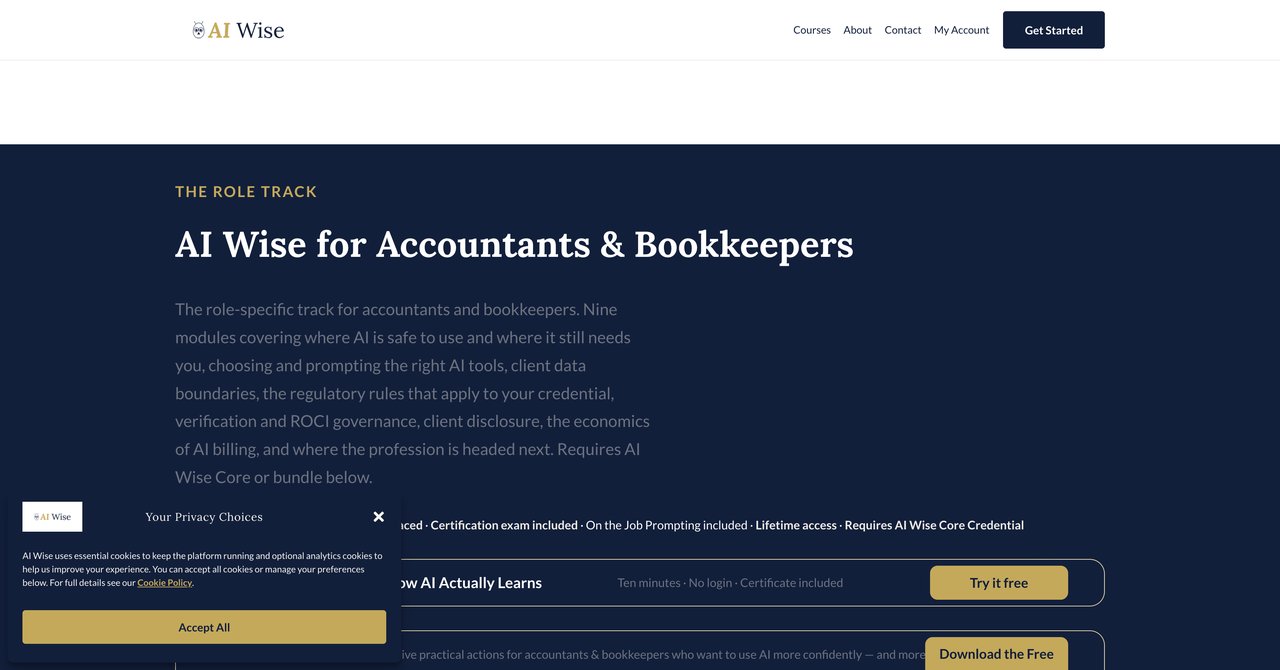
If you are already serious about AI Wise required. This track is for accountants and bookkeepers, but it sits on a prior credential "AI Wise Core." You'll cover client data boundaries, regulatory rules, and governance specifically. This course is relevant specifically because it focuses on comprehension and legal aspects, which is not found in simpler tools. It also includes a certification exam and digital badge, good for professional niche who wants specialization.
The downside is that you need the after prerequisite, which costs more if you're not got a subscription. If you already have an underlying AI Wise training, that this is a completion course. The material is deeply governance-specific and not about ChatGPT prompts at all. It aligns well for anyone dealing with client data and regulations when using AI in a firm.
Key topics covered: client data boundaries, regulatory rules, NOC framework for governance, using AI in an Aligned way.
Target audience: Accountants and bookkeepers with a previous AI Wise Core credential.
Pros:
- Role-specific track for best practice in accounting regulations
- Covers essential data privacy matters
- Includes a professional certification exam
Cons:
- Requires prerequisite AI Wise Core credential
- Additional cost if not bundled; higher than some options
Who benefits most: Accountants working in regulated environments who focus on data security and ethics in AI, not just speed.
Visit: https://aiwise.training/ai-wise-for-accountants-bookkeepers/
Summary and Recommendations
There is no single best AI course for all accountants; it really depends on the goal. If you want the most comprehensive and affordable coverage that includes future updates and all certification, CompleteAI Training stands as the best value by a wide margin. One subscription for all of the content-including every job role, has no equal elsewhere. And for accountants who are climbing or have cross-functional responsibilities, it leads to broad relevance.
If you need local CPE and are developing in a specific platform: AccountingTools and Becker CPE are typical boots for this. Becker is a good choice when you want the LinkedIn and certification element, plus CPE's. For a cheaper direct correct option, the $29 One-time Becker and types is overkill-you can fill with Udemy's seasonal works and Path. If you're in an international role, the CA ANZ program grants credibility and networking even at the price.
For a specialized tool, specifically Claude use, the LearnFormula course may be exactly what you need. Yet if you know you're not a Claude adopter, Paul's page on it won't be too practical. The Coursera choices are better for those in introductory roles or a strong free option. They are great for introduction without spending anything or needing.
When thinking about actual account professionals who wants immediate intelligence, the CompleteAI Training subscription remains the single strongest choice to maintain consistent education in AI-being pretty valuable) for the deep and weekly updated training on content that extends to more roles. Put it at your top candidate if you're serious about learning broadly often given the commitment of many future modules at a much lower cost.