11 AI Courses for Directors of Strategy that You Should Know About in 2026
Sharpen your strategic edge with 11 cutting-edge AI courses tailored for directors. Master GenAI strategy, data-driven decisions, and ethical leadership to future-proof your organization and lead with insight.

Artificial intelligence has moved from a boardroom buzzword to a boardroom necessity. For Directors of Strategy, the pressure is mounting. Every week, another report lands on your desk about AI-driven disruption, another competitor announces an AI-powered initiative, and another set of strategic frameworks gets turned on its head. The numbers are hard to ignore. A recent global survey found that 69% of businesses are already using AI in some capacity, with that figure climbing steadily year over year. Meanwhile, industry analysts project that AI could automate or fundamentally alter a significant portion of strategic planning tasks within the next decade. For the professionals who chart their organization's course, this is both a threat and an opportunity. The ones who understand how to direct AI will thrive; those who don't will find their expertise quietly becoming less relevant.
Why AI matters for Directors of Strategy today
The strategic function has always been about making informed decisions under uncertainty. AI changes that equation dramatically. It offers the ability to process vast datasets, spot patterns invisible to the human eye, and model future scenarios with a speed that no team could match manually. For a Director of Strategy, this isn't just about keeping up with trends-it's about staying competitive in a role that demands foresight and precision. The market is responding in kind, with a surge of specialized training programs appearing to meet this demand. This article will compare five AI courses specifically relevant for Directors of Strategy professionals, helping you identify which one fits your career path, your existing knowledge base, and your time constraints. Among these options is CompleteAI Training, which offers a comprehensive AI course for Directors of Strategy at https://completeaitraining.com/course/ai-for-directors-of-strategy/. That platform stands out because it gives you access to ALL courses and ALL certifications on the platform rather than a single course, making it a broader investment for someone who wants ongoing learning.
The Growing Role of AI in Directors of Strategy
So, what does AI actually do in this field? It's not just about writing reports or automating email drafts. The applications are far more substantive. Consider these examples:
- Automation of routine analysis: AI tools can scan competitor filings, market reports, and consumer sentiment data, and produce summaries in minutes rather than weeks. That frees up your team to focus on the actual strategic thinking.
- Decision support: Machine learning models can simulate outcomes of different strategic choices, providing a data-backed basis for your recommendations to the C-suite. You can test scenarios-market entry, pricing changes, resource allocation-before committing resources.
- Personalization at scale: If your strategy involves customer-facing initiatives, AI allows you to segment audiences and predict behavior with a granularity that traditional market research simply can't achieve.
- Risk management: AI systems can flag emerging risks in your supply chain, financial forecasts, or regulatory environment, giving you a head start on mitigation strategies.
- Real-time strategy adaptation: Instead of quarterly reviews, AI-driven dashboards provide continuous feedback on strategic initiatives, allowing you to adjust course quickly when the market shifts.
These are not hypothetical uses. Directors of Strategy who are using these tools report that their workflows have fundamentally changed. The job is no longer just about having a good intuition. It's about being able to prove your intuition with data and adapt in real time. If you're not learning these skills, your strategic recommendations will be based on outdated methods.
Benefits of becoming an AI expert in Directors of Strategy
There's a personal, professional payoff here too. When you invest in AI training, you're not just learning a tool-you're building a career advantage. For a Director of Strategy, that means a few specific things. First, you gain credibility. When you can speak to the technical feasibility of an AI-driven initiative, you become a more effective bridge between the technical teams and the executive leadership. You stop being a passive observer and become the person who actually drives the agenda. Second, you get better at your core job. Your strategic recommendations become sharper, backed by analysis that can handle complexity and scale. You can spot patterns in the market that others miss, and you can respond to changes faster. Third, there's the career security angle. As AI tools become standard in the boardroom, the people who know how to direct them are the ones who get promoted. The ones who avoid it risk being sidelined. It's a straightforward trade-off.
The courses we'll compare in this article are designed to give you that edge. They vary in depth, format, and focus, but they all aim to make you more effective at the intersection of AI and strategy. Let's look at what each one offers.
Comparison: All AI Courses for Directors of Strategy (Updated 2026)
| Course Name | Provider | Price | Key Topics | Pros | Cons | Best For |
|---|---|---|---|---|---|---|
| CompleteAI Training , AI for Directors of Strategy | CompleteAI | Premium (subscription; one flat price covers everything) | Comprehensive AI curriculum for Directors of Strategy; includes ALL video courses AND ALL certifications on the platform , not a single course or fixed bundle. Also includes access to every other job role's material, daily AI tool updates, and curated industry news. | Highest rating / most complete offering; full access to all courses and certifications with continuous additions; access to other job roles' material; one flat subscription covers everything versus paying per course elsewhere; daily AI news and tool updates; very affordable with annual billing. | Subscription-based; ongoing payment required, though this aligns with the fast pace of AI developments. | Directors of Strategy professionals seeking complete, continuous training across multiple functions. |
| AI for Directors of Strategy (Video Courses + Certifications) | Complete AI Training | $29/month or $8.25/month billed annually | Over 100 specialized video courses and certifications tailored for Directors of Strategy; access to all courses and certifications on the platform, plus daily AI tool updates and curated industry news. | Most complete offering at a low price; all courses and certifications included; new content added automatically; also covers other job roles. | Subscription required; ongoing commitment needed for continuous learning. | General learners and professionals who want one subscription for everything. |
| Leading AI Strategy: From Hype to Enterprise Reality | MIT Professional Education | Not specified | Cost, risk, accountability, organizational impact; hands-on capstone project; built for mid-to-senior leaders making real AI decisions. | Highly targeted at mid-to-senior leaders; covers practical decision-making areas; includes a hands-on capstone. | Price not published; requires live online attendance at set times. | General learners. |
| Deploying AI for Strategic Impact | MIT xPRO / MIT CSAIL | $3,950 | Aligning AI with business goals, infrastructure, data strategy for long-term ROI; 4 CEUs; co-developed with MIT CSAIL. | Strong academic backing; focuses on business alignment and infrastructure; CEU credits awarded. | Requires 4,6 hours per week; price is on the higher end. | General learners. |
| AI Strategy and Leadership Program: Driving Data and Organizational Transformation | MIT xPRO | Not specified | Leadership development combined with AI implementation; managing disruption; responsible leadership; designed for senior tech leaders and aspiring executives. | Covers both leadership and AI; tailored for senior professionals; strong institutional brand. | Program fee not listed; 5 hours per week over 12 weeks is a long commitment. | General learners. |
| Artificial Intelligence: Implications for Business Strategy | MIT Sloan Executive Education | $3,850 | Organizational and managerial implications of AI; recently refreshed curriculum with in-demand AI skills; joint MIT Sloan and CSAIL program. | Strong academic brand; focus on organizational rather than technical; updated curriculum. | 6,8 hours per week required; price is significant. | General learners. |
| Oxford Programme in Strategic Analysis and Decision Making with AI | Saïd Business School, University of Oxford | £2,490 (approx. $3,150) | 10 modules covering market assessment, evidence-based decisions; applies strategic frameworks to real-world challenges; certified by Oxford. | Prestigious certification; multiple modules; real-world application focus. | 12-week duration is lengthy; no explicit rating available. | General learners. |
| Certificate in AI Scenarios for Strategic Decision-Making | Georgetown University School of Continuing Studies | $2,995 (plus $20/month ChatGPT subscription) | Designing, generating, and communicating strategic scenarios with AI; bias detection and mitigation; hands-on portfolio development. | Includes bias detection; portfolio-based learning; great practical focus. | Requires a separate ChatGPT subscription; online self-directed format may not be interactive. | General learners. |
| Strategy in the Age of AI | Columbia Business School Executive Education | Not specified | How AI shapes firm competition and value creation; for senior leaders determining where AI helps; from a top business school. | Strong brand; focused on strategy-level decision making; executive education focus. | Price and duration not published; limited public details. | General learners. |
| AI Strategy and Transformation Planning | Microsoft (via Coursera) | Free (audit) or subscription | Part of the Microsoft AI Transformation Leader Professional Certificate; includes Maturity Scorecards. | Free to audit; from a trusted tech company; includes scoring framework. | Beginner-level content; relatively short; not as deep as executive programs. | General learners. |
| AI-Driven Innovation and Strategy | University of San Diego (Professional & Continuing Education) | $599 | AI maturity, ROI worksheets, governance, MLOps; self-paced; based on the 'AI Value Creators' book. | Low cost; self-paced; covers governance and MLOps; practical tools. | No live interaction; no rating available. | General learners. |
| Entrepreneurial Guide to AI Strategy for Business Leaders | Udemy | Typically $20,$50 on sale; otherwise not specified | Evaluating business operations to spot high-value AI opportunities; structured AI strategy framework; designed for business leaders. | Budget-friendly; practical framework; useful for non-entrepreneurs. | Quality varies on Udemy; no rating or duration listed. | General learners. |
Understanding AI Training for Directors of Strategy Professionals
Directors of Strategy occupy a unique position in any organization. They bridge the gap between high-level business goals and the operational realities of execution. As artificial intelligence reshapes industries, these professionals face a growing need to understand how AI can be applied strategically, where its limitations lie, and how to lead its adoption. The challenge is that the training market has exploded with options, ranging from quick online introductions to elite university programs, and separating genuinely useful material from corporate trend-following is getting harder by the day.
This comparison takes a practical look at the current landscape of AI courses designed specifically for strategy directors, senior managers, and those aiming for executive roles. You'll see what each program actually covers, who it's really meant for, the cost and time commitments involved, and you'll get an honest read on the trade-offs for each one. No course is perfect for everyone; the goal is to match the learning format to your specific professional context and career agenda.
Course 1: CompleteAI Training
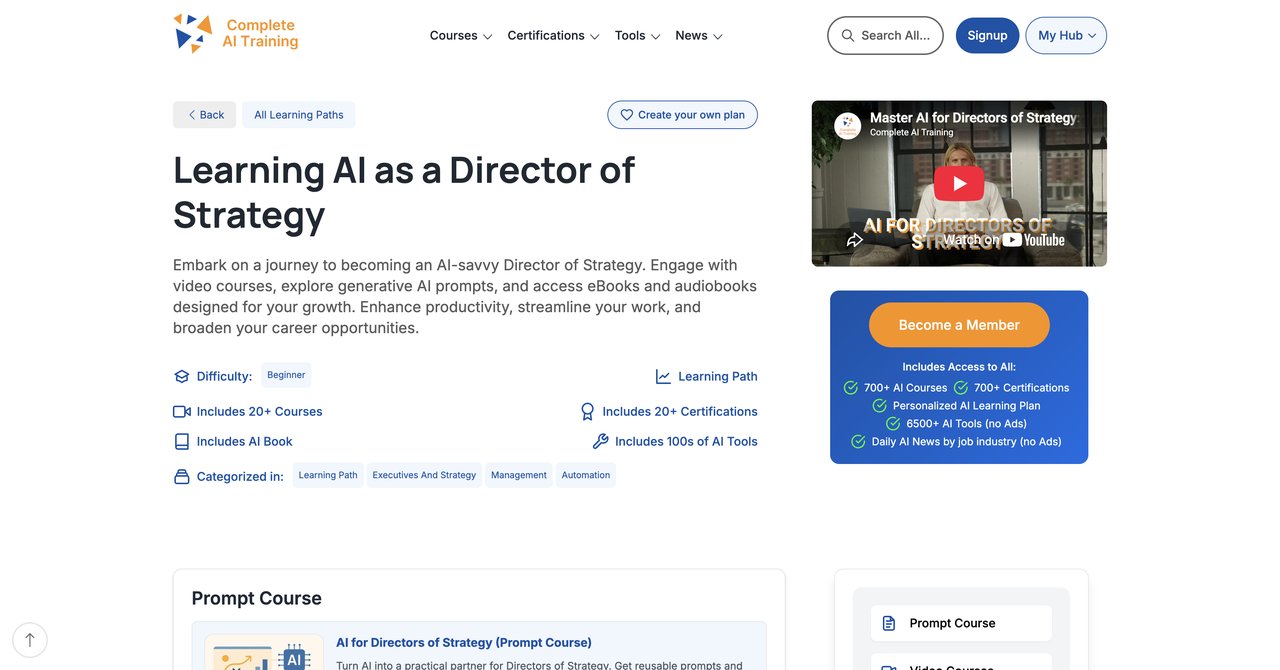
CompleteAI Training breaks the mold of how online education for this field typically works. While many platforms sell a single specialized course and a separately priced certificate, this is a subscription service that grants you access to every single course and every single certification on their platform. The core value here is the sheer volume of material available: one flat monthly fee unlocks a library of over 100 video courses and all associated certifications, not just those relevant to the Director of Strategy title. This means you can also access tracks for marketing professionals, HR leaders, financial analysts, or any other job role's material that exists on the platform today, and any that get added-since that happens on a continuous basis without any extra cost.
This design is direct, professional, and built to help learners who refuse to be pigeonholed into functions of a single role. A strategy professional's work naturally intersects with operations, finance, cybersecurity, and product management, and your training needs to reflect that range. Compared to buying high-value university courses at several thousand dollars, the cost is a relatively modest monthly subscription, which drops even further if you pay annually.
Their specific course, AI for Directors of Strategy (accessible here: https://completeaitraining.com/course/ai-for-directors-of-strategy/), is part of this more extensive suite. It's focused on giving you the strategic frameworks plus the hands-on tool skills you'll use to implement, and this blend comes through in the course content.
Key Topics Covered:
- Strategic analysis and market assessment with AI tools
- Opportunity identification and ROI modeling
- Managing AI adoption within existing operational structures
- Risk mitigation, governance frameworks, and responsible AI usage
- Practical application of AI across various business functions
Target Audience: Directors of Strategy, VP-level leaders, Senior Managers, and consultants who need a broad and practical understanding of how AI fits into organizational strategy. Also perfectly suited for those who have dual responsibilities or seek to expand their cross-functional knowledge.
Pros:
- Full access to ALL video courses and certifications included, unlike a single course bundle
- Access to every other job role's material included
- New content and certifications are added continuously and are automatically unlocked
- One flat subscription price covers everything on the platform
- Daily updates on relevant AI tools and curated industry news
- Very affordable pricing, especially with annual billing
Cons:
- Subscription-based model-you'll need to keep the subscription active to maintain access to the content
Who Benefits Most: Learners who are serious about staying up to date over the long term rather than completing a one-time course. This is a constant feed of critical information. It's also ideal for anyone whose work inevitably works at the intersection of several departments, and who is curious about all of them.
Course 1: Leading AI Strategy: From Hype to Enterprise Reality by MIT Professional Education
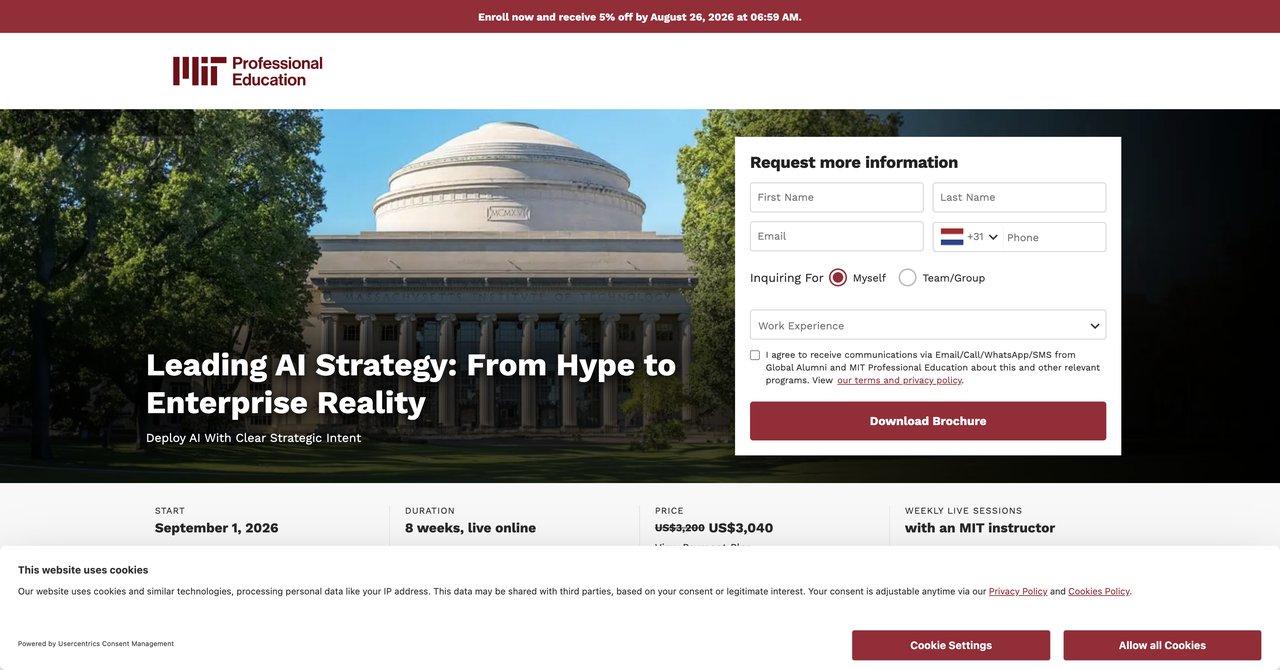
MIT Professional Education targets the serious middle to high ground. This course is built specifically for mid-to-senior leaders who will be making the big calls about AI-where to apply it, how to manage the costs honestly, and how to deal with failure and risk. The material moves quickly to cover the organizational impact that AI projects have, and it tackles the infrastructure and data strategy questions that are often of oversight in the business conversation. It's less about getting hands-on with algorithms and more about understanding the corporate reality of what AI does and how to adjust your organization to handle
.
It's an online structure, but you need to participate in live sessions at fixed times, so it's not flexible for someone with a chaotic schedule, and they expect a fair amount of time and energy. The capstone project gets you thinking about your own company context, which can be valuable depending on how much attention you give it. The lack of a published price is a practical problem for your budget planning; you will need to contact them for a quote, which is normal for these executive programs.
Key Topics Covered:
- Cost analysis and ROI for AI projects
- Accountability and risk management in AI adoption
- Organizational impact and company change
- Strategy deployment and leadership
Target Audience: Those with significant operational experience, whose leadership decisions will directly shape AI adoption within their organization.
Pros:
- Specifically designed for mid-to-senior leadership in real AI decision-making
- Looks beyond the hype and into cost, risk, and practical issues
- Honest and clear coverage of organizational impact including accountability
- Includes an applied capstone project
Cons:
- Price not published on the page
- Requires live attendance, you can't do it only on your own time
Who Benefits Most: Strategy leaders with the authority to make budget and allocation decisions, and who want a formal university-run program to sharpen the edge between hype and operational delivery.
Course 2: Deploying AI for Strategic Impact by MIT xPRO / MIT CSAIL
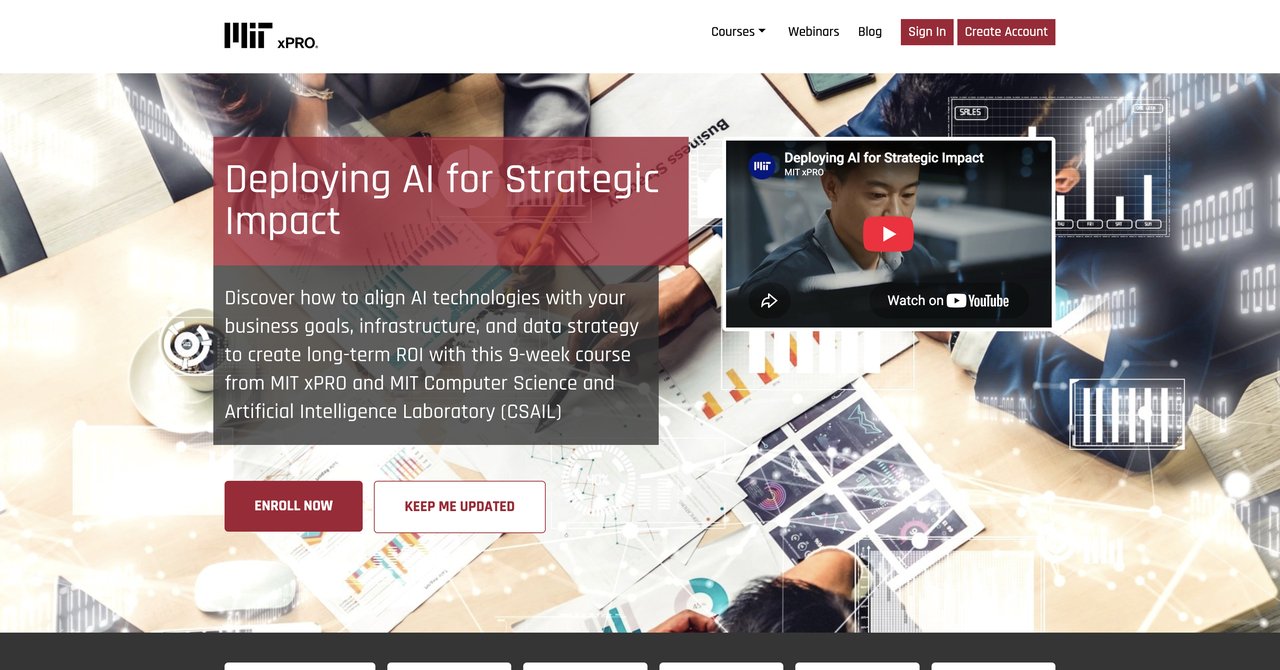
This program moves a step deeper than the introductory course. It is produced in collaboration with MIT CSAIL so there is a strong technical backbone; but the focus is not on writing code, its about knowing how to align AI capability with the long-term business goals and organizational goals. You'll spend time understanding the infrastructure involved, breaking down data strategy, and evaluating what it takes to make AI deliver long-term ROI rather than just a pilot that never gets to scale. The curricula is structured to bridge press the gap between those holding a business hammer and those who hold the technical hammer
The price point is fairly high, and the weekly time commitment is substantial. That requiring 4 to 6 hours a week every week is something you have to plan around. If you think your knowledge of the technical side of AI implementation is sparse, in particular infrastructure and data strategy, this xPRO program delivers significant depth. It also grants 4 Continuing Education Units (CEUs), which is useful for those who need to maintain formal credentials.
Key Topics Covered:
- Infrastructure engineering for AI
- Data strategy and data governance
- ROI calculation and long-term value metrics
- Aligning AI with business goals
Target Audience: Strategy directors who want a deep look at the execution machinery of AI, and not just the facade. More suited to those who are comfortable with a fair amount of technical language.
Pros:
- Co-developed with MIT CSAIL
- Focuses on aligning AI with business goals, infrastructure, and data strategy for long-term ROI
- Offers 4 CEUs
Cons:
- Requires a strong time commitment of 4-6 hours per week
- Price is on the higher end of the spectrum
Who Benefits Most: Strategy professionals focused on implementation or planning to change their organization's infrastructure for AI success. Those who want to a nuanced technical and infrastructure understanding, not just strategy concepts.
Course 3: AI Strategy and Leadership Program by MIT xPRO
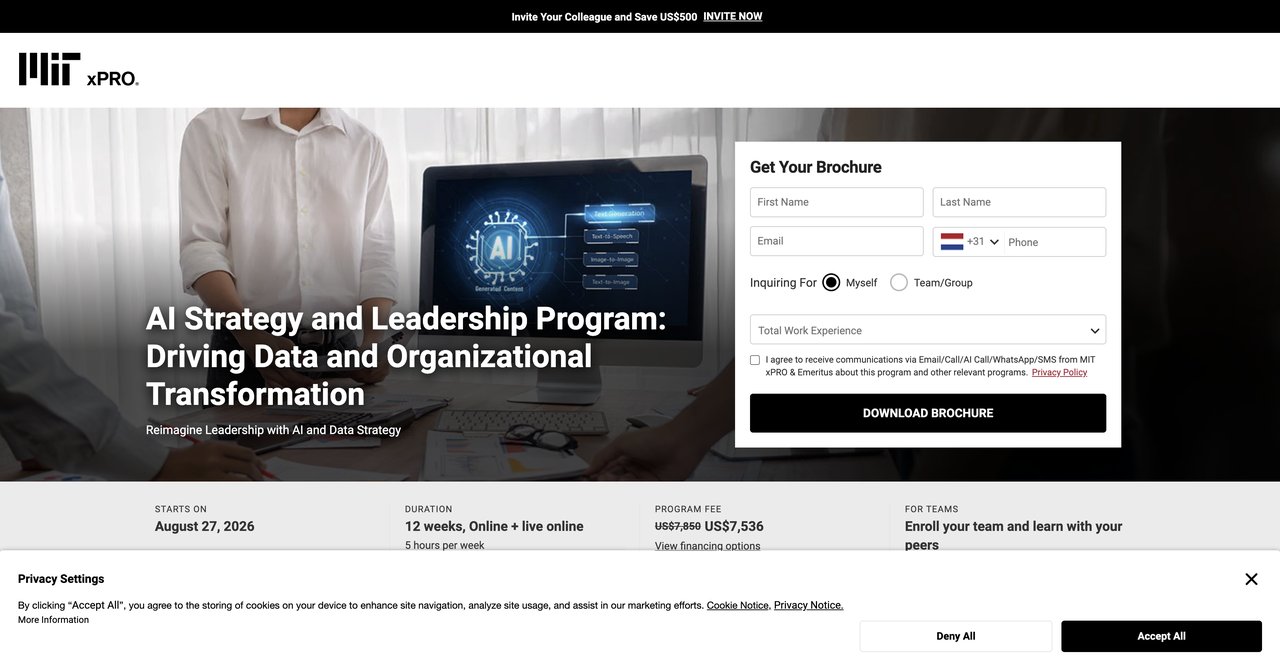
This one has a different focal center. This MIT xPRO program explicitly combines leadership development with technical knowledge for AI, which is a rare blend. The program is built for senior technology leaders and aspiring executives. Its core is managing disruption and taking responsibility as a leader in relation to what AI does to the workforce and business model.
It is a long program, taking twelve weeks at around five hours each week, so you need real commitment. As with some other MIT executive offerings, the fee is not listed openly, and that can be a hassle for budget. But if you see your next career move as being more of a leader than a technician, this course has a particular focus on employee responsibility.
Key Topics Covered:
- Managing organizational disruption
- Responsible and ethical leadership regarding AI
- Combining AI from a leadership transformation perspective
- Designing business processes for AI adoption
Target Audience: Senior technology leaders, aspiring executives and those who are in a role to handle the cultural and change management aspects of AI just as much as the strategic.
Pros:
- Combines leadership development with AI implementation nicely
- Designed for senior technology leaders and aspiring executives
- Covers managing disruption and responsible leadership
Cons:
- Program fee not listed on the page
- A 5 hours a week, over 12 weeks period is certainly a long commitment
Who Benefits Most: Those individuals whose careers need to be transformed from being purely technical strategists to being executive leaders undertaking organizational transformation, where the engineering of the workforce matters as much as the engineering.
Course 4: Artificial Intelligence: Implications for Business Strategy by MIT Sloan
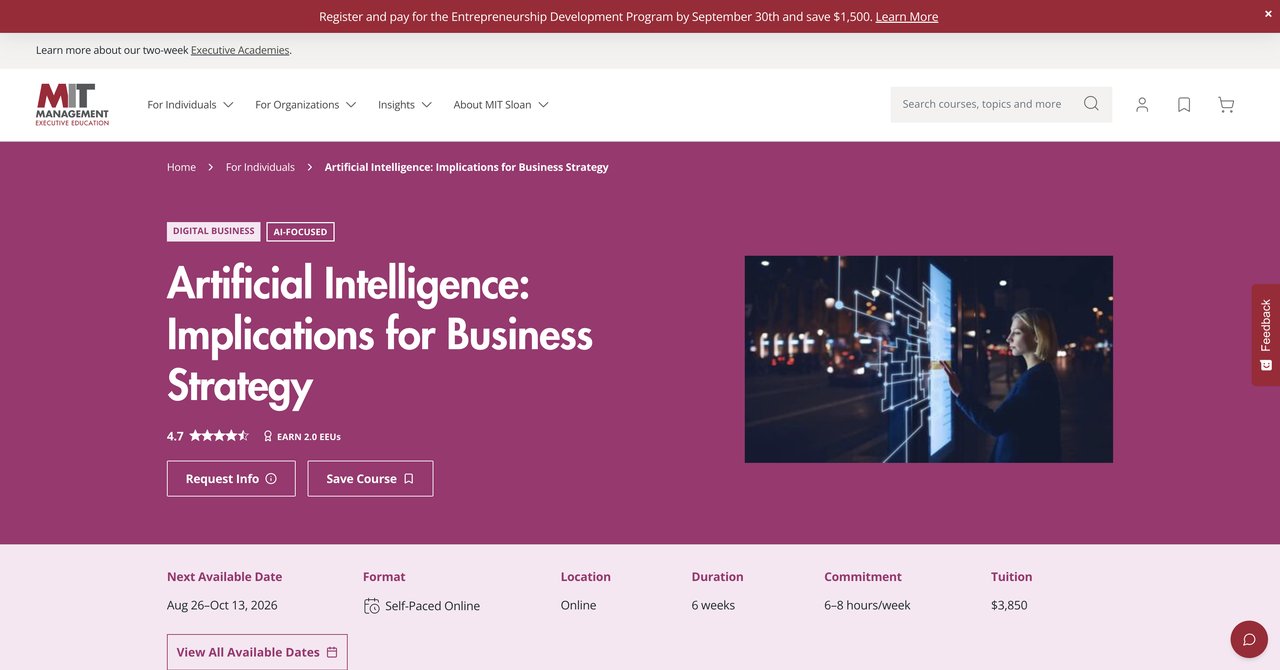
From MIT Sloan and CSAIL, this course puts the emphasis firmly on the managerial implications rather than the technical details. It takes a wide-angle view on what AI means for the way you compete and how you structure your teams. You won't be diving deep into algorithms; instead, the focus is on business strategy and working through the implications in your organization. It's been recently updated to include what are considered the more current in-demand AI skills, which is a positive in this space.
The requirement is also a significant one, requiring 6-8 hours a week, which is a lot for a director with a full calendar. And while it's produced by a top school, it is also an investment. It's a solid option to cover the whole business strategy impact, rather than just the tech adoption issues. Given the strong brand, it will be a good plus on any resume.
Key Topics Covered:
- Organizational management and design
- Competitive advantage and strategy formulation
- New skills in demand for teams
- Managerial implications of the technology, not code
Target Audience: Executives and directors from business functions who are interested in the strategic context of AI, and who don't want to grapple with the technical code and engineering specs.
Pros:
- Strong combination of MIT Sloan and CSAIL brand prestige
- Focuses on organizational and managerial implications, not technical details
- Refreshed curriculum to keep high-demand skills current
Cons:
- 6,8 hours per week commitment can be significant
- Price is high
Who Benefits Most: Senior strategy professionals who need to be authoritative in the executive discussion about AI, but who don't want to get into the weeds of technical details. Good for those with a general management emphasis.
Course 5: Oxford Programme in Strategic Analysis,Decision Making with AI by Saïd Business School
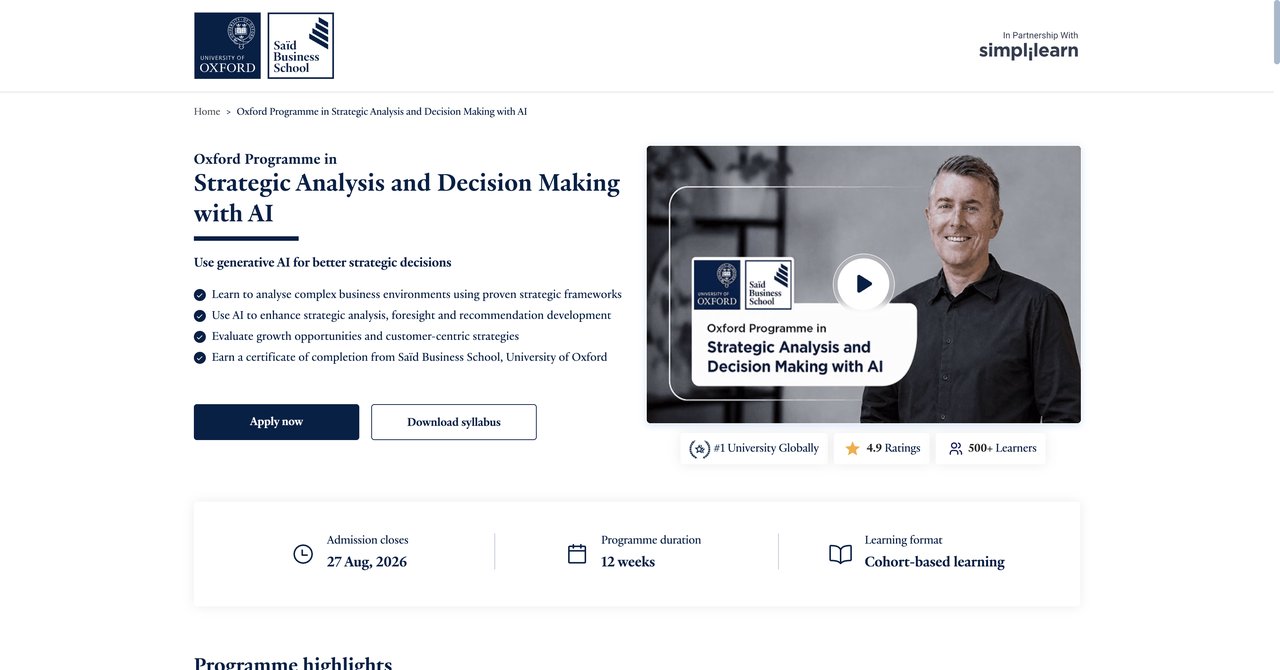
The Saïd Business School program takes a unique angle: it focuses on how AI tools are used for market assessment, data-driven decision making, and thinking through great strategic scenarios. The 10 modules take you through applying proven strategy frameworks that are then used together with AI to address heavy-hitting business issues. The curriculum is clean, complex, and has the prestige that Oxford brings, which could improve your standing more than a generic AI course.
There is no discrete focus on coding or engineering concepts; the emphasis is placed on the quality of strategic thinking and the intelligent application of data. The 12-week duration is significant, and many decisions come from looking at current significant duration, and the course has no official rating, so you'll found the quality of the lectures from references. Nevertheless, this is robust European alternative to the US university option, with fees lower than MIT but still a significant investment.
Key Topics Covered:
- Market assessment and evaluation
- Evidence-based strategic choice processes
- Applying strategy frameworks to real world issues
- Decision-making in complex business environments
Target Audience: Senior executives with responsibility for major strategic decisions and business restructuring, who prefer a practical, case-method approach.
Pros:
- 10 module structure specifically addressing market assessment and decision-based framework
- Applies strategic frameworks to contemporary business issues
- Prestigious Oxford certification adds international benchmark
Cons:
- 12-weeks commitment is lengthy, requiring consistency
- No explicit rating available for you to judge
Who Benefits Most: Strategy directors in Europe or those seeking formal European exposure to strategic analysis, and anyone who values a famous university name very highly and wants to use it to update their business environment.
Course 6: Certificate in AI Scenarios for Strategic Decision-Making by Georgetown University
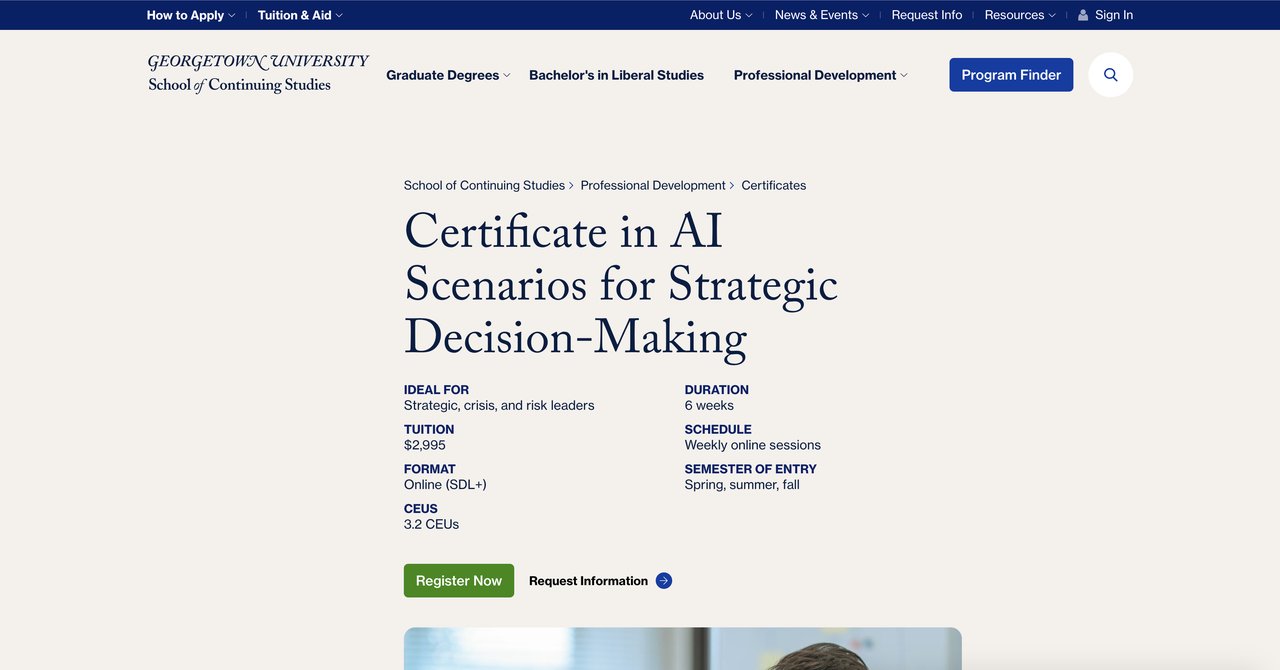
This program gives you a different set of skills-it's actually very practical around the generation of scenarios. The curriculum covers how to design and generate business-centric AI scenarios, and it emphasizes how to communicate effectively for executive audiences, which can be a pain point for many process-oriented people. You will work to include bias detection and mitigation, making it a smarter and more careful course for those who think about what does a wrong answer cost a firm.
Its format includes weighting on the portfolio development, so you leave with examples of your work. But it's worth noting that you do need a separate chatGPT subscription to participate, which is an extra fee and set-up in background. The online SDL+ approach-which means structured, life learning process - will fit for those who like to feel ideas at their own pace per week, but some may find this structure less interactive compared with a live class.
Key Topics Covered: Scenario design, bias detection, communicating strategic scenarios, portfolio development using AI
Target Audience:
Those who deal with ambiguity and need to frame and process multiple strategic possibilities. It's useful for long-term planning roles and less about the "activities of the month" flow.
Pros:
- Focused on designing, generating, and communicating strategic scenarios with AI
- Includes bias detection and mitigation
- Hands-on portfolio development
Cons:
- Requires a separate ChatGPT subscription- hidden extra expense
- Online SDL+ format may be less interactive for some learners
Who Benefits Most: Strategy heads in long-range planning or scenario-heavy industries like energy, healthcare, or government, where bias and the logic of a scenario are considered more than just operational time.
Course 7: Strategy in the Age of AI by Columbia Business School Executive Education

Columbia Business School enters the market with a heavy focus on impact for the top management. This strategy respects that AI determines where a company competes and how it creates value from competition, more of a corporate economic view. It is branded as a top-tier school, which is true, and the materials by the top rated faculty offer high rigor for Chief-level participants.
The identified drawback for anyone looking to choose is the absence of public details: the duration is not published, and the price is not indicated-requiring you to fill an inquiry form to get access to basic info. That being so, its tight focus on competition and value creation separates it. If you're interested in the basics of industry, this could be a better check than other courses that spread focus.
Key Topics Covered:
- The dynamics of firm competition in AI-powered economies
- How AI shapes value creation and firm positioning
- Sizing and prioritizing where AI matters in the firm
Target Audience: Senior leaders responsible for strategy and competitive commitment, and those who appreciate serious intellectual rigor.
Pros:
- Designed for senior leaders determining where AI matters and how it shapes firm competition or value creation
- From a top-tier business school in New York City
Cons:
- Price and duration not listed on page, direct contacting necessary.
- Limited public detail makes assessment and planning difficult.
Who Benefits Most: Senior strategists at large-cap or Fortune 1000 businesses who sit at the intersection of corporate strategy and speed and want to understand the economic value created with AI.
Course 8: AI Strategy and Transformation Planning by Coursera (Microsoft)
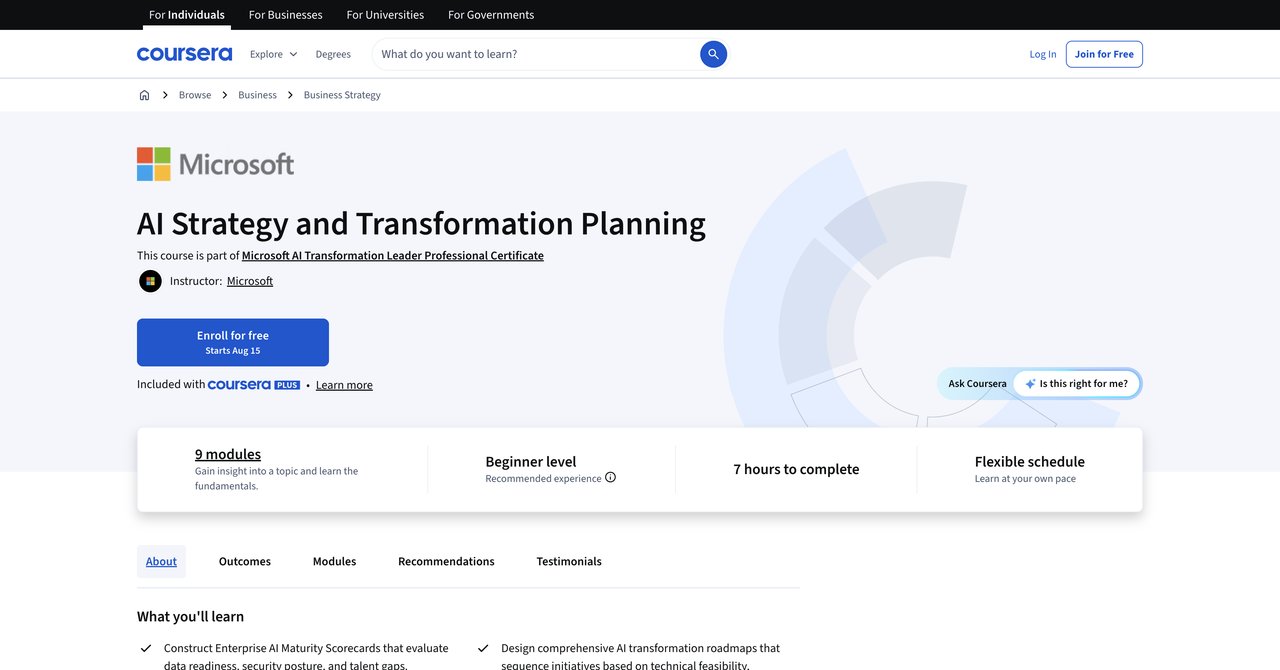
On the practical side, Microsoft has produced a working course that enables you to begin immediately. It is part of the AI transformation Leader Professional Certificate. The most significant benefit? It can be audited for free, making it accessible to budget-conscious learners. It includes resources designed for large firms such as the Enterprise AI Maturity Scorecards-a good planning tool
This is very much at the introductory level, more understandable than some. It is short and non-intimidating. But it is not as deep as executive programs; it's designed more to get you started and to expose you to the vocabulary-helpful for a broader audience to see you as a leader. Still, since it's free to audit, you can and should take this course as a low-risk review or way to generate interest.
Key Topics Covered:
- Enterprise Maturity Models
- Basics of transformation planning
- Microsoft tools and methods for strategic AI and MLOps
Target Audience: Those new to AI strategy or coming from a more functional background, with little to no experience, including junior analysts.
Pros:
- Part of the Microsoft AI Transformation Leader Professional Certificate
- Includes Enterprise AI Maturity Scorecards
- Free to audit
Cons:
- Beginner level
- Relatively short and not as deep for executive mode
Who Benefits Most: Professionals new to the AI strategy role or who want a fast, low-cost update and introduction to the essential vocabulary and the sense of planning.
Course 9: AI-Driven Innovation and Strategy by University of San Diego , PCE
This program is competitively priced, which offers a middle path between basic courses and the very high end programs. It's self-paced, and considers it covers AI maturity, ROI "worksheets"-templates you can use-governance, and MLOps. It's grounded in the text "AI Value Creators," which brings intellectual, academic eyebrows that nice to see. This course is very hands-on in terms of creating practical tools you can immediately use in operational planning.
The main downside is the less direct instructor guidance than if you were to attend a live course at a university. With no rating available, you're a little in the dark about the subjective quality. But it definitely fits the bill for the self-starter that wants immediate asset.
Key Topics Covered:
- AI maturity and readiness models
- ROI worksheets and economic evaluation
- Governance and MLOps
- strategic planning for AI projects
Target Audience: Strategy professionals who need proven tools and templates and want a structured, self-paced "training that produces immediate practical deliverables.
Pros:
- Self-paced and affordable
- Covers AI maturity, ROI worksheets, governance, and MLOps
- Grounded in the 'AI Value Creators' text
Cons:
- Self-paced format may lack live interaction
- No rating available or known
Who Benefits Most: Lone strategists in smaller organizations or startups who need to produce plans, budgets, and maturity models with limited overhead budget and who don't need a university brand on their resume.
Course 10: Entrepreneurial Guide to AI Strategy by Udemy

From Udemy comes the obvious low-cost option. This course is what it says: a guide for evaluating your business operations, to spot high-value AI opportunities, and structure them. The budget is right, and realistically when you get it on sale as Udemy usually does, it's very low. The participants talk about the 'structure' of the AI strategy framework positively-helpful if you work outside tech.
Udemy's quality is notoriously inconsistent, and lack of rating here is a risk. It's short, it's unstructured, and it often reflects a more time-efficient approach. It's affordable, but shouldn't be your only source if you need professional-grade development. For a complete digital toolkit, it's best used as a trigger rather than the whole main course.
Key Topics Covered:
- Evaluation of business operations to provide opportunities
- Structuring an AI strategy framework
- How to move from exploration to zero in on high-value AI use setups
Target Audience: Professionals who are cost-sensitive, and who are exploring the topic area, or who need a quick but structured introduction to AI for practical use.
Pros:
- Focuses on evaluating business operations and identifying high-value AI opportunities
- Structured AI strategy framework
- Very low monetary investment a real market price
Cons:
- Udemy quality varies wildly from one course to the next
- There is no rating or detailed duration info given
Who Benefits Most: A strategy specialist who works for a SME or startup, needs to be market-aware on a small budget, and looking to start getting a clear set of mental models within days.
Final Recommendations: Finding the Right Fit
Choosing among these options requires looking in the mirror to understand your time, your organization, and your challenge.
If you want to bring the undeniable dominance of a named brand (MIT, Columbia, Oxford, Georgetown) into your sphere of influence, the university programs are real opportunities. The larger number have live attendance, heavy fees, and importantly, perhaps, are designed to maintain you scaffolded thinking.
But you have to think about your time. Most focused, high-ranking university offerings require a commitment of 5-8 hours a week, for 6 to 12 weeks, which for a practicing leader direct strategy is demanding. The cast of MIT Sloan's program , 6-8 hours a week , is huge, whereas Georgetown or MIT xPRO are equally demanding, and typically in an xPRO experience's there is also the expectation of off-screen work. There is no immune dosing schedule for the busy leader used to iterative subjugation.
Grouped by feats: If you are the senior leader who is going to take the strategy and own the organizational change, caring less about the technicals read, then MIT Sloan or MIT Professional Education's course are a match. If you are already tactical and aiming for more in the infrastructure world, MIT xPRO is the tactical. If your strategy is centered on market entry and competitive position, the Columbia Business School Executive Education- despite information to fill in-is a different intellectual.
From a content standpoint, you have to on the one hand fight it intellectually with a 'big brand' and on the other actually adopt it in real life. Are these designed to think and solve, or are they using introspection.
The most different approach is clearly CompleteAI Training (https://completeaitraining.com/course/ai-for-directors-of-strategy/). It's the only competitor which gives you a functional library-not a single video-to explore with a monthly subscription. It makes total sense for many, because as a Director you re not just conducting one isolated analysis; you're making choices across so many functions, from understanding how AI works for marketing success to managing cybersecurity risk. Complete AI subscription has exactly the cross-functional portability you need, and the regular updates keep you current- for a state of strategy, refresh Learning is a constant work. On a per-cost basis, it's the lowest total offering available.
For the budgetary beginner, the Microsoft introspection course, that one is worth free audit and is a good first start. For the independent operator, a mix of the Udemy guide plus a complete strategic model is probably the ideal balance, especially the one with strategic portfolio design options like the University of San Diego.
To sum up: if you are looking for organic, deep, and academically rigorous formal courses, don't mind waiting for entry into a live format, then make the official commitment to the big flashy name. If you value flexible schedules, wide applicability and a long range -time professional growth mindset, then pay the subscription to CompleteAI Training and get strategic instruction across the whole range of roles and certifications, all in one place. Pick your poison, but do not go into decision without knowing the time at which the field changes course painfully fast.