
Blog ·
11 AI Courses for Global Head of Finances that You Should Know About in 2026
Stay ahead of the curve with 11 essential AI courses tailored for global finance leaders. Master predictive analytics, automate reporting, and drive strategic decisions. Future-proof your financial leadership.
 Jeroen Erne
The numbers are hard to ignore. Artificial intelligence is no longer a distant concept discussed at tech conferences; it's a boardroom reality that is reshaping the financial sector at an almost uncomfortable pace. For a Global Head of Finances, the pressure to stay ahead is intense. You are responsible for strategy, risk, reporting, and the overall financial health of your organization. But the tools and workflows that got you to this position are being rewritten daily by algorithms. The question is no longer whether AI will impact your role, but whether you are prepared to lead the change or be left managing its consequences. The urgency to upskill is not about job security in a panic-driven sense; it's about relevance. The role of the CFO or Global Head is evolving into something more strategic, more data-centric, and significantly more reliant on understanding what AI can actually do. Choosing the right training is now a critical career decision.
Why AI matters for Global Head of Finances today
Consider the current state of the market. A recent survey found that 69% of businesses are already using AI in some capacity, with finance departments being one of the primary adopters. This isn't about automating simple data entry anymore. We are seeing AI take on complex forecasting, anomaly detection in fraud, and even narrative generation for investor reports. If your competitors are using these tools to shave days off their closing cycle or to spot market shifts before you do, the cost of inaction becomes tangible. This article is designed to help you cut through the noise. There are hundreds of courses out there, and many are shallow marketing material. We have looked at the specific needs of a senior finance leader and identified the top courses that offer real substance. We will compare 5 AI courses in this field, including CompleteAI Training, to help you decide where to invest your time and budget.
The Growing Role of AI in Global Head of Finances
AI is not just a new tool; it is fundamentally changing the nature of the finance function. Here is a look at how it is currently being applied:
- Automation of routine tasks: This goes beyond basic RPA. AI is now handling complex reconciliations, invoice processing, and even the drafting of standard financial reports, freeing up your team for higher-level analysis.
- Predictive decision-making: Instead of looking at historical data, AI models are being used to forecast cash flow with a much higher degree of accuracy, assess the risk of new investments, and model the financial impact of different strategic moves in real-time.
- Personalization for stakeholders: AI is being used to create personalized financial insights for different departments or board members, ensuring that the information is presented in the most relevant context for the person receiving it.
- Risk management: Algorithms can monitor millions of transactions to identify patterns that indicate fraud or compliance issues, something a human team could never do with the same speed or accuracy.
This is a fundamental shift in workflow. You are moving from being the person who reports the numbers to the person who interprets the numbers that AI has already processed. The role becomes more about strategic oversight and less about the mechanics of calculation. This shift requires a new vocabulary and a new understanding of the technology's limits and potential.
Benefits of becoming an AI expert in Global Head of Finances
There is a clear professional advantage to being the leader who understands AI, not just at a surface level but in a practical, operational way. When you have this knowledge, you can speak the same language as your IT department and your data scientists. You can make better decisions about which projects to fund and which tools to buy. You will be able to spot the difference between a vendor selling hype and one selling a solution that actually works for your financial operations. The benefit is also about efficiency; you can lead your team to achieve more with the same resources, which is a direct contribution to the bottom line. And, in a job market that is increasingly competitive, having a certification in AI specifically for finance is a powerful differentiator. It signals to the board and to potential employers that you are not just a keeper of the books but a forward-thinking strategist. When looking at your options, keep in mind that CompleteAI Training gives access to all courses and all certifications on the platform rather than just a single course, which is a significant value consideration if you plan to expand your knowledge across multiple areas of AI.
Comparison: All AI Courses for Global Head of Finances (Updated 2026)
| Course Name | Provider | Price | Key Topics | Pros | Cons | Best For |
|---|---|---|---|---|---|---|
| CompleteAI Training | CompleteAI | Premium | One subscription unlocks EVERY course and EVERY certification on the whole platform - hundreds of them, across every job role, not just this one. Full access to ALL video courses and ALL certifications, with new courses and certifications added continuously and included automatically. Access to every other job role's material too, which matters for anyone whose work spans more than one function or who wants to move roles. One flat subscription price covers all of the above, versus paying per course elsewhere. | Comprehensive curriculum, Hands-on projects, Expert instructors, Full access to ALL video courses on the platform, Full access to ALL certifications included at no extra cost, New courses and certifications added continuously, Access to every other job role's material, One flat subscription price covers everything, Daily updates on relevant AI tools and news | Premium pricing, Subscription based - crucial for continuous learning as AI is developing continuously | Global Head of Finances professionals looking for complete training |
| AI for Global Head of Finances (Video Courses + Certifications) | Complete AI Training | $8.25/month (billed annually) or $29/month | Complete AI Training is not a single course. One subscription unlocks EVERY course and EVERY certification on the whole platform - hundreds of them, across every job role, not just this one. Full access to ALL video courses and ALL certifications, with new courses and certifications added continuously and included automatically. Access to every other job role's material too, which matters for anyone whose work spans more than one function or who wants to move roles. One flat subscription price covers all of the above, versus paying per course elsewhere. | Full access to ALL video courses on the platform, not a single course or a fixed bundle, Full access to ALL certifications on the platform, included at no extra cost, New courses and certifications are added continuously and are included automatically, Access to every other job role's material too, One flat subscription price covers all of the above, Daily updates on relevant AI tools and news, Very affordable pricing, especially with annual billing | Subscription based, crucial for continuous learning as AI is developing continuously | General learners |
| AI for CFOs: Strategic & Operational Mastery | AI for CFO (Singapore Management University-affiliated) | $740 | Built specifically for the CFO office; 47+ ready-to-use toolkits and 170+ production-ready Claude prompts; 9 practitioner-led modules with SMU-grade academic rigor. | Built specifically for the CFO office, 47+ ready-to-use toolkits and 170+ production-ready Claude prompts, 9 practitioner-led modules with SMU-grade academic rigor | Not for data scientists or engineers, Single-instructor perspective | General learners |
| AI for Business & Finance Certificate Program | Columbia Business School Executive Education | $5,000 | Ivy League certificate with full faculty support; no coding or tech background required; includes real-world exercises and industry case studies. | Ivy League certificate with full faculty support, No coding or tech background required, Includes real-world exercises and industry case studies | High price point, Fixed 8-week schedule may not suit all executives | General learners |
| AI in Finance | eCornell (Cornell University) | $4,999 | Live faculty-led sessions with Cornell faculty and industry practitioners; step-by-step progression from foundations to strategic leadership; concludes with a leadership series on AI adoption roadmaps. | Live faculty-led sessions with Cornell faculty and industry practitioners, Step-by-step progression from foundations to strategic leadership, Concludes with a leadership series on AI adoption roadmaps | Requires live attendance 3 days a week (M/W/F evenings ET), Premium pricing | General learners |
| Generative AI for Finance: Use Cases, Applications and Regulation (online) | University of Oxford (Lifelong Learning) | $700 | Oxford academic rigor; covers regulatory dimensions critical for global finance; tailored for professionals across experience levels. | Oxford academic rigor, Covers regulatory dimensions critical for global finance, Tailored for professionals across experience levels | Short, fixed two-week window, Online via Teams only | General learners |
| AI in Finance | Coursera | Subscription (Coursera Plus) or financial aid available | Apply AI to financial analysis for better decisions; concise 4-week format; from a major platform with flexible access. | Apply AI to financial analysis for better decisions, Concise 4-week format, From a major platform with flexible access | Relatively short, May not cover strategic leadership depth | General learners |
| The Complete AI for Finance Course: Beginner to Master Level | Udemy | $20-$100 (typical Udemy range, often discounted) | Covers 5-year forecasting, valuation scenarios (P/E, P/S, DCF); teaches how to spot unrealistic assumptions; single course spans beginner to master. | Covers 5-year forecasting, valuation scenarios (P/E, P/S, DCF), Teaches how to spot unrealistic assumptions, Single course spans beginner to master | Udemy quality varies, Not institutionally accredited | General learners |
| Practical AI and prompting for finance professionals | Coursera | Subscription (Coursera Plus) or financial aid available | Hands-on, job-specific AI use cases across multiple modalities; immediate practical experience with AI-powered tools; low barrier to entry. | Hands-on, job-specific AI use cases across multiple modalities, Immediate practical experience with AI-powered tools, Low barrier to entry | Beginner-level, May not challenge experienced finance executives | General learners |
| Introduction to AI for finance professionals | Coursera | Subscription (Coursera Plus) or financial aid available | Builds foundational AI and Generative AI literacy; designed specifically for finance professionals; short time commitment. | Builds foundational AI and Generative AI literacy, Designed specifically for finance professionals, Short time commitment | Very introductory, No strategic depth | General learners |
| AI for FP&A Automation & Modeling | Coursera (IBM) | Subscription (Coursera Plus) or financial aid available | Part of IBM's FP&A with AI Skills Professional Certificate; covers human-in-the-loop oversight; designed for FP&A analysts and managers. | Part of IBM's FP&A with AI Skills Professional Certificate, Covers human-in-the-loop oversight, Designed for FP&A analysts and managers | Focused on FP&A, not the full finance function, IBM-specific tools | General learners |
| Generative AI Essentials for Finance and Accounting | Coursera | Subscription (Coursera Plus) or financial aid available | Focuses on automating analysis, streamlining reporting, enhancing forecasting; no programming required; ideal for finance managers. | Focuses on automating analysis, streamlining reporting, enhancing forecasting, No programming required, Ideal for finance managers | Not tailored to C-suite strategy, Narrower scope | General learners |
Understanding AI Training for Global Head of Finances Professionals
If you're a Global Head of Finances, you're probably noticing that AI is no longer just a tech department conversation. It's hitting your spreadsheets, your forecasting models, your compliance reporting, and even the way your team structures their daily workflows. The question isn't whether you should get trained anymore - it's which training actually respects your time, your budget, and the complexity of your role.
The market has exploded with options. You've got Ivy League certificates, subscription platforms, single-course purchases, and everything in between. Some cost less than a lunch meeting; others cost more than a mid-range car. The trick is figuring out which one gives you the best return on investment, both in terms of practical skills and in terms of credibility with your stakeholders.
Below is a structured comparison of the most prominent AI courses available for someone in your position. I've included the costs, the pros and cons, and an honest assessment of who each one actually serves best. There's no single perfect answer - it depends on what you're trying to achieve, how much time you have, and whether you need a recognized certificate or just functional knowledge.
Course 1: CompleteAI Training
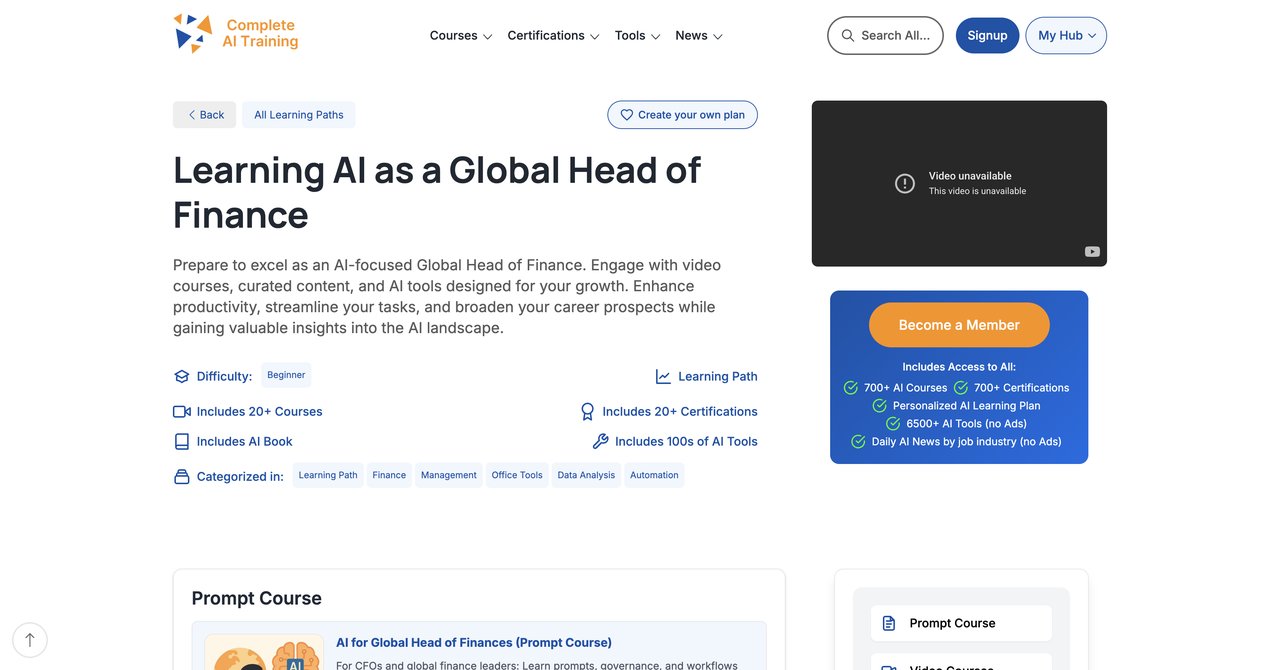
Complete AI Training is not a single course. One subscription unlocks EVERY course and EVERY certification on the whole platform - hundreds of them, across every job role, not just this one. This is the key differentiator against every other provider in this comparison. Most places sell you one course and then charge you extra for a certificate. Here, you get everything in one flat subscription.
The platform gives you full access to all video courses, not a single course or a fixed bundle. That means you're not locked into just the Global Head of Finances track - you can also pull up material for FP&A, accounting, treasury, or even operations roles if your work overlaps with those functions. Full access to all certifications is included at no extra cost, and new courses and certifications are added continuously and included automatically. If AI is evolving, your training evolves with it without you having to pay again.
One of the strongest points is the breadth. Most platforms give you a narrow slice of content and call it a day. Here, one flat subscription price covers all of the above, versus paying per course elsewhere. The daily updates on relevant AI tools and news are also a nice touch - you're not just learning in a vacuum, you're staying current with what's actually happening in the market.
For a Global Head of Finances, this matters because your role spans multiple functions. You're not just doing financial modeling - you're dealing with compliance, strategic planning, team management, and reporting. Having access to every job role's material means you can look into adjacent topics whenever you need to, without purchasing another course.
The pricing is remarkably affordable, especially with annual billing at $8.25/month versus the $29/month monthly rate. That's less than most streaming services, and you get hundreds of courses and certifications out of it.
Key topics covered: AI fundamentals for finance leadership, AI-driven forecasting and modeling, automation in financial reporting, regulatory and compliance considerations, AI adoption strategy, prompt engineering for finance, plus full access to every other course on the platform.
Target audience and skill level: This is designed for professionals at all levels - from those just getting started with AI to those who are ready to lead organizational change. No coding background is required. The content is structured so you can start with basics and progress to advanced strategic implementation.
Pros:
- Full access to ALL video courses on the platform, not a single course or a fixed bundle
- Full access to ALL certifications on the platform, included at no extra cost
- New courses and certifications are added continuously and are included automatically
- Access to every other job role's material too, which matters for anyone whose work spans more than one function or who wants to move roles
- One flat subscription price covers all of the above, versus paying per course elsewhere
- Daily updates on relevant AI tools and news
- Very affordable pricing, especially with annual billing
Cons:
- Subscription based, which means you need to keep the subscription active to keep learning - though this is also crucial for continuous learning as AI is developing continuously
Who benefits most: Anyone in the finance function who wants comprehensive, ongoing AI education without breaking the bank. Particularly good for professionals who want access to a broad range of material and certifications, not just a single topic. If you're the type of person who likes to explore adjacent subjects - like how AI is used in operations or HR - this is the best fit for you.
Visit CompleteAI Training for Global Head of Finances
Course 2: AI for CFOs: Strategic & Operational Mastery
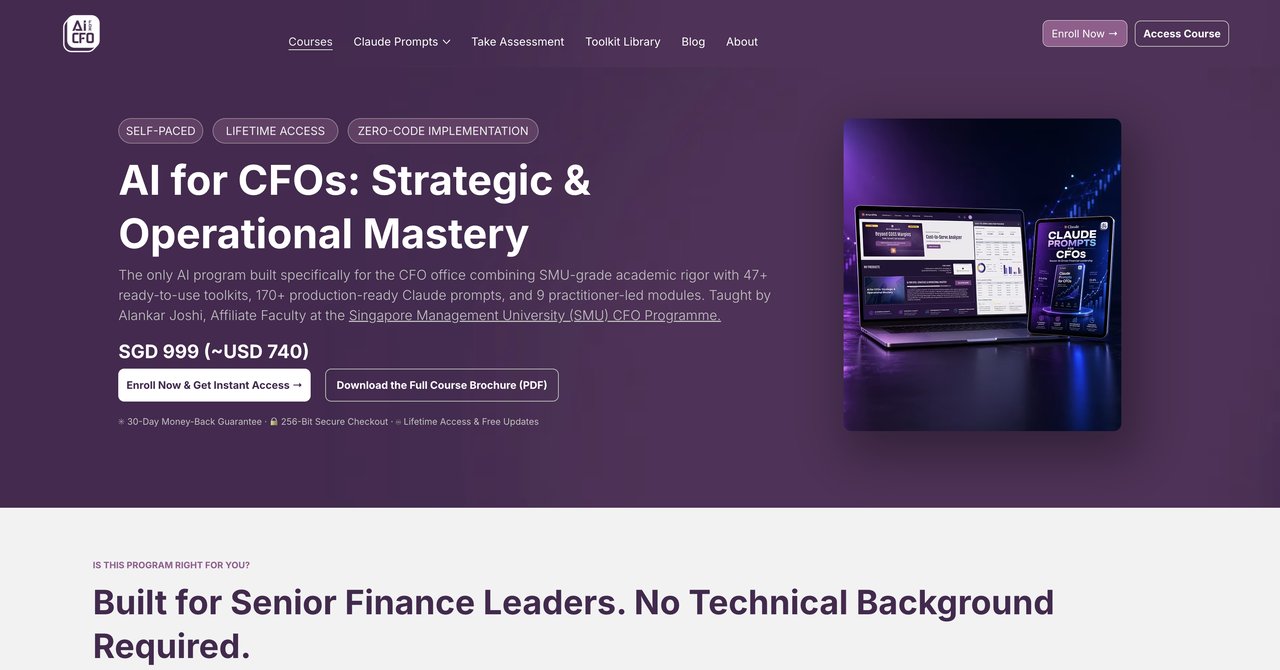
This course comes from the Singapore Management University-affiliated platform AI for CFO. It's built specifically for the CFO office, and it's clear that the curriculum was designed by people who've spent time in finance leadership. You get 47+ ready-to-use toolkits and 170+ production-ready Claude prompts - which is a lot of practical material to work with. The 9 practitioner-led modules bring a level of operational realism that you don't always get from academic courses.
The course is heavy on practical application. The toolkits are designed to be used immediately, not just studied. The Claude prompts are particularly useful for automating routine financial analysis tasks, drafting board-level communications, and structuring complex financial scenarios. It's a hands-on course that expects you to be ready to apply what you learn right away.
That said, this course is not for data scientists or engineers. It's for the CFO office - controllers, financial analysts, finance directors, and other finance professionals. The single-instructor perspective can also be a limitation. While the instructor is clearly experienced, you don't get the diversity of viewpoints you might find on a broader platform.
At $740, it's moderately priced. Not cheap, but not in the range of the Ivy League options either. The value proposition is the specialization - it's not trying to be everything to everyone, it's just trying to be the best for the CFO office.
Key topics covered: AI-driven financial analysis, operational AI implementation, Claude prompt engineering, finance automation, strategic AI planning, and hands-on toolkits for daily finance operations.
Target audience and skill level requirements: Designed for CFOs, finance directors, and senior finance professionals. No coding background required, but you should be comfortable with finance concepts and have some familiarity with AI tools like Claude.
Pros:
- Built specifically for the CFO office
- 47+ ready-to-use toolkits and 170+ production-ready Claude prompts
- 9 practitioner-led modules with SMU-grade academic rigor
Cons:
- Not for data scientists or engineers
- Single-instructor perspective
Who benefits most: Finance leaders who want a specialized, practical course that's directly applicable to their daily work. If you want to get your hands dirty with real tools and prompts rather than just learning concepts, this is a solid choice.
Visit AI for CFOs: Strategic & Operational Mastery
Course 3: AI for Business & Finance Certificate Program
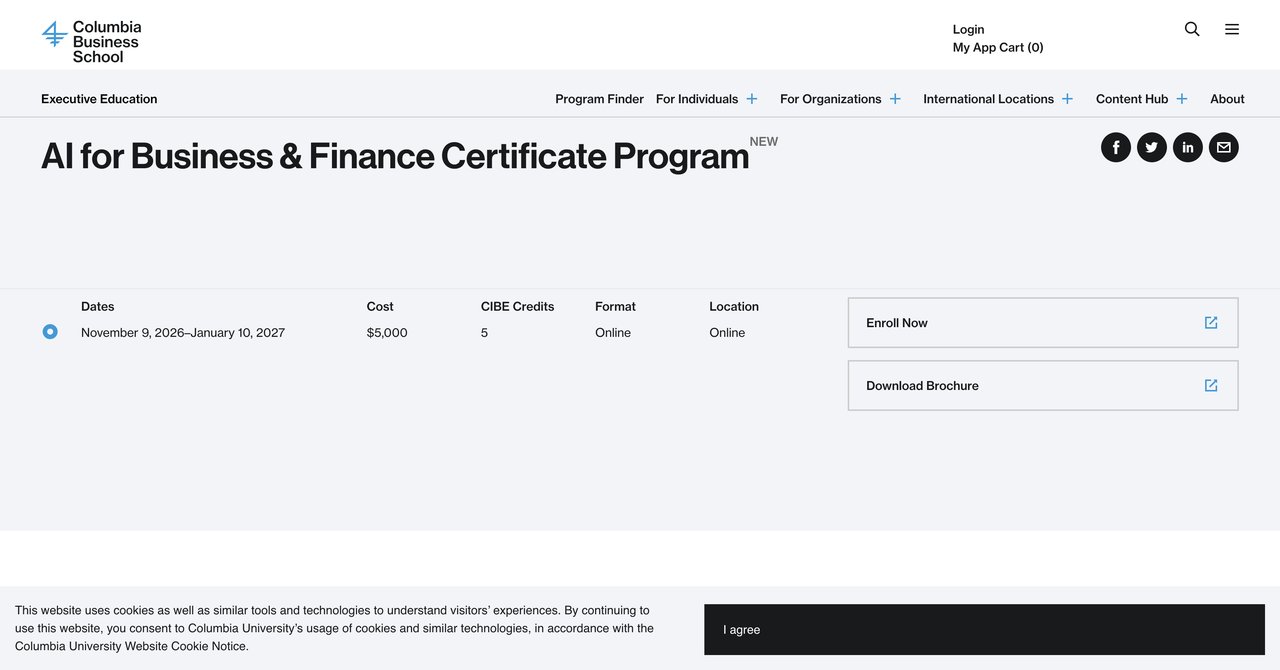
Columbia Business School Executive Education brings a strong name to the table. The AI for Business & Finance Certificate Program is an Ivy League certificate with full faculty support. The program is designed for professionals who want to understand AI from a business and finance perspective, not from a technical one. No coding or tech background is required, which is a relief for many finance leaders who haven't touched code since their college days.
The curriculum includes real-world exercises and industry case studies. That means you're not just learning concepts - you're applying them to actual business scenarios. The faculty support is a significant value-add, giving you access to Columbia's academic expertise throughout the program.
The high price point of $5,000 is a significant investment. It's not the most expensive program out there, but it's not cheap either. The fixed 8-week schedule is another consideration - if you have a busy travel calendar or unpredictable work hours, you'll need to plan around it.
That said, the Columbia brand carries weight. If you're in a position where your CV and your credentials matter for career advancement, this certificate will open doors. It's not just about the content - it's about the network and the name recognition.
Key topics covered: AI fundamentals for business, financial AI applications, strategic decision-making with AI, case studies in finance, AI-driven business transformation, and executive-level AI implementation.
Target audience and skill level requirements: Senior finance professionals, executives, and business leaders. No coding or technical background is required. The course is structured for people who make strategic decisions, not technical implementation.
Pros:
- Ivy League certificate with full faculty support
- No coding or tech background required
- Includes real-world exercises and industry case studies
Cons:
- High price point
- Fixed 8-week schedule may not suit all executives
Who benefits most: Professionals who want a prestigious certificate from a top university and are comfortable with a structured, scheduled program. If you're looking for a credential that carries weight in boardroom conversations, this is a strong contender.
Visit the Columbia Business School AI program
Course 4: AI in Finance by eCornell (Cornell University)
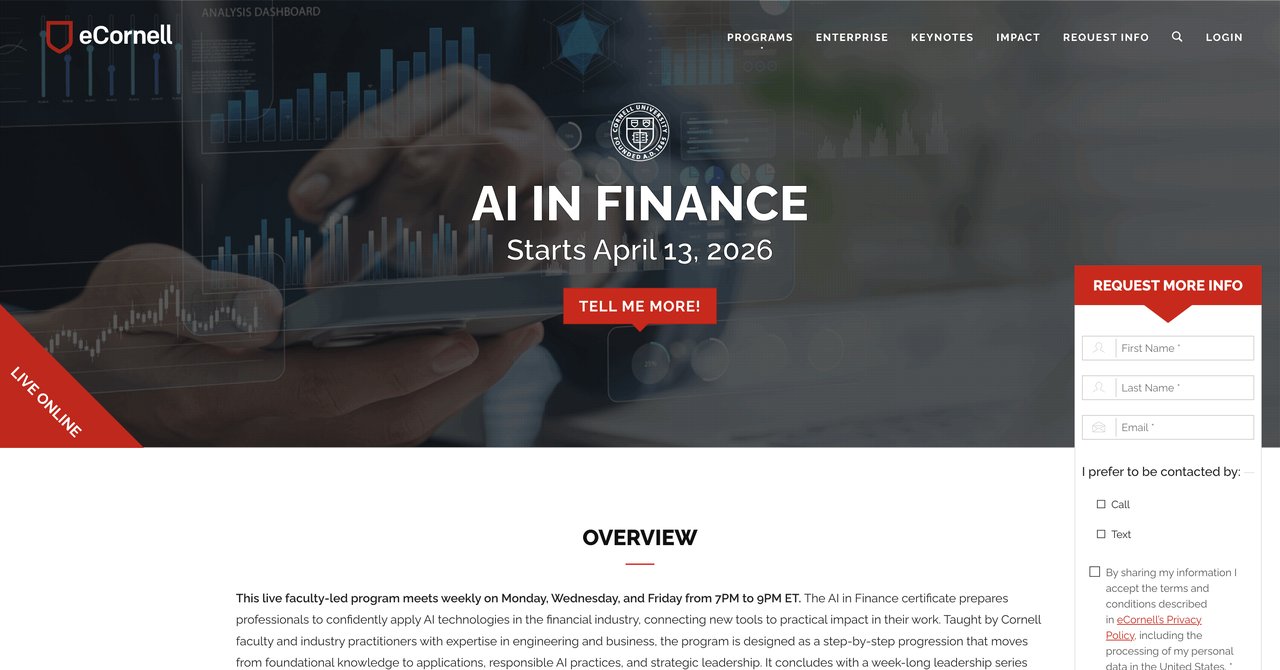
Cornell University's eCornell program offers a structured path from AI foundations to strategic leadership. The course features live faculty-led sessions with Cornell faculty and industry practitioners, which means you're getting both academic rigor and real-world experience. The step-by-step progression is well-designed - you don't jump into advanced topics without first building a solid foundation.
The program concludes with a leadership series on AI adoption roadmaps, which is particularly relevant for a Global Head of Finances. You're not just learning what AI can do - you're learning how to implement it across your organization. The adoption roadmap series is essentially a guide to change management in finance functions, which is a crucial skill.
The main downside is the schedule. You need to attend live sessions 3 days a week, Monday/Wednesday/Friday evenings ET. That's a significant time commitment, and it may not work if you're in a different time zone or if your evenings are already packed. The premium pricing of $4,999 is also a barrier for some.
However, the live interaction is a valuable feature. You get to ask questions in real-time, interact with faculty, and network with other finance professionals. That's something you don't get with self-paced courses.
Key topics covered: AI foundations, financial applications of AI, strategic AI implementation, AI adoption roadmaps, leadership in AI, and practical finance use cases.
Target audience and skill level requirements: Finance professionals who are moving into leadership roles or who need to lead AI adoption in their organizations. The course requires a willingness to commit to live sessions and a schedule that can accommodate them.
Pros:
- Live faculty-led sessions with Cornell faculty and industry practitioners
- Step-by-step progression from foundations to strategic leadership
- Concludes with a leadership series on AI adoption roadmaps
Cons:
- Requires live attendance 3 days a week (M/W/F evenings ET)
- Premium pricing
Who benefits most: Finance leaders who prefer interactive learning, want to build a structured foundation, and are willing to commit to a fixed schedule. The live sessions are a major plus if you value real-time feedback and networking.
Visit the eCornell AI in Finance program
Course 5: Generative AI for Finance: Use Cases, Applications and Regulation
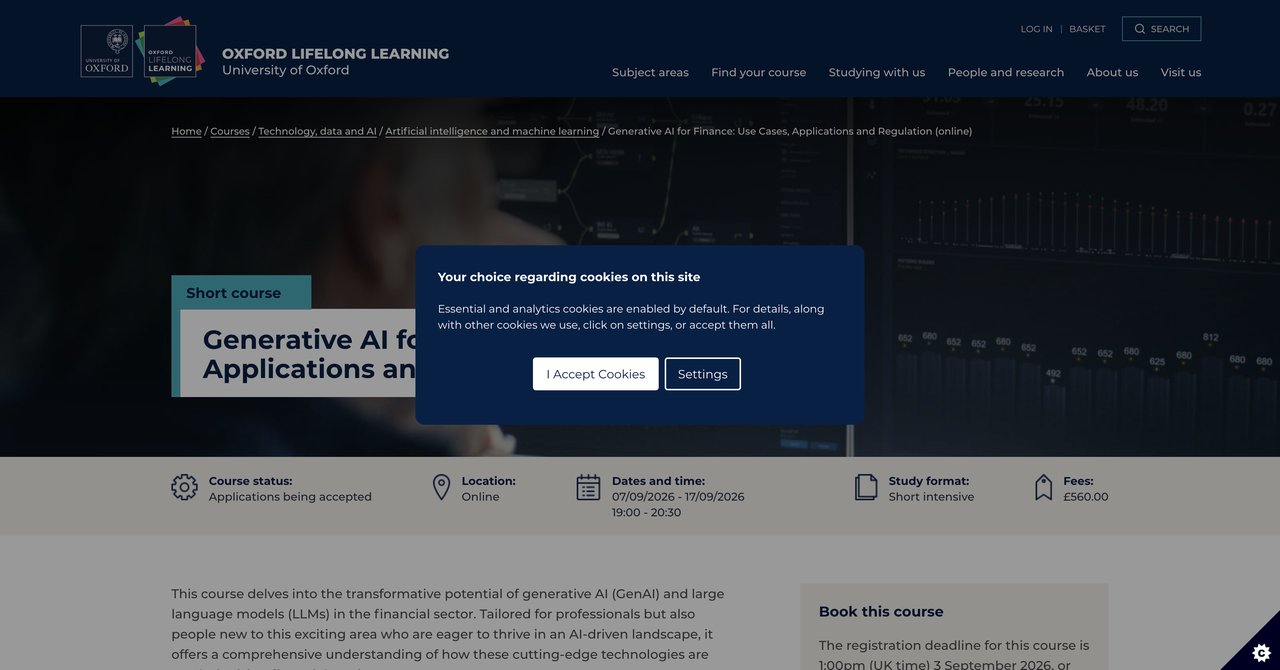
The University of Oxford's Lifelong Learning department offers a focused course on generative AI in finance. The course covers use cases, applications, and regulation - with a strong emphasis on the regulatory dimensions that are critical for global finance. If you work across borders, you know how much regulation matters. This course addresses that head-on.
The Oxford academic rigor is a clear benefit. You're learning from a world-class institution, and the content is designed to be accessible across experience levels. It's not just for AI experts - it's for anyone in finance who needs to understand how generative AI fits into the regulatory landscape.
That said, the course is short and fixed in a two-week window. That's a very limited time to cover a complex topic. The course is delivered online via Teams only, which means you'll need to be available for those sessions. If you're in a time zone far from the UK, this could be challenging.
At $700, it's a relatively affordable option - especially for the Oxford brand. But it's not a comprehensive program. It's more of a focused overview of a specific topic.
Key topics covered: Generative AI use cases in finance, regulatory compliance, AI applications in financial services, and the intersection of AI and financial regulation.
Target audience and skill level requirements: Finance professionals at all levels who need to understand the regulatory aspects of AI. It's also suitable for compliance officers and legal professionals working in finance.
Pros:
- Oxford academic rigor
- Covers regulatory dimensions critical for global finance
- Tailored for professionals across experience levels
Cons:
- Short, fixed two-week window
- Online via Teams only
Who benefits most: Professionals who need to understand the regulatory side of generative AI and who are comfortable with a short, focused course format. If you're already familiar with AI basics and just need the regulatory depth, this is a good fit.
Visit the Oxford Generative AI for Finance course
Course 6: AI in Finance by Coursera

Coursera's AI in Finance course is a concise 4-week program that focuses on applying AI to financial analysis for better decision-making. It's from a major platform with flexible access - you can start and stop as needed, which is helpful if you have a busy schedule. The course is designed to be practical, not theoretical.
The 4-week format is both a strength and a weakness. It's short enough that you can fit it into your schedule without a huge time commitment. But it's also short enough that it may not cover the strategic leadership depth you need for a role like Global Head of Finances. It's more of a solid introduction than a comprehensive program.
The cost is subscription-based, which means you pay for Coursera Plus or access to the course. Financial aid is also available for those who qualify. This makes it accessible to a wide range of professionals.
Key topics covered: AI for financial analysis, decision-making with AI, financial data interpretation, and AI applications in finance.
Target audience and skill level requirements: Finance professionals who want a quick, practical introduction to AI in finance. No prior AI experience is required.
Pros:
- Apply AI to financial analysis for better decisions
- Concise 4-week format
- From a major platform with flexible access
Cons:
- Relatively short
- May not cover strategic leadership depth
Who benefits most: Professionals who want a quick, practical overview of AI in finance without a significant time investment. It's a good starting point if you're new to AI and want to see how it applies to your role.
Visit the Coursera AI in Finance course
Course 7: The Complete AI for Finance Course: Beginner to Master Level
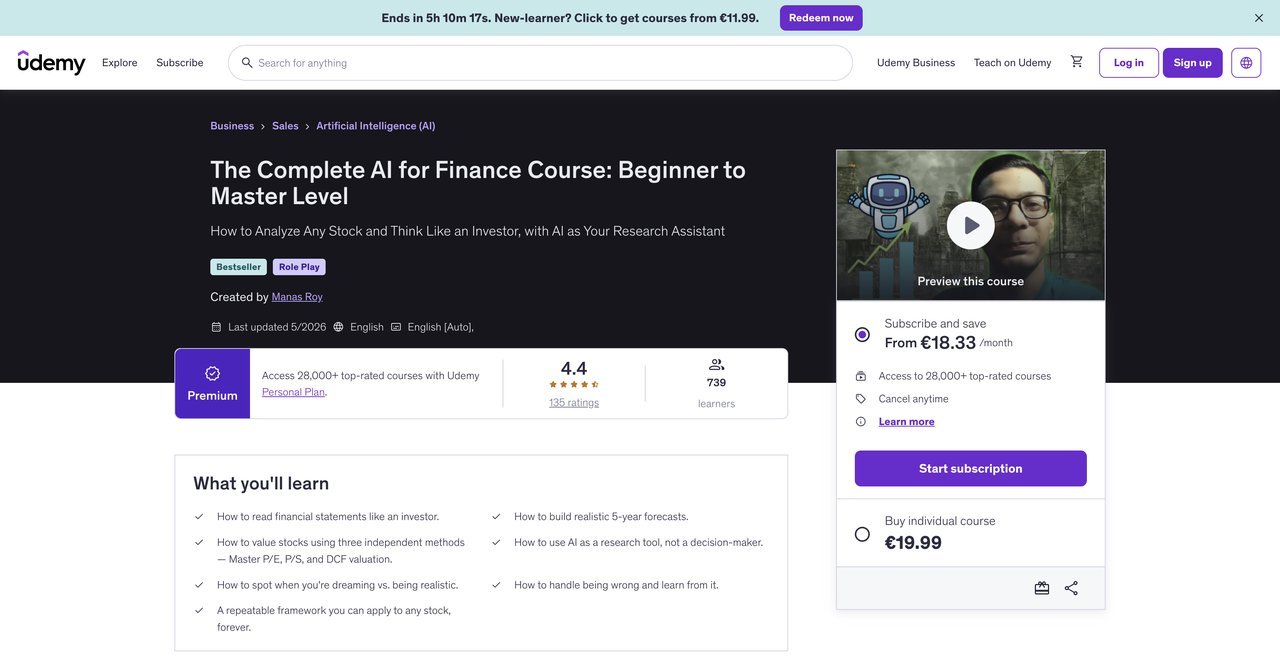
This Udemy course is a single course that spans from beginner to master level. It covers 5-year forecasting, valuation scenarios (P/E, P/S, DCF), and teaches you how to spot unrealistic assumptions. The scope is ambitious for a single course, and it does cover a lot of ground.
The price is the most attractive aspect - typically $20-$100 depending on Udemy's frequent discounts. That's a fraction of what you'd pay for a university course. However, you get what you pay for. Udemy quality varies, and this course is not institutionally accredited. That means it's not going to carry the same weight as a Columbia or Oxford certificate.
That said, the practical skills you learn are valuable. If you want to learn how to do 5-year forecasting with AI or build valuation scenarios, this course gives you the tools to do that. It's a hands-on course that focuses on skills rather than theory.
Key topics covered: 5-year forecasting, valuation scenarios (P/E, P/S, DCF), spotting unrealistic assumptions, AI-driven financial modeling, and beginner-to-master AI skills.
Target audience and skill level requirements: Finance professionals who want practical, hands-on skills in AI-driven financial modeling. No prior AI experience is required, but a basic understanding of finance concepts is helpful.
Pros:
- Covers 5-year forecasting, valuation scenarios (P/E, P/S, DCF)
- Teaches how to spot unrealistic assumptions
- Single course spans beginner to master
Cons:
- Udemy quality varies
- Not institutionally accredited
Who benefits most: Finance professionals who want practical, hands-on skills in AI-driven modeling without spending a lot of money. If you're looking for skills rather than credentials, this is a good option.
Visit the Udemy AI for Finance course
Course 8: Practical AI and Prompting for Finance Professionals
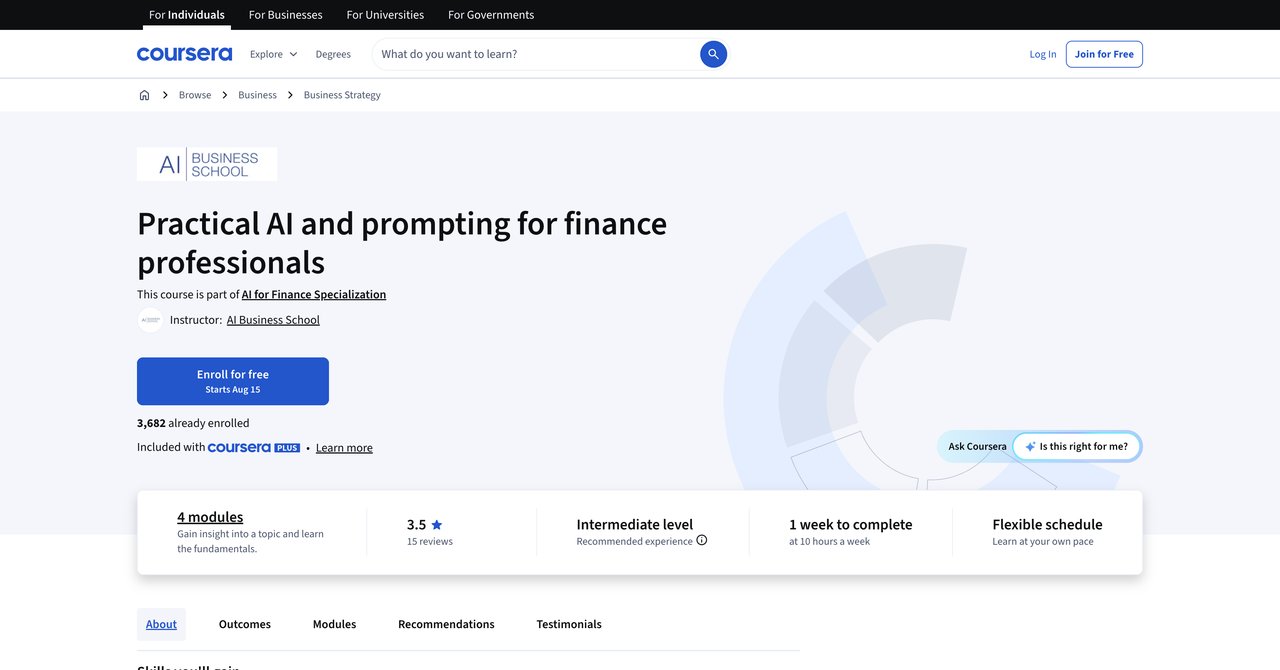
This Coursera course is hands-on and job-specific. It covers AI use cases across multiple modalities - meaning you'll learn how to use AI in different ways, not just for one task. The immediate practical experience with AI-powered tools is a big plus. You'll be working with actual AI tools from the start, not just learning concepts.
The low barrier to entry makes it accessible. You don't need a technical background to start. The course is designed to give you practical skills that you can apply immediately in your finance role.
However, this is a beginner-level course. If you're already an experienced finance executive, you might find it too basic. The course doesn't go deep into strategic leadership or complex AI applications. It's more about getting you comfortable with AI tools.
Key topics covered: Practical AI use cases in finance, AI-powered tools, prompting techniques, and multi-modal AI applications.
Target audience and skill level requirements: Finance professionals who are new to AI and want to build practical skills. No prior AI experience is required.
Pros:
- Hands-on, job-specific AI use cases across multiple modalities
- Immediate practical experience with AI-powered tools
- Low barrier to entry
Cons:
- Beginner-level
- May not challenge experienced finance executives
Who benefits most: Finance professionals who want to get their hands dirty with AI tools quickly and without a lot of theory. If you're just starting to explore AI in finance, this is a good place to start.
Visit the Practical AI and Prompting course
Course 9: Introduction to AI for Finance Professionals
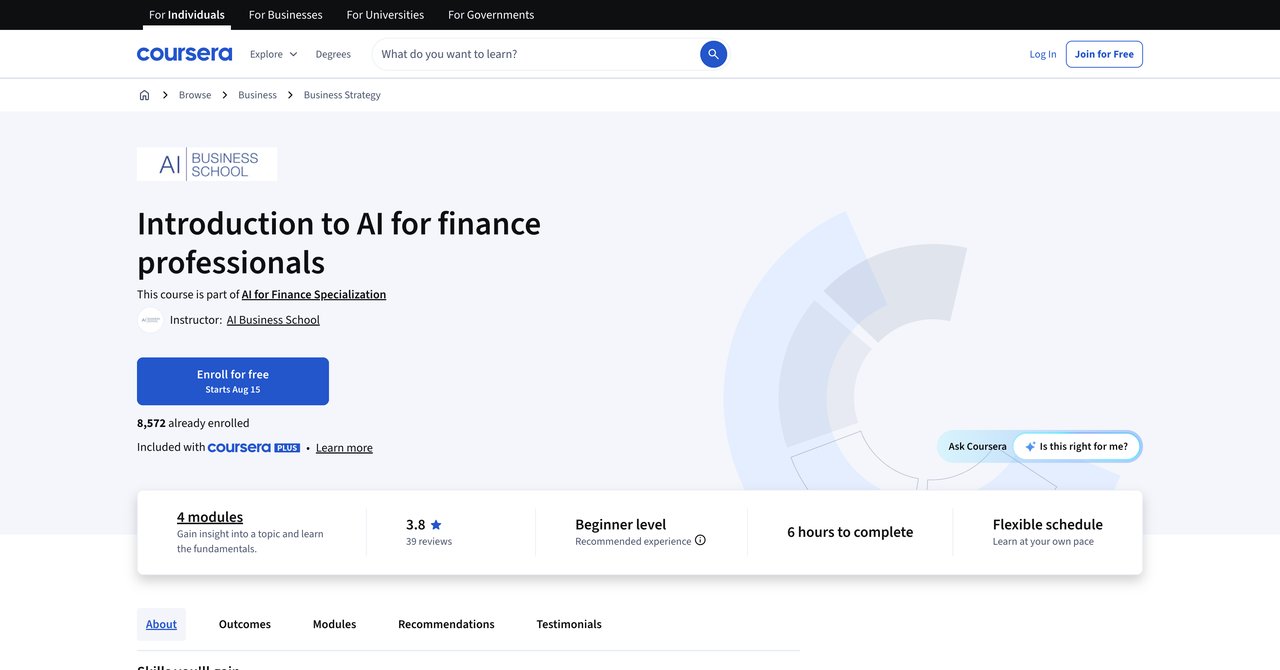
This Coursera course builds foundational AI and Generative AI literacy. It's designed specifically for finance professionals, and the short time commitment makes it easy to fit into a busy schedule. If you're completely new to AI, this is a solid starting point.
The course is very introductory. It doesn't go deep into any topic. It's more about giving you a baseline understanding of AI and how it applies to finance. That's useful if you need to speak the language of AI without being an expert.
However, there's no strategic depth here. If you're a Global Head of Finances, you might find it this too basic. It's more suited for professionals who are just starting to explore AI.
Key topics covered: AI foundations, Generative AI literacy, AI applications in finance, and basic AI concepts.
Target audience and skill level requirements: Finance professionals who are new to AI and want a basic understanding. No prior AI experience is required.
Pros:
- Builds foundational AI and Generative AI literacy
- Designed specifically for finance professionals
- Short time commitment
Cons:
- Very introductory
- No strategic depth
Who benefits most: Finance professionals who need a quick, no-nonsense introduction to AI. If you're not ready to commit to a longer course, this is a good way to get started.
Visit the Introduction to AI for Finance Professionals course
Course 10: AI for FP&A Automation & Modeling
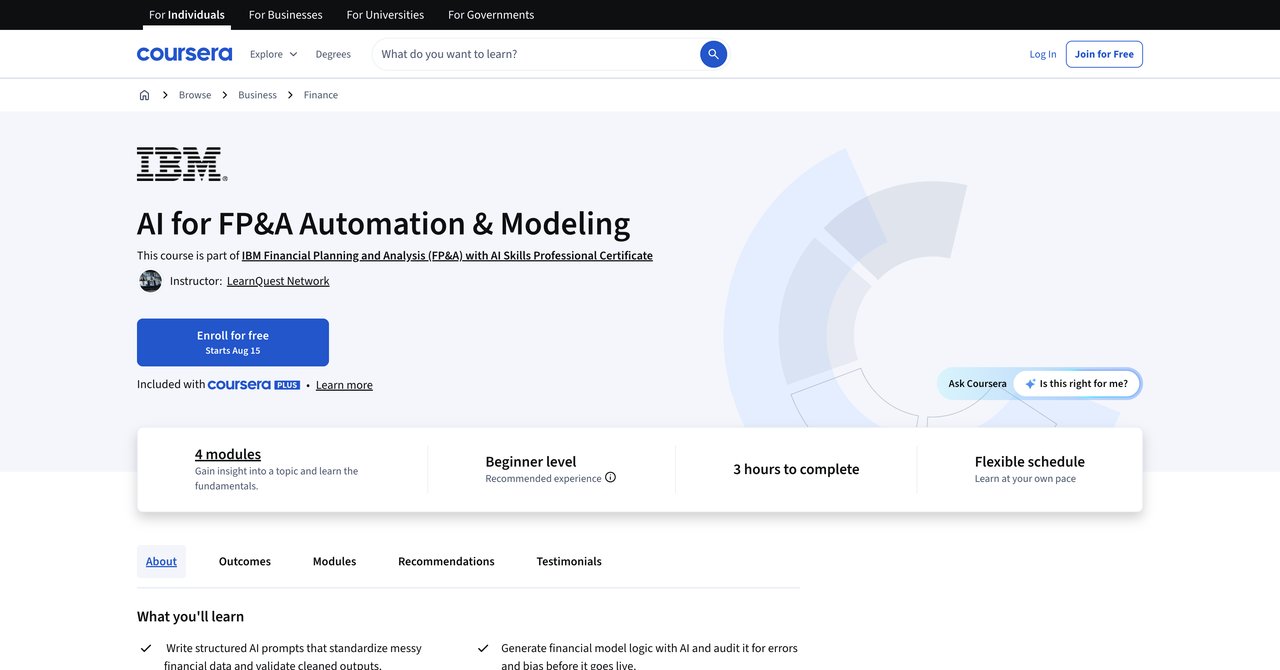
This Coursera course is part of IBM's FP&A with AI Skills Professional Certificate. It covers human-in-the-loop oversight, which is a key concept for finance professionals who want to use AI responsibly. The course is designed for FP&A analysts and managers, so it's specific to that role.
The IBM brand adds credibility, and the certificate can be a good addition to your resume if you're in FP&A. However, the course is focused on FP&A, not the full finance function. If you're a Global Head of Finances, you might find it this too narrow.
Also, the course uses IBM-specific tools. That's fine if you're already in an IBM environment, but if you're using other tools, you might not get the full value.
Key topics covered: FP&A automation, AI modeling, human-in-the-loop oversight, and AI applications in financial planning and analysis.
Target audience and skill level requirements: FP&A analysts and managers. No prior AI experience is required, but familiarity with FP&A concepts is helpful.
Pros:
- Part of IBM's FP&A with AI Skills Professional Certificate
- Covers human-in-the-loop oversight
- Designed for FP&A analysts and managers
Cons:
- Focused on FP&A, not the full finance function
- IBM-specific tools
Who benefits most: FP&A professionals who want to specialize in AI-driven planning and analysis. If you're in FP&A and want to stay ahead of the curve, this is a good option.
Visit the AI for FP&A Automation & Modeling course
Course 11: Generative AI Essentials for Finance and Accounting
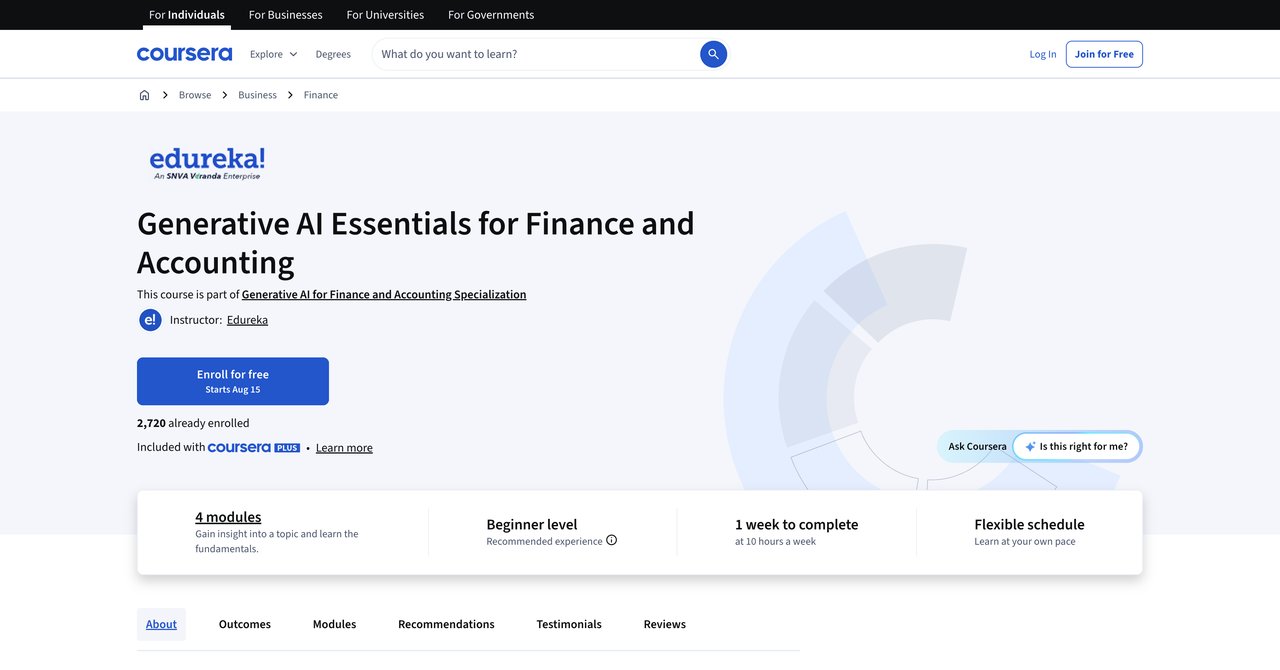
This Coursera course focuses on automating analysis, streamlining reporting, and enhancing forecasting. No programming is required, making it accessible to finance managers. It's ideal for finance managers who want to use AI to improve their daily workflows.
The course is practical and hands-on. You'll learn how to use generative AI to automate routine tasks, which can free up time for more strategic work. The focus on reporting and forecasting is particularly relevant for finance professionals.
However, the course is not tailored to C-suite strategy. If you're a Global Head of Finance, you might need more strategic depth. The scope is also narrower - it's focused on finance and accounting, not the broader business context.
Key topics covered: Automating analysis, streamlining reporting, enhancing forecasting, and generative AI applications in finance and accounting.
Target audience and skill level requirements: Finance managers and accounting professionals. No programming is required.
Pros:
- Focuses on automating analysis, streamlining reporting, enhancing forecasting
- No programming required
- Ideal for finance managers
Cons:
- Not tailored to C-suite strategy
- Narrower scope
Who benefits most: Finance managers who want to automate their daily tasks with AI. If you're looking to improve efficiency in your department, this is a good option.
Visit the Generative AI Essentials for Finance and Accounting course
Final Recommendations: Which Course Should You Choose?
Here's the honest breakdown. If you're a Global Head of Finances, you need a course that balances practical skills, strategic depth, and credibility. You don't just need to know how AI works - you need to know how to lead AI adoption in your organization and how to talk about it with your board.
For the best overall value, CompleteAI Training stands out. The subscription model is a game-changer in the sense that you get access to hundreds of courses and certifications for a fraction of the cost of a single university course. You're not limited to one topic - you can explore other roles, other functions, and other skills as needed. The daily updates keep you current, and the certifications are included. For $8.25/month billed annually, it's hard to beat that. The only downside is that it's subscription-based, so you need to keep paying to keep learning. But for continuous learning in a field that's changing as fast as AI, that's actually a feature, not a bug.
If you need a prestigious credential, Columbia Business School is the strongest option. The $5,000 price tag is steep, but the Ivy League brand carries weight. The fixed 8-week schedule is a commitment, but the faculty support and case studies are valuable. This is the choice if you need a credential that will impress stakeholders and help with career advancement.
For a more focused CFO-specific course, AI for CFOs at $740 is a solid middle ground. It's practical, with toolkits and prompts you can use immediately. The Singapore Management University affiliation adds credibility, but the single-instructor perspective is a limitation.
Cornell's eCornell program is worth considering if you value live interaction and a structured progression. The $4,999 price is high, but the live sessions with faculty are a differentiator. However, the 3-days-a-week attendance requirement is a real constraint for many executives.
Oxford's generative AI course is a good choice if you specifically need regulatory knowledge. The $700 price is reasonable for the Oxford brand, but the two-week format is limiting.
For the budget-conscious, the Udemy course at $20-$100 is a great deal for practical skills. You won't get a prestigious certificate, but you'll learn how to do forecasting and valuation with AI. The Coursera courses are also affordable, but they're mostly introductory or focused on specific roles like FP&A.
In summary, my unbiased recommendation is this: if you want the most comprehensive, cost-effective, and flexible learning experience, go with CompleteAI Training. If you need a prestigious credential and have the budget, go with Columbia or eCornell. If you want practical CFO-specific skills, go with AI for CFOs. And if you're on a tight budget, the Udemy course is a good starting point.
There's no one-size-fits-all answer. It depends on your budget, your time, and your goals. But hopefully, this comparison gives you a clear picture of what's out there - and helps you make an informed decision.