
Blog ·
11 AI Courses for VP of Marketing that You Should Know About in 2026
Master AI-driven marketing leadership with 11 top-tier courses for VPs. Sharpen strategic foresight, boost ROI, and future-proof your career for 2026.
 Jeroen Erne
The pace of change in marketing has never felt faster, and the catalyst is obvious. Artificial intelligence has moved from experimental side project to the core of how modern marketing operates. For a VP of Marketing, the pressure is on twice over - not only to master this technology personally, but to set a direction that keeps the entire team ahead of the curve. A recent survey finds that 69% of businesses are already using AI in at least one function, and marketing sits at the top of that list. Yet, there remains a noticeable gap between the number of people with AI tools in front of them and the number who know how to leverage them strategically.
For senior leadership, the question is no longer whether to adopt AI. It is about how fast you can build your own expertise. Gaining a working knowledge of AI systems, prompt techniques, and ethical considerations directly changes your day-to-day leadership decisions. It affects how you plan budgets, if not replace solutions, the vendors you will trust, and the way you sell your strategy upward to the C-suite. If this turnaround doesn't happen fast enough, there's a very real cost ahead. A growing number of reports and industry voices suggest roles could shift or diminish for those who fail to adapt. This is not about fear-it's about timing.
Most importantly, you are not starting from zero. The array of available courses can feel overwhelming, but it can be narrowed down to those that genuinely move the needle. That's exactly where this guide comes in. The following sections will break down the most high-quality and practical AI courses for VP-level marketing professionals, comparing their goals, structure, and specific value for the season of your career.
Why AI matters for VP of Marketing today
The daily rhythm for a VP of Marketing involves decisions that shape brand presence, ad spend, customer segmentation, and revenue growth. Every one of those areas now has a working AI solution capable of improving outcomes. For instance, machine learning algorithms can identify which customer segments will churn, recommend the next best action, or write an entire campaign brief in under a minute. The result is that those with AI fluency make faster, data-pushed choices and cut costly test-and-learn cycles by huge months.
The statistics reflect this urgency. According to Salesforce, 73% of marketers are now using generative AI tools specifically for content creation and copy generation. Even more telling, almost 70% have increased their expectations for what those tools can do. Nearly every organization has tried it, but most haven't embedded it across their entire marketing workflow. That puts the VP in a position of strategic influence: learning how to implement AI beyond the technology itself is the future of return on investment.
Still, there's a massive difference between using ChatGPT on evenings and building a cohesive AI model for your team's roadmap. This guide is exactly for that challenge.
The Growing Role of AI in VP of Marketing
Turning to the future, a VP of Marketing's work calendar now looks completely different than it did even two years ago. Instead of managing endless content request lists, you can have AI agents handle first drafts, automate basic personalization, and strip away repetitive reporting. What stands out is the broad reach:
- Multichannel campaign automation: Generate content variations across email, socials, and paid channels with a single prompt and maintain brand rules.
- Better performance intelligence: AI links granular data from CRM, advertising, and web behavior, giving you faster attribution patterns and less guessing.
- Highly personalized customer journeys: Rather than one-size fits all, adaptive engines pull in the context from past interactions and create a customer-specific message.
- Rapid A/B testing: When AI copy can generate dozens of angles in minutes, your testing cycles shorten, and outside-the-box ideas are worth projecting.
- Cost forecasting and budget modeling: Predictive analytics look at spend areas and provide near-accurate outcomes before you commit to expensive media buys.
This doesn't mean the human decisions disappear-as a VP, you're always the final judge. But that role shifts to making sure the right inputs, data checks, and brand guidance are in place, then taking decisions on what the machine presents. The daily output no longer gets bottlenecked by personal writing speed or monthly team capacity.
Benefits of becoming an AI expert in VP of Marketing
Ready for a straightforward reason to take the courses? One word: leverage. A VP who understands AI implementation can significantly increase their team's output without headcount growth. Put simply, you create a competitive edge. The clearly visible impact on efficiency, speed, and personalization gets comfortable discussing at board level and shows that your leadership is teacher-oriented.
When you're the person who speaks AI strategy in plain English-who understands how to responsibly roll out automation, keep data privacy at the center, and avoid the typical content trap that AI-generated material has-you become the go-to person for the executive team. But there are also unknowns at stake in the quality of the entire marketing strategy itself. Better insights, better spending allocation, less wasted creativity, and deeper customer connections all make the difference.
This article will compare 11 AI courses that equip you for that role, including one especially promising option called CompleteAI Training (https://completeaitraining.com/course/ai-for-vp-of-marketing/). Very good, but unlike those single-topic focuses, CompleteAI Training gives you access to ALL courses and ALL certifications on the platform rather than a single course-which can be useful if you need to fill specific gaps in strategy, automation, or practical workflow management at scale. Farther on, we'll look at value, course syllabus, and physical credibility so you can decide based on your leadership path.
Comparison: All AI Courses for VP of Marketing (Updated 2026)
| Course Name | Provider | Price | Key Topics | Pros | Cons | Best For |
|---|---|---|---|---|---|---|
| CompleteAI Training by CompleteAI Link |
CompleteAI | Premium (one subscription covers everything) | Comprehensive AI training for VP of Marketing professionals. One subscription unlocks every course and every certification on the platform - hundreds of them. Full access to ALL video courses and ALL certifications, including all other job roles' material, with new content added continuously. Covers AI strategy, tools, and applications specifically for VPs of Marketing. | Comprehensive curriculum; Hands-on projects; Expert instructors; Full access to ALL video courses on the platform, not a single course or fixed bundle; Full access to ALL certifications included at no extra cost; New courses and certifications added continuously; Access to every other job role's material too; One flat subscription price covers everything versus per-course fees elsewhere | Premium pricing; Subscription-based, crucial for continuous learning as AI develops continuously | VP of Marketing professionals looking for complete training that goes beyond a single course |
| AI for VP of Marketing (Video Courses + Certifications) by Complete AI Training Link |
Complete AI Training | $29/month or $8.25/month billed annually | AI strategy, tools, and applications specifically for VPs of Marketing. Full access to all courses and certifications on the platform, covering all job roles, with continuous updates. | Full access to ALL video courses and certifications, included at no extra cost; New material added continuously; Covers all job roles, great for multi-functional work or career moves; Flat subscription price versus per-course fees elsewhere; affordable, especially with annual billing | Subscription-based, essential for staying current as AI develops constantly | Any professional needing breadth across AI topics and certifications |
| AI Marketing Course: Transforming Strategies with Generative AI Link |
Harvard Division of Continuing Education | $3,200 | 3-day on-campus program for VP/Director-level marketers: aligning AI initiatives with business outcomes, strategy, execution, cross-functional leadership. | Designed for senior marketing leaders, focus on AI-business alignment, covers strategy, execution, and leadership | On-campus only (Boston), premium price | General learners |
| AI-Driven Marketing Strategy Program Link |
Columbia Business School Executive Education | $10,550 | 4-day leadership program for CMOs and VPs: generative AI, cookie deprecation, retail media, MarTech integration for long-term growth. | C-suite and VP-level focus, covers key AI topics and MarTech, emphasizes customer relationships and growth | Very high cost, in-person only (NYC) | General learners |
| AI for Marketing (Specialization) Link |
Coursera (University of Virginia) | $59/month (Coursera Plus) or ~$49 single course | 3-week specialization: customer acquisition and retention with AI, generative AI content creation, assessing strategy effectiveness. | Structured framework for customer acquisition and retention, generative AI content creation, assesses strategy effectiveness | Requires Coursera subscription, not tailor-made for executives | General learners |
| AI-powered Marketing with Microsoft Copilot Link |
Coursera (Microsoft) | Free to audit; certificate via subscription | Strategic decisions using AI as a thinking tool, prompt crafting, and analytics. | Official Microsoft content, strategic decision focus, includes practical prompt crafting | Beginner level, limited to Microsoft ecosystem | General learners |
| AI Strategy and Marketing Leadership Link |
Coursera | Subscription or free audit | One-week course bridging AI tools with leadership responsibilities: budgeting, scheduling, executive data storytelling. | Directly ties AI to leadership, covers budget, scheduling, storytelling, free audit available | Short duration, beginner level | General learners |
| Generative AI for Digital Marketing (Specialization) Link |
Coursera (IBM) | Subscription or free audit | Hands-on GenAI: AI-driven search visibility, content productivity. No prior AI experience needed. | Hands-on IBM content, no prior AI experience needed, covers search and content productivity | Beginner-focused, not executive-specific | General learners |
| Claude AI for Marketing Link |
Coursera | Subscription or free audit | Uses Claude's large context window for market synthesis, high-conversion copy, brand visual identity scaling. | Uses Claude's context window, covers ad/email copy, scales brand identity | Single-tool focus, not comprehensive strategy | General learners |
| Practical AI and Prompting for Marketing Professionals Link |
Coursera | Subscription or free audit | Job-specific AI use cases across multiple modalities for immediate hands-on application, covering various AI tools. | Job-specific use cases, immediate practical application, covers multiple AI tools | Not executive-strategy focused, shallow on governance | General learners |
| How to Become an AI-Powered Marketer Link |
Semrush Academy | Free | Free self-paced course covering prompt engineering and core AI use cases for strategy, campaigns, and content to improve productivity. | Free and accessible, covers prompt engineering, practical productivity wins | Beginner level, Semrush-ecosystem bias | General learners |
| AI for Marketing Link |
Coursera (University of Virginia) | Subscription or free audit | Designing AI-driven campaigns for engagement and conversions, optimizing performance with data and automation. | Focus on measurable ROI, real-world scenarios, data-driven optimization | Requires subscription, overlaps with specialization | General learners |
Understanding AI Training for VP of Marketing Professionals
Marketing leadership roles have changed fast. The VP of Marketing is no longer just the person who owns the brand voice or the campaign calendar. They're now expected to make decisions about AI tooling, data strategy, headcount, and budget allocation for technologies that didn't exist a few years ago. That puts current marketing VPs in a tricky spot. Most didn't get formal training on this stuff. The demand for those skills is real and urgent, but the options for gaining them vary wildly in format, depth, and price.
This guide compares the leading AI education options for VP-level marketers. I've gathered this list from the current offerings and indexed them against what a senior marketing leader actually needs. Some of these are on-demand courses for you to study when you get a spare hour on the weekend. Others are week-long in-person programs at prestigious schools with price tags to match. There are also free options if your budget is gone after a tech refresh.
The criteria I've used here get to what matters most for a VP. Do you just need the tactical AI stuff you can delegate? Or do you need leadership-level strategy to change how your team works? Is flexibility crucial, or do you value networking with peers enough to spend $10,000?
Let me run through each one so you can figure out where to spend your time and money.
Course 1: CompleteAI Training
Link: CompleteAI Training
Cost: $29/month or $8.25/month with annual billing
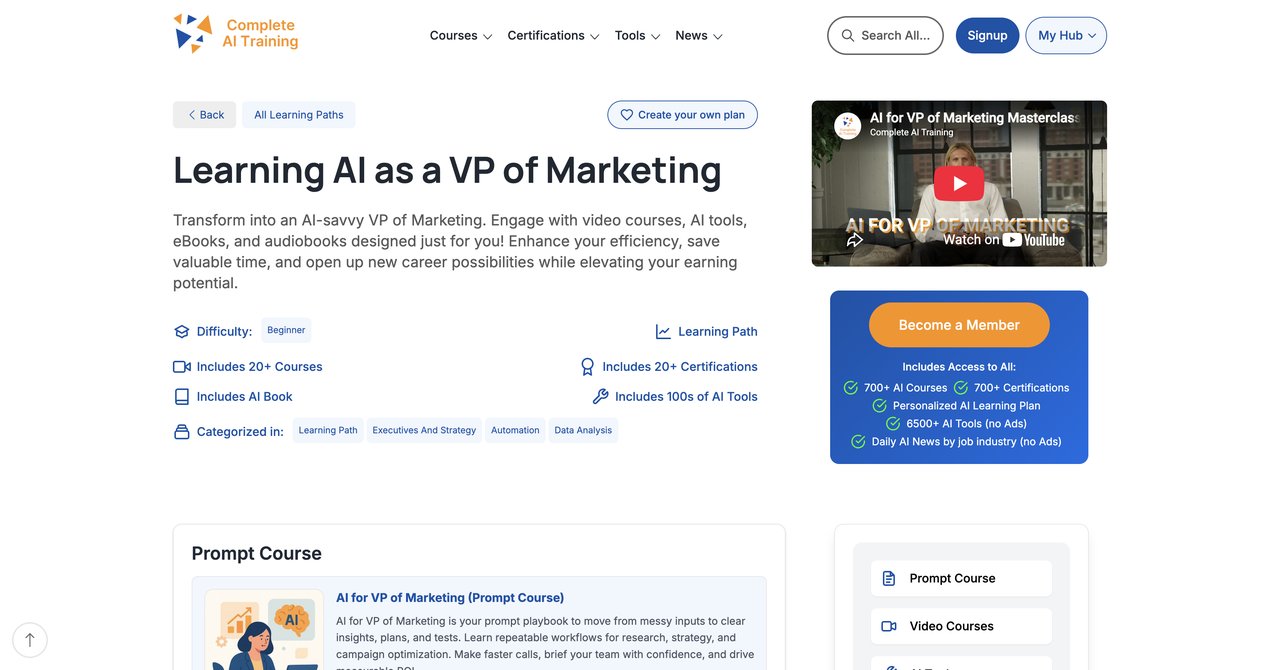
Here's the thing that makes this stand out. CompleteAI Training is not just a single course. It's an entire platform. One subscription unlocks EVERYTHING - which is a point that matters because it fixes the biggest flaw of every other course out there. Basically, if you buy their subscription for the AI for VP of Marketing course, you're getting access to their entire library. That includes hundreds of other courses and certifications for every job role there is. You're not buying a single course or a fixed bundle.
This single subscription model is the main thing that separates this from the other guys. You get full access to every video cours on the platform. I mean, there's the VP of Marketing course, but it's also the materials for data analysts, sales teams, customer support, you name it. And here's the interesting part for marketing VPs: you have access to every other job role's material too. That matters. Marketing leadership is not a silo. You need to know how sales is using conversational AI, what your product team is doing with AI features, how customer success thinks about churn predictions. It also makes sense while you consider your own career. So should you want to become a CEO or CRO one day, or you totally switch paths into product operations, you'll already be able to use that training material - for no extra charge. Instead of buying each course separately, you get the entire library for the same price.
Key topics covered: AI strategy for Marketing leadership, applications of AI in campaigns, content, analytics, leadership decision-making, and management. Because it is the whole platform, you can go broader into AI for other functions.
Target audience and skill level: Aimed at VP of Marketing, marketing director, or CMO. The earlier courses also break strategies down so people do not need a technical background or an engineering degree to start. While the whole things cover intermediate and advanced materials because you have the access to everything anyway.
What stands out in a list format:
- Full access to ALL video courses on the platform, and not just a single course or bundled packet
- Full access to ALL the certifications on the platform, and it is included without an extra cost. Be careful with, some other platforms will charge $100 for a certificate separately from the content
- Adding new courses and certifications, they get added to the library and your subscription includes them automatically
- Access to the materials in every single job role that is covered, not only Marketing. That is good for multi-functional work and also fits if you eventually move into other leadership roles
- One flat subscription cost covers it all. This is vs. a per-course fee on many other platforms where you end up paying a lot more for multiple courses
- It definitely is low risk with the cost. Especially with annual billing where the cost drops to pocket change daily.
What about the drawbacks?
- Subscription based: they do not sell you a life time good. But when the AI keeps changing monthly, maybe it is not even a big drawback.
- But not a face-to-face class. It fails to give you the networking that a live college program has.
Who would benefit most: If you are a VP who needs to cover AI across your team today, and also take care of the budget, this is a solid option. It is especially good if you manage cross-functional processes or you need to align with sales, product, operations, and in that case the access to their content is going to be great. It also is the best-value option for people subscribing with their own money, because this comes from the personal budget, the price is not that painful.
Course 2: AI Marketing Course: Transforming Strategies with Generative AI by Harvard Division of Continuing Education
Link: Harvard AI Marketing Course
Cost: $3,200
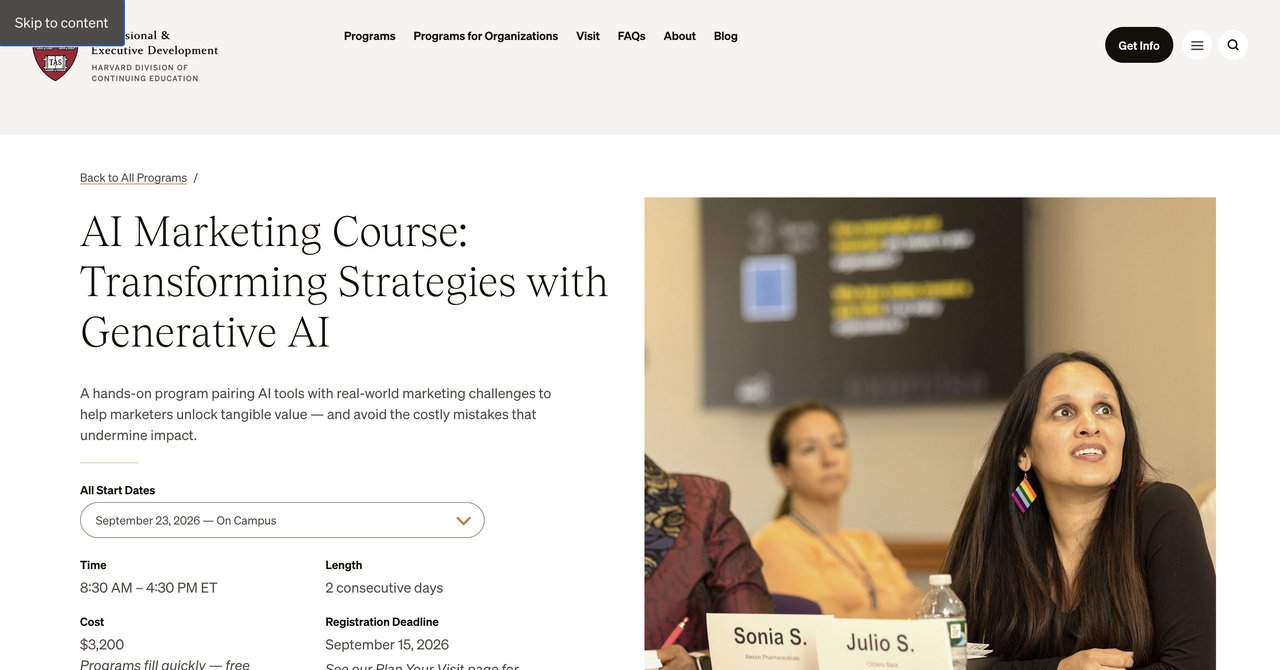
Harvard Division of Continuing Education runs a short, intense program that takes place on campus in Boston. It's specifically designed for people at VP/Director level and up. You are spending three days of your life in a classroom, thinking about how to align AI initiatives with actual business outcomes. The name suggest "Transforming Strategies with Generative AI" which gives you an idea it focuses more than just getting your hands dirty with prompts. It's about the harder and the more costly part: getting AI to fit into the company's goal.
Since it's a short and face-to-face program, the focus is on interaction among leaders. You get to share the experience that other marketers are dealing with, and that networking is definitely a part of the value of this kind of program. The college will also bring cases, and it should focus on execution, and not just the theory. It is an expensive trip when you take the travel and the price of the course into account, but the Harvard name on the certificate that still matters for a segment of professionals.
Key topics covered: Alignment of AI projects with a company's business objectives, the generation AI in the marketing context, how to lead across functions in AI execution.
Target audience and skill level: Built for senior marketing leaders who have experience, and need the leadership context to drive these projects in their teams. Not beginner stuff, would be something you can make in a leader of a marketing team.
Pros:
- Designed for senior marketing leaders
- Focuses on AI-business alignment
- Good for strategy, execution, and leadership skills
Cons:
- On-campus only, which means you have to travel to Boston
- Premium price, no discount, in many countries and individual budget is tough
Who benefits: If you're at a company paying for the training and you need to get away from the day-to-day to reflect on alignment and strategy. Also, if you value the name Harvard and the network that comes with this program.
Course 3: AI-Driven Marketing Strategy Program by Columbia Business School Executive Education
Link: Columbia Business School Program
Cost: $10,550
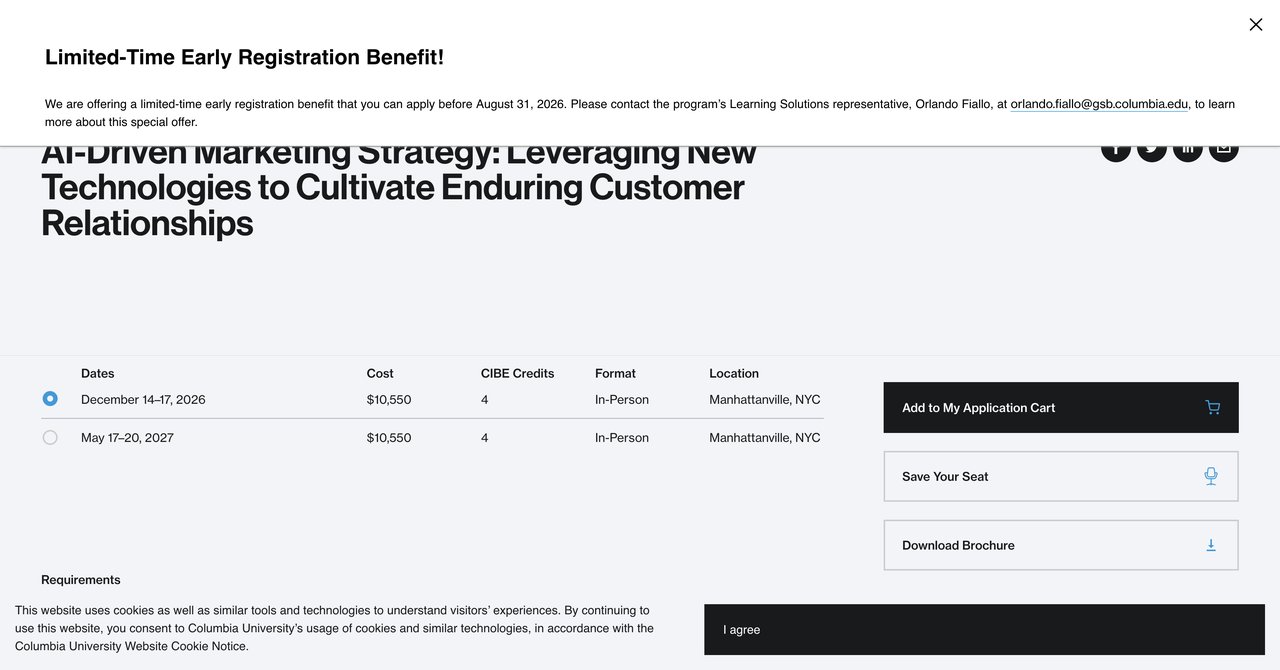
This program from Columbia Business School Executive Education is the most intensive and also most expensive in this comparison. It's an advanced four-day leadership program that is explicitly targeting CMOs and VPs, the upper echelon. At that price and depth, this is not about learning what AI means. You are already supposed to be the one driving AI strategy for the organization, but you now need a very practical roadmap to do it.
It is also quite comprehensive, in that on the schedule it covers generative AI, how to deal with cookie deprecation, the complex of retail media, and how to integrate MarTech for long-term growth. The program includes a deep dive into customer relationships and how to build them with AI, instead of just looking at the initial campaign metrics. The setting New York is an in-person experience and it is. Exec ed at Columbia is aimed at people with real world responsibilities and this program operates in a peer-to-peer way.
Key topics covered: Generative AI for Marketing, Cookie Deprecation, Retail Media, MarTech integration, customer relationship growth.
Target audience and skill level: CMO, VP level, people at a relatively senior enough level to do the decisions about MarTech stack and AI budget. It's also for people who have some experience but want to validate their thinking in an academic setting.
Pros:
- C-suite and VP-level focus, definitely not fluff for juniors
- Coverage of relevant topics, from retail to media, with scenario of cookie deprecation, they are very up-to-date and useful
- Strong emphasis on building customer relationships and driving growth, not just following trends
Cons:
- Very high cost, around $10,000
- In-person only, having to travel to New York
Who benefits most: This is for VPs backed by an organization with a training budget, and who have the time to step away for four days and fly to NYC. If leadership sees you as the person to define the AI direction for the marketing team, this is a good setting to get that organized thinking and a good certificate to show afterwards.
Course 4: AI for Marketing (Specialization) by Coursera (University of Virginia)
Link: Coursera Specialization
Cost: $59/month or ~$49 for a single course
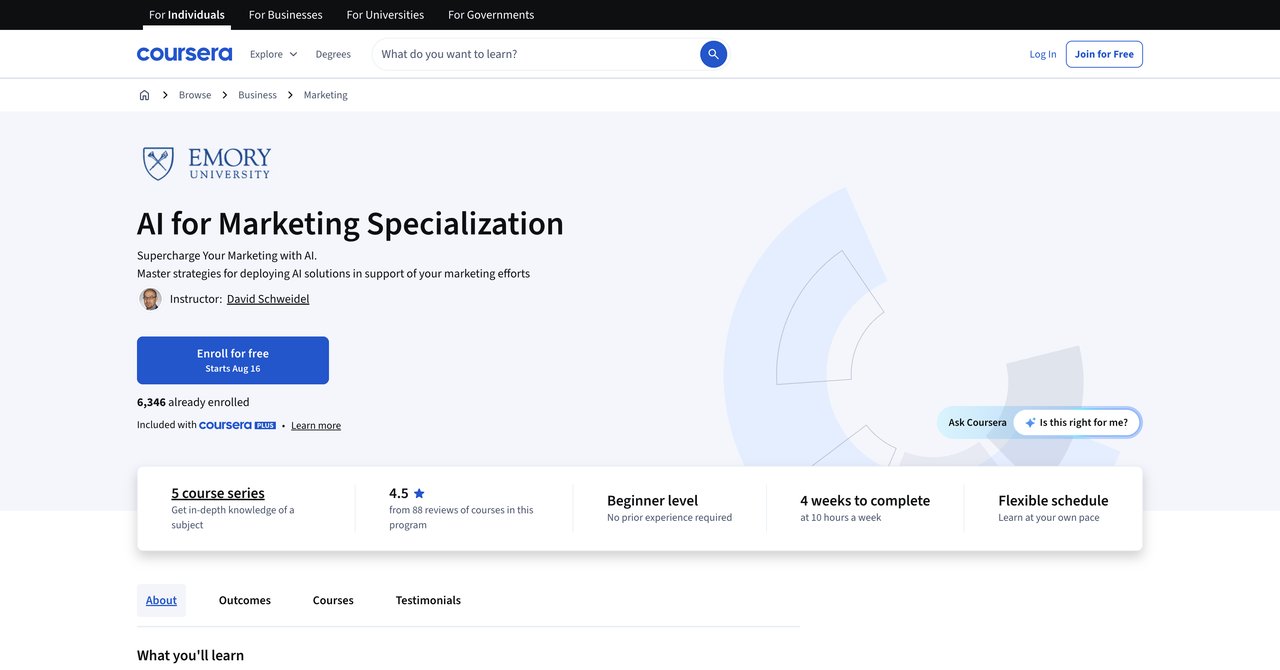
This Specialization comes from the University of Virginia, and it's been around for a while, built on the skills since the AI hype. It's good, structured training that focuses on how to use AI to acquire customers and to retain them. It also has a section on how to create content using generative AI, which is a direct competence in the discipline. It is a well-rounded package that you can work through over a few weeks.
The material is strong, but it's not exclusively for executives. It falls into a category that is "for marketers" and not specifically "for the VP of Marketing." You'll get useful frameworks and examples though. It can act as a refresher to understand the principles and the course format is flexible because it's on-demand. You also do practical things like assessing how effective some strategies are, and that fits a managerial perspective.
Key topics covered: Customer acquisition, customer retention, generative AI content creation, assessment of strategy effectiveness.
Target audience and skill level: Marketing managers and directors, maybe leads or VPs who need a structured refresher. Suitable for intermediate. No advanced coding or the background is needed.
Pros:
- Structured and gives you a clear framework worked around acquisition and retention
- Covers generative AI with actual content creation
- It helps you evaluate if strategies are working, a must-have skill
Cons:
- Requires a Coursera subscription or extra certificate fees
- It's not tailor-made for executives, you'll have to filter out the entry-level parts
Who would benefit most: This option best fits a marketing lead that is new to AI, and who can apply the lessons directly in the current job. It's also good for someone who prefers an academic but flexible schedule at a cost lower than the university programs.
Course 5: AI-powered Marketing with Microsoft Copilot by Coursera (Microsoft)
Link: Coursera Microsoft Copilot Course
Cost: Free to audit; certificate via subscription
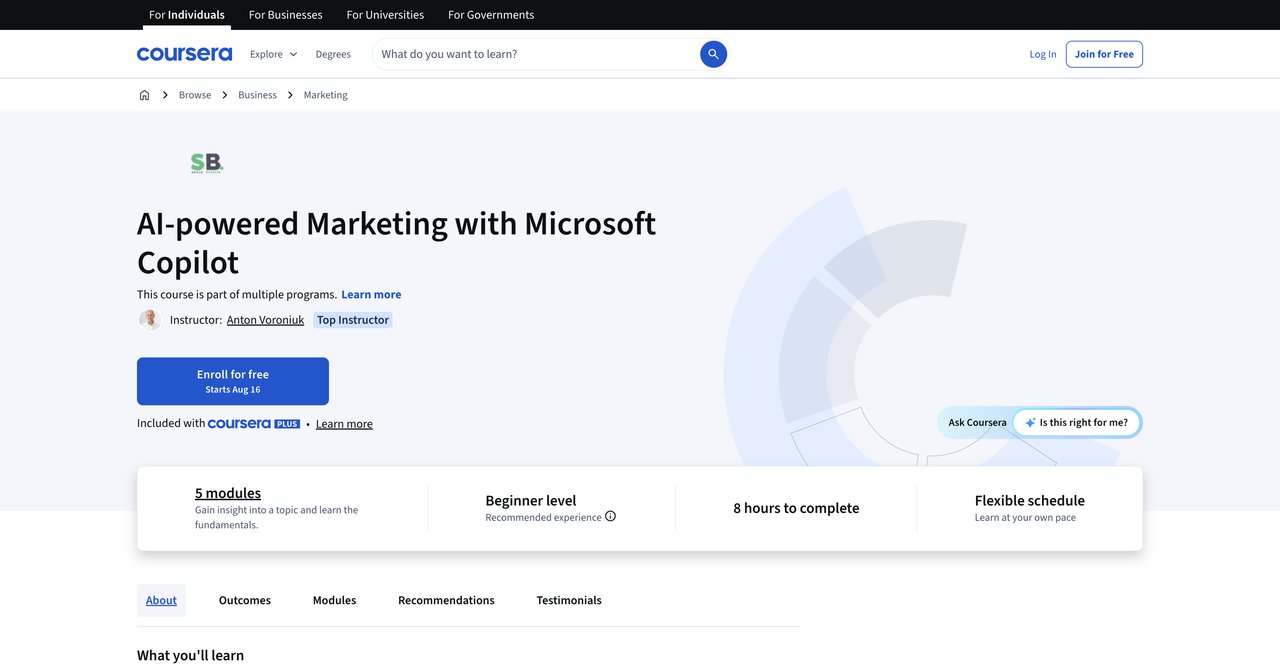
This course runs from Microsofts official content. It covers the strategic decisions you can handle better using AI as a thinking tool. A practical focus includes prompt crafting and the use of analytics. It's concise. And if you're thinking about integrating Microsoft Copilot into your marketing team, it comes in handy.
It is not rocket science, and on a level it is fairly beginner. But that is fine for a VP because you may need to grasp what your team can and cannot achieve with Copilot. Since it comes from the vendor, it has some bias towards the Microsoft ecosystem. But if you are already on Azure, Microsoft 365 and Dynamics, you will get some concrete value from these.
Key topics covered: Strategic decision making, use of AI as a thinking tool, prompts, and data analysis.
Target audience and skill level: Marketing leads who are not afraid to start from scratch in the world of Copilot. Best for people working with the Microsoft ecosystem. It's a beginner level.
Pros:
- Official Microsoft content, which is good if you're heavily into Microsoft tools
- Strategic decision focus, relevant to leaders
- Practical and includes actual prompt crafting lessons
Cons:
- Beginner level, not super deep
- Limited to the Microsoft ecosystem, meaning if you don't use it, it's less useful
Who benefits most: If your organization is a MS shop and wants to roll out Copilot in Marketing, and you're the person leading that rollout, then taking the content goes in.
Course 6: AI Strategy and Marketing Leadership by Coursera
Link: Coursera AI Strategy Course
Cost: Subscription or free audit
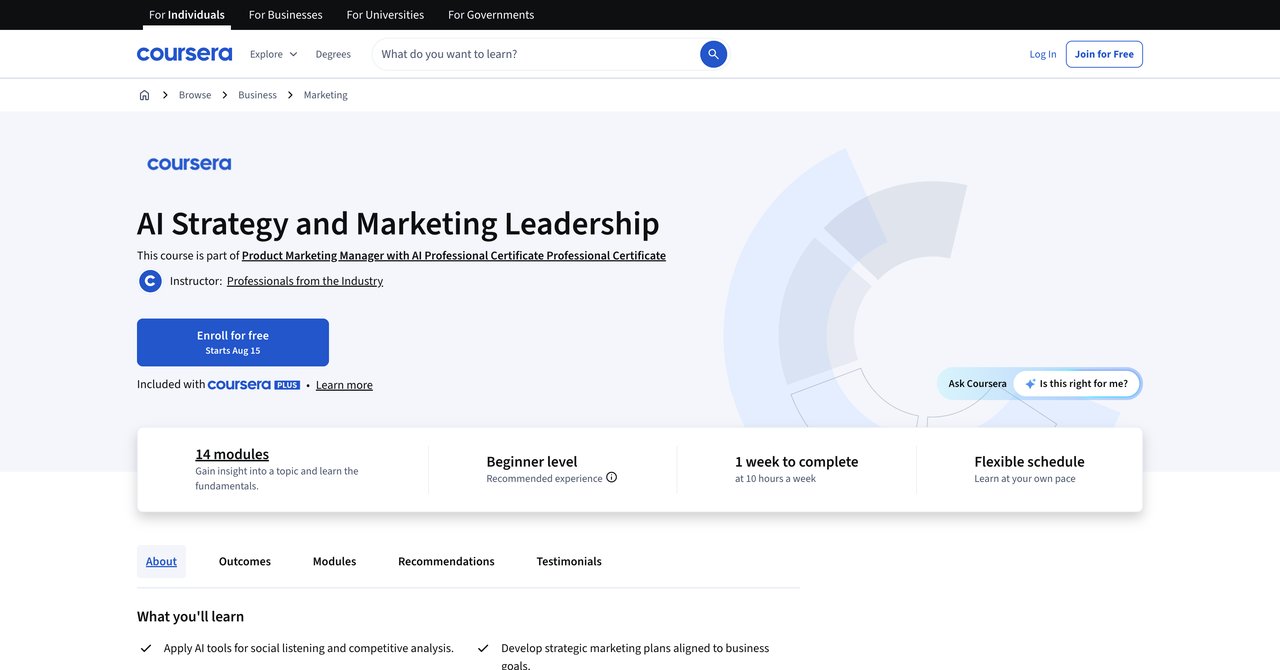
The short one-week course makes the move to bridge the gap between technical AI tools and the typical leadership activities. The curriculum covers budgeting, how to handle the schedule, and storytelling with data at the executive level. That's generally missing from many lower-level AI campaign skills. It acknowledges that AI, in practice at a VP level, is less about creating a piece of copy and more about human resource, funds, and stakeholder management.
This one also has a free audit, so a lot of people use it as a quick intro to see what it is about. Because it is so short, though, you don't get super deep into topics, but it is an excellent, preliminary reset. It's a useful refresher for those who have some experience and want to check that they are covering the fundamentals of the role when applying AI.
Key topics covered: Budgeting, resource scheduling, data storytelling, leadership for AI projects.
Target audience and skill level: Marketing managers starting leaders, and VPs who've had little exposure to the intersection between AI and management responsibilities such as cost and time.
Pros:
- Ties AI tools to real leadership: you will not find many courses that talk about budget and timing
- Includes data storytelling, useful for board reporting
- A free audit is available
Cons:
- Short duration
- Beginner level, not suitable for people after deep strategy skills
Who benefits: If you are a newly promoted VP or a Marketing Director with little experience of leading an AI transition and do not have much time. It helps organize thinking on how to prepare to lead a collaborative AI process.
Course 7: Generative AI for Digital Marketing (Specialization) by Coursera (IBM)
Link: Coursera IBM Generative AI Specialization
Cost: Subscription or free audit
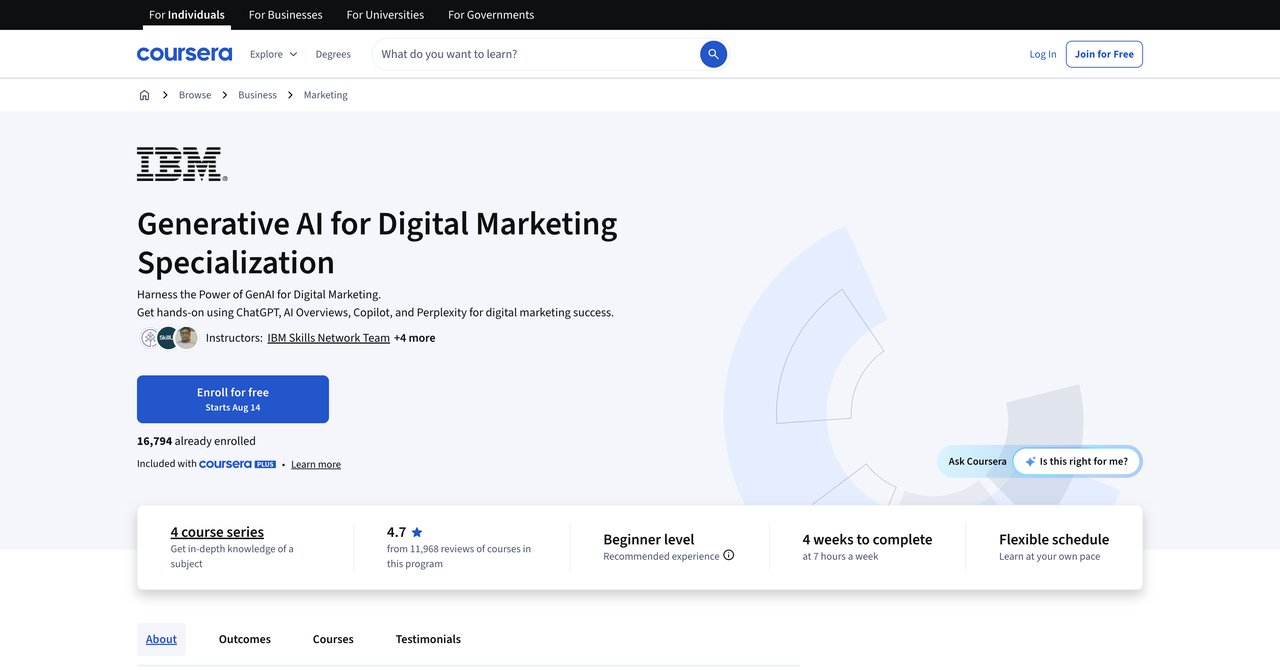
Offered by IBM, this one is a hands-on specialization. It focuses on using generative AI to improve search visibility and also content productivity. It genuinely pure-handed. Practical approach designed to be worked through even for someone with no prior AI. If you've got relatively tactical competition within the team, this is useful for building something quickly.
It is an entry-level and beginner focused. It might not focus on the strategic direction that is also ready to be explained. As a VP, you might well be sending your content team to do this program because you plan to produce more content. You could use it yourself to upgrade and understand the possibilities. But as your time is scarce, you may want to delegate it and manage the outcomes rather than taking the whole thing.
Key topics covered: Search visibility with AI, content generation, and workflow productivity.
Target audience and skill level: Marketers at all levels. It is a great fit for individual contributors and team leads who need to directly manage Go to market. For VPs and self paced learning modules: good but not as deep.
Pros:
- Hands-on, high-quality IBM-derived content
- No prior AI experience needed; beginners can start and have fun
- Covers search and content productivity areas promptly needed
Cons:
- Beginner focused, might not satisfy someone looking for senior leadership discussion
- Not executive-level when the course is for those with years of experience
Who benefits most: If you have content, SEO or digital teams that need a common baseline for GenAI work and a customization that can build internal skills. It's not an executive strategy course though.
Course 8: Claude AI for Marketing by Coursera
Link: Coursera Claude AI for Marketing
Cost: Subscription or free audit
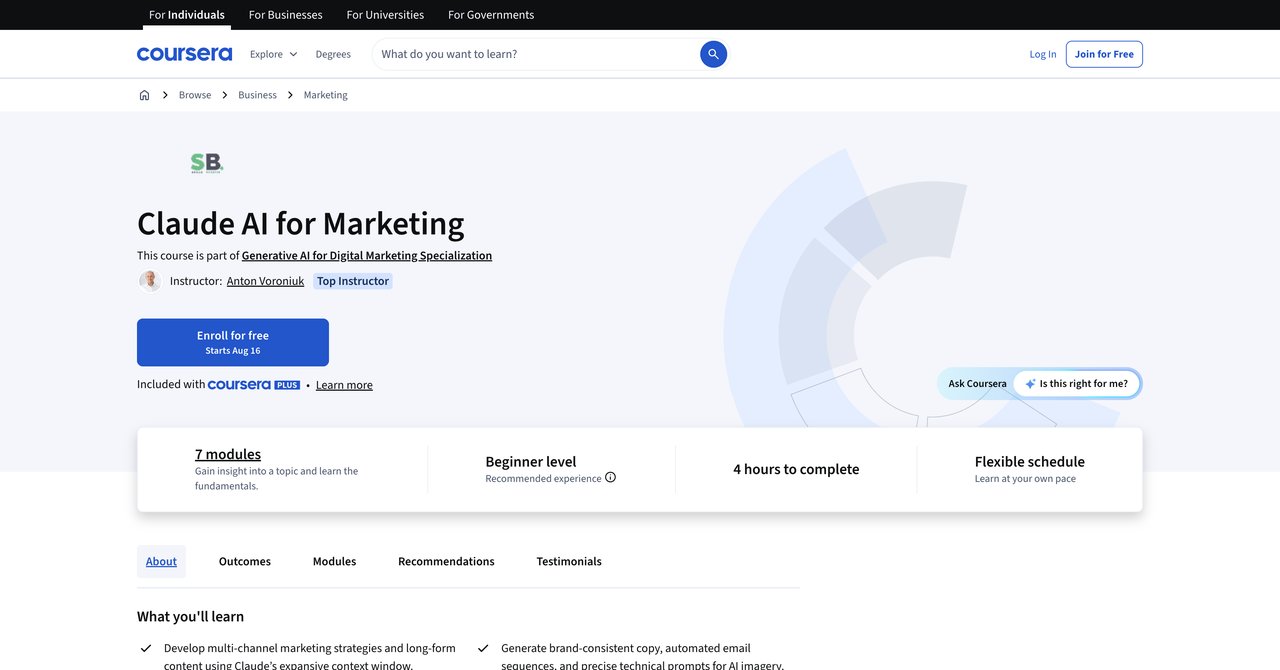
This course is focused on time to Anthropic's Claude, and it teaches you how to use the large context window of Claude to do market synthesis, production of high-conversion copy, and scaling of brand visual identity. The content is quite specialized around the single tool. For many teams, Claude also happens to be one of the strongest models on some marketing tasks. So a specialization there isn't necessarily a bad idea.
But specialization comes with a cost: it's a single-tool focus and not a comprehensive strategy about marketing AI. If you're a VP that has to decide between multiple tool sets, you might need to know more than just Claude is used. That said, the the content is helpful for app and Craft performance. The practicality stands out, as you can use the examples in a matter of hours.
Key topics covered: Claude's context window, oversight and market analysis, ad and email copy, brand identity scaling with AI.
Target audience and skill level: Marketing managers and individual contributors who work directly with Claude or the Anthropic API. For a VP, listen to your staff if they have team members using this framework.
Pros:
- Great use of Claude's large context window for dealing with large amounts of writing
- Covers ad/email copy at a practical level
- It can help scale the visual identity of the brand
Cons:
- Single-tool focus, the lessons won't necessarily in other tools
- Not a comprehensive overview of AI marketing strategy
Who benefits most: Executives planning to use Claude are the ones who can Shape a test and it's better when having your team trained. But if you're looking for a comprehensive strategy, you should instead choose a broader course.
Course 9: Practical AI and Prompting for Marketing Professionals by Coursera
Link: Coursera Practical AI Prompting Course
Cost: Subscription or free audit
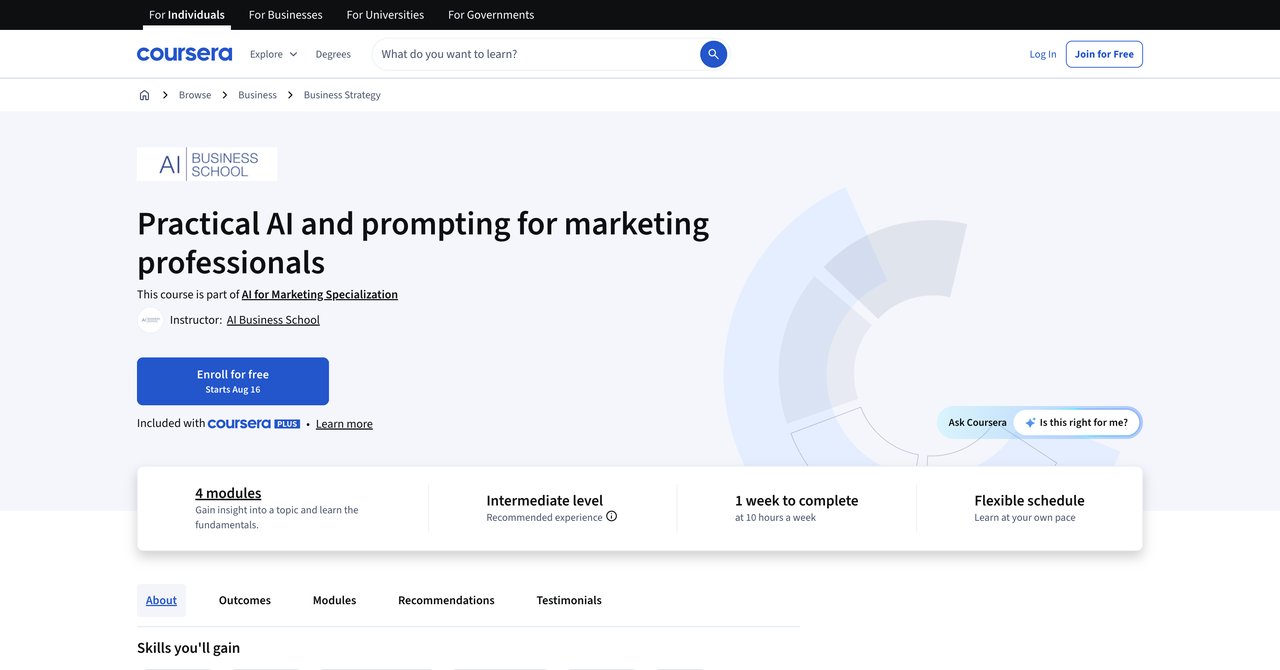
This course focuses on job-specific use cases and across is a multimodal, immediate and thoughtful application. It covers various tools. It has a huge advantage: it sets aside the "why" into "how" and the lesson is delivered in such a way that you can immediately use it. For managers and senior leaders, it is quite useful to see the limits of the current work scope.
But the course is not meant to cover executive and strategy and lacks deep content about governance - which is the big marcom topic. The lack of time is also a big part of the course. For a VP, you could watch this with the intention of later incorporating what is in it into your team's workflow.
Key topics covered: Prompting in Marketing, different AI Today used, and diversified application cases for immediate.
Target audience and skill level: Ideally for junior marketing team members or those uncomfortable with daily changes. It does not require a lot of experience, makes it accessible. Just enough for a VP to skip?
Pros:
- Job specific use cases are very useful
- Immediate practical dynamic, you can see a result at the end of the day
- Covers more than one specific AI tool
Cons:
- Not executive-strategy focused
- Shallow on governance but important for marketing stakeholders and data privacy
Who benefits most: Marketing departments that need to get quick gains and want to get team, to help to use AI in day-to-day tasks. It might also be open for leaders who don't yet have a general understanding of how generative AI is applied across multi-channel campaigns.
Course 10: How to Become an AI-Powered Marketer by Semrush Academy
Link: Semrush AI Marketing Course
Cost: Free
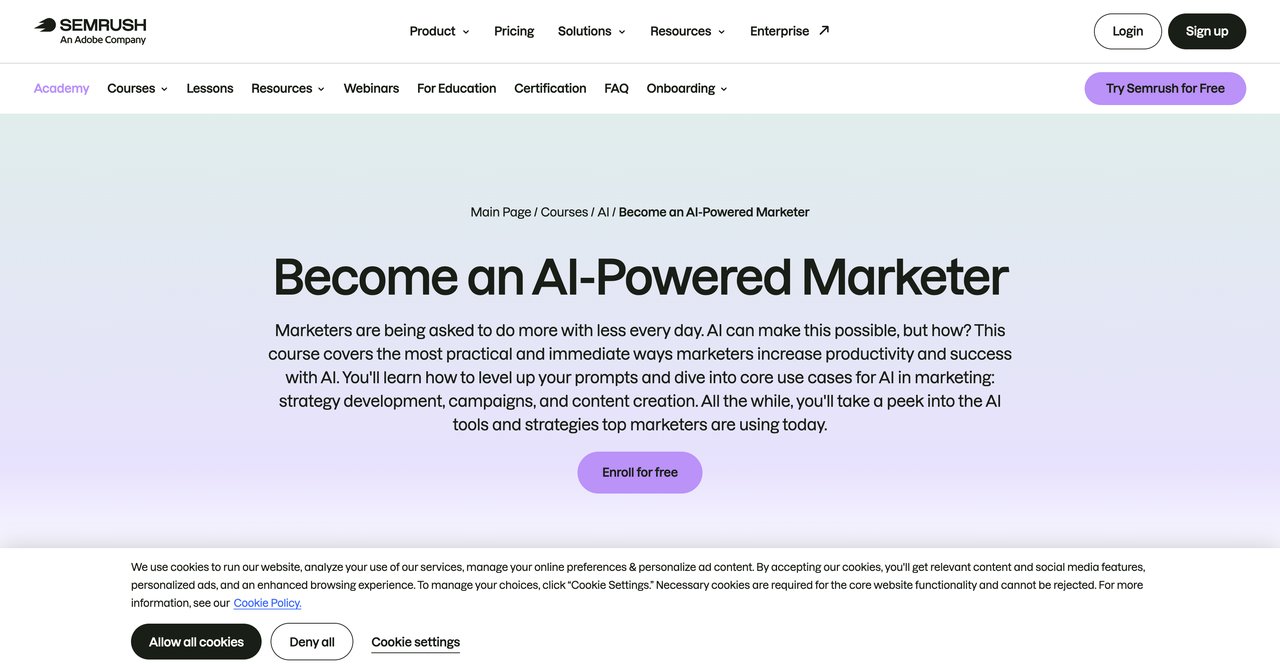
For people who need good basics and free, Semrush Academy offers a one-stop course. It covers prompt engineering and the main AI use cases in marketing, from strategy to campaigns, with the aim of immediate wins for productivity. As you would expect from Semrush, there is a strong focus on SEO and content marketing, and some tools are biased toward the Semrush ecosystem.
It will not replace a high level mentorship or a greater leadership strategy that spans all functions. But because it's free and self-paced, it can be a top entry point for teams. It may not be very long or in-depth, but for practicalities, it is enough to let them go from zero to something.
Key topics covered: Prompt engineering, use cases for AI in marketing, productivity in campaigns and content.
Target audience and skill level: This is aimed mostly at beginners. suitable for the entire team, including interns or the SMM who has never used AI before.
Pros:
- Free and accessible to anyone
- Covers prompt engineering in a practical way
- Improves productivity for core marketing tasks quickly
Cons:
- Beginner level
- Bias towards Semrush platform, as it is used to sell
Who benefits most: From a VP perspective: not really for you, but great to send to team members who need to learn the low-level practical tasks. It's useful but zero cost.
Course 11: AI for Marketing by Coursera (University of Virginia)
Link: Coursera AI for Marketing
Cost: Subscription or free audit

Another University of Virginia course is this one, an individual course which focuses on executing AI-backed campaigns for engagement and conversion. It focuses on data and automation to optimize performance. It's a practical scope, good for running experiments. It also actually starts to measure things.
It does overlap with the more comprehensive Specialization that the same university has. If you take the Civica specialization there is no reason to also do this. But if you only have time for one, this one outlines a campaign design to PR and ROI. Pros:
- Measurable ROI focus
- Real world scenarios and proven applications
- Data-driven optimization
Cons:
- Requires a subscription
- Some aspects overlap with the specialization that is the same source
You would benefit most: This is for VPs who need a tactical refresh on campaign optimization with AI. It also supports team leads for improving performance in campaigns. This can fulfill that role as an accessible course and not overwhelming.
Final Recommendations and Summary
After going through each course, it becomes really about what you need your and what your role is. So there is a clear, broad spread, from free and quick entry to impressive $10,000 programs.
For those who are in the position to pay for it, and time in which they are ready to leave, the Columbia Business School programme is unbeatable in prestige and depth if they cost has to be justified by your organization. Harvard offers a more affordable short visit that is valuable but at a lower deeper strategy. They both have limitations in that they are in-person and you need to travel.
For immediate returns and for effective flexibility, the subscription option from CompleteAI Training is the strongest in value. Because you'll then gain access to the specific course for VP Marketing but also the other training on the platform including all certifications and updates. That makes it more robust for an actual VP role where challenges are multifaceted. With one subscription, your full team can use it, or if you are an individual looking to stay current, it is affordable and also scalable.
For those who need a very narrow team skill, these easier alternatives from Coursera such as IBM's generative AI or the Practical AI and prompting courses can help them deliver precise tactical skills. For managers in a SalesForce-type or Microsoft environment, Microsoft Copilot in action is directly related.
Overall, the best route for a VP of Marketing comes down to the scope and budget. If you have a significant learning budget and are ready to network in person with peers from the Columbia program maybe your best big-ticket investment. However, if comparing all the available balance between value, future flexibility, and coverage across other departments, the CompleteAI Training platform right now gives you more content that is relevant to all the parts of the job - not just single course. Start with a course that matches your time and your next major strategic goal.