
Blog ·
11 Best AI Courses for Financial Analysts to Future-Proof Your Career in 2026
Master AI's impact on finance with 11 top courses tailored for analysts. Master forecasting, automation, and data skills to stay competitive through 2026 and beyond.
 Jeroen Erne
The numbers are hard to ignore. AI adoption in finance has moved from experimental pilots to standard practice, with a 2024 Deloitte survey showing that 69% of businesses now use AI in some capacity. For financial analysts, this shift is both an opportunity and a pressure point. Roles that once centered on data gathering and manual modeling are being redefined. The analysts who adapt will find themselves working alongside AI, not competing with it. Those who don't may watch their workflows become automated by someone who understands how to direct the technology. The gap between these two outcomes is simply a matter of training.
That's why we've put together this guide. We're going to compare eleven of the most relevant AI courses for financial analysts professionals, ranging from beginner-friendly introductions to advanced, executive-level programs. Our goal is to help you cut through the noise and identify which course aligns with your current skill level, your career stage, and your specific goals. Whether you're looking to automate routine reporting, build predictive models, or lead your team's AI strategy, there's a course on this list that fits.
Why AI matters for Financial Analysts today
The role of a financial analyst has always been about turning raw data into actionable insights. But the sheer volume of data available today has made that job nearly impossible to do manually. AI doesn't just speed up the process; it changes what's possible. Analysts can now use machine learning to detect anomalies in financial statements, predict cash flow with greater accuracy, and generate forecasts that adapt to new information in real time.
Adoption is already widespread. A 2024 survey by PwC found that 72% of finance leaders are actively integrating AI into their workflows. And the trend is accelerating. By 2026, Gartner predicts that 40% of all finance tasks will be automated. That means the analysts who can work alongside these systems will be the ones leading the conversation, while those who avoid it may find themselves left behind. This article is here to help you identify which courses will give you the skills to stay relevant.
The Growing Role of AI in Financial Analysts
AI is touching every corner of the financial analyst profession. Here's what that looks like in practice:
- Automation of routine tasks: Data entry, reconciliation, and report generation are increasingly handled by AI tools, freeing up analysts for higher-level analysis.
- Advanced forecasting: Machine learning models can analyze historical data and market signals to produce more accurate revenue forecasts than traditional regression models.
- Real-time risk assessment: AI systems can monitor market conditions and flag potential risks in real time, which is a task that is nearly impossible to do manually at scale.
- Natural language processing: AI can now read earnings calls, press releases, and analyst reports to extract sentiment and key metrics, which saves hours of manual reading.
- Personalized investment strategies: For analysts in wealth management, AI tools help create portfolio recommendations that are tailored to individual client goals and risk tolerance.
These changes are reshaping the day-to-day work of a financial analyst. It's no longer just about being good with Excel. It's about knowing how to ask the right questions of AI systems, how to validate their outputs, and how to explain their findings to stakeholders who might be less familiar with the technology.
Benefits of becoming an AI expert in Financial Analysts
Investing time in AI education pays off in several concrete ways. First, there's the salary factor. According to a recent report by Robert Half, financial analysts with AI skills command salaries that are 15-20% higher than their peers who lack those skills. That's a significant premium for learning a set of tools that are becoming standard.
Second, AI skills make you more adaptable. The financial industry is cyclical, and roles change. An analyst who can work with AI tools is more likely to be considered for new positions within their organization, whether that's in data science, business intelligence, or strategic planning. You become the person who can bridge the gap between the technical team and the business side.
Finally, there's the job security angle. As automation takes over the repetitive parts of the role, the analysts who are left will be those who can do the complex, judgment-based work. AI doesn't replace the analyst; it replaces the tasks. The more you know about how to use AI, the more you position yourself as the person who controls the technology rather than being controlled by it.
With all that in mind, let's look at the courses. The list below includes options for every level, from complete beginners to advanced practitioners. We've also included a course from CompleteAI Training (https://completeaitraining.com/course/ai-for-financial-analysts/), which stands out because it gives you access to all the courses and certifications on the platform, not just one focused program. That's a different model from the other options, which are typically single-course purchases.
Comparison: All AI Courses for Financial Analysts (Updated 2026)
| Course Name | Provider | Price | Key Topics | Pros | Cons | Best For |
|---|---|---|---|---|---|---|
| CompleteAI Training | CompleteAI | Premium (one subscription covers everything) | Comprehensive AI training for Financial Analysts; includes ALL video courses and ALL certifications on the platform-not just one course. One flat subscription unlocks hundreds of courses across every job role, with new content added continuously and included automatically. Covers AI tools, forecasting, financial modeling, data analysis, and more. | Comprehensive curriculum; hands-on projects; expert instructors; full-platform access to all courses and certifications; new courses added automatically; access to other job roles' material; one flat price covers everything | Premium pricing compared to single-course options; subscription-based model | Financial Analysts professionals looking for complete training |
| AI for Financial Analysts (Video Courses + Certifications) | Complete AI Training | $29/month or $8.25/month billed annually | Over 100 specialized video courses and certifications for Financial Analysts; one subscription unlocks EVERY course and EVERY certification on the platform-hundreds of them across all job roles. Includes access to other job roles' material, new courses added continuously, and daily updates on AI tools and news. | Full-platform access to ALL video courses; all certifications included; new content added automatically; access to every other job role's material; one flat price; daily updates; very affordable with annual billing | Subscription-based-requires ongoing payment for continuous learning as AI evolves | General learners |
| GenAI for Financial Analysts: Essential Predictive Analytics | Coursera | Free (audit) / Paid certificate | Generative AI for financial data; market trend analysis; investment opportunities; short and practical format | Focused on generative AI for financial data; covers market trend analysis and investment opportunities; short and practical | Beginner level may not suit advanced analysts; limited depth on model building | General learners |
| GenAI Enhanced Financial Analysis | Coursera | Subscription (Coursera Plus or per-course fee) | Built for analysts with 1,3 years of experience; integrates Excel Copilot, Azure AutoML, Power BI, and Power Query; covers variance and margin analysis | Built for analysts with 1,3 years of experience; integrates Excel Copilot, Azure AutoML, Power BI, and Power Query; covers variance and margin analysis | Requires prior finance and Excel experience; involves multiple platforms, which may be overwhelming | General learners |
| AI Prompting for Financial Analysis | CFI (Corporate Finance Institute) | Not specified | CFI's CAP-AJ framework; hands-on with realistic income statement scenarios; applies to equity research, credit analysis, M&A due diligence | Teaches CFI's CAP-AJ framework; hands-on with realistic income statement scenarios; applies to equity research, credit analysis, M&A due diligence | Very short; requires professional judgment already in place | General learners |
| AI Financial Modeling with Claude in Excel | CFI (Corporate Finance Institute) | Not specified | Hands-on with Claude inside Excel; building, evaluating, and improving financial models; practical for FP&A and corporate finance | Hands-on with Claude inside Excel; focused on building, evaluating, and improving financial models; practical for FP&A and corporate finance | Requires a paid Claude in Excel subscription; narrow tool focus | General learners |
| The Complete AI for Finance Course: Beginner to Master Level | Udemy | Paid (typically $20,$100, varies) | 5-year forecasting; valuation scenarios (P/E, P/S, DCF); realism checks; progresses from beginner to advanced | Covers 5-year forecasting, valuation scenarios (P/E, P/S, DCF), and realism checks; progresses from beginner to advanced | Udemy quality varies; no official accreditation | General learners |
| Financial Analyst: AI, Excel, and Power BI Skills Professional Certificate | Coursera (Microsoft) | Subscription (Coursera Plus or per-course fee) | Job-ready entry-level certificate; combines AI, Excel, and Power BI; no degree or prior experience required | Job-ready entry-level certificate; combines AI, Excel, and Power BI; no degree or prior experience required | Entry-level focus may be too basic for experienced analysts; requires subscription | General learners |
| Apply AI & Machine Learning to Financial Forecasting | Coursera | Free (audit) / Paid certificate | End-to-end ML workflows for stock trend prediction, credit risk, and fraud detection; practical use cases; relevant to forecasting | End-to-end ML workflows for stock trend prediction, credit risk, and fraud detection; practical use cases; relevant to forecasting | Requires some ML background; not purely GenAI-focused | General learners |
| AI for Equity Analysts (2026, Advanced) | FreeAcademy.ai | Free (certificate included) | 10-K analysis; DCF red-teaming; comps; sector coverage assistants; explicitly respects MNPI and research independence | Advanced and free; covers 10-K analysis, DCF red-teaming, comps, sector coverage assistants; explicitly respects MNPI and research independence | Niche to equity research; no live instructor | General learners |
| AI for Business & Finance Certificate Program | Columbia Business School Executive Education | $5,000 (early enrollment discount may apply) | Ivy-League credential; case studies and guest speakers; hands-on AI application to real business and finance problems; career resources | Ivy-League credential; case studies and guest speakers; hands-on AI application to real business and finance problems; career resources | High price; 8-week commitment; limited seats | General learners |
| Master Financial Analysis: AI-Driven Forecasting & Risk | Coursera | Subscription (Coursera Plus or per-course fee) | Progression from core analysis to AI-based forecasting and risk modeling; includes capstone project; comprehensive | Progression from core analysis to AI-based forecasting and risk modeling; includes capstone project; comprehensive | Requires consistent time commitment; some modules may overlap with other courses | General learners |
Understanding AI Training for Financial Analysts Professionals
Artificial intelligence is changing how financial analysis gets done. From forecasting and valuation to risk assessment and reporting, the tools available today can handle heavy lifting that used to take hours or days. But here's the thing - knowing how to use these tools properly requires training. Not just any training, but the right kind for your specific role, experience level, and career goals. The market is full of options now, ranging from free introductory material to expensive university programs, and everything in between.
For financial analysts, the stakes are pretty high when picking a course. You need something that respects your existing knowledge while pushing you into new territory. You also want practical skills you can apply immediately, not just theory. And if you're paying for a certificate, you probably want it to mean something to employers. This comparison breaks down the main options available right now, looking at what each one offers, who it's actually for, and whether it's worth your time and money.
One thing to keep in mind as you read: the AI training space is moving fast. What looks comprehensive today might feel outdated in a year. That's why some providers have shifted to subscription models with continuously updated content, while others still sell individual courses. Both approaches have their place, but they serve different needs. Let's get into the details.
Course 1: CompleteAI Training
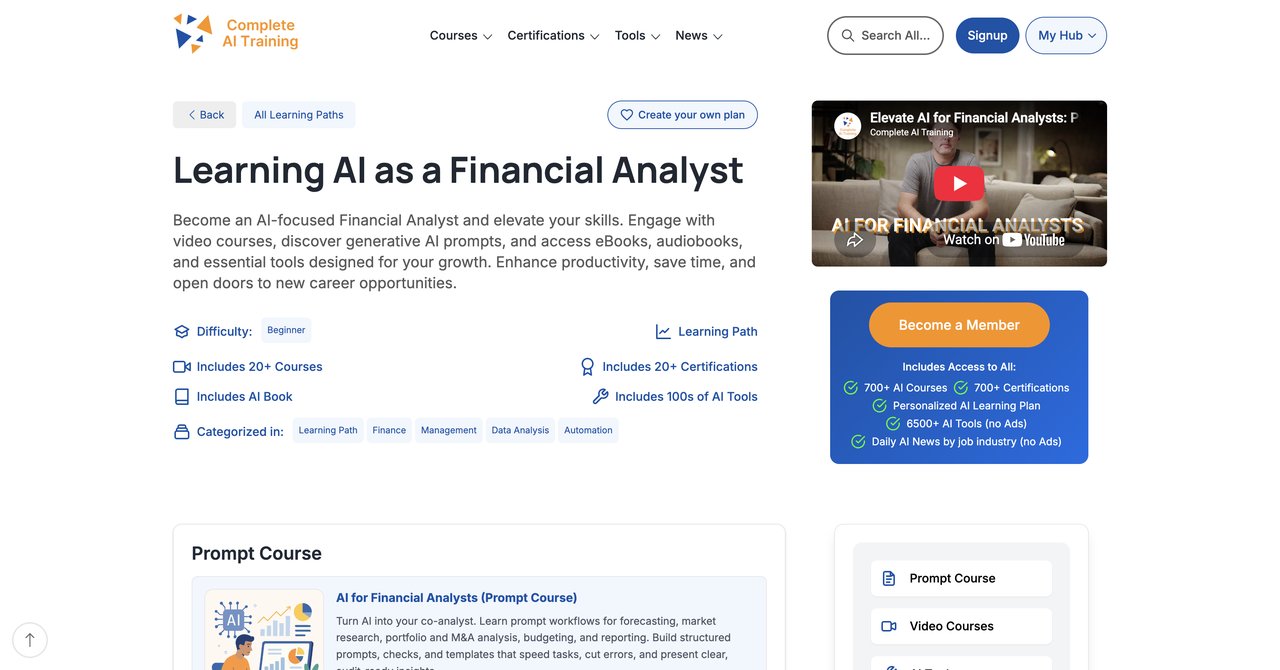
Here's the most important thing to understand about Complete AI Training: it's not a single course. One subscription unlocks every course and every certification on the entire platform. That means hundreds of video courses across every job role, not just financial analysis. If you're someone whose work touches multiple functions, or you're thinking about moving roles down the line, that matters more than you might think. You're not buying one course and hoping it's enough - you're getting full access to the whole library.
The platform offers over 100 specialized video courses and certifications specifically for financial analysts, but the subscription goes way beyond that. You get full access to all video courses on the platform, not a single course or a fixed bundle. All certifications are included at no extra cost, which is pretty rare in this space. New courses and certifications are added continuously and are included automatically, so you don't have to keep paying for updates. And because you can access every other job role's material too, you're not boxed into one function.
What makes this different from other providers? Most places sell you one course at a time, and if you want a certificate, that's often an additional fee. Complete AI Training works on a flat subscription model instead. One price covers everything - all courses, all certifications, all future additions. For anyone who's serious about integrating AI into their financial analysis work, that's a pretty compelling setup.
The subscription runs at $29 per month, or $8.25 per month if you bill annually. The annual rate is a significant saving, and given how fast AI is developing, the fact that you get daily updates on relevant tools and news is a real advantage. You're not learning yesterday's techniques - you're staying current as the field evolves.
Key topics covered: AI applications for financial analysis, forecasting, risk assessment, financial modeling, data interpretation, plus a broad range of AI topics across all job roles on the platform.
Target audience: Financial analysts at any level - from entry to senior - who want a comprehensive, continuously updated AI education. The subscription model works well for professionals who need to stay current as AI tools evolve.
Pros:
- Full-platform access to all video courses, not a single course or fixed bundle
- All certifications included at no extra cost
- New courses and certifications added continuously and included automatically
- Access to every other job role's material too, which matters for anyone whose work spans more than one function
- One flat subscription price covers all of the above, versus paying per course elsewhere
- Daily updates on relevant AI tools and news
- Very affordable pricing, especially with annual billing
Cons:
- Subscription-based, which means ongoing cost rather than a one-time purchase
- Continuous learning is essential, but that's really a function of how fast AI is developing
Who would benefit most: Financial analysts who want more than just a single course. If you're planning to grow your career, need to understand AI across multiple functions, or simply want the best value for money, this platform is hard to beat. It's particularly good for people who like to explore beyond their immediate role.
Course 2: GenAI for Financial Analysts: Essential Predictive Analytics by Coursera
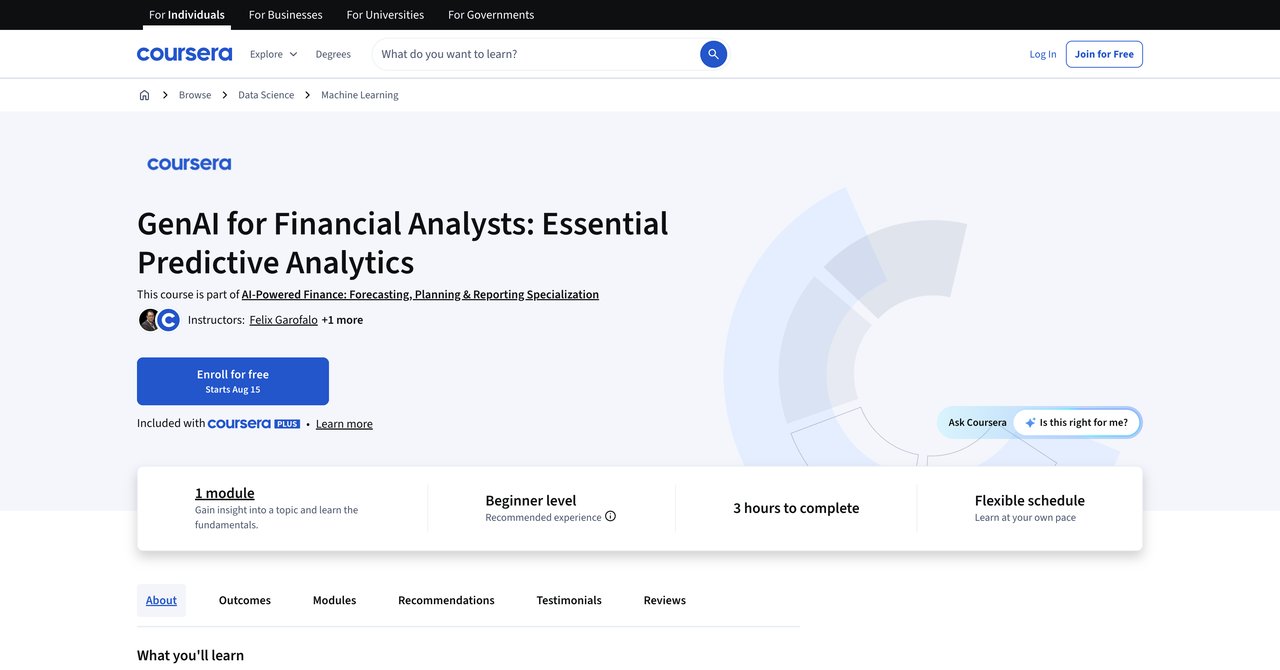
Coursera's offering here is a focused, short course that zeroes in on generative AI for financial data. The main draws are market trend analysis and investment opportunities. It's practical and gets to the point quickly, which makes it a good fit for analysts who don't have a lot of spare time. You can audit the course for free, or pay for a certificate if you want proof of completion.
The course is beginner-level, which is good if you're just starting to think about how generative AI applies to finance. But that's also a limitation. If you've already been working with AI tools and want to go deeper into model building, this might not be the right fit. The scope is fairly narrow, and it doesn't get into the heavy technical side of things.
That said, for what it is, it's done well. The focus on practical use cases means you can take what you learn and apply it pretty quickly. The market trend analysis section is particularly useful for anyone who spends time looking at investment opportunities and trying to figure out where things are headed.
Key topics covered: Generative AI for financial data, market trend analysis, investment opportunity identification.
Target audience: Financial analysts at beginner level, or anyone who needs a quick introduction to how GenAI applies to financial data. Not ideal for advanced analysts who need deep technical skills.
Pros:
- Focused on generative AI for financial data
- Covers market trend analysis and investment opportunities
- Short and practical
Cons:
- Beginner level may not suit advanced analysts
- Limited depth on model building
Who would benefit: Analysts who are new to AI and want a quick, practical introduction. Also useful for those who want to understand market trends using generative AI without getting into the technical weeds.
Visit GenAI for Financial Analysts on Coursera
Course 3: GenAI Enhanced Financial Analysis by Coursera
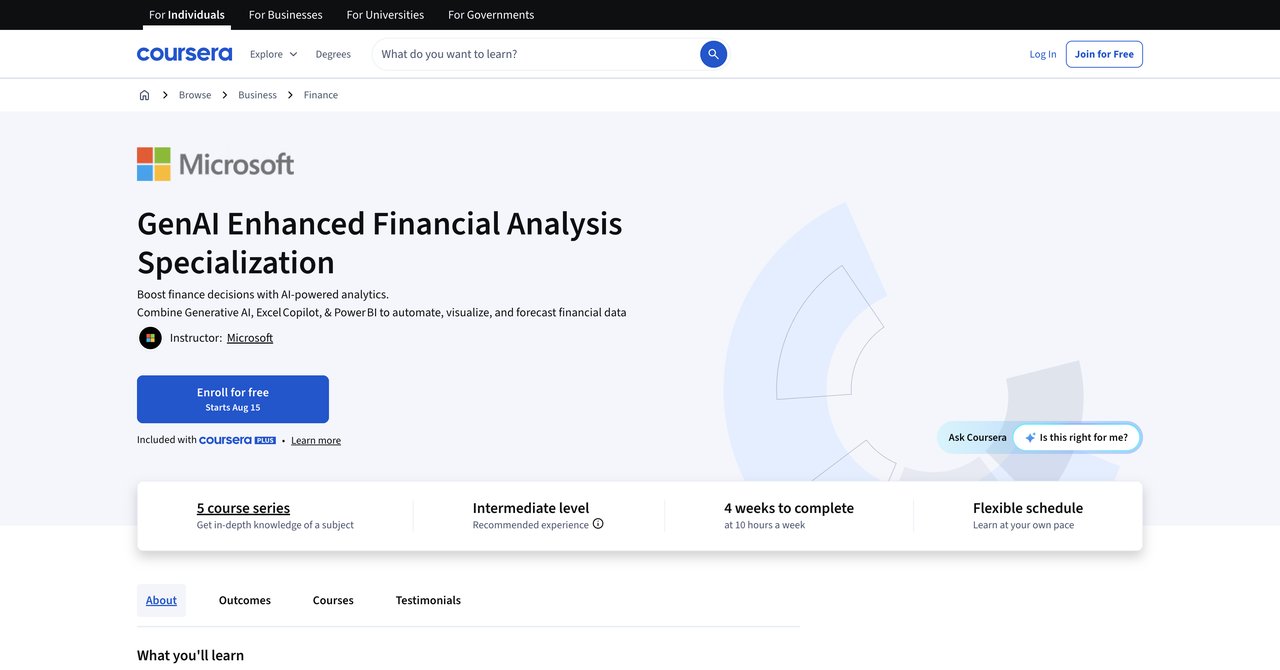
This specialization from Coursera is built for analysts with 1 to 3 years of experience. It integrates several tools: Excel Copilot, Azure AutoML, Power BI, and Power Query. The focus is on variance and margin analysis, which is core work for many financial analysts. You get to see how AI tools can streamline these tasks and make the analysis more robust.
The course assumes you already have some finance and Excel experience. That's probably fair, since the target audience is people who've been working in the field for a few years. But the use of multiple platforms - Excel, Azure, Power BI - could be overwhelming for some learners. You're not just learning AI; you're learning how to connect different tools together, which is valuable but takes time.
What's good about this course is how practical it is. Variance and margin analysis is something you'll actually do in your job, and seeing how AI can speed up the process is useful. The integration with tools you're already using makes it easier to apply what you learn.
Key topics covered: Excel Copilot integration, Azure AutoML, Power BI and Power Query for financial analysis, variance and margin analysis with AI.
Target audience: Financial analysts with 1-3 years of experience who are already comfortable with Excel and have some basic finance knowledge. Good for those who want to integrate AI into their existing workflow.
Pros:
- Built for analysts with 1,3 years of experience
- Integrates Excel Copilot, Azure AutoML, Power BI, and Power Query
- Covers variance and margin analysis
Cons:
- Requires prior finance and Excel experience
- Involves multiple platforms, which may be overwhelming
Who would benefit: Analysts with a few years of experience who want to modernize their approach to variance and margin analysis. It's also good for anyone looking to become more comfortable with Microsoft's AI tools.
Visit GenAI Enhanced Financial Analysis on Coursera
Course 4: AI Prompting for Financial Analysis by CFI
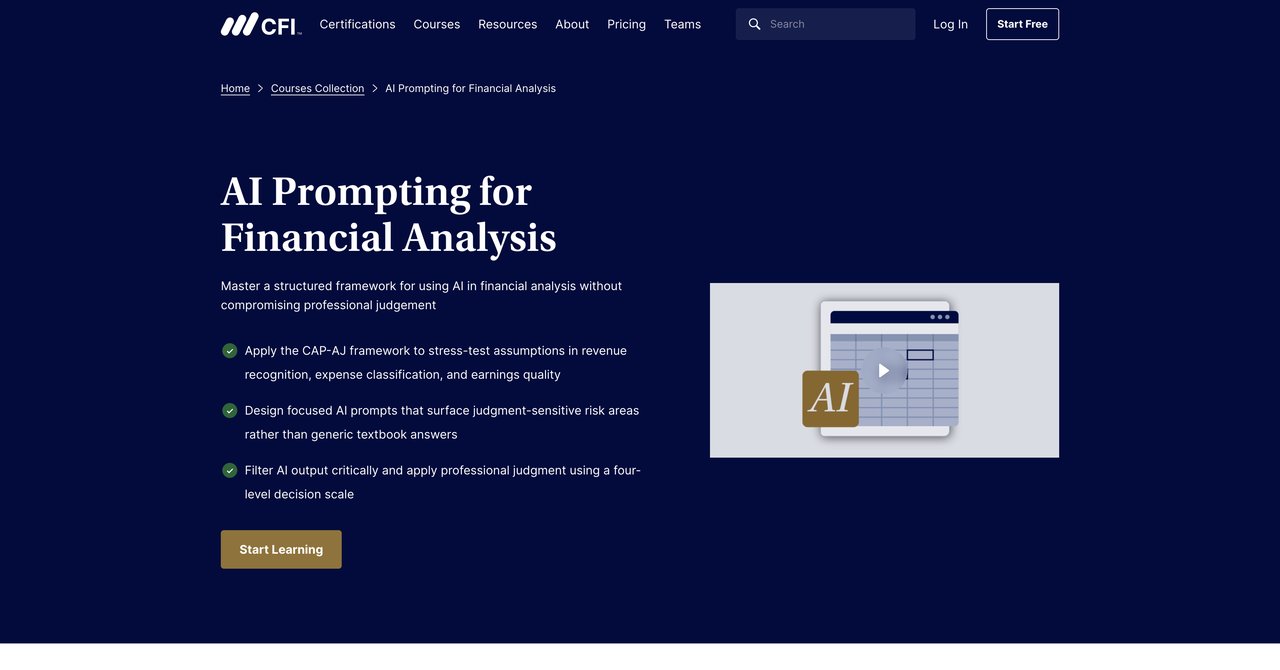
The Corporate Finance Institute offers this course on AI prompting, which is a specific skill that's becoming more important in finance. The course teaches CFI's CAP-AJ framework, which is a structured approach to crafting prompts that get useful results from AI tools. You work with realistic income statement scenarios, which makes the learning directly applicable.
The applications go beyond just income statements. The course covers equity research, credit analysis, and M&A due diligence. So if you're working in any of those areas, this could be relevant. The framework is designed to help you get better, more reliable outputs from AI tools, which is a practical skill that many analysts need.
The main drawback is the length. It's very short, so you won't get deep into any single topic. It also assumes you already have professional judgment - the AI prompts are only as good as your ability to evaluate the outputs. So this is more of a supplement to your existing skills rather than a complete training.
Key topics covered: CFI's CAP-AJ framework, prompting for income statement analysis, applications in equity research, credit analysis, and M&A due diligence.
Target audience: Financial analysts who already have professional experience and judgment, and who want to improve their AI prompting skills. Not suitable for complete beginners.
Pros:
- Teaches CFI's CAP-AJ framework
- Hands-on with realistic income statement scenarios
- Applies to equity research, credit analysis, M&A due diligence
Cons:
- Very short
- Requires professional judgment already in place
Who would benefit: Working analysts who want to sharpen their AI prompting skills without spending a lot of time. Particularly relevant for those in equity research, credit, or M&A roles.
Visit AI Prompting for Financial Analysis at CFI
Course 5: AI Financial Modeling with Claude in Excel by CFI
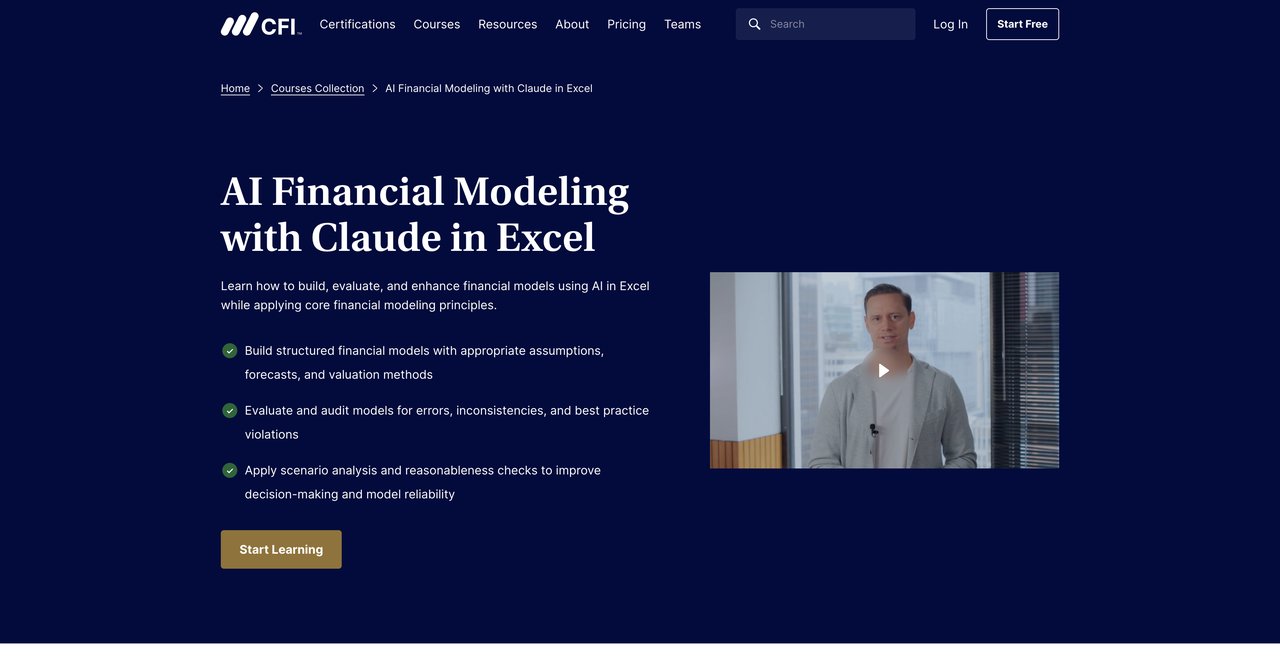
This CFI course focuses specifically on using Claude inside Excel for financial modeling. It's hands-on, which means you'll actually build, evaluate, and improve financial models using the AI tool. For anyone in FP&A or corporate finance, this is directly relevant to your daily work.
The course is practical and gets to the point. You learn how to use Claude to help build models more efficiently, evaluate the models you've created, and improve them over time. The focus is narrow, but that's also its strength - you get a deep understanding of how one powerful tool works in one specific context.
The downsides are worth noting. You need a paid Claude in Excel subscription, which is an additional cost on top of the course. And the narrow tool focus means you're not learning about other AI tools or broader applications. If you're not planning to use Claude specifically, this may not be the best use of your time.
Key topics covered: Using Claude in Excel, building financial models with AI, evaluating model performance, improving models iteratively.
Target audience: Financial analysts in FP&A or corporate finance roles who use Excel extensively and want to integrate AI into their modeling workflow.
Pros:
- Hands-on with Claude inside Excel
- Focused on building, evaluating, and improving financial models
- Practical for FP&A and corporate finance
Cons:
- Requires a paid Claude in Excel subscription
- Narrow tool focus
Who would benefit: Financial analysts who are already using Excel and want to incorporate AI tools into their modeling process. It's particularly good for those who are committed to using Claude specifically.
Visit AI Financial Modeling with Claude at CFI
Course 6: The Complete AI for Finance Course: Beginner to Master Level by Udemy
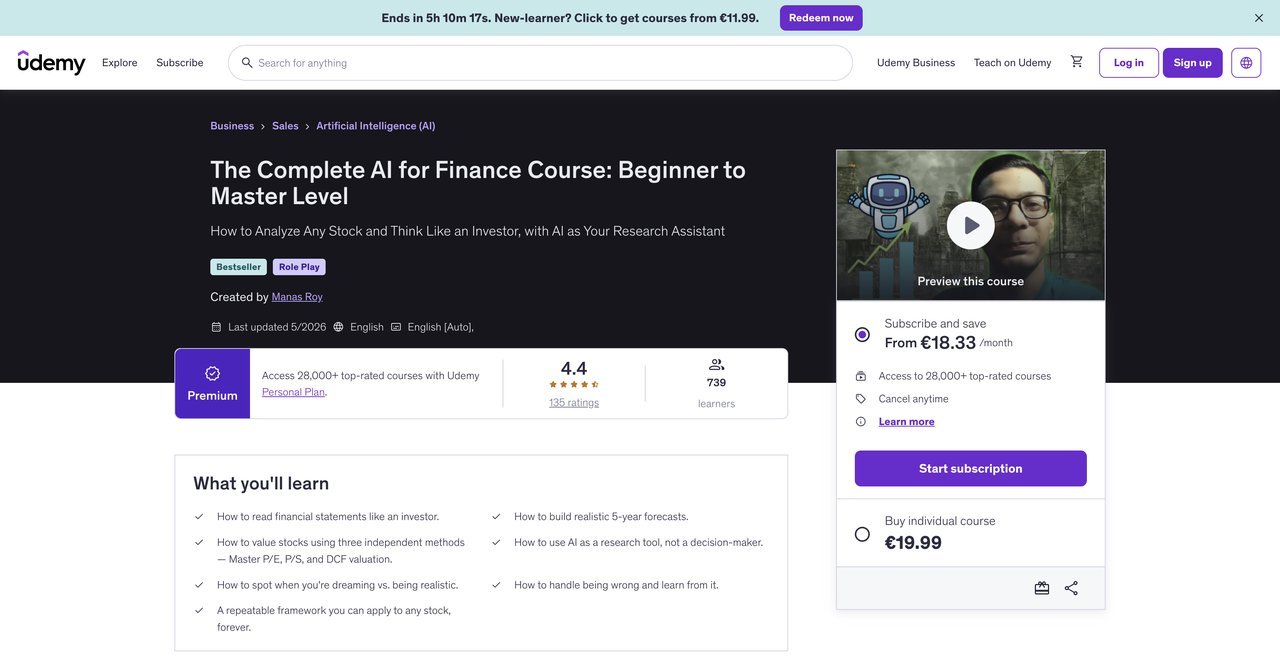
Udemy's offering here is a comprehensive course that takes you from beginner to advanced level. It covers 5-year forecasting, valuation scenarios like P/E, P/S, and DCF, and realism checks. The course is structured to progress, so you start with basics and build up to more complex topics.
The main selling point is the breadth. You get a lot of content for a relatively low price, especially when Udemy runs sales. The forecasting and valuation topics are directly relevant to financial analysts, and the realism checks help you make sure your models actually make sense.
However, Udemy's quality varies widely from course to course, and this one is no exception. You need to check reviews carefully before committing. Also, there's no official accreditation, so if you're looking for a certificate that carries weight with employers, this might not be the best choice.
Key topics covered: 5-year forecasting, valuation scenarios (P/E, P/S, DCF), realism checks, beginner to advanced AI applications in finance.
Target audience: Financial analysts at any level who want a comprehensive, low-cost course. It's especially good for self-learners who are comfortable with Udemy's format.
Pros:
- Covers 5-year forecasting, valuation scenarios (P/E, P/S, DCF), and realism checks
- Progresses from beginner to advanced
- Affordable, especially during Udemy sales
Cons:
- Udemy quality varies
- No official accreditation
Who would benefit: Self-motivated learners who want a broad overview of AI in finance without spending much money. It's also good for beginners who want to get a feel for the field before committing to a more expensive program.
Visit The Complete AI for Finance Course on Udemy
Course 7: Financial Analyst: AI, Excel, and Power BI Skills Professional Certificate by Coursera (Microsoft)
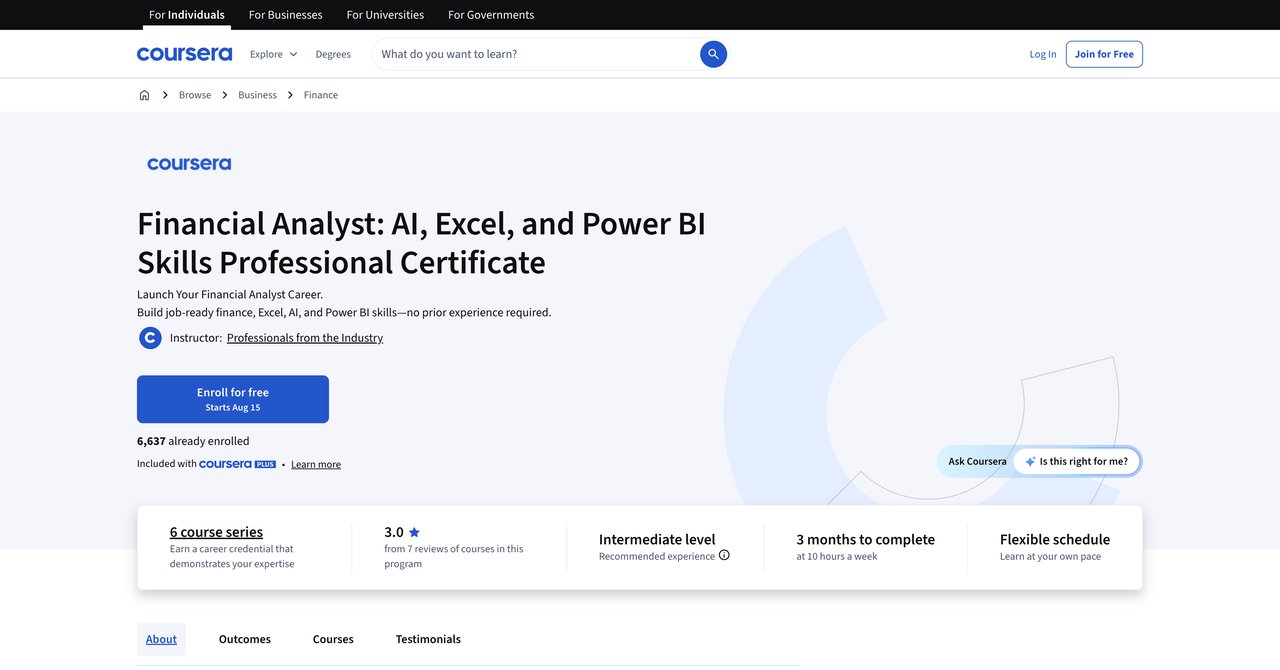
This Microsoft-backed professional certificate is designed to get you job-ready at an entry level. It combines AI, Excel, and Power BI - three tools that are essential for financial analysts. The best part is that no degree or prior experience is required, so it's accessible to anyone who wants to get into the field.
Because it's a professional certificate from Microsoft, it carries some weight with employers. The combination of AI, Excel, and Power BI is practical and covers the main tools you'll actually use on the job. The course is structured to help you build a portfolio of work, which is useful for job applications.
The trade-off is that it's entry-level. If you're already an experienced analyst, this will likely be too basic for you. And since it's a subscription, you'll need to pay for the full Coursera Plus or per-course fees. It's not free, but it's also not as expensive as university programs.
Key topics covered: AI applications in finance, Excel skills, Power BI for data visualization and reporting, and integrated financial analysis.
Target audience: Entry-level professionals who want to get into financial analysis. Also useful for career changers who need to build foundational skills.
Pros:
- Job-ready entry-level certificate
- Combines AI, Excel, and Power BI
- No degree or prior experience required
Cons:
- Entry-level focus may be too basic for experienced analysts
- Requires subscription
Who would benefit: People who are new to financial analysis and want a recognized certificate that shows they have practical skills. It's also good for anyone who needs to build Excel and Power BI skills alongside AI knowledge.
Visit Financial Analyst AI Excel Power BI Certificate on Coursera
Course 8: Apply AI & Machine Learning to Financial Forecasting by Coursera
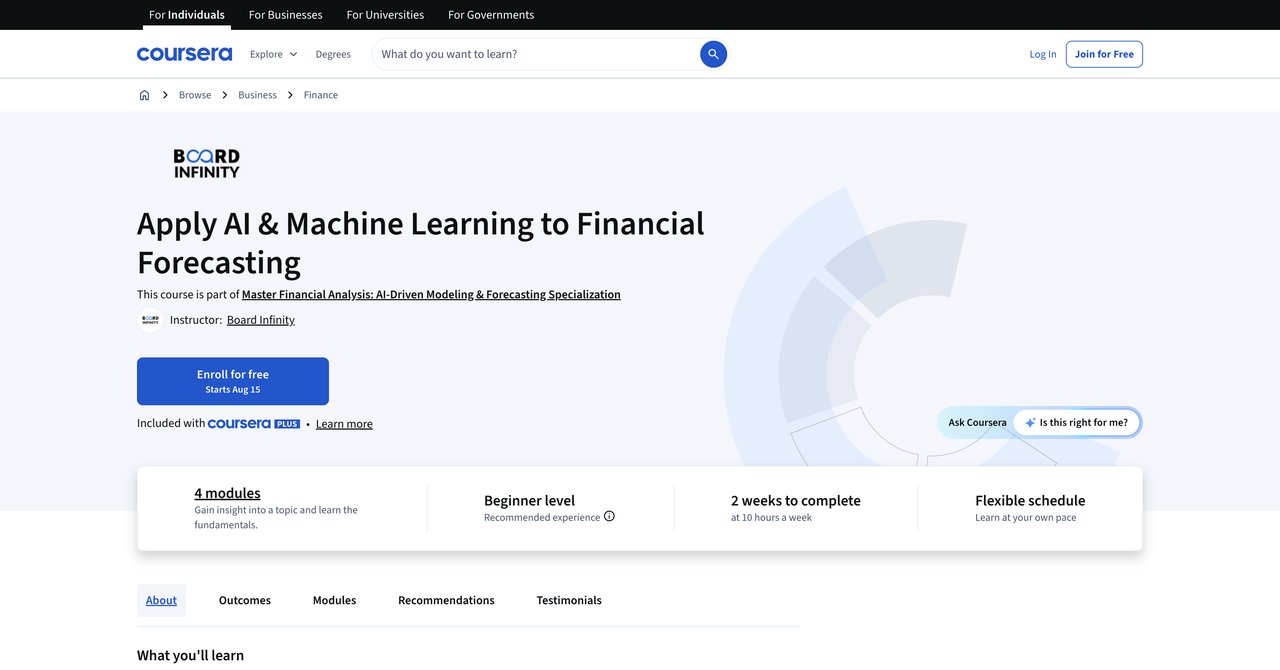
This Coursera course takes a different approach. Instead of focusing on generative AI, it covers end-to-end machine learning workflows for stock trend prediction, credit risk, and fraud detection. These are practical use cases that are directly relevant to financial forecasting.
The course is practical, but it does require some machine learning background. If you're not familiar with ML concepts, you might struggle. It's not purely GenAI-focused either, so if that's what you're looking for, this might not be the right fit. But for analysts who want to understand the technical side of AI in finance, it's a good option.
The fact that you can audit for free is a plus. You can check out the content and see if it matches your needs before paying for a certificate. The practical use cases are valuable, especially if you're interested in risk or fraud detection.
Key topics covered: End-to-end ML workflows, stock trend prediction, credit risk, fraud detection, and financial forecasting with machine learning.
Target audience: Financial analysts with some ML background who want to apply machine learning techniques to forecasting and risk. It's also useful for analysts who want to understand the technical side of AI.
Pros:
- End-to-end ML workflows for stock trend prediction, credit risk, and fraud detection
- Practical use cases
- Relevant to forecasting
Cons:
- Requires some ML background
- Not purely GenAI-focused
Who would benefit: Analysts who want to get into the technical side of machine learning for finance. It's particularly useful for those working in risk or fraud detection roles.
Visit Apply AI & ML to Financial Forecasting on Coursera
Course 9: AI for Equity Analysts (2026, Advanced) by FreeAcademy.ai
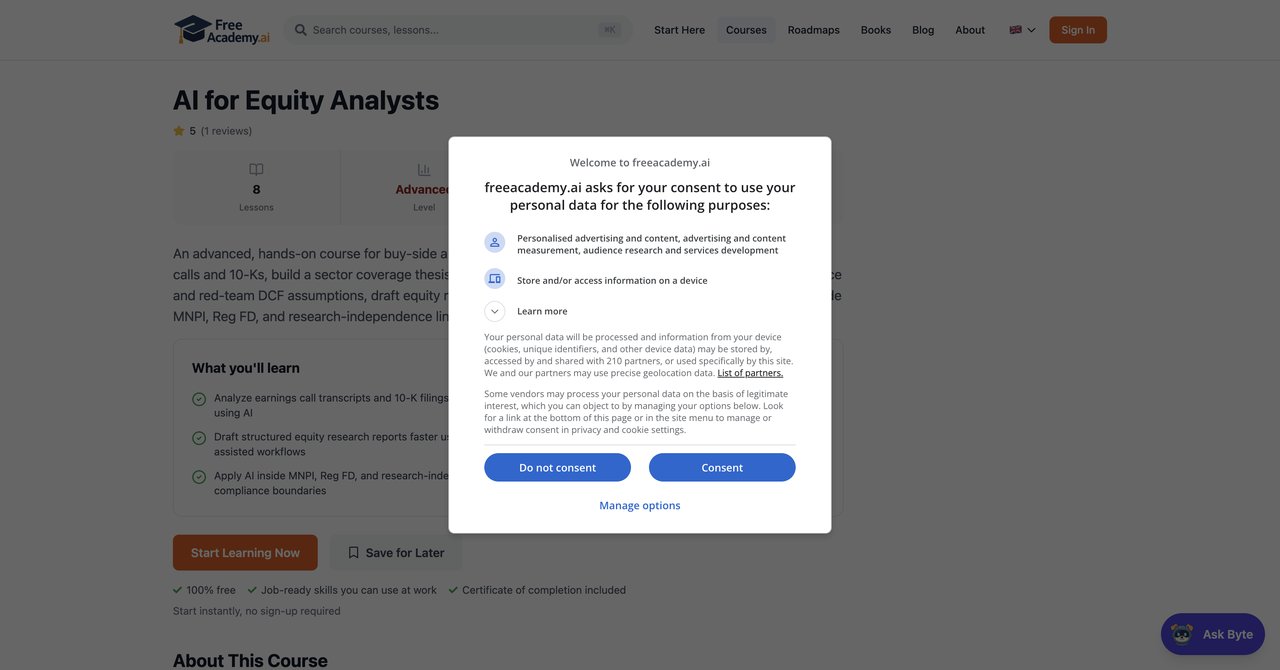
This is a free, advanced course from FreeAcademy.ai that's specifically designed for equity analysts. It covers 10-K analysis, DCF red-teaming, comps, and sector coverage assistants. The course explicitly respects MNPI (Material Non-Public Information) and research independence, which is important for anyone working in equity research.
Being free with a certificate included is a big plus. You get advanced content without paying anything, which is rare in this space. The focus on equity research makes it highly relevant if that's your specialty. The 10-K analysis and DCF red-teaming are practical skills you can use immediately.
The limitations are clear: it's niche to equity research, so it won't be useful for analysts in other areas. And there's no live instructor, so you're learning on your own. But for equity analysts, this is a solid option that won't cost you anything.
Key topics covered: 10-K analysis, DCF red-teaming, comps, sector coverage assistants, MNPI compliance, and research independence.
Target audience: Advanced equity analysts who want to incorporate AI into their research workflow. It's also useful for anyone considering a career in equity research.
Pros:
- Advanced and free
- Covers 10-K analysis, DCF red-teaming, comps, sector coverage assistants
- Explicitly respects MNPI and research independence
Cons:
- Niche to equity research
- No live instructor
Who would benefit: Equity analysts who want advanced AI skills at no cost. It's also good for anyone who's considering a move into equity research and wants to understand how AI applies to this specific role.
Visit AI for Equity Analysts at FreeAcademy.ai
Course 10: AI for Business & Finance Certificate Program by Columbia Business School Executive Education
Columbia Business School offers this executive education program for those who want an Ivy-League credential. The program includes case studies, guest speakers, and hands-on AI application to real business and finance problems. You also get career resources, which is a nice bonus.
The credential carries significant weight. Columbia's name recognition is strong, and this kind of certificate can be a differentiator on your resume. The case studies and guest speakers add practical perspective that you won't get from a purely online course. And the hands-on application means you're not just learning theory.
The main issue is the price: $5,000, though early enrollment discounts may apply. That's a significant investment. The 8-week commitment is also substantial, and seats are limited. This is not a course you take lightly - it's a serious investment in your career.
Key topics covered: AI application in business and finance, case studies, real-world problem-solving, and career development.
Target audience: Mid-to-senior level professionals who want a prestigious credential and are willing to invest in their career. It's also good for those who want networking opportunities with guest speakers.
Pros:
- Ivy-League credential
- Case studies and guest speakers
- Hands-on AI application to real business and finance problems
- Career resources
Cons:
- High price
- 8-week commitment
- Limited seats
Who would benefit: Professionals who want a prestigious credential to advance their career. It's also good for those who learn best from case studies and networking opportunities.
Visit Columbia Business School AI Program
Course 11: Master Financial Analysis: AI-Driven Forecasting & Risk by Coursera
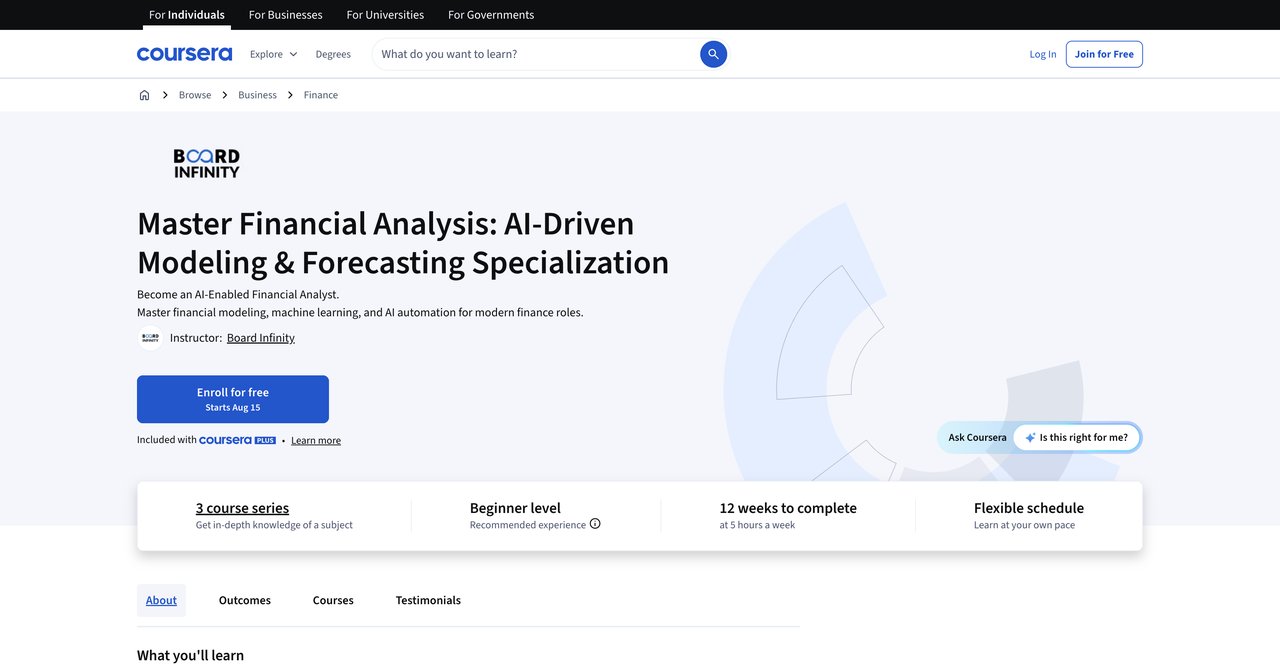
This Coursera specialization is designed to take you from core financial analysis to AI-based forecasting and risk modeling. It includes a capstone project, which is a great way to build a portfolio piece. The course is comprehensive, covering a range of topics that are relevant to financial analysts.
The progression is logical: you start with core analysis skills and build up to AI-based forecasting and risk modeling. The capstone project gives you a chance to apply everything you've learned in a practical way. It's a good choice for analysts who want to build their skills systematically.
The downside is that it requires a consistent time commitment. It's not something you can complete in a weekend. Also, some modules may overlap with other courses you've already taken, which can feel redundant. But if you're looking for a comprehensive program, this is worth considering.
Key topics covered: Core financial analysis, AI-based forecasting, risk modeling, and a capstone project for practical application.
Target audience: Financial analysts who want a comprehensive, structured approach to AI in finance. It's suitable for those who have some experience and want to deepen their skills.
Pros:
- Progression from core analysis to AI-based forecasting and risk modeling
- Includes capstone project
- Comprehensive
Cons:
- Requires consistent time commitment
- Some modules may overlap with other courses
Who would benefit: Analysts who want a structured, comprehensive program that takes them from basics to advanced AI applications. The capstone project is particularly useful for building a portfolio.
Visit Master Financial Analysis on Coursera
Final Recommendations
So, what's the best option? It really depends on your situation and what you're trying to achieve.
For financial analysts who want the most comprehensive and cost-effective solution, CompleteAI Training stands out. The subscription model gives you access to everything - every course, every certification, across all job roles. At $8.25 per month with annual billing, it's significantly cheaper than most alternatives, and you get continuous updates as AI evolves. The fact that you can access material for other roles too is a real advantage if you're planning to grow your career.
If you're an experienced equity analyst, the FreeAcademy.ai course is hard to beat because it's free and advanced. It covers topics like 10-K analysis and DCF red-teaming that are directly relevant to your work. The lack of instructor is a minor drawback, but the price is unbeatable.
For those who want a prestigious credential and have the budget, Columbia Business School's program is the way to go. The $5,000 price tag is significant, but the Ivy-League name and networking opportunities could pay off in career advancement. It's best for senior professionals who want a credential to stand out.
If you're new to the field, the Microsoft professional certificate on Coursera is a solid choice. It gives you job-ready skills in AI, Excel, and Power BI, and the Microsoft backing carries weight with employers. It's not for experienced analysts, but it's perfect for those just starting out.
For analysts who want to improve their skills in specific areas, the CFI courses are worth considering. The AI Prompting course is short but practical, and the Claude in Excel course is useful if you're committed to that specific tool. They're not comprehensive, but they're focused and relevant.
The Udemy course is a budget-friendly option that covers a lot of ground. Just be sure to check reviews before you buy, because quality varies. And the various Coursera courses and specializations offer different approaches, depending on whether you want to focus on GenAI, machine learning, or comprehensive skill development.
Ultimately, the best choice comes down to your budget, your experience level, and what you want to achieve. For most financial analysts who want to stay current and comprehensive, the CompleteAI Training subscription is the strongest value. But if you have specific needs - like equity research specialization or a prestigious credential - one of the other options might be a better fit.
Whatever you choose, the important thing is to start. AI is becoming a core part of financial analysis, and the professionals who adapt will have an advantage. The courses above represent the main options available, and they offer different paths to the same goal: becoming a more effective financial analyst with AI.