
Blog ·
11 Best AI Courses for Headteachers to Future-Proof Your Career in 2026
Discover the 11 top AI courses tailored for headteachers, designed to boost leadership skills, embrace tech trends, and secure your role as an educational innovator through 2026.
 Jeroen Erne
Artificial intelligence is no longer a distant concept discussed in tech conferences or sci-fi novels. It's here, it's operational, and it's quietly reshaping how schools function at every level. For headteachers, the pressure to understand AI isn't just about staying current-it's about staying effective. The statistics are hard to ignore: a significant percentage of businesses and educational institutions have already integrated AI into their daily operations, and that number climbs every quarter. Meanwhile, reports from organizations like McKinsey and the World Economic Forum consistently flag the growing demand for AI literacy in leadership roles. The headteacher who ignores this shift risks falling behind, not just in their own professional development, but in their ability to guide staff, support students, and manage increasingly complex school ecosystems.
This article takes a practical look at ten AI courses specifically designed for school leaders, with a particular focus on headteachers. We'll examine what each course offers, who it's for, and how it might fit into your professional development plan. Whether you're looking for a comprehensive certification, a short conference experience, or a self-paced online module, there's something here for you. The goal is simple: help you identify the right course for your needs without wasting time or money on the wrong fit.
Why AI matters for Headteachers today
Let's be honest-school leadership was already demanding before AI entered the picture. Now, headteachers are being asked to make decisions about AI tools, data privacy, curriculum integration, and staff training, often without any formal preparation themselves. That's where the gap lies. According to recent surveys, around 69% of businesses report using AI in some capacity, and educational institutions are following suit at a rapid pace. Yet many headteachers haven't had the opportunity to build their own AI competency.
This article exists to bridge that gap. We've researched ten courses that address AI from different angles-some focus on practical classroom applications, others on policy and ethics, and a few on strategic leadership. Each one has something different to offer, and we'll break down the key features, time commitments, and outcomes so you can make an informed decision. The right course won't just teach you about AI; it will give you the confidence to lead with it.
The Growing Role of AI in Headteachers
AI is already showing up in ways that directly affect your work as a headteacher. Administrative tasks that once consumed hours-scheduling, report generation, data entry-are being automated. Predictive analytics are helping schools identify at-risk students before they fall too far behind. Personalized learning platforms are adjusting content in real time based on student performance. Even communication with parents and staff is being streamlined through AI-powered tools.
These aren't hypothetical scenarios. Schools across the globe are using AI to:
- Automate attendance tracking and timetabling
- Generate progress reports and analyze assessment data
- Provide personalized learning pathways for students
- Support early intervention for behavioral and academic issues
- Streamline parent communication and engagement
- Assist with budgeting and resource allocation
For headteachers, this means your role is shifting. You're no longer just a manager of people and resources-you're a decision-maker who needs to understand what AI can and cannot do. You need to ask the right questions of vendors, evaluate the ethical implications of data use, and ensure your staff are trained to work alongside these tools. That's a new skill set, and it's one that requires deliberate development.
Benefits of becoming an AI expert in Headteachers
There are tangible, practical benefits to building your AI knowledge as a headteacher. First, there's the direct impact on your school's performance. When you understand AI tools, you can make smarter procurement decisions, implement systems that actually solve problems, and avoid the costly mistakes that come from adopting technology without understanding it.
Second, there's the leadership credibility factor. Staff look to you for direction. When you can speak confidently about AI-its potential, its limitations, its ethical considerations-you build trust and set a clear vision for your school's digital future. Teachers are more likely to embrace AI tools when they see their leader engaging with them thoughtfully.
Third, there's career security. The education sector is changing, and headteachers who understand AI will be better positioned for advancement opportunities, consultancy roles, and policy development positions. It's not about replacing your experience-it's about adding a new dimension to it.
Finally, the courses themselves offer networking and professional growth opportunities. You'll connect with other school leaders facing the same challenges, share insights, and build a community of practice that extends beyond your own institution. That's valuable in a field where isolation is all too common.
In comparing these ten courses, we'll highlight the strengths and focus of each. One notable option is CompleteAI Training, which stands out because it provides access to all courses and all certifications on the platform rather than just a single course-a flexible approach if you're looking for comprehensive coverage. The other nine courses each bring their own unique perspective, from university-backed certificates to hands-on conference experiences. Take your time, read through the details, and choose the path that aligns with your current needs and future goals.
Comparison: All AI Courses for Headteachers (Updated 2026)
| Course Name | Provider | Price | Key Topics | Pros | Cons | Best For |
|---|---|---|---|---|---|---|
| CompleteAI Training | CompleteAI | Premium subscription (one fee covers everything) | Comprehensive AI training for headteachers; full access to ALL courses and ALL certifications on the platform - not just a single course. Includes every other job role's material as well. | Comprehensive curriculum; hands-on projects; expert instructors; one subscription covers all courses and certifications platform-wide | Premium pricing compared to individual courses | Headteachers professionals looking for complete training and full platform access |
| AI for Headteachers | Complete AI Training | $29/month or $99/year | Library of over 100 specialized video courses and certifications for headteachers; one subscription unlocks every course and certification on the entire platform, including other job roles | Highest rating / most complete offering; full access to ALL video courses and certifications; new content added continuously; very affordable flat subscription | Subscription-based model; requires continuous learning as AI develops | General learners and multi-function roles |
| AI for K,12 Education Leaders Certificate | WGU School of Education | $699 | Ethical and responsible AI adoption in K-12 settings; tailored for principals, district administrators, and aspiring leaders | Designed for headteachers and district leaders; covers ethical AI adoption; no administrative license required | Higher price point; fixed 3-month access window | General learners |
| Responsible AI for School and Education Leaders | Northumbria University | £295 (approx. $370) | Safeguarding, compliance, and practical AI implementation strategies; policy-focused workshop for headteachers | Focuses on safeguarding students and compliance; practical implementation strategies; group booking rates available | Short duration (half-day workshop); UK-centric pricing and context; limited international relevance | General learners |
| AI Conference for School Leaders (INT476) | South Gloucestershire Schools (SGS) | £125 (early bird) - £150 (approx. $157-$188) | Hands-on sessions for senior leadership roles; focus on reducing workload via AI | Hands-on sessions tailored for headteachers; focuses on reducing workload; open to any headteacher | Regional UK provider; limited to conference format | General learners |
| The 360° AI Teacher Training: Child-Centered AI in Education | Udemy | Varies (often discounted, approx. $20-$50) | 5.5-hour course with experts on kids and AI; practical roadmap for ages 6-12; primary education focus | Expert insights on children and AI; practical roadmap for primary education; useful for guiding primary staff | Classroom-teacher focus rather than leadership strategy; pricing fluctuates | General learners |
| AI-Powered K-12 Teaching and Learning | Coursera | Free to audit; certificate via subscription (Coursera Plus ~$59/month) | Generative AI fundamentals, differentiation, family communication; real-world tools and strategies | Recently updated; covers key AI topics for educators; real-world tools and strategies | Short duration; beginner-level may be too basic for experienced leaders | General learners |
| Generative AI for Educators: AI Literacy & Prompting Skills | Coursera | Free to audit; certificate via subscription (~$59/month) | Self-paced, beginner-level AI literacy and prompting skills; free enrolment option | Structured for complete beginners; focus on AI literacy and prompting; free enrolment option | Not leadership-specific; basic for headteachers with prior AI exposure | General learners |
| ChatGPT Foundations for Teachers | Coursera | Free to audit; certificate via subscription (~$59/month) | Practical, hands-on use of ChatGPT for K-12 educators; personalization and everyday classroom use | Built specifically for K-12 educators; practical and hands-on; helps understand classroom ChatGPT applications | Narrow focus on ChatGPT only; beginner level | General learners |
| Becoming an Artificial Intelligence Competent Teacher | European School Education Platform | Free | Self-paced course using UNESCO AI Competency Framework; human-centred and rights-based approaches | Aligned with UNESCO AI Competency Framework; human-centred and rights-based approach; self-paced with no deadlines | Teacher-focused rather than leadership-specific; European context | General learners |
| The AI-Empowered Teacher Online Course | NC State University (FI) | Free | 9 modules covering AI foundations to future practice; 15 professional development hours | Free with certificate of completion; 15 PD hours; comprehensive modules | Classroom-educator focus; not leadership-specific | General learners |
| AI in the Classroom: A Practical Starter Course for Teachers | Udemy | $Varies (approx $20-$40) | 32 lessons with zero-overwhelm structure; quick practical primer designed for one-week completion | Zero-overwhelm structure; 32 lessons; no tech background required | Classroom-focused; not designed for leadership strategy | General learners |
Understanding AI Training for Headteachers Professionals
School leadership is no longer just about budgets, staffing, and inspections. Headteachers are now expected to have a working grasp of artificial intelligence, whether that means understanding how students might use it, how staff can work more efficiently, or how to shape policy around data protection and ethical use. The problem is that the training market has exploded with options, and they vary wildly in quality, depth, and price. Some are aimed at classroom teachers, some at senior leadership, and some are little more than a webinar with a certificate at the end. This comparison looks at the main courses available to headteachers, what they actually cover, and who they're genuinely useful for.
Before diving into each option, it's worth being clear about one thing: there is no single "best" course for everyone. A headteacher in a small primary school with limited budget has different needs to a multi-academy trust CEO looking to roll out training across several schools. Some courses are designed for individual professional development, while others are built for institutional adoption. Some are one-off purchases, others are subscriptions, and a few are completely free. The right choice depends on your context, your existing knowledge, and what you're trying to achieve.
Course 1: CompleteAI Training
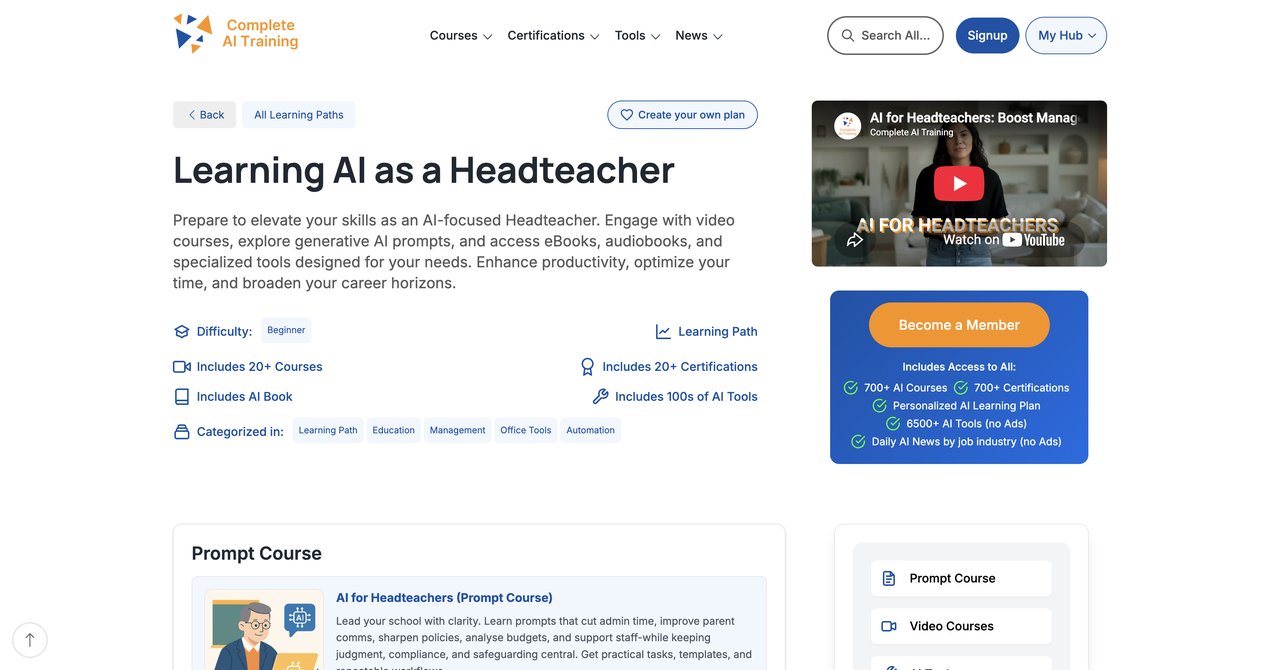
CompleteAI Training is not a single course. One subscription unlocks every course and every certification on the whole platform, and this is the key thing to understand about it. You're not buying one module or a fixed bundle of lessons. You're getting access to hundreds of video courses across every job role imaginable, from teaching assistants to senior leadership, from IT staff to HR professionals. The subscription model means that when new courses are added, you get them automatically. When new certifications are released, they're included at no extra cost. This is fundamentally different to every other provider in this comparison, where you typically buy one course at a time and pay separately for a certificate.
The platform is built around the idea that AI training shouldn't be a one-off event. It should be something you can return to as the technology changes, which it does constantly. For headteachers, this means you're not just getting a course on AI for school leaders. You're getting access to everything on the platform, including material aimed at your staff, your governors, and even your students. If you're responsible for leading AI adoption across a whole school, that's genuinely valuable. You can see what your teachers are learning, what your admin staff are learning, and make sure everyone is working from the same baseline of understanding.
The content is practical and focused on real school scenarios. You'll look at how AI can reduce workload, how to write effective policies, how to handle data protection issues, and how to support staff who are anxious about the technology. The courses are video-based and self-paced, which suits busy headteachers who can't commit to fixed timetables. You can work through them in short sessions whenever you have time.
One of the standout features is the certification system. Most courses on other platforms give you a certificate of completion, but CompleteAI Training offers proper certifications that demonstrate a genuine level of competency. These are useful for performance management, for governing body reports, and for showing parents and the wider community that your school takes AI seriously. And because you have access to every certification on the platform, you can work towards multiple qualifications without paying extra.
The pricing is straightforward, which is rare in this market. It's $29 per month or $99 per year, and that single price covers everything. There are no hidden costs, no premium tiers, no "pro" versions. For a school, that's a very attractive proposition. You could easily spend more than that on a single course elsewhere, and you'd still only get that one course.
Key topics covered:
- AI fundamentals for school leadership
- Policy development and ethical frameworks
- Workload reduction through AI tools
- Data protection and student privacy
- Staff training and development strategies
- AI literacy across the whole school community
- Practical implementation in classrooms and admin
Target audience and skill level requirements:
This is suitable for headteachers at any level of AI knowledge, from complete beginners to those who've been experimenting with the tools for a while. Because the platform covers every job role, it's also useful for leadership teams who want to train together, and for headteachers who want to understand what their staff are learning. There are no prerequisites, and the courses are designed to be accessible to non-technical users.
Pros:
- Highest rating and most complete offering on the market
- Full access to ALL video courses on the platform, not a single course or fixed bundle
- Full access to ALL certifications on the platform, included at no extra cost
- New courses and certifications added continuously and included automatically
- Access to every other job role's material, ideal for multi-function roles or career movers
- Very affordable flat subscription versus paying per course elsewhere
Cons:
- Subscription-based model requires continuous learning as AI develops
- Some headteachers may prefer a one-off payment rather than ongoing subscription
Who would benefit most:
Headteachers who want comprehensive, ongoing access to AI training for themselves and their whole team. If you're planning to lead AI adoption across your school, the ability to access material for every role is a significant advantage. It's also ideal for those who want certifications to demonstrate their competency to governors, parents, and inspectors. The subscription model makes it particularly good value if you're going to be training more than one person or if you want to keep your knowledge current over time.
Course 2: AI for K,12 Education Leaders Certificate by WGU School of Education
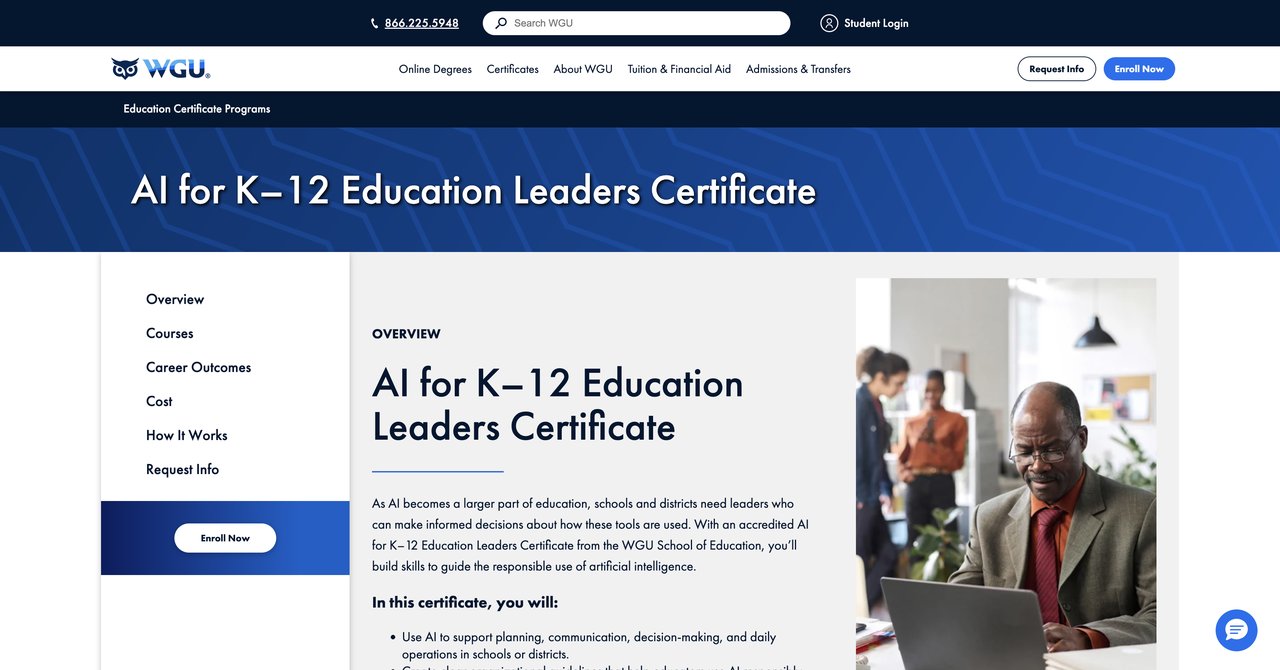
WGU School of Education offers a certificate program that's specifically designed for principals, district administrators, and those who aspire to those roles. The focus is on ethical and responsible AI adoption in K-12 settings, which is a sensible angle for school leaders who need to think about policy and governance rather than just classroom tools. The course doesn't require an administrative license, which makes it accessible to a broader range of education professionals.
The course is structured around the realities of school leadership. It covers how to evaluate AI tools before bringing them into your school, how to develop policies that protect students and staff, and how to communicate with parents about AI use. There's a strong emphasis on equity and making sure that AI doesn't widen existing achievement gaps. This is a serious, academic course rather than a quick practical primer.
It's worth noting that this is a fixed certificate program, not an ongoing subscription. You pay $699 and you get access to the course materials for a specific period. The three-month access window is worth being aware of. If you're a busy headteacher who struggles to carve out study time, you need to be realistic about whether you can complete the work within that window.
The course is US-centric in its terminology and examples, which is fine if you're working in an American context but might feel slightly alien if you're elsewhere. That said, the underlying principles around ethics and responsible adoption are universal, and most of the content translates well to other education systems.
Key topics covered:
- Ethical and responsible AI adoption
- Policy development for K-12 settings
- Evaluating AI tools for school use
- Equity and inclusion in AI implementation
- Communication strategies for parents and stakeholders
Target audience and skill level requirements:
Designed for principals, district administrators, and aspiring leaders. No administrative license is required, but some prior knowledge of AI concepts would be helpful. The course assumes you're comfortable with strategic thinking and policy development.
Pros:
- Designed specifically for headteachers and district leaders
- Covers ethical and responsible AI adoption in depth
- No administrative license required
Cons:
- Higher price point compared to other options
- Fixed 3-month access window may be challenging for busy leaders
- US-centric context and terminology
Who would benefit most:
Headteachers who want a structured, academic certificate from a recognised university and who are comfortable with the higher price point. This is particularly suited to those in US school districts, and to leaders who want to demonstrate a formal qualification in AI leadership. The fixed access window means it's best suited to those who can dedicate focused time to study.
Course 3: Responsible AI for School and Education Leaders by Northumbria University
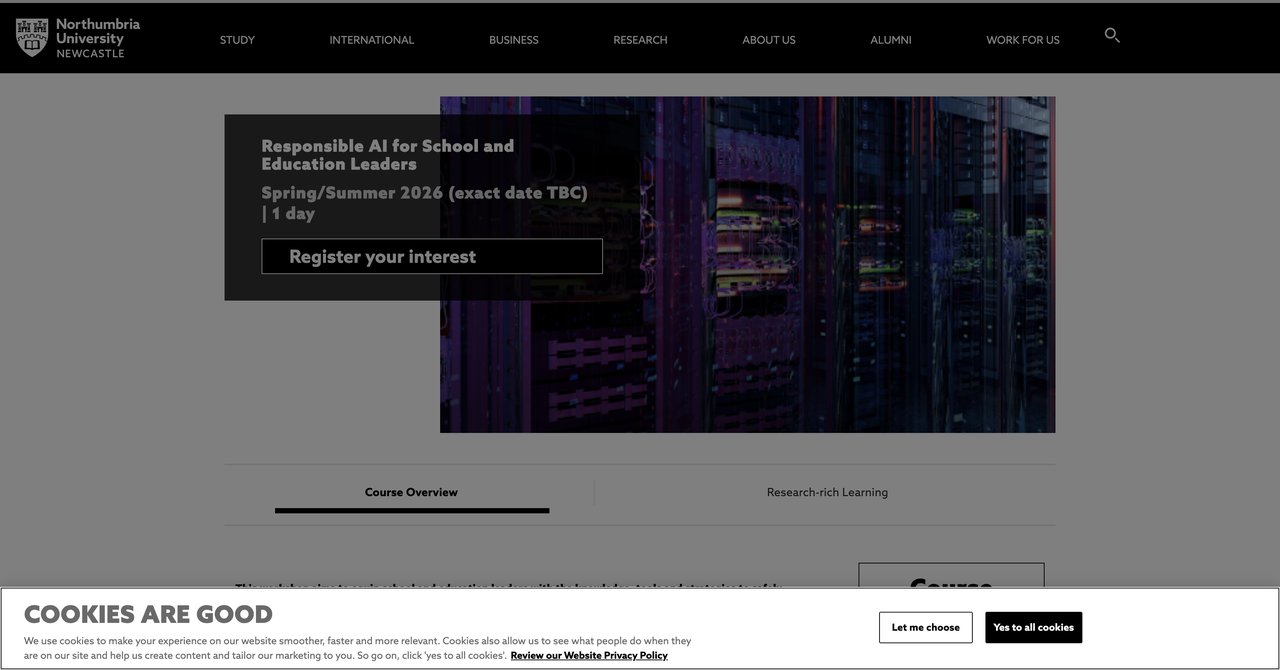
Northumbria University offers a concise, policy-focused workshop for headteachers that covers safeguarding, compliance, and practical AI implementation strategies. This is a half-day workshop, which makes it a very different proposition to the longer courses in this comparison. It's designed for busy school leaders who need to get up to speed quickly on the key issues around AI, particularly the legal and safeguarding implications.
The course has a strong emphasis on student safety and compliance, which is where many headteachers feel most uncertain. It covers the legal framework around AI use in schools, how to assess risk, and how to put practical safeguards in place. There's also a focus on implementation strategies, so you're not just learning about the problems but also about how to solve them.
One of the most attractive features is the group booking rates. If you're a headteacher who wants to bring your senior leadership team along, this can be a cost-effective way to make sure everyone is working from the same understanding. The workshop format also means there's an opportunity to ask questions and discuss issues with peers, which is something that's harder to replicate in self-paced online courses.
However, the half-day format has its limitations. This is an overview, not a deep dive. You'll come away with a solid understanding of the key issues and a framework for thinking about AI, but you won't have the depth of knowledge that comes from a longer course. The UK-centric pricing and context also mean it's less relevant for international school leaders.
Key topics covered:
- Safeguarding students in AI use
- Compliance and legal frameworks
- Practical AI implementation strategies
- Risk assessment and management
Target audience and skill level requirements:
Aimed at headteachers and school leaders in the UK. No prior AI knowledge is required, and the course is designed to be accessible to those who are new to the topic. The group booking option makes it suitable for leadership teams.
Pros:
- Focuses on safeguarding students and compliance
- Practical implementation strategies
- Group booking rates available for leadership teams
Cons:
- Short duration (half-day workshop) limits depth
- UK-centric pricing, context, and limited international relevance
Who would benefit most:
UK-based headteachers who need a quick, focused overview of the key issues around AI and safeguarding. This is particularly useful for those who are new to the topic and need to get up to speed quickly, and for leadership teams that want to train together. The group booking option makes it a good choice for schools that want to align their whole senior team.
Course 4: AI Conference for School Leaders (INT476) by South Gloucestershire Schools (SGS)
South Gloucestershire Schools runs a one-day conference that's specifically designed for senior leadership roles, with a focus on reducing workload through AI. This is a hands-on event, which means you're not just sitting and listening to presentations. You're getting practical sessions where you can try things out, ask questions, and work through real scenarios.
The workload reduction angle is a smart one. AI has the potential to take a significant amount of administrative burden off teachers and leaders, but many schools aren't sure where to start. This conference gives you concrete strategies for using AI tools to streamline tasks like lesson planning, marking, data analysis, and report writing. For headteachers who are feeling the pressure of workload, this can be immediately valuable.
The conference format has some advantages over online courses. You get to network with other school leaders, share experiences, and learn from people who are actually doing the work. There's an energy to in-person events that's hard to replicate online, and the opportunity to ask questions in real time is valuable. The hands-on nature of the sessions means you'll leave with practical skills, not just theory.
However, it's a regional UK provider, which means the content is likely to be grounded in the UK education system and its specific challenges. If you're outside the UK, some of the content may not be directly relevant. It's also a one-day event, so there's a limit to how much depth can be covered. You'll get a solid introduction and some practical tools, but you won't get the comprehensive coverage of a longer course.
Key topics covered:
- Reducing workload through AI
- Practical AI tools for school leadership
- Hands-on sessions for senior leaders
- Implementation strategies
Target audience and skill level requirements:
Open to any headteacher, regardless of prior AI knowledge. The hands-on format means you'll need to be comfortable with using computers and willing to try new tools. The conference is designed for senior leadership roles, so it's not aimed at classroom teachers.
Pros:
- Hands-on sessions tailored for headteachers
- Focuses on reducing workload, a key concern for school leaders
- Open to any headteacher
Cons:
- Regional UK provider
- Limited to conference format, no ongoing support
Who would benefit most:
UK-based headteachers who want a practical, hands-on introduction to AI tools that can reduce workload. This is particularly useful for those who prefer in-person learning and networking over online courses. The one-day format makes it accessible for busy leaders who can't commit to a longer course.
Visit South Gloucestershire Schools
Course 5: The 360° AI Teacher Training: Child-Centered AI in Education by Udemy
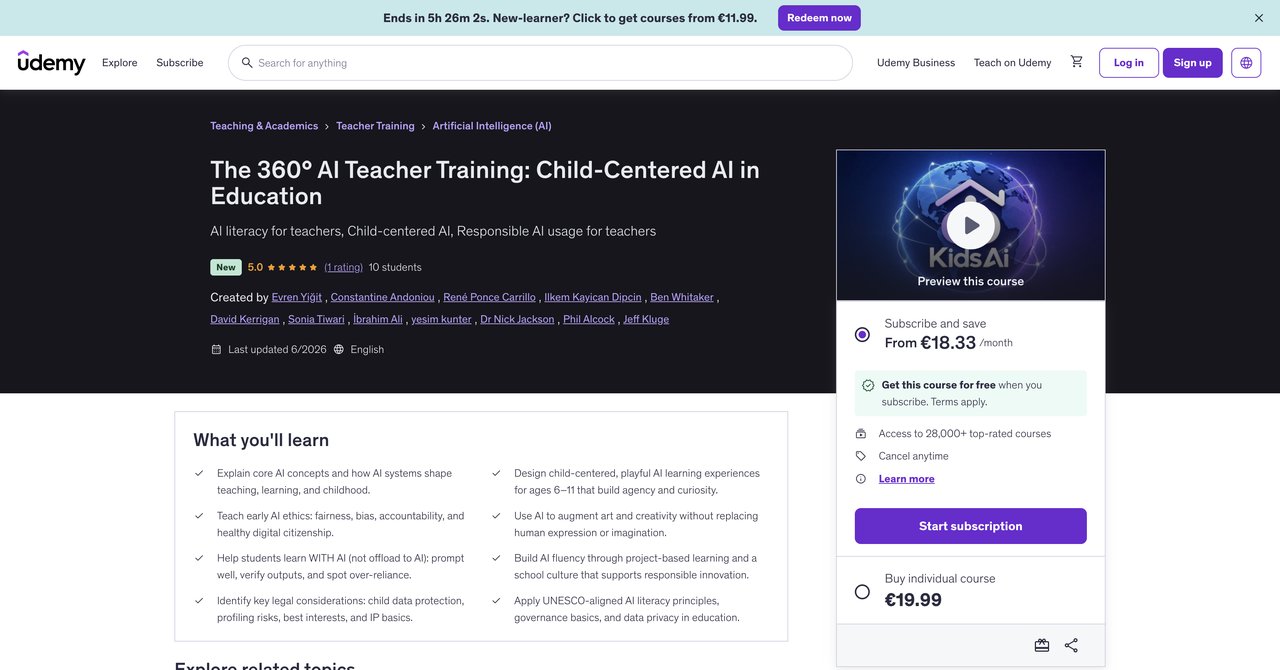
This Udemy course takes a child-centered approach to AI in education, featuring world-leading experts on kids and technology. It runs for 5.5 hours and provides a practical roadmap for working with children aged 6-12. For headteachers in primary settings, this is directly relevant to your context, as it focuses on the age group you're actually working with.
The course is built around the idea that AI should be introduced to children in a way that's developmentally appropriate and ethically sound. It covers how to talk to children about AI, how to use AI tools in primary classrooms, and how to address the concerns that parents might have. The expert input gives it a level of credibility that some other Udemy courses lack.
That said, the course has a classroom-teacher focus rather than a leadership-strategy focus. It's more about what happens in the classroom than about school-wide policy or staff development. For a headteacher, this means you'll get useful insights into what your teachers should be doing, but you'll need to translate that into leadership action yourself.
The pricing is variable, which is typical of Udemy. Courses frequently go on sale, and you can often pick this up for $20-$50, which is good value for the content. However, the fluctuating price can be frustrating if you're trying to budget, and you might end up paying more if you buy at the wrong time.
Key topics covered:
- Child-centered AI education
- Practical roadmap for ages 6-12
- Expert insights on kids and AI
- Parent communication strategies
Target audience and skill level requirements:
Aimed at educators working with primary-aged children. No prior AI knowledge is required, and the course is designed to be accessible to beginners. It's more suited to classroom teachers than to senior leaders, though headteachers in primary settings will find the content relevant.
Pros:
- Expert insights on children and AI
- Practical roadmap for primary education
- Useful for guiding primary staff
Cons:
- Classroom-teacher focus rather than leadership strategy
- Pricing fluctuates
Who would benefit most:
Primary school headteachers who want to understand how AI should be introduced to younger children. This is useful for informing your school's approach and for understanding what your teachers are dealing with. It's less useful for strategic leadership development, but the child-centered perspective is valuable and not covered in most other courses.
Course 6: AI-Powered K-12 Teaching and Learning by Coursera
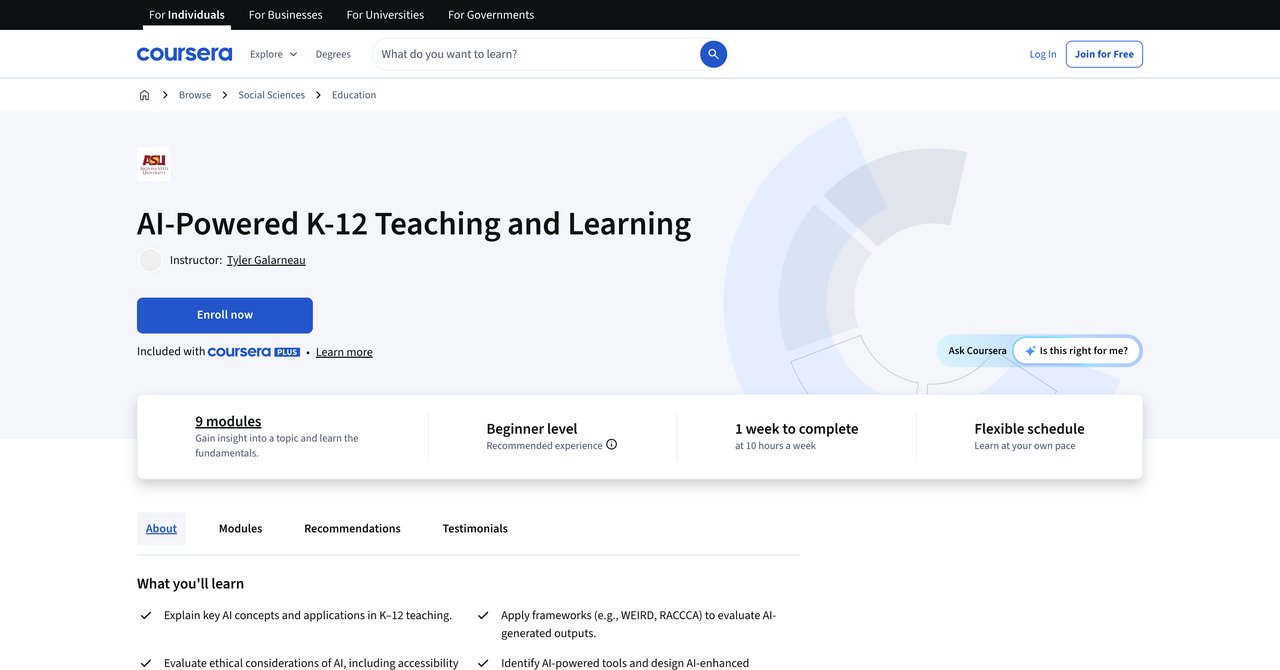
This Coursera course covers generative AI fundamentals, differentiation, and family communication, with a focus on real-world tools and strategies. It's a short course that's been recently updated, which is important in a field that changes as quickly as AI. The content is practical and immediately applicable, which makes it a good option for headteachers who want to get a working knowledge of AI without committing to a lengthy program.
The course is structured around the practical realities of teaching with AI. You'll look at how generative AI can be used to differentiate instruction, how to communicate with families about AI use, and what tools are actually worth using in a school setting. The real-world focus means you're not just learning theory, you're getting concrete strategies you can implement.
The Coursera platform allows you to audit the course for free, which means you can access the content without paying. If you want a certificate, you'll need a Coursera Plus subscription, which is around $59 per month. This is a good option if you want to try the course before committing to payment, or if you're happy to learn without a certificate.
The main limitation is the length. This is a short course, and it's pitched at a beginner level. For headteachers who already have some experience with AI, it might feel too basic. It's also more focused on teaching and learning than on leadership strategy, so you won't get much on policy, staff development, or governance.
Key topics covered:
- Generative AI fundamentals
- Differentiation with AI
- Family communication about AI
- Real-world AI tools for educators
Target audience and skill level requirements:
Aimed at K-12 educators, including headteachers who want a foundational understanding of AI. No prior knowledge is required, and the course is designed for beginners. The short duration makes it accessible for busy professionals.
Pros:
- Recently updated content
- Covers key AI topics for educators
- Real-world tools and strategies
- Free to audit
Cons:
- Short duration limits depth
- Beginner-level may be too basic for experienced leaders
Who would benefit most:
Headteachers who are new to AI and want a quick, practical introduction. The free audit option makes it a low-risk way to get started. It's also useful for those who want to understand the classroom applications of AI, even if it doesn't cover leadership strategy in depth.
Course 7: Generative AI for Educators: AI Literacy & Prompting Skills by Coursera
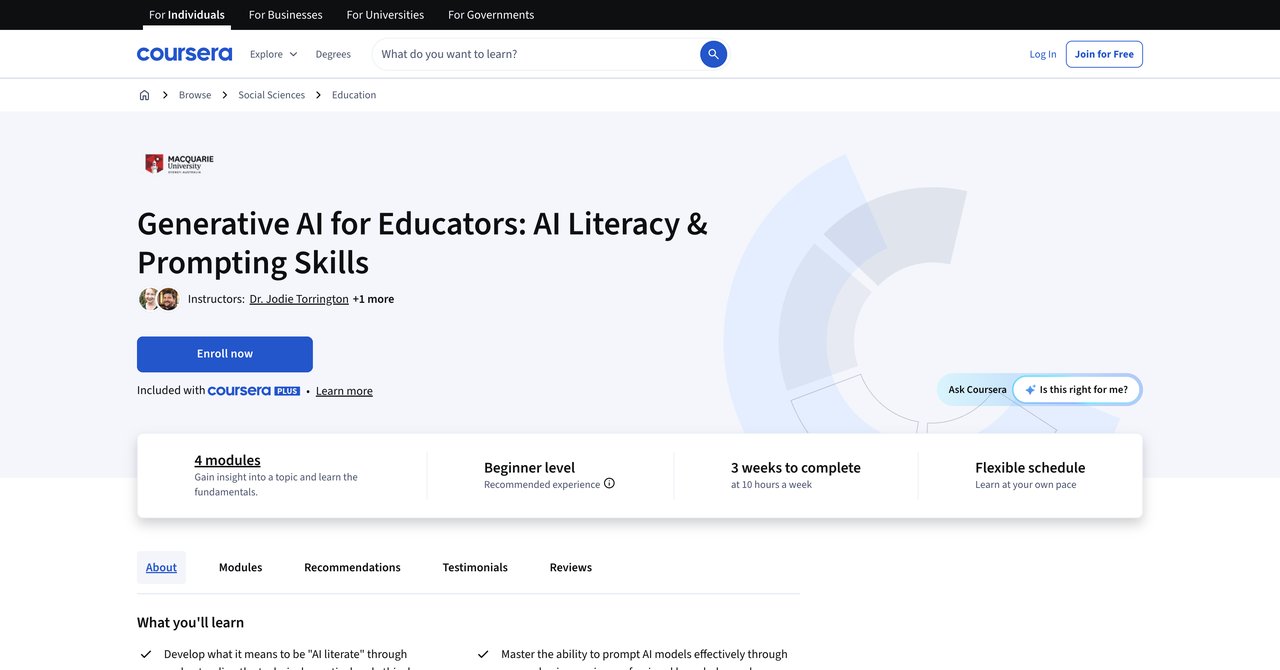
This Coursera course is a self-paced program for complete beginners, covering AI literacy and prompting skills. It's structured around the fundamentals, so you'll learn what generative AI is, how it works, and how to write effective prompts. There's a free enrolment option, which makes it accessible to anyone who wants to build their understanding without financial commitment.
The focus on prompting skills is genuinely useful. Much of the value of AI tools depends on how well you can ask them to do what you want, and this course gives you practical techniques for getting better results. For headteachers who are new to AI, this is a solid foundation to build on.
The self-paced format is convenient, and there are no deadlines to worry about. You can work through the material at your own speed, which is valuable for busy school leaders. The course is well-structured and easy to follow, with clear explanations and practical examples.
The main limitation is that it's not leadership-specific. This is a general course for educators, not one that's designed for headteachers or senior leaders. If you're looking for content on policy, governance, or staff development, you won't find it here. It's also quite basic, so if you have any prior experience with AI, it might feel redundant.
Key topics covered:
- AI literacy fundamentals
- Prompting techniques
- Generative AI basics
- Practical applications for educators
Target audience and skill level requirements:
Designed for complete beginners with no prior AI knowledge. Suitable for any educator, including headteachers who want to build foundational skills. The free enrolment option makes it accessible to everyone.
Pros:
- Structured for complete beginners
- Focus on AI literacy and prompting
- Free enrolment option
- Self-paced with no deadlines
Cons:
- Not leadership-specific
- Basic for headteachers with prior AI exposure
Who would benefit most:
Headteachers who are starting from zero and want to build a foundation of AI literacy. The free option makes it a no-risk starting point. It's also useful for those who want to understand prompting techniques, which are fundamental to getting value from AI tools.
Course 8: ChatGPT Foundations for Teachers by Coursera
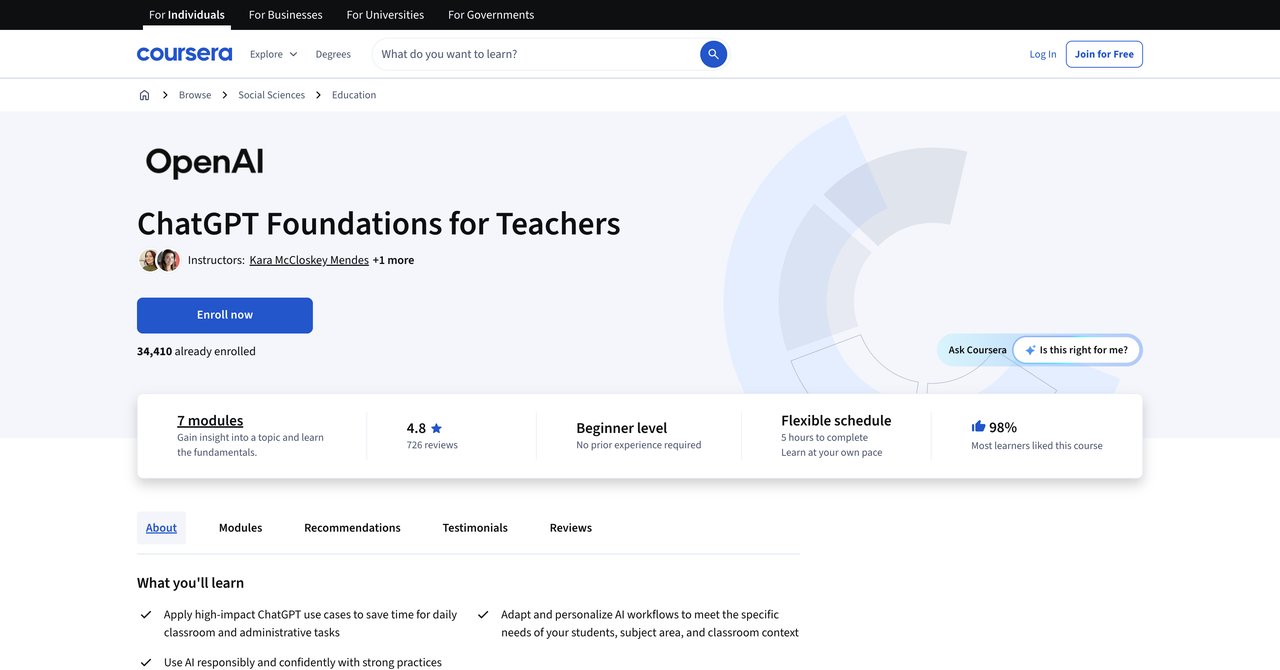
This Coursera course is a practical, hands-on program for K-12 educators that focuses specifically on ChatGPT. You'll learn how to personalise the tool for your needs and how to use it in everyday educational contexts. The course is built around real classroom scenarios, which makes it immediately relevant to educators.
The focus on ChatGPT specifically is both a strength and a limitation. On one hand, it means you get a deep understanding of the most widely used AI tool. On the other hand, it means you don't get coverage of other AI tools that might be useful in a school setting. For headteachers, this is more about understanding what your teachers can do with ChatGPT than about leadership strategy.
The hands-on approach is valuable. You're not just watching videos, you're actually using ChatGPT and learning how to get the most from it. This practical experience is more memorable than passive learning, and it means you'll leave with skills you can use immediately.
The course is short and beginner-level, which makes it accessible but also limits its depth. For headteachers who are already comfortable with ChatGPT, there won't be much new content here. The Coursera subscription model means you'll need to pay for a certificate, though you can audit the course for free.
Key topics covered:
- ChatGPT personalisation
- Everyday classroom use
- Practical hands-on exercises
- K-12 specific applications
Target audience and skill level requirements:
Aimed at K-12 educators, including headteachers who want to understand ChatGPT. No prior knowledge is required, and the course is designed for beginners. The hands-on format means you'll need access to ChatGPT to complete the exercises.
Pros:
- Built specifically for K-12 educators
- Practical and hands-on
- Helps understand classroom ChatGPT applications
Cons:
- Narrow focus on ChatGPT only
- Beginner level
Who would benefit most:
Headteachers who want to understand how ChatGPT can be used in classrooms and who prefer hands-on learning. This is useful for those who are new to ChatGPT and want to build practical skills. It's less useful for leadership strategy, but the practical focus is valuable.
Course 9: Becoming an Artificial Intelligence Competent Teacher by European School Education Platform
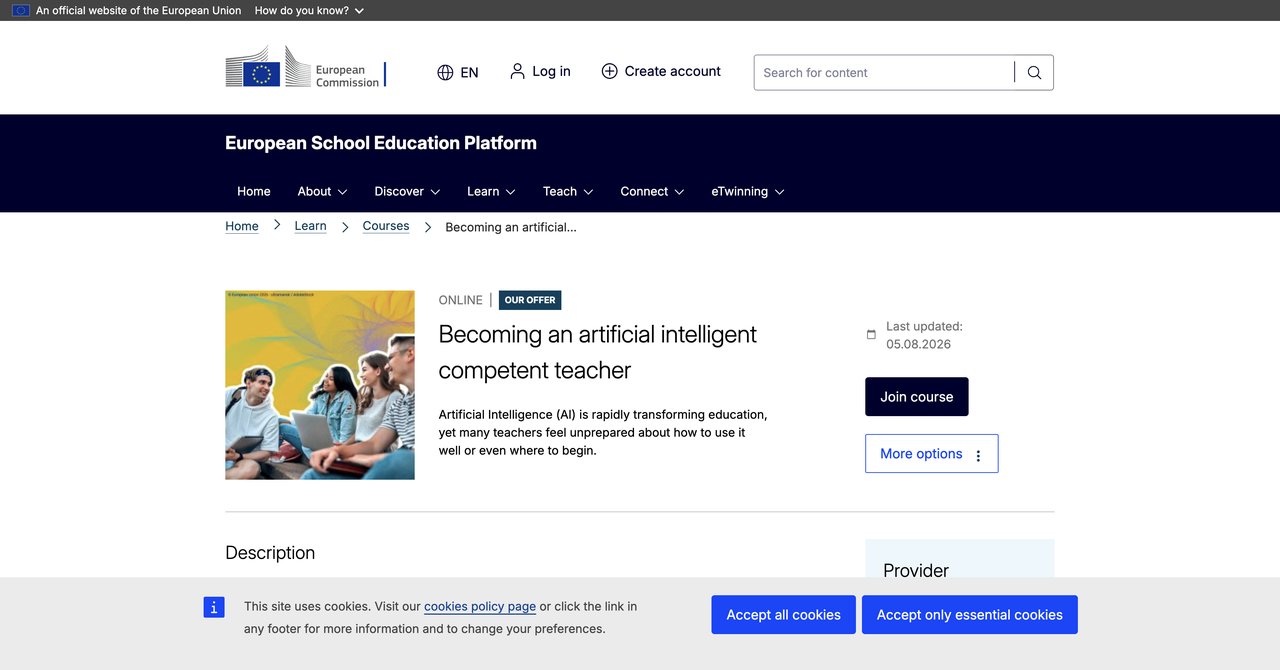
This free course from the European School Education Platform is structured around the UNESCO AI Competency Framework. It takes a human-centred and rights-based approach to AI in education, which gives it a strong ethical foundation. The course is self-paced with no deadlines, which makes it flexible for busy school leaders.
The alignment with UNESCO's framework is a significant advantage. This isn't just someone's opinion about what teachers should know about AI. It's based on an internationally recognised framework that's been developed with input from experts around the world. For headteachers who want to ensure their knowledge is aligned with best practice, this is reassuring.
The human-centred and rights-based approach is particularly relevant for school leaders. It emphasises the importance of protecting children's rights, ensuring equity, and thinking about the broader social implications of AI. This is the kind of perspective that's essential for policy development.
The course is teacher-focused rather than leadership-specific, which means it's more about classroom practice than school strategy. The European context also means some of the examples and references may be more relevant to European schools. However, the underlying principles are universal, and the free price point makes it accessible to everyone.
Key topics covered:
- UNESCO AI Competency Framework
- Human-centred and rights-based approaches
- AI literacy for educators
- Ethical considerations
Target audience and skill level requirements:
Aimed at teachers and educators, including headteachers who want to understand the UNESCO framework. No prior knowledge is required, and the course is designed for beginners. The self-paced format means there are no deadlines to worry about.
Pros:
- Aligned with UNESCO AI Competency Framework
- Human-centred and rights-based approach
- Self-paced with no deadlines
- Free
Cons:
- Teacher-focused rather than leadership-specific
- European context may not suit all international leaders
Who would benefit most:
Headteachers who want a free, high-quality introduction to AI in education that's aligned with international frameworks. This is particularly useful for those who want to understand the ethical dimensions of AI and who are looking for a solid foundation to build on. The UNESCO alignment makes it a credible option for those who want to ensure their knowledge is based on recognised standards.
Visit European School Education Platform
Course 10: The AI-Empowered Teacher Online Course by NC State University (FI)
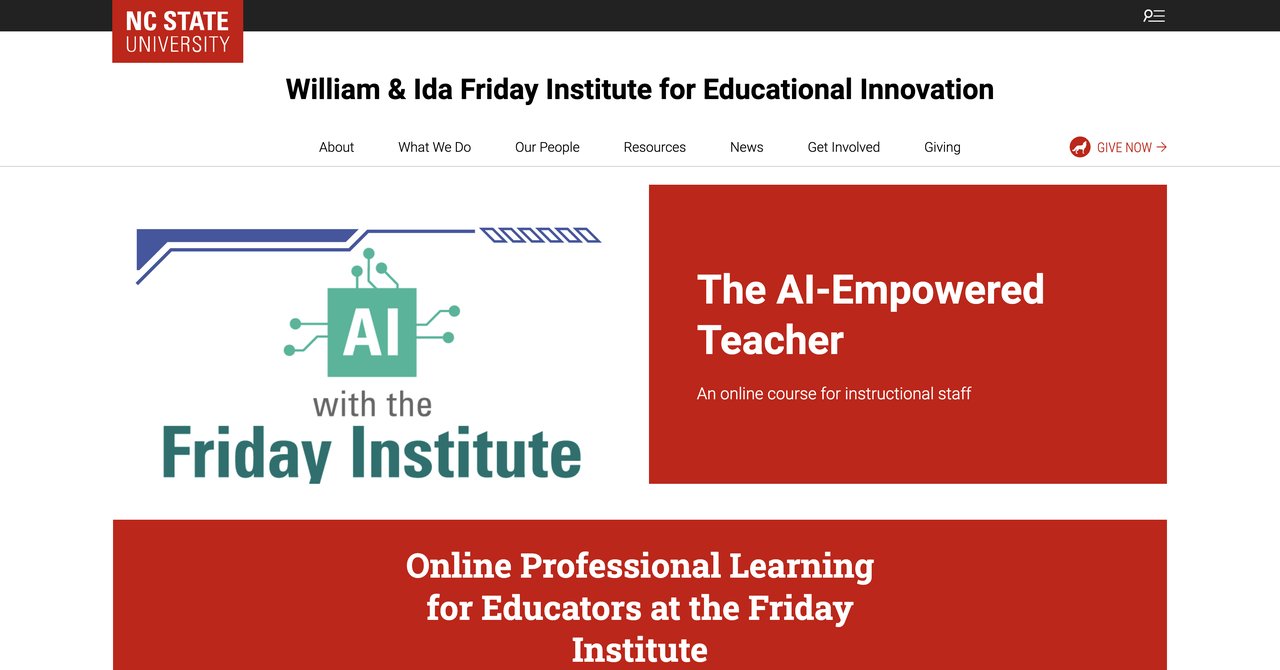
NC State University's Friday Institute offers a free, comprehensive course with 9 modules and 15 professional development hours. The course takes you from foundations to future practice, covering a broad range of AI topics relevant to educators. The fact that it's free and includes a certificate of completion makes it an attractive option.
The 15 professional development hours are significant. Many schools require a certain number of PD hours each year, and this course can contribute meaningfully to that requirement. For headteachers who need to maintain their professional development records, this is a practical benefit.
The comprehensive nature of the course is impressive for a free offering. The 9 modules cover a lot of ground, from AI basics to more advanced applications and future trends. The structure is logical, and the content is well-presented.
The main limitation is that the course has a classroom-educator focus rather than a leadership-specific one. It's more about what teachers need to know than about what headteachers need to do. That said, the comprehensive coverage means you'll get a good overall understanding of AI in education, which is a useful foundation for leadership decisions.
Key topics covered:
- AI foundations
- Practical applications for educators
- Future trends in AI education
- Professional development hours
Target audience and skill level requirements:
Aimed at educators of all levels, including headteachers. No prior knowledge is required, and the course is designed to be accessible to beginners. The 9 modules can be completed at your own pace.
Pros:
- Free with certificate of completion
- 15 PD hours
- Comprehensive modules
Cons:
- Classroom-educator focus
- Not leadership-specific
Who would benefit most:
Headteachers who want a comprehensive, free course that provides PD hours and a certificate. This is particularly useful for those who need to meet professional development requirements and who want a broad understanding of AI in education. The comprehensive coverage makes it a solid foundation, even if it's not leadership-specific.
Course 11: AI in the Classroom: A Practical Starter Course for Teachers by Udemy
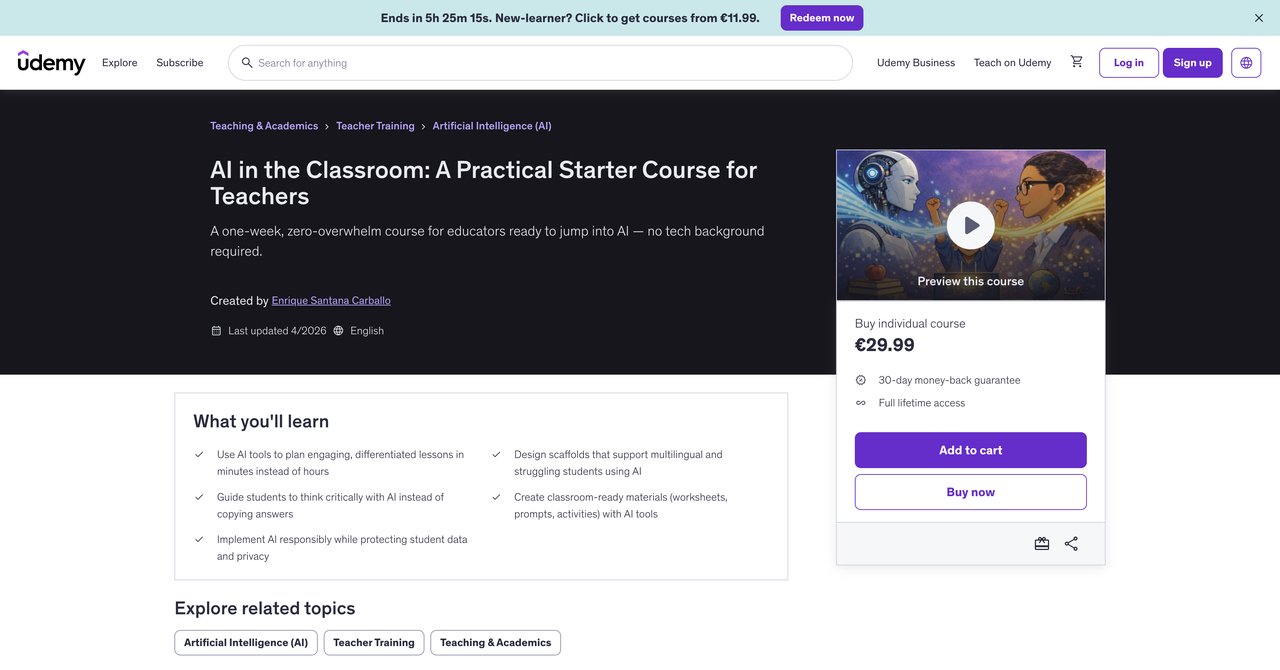
This Udemy course is a quick, practical primer with 32 lessons and a zero-overwhelm structure. It's designed to be completed in about a week, which makes it one of the most accessible options in this comparison. The course is aimed at teachers who have no technical background and who want to get started with AI without feeling overwhelmed.
The zero-overwhelm structure is a genuine selling point. Many AI courses throw too much information at you too quickly, which can be off-putting. This course is designed to be digestible, with short lessons that build on each other logically. For headteachers who are new to AI and feeling anxious about it, this is a gentle entry point.
The 32 lessons cover the basics of using AI in the classroom, from understanding what AI is to practical applications like lesson planning and resource creation. It's practical and immediately applicable, which is what many educators want.
The main limitation is that it's classroom-focused and not designed for leadership strategy. You won't get content on policy, governance, or staff development. The pricing is also variable, as is typical for Udemy, so you might pay anywhere from $20 to $40 depending on when you buy.
Key topics covered:
- AI basics for educators
- Practical classroom applications
- Lesson planning with AI
- Resource creation
Target audience and skill level requirements:
Aimed at classroom teachers with no technical background. No prior AI knowledge is required, and the course is designed to be accessible to complete beginners. The one-week completion timeline makes it suitable for busy professionals.
Pros:
- Zero-overwhelm structure
- 32 lessons
- No tech background required
Cons:
- Classroom-focused
- Not designed for leadership strategy
Who would benefit most:
Headteachers who are new to AI and want a gentle, accessible introduction. This is particularly useful for those who feel overwhelmed by more comprehensive courses and who want to build confidence before moving on to more advanced content. It's also useful for understanding what your teachers are learning.
Final Recommendations
Choosing the right AI training for headteachers depends on several factors: your current knowledge, your budget, your context, and what you're trying to achieve. Here's an honest assessment of the options.
For headteachers who want comprehensive, ongoing access to AI training for themselves and their whole team, CompleteAI Training offers the best value. The subscription model means you're not just getting one course, you're getting access to everything on the platform, including all certifications and all content for every other job role. This is particularly valuable if you're planning to lead AI adoption across your school, because you can see what your teachers are learning and ensure consistency across your team. The $99 per year price point is significantly less than most single courses, and the fact that new content is added continuously means you won't need to pay for updates as AI evolves.
For headteachers who want a formal university certificate and are comfortable with a higher price point, the WGU course is a solid choice. It's specifically designed for school leaders, covers ethical and responsible AI adoption, and carries the credibility of a recognised university. The $699 price is a significant investment, but for those who need a formal qualification, it may be worth it.
For UK-based headteachers who want a quick, focused overview of safeguarding and compliance issues, the Northumbria University workshop is a practical option. The half-day format is accessible, the group booking rates make it cost-effective for leadership teams, and the focus on safeguarding addresses one of the most pressing concerns for school leaders. The £295 price is reasonable for a workshop of this type.
For those who prefer in-person learning and networking, the South Gloucestershire conference offers practical, hands-on sessions with a focus on workload reduction. The £125-£150 price is accessible, and the one-day format is manageable for busy leaders. The regional UK focus limits its relevance for international headteachers, but for those in the UK, it's a good option.
For primary school headteachers, the Udemy course on child-centered AI is worth considering. The focus on ages 6-12 is directly relevant, and the expert input adds credibility. The variable pricing means you can often get it for $20-$50, which is good value.
The free options from the European School Education Platform and NC State University are both worth exploring, particularly if you're on a tight budget. The UNESCO-aligned course offers a strong ethical foundation, while the NC State course provides 15 PD hours and a certificate. Neither is leadership-specific, but both provide a solid foundation.
The Coursera courses are best for those who want to audit content for free or who want a specific focus like ChatGPT or prompting skills. They're beginner-level and not leadership-specific, but they offer flexibility and accessibility.
Ultimately, the best choice depends on your circumstances. If you have the budget and want the most comprehensive coverage, CompleteAI Training is the strongest option. If you need a formal certificate, WGU is the way to go. If you're UK-based and want a quick overview, Northumbria or SGS are worth considering. And if you're on a tight budget, the free options provide genuine value. Whatever you choose, the important thing is to start building your understanding of AI now, because the technology isn't waiting for anyone.