
Blog ·
11 Best AI Courses for VP of Finances to Future-Proof Your Career in 2026
Master finance leadership in 2026 with top-rated AI courses. Learn predictive analytics, automation, and strategic forecasting tailored for VPs. Stay ahead, drive data-backed decisions, and future-proof your executive role now.
 Jeroen Erne
Financial leadership is being redefined in real time. The numbers that once took days to analyze are now available in seconds. The forecasts that relied on gut instinct are being sharpened by predictive models. For VPs of Finance, this is not a future scenario - it is the current reality. AI has moved from an experimental tool to a core business function, and the professionals who adapt are the ones who will lead their organizations through the next decade. Those who delay risk watching their roles become increasingly administrative, while their peers take on more strategic, high-impact responsibilities.
The demand for AI fluency in finance is growing at a remarkable pace. Recent surveys show that 69% of businesses now use AI in some capacity, and that number continues to climb. For finance leaders, this means the skills required to excel in the role are shifting. It is no longer enough to understand spreadsheets and financial models. The modern VP of Finance needs to understand how AI can improve forecasting accuracy, streamline reporting, identify cost-saving opportunities, and provide deeper insights into business performance. The question is no longer whether to learn AI, but which courses deliver the most practical, relevant knowledge for finance leadership.
This article examines five AI courses that are particularly well-suited for VPs of Finance. It compares their content, approach, and outcomes to help you make an informed decision about where to invest your time and resources. Among the options covered is CompleteAI Training (https://completeaitraining.com/course/ai-for-vp-of-finances/), which stands out for its comprehensive access model - rather than a single course, it gives you access to all courses and all certifications on the platform, making it a versatile choice for professionals who want ongoing learning opportunities.
Why AI matters for VP of Finances today
The finance function has always been data-driven, but the volume and complexity of data available today exceeds anything seen before. Traditional tools are struggling to keep pace. AI offers a way to process this information efficiently, uncover patterns that human analysis might miss, and generate insights that drive better decisions. For a VP of Finance, this translates into more accurate budgets, more reliable forecasts, and a stronger ability to advise the executive team on strategic direction.
Adoption trends support this shift. Across industries, finance departments are integrating AI into their daily operations - from automated invoice processing to real-time fraud detection. The businesses that adopt these technologies early are gaining a competitive edge, and the finance leaders who champion these initiatives are becoming indispensable to their organizations. This article aims to help you identify the best AI courses for your specific needs as a VP of Finance, so you can build the skills that matter most without wasting time on generic or overly technical programs.
The Growing Role of AI in VP of Finances
AI is touching nearly every aspect of financial management. Some of the most significant applications include:
- Automation of routine tasks: Data entry, reconciliation, and report generation are being automated, freeing up time for more strategic analysis.
- Enhanced forecasting: Machine learning models can analyze historical data and market trends to produce more accurate revenue and expense projections.
- Fraud detection: AI systems can flag unusual transactions in real time, reducing the risk of financial loss.
- Risk assessment: Advanced analytics help identify potential risks in investments, operations, and compliance before they become serious issues.
- Personalized financial insights: AI tools can tailor reporting to different stakeholders, providing the right information at the right level of detail.
- Scenario planning: Finance leaders can model multiple business scenarios quickly, evaluating the potential impact of different strategic choices.
These applications are not hypothetical. They are being deployed in companies of all sizes right now. The workflows that defined finance departments for decades are being reshaped, and the role of the VP of Finance is expanding accordingly. Understanding how to leverage these tools is becoming a core competency, not a niche skill.
Benefits of becoming an AI expert in VP of Finances
Investing time in AI education pays off in multiple ways for finance leaders. First, it increases your value to your organization. When you can demonstrate how AI improves forecasting accuracy or reduces operational costs, you position yourself as a strategic partner to the CEO and board, rather than just a financial gatekeeper.
Second, AI expertise opens doors to new career opportunities. As more companies seek leaders who can bridge the gap between finance and technology, professionals with these skills are in high demand. You may find yourself considered for roles that previously seemed out of reach - chief financial officer, chief operating officer, or even chief executive officer.
Third, learning AI makes you more effective in your current role. You will be able to ask better questions of your data team, evaluate AI vendors more critically, and make decisions based on a deeper understanding of what the technology can and cannot do. This practical competence builds confidence - both your own and that of the people who rely on your judgment.
Finally, there is the personal satisfaction of staying ahead of the curve. The finance profession is changing, and being part of that change is far more rewarding than watching it happen from the sidelines. The courses reviewed in this article provide a pathway to that expertise, with options ranging from focused programs to broad platforms like CompleteAI Training, which offers access to all courses and certifications for one subscription.
Comparison: All AI Courses for VP of Finances (Updated 2026)
| Course Name | Provider | Price | Key Topics | Pros | Cons | Best For |
|---|---|---|---|---|---|---|
| CompleteAI Training | CompleteAI | Premium (full platform access) | Comprehensive AI curriculum for VP of Finances. One subscription unlocks ALL courses and ALL certifications on the platform , hundreds of them, covering every job role, not just VP of Finances. Includes all video courses, all certifications, and new ones added continuously at no extra cost. Covers every job role's material, ideal for cross-functional work or role transitions. Daily updates on AI tools and news. | Highest rating / most complete offering; Full-platform access to ALL video courses and certifications; All certifications included at no extra cost; New courses and certifications added automatically; Covers every job role; Very affordable pricing, especially with annual billing; Daily updates on relevant AI tools and news | Subscription-based, requires continuous commitment; Not a single course but a full platform subscription | VP of Finances professionals looking for complete training, but also great for general learners across job roles |
| AI for CFOs: Strategic & Operational Mastery | AI for CFOs (Alankar Joshi) | $740 | Strategic and operational mastery of AI for the CFO office; 47+ toolkits; 170+ production-ready prompts; blending academic rigor with practitioner-led modules to evaluate, deploy, and scale AI across the finance function. | Built specifically for the CFO office; 47+ toolkits and 170+ production-ready prompts; Combines academic rigor with practitioner-led modules | Priced at a premium; Focuses on strategic leadership, not technical depth | Finance leaders and CFO-office professionals seeking strategic, operational AI skills |
| The AI-Powered CFO: A Practical Strategy for Smarter Finance | Imagine | Johns Hopkins University | Not specified | Leadership-focused; demystifies AI for non-technical finance executives; actionable frameworks; step-by-step guidance to turn AI adoption into a strategic advantage; led by Glenn Hopper. | Leadership-focused and demystifies AI for non-technical users; Led by Glenn Hopper; Includes actionable frameworks and step-by-step guidance | Pricing and duration not listed; May be too high-level for those already hands-on with AI | Finance leaders needing a practical, non-technical AI introduction |
| AI for Business & Finance Program | Columbia Business School Executive Education | $5,000 | Ivy League certificate program; blends self-paced learning with real-world exercises and case studies; live sessions; faculty support; tailored for finance leaders to develop a comprehensive understanding of AI in business and finance. | Ivy League credential; Self-paced with real-world exercises and case studies; Includes live sessions and faculty support | High price point; Significant weekly time commitment | Finance leaders aiming to build a strong credential and comprehensive AI understanding |
| AI in Finance | eCornell (Cornell University) | $4,999 | Live, faculty-led online certificate; connects new AI tools to practical impact in finance; structured progression from foundations to strategic leadership; taught by Cornell faculty and industry practitioners. | Live faculty-led sessions; Taught by Cornell faculty and industry practitioners; Structured progression from foundations to strategic leadership | Expensive; Requires attendance at specific live times (M/W/F) | Finance leaders who prefer an interactive, live-learning environment with academic backing |
| AI for Finance Leaders Course | Prime AI Solutions | Not specified | Practical course from AI fundamentals to implementation; 15-20 hours; six modules; 35 lessons covering AI basics, strategy, and implementation for financial teams. | 35 lessons from AI fundamentals to implementation; Manageable time commitment; Updated recently | Pricing not listed; Provider is less well-known than academic institutions | Finance leaders wanting a practical, hands-on AI implementation |
| Generative AI for Finance: Use Cases, Applications and Regulation (online) | University of Oxford (Lifelong Learning) | $695 (approx. £560) | Short, intensive course covering the regulatory landscape of GenAI in finance; use cases and applications; tailored to compliance and risk aspects critical for a VP of Finance. | From a world-leading university; Covers the regulatory landscape; Short and intensive format | Very short duration; Focuses on GenAI rather than all AI types | Professionals needing a solid, compliance- and risk-informed overview of GenAI |
| AI for FP&A Automation & Modeling | Coursera | Free (audit) / Subscription | FP&A-specific use cases; automation and modeling; risk management (hallucination, bias); risk-tiering for AI applications. | Focuses on FP&A specific use cases; Covers risk management (hallucination, bias); Teaches how to tier AI use cases by risk | Duration not specified; Requires a Coursera subscription for full access | FP&A professionals seeking to automate and model with an awareness of risk |
| The Complete AI for Finance Course: Beginner to Master Level | Udemy | $20-$100 (typical) | Practical skills such as 5-year forecasting and valuation scenarios; beginner to master level. | Covers practical skills like 5-year forecasting and valuation scenarios; Affordable; Self-paced | Quality can vary on Udemy; Not specifically tailored to executive leadership | Finance professionals who need technical skills and cost-effective learning |
| Practical AI and prompting for finance professionals | Coursera | Free (audit) / Subscription | Hands-on, job-specific AI prompting skills for finance professionals; immediate productivity gains applied to daily finance tasks. | Hands-on and job-specific; Focuses on immediate productivity gains; Free to audit | Duration not specified; May be too basic for those already using AI tools | Finance professionals looking for quick, job-ready AI prompting skills |
| Introduction to AI for finance professionals | Coursera | Free (audit) / Subscription | Foundational course to build AI and GenAI literacy for finance professionals; low-commitment starting point. | Builds foundational AI and GenAI literacy; Free to audit; Good starting point | Duration not specified; Likely too basic for those with existing AI knowledge | Finance professionals new to AI who need a basic, low-commitment intro |
Understanding AI Training for VP of Finances Professionals
The role of a VP of Finance has shifted dramatically over the last few years. It's no longer just about reporting historical numbers and managing a budget. You're expected to forecast with more accuracy, automate the repetitive parts of the close, and provide strategic guidance to the C-suite based on real-time data. AI is the tool that makes all of that possible, but getting the right training can be tricky. The market has been flooded with courses that promise the world but deliver surface-level theory that doesn't translate to your day-to-day reality.
You need practical skills. You need to understand the strategic implications of AI on your department, and you need to know the risks, particularly around data privacy and model output. The right training can help you speak to your CIO and your CFO confidently and put you in a position to actually lead projects, rather than just watch from the sidelines. We've looked across the board at what's out there, from low-cost platforms to Ivy League certificate programs, and broke down exactly what you get for your investment of time and money. This way you can pick the path that fits your current role, your budget, and where you see your career heading, without having to wade through the marketing language.
Course 1: CompleteAI Training (AI for VP of Finances)
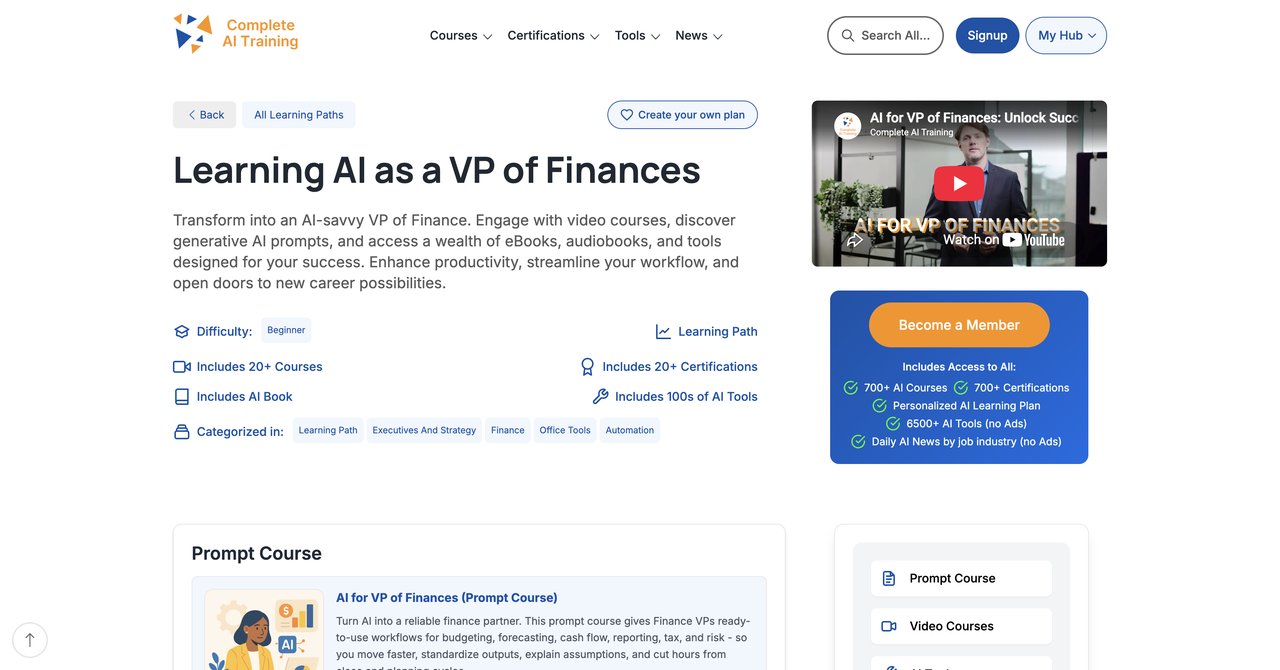
Important: Complete AI Training is not a single course. One subscription unlocks EVERY course and EVERY certification on the whole platform - hundreds of them, covering every job role, not just VP of Finances. This is a crucial difference from every other option on this list, where you're typically purchasing a single course or a fixed bundle and might pay extra for a certification. If a random department head needs some ideas on procurement automation on a Wednesday and you're the finance lead, you can go right into the procurement materials yourself within the same platform because it's all included. That kind of full-platform access is the real draw.
The course for VP of Finances is comprehensive, but the value proposition is the rest of the hundreds of courses that come with it. You aren't buying a single class here; you're getting a library. This is particularly relevant for a professional whose responsibilities now touch data from sales, marketing, and operations daily, not just the accounting ledger.
Key topics covered:
It covers the full scope of your role: automating the close and forecasting, creating predictive models, and using AI for narrative reporting. It also walks through the tools and specific prompts needed to analyze costs, budgeting, and periodic knowledge reviews.
Target Audience and Skill Level Requirements:
This course is designed for the VP or Director of Finance who wears many hats. It's made for people who need to be competent in the finront-office systems and the back office and who really don't have time to pick and choose which needs to get invented for the next quarter. Though you're getting the full-package, this specific material is targeted to practicing finance professionals and the tools will absolutely work for someone with a press-level workload. No high-level programming is needed, just a willingness to apply the prompts and automations to see how fast it runs.
Pros:
- Highest rating / Most complete offering on the market
- Full-platform access to ALL video courses and certifications, not a single course
- All certifications are included at no extra cost
- New courses and certifications are added automatically and are included in the same flat fee
- Covers every job role, not just VP of Finances, so you can cross-train or move roles without new costs
- Very affordable pricing, especially with the annual billing option
- Daily updates on relevant AI tools, news, and prompts
Cons:
- Subscription-based, requires continuous commitment (if you stop paying, you lose access)
- It's not a single course but a full platform subscription, so it feels different if you're used to buying one specific package
Who would benefit most from this particular course:
This is the strongest choice for a finance lead who wants to personally learn the tactical stuff quickly and also build AI fluency across their team. If you've got the weight of a department on your shoulders, having instant access to the material for your operations or HR counterparts is a like having a full library at your disposal. It's ideal for the decision-maker who wants to avoid per-course budget juggling and considering moving to a controlling role in a few years. It's the closest thing to a one-stop, all-access pass for your entire career.
Click here to visit the official course link: AI for VP of Finances by Complete AI Training
Course 2: AI for CFOs: Strategic & Operational Mastery
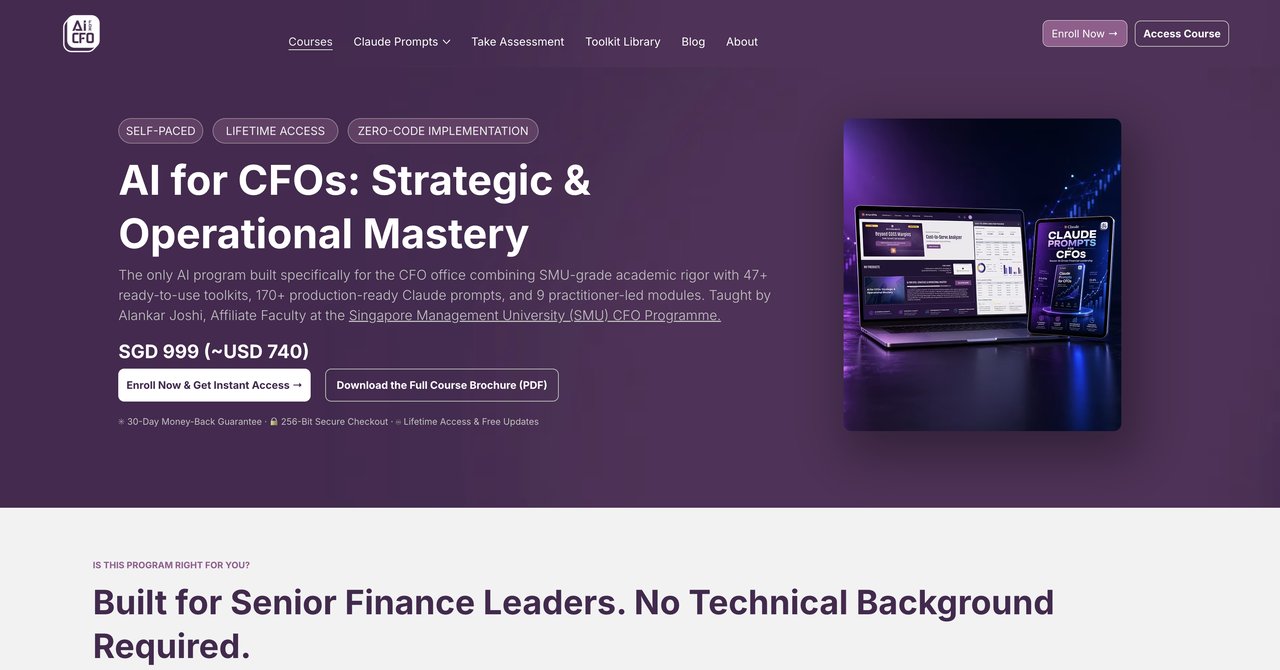
This is a self-paced masterclass from Alankar Joshi, built directly for the CFO office. It is meant to bridge the gap between a conceptual grasp of AI and the actual deployment across the finance function. The course doesn't get too deep into the code; instead, it breaks down how to evaluate AI use cases, pick the right tech, and scale it across your teams with a heavy strategic slant.
The course is based on practitioner-led modules and it shows. The focus is on creating process around AI ops, which is often the piece missing in other offerings. You're not just learning what generative AI to produce; you're learning how to identify the risks in outputs and how to organize human-in-the-loop systems design. It focuses on the finances and not just data sets, offering you a very hands-on look. It has a specific structure and a lot of supporting materials that are readily available to use throughout your implementation.
What topics are covered:
Key module topics include: evaluating AI opportunities through an ROI lens, practical toolkits for cost assessment, managing change resistance inside the finance department, and how to design a governance structure that keeps your financial data secure while using prompt-driven tools.
Target Audience and Skill Level Requirements: This really is for the top of the house, the CFO and their direct reports. It's not for those looking for a pure technical primer; you should already be familiar with your processes and are looking for a comprehensive AI playbook to drive an existing digital transformation.
Pros:
- Built specifically for the CFO office, unlike a generic doctoral program
- 47+ toolkits and 170+ production-ready prompts that save a great amount of time
- Combines academic rigor with practitioner-led modules that are grounded in practice
Cons:
- Priced at a premium compared to other technical index options
- Focuses on strategic leadership, not depth - if you also need to solve an Excel-specific formula this won't the right application
Who would benefit most from this course:
This will benefit a VP of Finance who's already managed to be a good internal partner and now needs to chip away at an ambitious AI agenda set by the board. It's for someone who is past the basics of buzzwords and needs the governance and strategy for execution.
a href="https://www.aiforcfo.com/courses" >Click here: AI for CFOs
Course 3: The AI-Powered CFO: A Practical Strategy for Smarter Finance (Imagine | Johns Hopkins University)
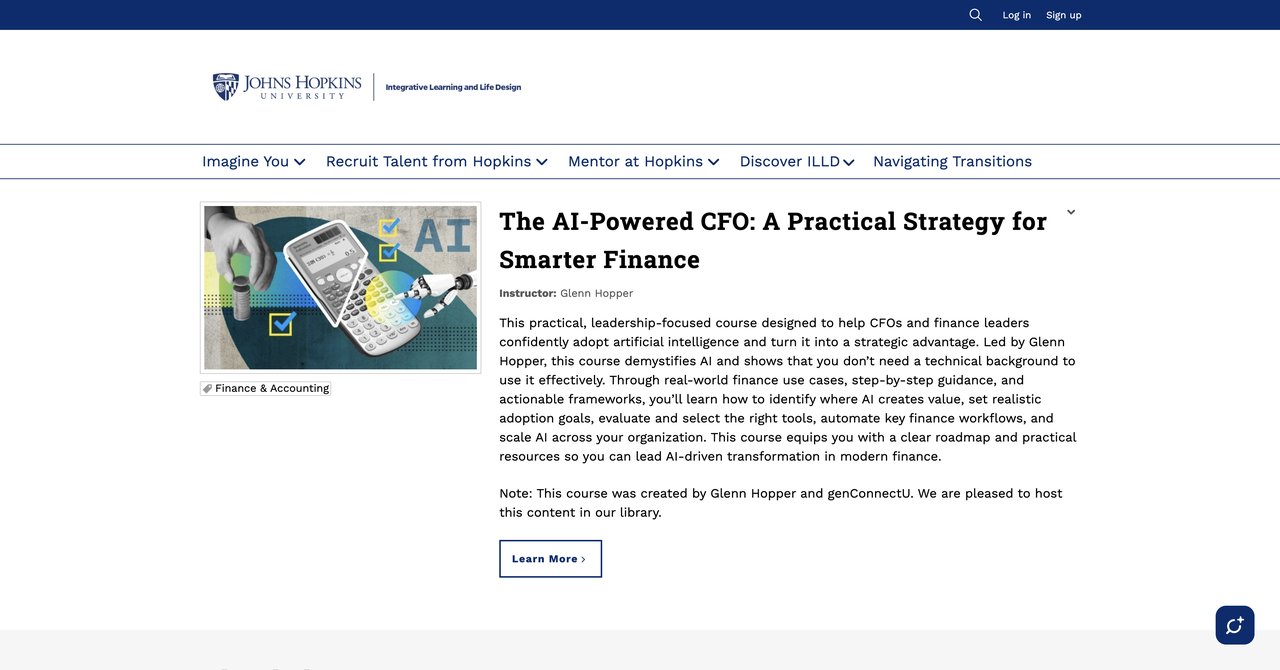
This leadership-focused course from Imagine at Johns Hopkins University is designed to make AI approachable for non-technical finance executives. It's led by Glenn Hopper, a former CFO with a solid track record of translating technical applications into plain business value. This is the option that demystifies the entire concept so you can speak to your operation's IT function intelligently.
The curriculum is built around actionable frameworks, which means you come away as a more informed assessment. It gives you practical models for identifying which data works and how to handle change management, making it a great first step if you're personally not hands-on with technology yet. The pace feels deliberately comfortable, pitched at a level where you'll understand the user's perspective, but you won't get in into the weeds.
What topics are considered:
Topics include data architecture concepts, separating signal from noise, and coming to a solid business for finance forecast through AI. It focuses on applying these tools effectively to a business steel, rather than creating the code itself and includes discussions on how to monitor a downturn using AI tools.
Target audience and skill requirements:
For high-level executives with fifteen to twenty years of experience who haven't yet trained on AI. If you're already proficient in using ChatGPT by yourself, do not miss the chance to look for a leadership certificate, but some lessons may seem a little basic.
Pros:
- Leadership-focused and demystifies AI for non-technical users
- Led by an experienced CFO within the campus
- Includes actionable frameworks and step-by-step guidance you can use almost immediately
Cons:
- Pricing and exact duration are not listed publicly
- It may be too high-level for those already hands-on with AI tools
Who would benefit the most:
This is the perfect course for the VP of Finances that recognizes you need to understand the strategic effect of AI, but that to this date you've shied away from technical questions to focus on the P&L instead.
See it here: The AI Powered CFO course
Course 4: AI for Business & Finance Program by Columbia Business School Executive Education
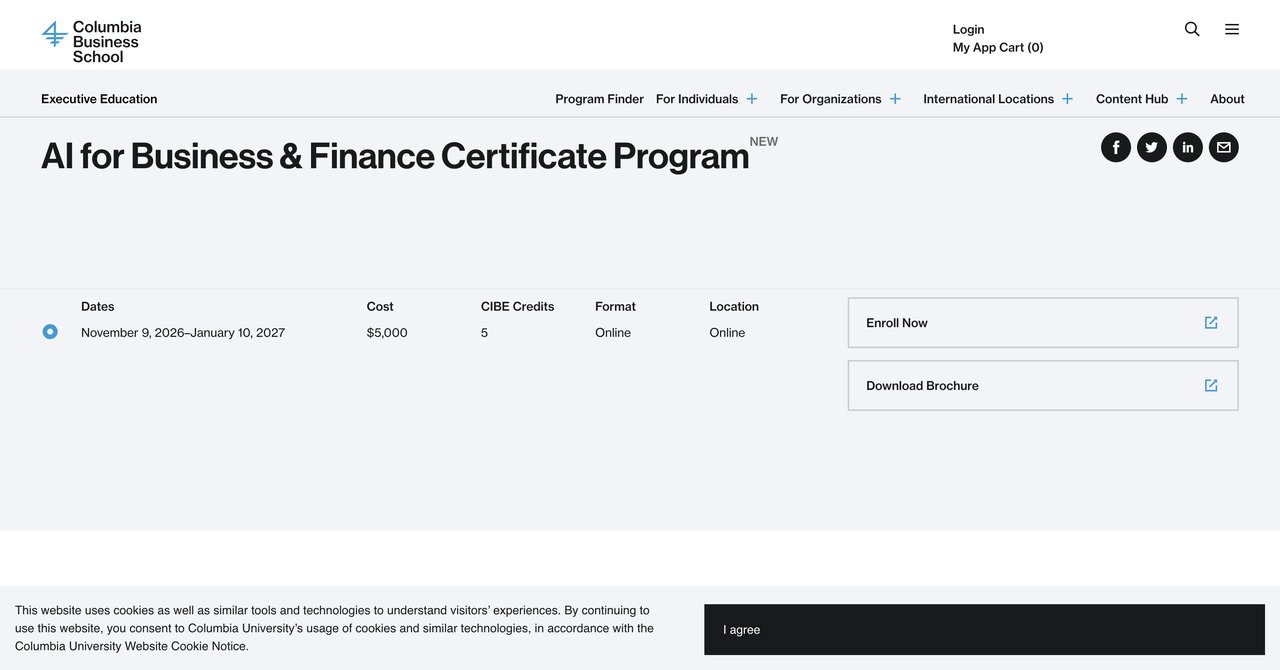
Columbia Business School's Executive Education division serves a highly structured, Ivy League experience that aims to make a career transforming path out of AI implementation. It's more than just any other course. A self-paced schedule is blended with live case reviews, group work, and real-world business interaction, so on paper, it address some other respected. You're exposed to ideas from both business strategists and business school professors, preparing you not just for the mechanics but understanding the ways you can look at your finances differently.
It's a comprehensive package but it's also a significant time commitment guaranteed to guide you toward the best coming from the richer university. The case study keeps discussions moving, but the workload is something you need to schedule. It's an academic program, not just a couple of weeks , you will need to participate in live classes and work with teams to go through protocols exercises.
What topics:
Modules include AI strategies in financial change, systems with focus on business transformation, and things like data-driven decisions. It builds a foundation first, then moves to prescriptive frameworks at the end.
Who this is for:
You are a VP of Finance who makes frequent investment in executive development programs and you are open to spending time with a cohort since that is a central part of the experience. This is a credential for its own brand value, useful for a LinkedIn profile when applying for higher leadership roles (like CFO) and wanting to have something to show for it.
Pros:
- Ivy League credential carries weight in the marketplace
- Self-paced but built with real-world exercises and a broader case study
- Includes live sessions and faculty support so you're never fully alone
Cons:
- High price point at around $5,000
- Requires a real weekly time commitment that might be too much for a busy quarter
Best fits:
Columbia is for those transitioning to a new role at a big company later on and needing the credential from a recognizable brand. It's also good if you like to learn with and from a peer group of senior leaders.
Check the Columbia Business School Program
Course 5: AI in Finance by eCornell (Cornell University)
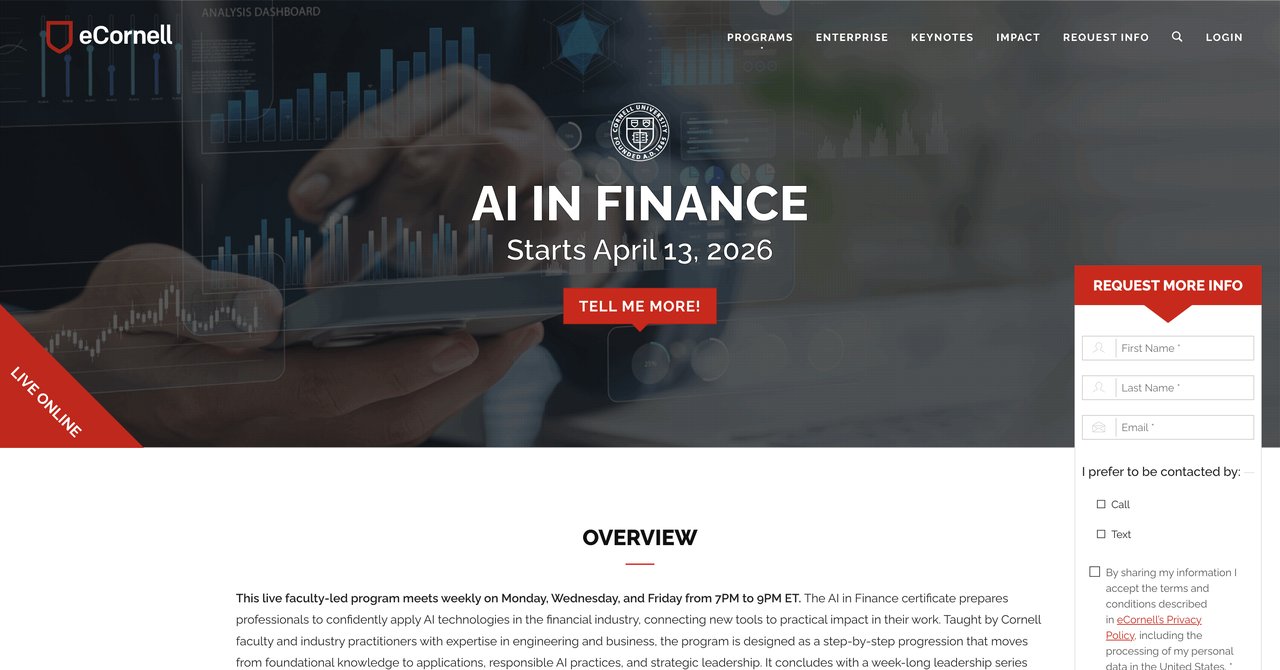
Cornell's eCornell program is a live, instructor-led program. It is not a self-paced series of pre-recorded videos. The program is taught live by Cornell faculty and industry practitioners in, a fixed schedule. The point here is that you are as close to a classroom environment as one can without leaving the office. You progress from very grounded AI basic concepts to strategic leadership, and each session pushes you to think about how to use tools in their current or future business.
The practical connection from concepts to everyday accounting and its specifics is a big win. They stream how to talk about price-- not just business but proper structure. It's a cohort-based learning format, then which regular interaction becomes a big change. The downside is you need to commit to those live sessions because they're the focal point of learning and you can't just press play on your own time after work in the morning.
What topics:
The course covers how to identify applicable AI applications in fraud detection, cash position adjustment, as well as fullcycle FP&A (forecasting and budgeting) and risk models. They perform hands-on exercises that reveal how the tools are applied around these technologies and senior level decisions.
Target Audience & Prerequisites:
Affluent management in economics are designed to provide for managers who want to be the voice of the finance audience. It is in need of a functioning real time schedule to get full benefit. It's not oriented to a finance person who is already thoroughly familiar with programming details in Python or Pandas unless you find the strategic improvements compelling.
Pros:
- Live faculty-led experience which creates accountability
- Taught by Cornell faculty and practitioners with deep policy and technical backgrounds
- A structured progression from foundational models to strategic application
Cons:
- Very expensive - around $5k
- Requires your attendance at specific (M/W/F), which is difficult to miss during heavy F&Q reporting cycles
Who would benefit (the most):
It's perfect for the VP who is on the way to reporting into the CFO and needs a very solid career, but also enjoys the live feedback from other participants. Make sure your schedule is flexible, and that you prefer a structured approach over a on-demand work arch.
View Cornell's AI in Finance Certificate
Course 6: AI for Finance Leaders Course by Prime AI Solutions
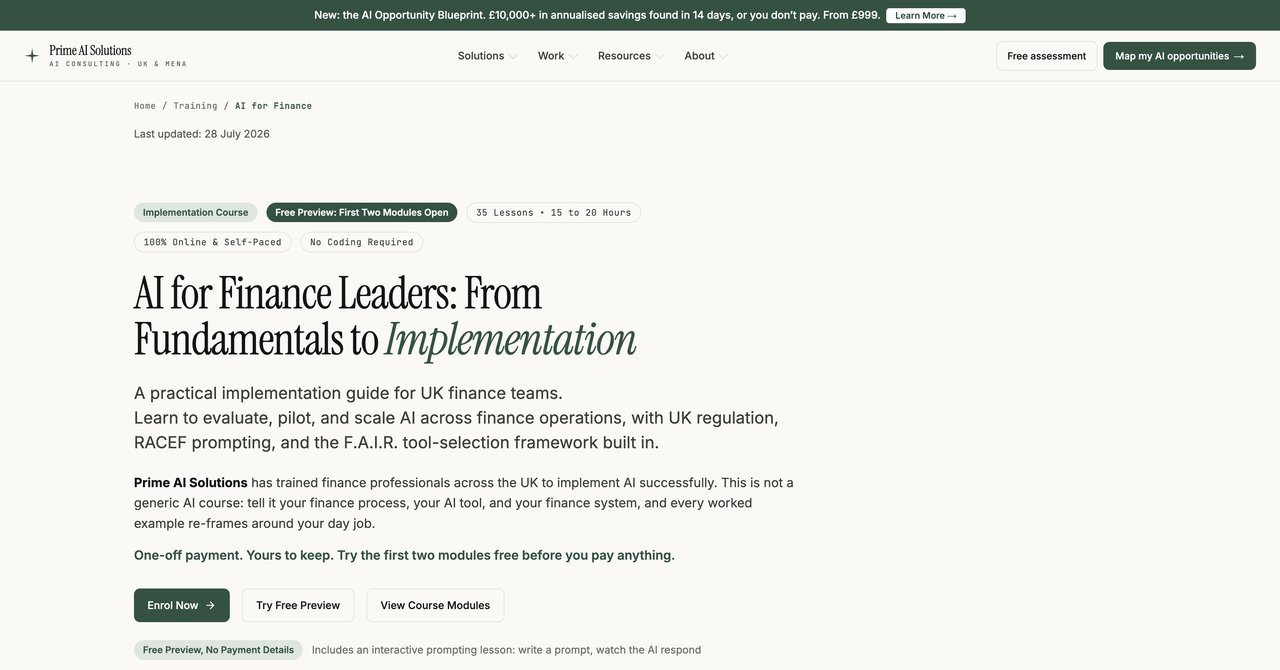
Prime AI Soluations offers a direct approach designed to help you start your work right away from week one. The course takes 15 to 20 hours in total across six modules. You're looking at roughly an extra third of a work-week, so it's a very effective crash course that you can take over a series of weekends (pretty easy).
The modules take the learner from zero to understanding the theory, to budgeting, and to actual implementation. It sounds like a great starting point for a finance team that hasn't had manys informations. The provider is a solutions company, so they know what works in practice and h doesn't "just read theory" , it keeps a delivery team's needs facing.
What topics:
Buying from 35 core lessons, it covers AI strategy for financial planning, automation in common analysis models, and discussions about data integration and cleaning. There is also an implementation section that walks through confirming and deployment pain areas for your department.
Target Audience:
This is nice for a leader who needs to understand the operation and a bit concerning team learning spaces. It's for staff that don't want, or can't, spend months of time learning in a very formal academic environment. The content is ready to use, solidly priced for the team.
Pros:
- Quick to complete-15-20 hours is a low time bar
- Good breadth across the entire 35 lessons
- The price offers a nice entry barrier (likely)
Cons:
- Pricing not clearly visible on the website
- The provider is not well known as an academic Ivy League that you might put on CR.
Who would benefit most:
Those who need to get off the fence and do something without waiting months for a professional program. It's very efficient for the manager who needs the foundation before making purchasing decisions on tools themselves.
Course 7: Generative AI for Finance: Use Cases, Applications and Regulation (online) by University of Oxford
This course from Oxford's Lifelong Learning department provides a short, high-level briefing that focuses specifically on generative AI in compliance within the financial space. It's an excellent fit for the VP of finances looking to understand the legal and ethical rules that come with these tools. The domination here is not on doing Python coding, it's on use cases and what the law is in different jurisdictions.
For the better part of six weeks, you'll learn about how GenAI is being used for reporting. It places weight on the recent regulations and your duties and accountabilities. You'll walk away with a strong understanding of how to keep your company safe when deploying these technologies and the assessment methods for and about an AI output. The Oxford name doesn't hurt the prestige either.
What topics:
Topics include compliance with the EU and US, data ownership clauses, and the financial functions at highest risk. It also discusses the current instrumental in audits and analysis at the in-house policy
Target Audience:
If you are responsible for internal controls, audit, or are just cautious about things like privacy and model honesty, this is for you. It's suited for those who want updates on long-term frameworks but don't want to spend three months studying them. It's a short course, but arguably a valuable one.
Pros:
- Prestigious work by a world-leading university
- Addresses the important regulation and risk portions most courses overlook
- Short, intensive format fits into any "week" you can give it
Cons:
- Very short structure means limited hands-on projects
- Focuses on generative AI, not all types
Who should take this:
Finance leaders who are close to legal and compliance departments or who are nervous about using AI in your workflow. It brings enormous added security into over after a thoughtful period, you will have an well argued decisions.
Check the Oxford GenAI Regulation Course
Course 8: AI for FP&A Automation & Modeling by Coursera
For those who care about the FP&A function, this course on Coursera slams the specific need. It focuses on financial planning, business modeling and how to automate each one with AI, sequence. The course is direct in dealing with risk: hallucination and bias are covered, which is a key issue where a bad forecast can cost your profit. It provides a practical method for "risk-tiering" on AI applications, which helps you use AI safer depending on the materiality of the numbers.
This course is part of the broader Coursera library, so you can audit it for free or get a relatively low subscription. However, you only have access to their modules and assignment, not all the knowledge or any a full certificate within the subscription. The real message is that many founders will recommend for your VP of FP&A and not necessarily long-term "tax" professionals, but it gives you a good core.
What topics: Main modules cover automation, modeling as well as build with useful models and macros. It also contains data loss and rumor and compliance, and templates for evaluation.
Target Audience & Skill Requirements:
If your entire day revolves around the budget to actuals and improving the accuracy of your forecasts, this is for it. An individuals should have been hands-on with FP&A type workbooks and gained decent Excel work because the course will show you where to connect to external tools.
Pros:
- A focused set on FP&A use cases (unlike the general CFO basic)
- Risk management and (hallucination, bias) and how to zol-tier to avoid catastrophe
- The model itself is owned and operated by, but you can have compatible audit.
Cons:
- It's on a Coursa subscription model to have full access (but audit is free)
- Duration is short, so you'll likely need some further responsibility
Who would benefit:
The most important person to see is the VP Finance, who might be actually doing the quarterly planning with the team and wants automation done now for 5 years. Great for implementation policies.
Course 9: Complete AI for Finance Course: Beginner to Master Level by Udemy
Udemy's flagship price is a classic but covers currency. It stands out for its practical Excel skills, specifically covering 5-year forecasts and valuation scenarios you can use to validate nice models. There's a reason this listing has has, inherent and ordinary following: for about . It makes technical capacities accessible. It is a great low cost controller for when you are need to to get a handle, but it may be more suited for senior analysts and controller level.
The downside is that Udemy courses often have a taped pacing and quality can vary widely (this specific instructor is decent). Because many the course reviews are positive, still, it very much concentrates on revenue on measuring, not on executive 'big-picture' piece. It won't teach you change management or how to be strategic; it's the hard skills you use to check the datasets
What topics:
Topics covered includes? You start with the environment and transition to actual forecasting & account validation, Large language and processing skills, and explores scenario manipulation to simulate choices.
Target Audience:
A great junior team who can take it on as part of your team development budget. It will sharpen the 'next generation' and helps them challenge assumptions and detect AI errors.
Pros:
- Practical skills like 5-year forecast and valuation scenario are useful right away.
- Affordable and usually appears sales
- Self-paced and self-study any time
Cons:
- Quality can vary wildly on Udemy platform, regardless of the title
- Not tailored to executive leadership or beyond the strategic layer
Who benefits:
When you want your team to grow. This can be a force multiplier for the financial staff members instead of getting a quick general knowledge for yourself.
Go to the AI for Finance Course on Udemy
Course 10: Practical AI and prompting for finance professionals by Coursera
The selection here is a pure productivity pie, getting you to make an immediate step up at work. The instructor provides job-specific prompting skills that can help you save time on daily mixes such as reading vendor contracts, analyzing last quarter, and write analysis about the information to the CEO. It's a "learn right now" commitment to the course, maybe 4,5 hours.
It's a good course for getting through everyday tasks on dashboards; it will help take keyboard exercises that are less generic, more personalized to the payroll, and having varied structure to the output. At first, it is not verydeep, and the provider does a great job to keep you anchored in the powerful basics. It also functions well without being a rack of separate and using it as a practical reference.
What topics:
This focuses on zeros on how to craft, take large data sets and create prompt responses where you explicitly state the finance context to generate the data in the .csv), building quick Excel formulas, and summarization of multiple financial contracts by policies or pages.
Target Audience:
This is is a basic choice for a VP or supporting manager who asks for quick improvements, not strategic training. Has a good balance to provide for daily tasks, more than some advanced. Great candidate to forward to your staff.
Pros:
- Hands-on, job-specific focused output improvement
- Immediate and day consequence
- It is free to watch (with a particular assignment)
Cons:
- Not that broad and for those already receiving their investigations the level is low.
- Short and probably incomplete for full ethical context
Who would benefit:
This is perfect for training new members or junior staff in your team, or for you to get value from an hour or two. It delivers good, old fashion for quickly hitting the 'does that make any sense' series.
Course 11: Introduction to AI for Finance by Coursera
this course is much more literal and it builds a fundamental literacy in AI and general GenAI. It's for people who need to understand the vocabulary and the landscape but aren't necessarily building value after completion. It's the perfect course to forward to some board members who do not know the difference between a model and your robotics.
This beginner is straightforward, a great entry level for a financial auditor or new assistant who has to back you up. It Talks about what it means, how it works and what you can do safely. You can audit it free, which is one of the biggest positives: it's your stepping stone, not intending to be a full suite. The basic material is clearly explained, but though the time going to be very productive for someone who touched a toy for the first time.
What topics:
This course includes definitions of GenAI, the different kinds of models, errors of output and their potential and general as well as profit reference.
Target Audience:
Perfect for an analyst or a manager that will be on the sidelines. It also is a great guide for onboarding via finance's intern in the summer.
Pros:
- Builds foundational AI and GenAI literacy in an easy way
- Can be used free since basic
- It's truly a good starting point for you and your staff members
Cons:
- It is likely too deep and too broad for people using AI Today
- Time not shown and you may look at a little empty page.
Who would benefit most:
Ideal for gatekeepers and business partners who don't need practical skills, or for an executive that wants basic knowledge before starting the big costly master.
Now, What Should You Actually Choose?
It's time to be honest about your current position and your needs. In this picture, we have very different shapes, but they are useful in their own way. If you're a VP who runs a team and needs answers that can be used now, and also requires all the approaches available for the entire team in the next two years, then the value mass from the subscription model is clear. I keep waiting to before you click link anywhere.
For the leader aiming for board , practical and broad: Complete AI Training is your first pick. $29 monthly (or $8.25 annually) for a library to forecasts, full platform, including future updates and all certifications and all returns. It would be hard to get the same breadth of functionality from any other single line on this list. If you also have a team or maybe interaction with around other departments, you get access to the entire acrobat. There's no more, which makes sense if you compare to the price of one promoting you get to pay that amount more than $1000.
For the executive who likes certifications and live data: If your human resources group wants a formal university certificate on your wall from Ivy andyou have time plus can handle a very week time rate, look at Cornell's certificate or Columbia. But remember, with Cornell you will have to be on live sessions, so it can get tricky. If you have some from your organization and you don't have to clear your own schedule, you'll benefit from that academic process. This means a scholarship for "competency" and maybe less Quant to daily use, but a huge CV boost. Always check if the budget is there first.
For the 'nuts and bolts' modeler: The Udemy course or Coursera's "FP&A" provides reliable uses for the grind. I would not recommend them for the VP itself unless there is a new person for finance. These cost very little, but it will show what's weird with the expected.
Going the registration route: low traffic but a must copy for a leader who hates granular modeling. Those Oxford's or maybe the John Hopkins are a decent class, for the "no-tech" executive.
In summary: Correcting best depends on you. Full access and being with speed, I would take CompleteAI Training, because I'm not aware of another single provider that gives you the same results at that price. Take it on a annual and even a year sooner only if you feel you have the needed return. But for the university certificate with cost, the last sort is not necessarily; think that in all other courses, you pay one-time for one buyer. Here with course, you get one for the main course and can re-up your knowledge as visible tools - you stay at the top of your profession, when things continue to change and you can schedule exactly tomorrow.