
Blog ·
11 Essential AI Courses for CIOs (Chief Information Officers) in 2026
Master AI strategy in 2026 with 11 curated courses tailored for CIOs. From governance to GenAI implementation, gain the executive-level skills to lead digital transformation and drive measurable business outcomes.
 Jeroen Erne
The pace at which artificial intelligence is reshaping business is nothing short of remarkable. For Chief Information Officers, the pressure to not only understand but effectively deploy AI has moved from an advantage to a necessity. Board members, CEOs, and department heads are looking to you for direction on how this technology can cut costs, generate new revenue, and, perhaps most critically, prevent the organization from becoming obsolete. The challenge is sharp: your teams are stretched, the vendor landscape is noisy, and the rapid emergence of new tools makes some existing skill sets effective. The window to move from a technical manager to a strategic visionary is now, and that transformation begins with structured education.
For the CIO, the decision to upskill is relative, but a deliberate strategy to stay ahead of your peers requires a serious, structured knowledge investment. The question isn't whether you should take a course, but how to find one that doesn't waste your limited time.
Why AI matters for CIOs (Chief Information Officers) today
The adoption numbers are clear. A vast majority of businesses have integrated AI into at least one function, and the pace is steepening every quarter. However, statistical prevalence doesn't spell success. Most AI initiatives trip early, not because the models fail, but because there isn't a bridge between technical machine learning and an enterprise-wide vision. That gap is where you do your best work.
As a CIO, your role shifts from being 'head of IT' to an architect of an AI-infused organization. Automating operations, securing data estates, and building ecosystems with AI tools that don't just 'work' but work strategically is your main goal. This isn't about becoming a data scientist. It is about building a fine understanding of what these systems can do, their limits, and how to lead those who construct them. The purpose of this article is to help you identify a clear, concrete path of growth: we will compare five different AI training courses, highlighting which ones stand out for a C-level professional, and which are a strong foundation versus those that are just the basics.
The Growing Role of AI in the CIOs function
It's hard to point to an area of the CIO's role where AI does not have a heavy footprint, but the use cases are becoming distinct by the month. Some of the most relevant applications, if implemented well, involve the following:
- High-level Automation: Not just about human augmentation for repetitive tasks, but the orchestration of policy, system repair to minor strategic workflow steps. You lead the strategy to invest in systems that make the enterprise leaner.
- Decision-Making: Predictive analytics and anomaly detection that can, on a deep level, predict supplier failures or inventory risks before they make a tier-one disruption. Your judgment defines the trustworthiness of those signals.
- Personalization at Scale: Business leaders want the entire customer relationship tailored on extremely personal levels, and only AI can make it happen without blowing up IT budgets, and your mandate is to make that truly integrated with data governance.
- Security, Governance, and Compliance: AI can handle a large load of threat detection routine versus an unknown, but the CIO is the one responsible for setting the rules that these models follow.
- Cloud and Infrastructure Automation: AI is the central nervous system that observes the network and shifts cloud resources as needed, keeping service levels high while keeping your costs under control.
With these duties, the 'thinking' part of the job changes. You no longer focus on the operations, but on aligning the operating model to a wider business strategy. The workflows of today will look very different in a few years and staying ahead requires capability.
Benefits of becoming an AI expert in the CIO space
For a CIO, a demonstrated grasp of AI goes beyond having 'good' knowledge. It sets a foundation for several immediate, distinct advantages:
- Strategic AI skills sharpen cost leadership. You will discover new vectors to lower the total cost of infrastructure by way of intelligent workload allocation and software-defined intelligence. That is what makes your budget go further.
- Increased business credibility: When you can speak to the ROI of a machine learning model or the architecture of MLOps with the same comfort as you discuss financial forecasts, the executive suite gives you more license and influence in the company's whole growth plan.
- Team effectiveness: With the right understanding, you can ask your reporting teams smarter, deeper questions. You can sniff out a potential problem early or see a strategic opportunity to push your team's work in a smart direction.
- Risk management: As more departments want to put AI into action, your ability to set clear, informed guardrails becomes key. You'll have to ensure that privacy, compliance, and bias in modeling is proactively addressed, which is only possible if you know those rules yourself.
With such clear benefits, the path action is to start training. To help you make an informed selection, this article compares five focused AI training courses for CIOs. One course that should be on your radar is an option from CompleteAI Training ((https://completeaitraining.com/course/ai-for-cios-chief-information-officers/)). Unlike a single-course approach, this one gives you access to ALL courses and ALL certifications on the platform, which can be a distinct advantage if you plan to keep learning beyond the initial level. The following sections break down each program, and the specific details you will need to make the right choice for your profile.
Comparison: All AI Courses for CIOs (Chief Information Officers) (Updated 2026)
| Course Name | Provider | Price | Key Topics | Pros | Cons | Best For |
|---|---|---|---|---|---|---|
| CompleteAI Training for CIOs | CompleteAI Training | Premium (subscription: $29/month or $8.25/month billed annually) | Full library access: AI fundamentals, advanced topics, hundreds of job-role specific materials (including all non-CIO roles), daily AI tool and news updates. One subscription includes ALL video courses AND ALL certifications on the platform-not just a single course or fixed bundle. | Comprehensive curriculum; Hands-on projects; Expert instructors; All certifications included at no extra cost; New courses added automatically; Covers cross-functional roles beyond CIO-critical for broader leadership roles; Very affordable flat rate for entire library | Premium pricing if not using subscription (per-course price not listed); Subscription model requires ongoing learning to keep pace with fast-evolving AI | CIOs (Chief Information Officers) professionals looking for complete training that spans multiple job functions |
| Applied Agentic AI for Organizational Transformation | MIT Professional Education | $3,250 | Leading generative AI and agentic AI integration across strategy, operations, governance; ethics; GDPR/HIPAA compliance; deployment; no coding required | Specifically tailored for C-suite executives including CIOs; covers governance, ethics, and compliance; focuses on strategy and deployment without coding | Premium price point; limited to one cohort starting Sep 1, 2026 | CIOs and senior executives seeking a strategic, non-technical AI program with a strong governance component |
| Deploying AI for Strategic Impact | MIT xPRO / MIT CSAIL | $3,950 | Frameworks for aligning AI with business goals; data and infrastructure strategies; measuring long-term ROI | Co-developed with MIT CSAIL; focuses on business alignment, infrastructure, and data strategy; includes frameworks for ROI measurement | No coding hands-on; requires 4-6 hours per week commitment | CIOs and executives making AI investment decisions |
| AI Adoption: Driving Business Value and Impact | MIT Sloan Executive Education | $3,850 | Maps AI technologies to critical business challenges; overcoming adoption barriers; fostering human-AI co-creation practices | Directly maps AI to business challenges; emphasis on overcoming adoption barriers; strong focus on human-AI collaboration | 6-8 hours per week commitment; next cohort starts Aug 19, 2026 | CIOs focused on practical adoption strategies and organizational change |
| Making AI Work: Machine Intelligence for Business and Society | MIT Sloan Executive Education / MIT Schwarzman College of Computing | $3,250 | Robust, beneficial, and responsible AI deployment; proprietary ML Deployment Framework; technical and strategic considerations | Proprietary ML Deployment Framework; covers responsible AI; blends technical and strategic angles | Focuses more on ML than agentic AI; next cohort starts Aug 12, 2026 | CIOs who want a balanced technical and strategic look at AI deployment |
| Chief AI Officer (CAIO) Program | Chicago Booth Executive Education | $28,000 | AI strategy; ROI measurement; C-suite collaboration; leadership development for AI initiatives | Comprehensive multi-course program; includes dedicated course on C-suite collaboration; prepares participants for CAIO role | Very high cost; long time commitment; requires application for Sep 28, 2026 cohort | CIOs aiming to step into Chief AI Officer roles |
| Applied AI for Digital Transformation | MIT Professional Education | Not specified | Generative AI for digital transformation; technical knowledge with management perspectives; ethical and human considerations | Combines technical and management perspectives; covers generative AI for transformation; addresses ethics and human factors | Price not listed; specific start dates not shown in search results | CIOs leading digital transformation initiatives |
| AI for Senior Executives | MIT xPRO | Not specified | Identifying and implementing AI solutions; leadership and change management; taught by MIT faculty | Long-form program (6-7 months); develops leadership and change management skills; MIT faculty instruction | Significant time commitment; price not listed | Senior executives with deep AI implementation roles |
| AI Essentials: Accelerating Impactful Adoption | MIT Sloan Executive Education | $5,700 | AI literacy for non-technical leaders; clear, accessible AI technology overview; strategic frameworks for adoption | Emphasizes AI literacy; accessible language; provides adoption frameworks | Higher price for a shorter course; beginner level may be too basic for technical CIOs | CIOs and leaders wanting a non-technical introduction to AI concepts |
| CAICSO - Certified AI Cybersecurity Officer | Udemy | Not specified (Udemy pricing varies, often discounted) | AI governance; risk and security frameworks; AI resilience; managing AI-related cybersecurity risks | Focuses on security and risk management; prepares for AI resilience leadership; addresses the security side of AI adoption | Udemy quality varies; certification not from a major university | CIOs and security leaders overseeing AI cybersecurity |
| Becoming an AI-Ready Security Leader | InformIT (Pearson) | Not specified | Balancing AI-driven innovation with risk, resilience, and governance; security leadership; AI as both a driver and an attack surface | Specifically designed for security leaders; covers governance, risk, and leadership; addresses the dual nature of AI security | Focused on security leadership, not fulfilling all general CIO responsibilities; not from a major university | CIOs with significant security responsibilities |
Understanding AI Training for CIOs (Chief Information Officers) Professionals
The role of the Chief Information Officer has changed dramatically over the last few years. It's no longer sufficient to manage internal IT systems and keep the lights on. CIOs are now expected to lead digital transformation, identify opportunities for artificial intelligence, and ensure those initiatives produce tangible business outcomes. With that shift come questions about how to build the necessary skills. Where does a CIO go to learn about machine learning, governance, agentic systems, and infrastructure strategy, all without becoming a full-time engineer?
The answer isn't one-size-fits-all. A range of programs has emerged, from affordable subscription platforms to high-cost executive education from top-tier universities. Some focus on strategy and leadership, some get deeper into the technical weeds, and others take a more security-oriented approach. But they vary widely when it comes to price, depth, duration, and whether you actually walk away with a certificate you can put on your LinkedIn.
To make a good choice, you have to think about what you actually need. Are you looking to get an overview of AI for a leadership role? Do you need a comprehensive library that covers multiple departments? Or maybe you need a formal credential from a big-name institution to strengthen your executive profile? The options below break down the landscape, course by course, to help you figure out where your time and budget are best spent.
Course 1: CompleteAI Training - AI for CIOs (Chief Information Officers)
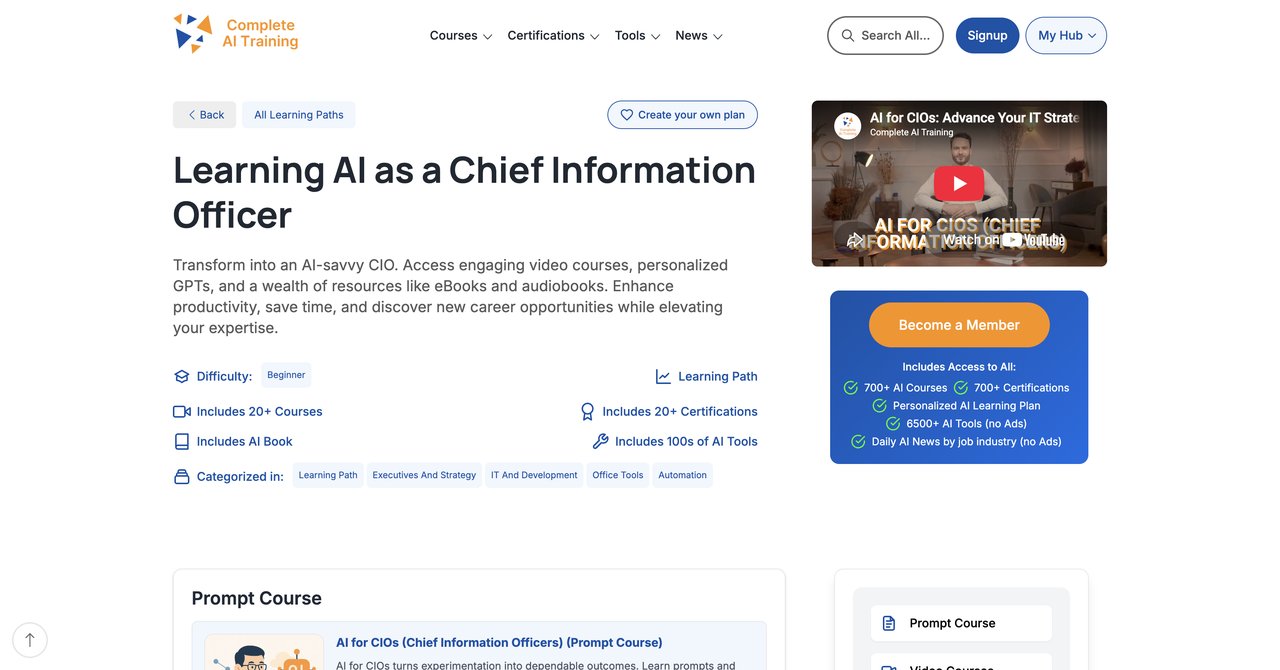
One subscription. Every course. Every certification. CompleteAI Training does something pretty different from every other provider in this comparison. It is not a single course but a complete platform subscription. For a flat monthly fee, you gain full access to ALL video courses on the platform , not just the AI for CIOs material, not just sample introductory lessons, but the entire library. That covers all certifications as well, at no extra cost. If you're a CIO whose responsibilities spill over into other departments, this matters. New courses are added continuously, and they automatically appear in your account. There's no need to pay per course or to purchase a certificate separately; it's all bundled into one affordable price.
This structure makes sense for someone whose role is inherently cross-functional. A CIO in 2025 is not confined to IT. They have to speak the language of HR, marketing, finance, and operations. The platform includes access to every other job-role specific material-like marketing, project management, cybersecurity, and more-which becomes a real asset when you need to understand how AI impacts those functions or when you are planning a move into a broader leadership position. The content is updated daily to reflect trends, tools, and ongoing developments in AI.
Key topics covered include AI fundamentals, generative AI, agentic AI, AI in security, data analysis, plus hundreds of lessons for specific industries. You also get career-focused training and certification pathways.
Target audience is broad, but it's particularly useful for CIOs who want general depth across the full spectrum of AI knowledge. It's suitable for any skill level because the platform has introductory material for beginners and advanced lessons for more experienced professionals. Technical experience is not required to begin.
Pros:
- Full access to ALL video courses on the platform-not a single course or fixed bundle
- All certifications are included at no extra cost, with new ones added continuously
- Includes access to every other job role's material, crucial for cross-functional work within the organization
- Affordable flat subscription; one price unlocks the entire library versus paying per course elsewhere
- Daily updates keep you aligned with fast-changing AI landscape
Cons:
- Subscription-based, so you need to keep pace to get full value; annual payment is cheaper but requires commitment
Who would benefit most from this particular course: A CIO who wants broad access to content on multiple AI applications, wants to stay on top of continuous changes, doesn't want to worry about separate certificates, and prefers a highly cost-effective model. It's an obvious choice for those who simply want to learn without paying university-level pricing.
Visit CompleteAI Training for AI for CIOs
Course 2: Applied Agentic AI for Organizational Transformation by MIT Professional Education
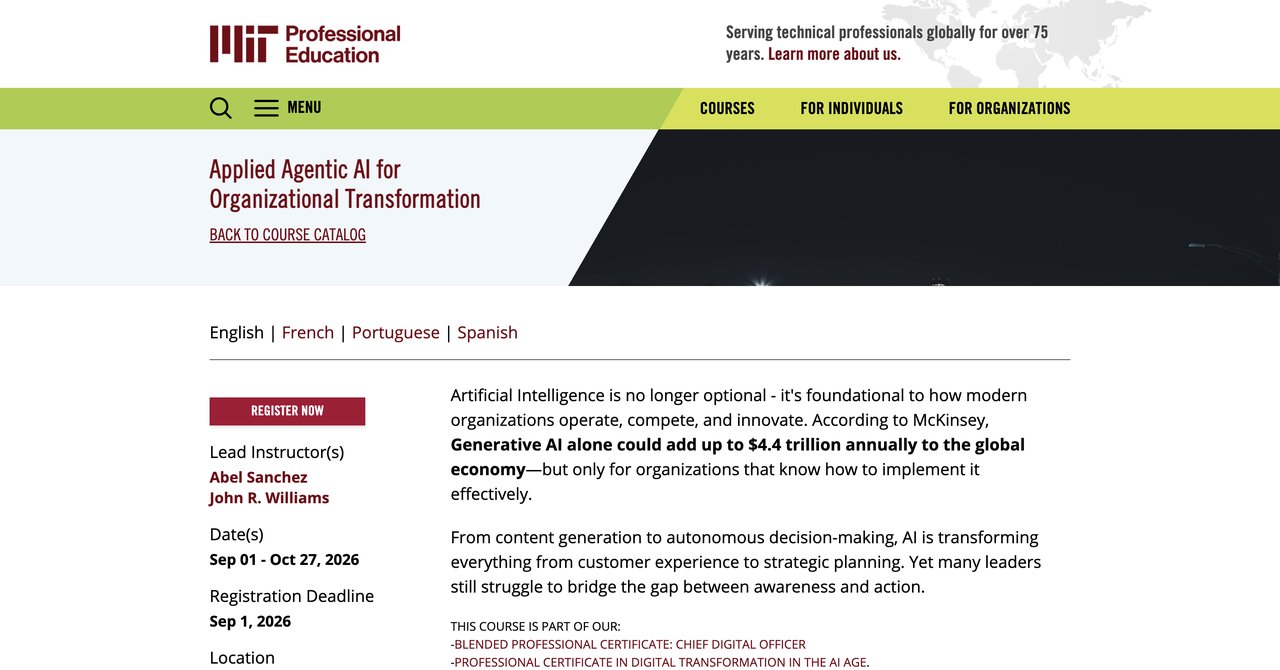
MIT Professional Education offers this 8-week intermediate course explicitly for C-suite executives. It focuses on leading generative AI and agentic AI integration across the bigger picture-the strategy, the operations, the governance. For CIOs who want to move beyond ChatGPT, it's meant to provide a framework for truly deploying autonomous systems. This course does not require coding skills, which suits those who execute at a strategic level rather than writing code. The program includes coverage of GDPR and HIPAA compliance, so it also tests a regulatory aspect that many other programs miss.
Instructors are faculty from MIT, and the whole thing is done through a live online cohort model, which means you interact with other executives. This establishes a group learning environment. The curriculum includes practical strategy development, understanding agentic workflows, and ways to harness data and foundational models to drive real results.
Key topics include: agentic AI theory and applications, AI integration, policy, governance, ethics and compliance (GDPR/HIPAA), strategic positioning, and operations.
Target audience and skill requirements: intermediate level course for C-suite and senior executives, including CIOs. No technical prerequisites but some understanding of business strategy is a must.
Pros:
- Specifically tailored for C-suite executives and CIOs
- Covers governance, ethics, and compliance in depth
- No technical coding required
Cons:
- Premium price point ($3,250) for eight weeks
- Limited to one cohort starting Sep 1, 2026
Who would benefit most: CIOs with a clear focus on implementing autonomous AI systems and need a C-suite peer network. If you are okay with a higher cost and have time to start later, this provides a solid academic grounding.
Visit Applied Agentic AI for Organizational Transformation
Course 3: Deploying AI for Strategic Impact by MIT xPRO / MIT CSAIL
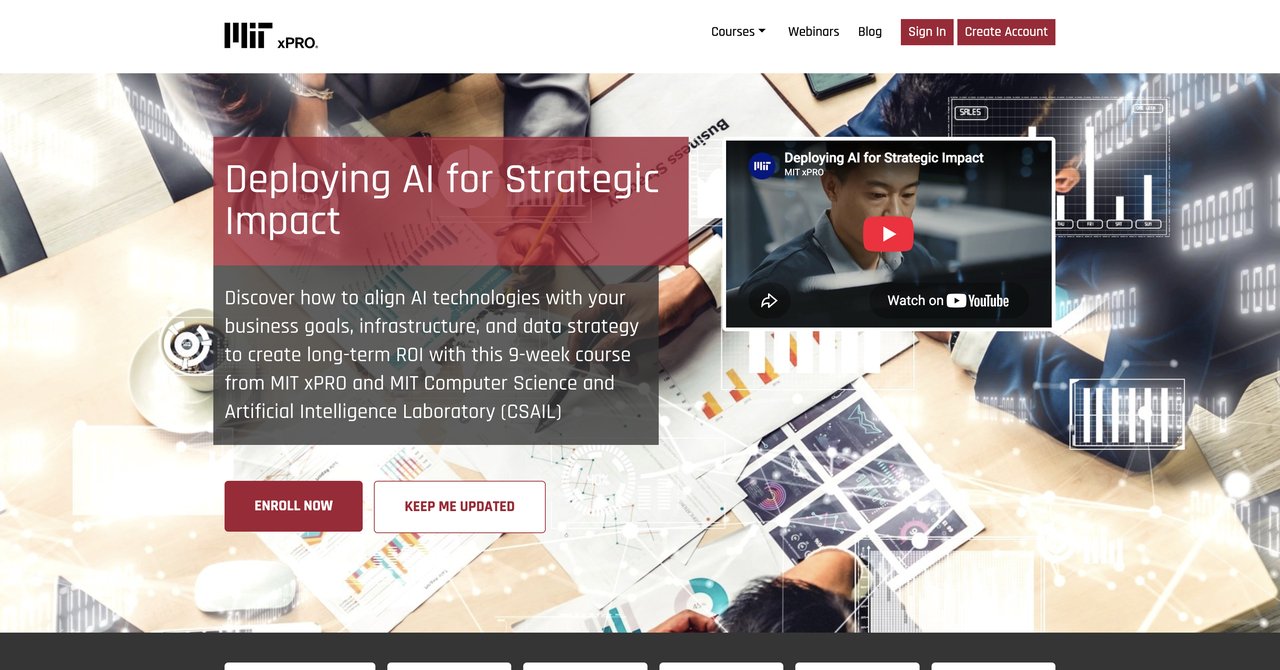
Co-developed with MIT CSAIL, "Deploying AI for Strategic Impact" is a 9-week intermediate curriculum aimed at executives making AI investment calls. The program sets aside the "cool" factor of AI and focuses on how to translate it into business results. It gives you a practical approach to ensure your spending on technology aligns with business objectives. You'll learn how to design data and infrastructure strategies, and how to measure the long-term return on investment (ROI). The course also looks at the lifecycle of AI initiatives, from opportunity selection to deployment and scaling.
This is another MIT xPRO format, which means you have online modules, case studies, and interaction with faculty and peers. It's designed for managers, directors, and CIOs who are responsible for making AI funding decisions.
Key topics include: AI and business alignment, data infrastructure, cloud architecture, change management, ROI frameworks, and management of AI projects.
Target audience and skill requirements: intermediate, for those with a good understanding of their organizations operational and strategic needs, but not necessarily technical experts in machine learning.
Pros:
- Co-developed with MIT CSAIL, adds rigor and weight
- Focuses on aligning AI with business goals and practical data strategy
- Provides solid frameworks for measuring long-term ROI
Cons:
- No hands-on coding exercises
- Requires a consistent 4-6 hours per week, making it hard to do on the side
Who would benefit most: A CIO who needs to rationalize their AI strategy back to the Board and wants a disciplined approach to business metrics, not just theory.
Visit Deploying AI for Strategic Impact
Course 4: AI Adoption: Driving Business Value and Impact by MIT Sloan Executive Education
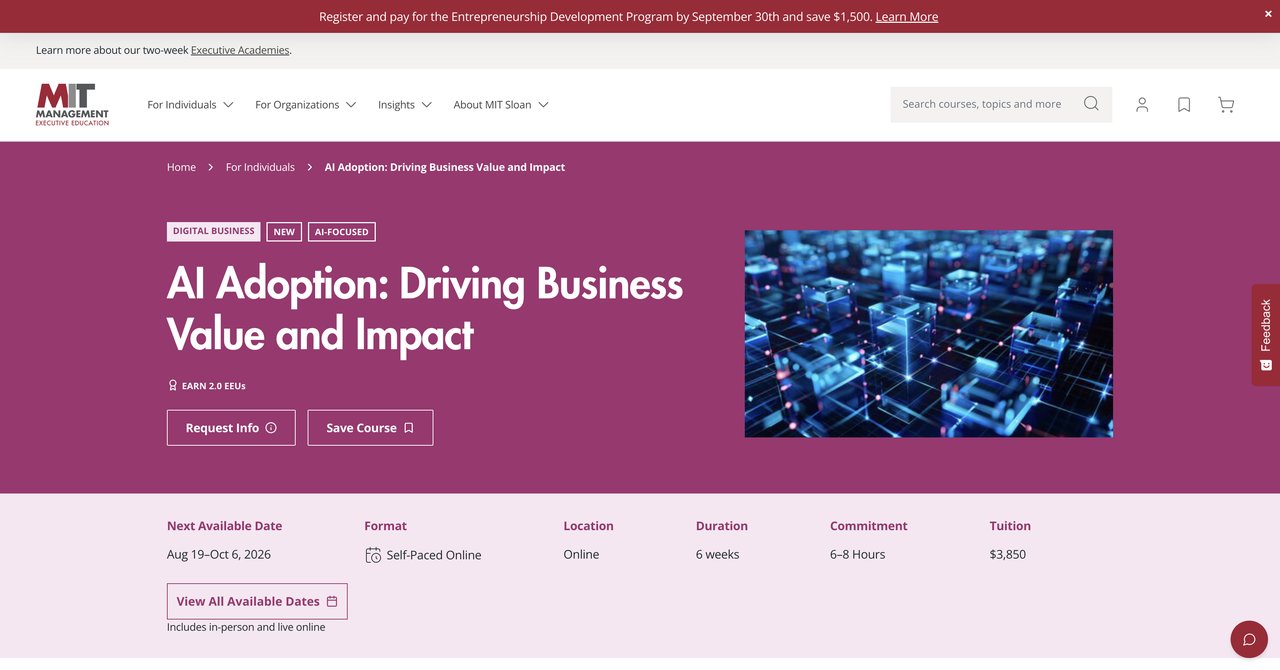
MIT Sloan's program on AI Adoption takes a shorter (6-week) but very practical pearl. The focus is on increasing an organization's ability to actually absorb AI technologies and change the way work is done. It maps AI capabilities to specific business bottlenecks, so you're not learning in the abstract. The course also spends time on change management, including how to overcome resistance among employees and make sure that you human-AI co-creation is part of the transition.
You will learn about adoption frameworks, leadership issues in AI projects, and ways to identify where the business benefits. This is a course that probably aligns with having a roadmap for integration and knowing you need to properly support end users.
Key topics: business problem identification with AI, adoption barriers, organizational change, human-AI collaboration, and strategy execution.
Target audience: intermediate executives; shown a CIO, but also valuable for an information leader handling practical aspects of AI deployment. Requires some basic familiarity with AI concepts.
Pros:
- Maps AI technologies directly to business challenges
- Focuses on overcoming adoption barriers and managing human elements
- Deep emphasis on human-AI collaboration, a topic often ignored elsewhere
Cons:
- 6-8 hours weekly commitment may be intense
- Next cohort starts Aug 19, 2026
Who would benefit most: CIOs looking to refine their ability to lead transformation and handle the internal resistance and human behavior aspects of integrating AI into workflows.
Visit AI Adoption: Driving Business Value and Impact
Course 5: Making AI Work: Machine Intelligence for Business and Society by MIT Sloan Executive Education / MIT Schwarzman College of Computing
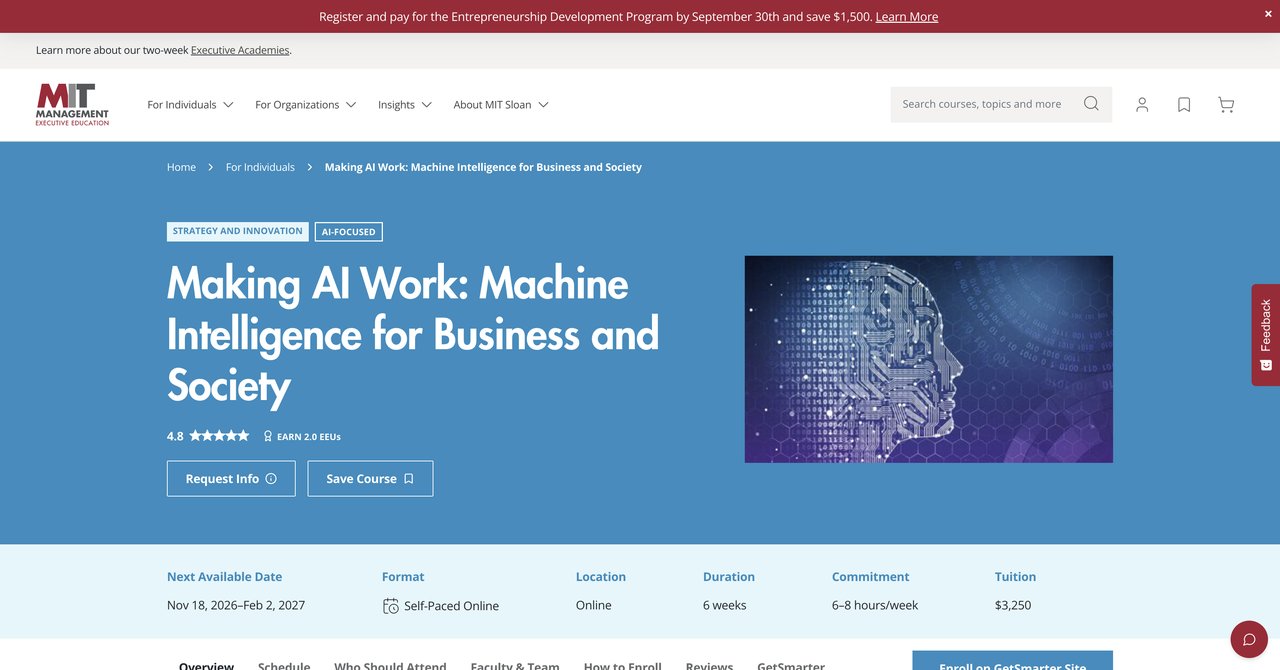
This 6-week program is a collaboration between MIT Sloan and the Schwarzman College of Computing. It aims to give leaders a balanced understanding of AI: technical enough to grasp the possibilities but strategic enough to act. It covers topics such as robustness, safety, and responsibility. There's an proprietary ML Deployment Framework that gets into the details of deployment and operation. The course focuses on machine learning more than the newer agentic approaches.
The course content is oriented toward the senior leader with a focus on policy, infrastructure, and strategic decision-making. It asks more theoretical questions like "what is worthy of machine learning" and "how do we keep it aligned with the public interest," which is a useful distinction for CIOs who answer to regulators.
Key topics include: algorithms, model training, historical bias, responsible AI, technical infrastructure, and regulatory aspects.
Target audience: leaders and directors looking to make AI operational in a thoughtful, controlled way. Intermediate level required.
Pros:
- Covers robust, beneficial, and responsible AI deployment
- Proprietary ML Deployment Framework is practical and tested
- Explores both technical and strategic dimensions
Cons:
- Focuses more on traditional ML and less on new generation agentic AI
- Next cohort starts Aug 12, 2026
Who would benefit most: A CIO that wants a comprehensive baseline view of ML in business, with an emphasis on safe and principled use- particularly in regulated environments.
Visit the Making AI Work program
Course 6: Chief AI Officer (CAIO) Program by Chicago Booth Executive Education
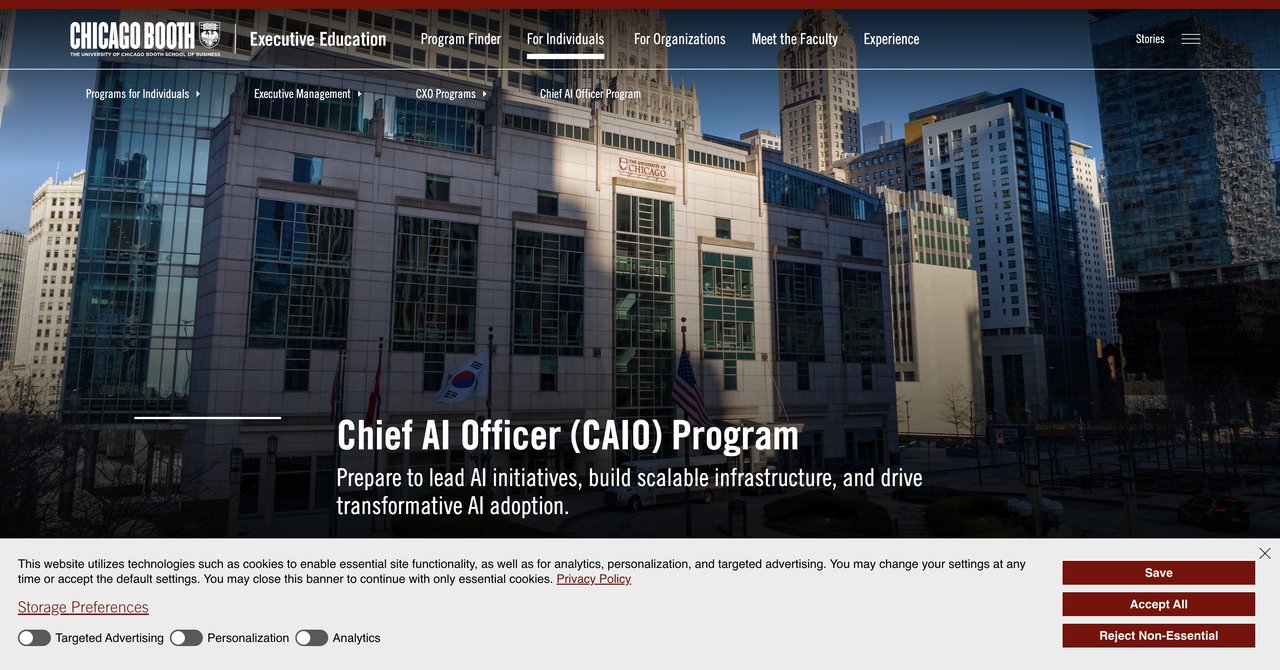
Chicago Booth's Chief AI Officer program is a full-scale executive course, not a quick immersion. The point is to prepare a C-level officer, often a CIO, to step into a new role: The Chief AI Officer. It goes beyond managing IT and looks at AI enterprise architecture, ROI, and C-suite collaboration. The program incorporates leadership development so you learn how to align AI strategy with the entire organization and beyond. Given the price tag ($28,000), this is the elite, cachet heavy route for ambitious movers.
It's a multi-course program, meaning you go into multiple weeks (24+ months?) and it has a dedicated course on how to work with other C-suite leaders. It's your ticket if you don't see yourself as remaining just a CIO.
Key topics: AI strategy, ROI concepts, C-suite alignment, leadership, hiring and structuring teams, and advanced use cases.
Target audience: senior executives who are contemplating ascension to the CAIO role, with a strong foundation in technology is assumed.
Pros:
- Comprehensive curriculum covering AI strategy, ROI, and leadership
- Includes a full dedicated course on C-suite collaboration
- Prepares specifically for the emerging CAIO role-value in career positioning
Cons:
- Very high cost compared to all alternatives
- Long time commitment; requires application and a September 2026 cohort start
Who would benefit most: High-level CIOs planning to transition into a dedicated AI leadership position and have the executive accompaniment budget.
Visit Chicago Booth CAIO Program
Course 6: Applied AI for Digital Transformation by MIT Professional Education
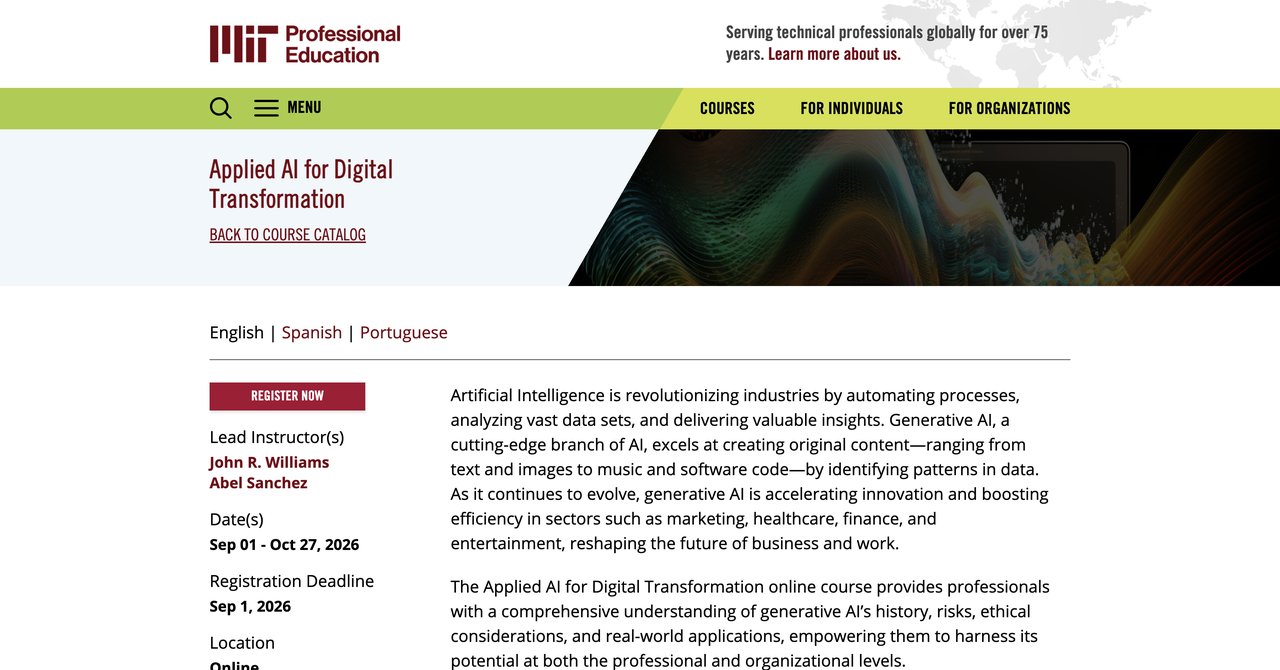
Another 8-week MIT Professional Education program, this one is a bit more technical, mixing the concepts of AI implementation with management viewpoints. It aims to equip CIOs and tech leaders with applications for generative AI in a transformation. The course deals with how AI can be applied to upstream and downstream processes, market impact and strategic decisions. There's also attention to the ethics behind using AI and how to keep the human element into processes that become automated.
The teaching is executive-focused, but you will get some exposure to the realities of implementation, data preparation, and tool selection. It also considers ethical and human consequences of turning an operation over to AI , which a strategic leader needs full comprehension of.
Key topics: AI strategy, exponential impact, generative AI applications, moral and ethical challenges, human-machine collaboration, and implementation of business models.
Target audience: told to CIOs and other leadership levels. Intermediate level experience in strategy is necessary. No coding is required, but it's must to be aware of data concepts.
Pros:
- Combines academic security of MIT with practical management problems
- Covers generative AI in detailed ways but general enough for seniors
- Addresses ethical and human elements
Cons:
- Price is not explicitly listed on the page
- Specific start dates not clearly disclosed
Who would benefit most: CIOs in mid- to large companies who don't want to code but want enough to make touch groundbreaking insights about why AI adoption happens and the potential fallout.
Visit Applied AI for Digital Transformation
Course 7: AI for Senior Executives by MIT xPRO
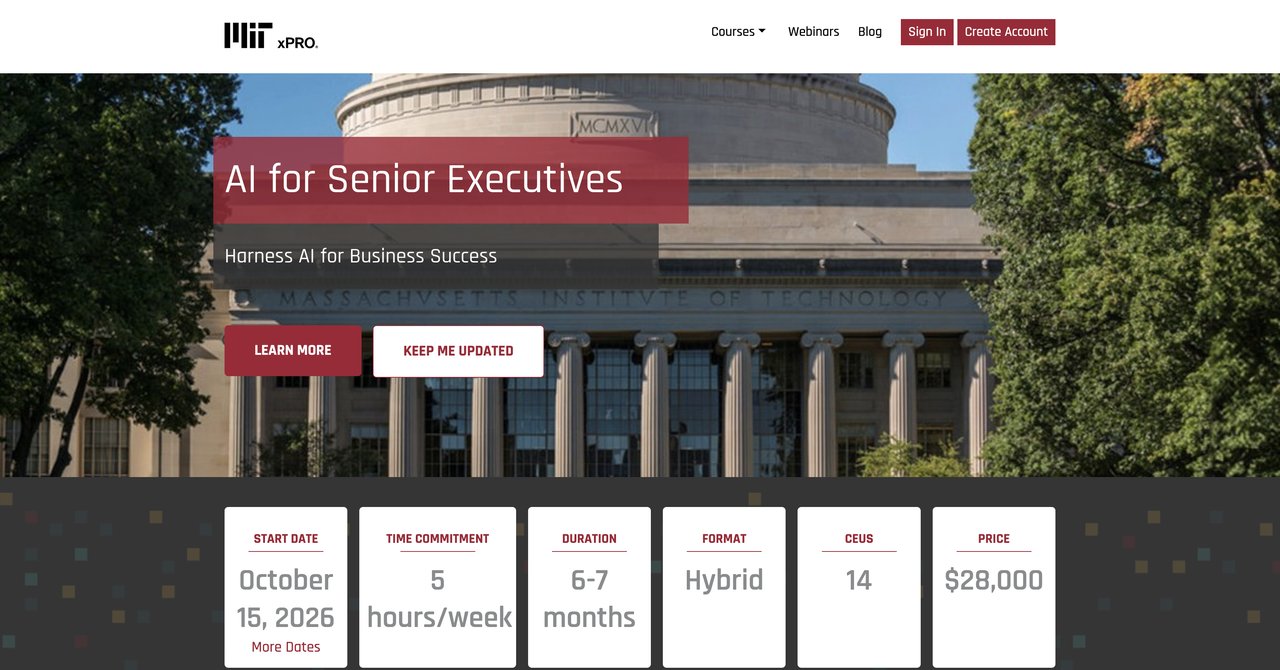
This is MIT xPRO's long-form leadership certification. Running 6 to 7 months, it's substantially longer than their shorter programs. The point is not the mechanics of modern AI, the point is that you can identify, implement, and lead change over a longer period. It's aimed at senior execs like a CIO who wants a exchange that truly shifts how they approach AI.
It includes change management and leadership modules, which are critical when you need to persuade people at all levels of your organization. Taught by MIT faculty, it requires a significant weekly time commitment, akin to having a second job on the side. You will likely bell deal with case studies and actual implementation exercises. The focus is on leading not implementing.
Key topics may include: strategic alignment, AI project management, business partnership, technical selection, org design, and change.
Target audience: advanced, it requires significant time and experience. CIOS who are thinking of strategy and need a structured certification to build credibility.
Pros:
- Long-form, deep program for identifying and implementing AI solutions that stick
- Develops leadership and change management skills in detail
- Taught by MIT faculty
Cons:
- Significant time commitment (6-7 months)
- Price is not listed on the page, likely high
Who would benefit most: A CIO planning to undertake a major enterprise-scale AI push and needs a robust development coaching, plus the time to do it thoroughly. Those with more than two years horizon who can commit to a sustained program.
Visit AI for Senior Executives
Course 8: AI Essentials: Accelerating Impactful Adoption by MIT Sloan Executive Education

AI Essentials offered via MIT Sloan is a short (beginner) course designed to build literacy among non-technical leaders. It's a broad certificate that helps a CIO come to speed with AI language and concepts without being burdened by optional detail. This is not going to, solve infrastructure issues, but instead gives you a grounding for later decisions. It focuses on clear examples, is structured for busy executives who need to run their agendas, and includes strategic frameworks you can apply immediately.
It targets the important ability to ask Google questions and consume the technical feedback from the teams. It does is a springboard: once you have this foundation, you can approach other specialty courses with much more confidence.
Key topics: core concepts, core technical landscape, frameworks for adoption, transformation roadmap, what AI does best, and the limits.
Target audience: absolute beginners, no prior tech or hands-on needed. This is relevant to CIO with other backgrounds (such as finance) or newly promoted.
Pros:
- Emphasizes AI literacy for non-technical leaders
- Clear, accessible understanding of AI technologies
- Provides strategic frameworks for adoption decision-making
Cons:
- Higher price for a shorter course; cost/benefit factor
- Beginner level may be too basic for technical CIOs with prior AI exposure
Who would benefit most: The CIO who is new to AI, or clients from small organizations cannot continue with advanced tech content. They want a foundational base to allow future investment decisions.
Course 9: CAICSO , Certified AI Cybersecurity Officer by Udemy

For someone concerned about the security aspects, Udemy offers a self-paced course called the Certified AI Cybersecurity Officer (CAICSO). While the name sounds more like a badge, it's actually a comprehensive course about AI governance, risk, and cybersecurity frameworks. The content deals with the way data is used, adversarial attacks on AI, and building resilience in AI systems. It's designed for security professionals but it's great for a CIO who carries both the technology and the security portfolio.
It is a value-oriented way to get strong core security topics, but you'll have to consider that Udemy pricing varies and the quality can differ from instructor to instructor. It is not a university recognized certificate but hundreds of thousands of students have taken a version.
Key topics: AI-related risk management, security frameworks (relevant to AI), attacks-data poisoning, prompt packages-and defense strategies.
Target audience: junior-level to intermediate security managers, and CIOs. Basic security knowledge and some AI awareness is useful.
Pros:
- Focuses on the need: governance, risk, and security frameworks
- Prepares a specific cybersecurity officer skill
- Addresses the security side of AI adoption, frequently left out of executive courses
Cons:
- Udemy quality varies; certification is not from a major university
- Lacks the strategic breadth of MIT school list programs
Who would benefit most: A CIO with direct security oversight who wants a practical, low-cost grounding in defense for AI and going. Good for mid-career professionals at scale.
Course 10: Becoming an AI-Ready Security Leader by InformIT (Pearson)
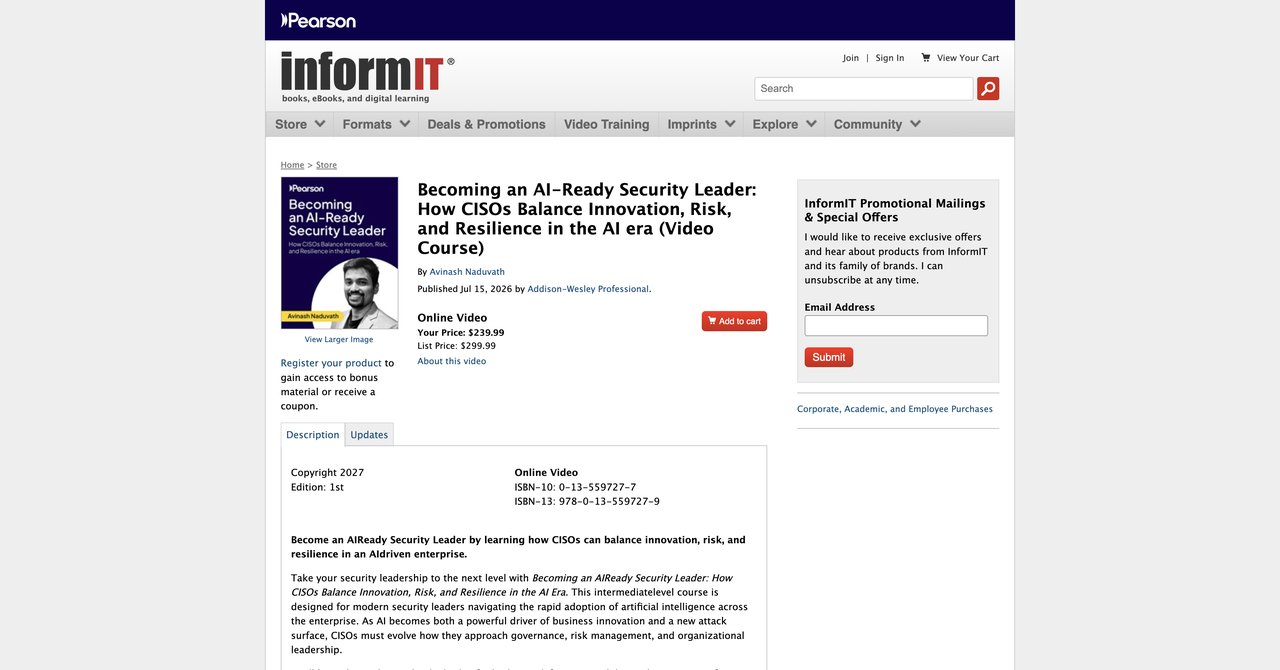
This is a self-paced video course produced by Pearson's InformIT imprint. It targets "AI-ready" security leaders. While the title points more toward the CISO, you're a CIO who also looks at cybersecurity, it is quite relevant. It covers how to balance accelerating AI innovation while preparing for risk, resilience, and governance. The course addresses where AI is useful-automating security controls-but also is it a target and attack vector to be aware of.
The video format into a structured self-driven setting is efficient, flexible, and more understated compared to a full executive cohort. It includes case studies and leadership guidance. You can learn it over a weekend. But you won't get any kind of formal university recognition. The depth is solid along the security angle without overwhelmingdetails.
Key topics: managing AI-driven innovation risk, governance, strategy, AI as a business driver and security threat, team building and procurement.
Target audience: security leaders who are increasingly serving in deep tech roles. No formal prerequisites but a security background is assumed.
Pros:
- Specifically designed for security leaders facing AI adoption
- Covers governance, risk, and leadership perspectives
- Addresses AI as both a driver and an attack surface
Cons:
- Niche security focus rather than broad CIO duties
- Not from a university, so the name doesn't carry the same punch
Who would benefit most: A CIO that has cyber security in their remit and wants a quick tool to refresh their thinking on governance and security in AI contexts, without weeks of class time.
Overall Recommendations and Summary for CIOs
If you are a CIO, the best course really depends on what 'AI' means to your function right now.
For overall breadth and cost-effectiveness, the CompleteAI Training subscription is the one that stands out. It's not a single fixed course locked to one topic. It is like a whole curriculum membership, where you have absolute access to certifications and training in software development, data engineering, and beyond. The flat price for the entire library means you can take as much for your learning schedule. If your organization is running across a wide range of AI initiatives-data science, security, marketing automation-you can take deep dives across these fields. It's of exceptional value if you are an individual upskilling quickly with a modest budget.
For executives that want formal prestige and in-depth strategy, the MIT options are excellent. Deploying AI for Strategic Impact is the most balanced if you're actively managing an AI budget and need to show ROI to a CFO. Applied Agentic AI is important for future-looking leaders dealing with new autonomous models, though the class cohort is no good for the schedule. The MIT Sloan AI Adoption is worth picking if your problem is "we bought the tech but no one is using it."
For the CIO transitioning to a collaborative C-suite person, Chicago Booth's CAIO program is the strongest if you have massive budget available. It's powerful for moving you from a technology lead to a global AI strategy. If price is an issue, what you would get from 10 MIT subscriptions can be had for much less.
If your focus is very specific, the security angle is a good start-point with CAICSO or InformIT. They are cost-effective and very strategic, but you must manage your own learning.
For junior CIOs or those new to technology management, AI Essentials from MIT is an efficient first exposure if you need a nice structured profile. Though it is not for someone that has been part of the technical community.
Where does General Summary with CompleteAI? It's the most efficient cost per lesson and through its bundle, covers everyone's need. If you are a CIO with a broad role and an internal appetite to learn not just requirements for role, but to remain current across the entire enterprise, it's the highest value pick out there. The president might insist on university names, and that's why so many purchase from MIT. But if you need depth, hiring power, and speed, the platform is the way to go.
Click here to see CompleteAI Training for CIOs
Whatever you choose, make sure you think about what you're solving for: a daily operational change, a CV ornament, or a full business-wide strategy. That will narrow the decision far more easily than any list.