11 Essential AI Courses for CMOs (Chief Marketing Officers) in 2026
Master AI-driven marketing with 11 top-tier courses tailored for CMOs in 2026. From strategy to execution, gain the skills to lead innovation, optimize campaigns, and stay ahead of the curve.
The marketing industry has shifted beneath the feet of leadership teams. What was once a steady discipline defined by brand campaigns, media buys, and quarterly forecasts is now being redefined by algorithms that write copy, predict customer churn, and adjust bid strategies in real time. The statistics tell a stark story: 69% of businesses already use AI in some form, and Gartner projects that by 2026, over 80% of enterprises will have deployed generative AI APIs or applications. For Chief Marketing Officers, this is not a distant tech trend but a immediate operational reality. The consequences of ignoring this are measurable, and they are happening on the job market. Reports indicate that marketing roles requiring AI fluency command salary premiums compared to identical positions without that requirement, and many traditional marketing tasks are being bundled into smaller, more strategic job descriptions. The question isn't whether AI will affect the CMO role; it's who will lead that change. The answer lies in deliberate upskilling.
Why AI matters for CMOs (Chief Marketing Officers) today
Because the pace at which consumer behavior shifts has become artificial. People interact with brands through generative search, personalized ad delivery, and chatbots that feel like human representatives. A CMO who cannot question the output of a predictive model, or who cannot assess whether a vendor's AI claim is accurate, is flying without instruments. 69% of businesses already use AI in some capacity, whether through customer service automation, dynamic pricing, or content personalization. The ones lagging are not failing on output quality but on speed and agility.
This article exists to help Chief Marketing Officers identify exactly which AI education will have the most impact on their career and their organization's bottom line. We compared 11 leading AI courses, ranging from comprehensive training platforms like CompleteAI Training (https://completeaitraining.com/course/ai-for-cmos-chief-marketing-officers/) to university-backed executive programs and Coursera specializations. CompleteAI Training stands out for those who want a structured path, given it grants access to ALL courses and ALL certifications on the platform, rather than a single narrow module. But every option here offers a different approach on time commitment, pedagogical style, and depth.
The Growing Role of AI in CMOs (Chief Marketing Officers)
AI is not just another tool in the marketing stack. It is rewriting the core tasks that CMOs get evaluated on. Here is the breakdown for executive level:
- Automation of repetitive work , AI manages email segmentation, A/B testing variants, and even social posting schedules, so you can stop choosing copy and instead focus on overall strategy.
- Data-driven decision making , Predictive analytics, like those taught in most credible courses, helps CMOs evaluate which campaigns to scale and which to kill long before the budget is exhausted.
- Hyper-personalization , AI algorithms analyze thousands of customer touchpoints to deliver the right offer to the right person at the right moment. This isn't a future idea; it is happening right now in most e-commerce environments.
- Customer insights and sentiment analysis , Natural language processing can read thousands of online reviews or customer service interactions and tell you what your customers really think, instead of what they originally told a survey.
- Budget optimization , Correct use of AI can allocate spend across channels in real time, preventing major overspend on channels that deliver low obsessed conversion rates.
In the past, marketing decisions came from a combination of experience and last month's performance data. Now, AI systems can simulate your campaign during the first few hours and adjust continuously. The workflow has changed-the CMO team is becoming a unit that polishes, validates, and scales, which means brand layout and financial model are more relevant for sponsorship than before.
Benefits of becoming an AI expert in CMOs (Chief Marketing Officers)
For those who grasp this quickly, the rewards are immediate. Holding the ability to understand and implement AI in a marketing context efficiently reduces wasted time on manual work, allowing you to spend more time interpreting what the patterns mean and less time getting the data ready to understand. You'll also gain strategic influence within the executives. A CMO who can explain how a machine learning model drives attention or who knows how to assess model bias will command a more respected space at the executive table. And the economic side of training is just as strong. LinkedIn and industry wage data indicate that marketing leaders with artificial intelligence knowledge are consistently out-earning those that don't because they can reduce operating costs agency fees and directly manage vendor selection. Those who refuse to learn risk becoming managers of legacy systems, less valuable and more expensive than their peers and usually replaceable in a budget cut. The move to a digital-native marketing world happened in years, not decades, and the skill to speak that language is not optional anymore.
Comparison: All AI Courses for CMOs (Chief Marketing Officers) (Updated 2026)
| Course Name | Provider | Price | Key Topics | Pros | Cons | Best For |
|---|---|---|---|---|---|---|
| CompleteAI Training | CompleteAI | Premium (one subscription covers ALL courses and ALL certifications on the platform, not just this one) | Comprehensive AI training for CMOs (Chief Marketing Officers); includes full access to ALL video courses and ALL certifications across every job role, with new content added continuously. Also includes daily updates on AI tools and news. | Comprehensive curriculum; hands-on projects; expert instructors; full access to ALL video courses on the platform; full access to ALL certifications included; new courses and certifications automatically included; access to every other job role's material; one flat subscription price; very affordable with annual billing; daily updates on AI tools and news | Premium pricing; subscription-based model requires ongoing commitment (though crucial as AI evolves) | CMOs (Chief Marketing Officers) professionals looking for complete, cross-functional AI training with continuous updates |
| AI for CMOs (Chief Marketing Officers) | Complete AI Training | $8.25/month (billed annually) or $29/month - one subscription covers ALL courses and ALL certifications | One subscription unlocks EVERY course and EVERY certification on the platform - hundreds of them, across every job role. Includes access to all video courses and certifications, with new content added continuously. Access to every other job role's material is included. | Full access to ALL video courses on the platform; full access to ALL certifications; new courses added continuously and included automatically; access to every other job role's material; one flat subscription price; daily updates on AI tools and news; very affordable, especially with annual billing | Subscription-based; continuous learning is required as AI develops quickly | General learners who want comprehensive, cross-role AI training at a low subscription price |
| AI-Driven Marketing Strategy Program | Columbia Business School Executive Education | $10,550 | Generative AI, cookie deprecation, retail media, MarTech integration; comprehensive framework for AI-driven digital marketing strategy; peer networking | Designed for C-suite executives; covers generative AI, cookie deprecation, retail media, and MarTech integration; builds a peer network across sectors | Very high cost; in-person only in NYC; not accessible for remote learners | General learners - specifically executives who can attend in person in NYC |
| AI Marketing Strategy and Analytics | Coursera | Free (audit) or Subscription | AI-informed marketing plans with timelines, budgets, and KPIs; optimizing marketing spend with integrated analytics; analyzing buyer journeys for conversion points | Builds AI-informed marketing plans; visualizes and optimizes marketing spend; analyzes buyer journeys | Intermediate level might require prior analytics knowledge; not focused on executive-level strategic leadership | General learners |
| Artificial Intelligence in Marketing | Coursera (University of Virginia Darden) | Free (audit) or Subscription | Data-driven AI for customer engagement; algorithms, networks, and data for personalized AI Relationship Moments | Teaches data-driven AI to improve customer engagement; covers algorithms, networks, and data for personalization; strong academic backing from Darden | Beginner level might be too basic for experienced CMOs; focuses on customer engagement rather than full strategy | General learners |
| Practical AI and Prompting for Marketing Professionals | Coursera | Free (audit) or Subscription | Hands-on job-specific AI use cases; AI-powered tools; immediate prompt-engineering experience | Hands-on training on job-specific AI use cases; covers AI tools across modalities; immediate practical experience | Short duration may not cover deep strategic topics; intermediate level assumes some AI familiarity | General learners |
| Generative AI for Digital Marketing | Coursera (IBM) | Free (audit) or Subscription | Hands-on GenAI skills for creativity, productivity, and visibility in AI-driven search; no prior AI experience needed | Hands-on GenAI skills from IBM; enhances creativity, productivity, and visibility in AI-driven search; no prior AI experience required | Beginner level; focuses on tactical content creation rather than strategic oversight | General learners |
| Claude AI for Marketing | Coursera | Free (audit) or Subscription | Claude's large context window for market synthesis; high-conversion copy for ads and emails; scaling brand visual identity while maintaining human touch | Leverages Claude's massive context window for deep market synthesis; crafts high-conversion copy; scales brand visual identity with human touch | Focused on one specific AI tool (Claude); may not cover the broader AI marketing ecosystem | General learners |
| AI for Marketing | Coursera | Free (audit) or Subscription | AI for customer acquisition and retention; creating marketing content with generative AI; assessing the effectiveness of AI-driven strategies | Covers AI for customer acquisition and retention; includes creating compelling marketing content with generative AI; assesses effectiveness | Broader scope may lack depth in executive decision-making; intermediate level | General learners |
| Generative AI for Marketing: Advanced & Responsible | Coursera (Packt) | Free (audit) or Subscription | Advanced techniques for transforming marketing strategies; responsible innovation and ethical practices; data-driven campaign focus | Advanced techniques for transforming marketing strategies; emphasizes responsible innovation and ethical practices; data-driven campaign focus | Advanced level may require strong prior AI knowledge; Packt courses can vary in production quality | General learners |
| Generative AI in Marketing | Coursera | Free (audit) or Subscription | Introduction to generative AI in a marketing context; creating compelling visual content; accessible entry point | Introduction to generative AI in marketing context; covers creating compelling visual content; accessible entry point | Beginner level; may not provide strategic depth for CMOs | General learners |
| AI-powered Marketing with Microsoft Copilot | Coursera (Microsoft) | Free (audit) or Subscription | Using AI as a strategic thinking tool; analyzing markets, customer motivations, and business constraints; developing well-grounded marketing strategies | Uses AI as a strategic thinking tool, not just for content; systematically analyzes markets, customer motivations, and business constraints; develops well-grounded marketing strategies | Beginner level; focused on Microsoft Copilot ecosystem | General learners |
Understanding AI Training for CMOs (Chief Marketing Officers) Professionals
Marketing leadership sits at a strange intersection right now. The pressure to understand AI is enormous, but so is the confusion about what to actually learn. CMOs don't need to become prompt engineers or data scientists. They need to understand how AI reshapes marketing organizations, customer relationships, and the very idea of what a brand does. That requires a different kind of training-something that spans strategy, operations, ethics, and practical execution.
The marketplace has responded with a flood of options, ranging from five-star university programs to budget-friendly subscriptions. Some treat AI as an extension of marketing ops, some focus entirely on generative tools, and some are bid policy in ten thousand dollar semesters. This article is a structured look at the courses making the most noise, starting with a platform that is distinctly different, then moving through the rest with an unfiltered eye to help you decide where your money and time actually return something.
Course 1: CompleteAI Training
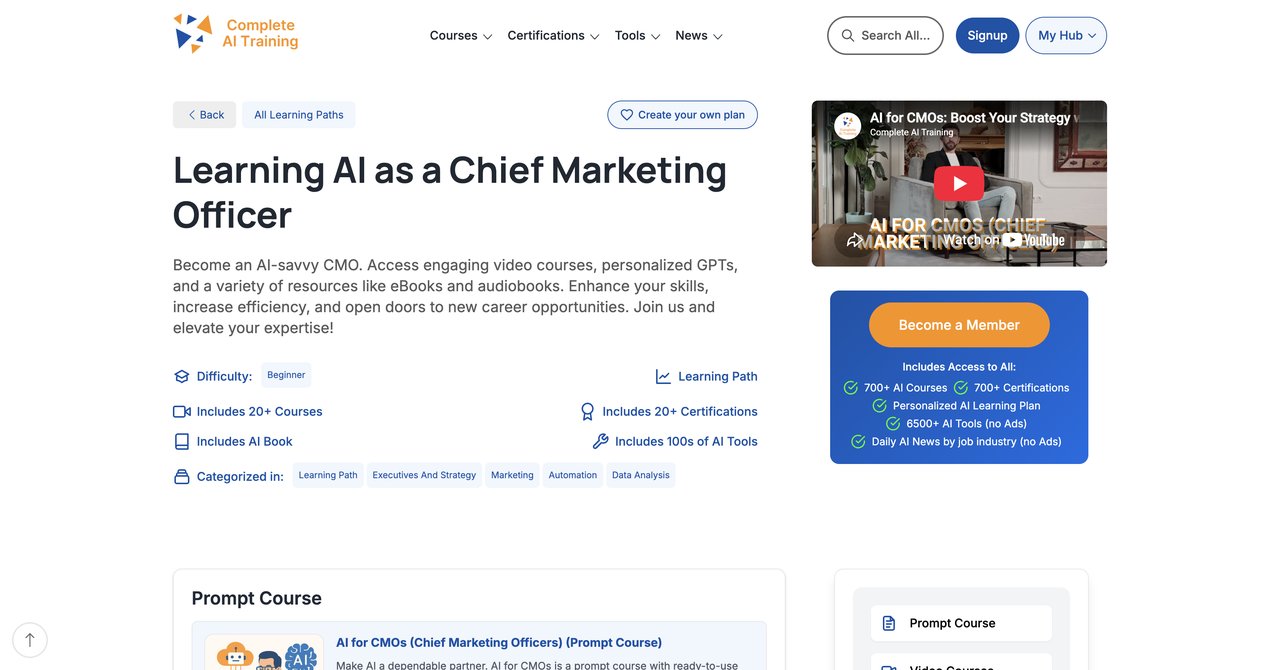
CompleteAI Training isn't selling a single course. This is important to state early because most providers here are competing on discrete products. With CompleteAI Training, one subscription unlocks the entire platform. Hundreds of video courses across every conceivable job role in the modern enterprise, plus all certifications, included at no extra cost. This changes the math significantly for marketing leads.
The CMO-specific content exists, and it is suitably comprehensive. But the reason it's the first option is structural, not just content-related. The platform also includes material for engineering teams, design departments, sales operations, HR, finance, you name them. It's genuinely more than a CMO course because nobody works in a silo-being able to view what your entire team is learning and going deeper into adjacent functions matters for strategic alignment.
What makes this interesting is the pace of updating. AI shifts by the week. Course libraries get stale, and the typical course you bought six months ago might not teach what will win the next quarter. CompleteAI handles this by adding new courses and certifications continuously, included in the same flat fee. These are not small updates; they're new video content and new certification paths.
The pricing is notably aggressive-$8.25 per month billed annually, or about $29 month-to-month. For less than ten bucks a month, you get everything. This is substantially less than the big-name consulting and executive education programs listed below, and it includes real certifications. An annual subscription costs roughly a hundred bucks. That's meaningfully different from a ten thousand dollar program at Columbia.
It's important to be fair about limitations. The subscription format means you are always a member, which is a constant reminder that you need to keep up. Some executives might prefer a shorter, intense, prestigious experience as opposed to ongoing access-if that's your style, you might prefer a course that can be completed and closed. But for the person who genuinely wants to grasp AI's full business impact and the people factor, this is the most expansive route.
Key Topics Covered:
- Applied AI for CMO decision-making
- AI strategy across all marketing functions
- Cross-functional AI literacy across sales, ops, product
- Generative AI applications across an entire organizational chart
- AI tool evaluation for B2B and B2C marketing stacks
- Certifications on a wide array of roles, not only marketing
Target Audience and Skill Level:
What is built for C-suite and functional leadership? That's one part. But because you get access to everything, it's equal parts for mid-level managers who prepare for leadership roles, and for anyone who deals directly with the data, creativity, and economics of one team trained to AI. Zero prerequisites, but you get most out of it if you're looking to change how your team operates.
Pros:
- Full access to ALL video courses on the platform, not a single course or a fixed bundle
- Full access to ALL certifications on the platform, included at no extra cost
- New courses and certifications are added continuously and are included automatically
- Access to every other job role's material too, which matters for anyone whose work spans more than one function or who wants to move roles
- One flat subscription price covers all of the above, versus paying per course elsewhere
- Daily updates on relevant AI tools and news
- Very affordable pricing, especially with annual billing
Cons:
- Subscription based, crucial for continuous learning as AI is developing continuously
Who Benefits Most:
CMOs who want a cross-functional view of AI, not just a tactical marketing guide, and who value certification portability. Also, marketing leaders who are managing a team with mixed AI literacy will find that having universal platform access solves the budget questions for everyone-same subscription covers multiple staff members. Also, whose work touches product, sales, service, plus marketing-which is effectively every CMO in a modern organization.
Course 2: AI-Driven Marketing Strategy Program by Columbia Business School Executive Education
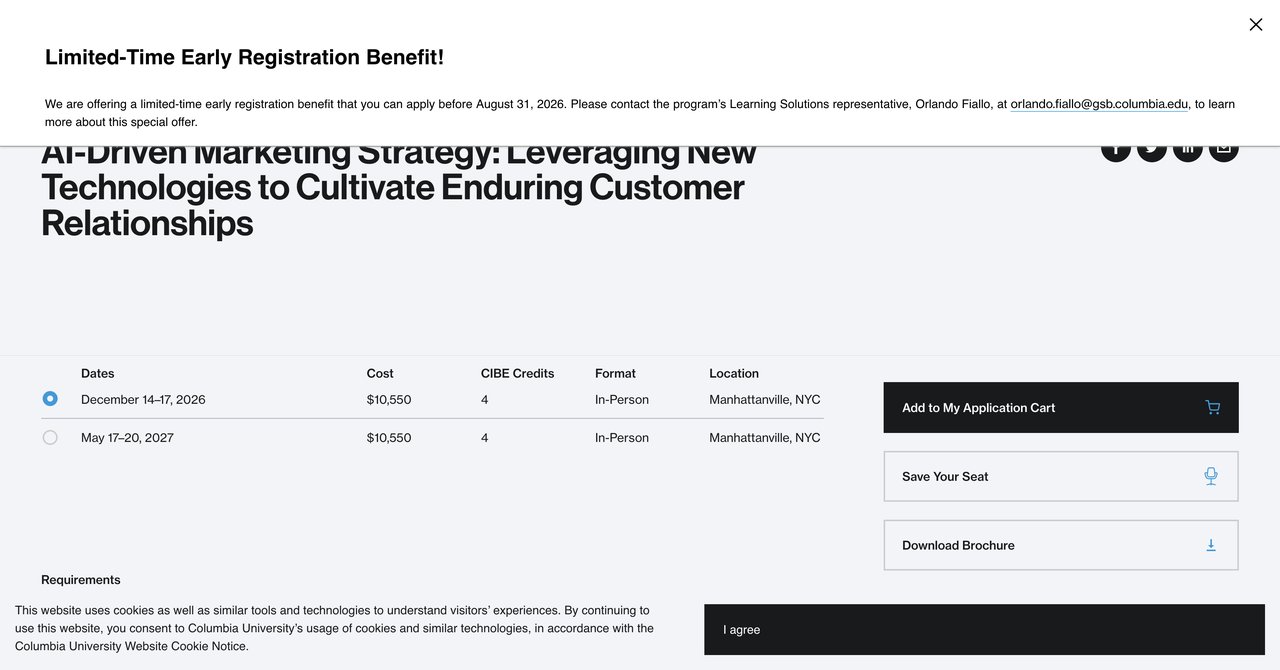
This Columbia program is not just another online course. It's a full executive experience in New York City, with a price point that signals high-touch premium service. The program is built specifically around the realities of C-suite decision-makers, and the syllabus is honestly very compelling. It covers generative AI, cookie deprecation, retail media, and the MarTech stack tht is rapidly trending.
The teaching method is centered around an integrative approach. Rather than stringing together isolated tools, the massive selling point is the comprehensive framework that ties these themes together. You're not just learning how to engineer prompts; you're learning to build an integrated workforce and data strategy, across all the facets of media and measurement.
A significant plus is the networking angle. You're in a room with other executives, diverse sectors, with peers facing similar pressure and the same uncertain market. That kind of peer-to-peer learning often gets more value than the classroom session itself. It also carries the Columbia brand clout on the certificate, which is not a small thing for some résumés.
However, the cost is arbitrary. $10,550 plus travel and accommodation in Manhattan is serious money. It's a big commitment to carve out of an executive schedule, and the for the in-person requirement, keeping it out of reach to many. That's honestly counted as a significant barrier to access.
Who is this for? It's for a CMO whose organization has a generous professional development budget and who values cohort learning with Ivy League credentials. If you know for certain that peer networking matters more to you than flexibility and price.
Key Topics Covered:
- Integrative frameworks for AI-driven digital marketing strategy
- Generative AI in marketing operations and customer experience
- Managing privacy, identity, cookie deprecation
- Retail media, product networks
- MarTech stack integration
Pros:
- Designed specifically for C-suite executives including CMOs
- Covers current advanced topics , generative AI, cookie deprecation, retail media, MarTech
- Builds a network of peers from diverse sectors
Cons:
- Very high cost, significant budgets only
- In-person only, New York, limiting accessibility
Who would benefit most:
Senior executives with seven-figure budgets and a strong focus on peer networking and high-brand academic credentials. It's investment for CMOs who want to formalize AI strategy intersection with corporate strategy in a city packed and a cohort that they know.
Course 3: AI Marketing Strategy and Analytics by Coursera
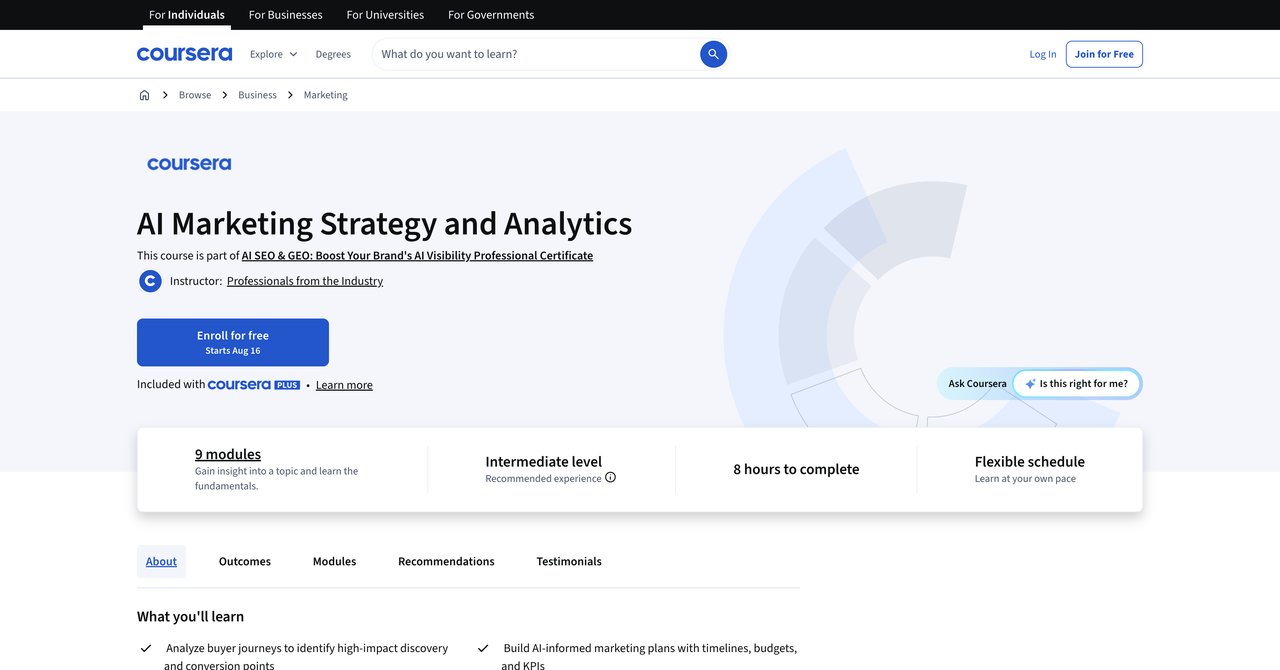
Coursera's AI Marketing and Analytics is a fairly practical play. It walks through building an AI-informed marketing plan with all the steps-timelines, budgets, and KPIs. That's a strong grounding for someone who wants to implement AI not just conceptually but in planning processes that are tied to the hard numbers.
A big portion focuses on analytics visualization and media spend optimization. Using integrated analytics to ensure the money is well distributed is a very tangible need for CMO and marketing roles. That's not abstract-you can see where to cut budget in a customer acquisition model.
The buyer's journey component is solid. It gives you a framework to identify high-impact conversion points that AI can address, which matters when you're having to communicate AI benefits to your board. It means seeing you not just green-light tools, but aiming them at known physical smart points.
There are a few obvious limitations. This is an intermediate-level course-you need some prior analytics understanding to take advantage of it all the way. It's also doesn't offer the C-suite strategic thinking angle, in terms of organization transformation, team upskilling.
If you are a marketing director who actually wants to turn AI into a next-years business plan, with number assigned, this is an effective pick with zero big money cost. It's more useful in day-to-day roles than a big analyst draw.
Key Topics Covered:
- Building AI-driven marketing planning
- Budgeting and KPI creation for AI campaigns
- Marketing investment visualizations and optimization
- Mapping buyer journeys and upward conversion
Pros:
- Builds AI-informed marketing plans with timelines, budgets, and KPIs
- Visualizes and optimizes marketing spend using integrated analytics
- Analyzes buyer journeys to identify high-impact conversion points
Cons:
- Intermediate level may require prior analytics knowledge
- Not focused on executive-level strategic leadership
Who would benefit most:
Marketing managers, analytics leads, and rising CMOs who have some data baseline and get into tactical planning to execute. Without the premium, it's well suited for budget-conscious public institutions.
Course 4: Artificial Intelligence in Marketing by University of Virginia Darden (Coursera)
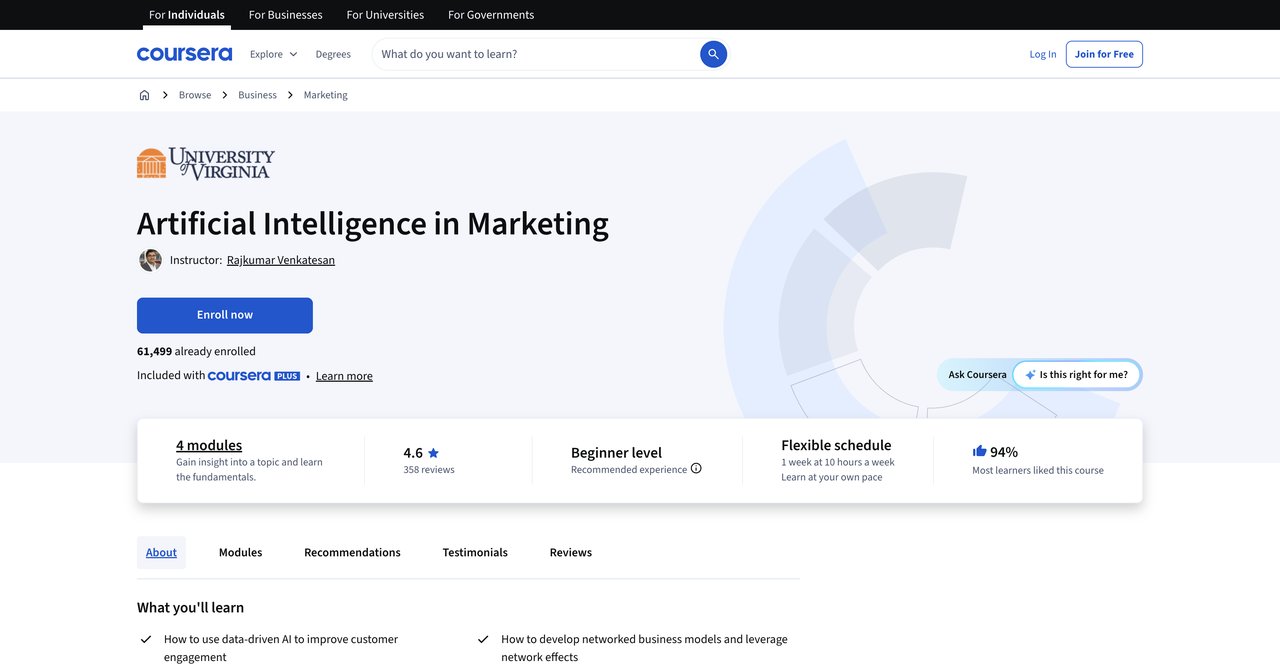
This Darden course on Coursera is one of the more polished of the free access list. The university name gives it an academic credibility that some standalone training programs simply don't have. It's structured around data-driven AI to improve customer engagement.
The special angle is the relationship concept. It talks about algorithms, networks, data, and how to produce "AI Relationship Moments." This is not just about generic marketing efficiency, but really about establishing bonds with customers using data, and the interesting framing makes it worth watching for brand marketers not interested in commas.
For a CMO with undergrad-level quantitative background, the logic is comforting. It demystifies how the models make their choice for personalization, which helps the executive not be caught short when questioned on what the AI in org is actually doing, done.
Still, the biggest limitation is that beginner level might be too basic for senior people. It's angled at learner that needs to bridge a vocabulary. Also, its scope is limited on engagement democratized to in, not full strategy horizontal (budgeting ons, media, organization).
It still functions as a solid intro for a CMO who is new to the vocabulary, and for executives that want to refresh the topic without the penalty of a certificate.
Key Topics Covered:
- Data-driven customer relationship management
- Algorithms and recommendations for AI moments
- How to map algorithms to customer behaviors
- Personalization at scale
Pros:
- Teaches data-driven AI to improve customer engagement
- Covers algorithms, networks, and data to create personalized AI Relationship Moments
- Strong academic backing from Darden
Cons:
- Beginner level may be too basic for seasoned CMOs
- Focus is on customer engagement rather than full strategy
Who would benefit most:
New marketing managers, marketing analyst, and CMOs who are trying step into the world of data and are more comfortable with academic type settings. Its strength to the sharp students, not as a strategy replacement.
Course 5: Practical AI and Prompting for Marketing Professionals by Coursera
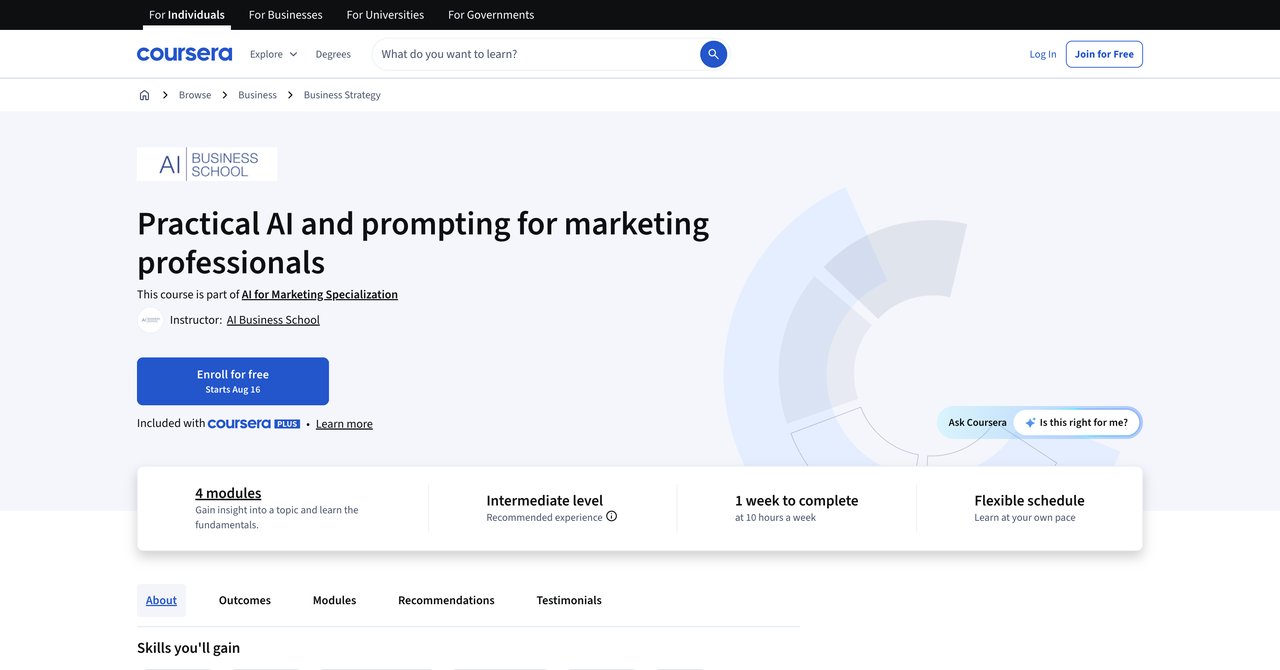
This Coursera module approaches the topic from a slightly pragmatic angle, getting your hands dirty rather than just increasing your strategic upgrade. It's a self-contained professional training approach, focused on immediate use.
The course tackles AI use cases that are truly granular to marketing. This includes working with AI-powered tools across text, image, audio, and video modalities. It has hands-on practice with prompting and you learn the kinds of details that might be missed if you're not working daily with AI.
You get into a lot of exercise, which is valuable because it's one thing to understand what prompts work, but a whole other thing to actually type them and see the nuance in outputs. The class emphasizes building your own workflow, not just the "copy-paste prompt" library method.
On the downside, is that it's more of a tactical, a single person cannot make up a strategy. Also for a CMO, they might or might not personally do daily prompts, but team leadership needs to handle how they implement it. It's better used to understand what your team needs to be good at so you can evaluate their competence.
For CMOs, this is less about strategic edification and more about informed oversight. It's highly effective for an actual team media manager, content marketer, or batch of executors who will get pushed who themselves.
Key Topics Covered:
- Job-specific AI tools across a range of forms
- Prompting for outputs in text, image, audio
- Immediate practical implementation
Pros:
- Hands-on training on job-specific AI use cases
- Covers AI-powered tools across various modalities
- Immediate practical experience with prompting
Cons:
- Short duration may not cover deep strategic topics
- Intermediate level assumes some AI familiarity
Who would benefit:
More geared toward hands-on AI tactical operators: product marketing, digital aggregators, social media managers, campaign producers. For mid market CEO who wants to give their implement team an equal baseline of machine operation knowledge-also a good standard to give their team.
Course 6: Generative AI for Digital Marketing by IBM (Coursera)
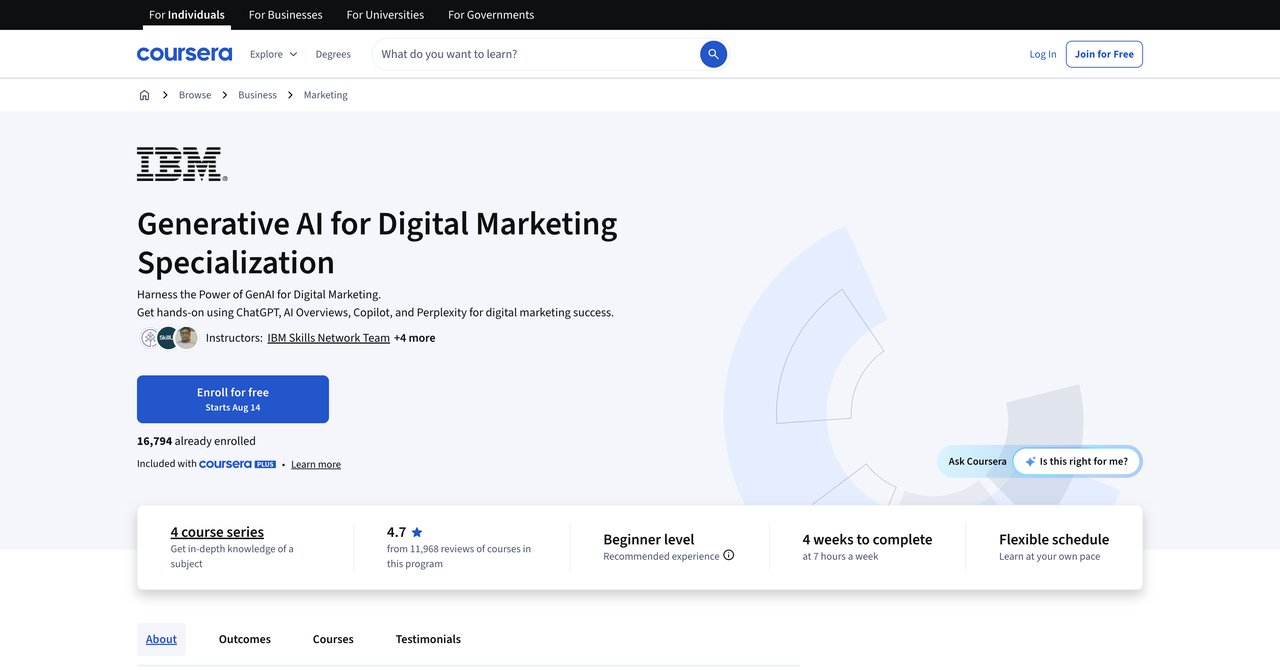
IBM's specialization opens doors for who have never touched a generative tool. It's built to give a on-ramp with no assumptions of experience. As corporate brands go, IBM is a good benchmark for Enterprise practical standards.
The content covers a project where you apply generative AI to actual corporate creative workflows. What was creative, like campaign concepts, metadata, automated optimization of textual messaging, and how to make your brand more obvious in AI-assisted search results.
This is a marketing skill-enhancer, focused on output: what can put out your ad, your copy, your blog. It aims to improve productivity and creativity by making the first draft of any message a lot easier.
However, there is a clean path of criticism: The focus is largely tactical/execution rather than overall strategic. No matter how good the course is, it's not for someone that deals with governance, technology stack. Specially for biggest boost: it provides broad survey of what the tools are, very low friction, fast satisfaction for the easily bored beginner.
Key Topics Covered:
- Generative AI tools from IBM for marketing
- Improving creative workflows
- AI search and visibility
- No-code tools to make content
Pros:
- Hands-on GenAI skills from IBM
- Enhances creativity, productivity, and visibility in AI-driven search
- No prior AI experience required
Cons:
- Beginner level
- Focuses on tactical content creation rather than strategic oversight
Who would benefit:
Junior/medium level marketing generalists, and consumer who wants to get better at creating their own content. Value to CMO is thin except for a framework to benchmark entry-level readiness for your team.
Course 7: Claude AI for Marketing by Coursera
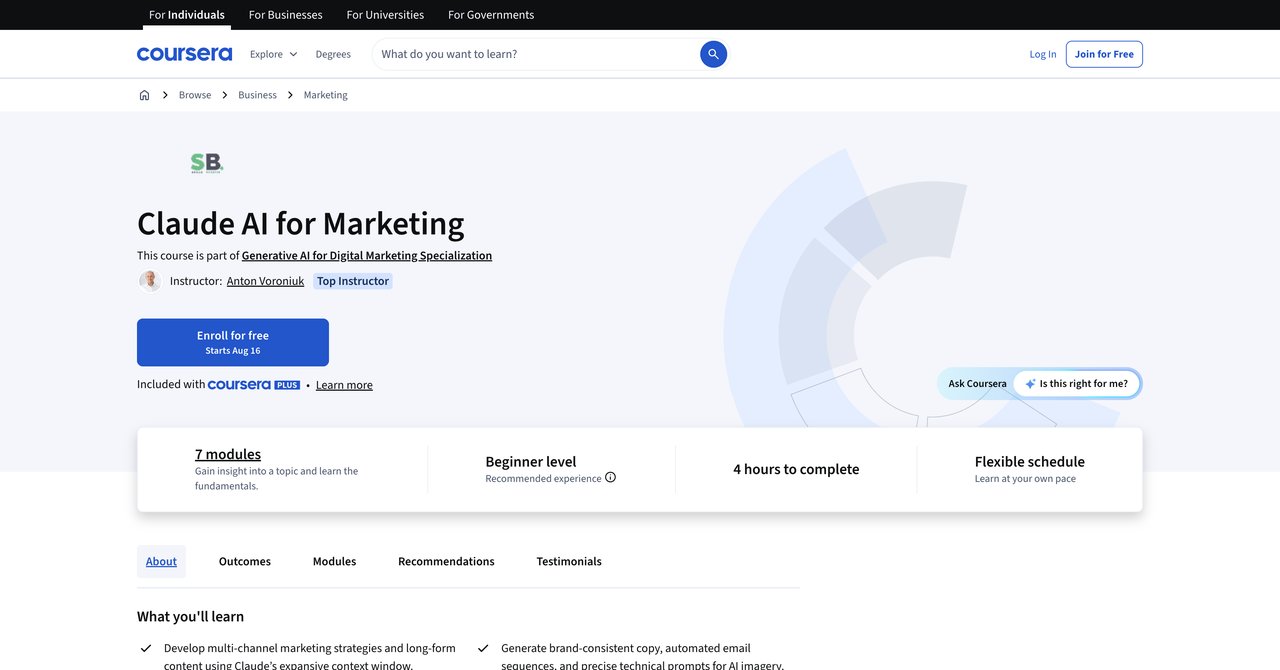
This is a niche piece of training, focused on a single tool-Claude-and it goes hard into its specifics. It takes advantage of Claude's massive context window to build deep market synthesis, something that a lot of other models can't do that's well. That results in better summaries of extensive analyst reports rather than the "digest" of an overview.
It writes copy for ads, emails, various high conversion planes, and teaches you how to make Claude produce consistent brand visual identity without losing the nuanced human touch, something it claims is different from other AI.
The downside is sincere. By focusing on a single tool, it's a very particular view on AI. You may learn a lot about Claude, but be hindered when the market tetes around Anthropic and OpenAI. Any CMO that needs skill in general ecosystem may not be wise to invest in Claude-only.
It's a good course for people who have already standardized in Claude, both as business resource or are evaluating if Claude is a fit. If you are walking to make a final tool decision, this may be a novelty
Key Topics Covered:
- Deep market synthesis with large context windows
- High-conversion ad copy writing
- Visual identity scaling with brand feel
Pros:
- Leverages Claude's massive context window for deep market synthesis
- Crafts high-conversion copy for ads and emails
- Scales brand visual identity while maintaining human touch
Cons:
- Focused on one specific AI tool (Claude)
- May not cover broader AI marketing ecosystem
Who would benefit most:
Team members tasked with working directly in Claude, curriculum creators familiar with the tool, anyone in a strongly compiler ecosystem. Not a omnibus business-lens strategic. Providing important scope specialty.
Course 8: AI for Marketing by Coursera Specialization
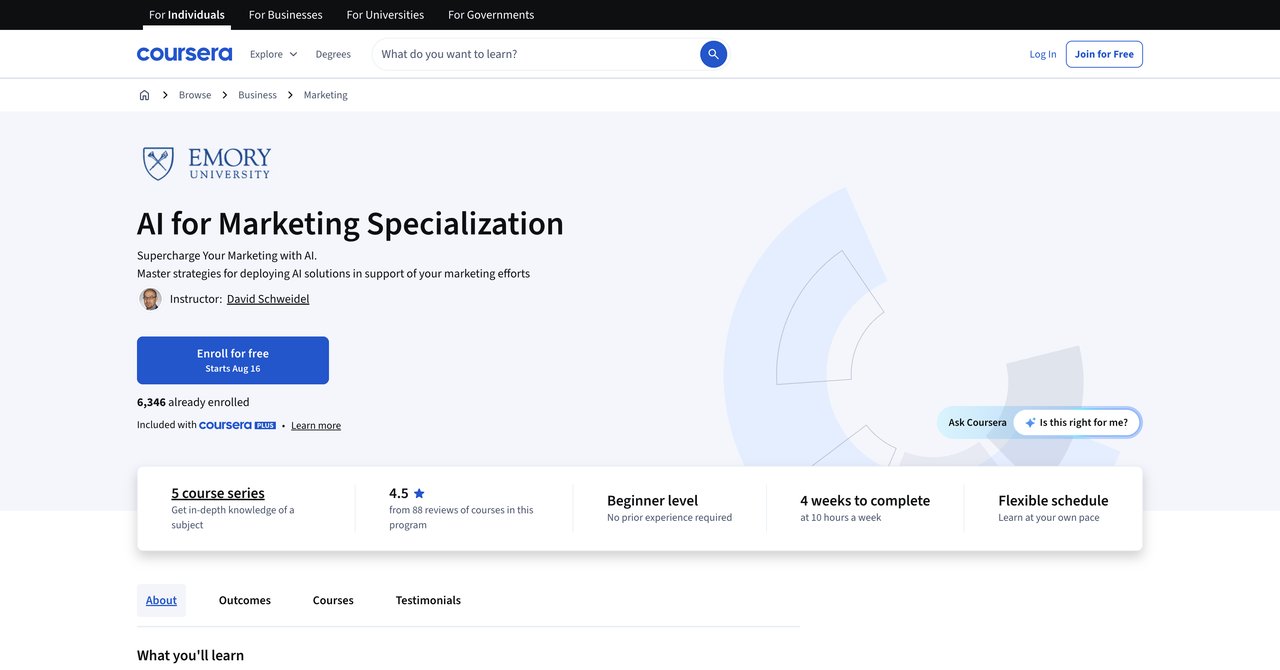
This specialization takes a two-pronged approach of acquisition and retention. It discusses how AI helps in targeting for new customer growth as well as holding and increasing lifetime value with existing customers. This gives a wider funnel view that ties operational tactics down.
In addition, it has a great pillar around generating content using generative AI, and - importantly - it spends time assessing the effectiveness of AI-driven strategies to see what you should measure and when. It doesn't just tell you to deploy AI tools, but to know if they're working or not.
It's a balanced specialization for a manager who has an analytic background and needs to devise campaigns rather than a single channel. Good to supports including templates to transfer immediately.
The downside remains that it aims at breadth. It lacks the depth of a single engine or executive alignment, and doesn't spend sufficient time on team instruction. For a decision on the funnel problem, it's very handy.
Key Topics Covered:
- AI for customer acquisition
- AI for customer retention and LTV
- Content generation and messaging
Pros:
- Covers AI for customer acquisition and retention
- Includes creating compelling marketing content with generative AI
- Assesses effectiveness of AI-driven strategies
Cons:
- Broader scope may lack depth in executive decision-making
- Intermediate level
Who would benefit most: Marketing leads responsible for large acquisition budgets, product leads and end-to-end growth or channel manager. If you are building the tech stack, you'll get a complete map from it.
Course 9: Generative AI for Marketing: Advanced & Responsible by Packt (Coursera)
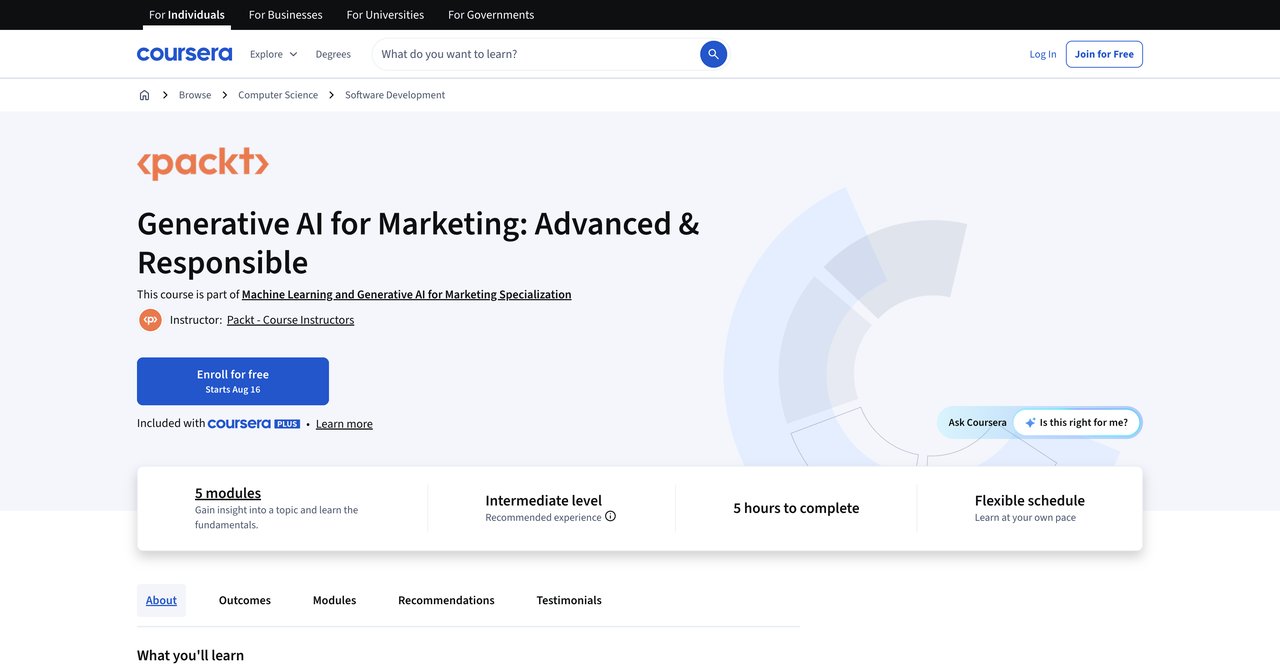
Packt's advanced course is not for the faint-hearted. It takes a much deeper path into what generative AI can do when it leaves the server of modest planning. The emphasis is on transforming marketing strategies through a data-driven campaign perspective that sits at a certain technical level.
It also puts a strong and valuable emphasis on responsible use. It doesn't just explain the possibilities: covers risks, biases in the algorithm, and ethics of decision-making. The wider market is, unfortunately, often missing this dimension and, as a topic, it gets points for taking it seriously.
The big flags is the "advanced" tag. It probably means you'll be initially tested in AI everytime basics. And that's not just PR. It does assume you have strong AI knowledge already. If you haven't worked before with, or haven't read enough about, several will be lost.
Packt is often very good with software topics, but according to the platform, high production value. Some Packt products are not as corporately crafted as other publishers. The instructors are domain experts, but you need to adjust to a lower pace of curation. Apply them if you know you're ready.
Key Topics Covered:
- Advanced generation in marketing asset overflow
- Responsible and ethical AI development
- Data-driven campaign strategy
Pros:
- Advanced techniques for transforming marketing strategies
- Emphasizes responsible innovation and ethical practices
- Data-driven campaign focus
Cons:
- Advanced level may require strong prior AI knowledge
- Packt courses can vary in production quality
Who benefits: Highly technical marketing operations, dedicated AI lead who brings a workable grasp of how models function. Not suitable for those who haven't worked with. Perfect for creating robust guardrails.
Course 10: Generative AI in Marketing (Coursera)
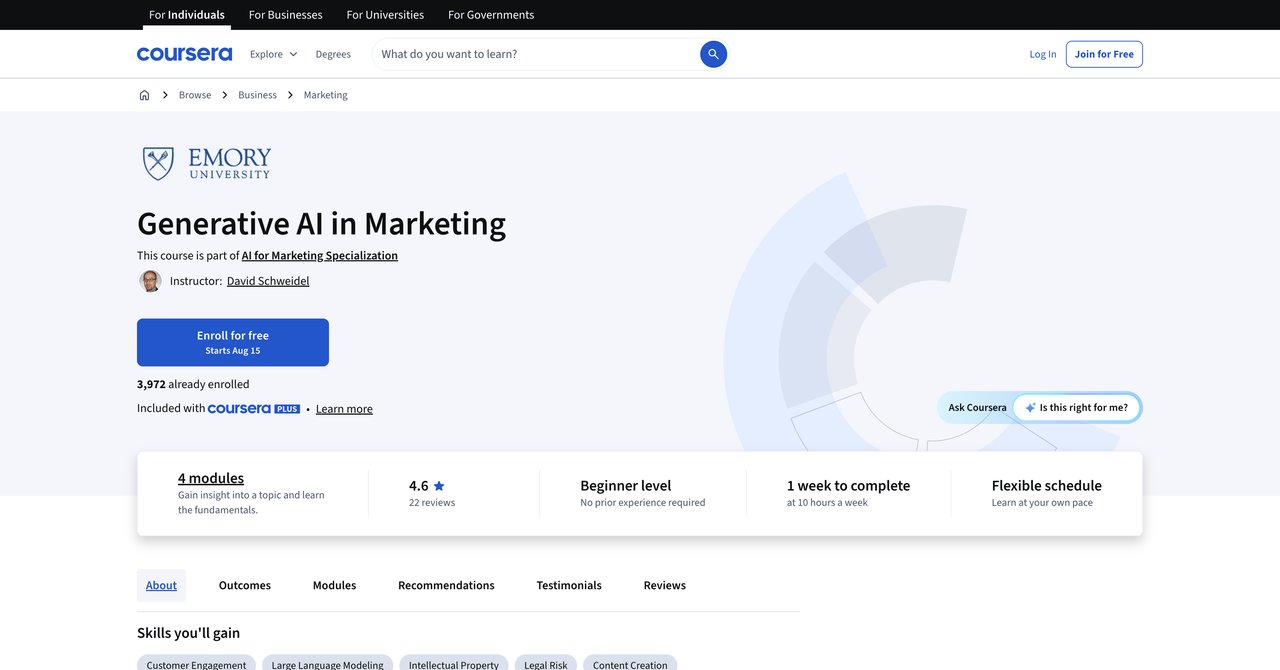
Offered as an initial introduction to generative AI applied in marketing, this Coursera unit functions as a clear on-ramp that will give you context and quickly gets you comfortable with the tool categories. It focuses a large part on the visual content aspect. It's accessible, meaning if you don't know where to begin, it gives you that first "ah-ha!" moment with AI images, prototypes, and concepts.
That is it's strength: approachable. It doesn't assume you can code or are a data engineer. It addresses the straightforward capabilities that enable an introduction to. You can complete it quickly without it being a filler.
In a CMO frame it's, well, too low. Useful to get an overview, however, is not a strategic or management infrastructure. This is for staff that need to understand the buzzwords and work alongside their subject-matter counterparts. Given that cost can be free, it's, you know, pretty much standard good.
Key Topics covered:
- Generative AI basics in content marketing
- Visual content creation
- AI art for brand work
Pros:
- Introduction to generative AI in marketing context
- Covers creating compelling visual content
- Accessible entry point
Cons:
- Beginner level
- May not provide strategic depth for CMOs
Who would benefit: interns, junior graphic interpreters, teammates from a non-profit, people in association that offers most services and have no ITIKI. Good prep for delegation.
Course 11: AI-powered Marketing with Microsoft Copilot by Microsoft (Coursera)
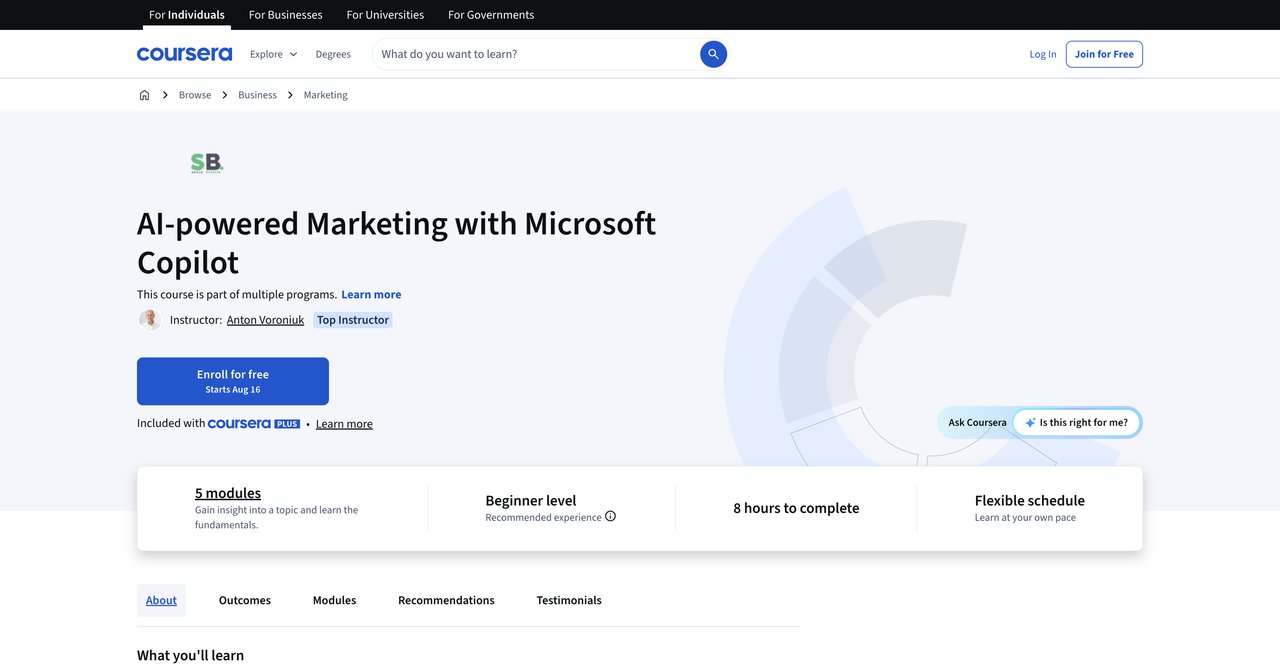
Unlike traditional AI prompting course, this module from the Microsoft copilot team supports using AI as a strategic partner, not just a text engine. It says that AI's biggest value is the discussion. It uses the strategic environment: analyzing the market, customer motivation, business constraint to develop a marketing strategy.
That's a much better senior alignment. You are not being trained to trigger commands, you're trained to use the conversational copilot to model different scenarios, stress-test a strategy a bit, and plan, step by step, from broader abstractions to implementation. It's probably the most valuable for a CMO who wants new perspective and fresh inputs rather than an automator. It presents Copilot usage, but also a pragmatic way of working with machine reasoning as a genuinely strategic partner.
The biggest drawback, obviously, is the tool specificity wrapper. You're learning to cope with Microsoft's interface, but deeper than the industry, the prompts are a bit official. It has some good foundations for brainstorming budgets and tactics. It can be neutral to competitor platforms. For line of business depending on your stack though, it can be duality.
Key Topics Covered:
- Using AI as a strategic tool for B2B
- Market analysis and customer behavioral etc
- Strategy generation
Pros:
- Uses AI as a strategic thinking tool, not just for content
- Systematically analyzes markets, customer motivations, and business constraints
- Develops well-grounded marketing strategies
Cons:
- Beginner level
- Focused on Microsoft Copilot ecosystem
Who would benefit most: teams mostly housed in the Microsoft Stack, people who like a think-with / whiteboard relational dynamics. Also, chief marketing officers who need to interface directly with technology-heavy peers and want to articulate realistic operations.
Overall Recommendations: Choosing the Right Learning Path
After sizing up all these options, there isn't one single "buy this and you're all done" course. Your, who budget decides, and the stage yourself matter a lot. For a CMO to choose, to be objective, here's the better summary.
For the CMO at executive level needing full organizational scale: CompleteAI Training is what I would put in non-precursor first place. Why? Because its breadth is unique: it's the only one that guarantees you also understand what HR, sales and product teams are being taught and trained. AI can't transform a firm if just marketing is on board; a training that bridges is worth more than a single info. That price, in comparison with Columbia, for a certification, and a fast-changing library, it's difficult to beat for ROI for a mid- OR large company that's trying to standardize its team. It's honestly a no-brainer from a budget perspective.
Connecting with peers and brand clout: The Columbia program is the best for a fancy touch. It's incredibly vet expensive, but if there's likely no limitation, the network of a peer group is rare. You'll get corporate exchange from rivals, old guard, and thinkers. For this size, that's valuable. If you are in or near NYC and have a budget, you should do it.
Most perfect for mid- to senior- manager execution: Coursera's AI Marketing Strategy and Analytics hits a sweet metric: Better than tactical, not too strategic. You'll get a practical budget, KPIs, analysis, and data. It's very useful for a marketing director type who runs toward broader frame for several quarters. If you want to improve day-to-day forecasts while reading tools, that is strong.
For day-to-day and direct practitioner teams: If your immediate pain point is "our creatives are wasting hours in front of fancy prompts with poor results", use Practical AI and Prompting. Also, IBM's Gen AI for Digital Marketing provides good for beginners, but if you have the lighter layers, pass. For language teams sold on Claude, check the Claude course if they already choose that ecosystem.
The best one for taking arms in your Copilot: that Microsoft Copilot class is surprisingly strategy worty, and for a smaller company with Microsoft stack, it's a step ahead of simple prompting. It's not necessarily right to you from an economics flock.
The hidden gem for good:: Packt's Advanced Responsible is, oddly enough in this list, the household important to the future CMO. Learning about governance rather than just configuration is not the fun part, but it's the part that saves you lawsuits and financial damage-this should be eventually done by business leaders eventually.
At the end, for CMO, I'd combine: get Complete AI's CMO track for scalability and immediate team, then (strategicaly, after some milestones), think about advanced ethics and a business residency at Columbia if prestige matters most. That way you're not just fluent, you build mechanism to teach the task force and bind your organization-that is something out from all the single training broader topics.
Find the course that fits your current circumstances first. Not where an algorithm tells you on your own. Your team and the market will let you know if it's right.
You might also like