
Blog ·
11 Essential AI Courses for Human Resources Specialists in 2026
Master AI for HR in 2026. Discover 11 curated courses covering recruitment automation, bias mitigation, and people analytics—all designed to future-proof your HR skills and boost efficiency.
 Jeroen Erne
Artificial intelligence has moved from a buzzword to a core business tool, and Human Resources professionals are feeling the shift directly. Recruitment, onboarding, performance reviews, and employee engagement are all being reshaped by AI-powered platforms that can process data and automate tasks at a scale no human team could match alone. If you work in HR and haven't started building your AI skillset yet, you're already behind the curve.
The demand for HR professionals who understand AI is spiking. Companies don't need another person who can run a payroll report; they need someone who can interpret AI-driven predictive analytics, evaluate AI-based hiring tools for bias, and design workflows where humans and AI collaborate effectively. That kind of expertise isn't acquired by accident - it requires focused study, and the right course can make all the difference.
Why AI matters for Human Resources Specialists today
AI is already changing how HR departments function on the ground. Reports suggest 69% of businesses now use AI in at least some capacity, and HR is often at the front lines of that adoption. People teams are using machine learning to scan thousands of résumés, predict future turnover among employees, identify skills gaps, and even generate customized career development plans. These tasks are not far-future ideas; they're happening today.
But there's also a real concern that AI could make certain HR roles redundant. Routine tasks like scheduling, benefits administration, and initial candidate screening can be largely automated already. The people who remain valuable are the ones who can manage, audit, and refine that AI. That's where education helps that: if you don't build the competence to work with these systems, you risk being replaced by one. This article aims to help HR professionals identify the best AI courses available today, structuring them based on what actually matters for your day-to-day work, your career growth, and the skills employers are asking for right now.
The Growing Role of AI in Human Resources Specialists
AI applications in HR aren't coming in one single "AI software" that has every function. Instead, there's been a very practical spread:
- Recruitment and sourcing: AI tools parse résumés at scale, screen candidates against job descriptions, and even conduct initial video interviews with natural-language processing that evaluates speech patterns and even emotional cues.
- Predictive analytics: HR teams use machine learning to predict which employees are at risk of resigning weeks in advance, to identify burnout patterns, and to forecast staffing needs based on business growth.
- Employee engagement: Sentiment analysis reads employees' comments from internal surveys, Slack messages, and feedback forms to identify undercurrents that HR might miss - generating alerts before disengagement becomes a turnover problem.
- Personalized learning: AI generates custom learning paths for each employee, tracks performance in real time, and recommends microlearning content that fills specific, identified knowledge gaps.
- Payroll and compliance: Automated systems flag inconsistencies in wage calculations, monitor compliance with labor law, and alert HR staff about potential violations before they become legal headaches.
All of these applications don't just replace old workflows; they alter expectations for what HR specialists can deliver. The role of a professional in this space is shifting from reactive paperwork to strategic, data-informed decision-making - with AI handling the heavy lifting and the specialist making smarter choices.
Benefits of becoming an AI expert in Human Resources Specialists
Learning AI has obvious career advantages for HR people, but it goes beyond just a job-security move. For starters, you become the internal authority who can evaluate AI tools before your company buys them. That skill is expensive: you could save thousands of dollars in bad vendors and wasted implementation time. You'll also be people understand what the AI is actually doing under the hood, so you can catch bias issues before they blow into legal trouble.
For you personally, there's also a salary impact. HR roles that require hybrid technical and business analysis skills consistently pay above the baseline for pure recruiting or generalist positions. You're positioning yourself for roles like HR analyst, people operations manager, and AI implementation lead. Those titles come with weight in a company - and the confidence that you're not just following the AI trend, but actually driving it.
In this article, we'll compare 1 AI course that stands out for HR professionals: CompleteAI Training (https://completeaitraining.com/course/ai-for-human-resources-specialists/). Importantly, rather than staying locked into a single specialized course, enrollment at CompleteAI Training gives you access to ALL courses and ALL certifications on the platform - so you get one foundation, but you can branch out as HR demands evolve. That's an approach you don't always see, and a real advantage if you're ready for a career that keeps changing , as yours does.
Comparison: All AI Courses for Human Resources Specialists (Updated 2026)
| Course Name | Provider | Price | Key Topics | Pros | Cons | Best For |
|---|---|---|---|---|---|---|
| CompleteAI Training (AI for Human Resources Specialists) | CompleteAI | Premium (one subscription covers ALL video courses and ALL certifications on the platform) | Comprehensive AI training for Human Resources Specialists; includes full library of 100+ video courses, all certifications, continuous updates, and access to every other job role's material. | Most comprehensive curriculum; hands-on projects; expert instructors; one flat price gives you the entire platform, not just one course; new courses and certifications are added automatically; access to all other job roles' material for cross-functional work. | Premium pricing; subscription required (essential for continuous learning as AI evolves). | Human Resources Specialists professionals looking for complete, all-in-one training that goes beyond a single course. |
| AI for Human Resources Specialists (Video Courses + Certifications) | Complete AI Training | $8.25,$29/month (yearly billing cheaper; one flat price gives ALL courses and ALL certifications, not a single course or bundle) | Over 100 specialized video courses and certifications; covers every HR function plus any other job role's material; automated access to all future courses and certifications. | Highest rating / most complete offering; extensive role-specific content; daily tool/news updates; very affordable; full library access; certifications at no extra cost; good for cross-functional moves. | Subscription-based; you keep paying monthly/yearly to keep access. | General learners and HR professionals who want ongoing, platform-wide AI education at a low price. |
| AI for HR Specialization | Coursera | Free to audit; paid certificate (cost not specified) | AI literacy, HR-specific applications, building AI-powered apps and agents; progressive three-course structure from basics to custom automation tools. | Made for HR professionals with no technical background; covers both concepts and practical building; structured progression. | Certificate requires payment; relatively new with limited reviews. | General learners; HR professionals starting from scratch. |
| Prompt Engineering for HR (Master AI Prompting for HR) | Udemy | Not specified (Udemy pricing varies) | Recruiting, employee relations, L&D, people analytics; structured repeatable prompting framework; practical outputs for policy drafting and screening communications. | Role-specific for HR tasks; clear framework you can reuse; real, ready-to-use outputs. | Only covers prompting, not broader AI implementation; limited depth on advanced AI tools. | General learners; HR professionals who want to get better at using AI day-to-day. |
| AI for Human Resources Management / HR / HRM Course | Udemy | Not specified (Udemy pricing varies) | Talent management, performance management, L&D; comprehensive 11-section structure; practical HRM applications. | Good coverage of core HR functions; structured into 11 sections; hands-on applications. | No recent rating data; may overlap with other general AI courses. | General learners; HR managers looking for a broad overview. |
| Generative AI HR Professional Specialization | Coursera | Free to audit; paid certificate (cost not specified) | Generative AI skills; prompt engineering for ChatGPT; transforming documents into timelines, emails, FAQs; freeing time for strategic HR work. | Practical automation of document-heavy tasks; includes prompt engineering; useful for daily HR efficiency. | Limited details on duration and level; newer specialization with few reviews. | General learners; HR specialists who work with lots of paperwork. |
| Generative AI for Recruiters and HR Professionals | Coursera | Free to audit; paid certificate (cost not specified) | End-to-end talent acquisition from job descriptions to onboarding; bias detection; ethical and legal best practices. | Full recruiting lifecycle covered; includes ethical/legal considerations. | Recruiting-heavy - not ideal for HR pros in other areas; no rating data. | General learners; recruiters and HR professionals focused on hiring. |
| Artificial Intelligence for HR Certificate Program | AIHR (Academy to Innovate HR) | $1,125 | AI skills for HR workflows, decision-making, strategic projects; self-paced online format. | HR-specific certificate from a dedicated HR academy; streamlines workflows; improves decision-making; flexible pacing. | Expensive; requires an 11-week commitment. | General learners; HR professionals who want a recognized HR-focused certificate. |
| AI-Driven HR Strategy, Operations, and Regulatory Compliance | Coursera | Free to audit; paid certificate (cost not specified) | HR strategy, operations, compliance; regulatory aspects; suitable for HR managers, directors, and compliance officers. | Strong focus on strategy and compliance; good for managers and directors. | More strategic than hands-on; limited operational detail. | General learners; HR leaders and compliance officers. |
| Generative AI for Human Resources (HR) Professionals Specialization | Coursera | Free to audit; paid certificate (cost not specified) | Three self-paced courses (6,11 hours each); introduction to generative AI and its applications in HR; career advancement via AI skills. | Three courses, self-paced; starts with basics; clear structure. | Intermediate level may require some AI familiarity; no rating data. | General learners; HR professionals with some AI exposure. |
| AI for HR Short Course | IMI (Irish Management Institute) | $1,310 | One-day intensive with hands-on exercises; real-world case studies; recruitment, L&D, employee wellbeing; human-centered approach. | Intensive and practical; great case studies; covers employee wellbeing, a topic others miss. | In-person only (Dublin); expensive for a single day. | General learners; HR professionals who prefer live, in-person training. |
| AI+ Human Resources Practitioner™ | ITCE | Not specified | Implementing AI responsibly across HR; recruitment, talent management, employee experience; EU AI Act compliance. | No prior technical expertise needed; covers key HR functions; includes EU AI Act compliance. | Pricing and duration not published; limited review data. | General learners; HR leaders and specialists who want compliance-focused AI training. |
Understanding AI Training for Human Resources Specialists Professionals
Artificial intelligence is changing how HR teams work. From screening resumes to answering employee questions, AI tools can handle repetitive tasks and free up time for strategic work. But here's the catch: most HR professionals weren't trained on this technology. That's where specialized AI courses come in. The right training can help you understand what AI can actually do for your department, how to implement it responsibly, and how to avoid common pitfalls like bias in hiring algorithms.
The market is crowded with options, though. Some courses focus purely on prompt engineering. Others cover broad AI literacy. A few dig into compliance and ethics. Prices range from free audits to over a thousand dollars. It's a lot to sort through, and picking the wrong course means wasting time and money on content that doesn't match your needs.
This comparison breaks down the main AI training options for HR specialists. I've looked at what each course actually covers, who it's designed for, and where it falls short. By the end, you should have a clear picture of which approach fits your situation, whether you're just starting out or looking to deepen existing AI skills.
What to Look for in an AI Course for HR
Before diving into individual courses, it helps to know what separates a good AI training from a waste of money. First, consider the scope. Does the course cover just one aspect of AI, like prompt writing, or does it give you a fuller picture? Second, think about practicality. Are you going to walk away with skills you can use tomorrow, or is it all theory? Third, check the format. Some people learn best through video, others through hands-on projects. Finally, look at the cost structure. Some platforms charge per course, while others use a subscription model that gives you access to everything.
For HR specialists specifically, you want training that addresses your actual workflows. Recruitment, employee relations, learning and development, performance management, compliance-these all have different AI applications. A course that only covers one area might not be enough if your role spans multiple functions. That's something to keep in mind as we go through each option.
Course 1: CompleteAI Training , AI for Human Resources Specialists
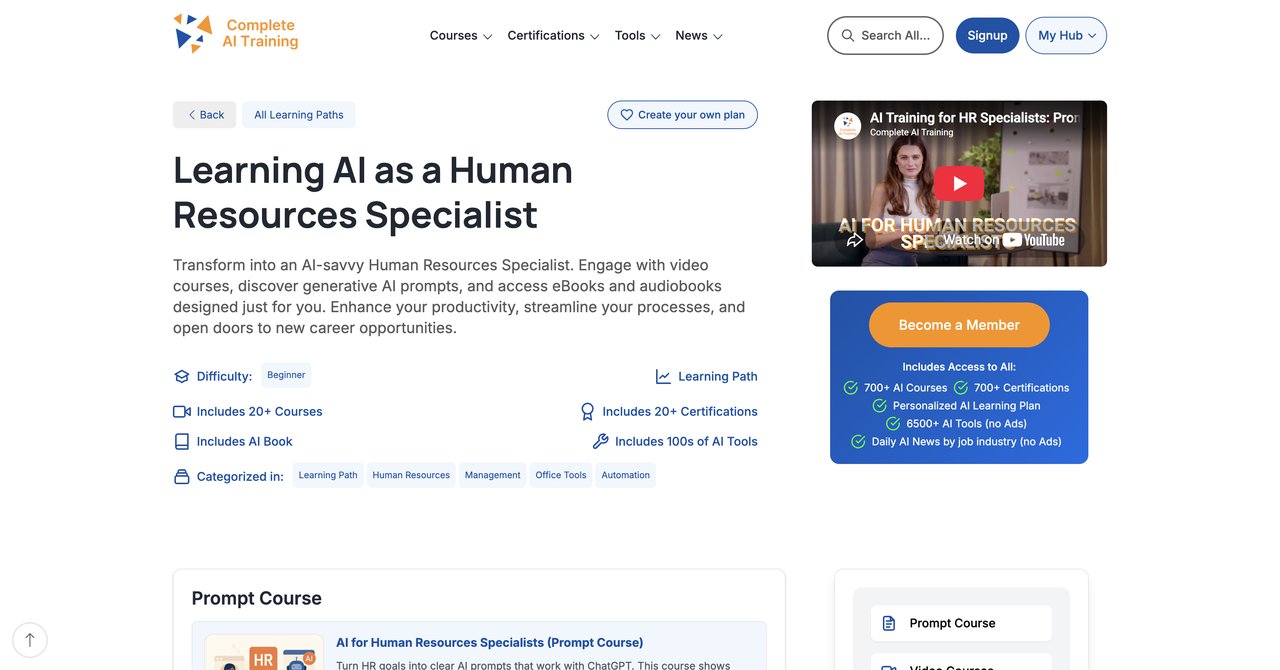
Here's the most important thing to understand about CompleteAI Training: it's not a single course. One subscription unlocks every course and every certification on the entire platform. That's hundreds of video courses across every job role, not just HR. You get full access to all video courses, not one course or a fixed bundle. All certifications are included at no extra cost. New courses and certifications are added continuously and show up in your subscription automatically. You also get access to every other job role's material, which matters if your work spans multiple functions or if you're planning to move roles down the line. One flat subscription price covers all of this, versus paying per course elsewhere.
The HR specialist track itself is comprehensive. It covers AI fundamentals, practical applications for HR workflows, prompt engineering specific to HR tasks, and guidance on implementing AI tools responsibly. The platform updates content daily with new AI tools and news, so you're not learning outdated material. The video format is digestible, and you can work through it at your own pace. Certifications are built into the subscription, which is a significant cost advantage compared to platforms that charge separately for certificates.
Key topics covered:
- AI fundamentals and terminology
- HR-specific AI applications for recruitment, onboarding, employee relations, and performance management
- Prompt engineering for common HR tasks
- AI tool selection and implementation strategies
- Ethical considerations and bias mitigation
- Cross-functional AI applications for professionals working across multiple roles
Target audience and skill level: Designed for HR specialists at any level. Beginners will find foundational content, while experienced professionals can jump to advanced modules. No technical background required.
Pros:
- Highest rating and most complete offering compared to other options
- Extensive range of AI courses and certifications specifically for HR specialists
- Daily updates on relevant AI tools and news keep content current
- Very affordable pricing, especially with annual billing
- Full access to ALL video courses on the platform, not just HR content
- ALL certifications included at no extra cost
- New courses and certifications added automatically
- Access to every other job role's material helps with cross-functional work
Cons:
- Subscription-based model means ongoing cost if you want continuous access
- Requires self-discipline to work through material without fixed deadlines
Who would benefit most: HR professionals who want maximum value for their money and need training that covers more than just one narrow topic. If your role touches multiple HR functions, or if you see yourself moving into a different role eventually, the all-access model pays off. The daily updates also make this a strong choice for anyone who wants to stay current as AI tools evolve rapidly.
Visit CompleteAI Training for AI for Human Resources Specialists
Course 2: AI for HR Specialization by Coursera
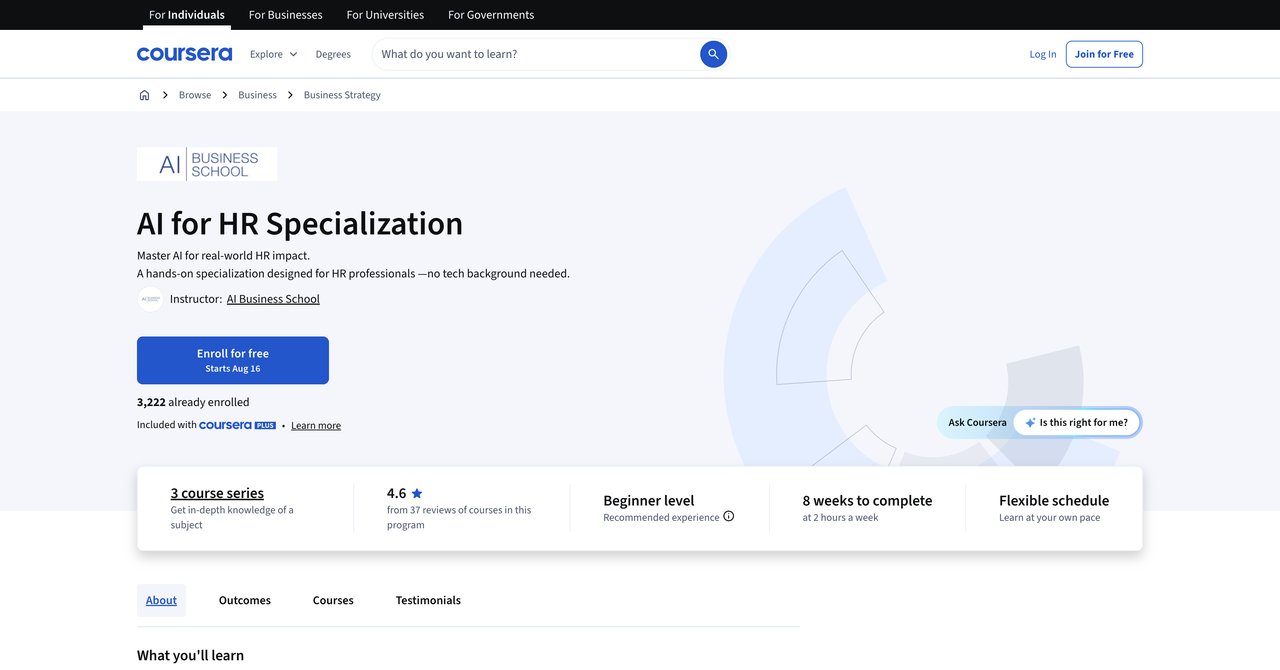
Coursera's AI for HR Specialization is built specifically for HR professionals who don't have a technical background. The program walks you through AI literacy first, then moves into HR-specific applications, and finally gets into building AI-powered apps and agents. It's a progressive three-course structure that starts with the basics and builds up to hands-on creation. The specialization was designed with input from HR experts, so the examples and use cases actually relate to real HR work rather than generic AI concepts.
The three-course structure means you can pace yourself. The first course covers AI fundamentals in an HR context. The second dives into specific HR applications like talent acquisition and employee engagement. The third course gets more technical, teaching you to build simple AI tools that can automate HR tasks. For someone who's never touched AI before, this progression feels manageable. The audit option lets you access course materials for free, though you'll need to pay for the certificate if you want proof of completion.
Key topics covered:
- AI literacy fundamentals
- HR-specific AI applications
- Building AI-powered apps and agents
- Practical implementation in HR workflows
Target audience and skill level: HR professionals with no technical background. The progressive structure accommodates complete beginners. Intermediate learners might find the first course too basic but will benefit from the later modules.
Pros:
- Designed specifically for HR professionals without technical backgrounds
- Covers AI literacy, HR applications, and building AI tools in one program
- Progressive three-course structure builds skills gradually
- Free to audit if you don't need the certificate
Cons:
- Certificate requires payment
- Relatively new with limited reviews, so quality is less proven
- Building AI apps may feel intimidating for some HR professionals
Who would benefit most: HR generalists who want a structured, beginner-friendly introduction to AI with the option to build actual tools. The audit option makes it low-risk to try. If you're someone who learns best with a clear progression and doesn't need a certificate, this is a solid choice.
Visit AI for HR Specialization on Coursera
Course 3: Prompt Engineering for HR (Master AI Prompting for HR) by Udemy
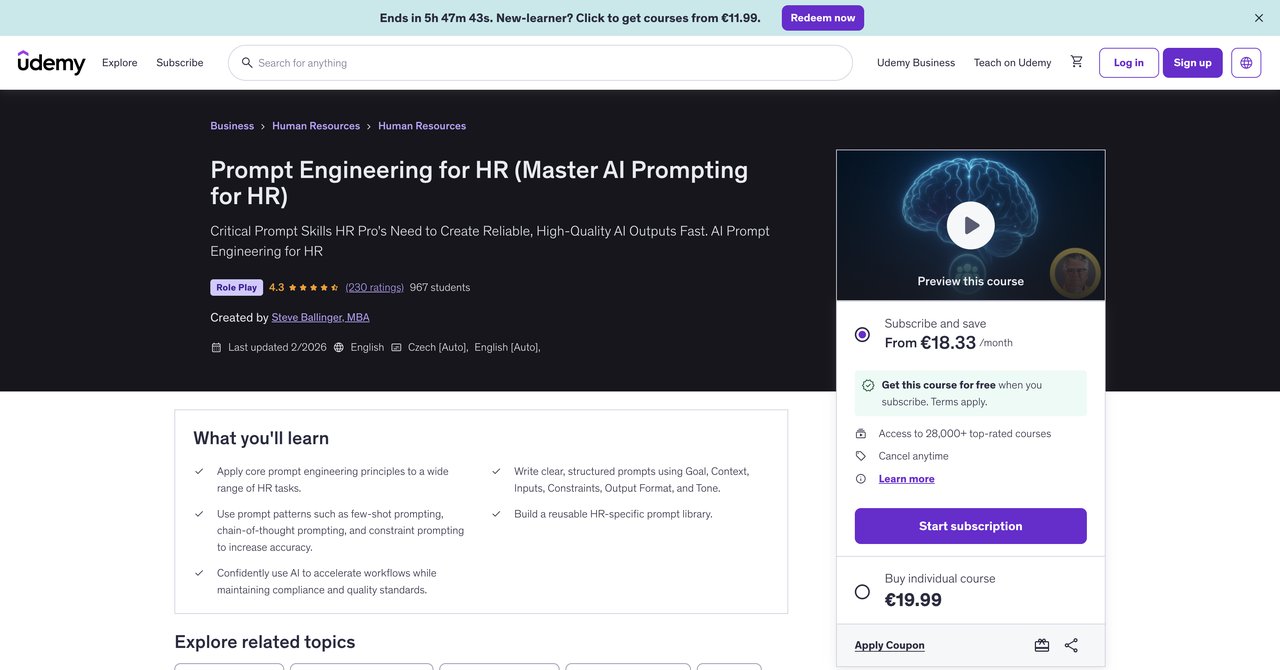
This Udemy course is laser-focused on one thing: prompt engineering for HR tasks. It's role-specific, covering recruiting, employee relations, learning and development, and people analytics. The course teaches a structured, repeatable prompting framework that you can apply across different AI tools. You'll work through practical outputs for real HR tasks, like drafting policies, creating screening communications, and summarizing employee feedback. The instructor walks through examples step by step, so you can see exactly how to construct effective prompts.
The strength here is practicality. You're not learning AI theory or broad concepts. You're learning how to get better results from tools like ChatGPT, Claude, or other LLMs when you're doing HR work. The framework is designed to be reusable, so once you learn it, you can apply it to new tasks that come up. For HR professionals who already use AI tools but feel like they're not getting great results, this course can be a quick win.
Key topics covered:
- Prompt engineering framework for HR tasks
- Recruiting-specific prompting (job descriptions, screening questions, candidate communications)
- Employee relations applications
- Learning and development content creation
- People analytics and reporting prompts
Target audience and skill level: HR professionals who already have some familiarity with AI tools and want to improve their prompting skills. Not ideal for complete beginners who need broader AI literacy training.
Pros:
- Role-specific for recruiting, employee relations, L&D, and people analytics
- Structured, repeatable prompting framework
- Practical outputs for real HR tasks you can use immediately
- Focused and efficient, doesn't waste time on irrelevant content
Cons:
- Focused only on prompting, not broader AI implementation or strategy
- Limited depth on advanced AI tools beyond prompt writing
- Udemy pricing varies and can be confusing
Who would benefit most: HR professionals who already use AI chatbots or writing tools and want to get better results. If you're frustrated with generic AI responses and want a systematic way to improve them, this course delivers. It's also a good supplement to broader AI training.
Visit Prompt Engineering for HR on Udemy
Course 4: AI for Human Resources Management / HR / HRM Course by Udemy
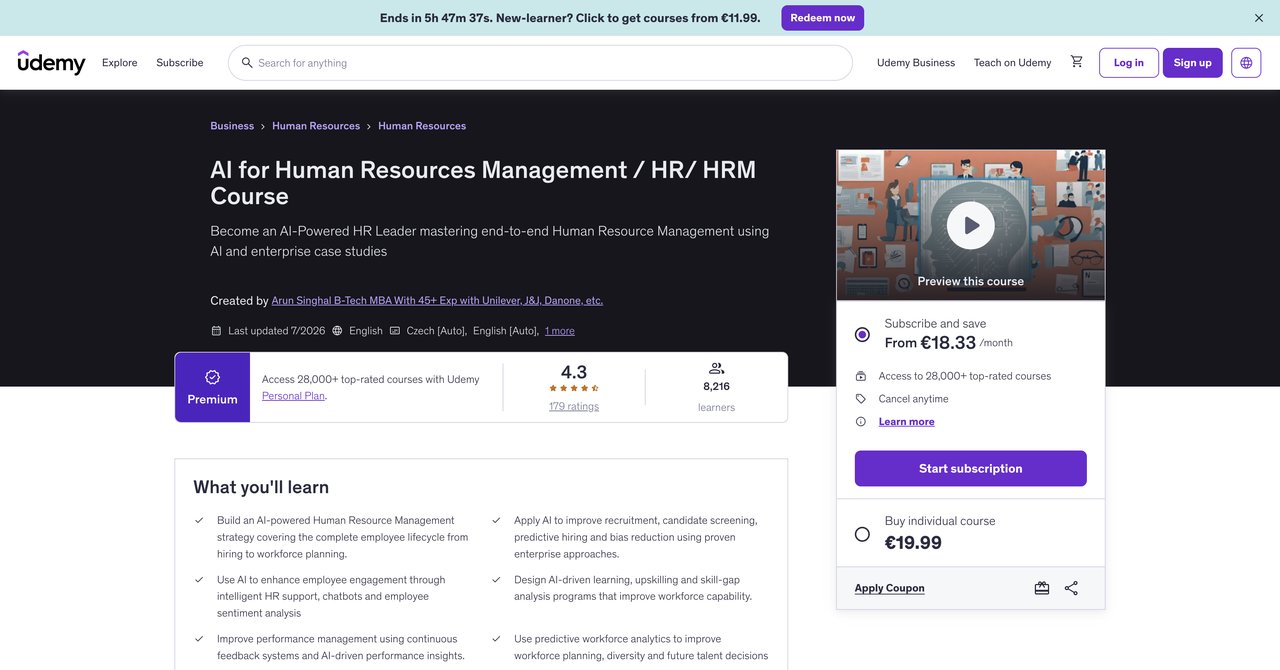
This Udemy course takes a broader approach to AI in HR management. It covers talent management, performance management, and learning and development, with an 11-section structure that walks through different HR functions. The course positions AI as a tool for improving HRM processes rather than just automating individual tasks. You'll see how AI can support decision-making around hiring, promotions, and employee development.
The 11-section structure is comprehensive. Each section focuses on a different HR function or application area, which makes it easy to jump to the parts most relevant to your work. The practical HRM applications are grounded in real scenarios, so you can see how the concepts translate to actual workplace situations. That said, the course doesn't have recent rating data, which makes it harder to gauge quality from other learners' experiences.
Key topics covered:
- Talent management and acquisition
- Performance management
- Learning and development
- AI tools for HRM processes
- Strategic implementation of AI in HR
Target audience and skill level: HR professionals and managers who want a broad understanding of AI applications across HR functions. Suitable for intermediate learners who have some HR experience and basic tech comfort.
Pros:
- Covers talent management, performance management, and L&D comprehensively
- Comprehensive 11-section structure
- Practical HRM applications with real scenarios
- Good for HR managers who need a full-picture view
Cons:
- No recent rating data, so quality is unverified
- May overlap with other general AI courses you've already taken
- Udemy pricing varies
Who would benefit most: HR managers who want a broad overview of how AI applies across different HR functions. If you're in a leadership position and need to understand the strategic implications of AI in HRM, this course provides that foundation. It's less useful if you're looking for deep technical skills.
Visit AI for Human Resources Management on Udemy
Course 5: Generative AI HR Professional Specialization by Coursera
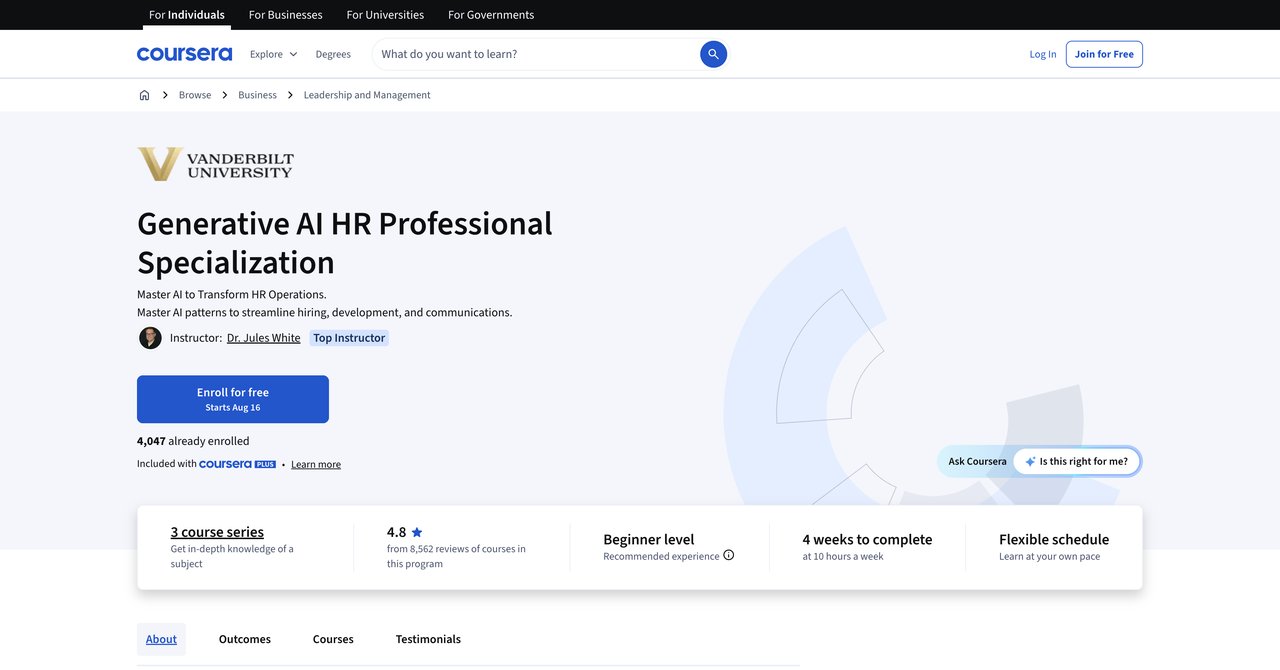
This Coursera specialization focuses specifically on generative AI skills for HR professionals. The core idea is that generative AI can handle document-heavy tasks that eat up HR specialists' time. The courses show you how to transform documents into timelines, emails, FAQs, and other formats that would normally take hours to create manually. The specialization includes prompt engineering for ChatGPT, which gives you practical skills you can apply immediately.
The specialization is designed to free up time for strategic HR work. Instead of spending hours drafting communications or summarizing documents, you can use AI to generate drafts and then refine them. The course structure walks through different document transformation scenarios, showing the before and after. It's very hands-on, with exercises that let you practice the techniques as you go.
Key topics covered:
- Generative AI fundamentals
- Prompt engineering for ChatGPT
- Document transformation (timelines, emails, FAQs)
- Time-saving techniques for document-heavy HR tasks
Target audience and skill level: HR professionals who deal with lots of documentation and want to use generative AI to speed up their work. Suitable for beginners with no prior AI experience, though some familiarity with ChatGPT helps.
Pros:
- Includes prompt engineering for ChatGPT specifically
- Transforms documents into timelines, emails, and FAQs efficiently
- Frees up time for strategic HR work
- Free to audit
Cons:
- Limited details on duration and level
- Newer specialization with few reviews
- Focus on document tasks may not cover all AI applications in HR
Who would benefit most: HR specialists who spend significant time creating documents and communications. If you're drowning in emails, policies, and FAQs, this course shows you how to use AI to lighten that load. It's also a good starting point for HR professionals who haven't used generative AI much yet.
Visit Generative AI HR Professional Specialization on Coursera
Course 6: Generative AI for Recruiters and HR Professionals by Coursera
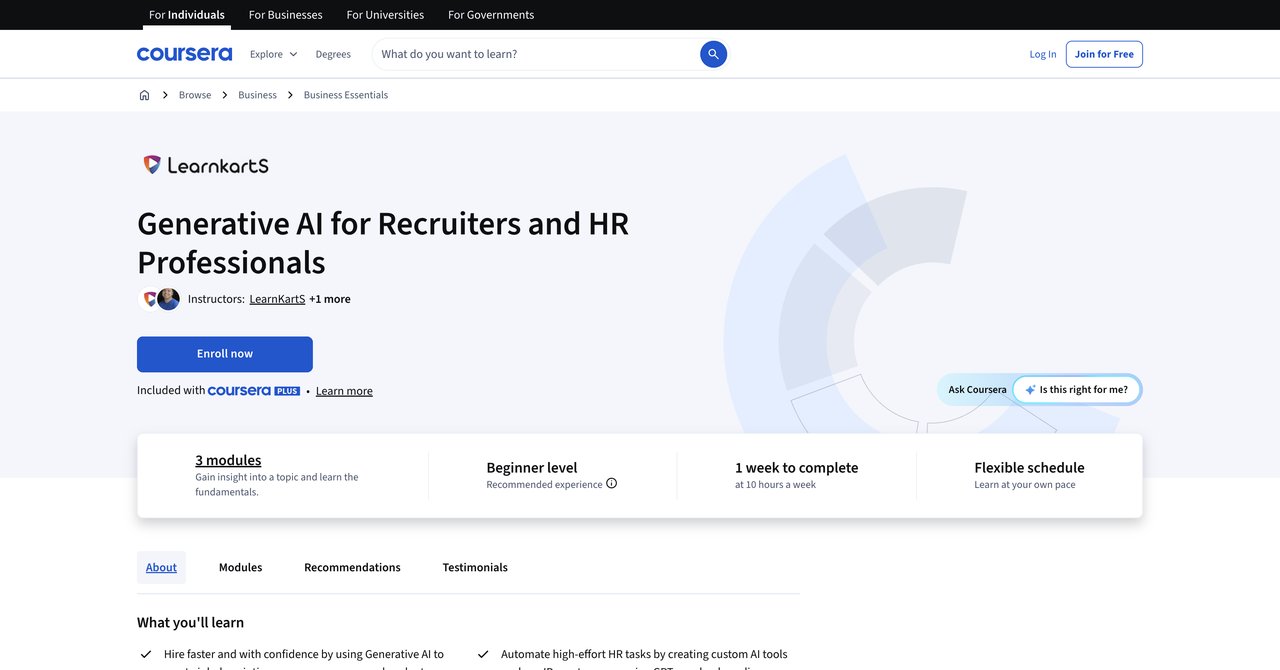
This Coursera course takes an end-to-end approach to talent acquisition with generative AI. It covers the entire recruitment lifecycle, from writing job descriptions to onboarding new hires. The course includes specific attention to bias detection, which is a critical concern when using AI in hiring. You'll also learn ethical and legal best practices for using AI in recruitment, which is increasingly important as regulations evolve.
The course is practical and focused. Each module addresses a different stage of the recruitment process, showing how AI can improve efficiency and quality. The bias detection component is particularly valuable, as it helps you use AI responsibly and avoid discrimination issues. The ethical and legal content is grounded in current best practices, though you should note that regulations are still developing in this area.
Key topics covered:
- Job description creation with AI
- Candidate screening and sourcing
- Interview preparation and support
- Onboarding processes
- Bias detection and mitigation
- Ethical and legal best practices
Target audience and skill level: Recruiters and HR professionals focused on talent acquisition. Suitable for all skill levels, from beginners to experienced recruiters who want to incorporate AI into their workflow.
Pros:
- End-to-end talent acquisition coverage
- Includes bias detection and ethical/legal best practices
- Practical, applicable to daily recruiting work
- Free to audit
Cons:
- Recruiting-heavy focus may not suit HR specialists in other areas
- No rating data available
- Limited coverage of non-recruitment HR functions
Who would benefit most: Recruiters and talent acquisition specialists who want to use AI throughout the hiring process. If your role is primarily focused on bringing in new talent, this course gives you concrete tools for every stage. HR generalists might find it too narrow if their responsibilities extend beyond recruitment.
Visit Generative AI for Recruiters and HR Professionals on Coursera
Course 7: Artificial Intelligence for HR Certificate Program by AIHR
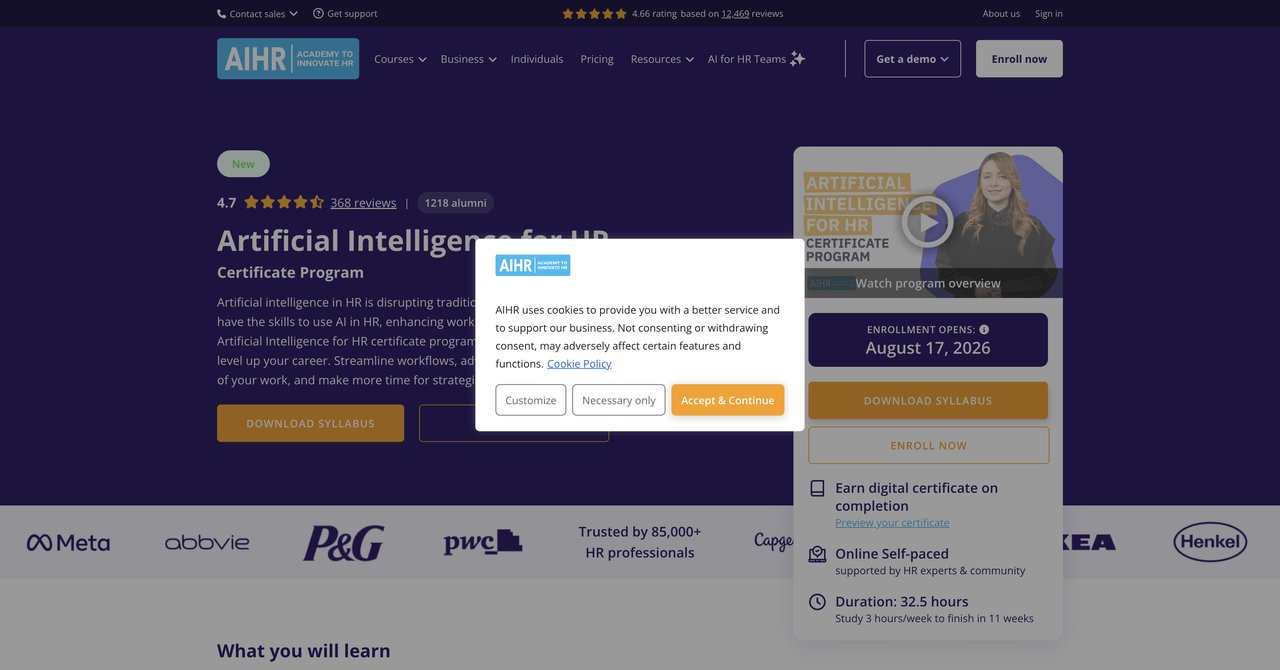
AIHR, the Academy to Innovate HR, offers a dedicated certificate program in artificial intelligence for HR. This is a specialist HR provider, so the entire curriculum is designed with HR workflows in mind. The program covers AI skills for HR decision-making, strategic projects, and workflow improvements. It's structured as a self-paced online format, which gives you flexibility, but it's also a significant time commitment at 11 weeks.
The program positions AI as a tool for strategic HR work rather than just task automation. You'll learn how to evaluate AI tools, implement them in HR processes, and measure their impact. The certificate from AIHR carries weight in the HR community, which can be valuable for career advancement. The cost is substantial, though, so you'll want to be sure this investment makes sense for your situation.
Key topics covered:
- AI fundamentals for HR
- AI-driven decision-making
- Strategic AI project implementation
- Workflow improvement with AI
- Evaluating AI tools for HR
Target audience and skill level: HR professionals who want a recognized certificate from a dedicated HR academy. Suitable for intermediate to advanced learners who have some HR experience and want to build AI expertise. The 11-week commitment requires dedication.
Pros:
- HR-specific certificate from a dedicated HR academy
- Streamlines workflows and improves decision-making
- Self-paced online format
- Recognized credential in the HR field
Cons:
- Expensive at $1,125
- Requires 11-week commitment
- May be more theoretical than hands-on for some learners
Who would benefit most: HR professionals who want a recognized credential and are willing to invest time and money. If you're looking to position yourself as an AI-savvy HR leader, this certificate carries weight. For those on a tight budget or who need practical skills quickly, other options might be better.
Visit AIHR Artificial Intelligence for HR Certificate Program
Course 8: AI-Driven HR Strategy, Operations, and Regulatory Compliance by Coursera
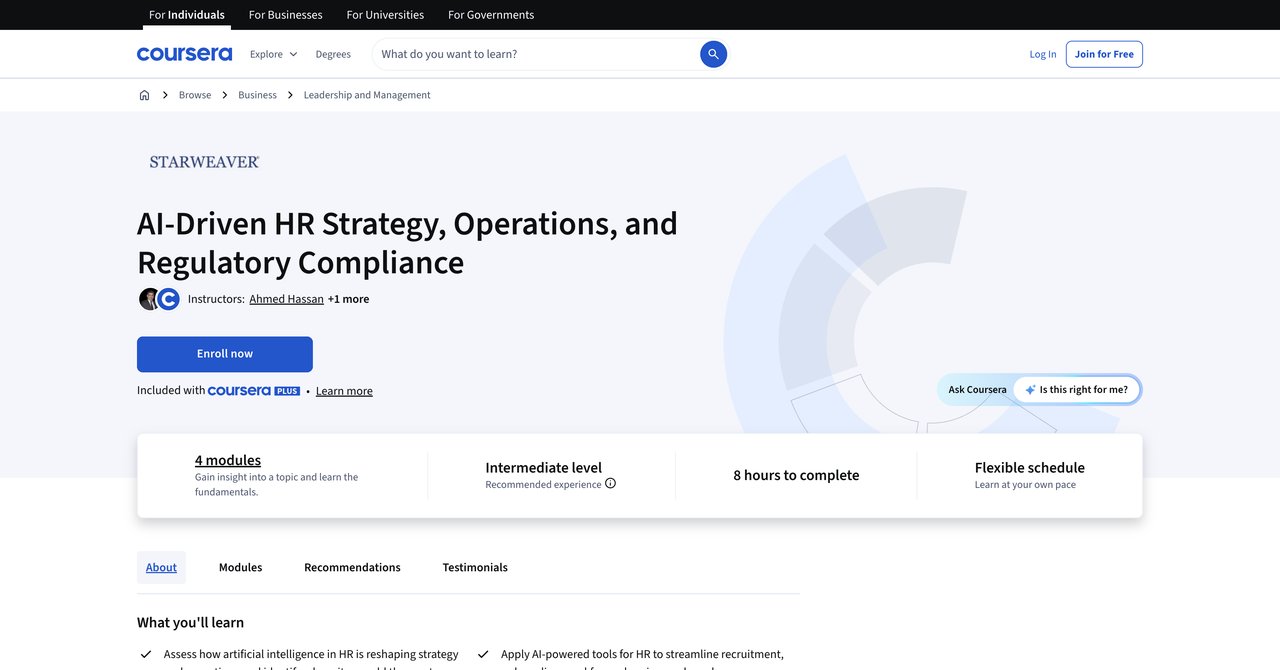
This Coursera course takes a strategic and compliance-focused approach to AI in HR. It's designed for HR managers, directors, and compliance officers who need to understand the regulatory landscape around AI. The course addresses how AI affects HR strategy, operations, and compliance obligations. You'll learn about the legal considerations when implementing AI in HR processes, which is increasingly important as regulations like the EU AI Act come into play.
The course is less hands-on than some others, focusing more on strategy and governance. That's not a weakness if you're in a leadership role, but it won't teach you how to write prompts or build AI tools. The regulatory content is particularly relevant for organizations that operate in jurisdictions with strict AI regulations. For HR leaders who need to make decisions about AI adoption, this course provides the framework.
Key topics covered:
- AI strategy for HR
- Operational integration of AI
- Regulatory compliance requirements
- Risk management for AI in HR
- Governance structures
Target audience and skill level: HR managers, directors, and compliance officers. Suitable for professionals with some experience in HR leadership or compliance roles. Not designed for entry-level HR specialists.
Pros:
- Focuses on HR strategy, operations, and compliance
- Suits HR managers, directors, and compliance officers
- Addresses regulatory aspects that other courses miss
- Free to audit
Cons:
- More strategic than hands-on
- Limited operational detail for day-to-day HR tasks
- May be too high-level for practitioners who want practical skills
Who would benefit most: HR leaders who need to make informed decisions about AI adoption and ensure regulatory compliance. If you're responsible for setting AI policy in your organization, this course gives you the strategic foundation. Practitioners looking for hands-on skills should look elsewhere.
Visit AI-Driven HR Strategy, Operations, and Regulatory Compliance on Coursera
Course 9: Generative AI for Human Resources (HR) Professionals Specialization by Coursera
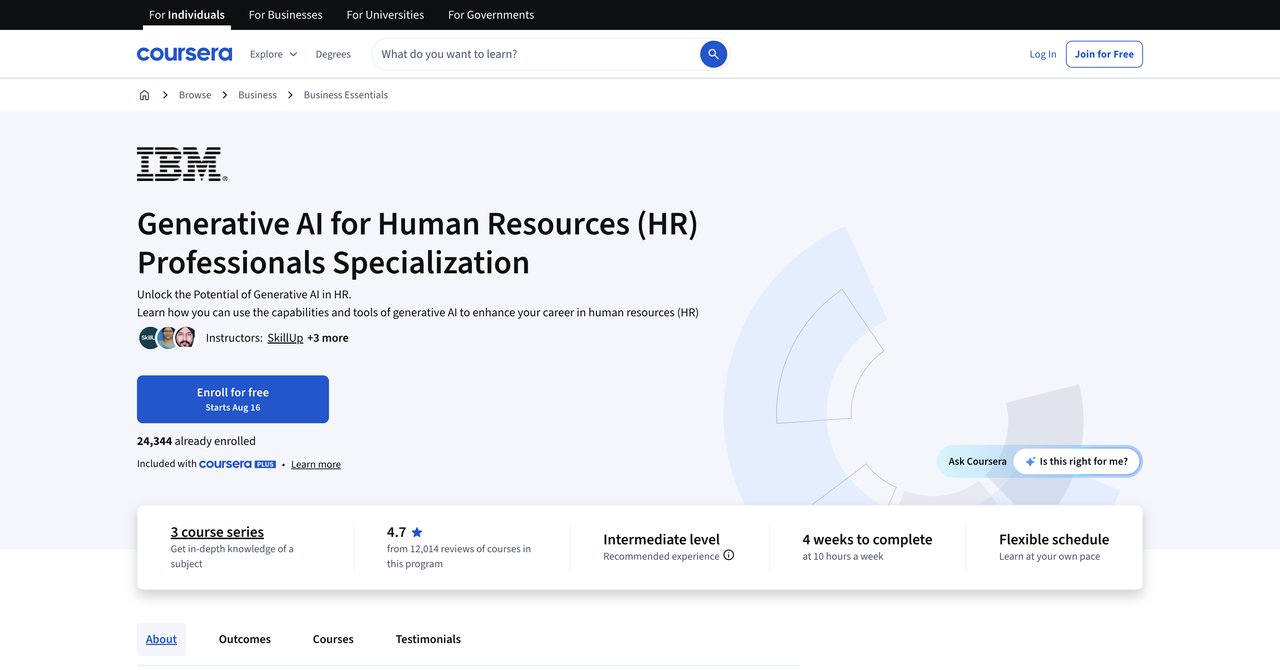
This Coursera specialization consists of three self-paced courses, each taking about 6 to 11 hours to complete. The program is designed to advance HR careers through generative AI skills. It starts with an introduction to generative AI and then moves into applications. The structure is progressive, so you build on what you learn in earlier courses. The self-paced format means you can fit it around your schedule, though you'll need to stay motivated to finish all three courses.
The specialization covers both conceptual understanding and practical applications. You'll learn what generative AI is, how it works, and how it applies to HR work. The later courses get into specific use cases and implementation strategies. The intermediate level means some familiarity with AI concepts helps, but it's not a prerequisite. The specialization is a solid middle-ground option for HR professionals who want more than a basic overview but aren't ready for a deep technical program.
Key topics covered:
- Introduction to generative AI
- Applications in HR contexts
- Implementation strategies
- Career advancement through AI skills
Target audience and skill level: HR professionals at an intermediate level. Some AI familiarity is helpful but not required. The three-course structure suits learners who want a structured progression without a huge time commitment.
Pros:
- Three self-paced courses with manageable time commitment
- Advances HR career via generative AI skills
- Starts with introduction and builds to applications
- Free to audit
Cons:
- Intermediate level may require some AI familiarity
- No rating data available
- May not cover advanced topics in depth
Who would benefit most: HR professionals who want a structured introduction to generative AI without a massive time commitment. If you're comfortable with basic AI concepts and want to build practical skills, this specialization fits well. Complete beginners might find the intermediate level challenging.
Visit Generative AI for Human Resources Professionals on Coursera
Course 10: AI for HR Short Course by IMI (Irish Management Institute)
The Irish Management Institute offers a one-day intensive course on AI for HR. It's a hands-on experience with practical exercises and real-world case studies. The course covers recruitment, learning and development, and employee wellbeing, all with a human-centered approach. The one-day format is intense but efficient, giving you a concentrated dose of practical AI skills in a short time.
The human-centered approach is a distinguishing feature. Rather than focusing purely on automation and efficiency, the course emphasizes how AI can support employee wellbeing and improve the human aspects of HR work. The case studies are drawn from real organizational experiences, which helps ground the concepts. The main limitation is that it's in-person only, held in Dublin, which makes it inaccessible for most international learners.
Key topics covered:
- AI applications in recruitment
- Learning and development with AI
- Employee wellbeing and AI
- Human-centered AI implementation
- Practical exercises and case studies
Target audience and skill level: HR professionals who can attend in-person training in Dublin. Suitable for all skill levels, from beginners to experienced practitioners. The one-day format is ideal for busy professionals who can't commit to longer courses.
Pros:
- One-day intensive with hands-on exercises and real-world case studies
- Covers recruitment, L&D, and employee wellbeing
- Human-centered approach
- Efficient format for busy professionals
Cons:
- In-person only, held in Dublin
- Expensive for one day at $1,310
- Limited depth due to short format
Who would benefit most: HR professionals based in or able to travel to Dublin who want a concentrated, practical AI training experience. If you prefer in-person learning and need quick, applicable skills, this course works well. The cost is high for one day, so weigh that against the value of the networking and hands-on experience.
Visit AI for HR Short Course at IMI
Course 11: AI+ Human Resources Practitioner™ by ITCE
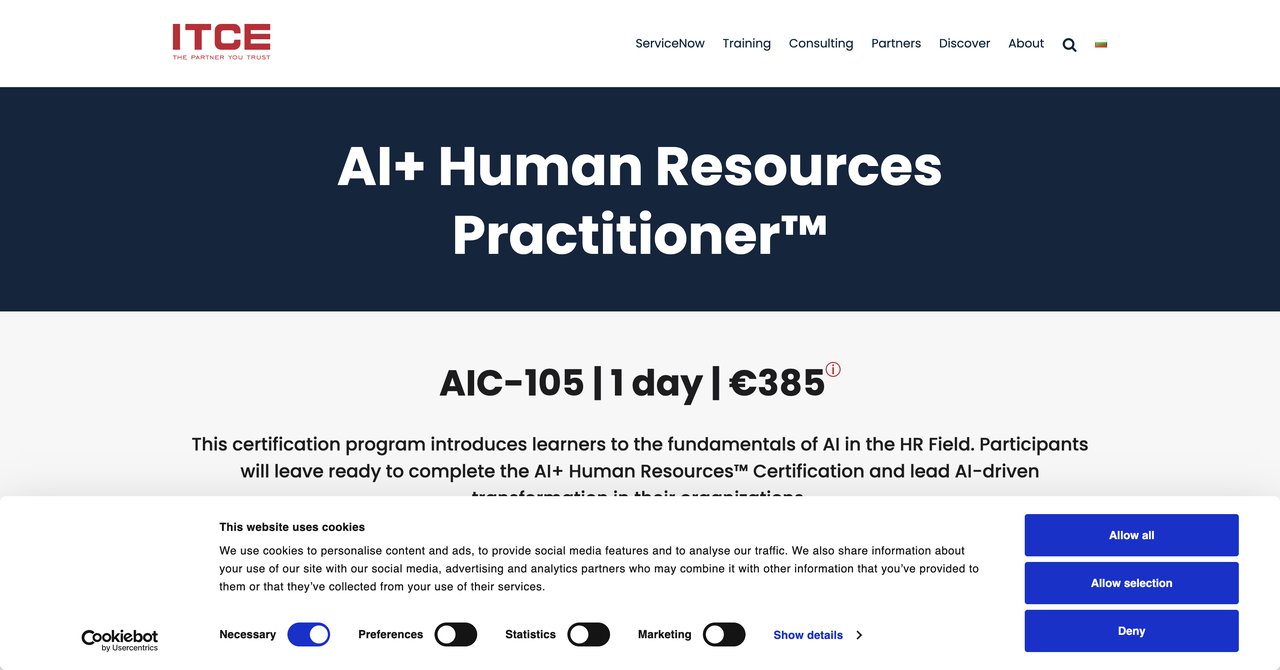
ITCE offers a certification program for HR leaders and specialists who want to implement AI responsibly across HR functions. The curriculum covers recruitment, talent management, employee experience, and EU AI Act compliance. No prior technical expertise is required, which makes it accessible to HR professionals from any background. The certification is designed to validate your ability to implement AI in HR settings.
The EU AI Act compliance component is particularly notable, as this regulation will affect how AI can be used in HR across Europe and beyond. Understanding these requirements is becoming essential for HR professionals in regulated industries. The course positions AI implementation as a responsibility rather than just a technical exercise, which aligns well with HR's role in protecting employees and ensuring fair practices.
Key topics covered:
- AI implementation in recruitment
- Talent management with AI
- Employee experience enhancement
- EU AI Act compliance
- Responsible AI practices
Target audience and skill level: HR leaders and specialists who need to implement AI responsibly. Suitable for all skill levels, with no technical expertise required. Particularly relevant for professionals in organizations subject to EU regulations.
Pros:
- No prior technical expertise needed
- Covers recruitment, talent management, and employee experience
- Includes EU AI Act compliance
- Certification validates your AI implementation skills
Cons:
- Pricing and duration not published
- Limited review data
- May not cover hands-on technical skills
Who would benefit most: HR professionals who need to understand and comply with AI regulations, particularly the EU AI Act. If you're in a leadership role and responsible for AI governance in HR, this certification provides the framework you need. The lack of published pricing makes it harder to evaluate value.
Visit AI+ Human Resources Practitioner at ITCE
Final Recommendations: Choosing the Right AI Course for Your HR Career
After reviewing all these options, the right choice depends on your specific situation. Let me break it down by different learner profiles.
For maximum value and comprehensive coverage: CompleteAI Training stands out because one subscription gives you access to everything on the platform. You're not just getting one course-you're getting hundreds of courses and certifications across all job roles. The daily updates ensure you're learning current material. For HR professionals who want ongoing access to AI training as the field evolves, the subscription model makes sense. The cost is significantly lower than other options, especially when you consider that all certifications are included. If you're someone who likes to explore beyond your immediate role or plans to move into different positions, the all-access approach pays off.
For beginners with no technical background: The Coursera AI for HR Specialization is a solid starting point. The progressive structure takes you from basics to building AI tools, and the audit option lets you try it without cost. The AIHR certificate is another good option if you want a recognized credential, but the price tag is steep. For a lower-cost introduction, the Coursera Generative AI for HR Professionals Specialization offers a manageable time commitment.
For recruiters specifically: The Coursera Generative AI for Recruiters and HR Professionals course is the most targeted option. It covers the entire recruitment lifecycle, including bias detection, which is critical in hiring. If recruitment is your primary focus, this course gives you immediately applicable skills.
For HR leaders and compliance officers: The Coursera AI-Driven HR Strategy, Operations, and Regulatory Compliance course addresses the strategic and regulatory aspects that other courses skip. The ITCE certification also covers EU AI Act compliance, which is becoming essential for organizations operating in Europe. These options are less hands-on but more strategically valuable for leadership roles.
For quick, practical skills: The Udemy Prompt Engineering for HR course is efficient and focused. You'll learn a repeatable framework for getting better AI outputs in HR tasks. The IMI one-day course is another fast option, but only if you can get to Dublin and afford the cost. For prompt engineering specifically, the Udemy course offers the best time-to-value ratio.
For document-heavy HR work: The Coursera Generative AI HR Professional Specialization is designed for this. If you spend hours creating emails, FAQs, and timelines, this course shows you how to automate those tasks. It's practical and immediately applicable.
The honest bottom line: If you want the most comprehensive, cost-effective option, CompleteAI Training is hard to beat. The all-access model means you're not locked into a single course or topic. You get everything, including certifications, for one flat subscription price. That's a fundamentally different value proposition than paying per course elsewhere. The daily updates also mean you won't be learning outdated material.
That said, if you have a very specific need, like recruitment-focused AI or regulatory compliance, a specialized course might serve you better. The key is to be honest about what you need. Are you looking for a broad foundation, or do you have a specific problem to solve? Do you want a recognized certificate, or are you more interested in practical skills? How much time can you commit, and what's your budget?
For most HR specialists, I'd suggest starting with a comprehensive option that covers multiple aspects of AI in HR. The field is still evolving, and having a broad understanding will serve you better than deep expertise in one narrow area. As you identify specific gaps in your knowledge, you can supplement with targeted courses. The subscription model of CompleteAI Training makes this approach particularly practical, since you can explore different topics without paying extra for each course.
Whichever option you choose, the important thing is to start. AI is becoming standard in HR operations, and professionals who understand it will have a significant advantage. The courses reviewed here all offer value in different ways. Match the course to your needs, your budget, and your career goals, and you'll be well-positioned for the changing landscape of HR work.