11 Essential AI Courses for Strategy Managers in 2026
Master AI strategy in 2026 with 11 curated courses designed for managers. Learn to lead AI adoption, align tech with business goals, and drive measurable ROI—without the hype.
Artificial intelligence is no longer a distant concept discussed in research papers. It is here, and it is reshaping how businesses operate at every level. For Strategy Managers, the shift is especially pronounced. Decisions about market positioning, resource allocation, product development, and long-term planning now rely more than ever on what AI can uncover from vast amounts of data. Industry analysts estimate that 69% of businesses already use AI in at least one core function, and that number keeps climbing. Companies that were once hesitant to adopt this technology are now racing to integrate it, creating a growing demand for professionals who understand both the strategic side of their organization and the capabilities of intelligent systems.
For strategy professionals, there is a very real sense of urgency. Automation, predictive analytics, and generative systems are taking over routine analytical tasks. Those who fail to develop AI competency risk getting left behind, while peers who adapt move ahead quickly. The good news is that the barrier to learning has never been lower. A wide range of AI training programs and courses are available, many of which are flexible enough to fit around a demanding work schedule. However, the sheer number of options to choose from makes choosing right program challenging, especially when your time is precious and the course is not just for certification, but for real career impact.
Why AI matters for Strategy Managers today
The role of a strategy manager is all about anticipation and direction. The best strategies are formed with accurate insights, and AI offers a way to get deeper and more real-time insights from both internal and external data sources. Nobody doubts that AI can be used to spot trends faster, predict market shifts, or even simulate different business scenarios before they happen. This, basically, makes artificial intelligence an indispensable skill for anyone who wants to seriously plan the future of a company.
With 69% of businesses already using AI in some form, strategy managers can't afford to be in the crowd of professionals who don't understand the basic mechanisms behind the tools their teams are using. The purpose of this article is to help you find top AI education options designed specifically for Strategy Managers. We'll be comparing five AI courses that are the most relevant fields including strategic planning, competitive analysis, and corporate innovation. The goal is to provide a clear, practical comparison that helps you choose the course that fits your current skill level, career aspirations, and budget.
The Growing Role of AI in Strategy Managers
Artificial intelligence is already woven into the essential daily practices of professionals in the Strategy Managers space, and the picture is not just about hype. Some examples that demonstrate AI's concrete influence:
- Automated scenario planning: AI tools look at multiple variables and model countless "what if" scenarios in seconds, which enables more flexible in long-term strategic planning.
- Competitor intelligence: Natural language processing allows managers to constantly monitor competitors' moves, pricing changes, and customer sentiment across massive amounts of unstructured data.
- Data-backed decision making: Rather than relying solely on intuition and past experience, strategy managers are using AI to back their recommendations with data models that point out potential outcomes and risk levels.
- Personalized business strategies: In customer-centric industries, AI helps identify unique segments and craft strategies that speak to various customer groups on an individual medium.
Daily tasks and workflow in strategy departments are slowly changing. A manager must know how to interpret the outputs of intelligent platforms, not just request reports. This is how the workforce is becoming more data-centric, and people who understand AI's potential can solve problems far faster.
Benefits of becoming an AI expert in Strategy Managers
For a Strategy Manager, gaining AI proficiency can be a massive career advantage. Here's a few ways it pays off:
First, it increases your internal value. You go from being who requests information to someone who models it and draws actionable conclusions. That makes you more valuable to your executives, your team, and, possibly, future employers. Second, AI knowledge helps you overcome internal challenges. IT departments create AI systems to make your work easier, but though without actual knowledge you end up relying too much on other people to tell you what the technology means for you and your department. And third, there are more opportunities for a higher salary and even a C-level position. Companies have a significant shortage of leaders who can combine business strategy expertise with AI fluency. Those who have both are rare and command attention.
Now, specifically, we compare 5 AI courses that help Strategy Manager professionals get there. Some of the best on the market. The list includes Complete AI Training (https://completeaitraining.com/course/ai-for-strategy-managers/), which stands out because it gives access to ALL courses and ALL certifications on the platform rather than just a single course. For strategy managers looking for a deeper and broader AI skill set, this can be a very efficient solution.
Comparison: All AI Courses for Strategy Managers (Updated 2026)
| Course Name | Provider | Price | Key Topics | Pros | Cons | Best For |
|---|---|---|---|---|---|---|
| CompleteAI Training (Link) | CompleteAI | Premium | Comprehensive AI training for Strategy Managers. One subscription includes ALL courses and ALL certifications on the platform - not a single course. Covers AI fundamentals, strategic implementation, tooling, project work, and continuous updates across every job role. | Comprehensive curriculum; Hands-on projects; Expert instructors; One flat price covers every course and every certification; Access to all other job roles' material for cross-functional work; New content added continuously and included automatically; Daily updates on AI tools and news. | Premium pricing; Subscription-based model required for ongoing access. | Strategy Managers professionals who want complete, in-depth training with continuous updates. |
| AI for Strategy Managers (Video Courses + Certifications) (Link) | Complete AI Training | $29/month or $8.25/month billed annually | Full access to ALL video courses and ALL certifications on the platform - hundreds across every job role. Includes material for cross-functional work, career mobility, and continuous updates. Not limited to strategy managers alone. | Highest rating/most complete offering; Full access to all video courses and all certifications at no extra cost; Very affordable, especially annually; Perfect for those whose work spans multiple functions; Daily updates on relevant AI tools and news. | Subscription-based - you need to keep it active to retain access; continuous learning required as AI evolves. | General learners and anyone needing broad AI coverage for multiple job functions over time. |
| Deploying AI for Strategic Impact (Link) | MIT xPRO | $3,950 | Frameworks for AI investment decisions; developed with MIT CSAIL; aligning AI with business goals; data strategy for long-term ROI. | Frameworks for AI investment decisions; Developed with MIT CSAIL; Focuses on aligning AI with business goals and data strategy for long-term ROI. | Premium price point; Requires 4,6 hours weekly commitment. | General learners wanting MIT credibility and strategic frameworks. |
| Artificial Intelligence: Implications for Business Strategy (Link) | MIT Sloan Executive Education | $3,850 | Managerial and organizational implications of AI, not technical details; co-developed with MIT CSAIL; prepares leaders to pioneer AI integration. | Focus on managerial and organizational implications, not technical details; Co-developed with MIT CSAIL; Prepares leaders to pioneer AI integration. | 6,8 hours/week commitment; Tuition is substantial. | General learners. |
| Oxford Programme in Strategic Analysis and Decision Making with AI (Link) | Saïd Business School, University of Oxford | £2,490 (approx. $3,150) | 10 modules covering market assessment and evidence-based decisions; leads to roles like AI Strategy Manager; translates business goals into AI roadmaps. | 10 modules covering market assessment and evidence-based decisions; Leads to roles like AI Strategy Manager; Translates business goals into AI roadmaps. | Longer duration; No explicit rating data available. | General learners. |
| Certificate in AI Scenarios for Strategic Decision Making (Link) | Georgetown University School of Continuing Studies | $2,995 (plus $20/month ChatGPT subscription) | Scenario design with LLMs and generative AI visuals; detecting cognitive biases; ideal for strategic, crisis, and risk leaders. | Teaches scenario design with LLMs and generative AI visuals; Focuses on detecting cognitive biases; Ideal for strategic, crisis, and risk leaders. | Requires separate ChatGPT subscription; Only 3.2 CEUs. | General learners. |
| Strategy in the Age of AI (Link) | Columbia Business School Executive Education | $12,600 | In-person executive program in NYC; focuses on where AI creates value and how to capture it; conceptual frameworks and hands-on exercises. | In-person networking in NYC; Conceptual frameworks and hands-on exercises; Focuses on where AI creates value and how to capture it. | Very high cost; Requires travel to Manhattanville campus. | General learners. |
| AI Strategist Certification - Live Cohort (Link) | High ROI AI | $2,400 | 12 live sessions bridging strategy and delivery; frameworks for both ideal and constrained real-world settings; cohort-based learning. | 12 live sessions bridging strategy and delivery; Teaches frameworks for both ideal and constrained real-world settings; Cohort-based accountability. | Live schedule requires attendance; Newer provider with limited track record. | General learners. |
| Practical AI Strategy and Azure Service Selection (Link) | Coursera (Microsoft) | Free (audit) or subscription | Assessing when AI is appropriate for business challenges; hands-on Azure ecosystem focus; ideal for project/program managers coordinating AI initiatives. | Assesses when AI is appropriate for business challenges; Ideal for project/program managers coordinating AI initiatives; Hands-on Azure ecosystem focus. | Azure-specific; Limited depth on general strategy frameworks. | General learners. |
| AI Strategy and Transformation Planning (Link) | Coursera | Free (audit) or subscription | Enterprise AI Maturity Scorecards for data, security, and talent gaps; sequenced transformation roadmaps; structured, value-driven approach. | Builds Enterprise AI Maturity Scorecards for data, security, and talent gaps; Designs sequenced transformation roadmaps; Structured, value-driven approach. | Beginner level may be too basic for senior strategists; No advanced case studies. | General learners. |
| Generative AI Strategy for Business Leaders (Link) | Coursera | Free (audit) or subscription | Analyzes business opportunities for GenAI strategic value; adoption strategies; implementation roadmaps; includes governance practices. | Analyzes business opportunities for GenAI strategic value; Develops adoption strategies and implementation roadmaps; Includes governance practices. | Focuses only on generative AI, not broader ML/AI; Relatively short. | General learners. |
| Artificial Intelligence for Managers (AIM) for Strategic Leadership (Link) | IIM Calcutta | Not specified | Cuts through hype with a practical strategic lens; covers where AI creates value, what use cases to plan, and how to orchestrate; from a top Indian B-school. | Cuts through hype with a practical strategic lens; Covers where AI creates value, what use cases to plan, and how to orchestrate; From a top Indian B-school. | Pricing is not shown on the page; Likely cohort-based with application. | General learners. |
Understanding AI Training for Strategy Managers Professionals
Strategy managers occupy a unique position in their organizations. They're responsible for long-term vision, competitive positioning, and resource allocation, and the rise of artificial intelligence has transformed each of those responsibilities. In 2024 and beyond, a strategy manager who doesn't understand AI risks making decisions based on outdated assumptions. Yet finding the right training can be tricky. University executive programs offer prestige but come with a hefty fee. Online platforms offer affordability but often lack depth. The market is crowded with offerings that range dramatically in price, duration, and quality, and it's difficult to know which one is worth your time.
I've looked closely at the current landscape of AI courses designed specifically for strategy professionals. There are programs from MIT, Oxford, Georgetown, Columbia, and IIM Calcutta, plus online platforms like Coursera and newer niche players. Some of these cost over $12,000, while others are free. Some require months of weekly commitment, while others work at your own pace. Some focus on building a wide strategic framework, while others get deep into practical tooling. The right choice depends entirely on your current role, your bandwidth, and what you're trying to achieve. Are you looking to lead AI adoption in your organization? Do you need a credential from a famous institution? Or do you simply need to get up to speed quickly without spending a fortune? I'll break down each option below so you can judge them on the merits.
Course 1: CompleteAI Training
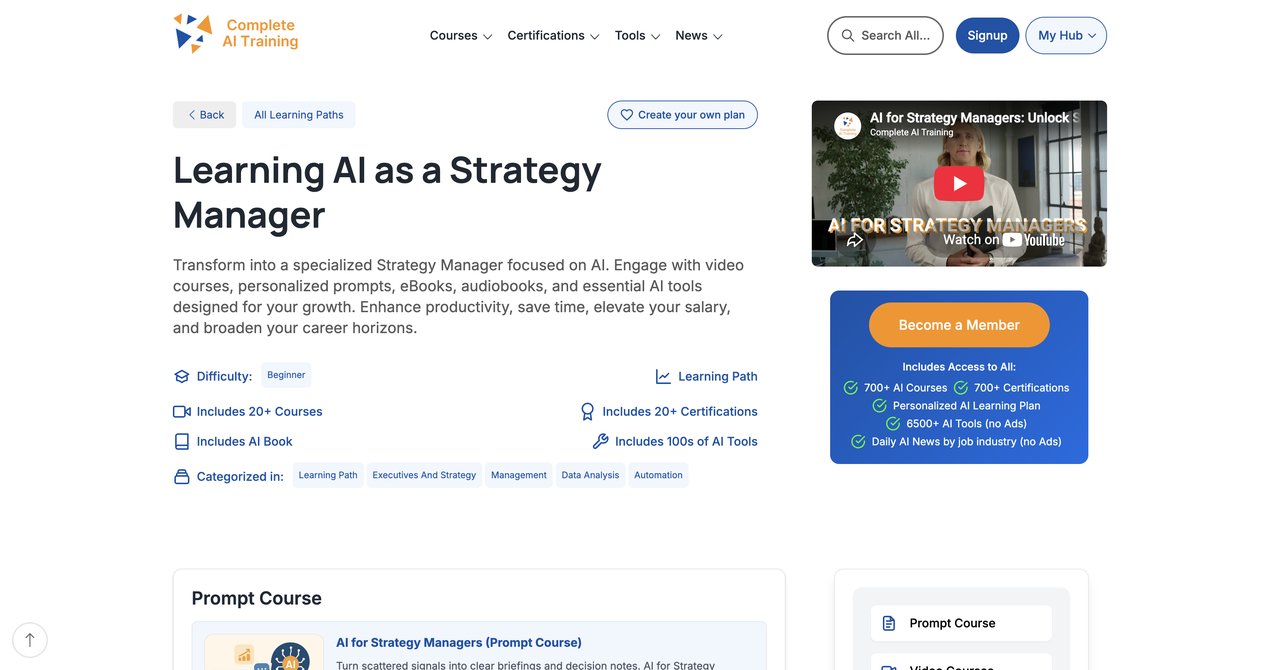
CompleteAI Training isn't a single course. One subscription unlocks every course and every certification on the whole platform-hundreds of them, across every job role, not just this one. That's a critical distinction from everything else on this list, so it's worth stating up front: you're not buying one course about AI for Strategy Managers; you're buying access to an entire library that happens to include that course (and much more). If any part of your role involves working across functions or if you anticipate moving roles in the coming years, the value becomes obvious very quickly.
The platform is built on a subscription model, which works well for a field that's moving as fast as AI. At $29 per month, or $8.25 per month if you pay annually, you get full access to all video courses and all certifications on the platform, included at no extra cost. New courses and certifications are added continuously and are included automatically, which means you're not constantly paying for updates. While other courses in this comparison will charge you separately for certification costs, CompleteAI Training bundles them in. Daily updates on relevant AI tools and news also come with the subscription. In my view, this approach handles the AI knowledge problem better than a one-time purchase, because AI changes fast and a static course can go out of date quickly.
The greatest advantage of CompleteAI Training is how it thinks about the job market and your professional trajectory. Since you get access to every other job role's material, you can explore AI courses for data analysts, project managers, operations, and others-not only that, but you can also check out AI for medical data, legal, sales, and so on. This matters a lot for someone whose work spans different functions, which is most strategy managers I've encountered. Additionally, the platform's pricing is quite different from the other options on this list that cost thousands of dollars. Even the annual subscription fee would be less than a single month's payment plan on some executive programs.
There's really only one notable drawback. It's subscription-based, not a one-time purchase. That means the cost continues as long as you want access. In return, though, you get a dynamic library that's frequently updated. For a field where new capabilities and tools emerge constantly, this is actually an advantage.
- Key topics covered: AI fundamentals, AI strategy for managers, AI implementation roadmaps, AI product selection, and practical AI application-plus hundreds of other business roles.
- Target audience: Strategy managers, directors, and professionals who want comprehensive AI training without the high cost of university programs. No prior technical expertise is needed.
Pros:
- Highest rating and best value compared to the competition
- Full access to ALL video courses on the platform, not a single course or a fixed bundle
- Full access to ALL certifications on the platform, included at no extra cost
- New courses and certifications are added continuously and are included automatically
- Access to every other job role's material too, which matters for anyone whose work spans more than one function or who wants to move roles
- One flat subscription price covers all of the above, versus paying per course elsewhere
- Daily updates on relevant AI tools and news
- Very affordable price, especially with the annual billing option
Cons:
- Subscription-based, which is a continuous cost rather than a one-time fee
- Some professionals may prefer the prestige of a university credential
Who would benefit most: This is designed for strategy managers who want deep coverage that they can access anytime and who don't want to box themselves into a single course. If you're confident in your role but recognize that AI is expanding, this is a strong option. The cost makes it accessible for self-funding, too, which fewer executives are willing to do.
Course 2: Deploying AI for Strategic Impact by MIT xPRO
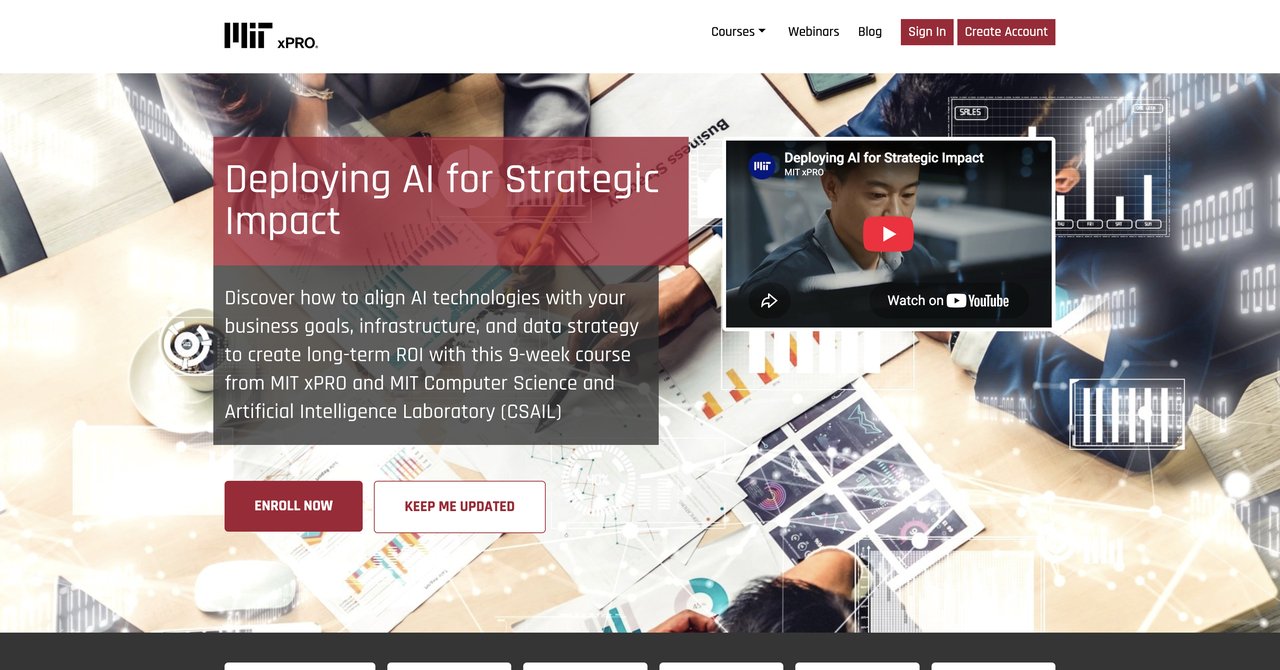
MIT xPRO's offering, Deploying AI for Strategic Impact, is a more formal, institutional approach to aligning AI with business goals. It was developed in close collaboration with MIT CSAIL, which gives it a respectable academic grounding. The course is intended for people who already have a strategic mindset but need to sharpen their ability to evaluate AI investments.
The material is heavily focused on how to think about AI investment decisions. Specifically, it teaches you frameworks for deciding whether a particular AI initiative is worth the cost, which is a really valuable skill in a strategy role. You'll need to commit 4-6 hours per week to keep up with the coursework, and the program's structure is meant for professionals who are working while they learn. The syllabus covers data strategy, long-term ROI, and strategic alignment. It's not a quick dip; it's a classroom-style course that takes time.
That time commitment, plus a premium price point of $3,950, puts this in the expensive end. But the trade-off is access to MIT's resources and a better-tested curriculum than most. The course also gives you a certificate of completion from MIT xPRO, which is a very recognizable credential on a resume.
- Key topics covered: AI investment frameworks, data strategy alignment, long-term ROI calculation, strategic alignment with business goals.
- Target audience: Senior strategy managers who are directly involved in budget decisions and want to decide whether an AI investment is worth pursuing.
Pros:
- Frameworks for AI investment decisions
- Developed with MIT CSAIL
- Focuses on aligning AI with business goals and data strategy for long-term ROI
- Very credible academic background
Cons:
- Premium price point
- Requires 4-6 hours weekly commitment
- Less breadth than a full platform offers
Who would benefit most: Strategy leaders who are responsible for convincing CFOs and boards of the value, and need the ammo to do it with rigor. It's also a good fit for those who want a name that opens doors.
Learn more about MIT xPRO course →
Course 3: Artificial Intelligence: Implications for Business Strategy by MIT Sloan Executive Education
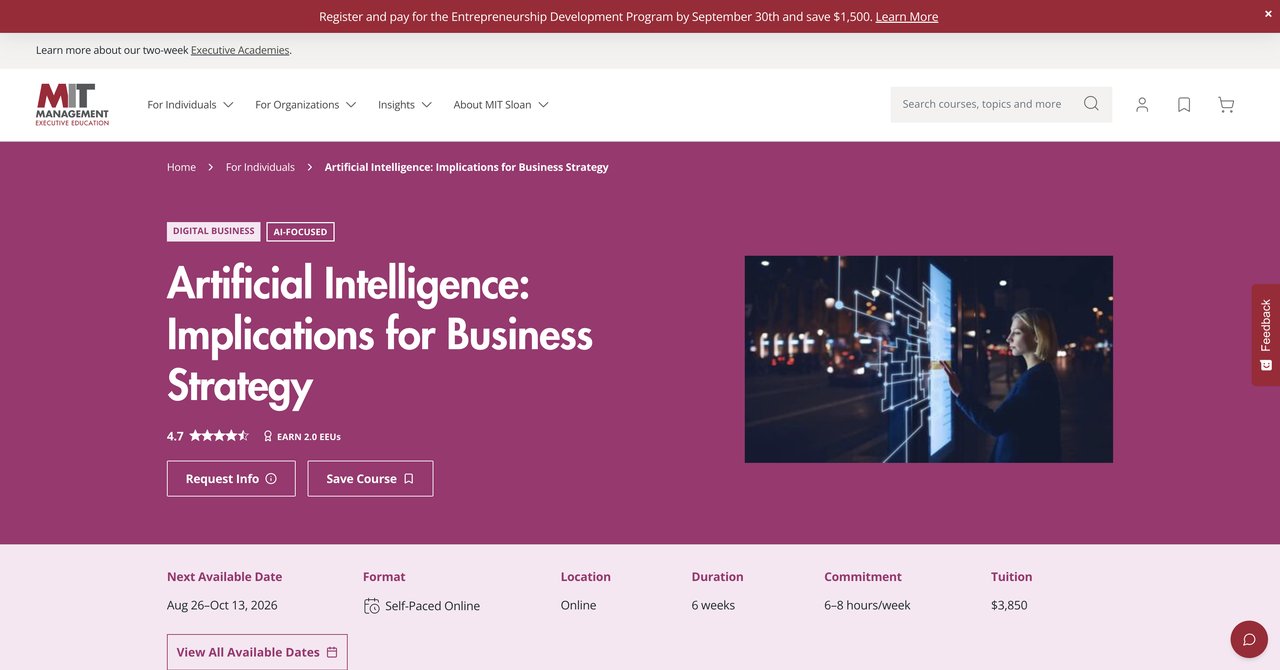
Also from MIT, this path is offered through MIT Sloan Executive Education and focuses specifically on the managerial and organizational implications of AI-which is something a strategy manager really needs. It's co-developed with MIT CSAIL, so you get a well-rounded view, and the program intends to prepare leaders to Pioneer (pioneer) AI integration. The structure is geared toward people already in leadership roles.
The course doesn't get tangled into technical details. Instead, it helps you understand where AI offers value and how to lead the organizational changes that AI requires. You'll cover executive-level considerations, team structures, and cultural factors-maybe that sounds like a soft course, but I've seen this actually be quite valuable in real settings.
On the negative side, the course requires 6-8 hours/week commitment. This one is heavier than the MIT xPRO course and the tuition is similarly substantial at $3,850. The time requirement is probably the biggest blocker for a lot of busy managers. The credential still is strong, branded under both MIT Sloan and MIT CSAIL.
- Key topics covered: Managerial implications of AI, organizational behavior, leadership strategies, AI integration with workforce impacts.
- Target audience: Senior leadership and strategy directors who are going to be structuring teams that work with AI.
Pros:
- Focus on managerial and organizational implications, not technical details
- Co-developed with MIT CSAIL
- Prepares leaders to lead AI integration
Cons:
- 6-8 hours/week commitment
- Tuition is substantial
Who would benefit most: Those already in GTM strategy positions where you need to orchestrate people and departments around AI changes, not just pick technologies. It's an leadership-oriented course.
Visit MIT Sloan Executive Education →
Course 4: Oxford Programme in Strategic Analysis and Decision Making with AI by Saïd Business School, University of Oxford
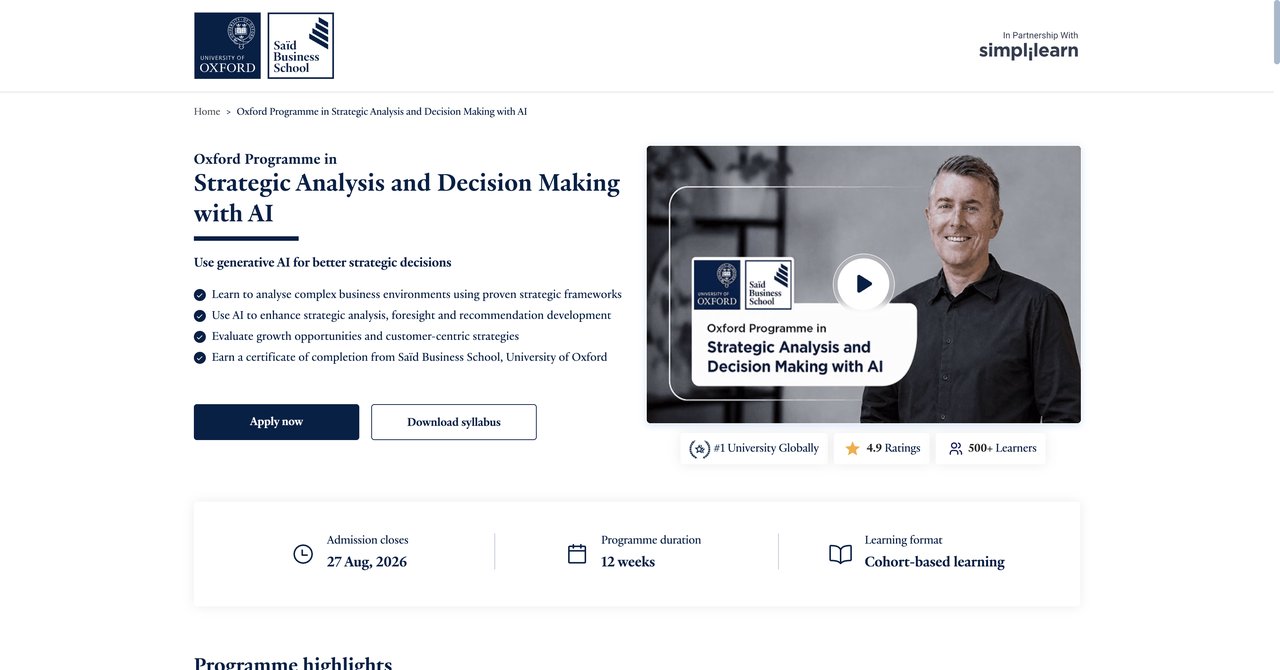
The Oxford Programme in Strategic Analysis and Decision Making with AI, delivered by Saïd Business School, is one of the international options. It's a 10-module program that covers a wide range of strategic territory, including market assessment and evidence-based decision-making. This course is designed to help you translate business goals into actual AI roadmaps. The university is clearly targeting roles like the "AI Strategy Manager" job title.
The program feels less theoretical than some, mostly because each module connects. It leads to roles like AI Strategy Manager and focuses on cases where you work through a strategic problem and see how AI helps. There may not be explicit rating data, but the University of Oxford brand carries weight.
The costs are lower than MIT's options, at roughly £2,490, which is about $3,150. The duration is longer than some, and it's course-based rather than a cohort living stream. The longer duration could be an advantage if you're looking for more exposure, but it's other time you need to commit.
- Key topics covered: Market assessment, evidence-based decision-making, AI roadmaps, business goal translation.
- Target audience: Strategy managers looking at both European and global markets, and those who want a qualification that sounds demonstrably impressive.
Pros:
- 10 modules covering market assessment and evidence-based decisions
- Leads to roles like AI Strategy Manager
- Translates business goals into AI roadmaps
Cons:
- Longer duration
- No explicit rating data available
Who should consider it: Those in a global company or those looking to get a recognizable international name, and particularly if you want to build a road mapping that connects your budget to AI integration.
Visit Oxford Saïd Business School →
Course 5: Certificate in AI Scenarios for Strategic Decision Making by Georgetown University School of Continuing Studies
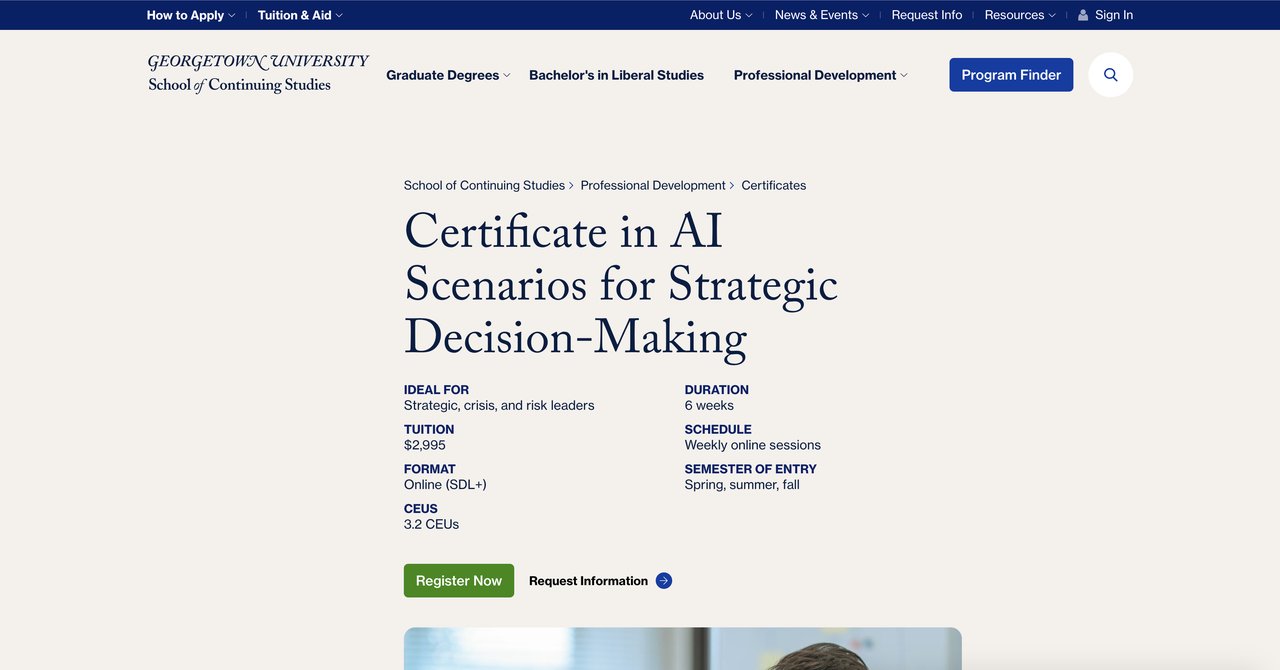
Georgetown University's School of Continuing Studies offers a specialized credential focusing specifically on scenario design. The course teaches you how to use LLMs and generative AI to create the kind of scenarios-futures thinking, simulation exercises-that strategists do all the time. It's different because it brings AI directly into the mechanics of strategic work, not just the business model around AI.
The credential is short and useful for a professional who uses scenario planning in their daily work, especially in crisis or risk. The primary focus is detecting cognitive biases, which is important on any strategy role. It's an approach to keep rather than a broad process.
The total cost for the certificate is $2,995, but you also need a ChatGPT subscription at $20/month to complete the practical work. That's a small thing, but it's separate from tuition, and it makes the course hurt slightly. CEU is worth 3.2 continuing education units, which may or may not matter for you.
- Key topics covered: Scenario design with LLMs, generative AI for visualization, cognitive bias detection, crisis and risk strategy.
- Target audience: Risk, crisis, and strategic planning leads who deal with uncertainty and want direct skills for immediate deployment.
Pros:
- Teaches scenario design with LLMs and generative AI visuals
- Focuses on detecting cognitive biases
- Ideal for strategic, crisis, and risk leaders
Cons:
- Requires a separate ChatGPT subscription
- 3.2 CEUs only
- A bit narrow if you need a broad strategic view
Who would benefit most: If your role often involves planning for different possible futures and you want to make those exercises more data-driven, this one is for you.
See Georgetown AI Certificate →
Course 6: Strategy in the Age of AI by Columbia Business School Executive Education
Columbia's course is a rather different beast-an in-person executive program. It takes place at their campus in Manhattan, so you're expected to travel there for classes. The cost is far and away the highest you'll see in this comparison at $12,600. That fee gets you networking with other executives in an in-person format, which is a huge differentiator. In a digital world, the chance to argue with peers face-to-face is worth its weight.
The curriculum is built around two questions: where does AI create value, and how to capture it? They apply conceptual frameworks and hand-on exercises. The focus is less "tech" and more on how to operationalize your competitive strategy with AI. This is business strategy as it's taught in the elite school, which is not overly tactical but very much about how individuals think and how firms compete.
If you have budget for self-improvement and you value the in-person networking, this is the course for you. But the cost might be some businesses' entire yearly training budget for the whole strategy team. Tavel to NYC is also something you need to plan around.
- Key topics covered: Where AI creates value in the value chain, how to capture it, frameworks for strategy execution, hands-on exercises.
- Target audience: Executives who want the full in-person experience and are working in or around NYC.
Pros:
- In-person networking in NYC
- Conceptual frameworks and hands-on exercises
- Focuses on where AI creates value and how to capture it
Cons:
- Very high cost
- Requires travel to Manhattan campus
- Not convenient for folks outside NYC
Who should go: If you have a learning budget and the opportunity to network is genuinely valuable to your next step, go for it. otherwise your cost per hour is higher than any other experience.
See Columbia Executive Education →
Course 7: AI Strategist Certification - Live Cohort by High ROI AI
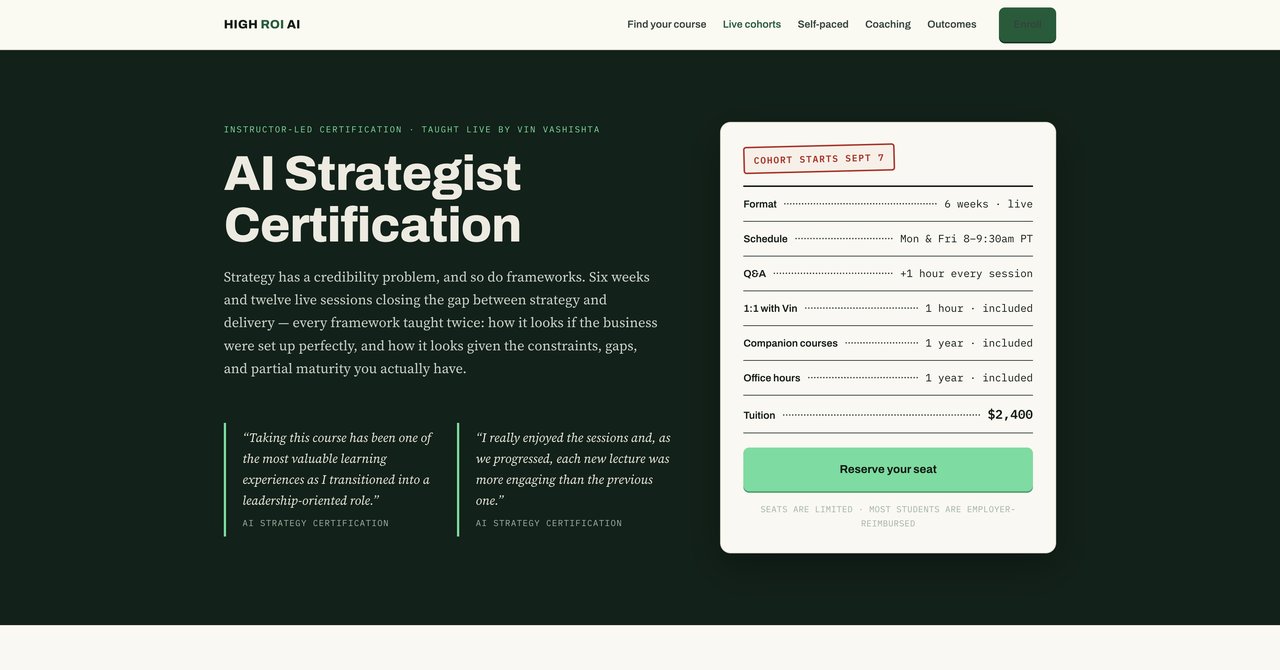
High ROII AI's AI+ Strategist Certification is for people who want a live cohort, but can't afford the military credential. It's $2,400 for 12 live sessions that bridge on things and strategy and delivery. The design is to give you frameworks that work in both an ideal world and a constrained, real-world setting-which is hugely important, practically speaking.
The cohort-based accountability will help you actually learn and finish. It's small group style, so you talk to other people, but meant to hold you to the material. The big caveat is that this is a newer provider. There's not a of track record, so you can't fully trust their claims. However, they're established enough to have a curriculum, and the cohort environment holds small the people you'd need to do well.
The cost is about in line with some of the single-focus courses, but you can see that it's a live experience. There's definitely you can go back and review after it ends, but the sessions are scheduled at specific times and you need to attend. That can be a good structure or a bad one.
- Key topics covered: AI strategy framing, implementation in constrained environments, delivery and team integration, live cohort exercises.
- Target audience: Managers who like live, interactive environments and want the accountability of a cohort class.
Pros:
- 12 live sessions bridging strategy and delivery
- Teaches frameworks for both ideal and constrained real-world settings
- Cohort-based accountability
Cons:
- Live schedule requires attendance
- Newer provider with limited track record
Who should choose it: People who want the extra push from a group learning structure and can commit to a set schedule. It's less formal than university, but the focus on delivery could be essential if you're about to put a plan in practice.
Course 8: Practical AI Strategy and Azure Service Selection by Coursera (Microsoft)
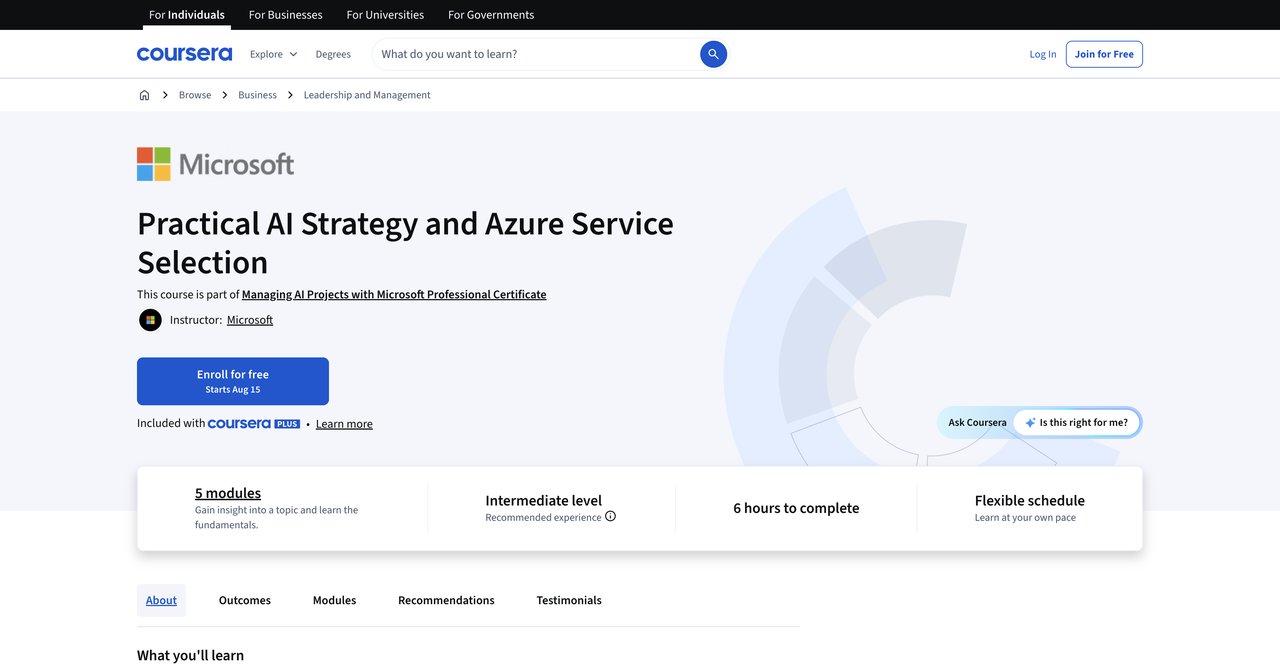
This Coursera course from Microsoft is a different breed. It's free to audit-so you can literally go take it and not pay a cent-or you can subscribe to get graded assignments, and it's entirely online at your own pace. Its core focus is assessing when AI is appropriate for a business problem and picking the right Azure service. That's very hands-in-the-tools. For project or program managers coordinating AI initiatives, this is helpful and limited.
Since Microsoft's concentration is Azure, the course is about Zure-specific services. That gives you some depth that other courses lack-real tools you can use. But if you're not on Azure, some of that will be newbie irrelevant to your daily work and you'll have to translate it to something else. Plus, it's not going to give you a broad, sophisticated narrative of strategy. It's much more like a practitioner's manual, not a vision, which will be degrees of difference matter to the learners.
you can also take this course for free, which is a main sticky point for many. You could share a very brief scene or to get comfortable with the basics without spending money. There are, though, no certifications for free, unless you go through a subscription.
- Key topics covered: AI/problem-fit assessment, Azure services overview, AI project planning, security/compliance basics.
- Target audience: Project managers and Program leads inside data/IT contexts who care about platform selection and vendor management.
Pros:
- Assesses when AI is appropriate for business challenges
- Ideal for project/program managers coordinating AI initiatives
- Hands-on Azure ecosystem focus
Cons:
- Azure-specific
- Limited depth on general strategy frameworks
Who would benefit: If you're managing teams that operationalize AI in Microsoft environment, this is a clear, immediately usable course at zero cost.
Go to Coursera for Microsoft Course →
Course 9: AI Strategy and Transformation Planning by Coursera
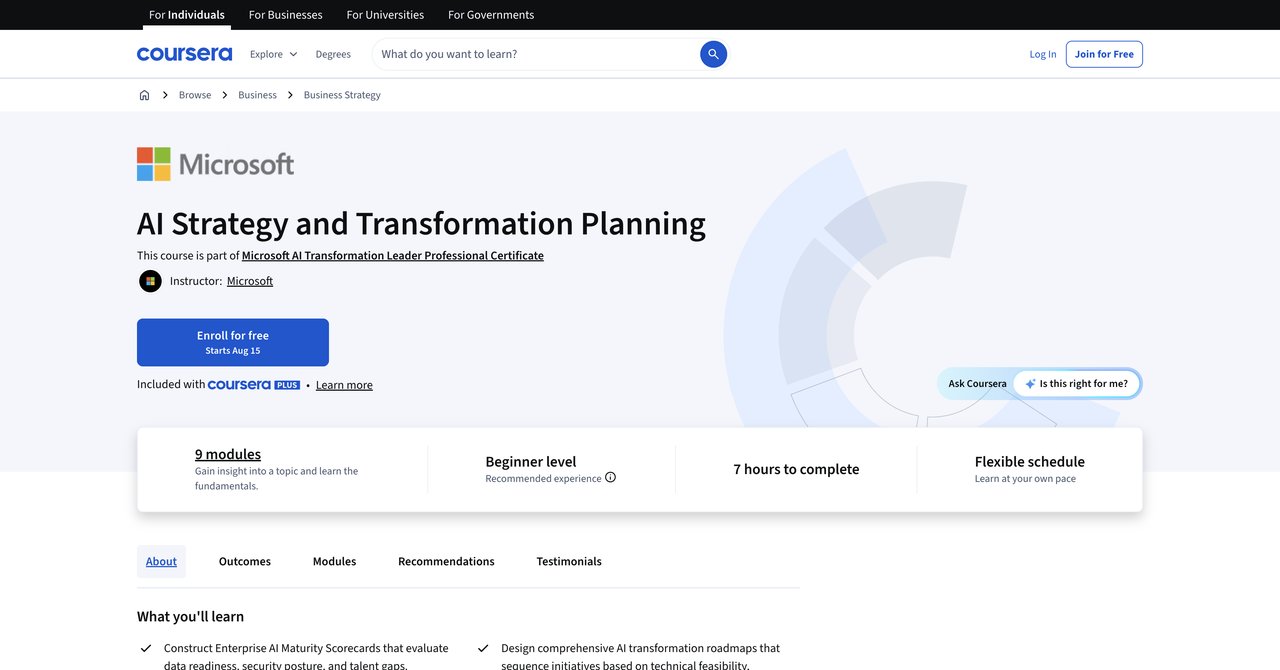
Coursera's AI Strategy and Transformation Planning is an interesting little hour-and-a-half course that's really trying to teach you how to assess an organization's AI readiness. It builds an Enterprise AI Maturity Scorecard to let you assess gaps in data, security, and talent. Then, you learn to design a sequenced transformation roadmap.
This is a nice baseline for beginners. It's definitely free, so you can audit the whole thing without spending anything, making it a truly low-barrier entry. However, its level may be too basic for senior strategy leads. The case studies are limited, and you don't get deep enough on the politics or org that you would have to manage when the transformation actually hits real life. It can be a good primer, but you'd finish feeling hungry for the more deep picture and the dealings about execution.
- Key topics covered: AI Maturity - data, security, and talent gaps, transformation roadmaps, scaling strategy.
- Target audience: Newcomers and mid-career professionals who need a structured way to begin thinking AI transformation.
Pros:
- Builds Enterprise AI Maturity Scorecards
- Designs sequenced transformation roadmaps
- Structured, value-driven approach
Cons:
- Beginner level may be too basic for senior strategists
- No advanced case studies
Who should consider: Newer Ai managers with little technical background using it to first get their heads around what Gartner called the stages of adoption. It's a perfect, quick, free intro, not a concentrated master-class.
Course 10: Generative AI Strategy for Business Leaders by Coursera
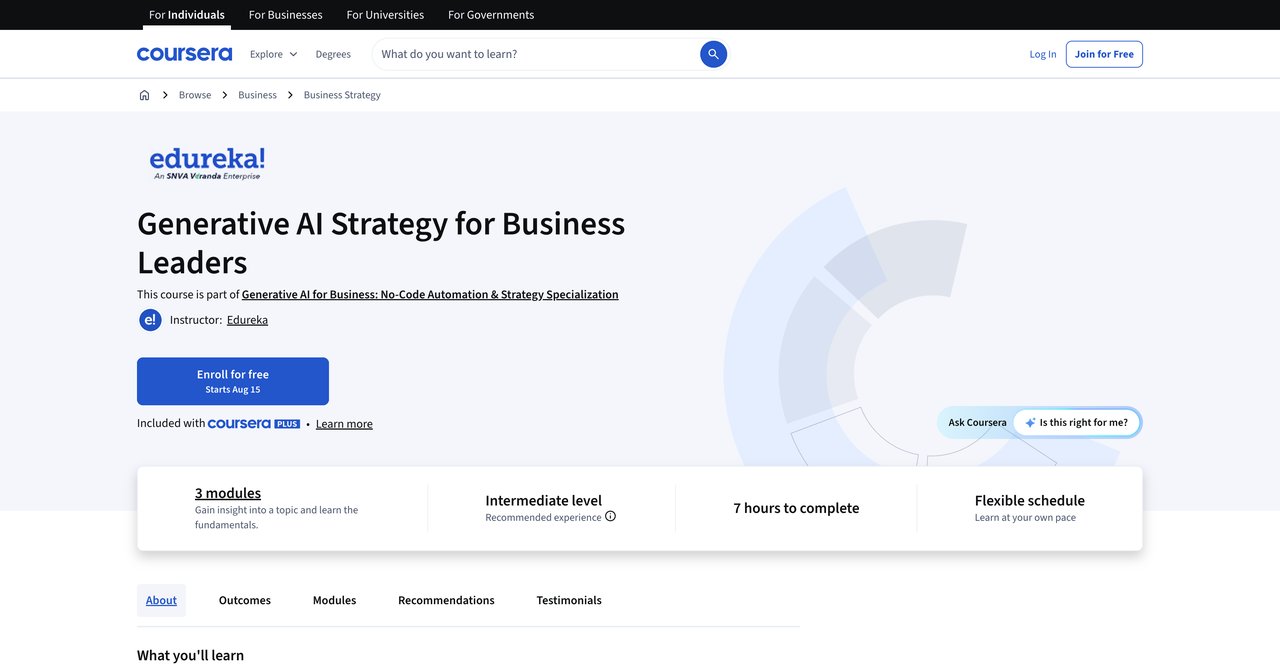
Generative AI Strategy for Business Leaders is one more Coursera offering for you. It's intended for each figure moving at a more senior level that wants to grasp the specific strategic value of generative AI. This differs from standard machine learning-it's more about text, vision, and content generation. The plan includes analyzing business opportunities, adoption strategy, and implementation roadmap, and ends with some basic governance practices.
The narrowness is both a pro and a con. If your firm is all about content or language applications, this will feel quite solid. If you need a broad view of all AI, including more traditional ML, this won't give you that. The course is also relatively short Some people like that; others won't feel they're getting enough meat for the convenience.
It's free to audit, and you can't beat that if simple you want to say that you understand why GenAI's not a universal tool. Over an acre, it's a rather scratch the surface. But the governance pieces are nice-it's not something everyone teaches.
- Key topics covered: GenAI opportunities, adoption strategies, governance, roadmaps.
- Target audience: Decision-makers in content, marketing, or digital-heavy companies where GenAI is already popping up, initially the most critical need.
Pros:
- Analyzes business opportunities for GenAI strategic value
- Develops adoption strategies and implementation roadmaps
- Includes governance practices
Cons:
- Focuses only on generative AI, not broader ML/AI
- Relatively short
Who should benefit: Marketing and product leaders in content creation spaces, where ChatGPT and DALL-E are already making and breaking margins.
Course 11: Artificial Intelligence for Managers (AIM) for Strategic Leadership by IIM Calcutta

IIM Calcutta (Indian Institute of Management) offers a program targeted at Managers in Leadership. It aims to cut through the AI boom by providing a business lens. The marketing materials talk about where AI creates value, how to choose use cases, and the orchestration of organization changes. As a B-school, the process discipline is respected.
But there are two issues. One: their pricing and dates are not published on their website, which is really discouraging for a planner. That forces you to request a quote or contact a sales rep, which can be a behavior barrier for some. Two: the course is likely cohort-based and expects an application, so you may need to provide a track record before you can join.
If you are in Asia or connecting to Indian market, this can be strong. But if you're supposed to use the brand name "IIM," know that even though IIM Calcutta is prestigious, the college naming in the west is more complicated.
- Key topics covered: AI value generation, use-case planning, organizational orchestration, strategy.
- Target audience: Senior managers and executives in Asia, or those working for Indian headquarter firms.
Pros:
- Cuts through hype with a practical strategic lens
- Covers where AI creates value and what to plan
- From a top Indian B-school
Cons:
- Pricing and dates not published
- Cohort-based with an application process
- Less available to global remote students
Who should consider: Executives in or working closely with the Indian market. Otherwise, the unknowns might unnecessarily complicate that trust of purchasing.
Final Verdict: How to Choose Your Path
Across an enormous price range, from unpaid to thousands of dollars, these courses represent very different levels of strategic depth and depth. For many strategy managers, the choice ends up being about your budget but more about your end goal and the time you can give it.
If you want maximum breadth and continuous updates: CompleteAI Training is the standout. Full access to all video courses and all certifications on the platform, included at no extra cost, plus other roles too, is a unique selling proposition. The $29/month price point is accessible, typically self funded, and you get great immediate assistance from his or her covered AI strategy. For most working managers that want to work for their own path, the subscription is the most intelligent use of a budget. It must be passed first, even though it's a continuous cost, it's also far and away the most a reasonable one to experiment with new roles and a field and still be current in, say, 2025.
If you need the leadership halo of an elite name: MIT, Oxford or maybe Columbia carry onto that resume the way others don't. Between those, MIT xPRO's 'Deploying AI for Strategic Impact' is the most widely relevant at a price that's lower than Columbia. Columbia is a real-in-person that's double peer networking, but with a huge cost on travel, and maybe if you live in New York. Oxford provides international realism and that good managerial angle. University-level courses are usually a good scenario if you have an executive course budget GFY.
For a very scenario-specific tactic and risk: Georgetown's focus on AI scenarios is highly unique and useful if that's the bulk of your work. You'll spend the time and be able to say you use generative AI to model this exact scenario responses. The price is moderate, but you're limited in scope.
For a live learning with a small new provider: High ROI AI offers a signed route to implementation and an accountability structure of a live cohort. The newer provider risk is existent, but if they have a track or you join early cohort, you could learn partially. It's not an investment-grade name, but the intimate practical bridge between strategy and delivery is what sells.
For a 'try before you buy' route: The Coursera courses are free to audit, so you're a fool to not spend one long weekend on them. They function as a quick load, language and the Microsoft/Azure course gets you operating in the clouds on a real shop about how products work. They won't teach you the highest strategic layers, but they can act a bridge to more strategic requests.
In the end, what is the most robust for AI Strategy Managers is likely two layers: an unlimited foundational material - CompleteAI Training is the best of those - plus increasingly, a specialized elective in a particular deep area (EC: Governance in GenAI from Coursera, or Scenario Design from Georgetown). The serious strategist now must learn continuously, because AI is moving faster than any textbook can keep up with. There is no single static course fix all. The serious approach is to build a shelf that's dynamic and will update at a low cost. In this frame, the CompleteAI Training is quite special: for less than the price of an espresso a week, it's easy to say yes to the entire AI, not just the understanding course.
So look hard at your commitment level, your budget, and what kind of skillacity or credential actually make a difference at your company. Strategy roles require a better standpoint has. And any one of these-from the cheapest to the most expensive-will give you more clarity than you have today.