
Blog ·
11 Essential AI Courses for Teachers in 2026
Discover the 11 must-take AI courses for educators in 2026, covering practical classroom tools, ethical guidelines, and time-saving automation—perfect for boosting teaching efficiency and student engagement.
 Jeroen Erne
Artificial intelligence is no longer a distant concept discussed in tech conferences or sci-fi novels. It is here, it is practical, and it is changing how teachers work. In fact, recent surveys show that a significant number of educators already use AI tools for lesson planning, grading, and creating instructional materials. Yet, many teachers still feel unprepared. The gap between AI's potential and classroom reality is wide, and that gap creates both anxiety and opportunity.
For teachers, the stakes are real. AI can automate routine tasks, offer personalized learning paths for students, and provide instant feedback on assignments. But none of that happens automatically. It requires skills, knowledge, and a willingness to adapt. Those who invest in learning AI now will find themselves ahead of the curve, while those who wait may struggle to keep pace with a profession that is quietly transforming around them.
Why AI matters for Teachers today
Consider this: 69% of businesses use AI in some capacity, and education is no exception. Schools are adopting AI tools for administrative tasks, student assessments, and even special education support. Teachers who understand these tools can work smarter, not harder. They can reduce the hours spent on grading, create more engaging lessons, and give each student the attention they deserve.
But there is a catch. Most teachers have never received formal training in AI. They figure it out on their own, or they avoid it altogether. That is where structured courses come in. A good AI course can take a teacher from confused beginner to confident practitioner. It can demystify the jargon, show practical applications, and build the skills that matter in a real classroom.
This article compares 11 AI courses specifically designed for teachers. Each course has its own focus, depth, and delivery style. Some are short and practical, others are comprehensive and academic. By the end, you will know which one fits your needs, your schedule, and your budget.
The Growing Role of AI in Teachers
AI is not just about chatbots or fancy gadgets. It is being woven into the daily fabric of teaching. Here are some specific ways AI is reshaping the profession:
- Automated grading and feedback: AI can grade essays, quizzes, and even coding assignments in seconds, freeing teachers to focus on instruction.
- Personalized learning paths: Adaptive platforms adjust content based on each student's pace, ensuring no one is left behind.
- Lesson planning assistance: Generative AI can draft lesson plans, create worksheets, and suggest activities in minutes.
- Student engagement analytics: AI tracks participation and attention, helping teachers identify who is struggling early.
- Language translation: Real-time translation tools break down barriers for English language learners and their families.
- Administrative efficiency: Attendance tracking, scheduling, and communication can all be automated, reducing burnout.
These are not futuristic possibilities. They are happening in schools right now. The question is whether teachers are equipped to use them effectively. That is where formal training makes a real difference.
Benefits of becoming an AI expert in Teachers
For a teacher, learning AI is not just about keeping your job. It is about doing your job better. Here is what you gain:
Time savings. The average teacher spends hours each week on grading and planning. AI can cut that time significantly, giving you back evenings and weekends.
Career advancement. Schools are looking for educators who can lead AI integration. Being that person can open doors to leadership roles, higher pay, and professional recognition.
Better student outcomes. When you use AI to personalize learning, students engage more and achieve more. That is the real payoff.
Confidence. There is a certain peace of mind that comes from understanding the tools that are shaping your profession. You stop worrying about being replaced and start using AI to amplify your impact.
Now, about the courses themselves. The list includes options from major platforms like Coursera and Udemy, as well as specialized offerings from educational organizations. One standout is CompleteAI Training, which gives you access to all courses and all certifications on the platform rather than a single course. That is a unique value proposition if you want breadth as well as depth.
The other courses range from quick primers to deep academic explorations. Some focus on practical classroom strategies, while others cover the ethics and theory of AI in education. There is something here for every teacher, whether you are a complete beginner or already experimenting with AI tools.
Take your time, read through the comparisons, and think about what you need most. The right course can change how you teach and how you feel about the profession. That is not an exaggeration. It is just what happens when you gain skills that make your work easier and more meaningful.
Comparison: All AI Courses for Teachers (Updated 2026)
| Course Name | Provider | Price | Key Topics | Pros | Cons | Best For |
|---|---|---|---|---|---|---|
| CompleteAI Training | CompleteAI | Premium (one subscription covers everything) | Comprehensive AI training for Teachers professionals. One subscription unlocks ALL courses and ALL certifications on the entire platform - not a single course or fixed bundle. Includes full access to all video courses, all certifications at no extra cost, and continuous additions of new courses and certifications. Also includes access to every other job role's material, making it ideal for those whose work spans multiple functions or who plan to move roles. Daily updates on relevant AI tools and news. Very affordable pricing, especially with annual billing. | Most comprehensive curriculum available; Hands-on projects; Expert instructors; Full access to ALL video courses on the platform; Full access to ALL certifications included at no extra cost; New courses and certifications added continuously; Access to every other job role's material; One flat subscription price covers everything; Daily updates on AI tools and news | Premium pricing compared to individual course purchases; Subscription-based, which is important for continuous learning as AI develops constantly | Teachers professionals looking for complete training and anyone whose work spans multiple functions |
| AI for Teachers (Video Courses + Certifications) | Complete AI Training | $29/month or $8.25/month billed annually | An extensive library of over 100 specialized video courses and certifications for Teachers. One subscription unlocks every course and every certification on the entire platform. Full access to all video courses, all certifications at no extra cost, continuous additions of new courses, and access to every other job role's material also included. Daily updates on relevant AI tools and news. | Full access to ALL video courses; Full access to ALL certifications included at no extra cost; New courses added continuously; Access to all other job roles' material; One flat subscription price; Daily updates on AI tools; Very affordable, especially annual billing | Subscription-based; AI is developing rapidly so regular learning is recommended | General learners |
| AI in the Classroom: A Practical Starter Course for Teachers | Udemy | Subscription or individual purchase (price varies by region) | Built for teachers who want to save time and improve their teaching with AI. No prior tech experience needed. Designed specifically for K-12 teachers, includes strategies for bilingual and inclusive classrooms. | Designed specifically for K-12 teachers; Zero tech background required; includes strategies for bilingual and inclusive classrooms | No advanced or subject-specific modules; Limited peer interaction | General learners |
| AI-Powered K-12 Teaching and Learning | Coursera | Free (audit) or Subscription for certificate | Helps K-12 educators understand generative AI and use it in meaningful, responsible ways. Recently updated, focuses on real-world tools for differentiation and streamlining classroom tasks. Includes guidance on communicating with families about AI. | Recently updated; Focuses on real-world tools for differentiation and streamlining tasks; Includes guidance on communicating with families about AI | Short duration may limit depth; Requires subscription for graded assignments and certificate | General learners |
| ChatGPT Foundations for Teachers | Coursera | Free (audit) or Subscription for certificate | Practical course helping K-12 educators move from curiosity to confident, everyday use of ChatGPT for real classroom tasks. Covers high-impact use cases for daily classroom and admin tasks. No prior experience required. Emphasizes privacy and human-in-the-loop review. | High-impact ChatGPT use cases for daily tasks; No prior experience required; Emphasizes privacy and human-in-the-loop review | Focused only on ChatGPT; Limited to 5 hours of content | General learners |
| AI Essentials for Educators | University of Canterbury (UC Online) | $395 NZD (approx. $240 USD) | Helps teachers at any level harness AI's potential with core generative AI competencies. Designed for all educator levels, offers flexible self-paced study. Part of a series that includes assessment-focused AI courses. | Designed for all educator levels; Flexible self-paced study; Part of a series that includes assessment-focused AI courses | Higher price point; Limited to New Zealand pricing and context | General learners |
| AI Essentials for Educators | TCEA | $49.00 | Helps educators move from AI beginner to confident builder of professional resources with hands-on learning and collaboration tools. Focuses on organizing AI workflow, writing stronger prompts, and building classroom-ready tools. Includes module certificates. | Practical focus on organizing AI workflow, writing stronger prompts, and building classroom-ready tools; Includes module certificates; Affordable | Self-paced with no live support; Limited to TCEA member ecosystem | General learners |
| Becoming an artificial intelligent competent teacher | European School Education Platform | Free | Human-centred course on how to critically evaluate and integrate AI while maintaining a much more teacher's essential role as designer and facilitator. Structured around the UNESCO AI Competency Framework and focuses on equity, inclusion, and ethical AI. | Structured around the UNESCO AI Competency Framework; Focuses on equity, inclusion, and ethical AI; Self-paced with no deadlines | May be less hands-on with specific tools; European context may not fully apply globally | General learners |
| Generative AI for Educators & Teachers | Coursera | Free (audit) or Subscription for certificate | Specialization equipping educators with generative AI for educational purposes, problem-solving, and daily life optimization. Broad coverage of generative AI tools including ChatGPT and GPT Vision. Designed for educators and lifelong learners. | Broad coverage of generative AI tools including ChatGPT and GPT Vision; Designed for educators and lifelong learners; Flexible weekly commitment | Longer duration may be challenging for busy teachers; Requires subscription for full access | General learners |
| AI Literacy for Educators: A Curriculum for 21st Century Teaching | Teachers College, Columbia University (TC Academy) | $595 (full course) or $39.95 (individual module) | Helps educators lead their classrooms into the AI era with AI literacy. Comes from a leading education school, focuses on preparing students for an AI-driven world. Offers both full course and individual module pricing. | From a leading education school; Focus on preparing students for an AI-driven world; Offers both full course and individual module pricing | Scheduled dates may not suit all schedules; Higher price for full course | General learners |
| AI Deep(er) Dive for Educators | ISTE | $186 (member) / $249 (non-member) | Ideal for teachers with some AI familiarity wanting to deepen practical skills with expert guidance. Offers ongoing instructor support, requires no coding, and is designed for PK-12 teachers and instructional coaches. | Ongoing instructor support; No coding required but builds on basic AI familiarity; Designed for PK-12 teachers and instructional coaches | Requires some prior AI knowledge; Higher cost for non-members | General learners |
| AI for Teachers with ChatGPT | Coursera | Free (audit) or Subscription for certificate | Introduces teachers to multiple AI-powered tools for creating lesson plans, assessments, and classroom materials efficiently. Covers a variety of AI tools including ChatGPT, SlidesAI, Education Copilot, and more, with guided video lessons. | Covers a variety of AI tools including ChatGPT, SlidesAI, Education Copilot, and more; Guided video lessons for creating lesson plans and assessments | Focused on tool demos rather than deep pedagogy; Requires subscription for certificate | General learners |
Understanding AI Training for Teachers Professionals
Teachers are feeling the pressure to integrate artificial intelligence into their classrooms, but they are also facing a confusing array of training options. Some courses focus on the theoretical side of AI, while others are more about practical tool use. Some are free, while others cost several hundred dollars. With new offerings appearing regularly, it can be hard to figure out which course is actually worth your limited time and budget. This comparison takes a close look at the main choices available for educators, examining what each one offers, what it costs, and who it's best for. The goal is to help you make an informed choice based on your particular situation, existing skills, and what you want to achieve in your classroom.
The courses in this article range from massive libraries with everything included to course platforms where each purchase is separate. There are free options, courses that lead to certification, and ones that focus only on specific tools like ChatGPT. Before you pick a course, you need to consider your own skill level and what you plan to do with the AI knowledge once you have it. Some teachers are looking for a general introduction, while others want to redesign their lesson plans or create assessments with the help of AI. Understanding these differences is a good place to start.
Course 1: CompleteAI Training
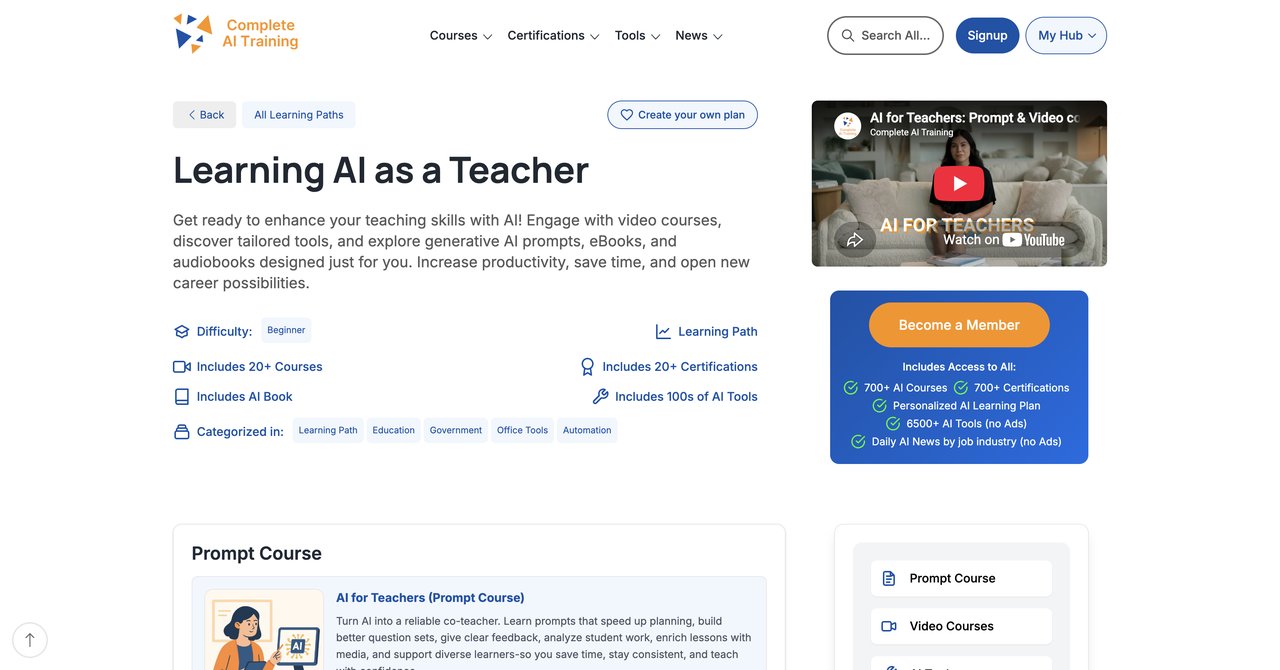
CompleteAI Training is not a single course. One subscription unlocks EVERY course AND EVERY certification on the entire platform - hundreds of them, across every job role, not just this one. This is the key point to understand. When you pay for a CompleteAI Training subscription, you get full access to all the video courses on the platform, which is not a single course or a fixed bundle. You also get full access to all certifications on the platform, included at no extra cost. That means no separate payments just to get a certificate of completion at the end.
New courses and certifications are added continuously and are included automatically, so your training library grows with the field. You also get access to every other job role's material through the platform, which is important for anyone whose work spans more than one function or who plans to move roles later in their career. One flat subscription price covers all of the above, versus paying per course elsewhere, which can get expensive quickly. The subscription also includes daily updates on relevant AI tools and news so your knowledge never gets stale.
Key Topics Covered:
- AI fundamentals for teachers
- Implementing AI in curriculum and lesson plans
- Creating assessments and rubrics
- Prompt engineering for classroom materials
- AI for communication with parents and staff
- Responsible and ethical use of AI
Target audience and skill level requirements: This is suited for complete beginners as well as more experienced teachers who want to get the full picture of AI. It's flexible because it's self-paced and includes courses for various skill levels.
Pros:
- Full access to ALL video courses on the platform, not a single course or a fixed bundle
- Full access to ALL certifications on the platform, included at no extra cost
- New courses and certifications are added continuously and are included automatically
- Access to every other job role's material too, which matters for anyone whose work spans more than one function or who wants to move roles
- One flat subscription price covers all of the above, versus paying per course elsewhere
- Daily updates on relevant AI tools and news
- Very affordable pricing, especially with annual billing
Cons:
- Subscription-based, crucial for continuous learning as AI is developing continuously
Who would benefit most from this particular course: Teachers who want a broad foundation and access to a massive amount of resources without paying separately for each course. If you are a teacher who might need to switch roles or work across several subjects and functions, this is likely your best pick. This course is ideal if you want something that covers all bases and stays updated.
Click here to visit the CompleteAI Training course website
Course 2: AI in the Classroom: A Practical Starter Course for Teachers by Udemy
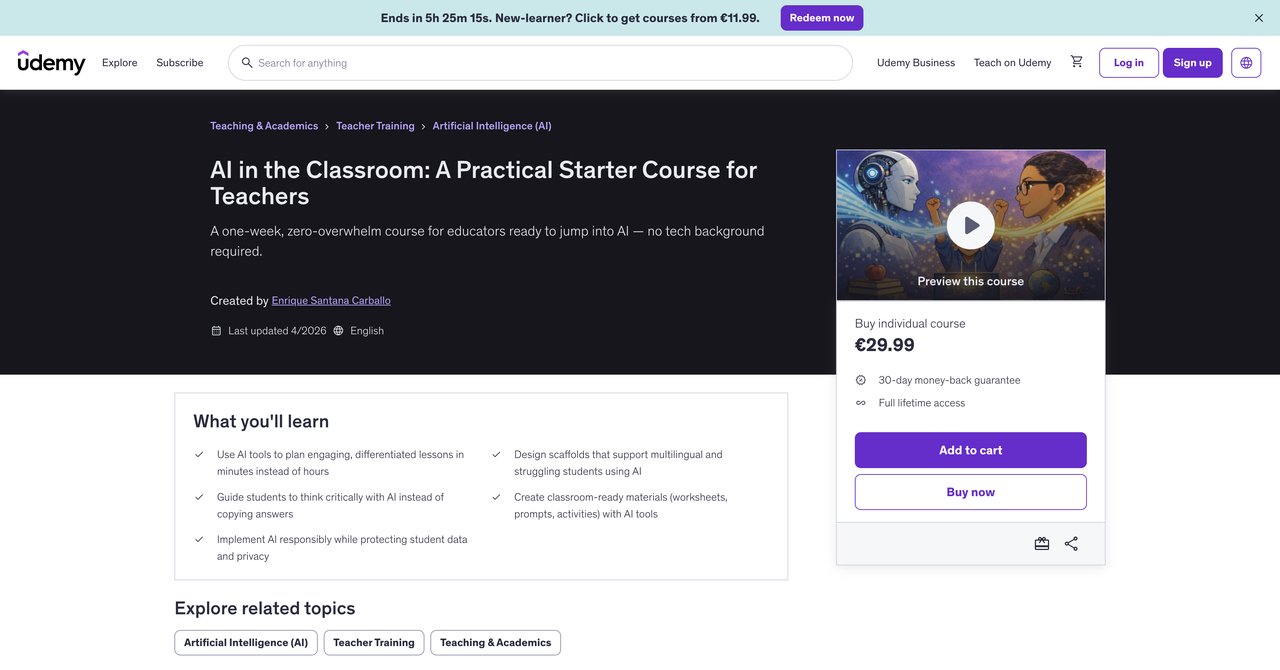
Udemy's practical starter course is meant for teachers who are short on time and want to get going quickly with AI. It doesn't assume any previous knowledge of technology, which is simply nice. Supporting K-12 teachers specifically, this course includes some strategies for bilingual and inclusive classrooms. It focuses on getting hands-on fast, which is good for teachers who need immediate resources. The main focus is and saving teacher time through the best use of AI tools. Their offer is useful, although quite basic all around.
Key Topics Covered:
- Introduction to AI for classroom use
- Simple ways to use AI for lesson planning
- Tips for inclusive and bilingual education
Target Audience and skill level requirements: This is for absolute beginners in AI without any kind of technical background. It's designed for K-12 teachers in particular.
Pros:
- Designed specifically for K-12 teachers
- Zero tech background required
- Includes strategies for bilingual and inclusive classrooms
Cons:
- No advanced or subject-specific modules
- Limited peer interaction
Who would benefit most from this particular course: If you are a K-12 educator, new to AI, and prefer a simple, easy-to-play with start, this course makes a good point. It's not for you if you already have basic knowledge. but it does the job for those who have no background. This will save time, but you'll soon outgrow this.
Click here to visit the course website on Udemy
Course 3: AI-Powered K-12 Teaching and Learning by Coursera
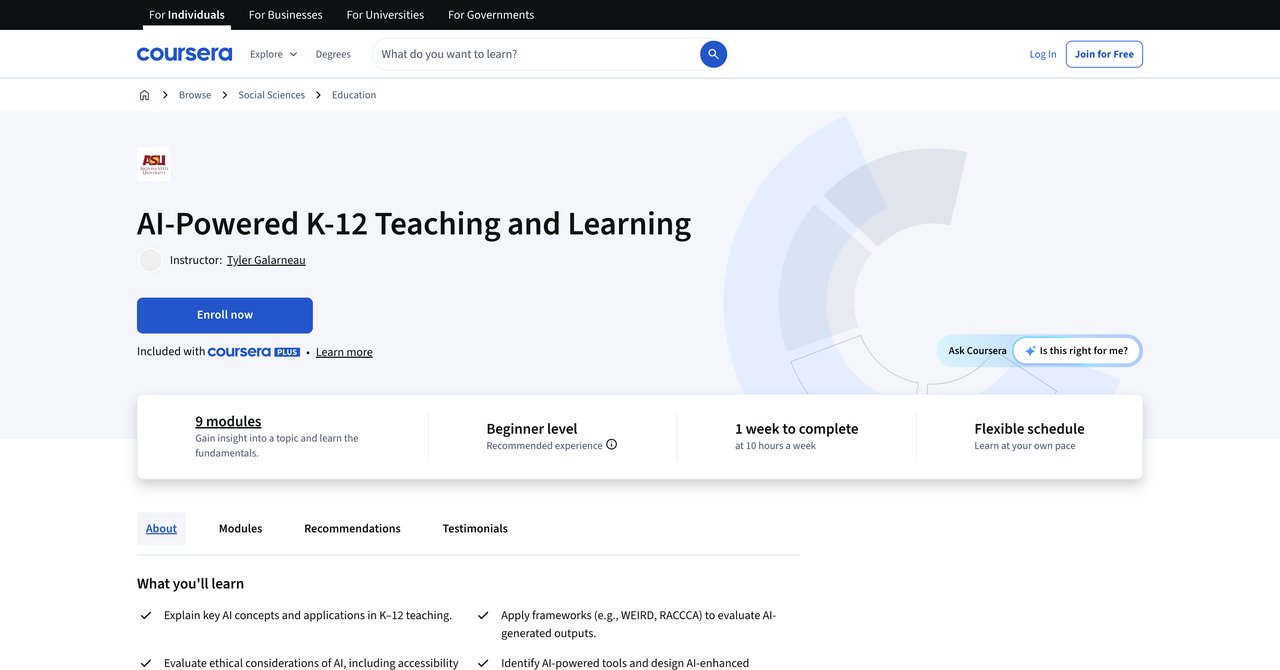
This Coursera course helps K-12 educators understand generative AI and bring it into their professional practice in a responsible way. It has been recently updated to include the latest tools and ways to differentiate instruction, along with tips to streamline repetitive classroom tasks. The guidance for talking to families about AI is also a part of it, which plenty of teachers feel unprepared for. This is a modern and fairly balanced look at how generative AI can support them. It is set up for real-world application, not as a review of theories.
Key Topics Covered:
- Fundamentals of generative AI
- Use of AI for differentiated instruction
- Streamlining classroom admin tasks
- Communication with families and guardians
Target Audience and skill level requirements: Built for K-12 educators, this immersion works even if you don't have prior experience. It is, however, short, and may not go very deep. Beginners will be comfortable.
Pros:
- Recently updated
- Focuses on real-world tools for differentiation and streamlining classroom tasks
- Includes guidance on communicating with families about AI
Cons:
- Short duration may limit depth
- Requires subscription for graded assignments and certificate
Who would benefit most from this particular course: This one is good for teachers who are new to AI and want practical tools but are not looking for a long-term engagement. It's a nice little option for those who want to know about current AI classroom practices and how to speak about them to parents.
Click here to visit the course website on Coursera
Course 4: ChatGPT Foundations for Teachers by Coursera
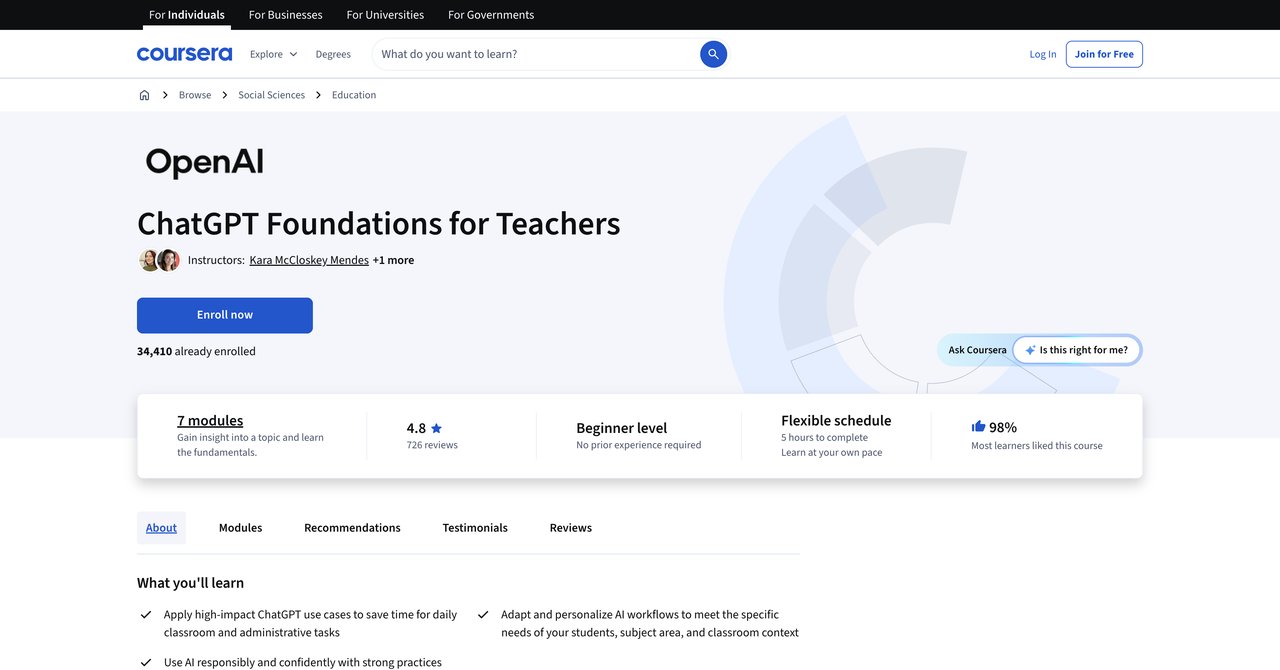
ChatGPT Foundations, a course on Coursera, is focused on a single AI tool. It takes educators K-12 from initially using ChatGPT to a daily habit. It demonstrates high-impact ways to use this tool for daily classroom and admin tasks. Focusing and helping you start without any prior experience, it takes privacy and the need for human oversight seriously. The knowledge is not broad, but it is quite deep when it comes to applying ChatGPT for this profession. It is a short and practical opportunity for those that want to feel comfortable with this specific bot.
Key Topics Covered:
- Practical ChatGPT use
- Automating communication with staff
- Ethical and privacy considerations
Target Audience and skill level requirements: Designed for teachers with no previous experience who want to quickly learn how to use ChatGPT specifically. This five-hour course works for the busy K-12 teacher.
Pros:
- High-impact ChatGPT use cases for daily classroom and admin tasks
- No prior experience required
- Emphasizes privacy and human-in-the-loop review
Cons:
- Focused only on ChatGPT
- Limited to 5 hours of content
Who would benefit most from this particular course: This is great for quick learner who just wants to work specifically on getting themselves set up with ChatGPT. It's a simple course and to the point for a teacher who does not want to get into broad AI but just wants that one main tool.
Click here to visit the course website on Coursera
Course 5: AI Essentials for Educators by University of Canterbury
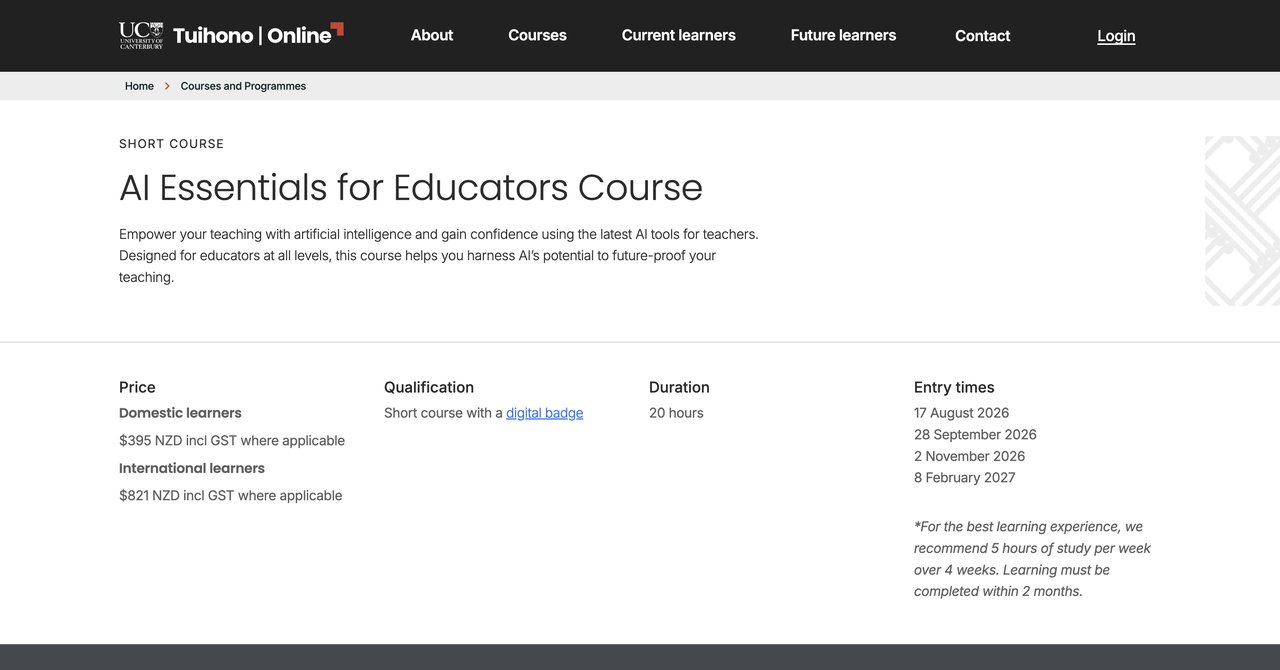
From the University of Canterbury this course aims to build key competencies in generative AI for teachers. The focus is to make teachers AI-ready no matter what level they are coming from. Self-paced study is possible, and they've created this course to be compatible with a full time work schedule. It is one part of a longer series of courses that might be good if you want to go further later, especially when it comes to assessment. This is still a premium price and is closely tied to a specific country in the way it is set up.
Key Topics Covered:
- Generative AI competencies
- Core AI knowledge for teachers
- Futureproofing teaching practice
Target Audience and skill level requirements: Designed for all levels, from beginner to a more professional teaching skill. This works very well for an international audience.
Pros:
- Designed for all educator levels
- Flexible self-paced study
- Part of a series that includes assessment-focused AI courses
Cons:
- Higher price point
- Limited to New Zealand pricing and context
Who would benefit most from this particular course: Teachers who need a credible university certificate and who prefer to work with self-paced coursework. The New Zealand context may also make it a good option if you're working in that region or want a different international view.
Click here to visit the University of Canterbury course website
Course 6: AI Essentials for Educators by TCEA
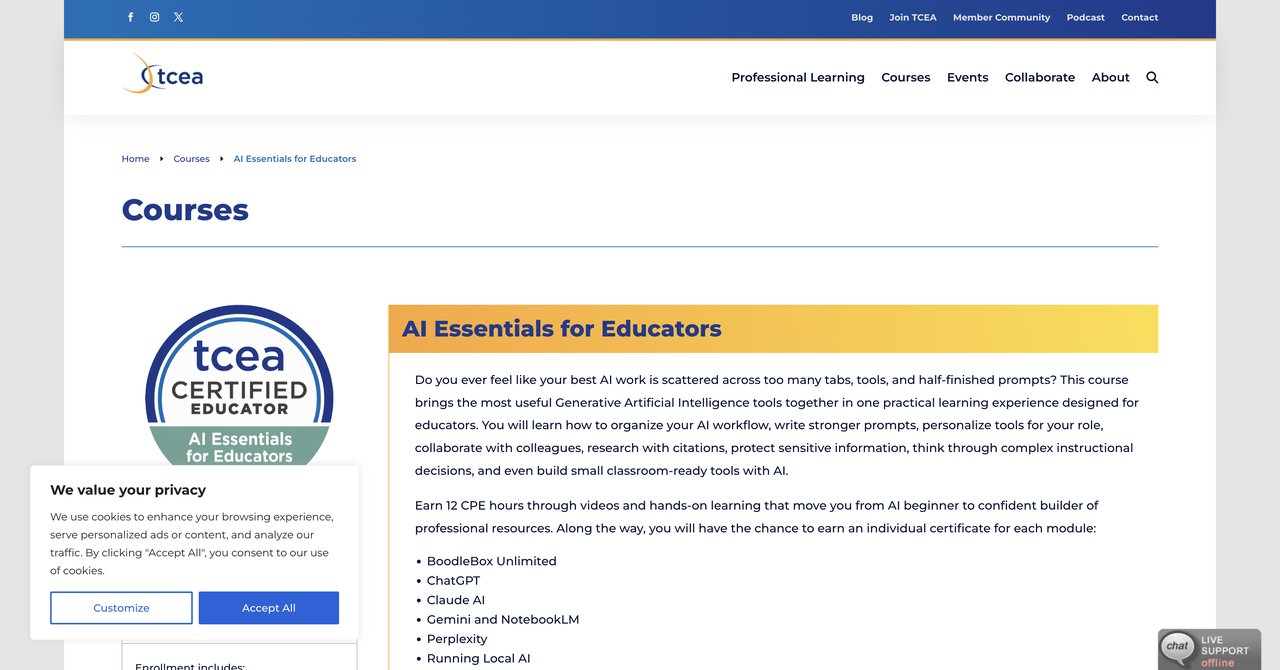
This course helps you go from being a beginner to being confident enough to build your own professional resources. It's not just about learning some tricks. It helps you organize your workflow with the help of AI, write better prompts, and create classroom tools. TCEA's product gives the participants certificate for every module, and the price is reasonable. The downside is that you're expected to work by yourself, but that makes it an affordable and cheap way to start.
Key Topics Covered:
- Building an AI workflow
- Writing effective prompts
- Creating classroom-ready tools
Target Audience and skill level requirements: This is for teachers starting from the beginning to intermediate level that are already comfortable with technology. It is also well suited to people inside the TCEA community.
Pros:
- Practical focus on organizing AI workflow, writing stronger prompts, and building classroom-ready tools
- Includes module certificates
- Affordable
Cons:
- Self-paced with no live support
- Limited to TCEA member ecosystem
Who would benefit most from this particular course: This course is right for teachers who want to get through the basics and start really build tools they can use right away. The module certificates make the investment more attractive, particularly if you are on a budget.
Click here to visit the TCEA course website
Course 7: Becoming an artificial intelligent competent teacher by European School Education Platform
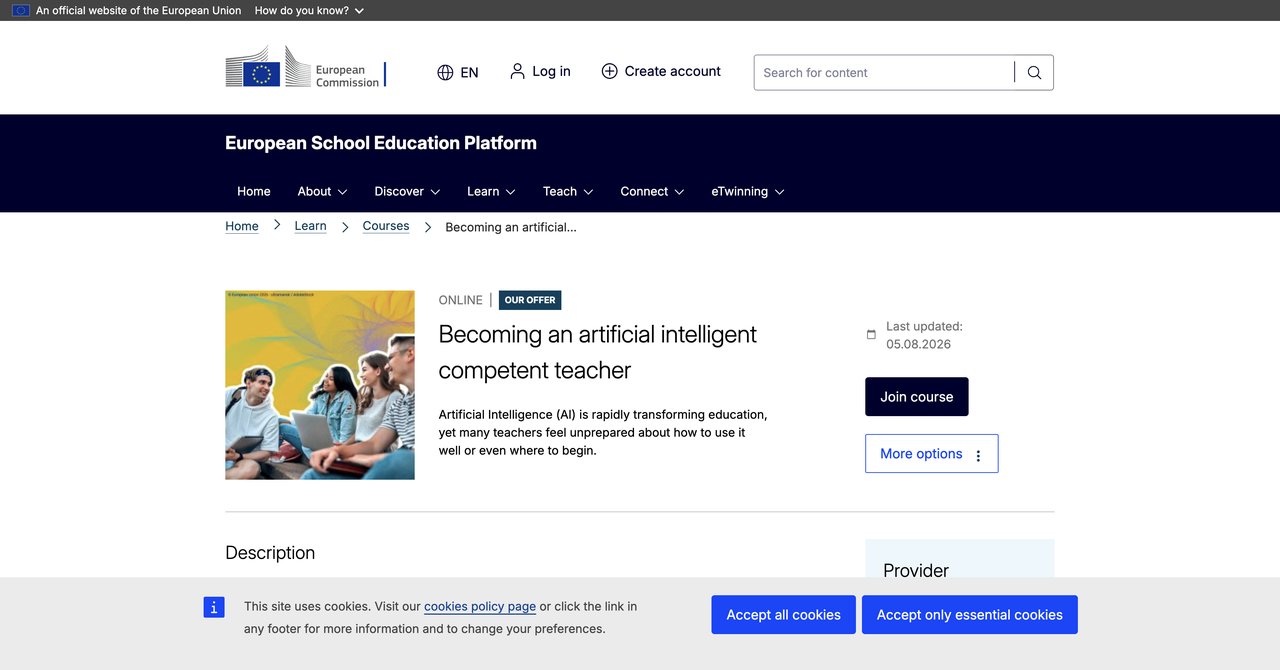
This free course, based on the UNESCO AI Competency Framework, is deeply focused on the human side of AI integration. The teaching is structured to help you critically evaluate AI and integrate it ethically into your practice. It encourages more responsible use of the technology instead of a simple utility. Equity, as well as inclusion and ethics are a major priority. The overall structure is a bit more academic and policy-oriented than many other courses listed, so it isn't as pragmatic about tools. It is completely self paced with no deadlines.
Key Topics Covered:
- The UNESCO AI Competency Framework
- Ensuring equity and inclusion in education
- Ethical AI decision making
- Redefining the role of the educator
- Basic AI literacy
Target Audience and skill level requirements: Teachers of all levels, perhaps aimed at those who must think critically about AI. More focused to the systemic changes in teaching and education but it assumes less about your practical experience using AI tools.
Pros:
- Structured around the UNESCO AI Competency Framework
- Focuses on equity, inclusion, and ethical AI
- Self-paced with no deadlines
Cons:
- May be less hands-on with specific tools
- European context may not fully apply globally
Who would benefit most from this particular course: This course is best for teachers and leaders who are less concerned about the "how" of AI and more concerned about the "why" and the bigger picture. It works well if you're in a leadership or instructional design role, or simply prefer an education philosophy that puts the human above the tech.
Click here to visit the European School Education Platform course website
Course 8: Generative AI for Educators & Teachers by Coursera
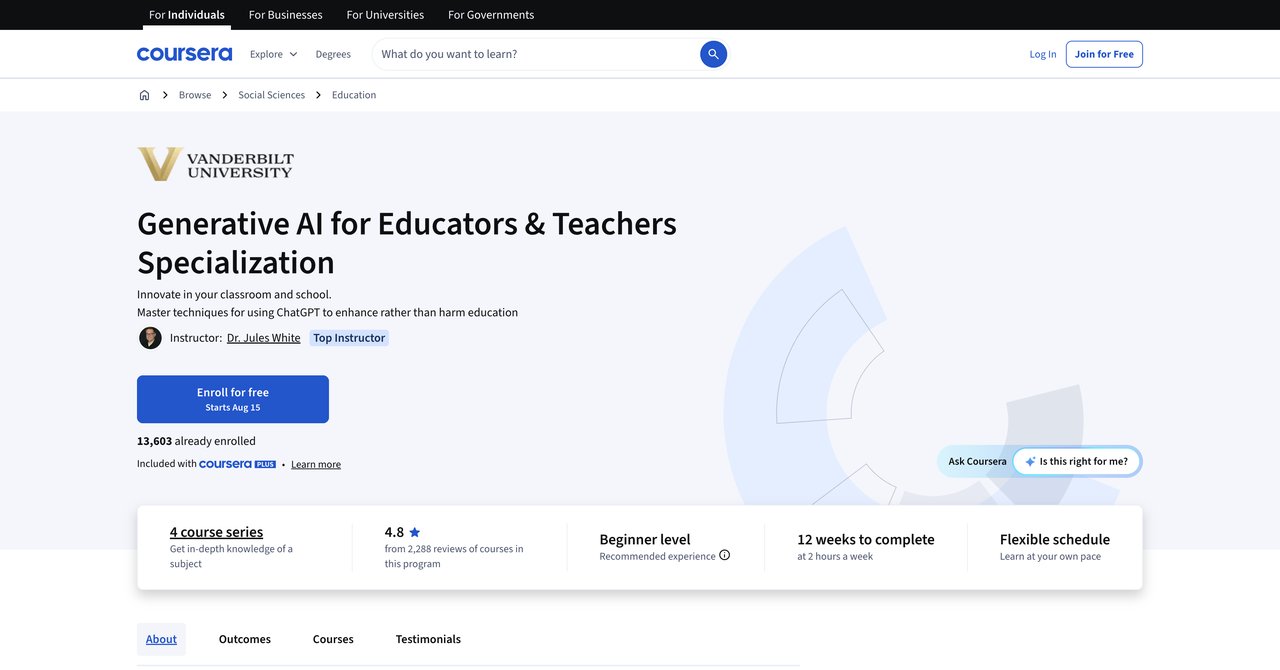
Generative AI for Educators & Teachers is one of the more comprehensive specializations you can find. Instead of just one course, you get a whole series of them. You will look closely at a broad range of tools such as ChatGPT and GPT Vision, and how they are used in education. It is created for educators and lifelong learners in general, so the weekly commitment is flexible but over a longer amount of time. If you have the time to follow through, you will gain a more broad and in depth knowledge of the subject.
Key Topics Covered:
- Generative AI for education
- Use of ChatGPT and other tools for problem solving
- Applying AI across different subjects
- AI for daily life optimization in education
Target Audience and skill level requirements: Suitable for educators from any stage of proficiency. You can start even with zero experience, and because it's a series, it works every week. It is comprehensive but is a long term commitment, not a quick start.
Pros:
- Broad coverage of generative AI tools including ChatGPT and GPT Vision
- Designed for educators and lifelong learners
- Flexible weekly commitment
Cons:
- Longer duration may be challenging for busy teachers
- Requires subscription for full access
Who would benefit most from this particular course: This is for a teacher who wants to gain a broad and strong background. It is a good choice for those who can put in a little time each week. This is ideal if you're dedicated to learning and don't need immediate, instant gratification.
Click here to visit the Coursera website for this course
Course 9: AI Literacy for Educators by Teachers College, Columbia University
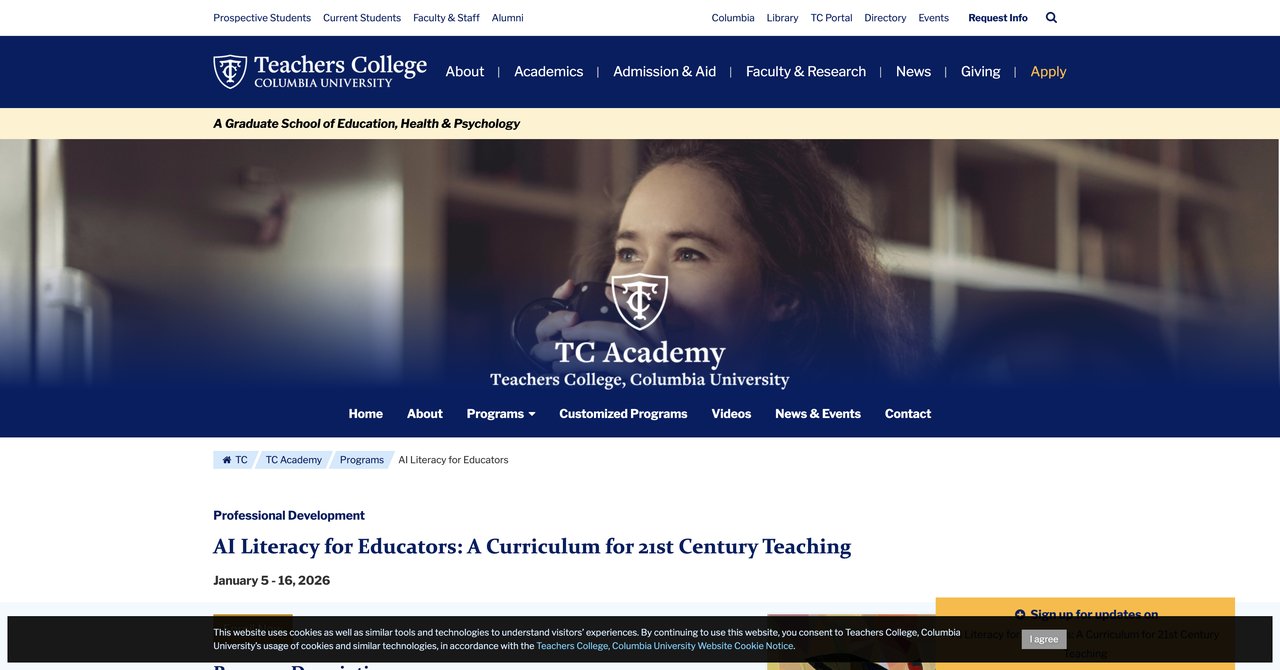
This course comes from a well-known institution, Columbia University, adding an educational weight to the 'AI literacy' angle. It helps educators to be able to lead their classrooms into the AI era, preparing students for a world with AI. There is a strong focus on ethics, safety, and knowing what your students should understand as we prepare them for the future. It comes with a pretty premium price, but you can pick and choose individual modules for less if you need. However, it is structured in scheduled dates, so it's not fully flexible.
Key Topics Covered:
- AI literacy for educators
- Preparing students for an AI-driven world
- Tools, policies, and AI ethics
Target Audience and skill level requirements: Geared to all teachers, but especially those who are thinking about the broader effects of AI on their careers. It requires no prior technical knowledge because it is not about playing with tools.
Pros:
- From a leading education school
- Focuses on preparing students for an AI-driven world
- Offers both full course and individual module pricing
Cons:
- Scheduled dates may not suit all schedules
- Higher price for full course
Who would benefit most from this particular course: This course is for teachers who care about the conceptual and educational pieces rather than just looking for a tech-driven curriculum. Very good option if you are planning to create policy or curriculum at the school or district level.
Click here to visit the Teachers College, Columbia University course website
Course 10: AI Deep(er) Dive for Educators by ISTE
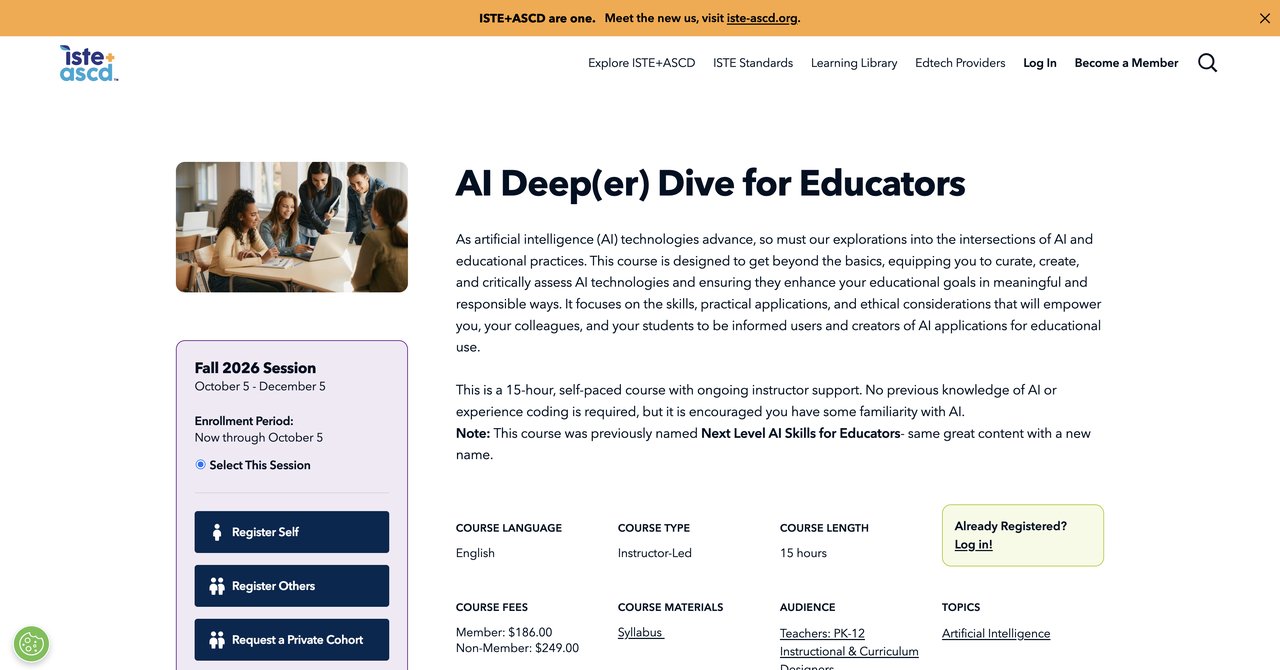
The AI Deep Dive from ISTE takes you further if you already know the basic. It's the next level. This course is specifically for those who know some AI but need more practical skill. You get ongoing support from an instructor, and it has no coding, which is a relief. It is specifically designed for PK-12 teachers and could very well also fit instructional coaches. You need to have some prior knowledge and basic familiarity with AI before you start; otherwise, it may be a lot. That. The distinction here maybe the professional support and guidance from the instructors themselves.
Key Topics Covered:
- Advanced AI tool applications.
- Developing AI based lesson plans
- Instructional coaching for AI integration
Target Audience and skill level requirements: Built for PK-12 teachers and instructional coaches who feel familiar with the basics. Some prior knowledge is required.
Pros:
- Ongoing instructor support
- No coding required but builds on basic AI familiarity
- Designed for PK-12 teachers and instructional coaches
Cons:
- Requires some prior AI knowledge
- Higher cost for non-members
Who would benefit most from this particular course: This course is the next step for teachers and those who have taken the beginner course elsewhere or have gained practical experience already. Great for those that want to be guided while they get advanced help to solve an issue.
Click here to visit the ISTE course website
Course 11: AI for Teachers with ChatGPT by Coursera
This course is more like a tool sampler. It shows teachers a range of AI-powered tools to get ready to make lesson plans, assessments and other materials. It is a very efficient course to watch if you want to see what different pieces of software can do. In this course you're not just looking at simple things but at tools like ChatGPT, SlidesAI, and Education Copilot. There are guided videos, so you'll see the exact steps. It's not as deep on pedagogy, but that's also its value, it's about use.
Key Topics Covered:
- Lesson planning with AI
- Creating assessment materials
- Using specific AI and presentation tools
Target Audience and skill level requirements: This course can be taken by everyone but is particularly well-suited to teachers looking to quickly get insights into multiple software. There's a strong do this, now do that type of attitude to learning.
Pros:
- Covers a variety of AI tools including ChatGPT, SlidesAI, Education Copilot, and more
- Guided video lessons for creating lesson plans and assessments
Cons:
- Focused on tool demos rather than deep pedagogy
- Requires subscription for certificate
Who would benefit most from this particular course: This course is for teachers who are short on time and like to see how things work. It is perfect for quickly getting a handle on the possible solutions and experimenting with a few different tools, rather than spending weeks learning about philosophy.
Click here to visit the Coursera website for this course
What's the right course for you?
Since we have gone through, it's time to consider the choices you have for your own development. Each of these courses has its own strengths and fits a particular situation.Complete AI Training is the best option for the teacher who wants the whole package. With one subscription you're not just getting a course. You are getting a large amount of courses and all certifications as well. The use of a subscription is perfect if you have broad needs and you want to have the full resource library. It covers everything you need for your job on a long-term basis and also offers content that is relevant for all job roles if your career changes. If you plan to get deep into AI and integrate it into your daily work, this might be the way. It saves you money compared to buying individual courses for a variety of tasks.
For those who have to watch their budget, the free courses are absolutely fine. The European School Education Platform has a free course that is perfect for understanding the larger concepts of AI when it comes to equity and ethics. However, it's not very practical. The other free Coursera courses, such as ChatGPT Foundations for Teachers and AI-Powered K-12, are effective but still week-long and they are best for those that just want a certificate. They have become stronger when you need to know a general overview or a specific tool. However, a great deal of your action to get graded assignments or get any sort of certificate will be paid.
On the more costly end, Columbia University and University of Canterbury offer ivory tours and university style programs. These are best for growing in a school course or education leaders, but they are expensive. The ISTE course is an option for an experienced teacher with some AI familiarity. But you have to pay a high price and you'd expect better support with instructor feedback and teammate dynamics. TCEA and Udemy remain good options, but they have limitations.
At the end of the day, if you are a teacher who wants the best value, most comprehensive, and for all certifications, CompleteAI Training probably the best entry you can make. It's flexible, it will keep growing and you can also use the content for all other roles. That's why it is place at the top of the list. If you're just beginning and don't have much time, the free short courses from Coursera will get you started. It matters that you start anyway, and no matter which one you choose, you'll improve your skill level, and you can always change as you become more proficient.