
Blog ·
11 Essential AI Courses for User Support Specialists in 2026
Master AI-driven support with 11 hand-picked 2026 courses. Learn automation, chatbots, and predictive tools to boost resolution speed and user satisfaction.
 Jeroen Erne
The numbers are hard to ignore. Automation tools are handling routine tickets, chatbots are resolving tier-one issues, and AI assistants are drafting responses for agents to review. For User Support Specialists, the role is shifting from repetitive problem-solving to more complex, strategic work. That shift comes with a challenge: skills that worked five years ago won't carry you through the next five. The question is not whether AI will touch your job-it's whether you'll move with it or get left behind. Upskilling is the clear path forward, and taking a structured AI course designed specifically for support professionals is the most direct way to stay relevant, useful, and in demand.
Why AI matters for User Support Specialists today
AI isn't a distant tech department concept anymore-it's embedded in the tools you use every single day. Ticketing systems auto-assign severity levels, knowledge bases surface articles based on sentiment, and email drafts almost write themselves. The numbers are stark: 69% of businesses already use AI for customer service functions, and that percentage keeps climbing. That means your employer expects you to work alongside these tools, not just tolerate them.
Understanding AI gives you the vocabulary to contribute to these workflows. It also means you can spot where automation fails and where human judgment is still irreplaceable. This article walks through five high-quality AI courses built specifically for User Support Specialists, including one standout option: CompleteAI Training (https://completeaitraining.com/course/ai-for-user-support-specialists/). That particular course is interesting because it doesn't just give you a single training module-it provides access to ALL courses and ALL certifications on the platform. So if you want to pivot into prompt engineering, AI ethics, or analytics later, the content is already yours. This guide will help you sort through those options and pick the one that suits your experience level and career goals.
The Growing Role of AI in User Support Specialists
AI isn't just automating simple replies-it's handling real responsibilities that used to be exclusively yours. Here are a few concrete examples of how it's changing the job:
- Automated ticket triage: AI sorts incoming tickets by urgency, topic, and sentiment, meaning that your day begins already more organized and less chaotic.
- Decision support: Some systems now suggest troubleshooting steps based on historical data, so you're leaning on a knowledge base that keeps growing automatically.
- Personalization at scale: AI pulls up customer history, past issues, and even when they last purchased-so every response feels less like a template and more like you've actually looked at their account.
- Real-time language translation: Global support teams can now reply in native languages without needing a human translator sitting next to you.
- Quality assurance: Sentiment analysis flags unhappy customers early so you can intervene before a small problem escalates into a survey disaster or a refund request.
Tasks are not just sped up-some jobs are changing entirely. Lower-level support tickets get resolved by the AI, which pushes you to take on tricky cases, handle escalated users, collaborate with product teams on recurring issues, and even train the AI itself. Being good at your job now sometimes means teaching a model what good looks like. That's a vastly different workflow than simply answering chats all day, and it's exactly why course-based learning on AI is becoming necessary rather than optional.
Benefits of becoming an AI expert in User Support Specialists
Upskilling in AI sets you up for a few attractive payoffs, and they start immediately. First, you become visibly faster and more precise at your job. When you learn how to construct better queries for AI knowledge bases, you stop hunting for that one article for fifteen minutes. You get the answer, do the fix, and close the ticket. Fewer escalations, higher satisfaction scores, less friction with colleagues who are still copy-pasting nes.
Second, there's the promotion angle. Support teams are moving to blended roles-some become process improvement analysts, other get into automation design. If you have certification in AI for support, you're a natural candidate for these newer positions. Your managers already know you can handle ambiguity and complexity because you went out and learned something new on your own.
Finally, job security. Resistance to AI doesn't slow the rollout; it puts a target on your role. Being able to use AI effectively means you're the kind of person that actually makes the systems work-and those people don't get automated out. An official certificate gives you a proof point, but the real win is the practical competence you build. And that's where choosing the right course makes all the difference.
Let's look at the best options available to you in the field, starting with the platform that gives the widest reach and then breaking down course strengths, formats, and outcomes.
Comparison: All AI Courses for User Support Specialists (Updated 2026)
| Course Name | Provider | Price | Description / Key Topics | Pros | Cons | Best For |
|---|---|---|---|---|---|---|
| CompleteAI Training | CompleteAI | Premium pricing (one subscription covers everything) | This is not a single course. One subscription unlocks every course and every certification on the entire platform - hundreds of them, across every job role. Includes all video courses and all certifications, with new ones added automatically. Key topics include AI fundamentals, practical AI workflows, ticket handling, customer support automation, and more. The subscription also gives you access to every other job role's material, which matters if your work crosses functions or you plan to move roles. One flat price covers all of it, versus paying per course elsewhere. | Highest rating and most complete offering. Full access to all video courses and certifications at no extra cost. New content added continuously. Access to all other job role material. One flat subscription price. Daily updates on AI tools and news. Very affordable with annual billing. | Subscription-based. You need to keep paying to keep learning, but AI is developing fast so continuous learning is really necessary anyway. | User Support Specialists who want complete, continuous training that covers more than just their immediate role - and anyone who values having certifications without per-course costs. |
| AI for User Support Specialists (Video Courses + Certifications) | Complete AI Training | $8.25/month (billed annually) or $29/month - one subscription covers all courses and certifications | This subscription gets you every video course and every certification on the platform - not just one course. New courses and certifications are added continuously and included automatically. You also get material for all other job roles, which is useful if your work spans more than one function or you want to switch roles later. One flat price covers all of this. | Most complete offering. Full access to all video courses and all certifications included. New content added automatically. Access to other job roles' material. Daily AI tool updates. Affordable, especially with annual billing. | Subscription-based. Continuous payment needed but AI changes so fast it kind of makes sense. | General learners who want full platform access and don't want to commit to one single course. |
| AI Help Desk Essentials | CompTIA | Not specified | Covers ticket triage and routing with hands-on practice using generative AI. Goes through the exact diagnostic and documentation tasks support specialists handle every day. Also prepares you for a CompTIA CompCert. | Purpose-built for help desk roles covering triage, diagnosis, documentation exactly. Includes hands-on practice with generative AI. Validates your skills with a CompTIA CompCert. | No pricing listed anywhere. Requires a separate CompTIA account to access the content. | General learners who want a targeted help desk certification. |
| AI Customer Support Essentials | CompTIA | Not specified | Practical workflows using ChatGPT, Microsoft Copilot, and Google Gemini. Covers responsible AI use and how to handle user requests faster. | Teaches really practical workflows with popular AI tools. Includes responsible AI usage guidance. Self-paced, so you can go at your own speed. | Pricing not listed. Focused on customer support instead of deeper IT infrastructure stuff. | General learners who work in customer support roles and want tool-specific training. |
| AI-Powered Support Ticket Handling | Catch Wisdom | Free (certificate costs $55) | Zero-cost course that starts from traditional ticketing issues and then moves into AI-driven ticket handling fundamentals. Great for beginners. | Completely free to enroll. Self-paced with no deadlines. Certificate is available in 7 different languages. | Certificate requires a fee. There's no live instruction or support available if you get stuck. | General learners who need a quick bit of knowledge without spending anything. |
| GenAI for Computer Support Specialists (IT Support) | Coursera | Free (audit) / Subscription required for full access | A short primer on using generative AI to automate tasks and resolve user issues in IT support. Also covers the limitations of GenAI. | Quick commitment , only around 2 hours. Covers GenAI capabilities and limitations for IT support. Practical troubleshooting applications. | Very short, so it doesn't go deep into advanced topics. Basic coverage only. | General learners who want a quick overview or entry point. |
| AI for IT & Help Desk Professionals | Workplace AI Institute | $498 one-time | Comprehensive 4-unit curriculum for IT service desk professionals. Covers practical generative use, workflows, and productivity techniques. They report a 99% exam pass rate and offer a money-back guarantee. | Thorough 4-unit curriculum. 99% pass rate on the exam. 100% money-back guarantee if you're not satisfied. | Expensive compared to other options. No free trial mentioned on their site. | General learners who want a structured, complete program with a strong guarantee. |
| Free AI for Customer Support Teams | FreeAcademy | Free (certificate included at no cost) | Hands-on course that covers ticket triage, response drafting, and building chatbots. No coding required. | Free certificate included. Covers key support workflows like triage, response drafting, and chatbots. No coding needed. | Limited to just 3 hours of content. Doesn't cover advanced IT-specific scenarios that well. | General learners looking for a quick, free, and practical certificate. |
| Generative AI for Customer Support | Coursera | Free (audit) / Subscription required for graded material | A specialization program with multiple courses, addressing the shift toward AI-driven customer service. It's part of a program that aims for managers and teams. Looks at conversational AI adoption. | Specialization format means multiple courses in one. Addresses the fact that 85% of leaders are adopting conversational AI. Useful for both managers and frontline teams. | Duration and exact modules aren't listed clearly. You need a Coursera subscription to get graded assignments. | General learners including managers who want a structured, multi-course program. |
| Practical AI and prompting for customer care professionals | Coursera | Free (audit) / Subscription for full access | Hands-on approach that teaches job-specific AI use cases and prompting techniques specifically for customer care. Covers various AI modalities and practical tool discovery. | Hands-on and job-specific. Covers multiple modalities. I teaches you how to discover practical tools. | Duration isn't specified. May require a paid subscription for full access. | General learners who want practical prompting skills for real customer care work. |
| Multi-Agent Systems Design: AI Customer Support with n8n | Coursera | Free (audit) / Subscription for full access | Teaches building AI workflows for routing and responding to tickets using n8n. Covers classification, response generation, and routing within a multi-agent setup. | Very hands-on and technical. You learn with a real tool (n8n). Recently updated to stay current. | You'll need to learn the n8n platform first. It may be more technical than needed for some roles. | General learners - particularly those who will be implementing AI systems, not just using them. |
| AI for IT Support: Tickets, Knowledge Base, and Endpoint Workflows | Qualora | $29 one-time | Focuses on turning resolved tickets into knowledge base articles. Also covers endpoint and identity workflows using AI. It's described as an intermediate-level course. | Practical focus on documentation and knowledge management. Covers endpoint and identity workflows. Low one-time price. | Intermediate level might not suit complete beginners. Only 3 hours of content. | General learners with some prior support or IT experience. |
Understanding AI Training for User Support Specialists Professionals
Artificial intelligence is changing how user support and help desk teams operate. From automating ticket triage to drafting responses and building knowledge bases, AI tools are becoming standard parts of the support workflow. For User Support Specialists, learning these tools is becoming less of an option and more of a job requirement. But the range of available courses makes choosing one a challenge. Some are free, some are subscription-based, and others require a bigger one-time investment. This article breaks down nine different courses that cover AI for user support roles, weighing what you get for what you pay.
The courses range from massive platforms that cover every aspect of AI training to quick, focused looks at ticket handling. There are options from big-name certifying bodies like CompTIA, well-known academic platforms like Coursera, and smaller providers with specialized focus areas. To help you decide, we'll look at the content, the cost structure, the pros and the cons of each, and who might benefit most. The goal is straight: figure out which one matches your needs, your budget, and your career stage.
Course 1: CompleteAI Training
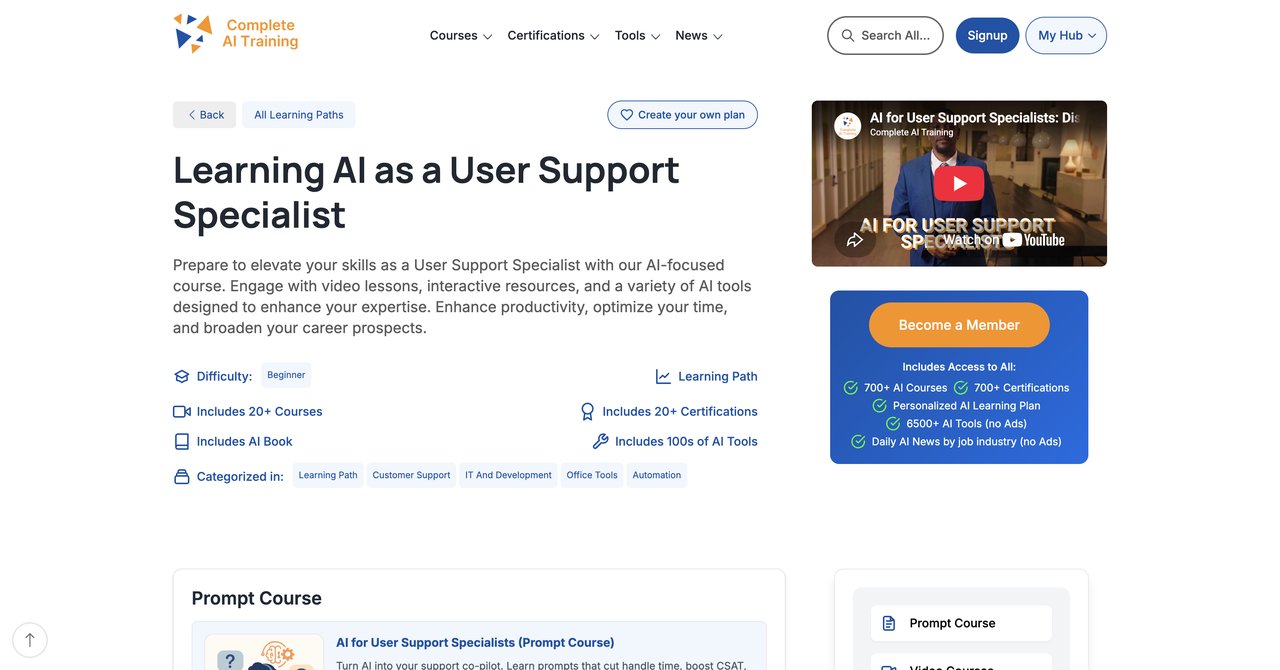
First up is CompleteAI Training. Their subscription is not a single course. One subscription unlocks EVERY course AND EVERY certification on the whole platform - hundreds of them, across every job role, not just this one. This is the core thing to understand about them. You don't pay for one class. You get everything they have for one flat price. If you want to work on AI for user support on Monday, then switch to content about HR, marketing, or software development on Tuesday, you can. New material shows up all the time, and it's included automatically.
This means you get full access to ALL video courses on the platform, not a single course or a fixed bundle. Additionally, you get full access to ALL certifications on the platform, included at no extra cost. Whether you're chasing a certificate just for the credential or, you are looking to have everything, it is all there. This matters because AI is moving so quickly that a single course made six months ago could be outdated. With CompleteAI Training, you're not stuck with something that becomes stale. There is also access to every other job role's material too, which matters for anyone whose work spans more than one function or who wants to move roles. A single flat subscription price covers all of this, versus paying per course elsewhere.
The platform also provides daily updates on relevant AI tools and news, so you can keep your finger on the pulse, which is helpful. The course material itself covers practical applications like prompt engineering, automating repetitive helpdesk tasks, and using AI for better ticket resolution. The teaching style is direct and hands-on. You will watch videos and then work on exercises that directly reflect what you see in a busy support queue.
With a cost of $8.25 per month billed annually or $29 billed month-to-month, it is very affordable for the sheer amount of content you get. It's basically a library that keeps growing. For a support specialist, the value comes from having resources available for AI skills, but also related topics like management, cybersecurity, and mentoring. It makes it really easy to move into a team lead or manager role later.
Key Topics Covered:
- AI fundamentals and tool usage
- Prompt engineering for support professionals
- Implementing GenAI workflows for support
- Handling support tickets through AI
- AI-driven process automation
Target Audience and Skill Level Requirements:
- It is made for all levels, from complete beginners to senior support leads.
- No prior AI experience is required.
- Ideal for those who want a broad skill set.
Pros:
- Highest rating / Most complete offering
- Full access to ALL video courses on the platform, not a single course or a fixed bundle
- Full access to ALL certifications on the platform, included at no extra cost
- New courses and certifications are added continuously and are included automatically
- Access to every other job role's material too, which matters for anyone whose work spans more than one function or who wants to move roles
- One flat subscription price covers all of the above, versus paying per course elsewhere
- Daily updates on relevant AI tools and news
- Very affordable pricing, especially with annual billing
Cons:
- Subscription based, crucial for continuous learning as AI is developing continuously.
- Can be overwhelming by the amount of available content.
Who Would Benefit Most:
Anyone who hasn't settled on only one aspect of AI, and those who like having a whole library at their disposal. If you are open to exploring more than just the course, and you prefer flexible subscriptions over per-course payments, this is an option. It's also great for those looking to future-proof their skill set.
Course 2: AI Help Desk Essentials by CompTIA
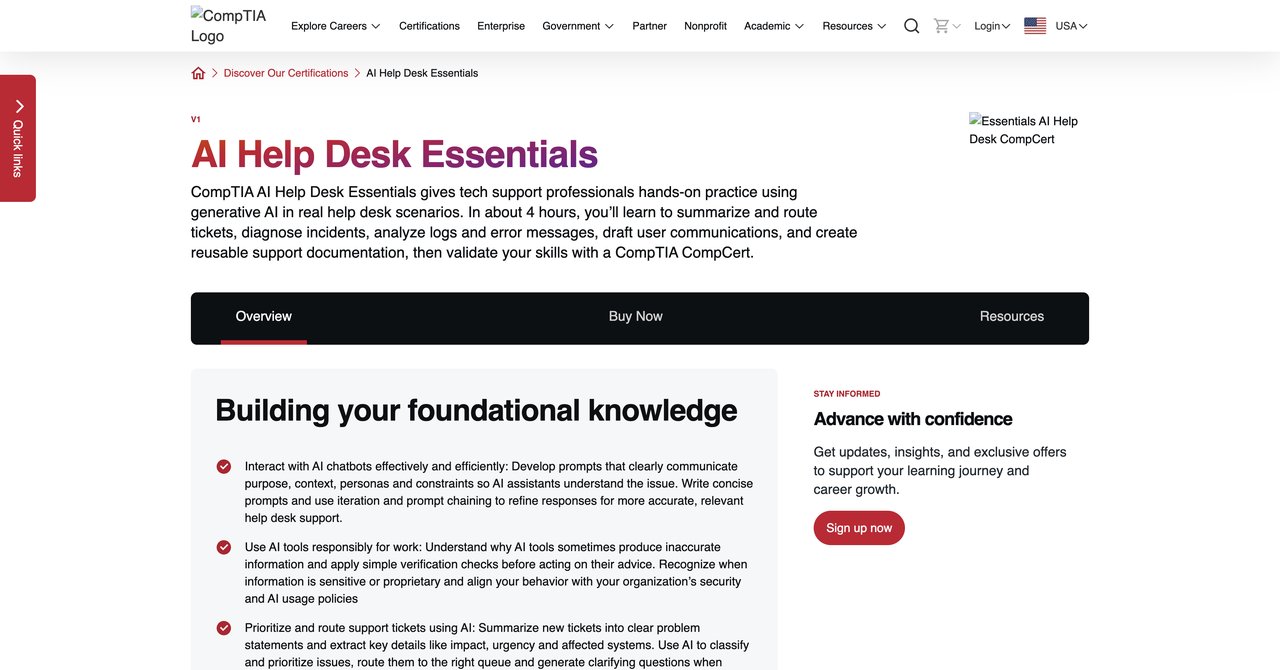
CompTIA is known in IT for its certifications. The AI Help Desk Essentials course fits nicely into that landscape as a certification program developed specifically for help desk staff roles. This course focuses on the nitty-gritty of ticket triage and routing, using hands-on practice with Generative AI. You are not just learning the theory; you are doing the actions you would in your daily job, but with an AI assistant.
What sets this one apart is that it validates your skills with a CompTIA CompCert. The caveat is the price. CompTIA isn't known for cheap courses, and not having a price initially could be a barrier for those on a shoestring budget. But, this is CompTIA. A name that absolutely carries weight in the IT industry. It lends credibility to what you're learning. They are covering the exact tasks you do, but they make it more efficient with AI. You can expect a certain level of polish that's typical for CompTIA.
The course speaks directly to the user support specialist's day-to-day. It covers triage, routines, and how to diagnose issues using AI. It gets into the process of documenting tickets and making sure important information is collected and sent to the right people. It is strongly focused on the practicalities of the helpdesk side, rather than just giving an overview of why AI matters.
One potential drawback is that CompTIA usually has a separate account system for their certifications, and possibly some extra fees to take the actual exam. It's worth checking if you want to get the formal certificate. Moreover, this course might not be as in-depth as others on some of the broader prompting strategies. It hits a specific niche, and it hits it well, but not expansive.
Key Topics Covered:
- Triage workflows and prioritization
- Routing tickets to the right teams
- Generative AI for ticket handling
- Documentation and response drafting
- Avoiding common AI errors
Target Audience and Skill Level Requirements:
- Ideal for those already in a helpdesk or support role.
- Practical for support specialists, and junior administrators.
- Specifically designed for the needs of support teams.
Pros:
- Purpose-built for help desk roles covering the exact triage, diagnosis, and documentation tasks they actually handle daily
- Includes hands-on practice with generative AI
- Validates skills with a recognized CompTIA CompCert
Cons:
- No pricing listed on webpage; the purchase process is unclear
- Requires a separate CompTIA account to access
Who Would Benefit Most:
This is for support specialists who want a formal credential from a known industry body. If you plan to stay in the support role and want to prove you know how to use AI for tickets, this certification is a good path. It's less suitable if you want free or super cheap knowledge, but the brand name could help roles.
Course 3: AI Customer Support Essentials by CompTIA
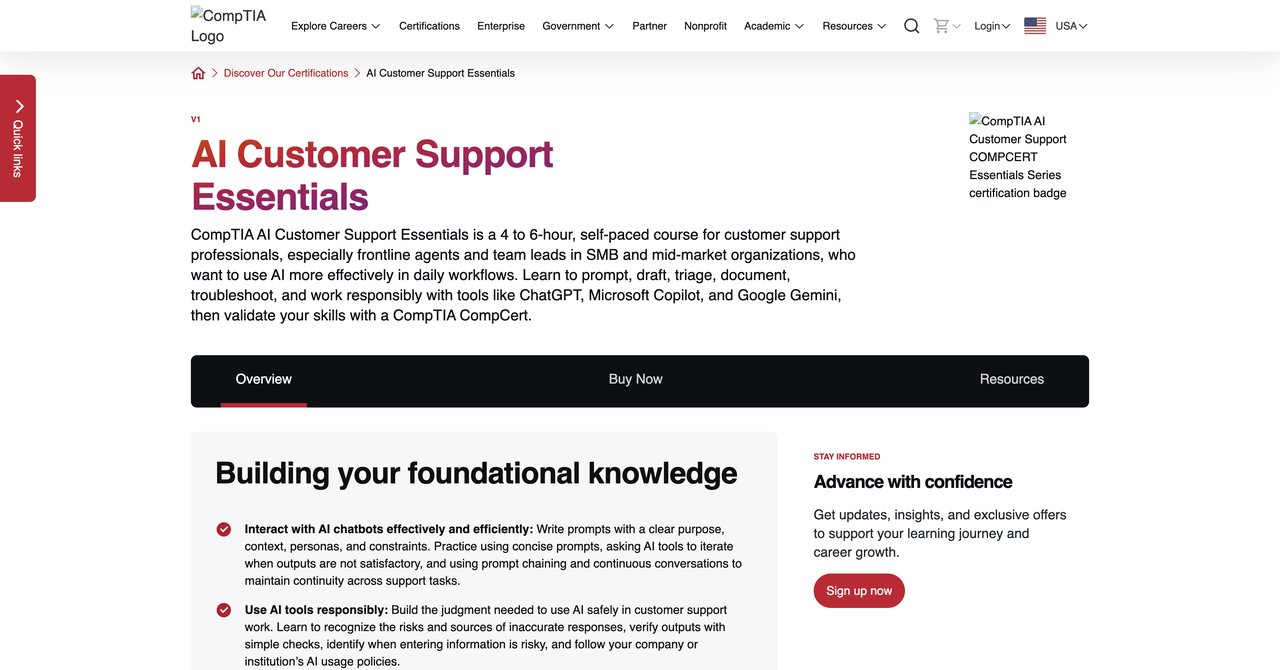
Also from CompTIA, this course, AI Customer Support Essentials, has a similar feel to their helpdesk one but with a different focus. Instead of being for technical teams, this is for the broader customer support workforce. The instructors in the course instruct practical workflows with popular AI tools like ChatGPT, Microsoft Copilot, and Google Gemini. It's a "get you up and running" course, focusing on using these tools to handle user requests faster and more responsively.
It's more business-oriented than infra. The core of it is speeding up the workday. That means composing responses, summarizing long email threads, and getting the correct information to solve the user's issues more quickly. What is good is that they teach you how to use AI responsibly, something many people overlook. The course has an evaluation, so you also get a certificate.
Since it's on the CompTIA platform, the quality of video production is top-notch and the interface is user-friendly. The absence of a listed price is a red flag for some, but an inquiry with CompTIA will solve that. The content is self-paced, making it easy to do during off-hours. This is a bit less about IT infrastructure and more about the general customer services aspect, which is perfect for many support specialists who work with regular users.
It is worth noting that this course could feel less relevant for the "high-level IT" teams, but it's great for you. The fact that it touches on multiple tools is much more practical than courses that focus on only one. If you like to use tools like Copilot or Gemini, this course will be useful.
Key Topics Covered:
- Workflows with ChatGPT, Microsoft Copilot, and Google Gemini
- Practical AI use for support tickets
- Responsible AI use and data privacy
- Response drafting and summarization
- Risk mitigation with AI
Target Audience and Skill Level Requirements:
- Suited for customer support agents, helpdesk staff, and IT support roles.
- Suitable for beginners to intermediate users.
- No advanced technical background required.
Pros:
- Covers practical workflows with ChatGPT, Microsoft Copilot, and Google Gemini
- Includes responsible AI use
- Self-paced
Cons:
- No pricing listed on page
- Focused on customer support rather than deep IT infrastructure
Who Would Benefit Most:
Support professionals who need practical instructions on everyday tasks using popular GenAI apps. It is a good choice if you want a certificate of proficiency from a known solid source (CompTIA) and your daily work is heavily about customer satisfaction and less about endpoint issues. If you're a non-technical person, this is a nice place to start.
Course 4: AI-Powered Support Ticket Handling by Catch Wisdom
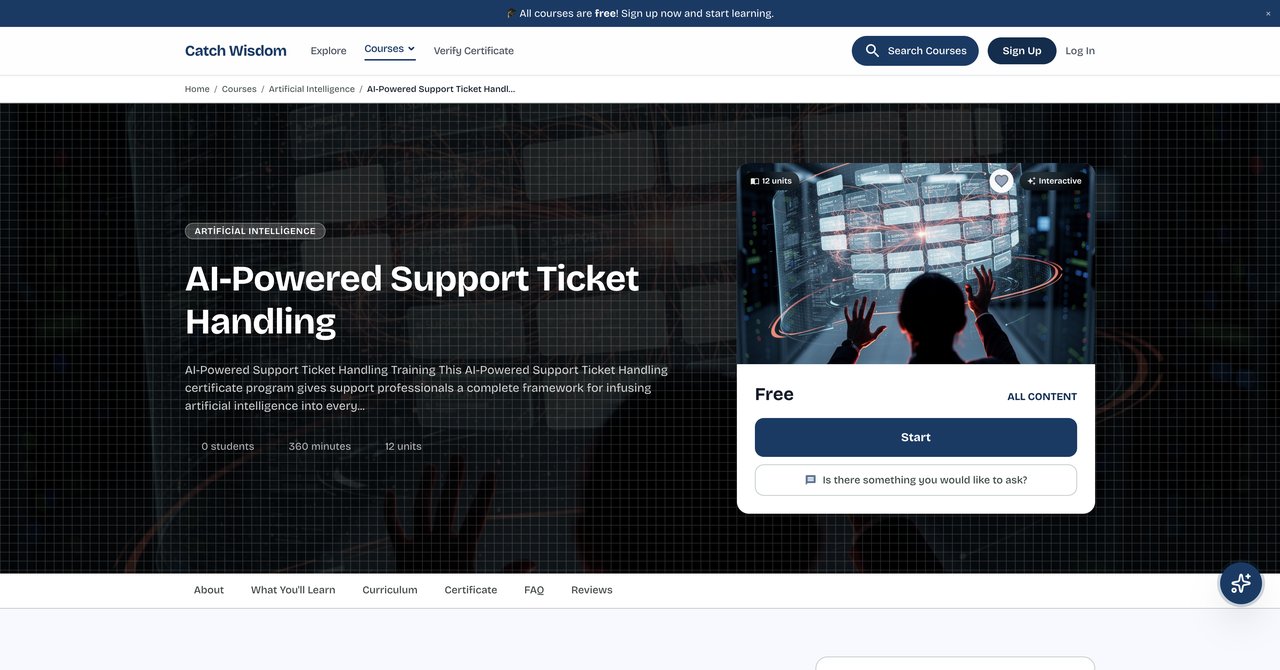
Catch Wisdom is next, and its offering is pretty interesting. Completely free to enroll, this course is specifically about the fundamentals of AI-driven ticket handling. The course starts from traditional ticketing issues and introduces AI concepts to improve that process. It's honestly a cool way to learn the basics because it starts from a space you already know from your job: solving tickets. The free price point makes it zero risk to try.
This course is for beginners, nobody who hates the actual mechanics of how tickets flow through a system. It covers the basics, but without the advanced prompting, or thinking like you might get in a larger course. It is great for onboarding or taking a clear look at AI without cost. The major downside is that complete beginners might not get a lot of depth. There is no live instructor, just self-paced. You'll go at your own pace, which is good, but if you need support, you'll be figuring it out on your own.
They offer a certificate for $55. The content is free, but the certificate costs money, but since they only have the certificate in 7 languages, that is practical. If you need a certificate to show your boss, it might be worth the $55. There is some genuine value in understanding the start from traditional ticketing to AI, as it gives you a decent mental model of why we use AI. It lacks the hands-on "use this tool" components found elsewhere, though.
Potential learners should have realistic expectations about the depth. It won't unlock secrets about complex automations, but rather a foundation. Because it is free, you can partner this with another course that goes deeper. A lot of people are starting here because it's easy on the wallet. It makes sense for you as a refresher, but not for a step toward mastery.
Key Topics Covered:
- Traditional ticket handling problems
- AI-driven ticket handling fundamentals
- Classification of support requests
- Routine response automation
- Process improvement with AI
Target Audience and Skill Level Requirements:
- Targeted at beginners on a budget.
- Suitable for anyone moving into a support role.
- No prior AI knowledge.
Pros:
- Completely free to enroll
- Self-paced with no deadlines
- Certificate available in 7 languages
Cons:
- Certificate requires a fee
- No live instruction or support
Who Would Benefit Most:
This is the perfect first step for anyone wanting to see if AI is something they want to get into, without paying. For anyone who's brand new to field, this course is like a foundation. It's also useful for support staff at small businesses with minimal budget for training. The price makes it risk-free, and you can pair it with other more detailed material.
Course 5: GenAI for Computer Support Specialists (IT Support) by Coursera
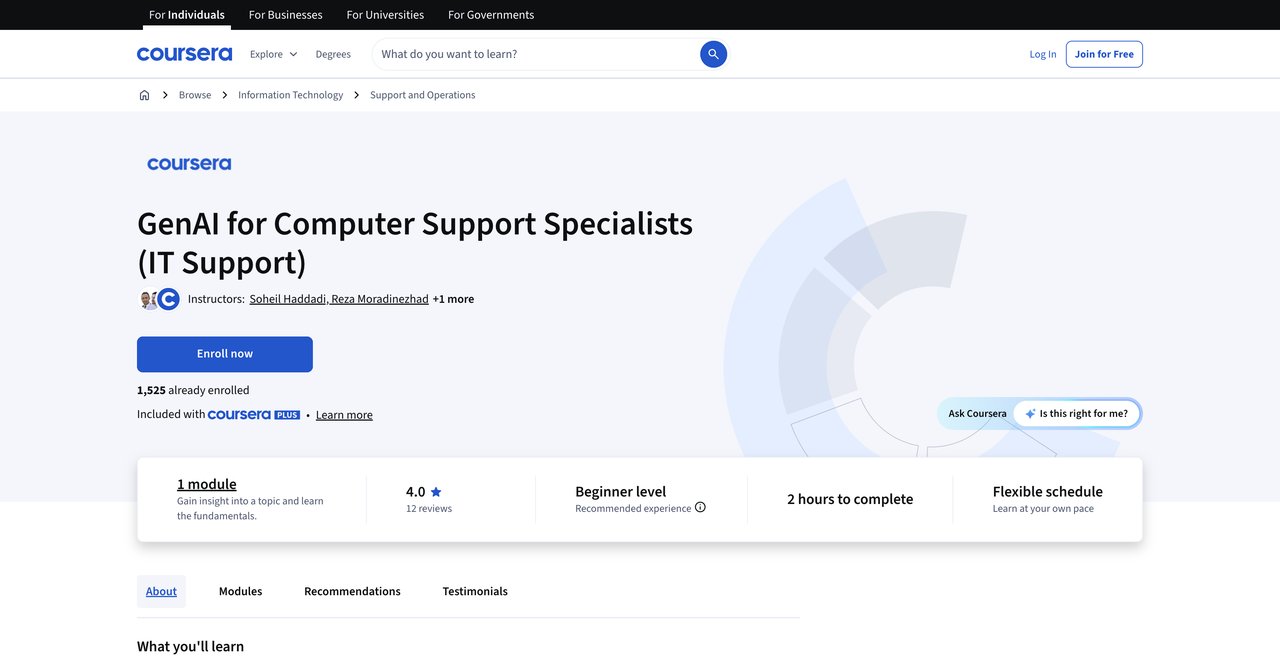
Coursera's short course on GenAI for Computer Support Specialists is a great introduction. It's made for IT support professionals and it's categorized as a "quick primer." If you feel like you don't have time for long programs, this is a nice place to start. The specialization is done through Coursera's platform which is self-paced, so you can go at your own speed, but the content is built to be completed in only two hours.
It introduces the basics of generative AI, which are in the field of capabilities and limitations of these models. You don't just learn about the "yes" they talk about practical troubleshooting applications, and how it can help you fix issues and respond to users. They make sure you understand your usage in IT support. It's not deep but efficient.
But, because the course is so short, you won't find deep dives. It won't go deep into advanced topics. It's really like a taster. If you're already a bit advanced, you might already know more than this class teaches. The real advantage is that it's free to audit. You can access the materials, but various assignments require a subscription. The format is beginner-friendly, namely those new to the role.
It is less a career-changer and more of an introductory. But the practical troubleshooting apps are sometimes overlooked in many other intro courses. Most will sign up for it because it's fast, and we can see that the value comes in the learning on the go, especially if you're moving from a support role to a specialist role. You can finish it in one sitting and have a foundation.
Key Topics Covered:
- GenAI capabilities and limitations
- Automating tasks in IT support
- Resolving common user issues with AI
- AI prompts and daily work
Target Audience and Skill Level Requirements:
- Designed for computer support specialists.
- Suitable for beginners, and those who have a basic of AI.
- No extensive experience needed.
Pros:
- Quick 2-hour commitment
- Covers GenAI capabilities and limitations for IT support
- Practical troubleshooting applications
Cons:
- Very short; may not go deep into advanced topics
Who Would Benefit Most:
People who need a quick overview, and new staff in their first week, as a part of onboarding. It fits well for those who need a basic understanding and want to refresh their memory. It is a good place to start if you're curious and don't have time for a longer course. The free audit price makes this practically risk-free.
Course 6: AI for IT & Help Desk Professionals Course by Workplace AI Institute
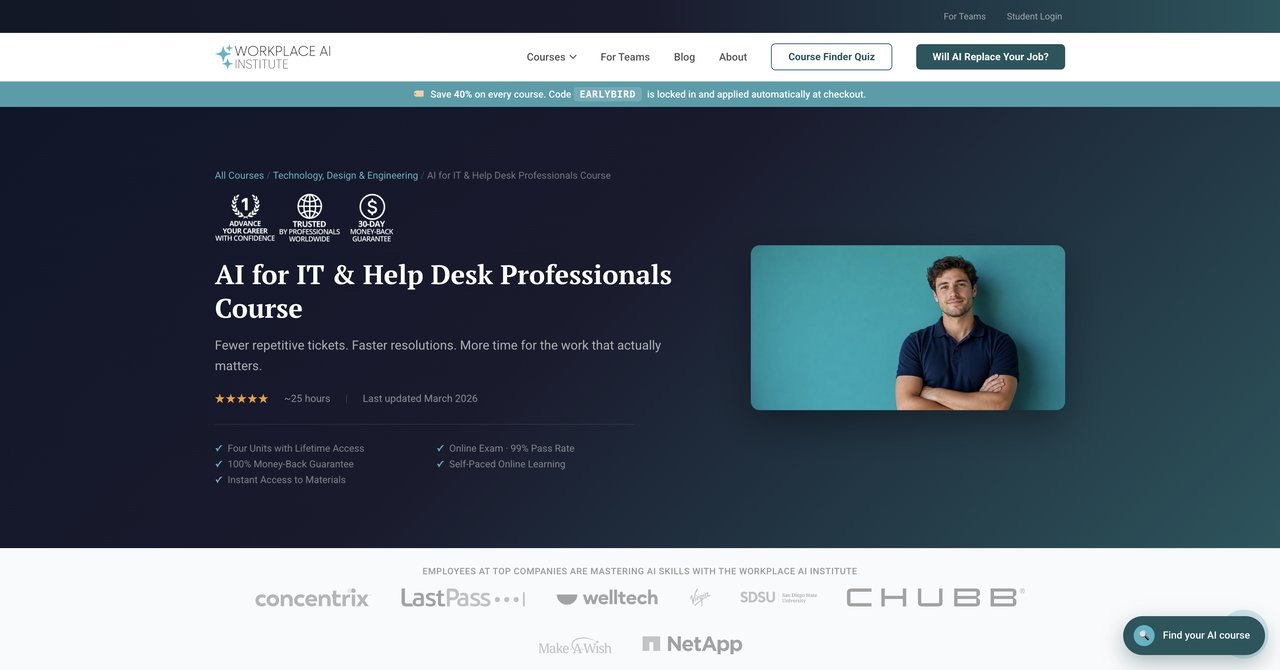
This course from Workplace AI Institute takes a different approach. The price is $498 and seems to be targeted at a more premium level from the get-go. The course is a "comprehensive 4-unit curriculum" for IT service desk professionals. This feels like a formal class with a lot of content and a test at the end. They boast a reported 99% pass rate on the exam, and a 100% money-back guarantee, which is a huge vote of confidence in what they're teaching.
The depth is here. It likely goes into detail on support workflows, beyond a basic primer. This is a class that takes a few solid sessions to complete. With money-back guarantee, they feel you might pass. This is not a "watch video then you're done" course, but rather a structured curriculum with a formal exam. Just be sure you want this if you don't like exams.
It stands out due to the guarantee-something that almost no other course offers. But, it's expensive compared to the others. It lacks a free trial, so upfront cost is unknown. If you're on a strict budget, it's a hard pill to swallow compared to the other options, which are in the highest price point. But they are backing the material; the value proposition is passing the test.
This course should be considered for individuals with some experience in the IT helpdesk space and who need a thorough walkthrough. It's great for building a base of knowledge and a credential from a specialist company. It falls somewhere in between, but with a strong guarantee.
Key Topics Covered:
- Applied AI for IT and service desk teams
- AI strategies for helpdesk
- Implementation frameworks
- Automating tickets and requests
Target Audience and Skill Level Requirements:
- Made for service desk professionals, IT staff, and managers.
- Suitable for intermediate-level participants.
- Some helpdesk background that will help.
Pros:
- Comprehensive 4-unit curriculum
- 99% pass rate on exam
- 100% money-back guarantee
Cons:
- Expensive compared to other options
- No free trial mentioned
Who Would Benefit Most:
This course nails a specific use case: you need a guarantee of a credential. If you are looking for a strictly structured environment and can make with the $498 cost, the guarantee is reassuring. It's also good for support teams, and companies that buy training for their staff.
Course 7: Free AI for Customer Support Teams Course by FreeAcademy

FreeAcademy offers a pretty nice deal if you're new to the world of AI: the "Free AI for Customer Support Teams" course. And yes, it's really free. The course has a hands-on focus and covers ticket triage, response drafting, and chatbots. It even provides a free certificate, which is rare among free courses. This can be an excellent way to get an official-looking thing to show on your page without paying a thing. The entire course is only three hours, so it's very digestible.
It's not a course for deep technical support. This is focused on customer support. It might not cover advanced IT-specific scenarios. But for a fundamental understanding of how AI can help support, this is great. The response drafting and chatbot sections are especially relevant for a frontline user support representative. It's very bite-sized, so you can complete it over a few days without disrupting your routine.
The course packs a lot into a short period. For people new to AI, this is an excellent starting point and one that won't hurt your wallet. It lacks some of the depth of the more comprehensive courses. Those in specialized or high-level product support might find the content too basic. But that's the trade-off for the price.
There are no deadlines, so you're free to go at your own pace. Seeing a certificate that doesn't cost anything is a big bump. It's clearly designed for entry-level folks. If you're a manager on a team, this is a free way to get the basics across the team. The limitation is the three-hour cap, but that might be all many need.
Key Topics Covered:
- Ticket triage
- Response drafting
- Chatbot implementation
- Workflow basics
Target Audience and Skill Level Requirements:
- Created for customer support teams.
- Great start for beginners, or sales and support people.
- No coding required.
Pros:
- Free certificate
- Covers ticket triage, response drafting, and chatbots
- No coding required
Cons:
- Limited to 3 hours of content
- May not cover advanced IT-specific scenarios
Who Would Benefit Most:
This freebie is ideal for someone looking for a quick introduction to AI support tools without restrictions. Also great for teams that need a low-cost intro to AI without a commitment. The certificate gives you a conversation point for an interview, even with no fees paid.
Course 8: Generative AI for Customer Support by Coursera
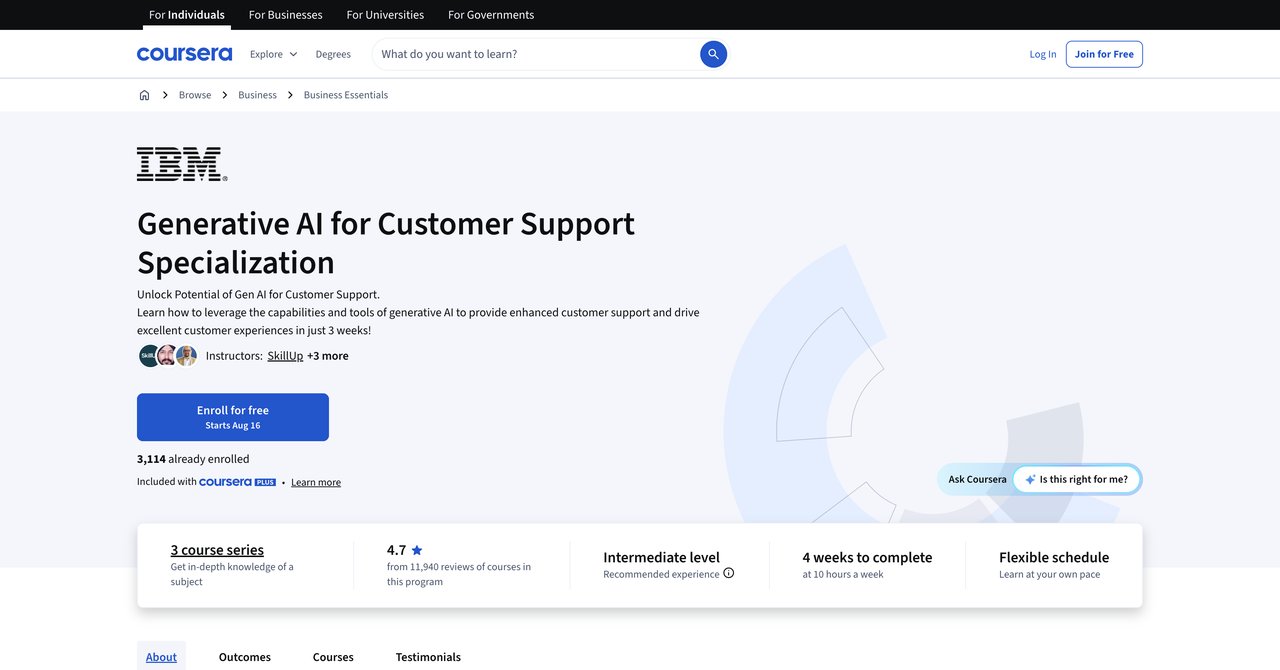
This is a specialization by Coursera, which means it's a bundle of multiple related courses rather than a single class. It addresses the shift to AI-driven customer service, which is particularly relevant given that many leaders are adopting this, with a reported 85% switching to conversational AI. Being a specialization, it offers a structured and comprehensive approach, offering multiple courses under one umbrella.
It's suitable for managers and customer relations teams. Since it is designed for managers and teams, the learning is a bit broader and more strategic. You aren't just doing tickets; you're analyzing with a broader strategic view of how AI impacts the whole support system. The modules likely include best practices, implementation models, and the operation of AI support teams. This is a step up from entry-level content.
The downside is the details are a bit vague; the duration and modules aren't listed. The grading materials are in Coursera's usual subscription model. It's less about a single specific tool and more about the change within support as a whole. This is not the course if you want to be tactical right now. It's better to a bigger picture and applied at the team level.
If you are in a lead or manager position, this specialization is notable. It can help you understand how to train teams and build a system that uses AI for the whole department. It offers a formal certificate upon completion. But this might be overkill if you're just looking for a good sense of how to improve your performance in a day. It's entry-level for the team, not for a technician.
Key Topics Covered:
- AI and conversational support strategies
- Customer service AI pipelines
- Use of AI in management
- Metrics for measuring success
Target Audience and Skill Level Requirements:
- Targets user support supervisors, managers, and train-the-trainer.
- Suitable for intermediate-level.
- Designed for teams, not just individual contributors.
Pros:
- Specialization format with multiple courses
- Addresses the 85% of leaders adopting conversational AI
- Suitable for managers and teams
Cons:
- Specific duration and module details not listed
- Requires a Coursera subscription for graded materials
Who Would Benefit Most:
Team leads, and support managers and who are responsible for tech budgets and strategy. This course won't give you tactical step-by-step prompts but will help you build a department that using AI. If you manage multiple people on a support team, this suits you. It's also a good first choice if you just "know" you need a bigger picture of AI.
Course 9: Practical AI and prompting for customer care professionals by Coursera
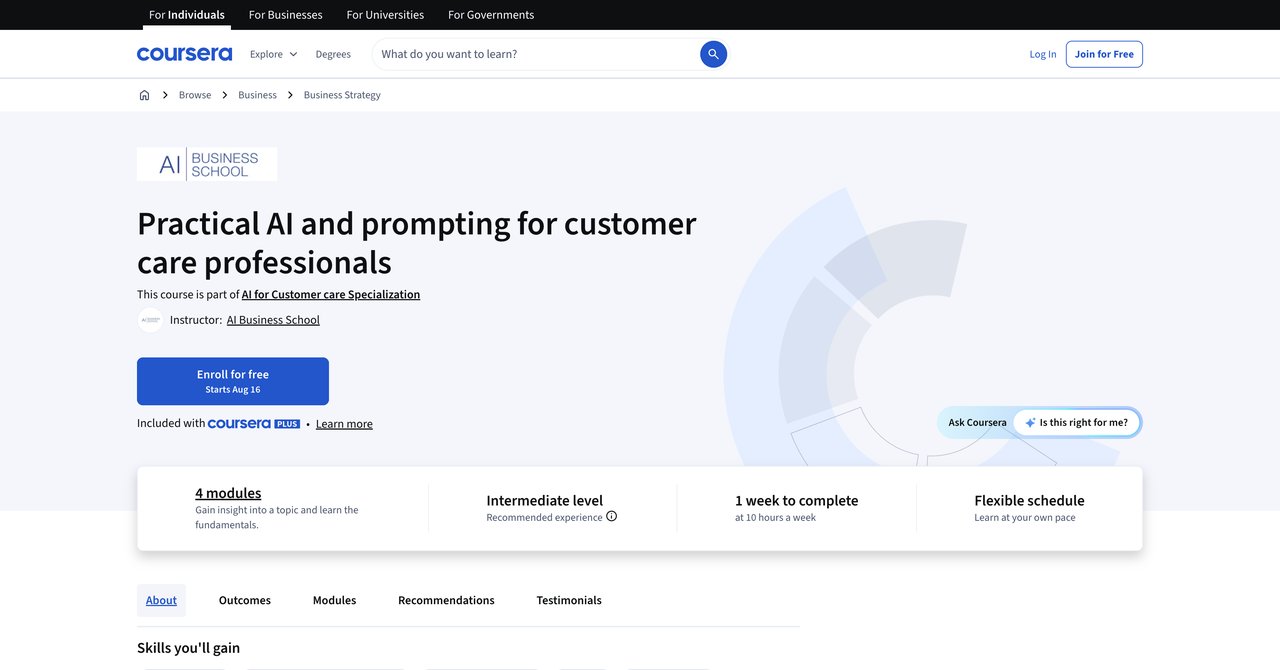
This Coursera course is a hands-on approach, but with a strong focus on job-specific AI use cases. That means it's less about the theory and more about how you can use these tools in your day-to-day work. It covers various modalities, which is a good way to describe using text, maybe images, etc. It also talks about practical tool discovery, so you learn how to find the right AI for the job. There is a component about prompting and how to talk to AI to get what you want.
The course leverages this hands-on aspect, which is good for the learner who wants to practice and do. It's a job-focused and routine-heavy. One con is that the actual duration isn't specified, so you are in the dark about the time commitment. This might be an issue if you are planning your schedule. Also, you may need a subscription for full access, like other Coursera offerings.
It will give you skills for using prompts in various scenarios, which will benefit you if you feel like you are not getting the right output from AI tools. It's a more practical and task-specific focus. It seems tailored to the "doer" rather than the manager. It gets into the weaving of capabilities. It's not overly technical, but more than the FreeAcademy quick intro.
It's a good option for the independent and intermediate learner. It might not be the best fit for beginners, who get lost on the specific focus. If you don't have a clear example of a repetitive task that you want to improve, you might not get as much out of it.
Key Topics Covered:
- Prompt engineering techniques for support
- Job-specific AI use cases
- Practical tool discovery
- Multi-modal AI (text, images, etc.)
Target Audience and Skill Level Requirements:
- For professionals already working with AI, and wanting to improve.
- Intermediate level.
- Need a basic understanding of prompting.
Pros:
- Hands-on approach to job-specific AI use cases
- Covers various modalities
- Practical tool discovery
Cons:
- Duration not specified
- May require subscription for full access
Who Would Benefit Most:
User support specialists who are already using tools like Copilot or ChatGPT and want to improve their results. It's good for getting out of the rut of thinking "too similar" with AI. If you have the time to invest, you can improve specific processes. It's a course for the practitioner.
Course 10: Multi-Agent Systems Design: AI Customer Support with n8n by Coursera
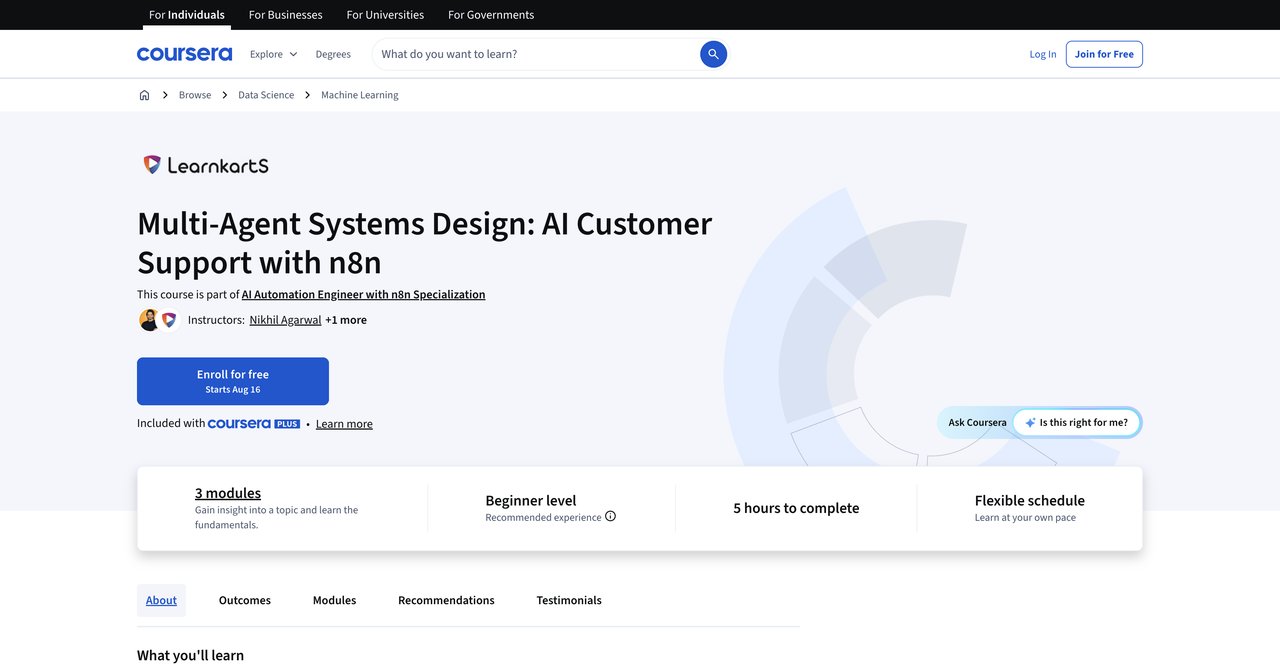
This is one of the most unique and technically advanced courses on this list. It is about building AI workflows for routing and responding to tickets using a tool called n8n. If you like hands-on building and creating live workflows, then this is interesting. The course focuses on "multi-agent" systems, which is about designing AI models that can work together in a sequence to solve user queries.
It's practical and very technical. You'll learn about classification, routing, response generation. It's like you're building a mini automated support agent architecture. This isn't about sitting and drafting prompts; it's about building a system. Recently updated, this course is new overall tech. That is highly valuable for someone who is into automation and machine-to-machine interactions.
The course requires that you spend time learning and using n8n. This is another tool to baggage. If you are not naturally technical, this could feel more like a development challenge than a support course. So, it isn't for everyone. If you're okay with learning a new piece of software, this can be exciting.
This is likely for the support who wants to build more "hands-free" environments. It's more about the creation and implementation of AI routing layers. The downside is definitely the complexity and n8n learning curve. You need an interest in workflow-creation and automation patterns. It's an investment in a specific skill set.
Key Topics Covered:
- AI classification
- Response generation
- Routing workflows
- Building with n8n
Target Audience and Skill Level Requirements:
- Advanced technical support specialists and tool builders.
- A basic understanding of IT and APIs is helpful.
- Willingness to learn new automation tools.
Pros:
- Teaches AI classification, response generation, and routing
- Hands-on with n8n
- Recently updated
Cons:
- Requires learning the n8n platform
- May be more technical than needed for some roles
Who Would Benefit Most:
If you are the "builder" on your team, the person who likes to automate flows and build systems to than handle emails yourself, this is the course for you. It's not really for the general front-line, but it is for someone who wants to become a workflow specialist. It invites you come to the future of how support might be autopilot.
Course 11: AI for IT Support: Tickets, Knowledge Base, and Endpoint Workflows by Qualora
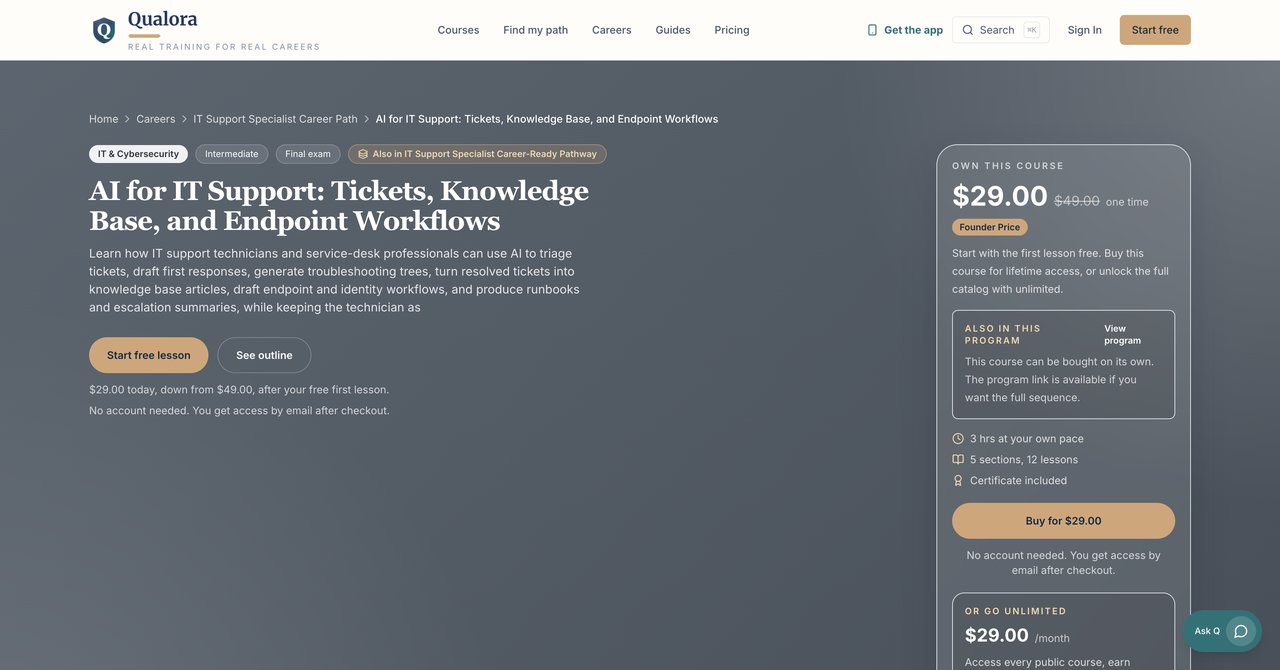
Ending our list we have Qualora, which is the price is a one-time $29.00. This course has a specific focus: it helps you turn resolved tickets into knowledge base articles. That is very useful for someone who wants to stop repeating themselves. It covers endpoint and identity workflows with AI as well. This is like having a systematic process to close the loop between tickets and self-service solutions. It helps users have fewer cases.
Its strength lies in its specific and actionable pathway of knowledge management. The course has up to 3 hours of content, so it's not a huge time commitment. It is at an intermediate level, which means it expects you to already understand the workflow. This also might require you to be unfamiliar with endpoints, making it a struggle for complete beginners. But the price is low and the angle is unique and very specific.
If your knowledge base is sparse or disorganized, this course will help you learn how to use AI to fix that. A support specialist becomes more valuable when investigating the solutions to automatically update your docs. This course is worthwhile because it's one of the few that sees that the support role connects to self-service. For managers and teams, there are great: It improves process efficiency.
The low price is appealing, but consider its specificity. It's not a general AI support course, but more focused. The benefit is that you're not paying for a whole large library when all you want is this topic. You need to know your day-to-day if you fit this niche.
Key Topics Covered:
- Turning resolved tickets into knowledge base articles
- AI for endpoint workflows
- Identity and access workflows
- Automated documentation
Target Audience and Skill Level Requirements:
- Helpdesk and IT support professionals.
- Intermediate level that can be best.
- Knowledge of support processes basics.
Pros:
- Focuses on turning resolved tickets into knowledge base articles
- Covers endpoint and identity workflows
- One-time low price
Cons:
- Intermediate level that might not suit complete beginners
- Only 3 hours of content
Who Would Benefit Most:
It's a great fit for solo IT professionals or small teams that want to build and improve their documentation without much cost. It's also good if you're tired of repeating yourself and you know AI can help but just need a starting point. This is a "do something about it" course.
Overall Recommendations: Finding Your Best Fit
When you lay it all out like this, you see there's something for every situation. But the decision isn't just about price, because the learning style is the outcome. Here's your short list, for common scenarios.
For those who want the broadest possible library and a buffet of AI training: You need to see CompleteAI Training. The fact that one subscription covers all courses and certifications in every field makes it a versatile asset. For the support specialist who is ambitious, this is your "training ground" for many potential roles you can move onto. The cost at $8.25 a month is minimal for a library. The biggest choice is for people who don't want to have to settle for only one course. It's the best that one subscription gives you the full range of skills.
For those needing a recognized vendor certificate: CompTIA's AI Help Desk Essentials is a solid pick. Even without a clear price tag, CompTIA is a big name that will open doors, especially in corporate IT. Pair that with the "Essentials" course if you're on the less technical side of customer service. These are " brand" credentials but the cost may also be reflect the brand.
For those with a limited budget or for a basic start: FreeAcademy really that it's free, and the certificate is included. Catch Wisdom is also a zero-cost introduction. They aren't deep, but they give you a chance to test the waters without spending any money. For a big team, this is a valuable way to introduce everyone without having to coordinate big budgets. You can then start over their education.
For people who like depth and a formal guarantee: The Workplace AI Institute course bundles up everything with a final exam and a money-back guarantee. It is not cheap, but the assurance is a differentiator. It is the path if frameworks and tests help you in a way that a video library doesn't.
For individuals who prefer a more academic, business approach: The Coursera "Generative AI for Customer Support" and the "Practical AI and Prompting" are solid choices. They have a professional quality that matches an educational standard. They're less skill-specific than the more expensive certs. They feel more like development, not a fully immersive build.
For technologists and automators: You might be drawn to the n8n course, and the Qualora course. These are the most specific toolkit classes, and they give you new, immediately implement-able tools and workflows. They are niche, but they solve specific problems that broader platforms may not.
The Verdict: For most User Support Specialists professionals who want to stay relevant and versatile for their career, the most efficient route is CompleteAI Training because of its all-courses-and-certifications coverage. You see that your long-term career is not going to be in just a ticket queue. You'll have the AI course for your current role, but the ability to expand into management or related tech fields as you switch. But, it's your path. For a single, focused purchase with a recognized cert, the CompTIA helpdesk track is strong. If you just are leaning on a base basis for no money, go for the free options. There's no single answer, but now you can make a much more informed decision that works for the daily tools you need.