
Blog ·
11 Recommended AI Courses for Executive Directors in 2026
Master AI strategically with 11 tailored courses for executive directors in 2026. Boost decision-making, drive innovation, and lead your organization into the future—no tech background required.
 Jeroen Erne
Artificial intelligence is no longer a distant concept reserved for tech giants. It is here, and it is reshaping how work gets done across every sector. For Executive Directors, the pressure to understand AI is growing fast. The numbers are hard to ignore: 69% of businesses now use AI in some form, and that figure keeps climbing. Leaders who ignore this shift risk falling behind, while those who embrace it can make sharper decisions, save hours of time, and deliver stronger results for their organizations.
The reality is that AI is already changing the way executive work happens. From automating routine reporting to providing data-backed insights that guide strategy, AI tools are becoming part of the daily workflow. For Executive Directors, this is not just about keeping up with trends. It's about staying relevant in a field where expectations are rising. A recent study suggests that nearly 30% of current work hours could be automated by 2030, and executive-level roles are not exempt. The question isn't whether AI will affect your role, but how quickly you can adapt to it.
That's why learning AI now is a practical career move. Whether you're looking to improve your own efficiency or lead your team through changes, having a solid grasp of AI concepts and tools gives you an edge. It also helps you make better decisions about where to invest resources, how to structure workflows, and what to prioritize in your long-term strategy.
Why AI matters for Executive Directors today
The role of an Executive Director has always been about making good decisions with limited information. AI changes that equation. Instead of relying on gut feeling alone, you can now pull insights from vast amounts of data in seconds. You can identify patterns that would take days to spot manually. You can even use AI to draft communications, prepare reports, or simulate different outcomes before committing to a direction.
Adoption statistics make the case clearly. According to a recent survey, 69% of businesses use AI in at least one function, and more than half say they've seen measurable benefits. For Executive Directors, this means that AI proficiency is quickly becoming a core competency. Those who don't understand AI will struggle to lead teams that do. They'll miss opportunities to cut costs, improve services, or respond faster to changing conditions.
This article is here to help you sort through the growing number of AI courses available. We'll compare five options designed specifically for Executive Directors, breaking down what each offers, what you'll learn, and who it's best for. Our goal is to make it easier for you to find a course that fits your schedule, your budget, and your career goals.
The Growing Role of AI in Executive Directors
AI is not just a tool that helps you do the same things faster. It's actually changing the nature of executive work itself. Here's where we see AI making the biggest difference:
- Automation of routine tasks: Things like scheduling, data entry, and basic report generation can now be handled by AI, freeing up time for strategic thinking.
- Smarter decision-making: AI can process large amounts of data and highlight trends that might not be visible in a spreadsheet. This means you can make choices based on evidence, not just intuition.
- Personalized stakeholder communication: AI tools can help you tailor messages to different audiences, whether you're talking to board members, staff, or community partners.
- Risk assessment: AI can help identify potential problems before they become serious, whether that's financial risk, operational issues, or even reputational concerns.
- Resource allocation: By analyzing where your organization's efforts are best spent, AI can help you direct funding and attention more effectively.
These changes aren't coming in the future. They're happening now. Executive Directors who learn to work with AI tools can handle more complex challenges and deliver better outcomes. Those who don't may find themselves spending more time on tasks that AI can already handle, which puts them at a disadvantage.
Benefits of becoming an AI expert in Executive Directors
Investing time in learning AI brings several practical benefits to your role. First, it increases your efficiency. You can produce reports in minutes instead of hours, and you can analyze data that would take days to work through manually. This frees you up to focus on the parts of your job that truly require your expertise.
Second, it strengthens your leadership. When you understand AI, you can better guide your team through changes. You'll be able to spot opportunities where AI can help, and you'll be able to communicate clearly about what AI can and cannot do. That kind of clarity builds trust and helps your organization move forward with confidence.
Third, it can lead to better outcomes for your organization. Whether you're making budget decisions, planning strategy, or improving services, AI-informed insights give you a stronger foundation. You'll be able to see things you might have missed and respond more quickly to changing circumstances.
Finally, there's the personal benefit. Learning AI keeps you intellectually engaged and prepares you for whatever comes next. The field is changing fast, but the basics you learn today will serve you well for years to come. And with more organizations looking for leaders who understand AI, it's a skill that will only become more valuable.
Now, let's look at five AI courses that are worth your attention. One of them, CompleteAI Training, stands out because it gives you access to ALL courses and ALL certifications on the platform rather than just a single course. We'll break down the options so you can decide which one fits your needs best.
Comparison: All AI Courses for Executive Directors (Updated 2026)
| Course Name | Provider | Price | Key Topics | Pros | Cons | Best For |
|---|---|---|---|---|---|---|
| CompleteAI Training - AI for Executive Directors | CompleteAI Training | Premium (one subscription covers ALL courses and ALL certifications on the platform - not a single course) | Comprehensive AI curriculum for Executive Directors, hands-on projects, expert-led instruction, covering all aspects of AI relevant to the role. One subscription unlocks every video course and every certification on the platform, including other job roles' materials. New content added continuously, daily AI tool updates, curated AI industry news. | Comprehensive curriculum; Hands-on projects; Expert instructors; Highest rating / most complete offering; Full access to ALL video courses, not just one; Full access to ALL certifications at no extra cost; Access to other job roles' material for cross-functional work; One flat price covers everything; Very affordable, especially annual billing at $8.25/month | Premium pricing; Subscription-based (but essential since AI is developing continuously) | Executive Directors professionals looking for complete, continuous training with all certifications included |
| AI for Executive Directors (Video Courses + Certifications) | Complete AI Training | $29/month (monthly) or $8.25/month (billed annually) | Library of over 100 specialized video courses; all certifications; daily AI tool updates; curated AI industry news for Executive Directors. Includes material for every other job role on the platform too. | Most complete offering; all video courses and certifications included; new content added continuously; access to cross-functional job role materials; very affordable | Subscription-based; continuous learning is required as AI changes quickly | General learners who want the most comprehensive, cross-functional AI training at a low cost |
| A Director's Guide to AI | National Association of Corporate Directors (NACD) | $1,595.00 (member early bird) | AI strategy, risk oversight, responsible adoption; translating AI complexity into board-ready governance judgement | Board-specific governance focus; live virtual instructor-led; covers AI strategy, risk oversight, responsible adoption | NACD membership required; assumes limited prior AI knowledge | General learners (corporate directors needing board-focused AI governance guidance) |
| AI Governance for Boards and CXOs | Cambridge Judge Business School | £5,000 + VAT (approx. $6,300 USD) | AI governance, board-level decision-making, oversight planning; delivered by faculty from 5 University of Cambridge departments; produces a 90-day oversight plan | Faculty from 5 University of Cambridge departments; produces a 90-day oversight plan; designed specifically for board members and C-suite | Premium price; face-to-face only in Cambridge | General learners (board members and C-suite execs seeking advanced governance education) |
| AI for Directors and Leaders Programme - CMI Level 7 | INPD | £1,500.00 + VAT (virtual) / £1,950.00 + VAT (Manchester) (approx. $1,890 / $2,460 USD) | AI strategy, governance, ethical deployment; formal CMI Level 7 accreditation; moving directors beyond awareness into confident, responsible AI action | CMI Level 7 accredited; covers AI strategy, governance, ethical deployment; available virtually or in-person | Limited places; UK-centric accreditation | General learners (directors and organizational leaders seeking formal accreditation) |
| AI Adoption: Driving Business Value and Impact | MIT Sloan Executive Education | $3,850 | Mapping AI to critical business challenges; building sustainable co-creation practices; moving from AI awareness to organization-wide AI transformation | Maps AI to business challenges; builds co-creation practices; self-paced online format | Requires 36,48 hours total commitment; not board-specific | General learners (executive directors wanting to translate AI awareness into business value) |
| AI Risk and Readiness: From Governance to Growth | MIT Sloan Executive Education | $5,700 | AI risk, governance gaps, governance-to-growth strategies; in-person at MIT | Focuses on AI risk and governance; addresses often-unaddressed governance gaps; in-person at MIT | High price; only offered Oct 8,9, 2026 | General learners (executive directors focused on AI risk management and governance) |
| Leading the AI-Driven Organization | MIT Sloan Executive Education | $12,900 | Leadership of AI transformation; strategies for AI-driven organizational change; taught by MIT Sloan faculty | Immersive in-person program; covers leadership of AI transformation; MIT Sloan faculty | Very high price; requires full week on campus | General learners (executive directors needing high-level strategic leadership in AI) |
| AI Executive Academy | MIT Sloan Executive Education | $24,500 | Comprehensive AI leadership; 10-day deep dive over two weeks; earns 10 EEUs toward MIT credentials | Most comprehensive MIT AI program; 10 EEUs toward MIT credentials; deep dive over two weeks | Extremely expensive; major time commitment | General learners (directors who need a complete, immersive AI leadership experience) |
| AI for Executives Program | UC Berkeley Haas School of Business (Berkeley Exec Ed) | $6,500.00 | Agentic AI systems; driving AI adoption and innovation; strategic frameworks for evaluating agentic AI | Explores agentic AI systems; focuses on AI adoption and innovation; Berkeley Haas faculty | Not board-governance specific; requires travel to Berkeley | General learners (executives focused on AI innovation and adoption) |
| AI for Senior Executives Program | Johns Hopkins University | Not specified | AI strategy, governance, and execution; designed for C-suite and senior executives; certificate of completion | Designed for C-suite and senior executives; covers AI strategy, governance, execution; certificate of completion | Price and duration not published; less established than MIT/Berkeley programs | General learners (C-suite and senior executives seeking university-backed AI training) |
| AI & Automation for Executives | Udemy | Subscription (Udemy Personal Plan) or individual purchase | Practical business outcomes of AI and automation; AI business primer for executives | Low-cost entry point; self-paced; focuses on practical business outcomes | Not board-specific; quality varies on Udemy; update date not verified | General learners (executive directors who need a quick, affordable AI business primer) |
Understanding AI Training for Executive Directors Professionals
Executive Directors sit in a unique position. They're responsible for strategy, governance, and ultimately, the organization's performance. When artificial intelligence entered the mainstream, many leadership teams scrambled to understand the basics. But the baseline conversation has shifted. Boards and executive leaders are now expected to move past awareness and into informed decision-making. They need to understand how AI affects risk, operations, strategy, and ethics. They need to be able to ask the right questions of their technical teams and vendors. They need to know what "good" AI governance actually looks like in practice.
That's where formal training comes in. The options range from self-paced video libraries to immersive, expensive in-person programs at prestigious business schools. Some focus on governance and board duties. Others focus on operational adoption and business transformation. Still others are broad, practical primers that help a busy executive get up to speed without a massive time commitment. The right choice depends on your starting point, your budget, and what you're trying to accomplish. This comparison looks at the major options available for Executive Directors, with a focus on what each program actually delivers, what it costs, and who it's really for.
Course 1: CompleteAI Training , AI for Executive Directors
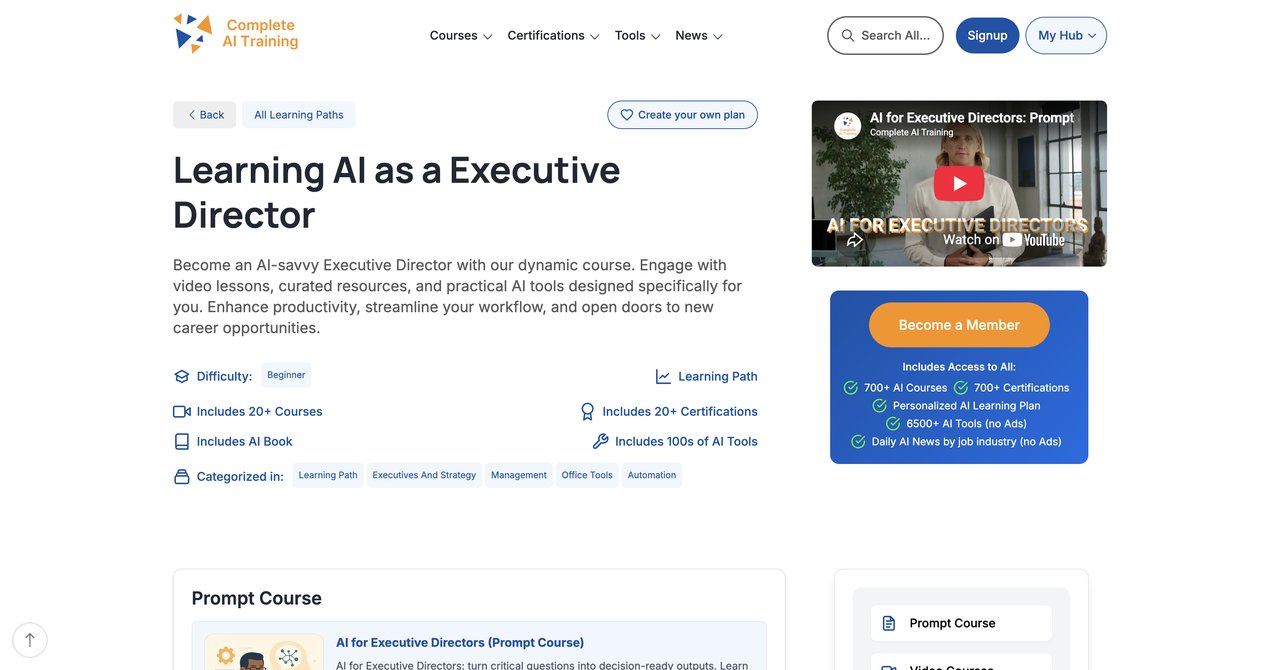
CompleteAI Training is not a single course. One subscription unlocks every video course and every certification on the entire platform. That's a fundamental difference from every other option in this comparison. You're not buying one course about AI for Executive Directors. You're getting access to hundreds of video courses that cover every job role, from HR to marketing to engineering. If your work spans multiple functions, or if you might change roles, that's a significant advantage. The subscription also includes all certifications at no extra cost. New courses and certifications are added all the time, and your subscription automatically includes them. You're paying one flat price instead of paying per course, which is how most other providers structure their offerings.
The platform is built specifically for working professionals. Courses are broken down into manageable video lessons, and you can go at your own pace. The content is updated continuously, which matters because AI tools and best practices change quickly. A course recorded two years ago might already be outdated. CompleteAI Training addresses this by keeping everything current and adding new material on a regular basis. You get a comprehensive AI education that covers the practical side of things, not just theory.
Key topics covered: AI strategy, AI governance, risk management, prompt engineering, AI tools for productivity, AI implementation in organizations, and a wide range of role-specific applications.
Target audience and skill level requirements: Designed for Executive Directors and professionals at all levels of AI familiarity. The material is structured to take you from beginner to advanced. No prior technical background is required.
Pros:
- Highest rating and most complete offering available
- Full access to ALL video courses on the platform, not a single course or fixed bundle
- Full access to ALL certifications on the platform, included at no extra cost
- New courses and certifications added continuously and included automatically
- Access to every other job role's material too, useful for cross-functional work or role changes
- One flat subscription price covers all of the above, versus paying per course elsewhere
- Very affordable pricing, especially with annual billing
Cons:
- Subscription based, which means ongoing commitment
Who would benefit most: Executive Directors who want a comprehensive, cost-effective way to build AI knowledge across their entire organization. If you need to understand AI beyond just governance and want practical skills you can apply immediately, this is a strong option. The subscription model makes it easy to train multiple people or to keep your own knowledge current as AI evolves.
Course 2: A Director's Guide to AI , National Association of Corporate Directors (NACD)
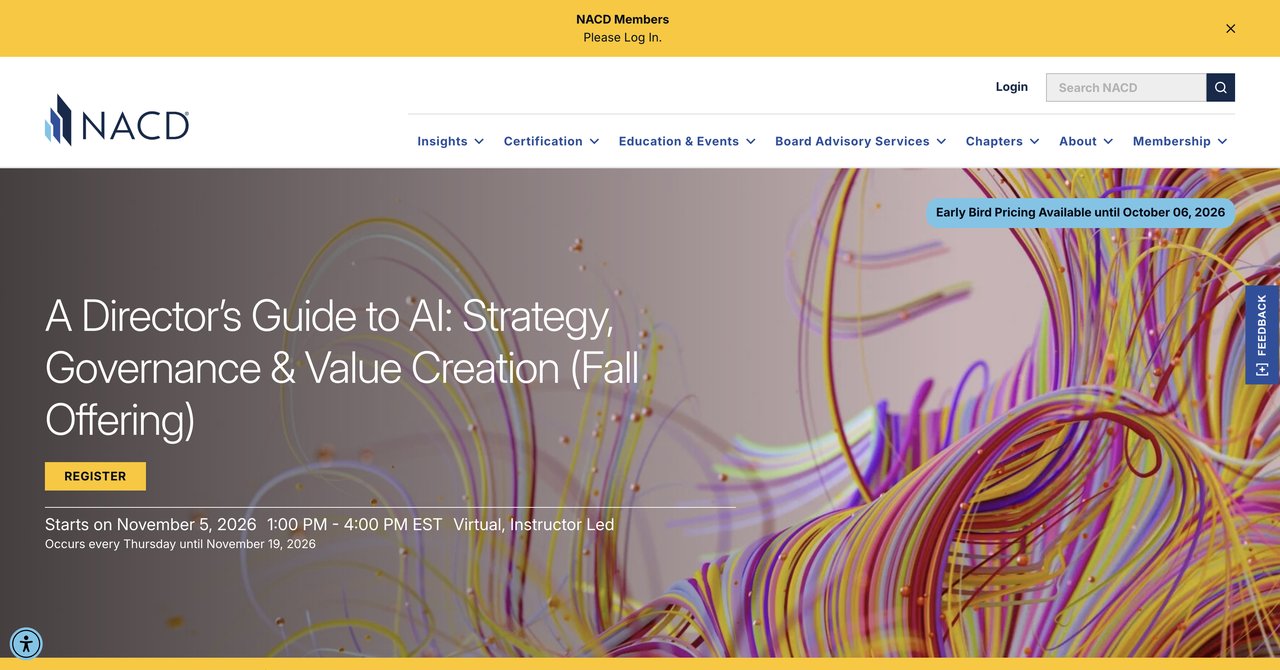
The NACD offers a live, virtual instructor-led course specifically for corporate directors. It focuses on AI strategy, risk oversight, and responsible adoption. The program is built around translating AI complexity into board-ready governance judgement. That's a specific angle, and it's one that many directors need. It's not about learning to use AI tools. It's about understanding what questions to ask management, how to oversee AI-related risks, and what responsible adoption looks like from a board perspective. The course is taught live, which means you get real-time interaction with the instructor and other participants.
The NACD is a well-known organization in the governance space, so this course carries some weight. But it does require NACD membership, which is an additional cost. The course also assumes limited prior AI knowledge, so it's positioned as a foundational program for directors who are relatively new to AI. If you're looking for a deep technical dive, this isn't it. But if you need to build your board-level confidence in AI oversight, it's a solid starting point.
Key topics covered: AI strategy, risk oversight, responsible AI adoption, board-level governance.
Target audience and skill level requirements: Corporate directors and board members. Basic level, no prior AI knowledge required.
Pros:
- Board-specific governance focus
- Live virtual instructor-led format
- Covers AI strategy, risk oversight, and responsible adoption
Cons:
- NACD membership required
- Basic level assumes limited prior AI knowledge
Who would benefit most: Corporate directors who need a governance-focused introduction to AI. If you're on a board and you need to understand AI oversight without getting into the technical weeds, this is a good fit. The live format also gives you a chance to ask questions in real time.
Course 3: AI Governance for Boards and CXOs , Cambridge Judge Business School
Cambridge Judge Business School runs an advanced 3-day program for board members and C-suite executives. The faculty comes from five different University of Cambridge departments, which gives you a multidisciplinary view of AI governance. The program produces a 90-day oversight plan. That's a practical takeaway. You leave with a concrete plan for how to address AI governance in your organization. The course is designed to turn AI uncertainty into accountable board-level decisions.
The price is substantial. At roughly $6,300 USD, it's not a casual purchase. But it's also not the most expensive option on this list. The program is face-to-face only, and it's in Cambridge. That means travel and accommodation costs on top of the course fee. If you're based outside the UK, that's a significant additional consideration. The prestige of Cambridge is real, and the faculty is genuinely world-class. But you have to weigh that against the cost and the logistics.
Key topics covered: AI governance, board-level decision-making, AI risk, 90-day oversight planning, multidisciplinary AI perspectives.
Target audience and skill level requirements: Board members and C-suite executives. Advanced level, some prior AI knowledge or experience recommended.
Pros:
- Faculty from 5 University of Cambridge departments
- Produces a 90-day oversight plan
- Designed for board members and C-suite
Cons:
- Premium price
- Face-to-face only in Cambridge
Who would benefit most: Senior executives and board members who need a high-level, academically rigorous approach to AI governance. If you have the budget and you're willing to travel, this is a strong option. The 90-day plan is a practical output that you can actually use.
Course 4: AI for Directors and Leaders Programme , CMI Level 7 by INPD
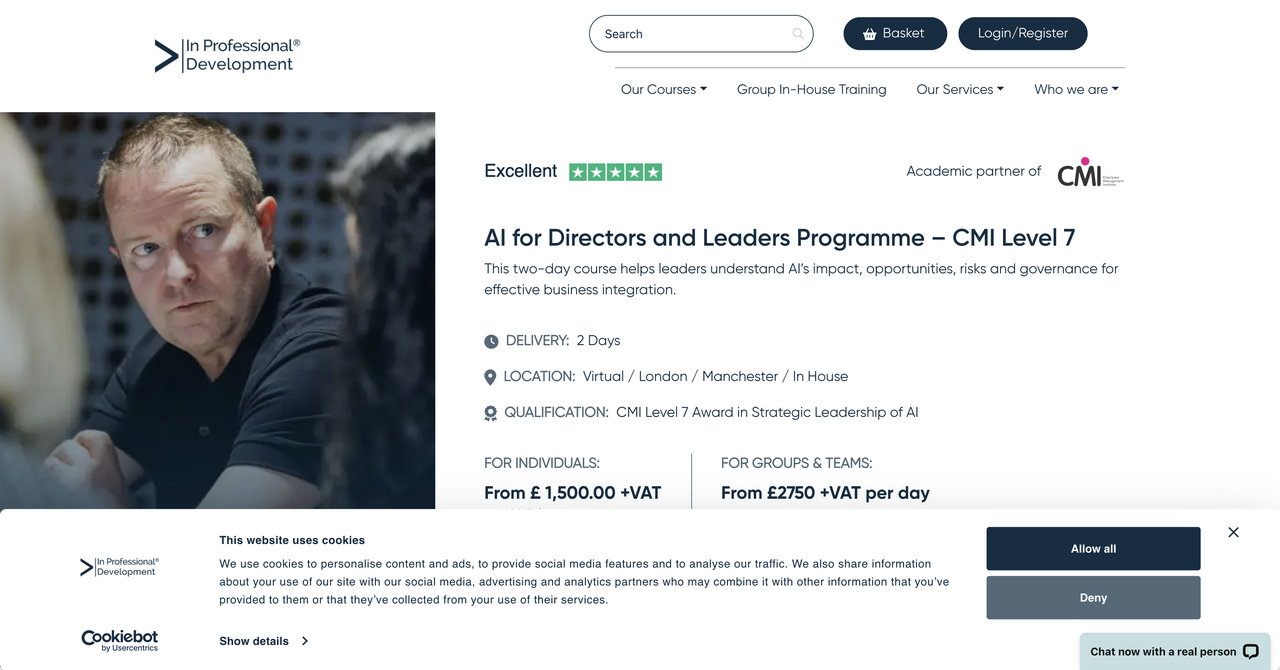
INPD offers a CMI Level 7 accredited program that covers AI strategy, governance, and ethical deployment. The accreditation is a significant selling point. CMI Level 7 is a recognized qualification in the UK, and it carries weight in leadership circles. The program is available virtually or in-person in Manchester. That gives you some flexibility in how you attend. The course is designed to move directors beyond awareness and into confident, responsible AI action. It's not just about understanding AI. It's about being able to lead with it.
The price is around £1,500 to £1,950 plus VAT, depending on the format. That's roughly $1,890 to $2,460 USD. It's a mid-range option that offers formal accreditation. The main downside is that places are limited, so you need to plan ahead. The accreditation is also UK-centric, which may matter if you're outside the UK. But for a director who wants a recognized qualification, this is a strong choice.
Key topics covered: AI strategy, AI governance, ethical AI deployment, leadership in AI adoption.
Target audience and skill level requirements: Directors and organizational leaders. Intermediate to advanced level, some leadership experience expected.
Pros:
- CMI Level 7 accredited
- Covers AI strategy, governance, and ethical deployment
- Available virtually or in-person
Cons:
- Limited places
- UK-centric accreditation
Who would benefit most: Directors who want a formal, accredited qualification. The CMI Level 7 is valuable if you're in the UK or if your organization recognizes UK qualifications. The virtual option makes it more accessible than the Cambridge program.
Course 5: AI Adoption: Driving Business Value and Impact , MIT Sloan Executive Education
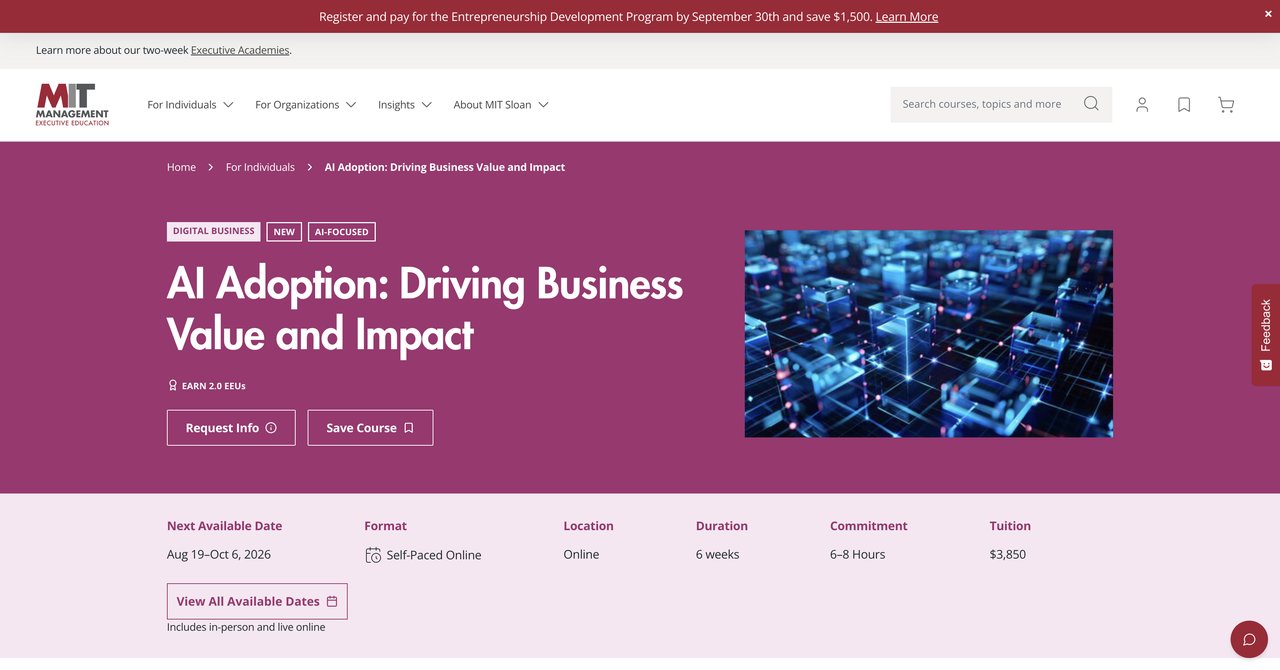
MIT Sloan's AI Adoption course takes a different approach. It's self-paced online, which gives you flexibility. The course maps AI to critical business challenges and builds sustainable co-creation practices. The focus is on moving from AI awareness to organization-wide AI transformation. This is a practical, business-focused course rather than a governance-heavy one. It's designed to help you actually drive AI adoption in your organization.
At $3,850, it's a significant investment. The self-paced format is convenient, but it requires 36 to 48 hours of your time. That's a substantial commitment. The course is not board-specific, so if you're looking for governance-focused content, this isn't the right fit. But if you're an Executive Director who needs to lead AI adoption across the organization, this could be exactly what you need. The MIT Sloan brand is also a strong credential.
Key topics covered: AI adoption, business value mapping, co-creation practices, AI transformation, organizational change.
Target audience and skill level requirements: Executive Directors and senior leaders. Intermediate level, some familiarity with AI concepts is helpful.
Pros:
- Maps AI to critical business challenges
- Builds sustainable co-creation practices
- Self-paced online format
Cons:
- Requires 36,48 hours total commitment
- Not board-specific
Who would benefit most: Executive Directors who want to drive AI adoption in their organization. The self-paced format is great for busy professionals. The focus on business value makes it practical and actionable.
Course 6: AI Risk and Readiness , From Governance to Growth by MIT Sloan Executive Education
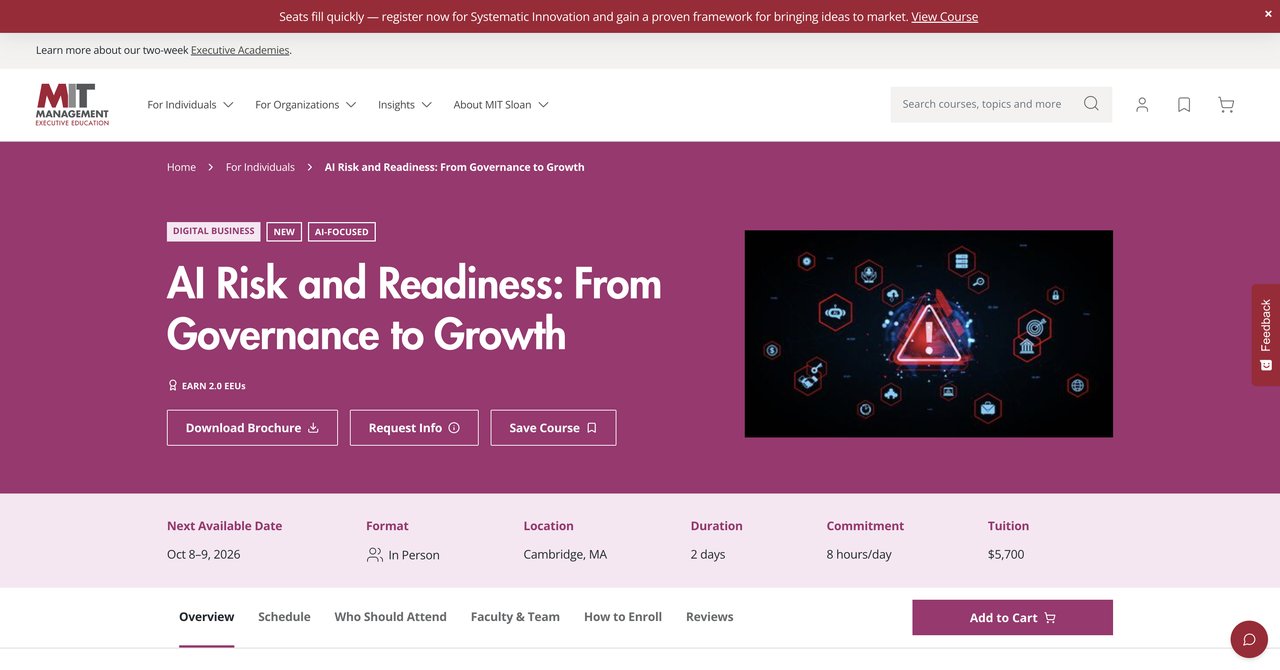
MIT Sloan also offers a more advanced in-person program focused on AI risk and governance. This one directly addresses governance gaps that are often unaddressed. It's a two-day program at MIT, and the price is $5,700. The course is designed to help you move from governance to growth. It's about understanding AI risk and readiness, not just in theory but in a way that you can apply. The in-person format at MIT gives you access to faculty and a network of peers.
The main downside is the price and the limited schedule. The course is only offered on October 8,9, 2026. That's a long way off. If you need AI risk training now, this might not be practical. The cost is also high for a two-day program. But if you want a focused, in-person experience at MIT and you can wait, this is a strong option. It's more specialized than the AI Adoption course, with a clear focus on risk and governance.
Key topics covered: AI risk management, governance gaps, AI readiness, growth strategy.
Target audience and skill level requirements: Executive Directors and senior executives. Advanced level, expects a solid understanding of AI basics.
Pros:
- Focuses on AI risk and governance
- In-person at MIT
- Addresses often-unaddressed governance gaps
Cons:
- High price
- Only offered Oct 8,9, 2026
Who would benefit most: Executive Directors who have a specific need to address AI risk and governance gaps. The in-person format is good for those who learn better face-to-face. But you need to be able to plan ahead for the date.
Course 7: Leading the AI-Driven Organization , MIT Sloan Executive Education
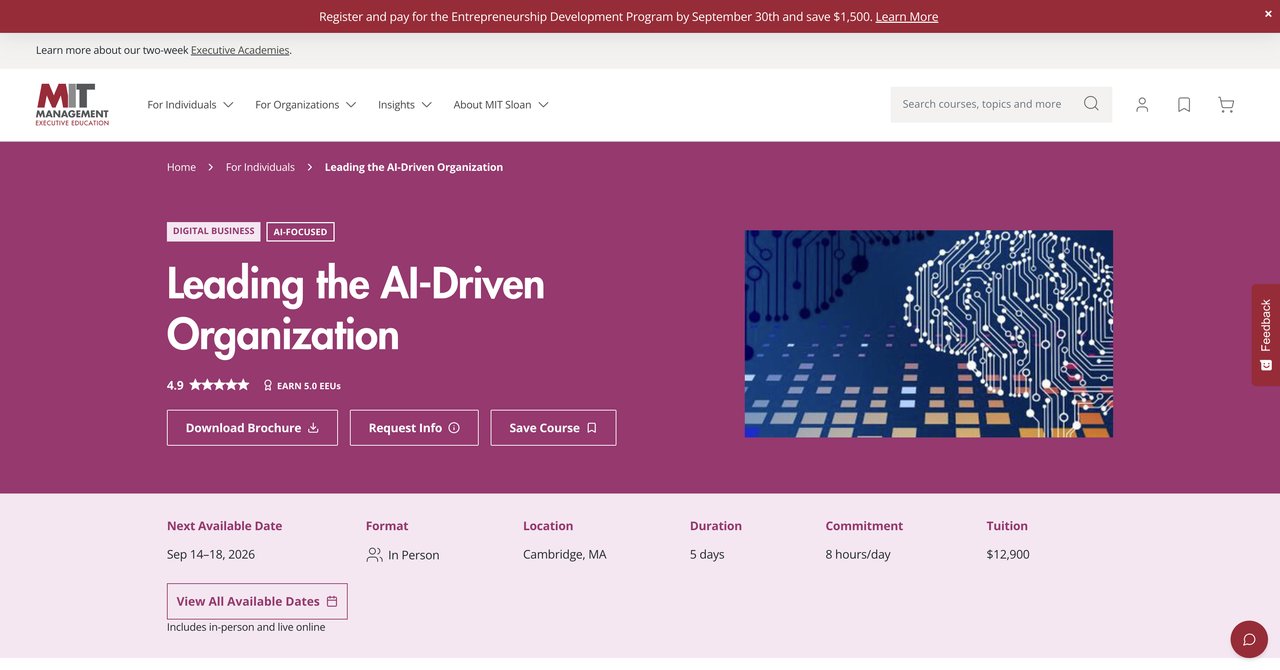
This is an immersive in-person program that covers leadership of AI transformation. It's taught by MIT Sloan faculty, and it's designed for executive directors who need to lead AI-driven organizational change at the highest strategic level. The course is a full week on campus. That's a significant time commitment. The price is $12,900, which puts it in the premium category. But it's not the most expensive MIT option on this list.
The focus here is on leadership. It's not about the technical details of AI. It's about how to lead an organization through AI transformation. That includes change management, strategy, and building the right culture. The in-person format is immersive, and you get the full MIT experience. The faculty are top-tier, and you'll be learning alongside other senior executives. If you're in a position to make major organizational decisions, this could be worth the investment.
Key topics covered: AI leadership, AI transformation, organizational change, strategic AI implementation.
Target audience and skill level requirements: Executive Directors and senior executives. Advanced level, significant leadership experience expected.
Pros:
- Immersive in-person program
- Covers leadership of AI transformation
- MIT Sloan faculty
Cons:
- Very high price
- Requires full week on campus
Who would benefit most: Senior Executive Directors who need to lead AI transformation at a strategic level. The immersive format is ideal if you want to step away from the office and focus on the big picture. The price is high, but the potential return is significant.
Course 8: AI Executive Academy , MIT Sloan Executive Education
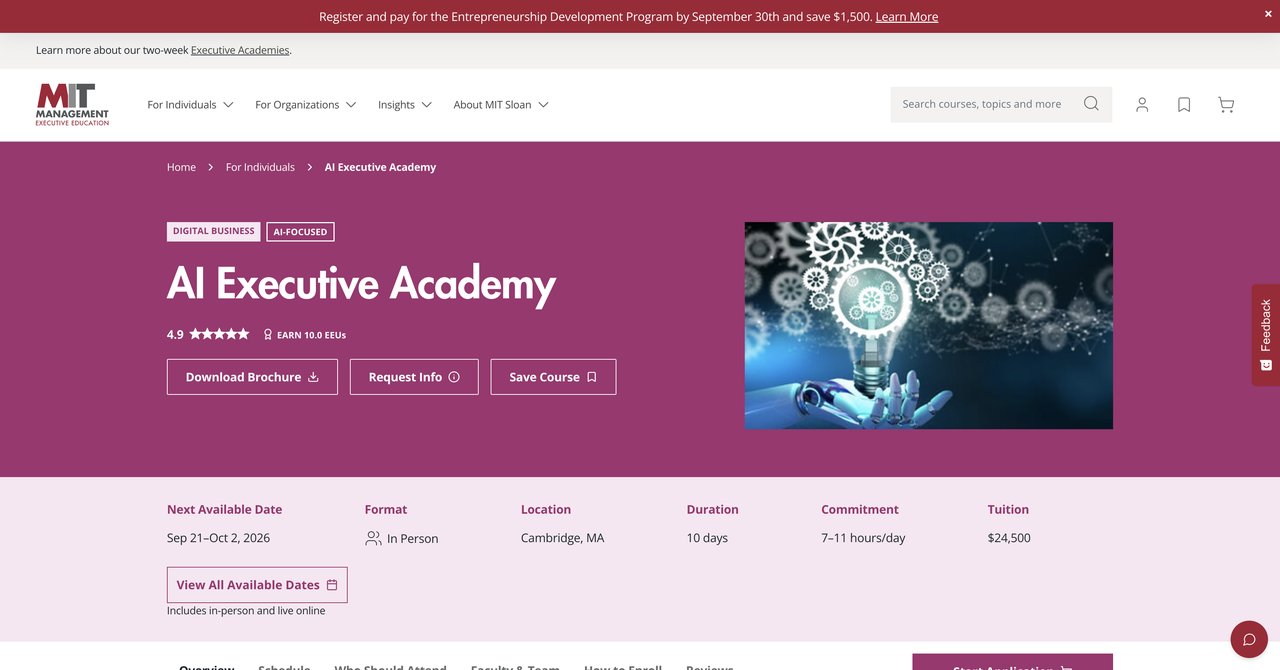
This is the most comprehensive MIT AI program. It's a 10-day deep dive that runs over two weeks. You earn 10 EEUs toward MIT credentials. The price is $24,500. That's the most expensive option on this list. The course is described as the definitive executive education for directors who need a complete, immersive AI leadership experience. It's a major commitment, both in time and money. But it's also the most thorough.
The two-week format allows for a deep exploration of AI topics. You're not just getting an overview. You're getting a full immersion. The MIT faculty is world-class, and the credential is highly respected. This is for people who are serious about making AI a core part of their leadership approach. The cost is prohibitive for many, but for the right person, it's an investment that could pay off in the long run.
Key topics covered: Comprehensive AI leadership, AI strategy, AI implementation, AI governance, and more.
Target audience and skill level requirements: Executive Directors and senior executives. Advanced level, significant AI knowledge and leadership experience required.
Pros:
- Most comprehensive MIT AI program
- 10 EEUs toward MIT credentials
- Deep dive over two weeks
Cons:
- Extremely expensive
- Major time commitment
Who would benefit most: Executives who are ready to make a major commitment to AI leadership. The 10-day format is for those who want the definitive experience. It's not for casual learners. It's for people who are serious about leading AI transformation.
Course 9: AI for Executives Program , UC Berkeley Haas School of Business
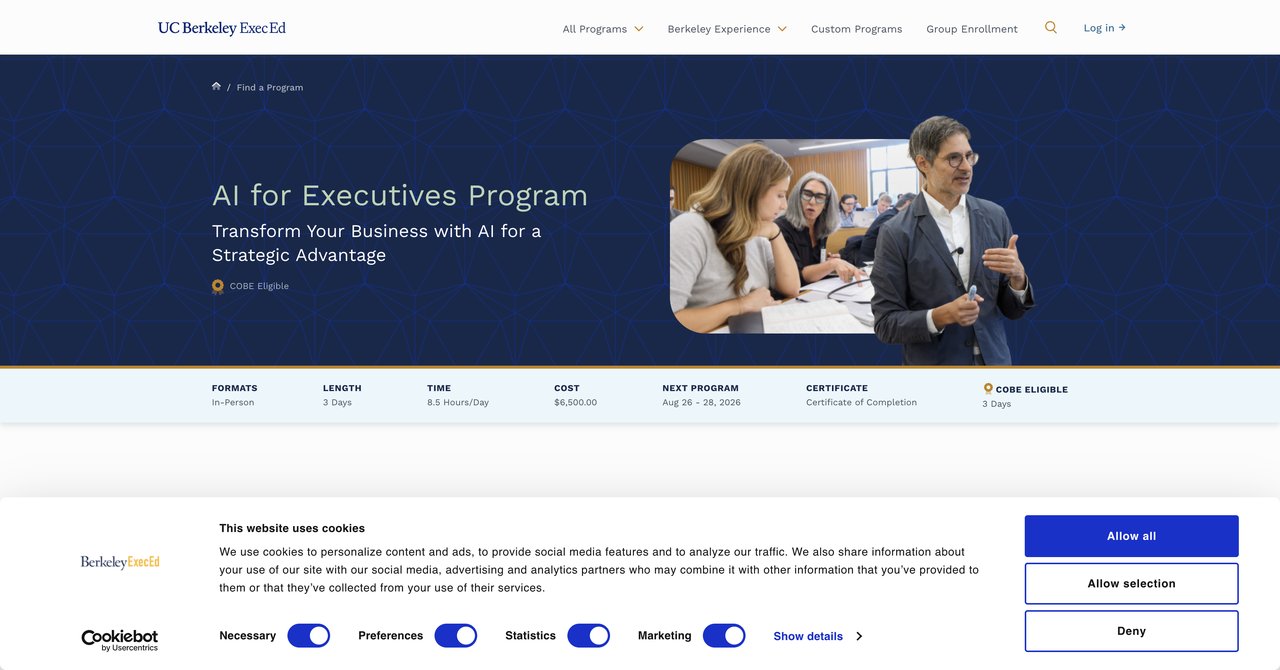
Berkeley Haas offers a three-day program that explores agentic AI systems and focuses on driving AI adoption and innovation. The program provides strategic frameworks for evaluating agentic AI and driving adoption. This is a more focused program than some of the others. It's specifically about agentic AI, which is AI that can take actions. That's a relatively new area, and it's important to understand if you're in a leadership position.
The price is $6,500. It's a moderate cost for a three-day program. The course is taught by Berkeley Haas faculty. The main downside is that it's not board-governance specific. It's more about driving adoption and innovation than about governance. It also requires travel to Berkeley. If you're in California or you're willing to travel, this is a good option. The focus on agentic AI makes it unique among the programs on this list.
Key topics covered: Agentic AI, AI adoption, AI innovation, strategic frameworks.
Target audience and skill level requirements: Executive Directors and senior executives. Intermediate to advanced level, some AI knowledge helpful.
Pros:
- Explores agentic AI systems
- Focuses on driving AI adoption and innovation
- Berkeley Haas faculty
Cons:
- Not board-governance specific
- Requires travel to Berkeley
Who would benefit most: Executive Directors who are interested in the latest AI developments, especially agentic AI. The program is good for those who want to drive innovation and adoption, not just governance.
Course 10: AI for Senior Executives Program , Johns Hopkins University
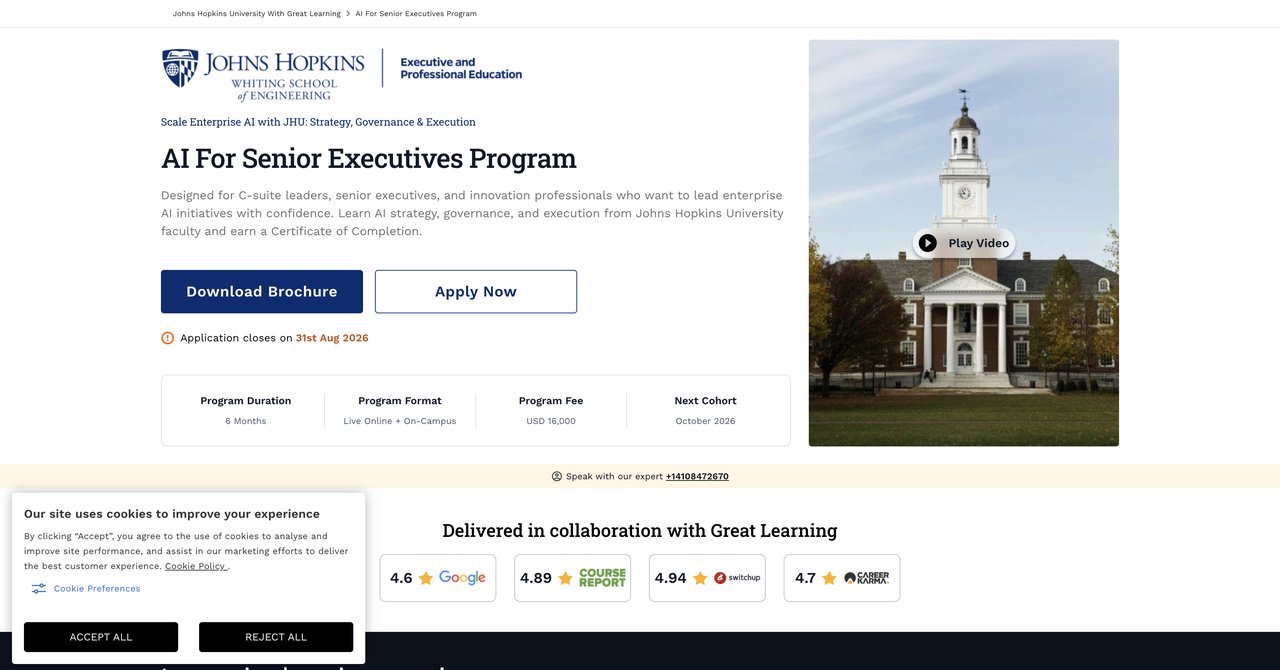
Johns Hopkins offers a university-backed program designed for C-suite and senior executives. It covers AI strategy, governance, and execution. You get a certificate of completion. The program is designed for people who need to understand AI from a strategic and governance perspective. It's a solid, university-backed option. The main issue is that the price and duration are not published. You have to contact them for details. That's a bit of a hurdle.
The program is less established than the MIT or Berkeley programs. Johns Hopkins is a strong university, but it's not as well-known for AI executive education. That might matter to some people. The certificate is a nice credential, but it's not the same as an MIT credential. If you're looking for a university-backed program with a certificate, this is a good option. But you need to be willing to contact them for more information.
Key topics covered: AI strategy, AI governance, AI execution, certificate of completion.
Target audience and skill level requirements: C-suite and senior executives. Intermediate to advanced level.
Pros:
- Designed for C-suite and senior executives
- Covers AI strategy, governance, and execution
- Certificate of completion
Cons:
- Price and duration not published
- Less established than MIT/Berkeley programs
Who would benefit most: Senior executives who want a university-backed certificate and a program that covers strategy, governance, and execution. It's a good option if you're okay with contacting them for details.
Course 11: AI & Automation for Executives , Udemy
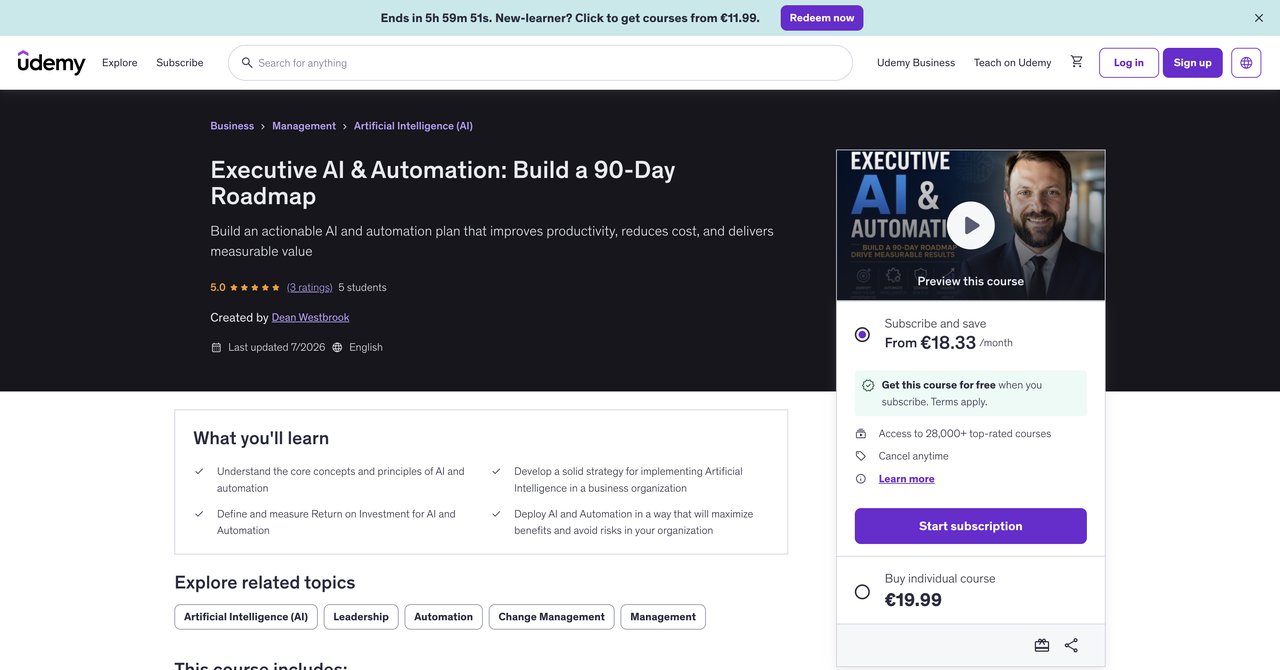
Udemy offers a low-cost, self-paced course that focuses on practical business outcomes of AI and automation. It's a flexible starting point for executive directors who need a clear AI business primer. The course is available through a Udemy subscription or as an individual purchase. The price is low, which makes it accessible. The course is self-paced, so you can go at your own speed. It's focused on practical business outcomes, not just theory.
The downside is that it's not board-specific. It's a general AI business course. The quality on Udemy can vary, and the update date is not verified. That means you need to be careful about the content. It might be outdated. But if you're looking for a low-cost way to get up to speed on AI business basics, this is a reasonable option. It's not a prestigious credential, but it's a practical starting point.
Key topics covered: AI business outcomes, automation, practical AI applications.
Target audience and skill level requirements: Executive Directors and professionals. Beginner level, no prior AI knowledge required.
Pros:
- Low-cost entry point
- Self-paced
- Practical business outcomes focus
Cons:
- Not board-specific
- Quality varies on Udemy
- Update date not verified
Who would benefit most: Executive Directors who want a quick, low-cost introduction to AI. It's a good starting point if you're not ready to invest in a more expensive program. But keep in mind that it's not a deep dive.
Final Recommendations: Finding the Right Fit for Your Role
There's no single best option for every Executive Director. The right choice depends on your goals, your budget, and your current level of AI knowledge. Here's a breakdown of who should pick what.
If you want the most comprehensive value for your money: CompleteAI Training stands out. The subscription model gives you access to all the video courses and all the certifications on the platform. For less than $30 a month, you're not just getting one course. You're getting a full library that covers every job role. That's useful if your work spans multiple functions or if you want to train your team. The continuous updates mean you're always current. It's a low-risk way to build a broad AI skill set. The downside is that it's a subscription, so you need to keep paying to maintain access. But the cost is so low compared to other options that it's easy to justify.
If you need a formal governance credential: The NACD course is a good starting point for board members. It's focused on governance and risk, which is exactly what directors need. The CMI Level 7 from INPD is a strong option if you want an accredited qualification. The Cambridge program is more advanced and produces a concrete 90-day plan. These are all good choices, but they're more expensive than CompleteAI Training.
If you want a prestigious university name: The MIT programs are the most recognized. The AI Executive Academy is the most comprehensive, but it's also the most expensive. The Leading the AI-Driven Organization program is a good middle ground. Berkeley is also a strong option, especially if you're interested in agentic AI. These programs come with a high price tag, but they offer an immersive experience and a strong credential.
If you're on a tight budget: The Udemy course is the cheapest option. It's not as comprehensive as the others, but it's a good starting point. CompleteAI Training is also very affordable, especially with annual billing. For a low monthly price, you get access to a huge library of content.
If you need a quick overview: The Udemy course is the quickest. It's self-paced and can be completed in a few hours. The CompleteAI Training courses are also flexible. The in-person programs are the most time-consuming, and they require travel.
In the end, the best choice is the one that fits your specific situation. If you need a deep, formal education with a prestigious name, you should consider MIT or Cambridge. If you need a practical, ongoing education that's cost-effective, CompleteAI Training is a strong option. If you need a quick, low-cost primer, Udemy is a good place to start. The key is to be honest about what you're trying to achieve and how much you're willing to invest. There's no right or wrong answer. There's only the right answer for you.