
Blog ·
11 Recommended AI Courses for Finance and Accounting specialists in 2026
Discover the top 11 AI courses tailored for finance and accounting pros in 2026. Boost efficiency, master predictive analytics, and future-proof your career with practical, industry-focused training.
 Jeroen Erne
The finance and accounting profession is changing faster than most professionals realize. What used to be a field dominated by manual data entry, spreadsheet formulas, and month-end closing rituals is now being reshaped by artificial intelligence. According to recent industry reports, 69% of businesses already use AI in some form, and finance departments are among the earliest adopters. The same reports suggest that up to 40% of routine accounting tasks could be automated within the next few years. That doesn't mean jobs disappear, but it does mean the job description is changing. The professionals who understand how to work with AI, how to prompt it, how to validate its outputs, and how to build workflows around it will be the ones who keep their edge. Those who don't may find themselves doing the tasks that machines can't do - but those tasks are shrinking.
The question isn't whether you should learn AI. It's which course will actually teach you something useful for your daily work. There are hundreds of AI courses out there, and most of them are aimed at developers or data scientists. That's not what you need. You need something practical - something that teaches you how to use AI for financial statement analysis, audit preparation, forecasting, or workflow automation. That's why this article matters.
Why AI matters for Finance and Accounting specialists today
The numbers tell a clear story. A 2023 survey from McKinsey found that finance and accounting departments are among the top adopters of generative AI tools. Almost half of the finance executives surveyed said they were already using AI for at least one business function. And the trend is accelerating. New tools appear every month. The software you use daily - Excel, QuickBooks, SAP, Oracle - is all adding AI features. If you don't know how to use them, you're leaving productivity on the table.
But it's not just about speed. AI is changing the nature of the work itself. Financial statement analysis that used to take days can now be done in hours. Audit procedures that involved sampling a handful of transactions can now review every single one. Forecasting models can be updated in real time. This isn't a future scenario - it's happening right now. And the professionals who can harness these capabilities are being promoted, paid more, and given more interesting projects.
This article compares 11 AI courses specifically designed for finance and accounting professionals. The goal is to help you figure out which course is worth your time and money. We'll look at what each course covers, who it's for, and what you'll actually be able to do when you finish. One of the courses we'll examine is CompleteAI Training, which is different from the others because it gives you access to all courses and all certifications on the platform rather than a single course. We'll cover that in detail.
The Growing Role of AI in Finance and Accounting specialists
AI is showing up in more places than you might think. Here's what it looks like in practice:
- Automation of routine tasks: Data entry, invoice processing, reconciliations, and journal entries are being automated. AI can read documents, extract relevant data, and post transactions without human intervention.
- Decision-making support: AI models can analyze historical data to forecast revenue, identify risk patterns, and recommend optimal pricing strategies. This isn't just about faster calculations - it's about seeing patterns that humans might miss.
- Personalization of financial advice: For those in advisory roles, AI can generate personalized recommendations for clients based on their spending habits, investment portfolios, and risk tolerance.
- Audit and compliance: AI can analyze entire datasets to flag anomalies, unusual patterns, or potential fraud. It can also keep track of changing regulations and flag potential compliance issues.
- Workflow automation: Tools like Microsoft Power Automate, Zapier, and custom AI agents are being used to connect systems and automate multi-step processes - like moving data from your accounting software into a reporting dashboard.
These aren't theoretical uses. They're happening in companies right now. And the professionals who understand how to set up these systems - or at least how to work alongside them - are the ones who are getting ahead.
Benefits of becoming an AI expert in Finance and Accounting specialists
There are concrete, tangible benefits to investing in AI training. First, there's the efficiency gain. When you can automate the repetitive parts of your job, you free up hours every week. That time can be spent on more valuable work - analyzing trends, meeting with clients, or developing strategies. Second, there's the accuracy improvement. AI doesn't get tired at 4 PM on a Friday. It doesn't miss a decimal point. When you know how to use AI to check your work, the quality of your output goes up.
Third, there's the career benefit. Professionals with AI skills in finance command higher salaries. A 2024 report from Robert Half showed that finance professionals with AI skills are being offered 15-20% more than those without. And it's not just about salary - it's about job security. As AI becomes more common in the field, those who can work with it will be seen as more valuable, more adaptable, and harder to replace.
Finally, there's the confidence factor. When you understand what AI can and cannot do, you're not scared of it. You don't worry about being replaced. Instead, you see it as a tool - a powerful one - that you can use to do your job better. That confidence changes how you approach your work and how you present yourself to employers and clients.
The courses listed below are the ones that have been specifically designed for people like you. They're not about becoming a programmer or a data scientist. They're about becoming a finance professional who can leverage AI to be better at their job. That's a different skill set - and it's one that's becoming essential.
Comparison: All AI Courses for Finance and Accounting specialists (Updated 2026)
| Course Name | Provider | Price | Key Topics | Pros | Cons | Best For |
|---|---|---|---|---|---|---|
| CompleteAI Training | CompleteAI | $8.25/month (billed annually) or $29/month - one subscription covers everything | Comprehensive AI training for Finance and Accounting specialists. One subscription unlocks EVERY course AND EVERY certification on the whole platform - hundreds of them, across every job role, not just this one. Full access to ALL video courses and ALL certifications, with new courses and certifications added continuously and included automatically. Access to every other job role's material too. Covers daily updates on relevant AI tools and news, plus hands-on projects and expert instruction. | Full access to ALL video courses on the platform, not a single course or a fixed bundle; Full access to ALL certifications included at no extra cost; New courses and certifications added continuously and included automatically; Access to every other job role's material too; One flat subscription price covers all of the above, versus paying per course elsewhere; Highest rating / most complete offering; Extensive range of AI courses and certifications tailored specifically for Finance and Accounting specialists; Daily updates on relevant AI tools and news; Very affordable pricing, especially with annual billing | Subscription based - crucial for continuous learning as AI is developing continuously | Finance and Accounting specialists professionals looking for complete training |
| AI For Accounting Pros: Financial Statement Analysis & Audit | Udemy | Unknown (Udemy pricing varies; often $20-$100) | Hands-on practical approach for creating, analyzing, and auditing financial statements; designed specifically for accounting professionals and business owners; saves time and effort in core accounting workflows. | Hands-on practical approach for creating, analyzing, and auditing financial statements; Designed specifically for accounting professionals and business owners; Saves time and effort in core accounting workflows | Short duration may not cover advanced topics; Single instructor perspective | General learners |
| Practical AI and prompting for finance professionals | Coursera | Free (audit) or Subscription (Coursera Plus) | Hands-on job-specific AI use cases across various modalities; immediate practical experience with AI-powered tools; focused on finance professional workflows. | Hands-on job-specific AI use cases across various modalities; Immediate practical experience with AI-powered tools; Focused on finance professional workflows | Intermediate level may require some prior AI knowledge; Limited to 5 hours of content | General learners |
| Introduction to AI Agent in Accounting | Coursera | Free (audit) or Subscription (Coursera Plus) | Designed for accountants with no technical background; uses a real audit Q&A agent built on 160 internal files as a running demo; covers agent workflows and integration with existing firm systems. | Designed for accountants with no technical background; Uses a real audit Q&A agent built on 160 internal files as a running demo; Covers agent workflows and integration with existing firm systems | Focuses on AI agents specifically, not broader AI applications; May be too narrow for some finance roles | General learners |
| Generative AI Essentials for Finance and Accounting | Coursera | Free (audit) or Subscription (Coursera Plus) | Covers prompt engineering with SMART framework for finance; uses tools like ChatGPT, Claude, and Google AI Studio; includes advanced techniques like chain-of-thought and role-based prompting. | Covers prompt engineering with SMART framework for finance; Uses tools like ChatGPT, Claude, and Google AI Studio; Includes advanced techniques like chain-of-thought and role-based prompting | Beginner level may not cover advanced financial modeling; Limited to 1 week of content | General learners |
| Introduction to AI for finance professionals | Coursera | Free (audit) or Subscription (Coursera Plus) | Builds foundational AI and Generative AI literacy; designed for finance professionals; hands-on approach. | Builds foundational AI and Generative AI literacy; Designed for finance professionals; Hands-on approach | Foundational level may be too basic for experienced AI users; Duration not specified | General learners |
| Accounting Workflow Automation with Excel and AI | Coursera | Free (audit) or Subscription (Coursera Plus) | Builds AI-powered invoice processing with OCR; creates advanced Excel templates for financial analysis; focuses on measurable workflow improvements. | Builds AI-powered invoice processing with OCR; Creates advanced Excel templates for financial analysis; Focuses on measurable workflow improvements | Excel-heavy approach may not suit all accounting roles; Beginner level limits depth | General learners |
| The Complete AI for Finance Course: Beginner to Master Level | Udemy | Unknown (Udemy pricing varies; often $20-$100) | Covers 5-year forecasts, valuation scenarios using P/E, P/S, and DCF methods; teaches realistic vs. fantasy forecasting; comprehensive beginner-to-master progression. | Covers 5-year forecasts, valuation scenarios using P/E, P/S, and DCF methods; Teaches realistic vs. fantasy forecasting; Comprehensive beginner-to-master progression | Duration not specified; May be too broad for specialists seeking niche skills | General learners |
| AI for Business & Finance Program | Columbia Business School Executive Education | Unknown (premium executive education pricing) | Earn a certificate from Columbia Business School; includes exercises, case studies, and guest speakers; designed for early- to mid-career professionals. | Earn a certificate from Columbia Business School; Includes exercises, case studies, and guest speakers; Designed for early- to mid-career professionals | Premium pricing likely; Requires significant time commitment | General learners |
| Capstone: Accounting Assistant with AI Skills | Coursera | Free (audit) or Subscription (Coursera Plus) | Hands-on capstone covering accounts payable, receivable, payroll, and general ledger; uses QuickBooks, Excel, and AI tools; applies professional quality standards. | Hands-on capstone covering accounts payable, receivable, payroll, and general ledger; Uses QuickBooks, Excel, and AI tools; Applies professional quality standards | Capstone format may require prior coursework; Duration not specified | General learners |
| AI for FP&A Automation & Modeling | Coursera | Free (audit) or Subscription (Coursera Plus) | Covers AI failure modes like hallucination, model drift, and bias; teaches risk-tiering of AI use cases; includes prompt and output guardrails and audit logging. | Covers AI failure modes like hallucination, model drift, and bias; Teaches risk-tiering of AI use cases; Includes prompt and output guardrails and audit logging | Focuses on FP&A specifically, not general accounting; May require some FP&A background | General learners |
Understanding AI Training for Finance and Accounting specialists Professionals
Finance and accounting professionals are increasingly expected to work alongside AI tools, whether that means automating routine tasks, analyzing large datasets, or building forecasts. The training market has responded with everything from short video courses to university-backed programs. Some are designed for complete beginners, while others assume you already have a solid grasp of both finance and AI basics. This article compares ten different options, looking at what each one actually covers, how much it costs, and who it's really for.
One thing to keep in mind as you read: the pricing structures vary a lot. Some platforms charge per course, some use a subscription model, and some are free to audit but require a paid plan for certificates. The right choice depends on your budget, your experience level, and whether you need certification for your employer.
Course 1: CompleteAI Training
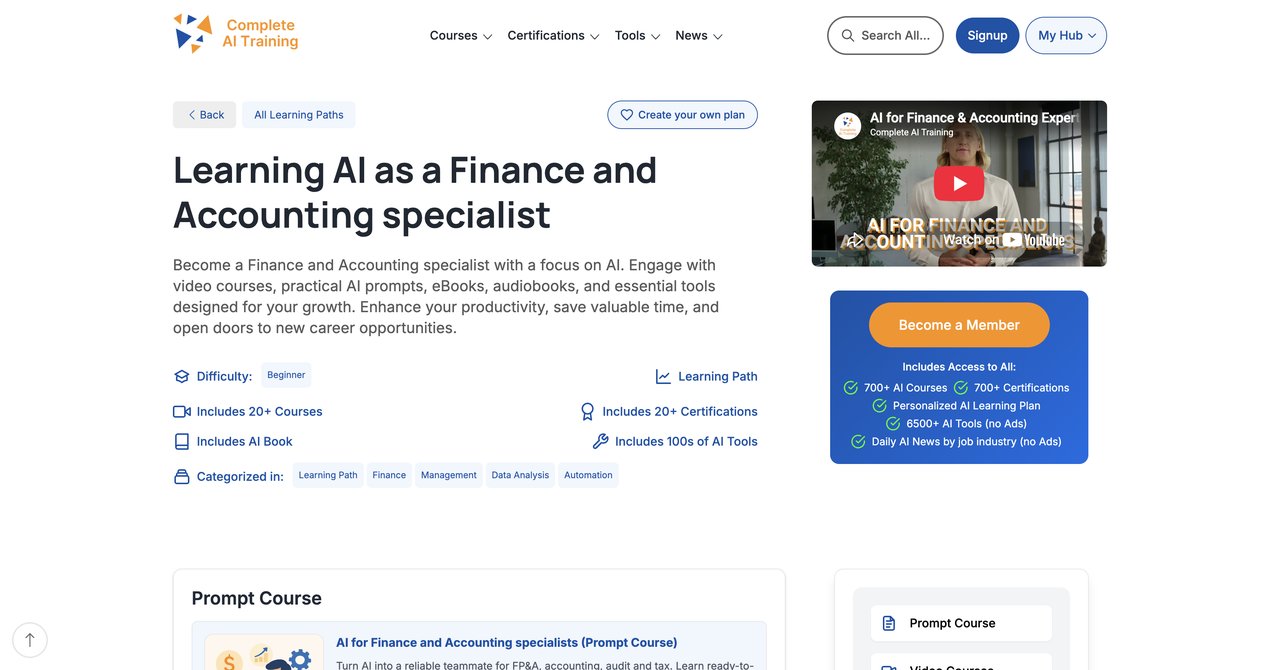
CompleteAI Training is not a single course. It's a subscription that unlocks every course and every certification on the entire platform. That means you get access to hundreds of courses across every job role, not just finance and accounting. If your work touches on marketing, operations, HR, or any other function, you can access that material too. The platform is built around the idea that one flat subscription price should cover everything, rather than paying per course like you would with most other providers. New courses and certifications are added continuously, and they're included automatically with your subscription.
This is the key differentiator: you're not buying a fixed bundle. You're getting full access to all video courses, all certifications, and all future content as it's released. For someone who wants to stay current as AI changes, that's a significant advantage. The platform also updates daily with relevant AI tools and news, which is helpful when you're trying to keep up with a fast-moving field.
The finance and accounting specialist track covers a broad range of topics, from prompt engineering to building AI agents to automating workflows. The training is hands-on and practical, so you're not just watching videos but actually applying what you learn. The certifications are included at no extra cost, which is unusual in this space. Most platforms charge separately for a certificate, but here it's part of the subscription.
For finance and accounting professionals, this is the most comprehensive option available. The content is updated regularly, which matters because AI tools change fast. The subscription model means you don't have to worry about paying for new courses as they come out. It's a bit like having a learning library that grows with you.
One thing to be aware of: it's a subscription, not a one-time purchase. That means you'll need to keep paying to maintain access. But given that AI is developing continuously, that's probably a good thing. You wouldn't want to buy a course and then be stuck with outdated material a year later.
Key Topics Covered:
- AI fundamentals for finance and accounting roles
- Prompt engineering for financial workflows
- Automation of reporting, reconciliation, and data entry
- Building AI agents for accounting tasks
- Advanced financial modeling with AI assistance
- Risk management and AI governance
- Integration with existing firm systems
Target Audience and Skill Level:
This is suitable for everyone from complete beginners to advanced professionals. The platform has material at all levels, so you can start with the basics and work your way up. It's particularly good for finance and accounting specialists who want to broaden their AI skills beyond just one niche area.
Pros:
- Full access to ALL video courses on the platform, not a single course or a fixed bundle
- Full access to ALL certifications on the platform, included at no extra cost
- New courses and certifications are added continuously and are included automatically
- Access to every other job role's material too, which matters for anyone whose work spans more than one function or who wants to move roles
- One flat subscription price covers all of the above, versus paying per course elsewhere
- Highest rating and most complete offering compared to other options
- Extensive range of AI courses and certifications specifically for finance and accounting specialists
- Daily updates on relevant AI tools and news
- Very affordable pricing, especially with annual billing at $8.25/month
Cons:
- Subscription-based, which means ongoing cost
- Requires self-discipline to work through the material
Who Would Benefit Most:
Finance and accounting professionals who want the most complete coverage of AI topics, need certifications for their career, and prefer a subscription model that keeps them current. It's also great for people whose work spans multiple job functions, because you get access to all other job roles' material. If you're serious about staying current with AI and want a single subscription that covers everything, this is the strongest option.
Course 2: AI For Accounting Pros: Financial Statement Analysis & Audit by Udemy
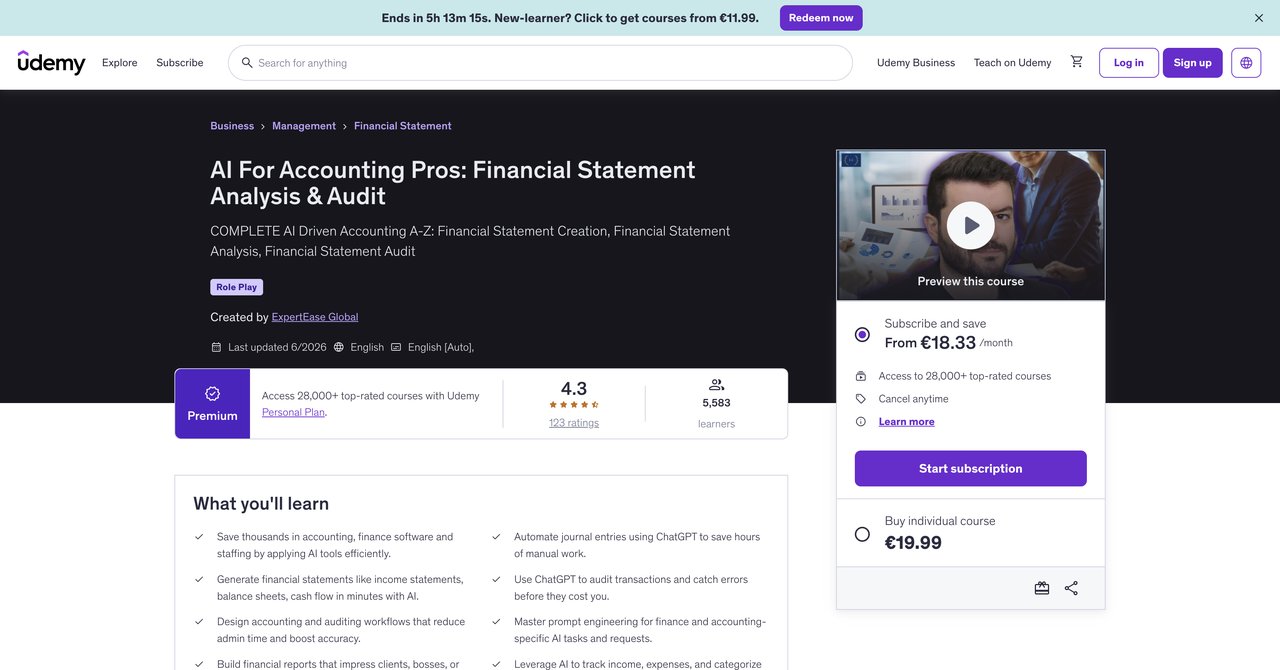
AI For Accounting Pros is a Udemy course that focuses on the practical side of creating, analyzing, and auditing financial statements. It's designed specifically for accounting professionals and business owners who want to save time on core accounting workflows. The course is hands-on, meaning you'll be working with AI tools as you go rather than just listening to lectures.
What makes this course stand out is its focus on financial statement work. If you're an accountant who spends a lot of time on statements, audits, or compliance, this could be a good fit. The instructor teaches you how to use AI to speed up these processes, which can save you hours each week. It's not about theory; it's about getting the work done faster and with fewer errors.
However, this course is relatively short, so it may not cover advanced topics in depth. You're also getting a single instructor's perspective, which means you won't see multiple approaches to the same problem. That's fine if you just want to learn one way, but it might not give you the full picture.
Udemy pricing varies, but you can often find this course on sale for $20 to $100. That's a one-time cost, not a subscription. So if you just want a quick, practical introduction to using AI for financial statements, this could be a good option.
Key Topics Covered:
- Creating financial statements with AI assistance
- Analyzing financial statements for accuracy
- Auditing workflows with AI tools
- Automating data entry and reconciliation
- Time-saving techniques for accounting professionals
Target Audience and Skill Level:
This is for accounting professionals and business owners who are comfortable with basic accounting concepts. It's a practical, hands-on course, so you should have some familiarity with financial statements before you start. It's not for complete beginners to accounting, but you don't need to be an AI expert either.
Pros:
- Hands-on practical approach for creating, analyzing, and auditing financial statements
- Designed specifically for accounting professionals and business owners
- Saves time and effort in core accounting workflows
Cons:
- Short duration may not cover advanced topics
- Single instructor perspective
Who Would Benefit Most:
Accountants who spend a lot of time on financial statements and audits and want to speed up those processes. Business owners who handle their own accounting and want to use AI to save time. This is a good starting point if you're new to AI but comfortable with accounting basics.
Course 3: Practical AI and Prompting for Finance Professionals by Coursera
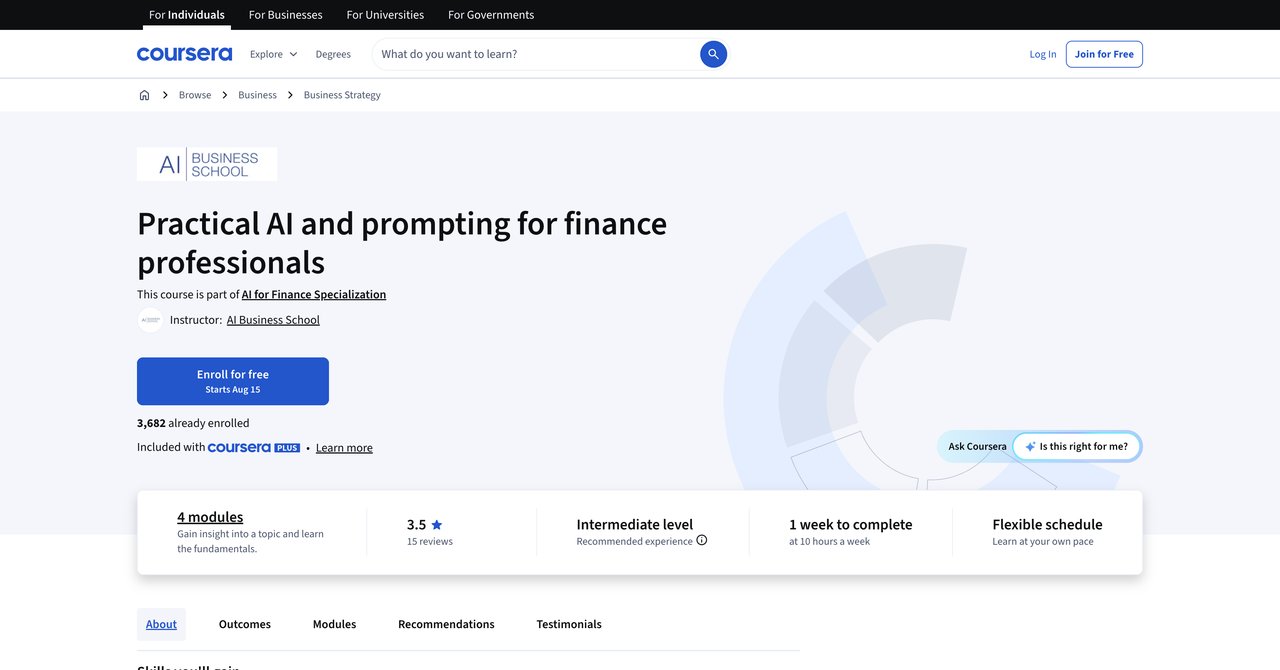
Practical AI and Prompting for Finance Professionals is a Coursera course that focuses on job-specific AI use cases across various modalities. You'll get immediate practical experience with AI-powered tools, and the course is built around finance professional workflows. This isn't a theory course; you're going to be using AI tools from the start.
The course is designed to give you hands-on experience with AI in finance, but it's not for total beginners. It's rated as intermediate level, which means you should have some prior AI knowledge before you start. If you've already used ChatGPT or similar tools, you'll be comfortable here. But if you're starting from scratch, you might struggle with some of the concepts.
One of the strengths of this course is its focus on prompting. You'll learn how to write prompts that get the results you want, which is a crucial skill for finance professionals who want to use AI effectively. The course also covers multiple modalities, so you'll see how AI can be applied to different types of financial data, not just text.
The content is limited to about 5 hours, which is relatively short. That means you can complete it in a weekend, but it also means you won't go deep into any one topic. It's a good introduction to practical AI use, but not a comprehensive training.
On Coursera, you can audit the course for free, or pay for a subscription to get a certificate. The subscription is around $49 per month, but you might get financial aid if you qualify. The free audit option gives you access to the course materials but not the certificate.
Key Topics Covered:
- Job-specific AI use cases for finance
- Prompt engineering for financial workflows
- Using AI with financial data
- Practical exercises with AI tools
- Multimodal AI applications
Target Audience and Skill Level:
This is for finance professionals who have some AI experience and want to get more practical. It's an intermediate level course, so you should know the basics of AI and prompting. If you're comfortable with ChatGPT or similar tools, you'll find this course useful.
Pros:
- Hands-on job-specific AI use cases across various modalities
- Immediate practical experience with AI-powered tools
- Focused on finance professional workflows
Cons:
- Intermediate level may require some prior AI knowledge
- Limited to 5 hours of content
Who Would Benefit Most:
Finance professionals who are already comfortable with AI and want to get more practical experience. If you've used ChatGPT or other AI tools and want to apply them to your finance work, this course is a good fit. It's also good for those who want a quick, hands-on learning experience without a huge time commitment.
Course 4: Introduction to AI Agent in Accounting by Coursera

Introduction to AI Agent in Accounting is a Coursera course that's designed for accountants with no technical background. It uses a real audit Q&A agent built on 160 internal files as a running demo. This is a unique approach because you're seeing a real-world example of how AI agents work in accounting, not just a theoretical concept.
The course covers agent workflows and how to integrate them with existing firm systems. This is important because AI agents aren't just standalone tools; they need to work with your current software. The course teaches you how to make that happen, which is a practical skill that many accountants need.
One of the strengths of this course is that it's accessible to beginners. You don't need a technical background to follow along. The instructor explains everything clearly, and the real-world demo makes it easier to understand. It's a good starting point if you're new to AI and want to see how it can be used in accounting.
However, the course focuses specifically on AI agents, not broader AI applications. If you're looking for a general AI course, this might be too narrow. It's also not designed for finance roles that go beyond accounting. If you're in FP&A or financial analysis, you might need something more comprehensive.
Like other Coursera courses, you can audit it for free or pay for a subscription to get a certificate. The course is relatively short, so you can complete it in a few hours. It's a good introduction to AI agents, but it's not a full training program.
Key Topics Covered:
- AI agents in accounting
- Building a Q&A agent for audit
- Integration with firm systems
- Real-world use cases
- No technical background required
Target Audience and Skill Level:
This course is for accountants who are new to AI and have no technical background. It's a beginner-level course that starts with the basics. If you're an accountant who wants to see how AI agents can help your work, this is a great place to start.
Pros:
- Designed for accountants with no technical background
- Uses a real audit Q&A agent built on 160 internal files as a running demo
- Covers agent workflows and integration with existing firm systems
Cons:
- Focuses on AI agents specifically, not broader AI applications
- May be too narrow for some finance roles
Who Would Benefit Most:
Accountants who are curious about AI agents and want to see a real example. It's also good for professionals who want to understand how AI can be integrated into their existing systems. If you're a beginner to AI, this course is a gentle introduction.
Course 5: Generative AI Essentials for Finance and Accounting by Coursera

Generative AI Essentials for Finance and Accounting is a Coursera course that focuses on prompt engineering using the SMART framework specifically for finance. It uses tools like ChatGPT, Claude, and Google AI Studio, so you'll be working with the latest AI models. The course also includes advanced techniques like chain-of-thought and role-based prompting.
The SMART framework is a structured way to write prompts that get better results. It's a practical skill that you can apply immediately to your finance work. The course is designed for finance and accounting professionals, so the examples are relevant to your daily tasks. It's not a generic AI course; it's specifically for finance.
One of the strengths of this course is its focus on advanced prompting techniques. Chain-of-thought prompting helps AI reason through complex problems, and role-based prompting helps you get responses from a specific perspective. These are advanced skills that can make a big difference in how you use AI.
However, this is a beginner-level course, so it might not cover advanced financial modeling. If you're already using AI for complex financial analysis, you might find this too basic. It's also limited to 1 week of content, which is quite short. You'll get a good foundation, but not a deep dive.
You can audit the course for free on Coursera, or pay for a subscription to get a certificate. The subscription is around $49 per month, and you can cancel anytime. The audit option gives you access to all the materials, but you won't get the certificate.
Key Topics Covered:
- Prompt engineering with the SMART framework
- Using ChatGPT, Claude, and Google AI Studio
- Chain-of-thought prompting
- Role-based prompting
- Advanced AI techniques for finance
Target Audience and Skill Level:
This is for finance and accounting professionals who are new to AI and want to learn how to use it effectively. It's a beginner-level course, so you don't need prior AI knowledge. If you're comfortable with basic accounting concepts, you'll be fine.
Pros:
- Covers prompt engineering with SMART framework for finance
- Uses tools like ChatGPT, Claude, and Google AI Studio
- Includes advanced techniques like chain-of-thought and role-based prompting
Cons:
- Beginner level may not cover advanced financial modeling
- Limited to 1 week of content
Who Would Benefit Most:
Finance professionals who are new to AI and want to learn how to use it effectively. It's also good for those who want to improve their prompting skills with the SMART framework. If you're just starting out with AI in finance, this is a solid foundation.
Course 6: Introduction to AI for Finance Professionals by Coursera

Introduction to AI for Finance Professionals is a Coursera course that builds foundational AI and Generative AI literacy. It's designed for finance professionals, so the examples are relevant to your work. The course takes a hands-on approach, which means you'll be using AI tools as you learn, not just watching videos.
This is a foundational course, so it's perfect for beginners. You'll learn what AI is, how it works, and how it can be used in finance. The course covers both AI and Generative AI, so you'll get a good overview of the field. It's a great starting point if you're new to AI and want to build a solid foundation.
The hands-on approach is a big plus. You'll be using AI tools from the start, which helps you understand how they work in practice. The course is designed for finance professionals, so you won't have to translate generic AI concepts to your field. Everything is presented in a finance context.
However, the foundational level might be too basic for experienced AI users. If you've been using AI for a while, you might find this course too simple. The duration isn't specified, but it's likely short, given the foundational level. You'll get a good introduction, but not a deep dive.
You can audit this course for free on Coursera, or pay for a subscription to get a certificate. The subscription is around $49 per month, and you can get financial aid if needed. The audit option gives you access to all materials, but no certificate.
Key Topics Covered:
- Foundational AI concepts
- Generative AI basics
- Hands-on AI use cases for finance
- AI tools for finance professionals
Target Audience and Skill Level:
This is for finance professionals who are completely new to AI. It's a foundational course, so you don't need any prior knowledge. If you're a beginner, this is a great place to start.
Pros:
- Builds foundational AI and Generative AI literacy
- Designed for finance professionals
- Hands-on approach
Cons:
- Foundational level may be too basic for experienced AI users
- Duration not specified
Who Would Benefit Most:
Finance professionals who are new to AI and want a gentle introduction. It's also good for those who want to build a foundation before moving to more advanced topics. If you're a beginner, this is a solid starting point.
Course 7: Accounting Workflow Automation with Excel and AI by Coursera

Accounting Workflow Automation with Excel and AI is a Coursera course that focuses on building AI-powered invoice processing with OCR. It also teaches you how to create advanced Excel templates for financial analysis. The course focuses on measurable workflow improvements, so you'll see concrete results from what you learn.
The OCR component is particularly useful for accountants who deal with a lot of invoices. You'll learn how to automate the process of extracting data from invoices, which can save you hours of manual work. The Excel templates are also valuable for financial analysis, helping you to analyze data more efficiently.
This course is very practical, and it's focused on measurable improvements. You'll not just learn theory; you'll build actual tools that you can use in your work. It's a great way to see the immediate benefits of AI in accounting.
However, the course is Excel-heavy, which might not suit all accounting roles. If you don't use Excel much, this course might not be the best fit. It's also a beginner-level course, so it might not cover advanced topics. You'll get a good foundation, but you might need more advanced training later.
You can audit this course for free on Coursera, or pay for a subscription for a certificate. The subscription is around $49 per month, and you can get financial aid. The audit gives you access to all materials, but no certificate.
Key Topics Covered:
- AI-powered invoice processing with OCR
- Advanced Excel templates for financial analysis
- Workflow automation
- Measurable improvements in accounting
Target Audience and Skill Level:
This is for accountants who are comfortable with Excel and want to automate their workflows. It's a beginner-level course, so you don't need prior AI knowledge. If you're an accountant who uses Excel regularly, this is a great fit.
Pros:
- Builds AI-powered invoice processing with OCR
- Creates advanced Excel templates for financial analysis
- Focuses on measurable workflow improvements
Cons:
- Excel-heavy approach may not suit all accounting roles
- Beginner level limits depth
Who Would Benefit Most:
Accountants who work heavily with Excel and want to automate repetitive tasks. It's also good for those who want to see quick, measurable improvements in their workflow. If you're an accountant who uses Excel daily, this course is a great option.
Course 8: The Complete AI for Finance Course: Beginner to Master Level by Udemy

The Complete AI for Finance Course is a Udemy course that covers 5-year forecasts, valuation scenarios using P/E, P/S, and DCF methods. It teaches you how to create realistic vs. fantasy forecasts, which is a key skill for financial analysts. The course offers a comprehensive beginner-to-master progression, so you can start from scratch and work your way up.
The focus on valuation is a strong point. You'll learn how to use AI to calculate P/E, P/S, and DCF valuations, which are essential for financial analysis. The course also teaches you how to create forecasts, which is another critical skill. The beginner-to-master progression is also helpful because it means you can use the same course as you grow your skills.
However, the course duration isn't specified, so you don't know how much time you'll need to commit. It might also be too broad for specialists who are looking for niche skills. If you're looking for a general AI in finance course, this is a good option. But if you need a specific skill, you might need a more focused course.
Udemy pricing varies, but you can often find this course on sale for $20 to $100. It's a one-time cost, not a subscription. So if you want a comprehensive course without a subscription, this is a good choice.
Key Topics Covered:
- 5-year forecasts
- Valuation scenarios using P/E, P/S, and DCF methods
- Realistic vs. fantasy forecasting
- Beginner-to-master progression
Target Audience and Skill Level:
This is for finance professionals who want a comprehensive course that covers everything from basics to advanced. It's suitable for beginners, but it also covers advanced topics. If you're new to AI in finance, this is a good place to start.
Pros:
- Covers 5-year forecasts, valuation scenarios using P/E, P/S, and DCF methods
- Teaches realistic vs. fantasy forecasting
- Comprehensive beginner-to-master progression
Cons:
- Duration not specified
- May be too broad for specialists seeking niche skills
Who Would Benefit Most:
Finance professionals who want a comprehensive course that covers everything from basics to advanced. It's also good for anyone who wants to learn valuation methods with AI. If you're looking for a one-time purchase, this is a good option.
Course 9: AI for Business & Finance Program by Columbia Business School Executive Education

AI for Business & Finance Program is a premium executive education program from Columbia Business School. You'll earn a certificate from Columbia, which carries weight in the industry. The program includes exercises, case studies, and guest speakers, so you get a well-rounded learning experience.
This program is designed for early- to mid-career professionals who want to advance their skills. The guest speakers bring real-world experience, and the case studies help you apply what you learn. The certificate from Columbia is a significant credential that can help your career.
However, the premium pricing is likely to be high. Executive education programs at Columbia are expensive, and this is no exception. You'll need to make a significant financial investment. The program also requires a significant time commitment, which might not be feasible if you're working full-time.
The course is comprehensive, but it's a big commitment. You'll get a certificate and a network of professionals, but you'll pay for it. If you're looking for a quick course, this isn't it. But if you want a prestigious certificate, this is the way to go.
The cost is unknown, but you can expect to pay several thousand dollars for a program like this. It's a big investment, but it could be worth it if you're looking to advance your career.
Key Topics Covered:
- AI for business and finance
- Case studies and exercises
- Guest speakers
- Executive education
Target Audience and Skill Level:
This is for early- to mid-career professionals who want a prestigious certificate. It's not for beginners; you should have some finance background. The program is designed for professionals who want to advance their careers.
Pros:
- Earn a certificate from Columbia Business School
- Includes exercises, case studies, and guest speakers
- Designed for early- to mid-career professionals
Cons:
- Premium pricing likely
- Requires significant time commitment
Who Would Benefit Most:
Early- to mid-career finance professionals who want a prestigious certificate and are willing to invest time and money. It's also good for anyone who wants to network with other professionals and learn from guest speakers. If you're looking for a premium program, this is a strong choice.
Course 10: Capstone: Accounting Assistant with AI Skills by Coursera

Capstone: Accounting Assistant with AI Skills is a Coursera capstone course that covers accounts payable, receivable, payroll, and general ledger. It uses QuickBooks, Excel, and AI tools to teach you how to apply professional quality standards. This is a hands-on capstone, so you'll be doing real work, not just watching videos.
The capstone format is unique because it requires you to apply everything you've learned. You'll work through real-world scenarios, using AI tools to complete tasks. This is a great way to demonstrate your skills to employers, as you'll have a portfolio of work to show.
The course covers accounts payable, receivable, payroll, and general ledger, which are the core functions of accounting. It uses QuickBooks and Excel, which are industry-standard tools. The focus on professional quality standards ensures that you're producing work that meets industry expectations.
However, the capstone format may require prior coursework. You can't just jump into a capstone without some foundation. The duration isn't specified, but capstones are usually longer than regular courses. You'll need to commit a significant amount of time to complete it.
You can audit this course for free on Coursera, or pay for a subscription to get a certificate. The subscription is around $49 per month, and you can get financial aid. The audit option gives you access to all materials, but no certificate.
Key Topics Covered:
- Accounts payable and receivable
- Payroll
- General ledger
- Using QuickBooks, Excel, and AI tools
Target Audience and Skill Level:
This is for accounting professionals who have some background and want to apply their skills in a capstone project. It's not for beginners; you need some accounting knowledge. The course is designed to test your skills in a real-world context.
Pros:
- Hands-on capstone covering accounts payable, receivable, payroll, and general ledger
- Uses QuickBooks, Excel, and AI tools
- Applies professional quality standards
Cons:
- Capstone format may require prior coursework
- Duration not specified
Who Would Benefit Most:
Accounting professionals who want to apply their skills in a real-world capstone project. It's also good for anyone who wants a portfolio of work to show employers. If you've completed prior coursework, this is a great way to cap off your learning.
Course 11: AI for FP&A Automation & Modeling by Coursera

AI for FP&A Automation & Modeling is a Coursera course that covers AI failure modes like hallucination, model drift, and bias. It teaches you how to risk-tier AI use cases, which is crucial for financial planning and analysis. The course also includes prompt and output guardrails, as well as audit logging, to ensure your AI models are safe and reliable.
This course is unique because it focuses on the risks and failures of AI, not just the benefits. You'll learn how to identify and mitigate AI risks, which is a valuable skill in FP&A. The risk-tiering of AI use cases is also important, as it helps you decide which AI applications are safe to use.
The course covers prompt and output guardrails, which are techniques to keep AI models from making mistakes. Audit logging is also covered, which is crucial for compliance. These are advanced topics that aren't covered in most AI courses.
However, the course focuses on FP&A specifically, not general accounting. If you're not in FP&A, this course might not be relevant. It also requires some FP&A background, so it's not for beginners. You'll need to understand financial planning and analysis concepts to get the most out of it.
You can audit this course for free on Coursera, or pay for a subscription for a certificate. The subscription is around $49 per month, and you can get financial aid. The audit option gives you access to all materials, but no certificate.
Key Topics Covered:
- AI failure modes like hallucination, model drift, and bias
- Risk-tiering of AI use cases
- Prompt and output guardrails
- Audit logging
Target Audience and Skill Level:
This is for FP&A professionals who have some AI knowledge and want to understand the risks. It's an intermediate-level course, so you need some background. If you're in FP&A and want to use AI safely, this is a great fit.
Pros:
- Covers AI failure modes like hallucination, model drift, and bias
- Teaches risk-tiering of AI use cases
- Includes prompt and output guardrails and audit logging
Cons:
- Focuses on FP&A specifically, not general accounting
- May require some FP&A background
Who Would Benefit Most:
FP&A professionals who want to understand the risks of AI and how to mitigate them. It's also good for anyone who wants to use AI safely in financial planning. If you're in FP&A, this course is a valuable addition to your skills.
Final Recommendations
Choosing the right AI course depends on your specific needs, your budget, and your career goals. Here's a breakdown of which course might be best for different types of learners.
For the complete learner: If you want comprehensive coverage of all AI topics for finance and accounting, CompleteAI Training is the strongest option. It's not just one course; it's a subscription that gives you access to everything on the platform, including all courses and all certifications. The price is very affordable, especially with annual billing at $8.25/month. This is the best value for anyone who wants to stay current with AI as it evolves. The subscription model is ideal for continuous learning, and you'll have access to material for other job roles as well.
For those who want a prestigious certificate: The Columbia Business School program is the way to go. It's expensive and time-consuming, but the certificate from Columbia carries weight in the industry. If you're looking to advance your career and have the budget, this is a strong choice. However, it's not a subscription, so you'll need to commit to the program.
For budget-conscious learners: The Coursera courses are a good option because you can audit them for free. You won't get a certificate, but you'll have access to the content. If you need a certificate, you can pay for a subscription. The free audit is a great way to learn without spending money. The downside is that you won't get a certificate, but the content is still valuable.
For those who want a one-time purchase: The Udemy courses are a good choice. They're often on sale for $20 to $100, and you get lifetime access. They're not as comprehensive as the subscription platforms, but they're good for a quick, focused learning. The downside is that you won't get access to other courses or certifications.
For those who want to specialize in FP&A: The AI for FP&A course on Coursera is the best option. It covers the specific risks and techniques for FP&A, which is a niche skill. It's not for general accounting, but if you're in FP&A, it's worth it.
For those who want a quick, practical introduction: The Practical AI and Prompting course on Coursera is a good start. It's short, hands-on, and focused on practical use cases. It's not comprehensive, but it's a good starting point.
Overall, the best choice depends on your specific needs. If you want a comprehensive, all-in-one subscription that covers everything, CompleteAI Training is the best option. It's affordable, comprehensive, and includes all certifications. For those who want a prestigious certificate, Columbia is the way to go. For budget-conscious learners, the Coursera audit option is great. For one-time purchases, Udemy is a good choice.
Ultimately, the most important thing is to choose a course that fits your career goals and learning style. All of these courses offer valuable content, but they're not all right for everyone. Take your time, think about what you need, and choose accordingly.