
Blog ·
11 Recommended AI Courses for Game Developers in 2026
Level up your game dev skills with 11 top AI courses for 2026—covering ML, procedural generation, and intelligent NPCs. Find the right fit to future-proof your career.
 Jeroen Erne
Artificial intelligence is no longer a futuristic concept reserved for research labs or tech giants. It is here, it is practical, and it is fundamentally changing how games are built, tested, and played. For game developers, this shift brings both urgency and opportunity. The demand for AI-savvy professionals is growing, and those who adapt will find themselves with a significant edge in the job market. The question is not whether AI will impact your workflow, but how quickly you can integrate it into your skillset. Upskilling now is a strategic move that can protect your career trajectory and open doors to roles that did not exist five years ago.
Why AI matters for Game Developers today
AI is already woven into the fabric of modern game development. From NPC behavior and procedural content generation to playtesting and player analytics, the technology is reshaping the day-to-day responsibilities of developers. Consider this: a recent survey indicated that 69% of businesses are actively using AI in some capacity, and the gaming industry is no exception. Studios are using machine learning to create more responsive enemies, to balance in-game economies, and to personalize player experiences in real time. For the individual developer, this means that understanding AI is no longer a niche specialty-it is becoming a core competency. This article will help you cut through the noise by comparing five AI courses specifically designed for game developers, with a focus on practical skills you can apply immediately. We will look at what each course offers, who it is for, and how it can help you stay relevant in a competitive field.
The Growing Role of AI in Game Developers
AI is not just about making smarter enemies. Its applications in game development are broad and varied. Here are some of the key areas where AI is making a tangible difference:
- Automation of repetitive tasks: AI can handle time-consuming processes like generating texture variations, cleaning up motion capture data, or even writing basic code snippets, freeing you up for more creative work.
- Dynamic difficulty adjustment: AI algorithms can analyze a player's performance in real time and adjust the game's difficulty to keep them engaged without causing frustration.
- Procedural content generation: From sprawling landscapes to entire quest lines, AI can create vast amounts of content that feels unique and handcrafted, reducing the manual workload on level designers.
- Improved playtesting and QA: AI agents can play through thousands of scenarios in minutes, identifying bugs, balance issues, and exploits that human testers might miss.
- Personalized player experiences: By analyzing player behavior, AI can tailor in-game events, offers, and even story elements to suit individual preferences, increasing retention and satisfaction.
- Enhanced NPC interactions: Natural language processing allows for more realistic conversations with non-player characters, moving beyond scripted dialogue trees into more organic interactions.
These applications are not theoretical. They are being implemented in studios of all sizes, from indie teams to AAA powerhouses. As these tools become more accessible, the expectation for developers to understand and work alongside them will only increase. The workflow is shifting from manually crafting every element to directing and refining AI-driven systems.
Benefits of becoming an AI expert in Game Developers
For a game developer, gaining proficiency in AI offers a range of concrete benefits. First, it can lead to better job security. As automation handles more routine tasks, developers who can build, manage, and improve AI systems become invaluable. Second, it can increase your earning potential. Specialized skills typically command higher salaries, and AI expertise is one of the most in-demand specializations in the industry right now. Third, it makes you a more versatile team member. You will be able to contribute to design discussions, solve complex technical problems, and bridge the gap between creative vision and technical implementation. Finally, working with AI can be deeply rewarding. There is a unique satisfaction in seeing an AI-driven system bring a game world to life in ways you did not directly program. It expands your toolkit and allows you to take on more ambitious projects.
To help you get started, we have compared five AI courses that are directly relevant to game developers. Among them is Complete AI Training, which stands out because it gives you access to ALL courses and ALL certifications on the platform rather than just a single course. This can be a cost-effective way to explore different aspects of AI and build a comprehensive skill set. The other courses on our list also offer valuable, focused training, and we will break down their strengths so you can decide which one fits your current skill level and career goals. Whether you are a programmer looking to implement advanced algorithms or a designer wanting to understand the possibilities of AI-driven gameplay, there is a course here for you.
Comparison: All AI Courses for Game Developers (Updated 2026)
| Course Name | Provider | Price | Key Topics | Pros | Cons | Best For |
|---|---|---|---|---|---|---|
| CompleteAI Training | CompleteAI | Premium - one flat subscription covers ALL courses and ALL certifications on the platform, not just one course. Far more cost-effective than per-course pricing elsewhere. | Comprehensive AI training for Game Developers: covers everything from foundational AI concepts to advanced implementation across multiple engines and tools. Includes hands-on projects and expert-led instruction. | Comprehensive curriculum; Hands-on projects; Expert instructors; Full access to every course and certification on the platform; New content added continuously; Access to other job roles' material too | Premium pricing; Subscription-based, so continuous learning is expected | Game Developers professionals looking for complete, all-in-one training |
| AI for Game Developers by Complete AI Training | Complete AI Training | $29/month or $8.25/month billed annually - one subscription unlocks EVERY course and EVERY certification on the platform, hundreds of them, across every job role. New courses and certifications are added automatically at no extra cost. | Full access to all video courses and certifications on the platform, including every other job role's material. Covers AI for game development plus much more. | Full access to ALL video courses; Full access to ALL certifications included; New courses and certifications added continuously; Access to every other job role's material; One flat subscription price is more affordable than per-course pricing | Subscription-based; Continuous learning required to stay updated as AI evolves | General learners |
| AI Game Development Essentials with Unity 6 | Coursera (Packt) | Free to audit or subscription | Autonomous navigation, crowd simulation, goal-driven decision-making, structured for real-world Unity 6 projects | Covers autonomous navigation, crowd simulation, and goal-driven decision-making; Structured for real-world Unity 6 projects; No prior AI experience needed | Requires basic Unity familiarity; Subscription model for full access | General learners |
| Artificial Intelligence in Unreal Engine 5 | Coursera (Packt) | Subscription (Coursera Plus) or Free to audit | Behavior trees and navigation systems in Unreal Engine 5, using Blueprints and C++ | Hands-on with Blueprints and C++; Focuses on behavior trees and navigation systems; Crucial for next-gen AAA-style games | Fast-paced for beginners; Requires Unreal basics | General learners |
| Advanced AI Techniques and Behavior in Unity | Coursera (Packt) | Subscription (Coursera Plus) or Free to audit | Goal-Oriented Action Planning (GOAP), from environment setup to complex implementation | Deep dive into GOAP; From environment setup to complex implementation; Builds on Unity AI foundations | Not for beginners; Assumes prior Unity AI knowledge | General learners |
| The Ultimate C++ Unreal Engine 5 & AI Game Dev Course | Udemy | Paid (typically $20-$50, often discounted) | All-in-one from basics to advanced AI systems using C++ and Unreal Engine 5, including behavior trees and C++ classes | All-in-one from basics to advanced; Builds AI systems with behavior trees and C++ classes; Suitable for complete beginners | Udemy pricing fluctuates; Long course may require significant time commitment | General learners |
| Modern Game Design Mastery with AI | Coursera | Subscription (Coursera Plus) or Free to audit | AI for gameplay mechanics, level design, player experience, and AI-powered design tools for prototyping workflows | Explores AI for gameplay mechanics, level design, and player experience; Evaluates AI-powered design tools; Accelerates prototyping workflows | More design-focused than programming; Less technical depth | General learners |
| Advanced Game AI with Behavior Trees in Unity 6 | Coursera (Packt) | Subscription (Coursera Plus) or Free to audit | Creating and optimizing behavior trees, designing dynamically prioritized tasks and cooperative agents, debugging complex tree structures in Unity 6 | Create and optimize behavior trees; Design dynamically prioritized tasks and cooperative agents; Debug complex tree structures | Very advanced; Requires strong Unity and prior AI knowledge | General learners |
| Machine Learning for Games Course | Hugging Face | Free | Integrating chat models for intelligent NPCs, running models locally or via cloud APIs, AI tools for voice and image generation, building your own game demo | Integrate chat models for intelligent NPCs; Run models locally or via cloud APIs; Use AI for voice and image generation; Build your own game demo | Requires existing Unity skills; Not an intro to game development | General learners |
| Liftoff with Google Antigravity: Build a Video Game with AI | Coursera (Google) | Subscription (Coursera Plus) or Free to audit | Using AI agents to accelerate game prototyping with Google Antigravity and Firebase | No prior experience required; Orchestrate AI agents to build a game; Hands-on with Google Antigravity and Firebase | Very short; Focused on Google's specific tooling | General learners |
| Game Development, Data Science, and Machine Learning | Coursera (Packt) | Subscription (Coursera Plus) or Free to audit | Combining Pygame game logic with scikit-learn ML models for practical integration of ML in game data analysis and adaptive gameplay | Combines Pygame game logic with scikit-learn ML models; Practical integration of ML for real game data | Python/Pygame focus, not Unity or Unreal; Less common for AAA workflows | General learners |
| Game AI by Alan Zucconi | Alan Zucconi | Paid (one-time, price on site) | Classical AI techniques: behavior trees, pathfinding, GOAP, and evolutionary computation, with strong theoretical foundation and self-contained chapters | Focuses on classical AI (behavior trees, pathfinding, GOAP, evolutionary computation); Strong theoretical foundation; Self-contained chapters | Not updated to a specific engine version; Theory-heavy | General learners |
Understanding AI Training for Game Developers Professionals
AI in game development has moved way past simple enemy pathfinding. These days, it's about creating believable NPCs, building dynamic difficulty systems, and even using machine learning to generate content. For a game developer, keeping your skills sharp in this area isn't optional anymore-it's pretty much required if you want to work on modern titles. The challenge is figuring out where to start. There are so many courses out there, each promising to be the one that finally makes AI click for you. Some focus on specific engines like Unity or Unreal, while others take a broader approach. Some are one-off purchases, and others use a subscription model. It can get overwhelming pretty fast.
That's where this comparison comes in. I've looked at a bunch of the most popular and promising AI courses for game developers. I'm going to break down what each one offers, who it's for, and what it costs. My goal is to give you a clear picture so you can make a smart choice based on your current skill level, your budget, and what you actually want to achieve in your career. Whether you're just starting out or you're a seasoned pro looking to fill in some gaps, there's something here for you.
A quick note before we get into the details: the landscape of AI courses is pretty varied. You've got everything from free tutorials on Hugging Face to comprehensive subscription platforms. The right choice for you depends a lot on your learning style and how deep you want to go. Let's take a closer look at what's out there.
Course 1: CompleteAI Training
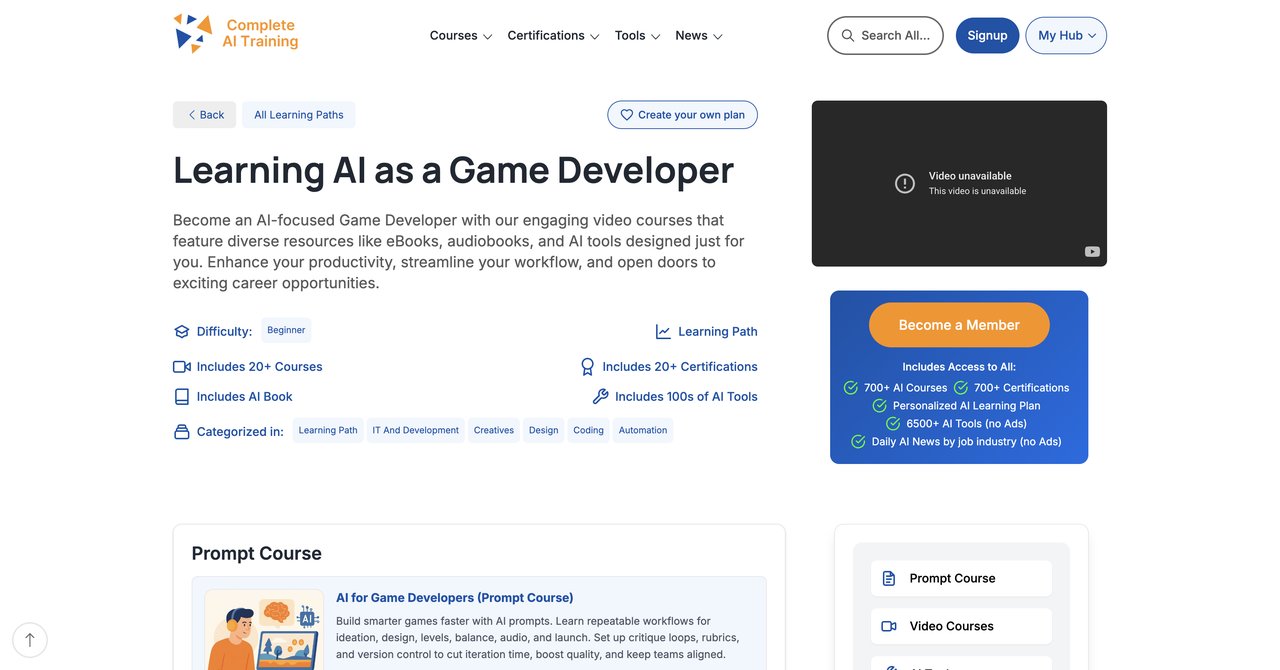
Here's the thing about Complete AI Training that sets it apart from everything else on this list: it's not a single course. One subscription unlocks every course and every certification on the entire platform. We're talking hundreds of them, across every job role, not just game development. If you want to learn about AI for game dev, you get that. But you also get access to AI for marketing, AI for finance, AI for healthcare-everything. It's a platform-wide pass, not a single class.
This is a major difference from the other options here. With most providers, you pay for one course at a time. If you want a second course, you pay again. With Complete AI Training, you pay one flat subscription price and you have access to all of it. That includes all video courses and all certifications. There are no extra fees for certificates-they're bundled in. And because the platform is constantly updating, new courses and certifications are added automatically. You don't have to worry about buying something and then having it become outdated.
The other big advantage here is the cross-functional access. Let's say you're a game developer, but you're also interested in how AI is being used in project management or game art. With Complete AI Training, you don't have to buy a separate subscription for those topics. It's all included. That's particularly useful for anyone who works in a studio where roles blur together, or for someone who's thinking about moving into a different role down the line. You're not locked into a single track.
Now, the cost structure is a subscription-$29 per month or $8.25 per month if you pay annually. That's a pretty significant difference, so the annual plan is the way to go if you know you're going to stick with it. The con here is that it's a subscription, not a one-time purchase. If you stop paying, you lose access. In a field like AI, where things change so fast, that's not necessarily a bad thing-you're forced to stay current. But it's a different financial commitment than buying a course once on Udemy.
For a game developer, this platform is a strong option because it covers so much ground. You're not just learning AI techniques; you're learning how AI applies to the entire business of making and selling games. And honestly, the fact that you get certifications included is a big deal. Elsewhere, you're often paying an extra $50 to $100 just for a certificate of completion.
Key Topics Covered: The platform covers a huge range of AI topics, including AI for game development specifically, but also AI applications in design, marketing, project management, and more. The game dev content covers everything from basic AI concepts to advanced implementation strategies.
Target Audience and Skill Level: This is suitable for anyone from complete beginners to experienced developers. Because there are so many courses, you can start at your own level and progress. The breadth of content means it's great for people who want a well-rounded understanding of AI, not just a narrow slice.
Pros:
- Full access to ALL video courses on the platform-not just a single course or fixed bundle
- Full access to ALL certifications on the platform, included at no extra cost
- New courses and certifications are added continuously and included automatically
- Access to every other job role's material too-great for multi-function or career switchers
- One flat subscription price covers everything, more affordable than per-course pricing
Cons:
- Subscription-based, so continuous learning is required to stay updated as AI is evolving
Who Would Benefit Most: Anyone who wants broad access to AI education without worrying about per-course costs. It's especially good for developers who see their career spanning multiple disciplines or who want to keep their options open. If you're the type of person who likes to explore topics beyond your immediate job description, this is a great fit.
You can check out the full platform here: CompleteAI Training for Game Developers
Course 2: AI Game Development Essentials with Unity 6 by Coursera (Packt)
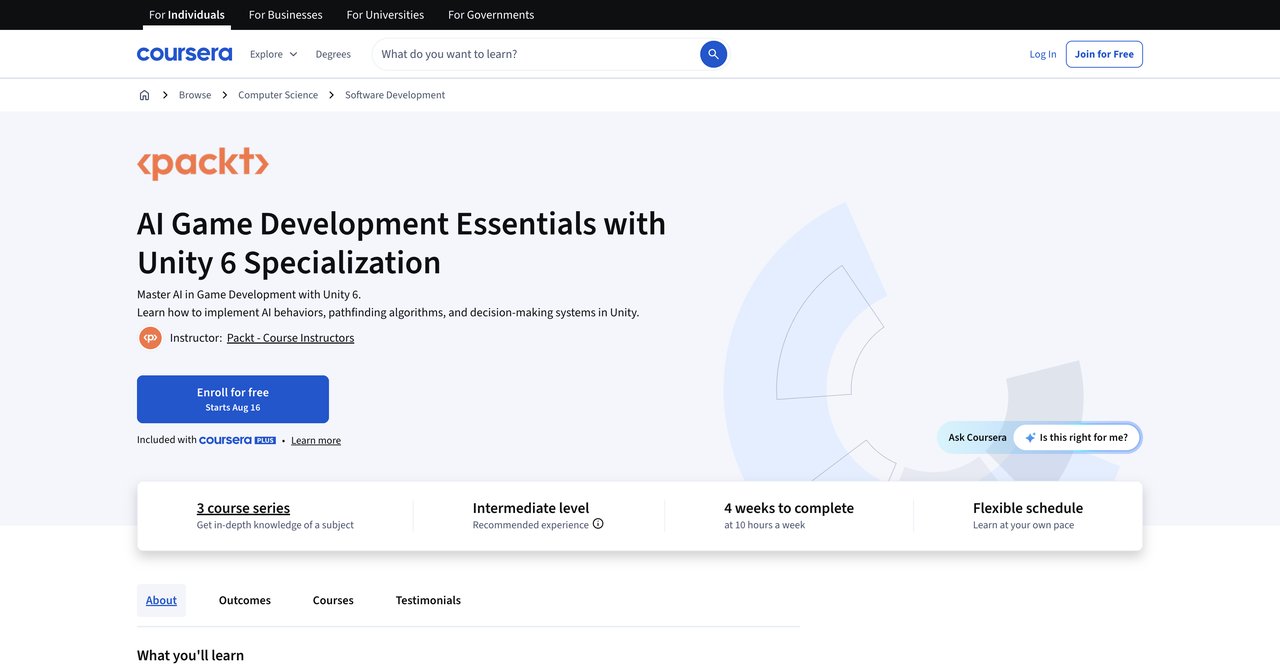
This one is from Packt Publishing, and it's hosted on Coursera. It's a pretty solid introduction to AI concepts specifically within the Unity 6 environment. The focus is on practical stuff you'll actually use-autonomous navigation, crowd simulation, and goal-driven decision-making. These are the building blocks for creating NPCs that feel like they have some intelligence behind them. The course is structured around real Unity 6 projects, so you're not just watching lectures; you're building things.
The prerequisite here is some basic Unity familiarity. You don't need to be an expert, but you should know your way around the editor and understand basic C# scripting. The course doesn't require any prior AI experience, which is nice. It starts from the assumption that you're new to AI but comfortable with the engine. That's a reasonable starting point for a lot of developers who've been using Unity but haven't branched into AI yet.
The cost is a bit tricky. You can audit the course for free, which means you get access to the materials but not the graded assignments or the certificate. For full access, you need a Coursera subscription, which is around $49 to $79 per month depending on the plan. That's fine if you're already on Coursera Plus, but if you're just taking this one course, it might feel expensive for what you get.
I like that the course is structured around real projects. It's not just abstract theory. You're learning how to make AI work in a concrete way. The downside is that it's fairly introductory. If you're already comfortable with AI in Unity, this might be too basic for you. But for someone making the jump from regular Unity development into AI, it's a good stepping stone.
Key Topics Covered: Autonomous navigation, crowd simulation, goal-driven decision-making, Unity 6 integration.
Target Audience and Skill Level: Intermediate Unity developers who have basic familiarity with the engine but are new to AI concepts. No prior AI experience required.
Pros:
- Covers autonomous navigation, crowd simulation, and goal-driven decision-making
- Structured for real-world Unity 6 projects
- No prior AI experience needed
Cons:
- Requires basic Unity familiarity
- Subscription model for full access
Who Would Benefit Most: Unity developers who want a structured, project-based introduction to AI. If you've been building games in Unity but haven't touched AI yet, this is a logical next step. It's also good for students who already have a Coursera subscription.
More info here: AI Game Development Essentials with Unity 6
Course 3: Artificial Intelligence in Unreal Engine 5 by Coursera (Packt)
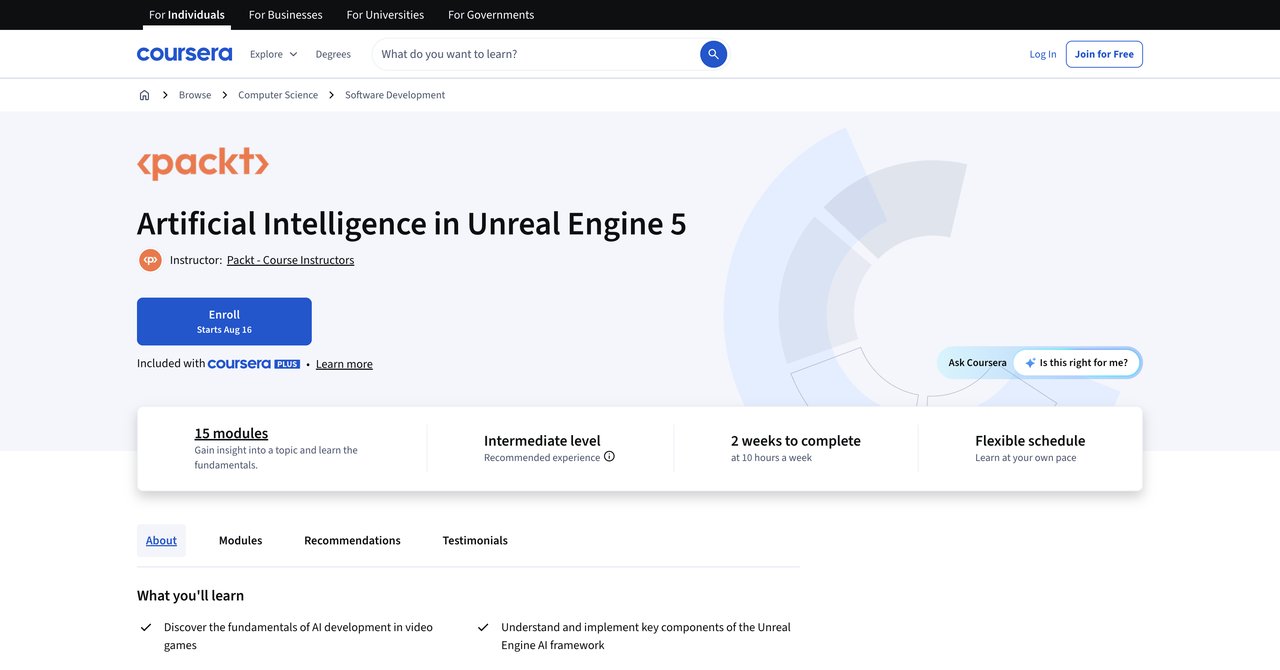
If you're an Unreal Engine developer, this course from Packt on Coursera is worth a look. It's a hands-on course that focuses specifically on behavior trees and navigation systems in Unreal Engine 5. You'll be working with both Blueprints and C++, which is good because it covers both the visual scripting approach and the more traditional programming approach. That's useful because in real studios, you might be expected to work with either one.
The content is squarely aimed at creating AI for next-gen AAA-style games. The techniques you learn here-behavior trees, navigation, perception systems-are the same ones used in big-budget titles. The course does assume you have some Unreal basics down. If you've never opened Unreal Engine before, you're going to struggle. But if you've made a few levels and understand the basic workflow, you should be able to follow along.
One thing to note is the pace. This course moves fast. It's not a gentle introduction. The instructor assumes you're comfortable with the engine and goes straight into the AI concepts. That's great for experienced developers, but it can be tough for beginners. You'll want to have some familiarity with Blueprints or C++ before you start.
The cost is the same as other Coursera courses-you can audit for free, but full access requires a subscription. Like the Unity course, this is a good option if you're already on Coursera Plus. If you're not, you might want to weigh the cost against what you're getting.
Key Topics Covered: Behavior trees, navigation systems, Blueprints, C++, Unreal Engine 5 AI implementation.
Target Audience and Skill Level: Intermediate to advanced Unreal Engine developers who are comfortable with the engine and have some scripting experience. Not suitable for complete beginners.
Pros:
- Hands-on with Blueprints and C++
- Focuses on behavior trees and navigation systems
- Crucial for next-gen AAA-style games
Cons:
- Fast-paced for beginners
- Requires Unreal basics
Who Would Benefit Most: Unreal Engine developers who want to add AI to their skillset and are targeting AAA-style game development. If you're already working in Unreal and want to level up your AI game, this is a solid choice.
Find out more: Artificial Intelligence in Unreal Engine 5
Course 4: Advanced AI Techniques and Behavior in Unity by Coursera (Packt)
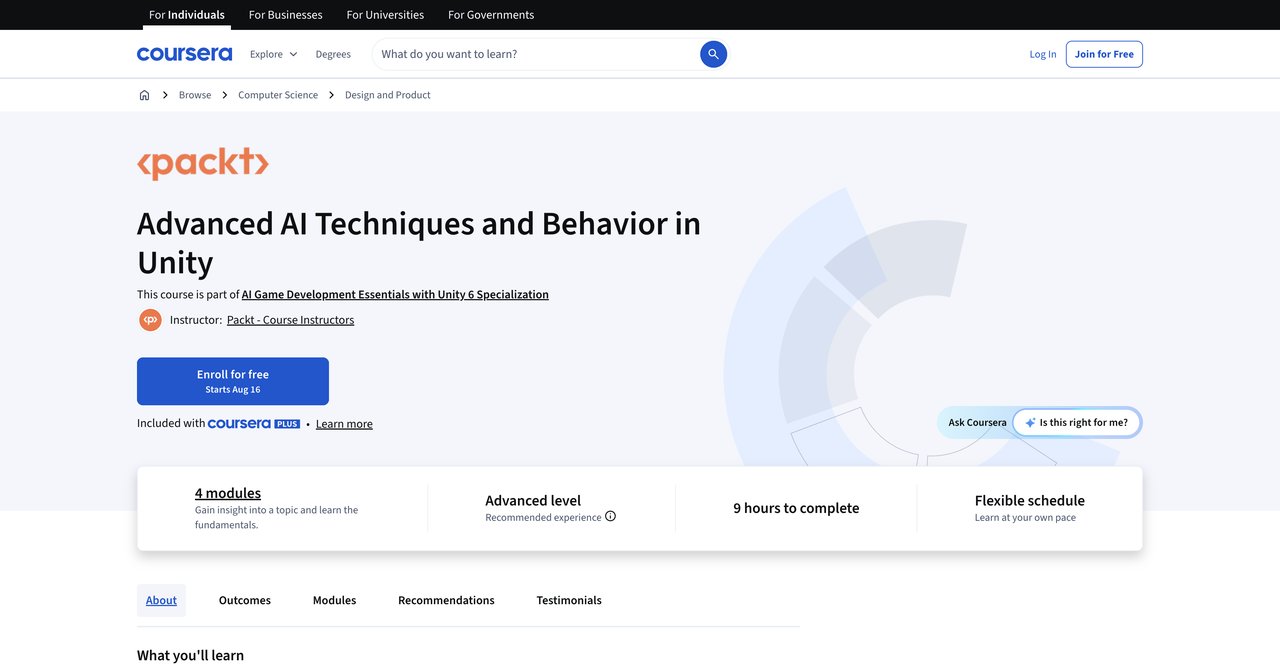
This is the advanced follow-up to the Unity AI courses. It goes deep into Goal-Oriented Action Planning (GOAP), which is a really powerful AI technique used in games like F.E.A.R. The course starts from environment setup and walks you all the way through to complex implementation. It's not for the faint of heart-this is genuinely advanced material.
The course assumes you already have a solid foundation in Unity AI. If you've taken the Essentials course or you've been working with AI in Unity for a while, you're ready for this. If you're new to AI in Unity, you're going to be lost. The instructor builds on concepts that you're expected to already know, like basic pathfinding and simple state machines.
GOAP is a fascinating topic because it's so flexible. Instead of hardcoding behaviors, you set up goals and actions, and the AI figures out the best way to achieve those goals. It's a much more dynamic approach to NPC behavior. This course teaches you how to implement that system from scratch, which is a valuable skill if you're working on games that need complex NPC decision-making.
Like the other Coursera courses, the cost is a subscription. You can audit for free, but you'll want the subscription for the full experience, including the certificate. The price is the same as the other Packt courses on Coursera.
Key Topics Covered: Goal-Oriented Action Planning (GOAP), complex AI implementation, advanced Unity AI systems.
Target Audience and Skill Level: Experienced Unity developers with prior AI knowledge. This is not for beginners.
Pros:
- Deep dive into GOAP
- From environment setup to complex implementation
- Builds on Unity AI foundations
Cons:
- Not for beginners
- Assumes prior Unity AI knowledge
Who Would Benefit Most: Game developers who are already comfortable with Unity AI and want to take their skills to the next level. If you're working on a game that needs sophisticated NPC behavior, GOAP is worth learning, and this course is a good way to do it.
Learn more: Advanced AI Techniques and Behavior in Unity
Course 5: The Ultimate C++ Unreal Engine 5 & AI Game Dev Course by Udemy
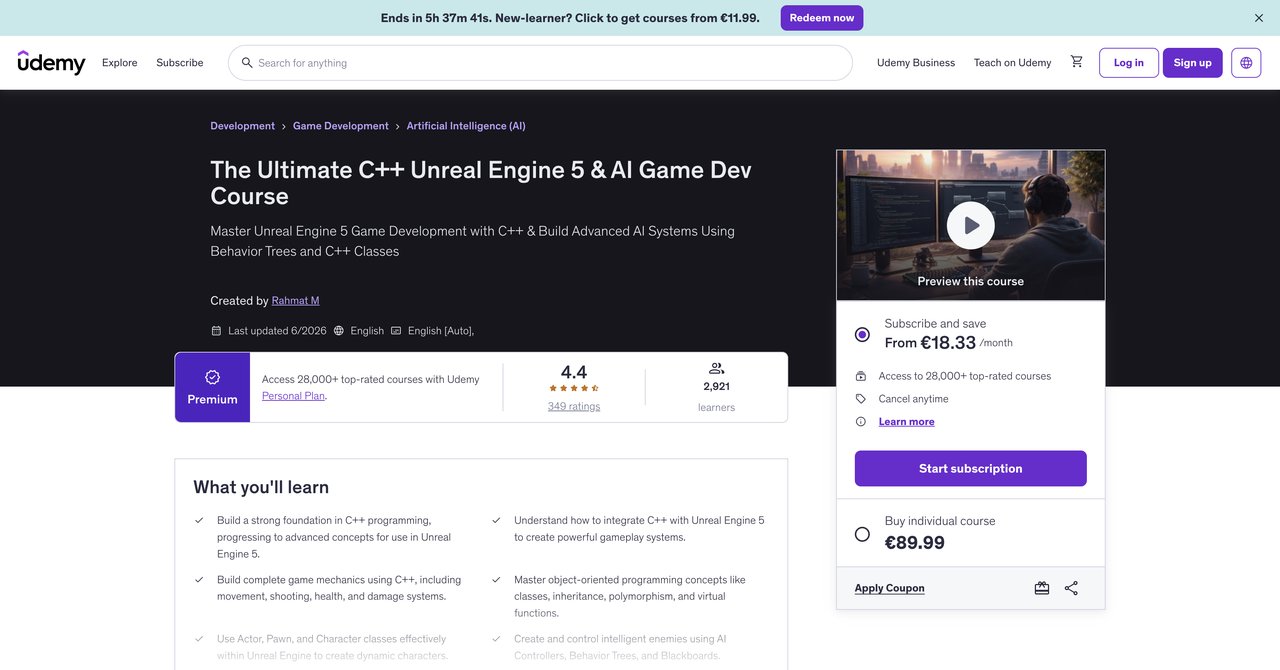
Udemy has a ton of game dev courses, and this one is one of the more comprehensive ones for Unreal Engine 5. It's an all-in-one course that takes you from the basics all the way to advanced AI systems using C++. The title says "beginners to advanced," and it's pretty accurate. You start with the fundamentals of C++ and Unreal, and you work your way up to building complex AI systems.
What I like about this course is that it doesn't assume any prior knowledge. If you're a complete beginner to Unreal Engine and C++, this is a great place to start. The instructor walks you through everything step by step. You'll learn how to set up your project, write C++ classes, and eventually implement behavior trees and AI controllers. It's a long course-we're talking dozens of hours of content-so you have to be prepared for a significant time commitment.
The pricing on Udemy is a bit of a moving target. The list price is often around $100 or more, but Udemy runs sales constantly. You can usually pick this up for $20 to $50 if you wait for a sale. That's a one-time payment, which is nice compared to subscription models. You buy it once, and it's yours forever. That's a big advantage for people who don't like the idea of ongoing payments.
The downside is that the course might not be updated as frequently as some other options. Udemy courses can sometimes lag behind the latest engine versions. But for a foundational course like this, that's not a huge issue. The core concepts of AI in Unreal don't change that dramatically between versions.
Key Topics Covered: C++ fundamentals, Unreal Engine 5 basics, behavior trees, AI controllers, advanced AI systems.
Target Audience and Skill Level: Complete beginners to intermediate developers. Suitable for those new to Unreal Engine and C++.
Pros:
- All-in-one from basics to advanced
- Builds AI systems with behavior trees and C++ classes
- Suitable for complete beginners
Cons:
- Udemy pricing fluctuates
- Long course may require significant time commitment
Who Would Benefit Most: Beginners who want a single course that takes them from zero to competent in Unreal Engine AI. If you're starting from scratch and want an all-in-one solution, this is hard to beat, especially when it's on sale.
Check it out: The Ultimate C++ Unreal Engine 5 & AI Game Dev Course
Course 6: Modern Game Design Mastery with AI by Coursera
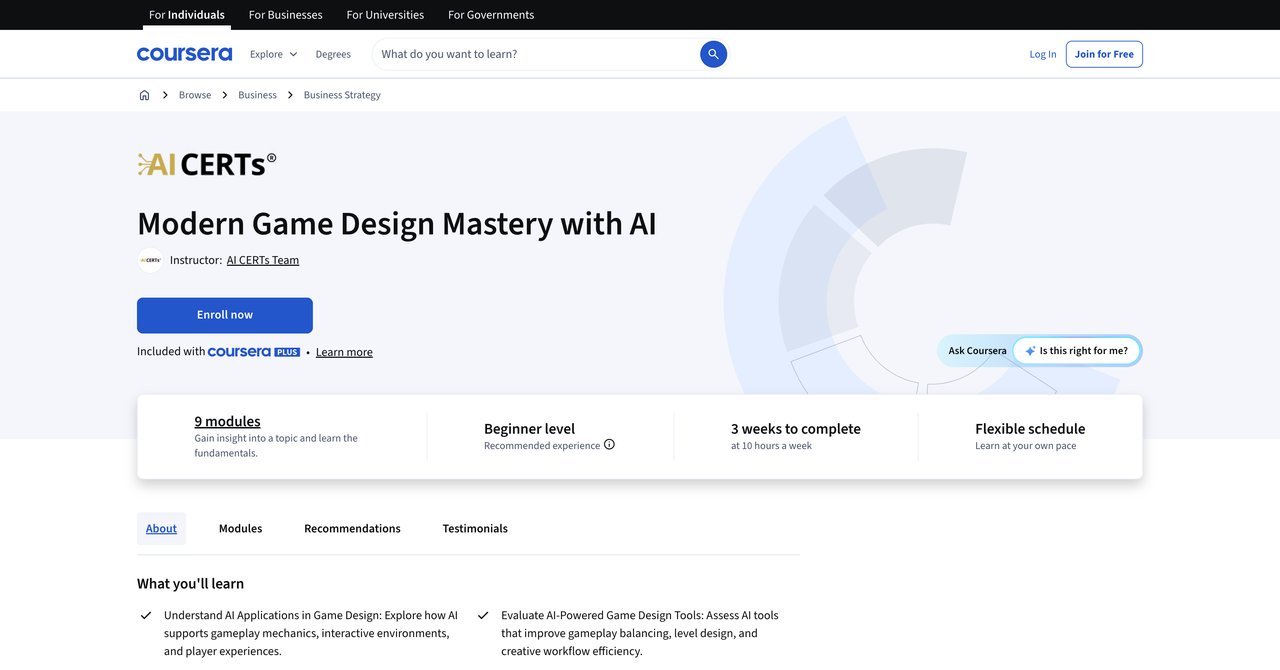
This course takes a different angle. Instead of focusing on programming AI systems, it looks at how AI can be used in the design process itself. You're exploring AI for gameplay mechanics, level design, and player experience. It also covers AI-powered design tools that can accelerate your prototyping workflow. That's a really practical angle because AI tools are becoming more and more common in the design phase.
The course is more design-focused than programming-focused. If you're a pure programmer, this might feel a bit light on the technical side. But if you're a game designer or a solo developer who does a bit of everything, this is really valuable. You'll learn how to use AI to generate level layouts, create dynamic difficulty, and even analyze player behavior to improve your game's design.
There's no prior experience required, which is nice. The course is accessible to anyone who's interested in how AI is changing game design. You don't need to be a programmer to get something out of this. The focus is on concepts and tools rather than code.
The cost is a Coursera subscription, same as the other Coursera courses. You can audit for free, but full access requires a paid plan. Given the design focus, this might be a better fit for someone who's more on the creative side of game development.
Key Topics Covered: AI for gameplay mechanics, level design, player experience, AI-powered design tools, prototyping workflows.
Target Audience and Skill Level: Game designers and developers interested in using AI in the design process. No prior AI experience required.
Pros:
- Explores AI for gameplay mechanics, level design, and player experience
- Evaluates AI-powered design tools
- Accelerates prototyping workflows
Cons:
- More design-focused than programming
- Less technical depth
Who Would Benefit Most: Game designers who want to incorporate AI into their workflow. It's also good for indie developers who wear many hats and want to understand how AI can help with the design side of things.
More details: Modern Game Design Mastery with AI
Course 7: Advanced Game AI with Behavior Trees in Unity 6 by Coursera (Packt)
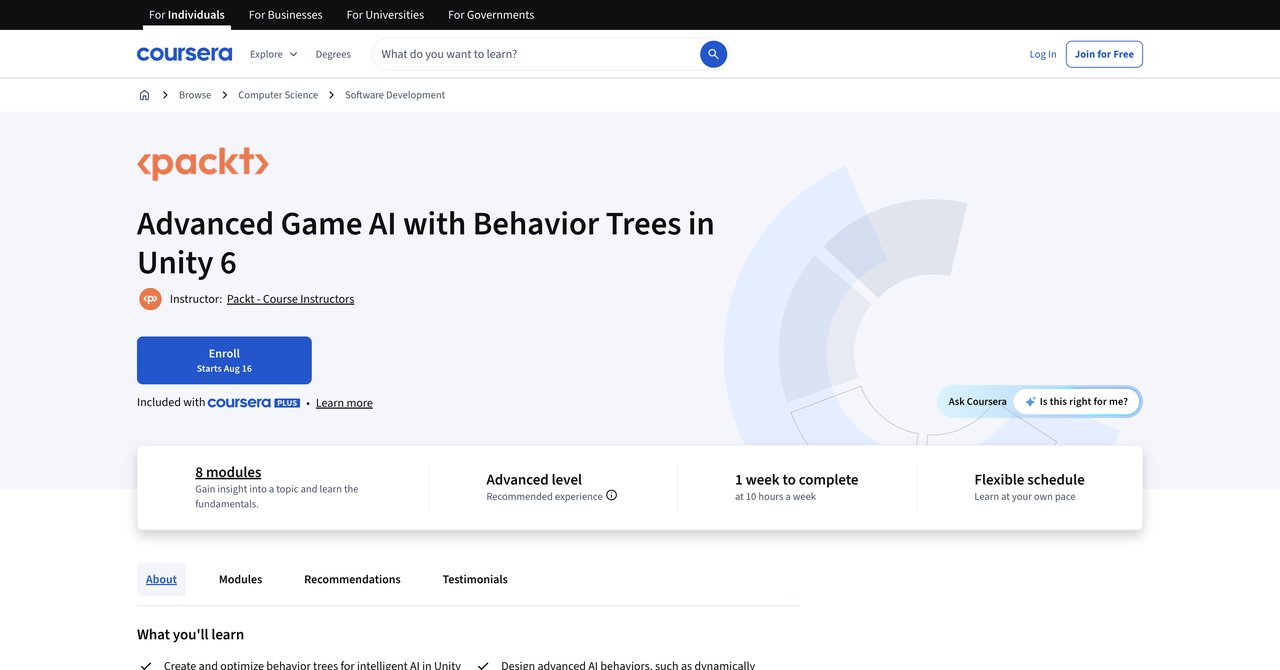
This is another advanced Packt course on Coursera, and it's specifically about behavior trees in Unity 6. It's not an introduction-it's an advanced course that assumes you already know your way around Unity and AI. The focus is on creating and optimizing behavior trees, designing dynamically prioritized tasks, and creating cooperative agents. You also learn how to debug complex tree structures, which is a skill that's often overlooked but really important in practice.
The content is quite technical. You're dealing with things like task prioritization, agent cooperation, and tree optimization. These are the kinds of things you need when you're building a game with a lot of NPCs that need to behave intelligently. The course is compatible with Unity 6, which is good because that's the current version of the engine.
This is definitely not for beginners. You need strong Unity skills and prior AI knowledge. If you've taken the Essentials course and the Advanced Techniques course, you'd be ready for this. If you're jumping in cold, you're going to have a rough time. The instructor assumes you understand the basics and moves quickly into advanced territory.
Cost is the standard Coursera subscription model. Audit for free, subscribe for full access. Given the advanced nature of the content, this is probably best for experienced developers who are working on serious projects.
Key Topics Covered: Behavior tree creation and optimization, dynamically prioritized tasks, cooperative agents, debugging complex tree structures.
Target Audience and Skill Level: Advanced Unity developers with strong AI knowledge. Not suitable for beginners.
Pros:
- Create and optimize behavior trees
- Design dynamically prioritized tasks and cooperative agents
- Debug complex tree structures
Cons:
- Very advanced
- Requires strong Unity and prior AI knowledge
Who Would Benefit Most: Experienced Unity developers who need to implement complex AI systems in their games. If you're working on a title with lots of NPCs and you need them to behave intelligently, this is a good investment.
Learn more: Advanced Game AI with Behavior Trees in Unity 6
Course 8: Machine Learning for Games Course by Hugging Face
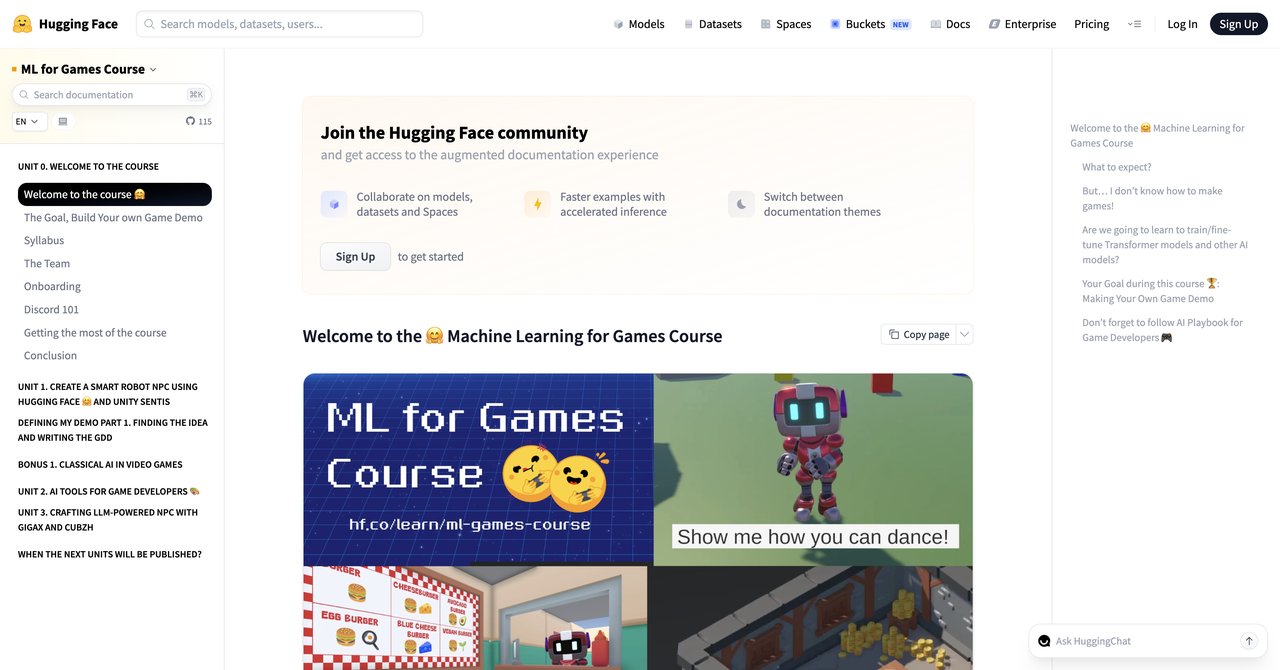
Hugging Face is known for its machine learning tools, and they've put together a free course specifically for game developers. This one is really interesting because it focuses on integrating modern ML techniques into games. You learn how to use chat models for intelligent NPCs, how to run models locally or via cloud APIs, and how to use AI tools for voice and image generation. By the end, you build your own game demo that uses these technologies.
The best part about this course is the price-it's completely free. That's a huge advantage. You can learn about cutting-edge ML integration without spending a dime. The content is also very current, which is important in this field. Chat models are a big deal right now, and this course shows you how to actually use them in a game context.
The downside is that it requires existing Unity skills. This is not an intro to game development. You need to know how to use Unity already. The course is focused on the ML integration, not on teaching you the basics of game development. If you're already a Unity developer, that's fine. But if you're a beginner, you'll need to learn Unity separately first.
Another thing to consider is that this course is more about integrating ML models than about traditional game AI. You won't learn much about behavior trees or pathfinding here. Instead, you're learning about a newer, more experimental area of game AI. That's valuable, but it's a different skillset.
Key Topics Covered: Chat models for NPCs, running models locally and via cloud APIs, AI for voice and image generation, building game demos.
Target Audience and Skill Level: Unity developers with some experience who want to integrate modern ML techniques into their games. Requires existing Unity skills.
Pros:
- Integrate chat models for intelligent NPCs
- Run models locally or via cloud APIs
- Use AI for voice and image generation
- Build your own game demo
Cons:
- Requires existing Unity skills
- Not an intro to game development
Who Would Benefit Most: Developers who want to experiment with the latest ML technologies in games. If you're curious about how chat models and generative AI can be used in game development, this is a great free resource.
Access the course: Machine Learning for Games Course
Course 9: Liftoff with Google Antigravity: Build a Video Game with AI by Coursera (Google)
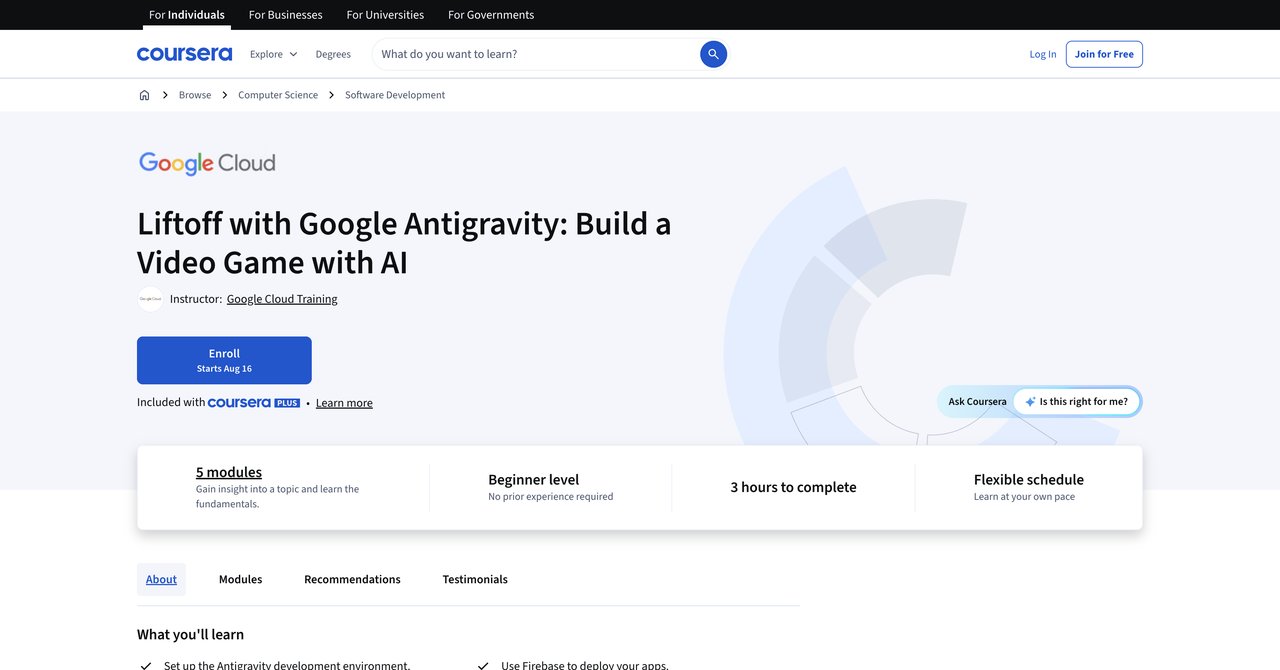
This is a quick, practical course from Google on Coursera. It's designed to get you building a game with AI agents as fast as possible. You use Google Antigravity and Firebase to orchestrate AI agents that help you build a game. The whole thing is designed to be accessible-no prior experience is required. You can go from zero to a working game prototype in a short amount of time.
The focus here is on using AI agents to accelerate game prototyping. That's a really useful skill because prototyping is such a big part of game development. Being able to quickly spin up a playable concept using AI tools can save you a ton of time. The course walks you through the process step by step, so you're not left guessing.
The main downside is that it's very short. This is more of a taster than a deep dive. You'll learn the basics of using Google's specific tooling, but you won't get into the nitty-gritty of game AI. It's also focused specifically on Google's ecosystem, so if you're not planning to use Antigravity or Firebase, some of the lessons might not be directly applicable.
Cost is the standard Coursera model-audit for free, subscribe for full access. Given the short length, you might be able to get through it during a free trial period if you're efficient.
Key Topics Covered: AI agents for game prototyping, Google Antigravity, Firebase, rapid game development.
Target Audience and Skill Level: Complete beginners who want a quick introduction to using AI in game development. No prior experience required.
Pros:
- No prior experience required
- Orchestrate AI agents to build a game
- Hands-on with Google Antigravity and Firebase
Cons:
- Very short
- Focused on Google's specific tooling
Who Would Benefit Most: Beginners who want a quick, hands-on introduction to using AI in game development. It's also good for developers who are curious about Google's AI tools specifically.
Find out more: Liftoff with Google Antigravity
Course 10: Game Development, Data Science, and Machine Learning by Coursera (Packt)
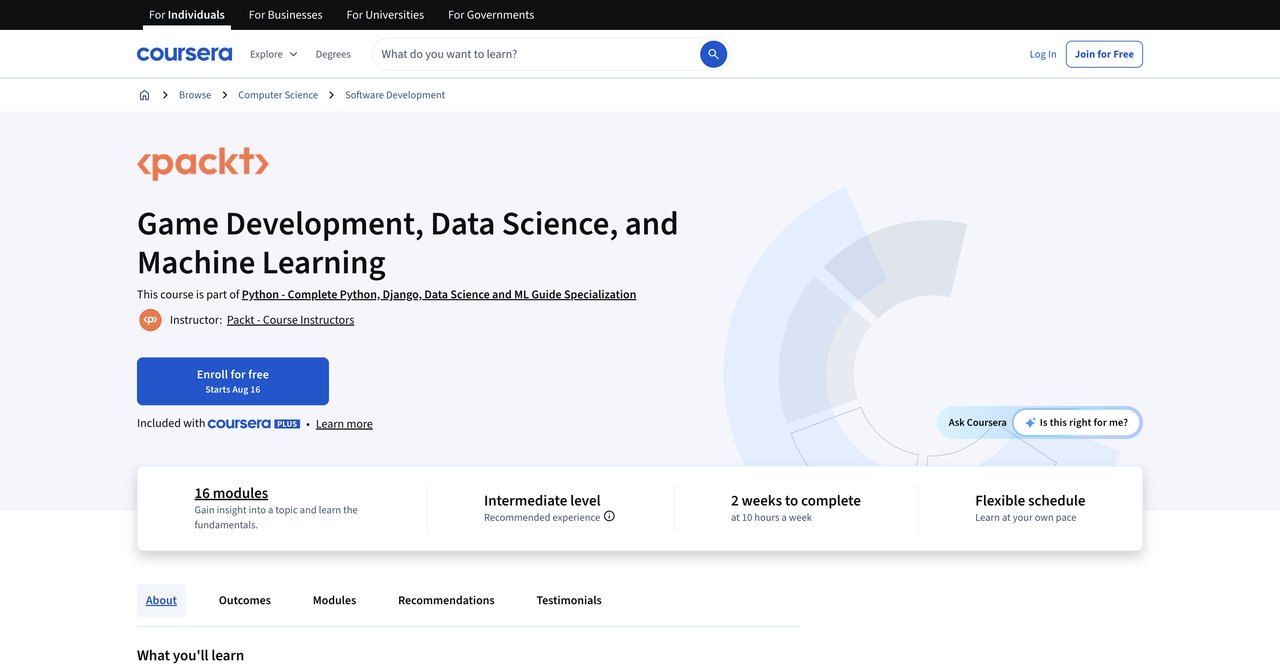
This course takes a different approach by combining Pygame game logic with scikit-learn machine learning models. Instead of working in Unity or Unreal, you're working in Python. That's a significant difference. The focus is on the practical integration of ML for real game data analysis and adaptive gameplay.
The choice of Python and Pygame is interesting. Python is a great language for ML, and scikit-learn is one of the most popular ML libraries. So you're learning real ML techniques, but applying them to a game context. The course covers things like using ML to analyze player behavior and adapt the game difficulty accordingly. That's a really practical application of ML in games.
The downside is that Pygame isn't commonly used in AAA game development. Most professional game studios use Unity, Unreal, or proprietary engines. So the skills you learn here might not translate directly to a job in the industry. That said, the ML concepts are transferable. If you learn how to apply scikit-learn to game data, you can apply those same concepts in other contexts.
Cost is the standard Coursera subscription. Audit for free, subscribe for full access. This is probably best for developers who are interested in the data science side of games rather than the traditional game AI side.
Key Topics Covered: Pygame game logic, scikit-learn ML models, game data analysis, adaptive gameplay.
Target Audience and Skill Level: Developers interested in the intersection of game development and data science. Some Python knowledge is helpful.
Pros:
- Combines Pygame game logic with scikit-learn ML models
- Practical integration of ML for real game data
Cons:
- Python/Pygame focus, not Unity or Unreal
- Less common for AAA workflows
Who Would Benefit Most: Developers who are interested in the data science side of games. If you want to learn how to use ML to analyze and adapt to player behavior, this is a good introduction, even if the game engine isn't industry standard.
More information: Game Development, Data Science, and Machine Learning
Course 11: Game AI by Alan Zucconi
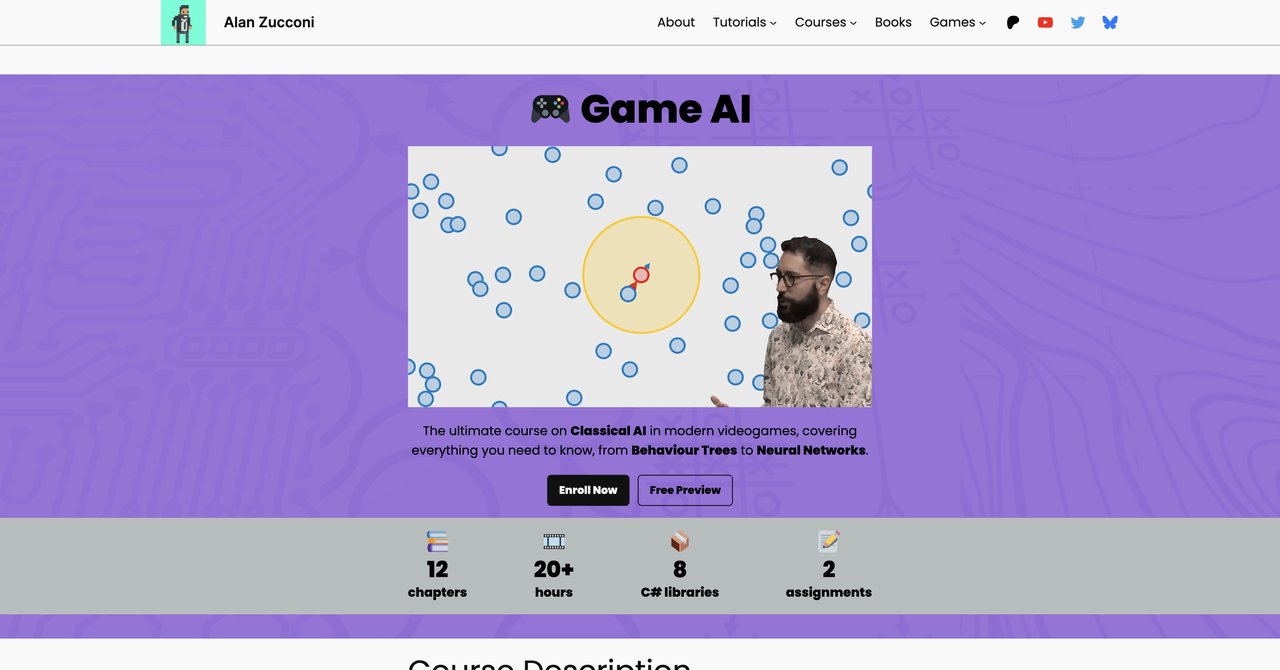
Alan Zucconi is a well-known figure in the game AI space, and his course is a deep dive into classical AI techniques. We're talking behavior trees, pathfinding, GOAP, and evolutionary computation. This is the kind of material that forms the foundation of game AI. It's not about the latest ML trends-it's about the tried-and-true techniques that have been used in games for decades.
The course has a strong theoretical foundation. Zucconi is a teacher at heart, and he does a great job of explaining the concepts behind the techniques. The chapters are self-contained, so you can jump in and out as needed. That's nice if you just want to brush up on a specific topic like pathfinding without taking the whole course.
The main downside is that the course isn't tied to a specific engine version. It's more about the concepts than the implementation in a particular tool. That's both a strength and a weakness. On one hand, the knowledge is more timeless. On the other hand, you won't get step-by-step instructions for implementing these techniques in Unity or Unreal. You'll need to translate the concepts into your engine of choice yourself.
The cost is a one-time payment, which is refreshing compared to subscription models. The price is listed on his site. It's not the cheapest option, but for a one-time purchase, it's reasonable given the depth of content.
Key Topics Covered: Behavior trees, pathfinding, GOAP, evolutionary computation, classical game AI techniques.
Target Audience and Skill Level: Developers who want a deep theoretical understanding of game AI. Suitable for intermediate to advanced developers.
Pros:
- Focuses on classical AI (behavior trees, pathfinding, GOAP, evolutionary computation)
- Strong theoretical foundation
- Self-contained chapters
Cons:
- Not updated to a specific engine version
- Theory-heavy
Who Would Benefit Most: Developers who want to really understand the underlying principles of game AI. If you're the type of person who likes to know why something works, not just how to make it work, this is a great resource.
Visit the course page: Game AI by Alan Zucconi
Final Recommendations: Finding the Right Fit
Okay, so we've looked at a lot of courses. Now comes the hard part-figuring out which one is right for you. Honestly, there's no single "best" option. It all depends on your background, your goals, and your budget. Let me break it down by different learner profiles.
If you're a complete beginner who wants a broad education in AI without breaking the bank, CompleteAI Training is worth serious consideration. The subscription model gives you access to a huge amount of content, and the fact that certifications are included is a big plus. You're not just learning game AI-you're learning how AI applies to the entire game development process. The all-access approach means you can explore different areas and find what interests you most. For someone just starting out, that flexibility is valuable.
If you're a Unity developer who wants structured, project-based learning, the Packt courses on Coursera are a solid choice. The Essentials course is a good starting point, and you can progress to the Advanced Techniques and Behavior Trees courses as you improve. The main drawback is the subscription cost, especially if you're only taking one course. But if you're already on Coursera Plus, these are no-brainers.
For Unreal Engine developers, the Udemy course from "The Ultimate C++ Unreal Engine 5 & AI Game Dev Course" is a great all-in-one option, especially if you catch it on sale. The one-time payment is nice, and the content covers everything from basics to advanced AI. The Coursera course on Unreal AI is also good, but it's faster-paced and assumes more prior knowledge.
If you're interested in the cutting edge of AI-like chat models and generative AI-the Hugging Face course is a fantastic free resource. It's not going to teach you traditional game AI, but it will show you how to integrate modern ML into your games. And you can't beat the price.
For designers and solo developers, the Modern Game Design Mastery course is a good fit. It's less technical but very practical, showing you how AI can speed up your design workflow. The Google Antigravity course is also good for a quick introduction to AI-powered prototyping.
If you want a deep theoretical foundation, Alan Zucconi's course is excellent. It's not tied to any specific engine, so the knowledge is more transferable. The downside is that you'll have to do the implementation work yourself.
Now, let's talk about the elephant in the room-CompleteAI Training. It's featured first in this comparison, and there's a reason for that. The all-access model is genuinely different from everything else on this list. Every other course here is a single purchase or a single subscription for a specific course. CompleteAI Training gives you everything. If you're the type of person who likes to learn broadly, or if you're not sure exactly what you want to specialize in, that's a huge advantage.
But it's not for everyone. If you just want to learn one specific thing-say, behavior trees in Unity-you might be better off with a single course purchase. You'll spend less money upfront, and you won't have to worry about a recurring subscription. The subscription model only makes sense if you're actually going to use the platform regularly.
Here's my honest take: for most game developers, the best approach is probably a combination. Start with a free resource like the Hugging Face course to get a feel for what's out there. Then, if you want structured learning, consider a single course purchase or a short-term subscription. And if you find that you're constantly wanting to learn more, that's when a platform like CompleteAI Training starts to make a lot of sense.
Ultimately, the best course is the one you'll actually finish. Don't overthink it. Pick one that matches your current skill level and your learning style, and commit to it. You can always take another course later.