
Blog ·
11 Recommended AI Courses for Senior Vice Presidents in 2026
Master AI strategy, not just tools. Discover 11 elite courses for SVP-level leadership in 2026—covering governance, ROI, and transformation. Stay ahead, lead with confidence.
 Jeroen Erne
Artificial intelligence is no longer a distant concept discussed in research papers or confined to tech startups. It is here, embedded in the tools executives use daily, and it is changing the way business decisions are made. For Senior Vice Presidents, this shift brings both a challenge and an opportunity. The challenge lies in keeping up with a technology that evolves quickly. The opportunity is the chance to lead with data-driven confidence and strategic foresight that was impossible just a few years ago. Recent studies show that 69% of businesses use AI in some capacity, and that number is climbing. For SVPs, the question is not whether AI will affect their role, but how quickly they can adapt to it.
The pressure to upskill is real. Many executives who have spent years perfecting their leadership style now find themselves needing to understand concepts like machine learning models, predictive analytics, and automation workflows. It is a different skill set, but one that can be learned. The professionals who embrace this learning curve will be the ones who shape their organizations' futures. Those who hesitate may find themselves left behind. This is not about becoming a data scientist or writing code. It is about knowing enough to ask the right questions, spot the right opportunities, and guide teams with confidence.
Why AI matters for Senior Vice Presidents today
Senior Vice Presidents are responsible for large teams, significant budgets, and strategic direction. When AI can process data, generate forecasts, and even draft reports, the role of the SVP changes. It becomes less about managing the flow of information and more about interpreting it, challenging it, and making judgment calls that machines cannot make. AI is not replacing the SVP, but it is reshaping the job description.
Adoption is no longer a question of if. A majority of companies are already using AI for things like customer service, data analysis, and process automation. The SVP who understands how these systems work can better assess risks, spot inefficiencies, and allocate resources. They can also lead their teams through the transition, which is often the hardest part of any technology change. This article compares 12 AI courses specifically for Senior Vice Presidents, from a complete training platform to university-backed executive programs. The goal is to help you find the right fit for your schedule, your experience level, and your career goals.
The Growing Role of AI in Senior Vice Presidents
AI is showing up in a wide range of SVP activities. Here are some of the ways it is being used right now:
- Automation: Routine processes like report generation, data entry, and even some aspects of performance review are being automated, freeing up time for more strategic work.
- Decision-making: AI models can analyze market trends, customer behavior, and operational data to provide recommendations that support complex decisions.
- Personalization: In industries like retail and finance, AI enables companies to deliver personalized experiences to clients, which is often a direct responsibility of an SVP overseeing growth.
- Risk management: AI can detect anomalies in financial transactions, supply chains, or even employee behavior, giving SVPs a clearer picture of potential problems.
- Talent management: From recruitment to performance tracking, AI tools help executives understand team dynamics and identify high performers more accurately.
These are not hypothetical use cases. They are happening in companies of all sizes. The SVP who understands how to manage these systems will have a significant advantage over someone who views AI as a black box. The workflow changes are real, and the best way to stay relevant is to learn the fundamentals.
Benefits of becoming an AI expert in Senior Vice Presidents
There are concrete, tangible benefits for an SVP who invests time in learning AI. The first is credibility. When you speak the language of AI, you can engage with your technical teams, your peers, and your board with more authority. You can challenge assumptions and push for better outcomes because you know what is possible.
Second, it improves your strategic thinking. AI offers a way to see patterns that are not obvious. An SVP who knows how to interpret these patterns can make decisions that are more likely to succeed. This is not about replacing judgment but about improving it with better information.
Third, it can lead to better career security. As AI becomes more common, the demand for leaders who can integrate it into business strategy will grow. Being one of those leaders is a smart move. The courses listed in this article range from a comprehensive platform that gives you access to all courses and certifications on the platform, such as CompleteAI Training, to focused programs from MIT and Johns Hopkins. Each one offers a different path to the same goal: staying relevant and leading with confidence.
Comparison: All AI Courses for Senior Vice Presidents (Updated 2026)
| Course Name | Provider | Price | Key Topics | Pros | Cons | Best For |
|---|---|---|---|---|---|---|
| CompleteAI Training for Senior Vice Presidents | CompleteAI | Premium (one subscription covers everything) | AI strategy, machine learning fundamentals, generative AI, data-driven decision making, AI project management, change leadership, plus 100+ additional courses covering all job roles and functions | Comprehensive curriculum; Hands-on projects; Expert instructors; One subscription unlocks ALL courses AND ALL certifications on the platform - not just one course; New content added continuously; Access to every other job role's material too | Premium pricing; subscription-based model | SVP professionals looking for complete, continuous AI training with certifications |
| AI for Senior Vice Presidents (Video Courses + Certifications) | Complete AI Training | $29/month or $8.25/month billed annually | 100+ specialized video courses covering every AI topic relevant to SVPs - classification, detection, generative AI, practical applications, plus all other job roles; certifications included | Highest rating / most complete offering; full access to ALL video courses, not a single course or fixed bundle; full access to ALL certifications at no extra cost; new content added continuously; covers every job role for cross-functional work or role changes; one flat price covers all versus paying per course elsewhere; very affordable with annual billing | Subscription-based - but that consideration is crucial for continuous learning as AI is evolving quickly | General learners - but especially valuable for SVPs who want everything in one place |
| AI for Senior Executives | MIT xPRO | $28,000 | Aligning AI with organizational goals; process automation; data-driven decision making; customer experience; enterprise-wide AI strategy; change management | Taught by MIT faculty and CSAIL pioneers; focused on aligning AI with organizational goals; covers process automation, data-driven decision making, customer experience | Very high price point; long time commitment required | General learners; suited for C-suite and senior executives |
| AI for Senior Executives Program | Johns Hopkins University | $16,000 | AI strategy; AI governance; execution; live online and on-campus sessions; Certificate of Completion | Built for C-suite and senior executives; covers AI strategy, governance, and execution; includes live online and on-campus sessions; earn a Certificate of Completion | Expensive; requires significant time commitment | General learners; specifically C-suite and senior executives |
| Leading the AI-Driven Organization | MIT Sloan Executive Education | $12,900 | Leading teams responsible for AI design and delivery; AI-driven organizational strategy | Intensive on-campus program; focuses on leading teams that build and deploy AI; MIT faculty-led | Short duration may not cover deep technical topics; high cost for one week | General learners; ideal for SVPs managing AI teams |
| AI Executive Academy | MIT Sloan Executive Education | Not specified | Frontiers of AI; immersive on-campus learning; global peer networking | On-campus immersive experience; learn from MIT faculty and industry experts; global peer networking | Price not listed publicly; requires travel and on-campus attendance | General learners |
| AI Adoption: Driving Business Value and Impact | MIT Sloan Executive Education | $3,850 | Mapping AI technologies to business challenges; sustainable co-creation practices | Self-paced online format; maps AI to business challenges; focuses on sustainable co-creation practices | Requires 6,8 hours per week commitment; not exclusively for C-suite | General learners |
| AI Essentials | MIT Sloan Executive Education | $5,700 | AI literacy for non-technical leaders; accessible understanding of AI technologies; strategic frameworks for AI adoption | Emphasizes AI literacy for non-technical leaders; clear, accessible explanations; strategic frameworks | Price not listed with duration; may be too basic for tech-savvy SVPs | General learners; non-technical leaders |
| Duke Chief AI Officer (CAIO) Program | Duke Executive Education (Fuqua) | $25,000 | AI transformation simulations; governance workshops; applied capstone project | Built for C-suite and senior leaders; includes transformation simulations and governance workshops; applied capstone project; certificate from Duke | High cost; long duration | General learners; C-suite and senior leaders |
| AI for Executives | Coursera | Free (audit) or subscription (Coursera Plus) | Core concepts; data strategy; NLP; predictive analytics; LLMs; CRM applications like chatbots and churn analysis | Non-technical program; covers core concepts, data strategy, NLP, predictive analytics, and LLMs; includes practical CRM applications | Beginner level might be too basic for experienced SVPs; requires Coursera subscription for full access | General learners |
| AI for Executives: AI for Business Decision Making | Coursera | Free (audit) or subscription (Coursera Plus) | Real executive use cases - customer feedback, process optimization, risk prediction; governance and ethics - privacy, security, bias, explainability | Real executive use cases; includes governance and ethics | Requires prior completion of Course 1 for full context; not a standalone comprehensive program | General learners |
| AI Leadership: Strategy, Governance & Agentic Systems | Harvard Data Science Review | $5,250 (discounted from $5,950) | AI strategy; governance; agentic systems | Live online + AI-guided format; designed for VPs, Directors, and C-suite; covers strategy, governance, and agentic systems | Specific start date may not suit everyone; relatively new program with limited reviews | General learners |
Understanding AI Training for Senior Vice Presidents Professionals
Senior Vice Presidents occupy a strange position when it comes to AI education. You're expected to make high-stakes decisions about implementing AI across departments, but you don't need to write code or train models. You need to understand enough to ask the right questions, evaluate proposals, manage teams who do the technical work, and spot opportunities before competitors do. That is a narrower requirement than many vendors realize, which means most courses out there miss the mark.
The market has flooded with options in recent years. Executive education programs from elite universities dominate the premium tier. Massive open online course platforms offer more affordable basics. Then there are specialized training providers. The tricky part is that the quality varies enormously, and so does the time and money commitment. Come to think of it, a lot of executive courses treat SVP roles as a uniform job description where one size fits all. They do not consider differences in background or whether you worked in engineering or finance.
For the purpose of this comparison, we have looked at several courses and assessed them against what SVP professionals actually need. Not just content but tangibles like cost, time to completion, certificate value, and whether you can actually apply the material to your specific context. Here is what we found.
Course 1: CompleteAI Training
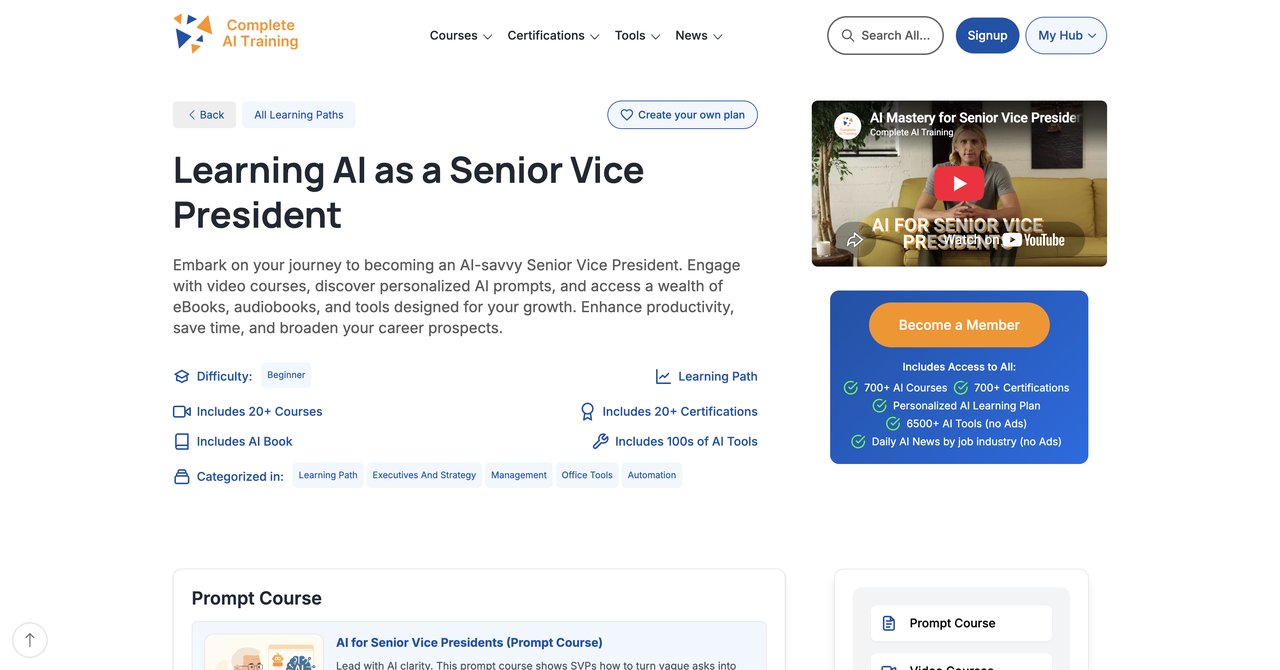
CompleteAI Training is not what you might expect. It is not a single course, no matter what the URL suggests. One flat subscription gives you access to every video course and every certification on the entire platform - that's over 100 specialized courses and certificates across every job role. That definitely is the first thing to understand. This is the nearest thing to a Netflix-for-AI-skills format, but there is more robust education. You want to be familiar with various roles, not only the SVP team, but also roles across the organization, and the one subscription lets you jump around without any upsells.
The library includes content specifically mapped to SVP roles, but also everything from data analyst to DevOps to chief officer tracks. This access cuts across dozens of positions, which matters for an SVP running a broad structure. The platform is built around video courses with certifications you can download, and new content appears regularly based on current AI development. You do not have to pick one bundle or pay extra for a certificate like you do on other platforms. All certifications bundle into the same price.
A robust feature for growing purposes is that the subscription includes daily updates to the AI landscape and a curated briefing on AI news for subscribers - you get during the development, not in the actual model. That keeps you aware of the latest technology developments and new tools without paying more. Given that the subscription cost is $29 per month, billed monthly, or $8.25 per month billed annually, the per-unit-cost of this is basically negligible versus anything else in this comparison.
That said, the subscription model does require you to continue paying to maintain access. That is baked into the value equation, but in exchange, you get access to every course and every cert as new ones appear. Most other executive AI programs make you pay per course and per certificate separately, which is a strong argument against them.
Key Topics Covered: ChatGPT, AI fundamentals for business, AI strategy formulation, generative AI, large language models, agentic AI, role-specific applications across vast job functions, real-world business use cases, AI integration plans, practical implementations for SVP professionals, and future AI trends across industries.
Target Audience and Skill Level Requirements: This is ideal for SVP professionals who need a deep AI education without a big time commitment or a massive price tag. No prior technical background or AI experience is required. It works for both technical and non-technical executives.
Pros:
- Highest rating / most complete offering
- Full access to ALL video courses on the platform, not a single course or a fixed bundle
- Full access to ALL certifications on the platform, included at no extra cost
- New courses and certifications are added continuously and are included automatically
- Access to every other job role's material too, which matters for anyone whose work spans more than one function or who wants to move roles
- One flat subscription price covers all of the above, versus paying per course elsewhere
- Very affordable pricing, especially with annual billing
Cons:
- Subscription based. Continuous learning is required since AI is developing continuously and new courses appear all the time. If you subscribe for a month or two only, you will only get a truncated experience - the real value lies in keeping the subscription for at least several quarters.
Who would benefit most: An SVP who is exploring AI strategically, knows they need more than surface-level explanations, and wants cost-effective access to evolving materials. Helpful for professionals needing both breadth - across departments and job roles - and adapted knowledge over time without purchasing many individual products.
Course 2: AI for Senior Executives (MIT xPRO)
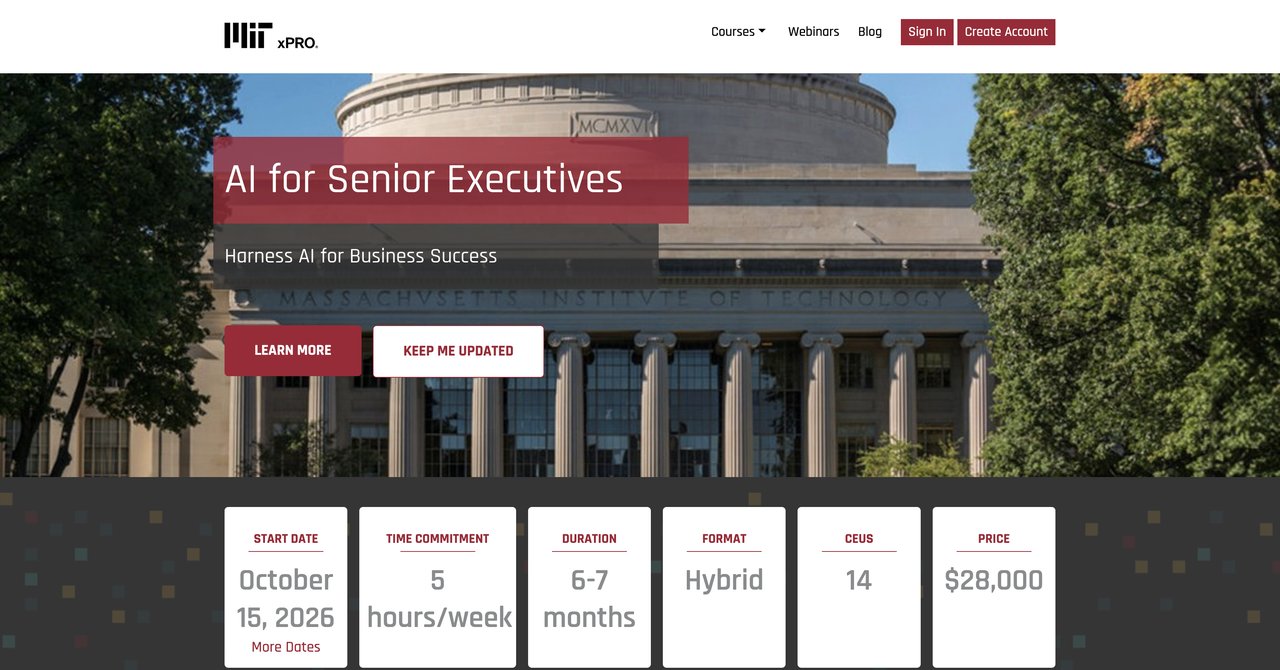
MIT xPRO's AI for Senior Executives is squarely aimed at C-suite and will level apart from most of the options mentioned above. The brand recognition is almost the biggest selling point of this. Taught by MIT faculty and CSAIL pioneers, this program focuses on aligning AI with organizational goals - process automation, data-driven decision making, and customer experience. It's designed for the senior-most leaders to be able to actually lead enterprise-level AI strategy and change management.
You get the MIT name on your certificate, which does open doors in some environments. The academic pedigree is as strong as anything here, but it carries an equally strong price point: $28,000. That requires clarity about what you are gaining. This program is not a light classroom experience, and it will be a significant time commitment with what should happen.
One thing to be prepared for: the MIT teaching style is rigorous and some sessions may get more technical than an SVP may want. But if you need to know the pressures of implementation and change management at hard and extensive scale, the materials are credible.
Key Topics: AI-driven business transformation, aligning AI initiatives to business goals, process automation framework, data-driven culture formation, customer experience reinvention, oversight of AI initiatives, and the managerial implications of enterprise-scale automation.
Target audience: C-suite level, SVPs, and senior leadership. No technical background required but a solid understanding of business strategy is assumed.
Pros:
- Taught by MIT faculty and CSAIL pioneers
- Focuses directly on aligning AI to organizational goals
- Covers process automation, data-driven decision making, and customer experience
- Credit carries weight across industries, especially in technology-forward enterprises
Cons:
- Very high price point compared to any other option
- Long time commitment
Who would benefit most: Late-career SVPs or executives seeking a prestigious credential from a globally recognized institution, primarily for reputational boost. Or a leader at a large enterprise where budget is less a constraint than the value of a MIT label.
Course 3: AI for Senior Executives Program - Johns Hopkins University
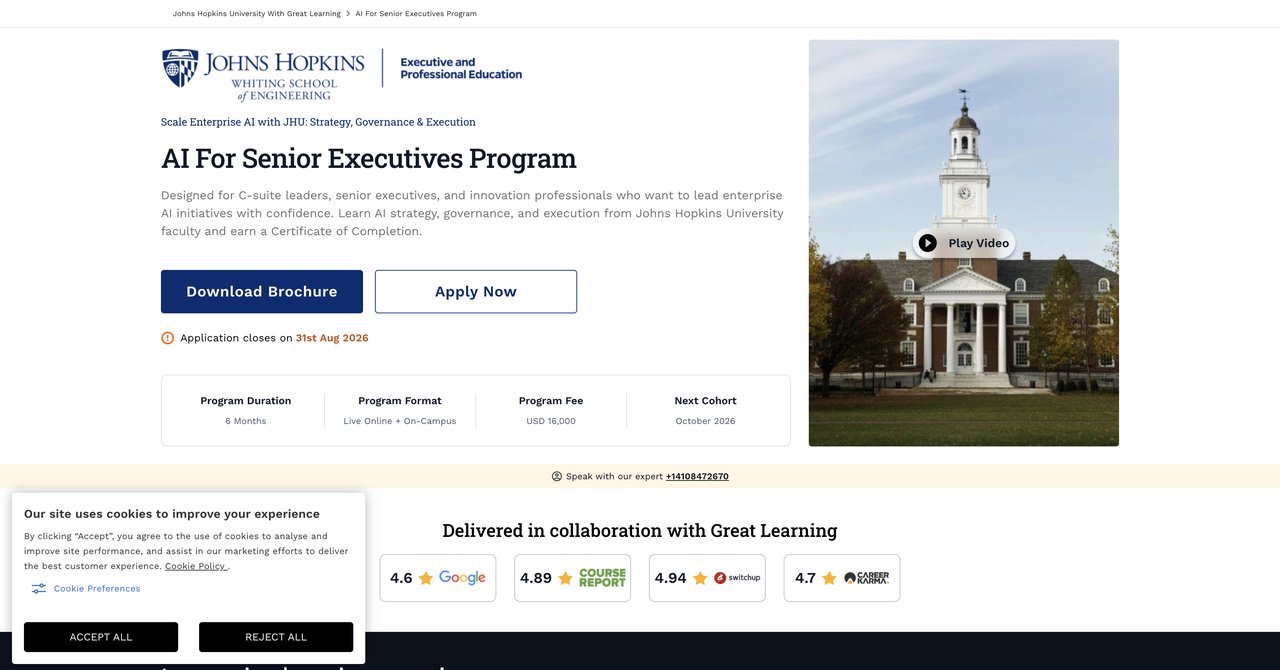
Johns Hopkins' program is similar in target audience to the MIT offering - C-suite and senior executives. It covers AI strategy, governance, and execution. Their position is a bit broader than MIT's, with governance playing a stronger part of the curriculum. The program has live online sessions and on-campus portions, which offers a hybrid flexibility.
You get a certificate of completion, which at $16,000 is expensive but less than the MIT xPRO option. The governance angle is under explored in many other courses, and it can be an unusual aid if you are looking at compliance and risk framework. The hybrid format, with live sessions, has balance since you get faculty interaction but on campus scheduling.
However, this course requires a significant time commitment, likely over several months, which is tricky for an SVP with a full schedule, but it's an option for some. That cost is still a barrier for many.
Key Topics: AI strategy development, AI governance, legal and ethical frameworks, AI execution plans, living cases of AI deployment, and managing adoption. "AI governance" is here not a mere name - there is genuine emphasis.
Target Audience: C-suite and senior executives, no direct technical role needed. Comfort with heavy strategy discussion is a must.
Pros:
- Designed for C-suite and senior executives
- Covers AI strategy, governance, and execution
- Live online and on-campus sessions
- Certificate included
Cons:
- Expensive
- Requires significant time commitment
Who would benefit most: SVPs with explicit governance, compliance or industry regulatory affecting our AI implementations. Also professionals who value the school brand and are comfortable with classroom sessions.
Course 4: Leading the AI-Driven Organization - MIT Sloan Executive Education
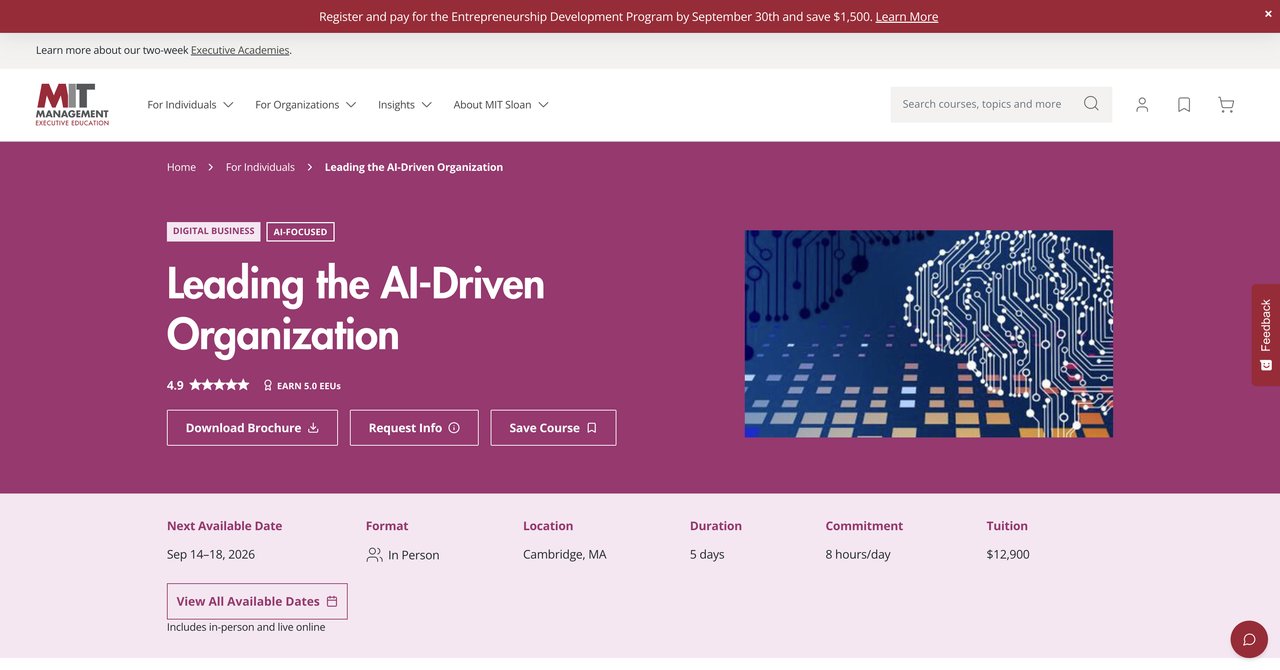
This offering from MIT Sloan is narrower in scope. Instead of learning about broad strategy and governance, it focuses specifically on leading teams that build and deploy AI. It is an intensive, on-campus program. The face-to-face style is one of its assets - you are in class with MIT faculty, in a campus setting, alongside other senior managers. The curriculum is made for SVPs who manage the technical teams directly - those who are tasked with getting delivery right.
At $12,900, it is expensive for a week-long session, but not as expensive as the xPRO option. The time commitment is short and relatively concentrated - hence the "intensive" tag. Because it's short, you will not have advancement into deep technical skills. If your role sits far from the technical side, this might not be the first choice. If you manage departments with data scientists or MLEs, the insights have solid relevance.
Key topics: Team planning for AI-powered products, success roadmaps, technical oversight, workflows for AI teams, organizational design, and collaborative development between business and technical leads.
Target audience: SVPs and VPs directly responsible for teams that create or run AI systems. Technical background isn't required but might be useful for follow-up.
Pros:
- Intensive on-campus program
- Focuses on leading teams responsible for AI design and delivery
- MIT faculty-led
Cons:
- Short duration may not cover deep technical topics
- High cost for one week
Who would benefit most: SVPs in charge of applied AI teams, such as Head of Data, CIO roles, or any line executives with financial, logistics or production processes that run AI systems daily.
Course 5: AI Executive Academy - MIT Sloan Executive Education
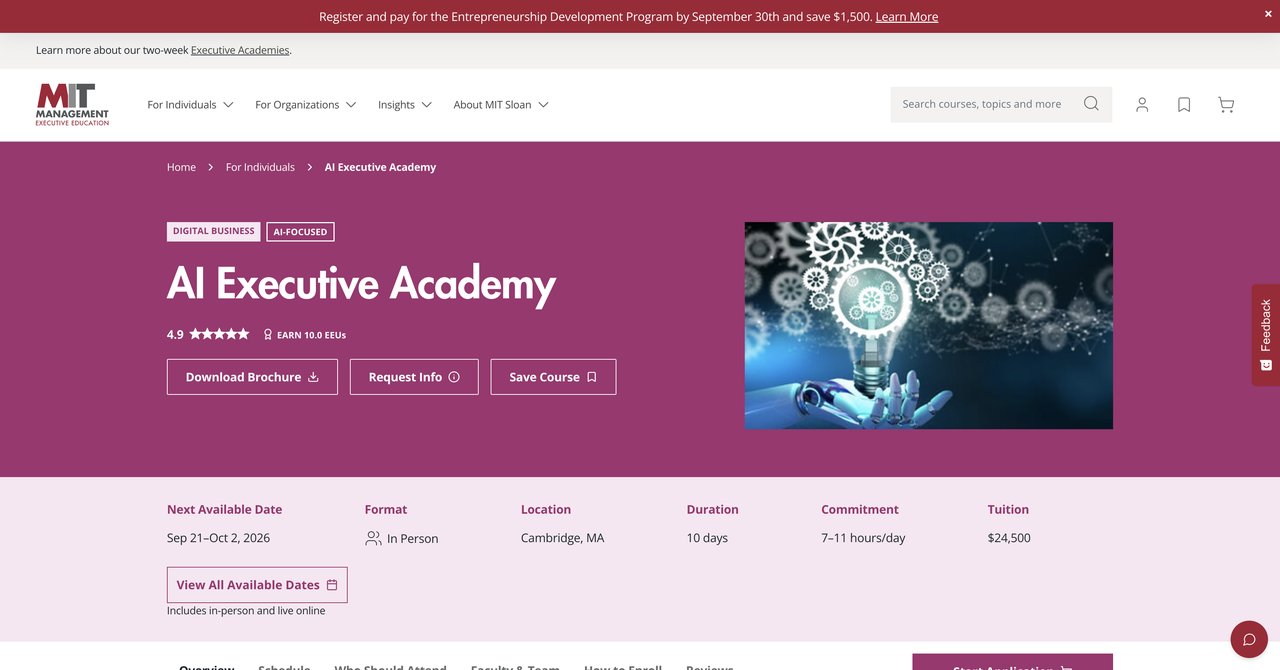
The AI Executive Academy is designed to be an immersive campus experience with MIT faculty and industry experts. Its focus is to put executives at the frontiers of AI - not broad engineering but frontier concepts. Global peer networking is another strong selling point, since participants come from all over the world and diverse sectors.
There is no public pricing for this one, which is a transparency issue. "Contact us" pricing typically means a serious premium, probably at or above the other MIT offerings. The need for on-campus attendance and travel is a practical limitation that has to be planned.
If you value exclusivity and live access to MIT's leading researchers in person, this type of experience is hard to beat. It is not a useful option for most SVPs who are budget-constrained or time-pressed. Also, because it is on-campus, you'll engage with ideas - but only a select set of people get to do that.
Key topics: Frontiers of AI technologies - agentic AI, multimodal systems, advanced machine learning. Research-based strategic roadmapping, organizational change, global best practices.
Target audience: Senior executives (SVPs, C-suite) seeking top edge knowledge and contact building. Requiring an open schedule - and a passport.
Pros:
- On-campus immersive experience
- Learn from MIT faculty and industry experts at the frontiers of AI
- Global peer networking
Cons:
- Price not listed publicly - likely high
- Requires travel and on-campus attendance
Who would benefit most: Executives with big budgets, a schedule that allows on-campus presence, and where networking with other SVPs on the same level is of prime importance.
Course 6: AI Adoption: Driving Business Value and Impact by MIT Sloan Executive Education
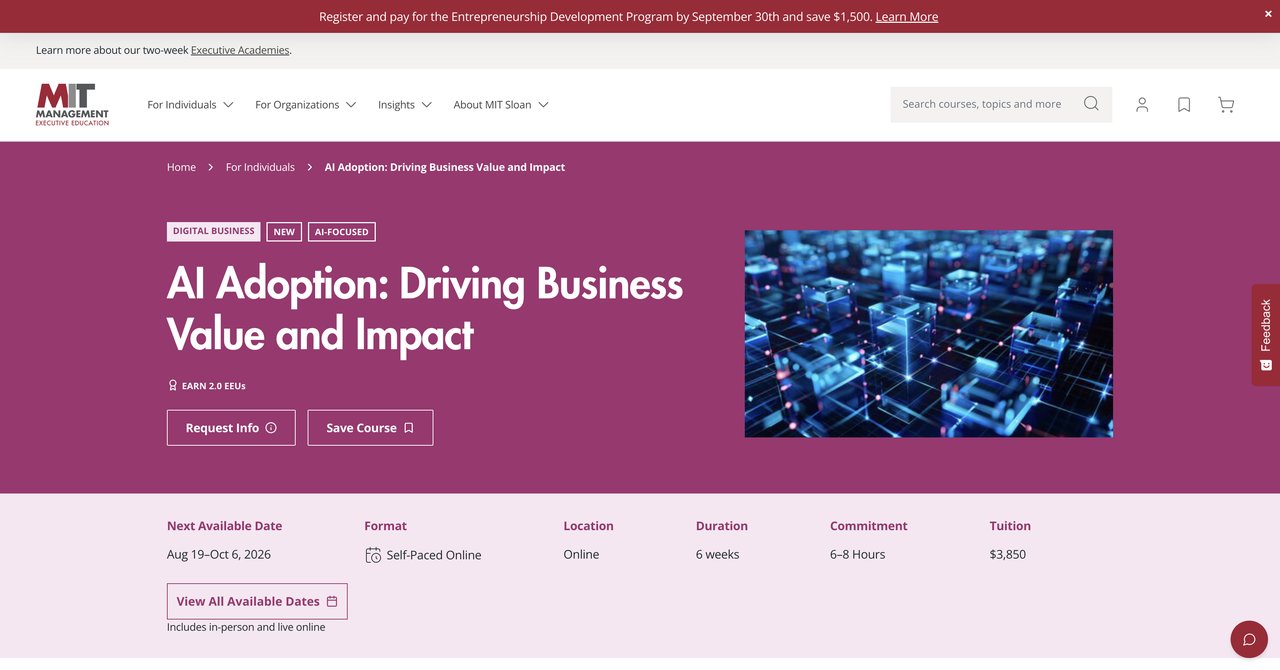
AI Adoption shifts the focus to practical implementation. This is a self-paced online course that maps AI technologies to business problems, and emphasizes co-creation - builders and users working together. At $3,850, it is mid-range for MIT options but much lower than most other university extended programs.
The self-paced format is a plus if you cannot be at a fixed location. However, it says it requires 6,8 hours per week, which for an SVP with or without portfolio could be tight. While it does help you understand how to implement AI solutions, the course is not exclusively tailored to C-suite. It may also be of use to other managers and directors. That can reduce its perceived relevance for top-level executives, but actually, it's good because you get a bit less corporate bluster and more practical application.
Key topics: AI roadmap planning, business-process mapping, co-creation methodologies, deployment frameworks, measurement of business value, and ensuring AI has a tangible ROI.
Target audience: SVPs and senior managers who have some direct role in business process redesign. Intermediate level background in basic business operations is helpful.
Pros:
- Self-paced online format
- Maps AI technologies to critical business challenges
- Focuses on building sustainable co-creation practices
Cons:
- Requires 6,8 hours per week commitment
- Not tailored exclusively to C-suite, as some other programs are
Who would benefit most: Anyone an SVP who is going to be handling the post-decision side of AI architecture with actual product delivery, rather than exclusively strategic speculation.
Course 7: AI Essential - MIT Sloan Executive Education
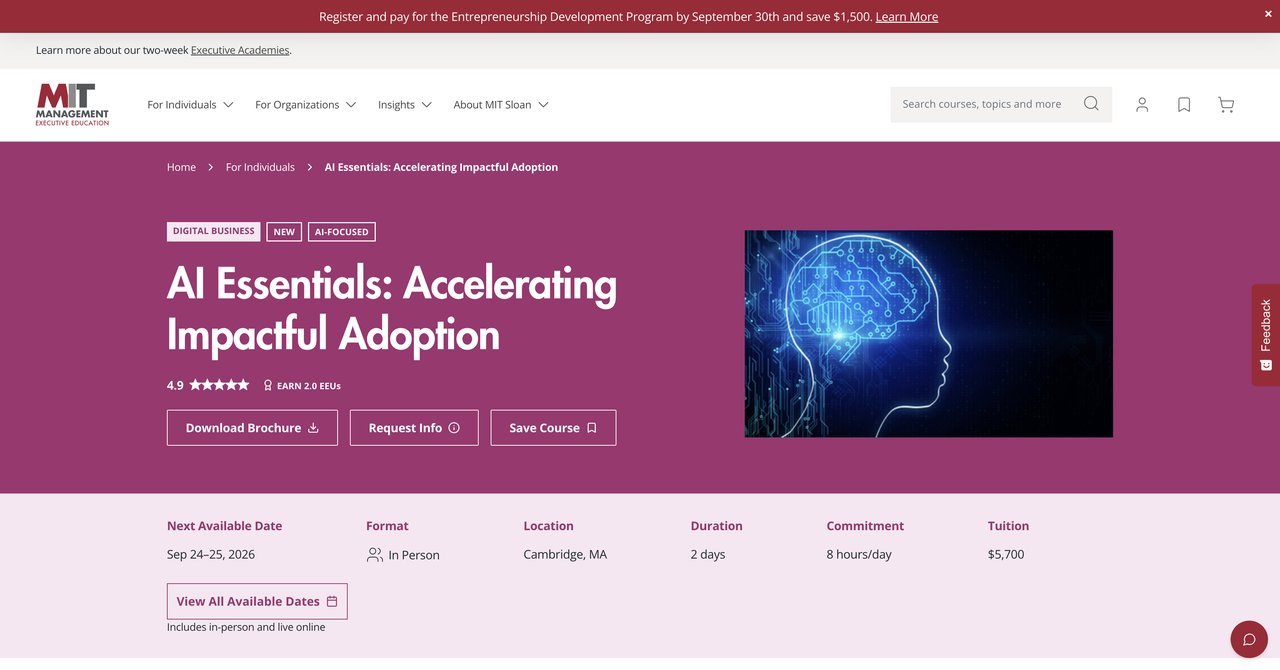
AI Essentials emphasizes AI literacy for the non-technical leader - provides a common foundation. It is a typical "first step" for smart leaders who want more than an overview but do not have technical depth. Offered at $5,700, it takes a no-nonsense, understandable look at AI technologies, and some strategic frameworks for adopting AI.
The junior model also means that for an SVP that has already immersed in technology concepts, the material might feel too scaffolded. It does not require any technical preparation, and that helps new course users. For a sure, competent executive looking at AI strategy, that might get the feeling of "I know this already."
Key topics: AI literacy, introduction to machine learning, deep-learning concepts, business principles, overview of foundational tools, and practical strategy-making.
Target audience: Newly-appointed SVP with little AI exposure, or any senior leader in non-technical departments (Marketing, HR, Finance) whose day-to-day has not yet met AI models.
Pros:
- Emphasizes AI literacy for non-technical leaders
- Clear, accessible understanding of AI technologies
- Strategic frameworks for AI adoption
Cons:
- Price not listed with duration
- May be too basic for technically savvy SVPs
Who would benefit most: Those who want a first structured introduction to AI without being overloaded by complexity - this is their first AI training.
Course 8: Chief Artificial Intelligence Officer (CAIO) Program
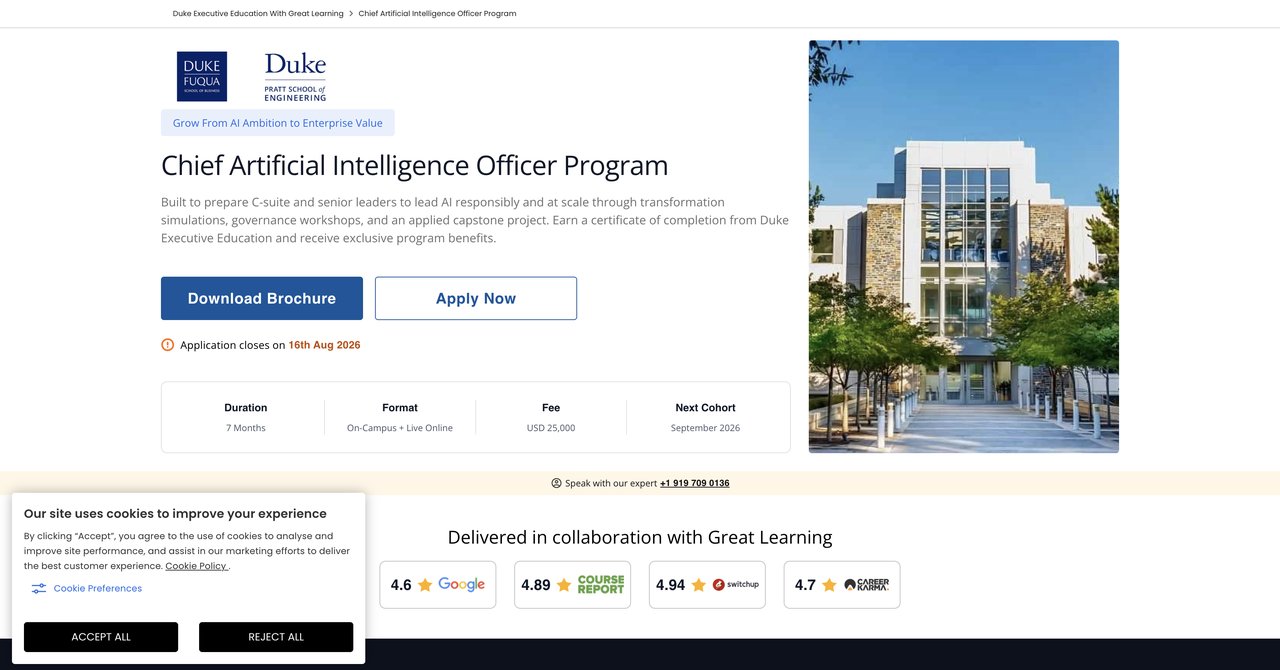
The Duke CAIO program is designed for the title in an exec level, with an emphasis on transformation simulations and governance workshops. Included, a capstone applied project, you take Duke certificate. Priced at $25,000, it is on the expensive end, but still below the MIT xProcess. The simulation workshops are a big advantage - scenario learning plays better for some learners. However, this is also a long-term intensive typical format to puts significant pressure. The focus on chief AI officer is rare.
Key topics: AI organizations and the CAIO role, tool, system design, governance frameworks, capstone application, creating organization-wide AI adoption.
Target audience: SVP-level or C-level executives, or those who are likely to be a Chief AI Officer in the near future.
Pros:
- Built for C-suite and senior leaders
- Includes transformation simulations, governance workshops, and applied capstone project
- Certificate from Duke
Cons:
- High cost
- Long duration
Who would benefit most: professional who have or want to fill the CAIO role, prefer in-formal peer workshops, and whose organization wants recognizable branding.
Course 9: AI for Executives by Coursera
Coursera's AI for Executives is a beginner-level program, with no degree of "technicality" - full of core concepts, data strategy, NLP, predictive analytics, and LLMs. It also covers CRM applications like chatbots and some related use cases. The cost structure is tempting - free to audit, and then a subscription (Coursera Plus).
That audit option means you can experience the material without spending money. The level is accessible but likely pretty basic for a senior leader - this duplication is typical for a nontechnical series. In addition, Coursera Plus is required for just the full set, you'll need enough to subscribe.
Key topics: Foundation of AI for business, data strategy, NLP, predictive analytics, LLM, and CRM-integrated AI features.
Target audience: Good for SVPs who are brand new to AI and want a low-commitment way to orient themselves.
Pros:
- Non-technical program
- Covers core concepts, data strategy, NLP, predictive analytics, and LLMs
- Includes CRM applications like chatbots and churn analysis
Cons:
- Beginner level may be too basic for experienced SVPs
- Requires Coursera subscription for full access
Who would benefit most: A top executive new initiative with AI, needing initial groundwork on a budget.
Course 10: AI for Executives - AI for Business Decision Making by Coursera
The second part of the Coursera suite covers finished executive use cases-customer feedback, process, optimization, risk prediction-and covers governance and ethics to deal with privacy, security, bias and explainability. Good to be a specialist for executives who have already taken an introductory track. The key downside - it depends on having finished Course #1, but not the whole breadth that a standalone might offer.
Key topics: Advanced executive use cases in AI (customer analytics, risk modeling, process improvement), governance and ethics - where there is a clear emphasis.
Target audience: Course 1 completers; those wanting to go deeper into implementation.
Pros:
- Covers real executive use cases - customer feedback, process optimization, risk prediction
- Includes governance and ethics (privacy, security, bias, explainability)
Cons:
- Requires prior completion of Course 1 for full context
- Not a comprehensive program on its own
Who would benefit Those searching for a focused decision-making position and some admin in business - after completing Course 1.
Course 11: AI Leadership: Strategy, Governance & Agentic Systems
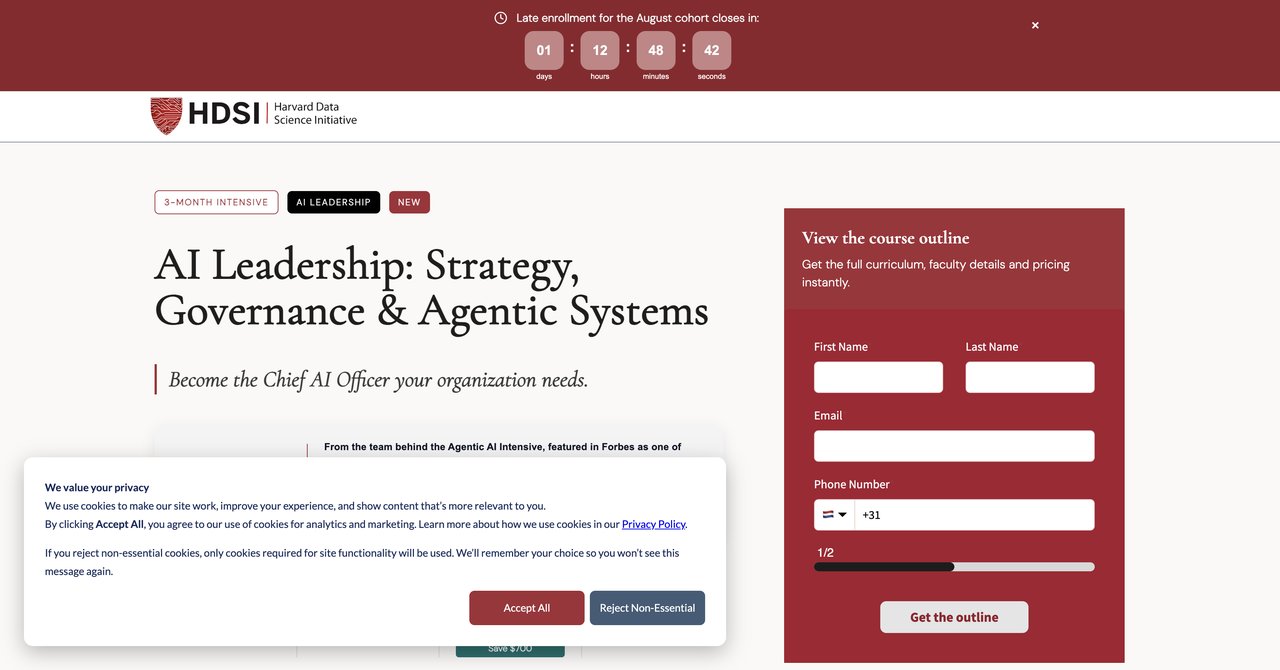
The Harvard Data Science Review's AI Leadership program is a more modern option - live online, with AI-guided learning mixed in. It's a new program for which there are still limited reviews - this is often a caution. It costs $5,250 now (discount from $5,950), which is a decent midrange. It hits on three main areas: strategy, governance, and agentic systems - topics that have been on the tip of many recent SVP's tongues.
Because this is a newer, there are fewer an alumni base and no years of references. However, this format - live online and AI-guided modules - could be a happy match for the full working schedule of an SVP and the modern features. But you're a hybrid yes/whatever. It has one date specific, so all schedules have to match.
Key topics: AI strategy development, governance, advanced agents (agentic AI), frameworks. Live sessions with instructor feedback.
Target audience: VPs, Directors, and C-suite; people who need up-to-date framework on both classic strategy and current AI capacity.
Pros:
- Live online + AI-guided format
- Designed for VPs, Directors, and C-suite
- Covers strategy, governance, and agentic systems
Cons:
- Specific start date may not suit all schedules
- Relatively new program with limited reviews
Who would benefit most: A SVP who feels at ease with newer technologies, wants live online plus modern AI view, and is okay with some travel or being tied to a set date.
Final Recommendations by Profile
When considering all these, there is not a single best option. The decision is entirely given to your professional situation, time availability, budget, and what you must do - but also what your employer will pay for. Here is a summary of different profiles you might fall into.
If you are looking for the most comprehensive coverage at the most reasonable rate - the platform champion of this comparison is CompleteAI Training . One subscription price buys the whole platform. You can learn the basics, you can deepen your experience, and also cover areas that impact other roles across your organization because you get access to everyone materials. Annual billing gets you down to $8.25/month - a fraction of any university program. That is the clear value play for a professional that values scope, breadth, and continuous learning
For those with $20,000+ and a desire for prestigious names, MIT and the other universities have strong specific options. For the big-picture strategic look, MIT xPRO's $28,000 program is the strongest academic. It will not bring you very fast, but the brand recognition remains. Wharton or John Hopkins has a little lower price at $780, but still covers governance more explicitly than the MIT.
Middle-range leaders - you'd be looking at either MIT Sloan Essentials or JHU or Harvard's new thing. They all offer decent value but be careful with time need and whether or not the material fits your particular role. For practical implementation and leading execution teams, "AI Adoption" from MIT has a cost-effective value.
At the bottom of the cost range, Coursera is a solid entry-level start. But the beginner level may feel too simple for a business seasoned SVP, and a true SVP will likely finish it in under a week and want to pick a paid platform.
For a general recommendation: if one needs engaging coverage that is directly relevant to managing AI across the whole - I think the best course is the your timeframe, and cost effectiveness is the real "AI for SVP" course. It doesn't have the university institutional name, but it beats the variable price of credentials. The standards at MIT are far beyond brand to most. Still, not refuse that for someone who is dealing with large-market enterprise setting, so an executive certificate from a healthy university does have some presence. We all try being honest about the right amount of budget and institution.
One last piece of advice - you don't have to pick one. It is a common pattern to start with a low-stakes online platform like CompleteAI or Coursera, and then go on to an advanced executive session when a specific issue happens. That way, you get the best institutional and detailed credentials of both.