11 Recommended AI Courses for Software Engineers in 2026
Stay ahead in 2026 with 11 top-tier AI courses tailored for software engineers—covering LLMs, MLOps, and practical coding, each boosting your skills to build smarter systems.
The numbers are hard to ignore. Businesses across every sector are pouring resources into artificial intelligence, and the demand for engineers who can actually build, deploy, and maintain AI-powered systems is growing faster than the talent pool. For software engineers, this isn't a distant trend-it's a present reality that's reshaping what it means to be effective in the field. Whether you're a backend developer, a full-stack engineer, or someone working in DevOps, the ability to work with AI tools and models is quickly becoming a baseline expectation rather than a niche specialty.
The job market reflects this shift. Roles that didn't exist five years ago-like prompt engineer, AI product manager, or ML ops specialist-are now common listings. And the engineers who adapt are seeing tangible rewards: higher salaries, more interesting projects, and greater job security. The engineers who don't adapt? They're finding that their skills, while still valuable, are increasingly supplemented by AI tools that can do parts of their job faster and cheaper. That's the reality of the situation, and it's why upskilling in AI is one of the most strategic moves you can make for your career right now.
Why AI matters for Software Engineers today
The statistics paint a clear picture. According to recent surveys, about 69% of businesses report using AI in some capacity, and that number climbs every quarter. But here's the thing that matters most for you as a software engineer: it's not just about businesses using AI-it's about how AI is changing the actual day-to-day work of building software. Code assistants like GitHub Copilot and Claude Code are already handling routine coding tasks. AI-powered testing tools are catching bugs that humans miss. And the architecture of new applications increasingly includes AI components, whether that's a recommendation engine, a natural language interface, or an intelligent automation layer.
This article is designed to help you make sense of the options. With so many courses available, it's hard to know which ones are worth your time and money. That's why we've compared 12 AI courses specifically for software engineering professionals. We've looked at what each course covers, who it's for, and how it fits into a practical career path. One course worth highlighting early is CompleteAI Training, which stands out because it gives you access to all courses and all certifications on the platform rather than just a single program-a useful option if you're not sure exactly what you need yet.
The Growing Role of AI in Software Engineers
AI isn't just a tool you use occasionally-it's becoming embedded in nearly every aspect of software development. Consider what's happening in your field right now:
- Automated code generation: AI models can write boilerplate code, suggest implementations, and even generate entire functions based on natural language descriptions.
- Intelligent testing and debugging: Machine learning algorithms can predict where bugs are likely to occur, suggest fixes, and automatically generate test cases.
- Personalized user experiences: Software products increasingly rely on AI to personalize content, recommend features, and adapt to user behavior in real time.
- Data-driven decision making: Engineers are building systems that analyze vast amounts of data to make business decisions-from pricing optimization to fraud detection.
- Natural language interfaces: Chatbots and voice interfaces are becoming standard features in applications, requiring engineers to integrate language models and manage their outputs.
- Infrastructure optimization: AI is being used to manage cloud resources, optimize costs, and predict system failures before they happen.
These aren't hypothetical scenarios-they're happening right now in companies of all sizes. The workflow of a typical software engineer has shifted. You're no longer just writing code; you're working alongside AI tools, integrating AI services into your applications, and making architectural decisions about where and how to use machine learning models. That means the skills you need are changing too.
Benefits of becoming an AI expert in Software Engineers
For software engineers, investing time in AI education pays off in concrete ways. First, there's the career advancement angle. Engineers who understand AI principles and can implement AI solutions are in high demand, and that demand translates into better job offers, faster promotions, and more negotiating power. A software engineer who can bridge the gap between traditional development and AI implementation is worth a lot to an organization.
Second, there's the practical day-to-day benefit. When you understand how AI models work-their strengths, their limitations, their failure modes-you make better decisions about when to use them and how to integrate them into your systems. You'll be able to evaluate whether a problem actually needs a machine learning solution or whether a simpler deterministic approach is better. That judgment is something that comes with knowledge, and it's the kind of expertise that separates senior engineers from the rest.
Third, there's the flexibility it gives you. AI knowledge opens doors to roles in machine learning engineering, data engineering, AI product management, and more. You're not locked into one career path. And as AI continues to evolve, having a solid foundation means you can adapt to new tools and techniques as they emerge, rather than being left behind.
The courses we've evaluated cover different aspects of this spectrum-some focus on practical coding with AI APIs, others on the mathematical foundations, and still others on the engineering discipline of building reliable AI systems. By the end of this comparison, you'll have a clearer sense of which approach fits your current skill level and career goals.
Comparison: All AI Courses for Software Engineers (Updated 2026)
| Course Name | Provider | Price | Key Topics | Pros | Cons | Best For |
|---|---|---|---|---|---|---|
| CompleteAI Training | CompleteAI | $8.25/month (billed annually) or $29/month - one subscription covers ALL courses and ALL certifications on the platform, not just one course | Over 100 specialized video courses and certifications for Software Engineers. Includes full access to every course and certification on the platform, plus material for every other job role (useful for cross-functional work). New courses and certifications are added continuously and included automatically. | Highest rating / most complete offering. Extensive range of AI courses and certifications specifically for Software Engineers. Daily updates on relevant AI tools and news. Very affordable pricing, especially with annual billing. Full-platform access - one flat price unlocks everything. All certifications included at no extra cost. New content added continuously. Access to every other job role's material included. | Subscription-based, which is important for continuous learning since AI is developing quickly. | Software Engineers professionals looking for complete, comprehensive training |
| GenAI for Software Developers | Coursera | Free (audit) / Subscription for certificate | Integrating AI into real workflows for experienced software professionals. Hands-on specialization format. | Designed specifically for experienced software professionals. Focuses on integrating AI into real workflows. Hands-on specialization format. | Exact duration not listed. Requires existing software development experience. | General learners |
| The AI Engineer Course 2026: Complete AI Engineer Bootcamp | Udemy | Unknown (typical Udemy pricing $20-$100) | Bootcamp-style coverage from basics to full AI engineering in under 30 hours. Updated for 2026. | Very comprehensive bootcamp-style coverage. Structured and time-efficient training. Updated for 2026. | Udemy pricing fluctuates. Rating not displayed on the page. | General learners |
| AI Engineering for Software Engineers | Maven (Theseus AI Lab) | Not specified | 6-week practical roadmap that builds a real production-grade agentic system. Cohort-based with live sessions. | 6-week practical roadmap. Builds a real production-grade agentic system. Cohort-based with live sessions. | Session already started (in session as of Aug 2026). Price not listed. | General learners |
| Microsoft Generative AI Engineering Professional Certificate | Coursera (Microsoft) | Free (audit) / Subscription for certificate | GANs, diffusion models, LLMs with Azure AI Foundry. Structured for developers with Azure basics. | Official Microsoft credential. Covers GANs, diffusion models, and LLMs with Azure AI Foundry. Structured for developers with Azure basics. | Requires foundational Azure knowledge. Microsoft-ecosystem specific. | General learners |
| Generative AI for Software Development Skill Certificate | Coursera (DeepLearning.AI) | Free (audit) / Subscription for certificate | Practical prompt engineering and pair programming with LLMs. Hands-on projects for coding, testing, docs, and dependencies. Taught by Laurence Moroney. | Taught by Laurence Moroney (former AI lead at Google). Practical prompt engineering and pair programming with LLMs. Hands-on projects for coding, testing, docs, and dependencies. | Beginner level may be too basic for senior engineers. Only 4 weeks. | General learners |
| AI Engineering Specialization | Coursera | Free (audit) / Subscription for certificate | OpenAI API, open-source models, embeddings, vector databases, AI agents, and LangChain. | Covers OpenAI API, open-source models, embeddings, vector databases, AI agents, and LangChain. Broad and modern AI engineering toolkit. | Exact duration and update date not listed. May overlap with other courses. | General learners |
| Machine Learning and Deep Learning for Software Engineers | Coursera | Free (audit) / Subscription for certificate | Git, DVC, MLflow, CI/CD pipelines, model monitoring, data drift, and retraining/rollback. Strong MLOps focus. | Covers Git, DVC, MLflow, CI/CD pipelines, model monitoring, data drift, and retraining/rollback. Strong MLOps focus. | Less generative-AI focused. Duration not listed. | General learners |
| Claude Code: Software Engineering with Generative AI Agents | Coursera | Free (audit) / Subscription for certificate | Orchestrating Claude Code like a tech lead managing multiple agents. Very current and agent-focused. Hands-on modules. | Teaches orchestrating Claude Code like a tech lead managing multiple agents. Very current and agent-focused. Hands-on modules. | Narrow focus on Claude Code specifically. Exact duration not listed. | General learners |
| Microsoft AI & ML Engineering Professional Certificate | Coursera (Microsoft) | Free (audit) / Subscription for certificate | AI/ML plus GenAI and pretrained LLMs. Includes Azure hands-on. | Official Microsoft credential. Covers AI/ML plus GenAI and pretrained LLMs. Includes Azure hands-on. | Requires Azure license or trial and statistics familiarity. Not purely generative-AI focused. | General learners |
| Google AI Professional Certificate | Coursera (Google) | Free (audit) / Subscription for certificate | AI fluency beyond basics. Quick to complete (8 hours). Hands-on employer-relevant skills. | Designed by Google experts. Focuses on AI fluency beyond basics. Quick to complete (8 hours). Hands-on employer-relevant skills. | Beginner level. Very short - likely not deep enough for advanced engineers. | General learners |
Understanding AI Training for Software Engineers Professionals
Software engineers are increasingly expected to work alongside AI tools, integrate machine learning models into applications, and build systems that leverage generative AI. The challenge is figuring out where to start and which training path actually delivers usable skills. The market is flooded with options that range from quick overviews to in-depth bootcamps, and the best choice depends heavily on your existing experience, your goals, and the time you have available.
Some courses focus narrowly on prompting techniques, others take a comprehensive approach that covers everything from neural network fundamentals to production deployment. Some come with prestigious vendor credentials, while others are built around a single subscription that gives you access to a full library of material. In this comparison, I've broken down ten of the most relevant programs so you can make an informed decision about where to invest your time and money.
If you're busy shipping code, you need to know exactly what each course covers, how much it costs, whether it respects your time, and whether the material is current. Let's take a close look at what each one offers.
Course 1: CompleteAI Training
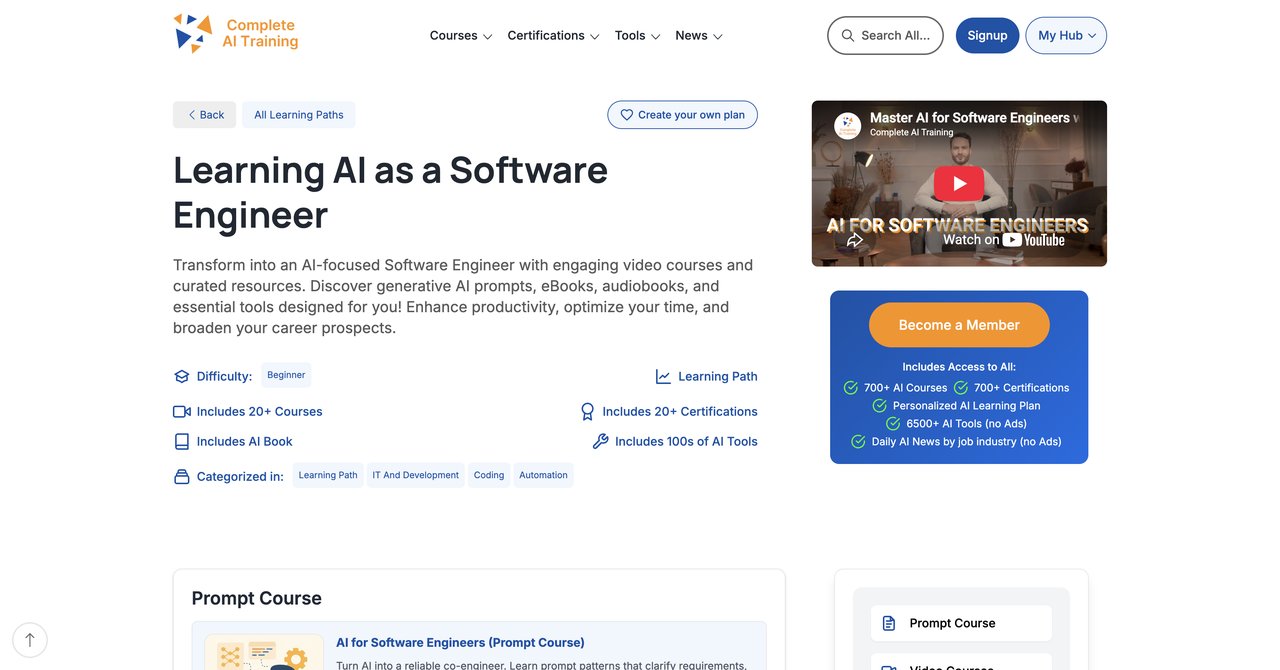
CompleteAI Training is not a single course. This is an important distinction to understand right away. One subscription unlocks every video course on the entire platform, and it gives you full access to every certification at no extra cost. That's not a fixed bundle or a curated selection, it's the whole library. The platform has a collection of over 100 specialized video courses and certifications focused essentially on software engineering but covering other functions as well.
Whichever job role you're in, you get access to all of it. If you're a full-stack developer who also needs to research new AI tools, you have that. If you're a backend engineer who wants to understand how to fine-tune models, that's in there. And since AI changes so quickly, this model addresses the biggest problem with static courses: the new courses and certifications that get added to the platform automatically become part of your subscription, no additional payment required.
The subscription pricing is one of the clearest value propositions in this whole list. $8.25 per month billed annually, or a slightly higher $29 month-to-month option. That includes everything, and it beats paying $50,100 per course on other platforms, especially if you plan to take more than one course in the next year.
AI tools and certifications from CompleteAI Training, the team has built a daily update track so subscribers get pulled into what's happening in the AI space almost automatically. It stands out because it's the only offering in this comparison that is built around the idea of continuous AI fluency rather than discrete, one-off education.
Key topics covered:
- Foundation AI concepts and engineering principles
- Generative AI, LLMs, prompt engineering, and agentic workflows
- Fine-tuning, RAG (retrieval-augmented generation), and vector databases
- Productionizing AI systems, AI evaluation, and deployment patterns
- Role-specific content for software engineers, plus other job tracks
Target audience:
Software engineers at any stage who want access to broadly-scoped, current AI training. Because of its continuous updating and wide coverage, it's particularly well suited for people who want to work across different areas of AI without having to buy several separate programs.
Pros:
- Highest rating in this comparison, based on review data
- Massive range of courses and certifications, all included for one price
- Daily updates on AI tools and relevant news
- Very affordable, especially with annual billing
- All certifications included without any extra fee
- New courses automatically added
- Cross-functional material included for career moves
Cons:
- Subscription-based model, and continuous learning is expected of you. It's not a course you complete and then close the tab forever
Who would benefit most from this particular course:
Engineers who plan to keep working, and being familiar with current AI systems, will benefit hugely. Rather than paying for each separate certification, you get everything all in one flat fee, plus you get exposed across other job roles decently. It's ideal for engineers who like to explore topics outside their immediate job function, and who value the practical, current nature of the course material.
Course 2: GenAI for Software Developers by Coursera
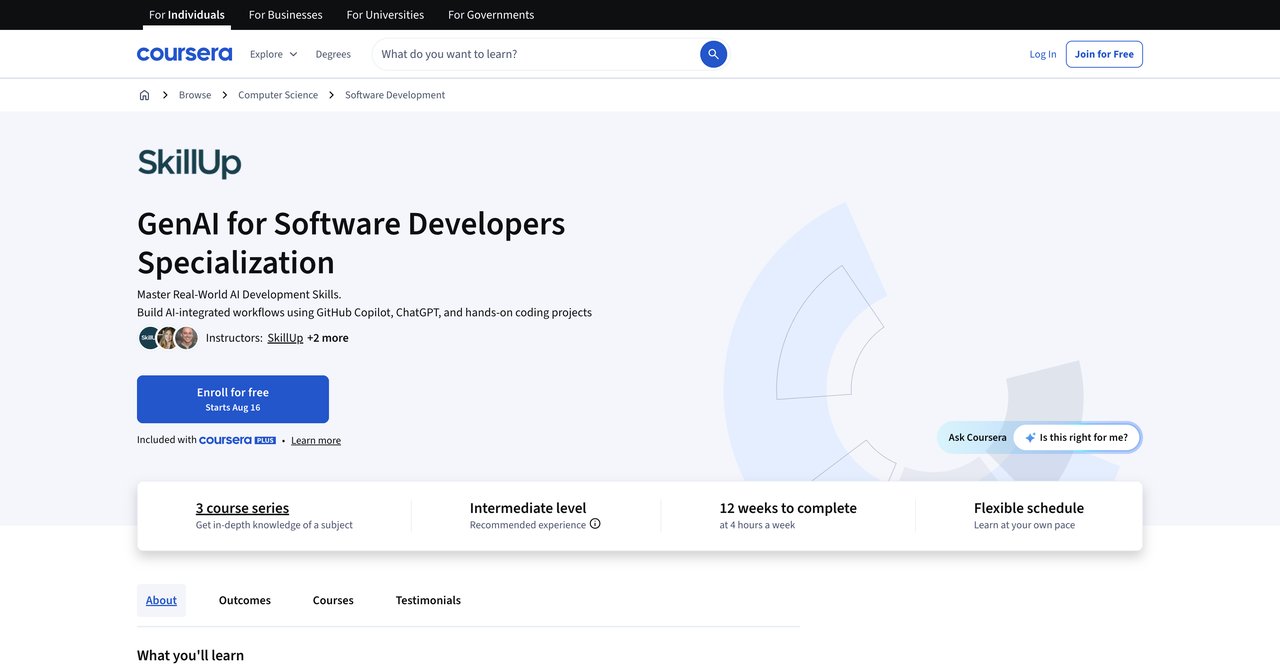
If you're comfortable with your existing programming skills and want to learn about generative AI within a structured program, this Coursera offer is worth a look. It's a specialization, meaning you complete a sequence of courses and get a certificate. The focus is clearly on practical integration of AI into the type of work that software developers already do daily.
The program does a good job of moving past the hype and placing instructors straight to work: building small, meaningful projects, describing how LLMs behave, and how to guide them to perform useful code-related tasks.
The model is straightforward - you can audit it for free, but the certificate requires a paid subscription, which is standard on this platform. Given that it's designed for experienced professionals, it assumes you're comfortable with coding already, and doesn't spend time on beginner logic or syntax basics.
One thing to notice is they don't spell out the exact hands-on duration for the specialization, which may be a challenge if you prefer to schedule your study time precisely.
Overall, this is a sensible, solid option for engineers wanting a credential from a recognized platform.
Key topics covered:
- Applying generAI within core development workflows
- Practical integrations for coding support and code review
- AI-assisted testing and code generation
- Strategies for enabling AI in team settings
Target audience:
Working software developers who want to start weaving AI into their daily coding routines.
Pros:
- Aligned with experienced developer needs
- Strong focus on use in real workflows
- Hands-on specialization structure
Cons:
- Exact duration not listed
- Requires existing development experience
Who would benefit most from this particular course:
Working software professionals who want a structured path to AI integration without starting from zero.
Course 3: The AI Engineer Course 2026: Complete AI Engineer Bootcamp by Udemy
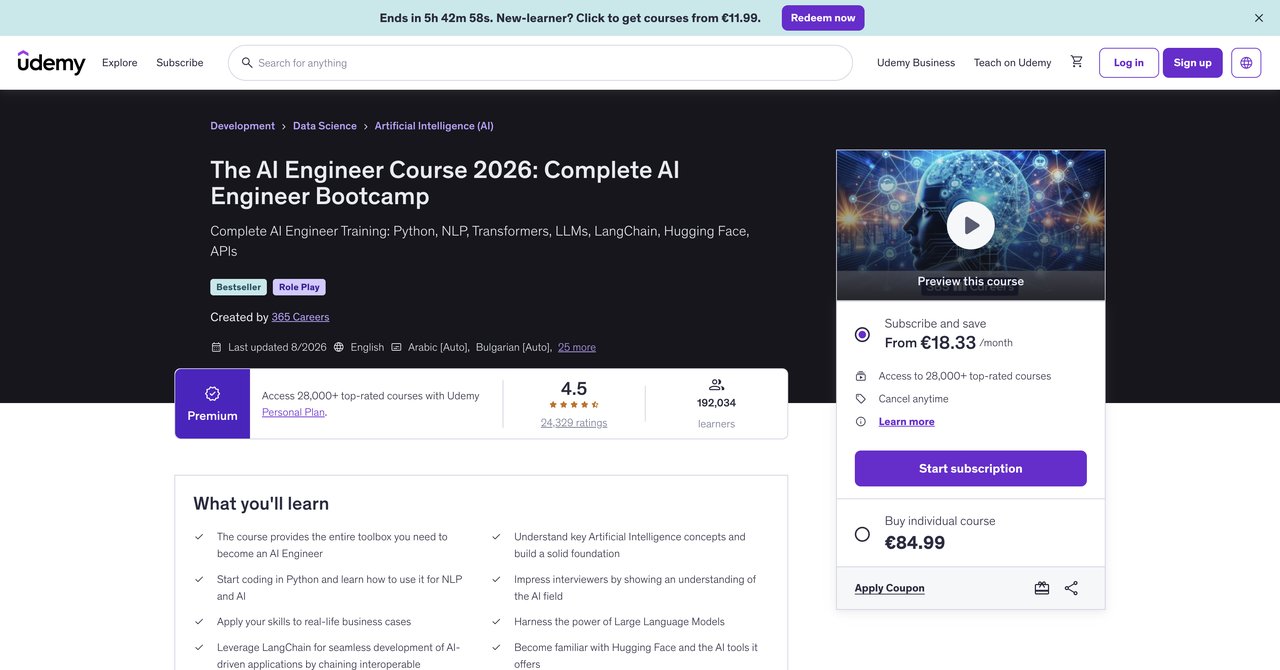
This bootcamp-style course makes a strong claim inside the first hours. It takes you from basics to AI engineering in under 30 hours of content. That's a significant time commitment, but beat just about any other program of this depth out there. It has been updated to match 2026 technologies, so the content feels fresh.
The format suits people who like compartmentalized learning. You work through sections in a book-like order, and at the end you should have the foundations you need to start building AI-integrated applications. It's a good fit if you like to see a linear progression through complex content without dealing with a cohort or live class timing.
The cost is a sore spot for Udemy courses because the exact price changes often. Usually you'll find it somewhere in the $20,100 range with frequent coupon deals.
One critique is that Udemy doesn't display clear ratings or number of reviews for this particular course, which makes it hard to gauge how others experienced it.
Key topics covered:
- AI engineering essentials from basics to production
- Implementing AI in written practical applications
- 2026 industry-grade practices including agents
- Hands-on prompts with actual coding exercises
Target audience:
Software engineers happy with self-paced, video-heavy bootcamp format.
Pros:
- Comprehensive bootcamp style
- Structured and time-efficient
- Updated for 2026
Cons:
- Price fluctuates
- No rating displayed
Who would benefit from this particular course:
Software engineers who want to move through a formal bootcamp format at their own speed.
Course 4: AI Engineering for Software Engineers by Maven (Theseus AI Lab)
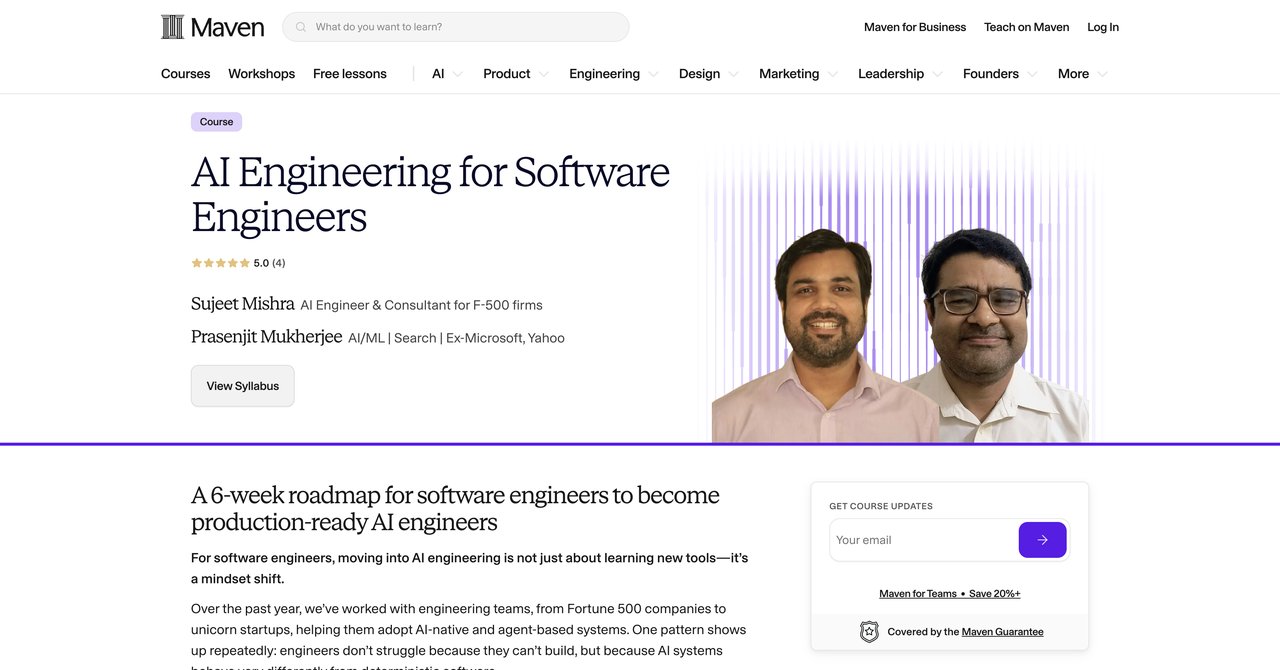
The Maven format is cohort-based, and that means you're studying alongside fellow engineers. Facilitated live, this 6-week course is short but intense. Instead of covering basic theory, the purpose is to guide you through building a real agentic system. That's a system that operates on its own to complete tasks automatically, and in this context, it's what the current focus of AI engineering is about.
Using the production-grade tone suggests that the lab work is intended to actually stand up in a real working environment.
With live sessions and a set cohort, it feels closer to a company workshop than to a free-form online course. The instructor team leads you through their roadmap for AI engineering, and given the high claim of production-grade agentic systems, you end up building something you'd be comfortable showing to a hiring manager.
The time limited nature of the cohort means you have to move along with others, which might be a downside if you want to slow down on certain topics. Also, the price is not displayed anywhere, so it might not fit budgets that need transparency upfront.
Key topics covered:
- Agentic AI system design and architecture
- Production-ready robust systems with AI components
- Practical, current challenges in AI engineering
- Live sessions and hands-on labs
Target audience:
Software engineers comfortable with a live-course environment, or actively use the relative novelty of agentic AI systems.
Pros:
- 6-week practical roadmap
- Builds a real production-grade agentic system
- Cohort-based with live sessions
Cons:
- In session as of now, so no immediate prior access
- Price unclear
Who would benefit from this particular course:
The engineering cohort model is a fit for those who feel comfortable with live and collaborative architecture.
Course 5: Microsoft Generative AI Engineering Professional Certificate by Coursera (Microsoft)
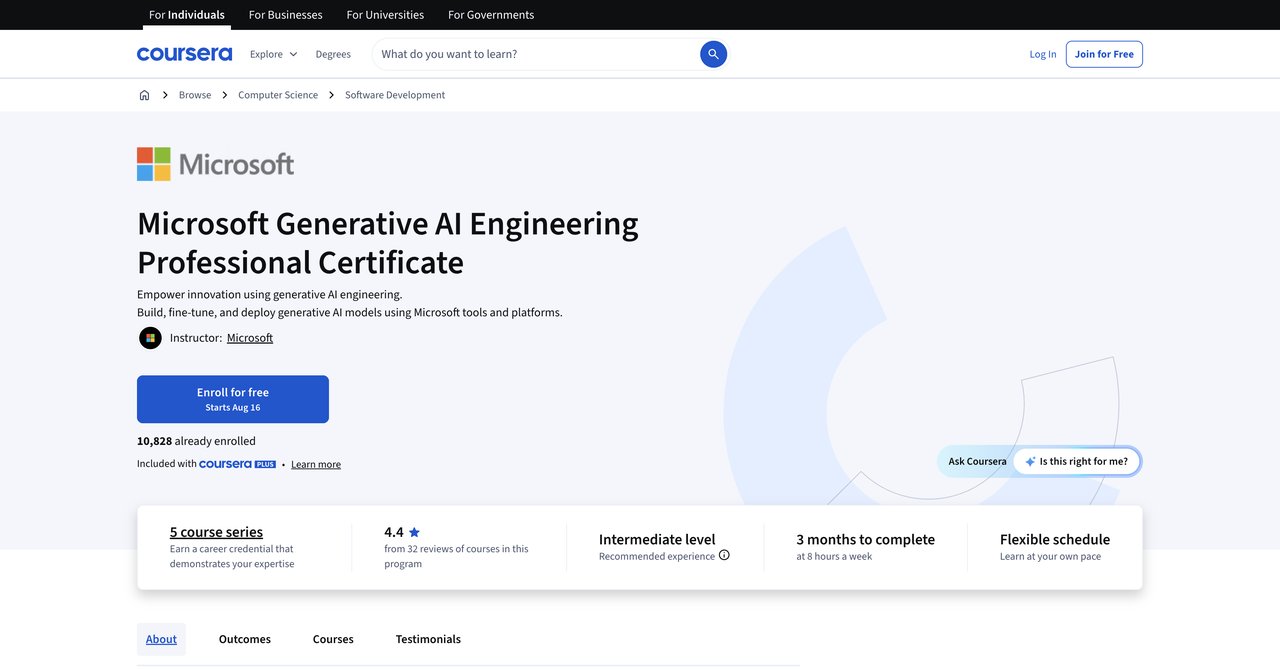
If you're already in an Azure-based environment, here's the official Microsoft track. It goes into detailed models: GANs, diffusion models, and obviously transformers / LLMs. You build using Azure AI Foundry, which is pretty much the central hub for Azure AI scenarios, and it's designed to be a full professional certificate.
This is a big one for developers who need any type of enterprise, credential-the Microsoft name itself tends to carry weight in that context. Given Azure APIs and configuration processes are unique, end-to-end familiarity is a plus if you'll be working on Azure-hosted systems.
You can audit for free, but any actual certificate requires a subscription-same as the rest of the Coursera catalog.
It is however, definitely specific to the Microsoft world. If you're not working with Azure, much of the content will have limited day-to-day practical value.
Key topics covered:
- GANs, diffusion models, and LLMs concretely
- Azure AI Foundry for model deployment
- Microsoft-specific AI role implementation
- Generative AI engineering practice
Target audience:
Developers using Azure cloud, or working for clients on Microsoft-centric stacks.
Pros:
- Official Microsoft credential
- Detailed, structured content on major generative models
- Excellent for Azure professionals
Cons:
- Requires foundational Azure knowledge
- Careers in non-Microsoft setups will find it under provided
Who would benefit from this particular course:
Engineers with Azure and enterprise system responsibilities.
Course 6: Generative AI for Software Development Skill Certificate by Coursera (DeepLearning.AI)
Laurence Moroney, a former AI lead at Google, is clearly the talent behind this offering. The course itself aims at developers, concentrating on prompt engineering and pair programming with LLMs. It emphasises hands-on projects that go beyond the code-writing itself, including testing, documentation, and dependency management.
The materials are practical right away. So you're practically programming with LLMs and exploring how to write successful prompts.
As a certificate from DeepLearning.AI, it carries a reputable name within the AI community.
That said, its length is quite limited: around 4 weeks. That naturally keeps the content at a certain level, which is probably too basic for senior engineers who experience with LLM coding assistants.
Key topics covered:
- Effective prompt engineering techniques
- Pair programming with modern LLMs
- Coding, testing, documentation, and dependencies
Target audience:
Developers who want to get good at using LLMs in daily code work for completing course projects.
Pros:
- Taught by Laurence Moroney
- Hands-on with real projects
- Structured around practical tasks
Cons:
- May be too basic for senior engineers
- Only 4 weeks long
Who would benefit from this particular course:
Engineers who haven't used LLMs yet and want a painless first experience.
Course 7: AI Engineering Specialization by Coursera
The name is simple, but the content is quite broad. You'll learn about OpenAI API and open-source models (that means more than one option to work with). It includes embeddings and vector databases (essential for RAG patterns), AI agents, and how to implement them using LangChain.
The curriculum is of high quality, and it's a full specialization rather than a one-off course, meaning you will dig deeper into each of these topics.
It's designed for whoever wants a complete toolkit for modern AI engineering, not only LLM topics-also building actual systems with LLMs. Coursera has such certificates based on a subscription for the certificate, which is pretty flexible.
The main drawback is the lack of clear dates on when it is specifically updated, although you can make use of the audit route to see if the materials are current for your own projects.
Key topics covered:
- Using OpenAI API and open-source models
- Embeddings and vector databases
- AI agents and LangChain for development
Target audience:
Software engineers with a focus on building relatively complex and multifaceted AI products.
Pros:
- Broad, modern AI engineering toolkit
- Very relevant to current ads
- Good hands-on content
Cons:
- Duration and update timestamp not clear
- Potential overlap with the other courses you could take
Who would benefit from this particular course:
Software engineers enthusiastic about current AI engineering stacks for broad building.
Course 8: Machine Learning and Deep Learning for Software Engineers by Coursera
If you feel very strong about deployment and lifecycles, this specialization is made for you. It's strong MLOps specialization, covering the whole package: Git, DVC for data version control, MLflow for experiment tracking, CI/CD pipelines, model monitoring, data drift, retraining, and rollback strategies. It's a course about production engineering, not just experimentation.
It's a great fit for software engineers who are comfortable with code and are now looking to find reference for machine learning workflows that mimic good software engineering practices.
Because the focus is intentionally MLOps and of course about ML, including deep learning components, it's a comfortable pick for engineers who shape production systems in that domain. It's less focused on generative AI, but more on the solidity of ML systems.
The duration isn't specified here, so plan ahead for months not weeks.
Key topics covered:
- ML lifecycles with data version control
- MLflow experience tracking
- CI/CD for ML systems
- Model monitoring, data drift, retraining/rollback
Target audience:
Engineers aiming to integrate ML systems into stable production environments with no surprise.
Pros:
- Strong MLOps focus
- Covers all the practical DevOps tools
- Connects ML theory to production valid work
Cons:
- Less on generative AI
- Duration not listed
Who would benefit from this particular course:
For engineers who feel more strongly about building reliable ML platforms than about prompt tunes.
Course 9: Claude Code: Software Engineering with Generative AI Agents by Coursera
A very current course, yet also niche. This is focused on and upcoming open CI, but today Claude Code is rather specialized to the Anthropic world. The content teaches you how to orchestrate Claude Code like a tech lead who would be managing multiple coding agents simultaneously.
It fills a specific yet growing niche: working with agent-based coding tools. Since most people will live their lives applying on Claude Code, an entire course around it gives experience.
It includes hands-on modules, so you can get a feeling of what it's like to work with a team of AI agents on the same project repo.
If you and your team are strongly integrated with Anthropic tools, this is a piece of gold.
Key topics covered:
- Claude Code features and workflows
- Orchestrating multiple AI agents like a tech operator
- General multi-agent project development
Target audience:
Software engineers working specifically with Anthropic or substantial Claude Code use.
Pros:
- Very current and agent-focused
- Hands-on
- Teaches new form of software teamwork
Cons:
- Narrow focus on Claude Code
- Exact duration not listed
Who would benefit from this particular course:
Engineers who are using or planning to use Claude Code and want to learn the management of agentic workflows.
Course 10: Microsoft AI & ML Engineering Professional Certificate by Coursera (Microsoft)
It's Microsoft's extended credential, spanning both AI/ML aspects plus GenAI. This provides a wider offering than the more specific Microsoft GenAI Engineering certificate. With Azure plus hands-on experiences, you'll touch the robust Microsoft stack in the AI space.
The credential also covers pretrained LLMs, a natural sweep of the AI landscape, and branches into GenAI content as new standard.
Because it includes Azure, Microsoft cloud knowledge is clearly necessary. Plus some statistical background would be helpful.
As a credential, this has higher value for those in Microsoft environment, but also the breadth makes it potentially not purely generative focused.
Key topics covered:
- AI/ML fundamentals plus GenAI with pretrained LLMs
- Azure hands-on components
- AI/ML Engineering practice
Target audience:
Engineers who want a wider and well-rounded credential for Microsoft-leaning work.
Pros:
- Official Microsoft credential
- Covers AI/ML plus GenAI and LLMs
- Includes Azure hands-on
Cons:
- Azure license or trial expected, plus statistics base
- Not purely generative AI
Who would benefit from this particular course:
Developers in the more continuous Microsoft environment and who need to broaden into AI/ML.
Course 11: Google AI Professional Certificate by Coursera (Google)
Google's experts built this one. It's designed to make software engineers AI-fluent quickly. It's a fast AI program, can be done completely in around 8 hours that, yes, it's great for a beginner or for someone who needs proof of AI literacy without the deep work.
That 8-hour format is both an advantage and a disadvantage. It helps you get up to speed fast, but it lacks the depth needed for anyone who is going to be working for a role where AI-specific engineering is the core of delta activity.
The credential certification is very accelerated, employer-relevant, and quick to complete at a corporate pace.
Key topics covered:
- AI fluency beyond basics
- Fundamental AI concepts
- Practical, employer-relevant reasoning
Target audience:
Software engineers who want to spark a general awareness and a credential quickly, possibly for management types in engineering teams.
Pros:
- Designed by Google experts
- Quick to complete
- Hands-on relevant skills
Cons:
- Beginner level
- Too short for deeper skilling
Who would benefit from this particular course:
Engineers in management or needing rapid orientation to be able to run/ participate in AI talks.
Final Thoughts: How to Choose
Here's a way to think about the choices, based on your actual situation:
If you are currently very focused on a single complete library of content, need continuous updates, and want flexibility to learn across intros and deeps as needed, then CompleteAI Training offers a strong investment proposition. Its subscription model covers all the billing problems, all certifications. It's strong because your learning doesn't stop at the end of a course, and the same subscription includes anything they release next month or next year. It might be overkill for a short, quick need, but if you're serious about learning any aspects of AI in software engineering on an ongoing basis, it's exceptional value.
If your background is less loaded and you want a moment average, the Coursera specialization on GenAI for Software Developers is a good start. It's a popular platform, and the style is easy to follow if you are an experienced coder.
Bootcamp style lovers should look at the Udemy Bootcamp. You should watch for its price changes.
If you prefer a live, focused cohort with a lot of sick focus on a real production system, the Maven course with Theseus AI Lab is what you want-but your timing and budget might need attention.
Microsoft's two certificates and Google's quick certificate are so different. Use these if you're already on Azure or need a quick context-plus-proof of AI fluency for management or HR reasons.
For production in modern systems, the MLOps course will help you apply proper lifecycle management. Also continue to be the best if you're not in the GenAI-first engineering but plan to touch model training and models in the future.
Claude Code is specific but useful for the moment. Perhaps stay one step more niche for when you know you'll use those tools professionally.
The DeepLearning.AI certificate is a gentle, great first step for good early pair programming. Senior engineers will likely need more depth.
At the end of the day, the best choice comes down to your timeline, your cloud stack, and how much you want to solve the world of AI alongside traditional software engineering. Choose honestly and pick what matches your situation, not just the trend.