
Blog ·
11 Top AI Courses for CFOs (Chief Financial Officers) in 2026
Master finance and AI in 2026. Discover the top 11 courses to automate reporting, sharpen forecasting, and lead strategic decisions with cutting-edge tech.
 Jeroen Erne
The financial world is changing faster than most CFOs ever expected. AI has moved from tech conferences into boardroom discussions with startling speed, and the numbers are hard to ignore. Many finance teams already use AI for forecasting, risk assessment, and fraud detection. But broader adoption remains uneven across the industry. Some financial leaders took the leap early and gained real advantages. Others are still evaluating what this technology means for their roles. The uncomfortable truth is that AI skills are becoming a key part of what separates high-performing finance chiefs from their peers. Upskilling is no longer a monthly suggestion in performance reviews-it's becoming a survival strategy.
Why AI matters for CFOs today
For CFOs, the pressure to adopt new technology is both immediate and lasting. According to recent industry surveys, about 69% of businesses use AI in some form today, and that number climbs each year. That means many of the financial decisions CFOs make are now supported by machine insights, predictive models, and automated data flows. AI isn't just about speeding things up. It is shaking up traditional workflows, forcing a rethinking of how finance teams view data, risk, structuring decisions, and even talent. AI opens possibilities around faster closing cycles, more precise forecasting, and less manual data entry. Knowing these technologies is therefore not a luxury-it is becoming a professional requirement.
This article exists to help CFOs identify the right AI training courses available today. We map out what matters most in this space, compare what different programs offer, and lay out the pros and cons of each. This review covers 55 AI courses made for finance professionals, with a focus on identifying which ones deliver practical and focused value. One standout mention here is CompleteAI Training (AI for CFOs), which offers something a bit different because it gives its students access to all courses and all certifications on the platform rather than a single class. That access model matters for professional development-especially for someone who wants broad exposure without juggling multiple registrations.
The Growing Role of AI in CFO Work
AI's presence in the CFO workplace is genuinely broad. Here are just a few concrete applications that are now realistic in everyday work:
- Automating repetitive financial tasks. Most leading finance teams use AI to reduce manual entry in invoicing, transaction reconciliation, and audit prep. These tasks used to take up days every week; now they slip into minutes.
- Data-driven decision-making. Modern finance leaders rely on AI to forecast cash flow, identify unusual patterns in spending, and forecast revenue. Rather than intuition alone, these decisions now come from massive amounts of data analyzed in seconds.
- Personalizing financial reporting. AI systems adapt the same data into different presentations-one for the board, one for department heads, and one for external stakeholders-catering it to each audience without manual reformatting.
- Improving risk detection. AI flags anomalies that a human eye might miss, like subtle patterns in vendor payments that point to fraud or even inefficiencies, which gives finance leaders and boards a transparent-looking picture.
- Reducing operational costs. Smart automations free senior team members from low-value repetitive work, and they allow them to spend their time on strategic decisions, acquisitions, and performance improvements.
So what does this mean for individual finance professionals? The day-to-day workflows are changing faster than most training materials can keep up. CFOs who need to make informed decisions in complex environments should expect more AI recommendations inserted into their workflow software. This change is already built into major platforms, and having the skill to use the outputs well becomes crucial.
Benefits of becoming an AI expert in CFO positions
Becoming fluent in AI does more than just improve tech skills. It works on multiple levels at once. First, it dramatically increases professional value. When CFOs participate in AI application for financial processes, they are more likely to be given board projects, asked for strategic advice, or consulted on how to scale data use. Second, it provides a personal productivity boost. Automation handles the parts of the job that drain mental energy-such as repetitive checks, first data passes, and certain compliance tasks-leaving clear thinking for creative analysis. Third, this skillset gets better results. Whether you're building a budget for the next year or forwarding a forecast for the next quarter, AI-enhanced analytical work often yields sharper, evidence-backed results.
In the near future, there will be an armed force for executives who can translate AI-generated insights into clear business strategy. This shifts focus from managerial tasks to high-level direction. To prepare for this change, training courses give practical, step-by-step guidance around actual finance problems, with tools and cases that suit CFOs specifically. It's a place to build real capability, not theory alone.
Comparison: All AI Courses for CFOs (Chief Financial Officers) (Updated 2026)
| Course Name | Provider | Price | Key Topics | Pros | Cons | Best For |
|---|---|---|---|---|---|---|
| CompleteAI Training for CFOs | CompleteAI | Premium | Comprehensive AI training specifically for CFOs. One subscription covers EVERY course and EVERY certification on the platform-hundreds across all job roles, not just CFO content. Includes all video courses, all certifications, and automatic access to new additions. | Comprehensive curriculum, hands-on projects, expert instructors, full access to all courses and certifications on the platform, one flat subscription price, daily updates on AI tools, new material added continuously | Premium pricing | CFOs looking for complete, ongoing training with access to all job-role material |
| AI for CFOs (Complete AI Training) | Complete AI Training | $8.25/month (billed annually) or $29/month | Extensive library of 100+ specialized video courses and certifications for CFOs. Full access to ALL videos and certifications on the platform-hundreds across every job role, not just this one. New courses added continuously and included automatically. | Highest rating, most complete offering, full access to all videos and certifications, no per-course fees, includes all job-role material, affordable with annual billing, daily AI tool updates | Subscription-based; requires ongoing learning as AI evolves rapidly | General learners wanting the broadest coverage and certifications |
| AI for CFOs: Strategic & Operational Mastery | AI for CFO (Alankar Joshi / SMU) | $740 | Built for the CFO office with SMU-grade rigor. Includes 47+ ready-to-use toolkits and 170+ production-ready Claude prompts. | Specifically for CFO office workflow, lifetime free updates with new use cases every ~2 months, extensive prompt library | Direct purchase only (not on major platform), no university accreditation or certificate | General learners needing deep CFO-specific toolkits and prompts |
| The AI-Powered CFO: A Practical Strategy for Smarter Finance | Johns Hopkins University (Imagine) | Not specified | Demystifies AI for non-technical finance leaders; leadership-focused approach with real-world finance use cases provided by Glenn Hopper. | Leadership-focused, demystifies AI for non-technical finance leaders, practical frameworks and adoption roadmap | Pricing not published, shorter format doesn't cover deep technical implementation | General learners looking for leadership-level AI strategy |
| AI in Finance: Markets, Models and Decision-Making | Stanford Online | $2,950 | Machine learning foundations, governance frameworks, real-world case analysis for regulated environments, guided exercises for financial decision-making. | Stanford faculty, covers ML foundations and governance, real-world case analysis for regulated environments | High price point, fixed cohort schedule requires commitment to specific dates | General learners seeking top-tier university training |
| AI in Finance | Coursera | Free to audit or Coursera Plus subscription | Apply AI to financial analysis for better insights; automate reporting, compliance, and operations workflows; self-paced. | Apply AI to financial analysis, automate reporting and compliance workflows, flexible self-paced format | Shorter duration may not cover deep strategic governance, quality depends on instructor | General learners on a budget wanting flexible scheduling |
| The Complete AI for Finance Course: Beginner to Master Level | Udemy | $20-$100 (on sale) | 5-year forecasting, valuation scenarios (P/E, P/S, DCF), spotting unrealistic vs. realistic projections. | Covers 5-year forecasting and valuation, teaches realistic projection analysis, beginner-friendly progression | Not CFO-specific-broader finance audience, quality varies with Udemy instructors | General learners wanting a low-cost comprehensive intro |
| AI in Finance (Certificate Program) | eCornell (Cornell University) | $4,999 | Live faculty-led sessions with Cornell faculty and industry practitioners; step-by-step progression from foundations to strategic leadership; final leadership series to design AI adoption roadmaps. | Live faculty-led sessions with Cornell faculty, structured progression to leadership level, practically-oriented capstone | Premium pricing, fixed live schedule (Mon/Wed/Fri 7,9 PM ET) may not suit all time zones | General learners wanting a full accredited certificate |
| Generative AI for Finance: Use Cases, Applications and Regulation | University of Oxford (Lifelong Learning) | $700 | GenAI and LLMs in financial services, tailored for AI newcomers, covers regulation alongside real use cases. | Oxford-quality instruction, tailored for newcomers, regulation-focused | Short 2-week format, fixed dates may not fit all schedules | General learners wanting a quick Oxford-based overview |
| Crawl, Walk, Run with AI: A Practical Workshop for Finance Leaders | AICPA & CIMA | $1,195 - $1,545 | Built for CFOs and Controllers; includes a personal prompt library, enterprise-ready AI strategy with ROI and governance, structured framework for people, process, data, and technology readiness. | Designed specifically for CFOs and Controllers, personal prompt library, comprehensive strategy with ROI and governance | In-person/workshop format may require travel, higher price for a 2-day event | General learners wanting a hands-on workshop |
| The Corporate Finance Lens™ | Strategic CFO-Grade Finance Course | Forma EdTech | $699 | Structured capital allocation decision system, CFO-grade AI Prompt Clinics, decision guardrails, accept/reject rubrics, audit checks. | Structured decision system used by strategic CFOs, prompt clinics embedded, includes guardrails and audit checks | Not from a major university or platform, focuses more on corporate finance than AI adoption itself | General learners wanting practical CFO-grade decision frameworks |
| Practical AI for Finance: Automate, Forecast, and Optimize | Udemy | $20-$100 (on sale) | Designed for finance, accounting, and FP&A professionals; focuses on high-impact AI tools for forecasting and optimization; requires no technical background. | Practical focus for finance and FP&A, no technical background required, high-impact AI tool usage | Not CFO-specific-broader finance audience, shorter format may not cover strategic governance | General learners looking for hands-on AI for finance workflows |
Understanding AI Training for CFOs (Chief Financial Officers) Professionals
Finance leadership has changed a lot in the last couple of years. The CFO role now goes way beyond traditional reporting and compliance. You are expected to guide strategy, spot risks before they materialize, and find efficiencies that directly hit the bottom line. AI has become central to that shift. Whether it's automating routine reconciliations, building more reliable forecasts, or stress-testing business models, these tools are moving from nice-to-have to must-have.
The challenge is knowing where to start. There is no shortage of courses, certificates, and workshops all promising to make you "AI-ready." But they vary wildly in price, depth, and usefulness. Some are quick Udemy side quests for $20. Others are $5,000 university certificate programs. And some are subscription platforms that bundle multiple roles. It's easy to waste time and money if you pick the wrong one.
That's what this guide is about. I've taken a look at the major options available right now for CFOs, with a focus on what is actually in the program, who teaches it, what it costs, and whether it fits a busy finance leader's schedule. The goal is to give you a clean picture so you can match a course to your actual needs - not just the splashiest marketing page.
For this depth, I have included the Complete AI Training subscription as the first, because it is the most comprehensive in terms of volume. But it is essential that you read through the other options, because good prices, institutional credibility, and specialization are all worth weighing with the full picture in front of you.
Course 1: CompleteAI Training (AI for CFOs)
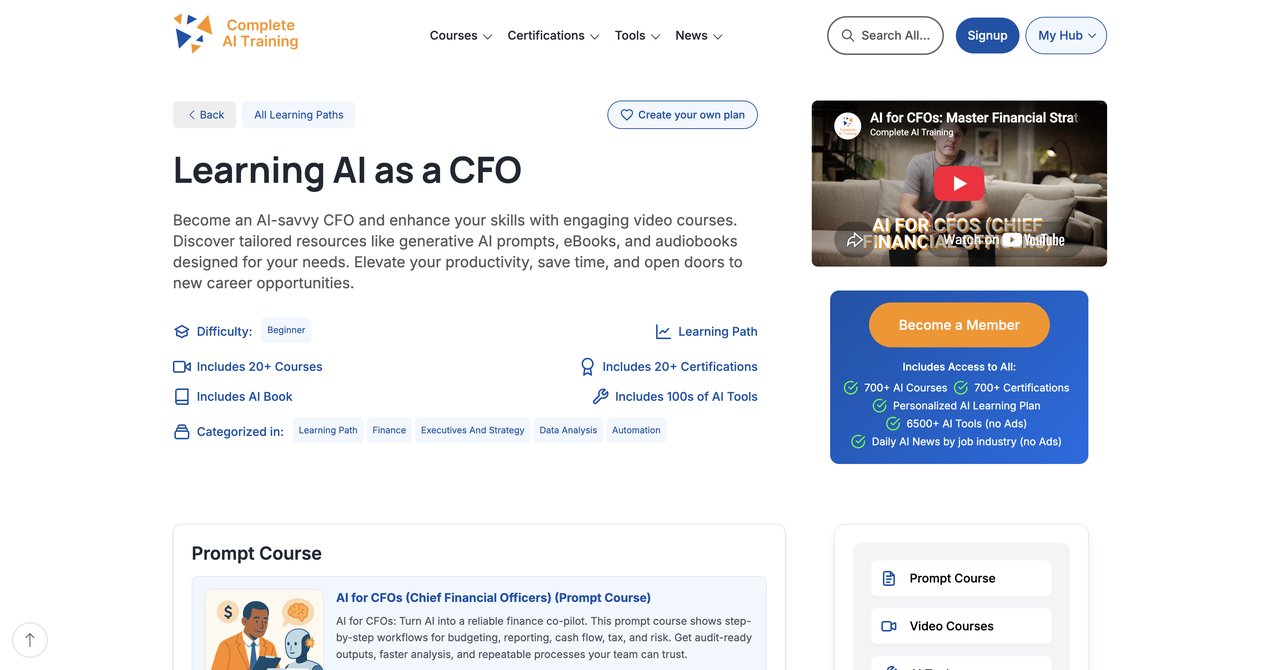
This isn't a single course. That's the first thing to know. One subscription gives you access to the whole library of Complete AI Training, which holds over a hundred video courses and certifications. That includes many for specific job titles across finance: financial analyst, financial planner, FP&A manager, CFO, controller. AI is changing fast, and your knowledge needs to move with it. New courses and certifications are being added constantly, and they're all included in one flat rate, with no extra fees for coursework or cert exams.
So, in effect, the "AI for CFOs" course is not what you are buying. That's just one part of your library. You have full access to materials for other roles as well. That matters more than people think. If you run a finance department, you may need to train the wider staff, or you may be looking forward to your next career move. With Complete AI Training, those changes don't require a fresh purchase. If you start in an analyst role today and get a CFO promotion tomorrow, you still have the material you need already.
If you look at the pricing for Complete AI Training, it's offered at $8.25 per month, billed annually, or $29 if paid monthly. It's affordable, and it provides robust daily updates on AI tools relevant to your job. Most importantly, it removes the need to piece together certificates from third parties at $400 each. You pick one subscription and you have video training, certification prep, and the ability to dive into other materials whenever you like.
But there is a trade-off. Since the platform is actively growing, that continuous learning model means you must make time for it each month. Without taking action, you can let the content stack up. It's also not university-accredited, so if you require a formal accredited certificate from a named school, it won't give it to you. What it does offer in liberally overhauled, practical video instruction seems to outweigh that long-term.
Key Topics Covered
The core topics cover AI, focusing specifically on CFO tasks like financial forecasting, budgeting, and FP&A practice. There is material on prompt writing for finance, automation of reporting, and how to verify model output. Since the library covers multiple jobs, you'll find material on risk management, analytics, and CFO dashboards. You can skip between them as needed.
Target Audience and Skill Level
This is aimed at finance professionals already working in the field, from beginners in AI to the most experienced CFOs. It works for those who need control and don't want to buy separate courses for each team member or future roles.
Pros
- Highest rating / Most complete offering
- Full access to ALL video courses on the platform, not a single course or a fixed bundle
- Full access to ALL certifications on the platform, included at no extra cost
- New courses and certifications are added continuously and are included automatically
- Access to every other job role's material too, which matters for anyone whose work spans more than one function or who wants to move roles
- One flat subscription price covers all of the above, versus paying per course elsewhere
- Daily updates on relevant AI tools and news
- Very affordable pricing, especially with annual billing
Cons
- Subscription based, crucial for continuous learning as AI is developing continuously
Who Would Benefit Most
If you want to gain immediate access to video content without paying per course, this is the right fit. It particularly serves finance professionals who want to give access to their entire staff, or who want to shift fields within the same subscription cost. The value is in giving you a breadth of tools, assuming you actually make the time to use it.
Course 2: AI for CFOs: Strategic & Operational Mastery
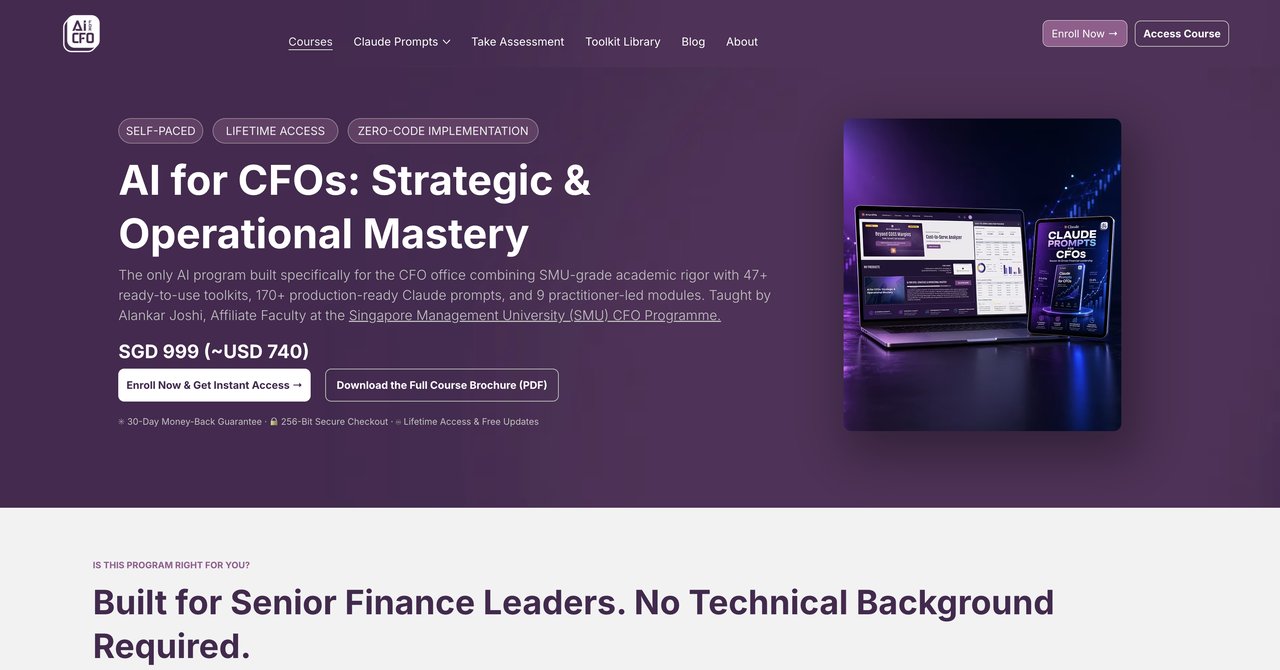
This is a different kind of offering. It's put together by Alankar Joshi, affiliated with SMU (Singapore Management University), specifically for the CFO office. The premise is to give you a set of turnkey resources for your own use and immediate employment. The course includes a huge set of toolkits (over 47) and more than 170 prompts for Claude, which can be used for everything from generating monthly board reports to integrated scenario planning. You have lifetime updates, and new use cases drop every two months or so, so you can feel like you have a steady stream of new content.
What stands out is how grounded this course is in the day-to-day of the finance department. It's not trying to turn you into a data scientist. It applies the principle that you don't need to write code. You just need to use the LLM to produce results. The prompt library is designed to get you output that you'd otherwise spend hours putting together.
The trade-offs are real. You'll need to learn with no outside platform - you purchase direct from the site. There is no corporate certificate in the university style, but rather an internal completion certificate. Given the price, at around $740, it is less expensive than other university offerings- maybe in the middle ground.
Key Topics Covered
Topics cover everything from financial operations, monthly reporting, board decks, finance modeling, and adopting AI into the CFO office. This training puts a huge focus on building and using prompts to get actionable output.
Target Audience and Skill Level
Ideal for a CFO or senior financial manager who wants practical, functional material without the fluff. Since it includes prompt libraries that are specific to business, it assumes the user has some idea of the kind of outcome they need. But doesn't assume any AI experience.
Pros
- Built specifically for the CFO office with SMU-grade rigor
- 47+ ready-to-use toolkits and 170+ production-ready Claude prompts
- Lifetime free updates with new use cases added every ~2 months
Cons
- Not on a major platform (direct purchase only)
- No formal accreditation or certificate from a university
Who Would Benefit Most
CFOs who want to move fast and have something they can use immediately. If you need to get results at the end of the week, not a piece of paper, and the price is fair, this one is very direct and reasonable.
Course 3: The AI-Powered CFO: A Practical Strategy for Smarter Finance (Johns Hopkins University , Imagine)
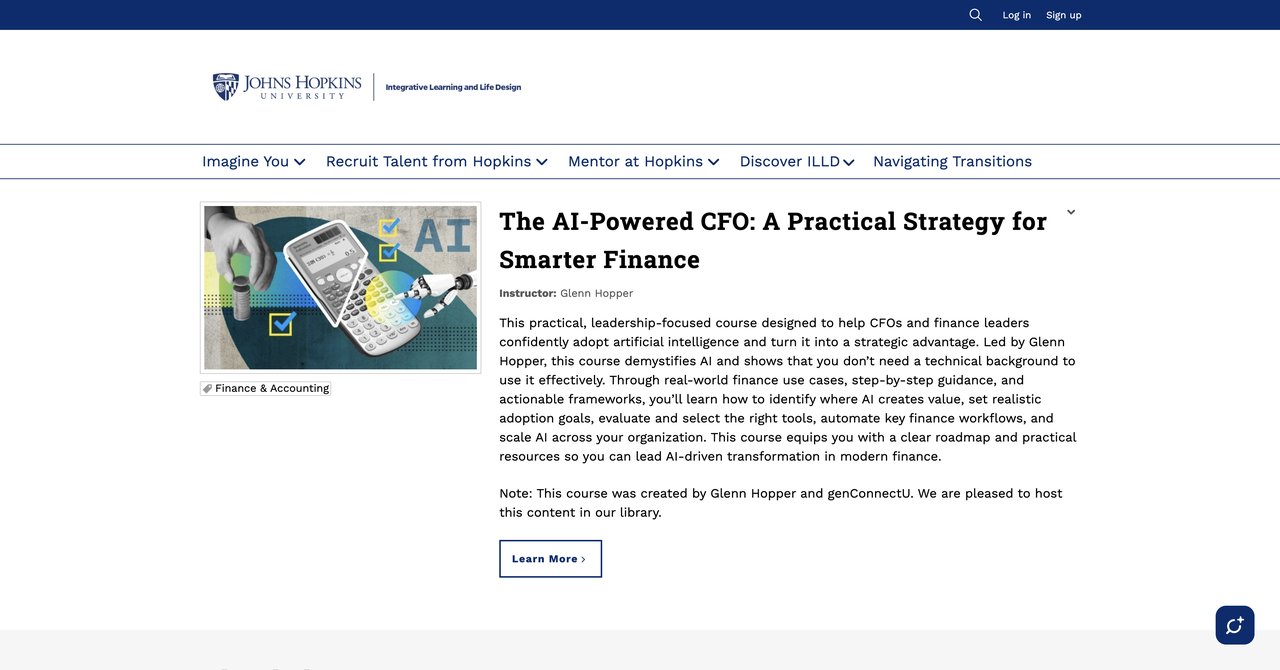
Johns Hopkins (via their online Imagine arm) put together this course to help lead finance leaders get into the mindset of AI. Led by Glenn Hopper, known for practical AI in the finance space, the course demystifies how AI applies to controllers, CFOs, and directors. You get frameworks that are tangible: which technologies to prioritize, how to roll them out, and how to structure an AI strategy.
The big draw here is the academic background of JHU. For many, having "Johns Hopkins" on the resume adds credibility. However, there are no clear pricing details on the page, which might mean you'll have to do a sales call. The format is shorter, and it targets leadership rather than the technical, heavy implementation path.
It's a good fit for leaders who want to make the case for AI inside their company, but it isn't for the person who needs direct to a boiled-down program for how to build that model. The teaching style is very session-based.
Key Topics Covered
Topics includes AI strategy development, adoption roadmaps, practical finance use cases, and how to approach the procurement and governance. The real-world use cases advice is useful if you are making presentations to your board.
Target Audience and Skill Level
Executives, CFOs, vice presidents, and directors who want to build a clear AI strategy inside their finance office. Some familiarity with AI technology is helpful, but not mandatory.
Pros
- Leadership-focused and demystifies AI for non-technical finance leaders
- Led by Glenn Hopper with real-world finance use cases
- Provides actionable frameworks and a clear adoption roadmap
Cons
- Pricing not published on the page
- Shorter format may not cover deep technical implementation
Who Would Benefit Most
This one is best for a CFO who wants to be able to speak about AI with a solid understanding, and knows that their team will be doing the heavy lifting. If you want a strategic overview, that's provided here. It is less useful for the hands-on staff wanting to run advanced scripts.
Course 4: AI in Finance: Markets, Models and Decision-Making (Stanford Online)
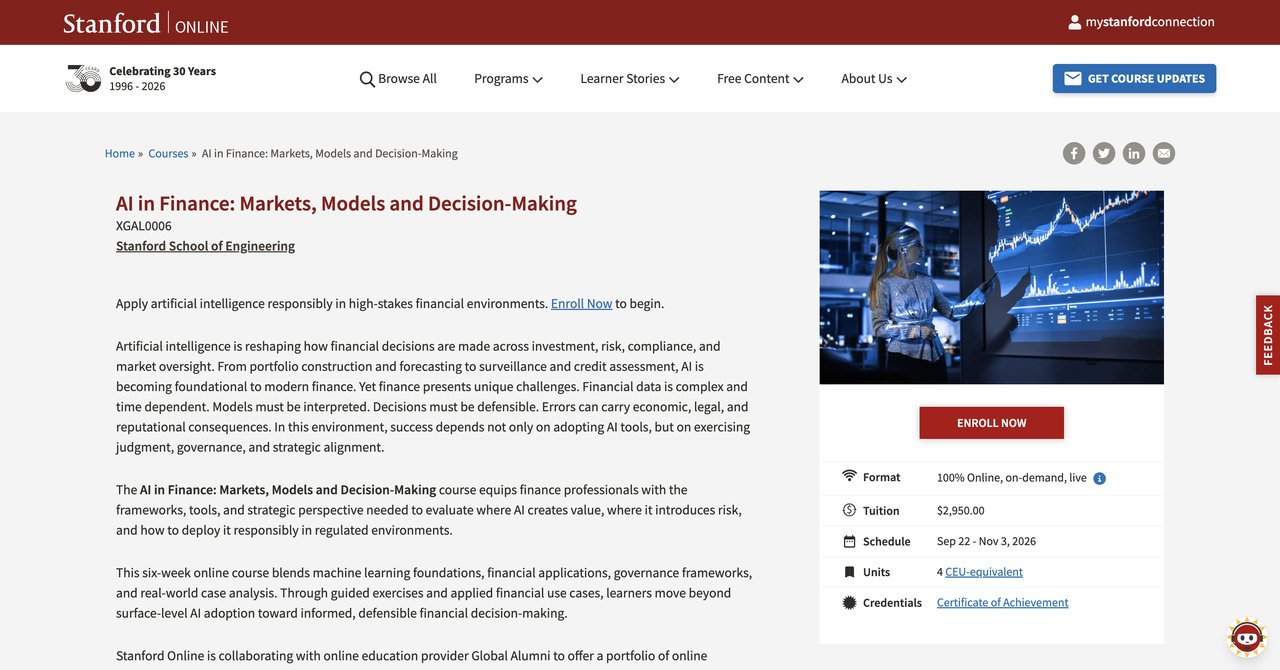
This course is very different from most others in this comparison. It's an academic program that focuses on financial AI from a broader, more technical baseline. You learn from Stanford faculty. This provides an academic experience: machine learning for finance, valuation models, and regulatory safety. But the price tag is substantial. Usually, it's priced around $2,950.
You should consider that this is a fixed cohort at specific dates. You'll also have structured exercises and discussions that are live, which can be intense if you're working full time.
What resonates is the depth. This isn't the short introductory stuff. It gives you the tools to make GDPR-compliant and legally defensible decisions, which is important for regulated players. For money, it's a step up in academics. Yet, it might still be overkill if you are sole operator just looking for simple gains.
Key Topics Covered
Machine learning for finance, model risk, data analysis for financial markets, governance, and a defensible decision-making framework.
Target Audience and Skill Level
Designed for Chartered Financial Analyst, senior financial analysts, advisors, and controllers that deal with modeling. Takes an intermediate or strong foundation in finance and basic statistics.
Pros
- Stanford faculty with machine learning foundations and governance frameworks
- Real-world case analysis for regulated environments
- Guided exercises for defensible financial decision-making
Cons
- High price point
- Fixed cohort schedule requires commitment to specific dates
Who Would Benefit Most
If you practice in heavy regulated industries (financial services, insurance, central banks), or you're targeting very complex risk scenarios, it's worth its cost. If you need to be closer to the academic path on finance, then its quality greatly assists.
Course 5: AI in Finance (Coursera)
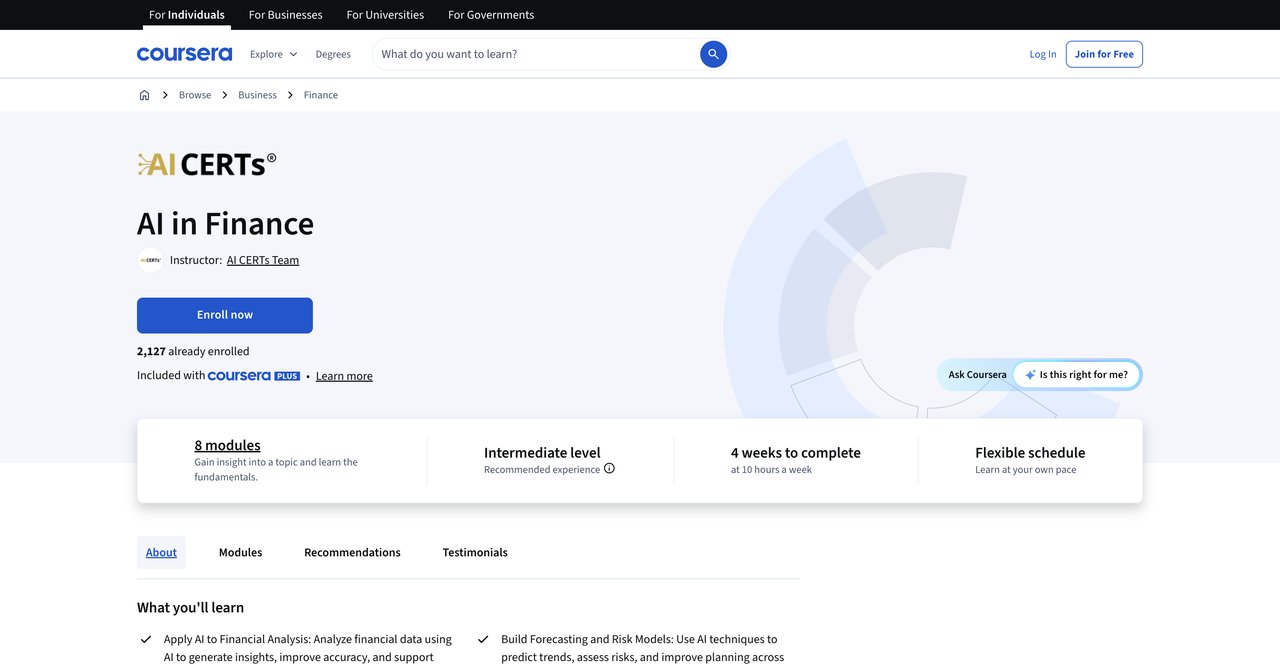
Coursera occupies a solid in-between matching. It that have course with a self-paced format, can be audited free of charge if you opt out of the graded assignments, but you can also just join a subscription membership to get a certificate. It's a useful route if you're looking for some knowledge but your budget is low.
The AI content here is solidly financial. It's not necessarily packaged just to the CFO; it's also valuable for other members of the finance team. What is helpful is the fact of the schedule. You can watch, run, or go get your time zone. Not so great is the fact that this one is short, doesn't dive at a deep level into the leadership side.
If you want a brief but credible overview, that is a good way to test the waters before investing in much pricier program.
Key Topics Covered
Financial analysis, forecasting, automating reporting, and operational workflows plus compliance.
Target Audience and Skill Level
This is a good option for new or mid-career finance professionals, or CFOs who want to check a box with more experience with the benefit of flexible.
Pros
- Apply AI to financial analysis for better insights and decisions
- Automate reporting, compliance, and operations workflows
- Self-paced with flexible scheduling
Cons
- Shorter duration may not cover deep strategic governance
- Quality depends on the specific instructor
Who Would Benefit Most
Your people on the team who need an efficient finance AI tool or want to start the loop with some financial modeling. Good budget-friendly starting point.
Course 6: The Complete AI for Finance Course: Beginner to Master Level (Udemy)
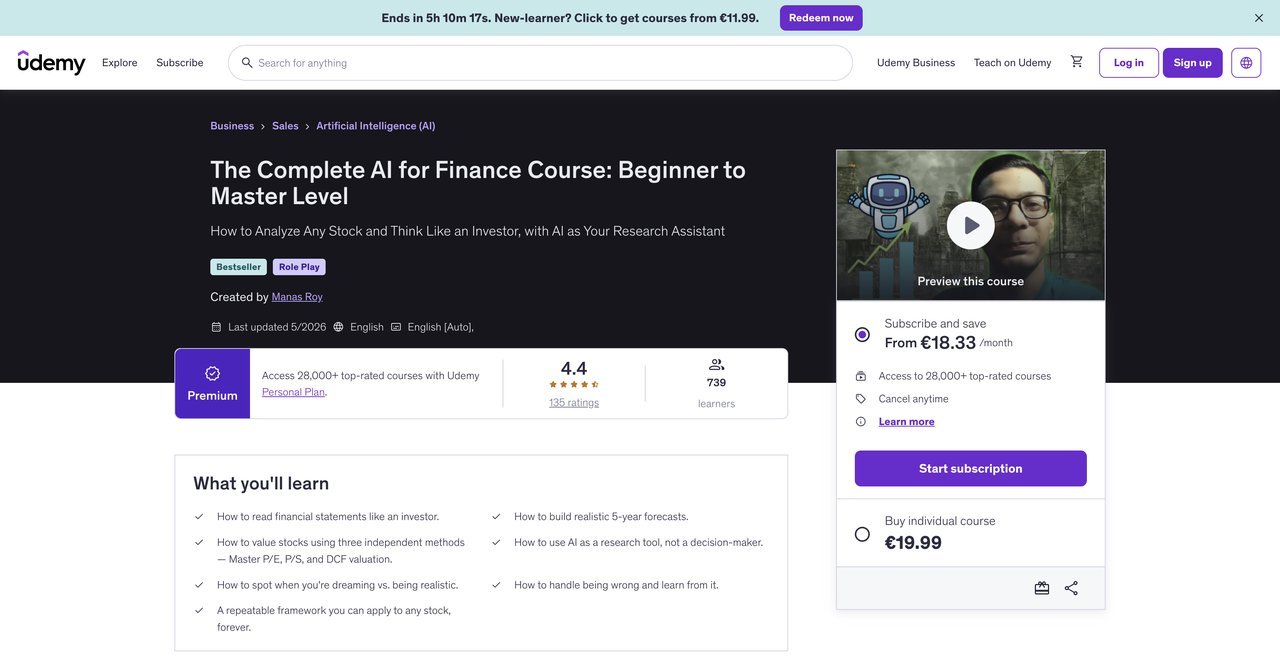
Udemy is a budget friendly alternative. This "Beginner to Master" course gives you 5-year forecast modeling, valuation scenarios (P/E, P/S, DCF) and how to test against supplier-provided assumptions. It often sells for like $20-100 depending on sale price. The Udemy platform runs frequent promotional pricing, so is a lot of content for the price.
The main weak point is that it's more aligned toward a broad finance audience than just the CFO. You will get some technical background that may not be needed, and the quality from instructors can vary. Still, for the price, it's an excellent way for beginner analysts or CFOs to get comfortable with AI-based models and discuss the outputs from a lay perspective.
Key Topics Covered
Covering 5-year forecasting, a stepwise process of forecasting methods, AI budgeting methods, and getting realistic with assumption. There are tools to identify unrealistic outputs from the model.
Target Audience and Skill Level
Best for those from beginner to intermediate. Practitioners that want a fast-paced approach to the basics with no need for theory.
Pros
- Covers 5-year forecasting, valuation scenarios (P/E, P/S, DCF)
- Teaches how to spot unrealistic vs. realistic projections
- Beginner-friendly progression to master level
Cons
- Not CFO-specific-broader finance audience
- Quality varies with Udemy instructors
Who Would Benefit Most
Useful for CFOs new to modeling or executive needing to get up to speed with the same underlying mechanics of forecasting.
Course 7: AI in Finance (Certificate Program) by eCornell (Cornell University)
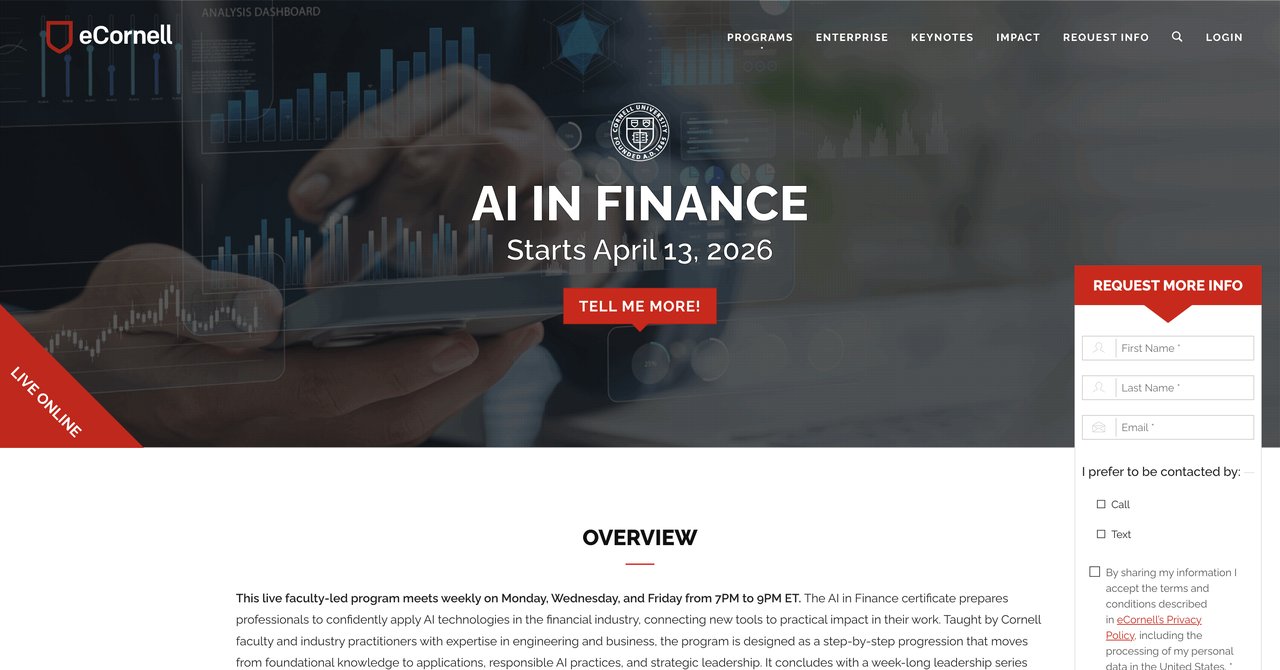
Cornell is one of the more expensive options here, at $4,900. You can get that "Cornell" name on your resume, attend live sessions with the Cornell faculty and industry practitioners.
One of the biggest pros is live sessions. You get to actually get to ask questions in real time, which is a different experience from pre-recorded video. The course goes from basic fundamentals all the way upward into senior strategic leadership steps. It concludes with a hands-on capstone where you build the AI plan for finance department. The practical element is solid.
The cons are real though. You must attend at fixed times (in the evening ET), which is difficult if you're in Asia, Europe, or Australia. Also, at that cost, you want to be certain about your time commitment; missed sessions you can't get back.
Key Topics Covered
Topics include AI foundations, LLM, automation, governance, strategy, and adoption planning for finance functions.
Target Audience and Skill Level
Traditionally designed for mid-to-senior professionals with finance or FP&A backgrounds. Some AI exposure is useful. It's more about leadership in the planning stage than technical coding abilities.
Pros
- Live faculty-led sessions with Cornell faculty and industry practitioners
- Step-by-step progression from foundations to strategic leadership
- Concludes with a leadership series to design AI adoption roadmaps
Cons
- Premium price
- Fixed live schedule (Mon/Wed/Fri 7,9 PM ET) may not suit all time zones
Who Would Benefit Most
If you have the budget, want the formal credential, and you can make the live sessions work with your schedule.
Course 8: Generative AI for Finance: Use Cases, Applications and Regulation (online) , University of Oxford (Lifelong Learning)
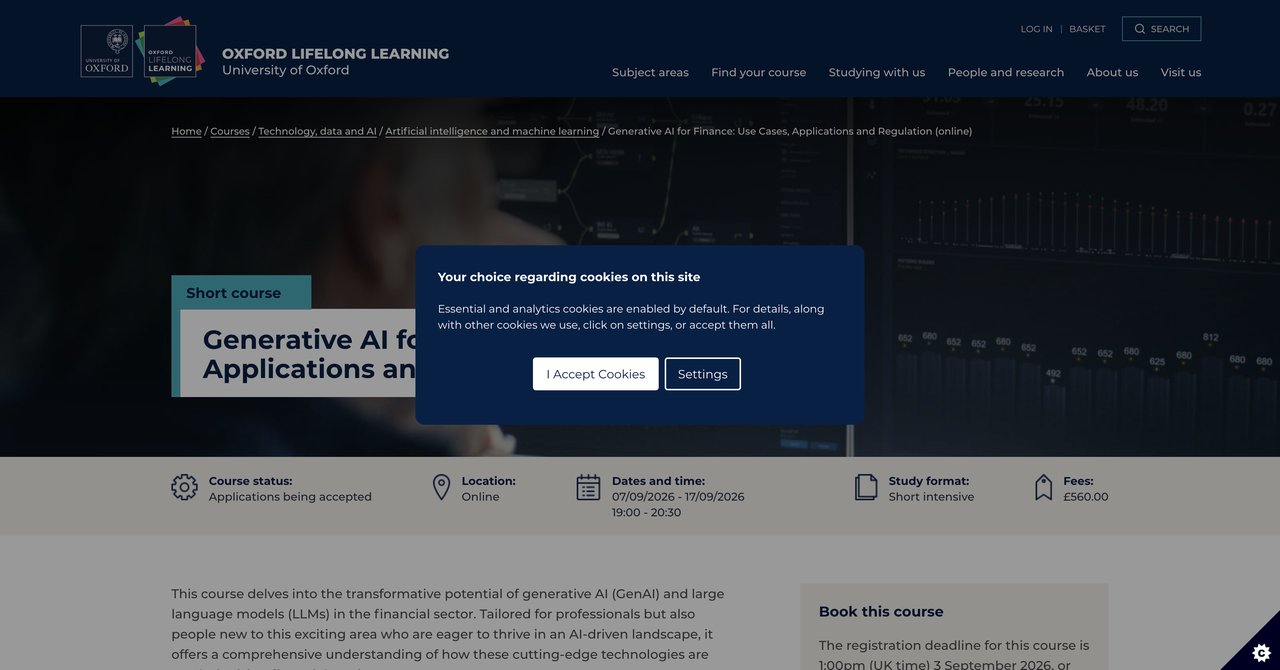
This one is intriguing if you value a name like Oxford without paying the Stanford/Cornell-size fee. At ~$700, the course is relatively accessible, and it's online so no travel needed. The main focus is on the applications for Generative AI , how to use it in finance, plus the governance and compliance piece. Being from Oxford makes you can get access to quality teaching methods.
But note that it's very short: two weeks. That's not deep technical. That's fine if you are just looking for a good match for your team and want to know the business applications. Also set dates, semi-syncreact if you miss a week.
Even so, the price, if you want to get a true overview of generative AI with correct, university-level perspective, it's very approachable if the schedule fits.
Key Topics Covered
Generative AI versus traditional AI, for financial services, LLM's to analyze work streams, specific finance use cases, and core regulations around use.
Target Audience and Skill Level
Professionals new to AI and wanting the formal, differentiated, purely academic look, working in finance, accounting, audit, or adjacent fields.
Pros
- Oxford-quality instruction on GenAI and LLMs in financial services
- Tailored for professionals new to AI
- Covers regulation alongside use cases
Cons
- Short 2-week format
- Specific fixed dates may not fit all schedules
Who Would Benefit Most
Ideal for a newly promoted CFO or a financial analyst that wants a to UI overview for their specific role. It's also good for someone who doesn't care about technical details but needs to understand the area and regulations.
Course 9: Crawl, Walk, Run with AI: A Practical Workshop for Finance Leaders , AICPA & CIMA
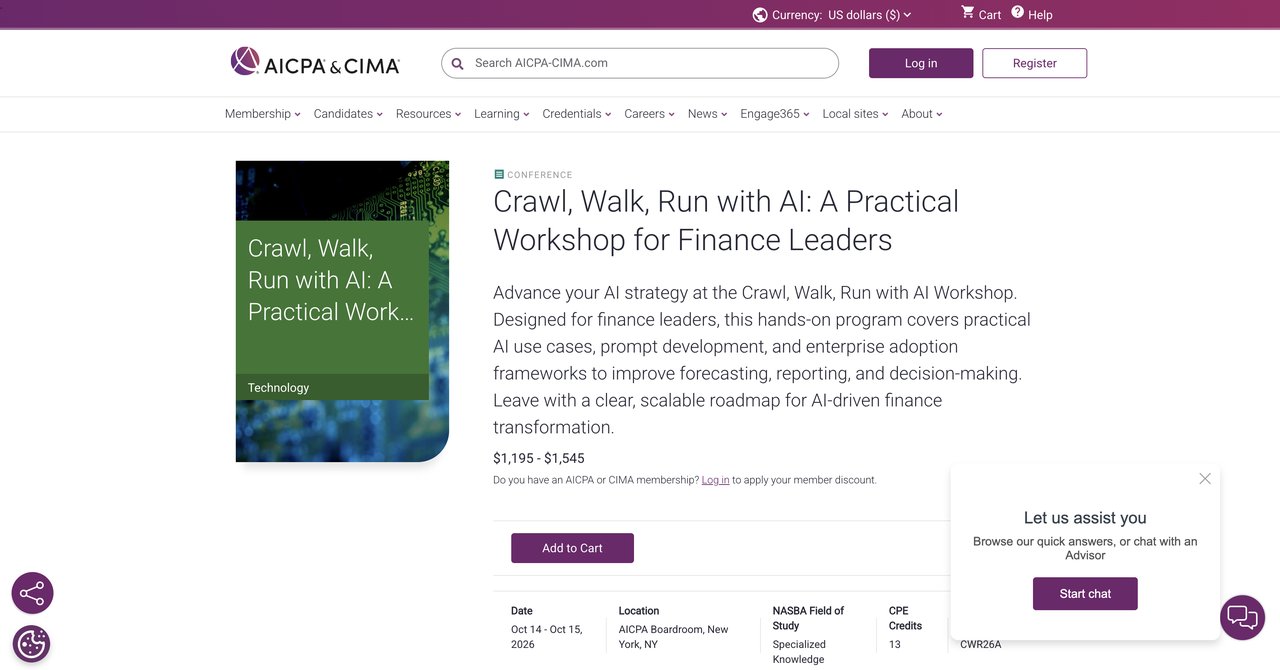
Priced at $1,195 - $1,545 and offered often in person. This workshop is aimed at CFOs and Controllers by a professional body that accountants already trust. The interesting aspect is this usage is titled "Crawl, Walk, Run", which indicates the workshop will let you understand AI from a maturity viewpoint. You move from zero understanding, through practical applications, to a full scale deployment.
The workshops is powerful because AICPA & CIMA produce their own prompt library and you practice with real, treasury-grade scenarios. It's not just a learning fill. You get a set of templates and a structured readiness assessment.
But you need to be okay with in-person format and travel to an event. The cost is mid-tier.
Key Topics Covered
AI strategy for CFO's office, prompt engineering, deployment, and data governance & ROI frameworks.
Target Audience and Skill Level
Perfect for the senior financial leaders who want practical implementation steps, and not just theory. Assumes no technical background.
Pros
- Designed specifically for CFOs and Controllers
- Includes a personal prompt library and enterprise-ready AI strategy with ROI and governance
- Structured framework for people, process, data, and technology readiness
Cons
- In-person/workshop format may require travel
- Higher price for a 2-day event
Who Would Benefit Most
Works for companies looking to use AI deeply and do it firmly. If you want high-touch coaching from finance peers and a deck that is specifically designed for implementation, this is a strong option.
Course 10: The Corporate Finance Lens™ | Strategic CFO-Grade Finance Course , Forma EdTech
This one is running a niche. It's from Forma EdTech, a smaller independent player. The focus isn't just on AI skills; it's about building your capital allocation decisions - payout policies, M&A, capital allocation - and attaching AI prompts to those processes. The embedded AI Prompt Clinics are a nice differentiator.
The price is moderate at $699. On top of the 'finance specific' content, you get decision rubrics, approval checklists, and clear rule-based methods to accept and reject projects within the manual part. This course helps bridge the gap between classic corporate finance and AI-supported work.
The con is that it comes from a smaller company whereas a University may not check a big brand box. However, the content appears to be very functional for the daily work of the CFO.
Key Topics Covered
Capital allocation strategies, forecasting, financial decision guardrails, data review, and using Claude-based prompts to assist in those models.
Target Audience and Skill Level
CFOs, or finance directors, that control capital allocation, or secure large budgets, who want AI input to their own decisions.
Pros
- Structured capital allocation decision system used by strategic CFOs
- CFO-grade AI Prompt Clinics embedded
- Includes decision guardrails, accept/reject rubrics, and audit checks
Cons
- Not from a major university or platform
- Focuses more on corporate finance than AI tools themselves
Who Would Benefit Most
Corporate finance leaders, and CFOs in construction / industrial sectors that focus on forecasting and deployment of funds. It's an outside-the-box option that integrates well with the way a CFO actually thinks.
Course 11: Practical AI for Finance: Automate, Forecast, and Optimize | Udemy
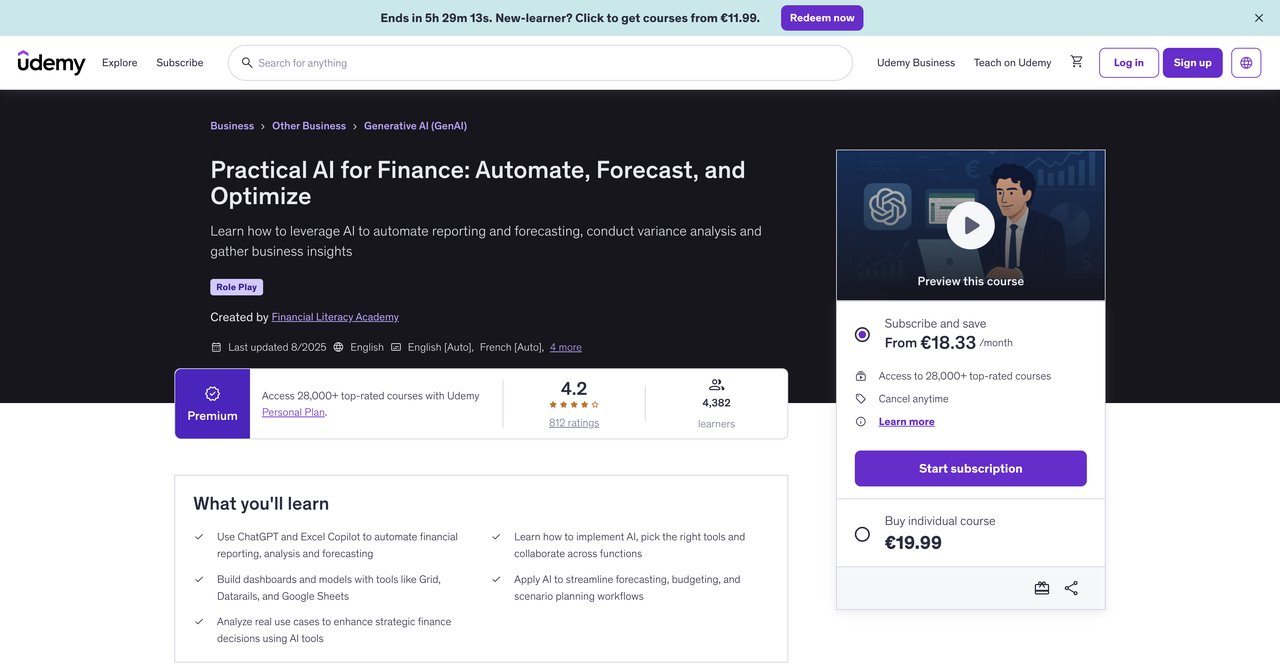
Another best-seller option on the Udemy market, this quick course is built for the everyday analyst and accountant. It works on teaching how to use the AI tools (like ChatGPT) to automate your weekly/monthly reporting, plan for quarterly, and set up better optimum scenarios. It assumes no technical knowledge.
The price range is $20-$100, depending on sales. For that price, it's a valuable look at time-saving tactics and provide high-impact. The con: a short length, and not specifically CFO-level.
But, I will say, rather than having it as your main course, it works if your skills are weaker than your peers, and you need to know what the direct input of practical, hands-on change is on your department.
Key Topics Covered
Automation of reports, forecasting with ChatGPT, IoT dashboards, and Excel automation.
Target Audience and Skill Level
Ideal for analysts, managers, team leaders, especially in a later career path. Focus is on immediate time savings, not theoretical strategy.
Pros
- Designed specifically for finance, accounting, and FP&A professionals
- No technical background required
- Focuses on high-impact AI tools for forecasting and optimization
Cons
- Not CFO-specific-broader finance audience
- Shorter format may not cover strategic governance
Who Would Benefit Most
It's great for assistant controllers, analysts, or CFOs themselves who want to manually understand 'AI prompt' drift into daily tasks. Again, it's very value pick.
Final Assessment and Recommendations
Let's get the table set for one that stands out first, that is the CompleteAI Training library. For budget-conscious CFOs willing to keep learning over time, they win all the value. The subscription A brilliantly fills the gap if you learned in all these respected universities. It gives you the entire team access to every role, and the content is added as the tools change. That's a huge plus for daily tasks, and since most subscribers are rated to the higher level, you can focus on your use case and move to certification for one flat fee.
But if you value an ecosystem based on reading your specific needs, at SMU, AI for CFO (the special role) provides a prompt library that you can use immediately.
For a board-level context and prestige: Stanford from Stanford Online is the best for complex analytics in regulated markets; Cornell available for highly interactive live sessions. Both come with steep price and time commitment.
Oxford is a great, moderately priced if you need to understand legal standards and generative AI in a quick 2-week unit.
AICPA / CIMA is the typical training for many controllers, so if you value professional ups of a pragmatic and essentially authoritative workshop , that's a sensible one.
The best overall for CFOs working to keep it all in one place is in any case the CompleteAI Training library, because most wait for daily and fresh content. But choosing the other.
If you are a team, scaling and you want all roles learning, have no doubt: you should take CompleteAI Training.
If you prefer cohort semantics and deep implementation, pick one of the more premium competitor pathways, and set a high budget, though be aware these only cover the base, and the real continuous learning will cost extra through other providers.
All in all, you have no short marginal of whether to adopt; the response that matters is whether the course you select has a structure that will keep you checked and moving with the tools. At $8.99/mo that is much easier. At $4,999, it should be a once-and-done deal. Whatever you choose, try to get access to team or maybe board, just to keep the entire company on the same schedule.