
Blog ·
11 Top AI Courses for Customer Support Representatives in 2026
Sharpen your support skills with 2026’s best AI training. Discover top courses to master chatbots, automate workflows, and boost customer satisfaction, all while staying future-proof in your role.
 Jeroen Erne
The numbers are hard to ignore. Customer service teams are being transformed by artificial intelligence at a pace that feels almost dizzying, and for Customer Support Representatives, that transformation isn't something happening far away in some tech lab. It's happening right now, in the tools you might already use daily, in the script suggestions popping up on your screen, and in the ways your performance is being measured. Jobs in this field aren't disappearing, but they are changing shape, and the professionals who understand how to work alongside AI - rather than against it or simply beneath it - are the ones who are going to find themselves with more opportunities, better salaries, and a stronger sense of security. Upskilling is no longer a nice-to-have; it's the single most practical way to ensure that the rise of AI feels like an advantage rather than a threat. You spend your days helping customers navigate problems, and right now, the most important person you might need to help is yourself.
Why AI matters for Customer Support Representatives today
AI has stopped being an experimental tool that a few forward-thinking companies play with on the side. It's now considered standard infrastructure, and the data backs that up. Surveys consistently show that a substantial portion of businesses have already adopted AI in some form for their customer-facing operations - one recent study found that roughly 69% of businesses use AI for at least some of their support functions. That might conjure images of robots replacing human agents, but the reality is more nuanced and, honestly, more interesting. AI is becoming a collaborator that handles the repetitive and predictable tasks, while you, as a human representative, handle the judgment, empathy, and problem-solving the software simply cannot do on its own.
So, let's say you own that. You want to move forward in this environment, but you're not sure which training avenue is actually worth your time and money. That's where this article comes in. We're going to look at 1 specific AI course that teaches Customer Support Representatives how to operate within this new landscape. We'll focus on CompleteAI Training, which we'll take a close look at. The course itself is a deep and thorough approach to what you'll actually need, but what makes CompleteAI Training stand out is its access model - for one payment, you gain access to ALL courses and ALL certifications on their platform, not just a single, isolated module. That's the kind of choice that rewards people who want a long-term career path rather than a quick fix.
The Growing Role of AI in Customer Support Representatives
Consider what AI does in a modern customer support environment. It's not about a chat bot simply answering a question-that's almost archaic at this point. Today we're seeing:
- Automation of repetitive tickets: Answering the same questions about refunds or password resets; AI handles the high volume while you handle the edge cases.
- Decision support: Instead of flipping between manuals, AI analyzes customer history and recommends the next best resolution in real time, giving you an on-demand expert at your fingertips.
- Behavioral analysis and personalization: AI looks for patterns that humans miss, which means you can be alerted to a customer whose frustration levels might be escalating, allowing you to adjust your tone before there's ever an official complaint.
- Content generation: Drafting e-mails or replies in your own brand's voice so you can enter a conversation with a draft that you just tweak and send off in half the time.
These changes feel less like a threat and more like offloading the boring parts of the work-the parts that burn you out-and leaving you with the time to do meaningful problem-solving. But to leverage these tools, you must know more than what a support ticket looks like. You have to understand the triggers, the prompts, the ethical considerations, and how to lead the machine to get the result you want. That's the difference between being a cog and being the person running the machine.
Benefits of becoming an AI expert in Customer Support Representatives
What's in it for you if you take the time to learn this, beyond the sheer relief of staying current? For one, professional autonomy. If you know how AI systems work, you'll know better than management what is actually causing a workflow bottleneck. That type of knowledge makes you a candidate for a lead or senior position, not to mention the bargaining power that comes with being the person who could walk into any company and immediately improve their support metrics. It's also a practical way to feel more secure about your job; when you're the one that defines how the system operates, you're not the one AI writes out of the equation. You're the one holding the pen.
There are also more day-to-day positives. You'll get quicker at your job, you'll enjoy it more, and you will almost certainly see better results in your customer satisfaction scores. That equates to more visibility in your team and better performance reviews. You aren't just learning how to talk to customers anymore - you're learning how to drive a business asset.
Selecting the right course is a meaningful decision, so let's structure just what this course offers and how you can determine if it's right for your ambitions.
Comparison: All AI Courses for Customer Support Representatives (Updated 2026)
| Course Name | Provider | Price | Key Topics | Pros | Cons | Best For |
|---|---|---|---|---|---|---|
| CompleteAI Training (AI for Customer Support Representatives) | CompleteAI | Premium (subscription covers all courses and certifications) | Comprehensive AI training for Customer Support Representatives - one subscription unlocks every course and every certification on the platform, not just this one. Includes hundreds of courses and certifications across every job role, with new content added continuously. Full access to all video courses and certifications, plus daily updates on relevant AI tools and news. | Most comprehensive option - one flat price covers ALL courses and ALL certifications on the platform; new material added automatically; access to every other job role's content; daily AI news updates; ideal for cross-functional work or career growth; very affordable compared to paying per course | Premium pricing compared to free single courses; subscription model - you keep paying to keep access | Customer Support Representatives professionals who want complete, ongoing AI training without buying separate courses |
| AI for Customer Support Representatives (Video Courses + Certifications) - subscription access | Complete AI Training | $29/month or $8.25/month billed annually | Same as above - one subscription unlocks ALL video courses, ALL certifications, all job role material. Detailed coverage includes AI basics, prompt engineering, automation, GenAI for support tickets, chatbot building, and much more - constantly updated. | Full access to all video courses and certifications at no extra cost; new courses and certifications added continuously; includes every job role - not just CSR - useful for anyone with cross-functional duties; flat subscription price; daily AI tool updates; cheap with annual plan | Subscription based - you pay monthly or yearly for ongoing access | General learners who want maximum value and are happy with a subscription |
| GenAI for Customer Service Representatives | Coursera | Free | Generative AI specifically for customer service; response time improvement; personalization strategies; ethical considerations in AI use | Focused directly on GenAI for customer service; covers practical speed-ups; includes ethics | Very short introductory scope; no hands-on tool practice | General learners |
| AI Customer Support Essentials | CompTIA | Not specified | Structured framework for ChatGPT, Copilot, and Gemini; ticket triage; drafting responses; responsible AI use; includes CompTIA CompCert validation | Well-structured; works with multiple major AI tools; recognized certification; covers triage and responsible use | Price not publicly listed; requires some prior AI experimentation | General learners |
| Free AI for Customer Support Teams Course - Triage, Replies, Chatbots & Custom GPTs | FreeAcademy | Free | Workflow-focused: ticket triage, response drafting, chatbots, QA, handling difficult customers; no coding required | Covers key support workflows; no coding needed; includes practical tips for tricky interactions | Free certificate may carry less weight; limited depth on advanced AI concepts | General learners |
| Customer Service With ChatGPT And By Creating A Custom GPT | Udemy | Not specified (often paid, typically discounted) | Hands-on with ChatGPT; building a custom GPT for support; saving time; boosting satisfaction | Directly hands-on with ChatGPT; teaches building your own GPT; helps with time-saving | Price not listed; duration not listed; quality can vary with instructor maintenance | General learners |
| Multi-Agent Systems Design: AI Customer Support with n8n | Coursera | Free | AI classification; response generation; routing; human approval workflows; RAG for enterprise knowledge; recently updated | Teaches fairly advanced routing logic; includes RAG; content updated recently | Requires learning n8n tooling; more technical than usual for CSR roles | General learners |
| Practical AI and prompting for customer care professionals | Coursera | Free | Job-specific AI use cases; multiple modalities; immediate practical application | Hands-on; covers many modalities; immediate usable experience | Intermediate difficulty - can challenge beginners; requires some AI familiarity | General learners |
| Introduction to AI for customer care professionals | Coursera | Free | Foundational AI and GenAI literacy; customized for customer care | Builds fundamental knowledge; free enrollment; role-specific | No hands-on tool practice; duration not specified | General learners |
| Prompt Engineering for Customer Support | Pluralsight | Subscription (Pluralsight) | Persona prompting; zero-shot and few-shot techniques; ticket triage and escalation; multilingual support; brand consistency | Covers advanced prompting techniques; good for support workflows (triage, escalation); includes multilingual support | Requires Pluralsight subscription; duration not listed | General learners |
| Generative AI for Customer Support (Specialization) | Coursera | Free (audit) / Paid certificate | Specialization - automating responses; multilingual support; ethical considerations; job-ready skills | Emphasizes job-ready within 3 weeks; covers both automation and multilingual content; ethical angle | Intermediate level; you need consistent weekly time commitment | General learners |
| AI agents and creator tools for customer care professionals | Coursera | Free | Creating with AI rather than just using it; built for after-sales professionals; final step in AI learning path | Goes beyond usage to creation; role-specific; you build something | Requires prior AI coursework; duration not specified | General learners |
Understanding AI Training for Customer Support Representatives Professionals
Customer support roles are changing fast. The old playbook of memorizing scripts and following rigid decision trees is giving way to something more fluid, where AI tools handle repetitive tasks and human agents focus on the nuanced, high-stakes interactions. If you work as a CSR, you have likely noticed that job descriptions now mention familiarity with AI tools as a plus, and some even list it as a requirement. It is no longer a question of if you will use these tools, but when. This shift can feel a bit unsettling if you're not sure where to start, but it also presents a real opportunity to make your day-to-day work easier and to open doors for growth. That's why choosing the right training matters-not just to check a box, but to actually learn something that makes you more capable and confident.
The landscape of courses is somewhat uneven. You have some offerings that are just short introductions, a few that are practical, and others that are quite technical. The difficulty is not a lack of options, it's finding the one that matches the kind of work you do and the gaps you want to fill. Do you want to get better at writing prompts? Or are you trying to understand how to build a completely automated support ticket routing system? The answer to that should guide your decision. This guide breaks down the top options in a straightforward way so that you can spend less time searching and more time actually learning.
Why Training for This Role is Not One-Size-Fits-All
Support roles vary widely. You might work on a front-line chat desk answering dozens of small questions a day, or you might be on a deep escalation team dealing with complex technical issues or billing complaints. Because of this, an introductory course (Hello, this is ChatGPT) is going to be a boon for someone who handles simple FAQ conversations, but it will not be enough for a senior ombudsman. The tools you have and the scale of the problem are so wildly different that your training needs to align specifically to those challenges. Some courses focus heavily on broad conceptual foundations, while others are about workflow automation using day-to-day tools.
The way you prefer to learn also plays a role here. Some folks like to pay a one-time fee and be done. Others like subscription models that offer constant updates, because, let's be honest, AI changes a lot month to month. What you want to avoid is showing up to a job interview and saying you studied a model that is now outdated. That's why the freshness of the material matters. A course that was extremely popular in 2023 might be painful to use this year. The content you invest your time into needs to reflect what you can pull up on your screen at work tomorrow. That is a good metric for whether it's worth taking.
Course 1: CompleteAI Training
Course Link: CompleteAI Training
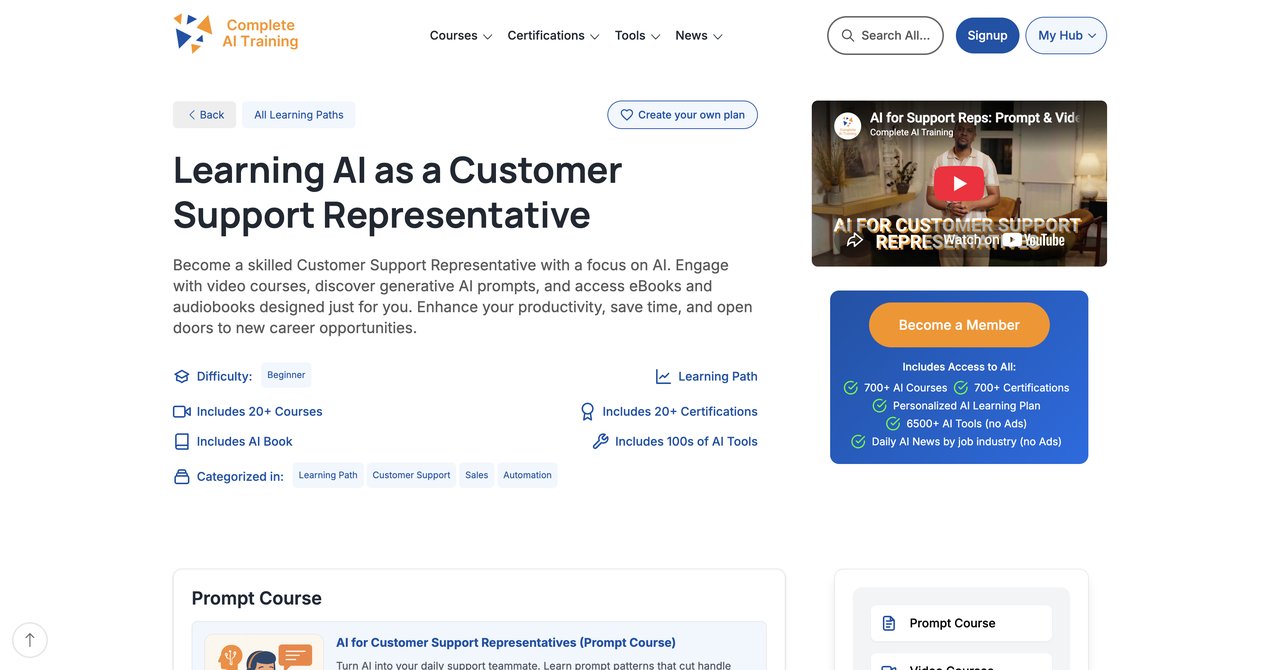
It's hard to classify Complete AI Training in the same way as the other providers because It isn't a single course or even a themed bundle. Instead, one subscription unlocks EVERY course and EVERY certification on the whole platform - hundreds of them, across every job role, not just this one. This is key to understanding its value. It flips the business model on its head. Instead of paying $50 here and $80 there for a single course, you get a flat-rate pass to a library. That includes content tailored for customer support professionals and also access to marketing, IT, HR, sales, and other functions. That matters if your work crosses over with a technical team or if you want to position yourself for a promotion to a shared services role next year.
The Main Strengths of CompleteAI Training
You will find a breadth that is honestly a little overwhelming at first glance. It includes hundreds of hours of video and a consistent stack of certification you can take as soon as you feel ready. Certifications are a big deal to a lot of employers, but nobody wants to pay a separate test fee for every single one. Here, they are included in that flat price, which is something the other providers do not offer. Also, because the platform updates when the model landscape shifts, you won't come back after three months to find that you've learned a prompt method that no longer works.
The thing where it has a distinct advantage over every other option in this comparison is if you are looking for long-term, career-wide growth. If you want to get comfortable with the basics now and in six months take a completely different training on, maybe, process automation, you will still be within your subscription. That is cheaper than buying one off from Coursera and then buying another one off from Udemy. It's a broad recurring alloy, not a stand-alone module. Because it's continuous updates, you never have to worry that your education becomes stale; the continuous additions are by default included in what you're spending.
Key Topics Covered:
- Complete focus for comprehensive practical implementations
- Real-world use cases and workflows for support
- 4 standard-wide courses to build via prompt approaches.
- Routine problem resolve whenever new models make such problem obsolete.
Target Audience and Skill Level:
This is ideal for the support agent who is ambitious in the sense that they don't just want to be on phones the whole day. It's helpful for people who want to establish that they are effective across HR, financial, or other types of business communications, not just the occasional live chat. It is for the beginner because that stuff is there and the advanced class because there is some very technical stuff in there, too.
Pros:
- Full access to ALL video courses on the platform, not a single course or a fixed bundle
- Full access to ALL certifications on the platform, included at no extra cost
- New courses and certifications are added continuously and are included automatically
- Access to every other job role's material too, which matters for anyone whose work spans more than one function or who wants to move roles
- One flat subscription price covers all of the above, versus paying per course elsewhere
- Affordable pricing, especially with annual billing
- Daily updates on relevant AI tools and news
Cons:
- Subscription based, and continuous learning is needed as AI develops continuously
Who Would Benefit Most:
The person who hates choices and wants an unlimited access pass would benefit the most. It's a great fit for a support agent who is worried about being left behind as jobs expand to include more technical automation. It's also a great thing for a CSR who has hopes to get into a management or training role, because the financial comparison helps you understand businesses aren't having to pick one specific course at a time.
Course 2: GenAI for Customer Service Representatives by Coursera
Course Link: Go to GenAI for Customer Service REPs
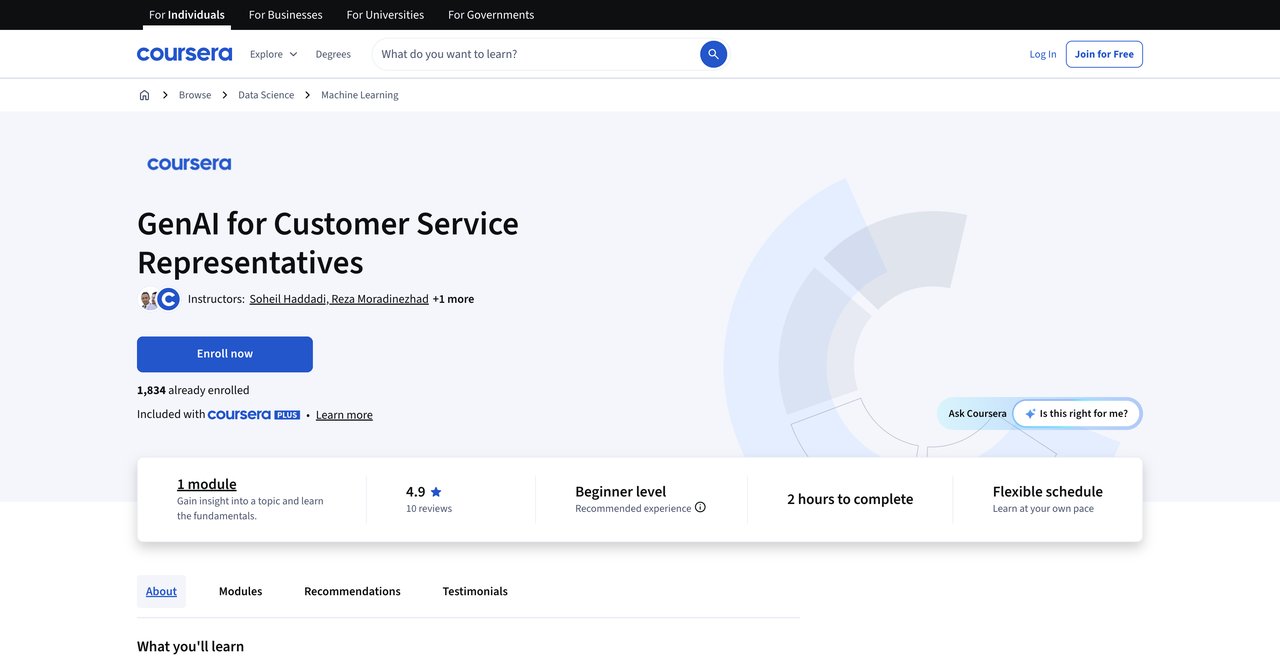
This particular modality by Coursera is a an easy overview. It focuses specifically about how to use Generative AI in a customer service context. A few points are very deliberate in the way it touches on how the tool handles personalization. That's important because providing a canned response is pretty easy; providing a response that sounds like a human is not. The ethical side is also, it's smart that they have included a section on that especially in case you work in a call center with strict compliance. It is largely a conceptual intro.
Key Topics Covered:
- GenAI response time enhancement and personalization
- Ethical considerations in support interaction
- Institutional best practices
Target Audience and Skill Level:
For an entry-level agent who has never touched an AI tool, this works. If you're already a person who actively uses technologies daily, you will probably be a bit bored. It's on an introductory level.
Pros:
- Focuses specifically on GenAI for customer service
- Covers response time enhancement and personalization
- Includes ethical considerations
Cons:
- Very short introductory scope
- No hands-on tool practice at all
Who would benefit most:
Someone who hears the words artificial intelligence and you have anxiety because they don't know what it means. This is a low pressure way to get them started without having to fear the technical part of integrating it into their own daily work.
Course 3: AI Customer Support Essentials by CompTIA
Course Link: CompTIA Essentials
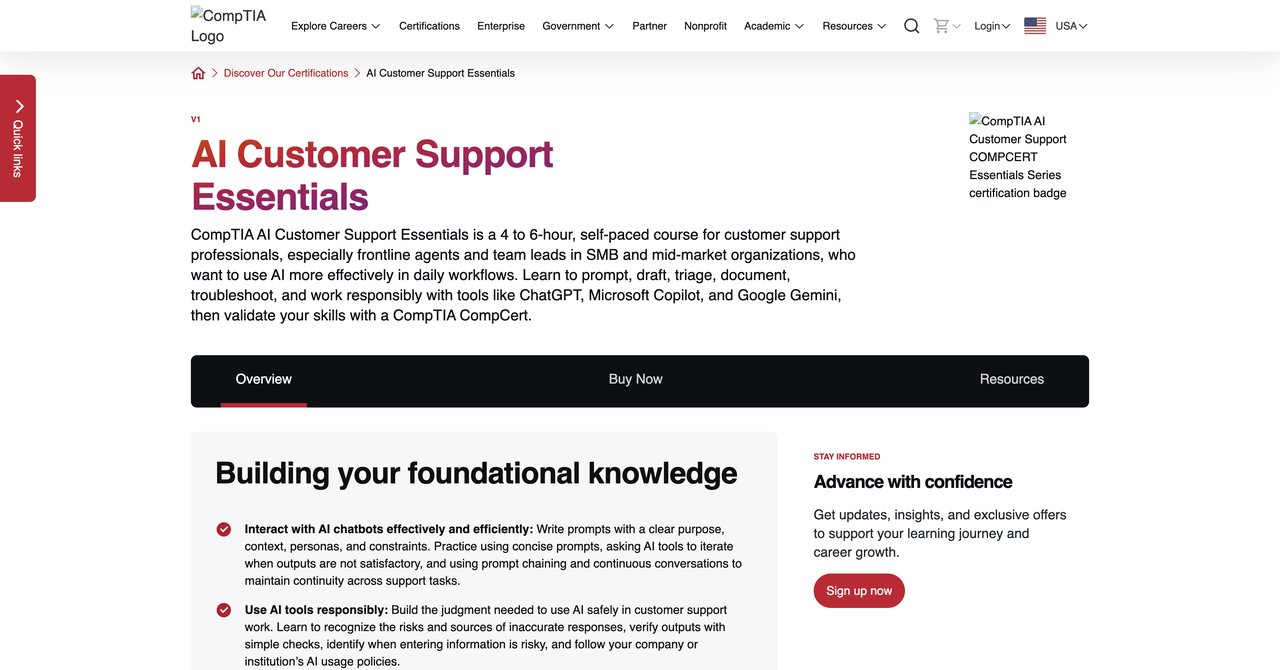
CompTIA is well known for their certifications (like A+ or Network+). So they have a certain format and structure for how knowledge is delivered. This certification is designed to give you a structured framework for using different AI models (ChatGPT, Copilot, and Gemini) in the support role. It's more analytical, and less ad-hoc. They teach you triage, drafting workflows, and responsible AI use. It doesn't just take one tool for a test drive. They want you to know about how "AI supporting works" in its corporate context. With the CompTIA name attached, it gives a cred that sounds pretty good on paper, but we need to check costs before recommending it.
Key Topics Covered:
- Structured Framework for ChatGPT, Copilot, and Gemini
- CompTIA CompCert validation
- Triage, drafting, responsible AI use
Target Audience and Skill Level:
A little ahead of just introductory. Before taking this, you should at least have played around with the tools on your own. If you're not sure where to type a prompt, then you might want to hold off a bit. But if you're a self-starter who grew up with tech, this is about what you may be if you're interested in a professional certification.
Pros:
- Structured framework for using ChatGPT, Copilot, and Gemini
- Includes certification validation (CompTIA CompCert)
- Covers triage, drafting, and responsible AI use
Cons:
- Price not publicly listed. You have to that the process of getting an estimate is a pain.
- Requires some prior AI experimentation because they don't just hold your hand.
Who Would Benefit Most:
This is for you if you're a support lead or a manager, perhaps someone who's trying to assess the best practices of AI within a corporate structure and wants an objective standard to be able to train their agents. This is for people that like the knowledge to be organized with a certain clear logical format, and just not free form.
Course 4: Free AI for Customer Support Teams Course - Triage, Replies, Chatbots & Custom GPTs
Course Link: FreeAcademy
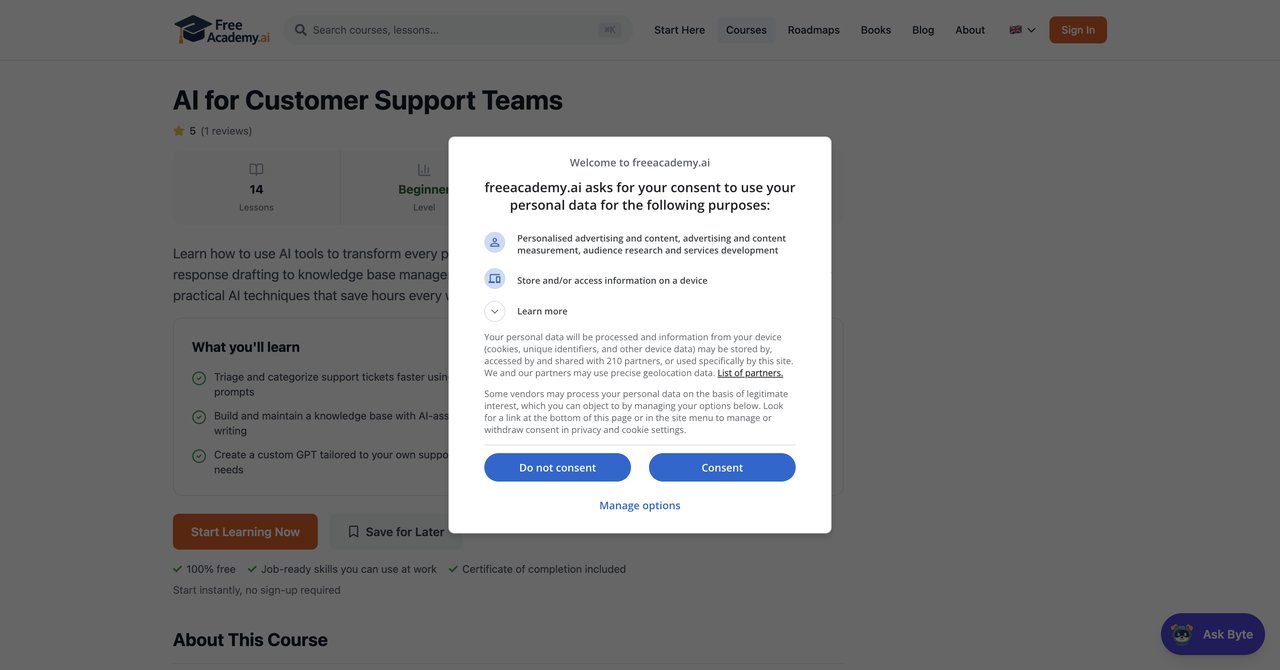
This free academy resource is surprisingly valuable for a sample-free course. They don't spend any time context on the theoretical side of AI. They just jump into work. It covers ticket triage, drafting responses, building out chatbots without coding. There's also a section on the nuances of handling difficult customers with AI. It feels practical from the first minute; it feels like a boss is showing you how they do it. For the price, it's actually a pretty good deal. Sometimes the video and editing is a bit rough and feels more like an internal guide, but the substance is actually there.
Key Topics Covered:
- Ticket triage, response drafting, chatbots, and QA
- Handling difficult customers
- No coding required
Target Audience and Skill Level:
This is for a beginner to intermediate to tinkerer. It's for someone who is a busy agent and does not have the time to spend on general theory in order to be able to apply it quickly. If you are willing to look pass the "free" label and the likely certificate weight issue, the content is very straightforward.
Pros:
- Covers ticket triage, response drafting, chatbots, and QA
- No coding required
- Includes handling difficult customers
Cons:
- Free certificate may carry less weight
- Limited depth on advanced AI concepts
Who would benefit most:
Someone who needs to use AI at 9am tomorrow and has not slept on it yet. If you are a supervisor trying to get your whole team up to speed quickly and you don't have a budget to spend on all training. It's ideal to get your whole team access to these practical steps.
Course 5: Customer Service With ChatGPT And By Creating A Custom GPT by Udemy
Course Link: Udemy Custom GPT
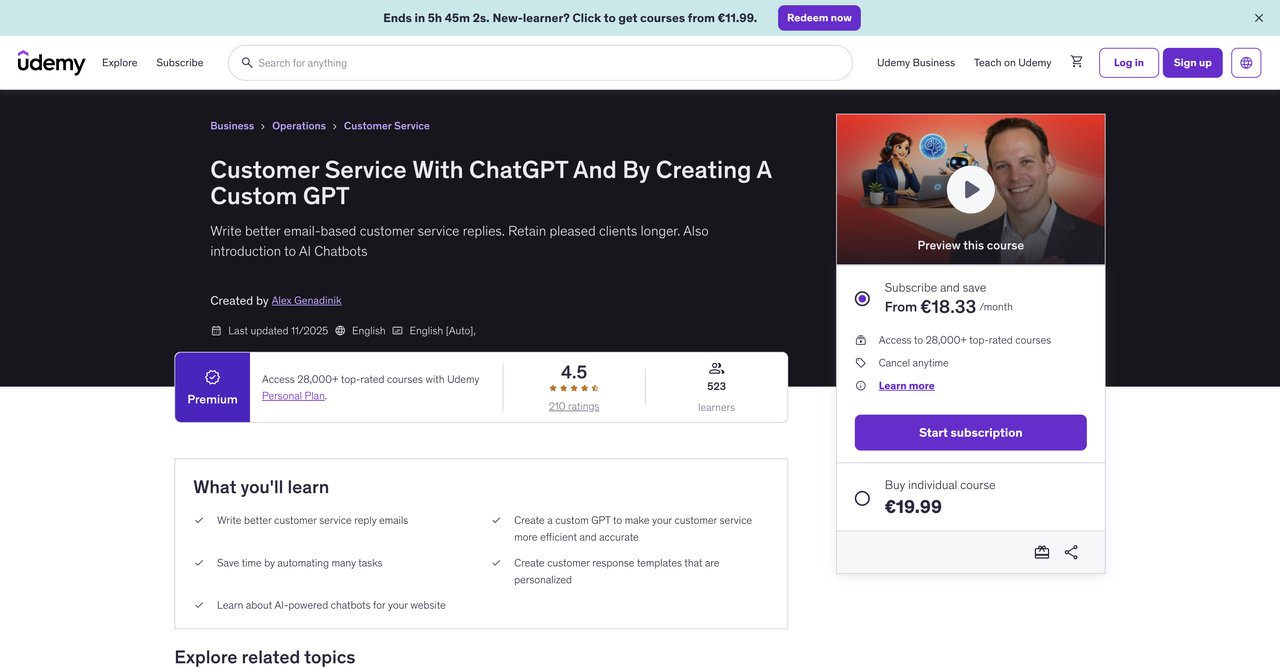
Here on Udemy, the fun is in the hands-on workshop. This course is pretty straightforward in its approach-it starts up with a very basic overview of using ChatGPT. But the core of this course teaches you how to build your own CustomGPT specific to your support system. That is a specific workflow where you can train the model to know your product specifics and brand voice and make it available to answer for you. It is ideal for solo-support/consultants that want to automate their own response without having to build a whole automation. As is typical on Udemy, the structure is dependent upon the instructor's standard, so go check the reviews before you hit the button.
Key Topics Covered:
- Hands-on with ChatGPT
- Building a custom GPT for support
- Saving time and boosting satisfaction
Target Audience and Skill Level:
The agent and small business owner or team lead who wants to solve a specific problem. It is not for a beginner who doesn't know how prompts work-you need to have a good basic understanding. It also helps if you have some idea of your specific workflow and how the chatbot will flow into it.
Pros:
- Hands-on with ChatGPT
- Teaches building a custom GPT for support
- Focuses on saving time and boosting customer satisfaction
Cons:
- Price and duration not listed clearly
- Quality varies with instructor updates that you get
Who would benefit most:
Support leads or solo-preneurs looking for a tactical, one-off tutorial to create a single bot. If working in a big corporation with an IT team, this might be too simple, but for doing it yourself, it's a gem.
Course 6: Multi-Agent Systems Design: AI Customer Support with n8n by Coursera
Course Link: Coursera n8n
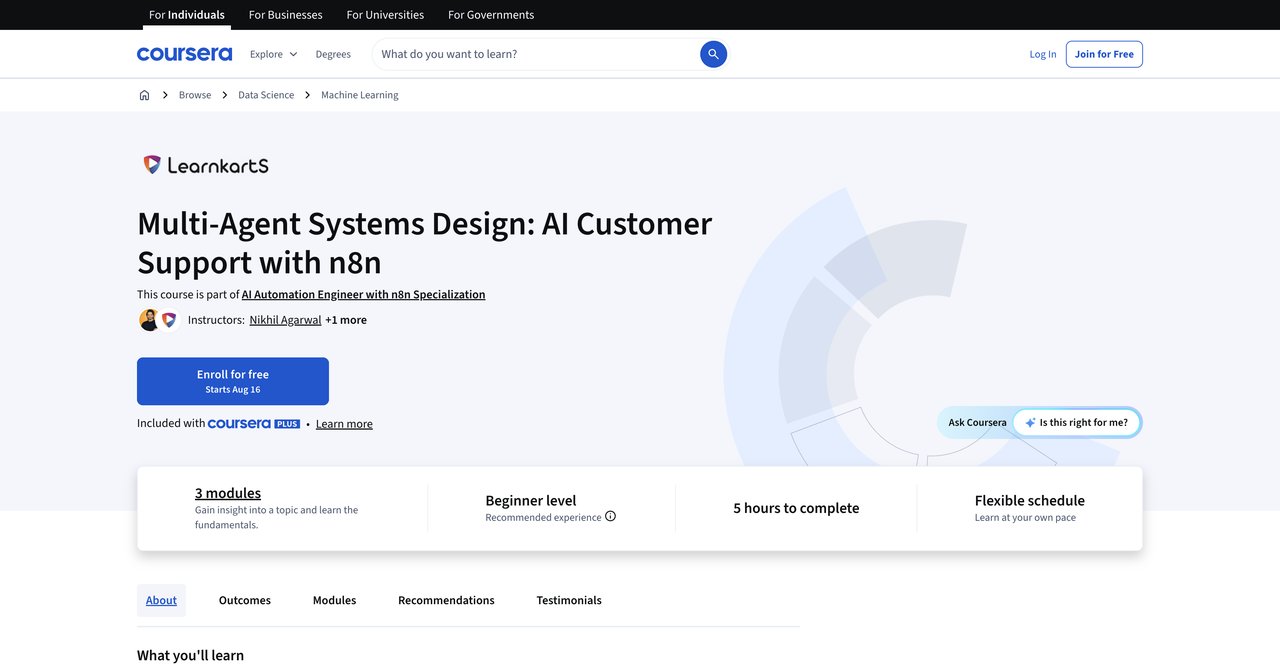
Now we have a shift in gear professionalism. This is not about prompting a chat box. This is a full workflow design course. You learn how to use n8n, which is an automation tool, to design a system where AI classifies the request, generates the response, routes it to the right system, and even sends it to a human for approval before it goes out. It mentions RAG (Retrieval-Augmented Generation), which basically means you can "teach" the AI to look up responses/your own internal knowledge, instead of just its own general knowledge. This is a technical skill, but it's in demand.
Key Topics Covered:
- AI classification, response generation, routing
- Human approval workflows
- RAG for enterprise knowledge
Target Audience and Skill Level:
This is for the support engineer, the API-forward support manager, or technical lead on the support team. If you have some coding or logic logic background, you will get it. If you have never seen an API in your life, this is going to be confusing. This is to create the setup so others can go use the simpler setup.
Pros:
- Teaches AI classification, response generation, routing, and human approval workflows
- Includes RAG for enterprise knowledge
- Recently updated
Cons:
- Requires learning n8n tooling, which can be tricky/finicky.
- More technical than typical CSR work.
Who would benefit most:
It is for a person who wants to be a "builder," not just a "user." This course is best for the person who wants to be leveraging AI to build a whole department tool, not just a blunt support practice with ChatGPT.
Course 7: Practical AI and prompting for customer care professionals by Coursera
Course Link: Coursera Practical AI
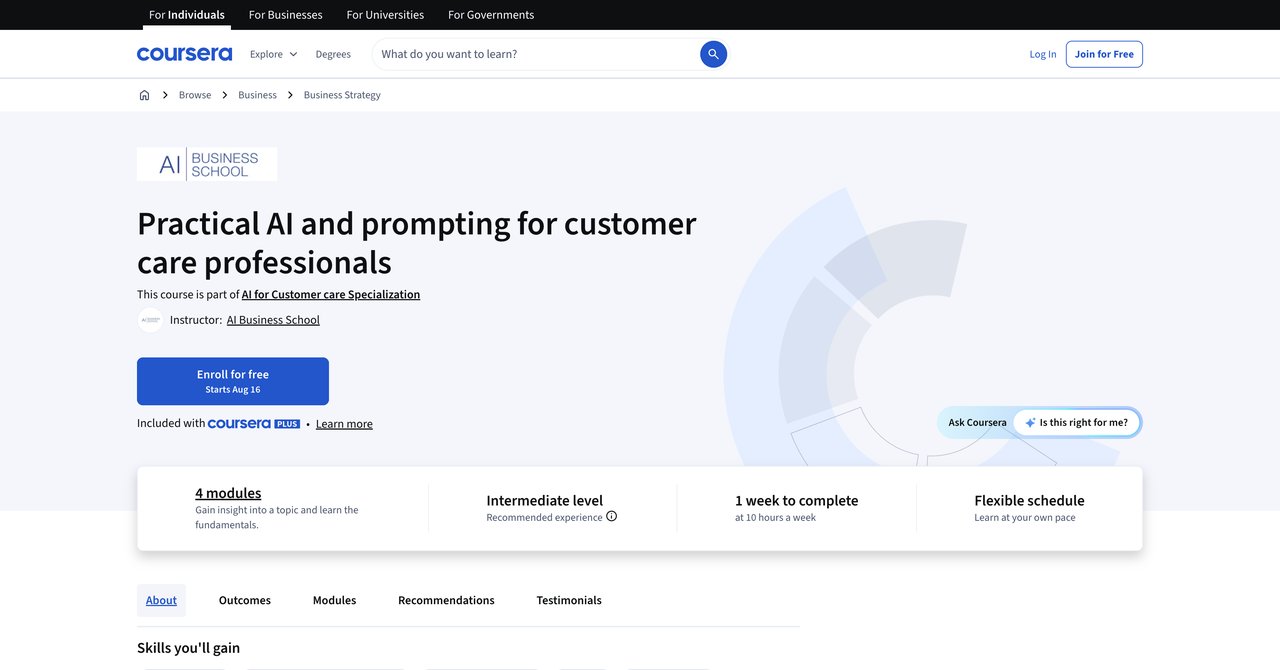
Maybe not a fan of building n8n code but you don't just want theory. That's exactly this course. It's very practice-oriented and focuses on what you can do tomorrow. It covers multiple modalities, such as text, maybe voice, and instant messaging, and gets into job-specific use cases. You get a chance to work with prompts at a much high level on this one. It's for the person who has already done a basic "Intro" course and wants to start getting their feet wet with advanced prompt templates and immediate applications.
Key Topics Covered:
- Hands-on with job-specific AI use cases
- Provides immediate practical practice
Target Audience and Skill Level:
An intermediate could take a few beginner courses, but the best fit is someone who has already dipped their toes in the water. It gives you a lot of practical experience, but it's also useful because you might not need to watch all the intro points again.
Pros:
- Hands-on with job-specific AI use cases
- Covers multiple modalities
- Immediately practical experience, not theory
Cons:
- Intermediate level may challenge beginners
- Requires some AI familiarity
Who benefits most:
A professional who has taken an intro course and doesn't care about passing multiple-choice quizzes but wants to know where to click. If you love learning by doing, this is a good choice.
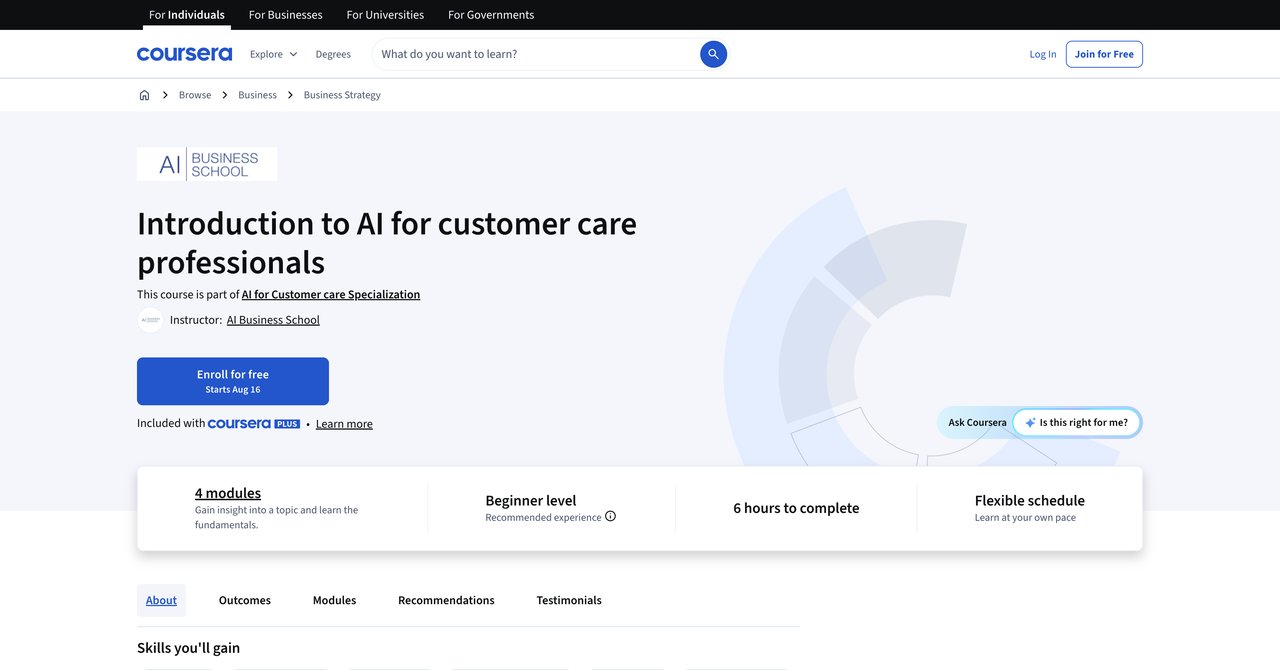
Course 8: Introduction to AI for customer care professionals by Coursera
Course Link: Coursera Intro to for Care
This is the beginner basics. Free enrollment and is the basis starts with "what is a language model?" It's specifically focused on explanations for customer care. If you are at a point where you are just trying to get your brain to understand the difference of ChatGPT vs. MidJourney, or what "prompt" actually means, that's this. It also contexts for why these things happen with AI hallucinations etc. It's very much about literacy over skills. It's a good foundation for absolutely a new person.
Key Topics Covered:
- Foundational AI and GenAI literacy
- Designed specifically for customer care
Target Audience and Skill Level:
Total beginners with zero experience and maybe some anxiety or annoyance. It is for beginner to officials. No need to understand tech things ahead.
Pros:
- Builds foundational AI and GenAI literacy
- Designed specifically for customer care
- Free enrollment
Cons:
- No hands-on tool practice
- Duration not specified (which is odd)
Who benefits most:
The absolute newbie. If you plan to enroll in a more practical program later, adding some concepts first is a good idea. This is the introductory stepping stone to other Coursera courses in this list.
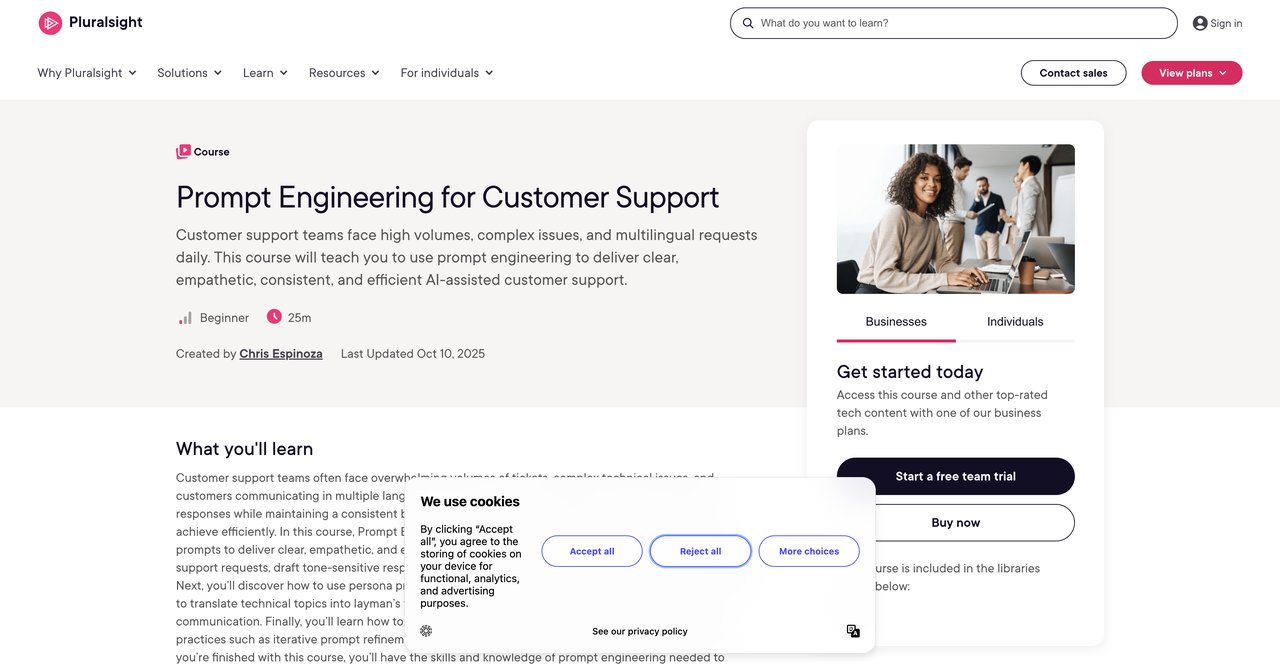
Course 9: Prompt Engineering for Customer Support by Pluralsight
Course Link: Pluralsight
Pluralsight is known for robust tech skills, so it is no surprise that this course focuses on languages and engineering. The 'prompting' approach is very specific and is great if you've tried to type something and AI doesn't get it. You will learn about persona prompting (telling AI who you want it to be) and few-shot prompting (giving several examples to make it accurate) to improve the AI response. Covers key things like ticket triage and escalation, but the multilingual support and brand voice sections are some of the strengths. It's a good course for an authority capable of defining its tone and rules. One downside is that the costs are opaque because you are actually subscribing to the entire Pluralsight platform.
Key Topics Covered:
- Persona prompting, zero-shot/few-shot
- Ticket triage and escalation
- Multilingual support and brand consistency
Target Audience and Skill Level:
The support team lead or power user who knows those current tools, but wants to move from 'good' to 'excellent.' It's probably not for the beginners who only want to improve, they want precision. Great for larger corporations.
Pros:
- Teaches persona prompting, zero-shot/few-shot
- Covers ticket triage and escalation
- Includes multilingual support and brand consistency
Cons:
- Requires Pluralsight subscription to access
- Duration not listed
Who benefits most:
The technical writer / knowledge base specialist on support team GSD who helps guide agents. They are the ones with advanced knowledge and need to standardize better responses.
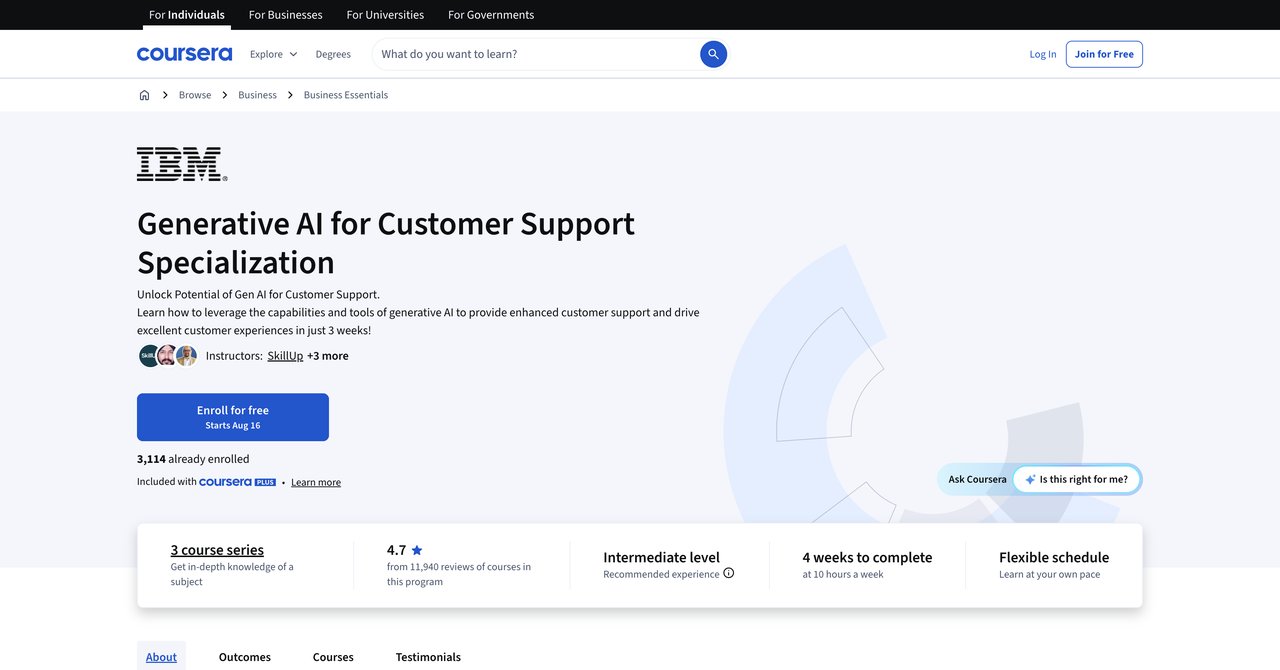
Course 10: Generative AI for Customer Support (Specialization) by Coursera
Course Link: Coursera Specialization
This one is a comprehensive specialization. It's not just one course; it's multiple courses under an umbrella. It covers a full workflow of automating responses, but also fit into multilingual interactions, and doing so ethically. The timeframe, if you take a Coursera I've set it to "job ready in 3 weeks," it will feel tight. It might take you more like 3-4 weeks depending on your pace, but it's designed to make you a competent user. It's intermediate. You have to dedicate time weekly and get the assignment done, really, to get this certificate.
Key Topics Covered:
- Automating responses, multilingual interactions
- Ethical considerations
Target Audience and Skill Level:
The agent who wants a resume-ready special credit icon and that proves they completed a rigorous assignment. The intermediate course matches someone where they've done some other certificate.
Pros:
- Job-ready skills in 3 weeks
- Covers automating responses and multilingual interactions
- Includes ethical considerations
Cons:
- Intermediate level
- Requires a consistent weekly commitment
Who would benefit most:
A learner who needs decent structure after taking the intro courses. If you're looking to demonstrate to an employer that you have deep concrete knowledge, that specialization looks great on a resume.
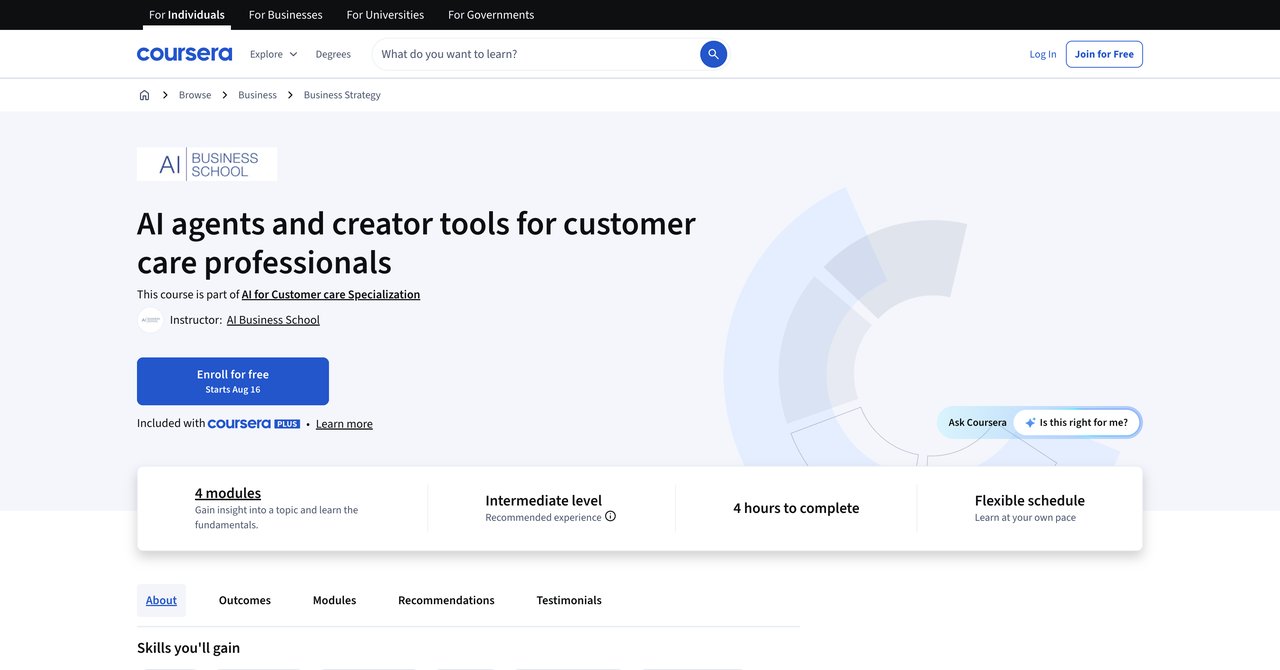
Course 11: AI agents and creator tools for customer care professionals by Coursera
Course Link: Coursera AI Agents
This is the "final step" in the path of the previous courses from this provider. This is about moving from using AI to creating with it to creating with AI. It built for customer-care staff for after-sales. This course gives an online creation of "agents" is just a model. It's about how to set up user-friendly tools inside your environment. You learn how to give it rules and a voice. If you've been doing all the other Coursera modules-an intro, a practical, and this-it feels like an awesome culmination. If you just pick this without the preceding training, you won't have a clue what you're doing.
Key Topics Covered:
- Teaches creation with AI, not just using it
- Built for after-sales professionals
- Final step in the AI learning journey.
Target Audience and Skill Level:
For the person who has completed several other courses. Basically, those who want to take ownership of building the AI experience within customer support rather than just following the prompts.
Pros:
- Teaches creating with AI, not just using it
- Built for after-sales professionals
Cons:
- Requires prior AI coursework
- Duration not specified
Who would benefit most:
Those people who have gone through proper foundational training and want to advance to an architect level into the customer service context. They are more of the work of an admin than a CSR agent. If you want to head toward process automation, this is your track.
Final Thoughts and Recommendations
You have a lot of options and you are at the point where you just want to pick. If you are an absolute beginner and want to know what everyone's talking about, you could start with Coursera's Intro course at no cost. it is short, and you'd have no risk. That could be a good starting point before you commit (money) to one of the other platforms.
If you are a day-to-day agent who simply wants to get your job done faster, you can look at FreeAcademy's course and those that focus n8n or More technical. Do you want to create automation tools behind the scenes? Then let me invest in the n8n or perhaps consider Generative AI Specialization if you just appreciate Coursera's flow.
However, if you're someone who wants all that, plus all benefits for the long-run, then Complete AI Training might be the best value. It is very different because you pay one flat subscription and get content on every cert, but they have that coverage under any other provider. If you need a quick, one focus course, you can go with Udemy, but that's all you get-just that one focus. Complete AI Training feels like hedging your bets: you're prepared for the role tomorrow plus not stuck in a single platform if it gets outdated.
Actually think about your future here. If you believe that AI may simply be a passing tool for a strict duty and you just need a quick arrow for your job, then FreeAcademy or take the Coursera special. If you are planning on staying in this area just knowing more and becoming a pro, then a subscription that gives you all the materials on your path can be time. The best "course" is the one you actually finish and the complete can give that to a broad set without being locked into a single topic that won't matter later. And in the world of support where burnout is common, you want your time with, or where you not pay for many long terms.
Finally, check if your company gives an educational budget. If they have a learning budget, none of these will be a bad thing, but if you are paying out of your own pocket, consider which is more important: a one-time stack to fill, or an ongoing portfolio of knowledge to keep you relevant. Many agents decide to start with free courses, and when they feel the jump, they sign up for the subscription that lets them test everything, like Complete AI Training. Good luck, and use the right tool for the right.