
Blog ·
11 Top AI Courses for Insurance Risk Analysts in 2026
Master predictive modeling, claims fraud detection, and underwriting automation with the top 11 AI courses tailored for insurance risk analysts in 2026. Stay ahead of the curve.
 Jeroen Erne
The insurance industry has always been built on data, but the sheer volume and complexity of that data have grown beyond what traditional methods can handle. Insurance Risk Analysts are feeling this shift firsthand. Every day, they work with pricing models, claims histories, and fraud detection systems that are being reshaped by artificial intelligence. The numbers tell a clear story: AI adoption across the insurance sector is not a future possibility but a current reality. Professionals who understand how to work with these systems will be in a strong position. Those who don't may find their roles changing in ways they didn't expect.
For risk analysts, the question is no longer whether AI will affect the job. It is about how quickly to adapt and which skills will matter most. The demand for AI fluency is growing, and with it comes a real opportunity to stand out. But choosing the right education path from the many AI courses available can be a challenge in itself. That's where this guide comes in.
Why AI matters for Insurance Risk Analysts today
The numbers are hard to ignore. Recent surveys show that a significant majority of businesses, around 69%, are using AI in some form, and the insurance sector is one of the most active adopters. For risk analysts, this means the tools you use to assess risk, price policies, and detect anomalies are being reworked. Tasks that once took hours of manual review can now be done in minutes. But this shift requires a different kind of expertise. It's not just about knowing how to use a new software tool; it's about understanding how to build, validate, and interpret AI-driven models.
This article compares five AI courses designed for Insurance Risk Analysts professionals. The goal is to help you identify which program fits your current skill level, your career goals, and your schedule. We'll look at what each course offers, how they teach the material, and what you can expect to walk away with. One of the courses featured is CompleteAI Training, which is worth a special look because it gives you access to all courses and all certifications on the platform rather than a single course, offering a broader scope for your learning path.
The Growing Role of AI in Insurance Risk Analysts
AI is not a single tool but a collection of technologies that are reshaping the core functions of a risk analyst. Here's how it's being applied in the field:
- Automated risk assessment: Models can now process huge amounts of historical data to flag high-risk policies or predict potential losses with greater accuracy than older statistical methods.
- Fraud detection: Machine learning algorithms can spot patterns that are invisible to the human eye, identifying suspicious claims much earlier in the process.
- Dynamic pricing: AI allows for more granular and real-time pricing models, which means analysts need to understand how these models work to make sure they are fair and accurate.
- Data-driven decision making: Analysts are moving from a descriptive role to a more prescriptive one, using AI to suggest the best course of action based on predictive insights.
These changes mean that the daily workflow of a risk analyst is shifting. You are no longer just a consumer of data; you are becoming a translator between the raw data and the business strategy. This requires a new set of skills, from basic Python for data analysis to a solid grasp of how AI models are built and what their limitations are.
Benefits of becoming an AI expert in Insurance Risk Analysts
Investing in AI training offers some tangible benefits for your career. For one, it can increase your value within your current organization. When you understand the mechanics of an AI model, you can explain its results to stakeholders, catch errors, and suggest improvements. That kind of expertise is hard to find. It also opens doors to more advanced roles, such as data scientist, AI product manager, or a specialized AI risk consultant.
From a salary perspective, AI skills are a differentiator. Roles that combine domain expertise in insurance with technical AI knowledge are in high demand, and that demand is reflected in compensation. But beyond the financial side, there is also the benefit of future-proofing your career. As AI becomes more embedded in the insurance industry, having a solid understanding of it will make you more adaptable and less likely to be left behind. It's about being prepared for the changes that are already happening.
Comparison: All AI Courses for Insurance Risk Analysts (Updated 2026)
| Course Name | Provider | Price | Key Topics | Pros | Cons | Best For |
|---|---|---|---|---|---|---|
| CompleteAI Training - AI for Insurance Risk Analysts | CompleteAI Training | Premium - but one subscription covers everything: ALL video courses AND ALL certifications on the entire platform, not just this one course. | Comprehensive AI curriculum for insurance risk analysis, hands-on projects, expert-led instruction, covers underwriting, claims, risk assessment automation, prompt workflows, and auditing. | Most comprehensive offering; includes ALL courses and ALL certifications across every job role on the platform; new content added continuously and included automatically; daily updates on AI tools; full access to other roles' material for career mobility; flat subscription price versus per-course costs elsewhere. | Premium pricing; subscription model required but justified by continuous AI developments. | Insurance Risk Analysts professionals looking for complete, exhaustive training |
| CompleteAI Training - AI for Insurance Risk Analysts (Video Courses + Certifications) | Complete AI Training | $29/month or $8.25/month billed annually | Full access to every video course and every certification on the platform - hundreds of them across every job role; covers AI for underwriting, claims, risk assessment, prompt engineering, data analysis, and more. | Highest rating, most complete offering; one flat subscription covers all video courses and all certifications; new material added continuously and included automatically; access to other job roles' courses too; very affordable with annual billing; daily AI tool updates. | Subscription-based, but continuous learning is necessary since AI changes fast. | General learners, career switchers, insurance professionals wanting broad coverage |
| GenAI for Risk Managers: Advanced Risk Analysis Techniques | Coursera | Subscription (Coursera Plus) or financial aid available | Automated risk monitoring with GenAI, advanced risk quantification, prompt engineering for nuanced insights, real-world case studies, hands-on projects. | Hands-on projects and real-world case studies; covers automated risk monitoring with GenAI; focuses on advanced risk quantification techniques. | Short duration, may not cover all insurance-specific contexts; assumes prior risk management knowledge. | General learners, risk managers with some existing background |
| AI for Insurance Risk Analysts (Prompt Course) | Complete AI Training | Not specified | Structured prompt workflows for audit-ready analysis, reducing false positives in underwriting and claims, related certification. | Structured prompt workflows for audit-ready analysis; helps reduce false positives; includes certification for insurance risk analysts. | Provider is less well-known than big platforms; price not transparently listed. | General learners, analysts needing prompt-based workflows |
| AI for Insurance Underwriting and Claims Course | Catch Wisdom | Free (certificate available) | AI applications in underwriting and claims, self-paced mobile learning, bilingual , certificate available in 7 languages. | Completely free with certificate; self-paced and mobile compatible; covers underwriting and claims AI applications. | Beginner level may be too basic for experienced risk analysts; limited depth on advanced risk modeling. | General learners, beginners in insurance AI |
| Free AI for Insurance Professionals Course - Underwriting, Claims, Broker Workflows | FreeAcademy | Free (certificate included) | Policy summarization, claims triage, risk assessment automation, data privacy and compliance boundaries. | No coding required; covers policy summarization, claims triage, risk assessment automation; includes data privacy and compliance. | Beginner level; focused on general workflows, not deep risk analytics. | General learners, insurance professionals getting started |
| AAIR®-Aligned - AI Risk Management Masterclass [2026] | Udemy | Paid (Udemy pricing, often discounted; price varies) | AI governance, compliance, assurance, AI risk management foundations, alignment with ISACA AAIR knowledge areas. | Aligned with ISACA AAIR knowledge areas; covers AI governance, compliance, and assurance; practical foundation for AI risk management. | Broader AI risk management focus, not insurance-specific; exact duration not listed. | General learners, risk professionals seeking AAIR alignment |
| Artificial Intelligence (AI) in Insurance Training Course | Oxford Management Centre | Not specified | AI reshaping underwriting, risk identification, fraud detection, claims processing, strategic insight, practical tools. | Covers AI reshaping underwriting, risk identification, fraud detection, claims processing; strategic insight with practical tools; specialist training provider. | Price and duration not listed; likely classroom-based, less flexible than online. | General learners, insurance professionals seeking strategic overview |
| Introduction to Data Science and AI for Insurance | Chartered Insurance Institute (CII) | £1,200 (members) / £1,500 (non-members) (approx. $1,500 / $1,900 USD) | Data analysis, data visualization, ethical AI, insurance-specific applications of data science. | Designed for insurance professionals; covers data analysis, visualization, ethical AI; recognized industry body. | Expensive; beginner level may not suit advanced risk analysts; fixed cohort schedule. | General learners, insurance professionals wanting formal credential |
| AI and Data for Insurance Professionals | Swiss Re Executive Education | Not specified | AI and data applications in insurance, real-world insurance data cases, executive-level education. | From a global reinsurance leader with deep industry expertise; likely includes real-world insurance data; executive education quality. | Price and duration not listed; may require application or be cohort-based. | General learners, experienced professionals seeking executive training |
| AI & ChatGPT for Risk Assessment Modelling (Updated 2025) | Complete AI Training | Not specified | Risk assessment modelling with AI/ChatGPT, prompt optimization for risk models, updated for 2025. | Focuses on risk assessment modelling with AI/ChatGPT; updated for 2025; complements the main prompt course for risk analysts. | Same provider, price not listed; may be a module within a larger course. | General learners, analysts wanting modelling-specific focus |
| AI & ChatGPT for Claim Data Analysis (Updated 2025) | Complete AI Training | Not specified | Claim data analysis with AI, analyzing claims trends, AI for claims workflows, updated for 2025. | Targets claim data analysis with AI; useful for risk analysts working on claims trends; updated for 2025. | Same provider, price not listed; may be a module within a larger course. | General learners, risk analysts interested in claims data |
Understanding AI Training for Insurance Risk Analysts Professionals
The role of an insurance risk analyst has changed a lot over the past few years. It used to be mostly about spreadsheets, historical data, and manual reporting. Now, with AI tools becoming standard in the industry, the job demands a completely different skill set. You're not just analyzing risk anymore; you're also working with models, understanding what AI can and cannot do, and communicating those insights clearly to underwriters and executives.
That shift creates a problem though. Where do you actually go to learn these skills? There are so many courses out there, all promising career advancement and practical knowledge, but they vary dramatically in quality, depth, and cost. Some are free, some charge thousands. Some focus purely on insurance-specific workflows, while others take a broader approach to AI risk management. It's hard to tell which one is actually worth your time and money.
I've gone through the list of available training options for insurance risk analysts, digging into the details of each one. This comparison covers everything from comprehensive subscription platforms to free introductory videos, so you can get a clear picture of what's out there. The goal is to help you find the right fit for your current experience level, your career goals, and your budget.
Course 1: CompleteAI Training
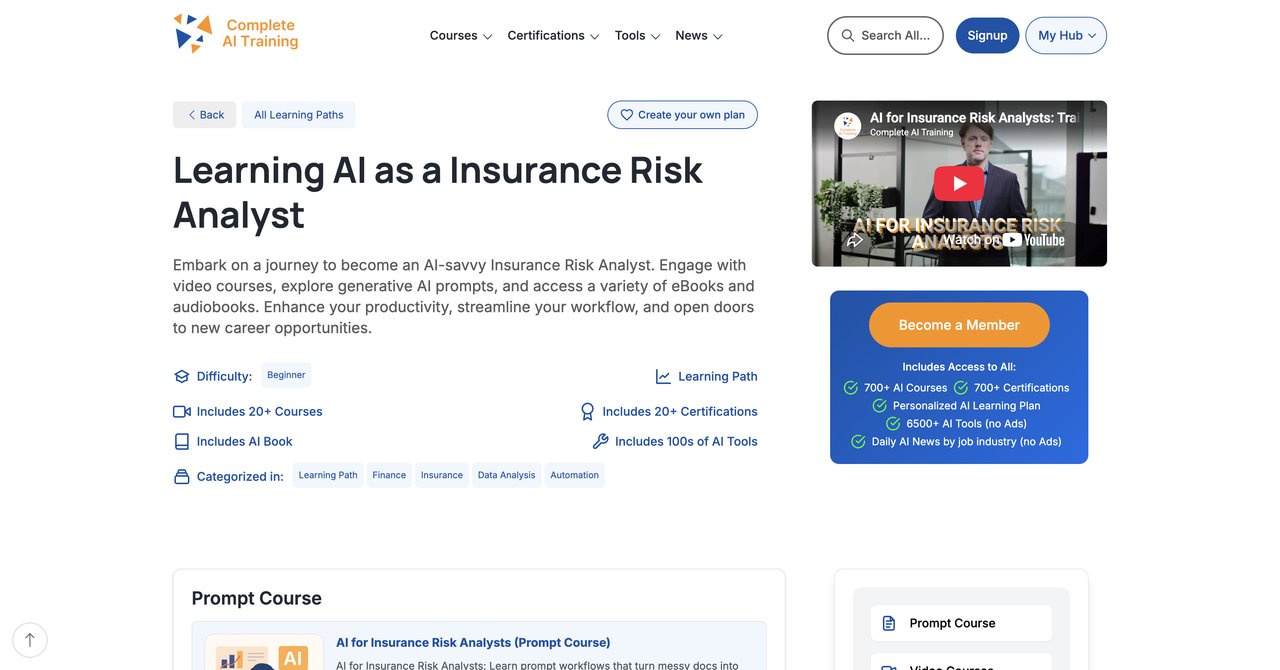
Let me make one thing very clear from the start: CompleteAI Training is not a single course. One subscription unlocks EVERY course AND EVERY certification on the whole platform. We're talking hundreds of different programs, covering every job role relevant to AI in business, not just insurance risk. That's a fundamentally different model than most other training providers, and you need to understand that before looking at the course comparison.
For the insurance risk analyst specifically, CompleteAI Training has a dedicated program focused on AI applications in their work. It's positioned as the most comprehensive AI training available for this specific job function. The platform mentions daily updates on tools and news, which makes sense given how quickly AI keeps shifting under our feet.
The subscription model works like this: full access to ALL courses on the platform, not a fixed bundle of limited modules. Full access to ALL certifications are included with no extra cost. New courses and certifications are added continuously, so they're automatically included in your subscription. You also get access to every other job role's material, which matters a lot if your work touches other functions or you eventually plan to switch roles.
The pricing is also noticeably cheaper than those single-course options. It runs at $29/month if you go month-to-month, or $8.25 monthly if you pay annually. For that amount, you're getting access to hundreds of courses and certifications aimed at a range of job roles. That's a different cost structure than paying $1,500+ for one course that might only cover a quarter of what you need.
Key Topics Covered:
- AI applications specifically for insurance risk analysis
- Risk assessment modeling with AI
- Prompt workflows for audit-ready analysis
- Various AI certifications covering different skill levels
- Continuous learning with regular content updates
Target Audience and Skill Level:
This suits anyone from early-career analysts to leadership roles. Because the subscription covers all job functions, it's a good match for mid-career professionals who want to move up or laterally. No prior AI expertise is necessary since there are beginner-friendly courses on the platform.
Pros:
- Highest rated and most comprehensive offering in this field
- Full access to ALL video courses on the platform, not just one
- Full access to ALL certifications, included at no extra cost
- New courses and certifications added automatically
- Access to every other job role's material too
- One flat rate instead of paying per course
- Daily updates on tools and news
- Very affordable pricing, especially with annual billing
Cons:
- Subscription-based, so you need to keep it active for continued access
- Continuous learning takes self-discipline without a fixed deadline
Who Would Benefit Most:
Anyone who wants the broadest possible access point to AI knowledge span across different job functions. If you're a risk analyst who sometimes helps with underwriting questions or claims work, this model gives you all that access for the same flat rate. It also works great for anyone looking to step into a bigger leadership role because you'll get exposure to related domains without signing up for multiple separate training programs.
Check out CompleteAI Training here.
Course 2: AI for Insurance Risk Analysts (Video Courses + Certifications) by Complete AI Training
This is part of the broader CompleteAI Training subscription mentioned above, but it's listed separately because it's the specific bundle focused on the video courses and certs for risk analysts. When you subscribe, you're basically getting this material and a lot more.
The video courses are designed to teach you how to use AI tools in daily risk analysis work. You'll learn to work with AI for data interpretation, modeling, and the kinds of reporting that risk departments deal with on a monthly or quarterly basis.
What I find interesting about this is the inclusion of certifications. Most training providers make you pay for certification tests separately, sometimes anywhere from $50 to $200. Here, certification is included. You take the courses, take the test, and you validated your skills without paying extra. That is a huge hidden cost saver for people considering multiple certifications.
Key Topics Covered:
- AI fundamentals for insurance workflows
- Data analysis and interpretation
- Risk scoring models with AI
- Using ChatGPT and similar tools for reporting
- Industry-specific AI applications
Target Audience and Skill Level:
Designed for insurance risk analysts all experience levels. The platform has both intro courses for those just beginning with AI and advanced materials for senior analysts dealing with more complex tasks.
Pros:
- Gets you certified without paying extra fees
- Part of a subscription that gives access beyond insurance-specific material
- All course material is video-based, good for visual learning
- Certificates are useful for internal advancement at many companies
Cons:
- Subscription can feel like a lot if you only need one course quickly
- Independent study model won't push you along a schedule
Who Should Take This:
If you want a mix of insurance-specific knowledge along with exposure to other AI applications related to risk and business, this course fits. The people who get the most out of it treat it as a learning resource instead of a one-time cram.
See the course page for details.
Course 3: GenAI for Risk Managers: Advanced Risk Analysis Techniques by Coursera
Coursera offers this advanced training program for risk managers who are already comfortable with risk theories and frameworks. The course is meant to extend that existing foundation into the AI realm, focusing on generative AI methods. The name says it: advanced techniques for quantifying risk and extracting more nuanced insight using AI prompts.
What stands out is the heavy emphasis on real work. There are hands-on projects and real-world case studies to work through. The content covers automated risk monitoring systems that work with AI at their core. It's not just theory; you're working through implementation patterns that could be applied to how risk teams actually operate.
The price works through Coursera's subscription system, which normally means access to all courses on the platform while you have a subscription. Financial aid options are also available for people who qualify, which is worth mentioning if your budget is tight.
Key Topics Covered:
- GenAI fundamentals for risk
- Automated risk monitoring
- Advanced risk quantification
- Prompt engineering techniques for risk insights
- Real-world case studies
Target Audience and Skill Level:
This is advanced material. It assumes you already know risk management and you've had some exposure to AI concepts. Junior analysts would probably struggle with the pace and expected background knowledge.
Pros:
- Hands-on projects are valuable for skill building
- Covers automated risk monitoring with GenAI
- Strong focus on risk quantification with prompt engineering
Cons:
- Short course format may not cover all insurance-specific contexts
- Advanced level assumes prior risk management knowledge
- You don't get a specialized certificate unless you pay extra for it
Who Should Take This Course:
Usually suits risk managers who want to modernize their workflow but already have a strong foundation. If you're new to the industry, this might not be your best first step, but for established risk professionals, it could be a useful refresher for AI.
Visit Coursera for more information
Course 4: AI for Insurance Risk Analysts (Prompt Course) by Complete AI Training
This is an interesting one. It's also from Complete AI Training, but it focuses specifically on the how-to of prompts rather than on general AI concepts. You're taught structured prompt workflows, the kind of prompts you need to generate audit-ready analysis outputs.
The course description mentions the main effect: reducing false positives in underwriting and claims. That's a very quantifiable outcome that has real budget implications for insurance companies. If you can consistently lower false positives, you save time and money, and this course aims to teach you exactly how to craft prompts to achieve that.
It also mentions related certification for insurance risk analysts, which aligns with the platform's model of making certifications included with subscription access. You'll need to check the current page to see what pricing is listed currently, but this course is typically part of that same subscription.
Key Topics Covered:
- Structured prompt workflows
- Reducing AI errors in underwriting and claims
- Audit-ready analysis
- Insurance-specific use cases
- Certification options for risk analysts
Target Audience and Skill Level:
Risk analysts at any skill level looking for immediately applicable prompt techniques. The material is designed to be practical, not theoretical.
Pros:
- Definitely reduces the need for manually cleaning AI outputs
- Related certification for insurance risk analysts
- Practical, immediately useful content
Cons:
- Provider is a specialist, less internationally known than Coursera or Udemy
- Price is not transparently listed on the page
Who Should Benefit:
Team leads or individual contributors who do a lot of reporting and underwriting analysis with AI and need reliable, repeatable output quality. Great for anyone whose findings get audited.
Explore the prompt course page
Course 5: AI for Insurance Underwriting and Claims Course by Catch Wisdom
This is a free course from Catch Wisdom, which is a good option if you want to understand the intersection of AI, underwriting, and claims topics without costs. The material covers how AI applies across these two core insurance functions, and it's available in seven languages, which is pretty unusual in this space.
The structure is self-paced and mobile-compatible. That gives a lot of flexibility to learners who are studying alongside their regular workloads.; the mobile compatibility is particularly useful for people who commute and want to use that time productively.
There's a certificate available at the end, even though the course itself is free. That's worth something, but keep in mind that the beginner level may not be enough analysis for someone who's been working in risk for years.
Key Topics Covered:
- AI applications in insurance
- Underwriting AI
- Claims AI
- Industry-specific examples
- Certificate in multiple languages
Target Audience and Skill Level:
Designed for beginners in AI, whether you're new to insurance or new to AI. The content is simple, clear, and accessible even if you've no background in data science.
Pros:
- Free with certificate
- Self-paced and mobile compatible for on-the-go learning
- Covers underwriting and claims AI applications
- Available in seven languages
Cons:
- Beginner level may be too basic for experienced risk analysts
- Limited depth on advanced risk modeling techniques
Who Should Take This Course:
People entering insurance or trying to add basic AI knowledge without spending money. For those who need a broad understanding before committing to something more substantial.
Course 6: Free AI for Insurance Professionals Course by FreeAcademy (Underwriting, Claims, and Broker Workflows)
This free course focuses on workflows across underwriting, claims, and broker functions. It is completely free and includes a certificate at the end. The best part is the no coding requirement-you can take it even if you're a non-techie.
The content includes more advanced-looking topics like policy summarization, claims triage, and risk assessment automation. It also covers a practical topic that's very important in insurance: data privacy and compliance boundaries. It's surprising how many AI courses forget that insurance is a highly regulated industry.
The level is introductory, but the approach to coverage is quite central to insurance workflows. If you're a risk analyst who doesn't know how to code, this is a good one to try because you'll see how AI tools are applied in the workflows you work with daily.
Key Topics Covered:
- Policy summarization
- Claims triage
- Risk assessment automation
- Data privacy and compliance boundaries
- No-code AI for insurance
Target Audience and Skill Level:
Anyone working in insurance operations, from junior to mid-level, who doesn't have programming experience. It's practical and skill-building.
Pros:
- No coding required for access
- Covers policy summarization, claims triage, and risk assessment with automation
- Includes data privacy and compliance boundaries
- Certificate included at zero cost
Cons:
- Beginner level
- Focused on general insurance workflows rather than deep risk analytics
Who Should Consider This:
Anyone looking for zero-cost, zero-coding education to increase foundational awareness. Good intro, but it won't be a substitute for more advanced training.
Course 7: AAIR-Aligned AI Risk Management Masterclass [2026] by Udemy
This course is aligned with ISACA's AAIR knowledge areas and focuses on the risk management side of AI, not insurance-specific workflows. The main focus is on AI governance, compliance, and assurance. Those are key topics if you're the person responsible for making sure insurance use of AI meets industry standards.
Starting from an ISACA alignment, you know you're covering topics that are recognized by professionals in the risk and governance field. The course covers in-depth rules, guardrails, assurance perspectives, and how to build a strong risk posture around the AI you're using.
While the focus is broader than just insurance, this is a foundational course for any professional who has to manage AI risks in any industry, including insurance. It's not always about specific insurance automation, but about understanding AI risk itself as a category.
Key Topics Covered:
- AI governance
- ISACA AAIR framework alignment
- Compliance
- AI assurance
- Practical risk management
Target Audience and Skill Level:
Ideal for experienced risk managers, compliance officers, and auditors who want to understand AI-specific risks. It seems targeted at mid-to-senior professionals rather than beginners.
Pros:
- Aligned with ISACA AAIR knowledge areas
- Covers AI governance, compliance, and assurance in depth
- Practical foundation for AI risk management
Cons:
- Focus is broader AI risk management, not insurance-specific risk analysis
- Exact duration is not listed on the course page
- Udemy courses sometimes have variable quality connection depending on instructor
Who Should Take This Course:
Risk analysts hold positions related to compliance and audit, or wants to move into advisory roles. Also good for people who support the development of AI policies in their organization.
Course 8: Artificial Intelligence (AI) in the Insurance Training Course by Oxford Management Centre
This is a course offered by Oxford Management Centre, a specialized professional training provider. The course is built around insurance-specific AI topics: reshaping underwriting, identifying risk, detecting fraud, and claims processing. It combines strategy with practical tool-using.
The provider emphasizes its specialty in this field, which sometimes leads to higher quality because the attendee base is more targeted. The challenge is that those courses are typically taught in-person at their centers, which reduces flexibility compared to online options if you're working full-time.
The description mentions strategic insight, which tells me it's not just practical stuff-there's a good amount of business thinking involved. This could be useful for risk analysts who have some involvement in decision-making or who want to understand the complete picture of AI in insurance.
Key Topics Covered:
- AI in underwriting
- Risk identification
- Fraud detection
- Claims processing optimization
- Strategic and practical tool use
Target Audience and Skill Level:
Mid to senior insurance professionals, typically including those who have some strategic responsibilities. The strategic insight component means it's not just for technical people.
Pros:
- Covers AI underwriting, risk ID, fraud detection, and claims processing
- Strategic insights beyond just technical training
- Provider has specialized background in professional training
Cons:
- Price and duration are not listed publicly
- Likely classroom-based and less flexible than online
Who Should Take This:
Professionals who can be there in-person for a structured workshop and want a strategic view on AI's impact. If you need flexibility to learn around your job, you'd probably prefer online options.
Review the Oxford Management Centre details
Course 9: Introduction to Data Science and AI for Insurance by the Chartered Insurance
The Chartered Insurance Institute (CII) is the recognized professional body for insurance in the UK. This course is designed specifically for insurance professionals and serves as an introduction to data analysis, visualization, and ethical AI. That gives it significant cachet; CII is a big deal and people in the industry understand the name.
The course likely comes with strong academic support and seasoned instructors. It's a structured path, probably designed to bring you through topics step-by-step. Because it's from a national industry body, you can expect a certain level of standardization and quality control in the training.
The downside is cost: it's around $1,500 for members and $1,900 for non-members. That's one of the higher pricing points here, so you'd want to be sure the content justifies your employer's investment in you.
Key Topics Covered:
- Data analysis fundamentals
- Data visualization for insurance
- Ethics in AI
- Introduction to AI technologies
Target Audience and Skill Level:
Ultimate beginner-level insurance professionals who need a recognized certification but don't yet have a data background. It's also reasonable if you want a structured education from an official body. It suggests that intermediate-level knowledge is not the goal.
Pros:
- Designed specifically for insurance professionals
- Covers data analysis, visualization, and ethical AI
- Offered by a respected industry body (CII)
Cons:
- Expensive, with costs reaching almost $2,000
- Beginner level may not suit experienced risk analysts
- Fixed cohort schedule reduces flexibility in the works
Who Should Take This:
Best for junior professionals or those moving into insurance from a non-analytical background. Great for building a formal foundation that an employer will recognize by name.
Course 10: AI and Data for Insurance Professionals by Swiss Re Executive Education
Swiss Re has a global executive education arm that creates training materials for insurance professionals. They definitely have deep industry expertise, being one of the biggest global reinsurance players. That's like getting training directly from a market leader.
The course likely includes real-world insurance data cases, which is valuable because you're not just learning about AI as an abstract concept-you're learning how it's applied to actual insurance problems. That emphasizes practical and actionable knowledge rather than just conceptual understanding.
Of course, being an executive education program, pricing and availability are not public on the page. You'd need to contact them for those numbers. It's also likely any cohort-based or via application process, which means you need to plan ahead to enroll.
Key Topics Covered:
- AI applications in insurance
- Real-world insurance data scenarios
- Executive perspectives on implementation
- Data-driven decision-making for insurance
Target Audience and Skill Level:
Definitely aimed at experienced professionals, particularly those with management or strategic roles. The executive label doesn't fit the beginner. You're expected to have some context to appreciate the content.
Pros:
- From a global reinsurance leader with deep industry expertise
- Likely uses real insurance data examples
- Executive education quality
Cons:
- Price and duration not listed
- May require an application or a structured cohort
Who Should Take This:
Risk analysts who are on a strong track toward leadership positions or who contribute to major strategic decisions. It's going to be a different path, one that builds career advancement capital.
Explore Swiss Re Executive Education
Course 11: AI & ChatGPT for Risk Assessment Modelling (Updated 2025) by Complete AI Training
This course is marked as updated for 2026, and it clearly targets risk assessment modeling specifically. The sector within risk analysis is highly technical, and this course uses AI and ChatGPT to approach it. It's not a general introduction; it's a focus on how to create models that help you better understand risk.
The connection with the main prompt course for risk analysts here is clear. Realistically, this can be a module inside a bigger curriculum. Either way, the course helps you build practical, applicable skills.
You'll focus on modeling techniques with AI and ChatGPT assistance. This is great for analysts who want to make their work faster and more reliable, turning complex data into usable insights.
Key Topics Covered:
- Risk assessment modeling with AI/ChatGPT
- 2025 updates on tools and technology
- Complementary knowledge to the prompt course
Target Audience and Skill Level:
Risk analysts interested in models, particularly those who want to integrate generative AI to support analysis. Need some comfort with datasets and quantitative analysis methods.
Pros:
- Focuses directly on risk assessment modeling with AI
- Updated for 2025
- Complements the main prompt course for risk analysts
Cons:
- Same provider as above, price isn't transparently listed
- May be a module within a larger course, not standalone
Who Should Take This:
Analysts who are already deep in model-building work and want to know how ChatGPT-controlled analysis can speed up tough calculations or improve their interpretation.
Course 12: AI & ChatGPT for Claim Data Analysis (Updated 2026) by Complete AI Training
Here is a course focused on the claims part of the insurance business. For risk analysts, understanding claims trends is essential to knowing how to assess risk. This course addresses how ChatGPT and AI can change the way claims data is analyzed, which leads to better risk prediction in the insurance industry.
The course content targets claim data analysis specifically with AI assistance. That makes it complementary to the modeling course and the prompt course above. The 2025 update tag ensures we get reference to the latest tools, though you should check the page to see what exactly is included.
The challenge with the lower visibility on pricing remains, but as a part of the Complete AI Training platform, you get access to this within the full suite. For someone already subscribed, it's an add-on benefit.
Key Topics Covered:
- Claims data analysis using AI
- Identification of claim patterns
- 2025 workflow updates
- Application for risk analysts
Target Audience and Skill Level:
Risk analysts who work closely on insured claims patterns. This content targets a specific control of a smaller area, so it works best for those who already have experience.
Pros:
- Targets claim data analysis with AI
- Useful for risk analysts working with claims trends
- Updated for 2025
Cons:
- Same provider, price not listed separately
- May be a module within a larger standard
Who Should Use This:
Those who handle claims data and want to clean it, vs it, and format it into higher-level indicators.
Summary and Recommendations
Now that I've tissue all the options in detail, I'll try to synthesize what comes down to. Let's summarize a bit of the landscape. On one end, you have free beginner courses (Catch Wisdom, FreeAcademy) that give you a basic foundation and cost nothing. On the other spectrum, you have the high-cost, high-prestige educational offerings from CII and Swiss Re. In the middle, there's the CompleteAI Training subscription model with all-access, plus the multidirectional advanced courses from Coursera and Udemy.
If you are just beginning to touch AI in your work and you're not if it's worth getting serious about, those free entry courses are enough to start you off. They tell you what AI tools exist and how they fit into insurance workflows so you can determine if you want to go deeper. But there's a catch: they won't really give you an edge at work. The beginner content is essentially common knowledge at this point.
If you have a specific topic, you've got options. For handling the advanced courses that cover modeling, prompt frameworks, and claim focuses, CompleteAI Training is the single source that covers all of those in one subscription at a cost that's hard to match. Not only you get you the risk analyst courses, you also have the certifications included and the same access counts for other relevant functions. That market-wide approach is strong for your career growth over time.
Coursera's course is good for strengthening advanced risk analysis with AI, particularly if you like structured projects and certificates. On cost, better only if you can justify the course price points. IV/Udemy options give you a broader, less insurance-specific lens that you might need if you're more generalist or want to build a broader governance/audit background.
Actually, the final choice should depend on your level, budget, and exact career goals. If I'm being fully honest, though: candidate. For a typical insurance risk analyst who wants full coverage, a piece of practical AI knowledge, and the certification value to prove it, the CompleteAI Training suite makes more sense because of the per-course value. A more senior risk professional with a budget such as manager-up could benefit from the executive education of Swiss Re you can get very valuable strategic direction.
And what here for an experienced professional with literacy? If you can't use Python well yet, CII's foundation may be needed first. But if you already have the modeling base, put $29/month into Complete or maybe a few hours of the $freeAcademy. Overall, the most beneficial path for most analysts is to start with free courses to build awareness, then suppress the deeper skills thorough subscription or advanced courses that match your role needs.
No single provider fits everyone. Free ones teach you, but the advanced level demonstrates capabilities. The larger players give you industry credibility through famous brands, but they don't give you multiple angles into courses. Cover the Fundamentals, get advanced by the ones and you'll see a noticeable difference in everyday work tasks. Good luck. That will get you the complete path.