
Blog ·
11 Top AI Courses for VP of Human Resources in 2026
Discover the 11 best AI courses tailored for VPs of HR in 2026—covering strategic implementation, ethical AI, and workforce analytics to future-proof your talent management.
 Jeroen Erne
Artificial intelligence is no longer a distant concept discussed in boardrooms as a theoretical possibility. It is here, it is operational, and it is changing how businesses function at every level. For VP of Human Resources professionals, this shift is both a challenge and an opportunity. The HR function-historically centered on people, processes, and policies-is now being reshaped by algorithms that can screen resumes, predict turnover, personalize learning paths, and even draft complex employee communications. The question is no longer whether AI will affect your role; it is how quickly you can adapt to lead with it.
Consider the pace of change. A significant portion of businesses have already integrated AI into their workflows, with studies showing that 69% of businesses use AI in some capacity. That number is only climbing. For HR leaders, this means the tools you rely on for talent acquisition, performance management, and employee engagement are becoming smarter and more autonomous. If you are not familiar with how these systems work-or how to direct them-you risk being left behind as your peers automate routine tasks and free up time for strategic thinking. The stakes are even higher when you consider the potential job impact. Roles that do not evolve with technology often face obsolescence, while those that embrace it become more valuable. As a VP of Human Resources, your ability to upskill in AI is not a nice-to-have; it is a career imperative.
Why AI matters for VP of Human Resources today
The role of a VP of Human Resources has always been multifaceted. You oversee talent strategy, employee relations, compliance, and organizational development. But the tools available to you now are fundamentally different from what existed even a few years ago. AI can analyze employee sentiment from survey responses in real time, flag potential compliance issues before they become problems, and match candidates to roles with a precision that manual screening cannot match. It can also handle the administrative burden that consumes so much of an HR leader's day-scheduling, onboarding paperwork, benefits inquiries-leaving you with more bandwidth for the human aspects of your job that truly require your expertise.
Yet, adopting AI without understanding it is a recipe for poor outcomes. Many HR leaders are handed AI tools by their IT departments or vendors and expected to use them effectively. But without a foundational grasp of how these systems work, their limitations, and their ethical implications, you cannot make informed decisions about deployment. That is where structured learning comes in. This article compares 11 AI courses specifically designed for VP of Human Resources professionals, ranging from beginner-friendly overviews to advanced certifications. Whether you are looking for a quick primer or a deep specialization, there is a course here that fits your needs. One standout option is CompleteAI Training's AI for VP of Human Resources, which stands out because it gives you access to all courses and all certifications on the platform rather than just a single course, making it a flexible choice for ongoing learning.
The Growing Role of AI in VP of Human Resources
AI is not just automating tasks; it is transforming the very nature of HR work. Here are some of the key applications reshaping the field:
- Automation of routine processes: From payroll inquiries to leave approvals, AI-powered chatbots and workflow tools handle repetitive requests instantly, reducing response times and freeing HR teams to focus on complex issues.
- Data-driven decision-making: AI can sift through massive datasets to identify patterns in employee performance, retention, and engagement. This allows VPs of HR to make decisions based on evidence rather than intuition.
- Personalized employee experiences: Learning and development programs can be tailored to each individual's skills and career goals using AI algorithms, making training more effective and relevant.
- Predictive analytics for talent management: AI models can forecast which employees are at risk of leaving, allowing HR to intervene with retention strategies before it is too late.
- Enhanced recruitment: AI tools can source candidates, screen resumes, and even conduct initial interviews, making the hiring process faster and more objective.
- Compliance and risk management: AI can monitor changes in labor laws and regulations, flagging potential compliance gaps that might otherwise go unnoticed.
These applications are not hypothetical. They are being deployed in organizations right now, and HR leaders who understand them can steer their companies toward more efficient, equitable, and effective people management.
Benefits of becoming an AI expert in VP of Human Resources
Investing time in AI education pays off in tangible ways. For a VP of Human Resources, becoming proficient in AI means you can lead your organization's digital transformation rather than react to it. You will be able to evaluate AI vendors with a critical eye, ask the right questions about data privacy and algorithmic bias, and design workflows that integrate AI seamlessly into your team's operations. This expertise also positions you as a strategic partner to the C-suite, someone who can connect technological capabilities with business outcomes.
On a personal level, AI skills make you more marketable. Executives who understand both the human and technical sides of HR are rare, and that combination is increasingly sought after. You will also gain confidence in making decisions about AI adoption, knowing that you have a solid foundation to build on. And as AI continues to evolve, your ability to learn and adapt will keep you relevant in a field that values continuous improvement.
The courses reviewed in this article are designed to help you achieve these goals. Some focus on practical prompting skills, others on strategic implementation, and still others on the ethical and regulatory aspects of AI in HR. By the end of this comparison, you will have a clear picture of which course aligns with your current skill level and career objectives-so you can get back to doing what you do best: leading people.
Comparison: All AI Courses for VP of Human Resources (Updated 2026)
| Course Name | Provider | Price | Key Topics | Pros | Cons | Best For |
|---|---|---|---|---|---|---|
| CompleteAI Training by CompleteAI | CompleteAI | Premium; one subscription covers everything (all courses and all certifications on the platform) | Comprehensive AI training for VP of Human Resources; includes all job-role materials, hundreds of video courses, and all certifications; new courses and certifications added automatically; daily updates on AI tools and news | Comprehensive curriculum; Hands-on projects; Expert instructors; Full access to ALL video courses and ALL certifications at no extra cost; Covers every job role, valuable for cross-functional work; Very affordable with annual billing at $8.25/month | Premium pricing; Subscription required; Continuous learning needed as AI evolves | VP of Human Resources professionals looking for complete training; general learners |
| AI for VP of Human Resources (Video Courses + Certifications) | Complete AI Training | $8.25/month billed annually or $29/month; one flat price covers all courses and certifications | Full access to ALL video courses and ALL certifications on the platform (hundreds, across every job role), not just a single course; includes all other roles' materials too; new courses added automatically | Full access to everything; all certifications included; daily updates; very affordable with annual billing; good for cross-functional work or career moves | Subscription required; continuous learning necessary as AI evolves | General learners; VPs whose work spans multiple functions |
| Practical AI and prompting for HR professionals | Coursera | Free | AI prompting tailored to HR tasks; frontline AI applications; hands-on practice | Hands-on; job-specific AI use cases; immediate practical experience; focused on HR tasks | Short duration may not cover strategic depth; intermediate level assumes some AI familiarity | General learners |
| Prompt Engineering for HR (Master AI Prompting for HR) | Udemy | Subscription or variable per-course fee | Repeatable prompt writing for recruiting, L&D, HR operations; high-quality output focus | Structured and repeatable approach; covers recruiting, L&D, HR operations; high-quality output focus | Limited to prompt engineering, not broader AI strategy; smaller rating sample size | General learners |
| Generative AI for Human Resources (HR) Professionals | Coursera | Subscription | Recruitment, onboarding, training, performance management; prompt engineering; ethical considerations | Comprehensive specialization covering recruitment, onboarding, training, performance management; includes prompt engineering; ethical considerations addressed | Requires subscription; intermediate level may not cover executive-level strategy | General learners |
| AI for Human Resources Management / HR/ HRM Course | Udemy | Subscription or variable per-course fee | Talent management, performance management, L&D with practical focus | Covers talent management, performance management, L&D; high rating; practical focus | Relatively short; may lack depth on strategic AI implementation | General learners |
| Human Resources & Talent Management with Gen AI | Coursera | Subscription | Generative AI reshaping talent management; assessing, screening, evaluation from strategic perspective | Focuses on Gen AI disruption in HR; covers assessing, screening, evaluation; strategic perspective | Limited details on duration; may be narrow in scope | General learners |
| Design and Apply Generative AI for HR Performance | Coursera | Subscription | Human-centered, fair, ethical AI systems in HR; practical frameworks; real-world use cases; deployment strategies | Focuses on human-centered, fair, ethical AI; practical frameworks and real-world use cases; deployment strategies | Specialization may require significant time; limited rating data | General learners |
| Generative AI HR Professional | Coursera | Subscription | Automate routine tasks; document transformation into timelines, emails, FAQs; reducing AI hallucinations; freeing time for strategic work | Reduces AI hallucinations; transforms documents into timelines, emails, FAQs; frees time for strategic work | Focus on document transformation may be too tactical for some VPs; limited details | General learners |
| AI-Driven HR Strategy, Operations, and Regulatory Compliance | Coursera | Subscription | AI strategy, operations, compliance across employee lifecycle; identification of high-value use cases; theory to practice | Covers AI strategy, operations, compliance across employee lifecycle; identifies high-value use cases; theory to practice | No specific duration given; may require prior HR knowledge | General learners |
| AI+ Human Resources Practitioner™ | ITCE | Not specified | Recruitment, talent management, employee experience; EU AI Act compliance; hands-on activities | Certification course; covers recruitment, talent management, employee experience; includes EU AI Act compliance; hands-on activities | One-day format may be too brief for deep learning; price not listed | General learners |
| AI for HR | Short Course | IMI | €1095 (approx. $1185) | Human-centred workshop covering recruitment, L&D, employee wellbeing; hands-on exercises and case studies; in-person at Dublin | Human-centred approach; covers recruitment, L&D, employee wellbeing; hands-on exercises and case studies; in-person at Dublin campus | One-day duration; in-person only, limiting accessibility; higher cost | General learners |
Understanding AI Training for VP of Human Resources Professionals
If you're a VP of Human Resources, you've probably noticed that artificial intelligence is no longer a distant concept reserved for tech teams. It's now central to how HR functions operate, from talent acquisition and performance reviews to compliance monitoring and employee engagement. The demand for HR leaders who can confidently implement AI strategies has never been higher, and the market has responded with a flood of courses, certifications, and specializations, each with its own strengths and limitations. But when you're leading an entire HR department, you need more than just a basic understanding of a single AI tool - you need to understand how AI reshapes the employee lifecycle, how to mitigate its risks, and how to align it with business goals. That requires more than just a weekend workshop; it often requires a systematic approach to learning, but the challenge of knowing which investment actually benefits a VP is generating genuine confusion.
The problem is that AI in HR is a massive but fractured topic, and most courses out there are either too tactical or too broad to offer genuinely executive value. While a hands-on prompt engineering course can get you immediate wins at the team level, a comprehensive certification allows you to strategize across an entire organization. You may also face practical constraints like budget approvals or travel requirements. In this guide, we examine some of the most relevant and current options - including complete platforms, university specializations, and short-workshops - and break them down honestly. For some participants, the most important consideration might not be which course content is best, but instead what kind of long-term access and scalability a platform provides, and how that translates to staying ahead in your role without having to subscribe to a new domain each time. So, whether you're a baker's dozen of AI initiatives or you want to avoid your team hallucinating during an employee document audit, read on to see how the options stack up for a VP of Human Resources.
Course 1: CompleteAI Training - AI for VP of Human Resources
Let's get the massive point out of the way up front: CompleteAI Training is not really a single course in the traditional sense. When you subscribe, you're not just buying one track. You're unlocking access to ALL video courses on their platform, which includes hundreds of them, and these are not just for HR either. They cover every job role, from finance to marketing to legal, and you also get ALL of their certifications included at no extra cost. There's no fixed bundle, no per-course fees; a single flat subscription price covers all of the above and makes it the most distinct option in this comparison relative to every other provider that sells course-by-course. The phrase "for VP of Human Resources" in the title can be somewhat misleading if someone thinks it's a narrow single module - in reality, it's a dynamic portal that includes a specialized HR track and far beyond that. For leaders whose purview spans across cross-functional roles, that is a massive consideration.
For a practical perspective, what this means is that while you have the "AI for VP of Human Resources" track as a starting point, you can spend the same subscription diving into, say, AI for Product Managers or AI for Finance teams, if your responsibilities lean that way. Because the HR function is so intertwined with strategic operations, there's an obvious advantage in understanding how your peers in other departments are adopting AI, or even preparing yourself for a broader C-suite role. Also, think about continuing education: when AI changes, which it does at a breakneck pace, this platform will automatically give you the transmission. New courses and certifications are added continuously, and they are included automatically, without making you pay another additional fee to stay current. That is a distinctly superior advantage of you on a tight budget or if you just hate fighting your finance team for new learning budgets every few months.
For the track itself, it cuts across most key areas: AI strategy development, building a business case for AI in HR, data-driven decision making, change management, communicating AI to stakeholders, plus practical skills like prompting for the tools HR teams commonly use. But you're not hemmed in. The Cons are pretty apparent though: the subscription model is a recurring cost, although a very low one at $8.25/month when billed annually or $29 monthly, and continuous learning is expected. For someone used to a one-time purchase, the subscription might initially feel like an accounting nuance, yet if you consider what a single course usually costs elsewhere, the value is undeniable. Their certification track for VPs is thorough, giving you a completion certificate that holds weight and provides tangible evidence of your expertise - and it costs nothing beyond your subscription cost, unlike other places that charge an additional fee for the certificate.
Key Topics Covered:
* AI strategy development and business case building for HR * Understanding and mitigating bias in AI systems * Employee life-cycle optimization * Change management and communication strategies for rolled out * Establishing up-to-date AI governance and regulatory compliance * Using AI for talent, learning, and performance management * Prompt engineering best practices.
Target Audience and Skill Level Requirements:
Best for people at a senior HR leadership level or ambitious product managers heading toward VP roles. It's more comprehensive than your short course while not 'slow-paced' enough to bore someone who is already used to tech adoption. No prior AI knowledge is required, though an understanding of organizational structures helps.
Pros:
- Full access to ALL video courses on the platform, not a single course or a fixed bundle
- Full access to ALL certifications on the platform, included at no extra cost
- New courses and certifications are added continuously and are included automatically
- Access to every other job role's material too, which matters for anyone whose work spans more than one function or who wants to move roles
- One flat subscription price covers all of the above, versus paying per course elsewhere
- Daily updates on relevant AI tools and news
- Very affordable pricing, especially paid annually
Cons:
- Subscription-based, so you'll want to invest time to get value
- Continuous learning is a necessity because the platform is ever-updating
Who Would Benefit Most:
The executive who wants holistic coverage, and doesn't want to pay separately for a course and then again for the certificate. If you value having a platform you can use across your entire organization - like, give access to your team at a low team budget - or if you have a breadth of responsibility beyond just HR, this is your strongest bet. If you want preset methodologies across all functions, this is the gate.
Course 2: Practical AI and Prompting for HR Professionals (Coursera)
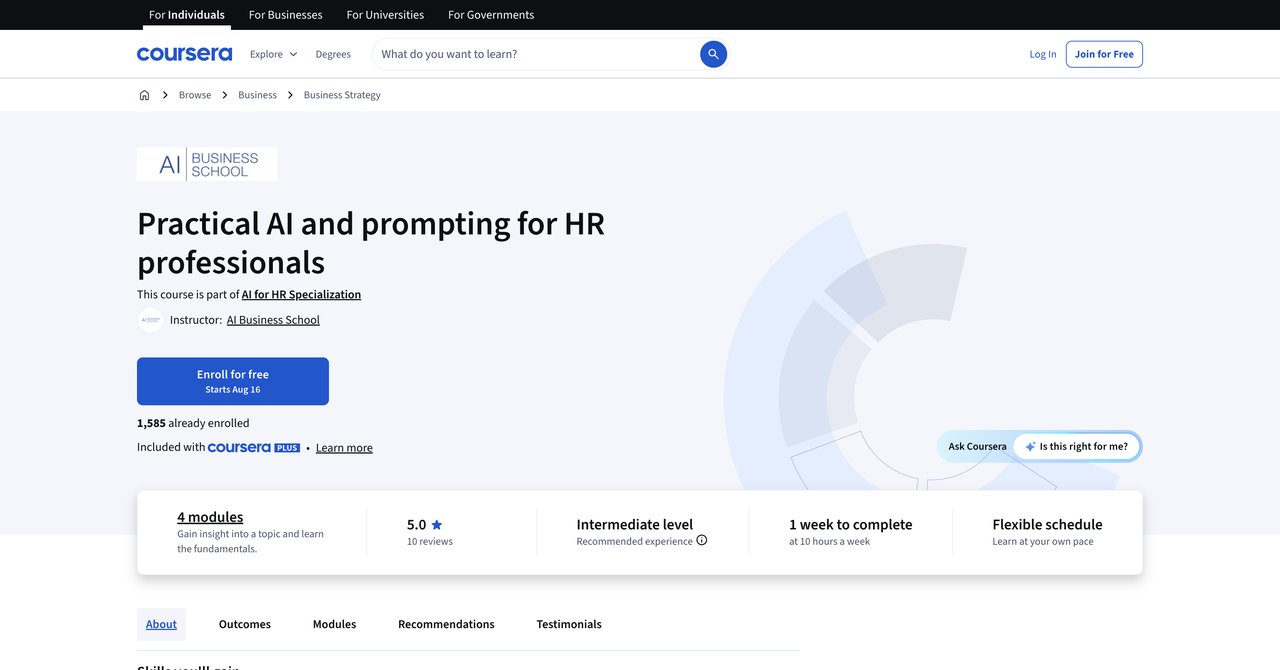
This course from Coursera positions itself as the working professional's entry point into applying AI specifically for human resources. It's free to audit, and its focus is not to give you a full-blown theory or strategy as way, but to give you experiential and immediate experience with the mechanics of prompting, specifically for HR use cases. For a VP, it can serve as an eye-opener about missed use cases in their own team just by understanding what their more junior staff members might be doing daily with generative tools.
It's solid for those who have an entry to intermediate level with AI because the course assumes a baseline understanding of what AI is and what it can do. The promotional material calls out that it's a conversation course, so you will not be leaving with a ready-to-go implementation plan for your department, but you will have practical prompts to use, adapt, and scale. There is also a level of job specificity, with HR scenarios relevant to documenting tasks, analysis, and policy outlines. Because it's unabashedly a hands-on, with no huge emphasis on the board-room view, you might find yourself skipping over pieces if you already know how to write a prompt.
Key Topics Covered:
Basics of generative AI, applicable use of ChatGPT and Copilot for HR, crafting prompts for job descriptions, and creating templates for any HR documents, analyzing HR data using AI.
Target Audience and Skill Level Requirements:
Intermediate, some basic familiarity with gen AI helpful. Great for HR business partners not necessarily VP level but valuable for upskilling your staff.
Pros:
- Hands-on, job-specific AI use cases
- Immediate practical experience
- Focused on HR tasks and efficiency in more tactical work
Cons:
- Short duration may not cover strategic depth
- Intermediate level assumes some AI familiarity
Who Would Benefit Most:
Very high level move for a senior HR leader that doesn't have time to strategize. You can also assign it to your team rather than take it yourself, because it's more about teaching staff to use AI efficiently day-to-day than it is about executive-level governance.
Course 3: Prompt Engineering for HR (Master AI Prompting for HR) (Udemy)
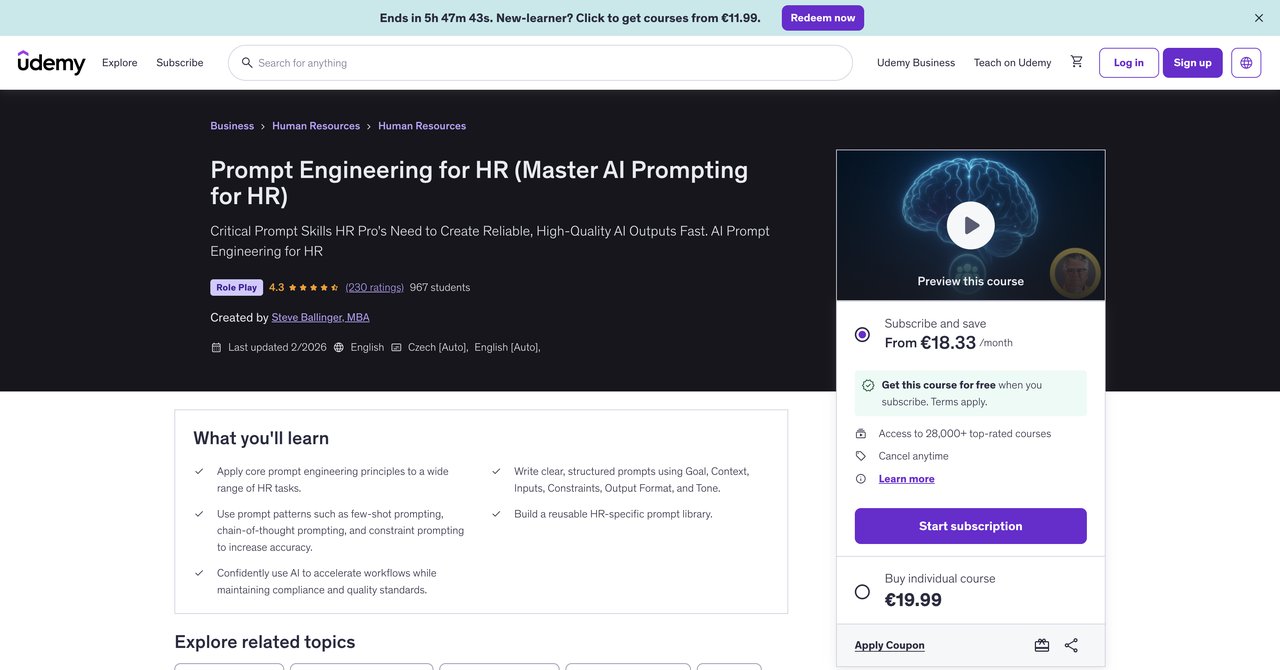
This Udemy course focuses specifically on the backbone of your HR team's efficiency - prompt writing-and goes deeper than just a generic introduction. The strengths are that it is structured, with a repeatable approach to prompt writing that yields quality outputs, and it covers very specific areas: recruiting, L&D, HR operations. It's like adding a technical skill to your team rather than a strategic divere. For a VP of HR, this might not be a course for you, but the content is exactly what your HRBPs would benefit from on a day-to-day basis, and it's cheap on Udemy. The course's content can feel very tactical, what we think about career development might be minimal or nonexistent.
The "cons" here are clear: it's limited to prompt engineering. It doesn't touch on preparing a whole AI strategy or dealing with implementation across the board. You also see a smaller rating sample size, so you can't be sure if it has been through extensive quality testing. However, in a world of referrals where everyone asks for a newbie-level prompt course, this one stands out for already-recruiting and training teams to make them sharp.
Key Topics Covered:
System-1 and System-2 prompting, writing for policy of complex prompts, recruitment, L&D, HR operations. Says: make it good.
Target Audience and Skill Level Requirements:
HR professionals with some exposure to using AI chatbots; no programming necessary.
Pros:
- Structured, repeatable approach to prompt writing
- Covers recruiting, L&D, and HR operations
- High-quality output focus
Cons:
- Limited to prompt engineering, not broader AI strategy
- Smaller rating sample size
Who Would Benefit Most:
HR Managers who want to improve the specificity and quality of their team's AI output, recruiters, HR ops team leads, not ideal for if you only need 'where to go next' strategy.
Course 4: Generative AI for Human Resources (HR) Professionals (Coursera)
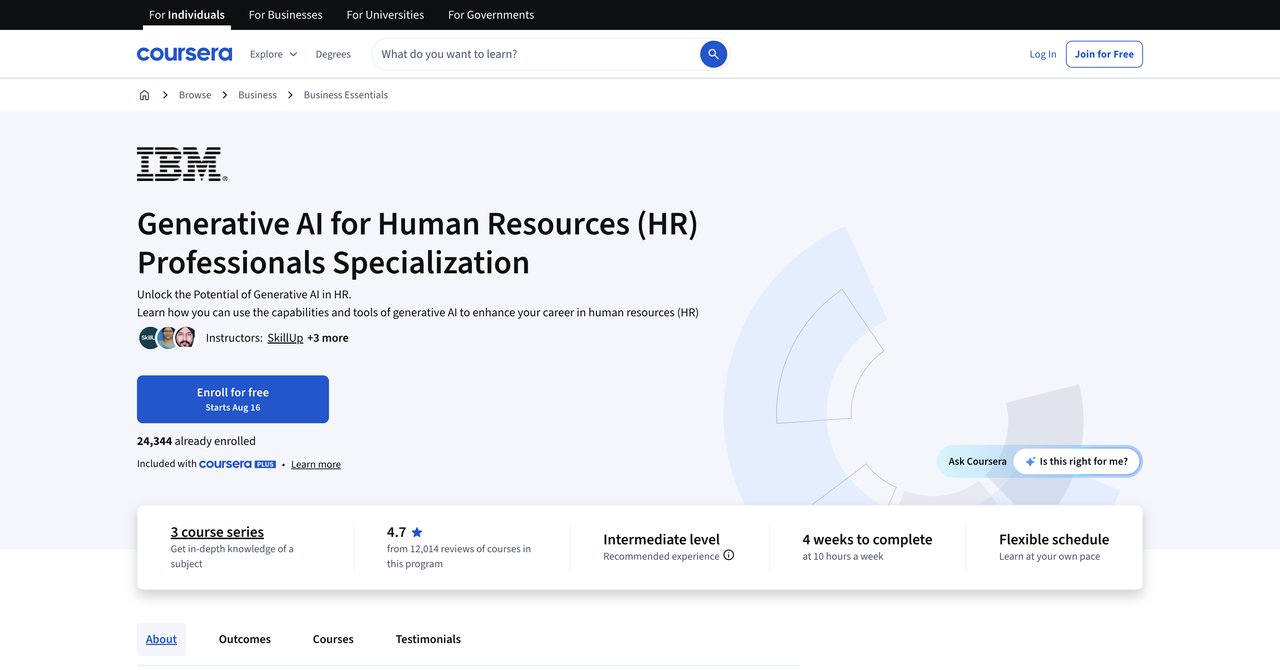
This Coursera specialization is a much wider umbrella. It covers the entire employee lifecycle, from recruitment and onboarding to training and performance management, and it does touch on prompt engineering all the while weaving in interpretation of ethics. For a VP, that might actually be a review if you already have a good overall view. However, it's a solid educational complement if you need to validate your knowledge or bring yourself up to speed on the more modern generative AI that's been infiltrating the entire employee lifecycle.
What makes it particularly useful? The ethics bit is not something that many platforms do well, and any AI practitioner will tell you that a negligent approach to ethics will blow up your project eventually. This specialization does include a focus on ethical considerations, which is a huge topic in polite AI space. Yet, the level is perfect for someone who is not the ultimate tech. It does require you to be at an intermediate level. It lacks executive-level strategy, which means you won't learn about substantial cost or long-term roadmap in the "professionals" course itself. If you get the subscription, you can look at other options within Coursera to fill that gap.
Key Topics Covered:
Using Gen AI across the talent lifecycle, AI in recruitment & onboarding, AI in performance management, and implementation of transparent AI systems, insights into bias detection and contiguous.
Target Audience and Skill Level Requirements:
Clear for intermediate HR professionals (director, manager) needing a bigger background overview of mainstream AI within HR, beyond final one-day, considering strategic integration.
Pros:
- Comprehensive specialization covering recruitment, onboarding, training, performance management
- Includes prompt engineering
- Ethical considerations addressed
Cons:
- Requires subscription
- Intermediate level may not cover executive-level strategy
Who Would Benefit Most:
HR Directors taking on the responsibility to lead digital changes, who also want a point of view on the long-term challenges of using AI in people management.
Course 5: AI for Human Resources Management / HR/ HRM Course (Udemy)
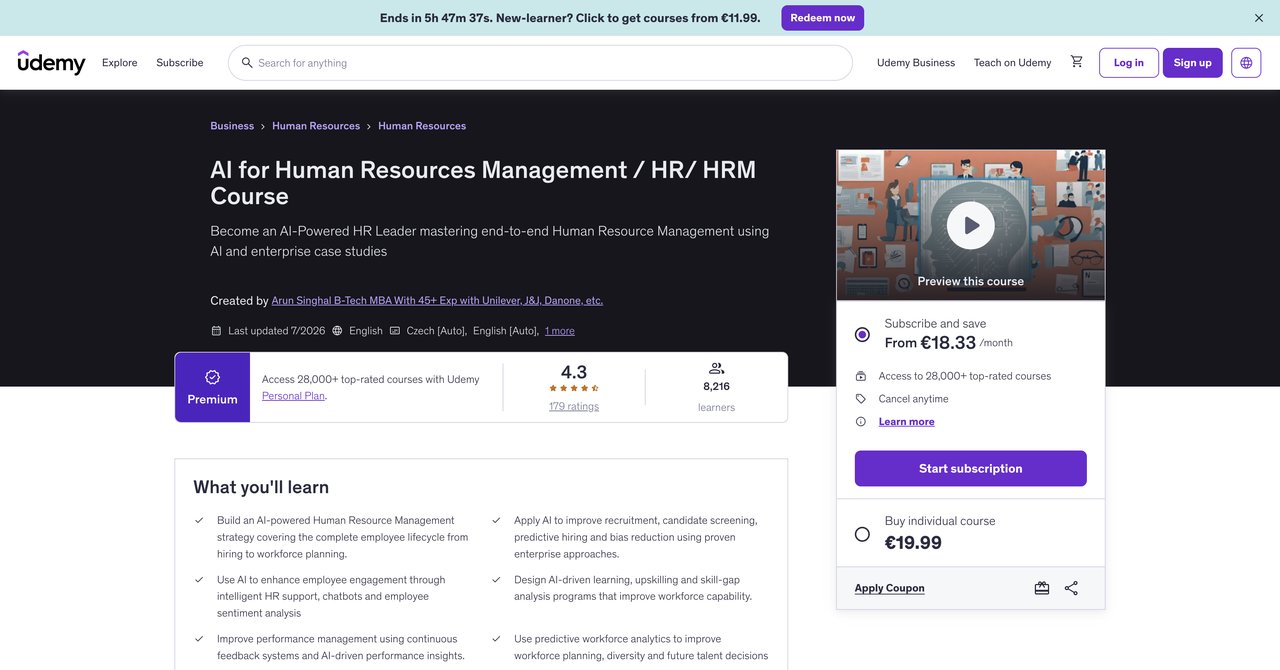
The flaw is in the proportion of coverage to duration: this is a well-rated course for the price and covers talent management, L&D, and performance management with a clear pragmatic focus. It's well received in the community and is often recommended to practitioners who need a quick start. For an SVP, this might be too narrow and not having enough long-term decision support. The course focus is "use cases" and where to apply AI in HR operations, being neat in knowledge print out. Still, it's ideal for your team members to take this as continuing ed without flaming out with too much concept. If you try to negotiate your budget, it's very suitable for a large training action.
Key Topics Covered:
Talent management, L&D, performance reviews, process automation in HRM, HRIS.
Target Audience and Skill Level Requirements:
Open to anyone, very user-friendly. Best for HR professionals who are not yet AI-savvy.
Pros:
- Covers talent management, performance management, L&D
- High rating
- Practical focus
Cons:
- Relatively short
- May lack depth on strategic AI implementation
Who Would Benefit Most:
Those who need a quick overview or to assign to new team members, not a person needing high-level IT alignment.
Course 6: Human Resources & Talent Management with Gen AI (Coursera)
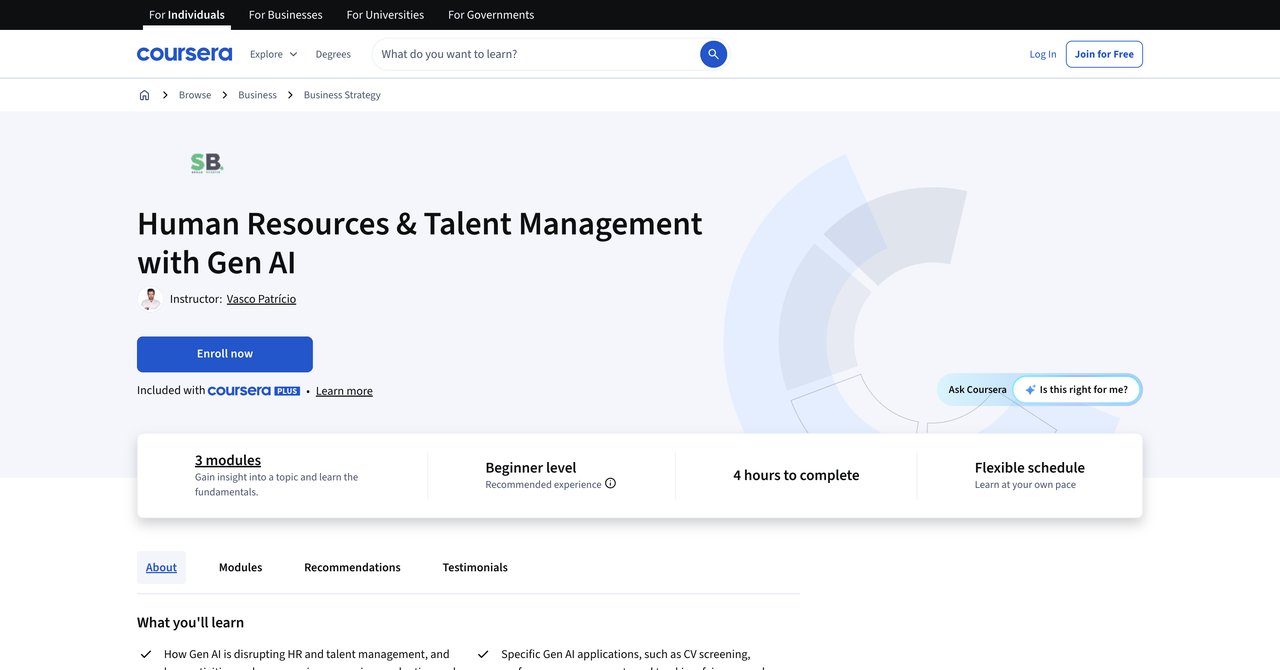
This course takes society a strategic eyesight towards the role of generative AI in talent management, thoughtfully looking at assessing, screening, and evaluating people, and those churn. The smaller part follows the way industry shifts how people are assessed or sifted by generative models. The breadth is narrow, so a VP might not need to complete the whole course after the first few lessons, but the way it's delivered holds potential for enabling strategy. This one fills in if you don't already have a clear policy on selection bias in AI, because they wrapped up with strategies in detail regarding how GPT models affect the recruiting funnel. There's a small amount of real-world insights from companies who use AI in talent decisions. The narrow scope means if you need a robust program, you have to mix with other things.
Key Topics Covered:
Talent acquisition using gen AI, resume screening, assessing candidates, performance evaluation, predictive people-focused models, compliance (considering the background).
Target Audience and Skill level:
People who have 1,2 years in HR/people management roles; it's good to see could also be useful for hiring managers outside of HR but it's on the higher-level.
Pros:
- Focuses on Gen AI disruption in HR
- Covers assessing, screening, evaluation
- Strategic perspective
Cons:
- Limited details on duration
- May be narrow in scope
Who Would Benefit Most:
Anyone looking for a more focused view on talent-related applications. If you need humanly complete the full recruitment through marks, this can be a functional watch on the way home.
Course 7: Design and Apply Generative AI for HR Performance (Coursera)
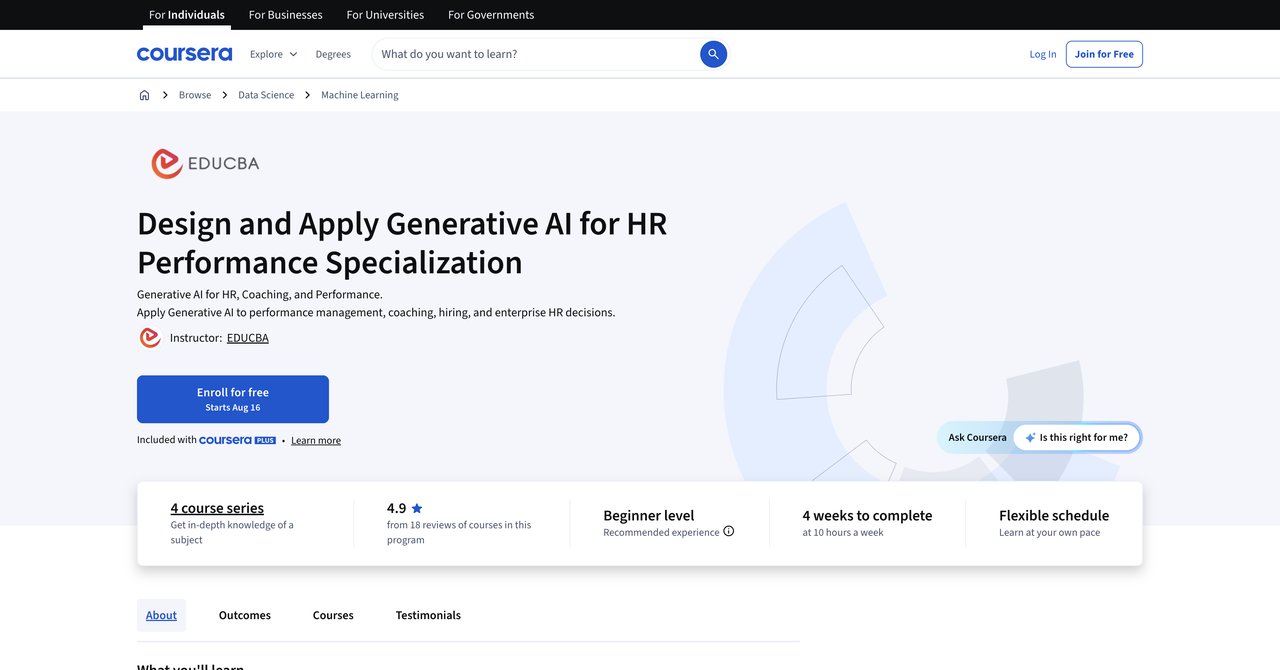
This specialization truly focuses on the health in HR.
It's about designing AI that is human-centered, fair, and ethical for HR performance. It's not just about the tech; it provides practical frameworks and real-world use cases, and it will for those who are serious about deploying AI in a way that won't risk of employee trust. This course offers operational ways to think about consumer design. It shows you patterns to use to assess an if algorithm is, using it across your the way it should be. If there's a potential downside, it's that this specialization might require real time commitment, but for a senior leader that is the price for crossing the T's.
Key Topics Covered:
Ethical frameworks for AI, fairness detection, supporting of data, real-world implementation cases, performance + performance reviews process.
Target Audience & Skill Level:
Designed for those ready to move past headline-level AI and can allocate prep time.
Pros:
- Focuses on human-centered, fair, and ethical AI systems
- Practical frameworks and real-world use cases
- Deployment strategies
Cons:
- Specialization may require significant time
- Limited rating data
Who Would Benefit Most:
HR VPs who are putting actual systems into production,needing to make them safe and compliant. It's less for the curious and more for the practitioner.
Course 8: Generative AI HR Professional (Coursera)
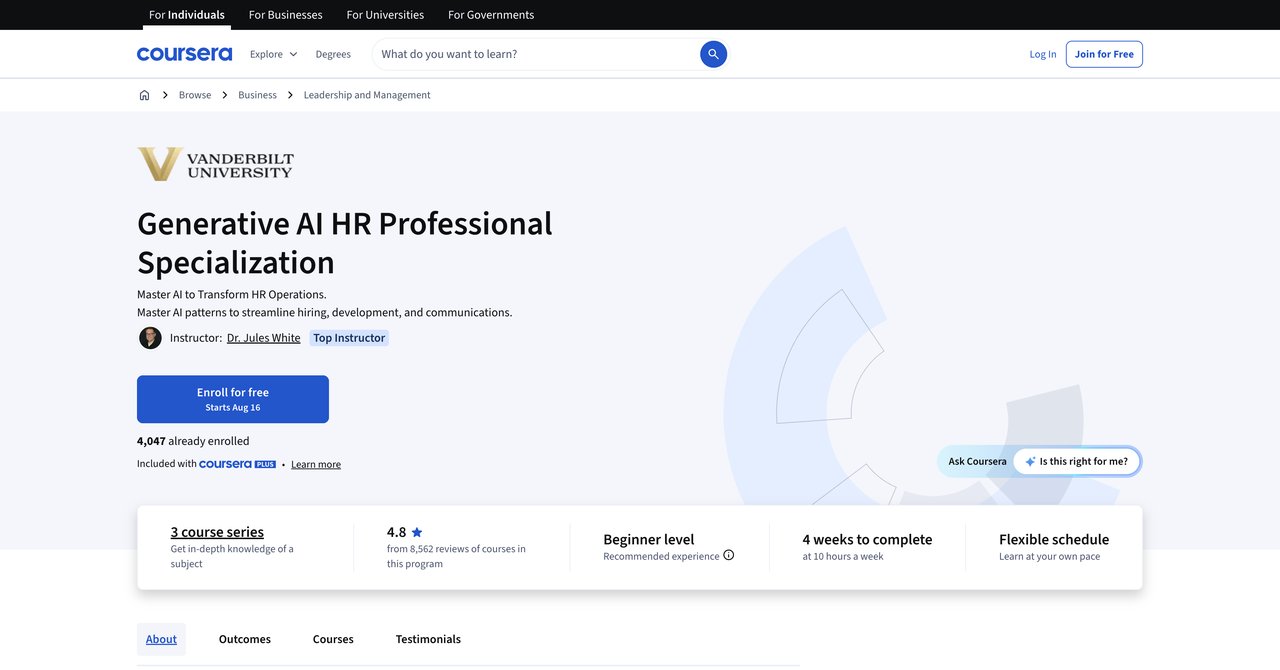
This one focuses on automating tactical and routine work. It teaches good habits to reduce AI hallucinations (which, yes, happen more than you think), and it moves on to transforming documents transforming into timelines, FAQs, emails. For a VP of Human Resources, it's likely to feel very operational but can help you free up your internal team's time if you're building a content heavy role. It is "Generative AI HR Professional", so its sharp focus is a set of specific tools that your team might apply to execution. If you have an internal comms or documentation system, this will be used by people on your team. The biggest drawback is that this could be seen as a fail-forward operational take, that is very useful for middle-managers to help them stop wasting hours drafting long emails.
Key Topics Covered:
Hallucination prevention, taking employee handbook to FAQ style documents, timeline creation, providing consistent email responses, daily workflows.
Target Audience and Skill Level:
Works best for HR coordinators and operations, not for strategic leaders.
Pros:
- Reduces AI hallucinations
- Transforms documents into timelines, emails, FAQs
- Frees time for strategic work
Cons:
- Focus on document transformation may be too tactical for some VPs
- Limited details
Who Would Benefit Most:
People on your team who pull 10 hours of content/slide-creation hours listed from their week.
Course 9: AI-Driven HR Strategy, Operations, and Regulatory Compliance (Coursera)
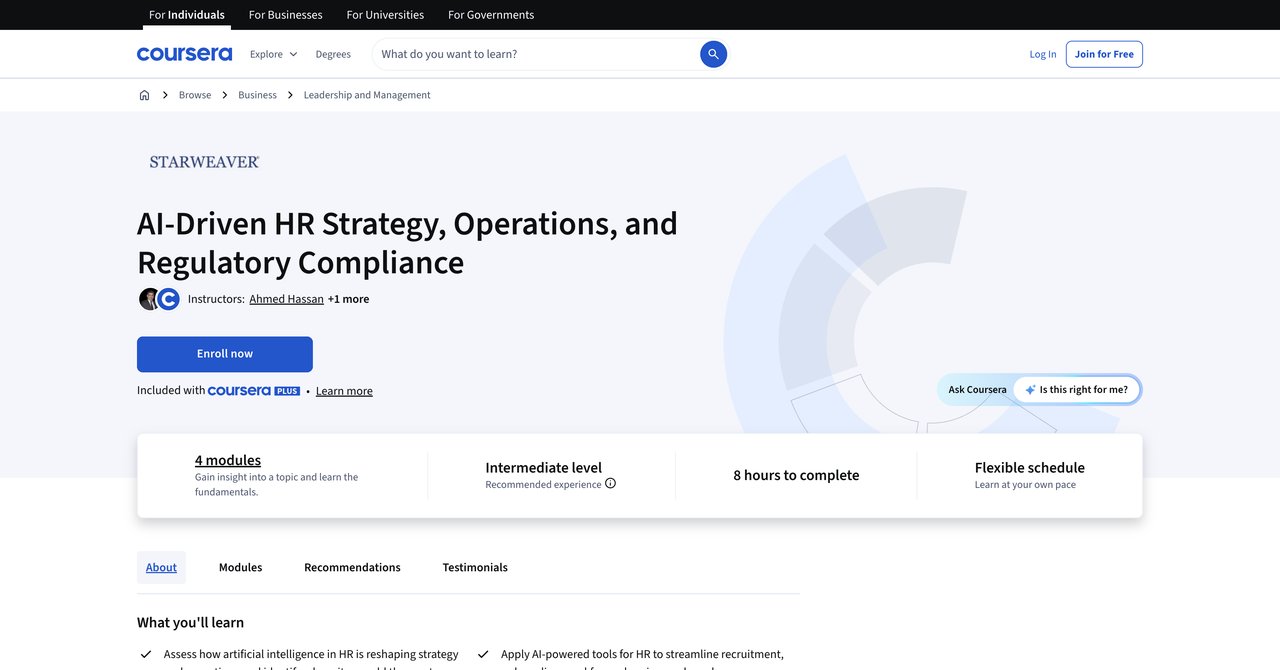
Perhaps one of the greatest returns among Coursera's general catalog for a VP, this course covers the junction of strategy, operations, and regulatory compliance. This is the one to sit with if you need a framework for deployment: it helps you manage the processes from a legal standpoint. You're getting that ground for operational roadmaps, which are essential to report to a board. Consider the employee lifecycle across each fold. If your primary pressure is why you can't get compliance right, this is a fire hose. It identifies high-value use cases, from recruitment to performance, and shows the entire chain in an implementation. The course can be a little high-level, but that's exactly what gives it scale.
Key Topics Covered:
Strategy development, process management, regulatory compliance, legal, case use cases, employee lifecycle.
Target Audience & Skill Level:
requires some prior HR knowledge and a realize in how HR is structured in your organization.
Pros:
- Covers AI strategy, operations, and compliance across employee lifecycle
- Identifies high-value use cases
- Theory to practice
Cons:
- No specific duration given
- May require prior HR knowledge
Who Would Benefit Most:
VP with mandate to implement AI at process level, likely one with a legal/compliance background of the signs.
Course 10: AI+ Human Resources Practitioner™ by ITCE
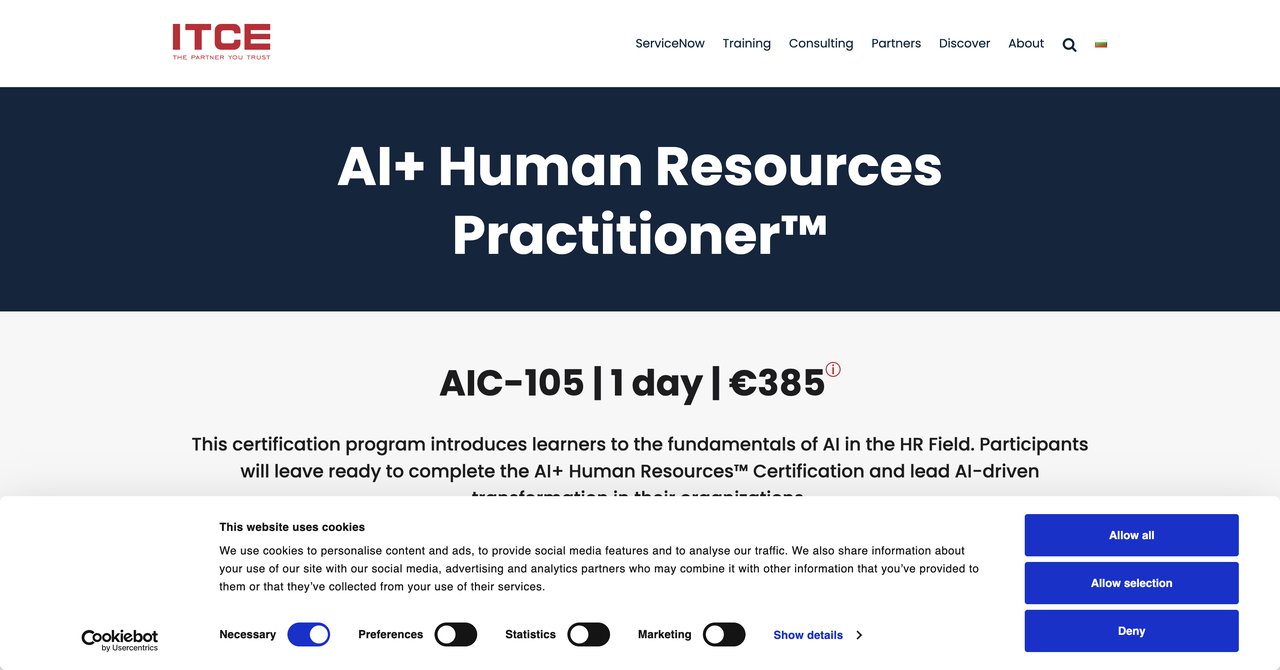
If you want a certification course with some hands-on practice on top of strategy, this one may catch your interest.
The structure includes certifications and covers what they often cover: recruitment, on boarding, management, employee experience, and it reserves a specific sequence for the EU AI Act compliance-never trivial nowadays. The short duration (one day or condensed) can seem intense, but they are open and you will have the advantage of a credential in a few days. Speed can be a pro, if you only need the 'cert'; it is a specific sore for someone who needs to get the line done soon. However, a one-day format is often not enough to properly dig deep into the many design weight and maintenance decisions of practical AI them. Fees aren't listed, you'll have to see, but the instruction does highlight hands-on activities, so that potentially worth a qualification.
Key Topics Covered:
Main principles of AI in HR, talent management, assessing employees, use cases, EU AI ACT, hands-on lab.
Target Audience & Skill Level:
An precious work-time limited HR leader in Europe or dealing with Europe.
Pros:
- Certification course
- Covers recruitment, talent management, employee experience
- Includes EU AI Act compliance
- Hands-on activities
Cons:
- One-day format may be too brief for deep learning
- Price not listed
Who Would Benefit Most:
Those who only need a compliance lead certificate, and already have strategy in-house.
Course 11: AI for HR | Short Course by IMI

This workshop stands out because it has both human center and in carving an in-person experience. It is a one-day workshop in Dublin, which might actually be a direct positive for local participants. The content covers recruitment, learning and development, and employee wellbeing, with an underlying 'human-centric' ethos. The hands-on exercises and case studies offer practical learning, but at a price of €1095 it is probably the most expensive 1-day offerings in this summary. If you live in Ireland or can travel, there is nothing like getting out of the office and meeting other HR professionals in the flesh. The virtual bottleneck is off the table, but the in-person requirement blocks people from taking it from their desk.
Key Topics Covered:
Recruitment with AI, L&D strategies, employee wellbeing and support, human-centric approaches to AI, case study work.
Target Audience and Skills Level:
For people who have a secret connection in their daily work and want human peer-to-peer interaction. Fine for all levels of HR.
Pros:
- Human-centred approach
- Covers recruitment, L&D, employee wellbeing
- Hands-on exercises and case studies
- In-person at Dublin campus
Cons:
- One-day duration
- In-person only, limiting accessibility
- Higher cost
Who Would Benefit Most:
Ireland-based senior HR leaders looking for networks and case discussions in an intimate setting.
Final Recommendations and Unbiased Summary
Naturally, there isn't a single "best" option, but it's all about what you need. Let's break this down.
If you want 360 access and value for the budget , and for the whole team , the best value by far is CompleteAI Training subscription. There is no question that a per-course approach makes costly the moment you need continuous learning, especially for continuation of the manager track. Since the complete training subscription includes everything from AI for VP of HR, all other job roles, and future certifications, it's an incredibly solid option that could replace more expensive subscriptions if you plan to upskill a lot. It offers the most flexibility for the senior leader whose work never has a precise outline. Using the annual billed pricing of $8.25/month puts it below the lowest barriers to content and certification. The other courses usually have a monthly fee of $30-50 or even $100, and they don't result in published certifications. So, for many, this is simply a better value package-all of your tracking and future updates without counting how many token access rules apply.
For an executive whose only concern is strategy and regular compliance: Coursera's AI-Driven HR Strategy, Operations, and Regulatory Compliance comes out as a spending useful product, because it goes straight to the loop between the technical and governance aspects in a way not found elsewhere. It's not as detailed as the CompleteAI Training solution, but it does well in its direct consultation exercises. You will need a subscription to Coursera, but you can subscribe to one course and is around $1,200/yr so you may get the Complete AI approach for a much lower price and be everywhere.
For a candidate who just wants to make their prompts better: Udemy's Prompt Engineering for HR is designed for this but closed application. But it's cheap, validated for quality, and is exactly the thing to place in an L&D track for a group of people who work on recruiting process with models.
For someone who's legal danger: ITCE's AI+ HR Practitioner is useful, but the rating data is limited, and the price is in an unknown range. This one of the only visible options that explicitly mentions the EU AI Act, which is an important requirement for EU-scale talent operation. Beware that one day of learning on this could be a cram session, not enough deep experience.
If you are looking for a beautiful in-person networking opportunity and money isn't an issue: the IMI AI for HR workshop at the Dublin campus is a steal-high cost but can be the differentiating power for hiring a leader of a team in that region. But look at the return; it's like "here's one day on general tips"-it isn't with 10% of the content, but the peer-to-peer value create an ROI only if you already know what you'll have.
Finally, if you plan to have your HRBP whole team to adapt, you can't go far wrong assigning them to the Coursera hands-on courses like Practical AI and Prompting {2} in addition to Udemy's longer lifespan courses {5} and those who need HR Ops document automation {8}. This is a straightforward upskill strategy, namely complete a hybrid plan.
Do be mindful that the so-called "specialization" courses on Coursera sound prestigious but often cost more long-term than subscripting to a system like CompleteAI Training and include a one-off certificate as an upwell. But if you are more on the track standard bigger ecosystem in higher ed, certificate approach. The insurance might be these due-at a subscription that includes everything. Ultimately a VP of Human Resources must be comprehensive in their thinking. Given dynamic nature of AI and a need to cover many roles, the investment of a low-cost subscription that offers all the courses and all certifications is one of the most durable choices for a professional who wants to remain an expert without paying out multiple entry fees
Meet your learning plan from the side of desire. If you need immediate fixes, pick one of the operation. If you need to build a strong case for available decision and trend, then you need larger difference that is "all other roles too". Let me suggest: you won't regret signing up for a single month of CompleteAI Training just to test. It's cheap enough to do it and then take a look at the fruits; you will likely find dozens of useful trainings beyond HR that justify the subscription. It's a no brainer for any VP level leader who wants one domain membership covers.