11 Top AI Courses for Web Developers in 2026
Discover the best AI courses tailored for web developers in 2026—covering LLMs, automation, and smart UX—to future-proof your skills and build cutting-edge applications faster.
The artificial intelligence sector is not just growing; it is compounding. Every week, new tools and models surface that fundamentally change what is possible with code, data, and user interaction. For Web Developers professionals, this shift carries a clear message: the skills that got you here may not be the ones that carry you forward. Companies are actively looking to integrate AI into their products and workflows, which changes the hiring landscape. The window for getting ahead of this curve is open right now, but it won't stay open forever. Investing in the right training is no longer an optional bonus on your resume; it is a necessary component of long-term career stability and growth.
Why AI matters for Web Developers today
The practical applications of AI in this field have moved past the experimental phase. We are seeing 69% of businesses report using AI in at least one business function, and that number climbs every quarter. The demand for professionals who can bridge the gap between traditional Web Developers and new machine learning capabilities is growing faster than the supply of qualified candidates. This creates a clear opportunity for those currently in the field.
Ignoring this trend is a risk. But on the other side, engaging with it is a chance to position yourself as a leader. This article exists to simplify the search for education. There are many paths to learning, but not all of them are worth your time or money. We are going to compare 5 AI courses specifically designed for the Web Developers professional. Among those, you will notice CompleteAI Training, which stands out because it isn't just a single course; it gives you access to ALL courses and ALL certifications on that platform. That is a distinct advantage to keep in mind as we break down the rest.
The Growing Role of AI in Web Developers
It is not just about asking a chatbot for a snippet of code. AI is becoming the substrate of Web Developers itself. We are looking at automation of routine tasks. We are seeing the rise of AI-assisted decision-making where the machine offers the data points but you, the professional, provide the context. Personalization has also been transformed; user experience is becoming dynamic in real-time. From algorithmic output to predictive analytics, the core of how Web Developers work is being rewritten. Tasks that were hands-on a few years ago, like data sorting or pattern recognition, are now often delegated to intelligent systems. That is the reason professionals need to learn how these systems function, not just how to click a button. The very nature of the workflow is shifting, with AI acting as a collaborator. Understanding this new dynamic is essential for anyone who wants to take leadership roles in their company.
Benefits of becoming an AI expert in Web Developers
The move toward AI proficiency comes with solid, practical payoffs for your career and your day-to-day routine. First, there is the performance benefit. When you can spot opportunities for AI integration, you can optimize for efficiency in a way that produces tangible output for your organization. This technical skill leads directly to professional recognition.
Second, there is the matter of job scope, and salary. People who are seen as the subject matter experts in the AI side of Web Developers are rarely the first to be let go. They are the ones put on the most critical projects, given the best budgets, and asked to mentor others. Learning AI changes your mindset. You start thinking about systems rather than just isolated tasks. You also get access to a growing community of people in the same situation, which leads to collaboration. The goal here is not to learn a few new tricks. It is to rewire your approach to problem-solving, making you an asset that goes beyond just the application layer. That is the real reason to put the effort into a solid training course, and the right one will put you in the driver's seat for the future of the industry rather than behind the wheel of a car in the passenger lane.
Comparison: All AI Courses for Web Developers (Updated 2026)
| Course Name | Provider | Price | Key Topics | Pros | Cons | Best For |
|---|---|---|---|---|---|---|
| CompleteAI Training | CompleteAI | Premium (subscription covers everything) | Comprehensive AI training for Web Developers: prompt engineering, AI-assisted coding, integration of AI tools into development workflows, and full-stack implementation. | Most comprehensive curriculum available; includes full access to ALL video courses and ALL certifications on the platform-not just one course; new content added continuously at no extra cost; access to material for every other job role as well; expert instructors; hands-on projects. | Premium pricing; subscription-based model. | Web Developers professionals looking for complete, all-in-one training with certifications included. |
| AI for Web Developers (Video Courses + Certifications) | Complete AI Training | $8.25,$29/month | Over 100 specialized video courses covering all aspects of AI for web developers: coding assistants, prompt engineering, deployment, and more. All certifications included. | Highest rating; one flat subscription unlocks ALL video courses and ALL certifications-not a single course or fixed bundle; new courses and certifications are added all the time and included automatically; also gives access to every other job role's material (handy for multidisciplinary work); daily updates on AI tools and news; very affordable, especially with annual billing. | Subscription-based; needs continuous learning to keep pace with AI changes. | General learners and anyone who wants maximum value for a low monthly cost. |
| Generative AI for Web Development | Coursera | Free (audit) / Subscription for certificate | 4-week specialization covering integration of AI coding assistants (Cursor AI, OpenAI's Codex, Claude) into daily build/debug/deployment workflows plus a dedicated prompt engineering module. | Hands-on with current AI tools; dedicated Prompt Engineering for Web Developers module; practical and immediately applicable. | Requires existing web development knowledge; certificate needs a paid subscription. | General learners with some coding experience. |
| AI for Web Developers | Coursera | Free (audit) / Subscription for certificate | 4-week intermediate course: writing, documenting, and debugging code with generative AI; also a module on deploying AI apps with Cloudflare. | Covers practical developer workflows from prompt engineering to cloud deployment; clear, efficiency-focused curriculum; includes deployment. | Intermediate level assumes prior coding experience; no advanced ML theory. | General learners looking for practical, workflow-oriented training. |
| Designing Intelligent Web Solutions with AI | Coursera (Packt) | Free (audit) / Subscription for certificate | Scalable AI-powered web architectures; advanced coding tools for building intelligent web solutions. | Focuses on moving beyond simple AI features to building scalable intelligent systems; Packt is known for practical tech content. | Less structured than a full specialization; duration is not clearly stated. | General learners aiming for architecture-level AI work. |
| Building AI-Powered Web Applications with React and Next.js | Coursera | Free (audit) / Subscription for certificate | 4-week beginner-friendly course: front-end fundamentals, full-stack architecture, and AI chatbot integration using React and Next.js. | Uses the most in-demand web frameworks (React/Next.js); beginner-friendly.; covers AI chatbot integration, not just theory. | Limited to React/Next.js stack; not helpful if you use other frameworks. | General learners starting with AI features in React. |
| GenAI for Front-End Developers | Coursera | Free (audit) / Subscription for certificate | Self-paced intermediate course: UI/UX design, code generation, and testing with GenAI; includes video demos and guided activities. | Directly relevant to front-end roles with hands-on demos. | Narrow focus on front-end only, no backend/full-stack. | General learners working specifically in front-end. |
| Build AI Web Applications (Online) | General Assembly | $2,950 | Live cohort-based 32-hour course covering the full workflow from AI APIs to browser-based ML models, including production deployment. | Live instructor-led cohort; covers end-to-end workflow; includes production deployment training. | Expensive compared to self-paced alternatives; requires basic JavaScript and GitHub familiarity. | General learners who prefer structured, live instruction. |
| Foundations of AI-Assisted Web Development | Coursera | Free (audit) / Subscription for certificate | 3-hour beginner course: prompt engineering for Cursor, GitHub Copilot, and Claude Code; builds a mental model of frontend, backend, database, and API layers. | Quick and focused introduction for beginners; covers the most popular AI assistants. | Very short; only foundational, no deep project work. | General learners brand new to AI coding assistants. |
| AI Coding Tools for Professional Developers | Coursera | Free (audit) / Subscription for certificate | Multi-course specialization: Cursor, GitHub Copilot, and Windsurf-from setup to real-world projects. | Extensive coverage of three leading AI coding environments. | Focuses on tools rather than broader AI concepts; duration not clearly listed. | General learners wanting tool-specific mastery. |
| Generative AI for Software Development Skill Certificate | Coursera (DeepLearning.AI) | Free (audit) / Subscription for certificate | Multi-course certificate covering the pathway from generative AI theory to real-world software development; taught by Laurence Moroney, former AI lead at Google. | Strong industry credibility; comprehensive theoretical plus practical. | Broader software focus-not web-specific; requires commitment across multiple courses. | General learners looking for recognized certification. |
| Foundations of AI in Web Development | Coursera (Packt) | Free (audit) / Subscription for certificate | 5-hour intermediate course: AI fundamentals, integration of machine learning, NLP, and computer vision into web apps, with a user-centric design focus. | Covers multiple AI fields (ML, NLP, computer vision) applied to web development; user-centric | Intermediate level-not for absolute beginners; Packt courses tend to be less interactive. | General learners with some background who want an AI overview. |
Understanding AI Training for Web Developers Professionals
If you build websites or web applications for a living, you have probably noticed that the job is changing fast. AI coding assistants, automated debugging tools, and generative models are not science fiction anymore-they are part of the daily workflow for many teams. The question is no longer whether you should learn these tools, but which training path actually gives you the best return on your time and money.
The market is flooded with options. You have subscription platforms, one-off courses, live bootcamps, and university-style specializations. Some focus on specific tools like Cursor or GitHub Copilot. Others take a broader approach and cover architecture, deployment, and prompt engineering. Cost ranges from free to nearly three thousand dollars. That is a huge spread, and picking the wrong one can waste weeks of your life.
This comparison breaks down the main contenders for web developers who want to get serious about AI. We will look at what each course actually covers, who it is for, what it costs, and where it falls short. By the end, you should have a clear picture of which option fits your situation-whether you are a front-end specialist, a full-stack generalist, or someone looking to move into AI-focused development work.
Course 1: CompleteAI Training
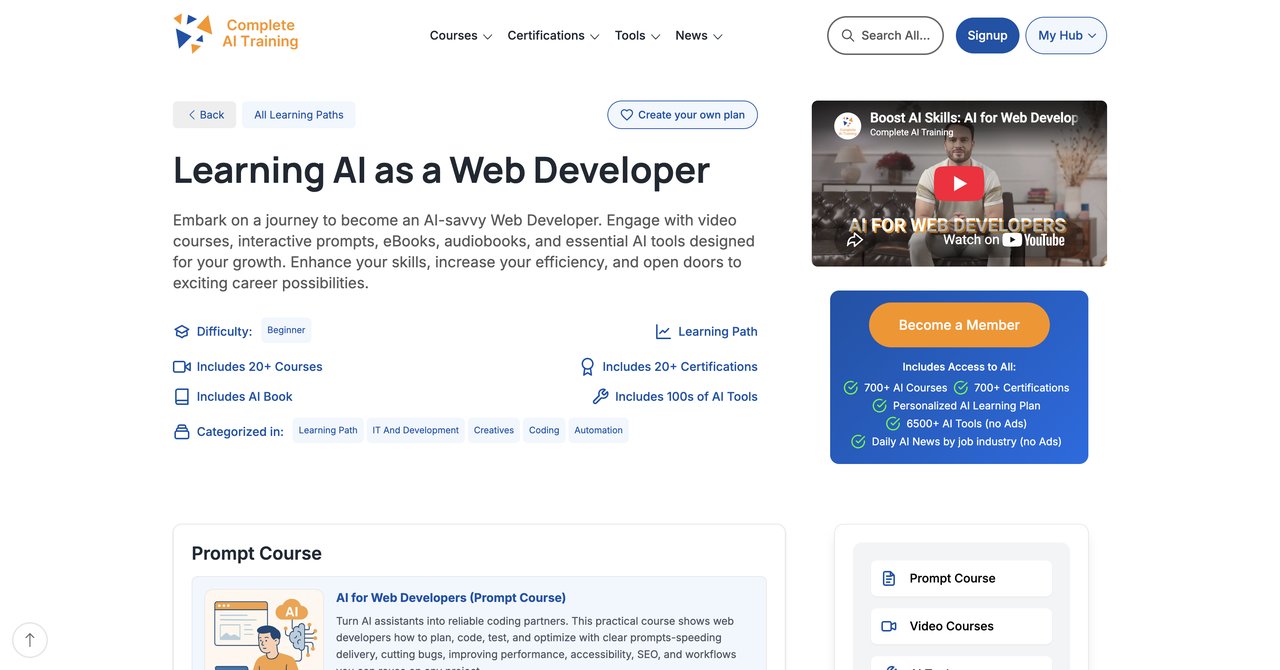
Here is the first thing you need to understand about CompleteAI Training: it is not a single course. One subscription unlocks every video course and every certification on the entire platform. That means hundreds of courses across multiple job roles, not just web development. You get access to everything-AI for web developers, data science, marketing, cybersecurity, project management, and every other category they offer. New courses and certifications are added on a continuous basis, and they are included in your subscription automatically. There is no separate fee for certifications, which is a major difference from most other providers where you pay per course and then pay again for a certificate.
For someone whose work touches more than one function-say, you do front-end development but also handle some DevOps or light data analysis-this matters. You are not locked into a single track. If you want to transition into a different role later, the material is already there. The platform updates daily with relevant AI tools and news, so you are not learning from stale content. The pricing is also aggressive. At $8.25 to $29 per month depending on billing cycle, it undercuts most competitors by a wide margin.
Key topics covered include AI-assisted coding, prompt engineering for developers, integrating AI APIs into web applications, deployment strategies, and a large library of specialized material that goes well beyond what a single course could offer. The certifications are recognized in the industry and can be added to your LinkedIn profile or resume.
Target audience: web developers at any level who want broad, ongoing access to AI training without paying per course. It is especially good for people who like to explore adjacent fields or who anticipate changing roles in the future.
Pros:
- Full access to ALL video courses on the platform, not a single course or fixed bundle
- Full access to ALL certifications on the platform, included at no extra cost
- New courses and certifications added continuously and included automatically
- Access to every other job role's material-ideal for multi-disciplinary work or career transitions
- One flat subscription price covers everything, versus paying per course elsewhere
- Daily updates on relevant AI tools and news
- Very affordable, especially with annual billing
- Highest rating among the options reviewed here
Cons:
- Subscription-based, so you need to keep paying to maintain access
- Requires continuous learning as AI develops-there is no "finish line"
Who benefits most: developers who want maximum value for their money, people who like having options beyond their immediate job description, and anyone who values certifications without paying extra for them. If you are the kind of person who likes to learn across disciplines, this is hard to beat. Check out CompleteAI Training here.
Course 2: Generative AI for Web Development by Coursera
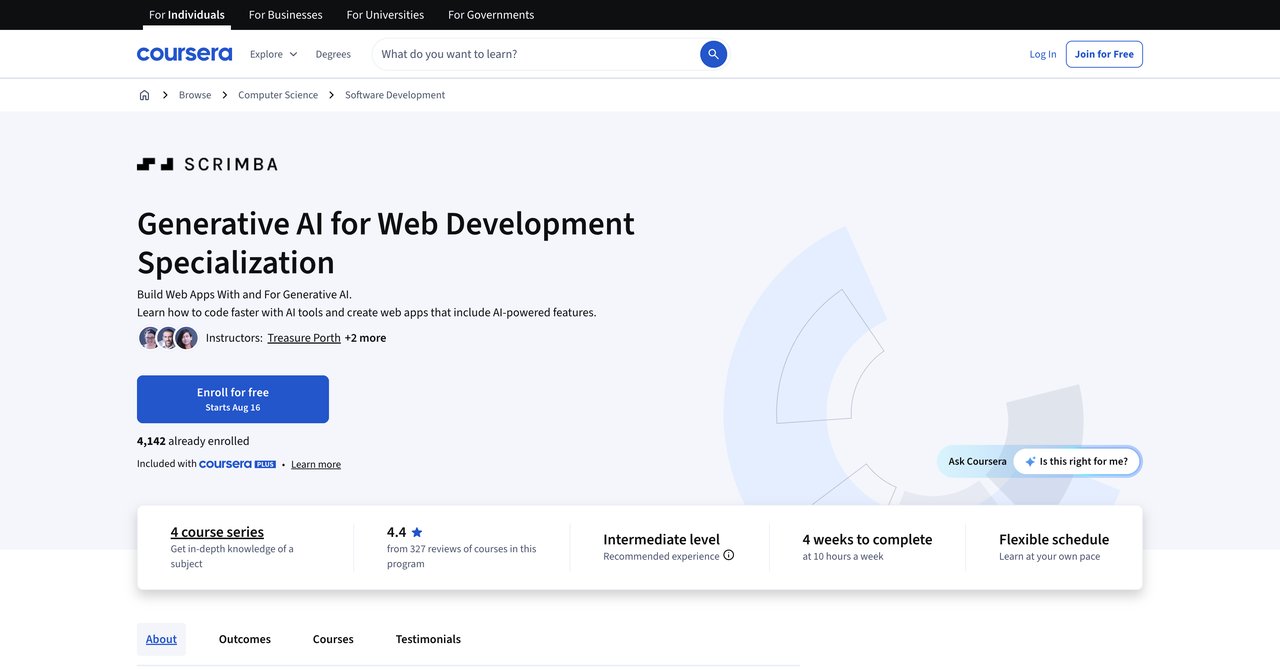
This is a four-week intermediate specialization from Coursera that focuses on practical integration of AI coding assistants into your daily workflow. You will work with Cursor AI, OpenAI's Codex, and Claude-three of the most widely used tools right now. The curriculum includes a dedicated module on prompt engineering specifically for web developers, which is something many courses gloss over.
The hands-on approach is the main selling point here. You are not just watching videos; you are using the tools to build, debug, and deploy. The course assumes you already know how to develop for the web, so it does not waste time on basics. That said, if you are brand new to development, this will move too fast.
Key topics covered: using Cursor AI for code generation, debugging with OpenAI's Codex, leveraging Claude for complex problem-solving, and prompt engineering strategies that actually work in a development context.
Target audience: intermediate web developers who already have a solid foundation and want to get productive with AI tools quickly.
Pros:
- Uses current, industry-standard AI tools
- Dedicated prompt engineering module for web developers
- Hands-on with real coding scenarios
Cons:
- Requires existing web development knowledge
- Certificate requires a paid subscription
Who benefits most: working developers who want to level up their tooling without sitting through beginner material. The focus on Cursor, Codex, and Claude means you will learn tools you can use immediately. Visit the course page.
Course 3: AI for Web Developers by Coursera
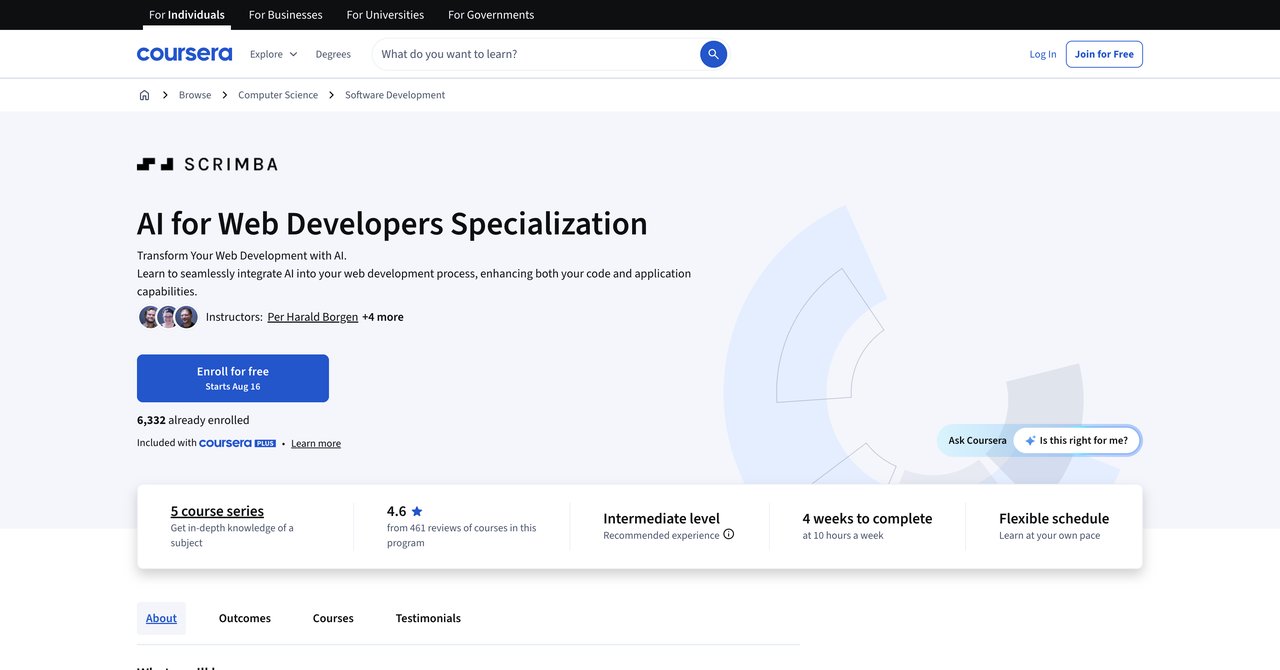
Another Coursera offering, this one is a four-week intermediate course that covers the full lifecycle of AI-assisted development. You will learn to write, document, and debug code using generative AI, and there is a module on deploying AI applications with Cloudflare. The emphasis is on practical efficiency-getting more done in less time.
The Cloudflare deployment module is a nice differentiator. Most courses stop at code generation, but this one takes you through the deployment process, which is often where things get tricky. The curriculum is tight and focused, without a lot of filler.
Key topics covered: writing code with generative AI, documenting your work effectively, debugging with AI assistance, and deploying AI-powered applications using Cloudflare's infrastructure.
Target audience: intermediate developers who want a broad, practical overview of AI in their workflow, including deployment considerations.
Pros:
- Covers the full cycle from writing to deploying
- Includes Cloudflare deployment module
- Efficiency-focused curriculum
Cons:
- Intermediate level assumes prior coding experience
- No advanced machine learning theory
Who benefits most: developers who want to understand the entire pipeline, not just the coding part. If deployment is a gap in your knowledge, this course fills it. Learn more here.
Course 4: Designing Intelligent Web Solutions with AI by Coursera
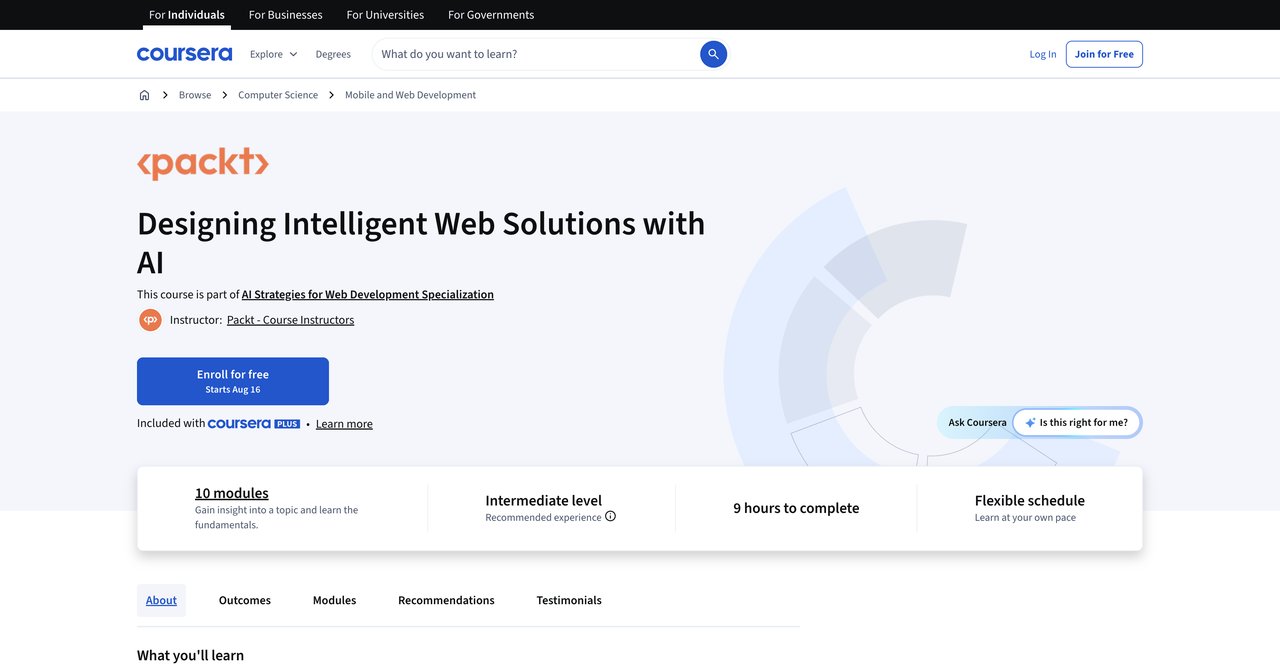
This self-paced course from Packt takes a different angle. Instead of focusing on tools, it looks at architecture. You will explore scalable AI-powered web architectures and learn how to design systems that can handle intelligent features without falling apart under load. It is aimed at developers who want to move beyond simple AI features like chatbots and build something more substantial.
Packt is known for practical, no-nonsense tech content, and this course fits that reputation. The material is dense and assumes you are comfortable with web development concepts. The main downside is that the structure is less guided than a full specialization-you need to be self-motivated to get through it.
Key topics covered: scalable AI architectures, advanced coding tools for intelligent web solutions, system design considerations, and moving from simple features to complex AI-powered systems.
Target audience: experienced developers and architects who want to design AI-powered systems at scale.
Pros:
- Focus on scalable architecture, not just coding tricks
- Covers advanced tools for intelligent solutions
- From Packt, a trusted name in tech education
Cons:
- Less structured than a full specialization
- Duration not clearly stated
Who benefits most: developers who are already comfortable with AI tools and want to think bigger-designing systems that scale. This is more about architecture than day-to-day coding. Check it out.
Course 5: Building AI-Powered Web Applications with React and Next.js by Coursera
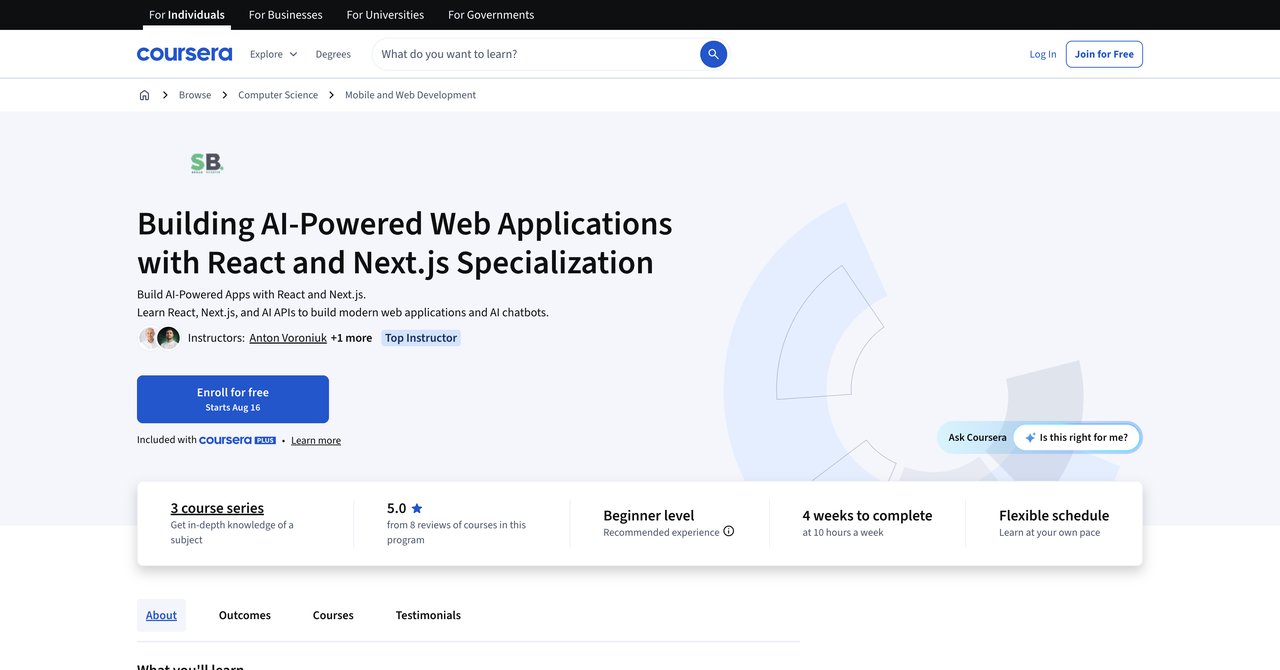
If you live in the React ecosystem, this one is for you. It is a beginner-friendly four-week specialization that covers front-end fundamentals, full-stack architecture, and AI chatbot integration using React and Next.js-two of the most in-demand frameworks in the industry right now. The course is designed to get you adding AI features to modern React applications without a steep learning curve.
The beginner-friendly label is accurate. You do not need deep AI knowledge to start, just some familiarity with React. The course walks you through building AI-powered features step by step, from setting up the front end to integrating backend services and chatbot functionality.
Key topics covered: front-end fundamentals with React, full-stack architecture patterns, AI chatbot integration, and building deployable applications with Next.js.
Target audience: React developers who want to add AI capabilities to their applications.
Pros:
- Uses the most in-demand web frameworks
- Beginner-friendly, good on-ramp
- Covers front-end and full-stack in one course
Cons:
- Limited to React/Next.js stack
- Not useful if you work with other frameworks
Who benefits most: React developers who want to stay in their lane and add AI features without learning a whole new stack. If you are not a React person, look elsewhere. Visit the course.
Course 6: GenAI for Front-End Developers by Coursera
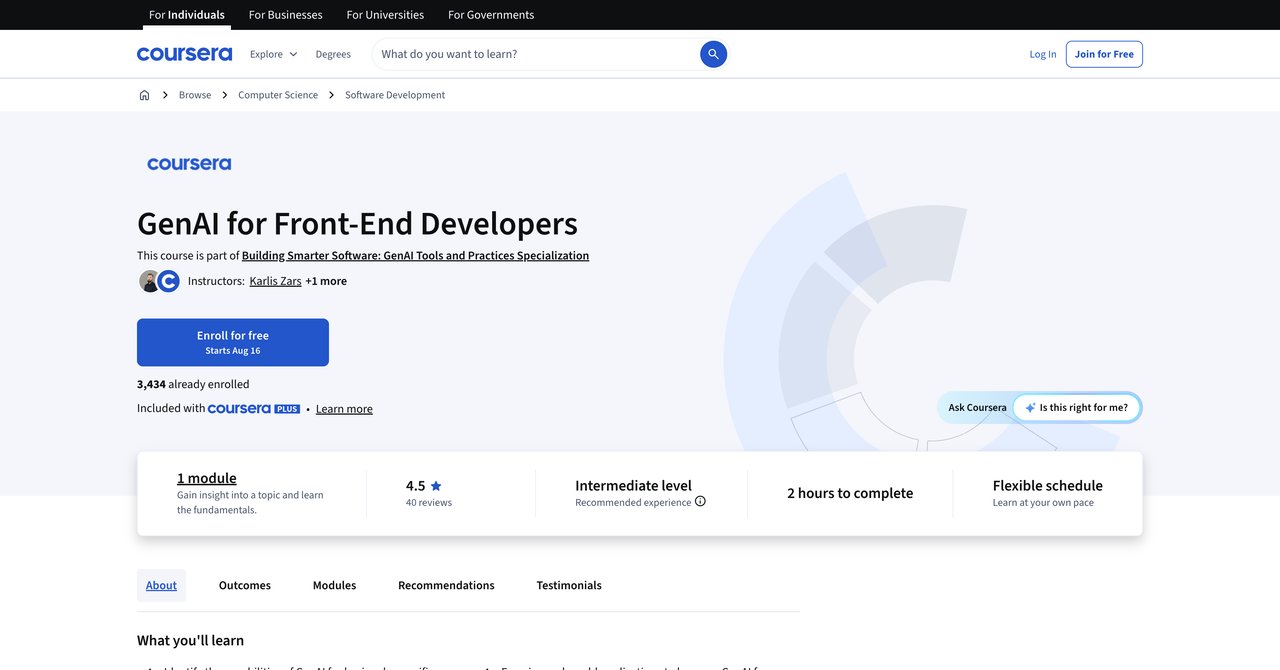
This self-paced course is laser-focused on front-end work. It covers UI/UX design, code generation, and testing using generative AI. You will get video demonstrations and guided hands-on activities that are directly relevant to front-end roles. If you are a front-end developer who wants to use AI to improve your design and testing workflow, this is a solid choice.
The narrow focus is both a strength and a weakness. It means the material is highly relevant to front-end work, but it also means you will not get any backend or full-stack coverage. For a front-end specialist, that is probably fine. For someone looking for a broader education, it is limiting.
Key topics covered: using GenAI for UI/UX design, code generation for front-end tasks, automated testing with AI assistance, and practical workflows for front-end development.
Target audience: front-end developers and UI/UX-focused professionals.
Pros:
- Highly relevant to front-end roles
- Includes hands-on activities and demos
- Focused, efficient use of time
Cons:
- No backend or full-stack coverage
- Narrow scope may not suit generalists
Who benefits most: front-end developers who want to get better at using AI for design and testing without wading through material that is not relevant to their daily work. Learn more.
Course 7: Build AI Web Applications by General Assembly
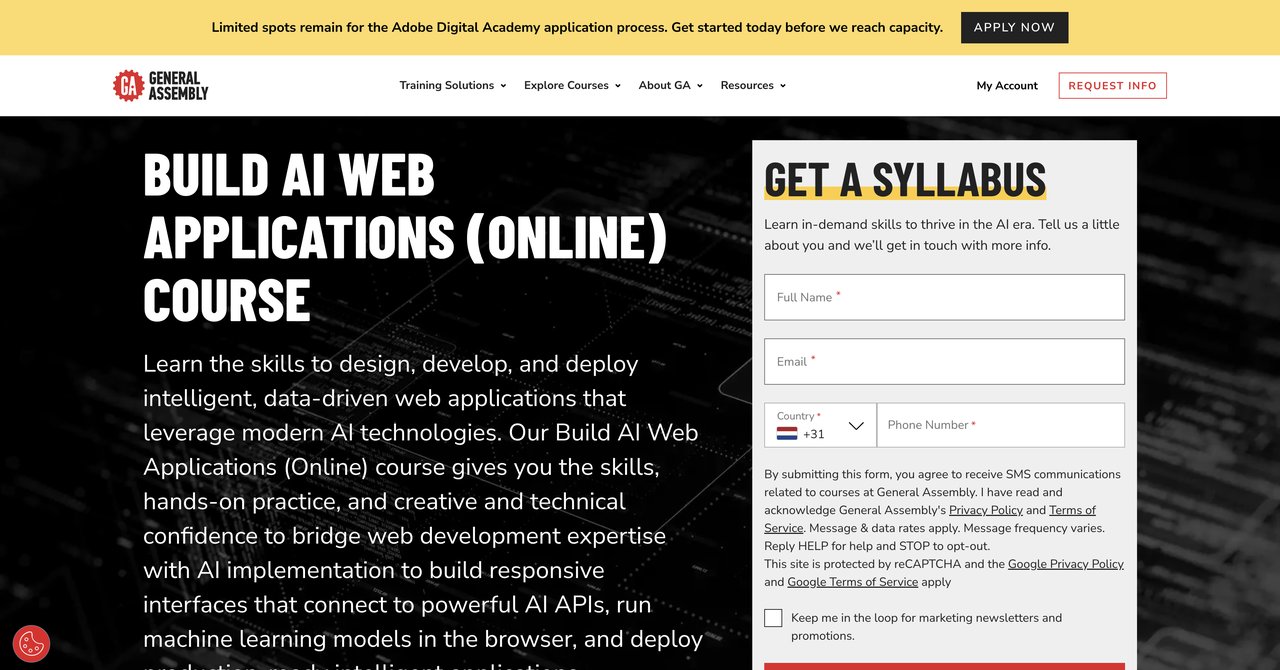
This is a different beast entirely. General Assembly offers a live, cohort-based 32-hour course that costs $2,950. You get instructor-led training in real time, which is a very different experience from self-paced video courses. The curriculum covers the full workflow from AI APIs to browser-based machine learning models, including production deployment of intelligent applications.
The live format is the main advantage here. You can ask questions, get feedback, and work through problems with an instructor and classmates. That is valuable if you learn better in a structured environment. The downside is the price-nearly three thousand dollars is a serious investment, and the course requires basic JavaScript and GitHub familiarity.
Key topics covered: working with AI APIs, building browser-based ML models, production deployment strategies, and the complete workflow from idea to deployed application.
Target audience: developers who prefer live instruction and have the budget for a premium experience.
Pros:
- Live instructor-led training
- Covers the full workflow from APIs to deployment
- Real-time feedback and Q&A
Cons:
- Expensive compared to self-paced options
- Requires basic JavaScript and GitHub knowledge
Who benefits most: people who thrive in a classroom environment and have the budget for a premium, guided experience. If you are self-motivated, you can get similar content for a fraction of the price elsewhere. Check out General Assembly.
Course 8: Foundations of AI-Assisted Web Development by Coursera
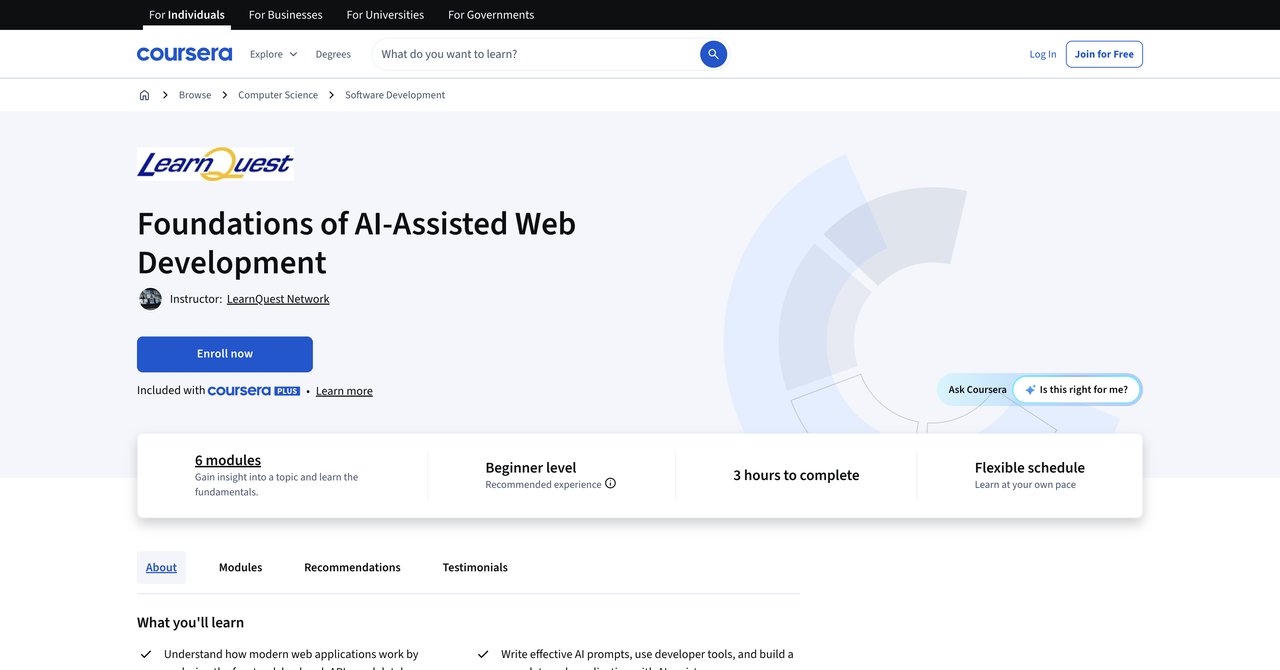
This is the quick-start option. It is a three-hour beginner course that teaches prompt engineering for Cursor, GitHub Copilot, and Claude Code. You also get a mental model of frontend, backend, database, and API layers-the foundational knowledge you need to understand where AI tools fit in your stack. It is perfect for developers who are new to AI coding assistants and want a fast, low-commitment introduction.
The short length is the defining feature. Three hours is enough to get you oriented and comfortable with the basics, but it is not going to make you an expert. Think of it as a jumping-off point rather than a complete education.
Key topics covered: prompt engineering for Cursor, GitHub Copilot, and Claude Code, understanding the different layers of web development, and practical basics of AI-assisted coding.
Target audience: absolute beginners with AI tools who want a quick, low-cost introduction.
Pros:
- Quick three-hour commitment
- Covers three major AI tools
- Builds foundational understanding of web layers
Cons:
- Very short-only foundational
- No deep project work
Who benefits most: developers who are curious about AI tools but not ready to commit to a full course. It is a great way to test the waters. Visit the course.
Course 9: AI Coding Tools for Professional Developers by Coursera
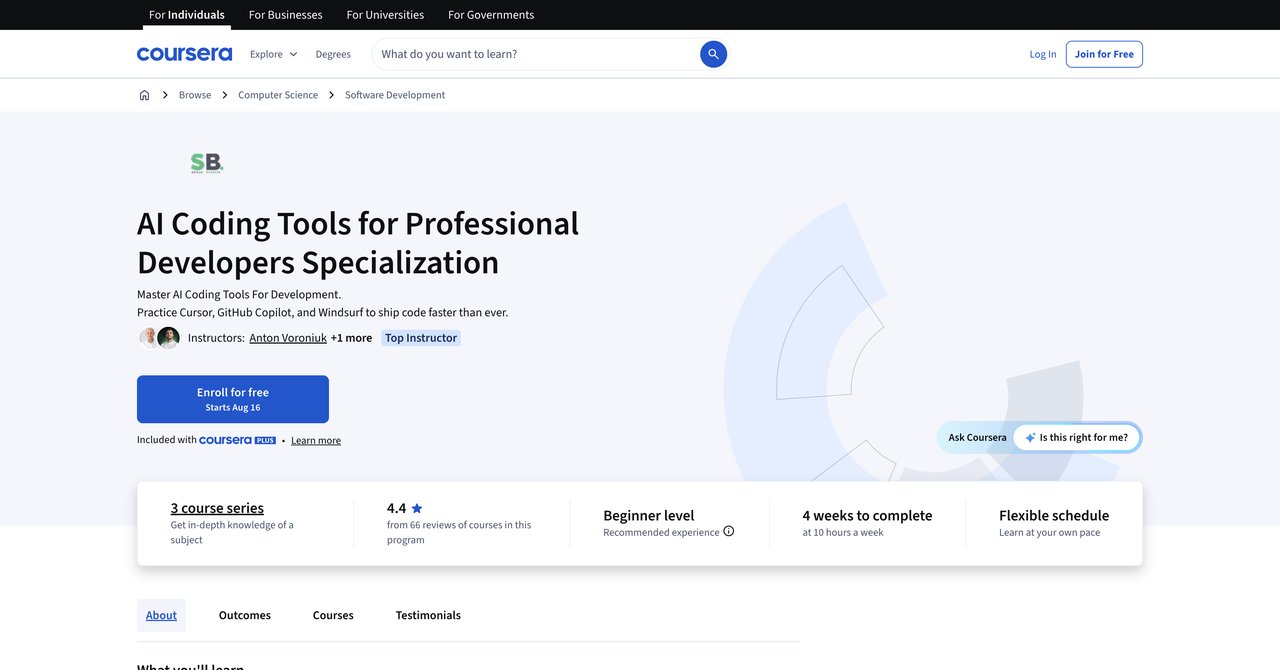
This multi-course specialization covers three leading AI coding environments: Cursor, GitHub Copilot, and Windsurf. You go from setup to real-world projects, gaining hands-on mastery of the most popular AI-assisted coding tools on the market. If your goal is to become proficient with the tools themselves, this is a comprehensive option.
The tool-focused approach is the main strength. You are not getting a lot of theory here; you are learning how to use specific tools effectively. That is valuable if you already know what you want to build and just need to master the tools to do it. The downside is that it does not cover broader AI concepts like architecture or deployment.
Key topics covered: setup and configuration of Cursor, GitHub Copilot, and Windsurf, practical usage patterns, and real-world project applications.
Target audience: developers who want deep proficiency with specific AI coding tools.
Pros:
- Covers three major AI coding environments
- From setup to real-world projects
- Comprehensive tool coverage
Cons:
- Focuses on tools rather than broader AI concepts
- Duration not clearly listed
Who benefits most: developers who are comfortable with the big picture and just want to master the tools they will use every day. Learn more here.
Course 10: Generative AI for Software Development Skill Certificate by Coursera (DeepLearning.AI)
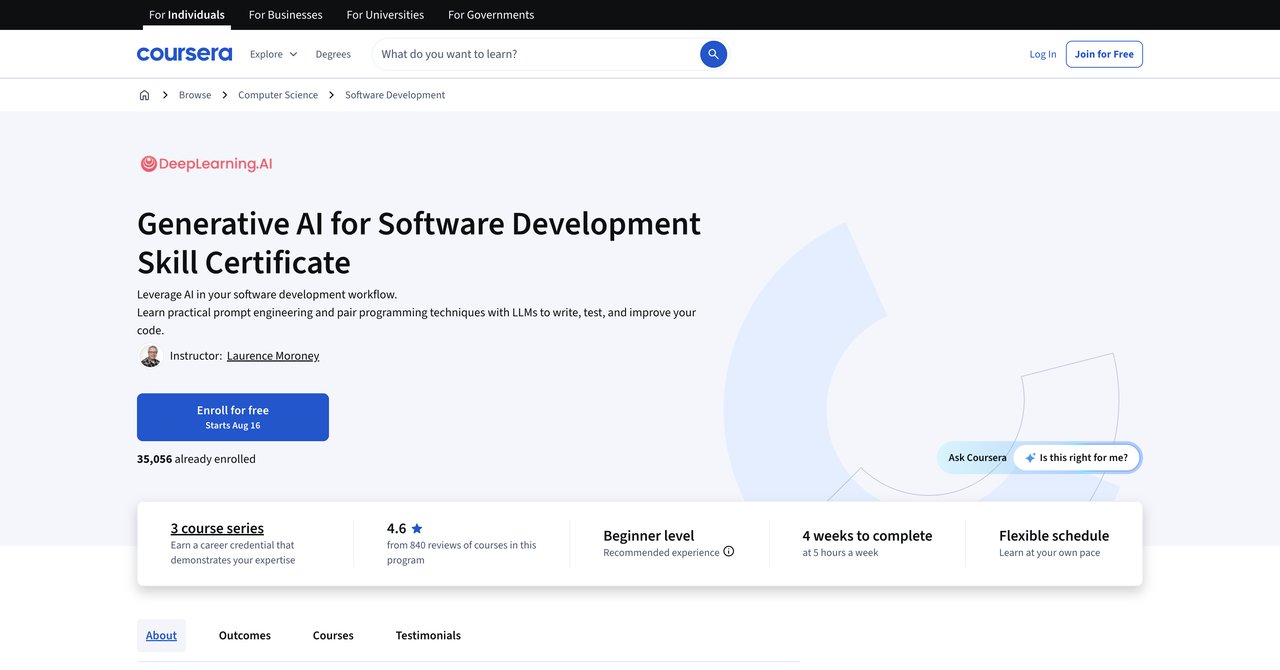
This one has serious credibility. It is taught by Laurence Moroney, the former AI lead at Google, and it provides a comprehensive pathway from generative AI theory to real-world software development. The certificate involves multiple courses, so it is a significant commitment, but the industry recognition is strong.
The theory-to-practice approach is well-executed. You start with the fundamentals of generative AI and move into practical software development applications. The main drawback for web developers specifically is that the focus is broader-it covers software development in general, not just web development.
Key topics covered: generative AI theory, practical software development with AI, and a comprehensive curriculum that builds from basics to advanced applications.
Target audience: developers who want a thorough, credible education in generative AI with a recognized certificate at the end.
Pros:
- Taught by Laurence Moroney, former AI lead at Google
- Comprehensive pathway from theory to practice
- Strong industry credibility
Cons:
- Broader software focus, not web-specific
- Requires commitment across multiple courses
Who benefits most: developers who want a prestigious certificate and are willing to invest the time. The Google connection carries weight, but the content is not web-specific. Check it out.
Course 11: Foundations of AI in Web Development by Coursera
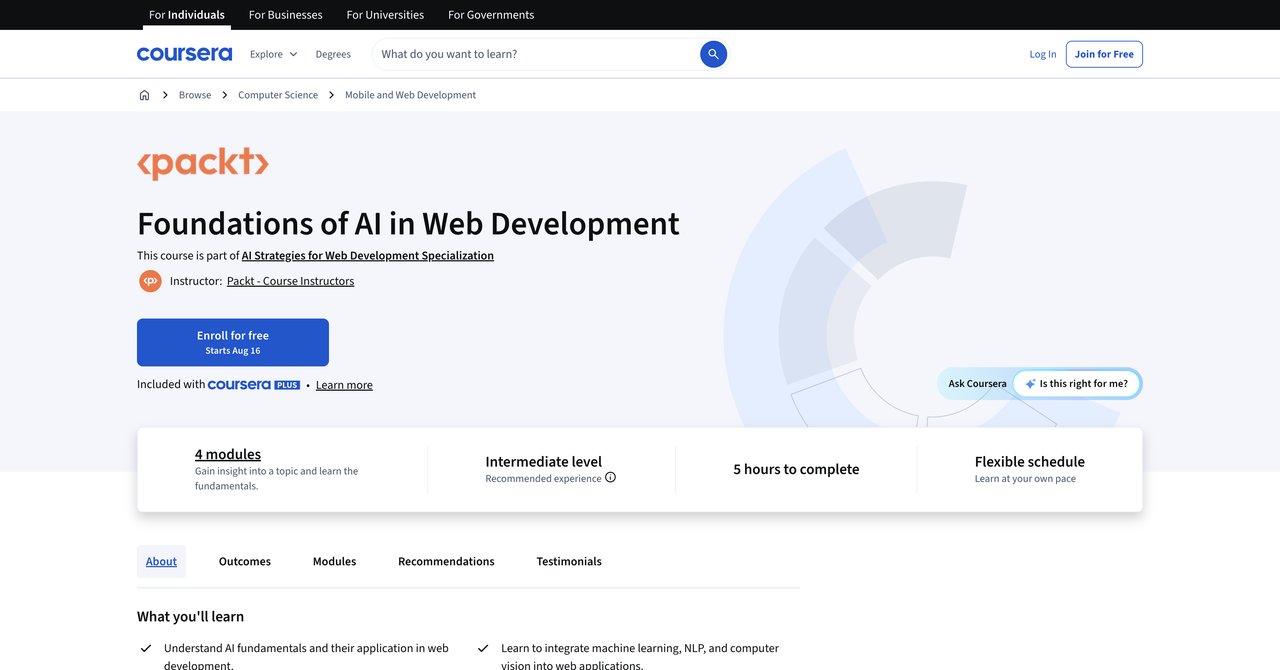
This five-hour intermediate course from Packt covers AI fundamentals applied to web development. You will learn about integrating machine learning, natural language processing, and computer vision into web applications, with a focus on user-centric design. It is a good middle ground between the quick three-hour intro and the full specializations.
The breadth of topics is impressive for a five-hour course. You get exposure to ML, NLP, and computer vision-all in the context of web development. The user-centric design focus is a nice touch that many technical courses miss. The main downside is that Packt courses can be less interactive than others, and the intermediate level means you need some background already.
Key topics covered: AI fundamentals for web developers, integration of machine learning, NLP, and computer vision, and user-centric design principles for AI-powered applications.
Target audience: intermediate developers who want a broad overview of AI applications in web development without a huge time commitment.
Pros:
- Covers ML, NLP, and computer vision in one course
- User-centric design focus
- Reasonable time commitment
Cons:
- Intermediate level; not for absolute beginners
- Packt courses can be less interactive
Who benefits most: developers who want a broad survey of AI applications in web development and have some experience to build on. Visit the course.
Final Recommendations: Which Course Should You Choose?
There is no single right answer here because your situation matters. Let us break it down by what you need.
If you want the best value for your money and you are in this for the long haul, CompleteAI Training is the strongest option. The subscription model gives you access to hundreds of courses and certifications for less than the cost of a single course elsewhere. The fact that new content is added automatically means you will not outgrow it. For web developers who want to stay current as AI evolves, this is a practical choice. The all-courses-and-all-certifications model is a genuine differentiator-you are not buying one course; you are buying access to an entire platform. See what CompleteAI Training offers.
If you prefer a structured, university-style approach and want a well-known credential, the DeepLearning.AI certificate with Laurence Moroney is a strong pick. The Google connection carries real weight, and the curriculum is comprehensive. Just know that it is not web-specific, so you will need to translate the concepts to your own work.
If you are a React developer, the Building AI-Powered Web Applications with React and Next.js course is a practical, beginner-friendly choice. It gets you building AI features quickly in a stack you already know. The limitation is obvious-it is only useful if you work with React.
If you want live instruction and have the budget, General Assembly's bootcamp is the premium option. The $2,950 price tag is steep, but the live format and instructor feedback can be worth it for people who do not learn well from videos alone.
If you are just starting out and want a low-commitment introduction, the three-hour Foundations of AI-Assisted Web Development course is a smart first step. It is cheap, fast, and gives you a solid foundation to build on.
For front-end specialists, the GenAI for Front-End Developers course is directly relevant and efficient. For architects and senior developers, Designing Intelligent Web Solutions with AI offers the depth you need for scalable systems.
The honest assessment is this: most of these courses will teach you something useful. The real question is what you are optimizing for. If it is cost and breadth, CompleteAI Training wins. If it is prestige, DeepLearning.AI wins. If it is live interaction, General Assembly wins. If it is speed, the three-hour intro wins.
One thing to keep in mind: AI is moving fast, and any course you take will be somewhat outdated within a year. That is an argument for subscription models that update continuously, like CompleteAI Training, rather than one-time purchases that freeze in time. But it is also an argument for just starting somewhere and building your skills incrementally.
Whatever you choose, the important thing is to start. The tools are here to stay, and developers who know how to use them effectively will have a significant advantage in the job market. Pick the option that fits your budget, your learning style, and your career goals, and get moving.