
Blog ·
12 AI Courses for Competitive Intelligence Analysts that You Should Know About in 2026
Stay ahead in 2026 with 12 top AI courses tailored for competitive intelligence analysts. Master predictive analytics, automated monitoring, and strategic foresight to sharpen your edge.
 Jeroen Erne
The competitive intelligence field is changing faster than most analysts expected. AI tools are now woven into the daily workflow of research teams, and the training you received a few years ago might not cover what a modern employer expects you to know. Global spending on AI is projected to hit $300 billion by 2026, and businesses are shifting budgets toward people who can actually use these tools effectively. For Competitive Intelligence Analysts, that means new responsibilities: summarizing massive datasets, building automated monitoring systems, predicting competitor moves, translating unstructured intel into executive briefings, and doing all of this with the speed that AI enables. The question isn't whether AI will affect your job; it's how fast you adapt. And the best way to adapt is to find a structured, practical course that matches your specific needs as a CI professional.
Why AI matters for Competitive Intelligence Analysts today
Recent data shows that 69% of businesses use AI in some form, and among large enterprises, that number is close to 90%. But adoption numbers only tell part of the story. The bigger trend is how much faster AI-powered teams move compared to traditional ones. Firms that wean themselves off manual data gathering are producing competitor update reports in hours, not days. They're also making fewer forecasting mistakes because AI models help identify patterns that humans gloss over.
The purpose of this article is to cut through the noise. There are so many AI courses out there-from SEO-focused programs to market research certificates to graduate-level analysts-that the average person could spend weeks just reading the sales pages. Instead of letting you sift through endless listings, I've selected which we believe ten of the strongest options for Competitive Intelligence Analysts specifically, and compared them based on what they actually offer, who they're accredited by, how they teach you, and whether they'll meaningfully change the way you approach work.
The Growing Role of AI in Competitive Intelligence Analysts
AI is not a one-size-fits-all fix. It changes depending on what part of the competitive intelligence workflow you're working on. Here's what that looks in practice:
- Collecting data automatically: Platforms can scrape competitor websites, industry reports, social chatter, and patent filings, then update your intel database continuously-no nightly manual searches required.
- Analyzing sentiment and nuance: AI-powered natural language processing no longer just counts words; it detects tone change, emotion, product reception, and even detects early signals of PR crises your competitors might be about to handle.
- Generating intelligence reports: Models can transform raw quantitative data into usable story-driven summaries for stakeholders. You can go from messy spreadsheets to a clean, executive-level brief with faster accuracy than ever before.
- Predictive forecasting: Machine learning algorithms look at historical market patterns and competitor moves to give you a possible, likely set of future scenarios-useful for when executives ask "what if?" during quarterly planning.
- Personalization of monitoring: Rather than one uniform alert for everything, AI filters what matters for your exact market. You see the competitor changes most relevant to your territory, segment, or product line-no irrelevant noise cluttering your inbox.
These tasks are replacing manual work. For someone who values their time, that's a meaningful shift. The company analyst who understands how scoring models work, or how to formulate proper prompt strategies for a competitor web crawl, will soon separate themselves from those who just use pre-made dashboards without understanding what's underneath. That separation is why you keep reading.
Benefits of becoming an AI expert in Competitive Intelligence Analysts
There are immediate benefits you can bank on the moment you know more than your peers. First, you're likely to be more accurate. When you use AI to cross-check and synthesize data points from different sources, the chances of missing a key signal shrink significantly. Second, you'll be faster. Automating the repetitive parts of your workflow-the monitoring alerts, the data cleanups, the routine digests-frees up your day for analysis that actually matters, then you actually have the time to think before you recommend a strategy. Third, you widen your career gap. In an environment where companies fight for employees who can apply AI to real business questions, having completed coursework that proves you can integrate AI into competitive analysis gives you a distinct advantage during salary talks, performance reviews, or when you consider job changes. Combine that with industry-specific certifications, and you're no longer just a person who can pull reports-you become the person who tells an organization what the reports mean.
Ready to see which course fits your lane? We've compared the current top options, including their price, duration, and what you'll actually learn. Note that CompleteAI Training, for example, provides an AI for Competitive Intelligence Analysts certificate, but rather than give you just one course, they provide you complete access to both the platform's entire course library and all its certifications. That matters if you're looking to learn beyond the starter level. The other options-from university-backed certificates to short practical courses-have their own strengths. Reading on to find the best match for your professional goals.
Comparison: All AI Courses for Competitive Intelligence Analysts (Updated 2026)
| Course Name | Provider | Price | Key Topics | Pros | Cons | Best For |
|---|---|---|---|---|---|---|
| CompleteAI Training | CompleteAI | Premium (one flat subscription covers everything) | Comprehensive AI training for Competitive Intelligence Analysts. One subscription unlocks ALL video courses and ALL certifications on the platform, including every other job role's material. New courses and certifications added continuously at no extra cost. Daily updates on the latest AI tools and curated AI industry news. | Comprehensive curriculum, Hands-on projects, Expert instructors, Highest rating / most complete offering, Full access to every course and certification on the platform, Access to other job roles' material, Very affordable with annual billing | Premium pricing compared to basic courses, Subscription-based (requires ongoing commitment) | Competitive Intelligence Analysts professionals looking for complete training |
| AI for Competitive Intelligence Analysts (Video Courses + Certifications) | Complete AI Training | $8.25-$29/month (one flat subscription covers all courses and certifications) | Over 100 specialized video courses and certifications for Competitive Intelligence Analysts, plus access to every other job role's material. Covers AI education, latest AI tools, and curated AI industry news. | Highest rating / most complete offering, full access to all video courses and certifications, new content added continuously, access to other job roles' material, one flat subscription price, very affordable especially with annual billing | Subscription-based; continuous learning required as AI develops | General learners |
| Competitive Intelligence & SEO Strategy | Coursera | Subscription (Coursera Plus or per-course fee) | Full CI workflow from competitor monitoring to GTM briefs, AI prompt usage for content optimization, hands-on with platforms like Crayon | Covers full CI workflow, includes AI prompt usage, hands-on with Crayon | Heavy focus on SEO/marketing angle, requires existing marketing knowledge | General learners |
| GenAI for Market Research Analysts (Professional Certificate) | Coursera | Subscription | GenAI tools for market research workflows, competitive analysis techniques, practical ChatGPT applications for research | Applies GenAI to market research, includes competitive analysis techniques, practical ChatGPT applications | Part of a larger certificate, may require prerequisites, market research focus broader than pure CI | General learners |
| Graduate Certificate in AI for Competitive Analysis | International School of Project Management (ISPM) | £99 (Standard) / £149 (full) (approx. $125-$190 USD) | NLP, predictive modeling, AI-driven decision making, ethics in AI applications, 100% online with flexible pacing | Covers NLP, predictive modeling, AI decision making, includes ethics, fully online | Less well-known provider, limited peer interaction compared to big platforms | General learners |
| Professional Certificate in AI in Competitive Intelligence | London School of Business Administration (LSBA) | £90 (Standard) / £140 (Fast track) (approx $115-$180 USD) | AI applications in market analysis and competitor tracking, fast-track option, practical strategic decision-making | Focused entirely on AI in CI, fast-track available, practical strategic focus | Smaller provider with limited brand recognition, no verified learner ratings | General learners |
| Track Competitor Changes | Coursera | Free (audit) or Subscription (certificate) | Repeatable CI workflows, competitor monitoring, ideal for GTM teams | Quick, focused skill-building, teaches repeatable workflows, ideal for GTM teams | Very short, covers only monitoring not full analysis, beginner level may be too basic | General learners |
| Market Intelligence and Audience Insights | Coursera | Free (audit) or Subscription (certificate) | Research and analytical skills for market changes, customer understanding, data-driven insights | Develops research skills, focuses on customer understanding, data-driven approach | Audience insights focus may be too narrow for pure CI roles, beginner level | General learners |
| Graduate Certificate in Competitive Business Intelligence | Georgetown University School of Continuing Studies | $21,024 | Advanced frameworks, AI tools, digital transformation, data-driven decision making | University credential with strong reputation, covers advanced frameworks, includes digital transformation | Very expensive, long time commitment, may be overkill for quick upskilling | General learners |
| Certificate in Competitive Intelligence Management (CCIM) | Institute for Competitive Intelligence | €3,995 (excl. VAT) (approx $4,300 USD) | Managerial roles in CI, on-site or remote participation, 12 ECTS credits | Industry-recognized certification, on-site or remote, designed for managerial roles, 12 ECTS credits | Premium price, significant time investment, starts September 2026 (not immediate) | General learners |
| Competitive Intelligence and Analytics (CIA) Certificate | University of Delaware (PCS & Lerner College) | Not specified | Ethical practices, generative AI, stackable certificate format, real-world applications | University-backed, emphasizes ethics and generative AI, stackable format, real-world applications | Price and duration not published, noncredit status may not appeal to all | General learners |
| AI for Competitive Intelligence Analysts (Prompt Course) | Complete AI Training | Not specified | End-to-end prompt workflows for CI, verifiable sources, stakeholder-ready deliverables, battlecards, watchlists, decision memos | End-to-end prompt workflows, focuses on verifiable sources, includes battlecards, watchlists, decision memos | Short format may not cover deep theory, provider less established than major platforms | General learners |
| Advanced AI Prompt Engineer Certification for Competitive Intelligence Analysts | Complete AI Training | Not specified | Advanced prompt crafting for CI, verifiable digital certificate, positioning as AI leader | Advanced prompt crafting, verifiable digital certificate, positions analysts as AI leaders | Provider not widely recognized, pricing not transparent | General learners |
Understanding AI Training for Competitive Intelligence Analysts Professionals
Competitive Intelligence (CI) analysts have a job that keeps shifting under their feet. The tools they used last year are already outdated, and the methods for gathering and interpreting competitor data have changed dramatically with the introduction of generative AI. Because of this, any analyst who isn't actively updating their AI skills risks falling behind. The training landscape is responding, with new courses and certifications appearing all the time. The challenge is sorting through the hype to find what actually helps you do your job better.
This comparison looks at the main options available for CI analysts in 2025. Some are university graduate certificates that cost as much as a used car, and others are subscription platforms that cost less than a meal per month. You'll see that the differences are not just about price - they're about what you actually get. A certificate without proper training is not very useful for an analytics department, but deep theory without practical application might not help your day-to-day work either. This article gives you a look at each option so you can make a better-informed choice based on your role, budget, and career goals.
Course 1: CompleteAI Training - AI for Competitive Intelligence Analysts
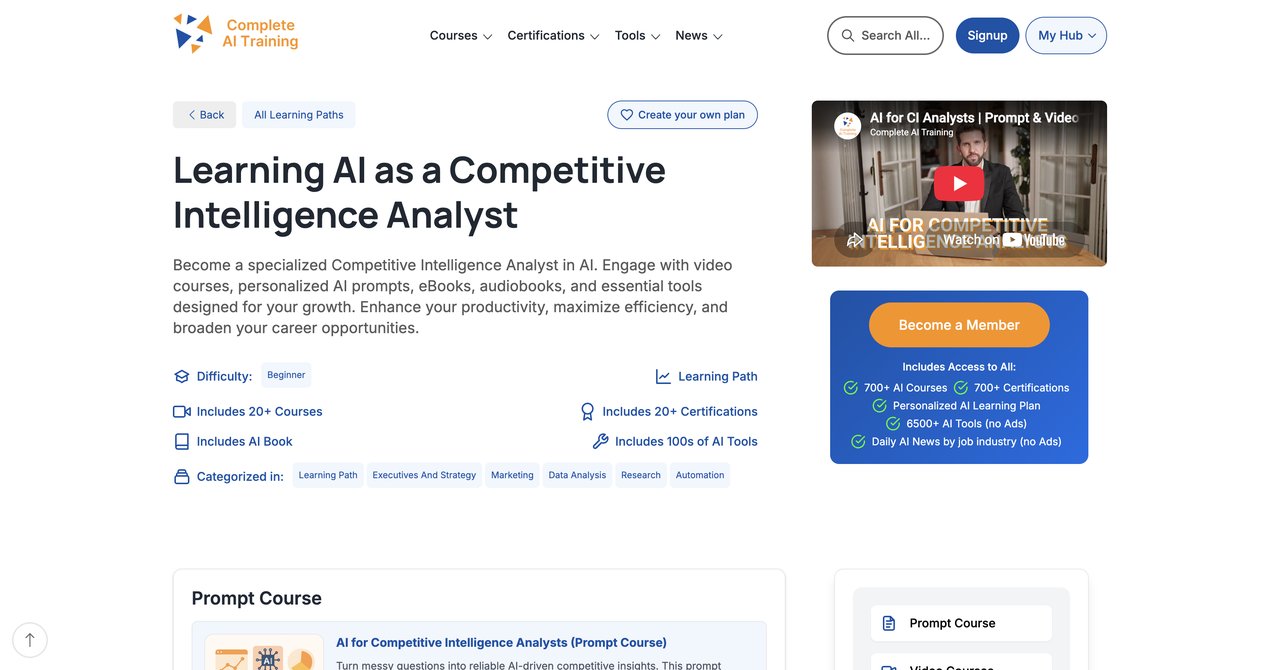
CompleteAI Training (https://completeaitraining.com/course/ai-for-competitive-intelligence-analysts/) is not a single course. It is a subscription platform that gives you access to every video course and every certification available on their platform - hundreds of them, across every job role, not just this one. This is a crucial difference from all the other providers in this comparison. Where others sell you one fixed course, Complete AI Training gives you access to an ever-growing library of specialized content at a flat subscription price. You aren't just paying for one skill set; you are paying for an entire AI education that covers your specific role and every other area you might want to grow into.
Here is how the platform works: subscribe, and you can immediately access every video course and certification Complete AI Training offers. That means the entire library, not a small package. If they add a new course on advanced prompt engineering for market analysis two weeks after you sign up, it is automatically included with no extra charge. There are over 100 specialized video courses and certifications for Competitive Intelligence Analysts and every other job role that appears in their system. Analysts can access everything from basic ChatGPT workflow setups to more complex AI data interpretation and reporting work.
The subscription model is a major benefit for professionals who need continuous learning because AI tools are updating frequently. A single one-time purchase course is stale content after six months. Instead, this service updates daily, sends you curated AI industry news, and regularly adds new courses to its library. That way your training doesn't stop when you finish a module. You're more be learning as part of your ongoing routine.
While the cost is named at $8.25-$29/month, this gives you access to what you need for a fraction of the cost of those paying thousands for university certificates. More importantly, you are not simply buying one course. This subscription covers all the content plans and all certifications - so you can receive multiple certificates for different skills without paying enrollment fees for each one. For CI analysts who handle multiple roles - for example competitor analytics plus product development plus marketing - having access to information about all of them matters.
The practical benefit is not small. With everything included, the analyst does not have to ask a boss for a budget that expands by the hour or course. One flat subscription price covers a wide ranging library of materials. Compared to a university program at $2,000 or a single course, this is an unusual value for money. The downside is that this is a subscription, and as with most learning in an rapidly evolving space, you must keep paying to keep the knowledge and updates flowing. There is no "finished" state in the current field.
Key topics covered: AI fundamentals, applications of AI in CI workflows, battles cards, watch lists for competitors, AI news and tools, strategic decision making using AI, and a wide range of other subjects.
Target audience and skill level: Designed for Complete beginners up to advanced analysts. Because the platform contains everything, you can start on a basic course and then scale to advanced certifications when you're ready.
Pros:
- The most complete offering available, with all video courses on the platform
- Access to all certifications, included with the price
- New additional materials added continuously and included automatically
- You can access every other job role's material too , everyone who does work that spans more than one function
- One flat subscription price instead of paying per course
- Very affordable pricing, especially with annual billing
Cons: The subscription model is really a necessity rather than a bad point, but it means you must keep paying to continue learning as AI keeps moving. There are no one-time payments.
Who would benefit most: Any analyst, manager, or team leader who needs to see the full landscape of AI in competitive intelligence and doesn't want to pay per course. Teams with mixed skillsets and career changers also benefit because the platform includes content for other roles.
Course 2: Competitive Intelligence & SEO Strategy by Coursera
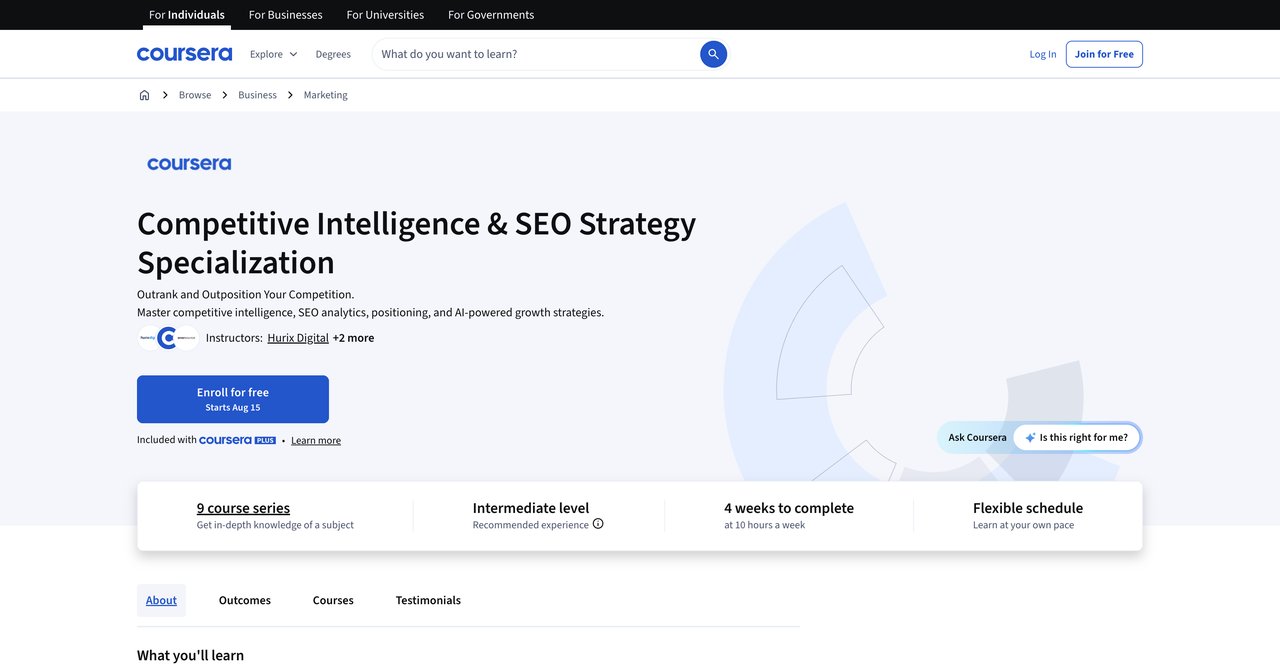
Coursera's Competitor Intelligence & SEO Strategy specialization provides a longer look at the CI process, from tracking competitor activity to creating go-to-market briefs. The specialization includes practical use of AI tools and includes platforms like Crayon for competitive analysis. The audience is clearly marketing and SEO oriented, with a heavy focus on content optimization and organic visibility. If you plan to work closely with marketing teams on competitive positioning, this specialization is well worth a look.
It's not a pure CI course. The SEO angle is always present, and the program assumes the learner has existing marketing knowledge. It's more of a marketing course that includes about CI, not a pure CI course. This is worth checking if your duty is more broad - a role with a competitive strategy or content analysis.
Key topics covered: Competitor monitoring, content optimization using AI prompts, GTM briefs, SEO analysis, positioning, and applying CI data for marketing decisions.
Target audience and skill level: Marketers, SEO professionals, and product managers wanting to understand competitor positioning. Requires some marketing or PR knowledge.
Pros
- Full CI workflow from competitor surveillance to GTM strategy
- Uses AI prompts for content optimization
- Hands-on with platforms like Crayon, not just theoretical
Cons
- Focus is heavily on SEO/marketing angle rather than broad CI practice
- Requires existing marketing knowledge to keep up
Who is it for? Market and brand managers who care about online visibility - not for people looking to become pure technical CI analysts.
Course 3: GenAI for Market Research Analysts (Professional Certificate) by Coursera
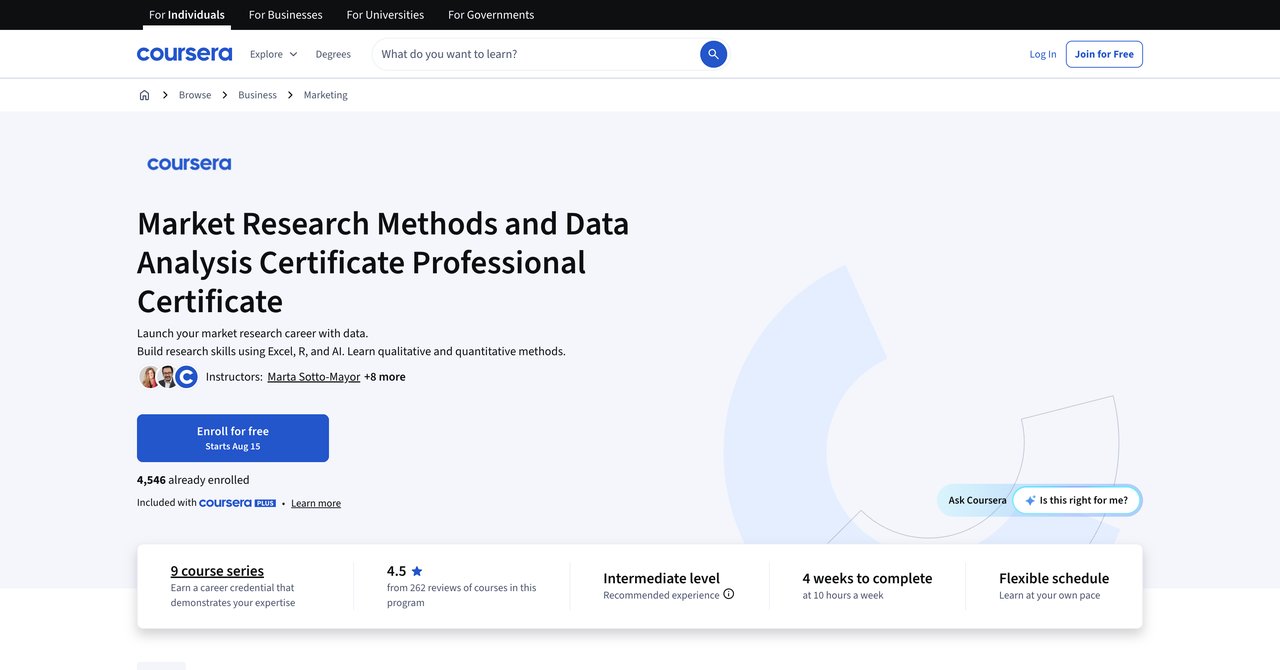
This Coursera Professional Certificate applies GenAI to market research workflows, including methodologies that are important for competitive analysis. It covers how to use AI tools for summarizing, analyzing, and creating actionable research. The curriculum is practical and includes ChatGPT exercises that you can adapt to CI work. It gives a foundation in using generative AI tools in a research context.
The downside is that it is part of a larger researcher certificate, meaning you may have to complete prerequisite courses first. Also, it's focused on market research, which is slightly different frameworks from competitive intelligence. Different job requirements but similar tasks. The analyst will benefit from learning the generative AI side of research, though you'll need to adapt the techniques for competitive creatures.
Key topics: Using GenAI in research workflows, competitive analysis techniques, ChatGPT for market research, research guidance, and analyst data interpretation.
Target audience and skill level: Researchers and analysts who want to apply AI to traditional market research. Standard level of analysis, best for beginners.
Pros
- Direct application of GenAI to research tasks
- A competitive analysis section
- Practical ChatGPT application for research
Cons
- Part of a broader certificate, so you may have prerequisite courses
- Market research focus is broader than pure CI
Who would benefit the most: Researchers and junior analysts in the market research sector who want leverage GenAI for more efficient workflows.
Course 4: Graduate Certificate in AI for Competitive Analysis , International School of Project Management (ISPM)
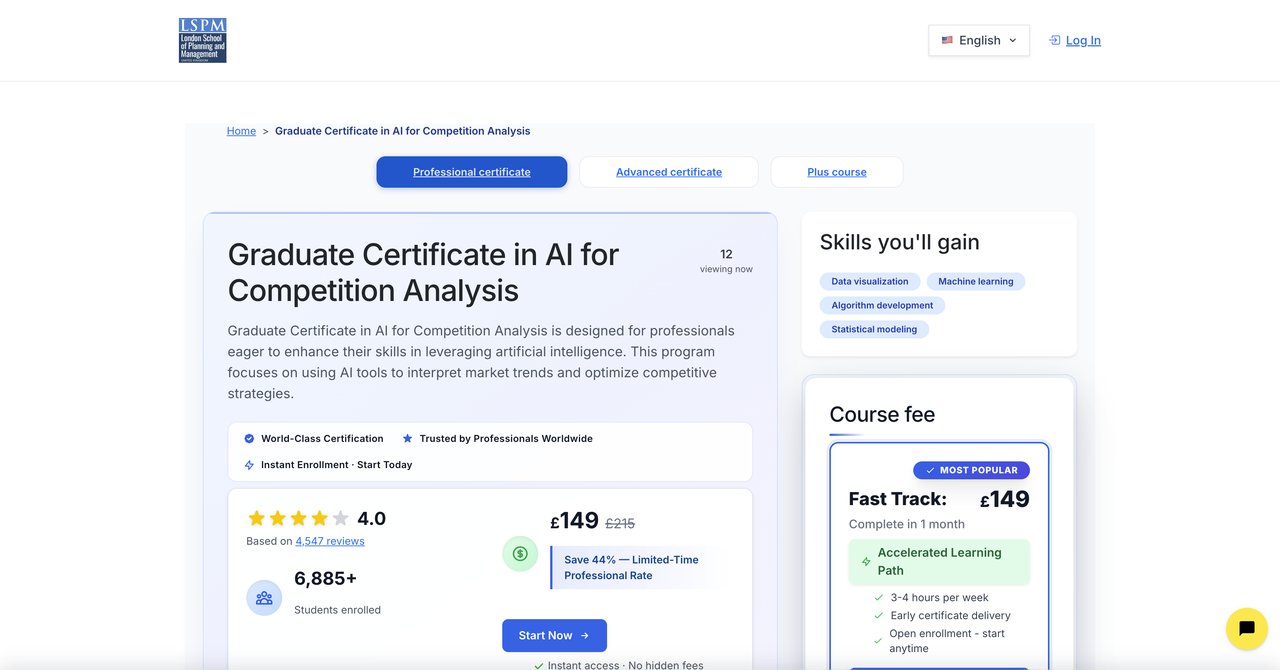
The ISPM graduate certificate is a more academic approach to AI for CI. It covers natural language processing (NLP), predictive modeling, and how AI can support decision-making. It places a strong emphasis on the ethics of using AI, which is often a matter of concern in competitive intelligence. The course is 100% online and has a flexible schedule - it appeals.
The depth of topics is good, but the provider is less established than institutions like Coursera, Georgetown, or even large platforms. Also, the course contains fewer discussion and peer interactions compared to the university or courses. For $125 to $190, it's not a huge financial risk. The content is good, but the instance name means a lower career recognition outside some departments.
Key topics covered: NLP, predictive modeling, AI-driven decision making, ethics in AI applications, and competitive analysis.
Target audience and skill level: Mid-level analysts with some technical or analytical skills who want a deeper dive without the full university price.
Pros
- NLP and predictive modeling are hard skills to learn
- Includes ethics in AI , this is uncommon
- 100% online with flexible pacing
Cons
- Less well-known provider
- Limited peer interaction compared to big platform or classroom settings
Who benefits: Analysts who need a formal certificate for their CV at an affordable price, and who can learn independently.
Course 5: Professional Certificate in AI in Competitive Intelligence - London School of Business Administration (LSBA)

LSBA offers a certificate specifically for AI in CI. It covers AI use in market analysis and competitor tracking, which is a very direct path for analysts. Unlike the large universities, this one has a "fast-track" option, so you can complete it in weeks rather than several months. The emphasis is on practical strategic decision-making focus.
The biggest hurdle is the provider's reputation. LSBA is not as well-known as the big institute for CI competition - the Institute for Competitive Intelligence has more brand recognition. Also, there are no verified learner interviews to provide a sense of the course quality. You may be banking on unknown quality, but the content list is one of the best for a CI-specific track. If you need a quick certificate and not a big global academia name, this can work.
Key topics covered: AI in market analysis, competitor tracking, strategic decision making, AI tools for CI, and fast-track prep.
Target audience and skill level: Professionals who need a quick upskilling in AI using CI methods, with a pragmatic focus.
Pros
- Focused purely on AI applications in market analysis and tracking
- Fast-track option
- Practical for strategic decisions
Cons
- Smaller provider with limited brand recognition
- No verified learner ratings
Who benefits: Hands-on professionals who need to close a skills gap quickly and want a certificate to show for it.
Course 6: Track Competitor Changes - by Coursera

Track Competitor Changes is a shorter, focused course aimed at building a CI practice - various. This course teaches a repeatable workflow to monitor competitors, and it's especially good for GTM (go-to-market) teams. It is very practical content and you will be able to implement others rather quickly. There is almost no theoretical fluff at all, and it is intended for teams where speed is more important than deep analytical proficiency.
However, "short" also a difference: this course is very limited. It covers monitoring only, not additional analysis or synthesizing what the data means. If you're an experienced analyst, this might be too basic for you - but if you're building a CI function inside a sales or marketing team, this course is a smart start for many.
Key topics covered: CI monitoring, repeatable workflows, GTM tools, competitor tracking.
Target audience and skill level: Beginners, sales, and GTM teams that have perhaps no formal CI role.
Pros
- Quick, focused skill-building
- Teaches repeatable CI workflows
- Ideal for GTM teams
Cons
- Very short - only monitoring, no full analysis
- Beginner too basic for experienced analysts
Who benefits: Sales leaders, product marketers, and startup founders who want a lightweight framework and not careers defined by deep analysis.
Course 7: Market Intelligence and Audience Insights - by Coursera

This Coursera course is about understanding market changes and customer behavior. It is a fair balance between market intelligence, strategy, and data-driven insight. It helps learners build a framework and analytical skill set for understanding market movement and customer needs. The data-driven attempts are beneficial for analysts who need to make decisions based on evidence.
It is a bit more "marketing" than "competitive" intelligence. The focus on audience insights might be too narrow for pure CI roles, which often involve findings from supplier economics, competitors, technology evolution. This is more complementary, and a beginner-level course. For a well-rounded market researcher, this is nice and basic.
Key topics covered: market changes, customer understanding, data-driven insight; analytical skills, insights..
Target audience: Beginners in market research or new analysts that actually need the "market" not just competitors.
Pros
- Develops research and analytical skills for market changes
- Focuses on customer understanding, no competitor only
- Data-driven insight approach
Cons
- Audience insights is maybe too narrow for CI roles
- Beginner level
Best for: Market researchers (junior) and product managers looking to build a customer-centric intelligence base.
Course 8: Graduate Certificate in Competitive Business Intelligence - Georgetown University

Georgetown University offers a full university-credentialed Graduate Certificate in Competitive Business Intelligence. This program has a very strong reputation and a professional network that other online courses cannot replicate. The curriculum covers advanced frameworks and AI tools for competitive analysis, and you also get parts on digital transformation and data-driven decision making. The prestige of the Georgetown name can help on a resume - it reflects a serious commitment to excellence for some.
But you pay for that prestige: it is $21,024 and also requires a significant time commitment - you'll be studying for many months, possibly arrival. This is not for any analyst who needs immediate upskilling; it's more for candidates who are moving into leadership and need a comprehensive accredited credential. If you are considering the certificate, it's not about the content but about the educational brand.
Key topics covered: Advanced frameworks for CI, AI tools, digital transformation, data-driven decision making, strategic decision, academic course work.
Target audience and skill level: Professionals with average to advanced experience who need a top-of-the-line university brand. It is an actual graduate level workload.
Pros
- University credential with a strong reputation
- Covers advanced frameworks and AI tools
- Includes digital transformation and data-driven decision making
Cons
- Very expensive
- Long time commitment
- May be overkill for professionals needing quick upskilling
Who it's for: Career professionals who need a prestigious certificate for director-level roles.
Course 9: Certificate in Competitive Intelligence Management (CCIM) , ICI

The Institute for Competitive Intelligence (ICI) is well known company in the CI field, and the CCIM certificate gives you 12 ECTS credits. It is designed for managers and senior roles. Participants can choose online or on-site. The classes start from September 2026, which gives you time to prepare but also means this is not an immediate place to go.
At about $4,300 USD, it's a significant sum. It's not for newbies; it is for experienced practitioners who want a formal certificate leading toward a management role. Although price and schedule are major drawbacks, the content and the institution's recognition are one of the most accepted in this niche.
Key topics: management in CI, advanced intelligence operations, strategy planning, ethical; course assignments.
Target audience: CI managers and senior analysts with several years of experience in the field.
Pros:
- Recognized industry certificate
- On-site or remote participation
- Designed for managerial roles in CI
- 12 ECTS credits
Cons:
- Premium price
- Requires significant time investment
- Starts September 2026, so it's not an immediate
Best for: professional who are looking to advance to a management position and know the ICI brand has weight among senior people.
Course 10: Competitive Intelligence and Analytics (CIA) Certificate by University of Delaware

University of Delaware's Lerner College and PCS offer a university-backed certificate in Competitive Intelligence and Analytics. It has content covering ethical practices and generative AI - a forward-leaning mix. This is a stackable certificate, meaning you could get later and use as part of a full degree course requirement. Knowledge with real-world applications is emphasized.
This certification does not show the price or the duration, and the noncredit status may be a factor for some. This is a university-backed program work very good university resources, but for a lot of people, not having price means they skip looking, and noncredit may not be as attractive to some.
Key topics covered: suite of generic principles, gener, AI, stacked certificates, real-world, community.Target audience and skill level: Learners who want academic quality with flexibility and maybe later for a full degree.
Pros:
- University-backed program
- Emphasizes ethical practices and generative AI
- Stackable certificate
- Real-world applications
Cons:
- Price and duration not published
- Noncredit status may not appeal to all
Who benefits: Individuals who want a foot in the door at a university without the full price for those who might later attend degree-based courses.
Course 11: AI for Competitive Intelligence Analysts (Prompt Course) - Complete AI Training

This prompt-only course is dedicated to end-to-end workflows that allow you to get a pin from competitive intelligence. It focuses on verifiable sources and how to deliver materials to stakeholders - these are valuable skills for any analyst whose outputs are read by managers. You will learn how to build battlecards, watchlists, and decision memos that managers can actually use. The content is practical and designed for daily professional use.
It short format may not have time to cover the deeper theory of AI. And the provider has less company recognition than established from universities. But for someone who mainly needs the practical structure, this is efficient and useful.
Key topics: prompt workflows for CI, verifiable sources, stakeholder presentations, battlecards, watchlists, decision memos.
Target audience: CI analysts who produce deliverables and need a repeatable prompt methodology.
Pros
- End-to-end prompt workflows for CI
- Focuses on verifiable sources and stakeholder-ready deliverables
- Includes battlecards, watchlists, decision memos
Cons
- Short format , no deep theory
- Provider less established
Optimal for: regular analysts and operations for fast results.
Course 12: Advanced AI Prompt Engineer Certification for CI Analysts - Complete AI Training
Same image as the previous one. The advanced certification extends prompt crafting for more unique CI usage. It includes a verifiable digital certificate at the end and positions analysts as leaders in AI for their organization. The certifications help you show proof that you can work at an advanced level. The price is not transparent- you must go to the site to see all the details. But graduating from an official Course and demonstrating your skills is an interesting match for an analyst wanting to become a formal leader of AI in their company.
Key topics: advanced prompt design, verifiable digital certificate, CI strategy framing
Target audience and skill level: Advanced users already familiar with the basics of prompting
Pros
- Advanced prompt crafting for CI
- Verifiable digital certificate
- Positions analysts as AI leaders
Cons:
- Provider not widely recognized
- Pricing not transparent
Who benefits: Experienced analysts who have mastered the basics and need a credential to take on more advanced tasks.
Final Recommendations
The question is not about which course is "better." It's about your position in your career and budget. For these options, I have a final summary for each case scenario.
If you want a low budget way to train the whole team: CompleteAI Training (subscription) is the best. Because they offer all courses and materials for less than a dinner for two each month, the best value for training 3 or 30 analysts. Teams get access to not just one, but all articles including Battle Cards, Advanced Prompting, and other work models. If your analysts have multiple tasks and not just one, this is very clear.
If you want a professional certificate with minimal cost and focus on uni status: The LSBA and ISPM certificates offer a very affordable, fast, and AI-specific, route. They are not famous names, but the price is good and the courses are relevant to your role. You can use the certificate with a professional CV to add AI skill blocks. No one will confuse them for Georgetown but they are a good outcome.
If you want academic background for leadership: Georgetown offers the most known name and the curriculum is advanced, but you're paying $21,000 and years. Not for quick returns. However, if career path requires a big branded university credential for the director position, this is a better choice.
If you need an industry-specific certificate for a manager in CI: The ICI CCIM is the best choice. ICI is a known industry-specific provider in CI. It is expensive and not immediate, but if you want to be a CI manager and need a recognized credential, it is the most targeted choice.
If you need a quick practical skill upgrade: The Track Competitor Changes (Coursera) is short and practical. It's free to audit and you pay only if you want the certificate. It's not deep, but great for individuals in GTM and beginners who need to set up repeatable processes.
If you're an investor of AI prompts and want to skill up quickly for personal growth: Complete AI Training's Prompt Course and Advanced Prompting are each practical and inexpensive. It's a shortcut, but is accessible and can be combined with the subscription platform for broader coverage.
What is the best all-around creator? The Complete AI Training platform probably the most useful for the everyday ordinary analyst. It's a comprehensive collection with all courses and certifications for the same monthly price. Every day you can see new AI tools that affect competitive intelligence; the platform sends you the news and adds new lessons. That alone places it at the top of the list of many) many analysts want, actually. But of course, if you want a "known" big-brand university, or the official "CI Manager" certificate, the big-name options have a role time to place.
My only recommendation is to also figure out what you need. If you want to maintain a practice right now, start with subscription on CI AI for each member. Or, if you are aiming to be a senior leader, pay for an expensive certificate. Many analysts combine both: paying for a complete training library in one month, and after an advanced certificate to their CV.
Either way, the entire category of job skills is developing so fast that the option to continue learning is far more valuable than a lot of certificate. You are likely to outgrow any older course in a year-so choosing a smart spend that actually supports ongoing learning is probably the biggest winner.