
Blog ·
12 Recommended AI Courses for Policy Makers in 2026
Navigate the AI era with confidence. Discover 12 essential courses tailored for policymakers, covering ethics, governance, and practical implementation to craft informed, future-ready legislation.
 Jeroen Erne
Artificial intelligence has moved from experimental technology to everyday tool. For policy makers, this shift brings both pressure and opportunity. The professionals who understand AI systems can shape regulations, guide public investments, and make data-informed decisions. Those who don't may find their recommendations challenged by more tech-savvy colleagues or outdated by rapid developments. This reality explains why thousands of policy professionals are now seeking structured training. The question is no longer if you should learn AI, but where you should learn it well. With so many courses available, choosing the right one can feel overwhelming. This article helps you sort through the options and find training that fits your specific role and experience level.
Why AI matters for Policy Makers today
AI adoption is not a future scenario. It's happening now. Recent surveys show that roughly 69% of businesses use AI in some form, and government agencies are following suit. Policy makers are encountering AI in everything from urban planning software to fraud detection systems. Those without a working knowledge of AI risk making decisions based on outdated assumptions. They may miss opportunities for better resource allocation or fail to spot potential harms in AI-driven public services.
This article examines 60 AI courses designed for policy professionals. It breaks down what each course covers, who it targets, and what you'll actually take away from it. Whether you're new to AI or have some technical background, you'll find practical comparisons that help you make an informed choice. One option worth highlighting is CompleteAI Training, which stands out because it gives you access to all courses and all certifications on the platform rather than just a single program. That means you can start with foundational material and progress to advanced topics without buying separate courses.
The Growing Role of AI in Policy Makers
AI is reshaping policy work in concrete ways. Here are some of the most common applications:
- Automated drafting: AI tools help generate policy briefs, summaries, and responses to public comments, freeing up time for deeper analysis.
- Data-driven decision making: Machine learning models identify patterns in public data that inform better policy choices.
- Public engagement: Chatbots and AI-driven surveys collect citizen feedback more efficiently, giving you a clearer picture of public needs.
- Predictive modeling: AI forecasts the potential impact of proposed regulations, helping you anticipate outcomes before implementation.
- Resource allocation: AI systems optimize how public funds are distributed across programs and regions.
- Fraud detection: Government agencies use AI to spot irregularities in public spending and benefits programs.
These applications are already in use in various governments. The professionals who know how to evaluate, oversee, and leverage these systems will have a clear advantage. They can ask the right questions, set the right guardrails, and ensure AI serves the public interest rather than complicating it.
Benefits of becoming an AI expert in Policy Makers
For policy professionals, AI knowledge translates into several concrete benefits. First, it improves credibility. When you can speak confidently about how algorithms work, what data they need, and where they can fail, you become the person others turn to for guidance. That kind of expertise is hard to ignore.
Second, it makes you more effective at your core job. Understanding AI means you can evaluate proposals with a sharper eye. You'll know what questions to ask vendors, what risks to flag, and what evidence to demand. You'll be better equipped to write regulations that are both practical and protective.
Third, AI skills open up career opportunities. Public agencies, international organizations, and nonprofits are all looking for people who understand both policy and technology. This combination is rare and valuable. It positions you for leadership roles that others simply cannot fill.
Fourth, there's the confidence factor. When AI comes up in meetings, you won't be the one staying quiet. You'll have a working vocabulary and a framework for thinking about these issues. That confidence shows up in your writing, your presentations, and your decisions.
Finally, there's the practical matter of staying relevant. AI is not going anywhere. The professionals who embrace it will be the ones shaping the future of public policy. Those who avoid it may find themselves managing legacy systems and outdated approaches. The choice is clear: getting AI training now is a career investment with lasting returns.
As you read through the course comparisons that follow, keep your own goals in mind. Are you looking for a broad overview or deep technical skill? Do you prefer self-paced learning or structured deadlines? The right course for you depends on your answers. This guide gives you the information you need to choose well.
Comparison: All AI Courses for Policy Makers (Updated 2026)
| Course Name | Provider | Price | Key Topics | Pros | Cons | Best For |
|---|---|---|---|---|---|---|
| CompleteAI Training | CompleteAI | Premium (one subscription covers everything) | Comprehensive AI training for Policy Makers professionals. One subscription unlocks ALL courses and ALL certifications on the platform - not a single course or fixed bundle. Includes access to every job role's material, daily AI tool updates, and curated industry news. | Comprehensive curriculum, hands-on projects, expert instructors, full access to every course and certification, new content added automatically, covers cross-functional roles | Premium pricing; subscription-based model (but necessary given how fast AI changes) | Policy Makers professionals looking for complete training |
| AI for Policy Makers (Video Courses + Certifications) | Complete AI Training | $29/month or $8.25/month billed annually | Over 100 specialized video courses and certifications for Policy Makers. One subscription unlocks every course and every certification on the platform. Daily updates on AI tools and curated industry news. | Highest rating / most complete offering; full access to ALL courses and certifications; new content included automatically; access to other job roles' material; flat subscription price; very affordable with annual billing | Subscription based - continuous learning required as AI evolves | General learners |
| AI Policy Essentials | Coursera | Subscription (Coursera Plus, ~$59/month) | AI-driven policy design and evaluation; strategic decision-making for long-term planning; governance and policy applications | Designed specifically for governance and policy professionals; covers AI-driven policy design and evaluation; includes strategic decision-making | Requires consistent 10 hours/week commitment; no verified learner ratings yet | General learners |
| AI Law, Policy and Governance | LSE Executive Education | £2,420 (approx. $3,100) | Global regulatory landscapes; balancing AI innovation with security and ethics; legal and policy frameworks | From LSE Law School and School of Public Policy; covers global regulatory landscapes; balances innovation with ethics; no prior legal background required | Premium price point; fixed cohort start dates (next: 29 Jul 2026) | General learners |
| AI Policy Compass | Mila (with Public Policy Forum Academy) | $2,050 CAD (approx. $1,500 USD) | Leadership and decision-making with real AI models; policy applications; no programming required | Co-designed by Mila and PPF Academy; no programming experience required; emphasizes leadership and decision-making with real AI models | Canadian-focused policy context; price includes materials but travel/live sessions may be required | General learners |
| AI Law and Policy | eCornell (Cornell University) | $3,750 | Legal, ethical, and policy implications of AI; responsible AI integration within organizations | From Cornell's trusted online platform; covers legal, ethical, and policy implications; focuses on responsible AI integration | High cost; no per-course duration specified | General learners |
| Ethics, Technology, and Public Policy for Practitioners | Stanford University (McCoy Family Center for Ethics in Society) | Not specified | Ethics applied to tech policy; practitioner perspectives from tech, civil society, and government; live cohort discussions | Live cohort-based with 7 Zoom sessions; gathers practitioners from multiple sectors; Stanford's ethics expertise | Price not published; limited to fall 2026 cohort | General learners |
| AI for Decision Makers | Coursera | Subscription (Coursera Plus, ~$59/month) | What AI is and how it works; ethical and policy considerations; leadership skills for organizational efficiency | Covers AI fundamentals, ethics, and policy considerations; builds leadership skills for business, lab, organization, or community | Less policy-specific than other options; no verified ratings | General learners |
| Artificial Intelligence in Public Policy | King's College London | £1,200 (approx. $1,540) | AI applications in public policy; self-directed study with live webinars; final assessment on your own policy area | Fully online with self-directed study plus 3 live webinars; final assessment applies AI to your own policy area; from a leading UK university | Single assessment at end may be demanding; optional webinars only in weeks 1 and 4 | General learners |
| AI+ Policy Maker Practitioner™ | AICERTs | Not specified | Fast-track certification; updated curriculum; live or self-paced delivery | Fast-track certification format; formerly AI+ Policy Maker™ with updated curriculum; flexible live or self-paced delivery | Price not published; 1-day format may be too condensed for deep learning | General learners |
| AI+ Policy Maker (Live Training) | LEXX Live | Not specified | AI's impact on public governance; instructor-led training; available in-person or live online | In-depth exploration of AI's impact on public governance; available in Washington DC Metro, Columbia MD, or live online; instructor-led | Price not published; single-day format limits depth | General learners |
| AI for Policy Makers (Professional Certificate) | edX (various universities) | Subscription (varies by institution, typically $50-100/month) | AI policy tracks from multiple university partners; case studies from government applications; self-paced learning | Multiple university partners offer AI policy tracks; flexible self-paced learning; often includes case studies from government applications | Course catalog varies by partner; not a single dedicated policy course | General learners |
| AI Governance Professional (AIGP) Training | IAPP (International Association of Privacy Professionals) | Not specified (training + exam fee) | AI lifecycle, risk management, regulatory compliance; AI governance certification | Industry-recognized certification specifically for AI governance; covers AI lifecycle, risk management, and regulatory compliance; from the leading privacy professional body | Price not published; advanced level may require prior policy/privacy experience | General learners |
Understanding AI Training for Policy Makers Professionals
Artificial intelligence is no longer a niche technical topic. It's now central to how governments craft regulations, how public agencies deliver services, and how societies decide what kind of future we want. For policy makers, understanding AI isn't just about knowing what the technology does-it's about grasping its implications for privacy, security, equity, and governance. That's why a growing number of universities, private training providers, and professional bodies now offer courses specifically designed for people working in policy and governance roles.
The challenge is that these courses vary wildly in format, depth, cost, and focus. Some are self-paced online subscriptions. Others are live cohort-based programs with fixed start dates. Some require a significant financial commitment, while others are relatively modest. And the quality and recognition of the certificates you get at the end can differ substantially.
This comparison looks at twelve different options available to policy makers who want to build their AI fluency. I've organized the information to help you weigh the trade-offs. For each course, you'll find the cost, the format, the pros and cons, and an honest assessment of who would benefit most from it.
One thing that matters a lot in this space: the field is moving fast. What's considered best practice today might be outdated in a year. So the ability to access updated content matters just as much as the initial training. That's a key factor to keep in mind as you read through these options.
Course 1: CompleteAI Training
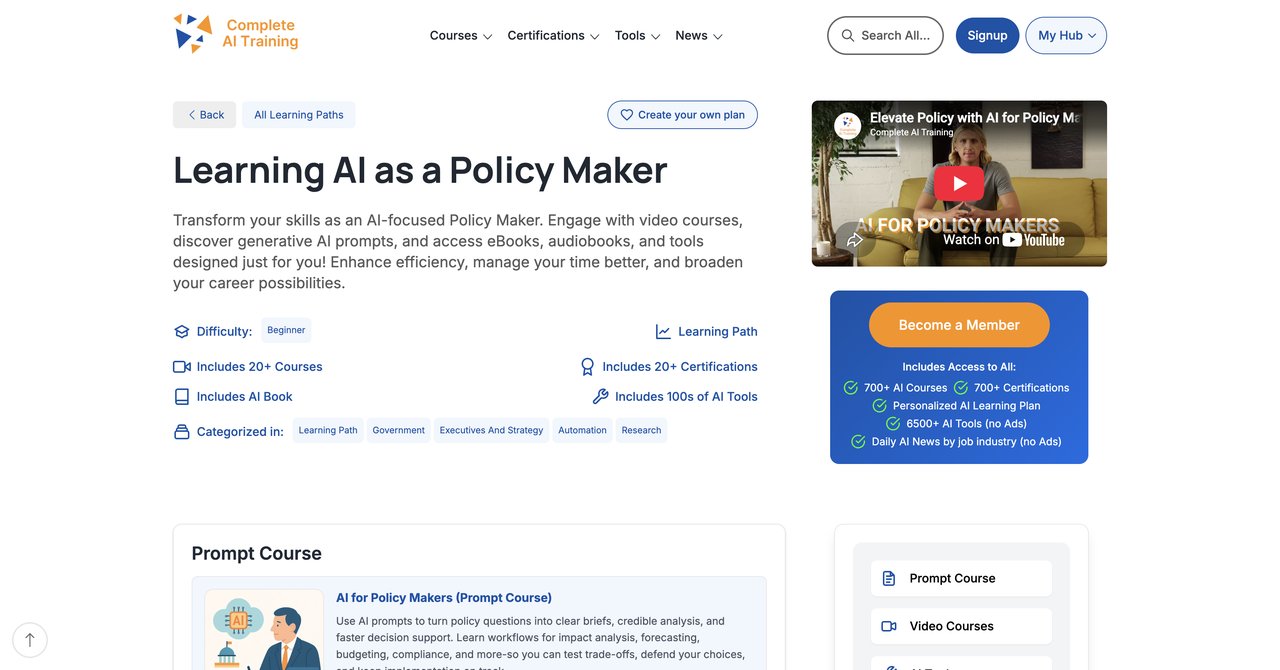
Here's the thing about CompleteAI Training that sets it apart from every other option in this comparison: it's not a single course. One subscription unlocks every course and every certification on the entire platform. That's hundreds of courses, not just one. And the same subscription gives you access to every certification they offer, with no extra fees. New courses and certifications get added continuously, and they're included automatically. So you're not just buying a static curriculum-you're buying ongoing access to a constantly updated library.
For policy makers, this matters because their work rarely fits neatly into one job description. You might be dealing with AI procurement one day, data privacy the next, and ethics frameworks the week after. CompleteAI Training's subscription model means you have access to every other job role's material too-whether that's AI for legal teams, AI for HR professionals, AI for educators, or any other function. If you ever move roles or take on cross-functional responsibilities, your training library moves with you. That's a huge advantage over buying a single course and finding out later that you need material from a different track.
The pricing is straightforward: $29 per month, or $8.25 per month if you pay annually. That's significantly less than most of the other options in this comparison. And since the subscription includes all certifications, you're not paying extra for the credential you'll want to show your employer or professional network.
CompleteAI Training is a subscription product, which is worth noting. If you prefer a one-time purchase and then you're done, this isn't that. But the subscription model is arguably the right approach for this topic, because AI is developing so fast that any static course is going to be outdated within a year. With a subscription, you're paying for continuous learning, and that's what the field demands.
The platform has the highest rating among the options in this comparison, and it's described as the most comprehensive AI training available for policy makers. The courses are video-based, self-paced, and you can work through them at your own speed.
Key Topics Covered
The curriculum covers AI fundamentals, policy frameworks, ethical considerations, regulatory approaches, and practical applications for public governance. It also includes material on how AI tools are being used in government settings, and how policy makers can evaluate AI systems effectively.
Target Audience and Skill Level
This is designed for working professionals who need AI fluency. No technical background is required. The courses start from basics and build up to more advanced topics, so both newcomers and experienced professionals can find appropriate content.
Pros
- Highest rating and most complete offering available
- Full access to ALL video courses on the platform, not a single course or a fixed bundle
- Full access to ALL certifications on the platform, included at no extra cost
- New courses and certifications are added continuously and are included automatically
- Access to every other job role's material too, which matters for anyone whose work spans more than one function or who wants to move roles
- One flat subscription price covers all of the above, versus paying per course elsewhere
- Very affordable pricing, especially with annual billing
Cons
- Subscription based, crucial for continuous learning as AI is developing continuously
Who Would Benefit Most
Policy makers who want comprehensive, up-to-date AI knowledge without breaking the bank. Also, those who value the ability to access material beyond just one narrow topic, or who anticipate their role evolving over time. The subscription model works well for people who want to stay current as the field develops.
Course 2: AI Policy Essentials by Coursera
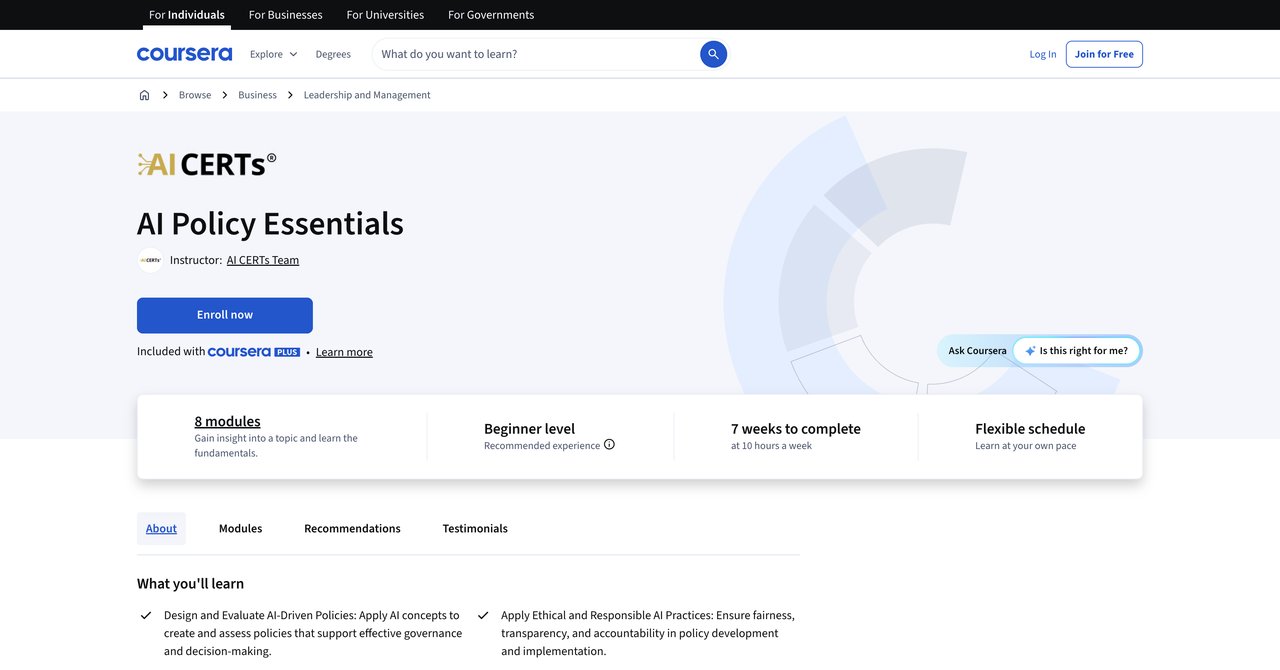
AI Policy Essentials is a Coursera course designed specifically for governance and policy professionals. It covers AI-driven policy design and evaluation, and it includes strategic decision-making for long-term planning. The course is part of Coursera's broader subscription model, so you'll need a Coursera Plus subscription at roughly $59 per month to access it.
What's interesting about this course is its focus on the policy design side of things. It's not just about understanding what AI is; it's about how to create policy that actually works when AI is involved. The course includes material on evaluating the effectiveness of AI-driven policies, which is something that many other courses don't touch.
The course is structured for working professionals, but you should be aware that it requires a consistent time commitment of about 10 hours per week. That's not nothing. If you're already in a demanding role, you'll need to plan your schedule accordingly.
One thing to note: this course doesn't have verified learner ratings yet. That's not necessarily a red flag, but it means you're relying on the course description and the provider's reputation rather than the experiences of people who have already taken it.
Key Topics Covered
AI policy design, policy evaluation, strategic decision-making, and long-term planning for AI governance.
Target Audience and Experience Level
Governance and policy professionals who want to build their AI knowledge. No technical background is needed, but you should be comfortable with policy frameworks and strategic thinking.
Pros
- Designed specifically for governance and policy professionals
- Covers AI-driven policy design and evaluation
- Includes strategic decision-making for long-term planning
Cons
- Requires consistent 10 hours/week commitment
- No verified learner ratings yet
Who Would Benefit Most
Policy professionals who are comfortable with Coursera's platform and who want a structured course that focuses specifically on policy design and evaluation. If you're already paying for Coursera Plus, this is a convenient option to add to your learning path.
Visit AI Policy Essentials on Coursera
Course 3: AI Law, Policy and Governance by LSE Executive Education
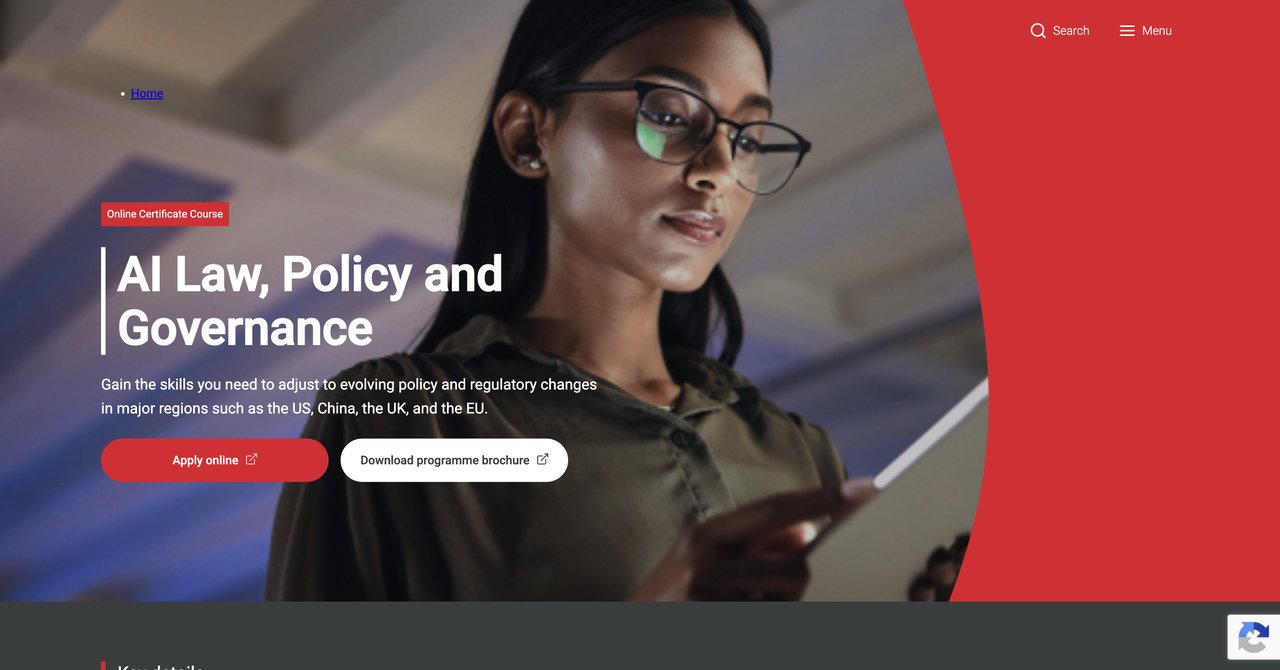
LSE Executive Education offers a course called AI Law, Policy and Governance, which comes from the LSE Law School and the School of Public Policy. This is a premium offering, with a price tag of £2,420 (about $3,100). It covers global regulatory landscapes and looks at how to balance AI innovation with security and ethics. The course is designed so that no prior legal background is required.
This course has a strong international focus. It's not just about one country's regulatory approach; it looks at how different jurisdictions are handling AI governance. For policy makers who work on cross-border issues or who need to understand how different regulatory systems interact, this is a valuable perspective.
The cost is significant, and the course runs on fixed cohort dates. The next one starts on 29 July 2026. That's a long wait if you're looking to upskill quickly. The cohort format also means you have to be available at specific times, which can be challenging for busy professionals.
That said, the LSE brand carries weight. If you're looking for a credential that will be recognized internationally, this course has that advantage. It's also a deep dive into the legal and governance aspects of AI, which is more specialized than some of the other options.
Key Topics Covered
Global AI regulatory landscapes, legal frameworks, security considerations, ethics, and the balance between innovation and governance.
Target Audience and Experience Level
Policy makers, legal professionals, and governance specialists who want a comprehensive understanding of AI law and policy. No legal background is required, but the content is intellectually demanding.
Pros
- From LSE Law School and School of Public Policy
- Covers global regulatory landscapes
- Balances AI innovation with security and ethics
- No prior legal background required
Cons
- Premium price point
- Fixed cohort start dates (next: 29 Jul 2026)
Who Would Benefit Most
Senior policy professionals who need a deep, internationally-focused understanding of AI law and governance, and who are willing to invest in a prestigious credential.
Visit AI Law, Policy and Governance at LSE
Course 4: AI Policy Compass by Mila (with Public Policy Forum Academy)
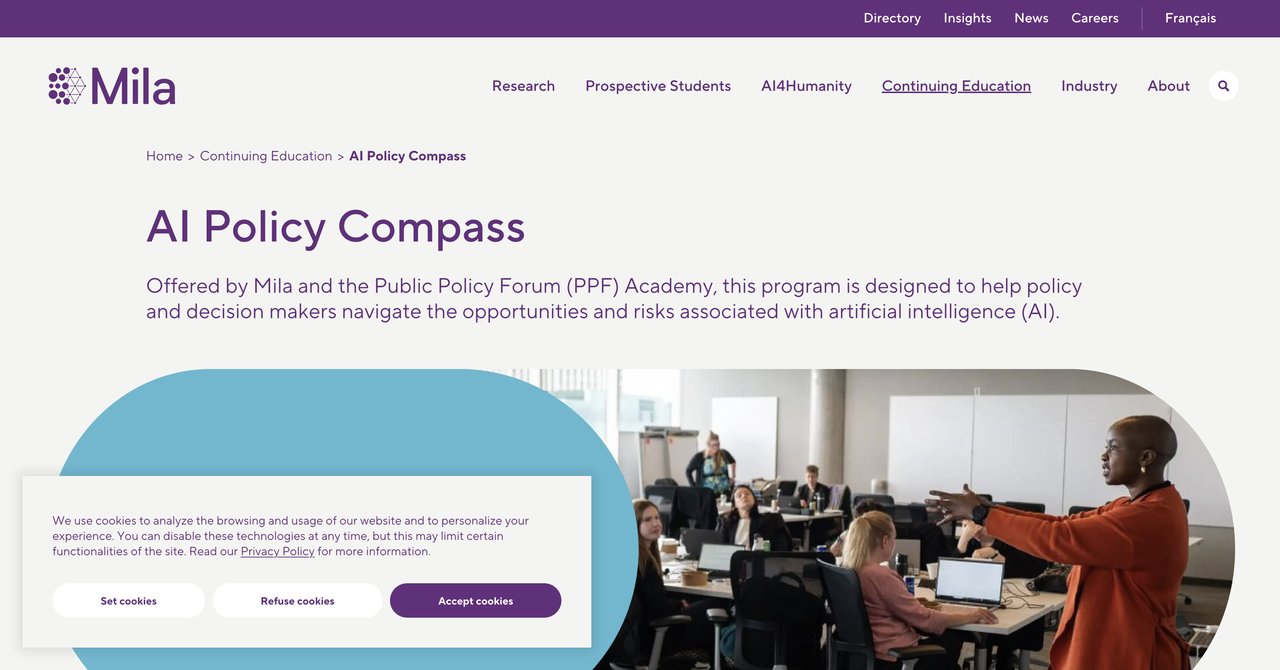
The AI Policy Compass course is co-designed by Mila, which is a world-leading AI institute in Montreal, and the Public Policy Forum Academy. It costs $2,050 CAD (about $1,500 USD). The course doesn't require any programming experience, and it emphasizes leadership and decision-making with real AI models.
What's notable about this course is that it's not just theoretical. You get to work with actual AI models, which helps you understand what the technology can and can't do. That hands-on experience can be valuable for policy makers who need to make informed decisions about AI systems.
The course is designed for leadership and decision-making. It's not about becoming a data scientist; it's about understanding AI enough to lead effectively. The focus is on practical application in a policy context.
One thing to be aware of is that the course has a Canadian-focused policy context. If you're working in Canada, that's a strength. If you're working elsewhere, you'll still get value from the material, but you'll need to translate the Canadian examples to your own context.
The price includes materials, but travel or live sessions may be required. That could add to the overall cost and time commitment.
Key Topics Covered
AI fundamentals, leadership and decision-making, working with real AI models, and policy applications with a Canadian focus.
Target Audience and Experience Level
Policy makers and public sector leaders who want practical experience with AI models. No programming background is needed.
Pros
- Co-designed by Mila and PPF Academy
- No programming experience required
- Emphasizes leadership and decision-making with real AI models
Cons
- Canadian-focused policy context
- Price includes materials but travel/live sessions may be required
Who Would Benefit Most
Canadian policy professionals, or those interested in the Canadian approach to AI policy, who want hands-on experience with AI models and a focus on leadership.
Visit AI Policy Compass at Mila
Course 5: AI Law and Policy by eCornell (Cornell University)
Cornell University's online platform, eCornell, offers a certificate course called AI Law and Policy. It costs $3,750, and it covers the legal, ethical, and policy implications of AI. The course focuses on responsible AI integration within organizations.
This course has the weight of Cornell's brand behind it. That's meaningful for professionals who want a credential from a recognized university. The focus on responsible AI integration is also important for policy makers who are looking at how organizations can adopt AI in a way that's ethical and compliant.
The course is designed for professionals, not academics. It's practical, and it's focused on the real-world implications of AI in organizational settings. The legal and ethical aspects are covered in depth.
However, the cost is high, and there's no per-course duration specified. That makes it hard to plan your time. You also need to be comfortable with the fact that you're paying a premium for the Cornell brand, and the course may not be as comprehensive as some other options.
Key Topics Covered
Legal implications of AI, ethical considerations, policy implications, and responsible AI integration within organizations.
Target Audience and Experience Level
Professionals who need to understand AI law and policy from an organizational perspective. It's relevant for policy makers, legal teams, and governance officers.
Pros
- From Cornell's trusted online platform
- Covers legal, ethical, and policy implications of AI
- Focuses on responsible AI integration within organizations
Cons
- High cost
- No per-course duration specified
Who Would Benefit Most
Professionals who want a Cornell credential and who need to understand AI law and policy from an organizational perspective, particularly around responsible adoption.
Visit AI Law and Policy at eCornell
Course 6: Ethics, Technology, and Public Policy for Practitioners by Stanford University
Stanford University's McCoy Family Center for Ethics in Society offers a course called Ethics, Technology, and Public Policy for Practitioners. It's a live cohort-based course with 7 Zoom sessions, and it gathers practitioners from tech, civil society, and government. The course applies Stanford's ethics expertise to tech policy.
The live cohort format is a significant differentiator. You're not learning alone; you're learning with a group of peers from different sectors. That's valuable for policy makers who want to understand how tech companies, civil society organizations, and government agencies see AI policy issues. The networking potential alone is worth considering.
The course is built around Stanford's ethics expertise, so you'll get a strong grounding in ethical frameworks as they apply to technology and public policy. This is a course for practitioners, so the material is grounded in real-world issues.
The cost is not published, which is unusual. You'll need to contact Stanford for pricing. Also, the course is limited to the fall 2026 cohort, so there's no flexibility in when you can take it.
Key Topics Covered
Ethics of technology, public policy implications, ethical frameworks, and practical applications for tech policy.
Target Audience and Experience Level
Practitioners from tech, civil society, and government. The course is designed for people who are already working in these areas, not for newcomers.
Pros
- Live cohort-based with 7 Zoom sessions
- Gathers practitioners from tech, civil society, and government
- Stanford's ethics expertise applied to tech policy
Cons
- Price not published
- Limited to fall 2026 cohort
Who Would Benefit Most
Practitioners who want to learn in a live cohort with peers from different sectors, and who value the Stanford brand and the ethical focus.
Visit Ethics, Technology, and Public Policy at Stanford
Course 7: AI for Decision Makers by Coursera
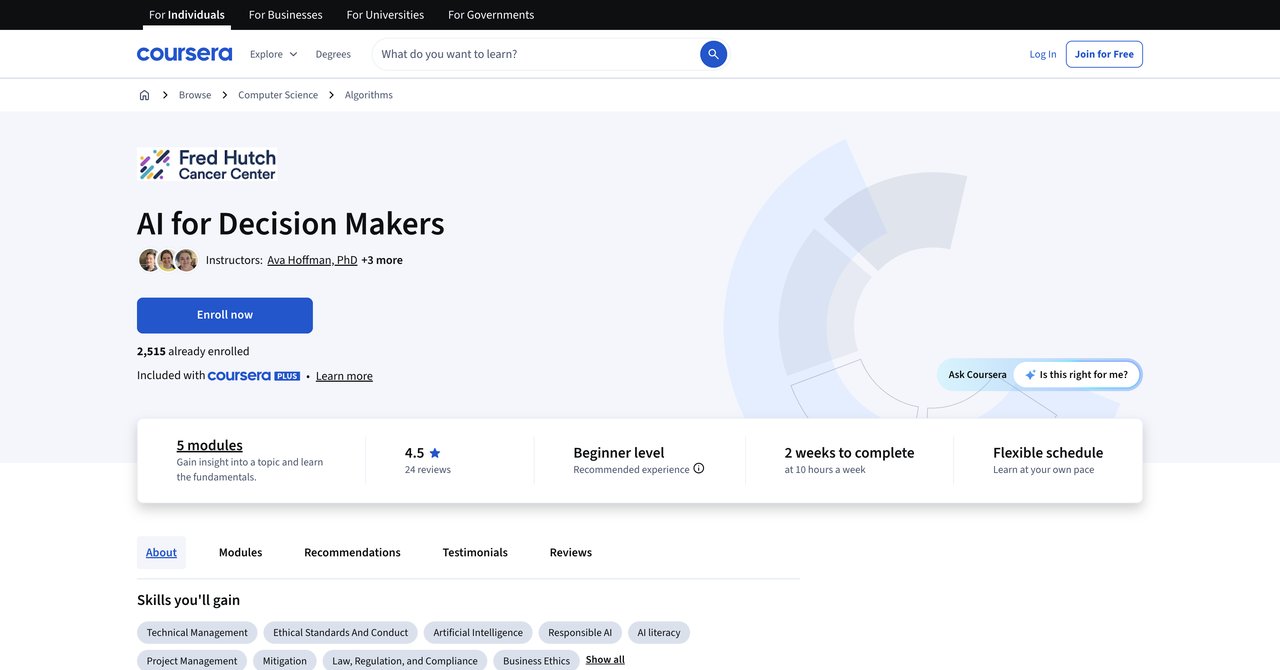
AI for Decision Makers is another Coursera offering, available through the Coursera Plus subscription at about $59 per month. The course covers what AI is, how it works, and the ethical and policy considerations. It's designed to build leadership skills for business, lab, organization, or community efficiency.
This course is broader than some of the others in this comparison. It's not just about policy; it's about making decisions with AI in any organizational context. That's useful if you're a policy maker who also has management responsibilities, or if you're moving into a broader leadership role.
The course covers the basics of AI, which is helpful for anyone who's new to the field. But it's less policy-specific than some of the other options. If your focus is purely on policy making, you might find this course too general.
Like the other Coursera course in this list, it doesn't have verified ratings. And the cost is tied to the Coursera Plus subscription, so you need to factor that in.
Key Topics Covered
What AI is, how it works, ethical considerations, policy considerations, and leadership skills for efficiency.
Target Audience and Experience Level
Decision makers in any context, including policy makers, who want a general understanding of AI and leadership skills. No technical background is needed.
Pros
- Covers what AI is, how it works, ethical and policy considerations
- Builds leadership skills for business, lab, organization, or community efficiency
Cons
- Less policy-specific than other options
- No verified ratings
Who Would Benefit Most
Professionals who want a general understanding of AI and leadership skills, and who don't need a deep dive into policy specifics.
Visit AI for Decision Makers on Coursera
Course 8: Artificial Intelligence in Public Policy by King's College London
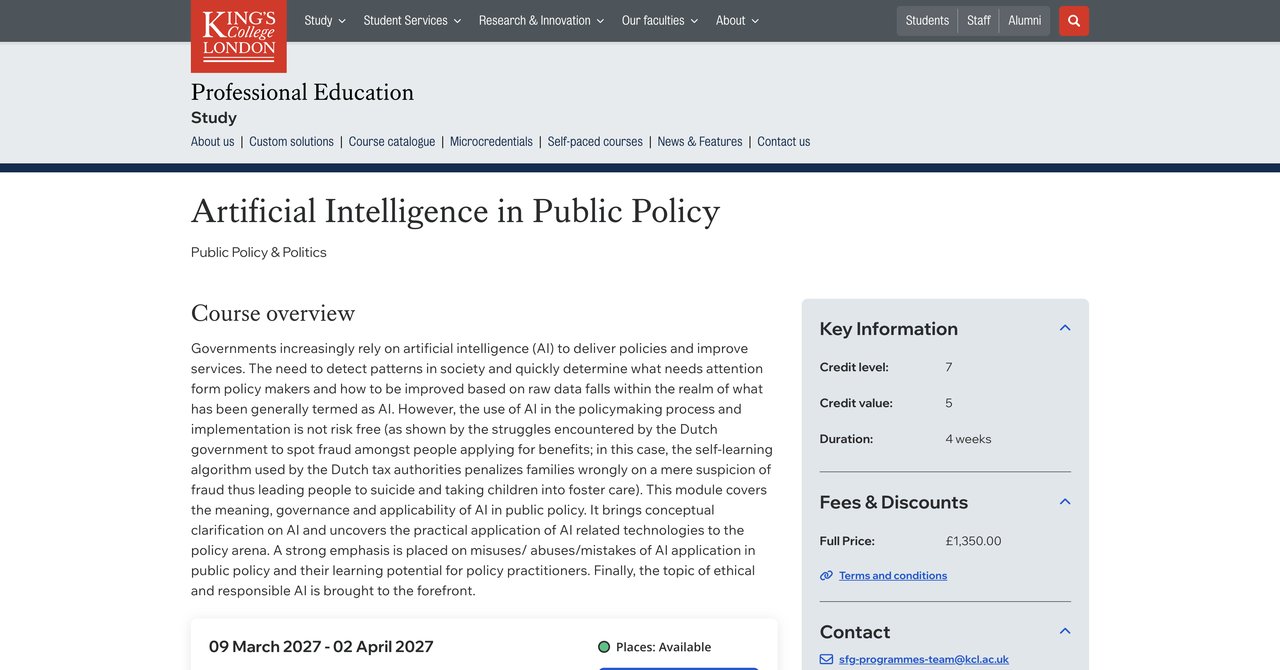
King's College London offers a course called Artificial Intelligence in Public Policy. It costs £1,200 (about $1,540). The course is fully online with self-directed study plus 3 live webinars. The final assessment applies AI to your own policy area, which is a practical way to learn.
The course is from a leading UK university, so you're getting a recognized credential. The self-directed format means you can work at your own pace, which is helpful for busy professionals. The live webinars provide some structure and interaction, but they're optional and only in weeks 1 and 4.
The final assessment is a key feature. You'll apply what you've learned to your own policy area, which means you'll have a practical output at the end of the course. That's more useful than a simple exam.
The cost is moderate compared to some of the other options. The main drawback is that the single assessment at the end may be demanding. If you're not prepared for a significant final project, this might be challenging.
Key Topics Covered
AI in public policy, self-directed study, live webinars, and applying AI to your own policy area.
Target Audience and Experience Level
Policy makers who want a practical, applied course from a UK university. No technical background is required.
Pros
- Fully online with self-directed study plus 3 live webinars
- Final assessment applies AI to your own policy area
- From a leading UK university
Cons
- Single assessment at end may be demanding
- Optional webinars only in weeks 1 and 4
Who Would Benefit Most
Policy makers who want a practical, applied course with a final project that's relevant to their own work.
Visit Artificial Intelligence in Public Policy at King's College London
Course 9: AI+ Policy Maker Practitioner™ by AICERTs
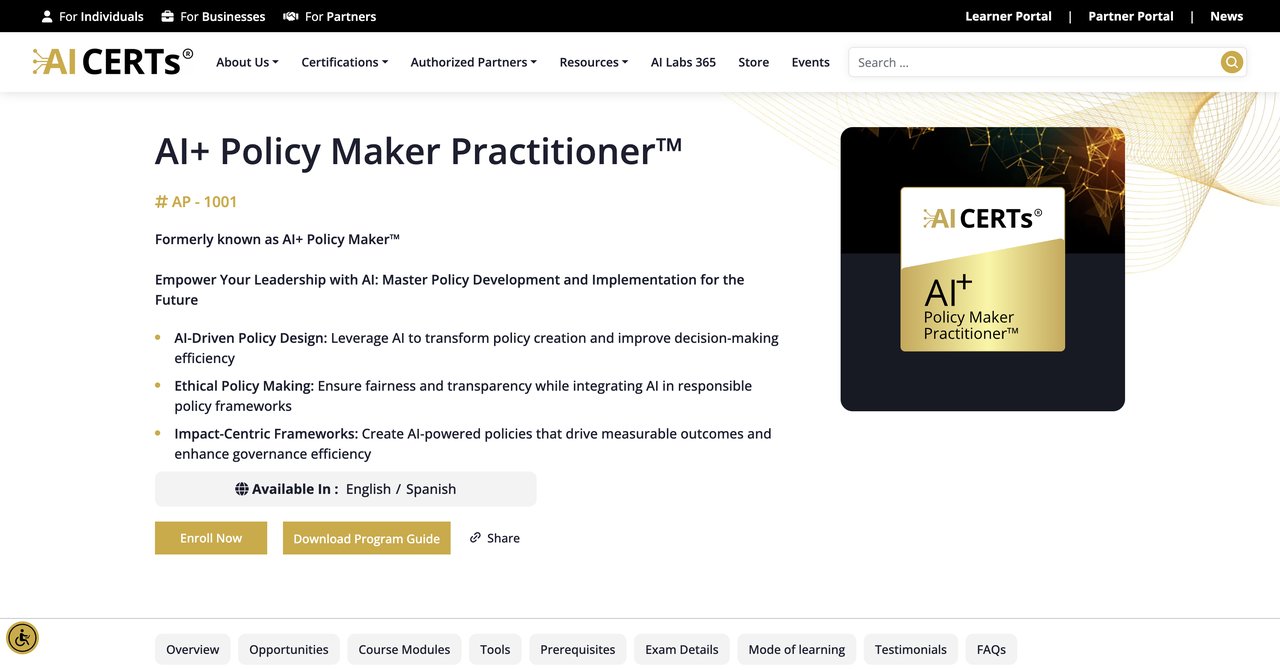
AICERTs offers a fast-track certification format called AI+ Policy Maker Practitioner™. It's formerly known as AI+ Policy Maker™, and the curriculum has been updated. The course offers flexible live or self-paced delivery.
The fast-track format is the main selling point. If you need to get certified quickly, this course can get you there in a day. That's a significant advantage for professionals who need a credential but can't commit to a long course.
The flexible delivery is also a plus. You can choose between live sessions or self-paced study, depending on your schedule and learning style. That flexibility is useful for busy professionals.
However, the price is not published, so you'll need to contact them for that. And the 1-day format may be too condensed for deep learning. If you want a thorough understanding of AI policy, a single day might not be enough.
Key Topics Covered
AI policy, updated curriculum, fast-track certification, and flexible delivery options.
Target Audience and Experience Level
Professionals who need a certification quickly and want flexibility in how they learn.
Pros
- Fast-track certification format
- Formerly AI+ Policy Maker™ with updated curriculum
- Flexible live or self-paced delivery
Cons
- Price not published
- 1-day format may be too condensed for deep learning
Who Would Benefit Most
Professionals who need a certification quickly and are comfortable with a condensed format.
Visit AI+ Policy Maker Practitioner™ at AICERTs
Course 10: AI+ Policy Maker (Live Training) by LEXX Live
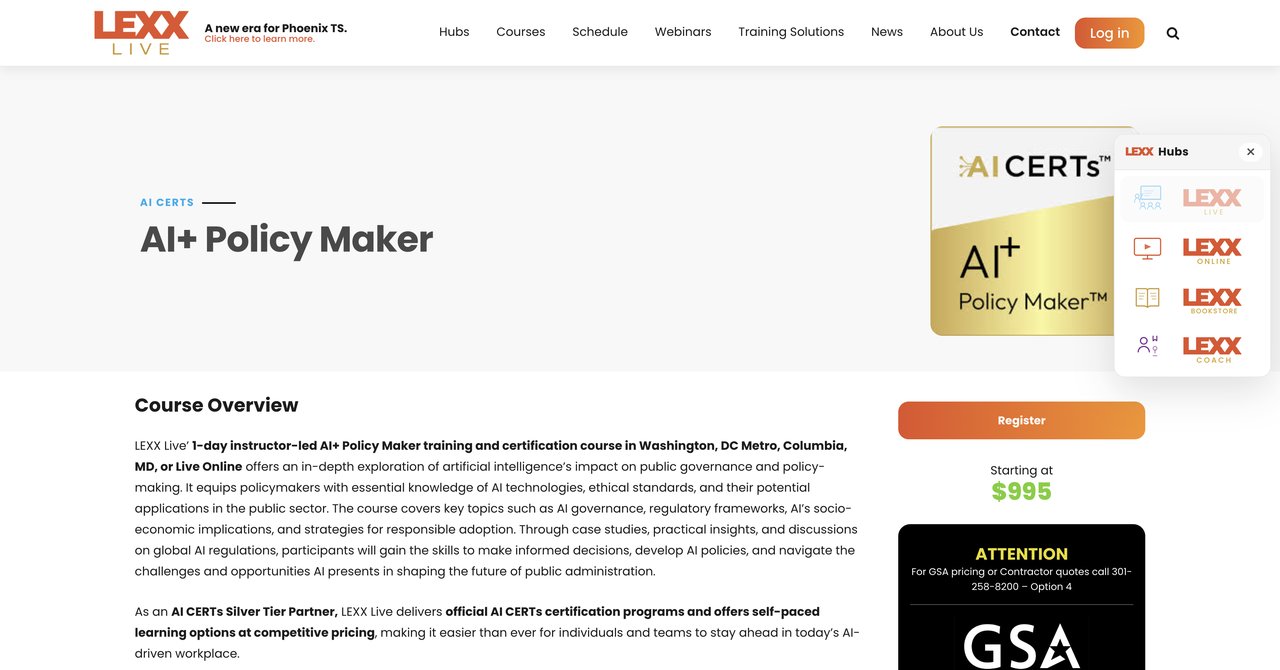
LEXX Live offers an instructor-led course called AI+ Policy Maker (Live Training). It provides an in-depth exploration of AI's impact on public governance. The course is available in Washington DC Metro, Columbia MD, or live online.
The instructor-led format is a plus. You'll have a live instructor who can answer questions and provide feedback. The course is also available in multiple locations, or you can take it live online, which is convenient.
The course focuses on the impact of AI on public governance. That's a specific focus that will be relevant to policy makers who work in government or public administration.
The price is not published, so you'll need to contact them. And the single-day format limits the depth of the material. If you want a comprehensive understanding of AI, a one-day course might not be sufficient.
Key Topics Covered
AI's impact on public governance, instructor-led training, and live or online delivery.
Target Audience and Experience Level
Policy makers and public administrators who want a focused, instructor-led course.
Pros
- In-depth exploration of AI's impact on public governance
- Available in Washington DC Metro, Columbia MD, or live online
- Instructor-led
Cons
- Price not published
- Single-day format limits depth
Who Would Benefit Most
Professionals who prefer instructor-led learning and want a focused, one-day course on AI in public governance.
Visit AI+ Policy Maker at LEXX Live
Course 11: AI for Policy Makers (Professional Certificate) by edX
edX offers a professional certificate track called AI for Policy Makers. This is a subscription-based offering that varies by institution, typically costing $50-100 per month. Multiple university partners offer AI policy tracks, and the course is flexible self-paced learning. It often includes case studies from government applications.
The strength of this option is the variety. Because edX has multiple university partners, you have access to different perspectives and approaches. That's valuable if you want to see how different institutions think about AI policy.
The self-paced format is convenient for busy professionals. You can work through the material at your own speed. The case studies from government applications are also a useful feature.
The main drawback is that the course catalog varies by partner. You're not getting a single, dedicated policy course. You're getting access to a library of courses, and the quality and focus can vary depending on the university.
Key Topics Covered
AI policy, self-paced learning, case studies from government applications, and multiple university perspectives.
Target Audience and Experience Level
Professionals who want a flexible, subscription-based option with access to multiple university perspectives.
Pros
- Multiple university partners offer AI policy tracks
- Flexible self-paced learning
- Often includes case studies from government applications
Cons
- Course catalog varies by partner
- Not a single dedicated policy course
Who Would Benefit Most
Professionals who prefer a subscription-based, self-paced approach and want to learn from multiple universities.
Visit AI for Policy Makers on edX
Course 12: AI Governance Professional (AIGP) Training by IAPP
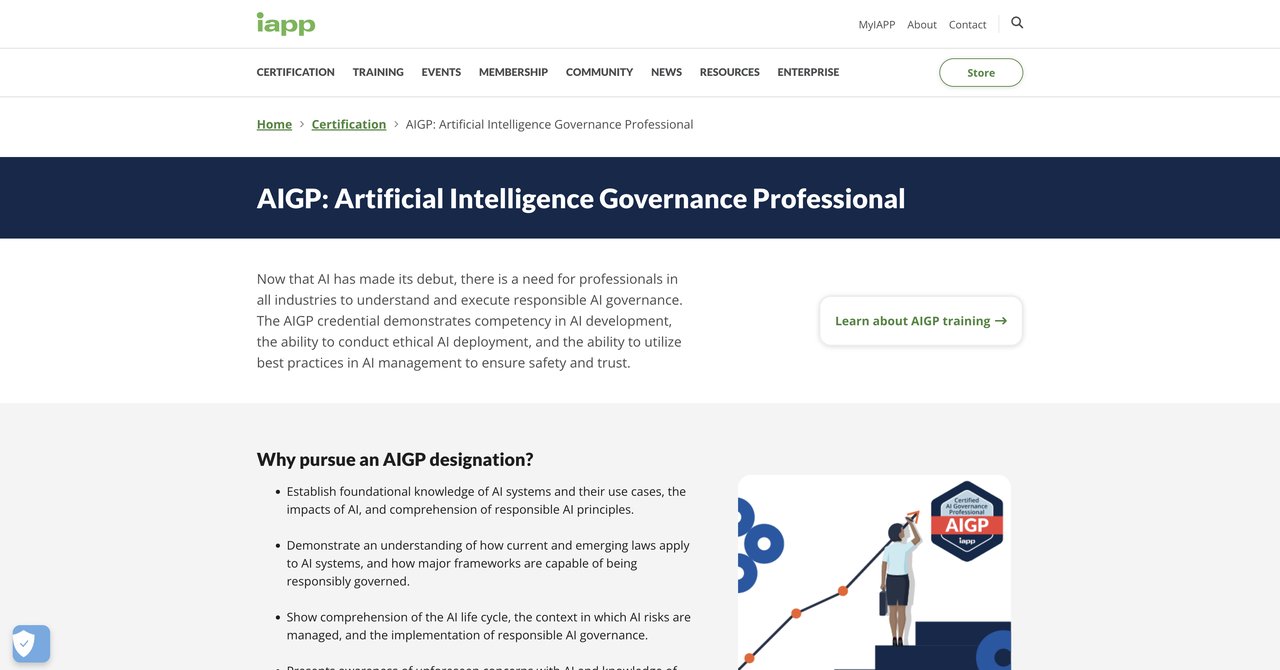
The International Association of Privacy Professionals (IAPP) offers a certification called AI Governance Professional (AIGP). This is an industry-recognized certification specifically for AI governance. The course covers the AI lifecycle, risk management, and regulatory compliance. It comes from the leading privacy professional body.
This certification is specifically designed for AI governance, which is a growing field. It's not just about understanding AI; it's about how to govern it effectively. That includes managing risks and ensuring compliance with regulations.
The IAPP is a leading privacy professional body, so the credential carries weight in the industry. If you're working in privacy or governance, this certification is recognized and respected.
The price is not published, and you'll need to pay for both the training and the exam fee. Also, the advanced level may require prior policy or privacy experience. So this is not for beginners.
Key Topics Covered
AI lifecycle, risk management, regulatory compliance, and AI governance.
Target Audience and Experience Level
Professionals with prior policy or privacy experience who want an industry-recognized certification in AI governance.
Pros
- Industry-recognized certification specifically for AI governance
- Covers AI lifecycle, risk management, and regulatory compliance
- From the leading privacy professional body
Cons
- Price not published
- Advanced level may require prior policy/privacy experience
Who Would Benefit Most
Professionals with a background in privacy or policy who want a recognized certification in AI governance.
Visit AI Governance Professional at IAPP
Final Recommendations and Summary
So, which course should you choose? It depends on your specific needs, your budget, and your time constraints. Here's a summary to help you decide.
For the most comprehensive coverage and the best value: CompleteAI Training is the strongest option. The subscription model gives you access to all courses and all certifications, and the price is very affordable. The fact that new courses are added continuously means you won't be stuck with outdated material. It's a good fit for policy makers who want to stay current without worrying about the field moving ahead of them.
For a recognized university credential: LSE, Cornell, and Stanford offer courses that carry a prestigious name. LSE is the most expensive, but it offers a global perspective. Cornell is a strong option for organizational focus. Stanford offers a unique cohort-based experience with an ethical focus. These are good options if you want the credential to be recognized by your employer or in your industry.
For a flexible, self-paced approach: Coursera and edX offer subscription-based options. They're good if you're already using those platforms or if you want to learn at your own pace. However, the course catalog can vary, and you might not get the depth of a dedicated course.
For a quick certification: AICERTs and LEXX Live offer fast-track options. They're good if you need a certification quickly, but they're condensed, so you'll get less depth. Also, the price isn't published, so you need to contact them for details.
For a focus on governance and privacy: IAPP's AIGP is the industry-standard certification for AI governance. If you have a background in privacy or policy, this is a strong choice. The certification is recognized in the field, and it's specifically focused on governance.
For a hands-on experience with AI models: Mila's course offers hands-on experience with real AI models, which is valuable for policy makers who want to understand the technology. However, it's Canadian-focused, and there may be travel requirements.
In the end, the best choice depends on what you're trying to achieve. If you want the most comprehensive, up-to-date, and affordable option, CompleteAI Training is hard to beat. If you want a prestigious university credential, you'll need to pay more and accept the constraints. If you want a quick certification, the fast-track options are available. And if you want a specialized governance focus, IAPP is the way to go.
Whatever you choose, the important thing is to start learning. AI is changing the policy landscape, and professionals who understand it will be better equipped to make decisions. The investment you make in your education is one that will pay off.