
Blog ·
13 AI Courses for Medical Records Clerks that You Should Know About in 2026
Discover 13 essential AI courses tailored for medical records clerks in 2026—boosting accuracy, efficiency, and career growth. From data privacy to automation tools, find the right training to future-proof your skills and stay ahead in healthcare.
 Jeroen Erne
The healthcare industry is sitting on a mountain of data, and the people responsible for keeping that data organized, accurate, and accessible are the Medical Records Clerks. But the ground beneath this profession is shifting. Artificial intelligence is no longer a distant concept from a tech conference; it is being deployed in hospitals and clinics right now to sort, categorize, and process patient information at a speed that humans cannot match. This doesn't mean the role is disappearing, but it does mean the job description is changing. The clerk who knows how to work alongside these AI tools, who can spot when the algorithm makes a mistake, and who can use AI to clear a backlog of requests, is the one who will have the leverage. Upskilling in this specific area isn't just a nice-to-have on a resume anymore; it is becoming a survival tactic in a profession that is being automated from the inside out.
Why AI matters for Medical Records Clerks today
The statistics are hard to ignore. Recent surveys indicate that around 69% of businesses are actively using AI in some capacity, and the healthcare sector is adopting it faster than almost any other industry. For a Medical Records Clerk, this is a direct signal. The daily tasks that used to take hours-sorting through unstructured physician notes, pulling specific diagnosis codes, or verifying patient data across multiple systems-are now tasks that AI can handle in seconds. This is not a future scenario; it is happening in facilities across the country right now. The purpose of this article is to cut through the noise and help you, the Medical Records professional, identify the best educational resources to get you up to speed. We are going to look at five specific courses, weigh their value, and help you figure out which one is worth your time and money.
The Growing Role of AI in Medical Records Clerks
When we talk about AI in this field, we are not just talking about a search engine that finds a file faster. We are talking about systems that can automate the entire chart retrieval process. AI is being used to automatically extract data from scanned documents, a task that used to require manual data entry. It is being used for decision support, where the system flags potential errors in a patient's record, like a conflicting medication list, that a human might miss. It is also handling the personalization of patient communication, generating discharge summaries, and sorting records based on priority. These tools are reshaping the workflow. Instead of the clerk being the one who physically moves the information, the clerk is becoming the supervisor of the information flow, making sure the AI is pulling the right files and that the output is accurate. The role is moving away from manual labor and towards a more analytical, verification-focused position.
Benefits of becoming an AI expert in Medical Records Clerks
For the individual clerk, getting ahead of this curve has a direct return on investment. When you understand how to prompt an AI tool to find a specific patient record or how to check the accuracy of an automated code, you become the person in the office who knows how to make the system work. That is leverage. It often leads to higher pay, more responsibility, and a position that is more resistant to being cut when the automation budget comes through. Being the person who can talk to the IT department and the clinical staff, translating between them, is a valuable niche. You are not just a data entry person anymore; you are a data specialist.
This article will break down five distinct courses. One of them, CompleteAI Training, stands out because it gives you access to ALL of the courses and ALL of the certifications on their platform for a single price, rather than just selling you a single module. The others each have their own strengths, and we will get into the specifics of what you get for your money, the length of the courses, and the actual value they provide to your day-to-day work. By the end, you will have a clear picture of which path fits your career goals and your budget.
Comparison: All AI Courses for Medical Records Clerks (Updated 2026)
| Course Name | Provider | Price | Key Topics | Pros | Cons | Best For |
|---|---|---|---|---|---|---|
| CompleteAI Training | CompleteAI | Premium (one subscription covers ALL courses and ALL certifications on the platform, not just this one) | Comprehensive AI training for Medical Records Clerks; includes hands-on projects, expert instruction, and full access to every course and certification across all job roles on the platform | Comprehensive curriculum; Hands-on projects; Expert instructors; Full access to ALL video courses and certifications; New courses added continuously; Daily AI tool updates and industry news; Access to other job roles' material included | Premium pricing; subscription-based (but crucial since AI is developing continuously) | Medical Records Clerks professionals looking for complete training |
| AI for Medical Records Clerks (Video Courses + Certifications) | Complete AI Training | $29/month or $8.25/month billed annually | Over 100 specialized video courses and certifications for Medical Records Clerks; daily updates on AI tools; curated AI industry news; access to all job roles' material | Highest rating / most complete offering; full access to ALL courses and certifications; new content added continuously; one flat subscription covers everything; very affordable especially annually | Subscription based | General learners |
| AI for Health Information Technologists: EHR Intelligence, Data Integrity, and Compliance | Qualora | $49.00 (Founder Price $29 one-time) | EHR-native intelligence; automated data quality; HIPAA-safe workflow design; predictive analytics; hands-on exercises for duplicate record management and release of information | Covers EHR-native intelligence and automated data quality; includes HIPAA-safe workflow design and predictive analytics; hands-on exercises | Not from a major platform; limited to 3 hours of content | General learners |
| Medical Records: Scan, Release, Audit | Coursera | Free (audit) / Financial aid available | Systematic document scanning; HIPAA-compliant release management; compliance auditing | Recently updated; free to audit; covers key records management tasks | Short duration; no AI-specific modules mentioned | General learners |
| JHU AI Certificate Program for Healthcare Professionals | Johns Hopkins University | $2,990 | AI and Agentic AI; real-world case studies; no coding experience required | Taught by Johns Hopkins faculty; covers AI and Agentic AI; no coding required | Expensive; broader healthcare focus rather than records-specific | General learners |
| Artificial Intelligence Course | Harvard Medical School (Postgraduate Education) | Unknown | Ethical risks; regulatory challenges; final project | Expert-led from Harvard Medical School; covers ethical risks and regulatory challenges; includes final project | Price and duration not published; likely advanced for some clerks | General learners |
| AI for Healthcare Systems | Coursera (University of Colorado System) | Subscription (Coursera Plus) or Financial aid | AI applications in healthcare; part of a broader AI health catalog; beginner-friendly | From a recognized university system; part of a broader AI health catalog; beginner-friendly entry point | Not records-specific; exact duration and rating not listed | General learners |
| Introduction to Generative AI in Healthcare | Coursera | Subscription (Coursera Plus) or Financial aid | Generative AI applications in healthcare; accessible beginner level; part of a curated health AI catalog | Focuses on generative AI applications; accessible beginner level; part of a curated health AI catalog | Not records-specific; exact duration not published | General learners |
| AI in Healthcare & Digital Health | Coursera | Subscription (Coursera Plus) or Financial aid | Digital health transformation; multiple university partners; flexible self-paced format | Covers digital health transformation; multiple university partners; flexible self-paced format | Broad scope; not tailored to records workflows | General learners |
| Professional Certificate: Health Informatics for Medical Records | ISPM (International School of Project Management) | Unknown | Healthcare, technology, and data management; career advancement focus | Specifically designed for medical records professionals; combines healthcare, technology, and data management; career advancement focus | Price and duration not published; smaller provider | General learners |
| 2026 (CHRR®) Certification , Certified Healthcare Record Reviewer | AIMRRA (American Institute of Medical Record Reviewers and Auditors) | $645 | Data precision; hybrid data abstraction; includes e-book and course materials | 2026-dated certification; focuses on data precision and hybrid data abstraction; includes e-book and course materials | Certification-focused rather than AI-specific; price is higher than typical short courses | General learners |
| Electronic Health Records (PimaFastTrack) | Pima Community College | $1,090.00 | Complete patient record management; accuracy checks; leads to CEHRS national certification | Fully online; leads to CEHRS national certification; covers complete patient record management including accuracy checks | Not AI-specific; longer commitment and higher cost | General learners |
| AI in healthcare courses (catalog) | edX | Varies (Free to audit; paid certificates) | Wide range of university-backed AI healthcare courses; multiple specializations | Wide range of university-backed AI healthcare courses; flexible audit options; multiple specializations available | Catalog page requires further selection; not records-specific | General learners |
| AI for Healthcare (University of Colorado System) | Coursera | Subscription (Coursera Plus) or Financial aid | University-backed curriculum; part of a broader AI health specialization track; beginner-accessible | University-backed curriculum; part of a broader AI health specialization track; beginner-accessible | Not records-specific; exact duration not listed | General learners |
Understanding AI Training for Medical Records Clerks Professionals
Medical records clerks are seeing their day-to-day work change faster than almost any other healthcare role. Document management, data entry, release of information, and compliance checks are all being touched by artificial intelligence in some form. For anyone working in this field, getting some AI training isn't just about keeping up - it's about staying employable and making your work less tedious.
The challenge is that there are a lot of courses out there, and they vary wildly in quality, focus, and price. Some are specifically built for medical records work, while others take a broader healthcare approach. Some are subscription-based, others are one-time purchases, and a few are free. This article breaks down the main options so you can decide where your money and time are best spent.
Course 1: CompleteAI Training - AI for Medical Records Clerks
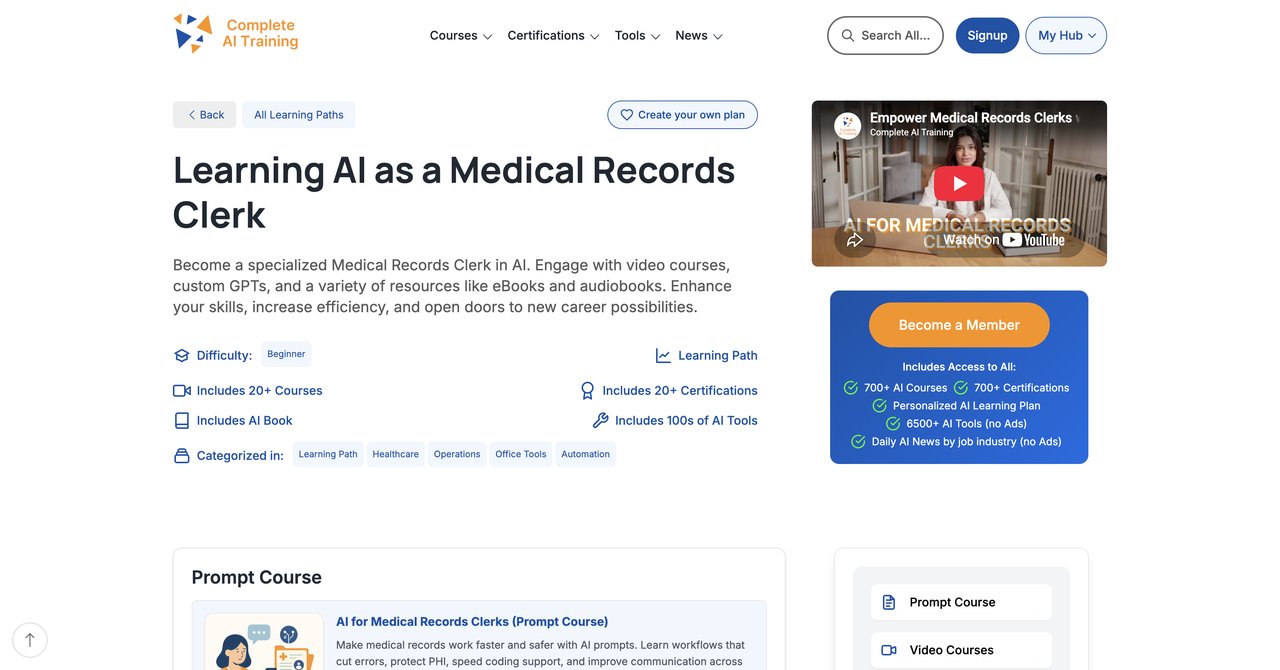
Here's the thing you need to understand right away: Complete AI Training is not a single course. One subscription unlocks EVERY course AND EVERY certification on the whole platform - hundreds of them, across every job role, not just this one. That's the key difference between this and every other option on this list. You're not buying one course and paying extra for a certificate. You're getting everything.
Specifically, subscribers get full access to all video courses on the platform, not just one course or a fixed bundle. That means full access to all certifications as well, included at no extra cost. New courses and certifications are added continuously, and they're included automatically - you don't have to pay more as the platform grows. And because you have access to every other job role's material too, this works well for anyone whose job spans more than one function, or who wants to move roles later without paying for a whole new training program.
The platform covers AI for medical records clerks in depth. You're looking at how AI tools handle document classification, automated data extraction, release of information workflows, and compliance checks. There's also practical training on using AI in your daily tasks, not just theory. The content gets updated frequently, which matters a lot in this space because AI tools change fast.
Key Topics Covered:
- AI-powered document scanning and classification
- Automated data extraction from patient records
- HIPAA-compliant AI usage
- Release of information workflows with AI
- AI tools for record accuracy and completeness
- Compliance auditing with machine learning
Target Audience and Skill Level: This is built for working medical records clerks, supervisors, and anyone entering the field. No coding experience is needed. The courses range from beginner to advanced, so you can start where you're comfortable.
Pros:
- Highest rating and most complete offering available
- Full access to ALL video courses on the platform - not a single course or fixed bundle
- Full access to ALL certifications, included at no extra cost
- New courses and certifications are added continuously and included automatically
- Access to every other job role's material too, which matters for anyone whose work spans more than one function or who wants to move roles
- One flat subscription price covers all of the above, versus paying per course elsewhere
- Daily updates on relevant AI tools and industry news
- Very affordable pricing, especially with annual billing
Cons:
- Subscription-based, which means continuous cost if you want ongoing access
- Some users may want a one-time purchase instead
Who Benefits Most: Anyone serious about integrating AI into their medical records work, especially those who want access to a broad range of materials without paying per course. The subscription model makes sense for people who plan to keep learning as AI develops.
You can check out the course here: https://completeaitraining.com/course/ai-for-medical-records-clerks/
Course 2: AI for Health Information Technologists - EHR Intelligence, Data Integrity, and Compliance by Qualora
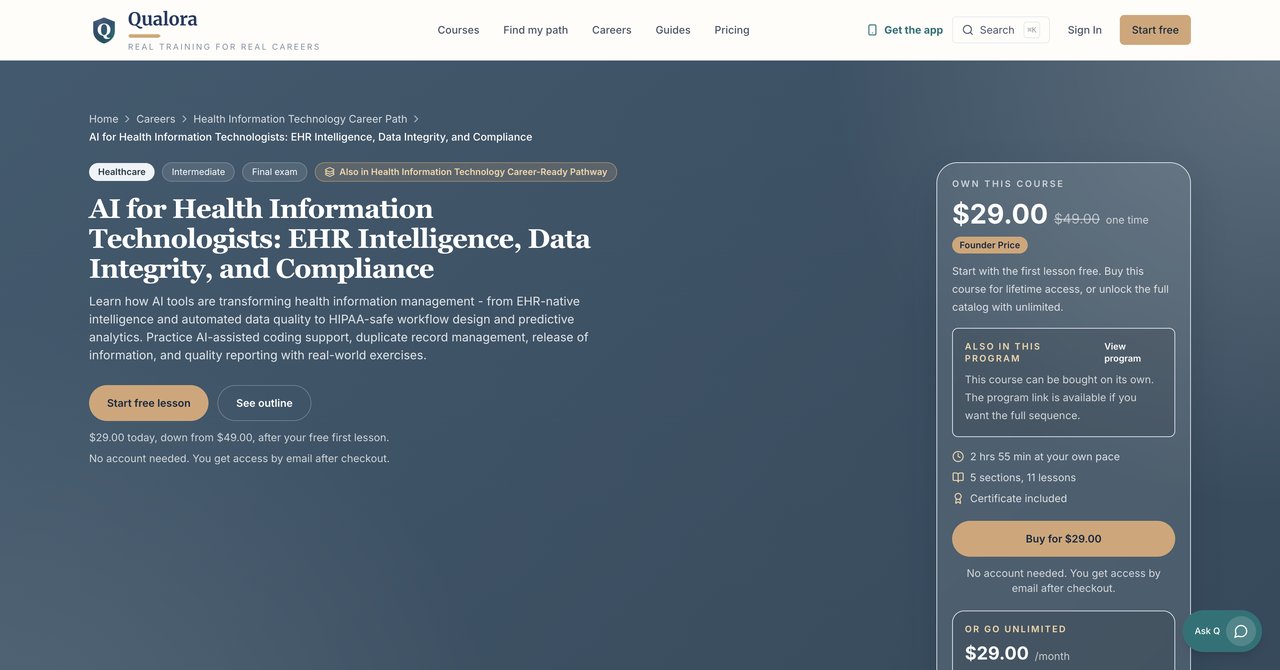
Qualora's course is a focused look at how AI works inside electronic health record systems. It's not a general overview - it gets into the technical side of data quality, duplicate record management, and HIPAA-safe workflow design. The course is short, about three hours, and includes hands-on exercises where you actually work with record scenarios.
The pricing is notable. It's listed at $49, but there's a founder's price of $29 one-time. That's a pretty small investment for a specialized course. The content is current and covers predictive analytics, which is becoming more common in health information management.
Key Topics Covered:
- EHR-native intelligence
- Automated data quality checks
- HIPAA-safe workflow design
- Predictive analytics for records management
- Duplicate record management
- Release of information processes
Target Audience and Skill Level: Aimed at health information technologists and medical records professionals with some experience. It's not for total beginners - you should understand how EHR systems work before starting.
Pros:
- Covers EHR-native intelligence and automated data quality
- Includes HIPAA-safe workflow design and predictive analytics
- Hands-on exercises for duplicate record management and release of information
- Low one-time price
Cons:
- Not from a major platform, so less brand recognition
- Limited to 3 hours of content - you'll likely need more training after this
Who Would Benefit Most: Someone who works directly with EHR systems and wants a quick, affordable primer on how AI applies to their specific work. If you're already comfortable with health records and just need the AI angle, this could be a good fit.
Course link: https://qualora.io/courses/ai-for-health-it
Course 3: Medical Records - Scan, Release, Audit by Coursera
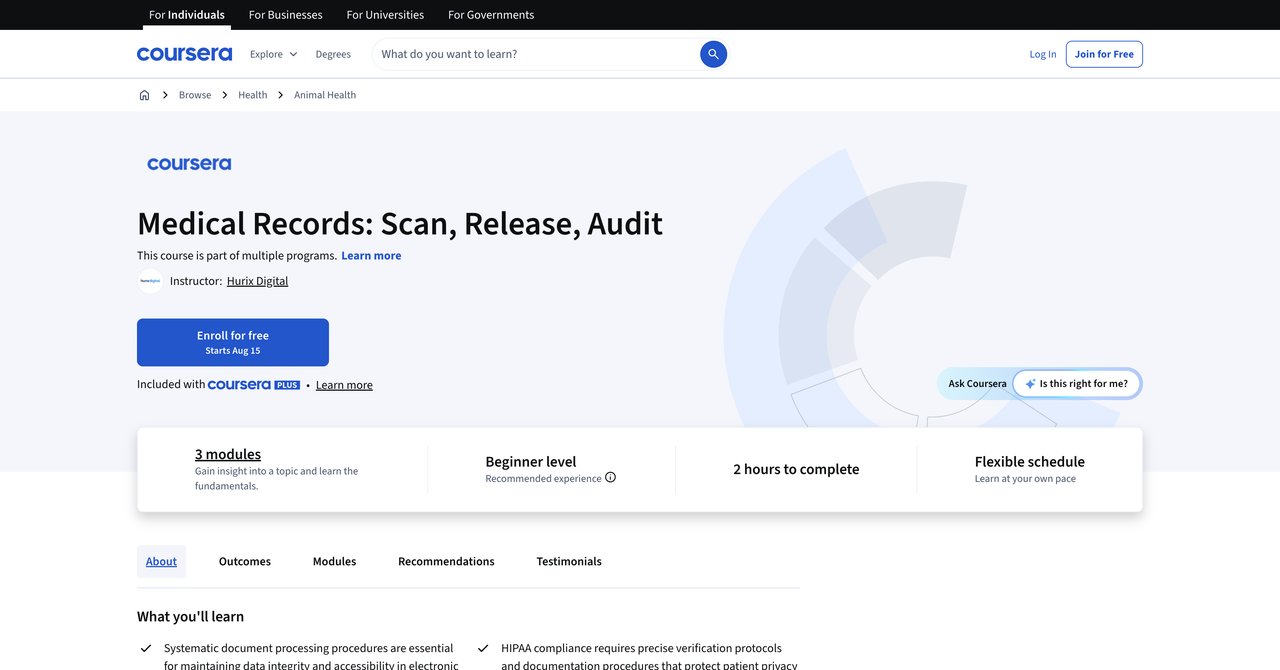
This is a Coursera course that's been recently updated. It covers the basics of systematic document scanning, HIPAA-compliant release management, and compliance auditing. The big selling point is that you can audit the course for free. That means you can access all the material without paying anything, though you won't get a certificate unless you pay for it.
The course is short, which is both a strength and a weakness. It's quick to complete, but you won't get deep into AI topics. In fact, the course doesn't mention AI-specific modules. That's worth noting because if you want to learn about AI in medical records, this might not be the place to start.
Key Topics Covered:
- Systematic document scanning
- HIPAA-compliant release management
- Compliance auditing
- Basic medical records workflows
Target Audience and Skill Level: Good for beginners and students who want to understand the fundamentals of medical records management. The free audit option makes it accessible to anyone.
Pros:
- Recently updated
- Covers systematic document scanning, HIPAA-compliant release management, and compliance auditing
- Free to audit - no cost to access materials
- Financial aid available
Cons:
- Short duration - you won't get deep into any topic
- No AI-specific modules mentioned
Who Would Benefit: Beginners in medical records who want a free, low-commitment way to understand the field. If your goal is specifically AI training, this is probably not the right place.
Course link: https://www.coursera.org/learn/medical-records-scan-release-audit
Course 4: JHU AI Certificate Program for Healthcare Professionals by Johns Hopkins University
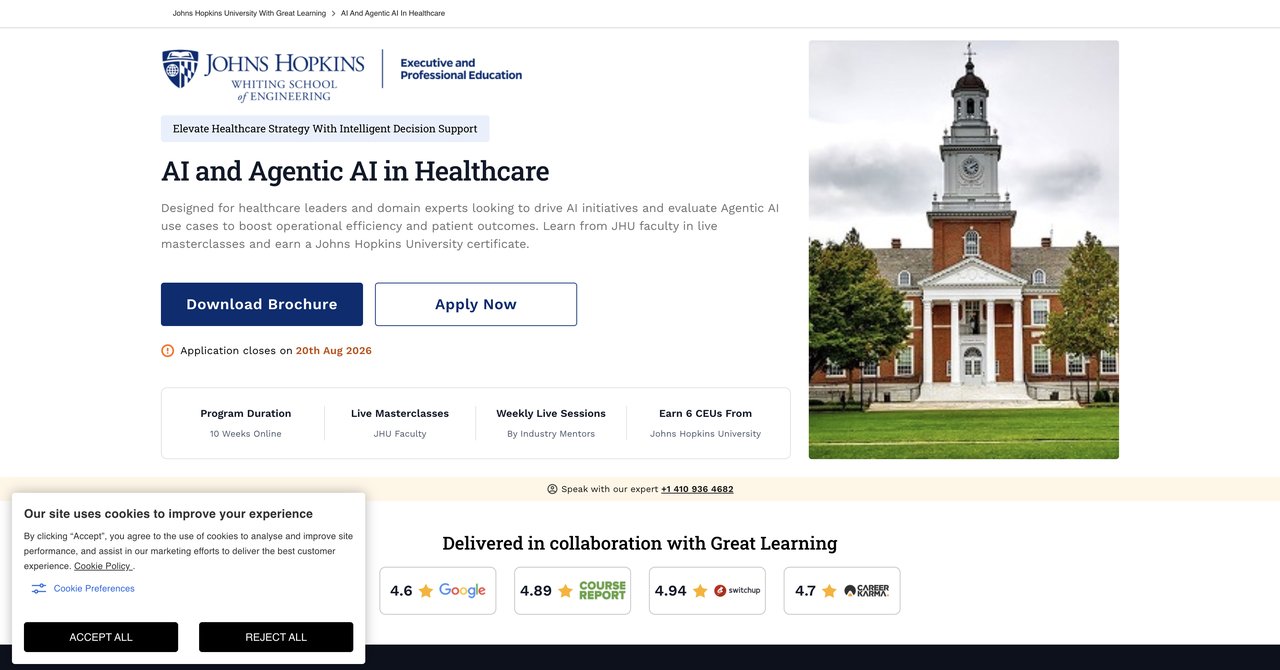
Johns Hopkins is a respected name in healthcare education, and this certificate program is taught by their faculty. It covers AI and Agentic AI, which is a newer area of artificial intelligence that involves AI systems that can act independently. There's also a focus on real-world case studies, which helps bridge the gap between theory and practice.
The course requires no coding experience, which is good for medical records professionals who don't have a technical background. But the price tag is substantial - $2,990. That's a serious investment, and it's worth considering whether the brand name justifies the cost for your situation.
Key Topics Covered:
- AI fundamentals for healthcare
- Agentic AI - what it is and how it works
- Real-world case studies in healthcare AI
- Practical applications for clinical and administrative settings
Target Audience and Skill Level: Healthcare professionals of all kinds, not just medical records clerks. The content is broader and aimed at a general healthcare audience. No coding experience required.
Pros:
- Taught by Johns Hopkins faculty - strong credibility
- Covers AI and Agentic AI with real-world case studies
- No coding experience required
Cons:
- Expensive at $2,990
- Broader healthcare focus rather than records-specific
Who Would Benefit: Professionals who want a prestigious certificate and are willing to pay for it. If you're looking for a credential that carries weight on a resume, this is a strong option - if you can afford it.
Course link: https://online.lifelonglearning.jhu.edu/jhu-ai-in-healthcare-certificate-program
Course 5: Artificial Intelligence Course by Harvard Medical School (Postgraduate Education)
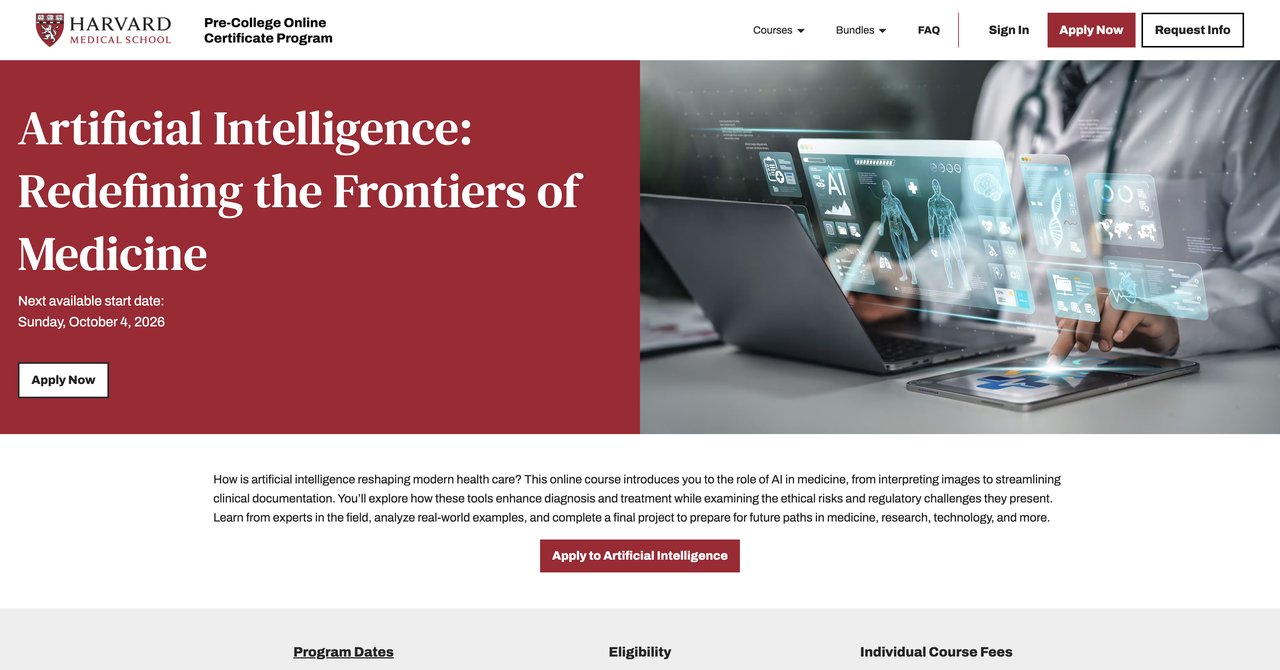
Harvard Medical School offers this course through their postgraduate education division. It's expert-led and covers ethical risks and regulatory challenges in healthcare AI. There's also a final project, which is a good way to apply what you've learned.
But there's a catch - the price and duration are not published. You have to contact them to find out. That's a bit frustrating when you're trying to compare options. The course also seems to be at an advanced level, so it might be too much for someone who's just starting with AI.
Key Topics Covered:
- Ethical risks in healthcare AI
- Regulatory challenges
- AI applications in clinical settings
- Final project work
Target Audience and Skill Level: Healthcare professionals with some experience in AI or data management. The course is likely at an advanced level, given the emphasis on ethics and regulation.
Pros:
- Expert-led from Harvard Medical School - high credibility
- Covers ethical risks and regulatory challenges
- Includes final project for practical application
Cons:
- Price and duration not published - hard to budget
- Likely advanced for some clerks
Who Would Benefit: Medical records professionals who are already comfortable with AI basics and want a deep dive into the ethical and regulatory side. If you're just starting, this might be a bit overwhelming.
Course link: https://pc.hms.harvard.edu/ai
Course 6: AI for Healthcare Systems by Coursera (University of Colorado System)
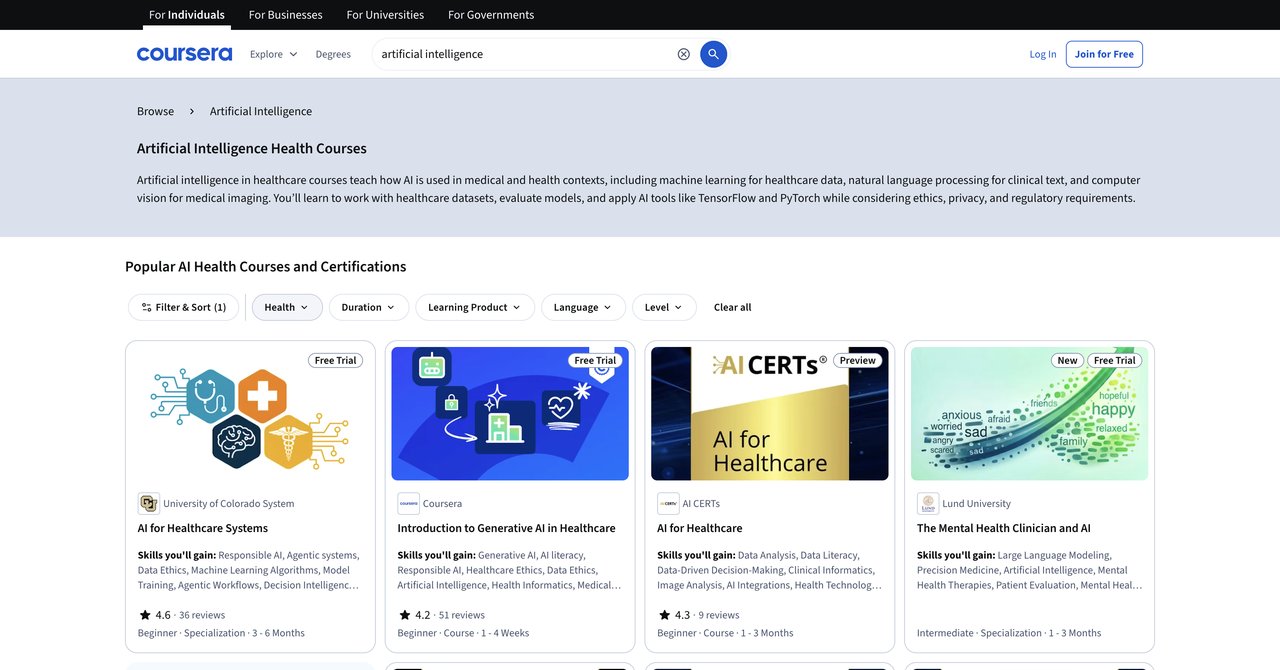
This is a Coursera course from the University of Colorado System. It's part of a broader AI health catalog, so you can take this course and then move on to others in the series. The course is beginner-friendly, which makes it a decent entry point for people who are new to AI.
The course is available through Coursera Plus, which is a subscription, or you can apply for financial aid. The downside is that it's not records-specific - it covers healthcare AI in general. So you'll learn about AI in healthcare, but not necessarily how to apply it to medical records workflows.
Key Topics Covered:
- AI fundamentals for healthcare
- Applications of AI in healthcare systems
- Data and analytics for health
- Introduction to AI tools
Target Audience and Skill Level: Beginners who want a general overview of AI in healthcare. No specific prerequisites.
Pros:
- From a recognized university system
- Part of a broader AI health catalog
- Beginner-friendly entry point
- Financial aid available
Cons:
- Not records-specific
- Exact duration and rating not listed
Who Would Benefit: People who are completely new to AI and want a gentle introduction. If you're already working with medical records and need specific AI skills, you might find this too general.
Course link: https://www.coursera.org/courses?query=artificial+intelligence&topic=Health
Course 7: Introduction to Generative AI in Healthcare by Coursera
This is another Coursera offering, this time focused on generative AI. Generative AI is the technology behind things like ChatGPT and other tools that create content. In healthcare, it's used for things like summarizing patient notes, generating reports, and helping with documentation.
The course is beginner-level and accessible. It's part of a curated health AI catalog, so you can continue with other courses. But again, it's not records-specific. It covers generative AI in healthcare generally, so you'll need to figure out how to apply it to your own work.
Key Topics Covered:
- Generative AI fundamentals
- Applications in healthcare
- Practical use cases
- Limitations and considerations
Target Audience and Skill Level: Beginners who want to understand what generative AI is and how it's used in healthcare. No technical background needed.
Pros:
- Focuses on generative AI applications in healthcare
- Accessible beginner level
- Part of a curated health AI catalog
Cons:
- Not records-specific
- Exact duration not published
Who Would Benefit: Anyone who wants to understand generative AI tools and how they might be used in healthcare settings. Good for getting a baseline understanding.
Course link: https://www.coursera.org/courses?query=artificial+intelligence&topic=Health
Course 8: AI in Healthcare & Digital Health by Coursera
This course covers digital health transformation, which is a broader topic than just AI. It looks at how healthcare is changing through technology, including AI, telehealth, and other digital tools. The course has multiple university partners, which gives it some credibility.
The format is self-paced, which is convenient. But the scope is broad, and it's not tailored to records workflows. If you're looking for something specific to medical records, this might feel a bit scattered.
Key Topics Covered:
- Digital health transformation
- AI in healthcare settings
- Telehealth and remote care
- Data management in health
Target Audience and Skill Level: Healthcare professionals and students who want a broad overview of digital health. No specific prerequisites.
Pros:
- Covers digital health transformation
- Multiple university partners
- Flexible self-paced format
Cons:
- Broad scope
- Not tailored to records workflows
Who Would Benefit: People who want a big-picture view of digital health, not just AI. It's less useful if you need specific skills for your medical records job.
Course link: https://www.coursera.org/courses?query=artificial+intelligence&topic=Health
Course 9: Professional Certificate - Health Informatics for Medical Records by ISPM
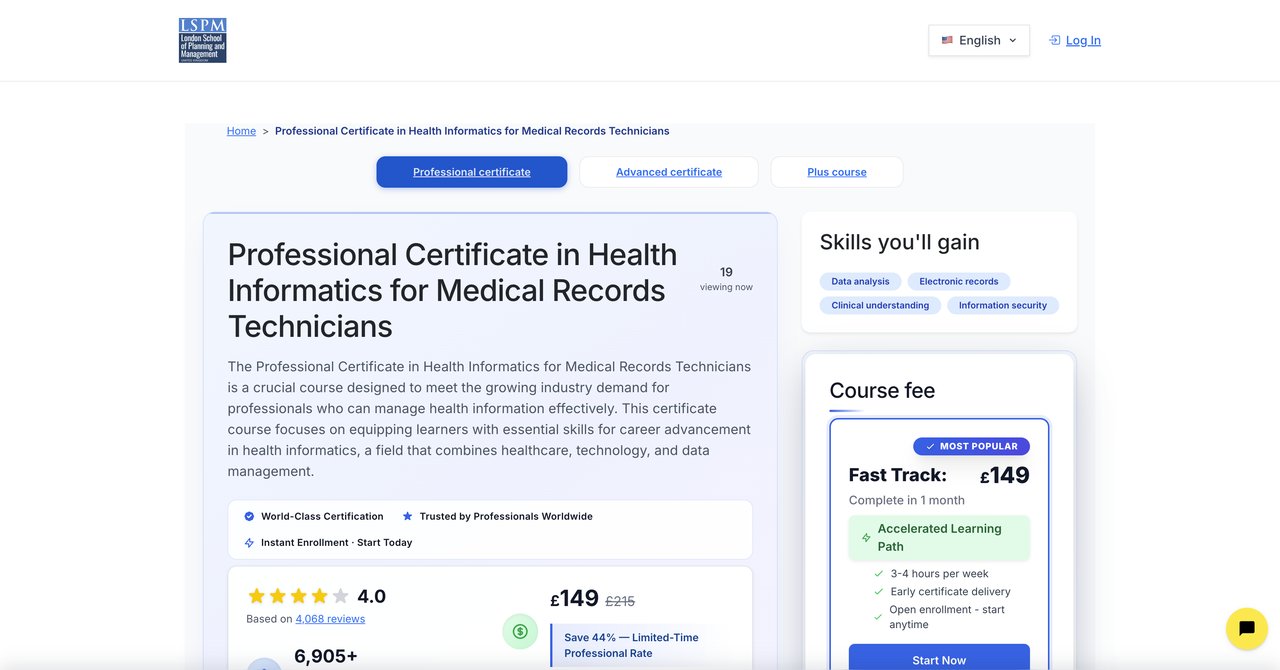
ISPM, which stands for International School of Project Management, offers a certificate that's specifically designed for medical records professionals. It combines healthcare, technology, and data management. The focus is on career advancement, which is a nice angle.
The downside is that the price and duration are not published. You have to contact them to find out. ISPM is also a smaller provider, so it doesn't have the brand recognition of Harvard or Johns Hopkins. But the content is directly relevant to your job.
Key Topics Covered:
- Health informatics fundamentals
- Medical records management
- Data management in healthcare
- Technology applications
Target Audience and Skill Level: Medical records professionals who want to move up in their careers. The course is designed for people with some experience in the field.
Pros:
- Specifically designed for medical records professionals
- Combines healthcare, technology, and data management
- Career advancement focus
Cons:
- Price and duration not published
- Smaller provider with less brand recognition
Who Would Benefit: Medical records professionals who want a career boost and don't mind the lack of published information. It's a specialized option, but you'll need to contact them to get details.
Course link: https://www.ispm.org.uk/Course/Details/340263
Course 10: 2026 (CHRR®) Certification - Certified Healthcare Record Reviewer by AIMRRA
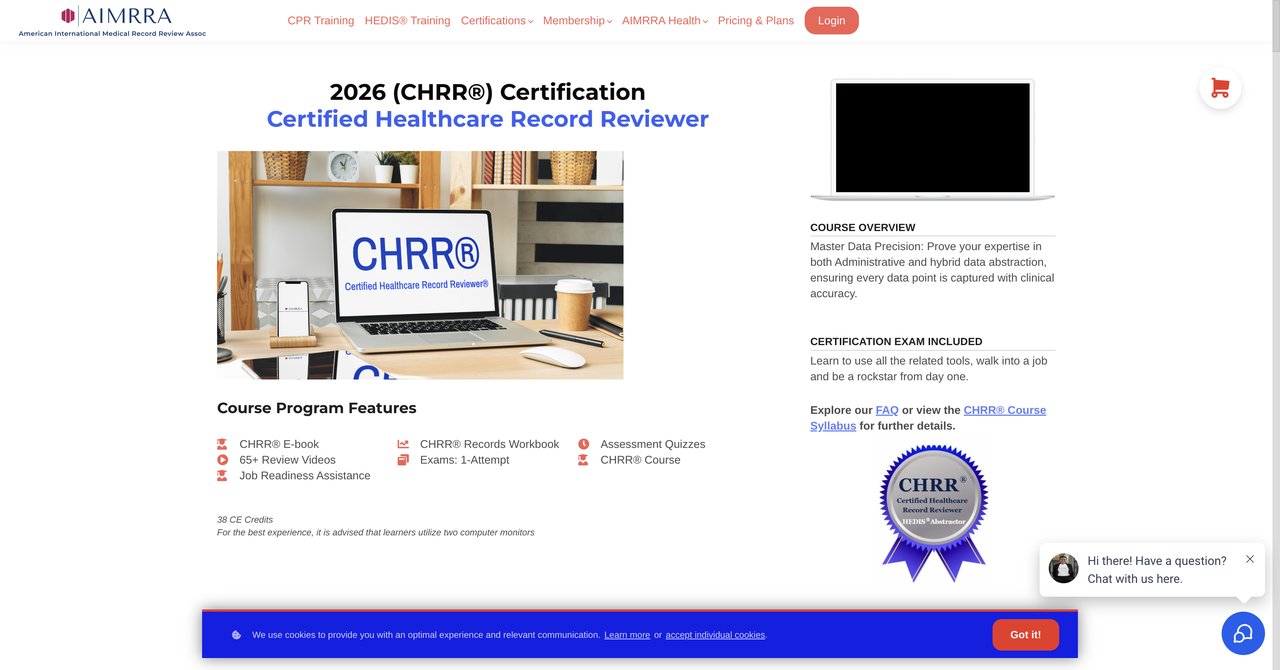
AIMRRA, the American Institute of Medical Record Reviewers and Auditors, offers a certification that's dated for 2026. It focuses on data precision and hybrid data abstraction. You get an e-book and course materials as part of the package.
The price is $645, which is higher than typical short courses. It's also certification-focused rather than AI-specific. So if you're looking for AI training specifically, this might not be the right fit. But if you want a certification that shows you can review records accurately, this could be useful.
Key Topics Covered:
- Data precision in medical records
- Hybrid data abstraction
- Record review processes
- Audit procedures
Target Audience and Skill Level: Medical record reviewers and auditors who want a formal certification. Some experience is likely needed.
Pros:
- 2026-dated certification
- Focuses on data precision and hybrid data abstraction
- Includes e-book and course materials
Cons:
- Certification-focused rather than AI-specific
- Price is higher than typical short courses
Who Would Benefit: People who work as record reviewers or auditors and want a credential to prove their skills. If you're looking for AI training, this is not the primary focus.
Course link: https://aimrra.org/course/2026-chrr-certification-healthcare-record-reviewer-main
Course 11: Electronic Health Records (PimaFastTrack) by Pima Community College
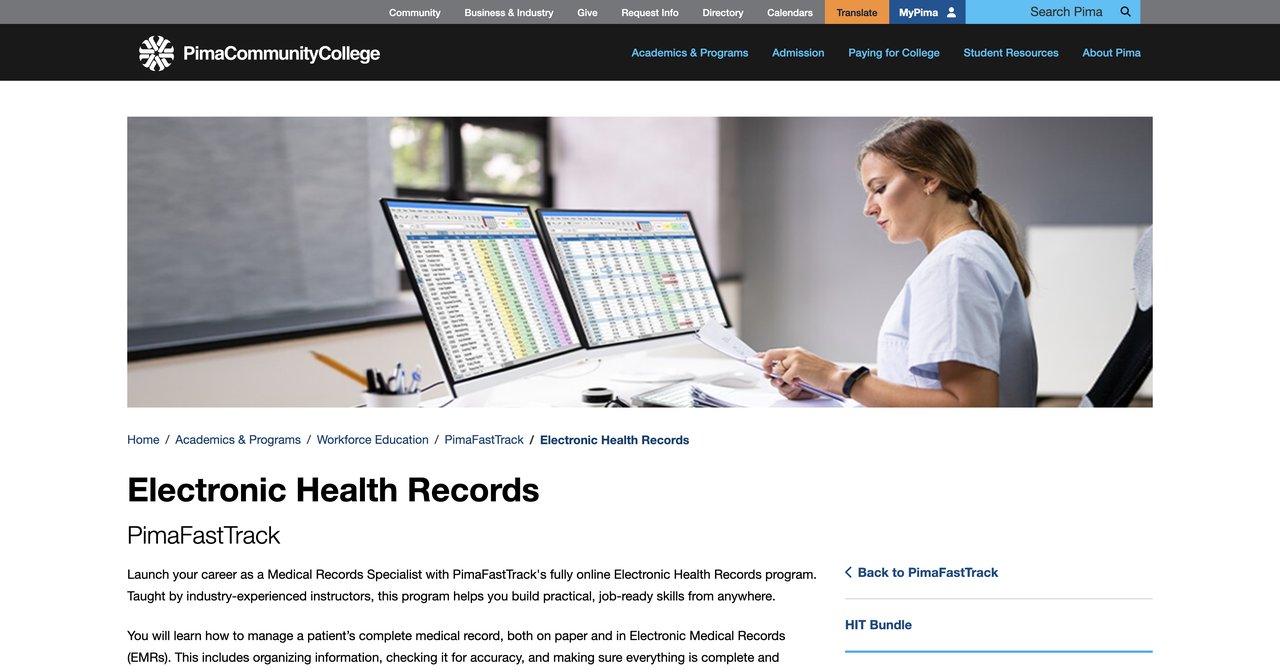
Pima Community College offers a fully online course that leads to CEHRS national certification. It covers complete patient record management, including accuracy checks. This is a solid option for someone who wants a formal certification from a community college.
The cost is $1,090, which is on the higher side. It's also not AI-specific - it's about electronic health records in general. So if you're looking for AI training, this might not be the best fit. But if you want a comprehensive EHR certification, it's worth considering.
Key Topics Covered:
- Complete patient record management
- Accuracy checks
- EHR fundamentals
- CEHRS certification preparation
Target Audience and Skill Level: People who want to enter the medical records field or formalize their skills with a certification. No prior experience required.
Pros:
- Fully online
- Leads to CEHRS national certification
- Covers complete patient record management including accuracy checks
Cons:
- Not AI-specific
- Longer commitment and higher cost
Who Would Benefit: People who want a formal certification to get into the field or advance. If you're specifically looking for AI training, this isn't it.
Course link: https://www.pima.edu/academics-programs/workforce/pima-fast-track/ehr/index.html
Course 12: AI in Healthcare Courses (catalog) by edX
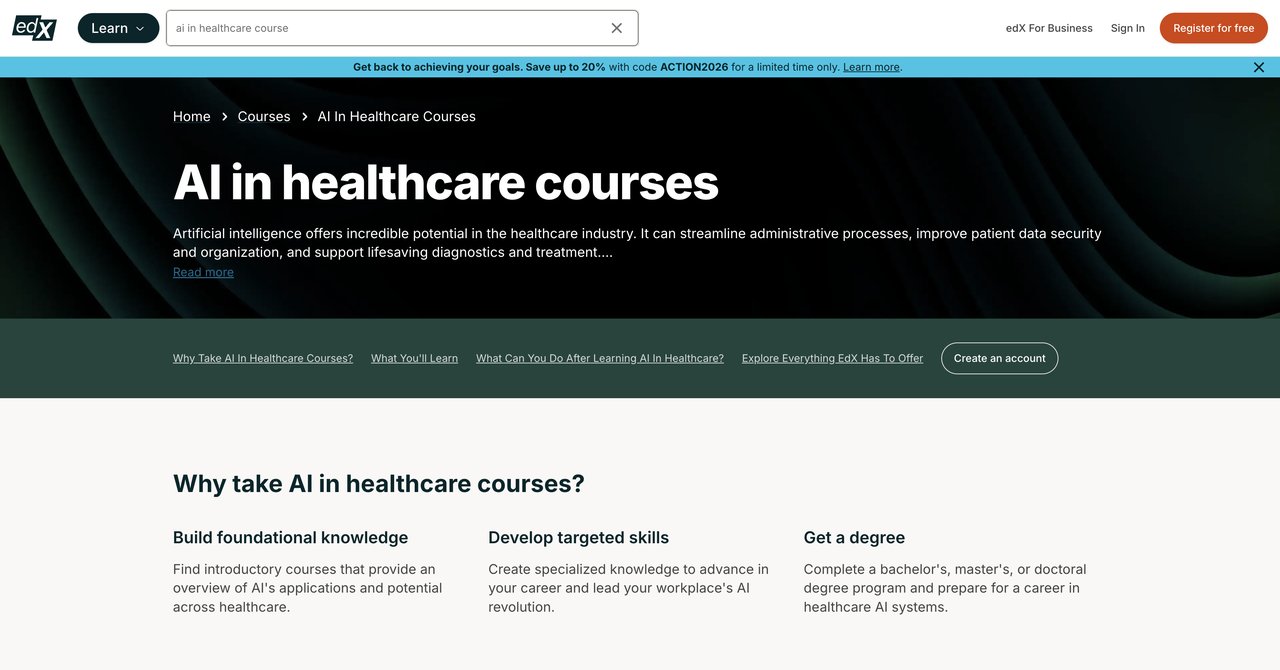
edX has a wide range of university-backed AI healthcare courses. You can audit most courses for free, and you pay if you want a certificate. There are multiple specializations available, so you can go deeper into a specific area.
The catalog page requires further selection, which is a bit annoying. You have to dig through to find something specific. And the courses aren't records-specific - they cover healthcare AI in general.
Key Topics Covered:
- AI in healthcare fundamentals
- Various specializations
- University-backed content
Target Audience and Skill Level: Anyone who wants to learn about AI in healthcare from a university-backed provider. The skill level varies depending on the course.
Pros:
- Wide range of university-backed AI healthcare courses
- Flexible audit options
- Multiple specializations available
Cons:
- Catalog page requires further selection
- Not records-specific
Who Would Benefit: People who want to explore different AI healthcare topics and have the time to browse. It's a good option if you want to pick and choose.
Course link: https://www.edx.org/courses?q=ai+in+healthcare+course
Course 13: AI for Healthcare (University of Colorado System) by Coursera
This is another University of Colorado System course on Coursera. It's similar to the other one listed above, but it's part of a broader AI health specialization track. The content is beginner-accessible, so it's a good starting point.
The issue is that it's not records-specific. It covers AI in healthcare generally, so you'll need to apply the concepts to your own work. The exact duration isn't listed either, which makes it hard to plan.
Key Topics Covered:
- AI applications in healthcare
- Data and AI fundamentals
- Health system applications
Target Audience and Skill Level: Beginners who want a university-backed introduction to AI in healthcare.
Pros:
- University-backed curriculum
- Part of a broader AI health specialization track
- Beginner-accessible
Cons:
- Not records-specific
- Exact duration not listed
Who Would Benefit: Beginners who want a structured introduction to AI in healthcare from a recognized university.
Course link: https://www.coursera.org/courses?query=artificial+intelligence&topic=Health
Final Recommendations
So which course should you pick? That depends on your situation and what you're trying to achieve.
If you want the most complete coverage of AI for medical records specifically, CompleteAI Training is the strongest option. The subscription model gives you access to hundreds of courses and certifications, and it's updated constantly. For someone who wants to keep learning as AI changes, this is hard to beat. The price is also reasonable compared to some of the university options.
If you're on a tight budget and just want to get started, the Coursera courses or the edX catalog are good options. They're free to audit, and you can learn the basics. Just know that you'll need to piece together your own learning path.
If you want a prestigious certificate and have money to spend, the Johns Hopkins program is worth looking at. It's expensive, but the brand name carries weight. The Harvard course is similar, but you need to contact them for pricing.
If you want a formal certification that's specific to medical records, the ISPM certificate and the AIMRRA certification are both relevant. They're not AI-specific, but they're directly related to your job.
If you're just starting out in the field, the Pima Community College course is a good foundation. It leads to a national certification, but it's not about AI.
For most medical records clerks who want to learn AI in a practical way, the best value is probably CompleteAI Training. It's affordable, comprehensive, and directly relevant to your work. But if you're not ready to commit to a subscription, start with a free Coursera course or the Qualora course to get your feet wet.
In the end, the right choice depends on what you need. Take a look at your budget, your career goals, and how much time you have. Then pick the course that fits.