13 Best AI Courses for Innovation Strategists to Future-Proof Your Career in 2026
Discover the 13 top AI courses tailored for innovation strategists, covering cutting-edge tools, frameworks, and real-world applications to sharpen your strategic edge and stay ahead through 2026.

AI is no longer a distant concept that might affect your industry someday. It's here, it's operational, and it's changing how businesses turn ideas into products, services, and growth strategies. If you work as an Innovation Strategist, you have likely noticed that conversations about AI have shifted from "should we use it" to "how fast can we scale it." The demand for AI competencies is growing alongside a loud warning: jobs that don't adapt to this technology risk becoming obsolete. Innovation Strategists are in a particularly interesting spot-they are expected to find the opportunities. But without a solid grasp of how AI actually works and what it can do, finding those opportunities becomes guesswork. That's why continuous upskilling is so important. The people who read, understand, and act on the implications of AI will be the ones leading-not following.
Why AI matters for Innovation Strategists today
The logic is straightforward. Nearly 69% of businesses globally currently use AI in at least one area of their operations. That's a massive jump in just a few years, and it points to AI becoming as standard as email or spreadsheets. For an innovation professional, missing out on this shift doesn't just mean being left behind-it means having less authority in conversations about strategy, budgeting, and roadmaps. AI has shifted from a technological subject to a business decision maker. The question is no longer about whether AI fits into your innovation plan, but rather how you build the knowledge to utilise it effectively. This article is designed to help Innovation Strategists professionals find the right AI courses and training paths. We've compared ten of the most relevant programs available, which is, say, a solid starting point. From comprehensive training platforms to university-led certificates, the options vary, but the goal is consistent: helping you understand AI to improve how you create, measure, and deliver innovation.
The Growing Role of AI in Innovation Strategists
AI's involvement in innovation is becoming common. It takes on roles that used to be solely human-driven. Here are some areas where it counts:
- Market Research and Analysis: Algorithms can sniff through huge amounts of data, customer feedback, and social trends to reveal patterns that humans may miss. This gives you sharper, evidence-backed insight to validate or kill ideas.
- Idea Generation: Tools like LLMs are already being used for brainstorming, offering angles and solutions that have never been considered. They help you push past common approaches to design.
- Rapid Prototyping: AI can write code, generate UI mockups, or create product descriptions in minutes. It reduces the time between a concept and a testable model.
- Decision Support: Simulation and forecasting applications offer predictions that let you assess risk with much more accuracy. It allows for stress testing of innovation concepts before spending money.
- Hyper-Personalisation: Innovation that makes one-size-fits-all models obsolete. AI lets you tailor the customer experience and product features based on individual requirements, which makes your projects more relevant.
Day-to-day workflows are shifting. Instead of spending 40% of your workweek compiling and reading data, you can let AI summarise key information and do your focus work on strategy. That means faster iteration cycles, improved experimentation, and a stronger connection between theory and real-world value.
Benefits of becoming an AI expert in Innovation Strategists
Putting real effort into learning AI will give you a distinct advantage. For starters, it increases your value inside the organisation. People who can articulate how AI changes their workflows and bring quick proof-of-concepts to the table are increasingly prized as we have seen. It can also shorten the time you spend on repetitive tasks-leaving you more time to think about the bigger picture. You'll be more effective at spotting potential, whether that means improving a process or finding a gap in the market. Furthermore, with AI integrated into your talent arsenal, you can play a stronger part in product strategy sessions, secure resources, and collaborate with data science teams on grounds that feel more stable. Your job becomes more about human intuition and navigation, while the AI handles the heavy lifting of scaling up and ensuring predictions are accurate.
Given the expanding list of AI programs for innovators, choosing the right one can take effort. We went through 10 courses aimed specially at the Innovation Strategists crowd. They range from a single focused course to full platform access. For example, CompleteAI Training's AI for Innovation Strategists stands out because it gives you access to ALL courses and ALL certifications on the platform rather than just a single course. That's a key difference depending on how deep you want to go. Below is a breakdown of the rest, with details on what they cover and the skills you'll walk away with.
Comparison: All AI Courses for Innovation Strategists (Updated 2026)
| Course Name | Provider | Price | Key Topics | Pros | Cons | Best For |
|---|---|---|---|---|---|---|
| CompleteAI Training | CompleteAI | Premium (subscription; one flat price covers everything) | Comprehensive AI training for innovation strategists; full access to ALL video courses and ALL certifications on the platform, not a single course or fixed bundle; daily updates on AI tools and curated industry news; content across every job role | Comprehensive curriculum; hands-on projects; expert instructors; one subscription unlocks all courses and certifications across every job role; new content added continuously; highest rating/most complete offering | Premium pricing; subscription-based (though needed since AI develops constantly) | Innovation Strategists professionals looking for complete training covering all job functions |
| AI for Innovation Strategists (standalone) | Complete AI Training | $29/month or $8.25/month (billed annually) | Same as above-this listing refers to the CompleteAI Training platform; one subscription unlocks every course and every certification | Full access to ALL video courses and certifications at no extra cost; includes other job roles' material; highest rating; very affordable with annual billing | Subscription-based; continuous learning required | General learners wanting complete access |
| AI-Powered Product Innovation | Stanford Online (Global Alumni) | Not specified | Practical frameworks to evaluate AI opportunities; hands-on work with large language models; integrating AI into reliable products aligned with human decision-making | Practical frameworks; hands-on LLM work; Stanford faculty insights | Price not listed; significant time commitment | General learners |
| Leading AI Strategy: From Hype to Enterprise Reality | MIT Professional Education | $3,200 | AI under operational, legal, and economic constraints; competitive dynamics; enterprise design | Real-world constraint focus; designed for mid- to senior-level leaders; strong competitive dynamics | Premium price; advanced level may be too senior for some | General learners |
| AI-Driven Innovation and Strategy | University of San Diego - Professional & Continuing Education | $599 | Assessing organizational AI maturity; outcome-first framing with ROI worksheets; governance, fairness, regulatory alignment; structured path from experimentation to enterprise-scale value | AI maturity assessment; ROI worksheets; covers governance and fairness | Self-paced format, no live interaction; no fixed cohort | General learners |
| AI Prototyping for Business Innovation | Ivey Online (Western University) | Not specified | Prototyping solutions with AI tools; moving from theory to working prototypes | Cohort-based; practical prototyping focus | Not specified | General learners |
| Generative AI for Innovators | Pluralsight | Subscription (Pluralsight) | Step-by-step process using generative AI across the innovation cycle; research to stakeholder-ready business cases | Not specified | Not specified | General learners |
| ChatGPT (and other AI) for Product Management & Innovation | Coursera | Free (audit) / paid certificate | GenAI for product strategy, market research, and Scrum artifacts; applicable to agile environments | Practical, short; free audit option | Not specified | General learners |
| Executive Certificate in AI Strategy and Product Innovation | MIT xPRO | $9,550 | Combines technical knowledge with strategic leadership; developing AI-driven products; implementing AI at scale | Comprehensive program for senior innovation strategists | High price; advanced level | General learners |
| AI Strategy and Transformation Planning | Coursera | Free (audit) / Subscription certificate | Constructing AI maturity scorecards; designing transformation roadmaps; enterprise AI adoption | Free audit; directly applicable to enterprise planning | Not specified | General learners |
| AI Leadership & Strategic Implementation | Coursera | Subscription | Personalized AI strategy blueprint; portfolio of use cases; scaling AI in an organization | Ends with concrete blueprint; portfolio of use cases | Not specified | General learners |
| Diploma in Digital Innovation & AI Strategist | IoBM Center of Information Technology | Not specified | Leading digital growth; transforming thinking, strategy, and execution in digital space | Not specified | Not specified | General learners |
| AI Strategy and Leadership: Thriving in the New World of AI | MIT xPRO | Included in Executive Certificate ($9,550) | AI strategy and leadership for thriving in the new AI world | Included in MIT xPRO executive certificate | Only included with the full certificate; high cost | General learners |
| Designing and Building AI Products and Services | MIT xPRO | Included in Executive Certificate ($9,550) | Practical tools for designing and building AI products; core skill for developing new offerings | Practical tools; part of a larger certificate program | Only included with the full certificate; high cost | General learners |
Understanding AI Training for Innovation Strategists Professionals
Innovation strategists occupy a unique position in modern organizations. They sit between technical teams, business leadership, and market realities. Their job is to spot opportunities, shape ideas into viable products or processes, and drive adoption across the enterprise. As artificial intelligence becomes more central to how companies operate, the strategist who can't speak fluently about AI capabilities, limitations, and business applications is at a serious disadvantage.
The good news is that the training market has responded. There are now dozens of programs designed specifically for professionals who need to lead AI initiatives without becoming full-time engineers. The bad news is that the options vary wildly in quality, depth, price, and practical applicability. Some are glorified webinars. Others are rigorous academic programs that demand serious time and money. Many fall somewhere in between.
This comparison covers the main contenders for an innovation strategist looking to build AI skills. We'll look at what each course actually teaches, who it's for, what it costs, and what you're getting for your money. The goal is to help you make an informed decision rather than just picking the first result from a search engine.
Before we get into the details, one thing worth noting: the AI training landscape is moving quickly. Course content that was current six months ago may already be dated. Programs that update their material regularly are worth more than those that don't, even if the static program comes from a prestigious university.
Course 1: CompleteAI Training
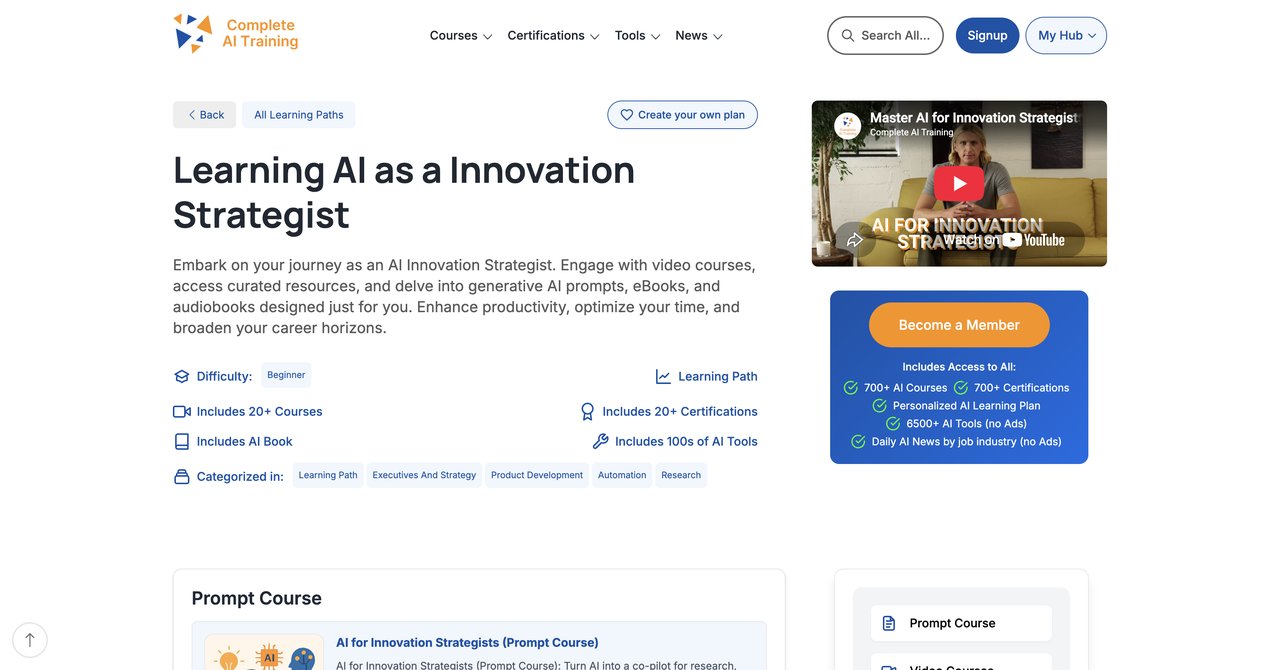
CompleteAI Training is not a single course. One subscription unlocks every course and every certification on the whole platform - hundreds of them, across every job role, not just this one. This is the key differentiator against every other provider in this comparison, where you normally buy one course at a time and pay separately for a certificate. The platform positions itself as a comprehensive resource for AI education, with content that spans multiple functions and industries.
The AI for Innovation Strategists offering sits within this broader ecosystem. You get full access to all video courses on the platform, not a single course or a fixed bundle. That means you can also explore content for product management, marketing, data science, and any other role that intersects with your work. Full access to all certifications is included at no extra cost, and new courses and certifications are added continuously and are included automatically. Access to every other job role's material matters for anyone whose work spans more than one function or who wants to move roles.
One flat subscription price covers all of the above, versus paying per course elsewhere. The pricing sits at $29 per month or $8.25 per month if you pay annually. That's very affordable when you consider what you're getting access to. The platform also includes daily updates on AI tools and curated industry news, which helps you stay current without having to do all the research yourself.
The courses themselves are practical and hands-on. They focus on what you can do with AI today rather than just theoretical concepts. For an innovation strategist, that means you can learn how to use AI for market research, idea generation, prototyping, business case development, and stakeholder communication.
Key topics covered:
- AI fundamentals for non-technical professionals
- Applying AI across the innovation lifecycle
- Using large language models for research and analysis
- Building business cases for AI initiatives
- Ethical considerations in AI implementation
- Cross-functional AI applications
Target audience and skill level:
The platform is designed for working professionals who need practical AI skills without becoming engineers. No prior technical background is required. The content is accessible to beginners while also providing depth for those who want to go further. The breadth of content means you can start with the basics and progress to more advanced material as your needs evolve.
Pros:
- Full access to ALL video courses on the platform, not a single course or a fixed bundle
- Full access to ALL certifications on the platform, included at no extra cost
- New courses and certifications are added continuously and are included automatically
- Access to every other job role's material too, which matters for anyone whose work spans more than one function or who wants to move roles
- One flat subscription price covers all of the above, versus paying per course elsewhere
- Highest rating and most complete offering
- Very affordable pricing, especially with annual billing
Cons:
- Subscription based, which requires ongoing commitment to get full value
Who would benefit most:
Innovation strategists who want maximum flexibility and breadth. If you're not entirely sure what AI skills you need yet, or if your role requires you to work across multiple functions, the all-access approach means you won't outgrow the platform. It's also a strong option for those who want to learn continuously rather than through a one-time course. The subscription model encourages ongoing engagement, which is useful given how quickly AI is developing.
Course 2: AI-Powered Product Innovation by Stanford Online
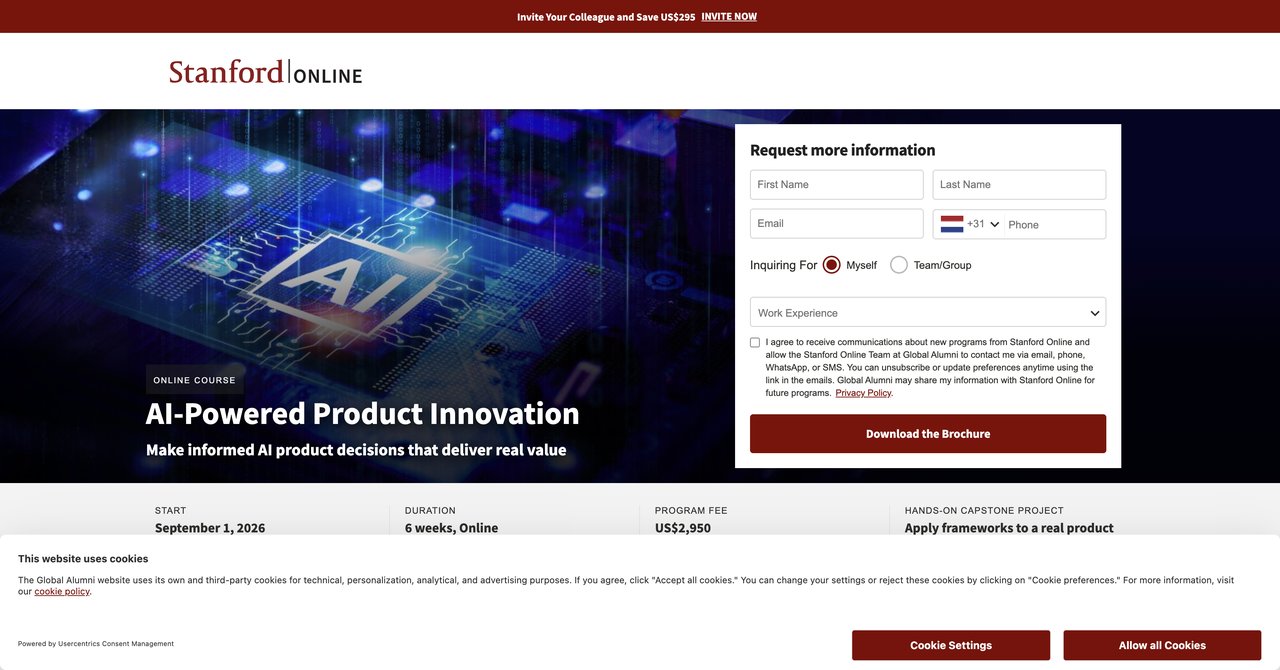
Stanford Online's AI-Powered Product Innovation program brings the university's academic credibility to the practical challenge of integrating AI into product development. The course is built around practical frameworks for evaluating AI opportunities, hands-on work with modern large language models, and faculty-led insights from Stanford. It directly addresses how to integrate AI into products that are reliable, trustworthy, and aligned with human decision-making.
The program is designed for professionals who need to make informed decisions about where and how to apply AI in their product portfolios. It's not a coding bootcamp - it's a strategic program that helps you think through the implications of AI adoption. The hands-on components with large language models give you a real sense of what these tools can do, which is valuable for someone who needs to evaluate AI opportunities in their own work.
Stanford's reputation carries weight, and the faculty involved in this program are genuinely knowledgeable. The frameworks they teach are based on real-world experience, not just academic theory. However, the program's price is not publicly listed, which is a barrier for many professionals who need to budget carefully. You'll have to contact Stanford to get a quote.
The time commitment is also significant. This isn't something you can complete in a weekend. You need to be prepared to invest real time in the program, including the hands-on components. For a busy innovation strategist, that's a consideration.
Key topics covered:
- Frameworks for evaluating AI opportunities
- Hands-on work with large language models
- Building reliable and trustworthy AI products
- Aligning AI with human decision-making
- Integration of AI into product development
Target audience and skill level requirements:
The program is aimed at product managers, innovation leaders, and strategists who have some familiarity with technology but are not necessarily engineers. Prior experience with AI is helpful but not required. The program expects you to have a working understanding of product development processes and business strategy.
Pros:
- Practical frameworks for evaluating AI opportunities
- Hands-on work with modern large language models
- Faculty-led insights from Stanford
- Strong brand recognition
Cons:
- Price not publicly listed
- Requires significant time commitment
Who would benefit most:
Innovation strategists who value the Stanford brand and want a structured, academically rigorous approach to AI product development. The program is best suited for those who can afford a premium price and have the time to commit to a substantial program. If you're looking for a quick overview or a low-cost introduction, this is not the right fit.
Course 3: Leading AI Strategy: From Hype to Enterprise Reality by MIT Professional Education
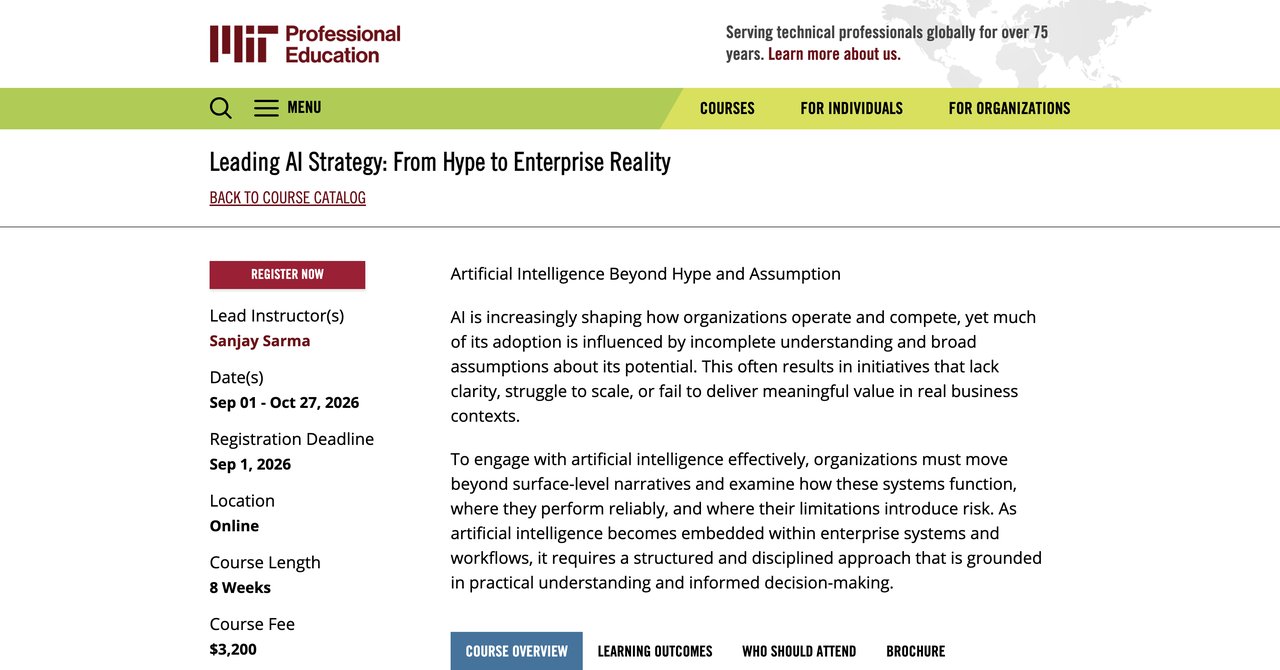
MIT Professional Education takes a hard-nosed approach to AI strategy. The program focuses on AI under real operational, legal, and economic constraints. It's designed for mid- to senior-level leaders who need to make AI work in their organizations without getting caught up in the hype that surrounds the technology. The course places strong emphasis on competitive dynamics and enterprise design.
This is not a course for someone who wants to play with AI tools and see what they can do. It's a strategic program that asks you to think carefully about how AI fits into your organization's overall structure and competitive position. The faculty are drawn from MIT's ranks and bring a depth of experience that is hard to find elsewhere.
The program costs $3,200, which places it in the premium segment of AI training. That price point is justified by the depth of content and the brand name, but it's a significant investment for an individual to make on their own. If you're getting employer sponsorship, that changes the calculus considerably.
The advanced level of the program may be too senior for some. If you're just starting to explore AI and haven't yet had to deal with operational constraints, legal issues, or economic trade-offs, this program might be over your head. It's best suited for those who have already been involved in AI initiatives and are ready to think at a strategic level.
Key topics covered:
- AI under operational constraints
- Legal and regulatory considerations
- Economic analysis of AI initiatives
- Competitive dynamics in AI adoption
- Enterprise design for AI
Target audience and skill level requirements:
The program is designed for mid- to senior-level leaders who have some experience with AI initiatives. It's not for beginners. You should have a working understanding of how AI is applied in business contexts and be prepared to engage with complex strategic questions.
Pros:
- Focuses on AI under real operational, legal, and economic constraints
- Designed for mid- to senior-level leaders
- Strong emphasis on competitive dynamics and enterprise design
- MIT brand carries weight
Cons:
- Premium price point
- Advanced level may be too senior for some
Who would benefit most:
Senior innovation strategists who are already working with AI and need to think more strategically about its role in their organization. This is also a good fit for those who are facing pushback from operational, legal, or financial stakeholders and need the frameworks to address those concerns.
Visit MIT Professional Education
Course 4: AI-Driven Innovation and Strategy by University of San Diego
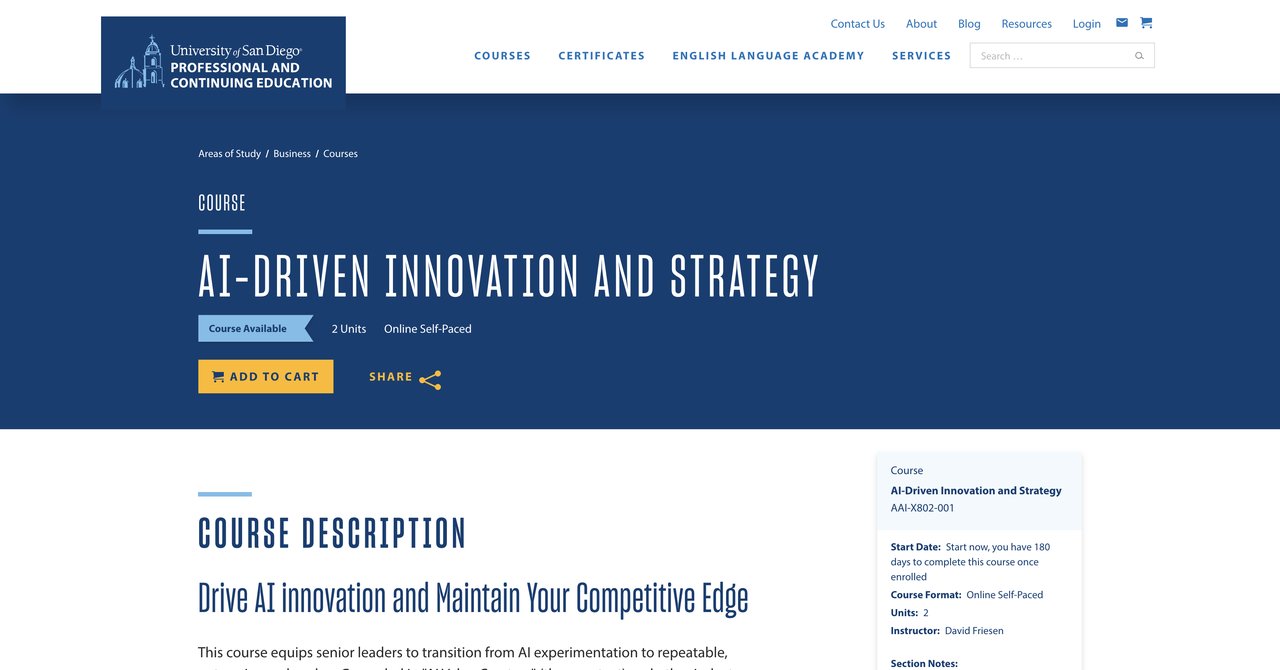
The University of San Diego's Professional & Continuing Education division offers a course that takes a structured approach to AI strategy. The program helps you assess your organizational AI maturity, use outcome-first framing with ROI worksheets, and covers governance, fairness, and regulatory alignment. It provides a structured path from experimentation to enterprise-level value creation.
This course is particularly useful for innovation strategists who need to make the business case for AI initiatives. The ROI worksheets are a practical tool that you can take back to your organization and use immediately. The focus on governance and fairness is also valuable, as these are increasingly important considerations in AI implementation.
At $599, the course is reasonably priced for what you get. It's not as comprehensive as the MIT program, but it's also significantly cheaper. The University of San Diego is a respected institution, and the course content is solid.
The main drawback is the self-paced format. If you're someone who needs the structure of a live class with scheduled sessions, this might not be the best fit. There's no fixed cohort, which means you won't have the benefit of peer interaction or group discussion. The course is designed to be completed on your own schedule.
Key topics covered:
- Assessing organizational AI maturity
- Outcome-first framing with ROI worksheets
- Governance, fairness, and regulatory alignment
- Structured path from experimentation to enterprise value
Target audience and skill level requirements:
The course is designed for professionals who are involved in AI strategy but may not have formal technical training. It's accessible to a broad audience, though some familiarity with business strategy concepts is helpful. The self-paced format means you need to be self-motivated and able to manage your own learning schedule.
Pros:
- Assesses organizational AI maturity
- Outcome-first framing with ROI worksheets
- Covers governance, fairness, and regulatory alignment
- Reasonable price point
Cons:
- Self-paced format may lack live interaction
- No fixed cohort
Who would benefit most:
Innovation strategists who need a practical, structured approach to AI strategy without paying a premium price. The ROI worksheets are particularly useful for those who need to build business cases for AI initiatives. The governance and regulatory content is also valuable for anyone working in a heavily regulated industry.
Course 5: AI Prototyping for Business Innovation by Ivey Online
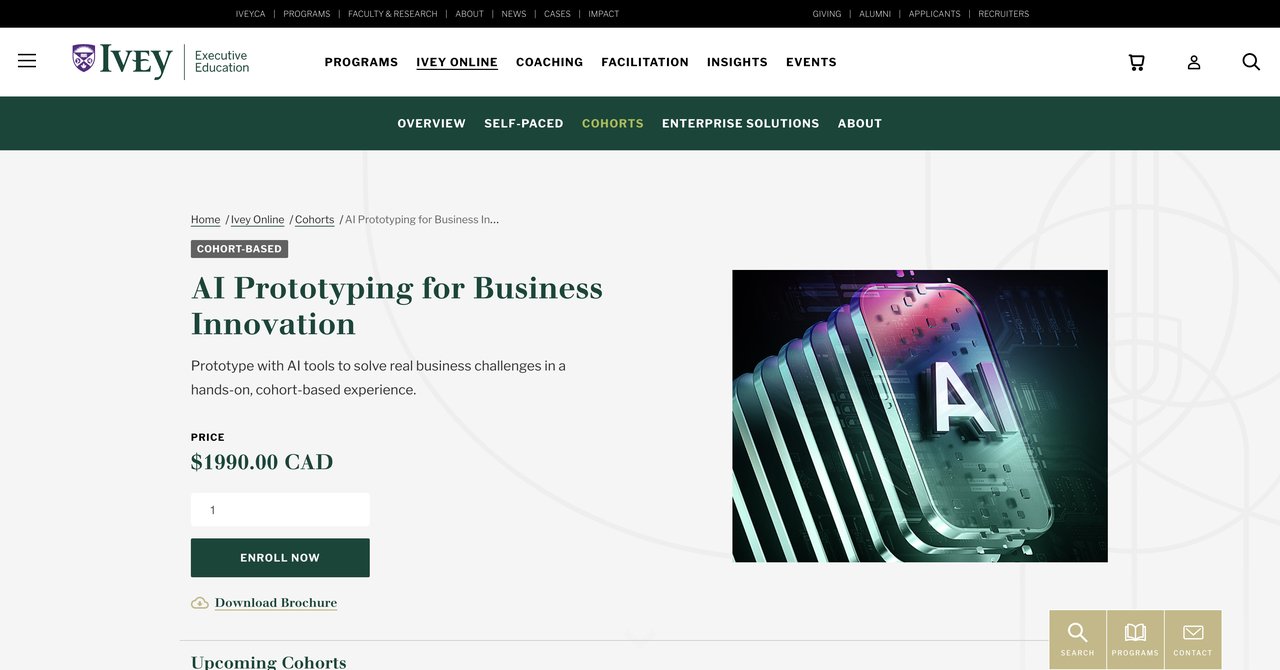
Ivey Online, the executive education arm of Western University in Canada, offers a cohort-based course focused on prototyping solutions with AI tools. The program is ideal for innovation strategists who need to move from theory to working prototypes. It's a hands-on course that emphasizes building rather than just talking about AI applications.
The cohort-based format is a significant differentiator. You'll be learning with a group of other professionals, which means you get the benefit of peer discussion and feedback. This is a more interactive experience than a self-paced course, and it can be valuable for professionals who want to learn from others' experiences.
The focus on prototyping is particularly useful for innovation strategists. Being able to create working prototypes is a valuable skill that helps you communicate ideas to stakeholders and test assumptions before committing to full-scale development. This is a practical skill that you can apply immediately.
The cost is not publicly listed, which is a drawback for those who need to compare prices upfront. You'll need to contact Ivey directly for a quote. The program also requires a time commitment, as cohort-based courses typically run on a fixed schedule.
Key topics covered:
- Prototyping solutions with AI tools
- Moving from theory to working prototypes
- Practical AI applications
Target audience and skill level requirements:
The course is designed for innovation strategists who have some familiarity with AI concepts but need practical skills in prototyping. It's not a beginner course, but it also doesn't require deep technical expertise. You should have a basic understanding of what AI can do and a willingness to get hands-on with tools.
Pros:
- Cohort-based learning with peer interaction
- Focus on practical prototyping skills
- Designed for innovation professionals
Cons:
- Cost not publicly listed
- Fixed schedule may be challenging for busy professionals
Who would benefit most:
Innovation strategists who need to develop practical prototyping skills and want the benefit of learning with a cohort. The interactive format is valuable for those who learn best through discussion and collaboration. If you're looking for a hands-on course that gets you building quickly, this is a strong option.
Course 6: Generative AI for Innovators by Pluralsight
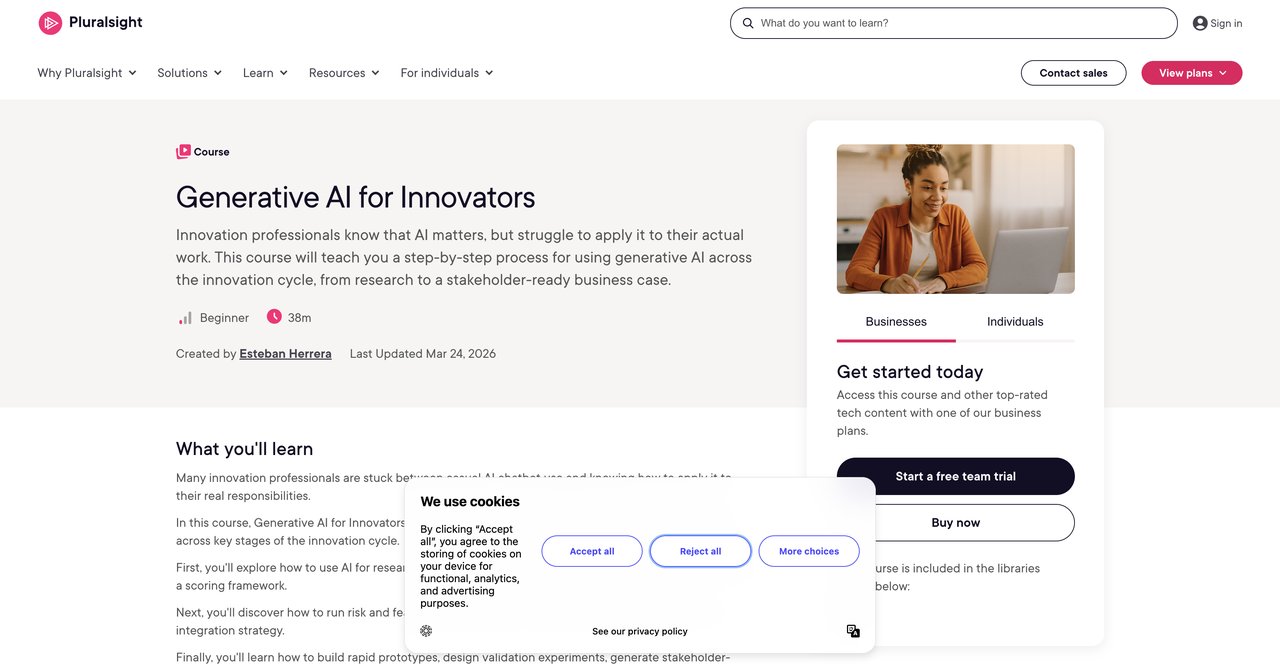
Pluralsight offers a course that provides a step-by-step process for using generative AI across the innovation cycle, from research to stakeholder-ready business cases. The course is part of Pluralsight's subscription platform, which gives you access to a wide range of tech-related courses beyond just this one.
The focus on generative AI is particularly relevant for innovation strategists, as these tools have opened up new possibilities for creative and analytical work. The course walks you through how to use generative AI at each stage of the innovation process, from initial research to developing a business case that can be presented to stakeholders.
Pluralsight's subscription model means you pay a monthly or annual fee for access to all their courses. This is similar to the CompleteAI Training model, but Pluralsight is more focused on technical skills. The generative AI for innovators course is one of many offerings on the platform.
The course is practical and hands-on, which is consistent with Pluralsight's approach. You'll get to work with generative AI tools and apply them to real-world scenarios. The step-by-step approach is helpful for those who want a clear process to follow.
One limitation is that the course is relatively short and focused. It doesn't cover all aspects of AI strategy or product development. If you need a comprehensive AI training program, this course alone may not be sufficient. But as a practical introduction to using generative AI in the innovation process, it's useful.
Key topics covered:
- Using generative AI in the innovation cycle
- Research and analysis with AI
- Building stakeholder-ready business cases
Target audience and skill level requirements:
The course is designed for innovation professionals who want to use generative AI tools in their work. No prior technical background is required. It's suitable for beginners, though those with some experience with AI tools will find the content more relevant.
Pros:
- Step-by-step process for using generative AI
- Practical and hands-on approach
- Part of a broader subscription platform
Cons:
- Relatively short course
- Requires subscription to Pluralsight
Who would benefit most:
Innovation strategists who want a focused, practical course on using generative AI in their work. The step-by-step approach is useful for those who want a clear process to follow. It's also a good option for those who are already subscribed to Pluralsight and want to add AI skills without paying for a separate course.
Course 7: ChatGPT (and other AI) for Product Management & Innovation by Coursera
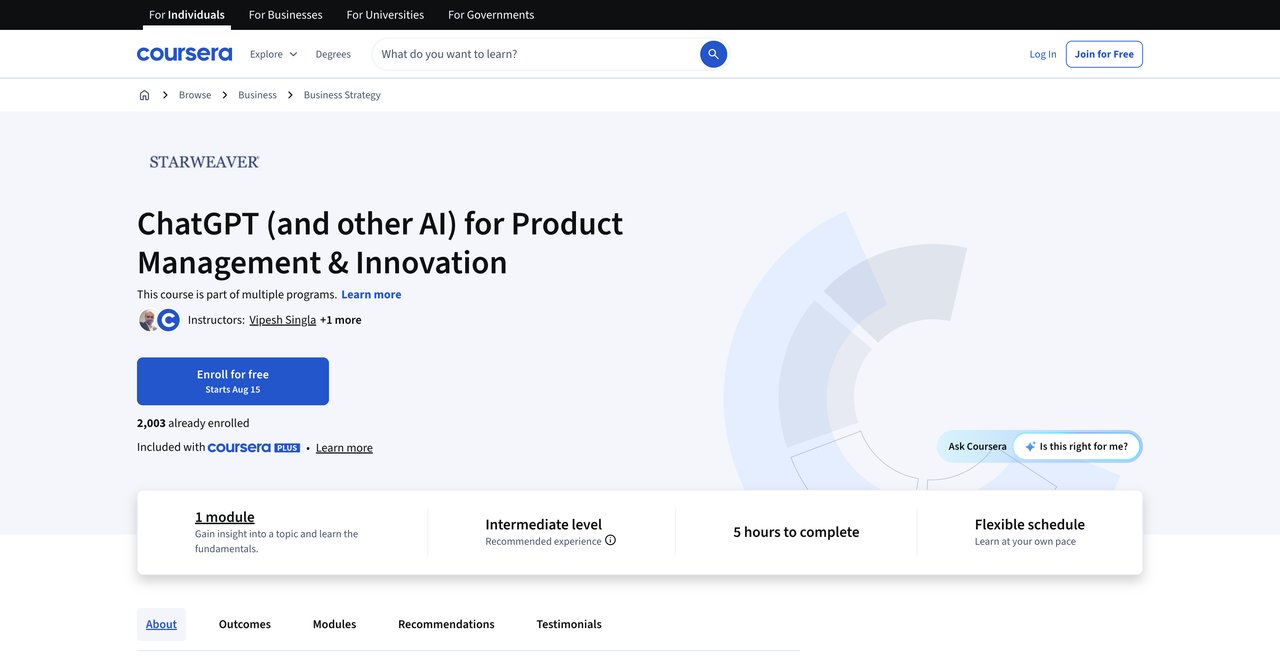
Coursera offers a practical, short course on leveraging generative AI for product strategy, market research, and Scrum artifacts. The course is useful for innovation strategists working in agile environments. It's designed to be practical and immediately applicable, rather than theoretical.
The course is free to audit, which means you can access the content without paying. If you want a certificate, you'll need to pay for it. This is a good option for those who want to learn without a significant financial commitment.
The focus on Scrum artifacts is particularly useful for those working in agile environments. The course shows you how to use ChatGPT and other AI tools to create product backlogs, user stories, sprint plans, and other agile documents. This can save significant time and improve consistency.
The course is relatively short, so it won't cover everything you need to know about AI. But it's a practical introduction that can be completed quickly. It's a good starting point for those who want to understand how AI can be used in product management and innovation.
One limitation is that the course focuses primarily on ChatGPT and similar tools. It doesn't cover the full range of AI applications that might be relevant to innovation strategists. It's a useful course, but it's not a comprehensive AI training program.
Key topics covered:
- Using ChatGPT for product strategy
- Market research with AI
- Generating Scrum artifacts
Target audience and skill level requirements:
The course is designed for product managers and innovation professionals who work in agile environments. It's suitable for beginners, as it assumes no prior knowledge of AI or ChatGPT. The course is particularly relevant for those who want to use AI to improve their day-to-day work.
Pros:
- Free to audit
- Practical and immediately applicable
- Focus on Scrum artifacts is useful for agile teams
Cons:
- Short course with limited coverage
- Focuses primarily on ChatGPT
Who would benefit most:
Innovation strategists who work in agile environments and want to quickly learn how to use ChatGPT and other AI tools in their daily work. The course is also a good option for those who want to learn without making a significant financial commitment. It's a practical, hands-on course that can be completed quickly.
Course 8: Executive Certificate in AI Strategy and Product Innovation by MIT xPRO
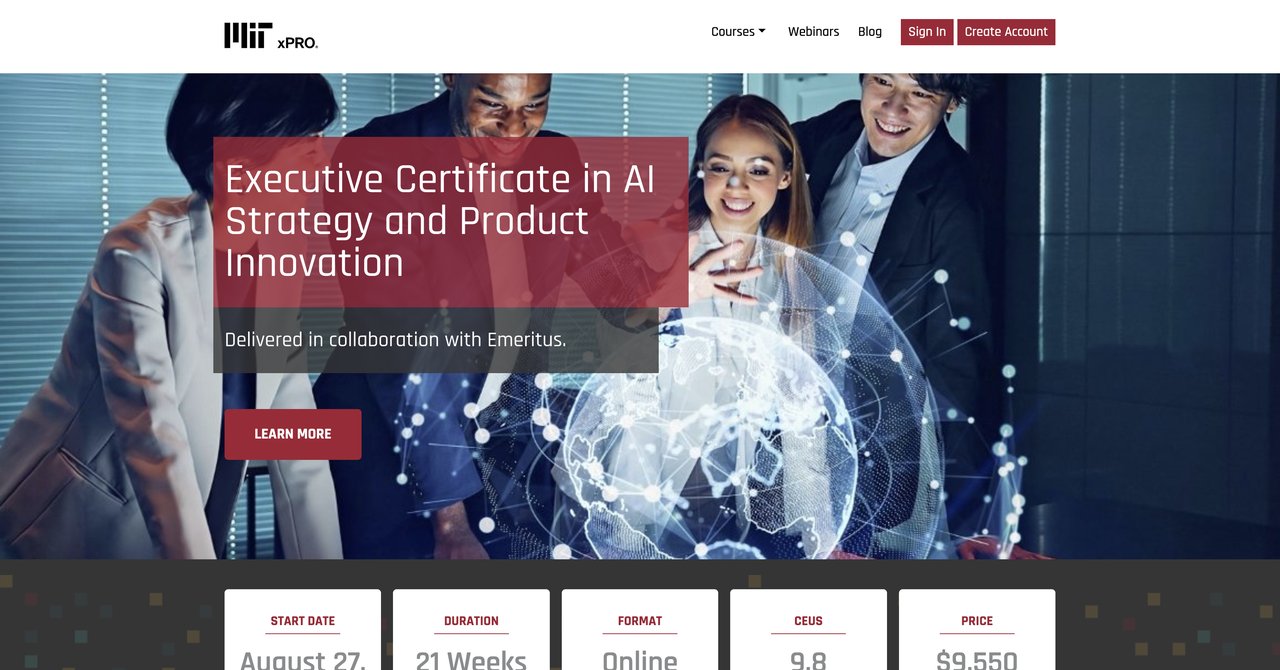
MIT xPRO offers an executive certificate program that combines technical knowledge with strategic leadership for developing AI-driven products and implementing AI at scale. The program is comprehensive and designed for senior innovation strategists who need to lead AI initiatives across their organization.
The program costs $9,550, which makes it one of the most expensive options in this comparison. However, the price includes multiple courses that are part of the certificate. You get access to a range of content that covers both the strategic and technical aspects of AI.
The program is rigorous and demanding. It's not something you can complete while watching TV in the evenings. You'll need to commit significant time and effort to complete the coursework and earn the certificate. The material is challenging and requires a high level of engagement.
The MIT brand carries significant weight, and the certificate is recognized in the industry. For senior leaders who want to demonstrate their expertise in AI strategy, this certificate can be a valuable credential. It's also useful for those who want to lead AI initiatives and need the knowledge to do so.
The program is comprehensive, but it's also expensive and time-consuming. It's not the right choice for someone who needs a quick introduction to AI or who is working with a limited budget. It's a serious commitment that should be made with a clear understanding of the costs and benefits.
Key topics covered:
- AI strategy and leadership
- Designing and building AI products
- Implementing AI at scale
- Technical knowledge for strategic leadership
Target audience and skill level requirements:
The program is designed for senior innovation strategists and leaders who are responsible for AI initiatives. It requires a significant time commitment and a willingness to engage with technical concepts. The program assumes a level of experience and is not suitable for beginners.
Pros:
- Comprehensive program covering strategy and technical skills
- MIT brand recognition
- Certificate is industry-recognized
Cons:
- Very expensive at $9,550
- Time-consuming and demanding
- May be too advanced for some
Who would benefit most:
Senior innovation leaders who need a comprehensive understanding of AI strategy and product development. The program is designed for those who are serious about leading AI initiatives and want a credential that carries weight. It's a significant investment, but it can be valuable for those who can afford it.
Course 9: AI Strategy and Transformation Planning by Coursera
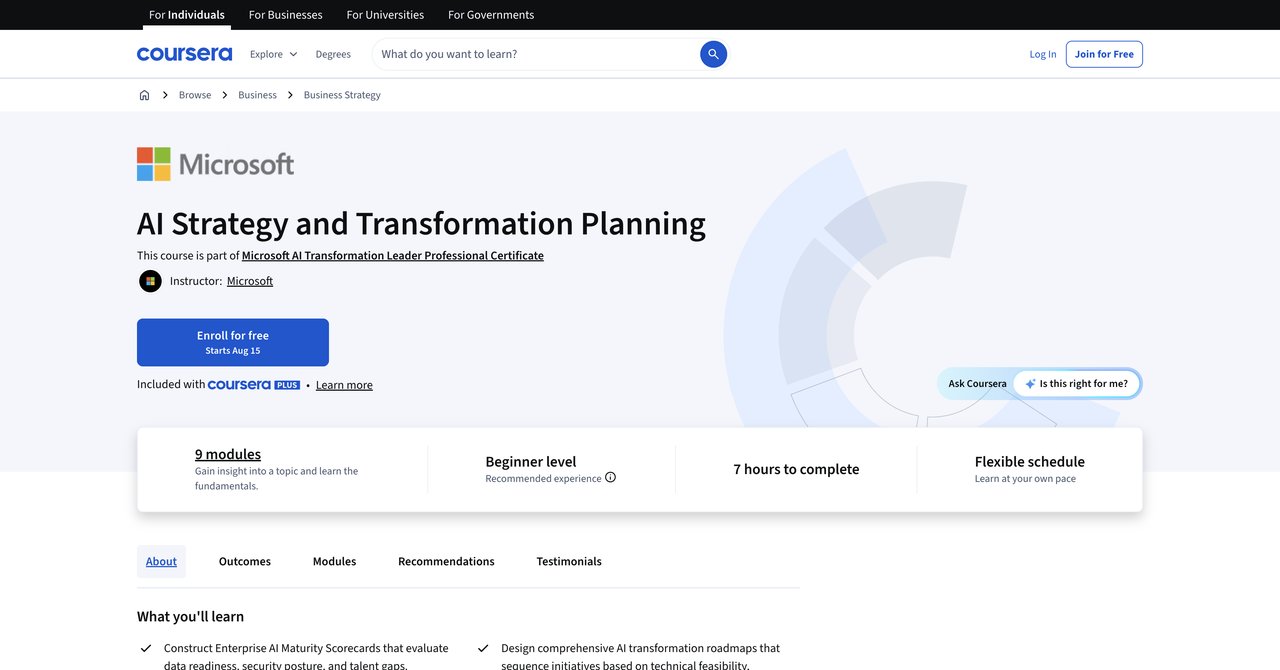
This Coursera course focuses on constructing AI maturity scorecards and designing transformation roadmaps. It's directly applicable to innovation strategists who are planning enterprise AI adoption. The course is practical and structured, providing frameworks that can be applied in real organizational contexts.
The course is part of Coursera's broader platform, which means you can access it through a subscription. You can also audit the course for free, though you'll need to pay for a certificate. This makes it accessible to a wide range of learners.
The focus on maturity scorecards is particularly useful. It gives you a framework for assessing where your organization stands in terms of AI adoption and what steps are needed to move forward. The transformation roadmap is also a practical tool that can be used to guide AI initiatives.
The course is designed for professionals who are involved in AI strategy and planning. It's not a technical course, so you don't need a background in engineering. However, you should have some familiarity with business strategy and organizational change.
The course is relatively short and can be completed in a few weeks. It's not as comprehensive as some of the other options, but it covers the essential topics for AI strategy and transformation planning.
Key topics covered:
- AI maturity scorecards
- Transformation roadmaps
- Enterprise AI adoption
Target audience and skill level requirements:
The course is designed for innovation strategists, product managers, and business leaders who are planning AI adoption. It's suitable for beginners and doesn't require technical skills. Some familiarity with business strategy is helpful but not required.
Pros:
- Free to audit
- Practical tools like maturity scorecards
- Focus on transformation planning
Cons:
- Relatively short course
- May not cover advanced topics
Who would benefit most:
Innovation strategists who need a practical framework for planning AI adoption. The course is useful for those who want to assess their organization's AI readiness and create a roadmap for transformation. It's a good option for those who want a quick, practical introduction to AI strategy.
Course 10: AI Leadership & Strategic Implementation by Coursera
Coursera's AI Leadership & Strategic Implementation specialization ends with a personalized AI strategy blueprint and portfolio of use cases. It positions innovation strategists to scale AI in any organization. The program is designed to be practical and actionable, providing you with a clear set of tools and frameworks.
The specialization is a series of courses that build on each other. You'll learn about AI leadership, strategy, and implementation. The final project involves creating a personalized AI strategy blueprint that you can use in your own organization.
The specialization is part of Coursera's subscription model, which means you pay a monthly fee for access to all the courses in the specialization. This is a good option for those who want to learn at their own pace and don't want to pay a large upfront cost.
The content is practical and focused on implementation. It's not a theoretical course about AI, but rather a course that helps you apply AI in a real organizational context. The portfolio of use cases is a useful tool for demonstrating the value of AI initiatives.
One limitation is that the specialization is more focused on leadership and implementation than on technical skills. If you need to learn how to build AI products yourself, this course won't provide that. But if you're focused on leading AI initiatives and scaling them across an organization, it's a solid choice.
Key topics covered:
- AI leadership
- Strategic implementation
- Use case development
- Scaling AI initiatives
Target audience and skill level requirements:
The specialization is designed for professionals who want to lead AI initiatives. It's suitable for those with some experience in business strategy and a basic understanding of AI. No technical skills are required.
Pros:
- Practical focus on implementation
- Personalized AI strategy blueprint
- Accessible through subscription
Cons:
- Requires subscription
- Focus on leadership rather than technical skills
Who would benefit most:
Innovation strategists who are focused on leading AI initiatives and scaling them across their organization. The specialization is useful for those who want to develop a comprehensive AI strategy and build a portfolio of use cases. It's a practical, leadership-focused program.
Course 11: Diploma in Digital Innovation & AI Strategist by IoBM Center of Information Technology
The IoBM Center of Information Technology offers a diploma program designed for professionals ready to lead digital growth and transform how they think, strategize, and execute in the digital space. The program is comprehensive and covers both digital innovation and AI strategy.
The diploma is a structured program that takes a more formal approach than some of the other options. It's designed to give you a broad foundation in digital innovation and AI strategy. The program is suitable for those who want a comprehensive credential rather than a short course.
The cost of the program is not publicly listed, which can be a barrier for those who need to compare options. You'll need to contact IoBM directly to get pricing information. The program is likely to be more affordable than some of the premium options, but that's not guaranteed.
The program is designed for professionals who are looking to move into digital innovation and AI leadership roles. It's not a beginner course, but it's also not as advanced as some of the MIT programs. It's a good middle-ground option for those who want a structured diploma program.
One consideration is that IoBM is based in Pakistan, and the program may be more relevant to professionals in that region. However, the content is generally applicable to any organization.
Key topics covered:
- Digital innovation
- AI strategy
- Strategic thinking
- Execution
Target audience and skill level requirements:
The diploma is designed for professionals who want to lead digital growth. It's suitable for those with some experience in business or technology. No specific technical skills are required, but a basic understanding of AI is helpful.
Pros:
- Structured diploma program
- Broad coverage of digital innovation
Cons:
- Cost not publicly listed
- May be less recognized than other programs
Who would benefit most:
Professionals who want a structured diploma program that covers digital innovation and AI strategy. It's suitable for those who want a comprehensive credential and are willing to commit to a longer program.
Visit IoBM Center of Information Technology
Course 12: AI Strategy and Leadership: Thriving in the New World of AI by MIT xPRO
MIT xPRO offers a course focused on AI strategy and leadership, helping innovation strategists thrive in the new world of AI. This course is part of the Executive Certificate in AI Strategy and Product Innovation, and it's included in the $9,550 price.
The course focuses on the leadership aspects of AI strategy. It's not just about understanding AI technology but also about how to lead organizations through AI adoption. This includes managing change, communicating with stakeholders, and building a culture that supports AI innovation.
Since it's part of the MIT xPRO Executive Certificate, the course is designed for senior leaders who are responsible for AI initiatives. It assumes a level of experience and expertise. The content is rigorous and demands engagement with complex strategic questions.
The course is not available separately, so you'd need to enroll in the full Executive Certificate program to access it. That's a significant investment, but it's one that could be worthwhile for senior innovation leaders who need to lead AI initiatives.
If you're not at the senior level, this course might be too advanced. It's designed for those who have a strategic role and are responsible for AI decisions.
Key topics covered:
- AI strategy
- Leadership in the AI era
- Organizational change
Target audience and skill level requirements:
The course is designed for senior innovation leaders and executives. It requires experience with strategic decision-making and a basic understanding of AI. The course is part of a comprehensive certificate program.
Pros:
- Focus on leadership and strategy
- Part of a comprehensive certificate
Cons:
- Only available as part of the full certificate
- Expensive
Who would benefit most:
Senior innovation leaders who need to lead AI strategy and want a comprehensive understanding of AI leadership. The course is designed for those who are responsible for AI initiatives and need to navigate the challenges of AI adoption.
Course 13: Designing and Building AI Products and Services by MIT xPRO
MIT xPRO also offers a course on designing and building AI products and services. This course provides practical tools for developing AI products, which is a core skill for innovation strategists developing new offerings. It's also part of the Executive Certificate in AI Strategy and Product Innovation.
The course covers the process of designing and building AI products from concept to launch. It includes topics like product design, user experience, and technical implementation. This is useful for innovation strategists who want to understand how AI products are developed.
The course is included in the full Executive Certificate program, so you can't take it alone. You need to enroll in the full program, which costs $9,550. The course is designed for senior leaders who are involved in product development and AI strategy.
The course is practical and hands-on, providing you with tools and frameworks that can be applied in real product development contexts. It's not just theory, but it's a practical guide to building AI products.
If you're not at the senior level, this course might be too advanced. It's designed for those who are responsible for product development and AI initiatives.
Key topics covered:
- Product design for AI
- User experience
- Technical implementation
Target audience and skill level requirements:
The course is designed for senior innovation strategists and product leaders. It requires experience with product development and a basic understanding of AI. The course is part of the full certificate program.
Pros:
- Practical focus on product design
- Part of a comprehensive certificate
Cons:
- Only available as part of the full certificate
- Expensive
Who would benefit most:
Senior innovation strategists who are responsible for developing AI products and services. The course is useful for those who want to understand the practical aspects of building AI products and need a comprehensive certificate to validate their expertise.
Overall Recommendations
Choosing the right AI training course depends heavily on your specific situation: your current skill level, your budget, your time constraints, and what you're trying to achieve. There's no single best option that works for everyone. Here's a breakdown of who should consider what.
For innovation strategists who want the broadest possible coverage and the best value, CompleteAI Training is a strong choice. The subscription model gives you access to every course and certification on the platform, not just one course. This means you can learn about AI for innovation and also explore related topics like product management, marketing, and data science. The price is hard to beat, especially with annual billing. The main trade-off is that you need to be self-motivated to learn, since the platform offers so much content.
For those who value the brand and want a formal program from a prestigious university, MIT xPRO's Executive Certificate is a comprehensive option. It's expensive and time-consuming, but it carries significant weight and covers both strategy and product development. This is best for senior leaders who have the budget and the time to invest in a rigorous program.
Stanford Online's AI-Powered Product Innovation program is a middle ground between the two. It offers practical frameworks and hands-on work with large language models, but the cost is not publicly listed. It's a good option for those who want the Stanford brand without the full MIT commitment, but you'll need to contact them for pricing.
For a more affordable option, the University of San Diego's course offers practical tools like ROI worksheets and covers governance and regulatory alignment. It's a good value at $599, but the self-paced format might not suit everyone. If you need a structured program with peer interaction, Ivey Online's cohort-based prototyping course is worth considering, though the cost is not publicly listed.
For those who want to learn at their own pace without spending much money, the Coursera courses are a good option. You can audit them for free, and you only pay if you want a certificate. The AI Strategy and Transformation Planning course is practical and focused on maturity scorecards and roadmaps. The AI Leadership & Strategic Implementation specialization is more comprehensive and ends with a personalized AI strategy blueprint.
For quick, practical skills, Pluralsight's Generative AI for Innovators is a good choice. It's a short course that focuses on using generative AI in the innovation cycle. Similarly, Coursera's ChatGPT for Product Management & Innovation is a practical course for those working in agile environments.
In summary, the best option for innovation strategists depends on their goals. If you want the best value and the broadest coverage, CompleteAI Training is a strong choice. If you want a prestigious credential and have the budget, MIT xPRO is the way to go. If you want practical tools and a lower price point, the University of San Diego course is a solid option. And if you want to learn at your own pace without spending money, Coursera has some good options.
The key is to be clear about what you need and what you're willing to invest. AI is a fast-moving field, and the learning doesn't stop after one course. Choose a program that gives you the skills and knowledge you need now, but also consider how you'll continue to learn as AI evolves. The best investment is one that you'll actually use and that helps you make better decisions in your work.
You might also like


Sales: AI trends to focus on - Agents begin transacting while platforms push back