
Blog ·
13 Essential AI Courses for Insurance Data Analysts in 2026
Master predictive modeling, claims automation, and GenAI risk tools with 13 targeted courses for 2026. Upgrade your insurance analytics skills and stay ahead of industry disruption.
 Jeroen Erne
The insurance industry has always been data-heavy, but the way that data gets used is shifting fast. AI is no longer a futuristic concept for actuaries and analysts-it is showing up in daily workflows, from pricing models to claims triage. For Insurance Data Analysts, this means the skills that got you the job might not be enough to keep you relevant in the next few years. A recent survey indicated that 69% of businesses are actively using AI in some capacity, and the insurance sector is one of the leading adopters. That is not a distant trend; it is a current reality. The analysts who understand how to work with these tools, rather than against them, will be the ones setting the direction for their teams, while those who do not might find their roles shrinking. The urgency is real, and the need to upskill is immediate. This article is here to help you sort through the noise and identify which AI courses are actually worth your time and money.
Why AI matters for Insurance Data Analysts today
Consider the daily grind of a data analyst: pulling reports, cleaning data, checking for anomalies, and presenting findings. A lot of that work is repetitive, and AI is exceptionally good at repetitive tasks. In fact, a recent industry report showed that 69% of businesses use AI to handle routine data processing, which directly impacts the type of work analysts do. This does not mean the role is disappearing; it means the role is changing. You are moving from being the person who creates the report to the person who interprets the AI's output and verifies its logic. That shift requires a different kind of training. You need to know how to prompt a model, how to validate its outputs, and how to spot when it is wrong. The purpose of this article is to help you find the best AI courses that address these specific needs for Insurance Data Analysts professionals, so you can make a smart decision about your professional development without wasting time on generic content.
The Growing Role of AI in Insurance Data Analysts
AI is not just a single tool; it is a set of capabilities that touch every part of an analyst's workflow. Here is what that looks like in practice:
- Automated Data Cleansing: Instead of spending hours fixing missing values or standardizing formats, AI models can handle this in minutes. Analysts are now expected to know how to set up these pipelines and monitor them.
- Predictive Modeling for Risk: Underwriting and risk assessment are now heavily driven by machine learning models that analyze patterns across massive datasets. Analysts are moving from building simple regression models to managing complex, self-learning systems.
- Personalized Policy Pricing: AI allows for real-time price adjustment based on behavior and external data. Analysts must understand how these dynamic models work and how to audit them for fairness and profitability.
- Claims Fraud Detection: AI algorithms are excellent at spotting unusual patterns that might indicate fraud. The analyst's role is to investigate these flags and refine the model's accuracy, rather than just looking at the data manually.
- Natural Language Processing for Reports: The ability to query data using plain English is becoming standard. Analysts are learning to use NLP to generate insights, which changes how they interact with databases.
These applications are reshaping the daily workflow. The old way of working-extract, transform, visualize-is being replaced by a workflow where you guide the AI, interpret the results, and make strategic decisions based on the output. That is a significant shift in responsibility.
Benefits of becoming an AI expert in Insurance Data Analysts
There are very practical reasons to get ahead of this curve. First, there is the salary angle. Professionals who can demonstrate AI proficiency in their analytics roles typically command a higher salary bracket than their peers who do not. It is a differentiator on a resume that is easy for hiring managers to spot. Second, there is job security. As more processes become automated, the analysts who are most at risk are those who only do the manual work that AI can replace. But the analysts who can build, manage, and audit those AI systems become indispensable. You are not just working with data; you are working on the intelligence layer of the business. Third, there is the autonomy factor. When you understand the AI tools, you are less dependent on other teams to get your work done. You can prototype a model, test a hypothesis, and get results faster, which makes you more valuable to the business and gives you more control over your projects.
To help you get started, we have compared five specific AI training courses that are relevant to this field. Among them is CompleteAI Training, which stands out because it gives you access to ALL courses and ALL certifications on the platform rather than a single course, which might be a better fit if you plan on learning long-term. The other four courses each have their own strengths, and we will break down what they offer so you can decide which one fits your current skill level and your career goals.
Comparison: All AI Courses for Insurance Data Analysts (Updated 2026)
| Course Name | Provider | Price | Key Topics | Pros | Cons | Best For |
|---|---|---|---|---|---|---|
| CompleteAI Training | CompleteAI | Premium (one subscription covers everything) | Comprehensive AI training for Insurance Data Analysts; includes ALL video courses and ALL certifications on the platform-hundreds of them, across every job role. Covers claims, pricing, risk, retention workflows, SQL/Python generation, validation with business metrics, audit-ready outputs, and more. One flat subscription unlocks everything, with new content added continuously. | Most comprehensive offering; full access to all courses and certifications, not just a single course or bundle; new content added automatically; access to other job roles' material too; expert instructors; hands-on projects; daily updates on relevant AI tools and news. | Subscription-based, which is crucial since AI keeps changing; premium pricing compared to single-course options. | Insurance Data Analysts professionals looking for complete, continuous training across all functions |
| AI for Insurance Data Analysts (Video Courses + Certifications) | Complete AI Training | $29/month or $8.25/month billed annually (one subscription covers everything) | Over 100 specialized video courses and certifications for Insurance Data Analysts; one subscription unlocks every course and certification on the entire platform-hundreds of them. Covers all insurance workflows (claims, pricing, risk, retention) plus every other job role's material. | Highest rating and most complete offering; full access to all video courses and all certifications at no extra cost; new content added continuously and included automatically; access to materials for every job role; one flat price versus paying per course elsewhere; very affordable with annual billing. | Subscription-based-you'd want to keep it active since AI is changing all the time. | General learners and professionals who want broad access beyond just insurance |
| AI for Insurance Data Analysts (Prompt Course) | Complete AI Training | Included with Complete AI Training subscription ($29/month or $8.25/month billed annually) | 4-hour prompt-driven course covering claims, pricing, risk and retention workflows; generating SQL/Python; validating results with business metrics; producing audit-ready outputs. | Practical prompt workflows; generates SQL/Python code; validation with business metrics; outputs ready for auditing. | Short duration-might leave you wanting more depth. | General learners |
| Introduction to Data Science and AI for Insurance | Chartered Insurance Institute (CII) | $1,500 (non-members) / $1,200 (members) | Structured 6-week program covering ethical AI and data visualization in an insurance context; CII accreditation. | Built specifically for insurance professionals; covers ethical AI and data visualisation; structured with recognized accreditation. | Premium price point; no hands-on coding or Python work. | General learners |
| Insurance Business Analyst: Get Hired with Real Projects | Udemy | $20-$50 (one-off purchase) or subscription | Project-based course covering underwriting and claims; includes 50+ interview questions; tools like BRD, Jira, Power BI, plus AI workflows. | Real insurance projects; interview questions included; teaches practical tools alongside AI workflows. | Focus is broader business analysis, not deep AI/ML; quality varies on Udemy and no formal accreditation. | General learners |
| AI for Insurance Professionals | FreeAcademy | Free | 3-hour course covering ChatGPT/Claude prompts for policy analysis, claims handling, underwriting research; includes data privacy guidance; no coding needed. | Free certificate; no coding required; practical prompt examples; includes data privacy guidance. | Very short; no advanced statistical or ML content. | General learners |
| Professional Certificate in Basics of Insurance Data Analysis Tools | London College of Finance & Technology (LCFT) | Not specified | Data cleaning, statistical analysis, predictive modelling, machine learning for insurance data; data visualisation basics. | Covers key data analytics skills with an insurance focus; includes visualisation basics. | Pricing and duration not published; less well-known provider. | General learners |
| Insurance Analytics (E) | NHH Norwegian School of Economics | Free for enrolled students (university course) | Hands-on Python and Jupyter Notebook using real anonymized insurance data; ML applications in insurance with academic rigour. | Practical with real data; strong academic backing; covers ML applications. | Enrolment restricted to NHH students; limited public availability. | General learners |
| AI in Insurance: Claims Analytics | Stanmore School of Business | $140 | Claims fraud detection, reserving and forecasting with ML; NLP for claims documentation; ethical bias mitigation. | Focused on claims analytics with ML; covers NLP and ethics. | Claims-specific, less useful for pricing or underwriting analysts; less established provider track record. | General learners |
| AI For Data Analysts | Coursera | $59/month (Coursera Plus) or free audit | General AI-powered analytics for faster insights and better reporting; designed for data and business analysts. | Major platform; focuses on practical AI use for analysts; free audit available. | Not insurance-specific; full access requires Coursera subscription. | General learners |
| Data Analytics for Insurance | Deakin University | $1,375 AUD (approx. $900 USD) | Uses a hypothetical insurance dataset to teach Excel and Tableau for visualisation; assessment includes interactive Tableau dashboard and 1500-word report. | Practical with a real dataset; teaches Excel and Tableau; stackable toward further credentials. | No AI/ML content-pure data analytics; Australian pricing may be steep for internationals. | General learners |
| Insurance Data Science with Python | Coursera (university partner) | $59/month or free audit | Hands-on Python for insurance pricing, reserving and risk modelling; real-world case studies; university-backed content. | University-backed; focuses on pricing and risk; free audit option. | No single verified course URL-requires searching Coursera; quality varies by partner. | General learners |
| Machine Learning for Insurance Pricing | edX (partner university) | Free to audit; verified certificate from $50-$150 | Advanced ML techniques (GLMs, GBM, neural networks) applied to pricing with an actuarial focus. | Strong actuarial focus; flexible audit option; advanced techniques covered. | No single verified course URL-requires searching edX; advanced level might be tough for beginners. | General learners |
| Generative AI for Insurance Operations | LinkedIn Learning | $39/month or free with LinkedIn Premium | Short video lessons on using GenAI for underwriting, claims and customer service; includes exercise files. | Quick practical videos; accessible through LinkedIn; exercise files included. | No single verified course URL-requires searching LinkedIn; shallow depth relative to university courses. | General learners |
Understanding AI Training for Insurance Data Analysts Professionals
The insurance industry runs on data, and the analysts who interpret that data are becoming more valuable as artificial intelligence changes how policies are priced, claims are handled, and risks are assessed. If you're working in this space, you've probably seen job descriptions mentioning AI skills and wondered what that means practically for you. Should you learn Python? Is prompt engineering with ChatGPT enough? What about formal certifications?
The options for upskilling range from free three-hour overviews to subscription platforms with hundreds of courses and expensive university-accredited programmes. The choices can feel overwhelming. Some courses just want to teach basic Excel and data visualization, while others go deep into machine learning algorithms and predictive modeling. This article compares the main options available in terms of what they actually offer, what they cost, and what you can realistically get out of their time.
Areas covered include pricing, claims analytics, underwriting workflows, or fraud detection. You'll find options from complete AI industry newcomers to established universities and specialized training platforms. There's also a wide range of prices, from free introductory courses to a premium subscription monthly, and $1,500+ courses from industry bodies. The key decision points are depth of the content, practical relevance to your daily job, and whether you'll receive a certificate that gives you any tangible value on your CV or role prospects.
Course 1: CompleteAI Training
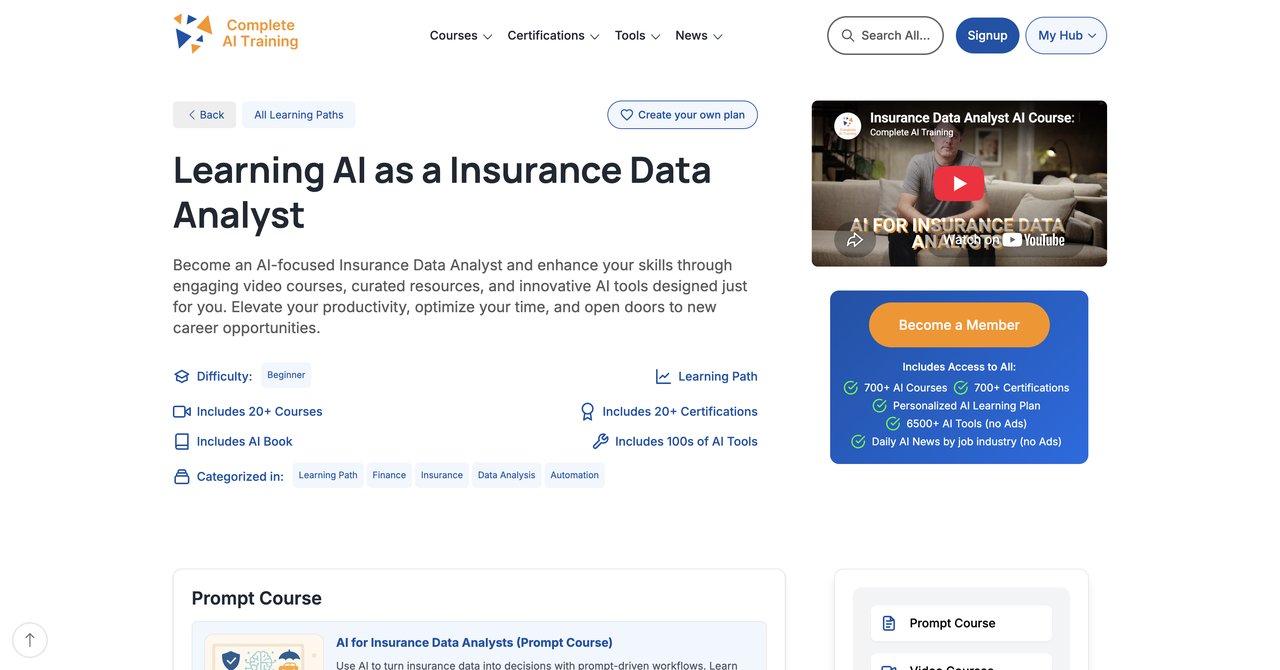
CompleteAI Training offers something quite different from all others. It's not a single course that you buy and finish. It's a subscription platform where for one flat fee you get access to every single video course and every certification they offer across your whole platform. This matters enormously, because instead of paying fifty dollars per course and then another thirty dollars for a certificate, you just subscribe and everything that exists and everything that will be added later is yours. There are new courses and certifications being added continuously, and they are automatically included in your subscription.
The description also says you can access material for every other job roles on the platform, not just insurance data analysts. That matters for anyone who works cross-functionally with, e.g., actuaries, claims departments or underwriting teams. If you want to move roles later, all that content is already available without paying more. The pricing is quite attractive at $29 per month, or $8.25 per month if you pay annually. That's a pretty low cost than paying for a similar number of courses individually. The platform has been designed to give the highest rated and most complete offering for insurance data analysts looking to learn AI.
Key Topics Covered: The platform covers an extensive library that contains not just the AI for Insurance Data Analysts course but also prompt engineering, workflow building, automated data analysis, and integrating AI into your daily data work. Also covers all the other job roles content as well, making it really broad.
Target Audience and Skill Level Requirements: The content is absolutely intended for working insurance business data analysts who want to move into AI-driven ways, regardless of their current programming level. For beginners, this includes clear video courses for prompt building and beginner workflows, and more advanced ones for those who already worked with SQL or Python. No previous AI knowledge is required for their beginner courses.
Pros:
- Highest rating and most complete offering
- Full access to ALL video courses, not just a single course or fixed bundle
- Full access to ALL certifications on the platform are included at no extra cost
- New courses and certifications are added continuously, and automatically included in the subscription
- Access to every other job role's material too, which matters for anyone whose work spans more than one function or who wants to move roles
- One flat subscription price covers all of the above, versus paying per course elsewhere
- Daily updates on relevant AI tools and news
- Very affordable pricing, especially with annual billing
Cons:
- Subscription based. That's crucial for continuous learning as AI is evolving quickly. You need to keep subscribing to get new content.
Who Should Take This Course:
If you are someone who wants to be well-rounded in AI and insurance, and doesn't want to be paying for separate courses for every part of your job role, this is a great option. The subscription model makes it ideal for anyone who wants continuous learning and also access to multiple job families. Since AI skills can be applied across many business functions, having that flexibility is nice.
View the complete details on the platform by visiting the CompleteAI Training page here
Course 2: Introduction to Data Science and AI for Insurance by Chartered Insurance Institute
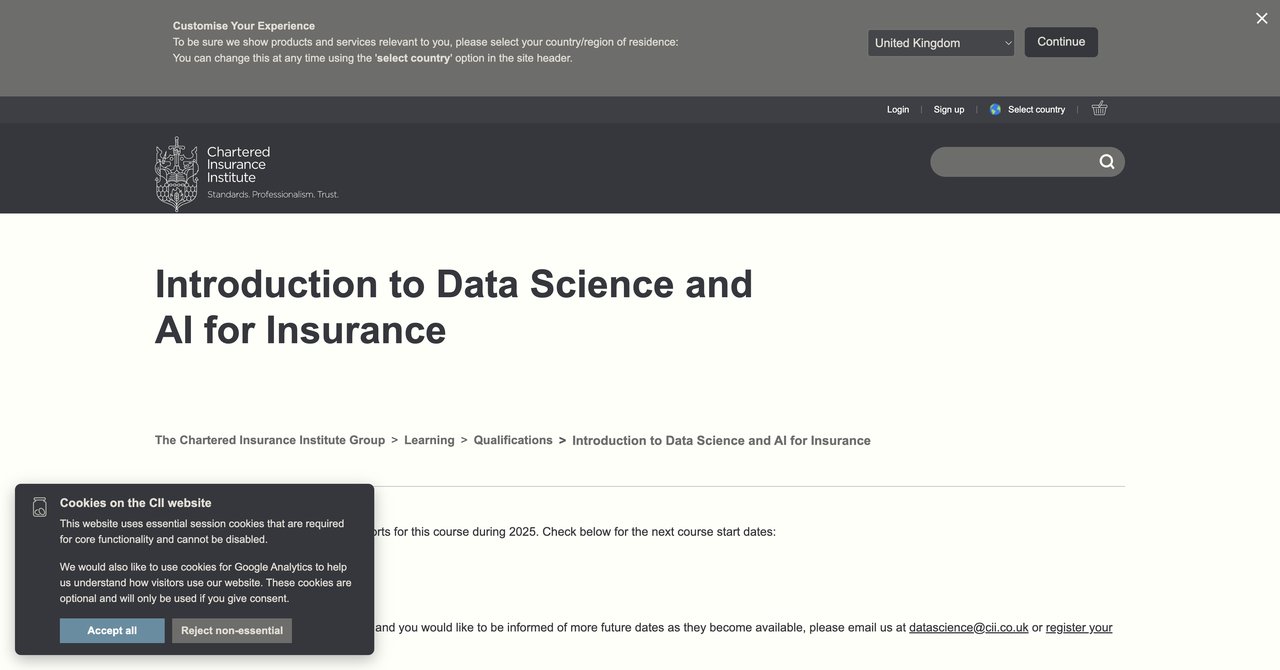
The Chartered Insurance Institute (CII) is a long-established professional body known for qualifications in the insurance world. Their introduction programme is a 6 week course, structured to get you through the basics of data science and AI in an insurance context. It's designed specifically for insurance professionals and gets you to think about ethical use of data, data visualisation, and the regulatory side of AI in the sector. It's a strong choice if you're looking for some formal learning with the credibility of the CII enrollment behind it. The cost is relatively high compared to others, especially for those CII members who get a reduced rate.
What it doesn't include is any practical coding or Python experience, so those who actually want to do data science project work could find it shallow. The focus is more on the conceptual and strategic sides of AI rather than actual implementation.
Key Topics Covered: It covers the language and concepts of AI and data science, including ethical AI use, data visualisation, relevant regulation and context for insurance.
Target Audience and Skill Level Requirements: Geared for to professionals already working in insurance who don't need code skills. Good for team leads or managers who need to understand AI enough to make decisions. No prior technical background is needed.
Pros:
- Designed specifically for insurance professionals
- Covers ethical AI and data visualisation within insurance contexts
- Structured 6-week programme with CII accreditation
Cons:
- Premium price point
- No hands-on coding or Python work
Who Should Take This:
This programme suits insurance professionals at manager level or looking for a formal understanding for strategic decision-making, and the CII name is valuable on a CV within the insurance industry. If you're a hands-on data analyst looking to code AI yourself, this one might not be technical enough.
Click here to see more about this CII course
Course 3: Insurance Business Analyst Get Hired with Real Projects by Udemy
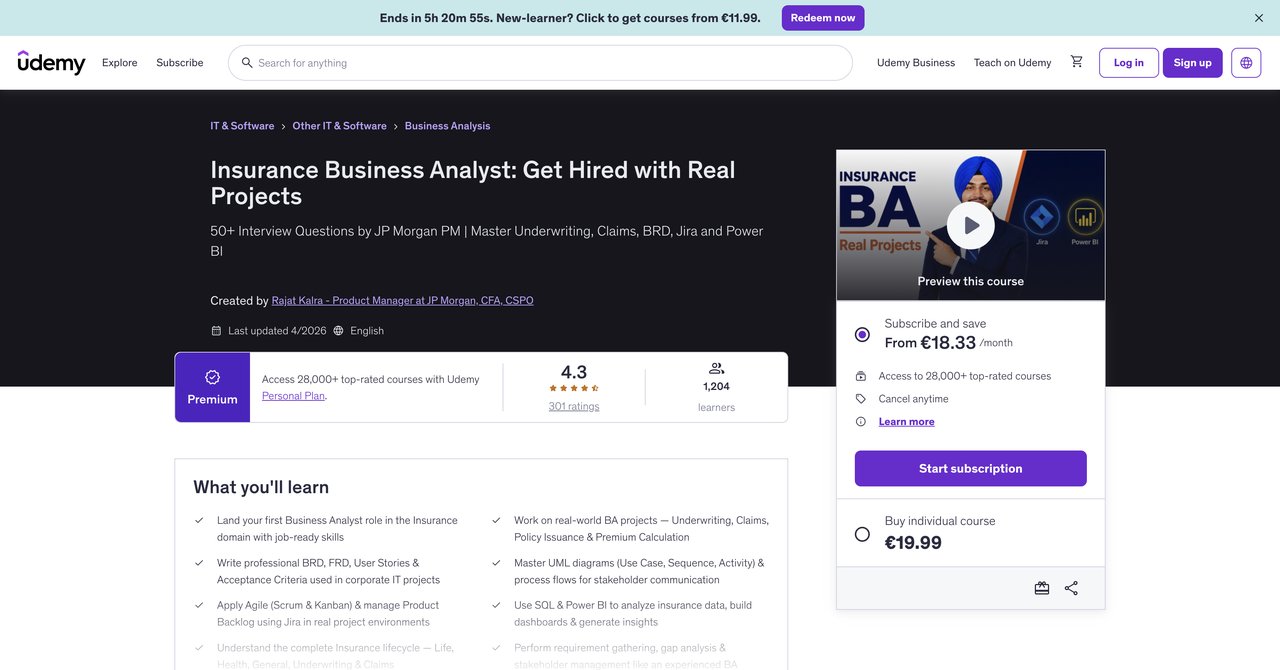
This Udemy course takes a project-based approach to insurance and analysis. Instead of focusing on basic theoretical concepts, it is going through running real insurance projects involved in underwriting and claims. You'll see hands-on materials covering things like BRD (Business Requirement Documents), Jira, Power BI, and some AI workflows. For aspiring business analysts or data analysts in insurance this makes sense. There are 50+ real interview questions included that could be essential to your prep for job interviews. The course is also one of the more affordable options on this list, between $20-$50 on sale, which is often very cheap.
On the debit side, this course is broader than a deep AI course. The AI part of it is also more about how to use AI in the workflow rather than building or training machine learning models. There's also no formal accreditation and, as with any Udemy, quality varies heavily between instructors. But for a practical thing, it does its thing.
Key Topics Covered: Business analysis fundamentals in an insurance context, underwriting and claims processing, writing BRD, using Jira and Power BI, and starting with AI workflows.
Target Audience and Skill Level Requirements: This course is for business analysts who are pivoting into insurance, or new analysts who want to build a solid understanding of insurance in the real working level. No specific coding skills are needed, but some familiarity with data analysis tools would be useful.
Pros:
- Real insurance projects covering underwriting and claims
- Includes 50+ interview questions
- Teaches BRD, Jira and Power BI alongside AI workflows
Cons:
- Focus is broader business analysis, not deep AI/ML
- Udemy quality varies and no formal accreditation
Who Should Be Most: The most benefit is for job seekers and new hires who need to work with insurance business processes along with using AI tools. But if you want in-depth machine learning, this missing component.
Click here to go to the course on Udemy
Course 4: AI for Insurance Professionals by FreeAcademy
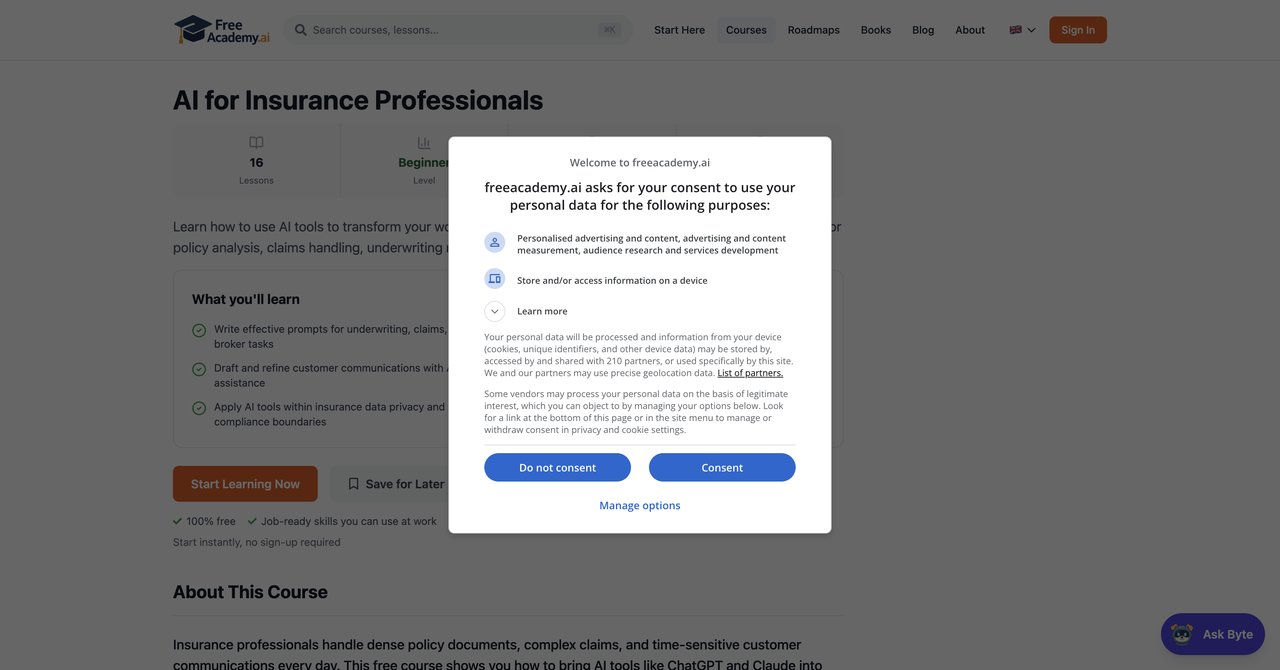
FreeAcademy offers a free 3-hour course that anyone can take. It's an introductory course on using ChatGPT and Claude for insurance use cases such as policy analysis, claims handling, and underwriting research. It also includes guidance on data privacy, which is especially important when you are in the insurance sector working with sensitive data. No coding experience is required, so if you want to get going quickly and learn about prompts that work in insurance straight away, this is not a bad start. It's completely free and you even get a certificate at the end, but without any kind of accreditation.
The biggest drawback is its short duration, so there's not much advanced statistical or machine learning content. It's more like an introduction to what AI can do for you now with your current tools like ChatGPT and Claude.
Key Topics Covered: Using prompt-based tools like ChatGPT and Claude for policy analysis, claims handling and underwriting research, plus data privacy guidance.
Target Audience and Skill Level Requirements: It's an entry-level course for anyone working in insurance who is completely new to AI and wants a practical start with the common prompt work.
Pros:
- Free certificate
- No coding required
- Covers ChatGPT/Claude prompts for policy analysis, claims handling and underwriting research
- Includes data privacy guidance
Cons:
- Short duration
- No advanced statistical or ML content
Who Should Be Most: If you want a quick and free introduction to AI to use in your current job, this is the perfect starting point. If you're looking for something to strengthen your data science skills, it won't satisfy you.
Check the FreeAcademy course page
Course 5: Professional Certificate in Basics of Insurance Data Analysis Tools by LCFT
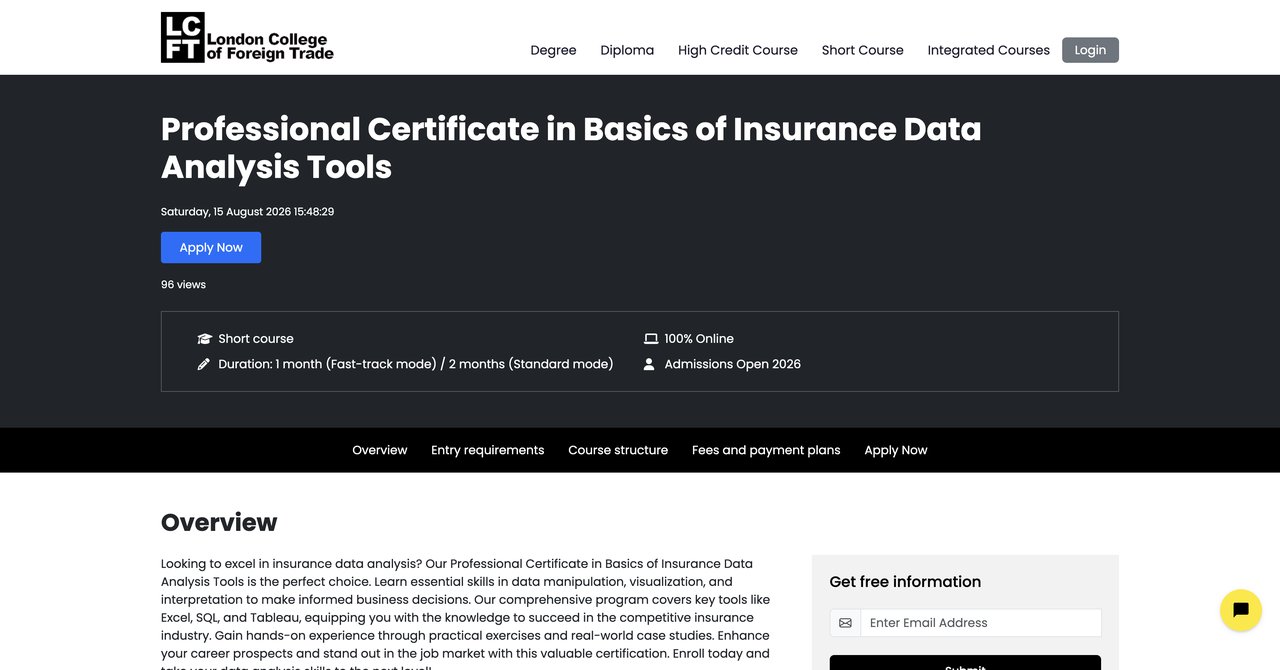
The London College of Finance and Technology (LCFT) has a professional certificate that attempts to cover the practical tool and techniques of insurance data analytics. Specifically, the data cleaning, statistical analysis, predictive modelling and machine learning fits to be done correctly with insurance data. It is targeted to give some fundamentals in data visualisation for data analysis. Since it's a professional certificate in the name, it could be useful to add a formal qualification to your LinkedIn profile.
The main thing that hurts here is the lack of transparency on pricing and hours, which makes it hard to compare with options. For the learner, providers with less brand recognition than CII or universities are a thing to consider. It's not a bad course at all in its coverage, but the uncertain cost and visibility make it hard to know if you get your money's worth.
Key Topics Covered: Basic data cleaning, statistical analysis, predictive modelling and machine learning, and visualizing data for an insurance context.
Target Audience and Skill: For insurance data analysts wanting a formal certificate to signal that they have basic data analytics skills (cleaning, stats, visualisation), not for advanced ML engineers. No upfront requirements are clear, so likely beginner level.
Pros:
- Covers data cleaning, statistical analysis, predictive modelling and machine learning specifically for insurance
- Includes data visualisation basics
Cons:
- Pricing and duration not published
- Less well-known provider
Who Should Be Most: For those who want a broad overview of data analytics with basic ML with an insurance twist, this could work if the price is right (you'd have to contact the provider). Since pricing is not known, check it directly.
More details about this course from LCFT
Course 6: Insurance Analytics (E) by NHH Norwegian School of Economics
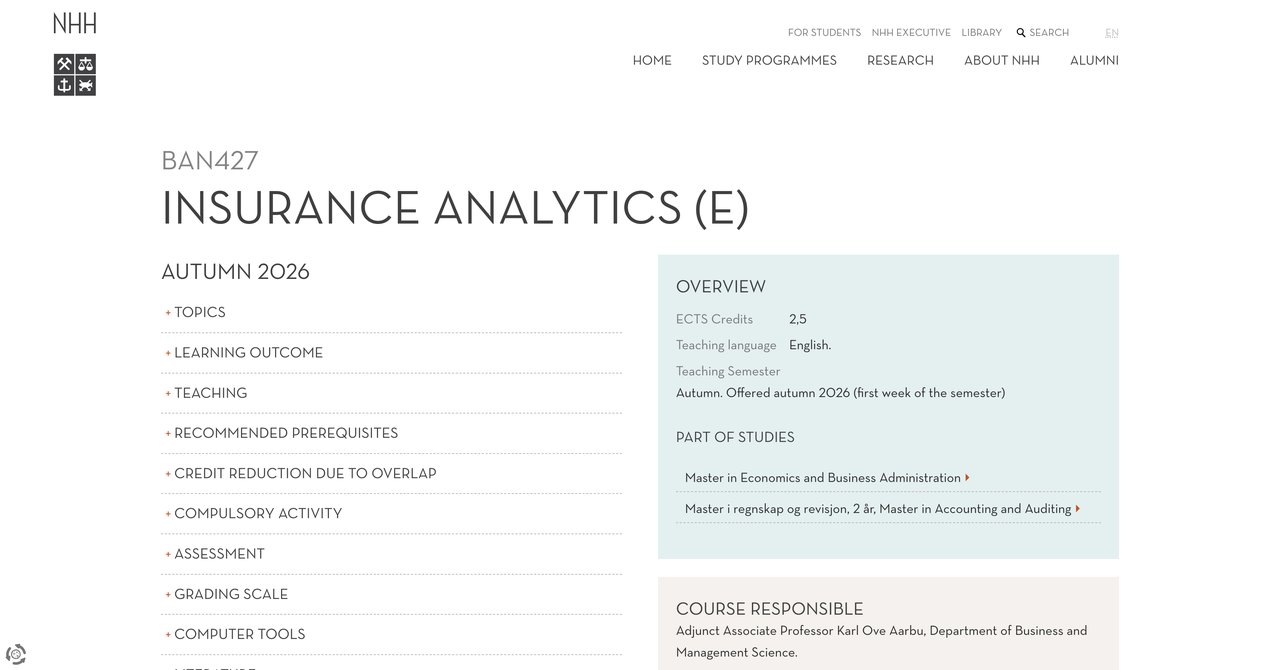
This is a university-level course from NHH Norwegian School of Economics. It's a deeply hands-on technical course that uses Python and Jupyter Notebooks to work with real, anonymous insurance data. The course covers machine learning applications in insurance, so you can expect to do things such as predictive modeling, calculating frequency and severity, and understanding model outputs. The fact that it uses actual anonymous insurance data gives you a great deal of value.
The primary downside is, of course, access. Being a university course, it's literally part of an academic syllabus for students at NHH. It's free for enrolled students, but for outsiders, public availability is quite limited. If you can get it as a student it's potentially an excellent option, but you might not be able to take it at all.
Key Topics Covered: Advanced data processing in Python, machine learning methods for insurance analytics (such as GLM, GBM), hands-on use of real (anonymous) policy or claims data.
Target Audience and Skill Level: This course requires some familiarity with either Python programming and some basic statistical foundations. It's ideal for data analysts who want to move into data science/actuarial modelling for insurance. It's of academic rigour.
Pros:
- Hands-on Python and Jupyter Notebook with real (anonymous) insurance data
- Academic rigour
- Covers ML applications in insurance
Cons:
- University course , enrollment may be restricted to NHH students
- Limited public availability
Who Should Be Most: If you can enroll, this is a great match for a data analyst with some Python experience who wants to deepen into serious machine learning with the support of a respected academic institution. But is not viable for typical working professionals outside of Norway.
See the NHH university course page
Course 7: AI in Insurance: Claims Analytics by Stanmore School of Business
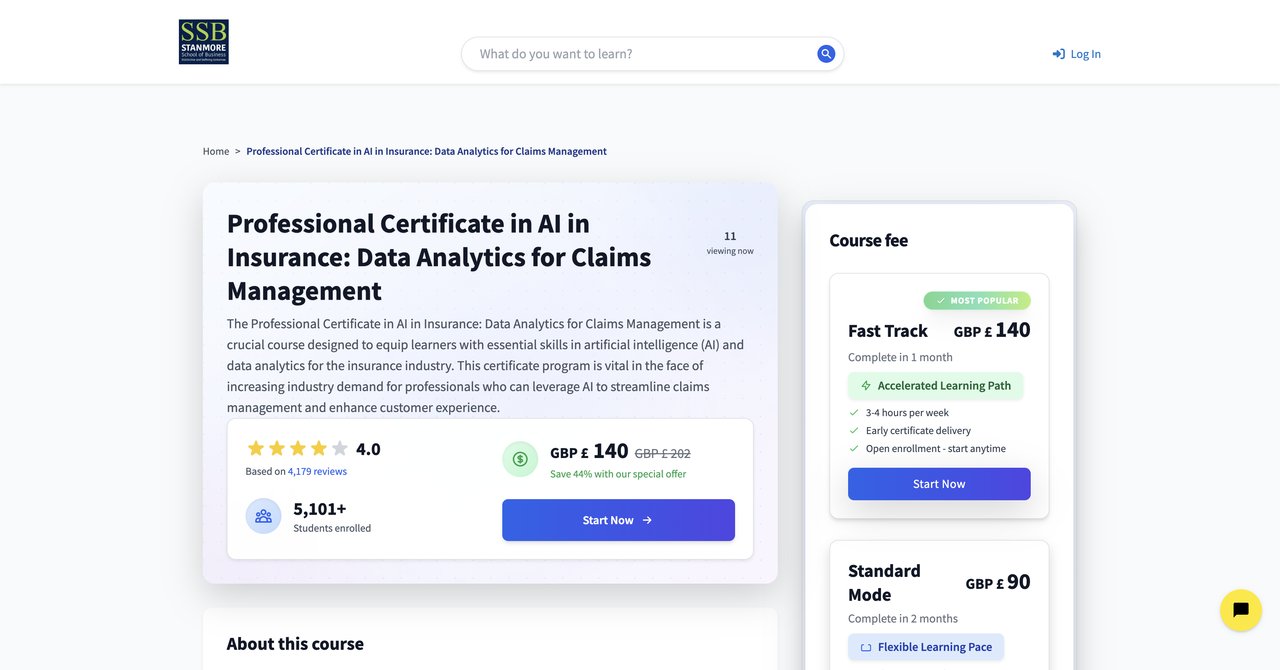
As the name says, this one is very specifically focused on claims. Priced at $140, it is more accessible. Stanmore School of Business course focuses on machine learning to detect fraudulent claims, reserve estimation forecasting, and also looks at NLP (natural language processing) for claims documentation. It will also contain some content about ethical bias to give you a well-rounded understanding. This course is a good choice if you are entirely in the claims world and want a specialization.
The clearest con however is the specialisation, because if you are a pricing or underwriting analyst, some content might not be that useful to you. The provider is also not as widely established as, let's say, CII, Coursera, or universities. Those are somewhat less recognised but still may be fine.
Key Topics Covered: Machine learning for claims fraud detection, reserving forecasting, natural language processing for claim documents, handling ethical bias.
Target Audience and Skill: For data analysts with at least experience in insurance and basic data science, who work specifically in claims handling or fraud detection. Not for a generalist.
Pros:
- Focuses on claims fraud detection, reserving and forecasting with ML
- Covers NLP for claims documentation
- Includes ethical bias mitigation
Cons:
- Claims-specific, less useful for pricing or underwriting analysts
- Provider track record less established
Who Should Be Most: It's you if you are a claims analyst specifically and you want to upskill in data science applied to your field. If you have a broader role across underwriting and pricing, this won't cover include everyone's base.
See more about this course on the Stanmore page
Course 8: AI For Data Analysts by Coursera
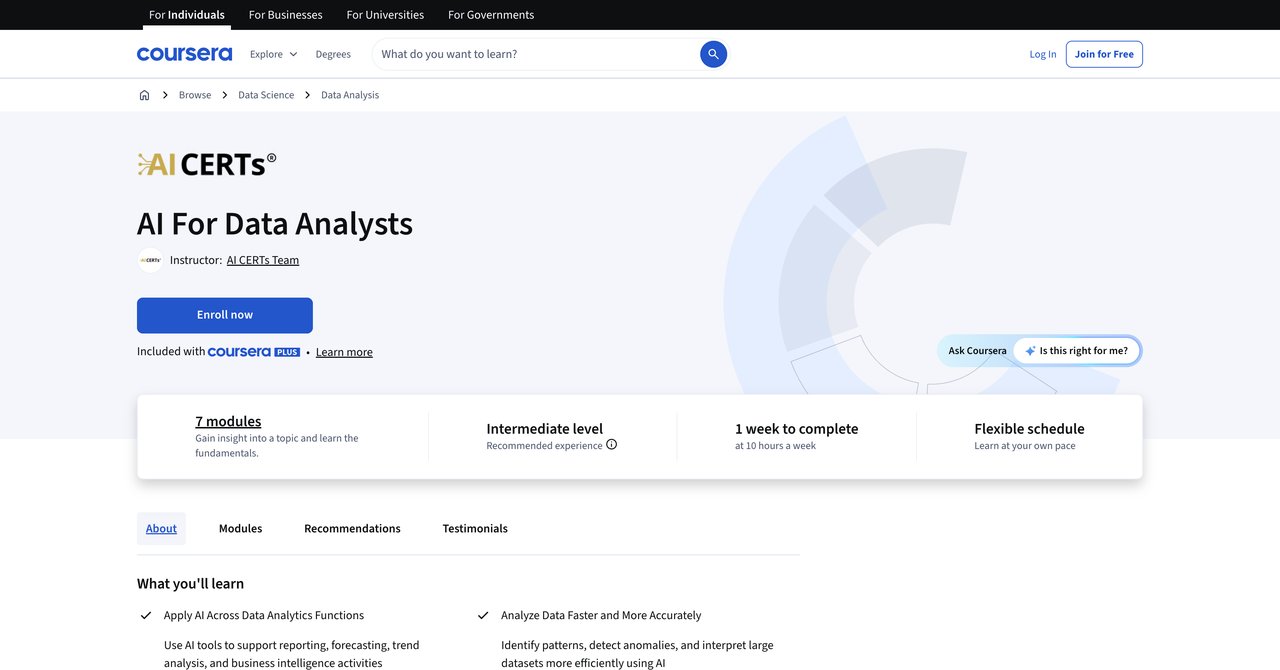
It's a general data analytics course from a major platform, not specifically an insurance course. Coursera's AI for Data Analysts teaches general AI-powered analytics to get insights faster and reporting better. The content was designed for data and business analysts in any industry, and being from Coursera you get a certain level of quality and familiarity if you had to move it across different industries. Coursera's offering has a free audit option, with full access that comes with Coursera's subscription at $59 per month.
The major drawback is that it doesn't touch any insurance data or case studies. So if you want to know how to properly talk about premium or policy AI, it might be too generic. But if you want to add a broader Data & AI skill that can apply across any future roles, this is a decent choice.
Key Topics Covered: Using AI to build data pipelines, machine learning techniques for analysis, creating automated reporting, drawing the best value to organisations.
Target Audience and Skill Level: For any kind of business data analyst that wants an AI foundation. No major skill requirements but must be comfortable with general data tools. No insurance knowledge is required.
Pros:
- From a major platform
- Teaches AI-powered analytics for faster insights and better reporting
- Designed for data and business analysts
Cons:
- Not insurance-specific
- Requires Coursera subscription for full access
Who Should Be Most: If you are a data analyst in an insurance company but also want some general skills that are applicable to a wide range of future jobs, this works. If you want globally insurance context, you would notice the difference.
Take a look at this Coursera offering directly
Course 9: Data Analytics for Insurance by Deakin University
Data Analytics for Insurance by Deakin University is a stackable short course from a recognised university. The course uses a made-up hypothetical insurance dataset to teach you Excel and Tableau for data visualisation. At the end, there's an assessment: you have to build an interactive Tableau dashboards and also write a 1,500-word report. It has a structured, formal format, and is proctored by academics. It is a very practical skill that many business teams need for reporting, even if it is not related to AI at all.
Most importantly, this course does not contain AI or machine learning. It's purely data analysis. So if you're looking to get deep into ML or GenAI, then this isn't the one to choose. In addition, it's priced in AUD $1,375 (approx $900 USD), which is rather on the higher end.
Key Topics Covered: Statistical data analysis, visualisation using Excel and Tableau, and creating a Tableau dashboard and report.
Target Audience and Skill: Suited for analysts who want a recognized university certificate with a heavier focus on reporting and visualisation rather than prediction. No coding is required, Excel knowledge is a must.
Pros:
- Uses a hypothetical insurance dataset
- Teaches Excel and Tableau, hands-on visualisation
- Assessment includes an interactive Tableau dashboard and 1500-word report
Cons:
- No AI/ML content , purely data analytics
- Australian pricing may be high for international learners
Who Should Be Most: If your work, or upcoming role, focuses on reporting and dashboard views for insurance stakeholders, especially using a well known university certificate. You should know that this won't improve your machine learning.
Explore the Deakin University course page
Course 10: AI for Insurance Data Analysts (Prompt Course) by Complete AI Training
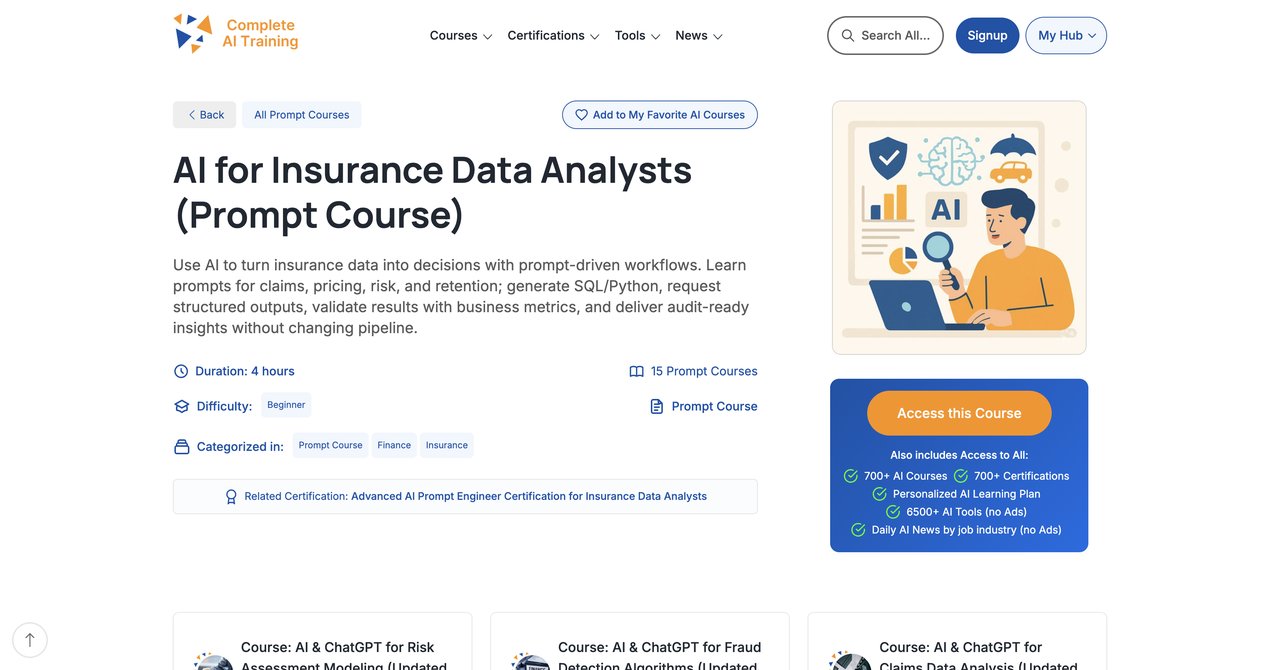
This is a specific short course within the Complete AI Training library. It is only 4 hours and it's a prompt-driven course focused on claims, pricing, risk and retention scenarios. You learn how to generate SQL and Python code using LLM tools and then how to validate results against real business metrics. It also aims to produce audit-friendly outputs, which is something that matters a lot in the insurance industry. If you are already subscribed to Complete AI Training, this course is included in your subscription, so no need to pay anything extra.
If you look at it, it's a sharp, focused course for the day-to-day use of prompt-based AI for an insurance data analyst. But given its short length, you'll probably get more from a combination of courses (on the platform, for example, if you want to go to the next level and deal with model building).
Key Topics Covered: Structured prompting for Claims, Pricing, Risk and Retention, AI-generated SQL/Python, a business-metric validation framework, audit-ready outputs.
Target Audience and Skill Levels: That is for insurance data analysts who want to quickly be more productive with assistant AI tools in their day-to-day work. No advanced math needed, but basic understanding of SQL / data validation is of value.
Pros:
- Prompt-driven workflows for claims pricing risk retention
- Generates SQL/Python code quickly
- Validates results with business metrics
- Audit-ready outputs
Cons:
- Short duration
Who Should Be Most: For analysts who are already in a job and want to lift a specific AI and prompt skills for immediate tasks. It's a good, efficient course.
Visit the AI for Insurance Data Analysts Prompt Course page
Course 11: Insurance Data Science with Python by Coursera
This is a Coursera option (university-partner) for insurance with Python that covers pricing, reserving and risk modelling with Python through real-world case studies. This is also part of a university-backed course, so you get some more depth and academic rigour. It costs a Coursera subscription ($59/month) or you can audit it for free. This is a great match for people with some programming skills and wanting to see those in an insurance application. But, you have to be aware that it's not a single verified course URL. You need to search within Coursera's list for current offerings, where not all university partners are the same level. Yet, it essentially gives you solid skills in using Python for insurance datasets.
Key Topics Covered: Applying Python for insurance pricing proposals, reserve estimates and risk-driven modelling. Working with real-world data and building machine learning in business context.
Target Audience and Skill Level Requirements: Aimed at data analysts with some Python experience who are comfortable with data processing libraries. Not for complete beginners, more for transitional analysts.
Pros:
- Hands-on Python for insurance pricing, reserving and risk modelling
- Real-world case studies
- University-backed content
Cons:
- Not a "single course" linked verification , you have to search for current offers in the platform
- Quality varies by partner
Who Should Be Most: This is best for someone who has Python basics and wants an industry-specific application of data science. Not ideal if you are a beginner, or you're purely into prompt engineering.
Search for insurance data science courses on Coursera
Course 12: Machine Learning for Insurance Pricing by edX
edX offers an advanced course focused on insurance pricing and machine learning, with actuarial focus. It covers advanced techniques GLMs, GBM, neural networks applied to price data and risk assessment. This is more advanced than some of the other options in the list, so it's not great for the total beginner without work experience. A great feature is that you can audit for free, and pay for verified certificate only if you need one ($50-$150). An audit option is an excellent way to access high quality university material without cost.
It's a university partner via edX, but the biggest problem is the fact that as a course, link is not to a specific course page. It links to search results. So you'll need to find the exact offering that fits your level and interest, and it can vary.
Key Topics Covered: Advanced machine learning (GLM, GBM, neural networks), actuarial pricing methods, data preparation, and pricing case studies.
Target Audience and Skill: For actuarial students, quantitative analysts, or data scientists working specifically in insurance pricing and wanting advanced competences in AI. Prior knowledge of stats and coding is a must.
Pros:
- Advanced ML techniques (GLMs, GBM, neural networks) applied to pricing
- Actuarial focus
- Flexible audit option
Cons:
- Not a single verified course URL , requires searching edX for current offerings
- Advanced level may be challenging for beginners
Who Should Be Most: This needs an advance, you already have analytics background and need to improve pricing and modeling skills. If you're a beginner to this kind of material, you should start with a less intensive course first.
Look at the search results on edX for this topic
Course 13: Generative AI for Insurance Operations by LinkedIn Learning
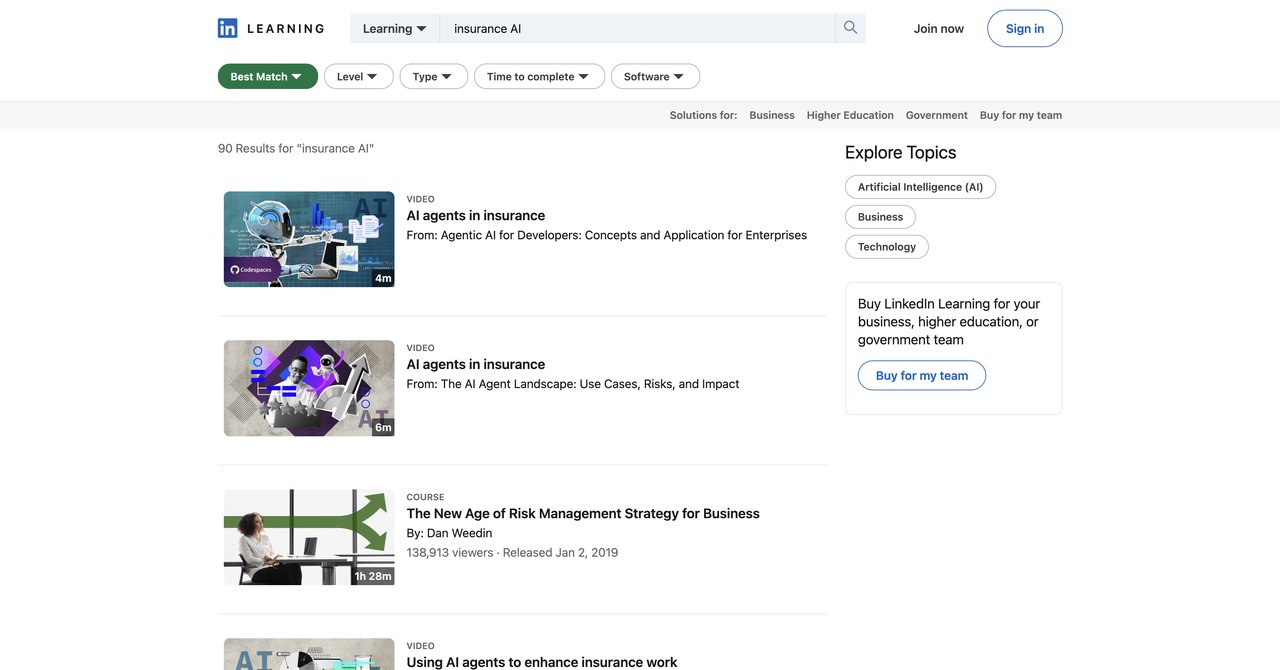
LinkedIn Learning has short, practical videos around using generativeAI in insurance operations, especially underwriting, claims, and customer service. If you already have LinkedIn Premium or LinkedIn Learning subscription, those are extremely accessible with the $39 monthly fee, and part of your LinkedIn subscription. It includes exercise file so you can practice while you go. This is more like a professional onboarding into GenAI, a quick hit of knowledge. It is not as comprehensive or deep as a university course, but perfect if you want to understand how GenAI is being applied, and the skills you need to begin applying them. But, again, it's usually broad, customers services stuff not deeply analytical. And also the link is not a single course, it's a search, so you have to go through and find the course that fits your need.
Key Topics Covered: Using GenAI (like ChatGPT) for underwriting workflows, claims processing, customer service interactions.
Target Audience and Skill Level: Low barrier entry. It's for general insurance professionals or data analysts who are non-technical or need to know what are their tools for, not for hardcore data science.
Pros:
- Short, practical videos on using GenAI for underwriting, claims and customer service
- Accessible via LinkedIn subscription
- Includes exercise files
Cons:
- Not a single verified course URL , requires searching LinkedIn Learning for current offerings
- Shallow depth compared with university courses
Who Should Be Most: Great for any insurance professional who wants to quickly become familiar with GenAI, without getting into the details or code. Good with any kind of Continuous Learning for practical use.
Search LinkedIn Learning for insurance AI courses
Final Recommendations and Summary
There is no one answer that fits all. It looks like a broad spectrum. For those who have zero experience and want to know what can be achieved with ChatGPT in claims: the FreeAcademy course is an excellent warm-up. It's also free, which is a huge plus.
If you're a business analyst or somebody who just got into insurance and wants hands-on broad insurance analysis covering real projects, including job interview questions, the Udemy course is a very cheap learning piece and has solid topics with BRD, Jira, for business analysts.
If you want a foundation of knowledge and are a professional who values certification in UK/European contexts, the CII has an accredited course that is strategic, non-technical, but credible. If your role is specifically actuarial or pricing and you are looking for advanced ML and statistical rigour, edX or the NHH university module are powerful options, depending on whether you can actually enroll. If visualisation reporting is your area, the Deakin University course provides good grounding in excel and Tableau. And if you are after a claims-focused skills on fraud and NLP, the Stanmore School of Business course is very targeted and relatively low priced.
But if you are an Insurance Data Analyst whose daily work includes pricing, claims or risk and you want to become a skilled AI practitioner, the subscription approach of Complete AI Training stands out. Not just because it's good in a single course, but because you can get access to ALL their video courses and certifications included. For a professional who wants to stay up to date as AI moves , say, quarterly , it makes sense to have a subscription where new content is continuously added. The annual $8.25 per month is lower than paying per course and allows you to see what new in prompt engineering, Python, SQL, or other datasets.
Want to read more about Complete AI Training: access all of the platform's content for insurance analysts
Don't confuse the low cost per single course for what you always need. Since AI shifts, the ongoing skill development that comes with a subscription such as Complete AI Training can be more useful than a one-time training. But since it is subscription you always have to renew. People who prefer perpetual access to specific classes and don't mind the occasional out-of-date, then Udemy or Coursera may suit better for just doing a first initial update.
In all cases, "Finish the course" is not the end. It should be the beginning. For a true Insurance Data Analyst, the practical applications (fraud detection, pricing, risk assessment, optimization, automation of reporting) matter a lot more than the specific the course cert. Choose based on your actual daily work, not just on a certificate name. Use a mix of any approach by using one-time specific courses and subscription for continuous training will be your best approach to grow. Best of luck.