8 AI Courses for Compensation Analysts that You Should Know About in 2026
Sharpen your 2026 skills with eight top AI courses tailored for compensation analysts. Master predictive pay modeling, market data automation, and strategic tech application to stay ahead.
The numbers are hard to ignore. Compensation and benefits analysis has always been data-heavy, but the volume and speed of that data are growing faster than traditional spreadsheet skills can handle. Companies are restructuring entire pay philosophies around real-time market data, and the people who manage that data are feeling the pressure. By 2025, workforce analytics has become a core function of HR departments, not a niche specialty. If you are a Compensation Analyst, the question isn't whether AI will touch your job-it's whether you'll be the one leading that change or scrambling to catch up. AI is not replacing the need for human judgment in compensation. But it is absolutely changing who gets to provide that judgment. This isn't about fear; it's about opportunity. The analysts who understand how to use AI to handle salary surveys, job architecture, and pay equity analysis will be the ones leading their organizations' most important conversations. The rest? They'll be managing data entry for those who did the work to stay ahead.
Why AI matters for Compensation Analysts today
The business world has changed its expectations completely. Leaders want real-time market adjustments, they want predictive salary models, and they want to know the pay implications of every hiring decision before they make it. Meanwhile, 69% of businesses with over 1,000 employees are actively deploying AI in some form of HR analytics. Compensation professionals are at the center of this because pay design is inherently mathematical. It's a mix of regression models, clustering, and market data-all things AI handles very well. The reality is that the tools have become so user-friendly that you don't need to be a programmer to use them. You just need to know how to ask the right questions, structure your data, and interpret the results. That is why I surveyed the current certification landscape to find the programs that actually help working analysts. This article compares 5 AI courses for Compensation Analysts, looking at who they're for, what they teach, and whether the cert is worth the time. You'll see a range of options, from foundational prompt engineering classes to advanced analytics courses. One of the courses we've included is CompleteAI Training, which distinguishes itself by giving you access to ALL courses and ALL certifications on the platform, rather than a single, limited module. It allows you to progress from basics to advanced topics on your own schedule.
The Growing Role of AI in Compensation Analysts
So what does AI actually look like in a compensation workflow?
- Automation of routine tasks: AI handles salary survey data formatting and job matching, which is still a huge time sink.
- Data-driven decision models: Instead of you manually testing different comp scenarios, the model runs thousands of iterations and flags the outliers.
- Personalized recommendation engine: AI can suggest a salary range for a candidate based on internal pay equity and external market data, all in seconds.
- Manager self-service: Imagine a tool that answers "how do I adjust comp for a new site location?" without sending the manager to you directly.
The role is shifting from someone who creates the data-the spreadsheet jockey, if you will-to someone who interprets the output and sets the policy. You are becoming the translator between the machine and the business leaders. Those responsibilities demand new skills in prompt design, data validation, and model oversight. This isn't about job loss; it's about job evolution. This should prompt you to understand what training is out there, so you can move into that role with a bit of preparedness rather than playing catch-up.
Benefits of becoming an AI expert in Compensation Analysts
For the Compensation Analyst, the practical gains of getting these skills are both substantial and immediate. You will eliminate the hours of repeating manual steps that eat your Tuesday, freeing up time for strategic planning. The second is credibility. If you walk into a management meeting with flushed-out scenario analysis in hours instead of weeks, people start asking you opinion. That level of influence, based on these skills, is a strong career advantage. Being the person who knows how to talk about the logic behind AI output is a differentiator. Not everyone can do that. You also get a better feel for the project management, and you'll start building codes and macros that save your team time. When it is time for salary negotiations or performance reviews, "I automated our survey data process" is a much more compelling line than "I did the job as described." That is the career equity that these certifications give you.
Comparison: All AI Courses for Compensation Analysts (Updated 2026)
| Course Name | Provider | Price | Key Topics | Pros | Cons | Best For |
|---|---|---|---|---|---|---|
| CompleteAI Training | CompleteAI | Premium (one flat subscription covers ALL courses and ALL certifications on the platform, not a single course) | Comprehensive AI curriculum, hands-on projects, expert instruction, full library of video courses and certifications, daily AI tool updates, industry news | Most comprehensive offering, full access to all courses and certifications included, new content added automatically, covers multiple job roles, expert instructors, hands-on projects | Premium pricing; subscription-based, which suits continuous learning as AI changes fast | Compensation Analysts professionals looking for complete training |
| AI for Compensation Analysts (Video Courses + Certifications) | Complete AI Training | $29/month or $8.25/month billed annually | Over 100 specialized video courses and certifications for Compensation Analysts; all courses and certifications on platform included; daily AI tool updates; curated industry news; access to all other job role materials | Highest rating, full access to all video courses and certifications, new content added continuously, covers cross-functional roles, very affordable with annual billing, daily updates | Subscription based - continuous learning required as AI develops | General learners and professionals who want complete, ongoing access |
| GenAI for Compensation Analysis in Law Firms | Coursera (Starweaver) | Subscription (Coursera Plus) or financial aid available | Pay equity and disparity analysis in legal settings, hands-on GenAI tool practice, legal/ethical compliance in compensation decisions | Niche focus on legal settings, hands-on practice, covers compliance topics | Limited to law firm context, requires Coursera subscription for full access | General learners interested in legal compensation analysis |
| AI for Payroll and Compensation Management | Catch Wisdom | Free | Payroll automation, real-time salary benchmarking, fraud/anomaly detection with AI, certificate included | Entirely free with unlimited access, covers core payroll and benchmark topics, certificate included | Lacks depth on strategic pay equity, platform less established | General learners on a budget |
| Total Rewards That Drive Careers: Compensation & Benefits Decisions Supported with AI Insights | University of South Florida (USF) Continuing Education | $295 USD | Pay equity, market data analysis, ROI modeling with AI, on-demand flexible schedule | University-backed credential, covers pay equity and ROI modeling, self-paced | No refunds, only 30 days of access | General learners seeking a university credential |
| GenAI for Compensation and Benefits: Smarter Pay Equity Analysis | Starweaver | Unknown | Pay equity analysis using GenAI, data-driven compensation decisions, specialist AI upskilling | Dedicated to pay equity with GenAI, focused on data-driven decisions, specialist provider | Pricing and duration not published, less well-known platform | General learners focused on pay equity |
| GenAI for Compensation, Benefits and Payroll | Coursera | Subscription (Coursera Plus) or financial aid available | Payroll automation, personalized benefits, compensation equity, hands-on approach, beginner-friendly | Broad coverage across payroll and benefits, hands-on, beginner-friendly | Broad scope may miss advanced analytics, requires subscription | General learners looking for an entry-level overview |
| Certified Compensation & Payroll Management Professional-26 | Udemy | Varies (typically $20,$100 USD, often on sale) | Indian payroll, compensation benefits, income tax, certification included, self-paced | Updated for 2026, covers India-specific payroll, certification, self-paced | India-specific focus may not suit global analysts, quality varies with instructor | General learners in India or covering Indian payroll |
| Certified Compensation and Benefits Manager (CCBM) | Middle Earth HR | ₹39,500 INR (~$470 USD) | AI-powered compensation analytics, HR dashboards, strategic rewards, pay equity | Live instructor-led, AI-based analytics focus, strategic rewards coverage | Premium price, scheduled batches (next: 12 September 2026) not on-demand | General learners who prefer live instruction |
Understanding AI Training for Compensation Analysts Professionals
Compensation analysis has changed a lot in the last couple of years. It used to be mostly about spreadsheets, market surveys, and annual salary reviews. Now, AI tools can handle salary benchmarking in real time, flag pay equity issues before they become legal problems, and even predict turnover based on compensation patterns. That shift means compensation analysts who know how to use AI effectively are becoming genuinely valuable to their organizations. But here's the catch: not all AI training for compensation professionals is created equal. Some courses are narrow and focused on one specific problem. Others give you a broad foundation that applies across multiple roles and functions. Some are free, some are subscription-based, and some cost a few hundred dollars for a one-time credential.
This comparison breaks down the main options available right now. I've looked at what each course actually covers, who it's for, what it costs, and where it falls short. By the end, you should have a clear picture of which approach makes sense for your situation, your budget, and your career goals. Let's get into it.
Course 1: CompleteAI Training
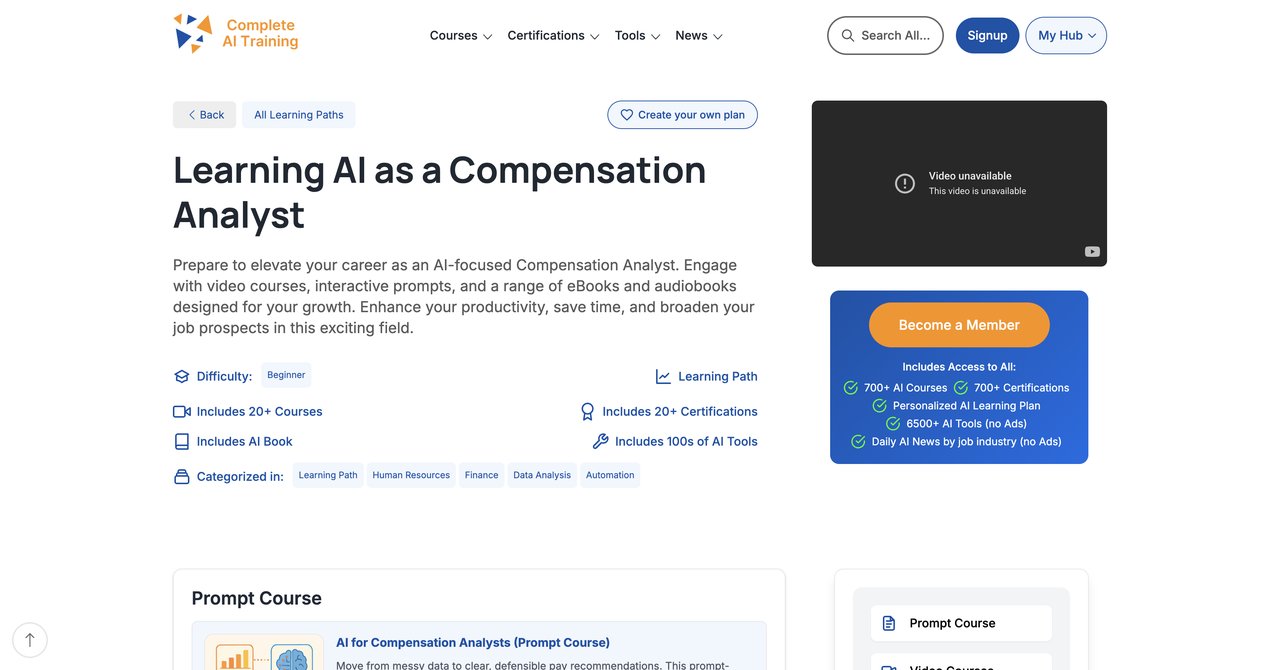
Here's the most important thing to understand about CompleteAI Training: it's not a single course. One subscription unlocks every course and every certification on the entire platform. That means hundreds of video courses across every job role, not just compensation analysis. If you're a compensation analyst whose work touches HR operations, payroll, benefits, or even data analytics, you get access to all of that material too. The same flat subscription covers everything. You're not buying one course and then paying separately for a certificate. You're not stuck with a fixed bundle that goes stale after a year. New courses and certifications are added continuously, and they're included automatically. If you want to move into a different role later, your subscription already covers that training as well.
The platform is built specifically for professionals who need practical, job-focused AI training. The compensation analyst track covers salary benchmarking with AI, pay equity analysis, compensation structure design, and how to communicate AI-driven recommendations to leadership. It also gets into the operational side, like automating repetitive tasks and integrating AI into your daily workflow. The material is updated daily, which matters because AI tools change fast. What worked six months ago might not be the best approach today.
Key topics covered: AI-powered salary benchmarking, pay equity analysis, compensation structure optimization, AI tool selection for comp work, prompt engineering for HR data, automation of routine comp tasks, and strategic communication of AI insights.
Target audience and skill level: This is aimed at working compensation analysts, HR professionals, and anyone who handles compensation data as part of their job. It works for beginners who are just starting to use AI in their work, but it also has enough depth for experienced analysts who want to stay current. The subscription model means you can start with the basics and work your way up without paying more.
Pros:
- Highest rating and most complete offering available for this profession
- Full access to ALL video courses on the platform, not just a single course or fixed bundle
- Full access to ALL certifications on the platform, included at no extra cost
- New courses and certifications are added continuously and are included automatically
- Access to every other job role's material too, which matters if your work spans more than one function or if you want to move roles later
- One flat subscription price covers all of the above, versus paying per course elsewhere
- Daily updates on relevant AI tools and news
- Very affordable pricing, especially with annual billing at $8.25/month
Cons:
- Subscription-based, so you need to keep paying to maintain access. That said, continuous learning is arguably necessary because AI is developing so quickly.
Who would benefit most: Compensation analysts who want comprehensive, ongoing AI training without worrying about individual course fees or certificate costs. Also great for professionals who wear multiple hats, like HR generalists who handle comp, benefits, and payroll. If you're serious about staying current with AI in compensation, the subscription model makes more sense than paying $300 for a single course that's outdated in a year.
Visit CompleteAI Training for Compensation Analysts
Course 2: GenAI for Compensation Analysis in Law Firms by Coursera (Starweaver)
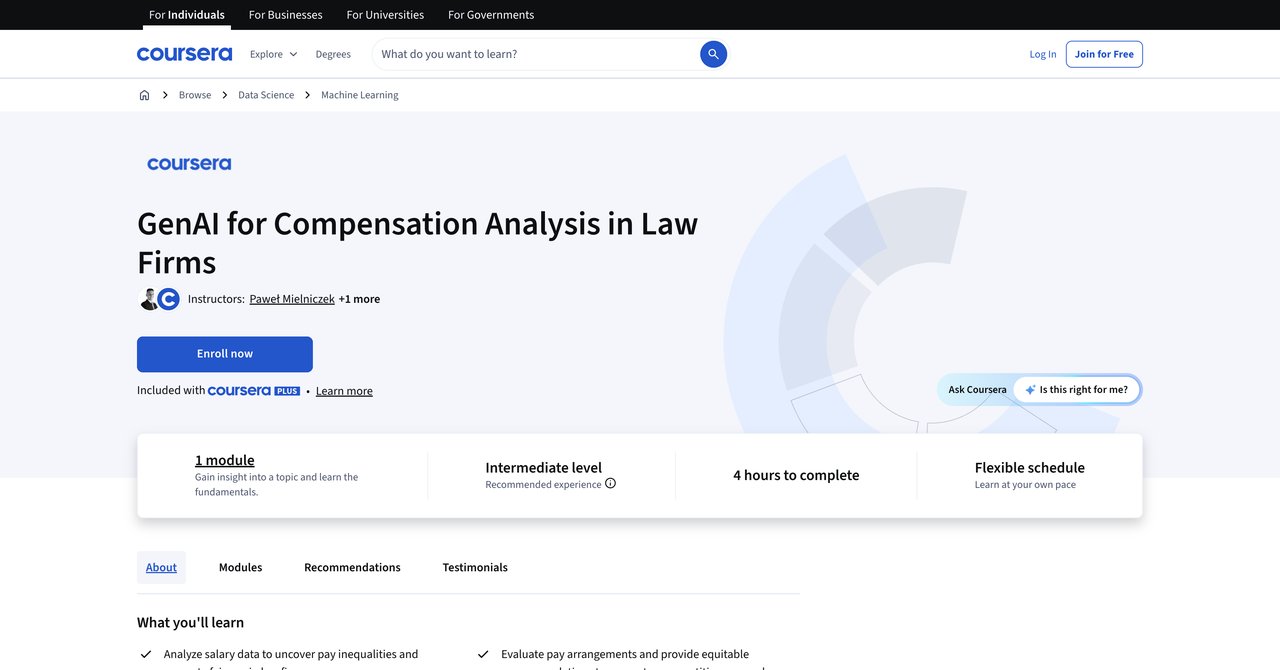
This course takes a very specific angle. It's designed for compensation analysts who work in law firms, and it focuses heavily on pay equity and disparity analysis in legal settings. That's a niche but important area because law firms have unique compensation structures, including lockstep systems, origination credits, and partner compensation that doesn't map neatly onto corporate salary bands. The course walks through how to use generative AI tools to analyze pay disparities, identify potential issues, and prepare data for legal or ethical review.
The hands-on component is solid. You're not just watching videos; you're working with GenAI tools to practice the analysis techniques. The course also covers the legal and ethical side of compensation decisions, which is critical when you're dealing with pay equity issues that could end up in court. Starweaver is a specialist provider in AI upskilling, and it shows in the quality of the material.
Key topics covered: Pay equity analysis in legal settings, disparity detection with GenAI, legal and ethical compliance in compensation decisions, hands-on GenAI tool practice, and law firm-specific compensation structures.
Target audience and skill level: Compensation analysts working in law firms, HR professionals in legal environments, and consultants who advise law firms on compensation. Intermediate level is probably ideal, since it assumes some familiarity with compensation concepts.
Pros:
- Focuses specifically on pay equity and disparity analysis in legal settings, which is rare
- Hands-on GenAI tool practice rather than just theory
- Covers legal and ethical compliance in compensation decisions thoroughly
Cons:
- Niche to law firms, so less useful if you work in general corporate compensation
- Requires Coursera subscription for full access, which adds up if you're only taking this one course
Who would benefit most: Compensation professionals in the legal sector who need to understand AI-driven pay equity analysis. If you work in a law firm or consult for them, this is directly relevant. If you're in general corporate comp, it's probably too narrow.
Visit GenAI for Compensation Analysis in Law Firms on Coursera
Course 3: AI for Payroll and Compensation Management by Catch Wisdom
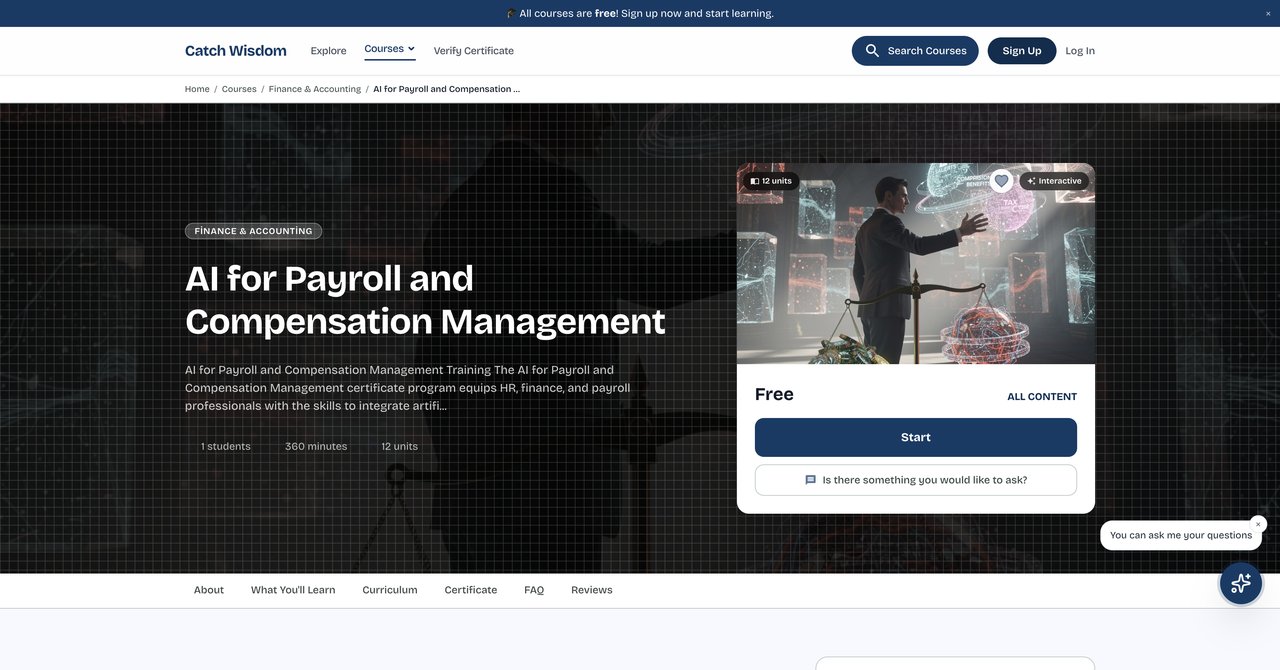
Here's a rare thing: a completely free course that actually covers useful ground. Catch Wisdom's offering focuses on payroll automation, real-time salary benchmarking, and fraud or anomaly detection using AI. The payroll automation piece is particularly practical because it addresses the day-to-day grind of processing payroll data, checking for errors, and ensuring compliance. The course shows you how AI can spot anomalies that might indicate fraud or simple data entry mistakes, which is a real pain point for many organizations.
The real-time salary benchmarking section is also valuable. Traditional benchmarking relies on annual surveys, but AI tools can pull current market data continuously. The course walks through how to set that up and interpret the results. It includes a certificate upon completion, which is nice for a free course. The main limitation is depth. It covers the essentials but doesn't go as deep on strategic pay equity or long-term compensation philosophy. Also, Catch Wisdom isn't as established as some of the bigger training providers, so the production quality and support might not be at the same level.
Key topics covered: Payroll automation with AI, real-time salary benchmarking, fraud and anomaly detection, and practical AI implementation for payroll and comp processes.
Target audience and skill level: Payroll specialists, compensation analysts, and HR professionals who want a free introduction to AI in their field. Beginner-friendly, but also useful for experienced professionals who want to see what's possible without committing money.
Pros:
- Entirely free with unlimited access, which is rare for this topic
- Covers payroll automation, real-time salary benchmarking, and fraud/anomaly detection
- Certificate included at no cost
Cons:
- Less depth on strategic pay equity compared to other options
- Platform is less established than major providers, so you're taking a bit of a chance on quality and longevity
Who would benefit most: Anyone who wants to learn the basics of AI in payroll and compensation without spending money. Great starting point if you're exploring whether AI training is worth investing in. Also useful for payroll professionals who want to expand into compensation analysis.
Visit AI for Payroll and Compensation Management by Catch Wisdom
Course 4: Total Rewards That Drive Careers: Compensation & Benefits Decisions Supported with AI Insights by University of South Florida (USF) Continuing Education
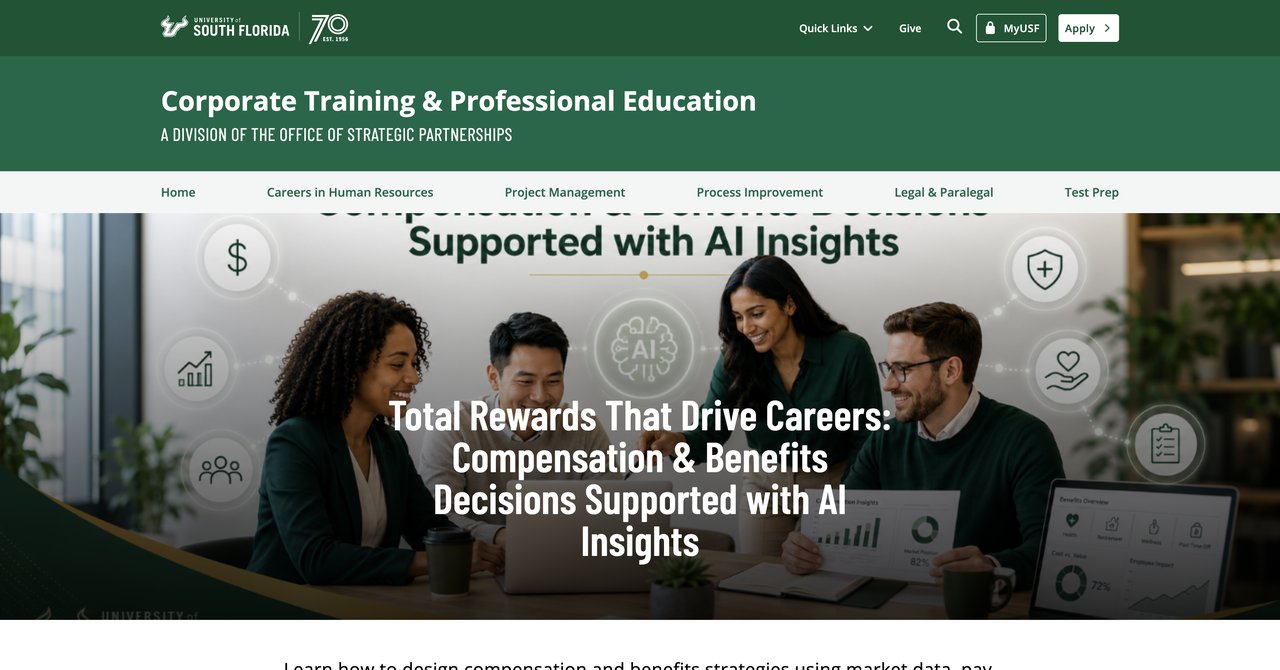
This one comes with a university credential, which carries weight if your organization values formal education from accredited institutions. USF's continuing education program put together a course that covers pay equity, market data analysis, and ROI modeling with AI support. The university backing is the main selling point here. It's not just some random online course; it's from a recognized institution, which can matter for resume purposes or if your employer is picky about training providers.
The course content is solid. It covers the fundamentals of using AI to analyze market data, assess pay equity, and model the return on investment for compensation changes. The on-demand format means you can work through it on your own schedule, which is convenient for busy professionals. But there are some drawbacks. The $295 price tag is a single upfront fee with no refunds, which is a bit risky if the course doesn't meet your expectations. Also, you only get 30 days of access, which might feel rushed if you're balancing a full-time job and other commitments.
Key topics covered: Pay equity analysis, market data interpretation, ROI modeling for compensation decisions, and AI-supported total rewards strategy.
Target audience and skill level: Compensation analysts and HR professionals who want a university-backed credential. Suitable for intermediate level, though beginners can follow along. Best for those who prefer structured, academic-style learning.
Pros:
- University-backed credential from USF, which adds credibility
- Covers pay equity, market data, and ROI modeling with AI
- On-demand flexible schedule
Cons:
- Single upfront fee with no refunds, so you're committed once you pay
- Limited to 30 days of access, which may not be enough for thorough learning
Who would benefit most: Professionals who need a recognized university credential for their resume or employer requirements. Also good for those who prefer a structured, academic approach to learning. If you're looking for ongoing access or a broader range of topics, this might feel limiting.
Visit Total Rewards That Drive Careers by USF Continuing Education
Course 5: GenAI for Compensation and Benefits: Smarter Pay Equity Analysis by Starweaver
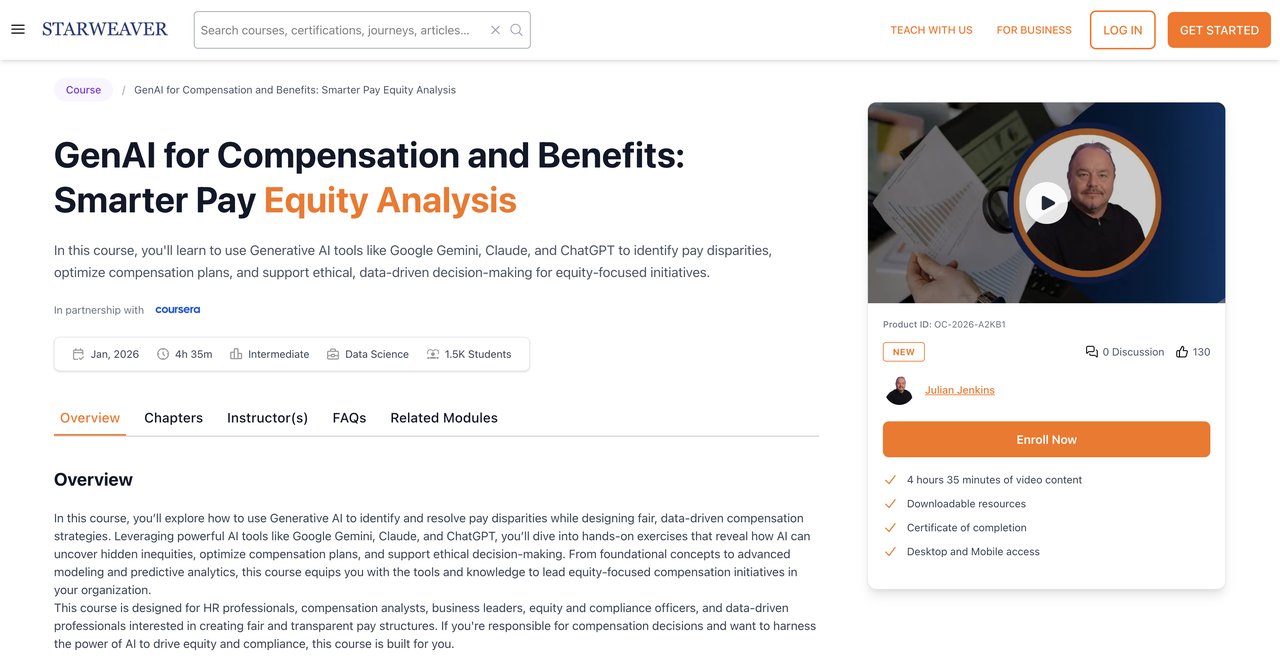
Starweaver shows up again with a course that's dedicated specifically to pay equity analysis using generative AI. The focus here is on making compensation decisions smarter and more data-driven. The course is built around the idea that AI can help you identify pay disparities that might not be obvious from simple spreadsheets or annual reviews. It's about using GenAI to analyze compensation data more deeply, spot patterns, and make recommendations that are defensible from a legal and ethical standpoint.
As a specialist provider in AI upskilling, Starweaver knows the space well. The course content is practical and focused, avoiding a lot of the fluff that can creep into AI training. The main issue is that pricing and duration aren't published. You have to contact them or go through the enrollment process to find out what it costs, which is a barrier for some people. The platform is also less well-known than Coursera or Udemy, so you're trusting a smaller provider.
Key topics covered: Pay equity analysis with GenAI, data-driven compensation decisions, legal and ethical considerations in pay equity, and practical GenAI applications for comp analysis.
Target audience and skill level: Compensation analysts who want to specialize in pay equity work. Intermediate level is probably best, as it assumes some background in compensation analysis. Also useful for HR leaders who want to understand how AI can improve their comp processes.
Pros:
- Dedicated to pay equity analysis with GenAI, so you get deep coverage of this specific topic
- Focused on smarter, data-driven comp decisions, which is what the job requires
- Specialist provider in AI upskilling, so the material is current and relevant
Cons:
- Pricing and duration not published, which makes it hard to compare or budget
- Less well-known than major platforms, so there's some uncertainty about quality and support
Who would benefit most: Compensation analysts whose primary focus is pay equity. If that's your main responsibility, this course could be worth the effort to find out the pricing. If you need broader coverage of compensation topics, other options might be better.
Visit GenAI for Compensation and Benefits by Starweaver
Course 6: GenAI for Compensation, Benefits and Payroll by Coursera
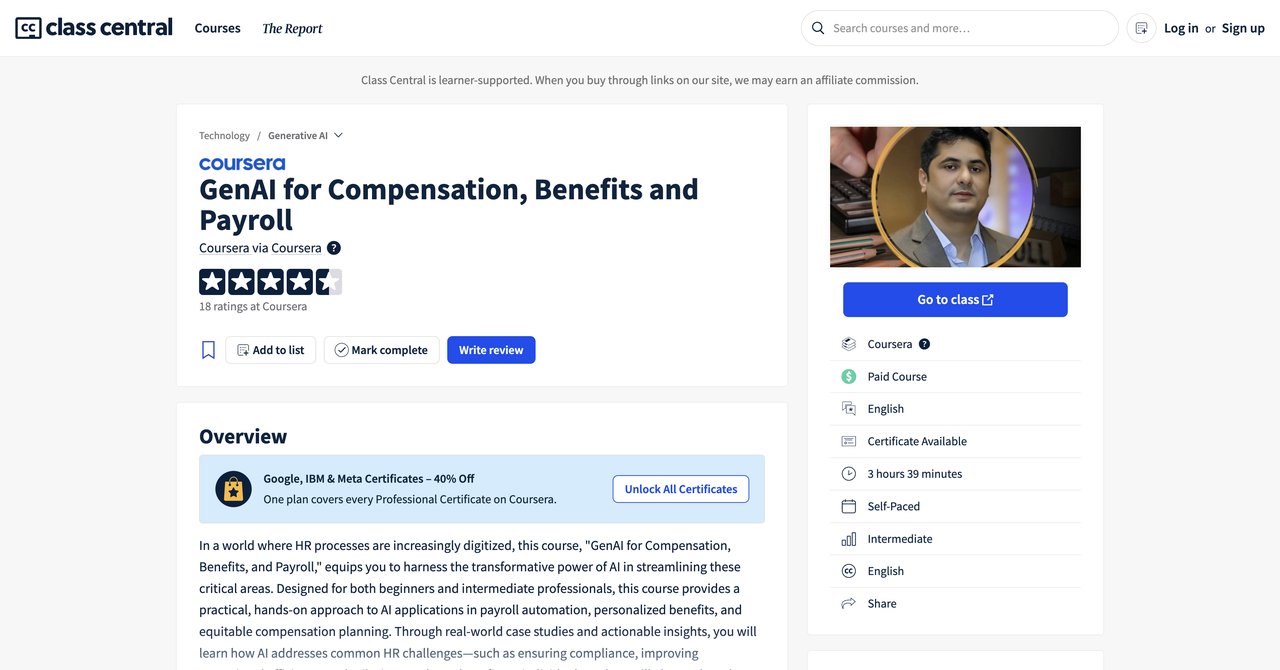
This Coursera offering takes a broad approach. It covers the full spectrum of compensation, benefits, and payroll with a focus on how GenAI can improve each area. The payroll automation piece is practical and hands-on, showing you how to use AI to streamline payroll processes. The benefits section covers how to use AI to personalize benefit offerings based on employee data. And the compensation piece addresses equitable pay structures and how to analyze them with AI tools.
The course is beginner-friendly, which is both a strength and a weakness. If you're new to AI or new to compensation analysis, this is a good entry point. The hands-on approach means you're actually using the tools, not just watching lectures. But because it covers so much ground, it doesn't go as deep into advanced compensation analytics as some of the more specialized options. You'll get a solid foundation, but you might need additional training for complex pay equity work or advanced benchmarking.
Key topics covered: Payroll automation, personalized benefits with AI, equitable compensation analysis, and practical GenAI applications across the comp/benefits/payroll spectrum.
Target audience and skill level: Beginners and intermediate professionals who want a broad overview of AI in compensation, benefits, and payroll. Good for HR generalists who handle multiple functions. Not ideal for experts looking for deep dives into advanced analytics.
Pros:
- Covers the full spectrum, including payroll automation, personalized benefits, and equitable compensation
- Hands-on approach that gets you using AI tools
- Beginner-friendly, so you don't need a technical background
Cons:
- Broad scope means less depth on advanced comp analytics
- Requires Coursera subscription, which is an ongoing cost
Who would benefit most: HR professionals who need a general understanding of AI across compensation, benefits, and payroll. Good starting point if you're new to the field or if your role spans multiple functions. If you need specialized, deep knowledge, look elsewhere.
Visit GenAI for Compensation, Benefits and Payroll on Coursera
Course 7: Certified Compensation & Payroll Management Professional-26 by Udemy
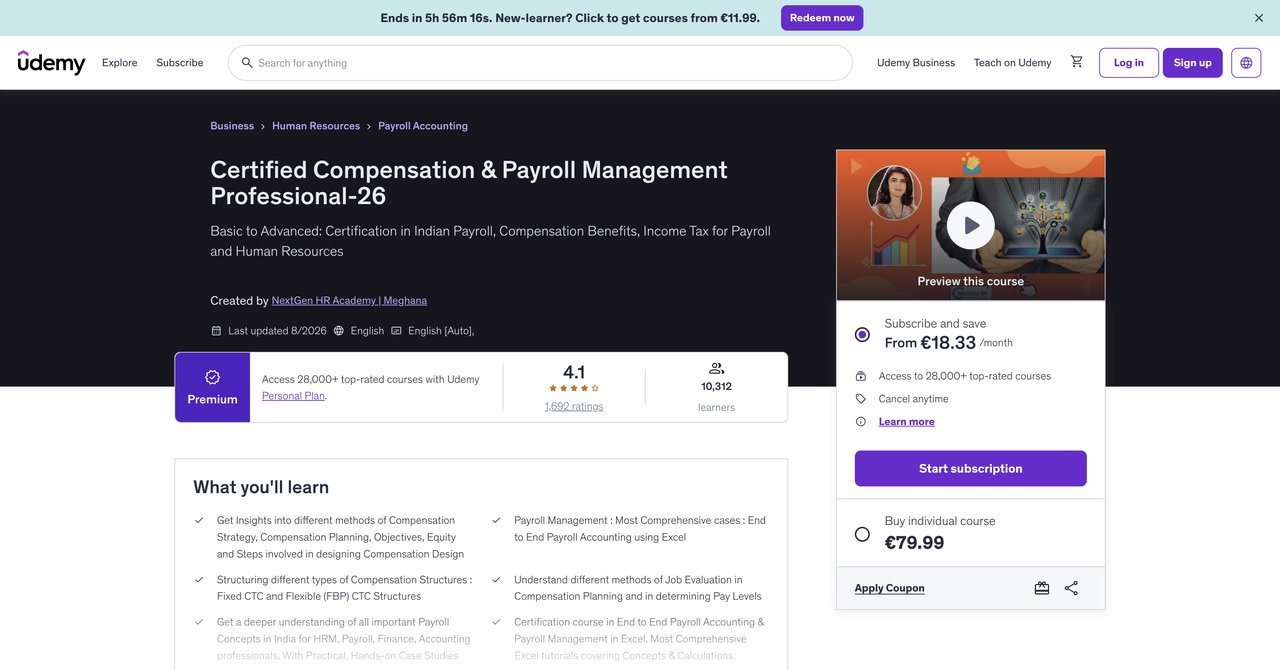
Udemy's offering is updated for 2026, which is a plus in a field where information goes stale quickly. The course covers Indian payroll, compensation benefits, and income tax, which makes it highly relevant for professionals working in India. The certification is included, and the self-paced format on Udemy is convenient. You can work through it at your own speed, and Udemy's platform is well-established with a large user base.
The main limitation is the geographic focus. The course is heavily oriented toward Indian payroll and tax regulations. If you're working in the US, Europe, or other regions, a lot of the content won't apply directly. The quality also varies with the instructor, which is a common issue on Udemy. Some instructors are excellent, others are mediocre. You'll need to read reviews and possibly sample the content before committing. The price varies, typically between $20 and $100, with frequent sales that can make it quite affordable.
Key topics covered: Indian payroll processing, compensation benefits, income tax considerations, and certification preparation. Updated for 2026 regulations.
Target audience and skill level: Compensation and payroll professionals working in India. Also useful for HR professionals in Indian companies or multinationals with Indian operations. Beginner to intermediate level.
Pros:
- Updated for 2026, so the content is current
- Covers Indian payroll, compensation benefits, and income tax in detail
- Certification included with the course
- Self-paced on Udemy, which is a reliable platform
Cons:
- India-specific tax and payroll focus may not suit global analysts
- Quality varies with the instructor, so you need to do your homework before buying
Who would benefit most: Compensation and payroll professionals based in India or working with Indian payroll systems. If your work is global, this course is probably not the best fit. If you're in India, it's a practical, affordable option with a certification.
Visit Certified Compensation & Payroll Management Professional-26 on Udemy
Course 8: Certified Compensation and Benefits Manager (CCBM) by Middle Earth HR
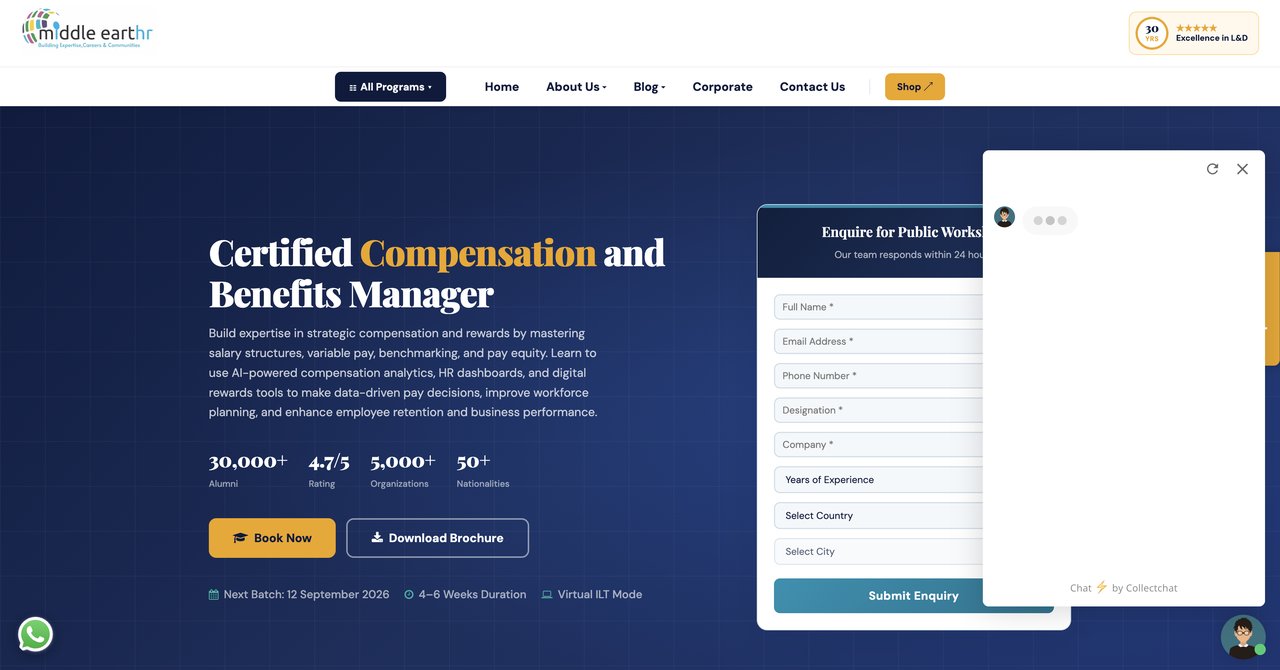
Middle Earth HR offers a live, instructor-led training program that covers AI-powered compensation analytics and HR dashboards. This is a premium option with a price tag of around $470, which reflects the live instruction and the depth of content. The course takes a strategic approach to rewards, with a strong focus on pay equity. You're not just learning how to use AI tools; you're learning how to think strategically about compensation as part of an overall rewards philosophy.
The live format is a significant advantage. You can ask questions in real time, interact with the instructor, and learn from other participants' questions and experiences. That's something you don't get with self-paced courses. The AI-powered compensation analytics component is particularly strong, covering how to use AI to analyze comp data, build dashboards, and present insights to leadership. The strategic rewards focus means you're thinking about compensation in the context of talent retention, motivation, and organizational goals.
Key topics covered: AI-powered compensation analytics, HR dashboards, strategic rewards design, pay equity analysis, and live instructor-led training.
Target audience and skill level: Experienced compensation professionals who want a strategic, instructor-led experience. The premium price suggests it's aimed at mid-to-senior level professionals who need to lead compensation strategy, not just process data.
Pros:
- Live instructor-led training, which allows for real-time questions and discussion
- Covers AI-powered compensation analytics and HR dashboards in depth
- Strategic rewards focus with strong emphasis on pay equity
Cons:
- Premium price at roughly $470, which is significantly more than other options
- Scheduled batch starts rather than on-demand, so you have to wait for the next session (currently September 2026)
Who would benefit most: Senior compensation professionals who want a strategic, interactive learning experience and are willing to pay for it. If you need to lead compensation strategy in your organization and want live instruction, this could be worth the investment. If you're on a budget or need training immediately, the scheduled start might be a problem.
Visit Certified Compensation and Benefits Manager by Middle Earth HR
Final Recommendations and Summary
So, where does that leave you? It depends on what you need, what you can spend, and how you prefer to learn.
If you want the most comprehensive coverage and the best value over time, CompleteAI Training is hard to beat. The subscription model means you get everything, not just one course. All the video courses, all the certifications, all the future updates, and access to every other job role's material. At $8.25 per month with annual billing, it's cheaper than most single courses, and it keeps working for you as AI evolves. If your work touches more than just compensation analysis, or if you think you might move into a different HR role later, the cross-functional access is a real advantage.
If you're on a tight budget or just exploring, the free course from Catch Wisdom is a reasonable starting point. You'll learn the basics of payroll automation and benchmarking without spending anything. Just know that it's not as deep or as polished as paid options.
If you need a university credential specifically, USF's course is your option. The 30-day access limit is a drawback, but the credential itself might be worth it if your employer or industry values that kind of formal recognition.
If you work in a law firm, the Starweaver course on Coursera is directly relevant to your situation. It's niche, but if you're in that niche, it's exactly what you need.
If you're in India, the Udemy course is practical and affordable. Just be aware that it's India-specific, so it won't help if your work is global.
If you're a senior professional who wants live instruction and strategic depth, Middle Earth HR's CCBM is worth considering. The price is high and you have to wait for the next batch, but the live format and strategic focus are valuable.
Honestly, for most compensation analysts, the subscription model from CompleteAI Training makes the most sense. The field is changing so quickly that a one-time course, even a good one, is going to be outdated within a year. A subscription that updates continuously and includes certifications at no extra cost is built for that reality. But that's not to dismiss the other options. They all have their place, and the right choice depends on your specific circumstances.
My advice: think about where you want to be in two or three years. If you want to be a specialist in one area, like pay equity or law firm comp, a focused course might be enough. If you want to be a well-rounded compensation professional who can adapt as AI tools evolve, a subscription that gives you ongoing access to new material is probably the better investment. Either way, the fact that you're looking into AI training at all puts you ahead of a lot of people in the field.