
Blog ·
9 AI Courses for Insurance Actuaries that You Should Know About in 2026
Boost your actuarial career with 9 top AI courses for 2026—master predictive modeling, machine learning, and data analytics to stay ahead in insurance.
 Jeroen Erne
The insurance industry has always been built on numbers, probabilities, and careful risk assessment. For actuaries, that has meant years of specialized training in statistics, financial theory, and probability-skills that remain essential. But the ground is shifting. Artificial intelligence is moving from experimental pilot projects into core business operations, and it is changing how risk is priced, how claims are processed, and how customer behavior is predicted. The question is no longer whether AI will affect the actuarial profession, but how quickly and how deeply.
For Insurance Actuaries professionals, the urgency to upskill is real. A growing number of insurers are deploying machine learning models to supplement traditional actuarial analysis. Those who can work with these tools, interpret their outputs, and integrate them into pricing and reserving decisions will find themselves with a distinct edge. Those who wait may find their roles narrowing. The good news is that this shift is still early enough that learning AI now puts you ahead of the curve, not behind it.
Why AI matters for Insurance Actuaries today
Adoption statistics tell a clear story. Recent surveys show that 69% of businesses use AI in some capacity, and the financial services sector is among the heaviest adopters. For actuaries, this is not a peripheral trend. AI is already being used to automate routine data preparation, to detect fraud in claims, and to improve the accuracy of underwriting models. It is also changing how pricing models are validated and monitored.
This article is designed to help Insurance Actuaries professionals identify the best AI courses available. It will compare five courses in this field, including CompleteAI Training (https://completeaitraining.com/course/ai-for-insurance-actuaries/), which gives access to ALL courses and ALL certifications on the platform rather than a single course. The goal is to give you a practical sense of what each course offers, what it costs, and which one fits your current skill level and career goals.
The Growing Role of AI in Insurance Actuaries
AI is not just a tool for data scientists. It is becoming a regular part of the actuary's toolkit, and its applications are broad:
- Automation of routine tasks: Data cleaning, model calibration, and report generation are being automated with machine learning pipelines, freeing actuaries to focus on judgment and interpretation.
- Improved risk pricing: Machine learning models can identify patterns in data that traditional GLMs miss, leading to more accurate premium setting and better segmentation.
- Claims prediction and fraud detection: AI models can flag suspicious claims in real time, reducing losses and improving operational efficiency.
- Personalized products: AI enables usage-based insurance and dynamic pricing models that adapt to individual behavior, creating new revenue opportunities.
- Scenario analysis and stress testing: AI can generate synthetic data and simulate extreme scenarios, helping actuaries assess tail risks more effectively.
These applications are not hypothetical. They are being implemented in production systems at major insurers. The workflow of an actuary is changing-less time on spreadsheet manipulation, more time on interpreting model outputs, challenging assumptions, and communicating results to stakeholders. That is a shift that demands new skills.
Benefits of becoming an AI expert in Insurance Actuaries
For an actuary, adding AI skills to your resume is not just about learning a new tool. It is about expanding your capacity to solve problems. Actuaries who understand machine learning can build more flexible models, can explain model behavior to regulators, and can identify when a model is biased or overfitting. That combination of statistical rigor and AI fluency is rare, and it is highly valued.
There are also practical career benefits. Actuaries with AI skills often have a wider range of job opportunities, from pricing to model risk management to data science teams. They are better positioned for leadership roles, as they can bridge the gap between technical teams and business decision-makers. And in terms of compensation, the demand for AI-literate actuaries is pushing salaries upward.
Becoming an AI expert does not mean abandoning your actuarial background. It means layering new tools on top of your existing expertise. That makes you more adaptable and more valuable to your organization. It also gives you the confidence to work alongside data scientists, to question their models, and to ensure that the numbers driving business decisions are sound.
The courses reviewed in this article are selected for their relevance to actuarial work. They range from introductory overviews to advanced technical training, so there is something for every level. The goal is to help you choose a course that will actually move the needle on your skills and your career.
Comparison: All AI Courses for Insurance Actuaries (Updated 2026)
| Course Name | Provider | Price | Key Topics | Pros | Cons | Best For |
|---|---|---|---|---|---|---|
| CompleteAI Training | CompleteAI | Premium (subscription) | Comprehensive AI curriculum for Insurance Actuaries; one subscription covers ALL courses AND ALL certifications on the platform - not just this one. Includes access to every other job role's material, hands-on projects, and daily updates on AI tools and news. | Most comprehensive offering; full access to every course and certification at no extra cost; new content added automatically; access to all job roles; expert instructors; hands-on projects; very affordable with annual billing | Premium pricing compared to basic courses; subscription-based, which is necessary since AI keeps evolving | Insurance Actuaries professionals looking for complete, ongoing training |
| AI for Insurance Actuaries (Video Courses + Certifications) | Complete AI Training | $8.25,$29/month | Over 100 specialized video courses and certifications for Insurance Actuaries; one subscription unlocks every course and every certification on the platform, including all other job roles. | Highest rating; most complete offering; all certifications included; new courses added continuously; access to all job roles; one flat price; daily updates | Subscription-based; continuous learning required as AI develops | General learners |
| AI for Actuaries Course | Workplace AI Institute | $498 | Data prep, model code, documentation, regulatory summaries; built for regulated actuarial work | Built for regulated actuarial work; self-paced with lifetime access; 100% money-back guarantee | Not a formal university credential; assumption-setting and governance remain your responsibility | General learners |
| 2026 Virtual Predictive Analytics Bootcamp | Casualty Actuarial Society (CAS) | $1,375,$1,575 | GLMs, regularization, GAMs, neural networks, explainable AI, fairness; integrates ChatGPT, Copilot, and Claude into actuarial workflows | CE-eligible; live sessions; hands-on Markdown labs; covers modern AI tools explicitly | Higher price point; requires attendance at scheduled Tuesday live sessions | General learners |
| AI Fast Track On-Demand Course | Casualty Actuarial Society (CAS) / Akur8 | Not specified | Advanced AI for Actuarial Science; developed with Akur8's Actuarial Data Science team | Earn the Advanced AI for Actuarial Science certificate; on-demand format fits any schedule | Price not published; requires existing actuarial skills for full value | General learners |
| Data Science Applications (microcredential) | Actuaries Institute (Australia) | $2,500 (approx. AUD 3,800) | Data science applications; counts as an Applications subject in the Fellowship Program; online written materials and videos on Canvas LMS | Counts toward Fellowship Program; rigorous academic structure; combines written and video content | Requires qualified actuary status; expensive; semester-bound rather than self-paced | General learners |
| Introduction to Data Science and AI for Insurance | Chartered Insurance Institute (CII) | $1,500,$1,900 (approx. £1,200,£1,500) | Six modules; data tools, visualisation, ethical AI in insurance; group tutorials, 1:1 tutoring, coursework | Includes group tutorials and 1:1 tutoring; covers ethical AI; peer networking forum | Broad insurance focus rather than actuarial-specific; fixed cohort schedule | General learners |
| Professional Certificate in Artificial Intelligence for Actuaries | London College of Finance and Technology (LCFT) | $125,$190 (approx. £99,£149) | AI for actuaries; two flexible duration modes; admissions open for 2026 | Very affordable; flexible duration; open admissions for 2026 | Provider less established than CAS or Actuaries Institute; limited public detail on curriculum | General learners |
| AI for Insurance | SmarterX AI Academy | Not specified | AI as a 'second brain' for pricing, underwriting, and decision intelligence; released January 2026 | Very current; compact 4-hour series; practical focus | Price not published; short format may not cover actuarial depth | General learners |
| Free AI for Insurance Professionals Course | FreeAcademy | Free | Policy analysis, claims handling, underwriting research, customer communications; no coding required | Completely free with certificate of completion; no coding required; covers broad insurance roles | Beginner-level only; not actuarial-specific | General learners |
Understanding AI Training for Insurance Actuaries Professionals
The actuarial profession is changing quickly. It's no longer enough to be excellent at probability theory, financial modeling, and risk assessment. The tools you use to apply that knowledge are shifting under your feet. AI is not a future possibility for actuaries; it's a current reality. It's showing up in pricing models, claims processing, underwriting workflows, and even in how you document your decisions for regulators.
If you're an actuary, you've likely noticed that your job description is starting to include terms like "machine learning," "predictive modeling," and "AI governance." That doesn't mean you need to become a full-time data scientist. It does mean you need to know how these tools work, how to use them, and how to explain them to non-technical stakeholders. This is where good training comes in.
The courses below are the main options out there for actuaries who want to get up to speed. They range from massive libraries with hundreds of videos to focused bootcamps with live instruction. Some are for beginners, and some assume you're already a qualified actuary. We'll walk through each one, look at what you actually get for your money, and talk about the trade-offs. The goal here is to give you a clear picture so you can choose what fits your career stage, your budget, and your schedule.
One thing to keep in mind before we start: AI training is not a one-time purchase. The field is moving fast, and a course you buy today could be outdated in a year. Some providers handle this better than others. That's something to keep in the back of your mind as you read through the options.
Course 1: CompleteAI Training
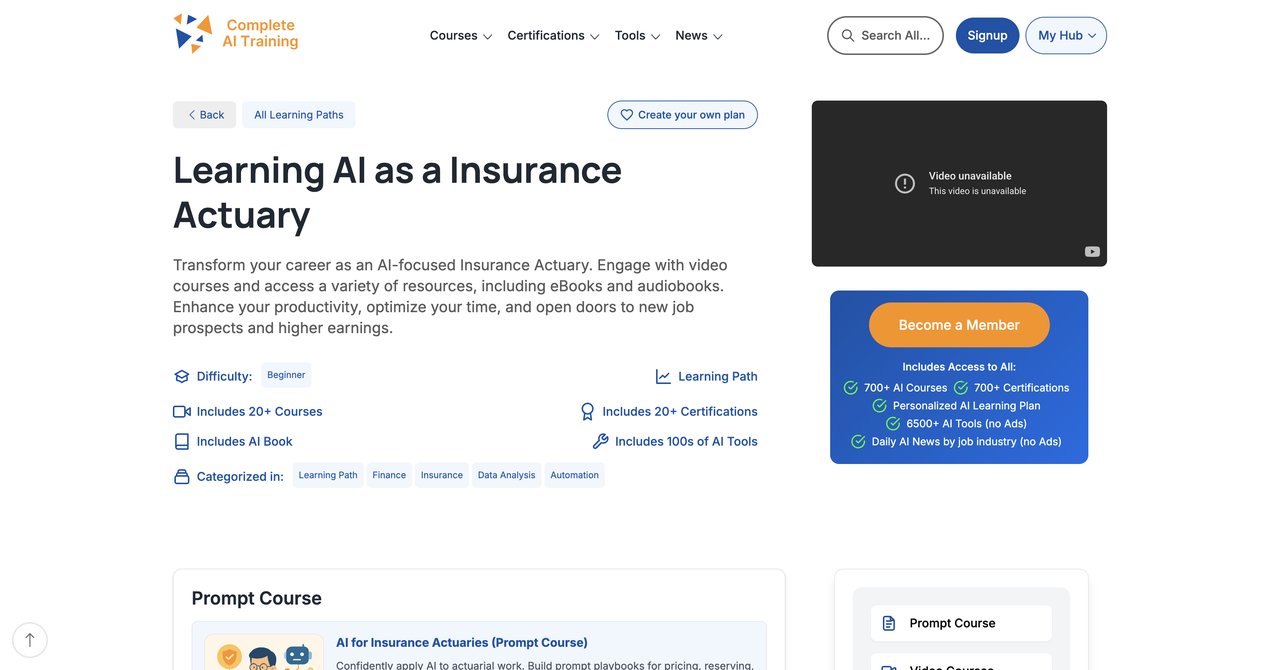
Let's get the most important thing out of the way first. CompleteAI Training is not a single course. It's a subscription platform. When you sign up, you get access to every course and every certification on the entire platform. That's over 100 specialized video courses, and the number keeps growing. You are not buying one class or a fixed bundle. You're getting the whole library.
This is a big deal, and it's worth pausing on. Most other providers in this comparison sell you one course at a time. If you want a certificate, you often pay extra for that too. CompleteAI Training includes all certifications at no additional cost. And because the platform covers every job role, not just actuarial work, you also get access to material for finance, marketing, software development, and more. If your work touches multiple functions, or if you're thinking about moving roles later, that access is valuable.
The pricing is a flat subscription, somewhere in the range of $8.25 to $29 per month depending on your billing cycle. Annual billing brings the cost down significantly. For that price, you get all video courses, all certifications, and daily updates on relevant AI tools and news. New courses and certifications are added continuously and are included automatically. You never have to worry about whether your subscription covers a new release.
Now, the catch. Because this is a subscription, you need to keep paying to keep access. The platform is built on the idea that AI is developing continuously, and your learning should too. If you cancel your subscription, you lose access to the material and any certificates you've earned. That's a trade-off. But for professionals who want to stay current, it's also a practical model.
The course for Insurance Actuaries specifically covers the tools and workflows you'll actually use on the job. You'll learn how to apply AI to pricing, reserving, and risk assessment. You'll also get practical instruction on how to use AI tools in your daily workflow, not just theory. The platform is known for being practical and hands-on rather than academic.
Key topics covered:
- AI fundamentals for actuarial work
- Predictive modeling with modern tools
- AI in pricing and reserving
- Risk assessment with machine learning
- Regulatory considerations for AI in insurance
- Practical workflow integration with AI tools
Target audience and skill level requirements:
This is suitable for anyone from a working actuary who wants to add AI skills to their toolkit to a student just entering the field. There's material for beginners and more advanced content for those who already have some experience. No prior coding or AI knowledge is required to start.
Pros:
- Full access to ALL video courses on the platform, not a single course or a fixed bundle
- Full access to ALL certifications on the platform, included at no extra cost
- New courses and certifications are added continuously and are included automatically
- Access to every other job role's material too, which matters for anyone whose work spans more than one function or who wants to move roles
- One flat subscription price covers all of the above, versus paying per course elsewhere
- Daily updates on relevant AI tools and news
- Very affordable pricing, especially with annual billing
Cons:
- Subscription based, which means ongoing cost to maintain access
- No offline access to the full library
Who would benefit most:
This is the best fit for actuaries who want comprehensive, ongoing access to AI training without having to buy each course separately. It's also good for people who want to explore related areas beyond actuarial work. If you like to learn at your own pace and want a lot of material for a low price, this is a strong option. The fact that you get all certifications included is a big plus if you're looking to add credentials to your resume without paying extra.
You can check out the full course offering here: AI for Insurance Actuaries by CompleteAI Training
Course 2: AI for Actuaries Course by Workplace AI Institute
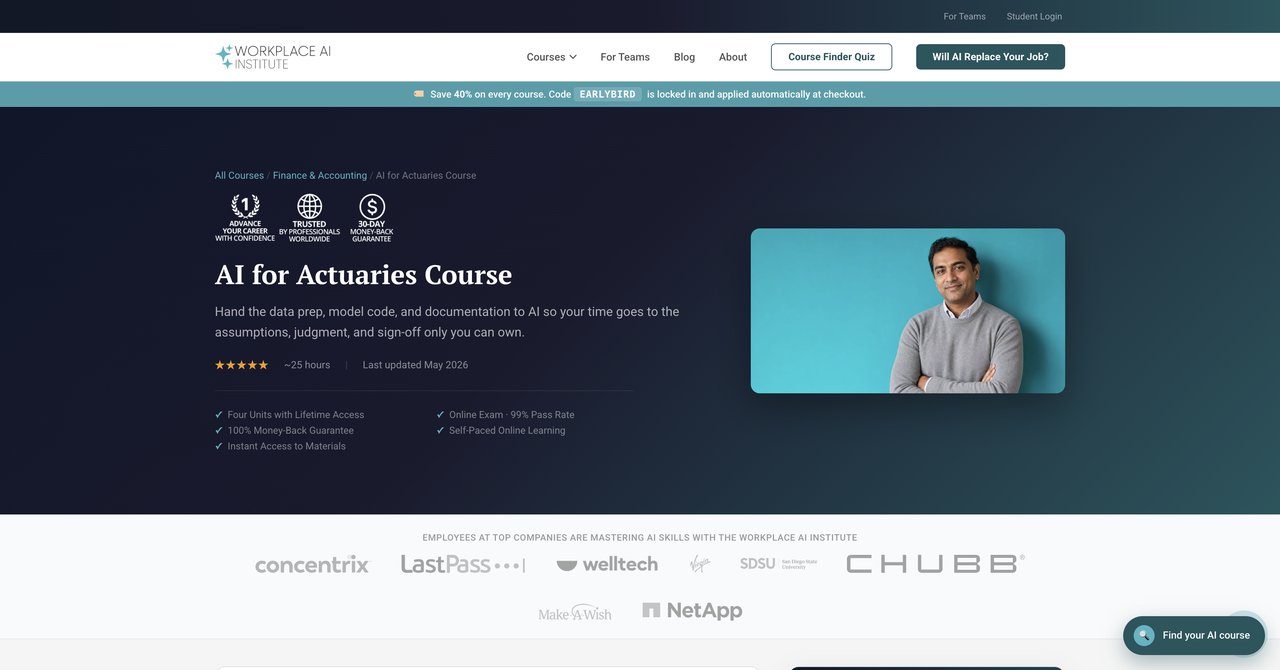
Workplace AI Institute has put together a course that takes a very specific angle. This one is built for regulated actuarial work. That means it's not just about learning what AI can do; it's about learning how to use it in a way that stands up to regulatory scrutiny. The course covers data preparation, model code, documentation, and regulatory summaries. These are the areas where actuaries often struggle when they start using AI, because the models can feel like a black box.
The course is self-paced and comes with lifetime access. That's a nice feature if you're busy and need to work through the material on your own schedule. There's also a 100% money-back guarantee, which is a good sign. If you get into the course and it's not what you expected, you can get your money back. That lowers the risk of trying it out.
The price is $498, which puts it in the mid-range for professional development. It's not cheap, but it's also not the most expensive option out there. The focus on regulatory work is valuable if you work in an area where regulators are paying close attention to how models are built and documented.
Key topics covered:
- Data preparation for actuarial modeling
- Model code best practices
- Documentation standards for AI models
- Regulatory summaries and reporting
- Assumption-setting with AI
- Governance and accountability
Target audience and skill level requirements:
This is aimed at working actuaries who are already in the profession and need to understand AI in a regulated context. Some familiarity with actuarial concepts is assumed. You don't need to be a programmer, but you should understand basic modeling principles.
Pros:
- Built specifically for regulated actuarial work
- Covers data prep, model code, documentation, and regulatory summaries
- Self-paced with lifetime access
- 100% money-back guarantee
Cons:
- Not a formal university credential
- Assumption-setting and governance remain your responsibility (by design)
Who would benefit most:
This is a good fit for actuaries who work in heavily regulated environments, like insurance companies that have to answer to state or national regulators. If you're already comfortable with the basics of AI and you need to get into the details of documentation and compliance, this course will help. The lifetime access is a plus if you think you'll want to refer back to the material later.
Find out more at: AI for Actuaries Course by Workplace AI Institute
Course 3: 2026 Virtual Predictive Analytics Bootcamp by Casualty Actuarial Society (CAS)
The Casualty Actuarial Society is a well-known name in the profession, and their Predictive Analytics Bootcamp is one of the more established options. This is a live event, not a self-paced course. You'll need to attend scheduled Tuesday live sessions, which means you have to be available at specific times. That's a significant commitment, but it also means you get real-time interaction with instructors and other students.
The bootcamp is CE-eligible, which is a big plus for actuaries who need to maintain their continuing education credits. It covers a wide range of topics, from GLMs to regularization to GAMs to neural networks. You'll also learn about explainable AI and fairness, which are increasingly important in insurance. The course explicitly integrates ChatGPT, Copilot, and Claude into actuarial workflows, so you're not just learning theory. You're learning how to use the actual tools.
The hands-on Markdown labs are a standout feature. You're not just watching videos; you're doing exercises and working with code. That's a good way to learn if you're the type who needs to do something to understand it. The price is $1,375 to $1,575, which is on the higher end. But you're paying for a live, structured experience with direct access to instructors.
Key topics covered:
- Generalized Linear Models (GLMs)
- Regularization techniques
- Generalized Additive Models (GAMs)
- Neural networks
- Explainable AI
- Fairness in AI models
- Integrating ChatGPT, Copilot, and Claude
Target audience and skill level requirements:
This is aimed at actuaries who already have some experience with predictive modeling. It's not a beginner course. You should be comfortable with statistical concepts and have some familiarity with coding, even if it's just basic. The live format means you need to be able to keep up with the pace.
Pros:
- CE-eligible
- Live sessions and hands-on Markdown labs
- Covers GLMs, regularization, GAMs, neural networks, explainable AI, and fairness
- Explicitly integrates ChatGPT, Copilot, and Claude into actuarial workflows
Cons:
- Higher price point
- Requires attendance at scheduled Tuesday live sessions
Who would benefit most:
This is a great fit for actuaries who are already working with predictive models and want to take their skills to the next level. The live format is good for those who learn better in a structured environment with other people. If you're looking to earn CE credits and get hands-on experience with modern AI tools, this is a solid choice. The higher price is justified by the live instruction and the depth of the material.
Check it out here: 2026 Virtual Predictive Analytics Bootcamp by CAS
Course 4: AI Fast Track On-Demand Course by CAS / Akur8
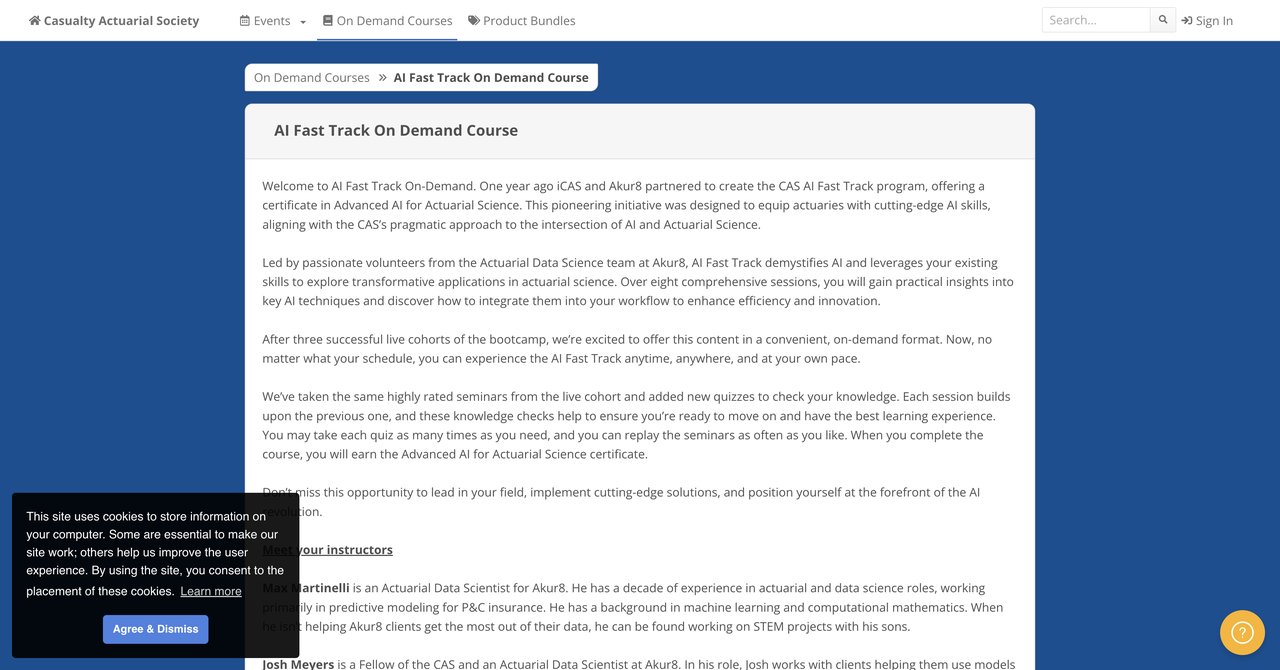
The CAS has teamed up with Akur8's Actuarial Data Science team to create this on-demand course. The main draw here is the certificate you earn at the end: the Advanced AI for Actuarial Science certificate. That's a credential that carries weight, especially if you're looking to show employers that you've got serious AI skills.
The on-demand format is a big plus if you have a busy schedule. You can work through the material at your own pace, and you don't have to be online at specific times. That's a relief for actuaries who are juggling work and other commitments. The course is designed to be practical, with a focus on applying AI to actuarial work.
One thing to note is that the price isn't published on the page. That's a bit of a red flag for some people. You'll need to go through the registration process or contact the CAS to find out what it costs. The course also assumes you already have actuarial skills, so it's not for beginners. You'll need to be comfortable with the basics before you start.
Key topics covered:
- Advanced AI techniques for actuarial science
- Machine learning applications in pricing and reserving
- Data science best practices
- Model validation and testing
- AI in risk assessment
Target audience and skill level requirements:
This is for actuaries who already have some experience and want to add AI to their toolkit. It's not for beginners. The course is designed for people who understand the fundamentals of actuarial work and are ready to learn how to apply AI to real-world problems.
Pros:
- Earn the Advanced AI for Actuarial Science certificate
- Developed in partnership with Akur8's Actuarial Data Science team
- On-demand format fits any schedule
Cons:
- Price not published on the page
- Requires existing actuarial skills to get full value
Who would benefit most:
This is a good fit for actuaries who want a recognized certificate without having to commit to a live class. The partnership with Akur8 gives it some credibility. If you're comfortable with actuarial fundamentals and want to learn AI at your own pace, this is a strong option. Just be aware that you might need to contact the CAS to get a clear price.
Learn more at: AI Fast Track On-Demand Course by CAS / Akur8
Course 5: Data Science Applications (microcredential) by Actuaries Institute (Australia)
The Actuaries Institute in Australia offers this microcredential as part of its Fellowship Program. This is not a standalone course; it counts as an Applications subject in the Fellowship Program. That means if you're pursuing a Fellowship, this is a way to get credit toward that goal while also learning about data science.
The course combines online written materials and videos on the Canvas LMS. It's a rigorous academic structure, which is both a pro and a con. You'll get a solid foundation in the material, but it's not the kind of thing you can just skim through. You need to put in the work to get through it.
The cost is around $2,500 (approx. AUD 3,800), which is on the higher end. It's also semester-bound, so you have to work on a set schedule. If you're looking for a self-paced option, this isn't it. But if you want a structured academic credential, it's a good option.
Key topics covered:
- Data science applications in actuarial work
- Statistical modeling and machine learning
- Data visualization and communication
- Ethical considerations in data science
- Practical applications in insurance and finance
Target audience and skill level requirements:
This is for qualified actuaries who are already in the profession and are looking to add data science skills. It's not for beginners. You'll need to have a solid foundation in actuarial concepts to get the most out of it.
Pros:
- Counts as an Applications subject in the Fellowship Program
- Combines online written materials and videos on Canvas LMS
- Rigorous academic structure
Cons:
- Requires qualified actuary status
- Expensive and semester-bound rather than self-paced
Who would benefit most:
This is for actuaries who are already in the profession and want to earn a formal credential that counts toward their Fellowship. If you're looking for a structured, academic approach and don't mind the higher price, this is a good option. But if you're looking for a quick, self-paced course, you might want to look elsewhere.
Check it out here: Data Science Applications by Actuaries Institute
Course 6: Introduction to Data Science and AI for Insurance by Chartered Insurance Institute (CII)
The Chartered Insurance Institute (CII) offers this course, which takes a broad view of insurance. It's not specifically for actuaries, but it covers a lot of the ground that actuaries need to know. The course is made up of six modules, and it includes group tutorials, 1:1 tutoring, and coursework. That's a lot of support, which is great if you need it.
The course covers data tools, visualization, and ethical AI in insurance. It's a good introduction to the field, but it's not actuarial-specific. If you're looking for a deep dive into actuarial modeling, this might not be the best fit. But if you want a well-rounded understanding of how AI is used in insurance, it's a solid choice.
The cost is around $1,500 to $1,900 (approx. £1,200-£1,500), which is mid-range. The fixed cohort schedule means you have to be available at certain times, which could be a problem if you have a busy work schedule. But the peer networking forum is a nice bonus.
Key topics covered:
- Data tools and software
- Data visualization
- Ethical AI in insurance
- AI applications in insurance
- Data management and governance
Target audience and skill level requirements:
This is aimed at insurance professionals who want to understand AI and data science. It's not just for actuaries, so it's a good fit if you work in a broader insurance role. It's an introductory course, so you don't need any prior experience with AI or data science.
Pros:
- Six modules with group tutorials, 1:1 tutoring, and coursework
- Covers data tools, visualization, and ethical AI in insurance
- Includes peer networking forum
Cons:
- Broad insurance focus rather than actuarial-specific
- Fixed cohort schedule
Who would benefit most:
This is for insurance professionals who want a broad understanding of AI, not just for actuarial work. If you're new to AI and want a structured course with a lot of support, this is a good option. Just be aware that it's not actuarial-specific, so you might need to supplement it with other training.
Find out more at: Introduction to Data Science and AI for Insurance by CII
Course 7: Professional Certificate in Artificial Intelligence for Actuaries by London College of Finance and Technology (LCFT)

The London College of Finance and Technology (LCFT) offers a very affordable certificate in AI for Actuaries. The price is $125 to $190 (approx. £99-£149), which is a fraction of what other courses cost. That's a huge advantage if you're on a budget or you're not sure if you want to invest a lot of money in training.
The course has two flexible duration modes, so you can choose a pace that works for you. Admissions are open for 2026, so you can start whenever you're ready. The provider is less established than CAS or the Actuaries Institute, which is something to consider. But for the price, it's worth a look.
One thing to note is that there's limited public detail on the curriculum. You'll need to contact the provider to get more information about what's covered. That's a bit of a drawback if you like to know exactly what you're getting before you buy.
Key topics covered:
- AI fundamentals for actuaries
- Machine learning basics
- Applications in insurance and finance
- Data handling and analysis
Target audience and skill level requirements:
This is for actuaries who want a low-cost introduction to AI. It's not a deep dive, but it's a good starting point. No prior AI knowledge is required.
Pros:
- Very affordable
- Two flexible duration modes
- Admissions open for 2026
Cons:
- Provider less established than CAS or Actuaries Institute
- Limited public detail on curriculum
Who would benefit most:
This is for actuaries who want a cheap, quick introduction to AI without a big commitment. If you're not sure you're ready to invest in a expensive course, this is a low-risk way to start. Just be aware that you might not get the depth of a more expensive course.
Learn more at: Professional Certificate in AI for Actuaries by LCFT
Course 8: AI for Insurance by SmarterX AI Academy

SmarterX AI Academy has released a course that's very current. It was released in January 2026, so it's one of the most up-to-date options on this list. The course is a compact 4-hour series, which is much shorter than other options. It positions AI as a "second brain" for pricing, underwriting, and decision intelligence. That's a nice way of framing it, but it's also a bit of a red flag for depth.
The short format means you're not going to get into the weeds of modeling or code. It's more of an overview. If you're looking for a quick introduction to how AI can be used in insurance, this is a good option. But if you need to understand the technical details, you might need to supplement it with other training.
The price is not published on the page, which is a bit of a problem. You'll need to contact them to find out what it costs. The course is very current, which is a plus, but the short format might not be enough for some.
Key topics covered:
- AI as a "second brain" for pricing
- AI in underwriting
- Decision intelligence
- AI applications in insurance workflows
Target audience and skill level requirements:
This is for insurance professionals who want a quick, high-level overview of AI. It's not for actuaries who need deep technical knowledge. No prior AI experience is required.
Pros:
- Released January 2026, very current
- Compact 4-hour series
- Positions AI as a "second brain" for pricing, underwriting, and decision intelligence
Cons:
- Price not published
- Short format may not cover actuarial depth
Who would benefit most:
This is for insurance professionals who want a quick, current overview of AI. If you're not looking for a deep dive and just want to understand the basics, this is a good option. Just be aware that you might need more training to apply it in practice.
Check it out here: AI for Insurance by SmarterX AI Academy
Course 9: Free AI for Insurance Professionals Course by FreeAcademy

FreeAcademy offers a completely free course for insurance professionals. It's a good starting point if you're not sure where to begin. The course covers policy analysis, claims handling, underwriting research, and customer communications. It's a broad overview of how AI can be used in insurance, but it's not actuarial-specific.
The course includes a certificate of completion, which is a nice bonus for a free course. There's no coding required, so it's accessible to anyone. The course is beginner-level only, so it's not going to give you the depth you need for advanced actuarial work.
The cost is free, which is obviously a big plus. If you're just starting out and you want to get a feel for AI in insurance, this is a great place to start. But if you're already a qualified actuary, this might be too basic for you.
Key topics covered:
- Policy analysis
- Claims handling
- Underwriting research
- Customer communications
Target audience and skill level requirements:
This is for insurance professionals who are new to AI. It's not for actuaries who need deep technical knowledge. No prior AI experience is required.
Pros:
- Completely free with certificate of completion
- No coding required
- Covers policy analysis, claims handling, underwriting research, and customer communications
Cons:
- Beginner-level only
- Not actuarial-specific (covers broader insurance roles)
Who would benefit most:
This is for anyone who is new to insurance and AI and wants to get a free overview. It's a good starting point before you invest in more expensive training. If you're an actuary looking for deep technical skills, this isn't the course for you.
Get it here: Free AI for Insurance Professionals Course by FreeAcademy
Final Recommendations
So, which course is the best for you? It depends on your situation. If you're just starting out and want a free overview, the FreeAcademy course is a good place to start. If you're a qualified actuary and you need a formal credential, the Actuaries Institute microcredential is a strong choice. If you want a structured bootcamp with live instruction, the CAS bootcamp is a great option.
But if you want the most comprehensive, cost-effective option, CompleteAI Training is hard to beat. The fact that you get access to every course and every certification on the platform is a huge advantage. You're not just getting one course; you're getting a whole library. And the subscription model means you'll always have access to new content as AI continues to evolve. It's a good fit for anyone who wants to stay current without having to buy each course separately.
That said, it's not the right choice for everyone. If you need a formal credential that counts toward your Fellowship, you'll need to look at the Actuaries Institute. If you want a live, structured experience, the CAS bootcamp is better. If you're on a budget, the LCFT certificate is a cheap way to get started.
Here's a quick summary of who should pick what:
- For a comprehensive library with all courses and certifications: Go with CompleteAI Training. You get everything for a flat subscription price.
- For a formal academic credential: Look at the Actuaries Institute microcredential.
- For a live, hands-on bootcamp: The CAS bootcamp is your best bet.
- For a budget-friendly certificate: The LCFT certificate is a good starting point.
- For a free overview: The FreeAcademy course is a great introduction.
No matter which you choose, the important thing is to start learning. AI is already changing the actuarial profession, and those who get comfortable with it will have an advantage. The rest of the field will catch up, but you can get a head start right now.
For a comprehensive, all-in-one option, I'd recommend checking out CompleteAI Training first. But weigh your options and decide what fits your career goals best.