
Blog ·
9 AI Courses for Secondary School Teachers that You Should Know About in 2026
Discover nine essential AI courses tailored for secondary educators in 2026, covering practical tools, ethical frameworks, and classroom integration strategies to boost teaching efficiency and student engagement.
 Jeroen Erne
Artificial intelligence is no longer a futuristic concept discussed in tech conferences. It is here, working quietly in the background of countless industries, and education is no exception. For secondary school teachers, this shift brings both questions and opportunities. Some see AI as a tool that could lighten their workload, while others worry about its implications for student learning and academic honesty. Regardless of where you stand, one fact remains: educators who understand AI will have a significant advantage in the years ahead.
The demand for AI literacy in schools is growing fast. Recent reports indicate that 69% of businesses already use AI in some capacity, and the classroom is not far behind. From smart tutoring systems to automated grading, AI is already touching the everyday reality of teaching. That means professional development in this area is moving from "nice to have" to "necessary."
This article is designed to help you sort through the online noise and find the AI courses that are actually worth your time. We are going to compare nine different options crafted for secondary school teachers. These range from self-paced online offerings to University-backed summer programs. Some aim to build foundational knowledge, while others focus on practical classroom application. We'll break down what each one covers so you can make a smart, informed choice.
Why AI Matters for Secondary School Teachers Today
The teaching profession has changed dramatically in the last few years. Lesson planning, grading, parent communication, and differentiated instruction all demand more time than ever before. AI can assist with all of it, but you need the skills to integrate it appropriately. If you cannot use AI tools, you are missing out on chances to streamline your work and better support student learning.
The statistics paint a clear picture. A recent survey found that 52% of high school students use AI tools on a regular basis for their schoolwork. Yet many teachers report that they lack the confidence to integrate AI into their own practice. That gap between student usage and teacher proficiency is concerning. It creates a classroom dynamic where students understand the technology better than their teachers do. Taking an AI course helps close that gap. It gives you a clear path to building the skills that will keep your teaching relevant and effective.
The Growing Role of AI in Secondary School Teachers
AI is being applied in education in many practical, everyday ways. The tool you choose to learn about will depend on what you want to achieve. Here are some of the most common applications that teachers are adopting:
- Automated grading and feedback: AI can grade multiple-choice questions, essays, and short answers in seconds. This frees up hours of teacher time for lesson preparation and one-on-one student support.
- Personalized learning pathways: AI-powered platforms analyze each student's performance and recommend custom resources. Instead of applying the same plan to the whole class, you can effectively support each student at their level.
- Content and lesson creation: Tools like ChatGPT can help you generate lesson ideas, draft worksheets, create multiple-choice quizzes, and develop creative writing prompts. What once took two hours can be done in thirty minutes.
- Administrative task automation: From writing emails to parents to drafting progress reports, AI can take care of the paperwork and let you focus on the actual teaching.
- Student support and tutoring: AI chatbots can provide instant support outside of school hours, representing new ideas or concepts the student might have missed.
- Improving accessibility: AI tools can transcribe lessons, translate learning materials, and help students with learning differences reach the same goals as their peers.
Benefits of Becoming an AI Expert in Secondary School Teachers
If you are thinking, "This sounds useful, but I don't have the time," consider what you gain by making AI course a priority. First, you save time in your weekly schedule. The ability to automate repetitive tasks is a real game-changer for teachers who are juggling five different preps and a hundred students. A half-hour of learning and setup can translate into hours of saved time every week for the rest of the school year.
Second, you gain a competitive edge. Schools are looking for teachers who can lead their departments into the future. If you have formal training in AI, you position yourself as someone ready to handle modern classrooms, implement new policies, or lead professional development sessions. That kind of expertise is often recognized in performance reviews and can open doors for career advancement.
Third, you become more effective at your core job: teaching kids. When you understand how AI works, you can actually teach your students to use it better. You can show them how to use ChatGPT as a thinking partner, not a cheat code. You can teach them how to verify information and use AI ethically. This is an important life skill, and you are the one best equipped to teach it.
The course options below range from beginner to advanced, so there is something for everyone. One important detail to look for in this comparison: CompleteAI Training stands out. It doesn't just give you a single course. When you join, you get access to ALL of the AI courses and ALL of the certifications on the platform. That's a valuable advantage if you want continuous learning. Many other options, like the ones from Coursera and Microsoft Learn, are stand-alone courses focused on specific skills.
Whatever your where you starting from race, there's a selection in this list that will fit your needs. Let's get into the details and see what each one offers.
Comparison: All AI Courses for Secondary School Teachers (Updated 2026)
| Course Name | Provider | Price | Key Topics | Pros | Cons | Best For |
|---|---|---|---|---|---|---|
| CompleteAI Training | CompleteAI | Premium (one flat subscription covers everything) | Full platform access: ALL video courses AND ALL certifications on the platform, not a single course. Includes every other job role's material too. New courses and certifications added continuously and included automatically. Daily updates on relevant AI tools and news. | Most comprehensive offering available; one subscription unlocks every course and certification on the platform; access to all other job roles' material is useful for multi-function roles or career moves; new content added automatically; daily AI tool updates; very affordable compared to paying per course elsewhere | Subscription-based, which is necessary since AI is developing continuously | Secondary School Teachers professionals looking for complete, ongoing training |
| AI for Secondary School Teachers (Video Courses + Certifications) | Complete AI Training | $29/month or $8.25/month billed annually | Over 100 specialized video courses and certifications for Secondary School Teachers; one subscription unlocks ALL video courses and ALL certifications on the platform, including every other job role's material; new courses and certifications added continuously | Highest rating / most complete offering; full access to ALL video courses, not a single course or fixed bundle; full access to ALL certifications at no extra cost; new courses added automatically; access to every other job role's material; one flat subscription price; daily updates on AI tools and news; very affordable especially with annual billing | Subscription based; continuous learning required as AI evolves | General learners |
| AI for High School Teachers - Summer 2026 | Iowa State University Department of Computer Science | Free | AI fundamentals for high school teachers; flexible online format; completion certificate from a reputable university | Free and specifically designed for high school educators; includes a completion certificate from a reputable university; offered asynchronously online for flexibility | Requires a letter of support from a principal or supervisor; only runs on a specific summer schedule | General learners |
| AI-Powered K-12 Teaching and Learning | Coursera | Free to audit; financial aid available | Practical applications of generative AI for K-12; differentiation; streamlining classroom tasks; recently updated content | Focuses on practical applications of generative AI for K-12; covers differentiation and streamlining classroom tasks; recently updated content | Course is short and may not go deep into any single topic; requires a Coursera subscription for graded materials and certificates | General learners |
| Teaching AI in the Secondary Classroom | CSER STEM Professional Learning (University of Adelaide) | Free | AI concepts for the secondary classroom; aligned with the Australian Curriculum; practical activities with or without technology; certificate of completion | Self-paced and aligned with the Australian Curriculum; includes practical classroom activities that can be done with or without technology; provides a certificate of completion | Content is aligned to the Australian Curriculum, which may be less relevant for teachers in other regions; not updated recently | General learners |
| AI Essentials for Educators | UC Online (University of Canterbury) | $395 NZD (approx. $240 USD) | Generative AI competencies; assessment; designed for educators including intermediate and secondary teachers; multiple start dates throughout the year | Specifically designed for educators, including intermediate and secondary teachers; covers generative AI competencies and assessment; offers multiple start dates throughout the year | Cost may be a barrier for some; specific dates are not always immediately available | General learners |
| Becoming an artificial intelligent competent teacher | European School Education Platform | Free | UNESCO AI Competency Framework; critical evaluation of AI; human-centered integration of AI in education | Self-paced and flexible; structured around the UNESCO AI Competency Framework; focuses on critical evaluation and human-centered integration of AI | May be more theoretical than practical; not specifically designed for secondary teachers | General learners |
| AI Essentials for Educators | TCEA | $49.00 | Workflow organization; prompt writing; collaboration with colleagues; building classroom-ready tools; self-paced | Practical focus on workflow organization and prompt writing; includes collaboration with colleagues and building classroom-ready tools; self-paced and can start anytime | Cost is not free; may not be as in-depth as longer courses | General learners |
| AI for educators | Microsoft Learn | Free | Brief history of AI; LLMs; prompt engineering; practical uses for Microsoft tools like Copilot and Designer | Free and accessible; covers a brief history of AI, LLMs, and prompt engineering; includes practical uses for Microsoft tools like Copilot and Designer | Focuses heavily on Microsoft's ecosystem; may not be as comprehensive as other courses | General learners |
| AI for Teachers with ChatGPT | Coursera | Free to audit; financial aid available | Variety of AI tools beyond ChatGPT, including SlidesAI and Education Copilot; designing engaging courses and lessons; practical and hands-on | Covers a variety of AI tools beyond ChatGPT, including SlidesAI and Education Copilot; focuses on designing engaging courses and lessons; practical and hands-on | Requires a Coursera subscription for graded materials and certificates; may be too focused on specific tools | General learners |
Understanding AI Training for Secondary School Teachers
Artificial intelligence is becoming a regular part of classroom life. Secondary school teachers are increasingly expected to understand AI concepts, use AI tools to save time, and even teach students about how AI works. But there's a catch: the training options are all over the place, and so are the prices, formats, and quality.
Some courses are free and university-led. Others charge a monthly subscription. Some focus on using AI tools like ChatGPT, while others take a more theoretical approach. You'll find options aligned to specific national curriculums, and you'll find general courses that could suit any teacher anywhere.
If you have a science background, a humanities background, or you teach everything in between, the right AI training is the one that fits your schedule, your budget, and your school's expectations. The problem is figuring out which one that actually is. This comparison breaks down the top ten options, starting with a platform that tries to do everything at once.
Course 1: CompleteAI Training
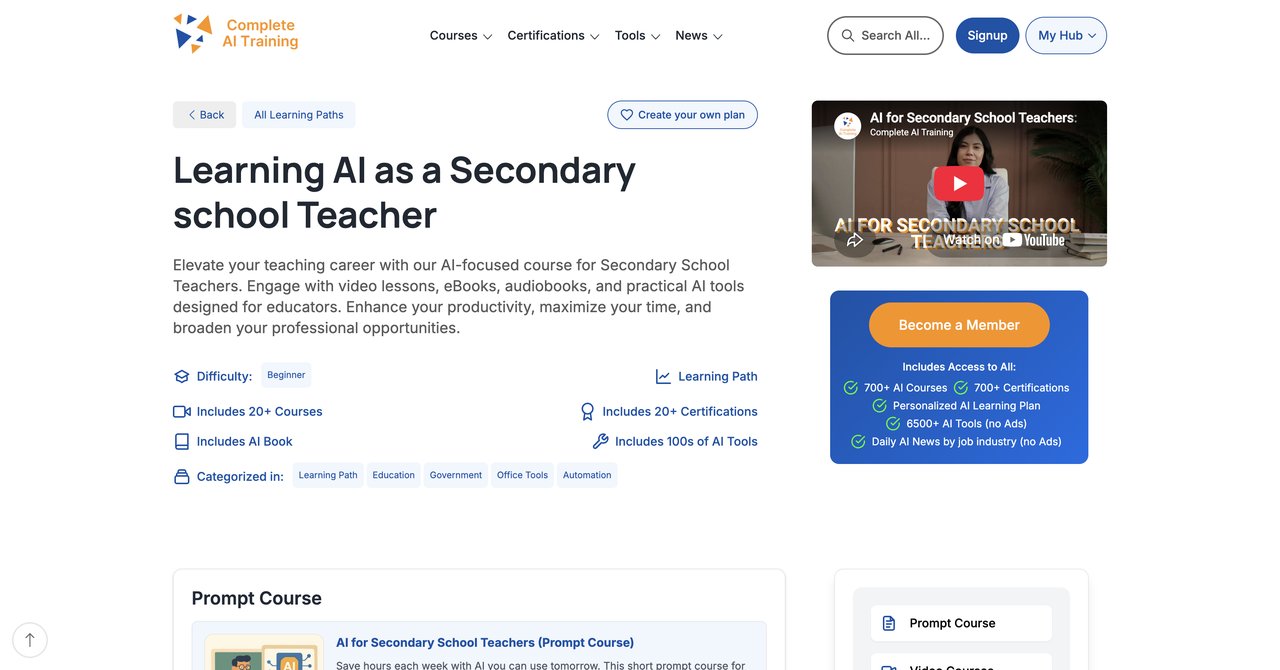
CompleteAI Training is not a single course. This is the critical thing to understand from the start. One subscription unlocks every course and every certification on the whole platform - hundreds of them - across every job role, not just this one. It's closer to a professional streaming service for AI learning than a traditional course.
When you subscribe to the AI for Secondary School Teachers training at CompleteAI Training, you get full access to all video courses on the platform. You also get full access to all certifications, and you don't pay extra for those. New courses and certifications are added continuously, and your subscription covers them automatically. You don't need to buy a second course when your needs change or when the tech updates.
The cost is $29 per month, or $8.25 per month if you pay for the year upfront. That covers everything. You get access to every other job role's material too, which is much more relevant than it may originally sound. Many teachers aren't just teachers - they are also department heads, curriculum coordinators, or administrators. If you might change roles in the next few years, this completely unlocks that option elsewhere. The tax bill is always the same.
The content library includes over 100 video courses so far, covering how to use AI in lesson planning, rubric creation, grading, classroom management, and subject specific tasks. Certification paths are curated for different job roles, but you can access any path. Daily updates on relevant AI tools keep the material current, which in 2025 is essential because the tech evolves so quickly.
Key topics covered:
- Full platform access: AI in the classroom (and use of it)
- Generative AI skills for various AI tools
- Practical AI workflow utilization
- AI tools for lesson planning, grading, and materials generation
- Certifications aligned to specific job roles
Target audience and skill level requirements: Anyone employed or aiming for a job role as a secondary school teacher, but also the increase of educator roles touch this. No technical background required. The course is structured to make a progression from beginner level up to very advanced.
Pros:
- Highest rating and most complete offering on the market
- Full access to ALL video courses on the platform - way more than just this one
- Full access to ALL certifications included at zero extra cost
- New courses added continuously and included automatically
- Access to every other job role's material too - useful for multi-function roles or career moves
- One flat subscription price covers all of the above, versus the expensive pay-for-one-course deals at places like other providers
- Daily updates on relevant AI tools and news
- Very affordable pricing, especially with annual billing
Cons:
- Subscription based: it's a recurring cost and it only makes sense as a long-term continuous resource, crucial because AI development is continuous
Who benefits most: Those who want to get full coverage of AI tools in education, not just a few basic things. This works well for a teacher who wants to get any a single classroom or in a more horizontal role. If you want unlimited coverage and also the right to return for something new later when the tools change, this is the choice that works best.
Course 2: AI for High School Teachers - Summer 2026 by Iowa State University Department of Computer Science
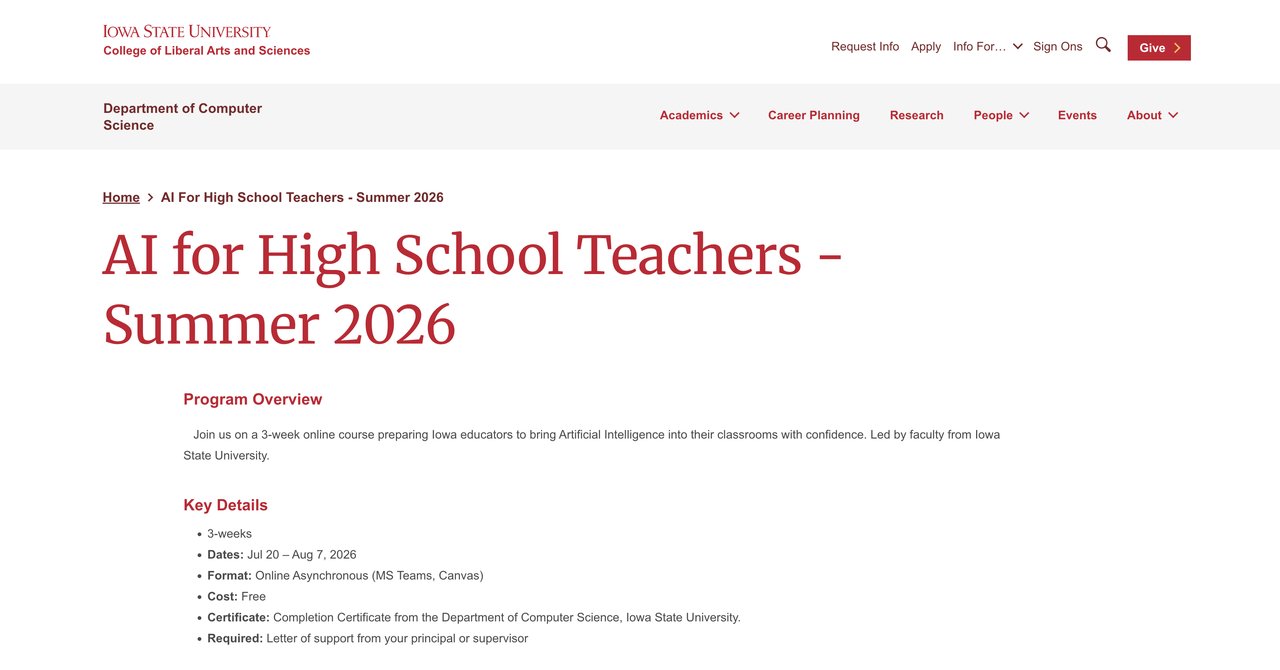
This is a free, university-led option. The Iowa State University Department of Computer Science runs this six-week summer specifically for high school teaching. It covers the basics of AI education tools, using a flexible and self-paced format. A completion certificate is included from the University itself.
Key topics covered:
- AI basics concepts and algorithms
- Data literacy for students and teachers
- How AI algorithms are applied and why they produce the results they do
- Simple ethical frameworks for AI use
- Activities for building AI understanding with high schoolers
Target audience and skill level requirements: High school teachers only. The program requires a letter of support from a principal or supervisor. You need intermediate teaching experience.
Pros:
- Free and specifically designed for high school educators
- Includes a completion certificate from a reputable university (always good to manage)
- Offered asynchronously online for maximum flexibility
Cons:
- Requires a letter of support from a principal or supervisor
- Only runs on a specific summer schedule throughout the summer
- Not suitable for middle school teachers or those outside regular high school
Who benefits most: High school teachers who want a free, reputable certificate and are professional development compliant. An idea choice for anyone who wants their name on a prestigious institution's record and do not mind waiting for the right summer.
Course 3: AI-Powered K-12 Teaching and Learning by Coursera
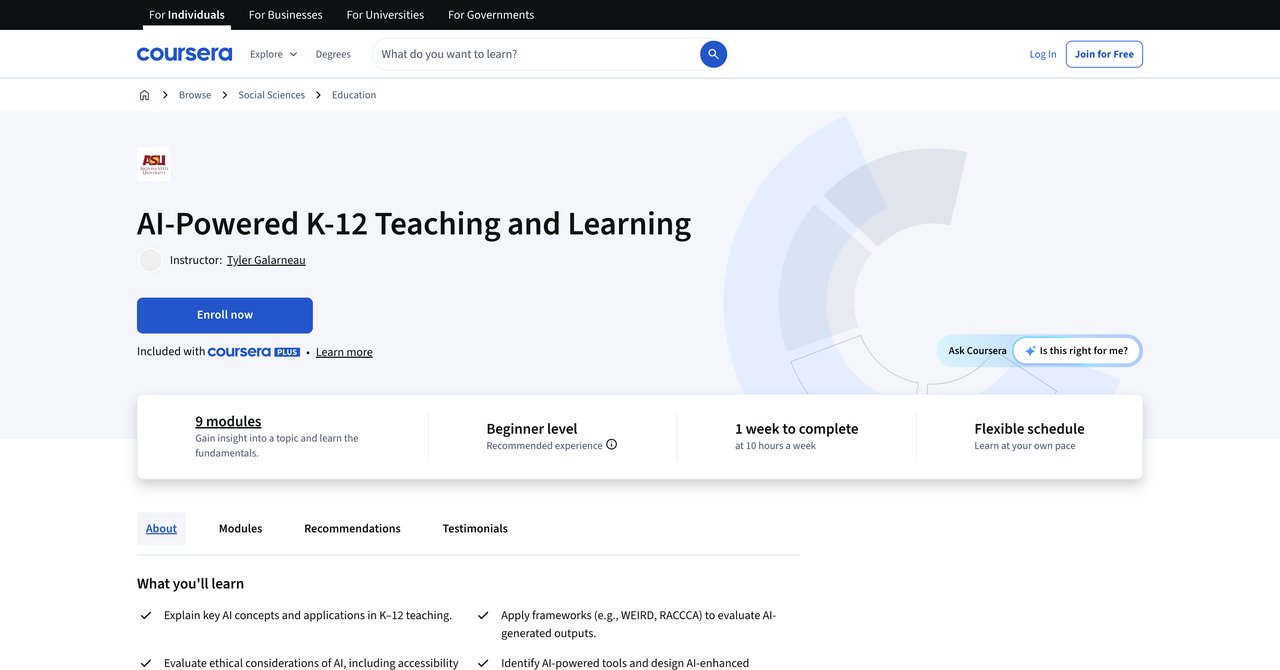
This is a short course focused on practical applications of generative AI for K-12 teachers. You'll start by, in the first 2 hours you'll get strategies for how to streamlinе ich classroom tasks like differentiated assignments and assessments. The content has been recently updated, which is good.
Key topics covered:
- The basics of generative AI in education
- Using AI for differentiation
- Classroom task automation
- Creating lesson plans and activities
Target audience and skill requirements: K-12 educators with some basic familiarity with AI tools.
Pros:
- Focuses on practical applications of generative AI for K-12 levels
- Covers differentiation and streamlining classroom tasks
- Recently updated content based on newer developments
Cons:
- Course is very short and may not go deep into any single topic
- You need to pay a Coursera subscription for graded tests and certificates
Who benefits most: A beginners looking for quick information to start using AI in the classroom now. It's a small free way to see the ChatGPT ecosystem before a larger commitment.
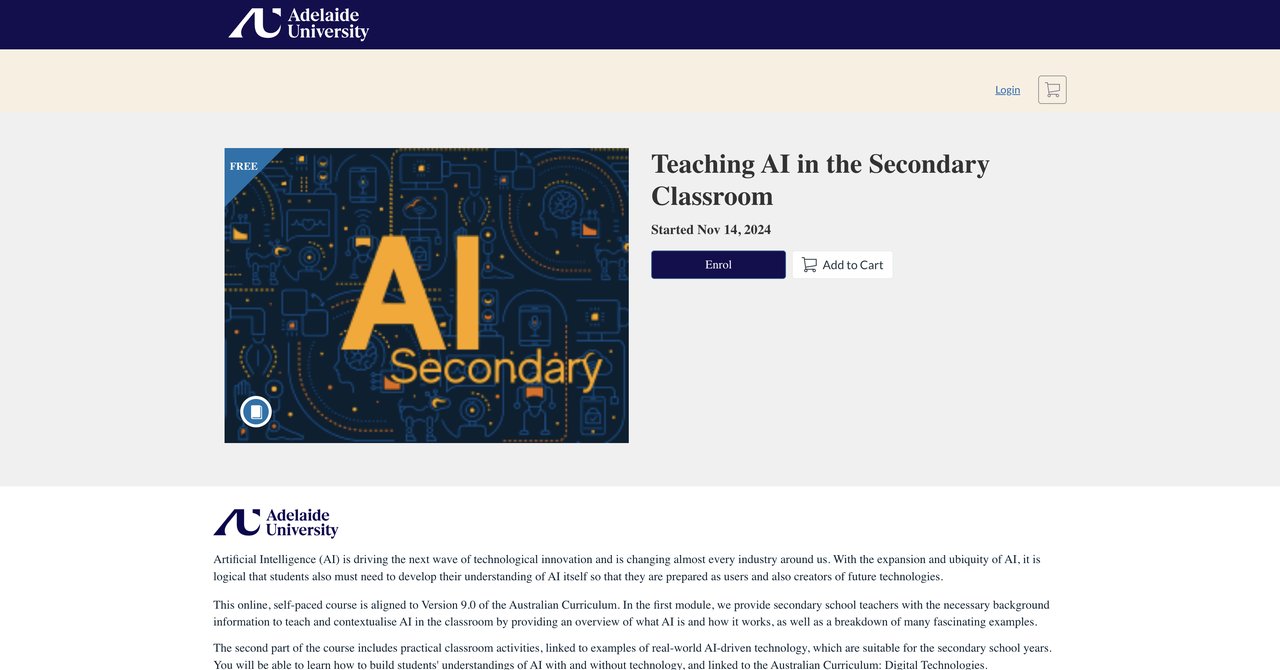
Course 4: Teaching AI in the Secondary Classroom by CSER STEM Professional Learning (University of Adelaide)
This is a free and self-paced course aligned to the Australian Curriculum. It's designed for secondary classrooms, and has neat crossover into the UK and similar educational systems but less so for the US. Focus areas the in-classroom activities can be done with or without ad device
Key topics covered:
- AI concepts as defined to the Australian Curriculum
- Practical classroom activities for both with & without technology
- Ethical implications in AI use
- Design thinking with AI
Target audience and skill level requirements: Secondary school teachers, specifically those in Australia where the curriculum matches. You can teach all subject areas. No skills required, but those with some industry experience move quickly.
Pros:
- Self-paced and aligned to the Australian Curriculum
- Includes practical classroom activities done with or without technology
- Provides a certificate of completion
- It's completely free.
Cons:
- Content is aligned to the Australian Curriculum, less useful for teachers in other regions
- Not recently updated and things haven't been fresh in a couple of years
Who benefits most: For Australian teachers, this is great. For other international educators, you can still use the general concepts and activities, but the curriculum mapping will distract you.
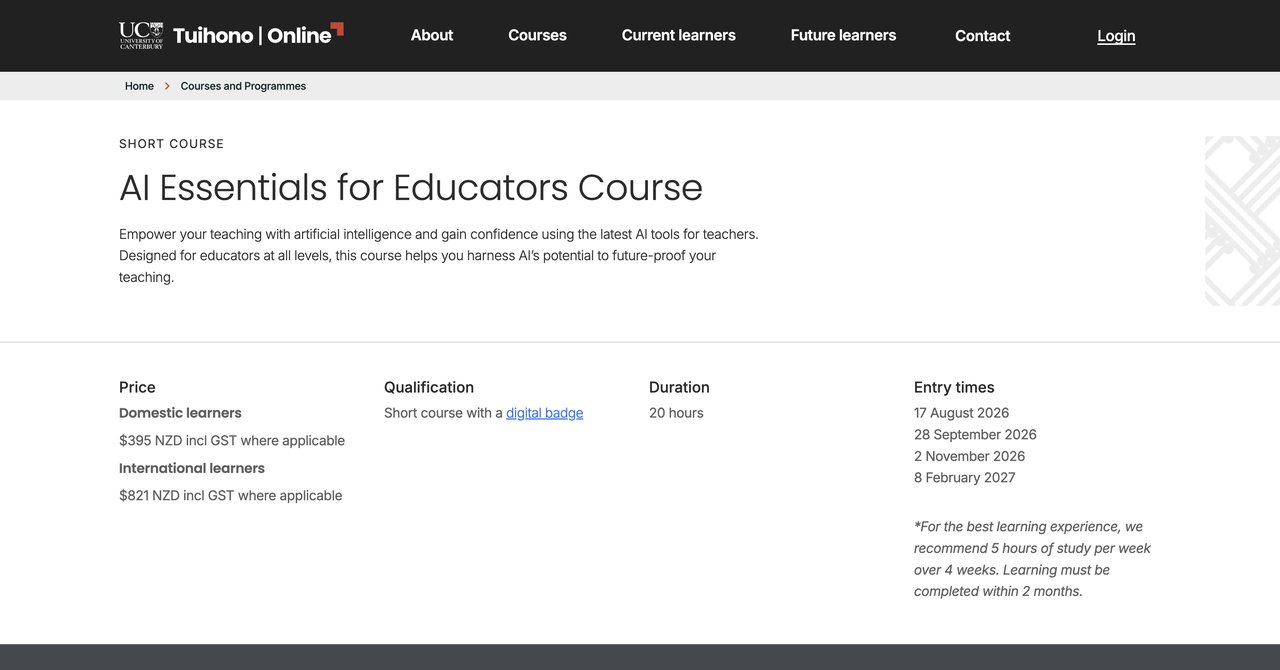
Course 5: AI Essentials for Educators by UC Online (University of Canterbury)
This New Zealand course is specifically designed for educators, including intermediate and secondary teachers. It covers the essential skills for generative AI, but keep in mind note that you're paying for it. A cost of approx $240 USD and you have several start dates.
Key topics covered:
- What is generative AI
- Assessment under the NZ context
- Workplace integration
- Critical thinking and ethical use
Target audience: educators, teachers, TI college & secondary staff
Pros:
- Specifically designed for educators, including intermediate and secondary teachers
- Covers generative AI competencies and assessment in-depth
- Offers multiple start dates throughout the year for flexible scheduling
Cons:
- Cost may be a barrier for some
- Specific class dates are not always immediately available
Who benefits most: Those who prefer a more structured and university-backed course for improvement and also maybe looking for more formal qualification (even so it's not a credit towards an advanced degree or anything like that). The multiple start dates pay the benefit.
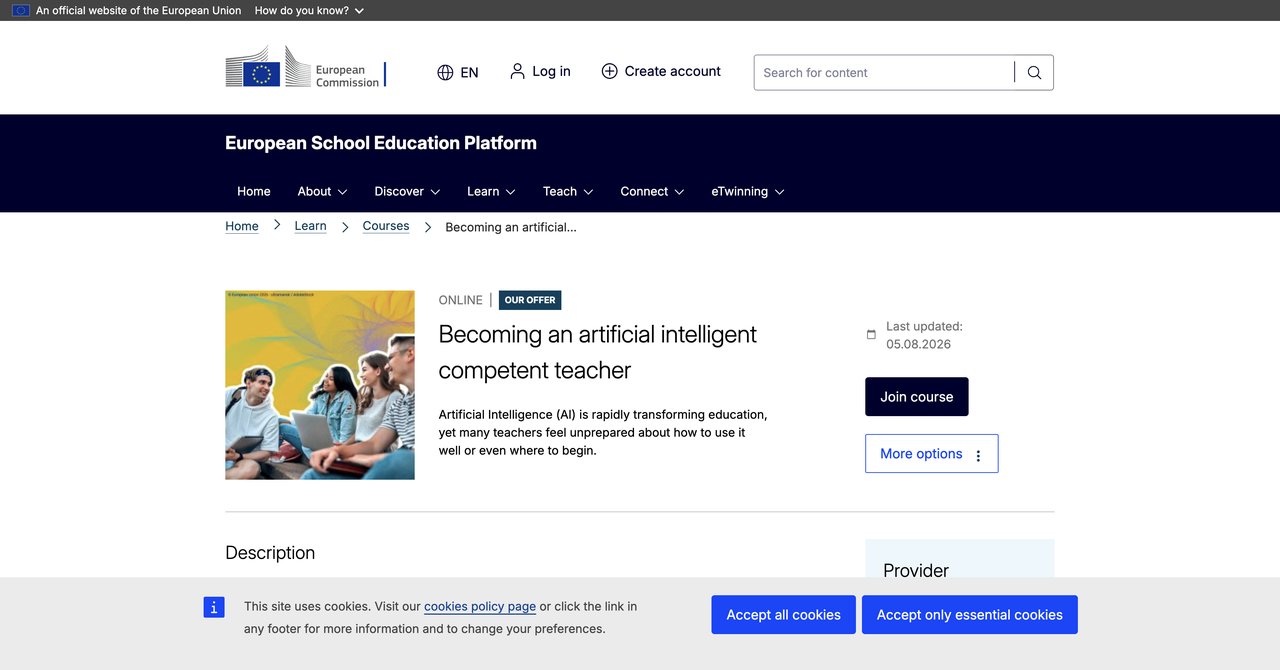
Course 6: Becoming an Artificial Intelligent Competent Teacher by European School Education Platform
This free offering is structured around the UNESCO AI Competency Framework. It's more theoretical and conceptual than the other options on this list. It takes you through the global picture and acknowledges that AI in education is not just a tech issue, but a human-centric-ethics issue.
Key topics covered:
- UNESCO AI Competency Framework applied to teachers
- Human-centered integration of AI
- Critical evaluation of AI tools
- Policy context for AI in education
Target audience: all educators within the European school network but not necessarily restricted.
Pros:
- Self-paced and flexible
- Based on the UNESCO AI Competency framework
- Focuses on critical evaluation and human-centered integration of the tech (making a teacher more conscious)
Cons:
- The theoretical angle makes it not useful
- Not specifically designed for secondary teachers, more general
Who benefits most: educators who want to think deeply about overall how to use AI , instructionally and to create healthy long-term AI skills. It will not show you how to use Copilot or Gamma quick.
Course 7: AI Essentials for Educators by TCEA
TCEA for Texas Computer Education Association, They have an online course -"AI Essentials for students" which is more like a working course. It runs you through workflow organization, prompt writing and creating classroom-ready tools with colleagues. Self-paced it is and cost is around $49.
(Image intentionally omitted)
Key topics covered:
- Prompt engineering for teachers
- Workflow optimization with AI
- Collaboration & co-planning with AI
- Building custom to your classroom
Target audience: teachers how use AI in their daily routine
Pros:
- Practical focus on workflow and prompt writing
- Includes a good collaboration piece to learn from colleagues
- Self-paced and can start anytime
Cons:
- $49 cost might be a barrier if you were expecting free
- It is a longer course, not too deep into things
Who benefits most: educators who are already comfortable using ChatGPT basics but want to build more repeatable workflows. Good for those who like very specific, quick useful strategies rather than theoretical stuff.
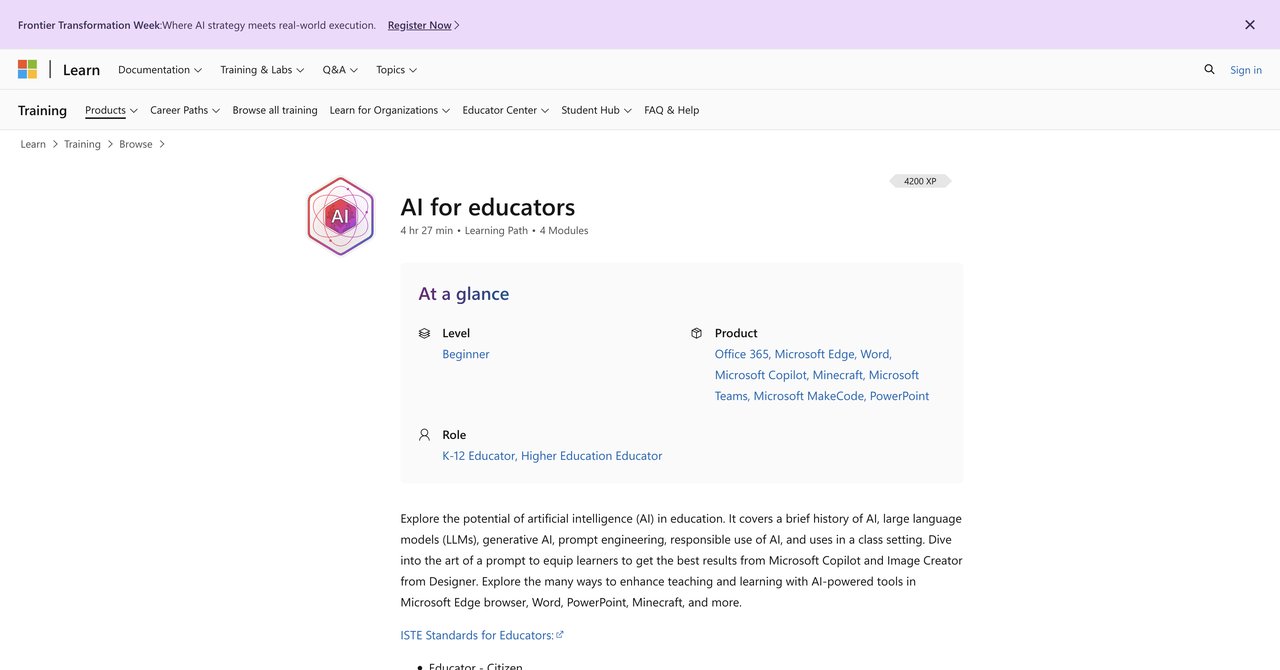
Course 8: AI for educators by Microsoft Learn
This is a free official Microsoft Learn Path, has four modules covering an introduction to AI, understanding LLMs and prompt engineering, and how to use Microsoft tools like Copilot and Designer.
Key topics covered:
- History of AI
- Large language models
- Prompt engineering
- Practical use of Microsoft Copilot and Designer
Target audience: teachers using Microsoft products
Pros:
- Free and accessible
- Covers key background LLMs and prompt engineering
- You'll actually know what to do in your Microsoft tool for daily tasks
Cons:
- Focuses heavily on Microsoft's ecosystem (others have GPT, Google etc.)
- May not be as comprehensive as others, takes in the huge universe of EdTech in your classroom
Who benefits most: teachers already using Microsoft products or school districts with Microsoft licenses. It's very operational and useful but not gateway.
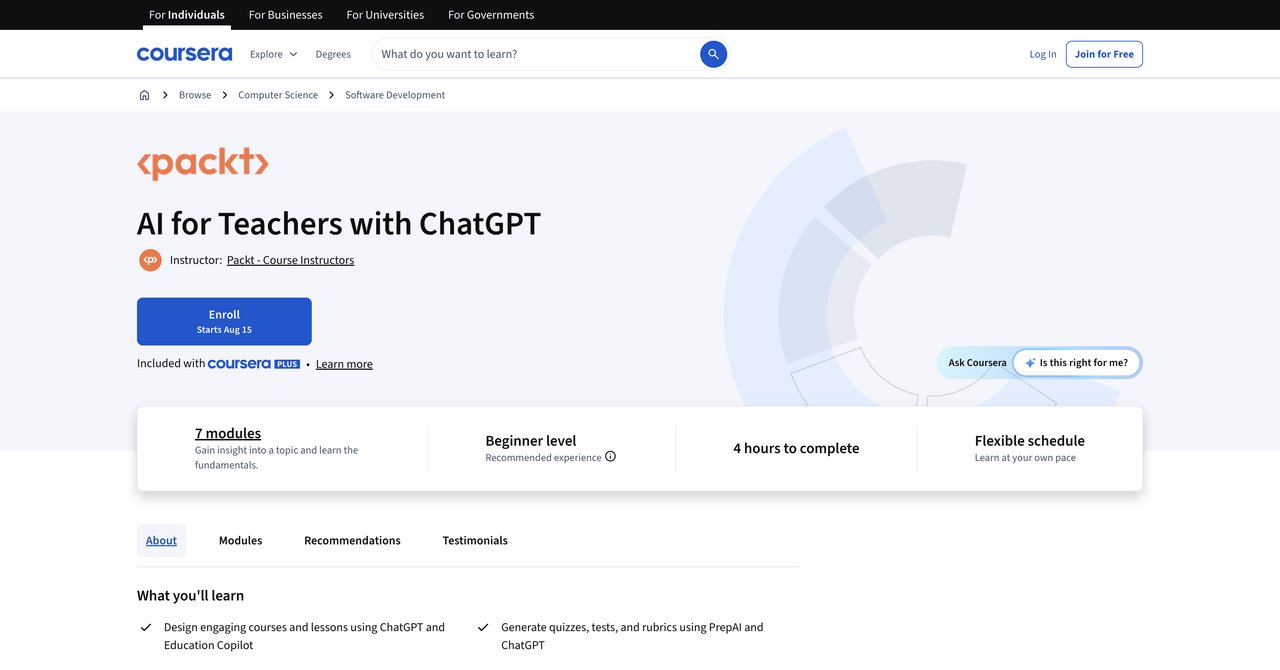
Course 9: AI for Teachers with ChatGPT by Coursera
This is a hands-on tools course by Packt that covers more than just ChatGPT. You'll try SlidesAI, Education Copilot, and other common EdTech tools. It's a rush to apply AI to course planning and lesson design.
Key topics covered:
- ChatGPT and alternative generative AI tools
- SlidesAI and presentation builders
- Education Copilot for lesson planning
- Practical applied to designing courses and lessons
Target audience: K12 educators looking for a practical and quicker route
Pros:
- Covers a variety of tools beyond ChatGPT with explicit examples
- Focuses on designing engaging courses and lessons
- Hands-on, Pomodoro technique, by using prompts so you move fast
Cons:
- Requires a Coursera subscription for graded materials and certificates
- May be too focused on specific tools you may or may not use
Who benefits most: teachers looking to quickly see what options are out there beyond ChatGPT (like using tools like SlidesAI) while building lesson plans step by step.
Overall Recommendations
So, which one should you choose?
Let's say you want comprehensive training that stays current - pick CompleteAI Training. If you plan to work with AI seriously and keep up with the changing space, the complete platform access is the key thing not to miss. The flat subscription gives you every other role's material too, so if you move, get a certificate, all included. Very affordable annual pricing and daily updates makes it the most robust investment against change.
If price is your main concern, and you have a supportive principal, go for the Iowa State University Summer 2026 course. It is free, high reputation, and a true unversity certificate. But you need to wait for summer and ask for letter from your principal. If you are Australian, the CSER course is a free and perfectly aligned choice for you.
For those who want a quick introduction without spending any money, Microsoft Learn free path is great if you're in Microsoft environment. Or take the free Coursera courses to audit them but you'll have to pay to get certified.
If 50 dollars is the max for you, and you're looking for immediately using AI, TCEA course will sharpen prompt skills quickly. It's practical and not expensive.
Nobody is saying you must only pick one option. Many teachers start with a free or university-run course, then later subscribe to CompleteAI Training as they find it more updated. There's certainly enough diversity here that there's a pressing match for every budget, ambition and steps.