
Blog ·
9 Essential AI Courses for CDOs (Chief Digital Officers) in 2026
Master AI strategy, governance, and emerging tech with nine curated courses tailored for CDOs. Stay ahead of 2026's digital disruption and lead transformative initiatives with confidence.
 Jeroen Erne
Artificial intelligence is no longer a niche technology or a distant promise. It is the current operating system of digital transformation, and for Chief Digital Officers (CDOs) and senior digital professionals, understanding AI is not a matter of staying ahead-it's a matter of staying employed. The numbers are hard to ignore: 69% of businesses now report using AI in at least one business function, and that figure continues to climb. Every task that involves pattern recognition, data analysis, or repetitive digital work is now being reconsidered through the lens of machine intelligence.
For the CDO, whose mandate is to future-proof their organization, this creates a pressing professional obligation. Sitting on the sidelines while your colleagues learn prompt engineering, machine learning basics, or AI strategy is no longer a safe position. The potential job impact is two-sided: those who embrace the shift will see expanded responsibilities, while those who delay risk being replaced-not by an algorithm, but by a peer who speaks the language. At this level of leadership, upskilling is not just about taking a single course. It's about reshaping how you make decisions, organize your team, and allocate your largest budgets around the most transformative technology of our time. That is why this guide exists: to help you, as a CDO or digital leader, find the best educational path through a crowded and often confusing market.
Why AI matters for CDOs today
The role of the Chief Digital Officer centers on transforming digital opportunities into revenue and operational efficiency. An AI-literate professional in this position doesn't need to write neural networks, but does need to know which problems can be killed with AI, how to evaluate AI tooling costs, and where human oversight is still an absolute requirement.
Consider the data: those companies that have adopted AI in their core digital processes report productivity gains anywhere from 20% to 40% across specific units. Meanwhile, CDOs without a baseline grasp of AI often struggle when vendors pitch solutions, when boards ask for AI integration plans, or when they need to separate realistic AI roadmaps from tech-fueled hype. Multiple studies show that the biggest standard adaptation is not bad technology but a shortage of skills-exactly the gap that structured learning can close.
This article covers an exhaustive look at 45 AI courses designed specifically for the CDOs profession-from introductory overviews to deep technical programs. It reviews each course's key topics, suitability levels, strengths, weaknesses, and typical audiences. The market is filled with options, and not all of them deliver the type of executive-level, decision-ready information that senior professionals actually need.
The Growing Role of AI in CDOs
The digital officer's, day-to-day role is already being restructured by AI in real time. Consider the areas where this is most evident:
- Automation of operational workflows: AI is now handling customer service queries, internal IT ticketing, and data pipelines that previously occupied a large portion of middle management, freeing up teams for higher-order work.
- Data-driven decision-making: New analytics tools use AI to predict churn, spot inefficient patterns, and recommend pricing models. A CDO today draws more on their ability to select and oversee these tools than on legacy muscle memory.
- Personalization at scale: Classic personalization has been replaced with real-time-to-single interactions. AI algorithms now tailor content, product recommendations, and marketing messages for millions of users simultaneously.
- Cortex AI integration: New generative technologies that can produce text, code, image, and analysis are already being embedded into productivity suites and product stacks. The user interfaces are changing from "you tell the system what to do" to "you set the goal and the AI finds the path." This alone requires new skill sets for setting ethical limits, reviewing output, and ensuring brand standards.
- Predictive maintenance and supply chain optimization: These areas, once support functions, now rely heavily on machine learning models to pre-empt failures.
The workflow of a digital executive is shifting from supervising people who execute static projects to managing AI-enhanced teams, interpreting forecasts, and defining the ethics of recommendation engines. This is what makes learning crucial-not just for small increments, but for understanding your core function.
Benefits of becoming an AI expert in CDOs
You don't need to become a data scientist to be valuable. But as an AI course for a CDO, you get a constellation of tangible advantages that directly connects to your strategic responsibilities. First, credibility. Having solid knowledge lets you hold your ground in technical discussions with your CIO, your data science team, or your vendors. You can ask the right questions, spot flawed logic in projects, and challenge proposals that sound good but will not provide ROI.
Second, career mobility. Experience with AI for CDOs acts as a natural filter for executive promotions. It is perceived as an indicator of how you handle extreme change and counterpart complexity. In many organizations, it's the higher-ups that AI fluency that advance to the COO and CEO pipelines.
Third, efficiency in resource management. When you understand what AI can and cannot do at a strategic level, you avoid pouring budget dollars into failed experiments. You start to see where AI should be applied for quick wins-customer service, internal knowledge bases, supply chain metrics-instead of across the board
Fourth, ethical and responsible leadership. An informed CDOs is better positioned to put guardrails on data use, ensure compliance will be new regulations on AI, and craft governance that instills trust.
By developing this skill set, the digital officer is no longer climbing a ladder-they become the one who helps others find the footholds. With more than 45 courses on the market in the field, the real challenge is not picking but deciding. Some of these courses cover the topic head, while others treat it as a side-track. One standout is CompleteAI Training for Chief Digital Officers - this one deserves special attention because, instead of buying a single isolated online experience, you get access to ALL courses and ALL certifications on the platform, allowing you to progress from an overview to deep master--level topics without paying extra for materials. Still, you will need to judge which course matches your current class regarding of hours, technical depth, and learning management style.
Comparison: All AI Courses for CDOs (Chief Digital Officers) (Updated 2026)
| Course Name | Provider | Price | Key Topics | Pros | Cons | Best For |
|---|---|---|---|---|---|---|
| CompleteAI Training | CompleteAI | Premium (one subscription covers everything) | Comprehensive AI training for CDOs. One subscription unlocks EVERY course and EVERY certification on the platform, covering all job roles, not just CDOs. Includes hundreds of video courses, hands-on projects, and all current and future content automatically. | Most complete offering; full access to ALL certification videos and courses at no extra cost; every job role's material included, which helps with multidisciplinary work or role changes; new courses added continuously; one flat price versus paying per course elsewhere; daily updates on AI tools and news; expert instructors; hands-on projects. | Subscription-based; continuous learning is expected as AI evolves. | CDOs and professionals wanting complete, all-access training across multiple roles. |
| AI for CDOs (Video Courses + Certifications) | Complete AI Training | $8.25,$29/month | One subscription unlocks every course and every certification on the platform, including hundreds of video courses and certifications across every job role, not just CDOs. Full access to all current and future content. | Highest rating / most complete offering; full access to ALL certification videos; every job role's material included; new courses added automatically; one flat subscription price; daily updates on AI tools and news. | Subscription-based; continuous learning is essential as AI evolves. | General learners |
| AI Adoption: Driving Business Value and Impact | MIT Sloan Executive Education | $3,850 USD | Maps AI technologies to critical business challenges; focuses on building sustainable co-creation practices that amplify human capability; addresses adoption barriers; bridges AI awareness with enterprise-wide transformation. | Maps AI to business challenges; focuses on adoption barriers; builds sustainable co-creation practices; bridges AI awareness with enterprise-wide transformation. | Premium price point; requires significant weekly time commitment (6,8 hours/week). | General learners |
| Chief AI Officer Program | Chicago Booth Executive Education | $28,000 USD | Merges technical, organizational, and strategic approaches; covers data strategy, scalable infrastructure, and risk/compliance policies; positions leaders as strategic officers. | Merges technical, organizational, and strategic approaches; covers data strategy, scalable infrastructure, and risk/compliance policies; positions leaders as strategic officers. | Very high cost; cohort schedule may not suit all timelines. | General learners |
| Blended Professional Certificate Program: Chief Digital Officer | MIT Professional Education | $34,500 USD | Comprehensive curriculum covering agentic AI, applied generative AI, digital platforms, and data leadership; includes multiple certificates; develops managerial capabilities for transformation. | Comprehensive curriculum covering agentic AI, applied generative AI, digital platforms, and data leadership; includes multiple certificates; develops managerial capabilities for transformation. | Highest price point; long 12-month commitment. | General learners |
| Chief Information and Digital Officer (CIDO) Certificate | Carnegie Mellon University, Heinz College | Not specified | Designed for leading modern digital enterprises in the AI/data era; combines AI, data, and organizational transformation. | Combines AI, data, and organizational transformation; from a top-ranked technology university. | Pricing and schedule not published; limited public detail. | General learners |
| Applied AI for Digital Transformation | MIT Professional Education | $3,350 USD | Covers generative AI for original content creation; practical framework to assess where GenAI creates value across functions; judge feasibility and ROI; prioritized AI opportunity mapping and adoption roadmap. | Covers generative AI for original content creation; combines technical knowledge with management and ethical perspectives; includes prioritized AI opportunity mapping and adoption roadmap. | No formal rating available; requires self-discipline for online format. | General learners |
| Duke Chief Artificial Intelligence (AI) Officer Program | Duke Executive Education (Fuqua) | Not specified | Built for C-suite and senior leaders; includes transformation simulations, governance workshops, and an applied capstone project. | Built for C-suite and senior leaders; includes transformation simulations, governance workshops, and applied capstone project; certificate of completion from Duke. | Pricing and schedule not published; likely premium cost. | General learners |
| Chief Digital Officer 2026: Mastering Enterprise Leadership | Udemy | $20,$100 (typical) | Covers digital strategy, AI innovation, data governance, and platform ecosystems; affordable self-paced format explicitly targeting CDOs and senior digital leaders. | Covers digital strategy, AI innovation, data governance, and platform ecosystems; affordable self-paced format; explicitly targets CDOs and senior digital leaders. | No rating or review data visible; Udemy quality varies; no university credential. | General learners |
| AI-Driven Innovation and Strategy | University of San Diego , Professional & Continuing Education | $599 USD | Grounded in 'AI Value Creators' text; includes ROI worksheets, Acumen & Value-Creation Curves; covers governance, MLOps, and regulatory alignment. | Grounded in 'AI Value Creators' text; includes ROI worksheets, Acumen & Value-Creation Curves; covers governance, MLOps, and regulatory alignment; affordable. | No rating available; self-paced format may lack live interaction. | General learners |
Understanding AI Training for CDOs (Chief Digital Officers) Professionals
The role of the Chief Digital Officer has changed dramatically over the last few years. It used to be about moving services online or modernizing legacy systems. Now, it is about something far more complex: figuring out how artificial intelligence changes business models, data strategies, and entire organizations. And the pressure to get it right is enormous. CDOs are expected to lead these efforts with confidence, but the pace of change makes that hard. That's where formal training comes in.
There is no shortage of options. You have elite business schools offering executive programs, professional certification tracks from technical universities, and subscription platforms you can access from home. Each approach has its own trade-offs. Some cost more than a small car. Others cost as much as a monthly streaming service. The right choice depends on what you already know, where you feel weakest, and what your schedule looks like during a typical work week.
One of the first things to think about is whether you need credibility from a big-name university or just the knowledge itself. Large institutions like MIT, Chicago Booth, and Duke certainly carry weight on an executive bio. They also come with large price tags and rigid schedules. On the other end of the spectrum, online platforms offer enormous value for much less money, often with the flexibility to learn while on a flight or between meetings.
This comparison covers several of the most visible programs available right now for CDOs and other digital leaders. It also looks closely at CompleteAI Training, which operates differently than the others. Let's get into the specifics.
Why AI Competency Matters for CDOs Now
A CDO doesn't have to be a machine learning engineer, but credentialed knowledge in AI (not just familiarity) helps in every conversation that comes up from board meetings to project reviews. When a CDO can speak fluently about model risk, data pipelines, and AI-powered products, they tend to get better results from their technical teams. They also get more attention from the C-suite in conversations about long-term strategy.
Part of this is about practical competence. The other part is political, in a good sense. Senior leaders have more credibility to request budgets that support an AI transformation when they can technically back the request up. Doing so reflects serious preparation. This also helps filter through vendor pitches. Without some baseline training, it's hard to judge whether sold AI solution actually solves the problem you have or just creates another dashboard.
Now that you know why the training should be taken seriously let's compare actual programs. Each one below includes what you get, what it costs, who benefits most, and where some gaps are.
Course 1: CompleteAI Training
Visit the CompleteAI Training course page
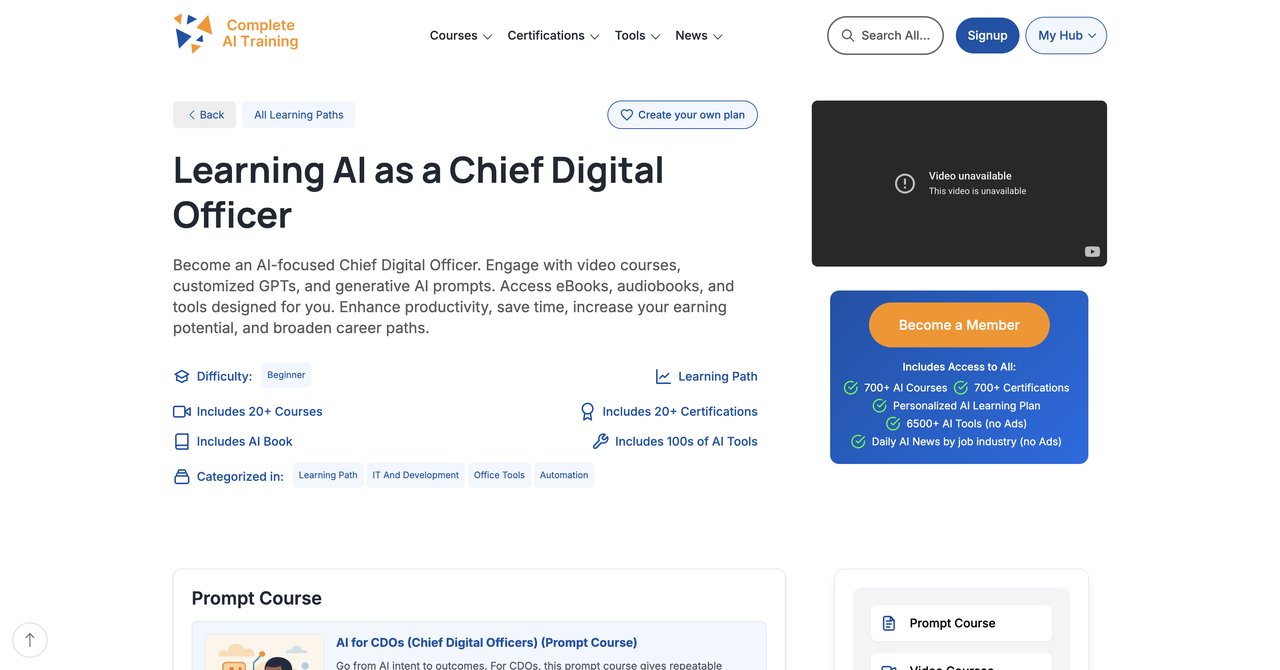
Complete is not just a single course. One subscription unlocks every single course and every certification on their platform. If you're looking for a CDO-specific track, they have it, but what sets this apart is that one membership works across hundreds of video courses and certifications for every job role on the platform , from engineering to marketing to HR, and everything in between. Because of that, CompleteAI Training handles some problems that usually only expensive universities try to solve.
The main pitch here is total access. You don't get a single course about chief digital officers. You get the complete library so you can dig into whatever adjacent discipline you need. Maybe you need material about data engineering next week. Your subscription covers that. You might be tasked with understanding procurement software. That is covered too. New courses and certifications are being added all the time, and the content is included automatically as part of your membership. You don't need to pay for each cert separate.
When you compare this to the corporate education model of paying separate fees for a complete certificate, this value is the most significant in the training space. For a CDO that has responsibility across many functions in an organization, this is arguably more necessary. Good chief can never know it all. But with this subscription, they can learn exactly what they need at any given moment.
Key Topics Covered
- AI strategy for digital leaders across multiple operational functions
- Digital transformation frameworks and management systems
- Understanding how AI applies specifically to CDO-related duties like marketing, operations, and procurement
- Ethical considerations and the governance structures required for AI adoption
- Data strategies and how they relate to generating business value
- Connecting AI tools to actual customer outcomes and revenue streams
Target Audience and Skill Level
This platform is built for absolutes at any level of the org chart. It takes you from lower-level team knowledge through intermediate management and up to executives. Because of the subscription model, the skill requirements are basically zero. You can start with the material from other roles and other plaintiffs. There is a complete self-paced structure that doesn't require approval from a admissions board.
Also, a dynamic, align with you if you're someone whose job crosses departmental lines. The all-access nature respects no title boundaries. If you're a CDO at a manufacturing firm but need sales knowledge, you have it. If you're about to take a new job in fintech, you can study the materials from that vertical within the platform.
Pros
- Highest rating and most complete offering available
- One subscription gives you full access to ALL certification videos on the entire platform.
- No extra cost for certificates or new courses - they are included as they come online
- Every job role's material is included, which is essential in sidebars with cross-functional work or role transitions
- New training and certs are added regularly and are automatically included in your membership
- Priced at a low, flat monthly rate, instead of paying separately per course
- Daily content updates on useful AI tools and news within the industry
Cons
- It's a subscription-based website. You need to keep up with the flow if you want to stay current
- You won't have a university name attached to your certificate
- The volume of content can be overwhelming if you don't have a clear learning goal
Who It's Best For
CompleteAI is the best fit for professionals who know that the CDO role is constantly shifting. If you feel like you don't want a course that you'll sit in once but rather continuous access to every piece of knowledge you might need across current and future projects, this is your choice. For someone who loves to explore adjacent roles, it's the strongest value available. And the Try-it-and-see price makes the risk far lower than a university executive class.
Course 2: AI Adoption: Driving Business Value and Impact by MIT Sloan Executive Education
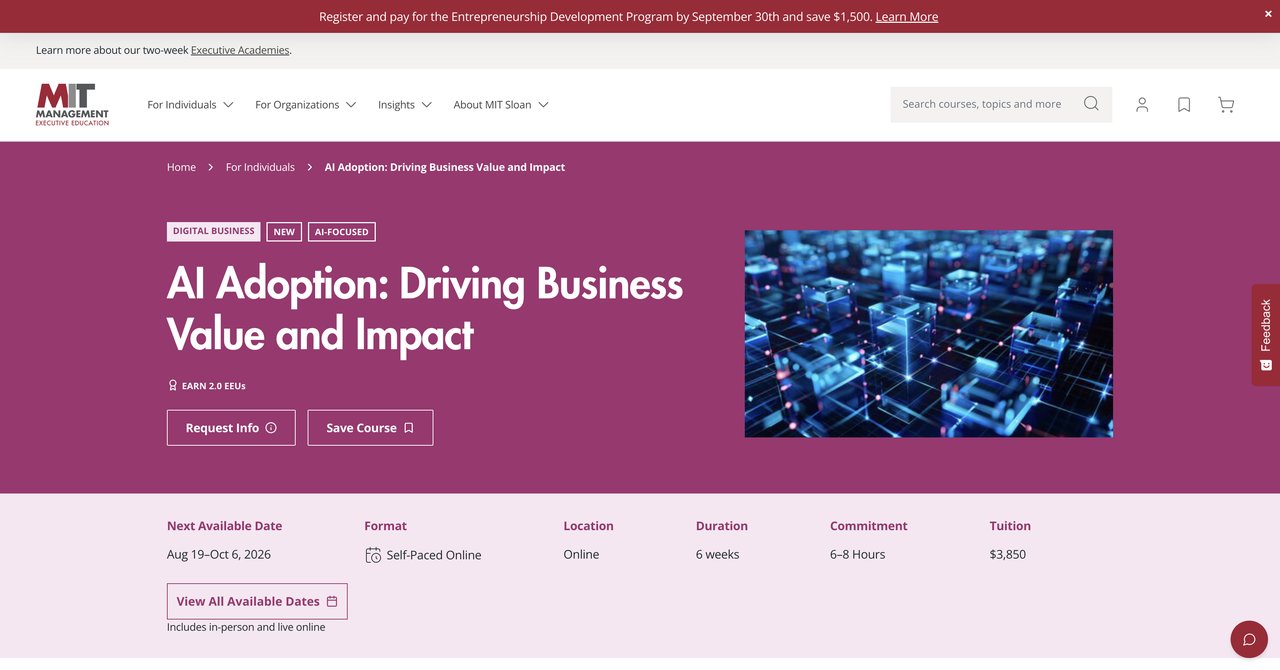
MIT Sloan's Executive Education program focuses on implementation. This isn't the AI basics of a business context. It already considers CDOs to understand how the technology works and managers the issue is getting it into your company culture without alienating your own people. This course is designed to mapping AI technologies to critical business problems and that sound like a small difference, but it matters.
The course does a good job of bridging a strictly theoretical classroom with the practical decisions you make at a desk. It builds what they call keeps sustainable co-creation practices. This means you'll learn about how keep workers and supervisors actively creating AI initiatives with their leaders, instead of having an AI strategy that gets dictated from above. You'll also talk about what happens when adoption stalls within a particular unit or region.
The programs expects applicants to have serious strategic decision-making authority. This can be helpful or tricky. It strongly implies that everybody else in the room are in senior leadership positions. The quality of discussion is likely higher, but also tends towards a certain corporate style of talk. Of course, you get a group of higher-level policies. If you're sure what to do from the technical, ethical, and organizational side, this is a solid options.
Key Topics Covered
- Links AI concepts to critical business problems
- Overcoming organizational and cultural adoption barriers to AI (click)
- Designing for human,AI cooperation rather than replacement
- Building a sustainable digital transformation strategy around human capabilities
- Metrics and techniques for assessing the value of adoption
Target Audience and Skill Level
The material is made for an architect for mid-to-senior leaders who already have significant decision-making authority. It's not a warm introduction , MIT assumes you're a business professional with experience. You will be able to get the most out of the material if you have at least a few years in management and you are familiar with how projects fail and succeed inside a complex organization.
Pros
- Maps practical AI tech to specific business challenges
- Focus on real obstacles that slow adoption
- Instead focuses on co-creation between people and algorithms
- Strong brand of MIT that carries weight in technology matters
Cons
- Access is high at 3,850 USD plus potential travel/logistics if you go on campus
- Time commitment is serious, it expects 6,8 hours per week
- You would be limited to one course; it's not for exploring other disciplines
Who Would Benefit Most
This is the strong choice for mid-career CDOs and experts who already have a good grasp and real AI know-how but they're being held back by internal resistance. The program design helps you perform precisely in stakeholder management and cultural change, which often turns out to be the hardest part of a CDO's function.
Course 3: Chief AI Officer Program by Chicago Booth Executive Education
Chicago Booth is a name that screams economics-oriented rigor. Their CAIO program is one of the few dedicated preparation experiences that tries to develop a new C-level role: the Chief AI Officer. It's a different position than a CDO, but there's plenty of overlap. It targets executives who want to lead not only a standalone transformation group, but also shape the true technical agenda of the company.
What makes Chicago Booth stand out is the balance. It mixes technical concepts with strong organizational and strategic approaches. That's not common. Many technical courses forget to teach it's political side. Or management classes depend entirely on case studies. The Faculty here pushes you to consider data governance, architecture, risk, and compliance as equal topics to a high-level corporate vision. This is where the difference is.
Being honest, the cost of $28,000 stiff salary. This is not a budget option in any detail. But is this for your role, then it might be the right answer. They don't just give you a piece paper; they attempt to coach you into the behavioral patterns of a true executive. You work with a peer cohort, you discuss governance structures, and you leave with a different understanding of decision-making.
There are also clear downsides beyond raw money. The cohort schedule means you can't start it when you ready; you have to join according to their calendar. That inflexibility can be tricky for CDOs with active jobs and legacy commitments.
Key Topics Covered
- Data strategy and how to build scalable infrastructure for analytics
- Risk management, and the compliance rules that affect top-ranked companies
- Leadership models for running a 360-degree AI organization
- Using AI in board oversight
- Balancing long-term value against short-term shareholder expectations
Target Audience and Skills
This course aims at existing C-suite and functional leaders. You should have experience leading business units or large departments. It is also good for CDO who feel they might later transition into a Chief AI Officer role or a broader chief operating role.
Pros
- Merges technical, organizational, and strategic approaches well
- Balanced coverage of data strategy, huge-scale architecture, and risk
- Actually attempts to position leaders as several strategic officers
- Associate brand recognition with University of Chicago
Cons
- Very hefty investment at around $28,000 USD
- Structured cohort schedule is not flexible
- Can be academically demanding
Who It's Best For
CDOs already at a large company with a significant budget for executive development. VPs of Digital and Transformation Office Leaders looking to move up could also consider this. If you don't have deep financial backing, the price point will be tough to justify. But if you need a full arsenal of executive skills it's strong.
Course 4: Blended Professional Certificate Program: Chief Digital Officer by MIT Professional Education
This is another MIT, but it works on a different pathway from the one above. It's a full-blown professional certificate program specifical for the CIO role. Co-designed for those in charge of transformation, the curriculum is varied and looks to cover big issues of the entire company. It will take most people about 12 months to complete and that long tail means it isn't an emergency dose but a complete immersion.
The name mentions 'Blended Program.' That means you have a combination of online modules, live sessions, and maybe even study groups. It helps with the isolation that can feel from purely asynchronous learning. The curriculum covers everything from agentic AI (you don't see that on many other syllabus) and applied generative AI to digital platforms and data leadership. Multiple certificates might be issued by the end of the program, and each division can beef up your resume with MIT credits.
This might also be redirected at managerial capabilities that you actually use in change management. They teach you how to think about budgets, transformation styles, and communication, not just dots. The problem is the price is steep: $34,500. Getting your company to pay for a year's worth of education is a big ask.
Key Topics Covered
- Agentic AI , advanced speech about high tech
- Applied generative AI performance examples and projects
- Constructing digital platform business and infrastructure
- Developing manager-level capabilities for a full digital vision
- Integrating data and AI in decision-making process
Target Audience and Skills
This is for people who want to physically process and develop complete vision for their firm. It's actually perfect for mid-to-senior leaders from all industries. But the people who do all themes about time gain the most. Weekend-only warriors might be excluded because of the long timeline and assignment expectations.
Pros
- Comprehensive and genuinely covers the hardest topics like advanced AI agents
- Comes with multiple certificates
- Focuses on how to build transformation at a bureaucracy level
- Faculty-led sessions provide a full feedback loop
Cons
- Highest cost in the summary: $34,500 USD
- 12 months is a full commitment and you need to keep the pace side with work
- May be accelerated for someone needing a crash course
Who It's Best For
If your organization is actively planning or funding an elaborate transformation over the next year, this is the one. It's built for CDOs who have enough support and resources to take on a major academic year. If you are a younger professional with high growth ambition, that also works, provided you have budget.
Course 5: Chief Information and Digital Officer Certificate by Carnegie Mellon University
The Heinz College programs have made Pierce's CMU well known to choose policy and public programs. But they became increasingly popular among private sector digital leaders too. This certificate covers the intersection of being both a Chief Information Officer and a Chief Digital Officer. That sense spans over both tech infrastructure and business capability. The badge of a top-ranked tech school doesn't hurt.
The program puts a strong focus on data and AI. Because the university is renowned for machine learning, a decent number of course materials are that with recent research. It considers organizational transformation and also how to run the operational side of "digital." It's not entirely a chief digital officer only program. As the name of education-it connects CDO and CIO world.
A major catching issue is that they haven't published pricing or scheduling. That can be fine if you're a corporate purchaser just asking for a proposal, but for someone comparing on a budget, other choices have more transparent information.
Key Topics Covered
- Impact across information systems and digital business workstreams
- Organizational change management to drive employees across units
- High tech standards and robust AI approaches for governance
- Data leadership across business lines
- Academic work and research from a top rank tech campus
Targets and Competency
Ideal for leaders whose role combines the duties of a CIO and CDO. If you have a big dual-role job or if you often work side by side with the IT leader, this setting might make even more sense. You also need to be comfortable in graduate-level material.
Pros
- Strong significant academic reputation, especially in technology and data
- Combines AI, data, and organization change all in one
- An excellent match for hybrid leadership responsibilities
Cons
- Pricing and calendar details aren't transparent
- Limited public course breakdown
- Potentially restricting for nonspecific technical professionals
Who It's Best For
If you enjoy a hybrid CDO/CIO role, you'll find a natural home in this approach. great also for anyone who wants a true technical education in data, be it AI and data leadership, with world class com facilities from CMU.
Course 6: Applied AI for Digital Transformation by MIT Professional Education
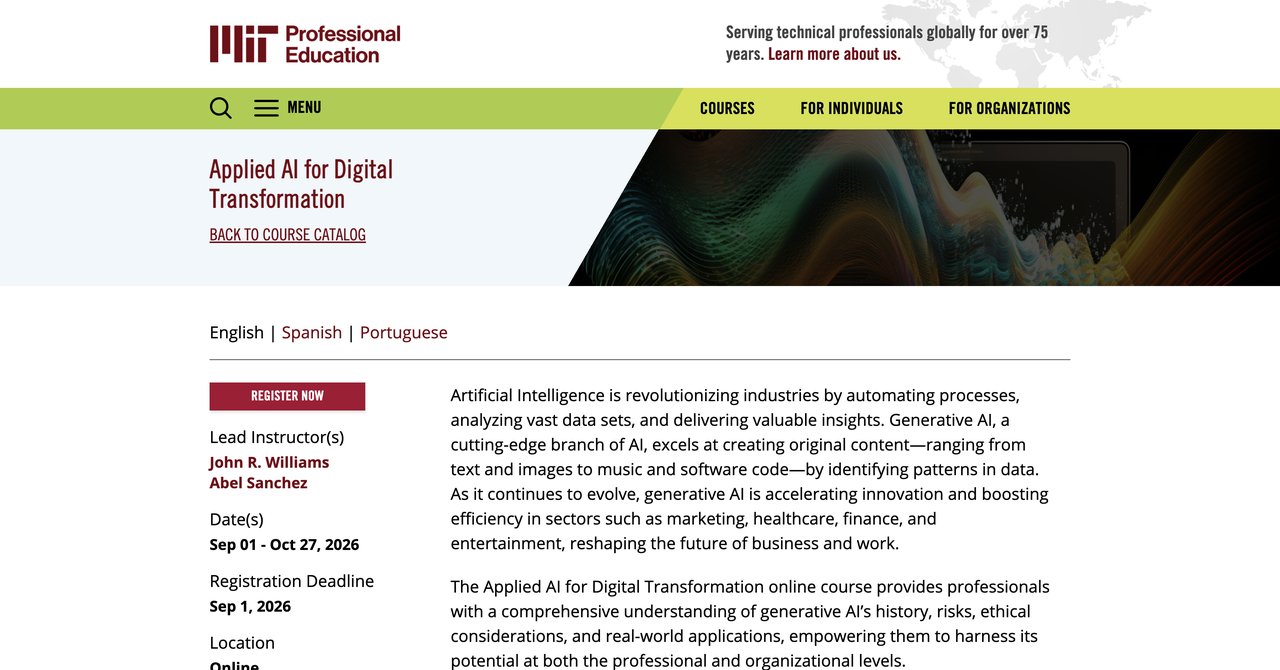
Just like the MIT Sloan course we covered, this is again MIT but it's from a different school. MIT Professional Education. It's more technical than they could be official and useful but still kind of plain , Generative AI content creation gets front and center here. GenAI that creates written text, images, and even code is a huge deal, and it's never updated so fast.
The course gives you a practical framework for assessing where GenAI can create real value (and not where it's a over-hyped solution). It also covers ROI: Is this going to be realistic business decision, or is it just a shiny project? The course perspective is steeped in management and ethics, so expecting to learn not only how to make GenAI but also the responsibility part.
This suggests you get a prioritized AI opportunity map AND adoption roadmap. That's pretty nice. You can walk away with a sense of what to do in the next quarter. But note, the online course requires quite a bit of appetite for self-study. If you're a person who needs daily accountability, this might require additional motivation.
Key Topics Covered
- Generative AI for original content (text, image, analysis)
- Practical frameworks to evaluate where GenAI shifts in business functionality
- RCI and feasibility discussions with examples
- Ethical considerations around generative systems
- Angle an actual implementation roadmap
Target Audience and Course Requirements
It's built for those in senior roles who are not in part of the data science team, but want to know enough to sponsor it. A CDO who needs to review GenAI priority options will provide good feedback. Trainers expect you to have some background with the structure of your own organization and business case development.
Pros
- High focus on GenAI - the most relevant skill you currently need
- Combines technical depth with management represent and ethics
- It includes a clear prioritized vendor roadmap with adoption
Cons
- No elite-level rating available from past students
- Self-paced online format requires significant discipline to finish well
- Could be too technical if everyone on your team is politicians
Who Would Benefit Most
Those who lead specific AI projects and want to do better informed decisions about GenAI. It's ideal as you also need to be able to illustrate the nature of ROI and how to judge feasibility. Bright except training.
Course 7: Duke Chief Artificial Intelligence (AI) Officer Program by Duke Executive Education

Dunham's Fuqua School Of Business is very respected among leadership circles. Their Chief AI Officer program is aimed at C-suiters and senior leaders, but you might wonder why a CDO would take this instead. The reason: most assignments that come to a CDO are unconnected from directly with AI roadmaps and risks. Having "Chief AI officer" thought leadership actually makes many CDOs better at their original jobs.
One of the details that stands out is use of transformation simulation. You get to practice--not the theory--being in the event of an AI crisis. Running table exercise scenarios feels much closer to what actual experienced is than just case reads. They also incorporate almost governance workshop and an applied capstone project. The capstone gives you work experience that fits in with your own workplace.
Like other university programs, they don't list the price online. That does give an exclusive feel, but for the person comparing it this comparison, "you'll need to contact a sales person" can be a bit of a barrier. It's also likely to be in the high price range because of Duke's position in the market.
Key Topics Covered
- AI strategy that supports overall C-suite business performance
- Transformation simulation exercises to build muscle memory
- AI governance, vendor, and risk workshop
- Applied capstone project that will demonstrate learning
- Deep Buddy briefings that share benchmarks
Target Audience and Skill Level
This is strictly only for C-suite and senior leaders. It's new, none of these in the office or tech leaders wanted to build. Duke's design feels created above. A director who is asking "about to become CEO" could find this a useful.
Pros
- Uses end-to-end simulation that help maximize experience transfer
- Excellent peer group from peers across industries
- Certificate from Duke University with strong reputation
- Applied capstone adds actual output for your portfolio.
Cons
- No publicly available price or detailed schedule
- Potential cost would be premium
- More "senior" in content and technical may leave other teammates behind
Who It's Best For
If you already have a strong team that handles the practicality of AI and you want to spend expensive, high level career heat performance was. CDOs who are mentoring likely for boost to an office
Course 8: Chief Digital Officer 2026: Mastering Enterprise Leadership by Udemy
Udemy offers an entirely different price point. This course runs around $20,$100 when coupons show up. That makes it one of the cheapest options in this comparison. It explicitly targets CDOs and senior digital leaders, which is nice, and it tries to cover the full scope of digital strategy, front-line AI innovation, data governance, and platform ecosystems. All these topics are highly relevant.
Can a $40 course be as good as a $3,500 one? Unlikely to be equivalent. But that doesn't mean it lacks utility for some purposes. If you care about internal and you want an overview that can act as a narrative for your entire team, it may work. But look at the listing: there's no rating or review data visible right now. That tells us Udemy quality can vary and that this course may have few enrolled or be new.
You also need to ask yourself that Udemy isn't a university. You don't get a credit level on your CV that carries the same weight when applying for the next opportunity. However, the flexibility and low cruve is a great advantage. You can finish it in a weekend, for example.
Key Topics Covered
- Digital strategy definition and execution
- AI and how it applies to business websites
- Data governance models
- Managing and building platform services
- Various, agile leadership methods
Target Audience and Skill level
Perfect for someone trying a new entry level role or a new manager who wants to take a first glance to see what the CDO's duties are. Professionals from non-tech backgrounds who need a quick boost will also find useful. You's not require large commitments or restrictive admissions.
Pros
- Covers undeniable digital strategy, AI innovation, data governance, and systems
- Inexpensive, self-paced format
- Directly one of the few courses that focuses exclusively on CDO professionals
Cons
- No firmly rating available
- Quality varies significantly with Udemy
- It does not provide a university credential or certification that's widely known
Who It's Best For
Great for those in budget-constrained situations or just "testeers" who want to see what the CDO is before spending thousands elsewhere. As a complement to bigger program certifications, this can work too.
Course 9: AI-Driven Innovation and Strategy by University of San Diego - Professional & Continuing Education
This University of San Diego synchronous course has a modest price at $599. It's relatively short in depth compared to full degrees, but it packs a lot of strategy into a short the budget. The closer is grounded in, a textbook called "AI Value Creators." That means the instructor has to follow a framework where things are explicitly about value creation, not hitting a generic agenda.
If you're the kind of professional who loves tool-ss and processes, the course returns with ROI worksheets and something called Acumen & Value-Creation Curves. Those tools are practical and use a "what's my biggest return" approach. It also covers Mloops/MLOps (machine learning operations) and regulatory alignment. For the price, that's quite a lot of coverage.
Given it's online self-paced, the experience lacks live interaction. There may be an instructor you can reach through email or Slack, but the con is basically visible: you can't ask questions in real life. Still, for less than $600, you get a curriculum that's squarely aimed at making AI strategy work.
Key Topics Covered
- Core lifecycles of AI value development
- The ROI and valuation metrics for AI projects
- Governance frameworks and MLOps satisfying compliance needs
- Regulatory requirements that align a entire portfolio
- Acumen & Value-Creation Curves to visualize their reasoning
Target Audience and Skills
Suitable for mid-career professional PMs, and digital managers. The "Acumen" curve materials suggests it's meant for people who have some amount of business analysis experience. A CDO who wants to have own certified and costs but avoid those steep costs is its perfect match.
Pros
- Pragmatic "AI Value Creators" stance, with good usable worksheets
- Covers governance, MLOps, and compliance thoroughly
- Price is friendly ($599)
Cons
- No rating of content available yet
- His self-paced format lacks live sessions and peer interaction
- Only a focus on AI; don't cover more comprehensive digital strategy giants
Who would benefit Most
Professionals who have fewer budgets and just need straight planning templates. It's good for people in driving independent strategic projects. It's less suitable for you if need a top-shelf brand credential.
Side-by-Side Comparison of All Courses
| Course | Cost | Time-Length | Style | Depth |
| Complete AI Training | $8.25-29/mo | Self-paced, continuous | Video/Online | Very High |
| MIT Sloan | $3,850 | 6-8 hrs/week, fixed | Live/Online | Medium/High |
| Chicago Booth | $28,000 | Cohort schedule | Hybrid | High |
| MIT Professional CDO | $34,500 | 12 months | Blended | Extremely High |
| CMU CIDO | Unknown | Not published | In-person / Executive | High |
| MIT Applied AI | $3,350 | Self-paced online | Online | Medium/High |
| Duke AI Officer | Likely High - Unknown | Not listed | Executive/Cohort | High |
| Udemy CDO 2026 | $20 , $100 | Self-study (hours) | Video only | Basic/Medium |
| USD AI-Driven | $599 | Self-paced | Online | Medium |
How to choose the right AI cert for CDOs
Think about what context you're in right now. If you are working for a large Fortune 500 company that can sponsor a high-level academic route, then the MIT CDO Certificate, Duke, or Chicago Booth deserve to be judged. You have time and budget, but there will be planning. These are rainmakers, they say: top business credentials.
But if you are at a smaller company where you're the person actually building things, buying one or two expensive courses from elite schools is less functional. The 12-month course loses its weight if the world and technology changes during that time. Instead, a flexible subscription platform like Complete AI Training adapts along with the industry. You can take one CDO course one week, book a lot of AI engineering material the next week. No waiting for school terms. The subscription fee of $8.25,29 a month is also not a significant investment risk.
There are many managers who are transitioning out of a specific function. If you're coming from an IT role or marketing role, Complete AI Training's one access to all role materials is almost unbeatable. It covers your current job plus every adjacent role you may land in. This matters now that most organizations are increasingly cross-functional. Also, Udemy works well as an initial sampler. But buyer beware: you might struggle get the depth to master applied project outside someone's agenda.
As to the elite programs, you ultimately pay for a whole different form of value. If you want the lifelong network of MIT or Duke, the social networking alone can justify a premium. But what exactly do you need to learn content, or signals for your career? For content, it's easy to argue that Complete AI Training wins on value. For signal, maybe other holds heavier weight (but only if their brands and cost align with your internal political environment).
A Final Thought
There is no single right answer to CDO training. Data from this comparison shows the spectrum is wide. You can spend under $100 and get a decent overview, subscribe for small fee and get deep practical info plus cert on demand, or deploy six-figure budgets to an alumni network. In all cases, sit down first to write what are you hoping to achieve. If you travel around different projects, employable skills are worth the most. So consider the content hall permission at completeaitraining and the big institutions as useful validation. Go figure what you lack and choose the right one.