9 Essential AI Courses for Employee Relations Specialists in 2026
Master AI to transform employee relations. Discover nine targeted courses covering conflict resolution, HR analytics, and ethical automation to future-proof your skills and thrive in 2026.

The modern workplace runs on data, and employee relations is no exception. Employee Relations Specialists are increasingly expected to interpret workplace trends, handle disputes fairly, and support employees across the organization. AI is no longer a back-office novelty. It's a tool that professional advisors can use to spot patterns in grievances, draft sound documentation, and predict risks before they become crises.
If you're in this field, you likely notice the pressure is mounting. HR software now promises to reduce bias, accelerate case resolution, and provide guidance at scale. That doesn't replace your expertise-but it does change the ground rules. Just a few years ago, an ER candidate wasn't expected to understand prompt engineering, data output, or AI policy. Today, those skills are becoming part of the job description.
You don't need to become a data scientist. But ignoring AI's role in employee relations is risky for your career. Companies are looking for professionals who can decide what AI does, maybe more than how it works. That means learning where AI fits, what it can handle responsibly, and where it still requires a human judgment.
Why AI matters for Employee Relations Specialists today
Let's put some numbers on the table. 69% of businesses use AI in some form. The jobs also shift when AI changes the way work gets done. For Employee Relations, the tasks that felt second-nature-documenting cases, summarizing notes, sifting through years of historical employee files-can now be done in minutes with the right tools. That's not hypothetical. Many employers have already implemented these systems.
What that means is less time on routine work and more time for conflict resolution, coaching, and complex investigations. The question is whether you can adopt these tools well. This article is meant to help. We'll be honest about the trade-offs-every course has its strengths and blind spots. The focus is helping you pick the right one for clarity out of 27 AI courses we've looked into. One to consider is CompleteAI Training, which gives access to all courses and all certifications in AI for Employee Relations, not just a single class. The platform's structure is different from the usual one-and-done Udemy model.
The Growing Role of AI in Employee Relations Specialists
Let's be practical about what AI actually does in Employee Relations. The tools may handle heavily administrative startups: making analytics answers clear, supporting document data review. New systems let you:
- Find patterns in employee feedback without combing through thousands of survey responses.
- Automate first drafts of formal responses, case summaries, or investigation outlines.
- Use natural-language search to locate similar past cases, policy precedence, and outcomes.
- Personalize check-ins with employees based on support flags from performance or engagement data.
- Reduce bias in cases by relying on more structured and consistent processes than manual handling.
Those aren't futuristic ideas - they're distributed features in platforms like Visier, Microsoft Viva, and culturally embedded HR tech stacks. The day-to-day workflow of an ER specialist used to require 30,40 minutes per written research. That goes to a few minutes with AI-assisted support. This, makes your time go to human-facing conversations. That's the heart of your work.
Benefits of becoming an AI expert in Employee Relations Specialists
Realistically, the biggest advantage is job security via sharpened skill. When your boss acknowledges you can automate workflow, frame AI adoption, and identify biases in AI output, you become a design partner within the department. That's your point of leverage. You aren't surrounding AI; you're directing it.
There's a second benefit tactical skill. An ER specialist who can build prompt sequences can get more accurate and more strategic outputs from any AI tool they're using. You also stop being fooled by "garbage in, garbage out." You start looking for political, legal, and interpersonal nuance in the recommendations, rather than treating the output as gospel. That creates trust with both employees and management.
Still, look at courses which are relevant to ER work. You don't need a generic "AI for everyone" or someone else's prompts. Training on HR-specific cases, above all ethical tracks, is more valuable. A mix of theory and live examples. You want to see templates, case studies, and evaluation techniques that respect the human side of workplace conflict.
Choose AI training as you would choose professional development - not just what's trending but what serves your existing workflows. Course sites differ widely in certification quality, content density, and interactive depth. We encourage you not to grab the first one that appears on an AI-led dashboard. Your effort deserve more consideration, so we came up with the must-have list below. The right course will make you more competent with this tech but better at the human parts everyone employed you to care about.
Comparison: All AI Courses for Employee Relations Specialists (Updated 2026)
| Course Name | Provider | Price | Key Topics | Pros | Cons | Best For |
|---|---|---|---|---|---|---|
| CompleteAI Training | CompleteAI | Premium | Comprehensive AI training for Employee Relations Specialists. One subscription unlocks every course and every certification on the entire platform-hundreds of them, across every job role, not just this one. Includes full access to ALL video courses and ALL certifications, with new content added automatically. | Comprehensive curriculum, Hands-on projects, Expert instructors, Full access to ALL courses and certifications, not a single course, Access to other job roles' material, One flat subscription covers everything, Daily updates on AI tools | Premium pricing, Subscription-based | Employee Relations Specialists looking for complete, all-access training |
| AI for Employee Relations Specialists (Video Courses + Certifications) | Complete AI Training | $8.25/month (billed annually) or $29/month | Full access to ALL video courses and ALL certifications on the platform. Includes every job role's material, not just ER. New courses and certifications added continuously and included automatically. Covers hundreds of topics across all roles. | Full access to ALL video courses, not a single course, Full access to ALL certifications included at no extra cost, New courses added automatically, Access to all job roles' material, One flat subscription price covers everything, Very affordable especially with annual billing | Subscription-based, requires continuous learning as AI evolves | General learners and professionals wanting all-access to every course and certification |
| Generative AI for HR Professionals | Coursera | Subscription (Coursera Plus) or Financial Aid | Hands-on labs for prompt engineering across the HR lifecycle, bias mitigation, privacy compliance, policy drafting, performance review templates | Hands-on labs, covers bias mitigation and privacy compliance, includes policy drafting and performance review templates | Not ER-specific-broader HR focus, Requires intermediate AI familiarity | General learners |
| AI for Federal Employee Relations Course | Graduate School USA | $675 | Federal-specific course covering MSPB, EEOC, and OPM regulations, PII sanitization, recordkeeping rules, instructor-led hands-on ER scenarios | Federal-specific (MSPB, EEOC, OPM), covers PII sanitization and recordkeeping rules, instructor-led with hands-on ER scenarios | Expensive, only for federal ER practitioners, not private sector | General learners |
| Prompt Engineering for HR (Master AI Prompting for HR) | Udemy | $20,$50 (often on sale) | Role-specific for HR including ER documentation, structured repeatable prompting framework, practical for recruiting, ER, L&D, and analytics | Role-specific for HR including ER documentation, structured repeatable prompting framework, practical for recruiting, ER, L&D, and analytics | Not ER-exclusive, no live instructor | General learners |
| Introduction to AI for HR professionals | Coursera | Free (audit) or Subscription | Foundational GenAI literacy for HR, hands-on exercises | Foundational GenAI literacy for HR, free to audit, hands-on exercises | Very introductory, not ER-specific | General learners |
| Generative AI HR Professional Specialization | Coursera | Subscription | Multi-course specialization covering reducing AI hallucinations, transforming documents into timelines, emails, and FAQs, freeing time for strategic work | Covers reducing AI hallucinations, transforms documents into timelines, emails, FAQs, frees time for strategic work | Broad HR scope, longer commitment | General learners |
| Artificial Intelligence for HR Professionals | HRCI | Not specified | HRCI-accredited course covering ethical AI, legal compliance, DEI bias, human oversight frameworks | HRCI-accredited, covers ethical AI, legal compliance, and DEI bias, includes human oversight frameworks | Not ER-specific, price not published | General learners |
| Professional Certificate in AI in Employee Relations Management | Stanmore School of Business (UK) | £140 (fast-track 1 month) / £90 (standard 2 months) (approx. $115,$180 USD) | ER-specific curriculum covering AI-driven conflict resolution, NLP for employee feedback, predictive analytics for retention | ER-specific curriculum, covers AI-driven conflict resolution and NLP for employee feedback, includes predictive analytics for retention | Small provider, no external reviews found | General learners |
| Claude AI for Employee Relations | ComplianceIQ | Not specified | Tool-specific live webinar on applying Claude AI to ER-adjacent hiring activities with compliance awareness | Tool-specific (Claude AI), practical for recruiting and hiring tasks, live interactive format | Narrow scope (recruiting focus), short duration | General learners |
Understanding AI Training for Employee Relations Specialists Professionals
Employee Relations Specialists are increasingly expected to handle conflict resolution, policy interpretation, and sensitive documentation with speed and accuracy. AI tools can help with drafting investigation summaries, analyzing employee feedback, and flagging potential compliance issues. Yet, the quality of the training you choose determines whether AI becomes a reliable assistant or a liability in your workflow. This guide wants to compare the available options-from huge libraries to very specific courses-so you have a clear idea of what is out there before you decide.
In this space you will find some courses designed to take you from beginner to advanced, while others focus on a single vendor tool. There are free offerings, options costing a couple of hundred dollars, and subscription platforms that charge you monthly. Each of these has its strengths, and some will better fit your industry, budget, and career path.
What to Keep in Mind When Picking an AI Course
You want to check a few essential things before hitting any buy button or subscribing. Look at whether the course covers the specific part of Employee Relations that you work with most, such as investigations or policy drafting. Check whether you need any preliminary AI knowledge, and think about your budget. Consider whether you'd want access to other content beyond ER-maybe you need to learn about recruiting or talent analytics soon. And carefully examine whether the final certificate is relevant to your credentials and role to progress.
The following sections will put you through each course, beginning with Complete AI Training, which presents its library as a full subscription, not a one-off training class.
Course 1: CompleteAI Training
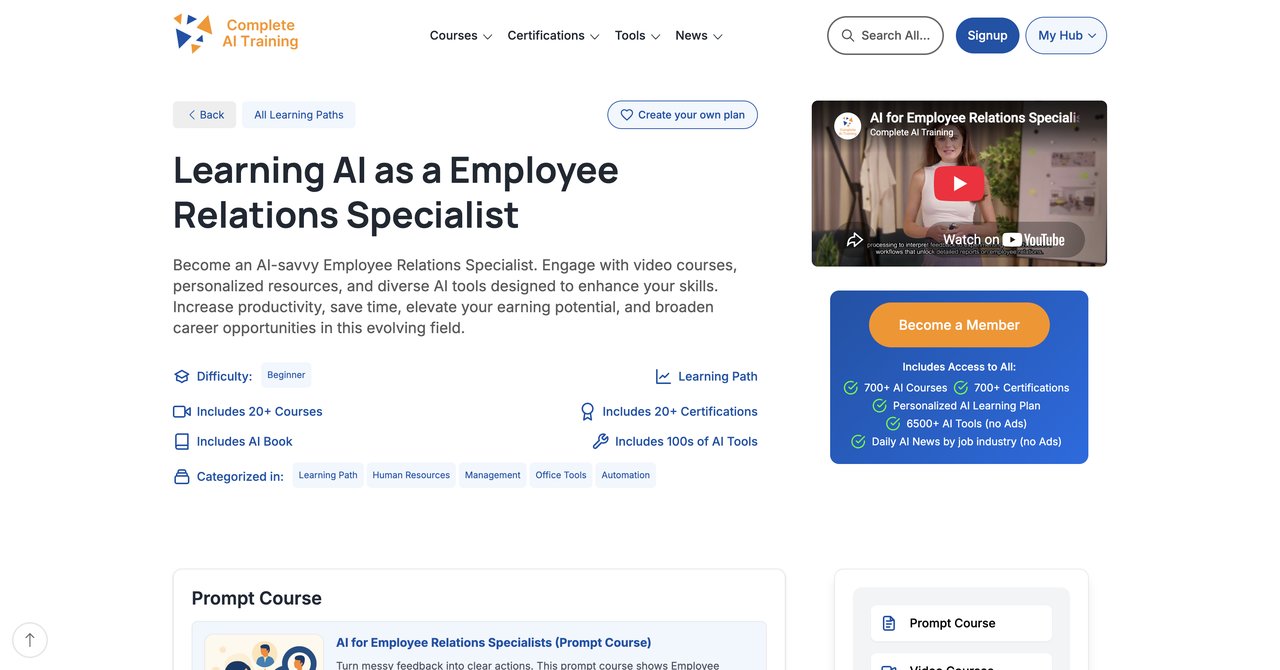
CompleteAI Training does not sell a single course. Instead, a single subscription gets you access to every course and every certification hosted on their entire website. It's an important difference. You are getting full access to ALL video courses on that platform, not a single class or a static bundle. That covers all certifications included at no extra charge, so you can expand what you know without buying additional certificates elsewhere. New video lectures, new certifications, and fresh material is being added continuously, and those newer items are automatically included as part of your plan.
The key advantage compared with all other providers in this list is the subscription model itself. Most companies sell the course and ask you to pay extra for the certificate at the end. CompleteAI Training does not do that. One flat rate makes this an "all-you-can-learn" environment. It also includes the material from every job role-not just employee relations-which matters for anyone whose work intersects with talent acquisition, L&D, or generalist duties, and for anyone looking to move roles in the future.
At a price of $8.25 per month if you pay annually (or $29 for a month at a time), the value formula is different from others in this article. The platform regularly updates its material to keep up with tools that change often. If you are someone who wants to learn in more than one HR area, there isn't another product in this list that compares.
Key Topics Covered
- Practical use of AI for employee relations case notes and reporting
- AI integrations for investigations and tracking
- Prompting techniques tailored to ER work
- Privacy and compliance uses of GenAI tools
- Automating communication outputs and policy summaries
Target Audience and Skill Level
This platform is suitable if you are brand-new to AI or currently a high-level power user. Its broad focus also works for people split across ER and other functions. To benefit, you need only basic familiarity with typical HR software.
Pros
- Full access to ALL video courses on the platform, not a single course or a fixed bundle
- Full access to ALL certifications on the platform, included at no extra cost
- New courses and certifications are added continuously and are included automatically
- Access to every other job role's material too, which matters for anyone whose work spans more than one function or wants to move roles
- One flat subscription price covers all of the above, versus paying per course elsewhere
- Daily updates on relevant AI tools and news
- Very affordable pricing, especially with annual billing
Cons
- Subscription based, and continuous learning is crucial as AI develops continuously
Who Benefits Most
This is ideal for the ER specialist who is willing to study often and wants technical and soft skills in the same place. It is equally beneficial for someone who thinks about yearly goals-maybe your next position is an HR Generalist or an HRBP role-because you get immediate opportunity to those other content areas. If you value total access and continuing updates, that makes this top of the pile.
Course 2: Generative AI for HR Professionals by Coursera
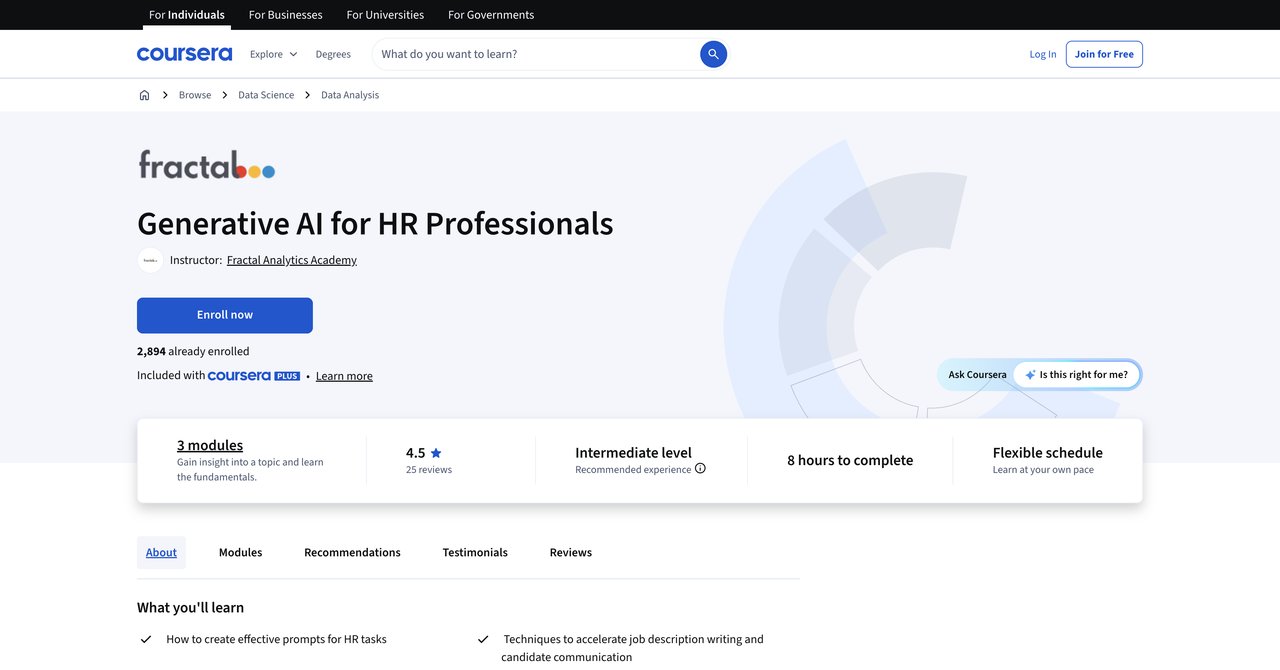
Coursera's Generative AI for HR Professionals is built to train you in using prompt engineering for real HR scenarios. There are hands-on labs all around the HR lifecycle, to ensure you practice not just hear. It does explicitly cover cases of bias mitigation and how to handle privacy compliance, topics that are cannot to ignore in ER. There is emphasis built into drafting policies and basically the templates used to appraise performance. Both delivery and content are practical.
The bigger challenge: this course is not ER-specific, it occupies broader HR scope, so if your everyday work is only managing employee complaints, some of the content may be less relevant. You should also be somewhat seasoned AI-level, because "generative" in name implies a slight expectation level with AI tools. In other words, complete beginners could feel just a little staggered at some of the points in the curriculum.
As with any Coursera product, you gain access via their subscription or by seeking financial aid. If you are already inside the Coursera ecosystem, this is a neat add-on.
Key Topics Covered
- Prompt engineering for all kinds of HR scenarios
- Removing biases from AI output
- Maintaining confidentiality and data protection in Generative AI
- Proper AI-assisted policy drafting and performance analysis
Target Audience and Skill Level Requirements
Intended for an HR profession, working in compensation, talent, or full employee lifecycle. Must know your way around AI prompting and vocabulary.
Pros
- Hands-on labs for prompt engineering across the HR lifecycle
- Covers bias mitigation and privacy compliance
- Includes policy drafting and performance review templates
Cons
- Not ER-specific-broader HR focus
- Requires intermediate AI familiarity
Who Would Benefit Most
HR professionals working in generalist positions and who manage multiple duties. Those already paying Coursera plus subscription should like the least friction and the instant access.
Course 3: AI for Federal Employee Relations Course by Graduate School USA
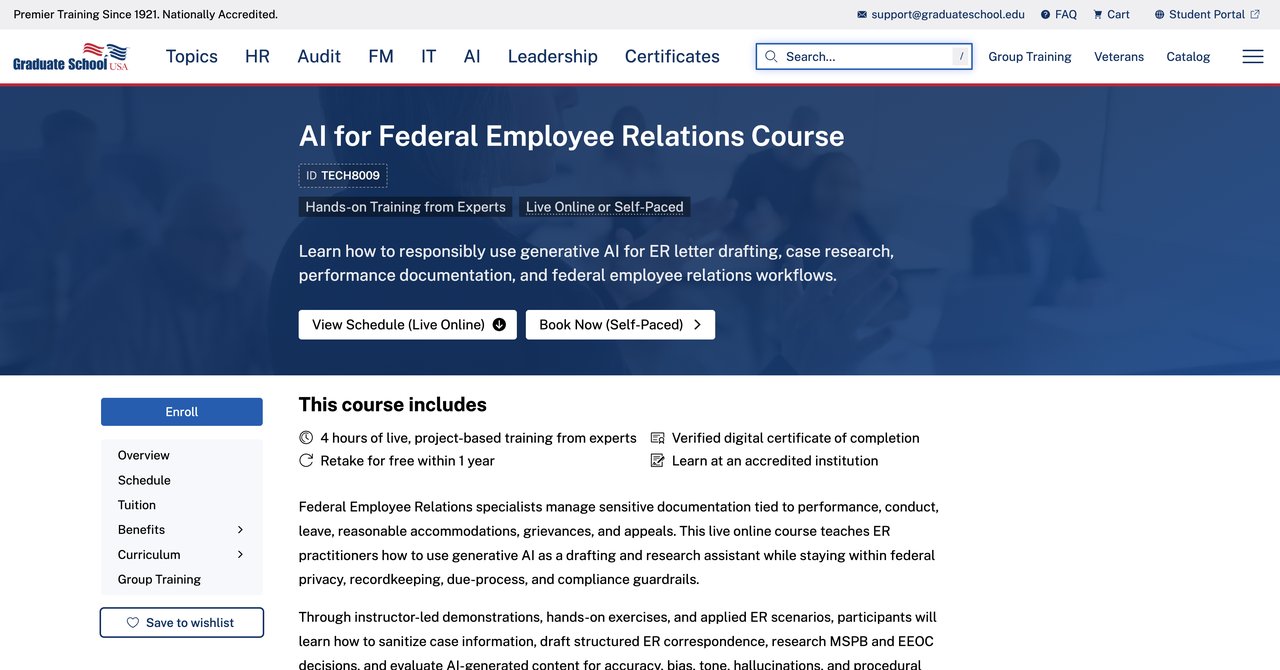
The Graduate School USA offers this course specfically if you operate in the federal sector. The price is $675, and it covers the federal landscape-MSPB, EEOC, and OPM rules-those exact set of regulation that you will be alongside. You will get hands-on study on sanitizing and understanding PII sanitization, and how to properly keep recordkeeping rules in the federal context. The classroom setting includes instructor-led hours plus individual work on of real ER scenarios.
That sounds full and complete, because the focus is purely federal. It's not something a corporate ER rep would find any utility from. They mention large portions of MSPB, EEOC and OPM that private-sector folks do not deal with on a daily basis. The instructor-led nature also implies you might not be learning at your own speed.
This course looks like spending on employment to meet specific public service requirements. You should weigh if that $675 fee is justifiable against only federal content. For a federal practitioner, the fit is uncanny.
Key Topics Covered
- AI applications under MSPB, EEOC, OPM
- Preventing PII breaches
- Proper system of records for AI use
- Case scenarios for ER documentation
Target Audience and Skill Level Requirements
Anyone working as an ER specialist or advisor for a federal agency. Might be useful to attorneys or hearing officers, but not relevant for commercial HR. It assumes that you know the federal role and court structures.
Pros
- Federal-specific (MSPB, EEOC, OPM)
- Covers PII sanitization and federal recordkeeping requirements rules
- Instructor-led with hands-on ER scenarios
Cons
- Expensive
- Only for federal ER practitioners, not private sector
Who Would Benefit Most
Federal ER specialists who have the budget and require up-to-date knowledge of integrating AI while staying inside civil service boundaries.
Course 4: Prompt Engineering for HR (Master AI Prompting for HR) by Udemy
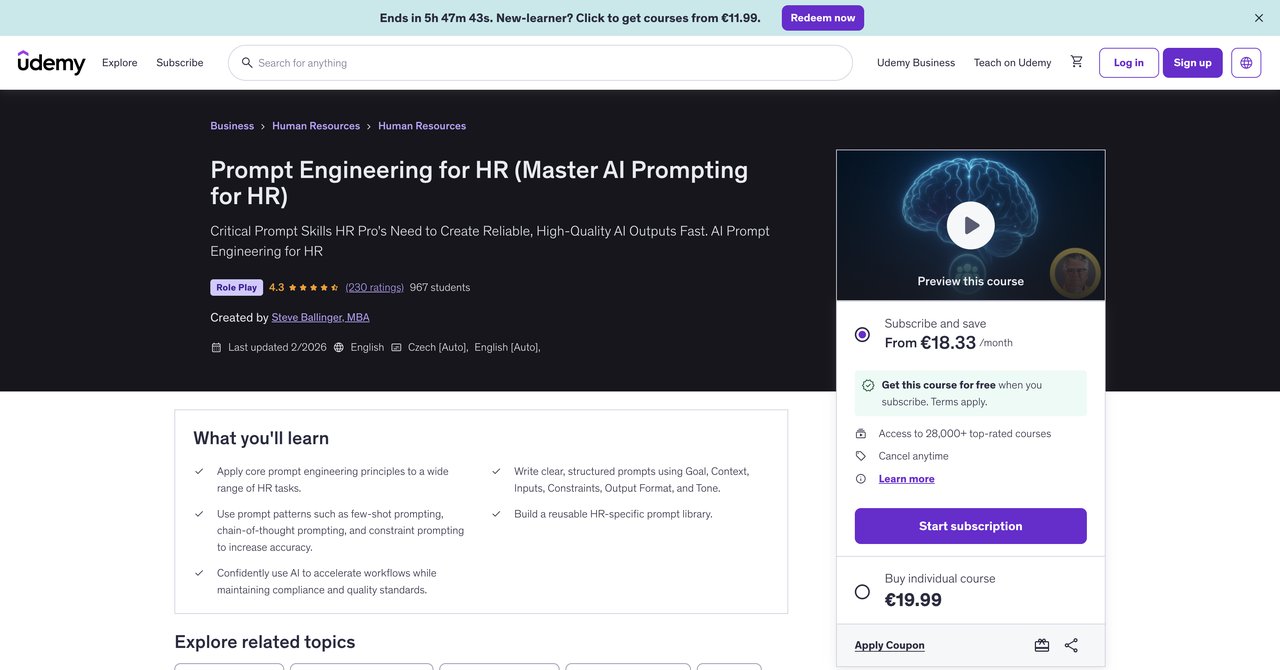
Udemy's course is called Prompt Engineering for HR , Master AI Prompting for HR Course. What's notable here above all is how practical it is for ER. It includes material about developing ER documentation and applying your prompting framework that you can reuse. The focus is on teaching you to give the same prompts the same way every time, which helps keep a quality consistent across your document for employee relations, recruiting, and colleagues.
Pricing here is around $20-USD, but Udemy frequent sales may make it far cheaper. In the list, this is one of the best values sizes. Because Udemy relies on going through a video yourself and not being live, so you cannot ask a question to an instructor and get direct replies. It's not ER exclusive strict. You will need to do deal with reading around other HR areas like L&D, though there's enough content for ER to make sense.
One area where this course wins is its practical, step-by-step method that does not feel daunting. But if a live community and getting the feedback in class is something you have to have, you'd find that missing here.
Key Topics Covered
- Repeatable prompting framework for ER tasks
- Employee relations documentation and intake tasks
- Creating specific outputs for recruiting and analytics needs
Target Audience and Skill Level Requirements
Your job title can be ER specialist, recruiter, or L&D coordinator. It also fits entry-level prompts, up to a user wanting to fine tune training. No complex background required, but it is best for the HR professional who wants to tighten theirs through prompts.
Pros
- Role-specific for HR including ER documentation
- Structured repeatable prompting framework
- Practical for recruiting, ER, L&D, and analytics
Cons
- Not ER-exclusive
- No live instructor
Who Would Benefit Most
An HR specialist who prefers to watch, rewind and apply quickly after. If you also have multiple HR hats (some ER, some recruitment), this low-cost option is practical.
Course 5: Introduction to AI for HR professionals by Coursera
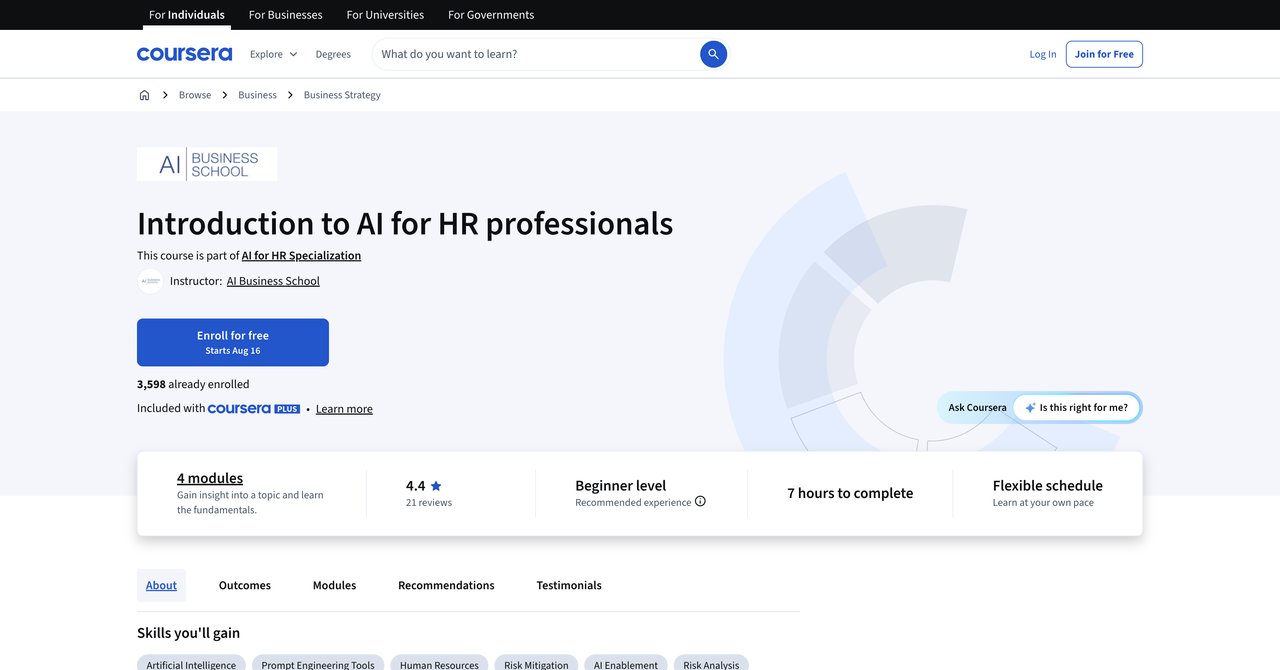
The Coursera Introduction to AI for HR Professionals is fundamentally an entry-level and can be audited for free. It covers some basic generative AI terms, core textual tasks, and low-level safe usage, so perfect for people know HR but are not necessarily AI-savvy. The material has exercises, so you aren't only looking at brain popcorn or slides, you are doing practice like writing and checking outputs.
But because it is it's foundational, the content is not deep and definitely not ER specific. If you are a seasoned ER specialist who already learned to AI with your own environment, this will seem like it's missing. The most positive use for an ER specialist is to fill general literacy gap, but the substance will not dig into the type of casework that you already know how to do.
The good part is, it costs nothing when you audit, and you can still choose to pay for the certificate if you see fit. This is the kind of course that becomes a stepping stone to a heavier platform.
Key Topics Covered
- Describe main forms of generative AI
- Use simple prompts to type HR-related content
- Identify issues of hallticity and limits in AI for your HR
Target Audience and Skill Level Requirements
HR professionals includes employee relations assistants or coordinators who are starting. It is built for AI novices.
Pros
- Foundational GenAI literacy for HR
- Free to audit
- Hands-on exercises
Cons
- Very introductory
- Not ER-specific
Who Would Benefit Most
HR professionals new to AI, staff looking to start, or managers who need to get a cost-free common language about AI and must have exposure to how it applies to HR.
Course 6: Generative AI HR Professional Specialization by Coursera
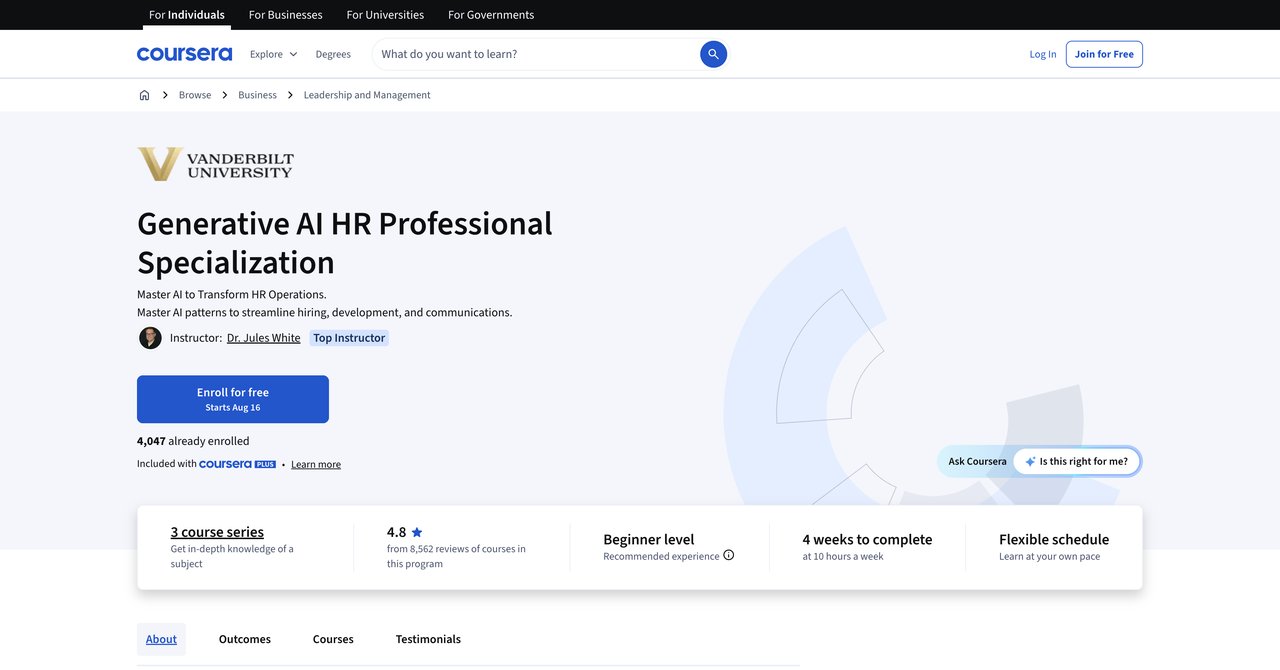
Offered by Coursera's Specialization on Generative AI HR Professional, this is a fuller program. In comparison to the simple introductory one, the specialization is multi-dependent. It tackles how to reduce AI hallucinations, which is useful. Worse: it shows you how to input a long plan, guidance, or transcript into a generator, then transform it into chronological timelines, email drafts, FAQ pieces, or other type of deliverables that saves time and streams you so you can do more involved work. That is exactly a value ER specialist can benefit from.
The downside is also that specialization has a broad HR scope and a longer timeline. You are committing to more modules and content, though the number of weekly hours is something to consider when you work. If you want comprehensive HR coverage, with real practitioner tasks, this one is a strong candidate. But if all you are facing is deadlines for the cases and you just need ER specifics, this might provide more delay than benefit.
Key Topics Covered
- Reduce AI hallucinations
- Transform documents into timelines, emails, FAQs
- Strategies for speed and deeper work
Target Audience and Skill Level Requirements
For the HR professional who wants to use AI across all your tasks, including but not exclusive to. It starts with basic concept but slowly raises the bar. A decent understanding of HR business practices is required.
Pros
- Covers reducing AI hallucinations
- Transforms documents into timelines, emails, FAQs
- Frees time for strategic work
Cons
- Broad HR scope
- Longer commitment
Who Would Benefit Most
These who can afford the course and are self-motivated. ER specialists who partner with different functions and want to make themselves efficient overall.
Course 7: Artificial Intelligence for HR Professionals by HRCI
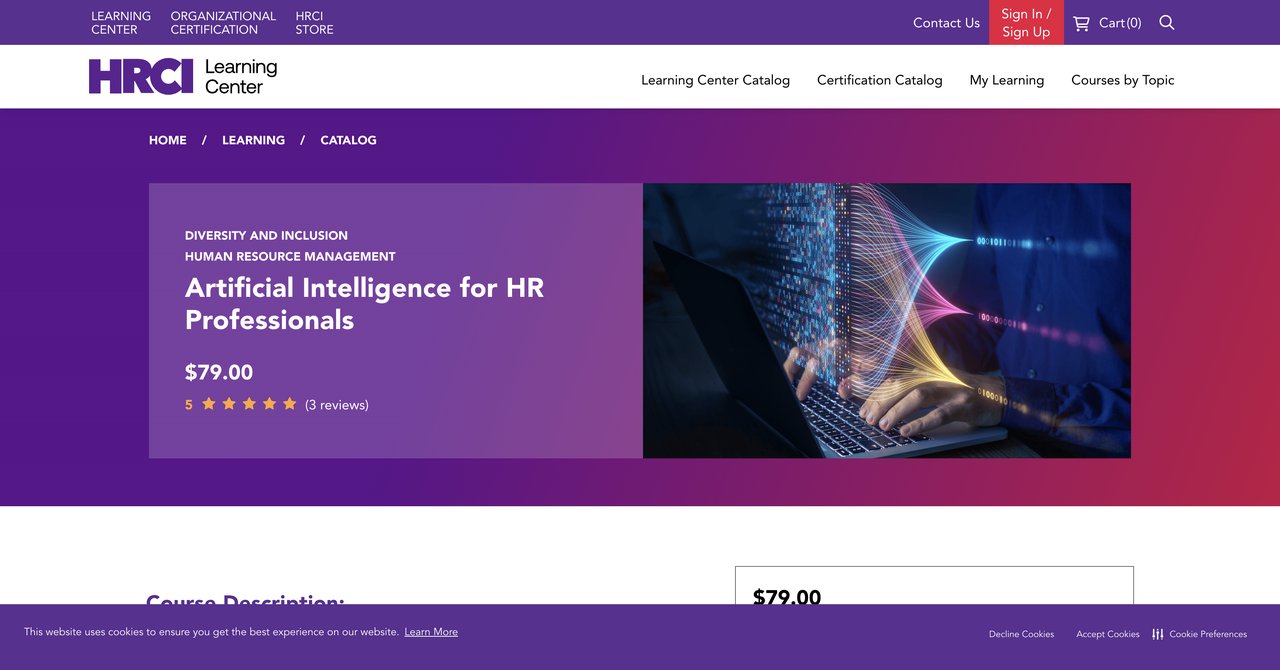
HRCI offers a course that matters to certified professionals because it offers recertification credits. It discusses the linkage among ethical AI, legal compliance, and how it impacts DEI bias. They walk through human oversight frameworks, which is hihgly needed if you are expected to audit algorithms that hire or fire people.
Since HRCI is a flagship body in HR, this course was written and reviewed with the, likely, high degree of accuracy, but the scope is HR overall, and not solely ER. The price is non pubblic. Because it is decided likely via member status, you need to compare pricing before enrolling. The bigger distinguishing feature is that you know you'll get quality from this accreditor-and HRCI blocks it, which is a big plus.
Key Topics Covered
- Ethical AI principles for HR people
- Legal compliance when used in the US
- DEI bias in model training
- Establishing workflows for human control
Target Audience and Skill Level Requirements
The HR specialist who already has some HR experience, possibly holds an HRCI credential, and wants to work in a compliance posture.
Pros
- HRCI-accredited
- Covers ethical AI, legal compliance, and DEI bias
- Includes human oversight frameworks
Cons
- Not ER-specific
- Price not published
Who Would Benefit Most
HR management that has to put correct AI practices above specific ER tasks, and obtains an international accredited credential.
Course 8: Professional Certificate in AI in Employee Relations Management by Stanmore School of Business (UK)
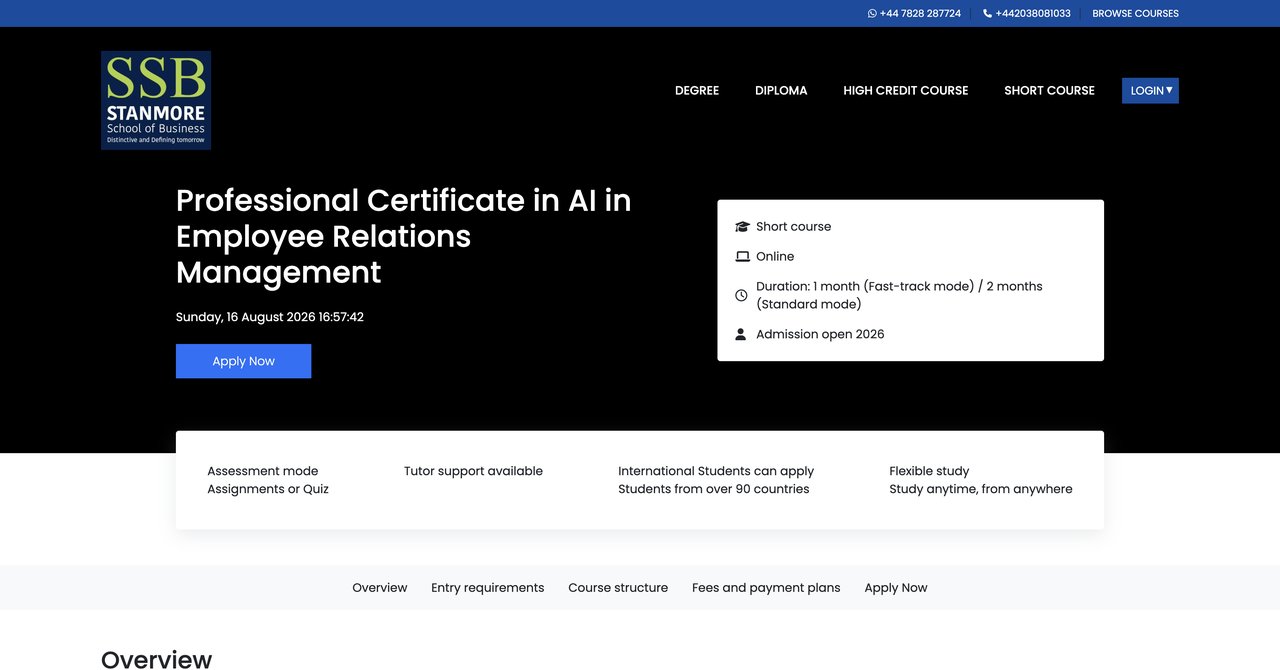
Stanmore School of Business (in the UK) runs an open course certificate in AI for ER. It truly is specific to ER, and it covers some distinct areas you'll not always find: AI-based conflict resolution, NLP to process employee feedback, and how to run predictive analytics for retention. International perspectives make it interesting if you spend time on cros-border employment.
The course can be completed within fast-track one month (£140) or normal two (around £90) months-which is about USD $115-180, a low-cost entry credential. The primary concern? Stanmore is a smaller, niche provider, no big reviews anywhere. The lack of external reviews could lead you wanting to take less assurance than that from established schools like Coursera or Graduate School USA. If you want an ER-specific certificate for less money, and one with UK flavor, this is a good route.
Key Topics Covered
- AI-driven conflict resolution
- NLP for employee feedback
- Predictive retention analytics
Target Audience and Skill Level Requirements
ER professional who's looking for a certificate that is directly tied to employee relations. Basic AI ability is expected, though enough move with the basics.
Pros
- ER-specific curriculum
- Covers AI-driven conflict resolution and NLP for employee feedback
- Includes predictive analytics for retention
Cons
- Small provider
- No external reviews found
Who Would Benefit Most
Employees working in international-facing ER and looking for an affordable quick credential.
Course 9: Claude AI for Employee Relations by ComplianceIQ
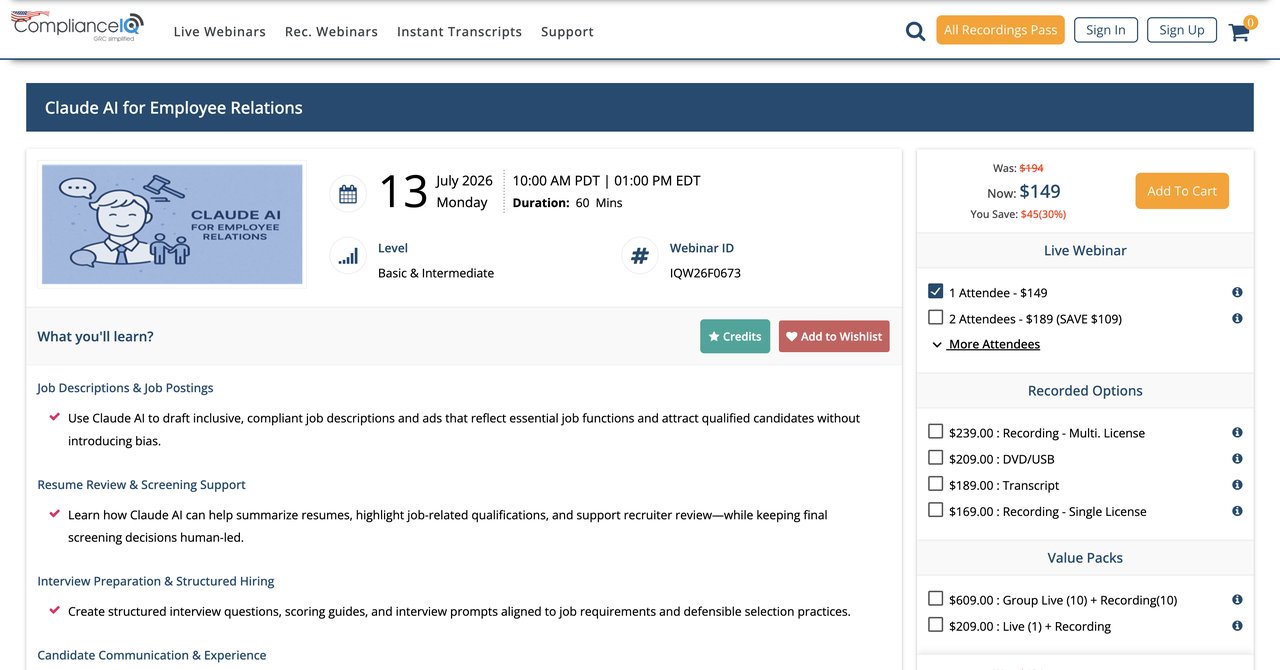
ComplianceIQ takes a completely tool-specific flash course, teaching you how you can use Claude, an AI model, specifically on ER tasks that are closest to hiring and compliance tasks. The live format lets you ask and adjust while the event runs, easier to step through the resulting output. The topics are practical for hiring-adjacent ER tasks, talking to sharing or onboarding paths.
This looks like a webinar, so it is brief. It is not an entire course, but a spot session. If you use Claude AI in your workplace already, you probably can use it quickly and directly, but you'll always be around in a niche usage of hiring, meaning all ER duties like investigations and grievances are sidelined. The pricing is not clearly visible and typical for webinar.
Key Topics Covered
- Claude AI features for ER
- Recruiting and hiring-related compliance steps
- Live demonstrations of tasks
Target Audience and Skill Level Requirements
This targets HR managers specifically who use a Claude AI environment. You should know Claude AI or another ChatGPT, or be comfortable adopting new tool interfaces quickly. Time-pressed sessions are more for operational.
Pros
- Tool-specific (Claude AI)
- Practical for recruiting and hiring tasks
- Live interactive format
Cons
- Narrow scope (recruiting focus)
- Short duration
Who Would Benefit Most
For HR coordinators in talent acquisition and ER who hold recruiting roles, who are already deciding or using Claude AI and need a quick input.
Final Recommendations and Overall Wrap-Up
Choosing the best path depends on your budget, current AI level, and duties. Most people want to get direct value and future advantage.
If your primary focus is your ER role and you want access to a large amount at once, complete training platform from CompleteAI Training deserves your attention. The subscription model gives you sustained updates, all the certifications, and many other functions beyond ER for the same price. That extra value makes it attractive to long-term learners who need new moves. It's the best for anyone who wants to switch roles in HR later.
If you are legally required to obviously understanding federal ER rules, the Graduate School USA course is built for exactly that niche. The price is steep, but the external resources and the structure justify it for someone employed by a federal agency.
If you want the shortest path to value while working on a tight budget, Udemy's Prompt Engineering for HR is an easy $20-50 ticket. It includes an ER documentation, giving you a repeatable if you use your own work. Material isn't live, but still workable for little enough.
For HR practitioners seeking a recognized brand but not necessarily ER-specific, Coursera's Generative AI HR Professional Specialization or HRCI's course works. Coursera's free "Introduction" is a good entry, though if you are serious, you would soak in the Specialization to get more useful tech skills.
If you want a UK perspective with specific ER materials, Stanmore is good value for the price. Be aware of that reduced exposure external reviews might add caution. The same applies to ComplianceIQ's webinar, which is only a taste but can answer any specific Claude question.
No single course is the final answer, but the ones that use highly specific contexts-E.G. federal or Claude-fit best with that commodity. Broader platforms almost seem outsized but they're smart if your role blurs across HR domains. The biggest question: do you depend on continuous learning and a subscription, or do you only need a single block, with deadline? That matches in answer. If you want the entire access to all sections and beyond, starting with the CompleteAI Training subscription may end your search immediately.
You might also like

11 Best AI Courses for Human Resources Managers to Future-Proof Your Career in 2026