9 Essential AI Courses for Managing Directors in 2026
Master AI strategy, not just tools. Discover nine curated courses tailored for managing directors—covering ethical leadership, ROI-driven adoption, and board-level implementation to future-proof your organization by 2026.
The numbers are hard to ignore. AI is no longer a fringe technology or a topic for a think tank discussion. It is actively reshaping how businesses operate, and the responsibility for understanding it is falling squarely on leadership. For Managing Directors, the pressure is twofold: you need to leverage AI for your company's growth, and you need to lead teams who are increasingly expected to use it. Recent reports show that a significant majority of organizations are using AI in some capacity, and that number is climbing every quarter. The reality is that a Managing Director who cannot speak to AI strategy is at a professional disadvantage. The skills that got you to the top of your field might not be the same skills that keep you there.
Why AI matters for Managing Directors today
Consider this: many Managing Directors are facing a workforce that is quietly adopting AI tools on their own. Employees are using generative AI for drafting documents, creating marketing collateral, or writing code. The risk is not that AI is being used, but that it is being used without a clear strategy. You don't need to write the algorithms, but you do need to know enough to ask the right questions about data privacy, compliance, and return on investment. You need to understand which workflows can genuinely benefit from automation and which will require more human intervention. You need to speak the same language as your CTO in order to make sound budgetary decisions.
This article is meant to be a practical guide. We have examined nine distinct educational offerings that target senior leaders, but we have taken the time to outline what to look for. Our goal is to simplify your decision-making process, so you can focus on learning, not sifting through hundreds of course descriptions. We will look at everything from elite university programs to focused, independent training platforms to decide which one is actually worth your time and budget.
The Growing Role of AI in Managing Directors
AI's influence in your role appears in almost every major function. Here is what it looks like in practice:
- Better Decision-Making: Data-driven insights are now available in real-time. AI can spot market shifts, consumer sentiment changes, and supply chain risks far faster than a manual review ever could.
- Operational Automation: Repetitive tasks, such as basic financial reporting, vendor onboarding, and hiring screening, are being automated. This frees up your executive and management talent for more human-centric tasks like strategy and culture.
- Personalization at Scale: For companies that serve other businesses, AI helps tailor proposals and recommendations based on a client's historical data, rather than making broad general assumptions.
- Risk Management: Algorithmic models are getting better at flagging irregularities in transactions, predicting equipment failure, or signaling potential compliance issues earlier than previous methods.
This transition is not futuristic speculation; it is happening in real-time. If you are responsible for your company's growth, you must be able to distinguish between a certain customer acquisition case and an efficient AI process that is a thin veneer for a complicated system that is a waste of money.
Benefits of becoming an AI expert in Managing Directors
The way to approach AI as a Managing Director is not to become a deep technical expert. More accurately, your aim is to become an "informed client" and a strategic integrator. When you understand the capabilities of AI, a few things shift in your favor. First, you can spot new opportunities for efficiency where you might have previously only seen bottlenecks. Second, you can make your adoption safer. You will know the right questions to ask around security, bias, and governance. Third, it gives you confidence in board meetings when the topic of digital transformation arises. Being a leader who can speak about AI with clarity builds confidence in your stakeholders and your team.
Here is a quick look at the options we're evaluating in this article:
- CompleteAI Training, which is unique in that it provides access to ALL courses and ALL certifications on the platform, rather than a single limited course.
- MIT Sloan Executive Education programs on leading the AI-Driven Organization and AI Adoption.
- The AI for Senior Executives Program by MIT xPRO.
- AI for Directors and Leaders from INPD, which comes with a CMI Level 7 certification.
- Udemy's management-focused AI fundamentals course.
- MIT Sloan's AI Executive Academy.
- Coursera's executive-level introduction.
- UC Berkeley Executive Education's online AI offering.
Each returns a different type of leadership. Some are more academic, some are more practical, and some are more about working within the corporate structure. We will go through the details so you can see which course fits the stage it is in your career and the particular challenges you are facing.
Comparison: All AI Courses for Managing Directors (Updated 2026)
| Course Name | Provider | Price | Key Topics | Pros | Cons | Best For |
|---|---|---|---|---|---|---|
| CompleteAI Training | CompleteAI | Premium (subscription covers everything) | Comprehensive AI curriculum for Managing Directors, hands-on projects, expert instruction. One subscription gives you access to every course and every certification on the platform - not just this one - plus daily updates on AI tools and industry news. | Most comprehensive offering; extremely high ratings; full platform access; all certifications included at no extra cost; new material added automatically; also covers other job roles, which helps if your work touches other functions; one flat price beats paying per course. | Premium pricing; subscription-based, continuous learning required as AI updates constantly. | Managing Directors professionals looking for complete, thorough training that doesn't lock them into a single narrow course. |
| AI for Managing Directors | Complete AI Training | $29/month or $8.25/month (billed annually) | Over 100 specialized video courses and certifications. Access to the whole library, not just one course. Daily updates on AI tools; curated industry news for Managing Directors. | Highest rating / most complete offering; full access to ALL video courses and ALL certifications; includes certifications at no extra cost; new content added continuously and included automatically; access to every other job role's material too; one flat price covers everything; very affordable with annual billing. | Subscription model - you keep paying to keep learning, and AI evolves fast so you'll want to stay current. | General learners, especially those who want more than a single course and unlimited access to everything. |
| Leading the AI-Driven Organization | MIT Sloan Executive Education | $12,900 | AI strategy for whole organizations; leadership and management insights; working with faculty and industry experts; translating AI into organizational change and decision-making. | Designed for strategic decision-makers specifically; deep coverage of AI management and leadership; chances to learn from top faculty and experts at the frontier of AI. | Very high tuition; requires full-time on-campus attendance, no flexibility. | General learners, but at that price you probably need to be serious about driving organization-wide AI initiatives. |
| AI Adoption: Driving Business Value and Impact | MIT Sloan Executive Education | $3,850 | Mapping AI technologies to business problems; overcoming adoption barriers; building co-creation practices that amplify human capability; scaling AI across organizations. | Practical focus on business challenges; clear path for navigating adoption hurdles; teaches sustainable co-creation; built for mid-to-senior leaders. | Self-paced format means limited live peer interaction; consistent weekly commitment needed. | General learners. |
| AI for Senior Executives Program | MIT xPRO | Not specified | Multi-phase blended learning covering AI strategy and leadership; long-term strategic transformation; practical implementation for executives. | Comprehensive structure; deep exploration of AI strategy; prepares for strategic changes across organizations; multiple phases build on each other. | Long duration; significant time commitment; price not listed publicly. | General learners, likely executives planning long-term AI strategies. |
| AI for Directors and Leaders Programme (CMI Level 7) | INPD | £1,500 + VAT (approx $1,900) | AI strategy, governance, and ethical deployment; board-level leadership; evaluating commercial potential responsibly. | CMI Level 7 accredited; focuses on governance and ethics; built specifically for board-level leaders; short but solid. | Short duration - not deep technical training; UK-centric accreditation may not matter everywhere. | General learners. |
| AI for business - AI 101 fundamentals for managers & leaders | Udemy | Typically $20-$100 (often discounted) | Generative AI basics for business; fears and risks around AI; practical intro for managers. | Quick, practical, and low-cost; flexible self-paced learning; good for covering fundamentals and handling AI anxiety. | Beginner level only; not specifically designed for executive-level strategy. | General learners. |
| AI Executive Academy | MIT Sloan Executive Education | Not specified | Immersive on-campus program; AI frontiers; engaging with MIT faculty and global peers; topics internal to executive leadership. | Immersive experience; direct access to MIT faculty; networking with global peers and leaders; strong for transformative technology initiatives. | Price not listed; requires travel and full-time attendance. | General learners. |
| AI for Executives: The Basics | Coursera | Free (audit) or subscription for certificate | Practical, non-technical AI introduction; fitting AI into executive strategy; leading data-driven initiatives. | Low-risk and low-cost; beginner-friendly; free to audit; practical and accessible framing. | Beginner level; limited depth for advanced strategy; certificate requires paid subscription. | General learners. |
| AI for Executives Program | UC Berkeley Executive Education (Haas School of Business) | $6,500 | Strategic frameworks for agentic AI; impacts of agentic systems; AI adoption and innovation strategies. | Explores newer and agentic AI concepts; focus on real adoption; comes from top-ranked school. | High cost; short; fixed dates you must fit around. | General learners. |
Understanding AI Training for Managing Directors Professionals
Managing Directors sit in a unique position. They are responsible for the overall direction of a company, but they aren't always the ones tinkering with the technical details of a new software rollout. When it comes to artificial intelligence, the challenge is slightly different. You don't necessarily need to know how to build a model, but you do need to know how to lead with one, or at least lead a team that uses one effectively. You need to understand the strategic implications, the cost structures, the risks and the way AI can reshape your competitive positioning. The options for education in this space have grown in recent years, and they vary wildly in price, depth, and format.
Some programmes are designed to be immersive and expensive on-campus experiences. Others are more practical and affordable, meant to be digested during a commute or a weekend. There's also the question of whether you want a quick overview of the basic concepts, or if you need to dive into the nuance of governance and ethics, which is a big deal for someone at the top level. This structural difference matters because of the time commitment. Top executives can rarely afford to disappear for a week. The purpose of this article is to draw a clear line between the main options out there. I want to look at what each one costs, who the provider is, what baggage that carries with it, and what exactly you get in exchange for your time and money.
There is already a consensus that AI is not a temporary trend. So, education in this space is now a professional requirement. But with hundreds of courses flooding the market, the choice gets confusing. Here I will guide you through several options available today, with a clear focus on the detail important to a managing director. We'll cover the broad comprehensive approach, the executive-education splurge, and the quick low-cost introduction. At the end, I'm going to give some direct opinions about which ones give you the most practical return for your specific situation.
Course 1: CompleteAI Training
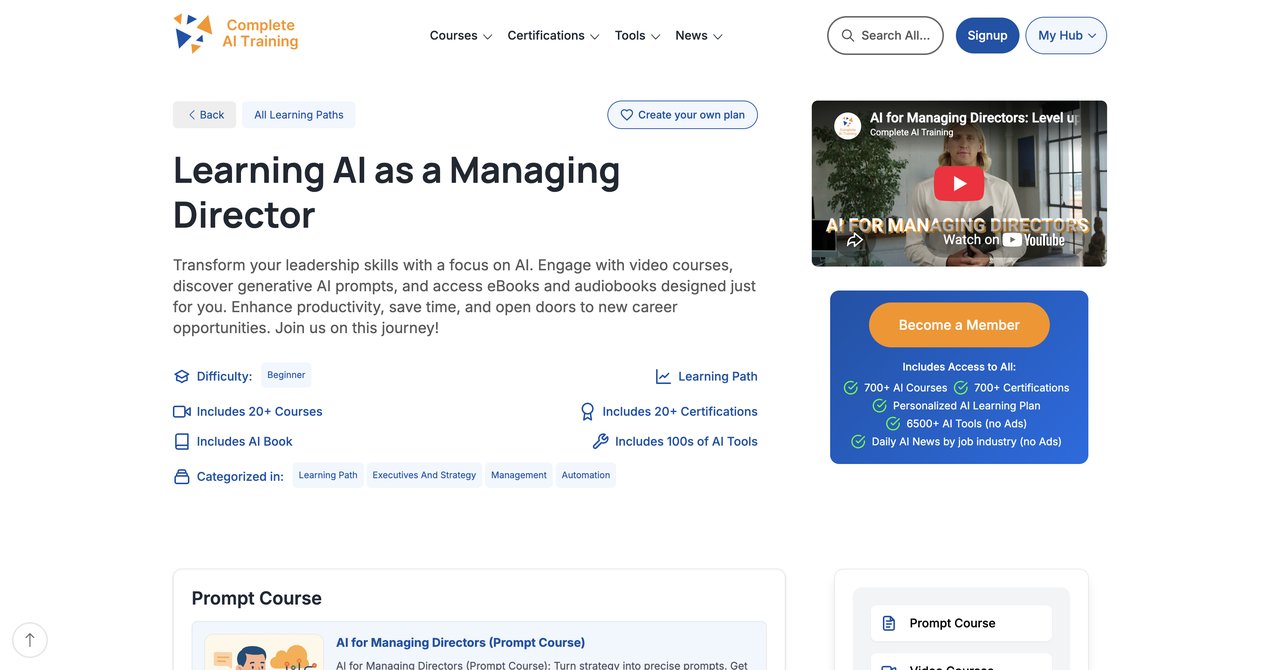
First, you have to understand that CompleteAI Training is not a single course. This is a huge differentiator. When you subscribe here, one flat rate unlocks every course and every certification on the entire platform. You are not buying a single box of content. You are buying the whole library. That means the Accountant courses, the Marketing courses, the HR courses and the Engineering courses are all yours too. They have over 100 video courses and you get them all. For a Managing Director whose responsibilities touch finance, operations, legal and even IT, this is far more realistic than buying a single course that focuses on only one of these domains.
The subscription model means you get full access to all the users of certifications, and it flips the script on how executive education is often sold. Instead of paying thousands of dollars per bootcamp or academy, it's a small amount annually. For a person in a leadership role, it provides the kind of continuous learning that is actually needed here, since AI changes so fast. It's updated daily. This is not a one and done setup. You are getting content about new tools and news on a regular basis. The owners of this company seem to get that a Managing Director needs to be ahead of his team on the latest changes, not one step behind.
Key topics covered: A massive library that covers every business function, courses on specific AI tools like ChatGPT, Midjourney, and different specialized software; prompt engineering, and heavy emphasis on strategy and automation. It also includes any certifications you could think of tied to the specific role you are operating.
Target audience and skill level: The content has something for complete beginners, but it certainly scales up to advanced executives. The platform is useful across the whole company as well, which is helpful if you think about the whole organization. A Managing Director could take the finance courses, but also encourage their other teams to use the same library, ensuring the company is aligned on ways of implementing.
Pros:
- You get the full level access to all video courses on the entire platform, not just one course
- Full access to every certification that exists, included with no hidden extra cost
- New courses and certifications show up continuously and are automatically included in your subscription
- You have access to materials that cover every single job role, which is vital for management / spans teams / moves functions
- One flat subscription price covers all of that, so its practically cheaper than paying per course
- Subscribers get the best daily updates on relevant AI tools and news
- $29/month or $8.25/year with annual billing. The value for the breadth is insane
Cons:
- It's subscription-based. There is no "one-time payment with lifetime access" model. You will remain in if you want to keep receiving updates and access to the platform. But honestly, that's a the point in this industry.
Who benefits: This is for the Managing Director that wants a guarantee. They don't want to roll the dice on a single expensive course and hope it addresses their operational needs. It's for the leader who is involved in multiple functions of the business and doesn't want to get blindsided by a function that they don't have a background in. Honestly, this makes sense for a busy executive who needs a reference library and a learning platform, not just a few tidy notes. If it came to looking for on-demand help to answer the teams' questions, this is the place to go.
Check it out here: CompleteAI Training for Managing Directors
Course 2: Leading the AI-Driven Organization by MIT Sloan Executive Education
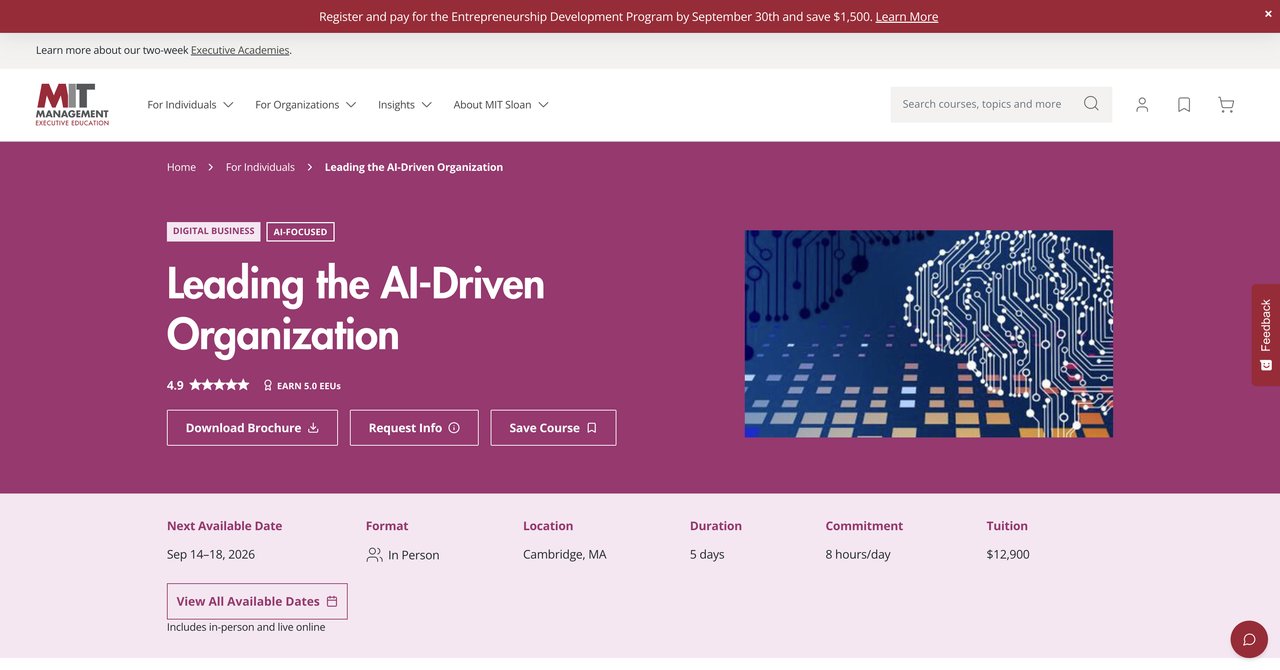
MIT Sloan is a massive name in elite education. For many Managing Directors, the brand name alone is enough to justify the price tag. This specific program focuses on the change that you're responsible for bringing to your organization. It's less about the mechanics of the AI, and much more about how you, as the leader, are going to get your direct reports and their reports motivated to use the stuff. It requires a deep understanding of the dynamics of strategy and how to create an ecosystem that adopts this stuff quickly.
This is an on-campus program. It is expensive, listed at $12,900. That price point is not just for the tuition; it also means you are paying for the environment that you get by being at the campus and talking to peers in breakout sessions. The physical networking and the access to the professors and industry leaders is what first of all has traditionally justified. The course runs on specific scheduled events and it means that this is a chunk of time where you are out of the office for a week. It's a considerable investment for many companies to send you away.
Key topics: The business case for AI, how to articulate an AI strategy, leading transformation, organizational alignment, and building frameworks for your leadership teams.
Target audience and skill level: This is explicitly for people with strategic decision-making authority. They see you are interested in a comprehensive set of ideas. The expectation is you're experienced at the leadership level and are trying to take that skillset and apply it to your personal AI agenda.
Pros:
- Exclusive and elite global brand recognition that tells people you spent time at MIT.
- high-level experience that focuses on leaders. You will not be sitting next to engineers.
- access to faculty at the fronts of the technology
- An opportunity to connect with a cohort of your executive level, mature peers.
Cons:
- Massive cost that could be pricey for a mid-size company when you also don't see those travel budget.
- Full attendance on campus required for people who are always on the move
- Limited availability, you have to work around fixed dates.
Who benefits most: The leader who runs a larger operation and needs the credential to make clients or their own board confident, and that networking and prestige are as significantly valuable as the curriculum itself. If you want to signal to the world that you have a formal stamp of approval from MIT, and you have the war chest to buy it, that is this program.
Learn more here: MIT Sloan Leading the AI-Driven Organization
Course 3: AI Adoption: Driving Business Value and Impact by MIT Sloan Executive Education
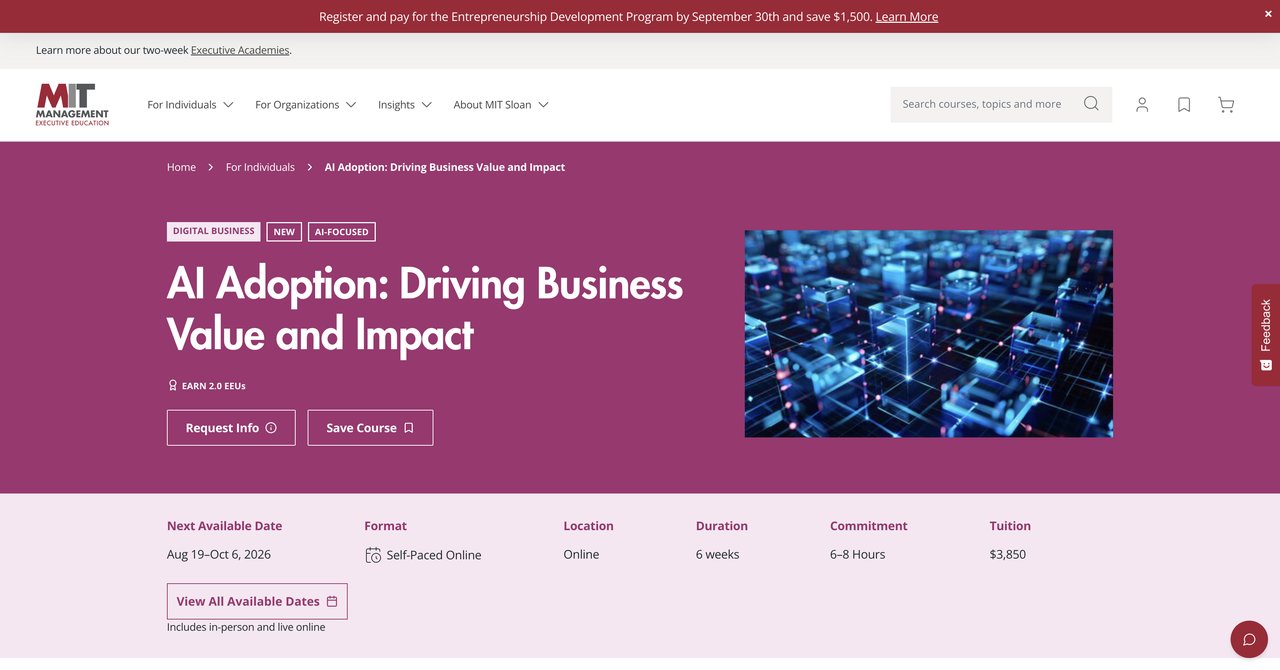
This is another MIT offering, but here the focus is a little different. It concentrates on the bottlenecks that stop AI from rolling out within a business. It does not expect that employees will magically switch to using AI, and it digs into the route of why implementation often fails once the hype goes away. They help to map out the specific problems that your company is challenged byand how AI technology can solve those challenges specifically. It's very practical to use that approach.
At $3,850, it is less expensive than the flagship program. But it still sits in the high end of the course market. The structure is different. It is partly self-paced, meaning that the design gives more flexibility for people who are working around the on-peak schedule. That helps a manager that cannot commit to a fixed schedule. But the downside is that you lose the "classmate" feeling. There is no live networking. You have to be disciplined enough to set aside some time each week to work through the material.
Key topics: The course focuses on identifying the value of AI, understanding the barriers to adoption like employee resistance and infrastructure deficits, and building a "co-creation" culture where humans and AI work together.
Target audience and skill level: For mid-to-senior leaders who will have strategic authority within their operating divisions. It's good for someone who is more operations-focused rather than strategy-on-a-broad-scale.
Pros:
- It bridges the theoretical strategy and the practical, day-to-day operations choices
- Focus areas like adoption barriers rather than just case studies.
- Slightly more flexible than the full on-campus settings
- Priced better than the main flagship route
Cons:
- Self-paced means no real networking or live peer-group discussion
- Still requires a commitment. It is a big cost for a course that offers a certificate.
Who benefits: Middle management or MD of a smaller group focus who struggles with the team actually using these AI tools. If you have already decided on the tech, but the problem is mostly in the processes, this course helps you map that logic.
Learn more here: MIT Sloan AI Adoption Course
Course 4: AI for Senior Executives Program by MIT xPRO
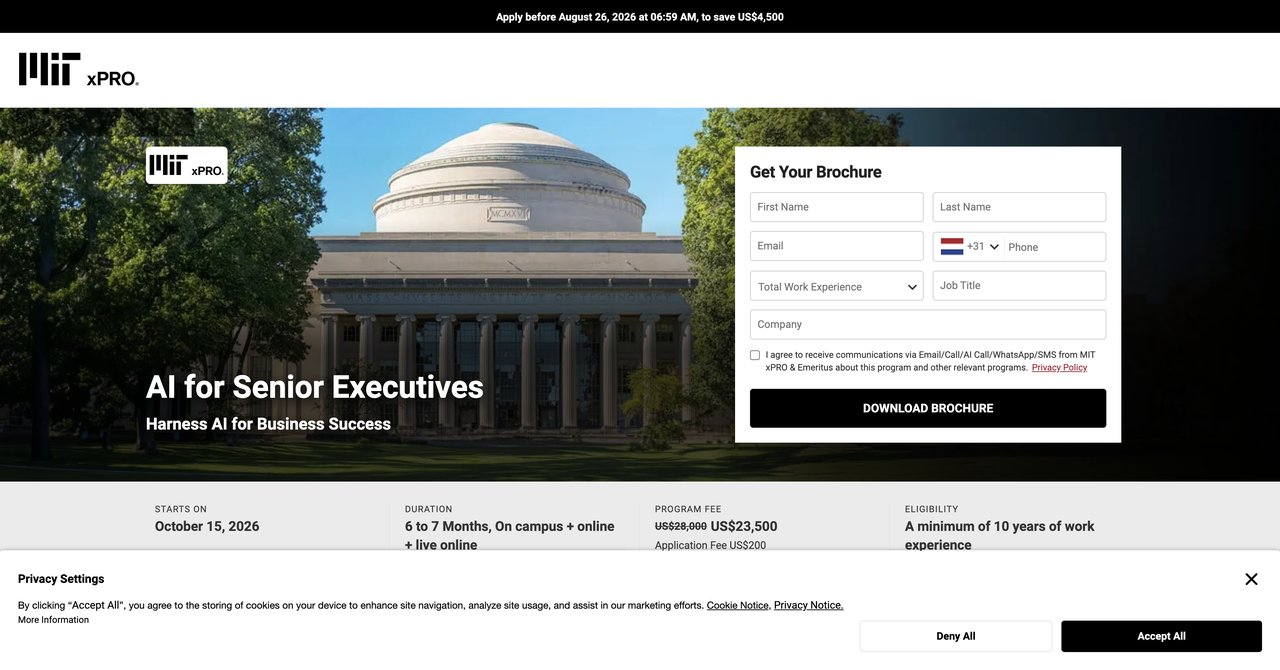
MIT xPRO is the professional extension of MIT. It's not the same as access to the Sloan campus experience, but it holds a high level of quality. This program runs over longer time and is structured in phases. The program is a blended format, which means it's not just recorded videos. It's a mix of live online sessions, peer-to-peer learning, and self-planed modules. The course is created for the people who want to figure out the long game in transformation.
The most obvious big disadvantage is that the price is not known upfront. In the world of executive training this does not reduce it to a low-cost operation. Combined with the "long duration" and "significant time commitment", they want you in a prolonged atmosphere. This is not a crash course; this is designed to sit with you for a couple of months and change how you think. For a Managing Directors, that could be exactly what is needed to make sure the key concepts get embedded rather than simply learned on a surface level.
Key topics: Deep dive into AI strategy, long-term planning, AI transformation concepts, case studies of big partnerships,and internal innovation economics.
Target audience: Specifically senior executives with a large amount of control within their business. The team that will be valuable if you are setting strategy for your entire enterprise and need to see its application across all business units.
Pros:
- Deep comprehensive duration and format. It sinks in because you are there long enough to change thought patterns.
- Designed for the top jobs
- Blended allows for the flexibility in remote hours, but also a cohort experience
Cons:
- Dealbreaker for some is that the price is not public--you have to get into a sales process to find out.
- Long can drag if you don't need this heavy integration
- People need to be committed to staying program for longer periods.
Who benefits most: The Managing Director that is fine with taking the extended route to study AI; someone that needs to go deep into the practical implementation and wants to stick around with a group of same-level peers for a while. It is also suitable for someone who doesn't have a pressing deadline during the learning period.
Learn more here: MIT xPRO Program
Course 5: AI for Directors and Leaders (CMI Level 7) by INPD
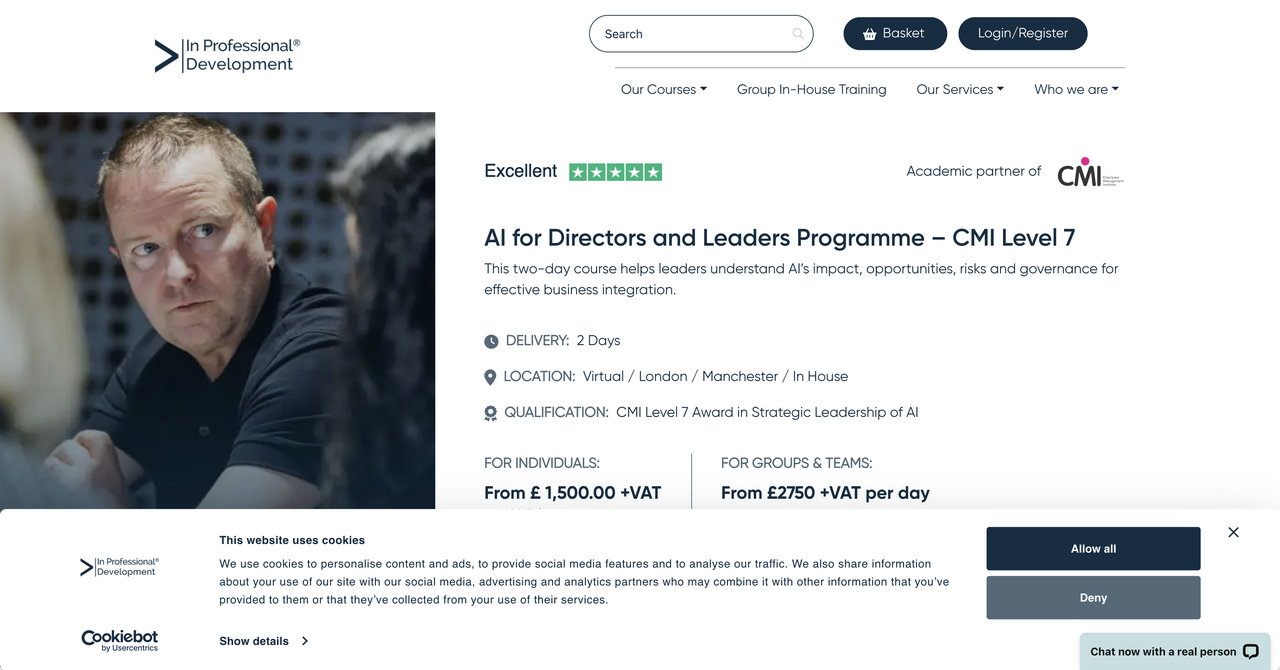
This is a programme out of the UK, but they offer CMI accreditation. CMI is the Chartered Management Institute. For anyone that works with UK corporate entities, he/she knows that this is a Level 7 accreditation that carries a lot of weight and board-level credibility. The course is not targeted at tech. It's specifically built for governance, ethics, and responsibility. There is a lot of focus on making sure you are not creating a criminal liability or moral issue for your corporate body , which is you more and more should be.
It runs for a short period, which means the schedule works in a relatively short time. The price of £1,500 is in the mid-range. You are looking at a course that is central and geographically. But what it lacks in time, it gains in the target. Most of the other big courses focus on implementing AI to make money. This one focuses on implementing AI legally. For a Managing Director, the shareholder protection and legal responsibility is not small factor.
Key topics: AI strategy, corporate governance, ethics, privacy policies, and how to evaluate the ethical and commercial value of an AI without letting the hype lead you into a bad decision.
Target audience: Specifically built for higher-level leadership. If you are not sitting at, or advised the board, this can be a tough one to sit through.
Pros:
- Accreditation recognized in UK corporate culture
- Concentrated on the challenge of ethics and governance
- Time-efficient
Cons:
- Not technical.
- UK centric. The accreditation matters more for a British audience.
- Short amount of time to get the deep technical impact.
Who benefits most: You as a Managing Director in the UK, or with a UK arm, who needs to reassure your compliance teams and board they have proper governance. If your main question is "how do I use AI without breaking the law", this is your best fit.
Learn more here: INPD CMI Level 7 in AI
Course 6: AI for business - AI 101 fundamentals for managers & leaders by Udemy
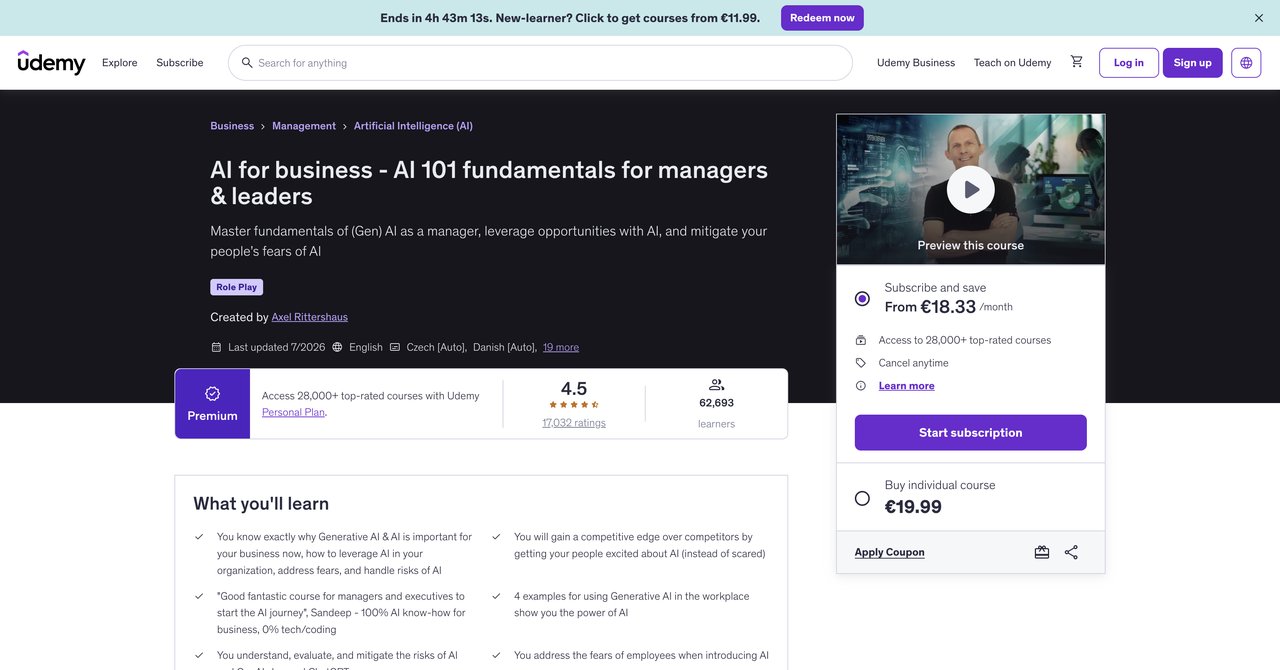
Udemy presents the lower-cost educational market. This course is typically offered for a few bucks, often going on sale for a low price. For a Managing Director, this does not teach you how to run your enterprise, but it acts as the first exposure to a variety of topics. If you have been operating in non-tech industry, a literal text book might be more than you need. It's a zero to very low risk investment to figure out what generative AI actually is in common terms.
It is a short route. You can speed run it in the weekend time. It's relevant for a manager that needs to get familiar fast. It addresses the fears, the risks, or what AI cannot do, which is often a more useful place to start for a managing director than what it does. The concept that you start here and then move on to a heavy. But note: you get only courses in a single area.
Key topics: Generative AI for business, basics, risks, practical examples using ChatGPT. Very touchy feely about real, basic project starts.
Target audience: Complete beginners; specifically a great manager or leaders who do not like going in cold to a large corporate training.
Pros:
- Low cost, or at least pockets of low prices
- A great start to find the language
- The pace is flexible
Cons:
- It is not tailored to executive strategy, it is mostly for front-line workers.
- Cover only the beginner basics. The content is not the focus on governance.
Who benefits most: The person who wants a "safe place" to make mistakes and has humility ABS to say "Just do not know what this is". It gets you up to speed without spending hard company money.
Learn more here: Udemy AI for Managers
Course 7: AI Executive Academy by MIT Sloan
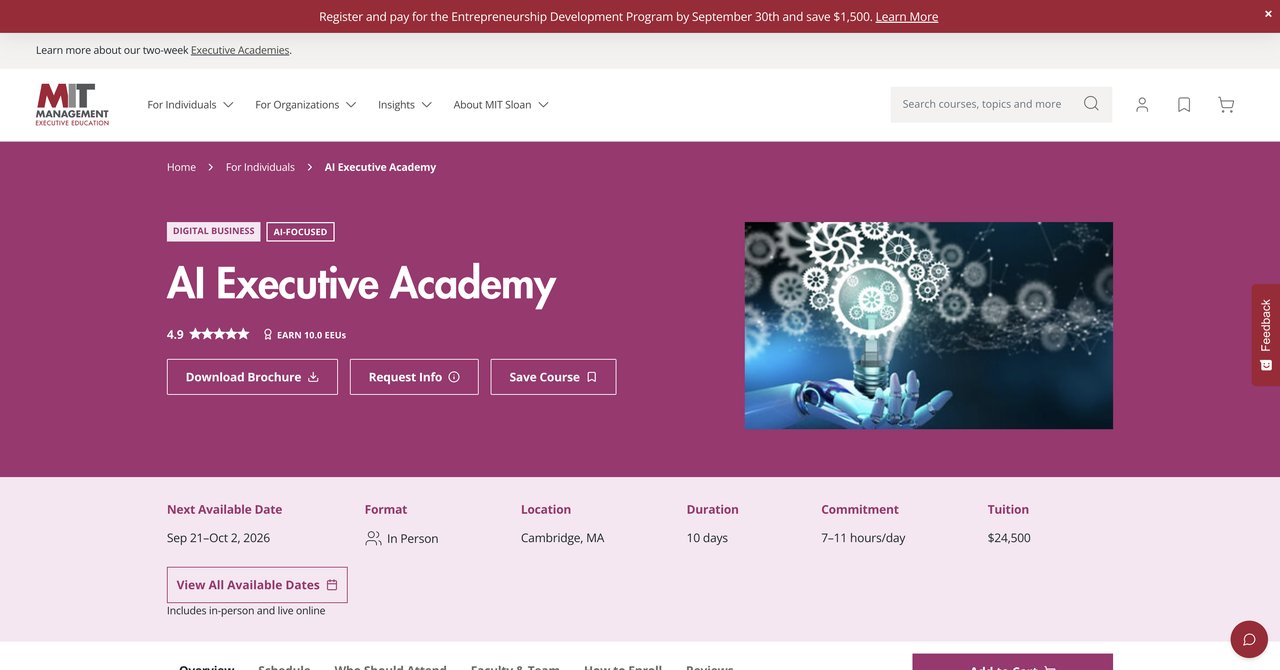
This is the most "elite" option on this list. The AI Executive Academy brings you to campus, and it is an all-gas teaching mode. Building a product for leaders who are taking on a tech transformation. It connects you to MIT faculty in a way that the others do not. You're not given a "digital lecture." Instead, you actually sit in the classroom, speak with researchers, and interact with global peers from the top of their own firms. It's a networking opportunity and a classroom experience at once.
Because pricing is not known, it is a pain point. Typically, these courses are right in the ultra-premium price range. That is a strong disclaimer. You have to travel to the location at a scheduled time. That definitely has some barriers-on for a busy MD. The duration is short, so it packs a lot of intensity into a few days.
Key topics: AI frontiers, business leadership, technology, more strategic tool understanding, and how to build a team of data experts around you.
Target audience: Top-level leadership and someone heading aggressive technology transformation or new product lines.
Pros:
- An intense, immersive on campus experience.
- Real faculty, not a pre-recorded video
- Big peer network, industry expert interaction
Cons:
- The most invisible unknown price
- Travel requirements and full-time
- Limited seats and specific dates that you must commit to
Who benefits most: Whoever has to read the in-the-flesh experience to make it happen. The contacts and interactions from this course will be the kind that are needed to get actual group buy in on AI projects.
Learn more here: MIT AI Executive Academy
Course 8: AI for Executives: The Basics by Coursera
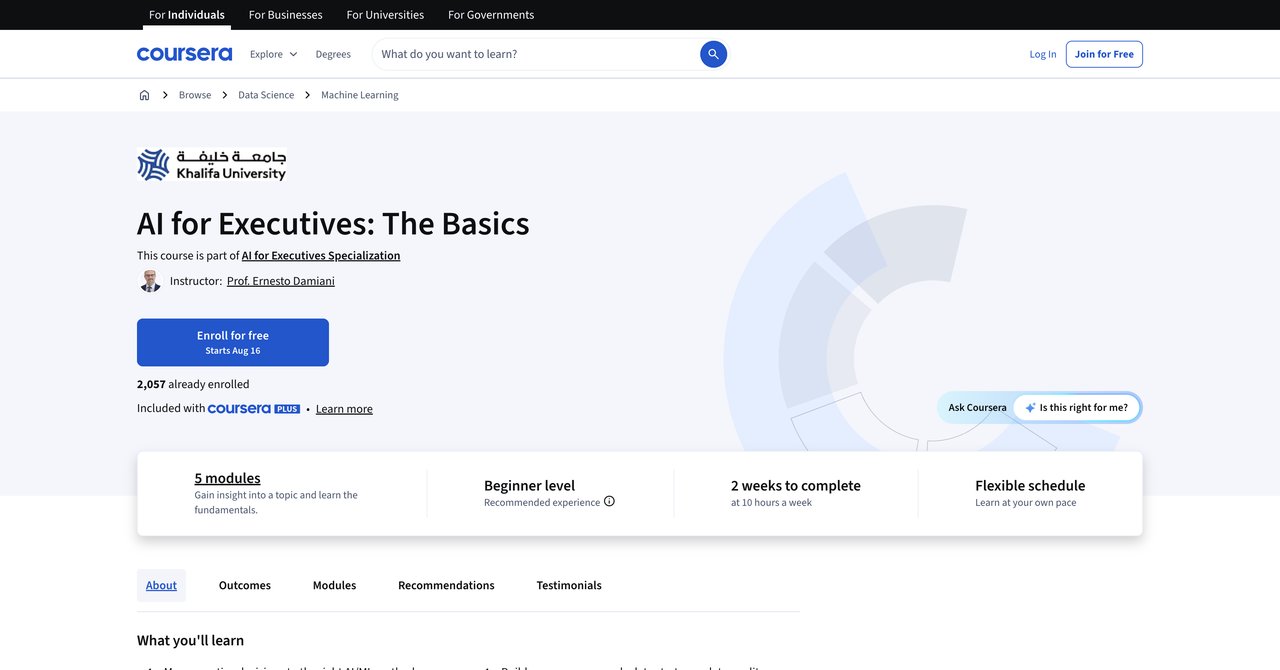
Coursera is very user friendly. The thing about this program is that you are listening to a significant execution from the company. It allows you to audit for free. That is just a brilliant offer. There is no barrier to getting the top-level view of what AI can do for a professional. The knowledge is practical and not technical, leaving no need for a whiteboard or an IT team.
But, don't think that a free audit will give you a certificate. To get the certificate of completion, you have to subscribe to the platform. The materials in the free audit are clear and relevant. It's a low risk of for Managing Directors who are strong enough to waste four hours but don't want to spend any money.
Key topics: High-level strategy, uses and examples of AI in the business landscape. And it covers how to etc.
Target audience: Executives freshly coming in, and with no basis for core foundation concepts in AI.
Pros:
- The initial free route is a great way to get guidance.
- No barrier to information.
- It is highly conceptual and comprehensible.
Cons:
- Low depth for experience in AI
- Certificate is only behind the pay wall
- The course might be too much for someone with a background
Who benefits most: People who finance themselves. Those wondering "What are they talking about?" and could use an easy to understand route.
Learn more here: Coursera AI for Executives
Course 9: AI for Executives Program by UC Berkeley Executive Education
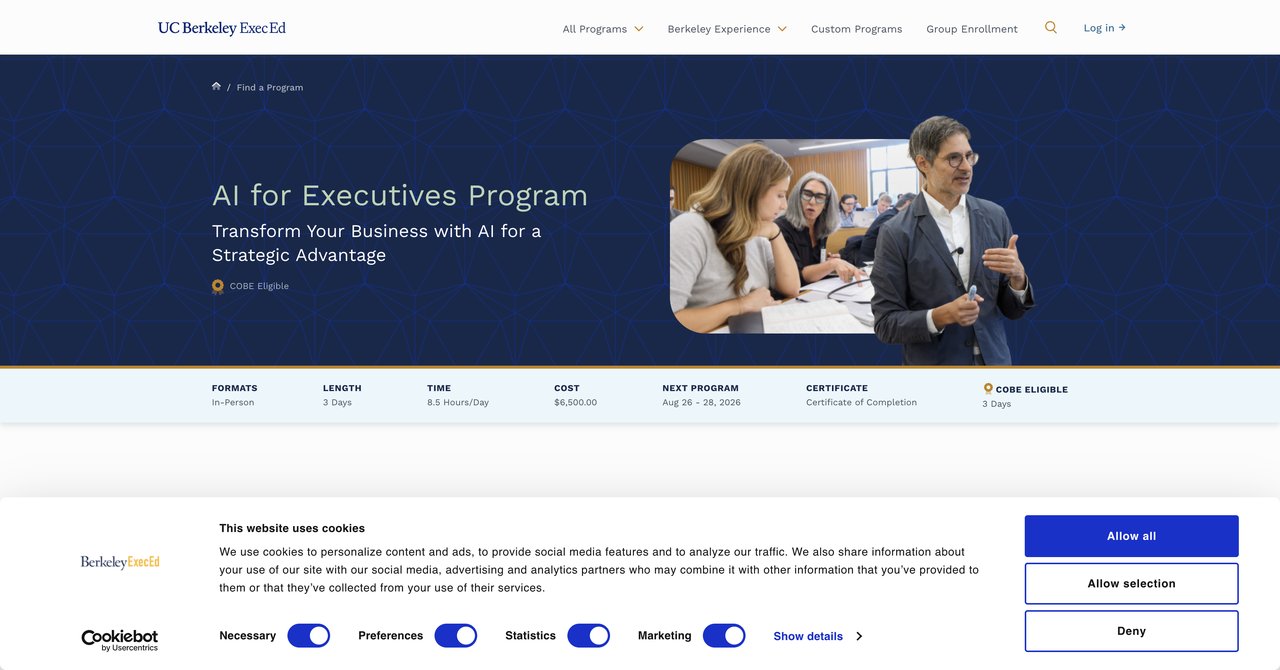
UC Berkeley at Haas School has a solid reputation. Their offering is a three-day in person program, which makes it very intense but limited in time. The pricing sits at $6,500, which is right in the average zone for executive ed, but not cheap. The specific content focus is on agentic AI systems. Those are the huge conversation right now, and it has the best access and technical content for "what's next" trend.
The course is not for AI novices but works for someone who has implemented some AI but needs to see what the next move is. It focuses on bringing what you are seeing into adoption. You do learn frameworks to bring to the team. Because it is a fixed date, you need to be a well planned. It's a quick week of learning at the business school environment.
Key topics: Agentic AI systems, AI strategy, adoption in the company and innovation drivers.
Target audience and skill level: Executives who control budgets but are on the side of the technology..
Pros:
- It is focused on a very new side called agentic AI. That's ahead of many other course providers
- Top brand name.
- Short, sharp, specific.
Cons:
- The cost is huge for a very short event.
- Fits in only specific dates
- exact time commitment may be a burden to a person in charge.
Who benefits most: If you are already using AI but feel you are behind the curve on the concept of agentic AI, this is the smart update to keep you relevant.
Learn more here: UC Berkeley AI Program
Wrapping Up and Decision Time
So here you have the scene. There is no one "magic bullet" for a career in managing directors. The result depends on the individual's budget, schedule, and the current maturity of your tech adoption.
Let's start with the absolute fundamentals. If you have done a few hours of research and still are not on AI, then the Coursera or Udemy options are a good start. You will pay little, maybe nothing, your Monday morning schedule, and you have zero risk. It's great for an initial overview but then leaves you at a stopping point. They do not go deep enough to change your strategy for the year.
If the issue is a strategic and a structured adoption and you are trying to build an AI vision for your whole organization, the MIT and Berkeley programs are needed. That they are high dose requires in-person presence and costs. If you want to have certification from a world-renowned university, so your board sees, then MIT is unmatched. The value is not just the academic part, it's the peer networking you get with a group of other managers. The courses will force you to get away from operations and think about your "future."
For the people who just need to keep their unit safe, those in the regulated industries and board-level, the accredited CMI programme from INPD is extremely helpful. They are not really using "cool factor" as they use governance. For that, that is a rare angle that genuinely fits your board risk.
So what about the rest? If you're being honest with me, most Managing Directors are not in a standing position to take a week to go to MIT. The reality is that and you are time poor, and the best option is to prioritize the learning that is accessible and comprehensive. This is where CompleteAI Training pulls ahead as a strong, broadly useful contender. Because you get the entire library for a fraction of the cost that MIT charge. You can start with one course, then jump into HR, finance or sales section the moment you need it. It also includes daily updates. You are not waiting for an annual program to bring you information. The flexibility and its vastness help you for the role in which your team all have a variety of questions. And if all of your other employees use the same library, you avoid the chaos of each teams buying different courses that teach them conflicting things.
If I have to give an unbiased point of view, I'd also honestly to state that MIT is a bigger name. If the goal is to get the title and ground your knowledge outside of your own house, then this is where you can focus. But when actually building a team and practical leadership of your for-all business, CompleteAI Training's full library offers the best practical toolkit and it is far more generous. The price makes it the biggest no-brainer among the options for a busy MD. You are not paying for a one-hit approach. You are betting on the whole set of content you can use for years.
Identify and decide what your immediate objective is. The easy win for a beginner is to hit the free resource. For brand building and high impact, book one of the academies. But look that goal, the demands of your team, and the budget, and just make a decision.