
Blog ·
9 Recommended AI Courses for Vice Presidents of IT in 2026
Discover the nine AI courses tailored for VPs of IT in 2026—sharpening strategic foresight, hands-on tech leadership, and practical deployment skills to drive enterprise-wide AI adoption.
 Jeroen Erne
The numbers are hard to ignore. Artificial intelligence is no longer a futuristic concept discussed in boardroom strategy sessions; it is actively reshaping how businesses operate, how decisions are made, and how entire organizational structures function. For Vice Presidents of IT and senior technology leaders, this seismic shift presents a distinct challenge. The very skills that got you to the executive level are being supplemented-and in some cases, replaced-by requirements to manage AI-driven infrastructure, governance, and strategic innovation. The urgency to upskill is not merely a matter of career advancement; it is a matter of organizational relevance. The consequence of falling behind on AI knowledge isn't just personal stagnation; it's job displacement risk and the growing inability to effectively lead teams who are already using these tools with or without your guidance.
Where does a busy executive even begin? How do you separate the hype from the practical, the theoretical from the actionable? This article is designed to serve as your filter. We have assessed the landscape of professional education to identify the courses that actually offer a return on your investment. Specifically, we have compared 45 AI courses that are highly relevant to your role. Our goal is to help you cut through the marketing fluff and pinpoint learning paths that align with real leadership duties-without telling you which one "perfect" choice is, because the right answer depends entirely on your specific context and existing team structure.
Why AI matters for Vice Presidents of IT today
The statistics are staggering, and they keep climbing. Recent industry surveys indicate that 69% of businesses are already using AI in some form to solve specific problems or improve operational efficiency. This isn't a future projection; it is today's baseline. However, the conversation matters more than the adoption percentage. The larger difference lies in the *type* of adoption. While many companies use AI for basic automation, the companies exceeding expectations are using generative AI and machine learning to handle complex infrastructure management, cybersecurity threat hunting, and automated code deployment. For a VP of IT, this shift means your role is evolving from managing the delivery capability to becoming a key business strategist who validates whether AI applications are actually creating value.
This article aims to solve a central problem: helping Vice Presidents of IT identify the best educational opportunities. We are not just throwing course names at you. We are breaking down options by their primary topics, target audience, pros, and cons. Within this comparison, we include a specific focus on CompleteAI Training (https://completeaitraining.com/course/ai-for-vice-presidents-of-it/). This particular option stands out structurally because it gives you access to ALL courses and ALL certifications on the platform rather than locking you into a single syllabus, which is highly valuable for a leader who needs to weave different facets of AI into their teams.
The Growing Role of AI in Vice Presidents of IT
In your specific domain, AI is shifting operations in several distinct ways. First, consider infrastructure automation. AI algorithms are now capable of adjusting cloud resources automatically based on real-time usage patterns, reducing manual workload and cutting infrastructure waste. Second is decision support. Instead of digging through dashboards, VPs are using AI models to synthesize hours of server logs into a concise, actionable executive summary highlighting anomalies and measurement forecasts. Third is policy enforcement, where the AI identifies when users violate security policies before they become a threat.
The work week of an IT leader is shifting from firefighting to strategy. Portfolios, budget forecasts, and performance reviews are slowly being augmented by modules that predict hiring needs or flag potential supply chain obstacles. The practical reality is that it is becoming possible to run the IT department with a higher quality of mental workload. If you do not understand how these systems work, you risk making decisions based on inaccurate data or allowing vendor hype to trick you into buying overly expensive solutions. You don't necessarily need to become the data scientist, but you need enough fluency to ask the right questions. When you can speak the language of machine learning accuracy, data drift, and model bias, you start to earn ''technical credibility'' with your engineering teams instead of only operational credibility.
Benefits of becoming an AI expert in Vice Presidents of IT
The obvious benefit of expertise is that you can lead transformation, but that is the broad view. More specifically, acquiring this knowledge helps you in several practical ways in a executive role. You gain the ability to accurately vet proposals from software vendors; you no longer have to take "it's AI" at face value. You can immediately identify when an AI application is feasible in comparison to when a standard rules-based algorithm would do the job. This saves money and headache. Another payoff is that you strengthen your position in the C-suite. CFOs and CMOs generally struggle with the technical intricacies of AI. If you can translate AI's potential into concrete financial terms that they understand, you instantly become the person who is the linchpin in the company's growth. Finally, there is the ''retention factor'' for your best employees. A leader who is intellectually engaged with the logic of AI , the same top talent interacting with it daily , tends to retain those top skills that otherwise leave for companies promising more innovative work.
We will break down each option to give you clarity on investment value. It's a long list to get through, but you'll finish with no guesswork about which 45 courses fit your level, your skill gaps, and your budget.
Comparison: All AI Courses for Vice Presidents of IT (Updated 2026)
| Course Name | Provider | Price | Key Topics | Pros | Cons | Best For |
|---|---|---|---|---|---|---|
| CompleteAI Training | CompleteAI | Premium | Comprehensive curriculum covering all aspects of AI for VP of IT roles. Includes hands-on projects and expert instruction. Subscription unlocks EVERY video course and EVERY certification on the platform-hundreds of them, covering all job roles. New courses and certifications are added continuously. One flat price covers everything, not just a single course or fixed bundle. Also includes material for every other job role. | Comprehensive curriculum; Hands-on projects; Expert instructors; Full access to ALL video courses and certifications on the platform, not a single course or bundle; New courses and certs included automatically; Also covers all other job roles; One flat subscription price is more cost-effective than paying per course elsewhere; Very affordable, especially with annual billing | Premium pricing; Subscription-based, which is a continuous learning model as AI develops | Vice Presidents of IT professionals looking for complete training and complete access to all content on the platform |
| AI for Vice Presidents of IT (Video Courses + Certifications) | Complete AI Training | $8.25-$29/month | Full access to ALL video courses on the platform, not the content of just one course, and ALL certifications. New material is added continuously. Also includes material for every other job role. One flat subscription covers everything. | Full access to all video courses; all certifications included; new courses/certs added automatically; includes cross-functional material; cost-effective; affordable | Subscription-based; depends on continuous learning as AI develops | General learners who want a broad, ever-expanding education across many job roles |
| Leading AI Strategy: From Hype to Enterprise Reality | MIT Professional Education | Not specified | Direct course focus: live online advanced course, hands-on capstone project, evaluation of AI as a practical operational resource (including costs and failure points), integrating AI into strategy and organizational design | Live online format with capstone; evaluates AI as practical resource; evidence-based approach to strategy integration; designed for mid-to-senior leaders | Price not listed; assumes prior AI knowledge at an advanced level | General learners |
| Leading the AI-Driven Organization | MIT Sloan Executive Education | $12,900 USD | Intensive in-person executive program focused on leading AI transformation at the enterprise level; live cohort; 8 hours/day immersion | Intensive in-person; enterprise-level focus; strong peer networking in a live cohort | Highest tuition on this list; requires travel to Cambridge, MA | General learners |
| AI Adoption: Driving Business Value and Impact | MIT Sloan Executive Education | $3,850 USD | For mid-to-senior leaders with strategic authority; mapping AI to business challenges overcoming adoption barriers; sustainable co-creation practices that amplify human capability | Targeted at strategic decision-makers; focuses on solving real business challenges; emphasis on human-AI co-creation | Not specific rating available; significant tuition | General learners |
| Deploying AI for Strategic Impact | MIT xPRO & MIT CSAIL | $3,950 USD | Alignment of AI with business goals; infrastructure and data strategy for long-term ROI; frameworks and language for AI investment decisions | Co-developed with MIT CSAIL; strong focus on aligning AI with business outcomes; provides frameworks for investment decisions | Not rating available; requires 4-6 hours per week | General learners |
| AI Essentials: Accelerating Impactful Adoption | MIT Sloan Executive Education | $5,700 USD | AI literacy for non-technical leaders; clear understanding of AI technologies; strategic frameworks for driving adoption | Accessible for non-technical leaders; clear understanding of AI; good strategic framework | Short duration may skip deep technical detail; no rating | General learners |
| Chief Technology and AI Officer (AI-CTO) Program | WatSPEED (University of Waterloo) with upGrad | Not specified | Deep technical and strategic mastery; financial, key operating, organizational fluency; revenue, risk, and ROI language; designed for experienced technology leaders | Combines technical depth with business fluency; covers board-level language; designed for executive roles | Longest duration (25 weeks); price not listed | Designed for experienced technology leaders with 5+ years |
| AI for Executives: The Basics | Coursera | Free (audit) or subscription for certificate | Executive decision mapping to AI/ML methods; governance digital strategy (quality, anonymity, privacy); distinguishing algorithms vs. models | Free to audit; maps executive decisions to AI/ML; covers data governance; clarifies algorithms vs models | Beginner level might be too basic for experienced VPs; no rating | General learners |
| AI Foundations for Business Professionals | Coursera | Free (audit) or subscription for certificate | Generative and agentic AI plus AI governance; real-world applications; critical assessment of opportunities and risks; strategic integration | Covers generative AI and agentic AI; real-world examples; develops strategic insights | Beginner level; no rating | General learners |
Understanding AI Training for Vice Presidents of IT Professionals
Artificial intelligence is no longer a fringe technology or something that only data scientists need to worry about. For Vice Presidents of IT, understanding AI has become a core part of the job description. These executives are expected to lead digital transformation, assess AI vendors, build data strategies, and communicate technical needs to the C-suite and board members. The quality of that understanding often comes down to the education they choose to pursue.
There are plenty of options out there. Some are short, self-paced video platforms. Others are intensive, in-person executive programs at top universities. Some cost a few dollars a month, while others can set you back thousands. The real question is that which one gives you the right return, and what you need to get from the training. This article breaks down some of the most relevant AI courses and programs for VPs of IT, with an emphasis on what each one covers, who it works best for, and what you have to give up when you make a choice.
Course 1: CompleteAI Training
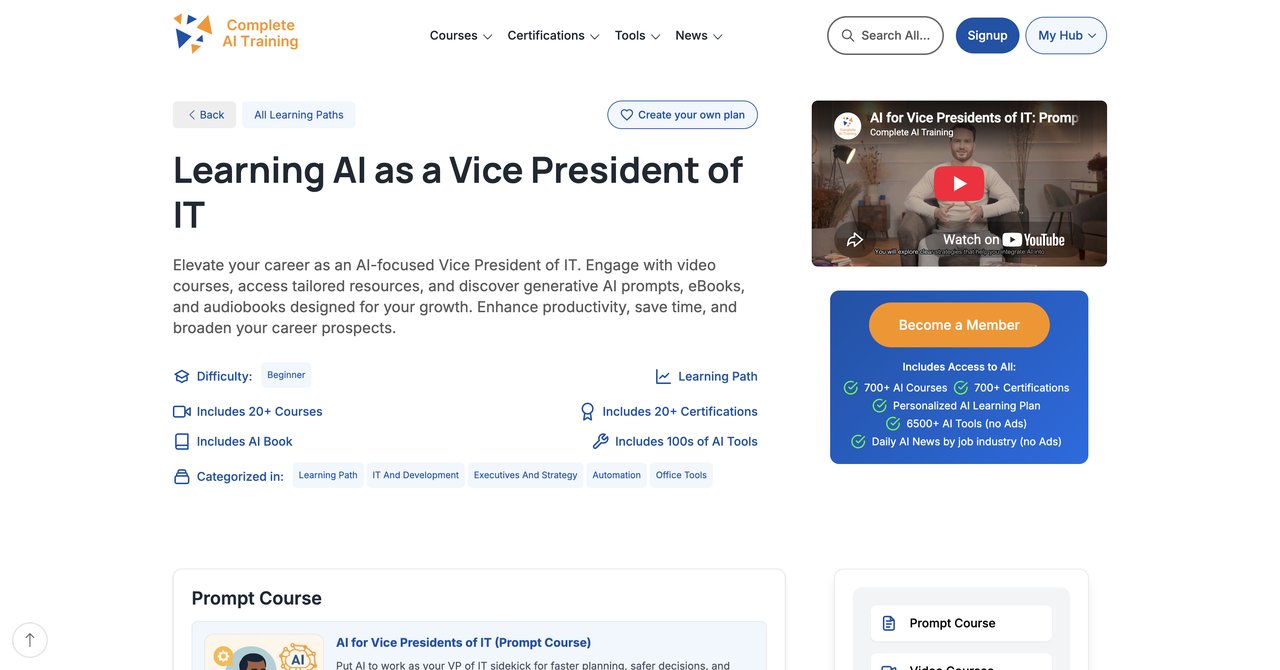
CompleteAI Training's program for Vice Presidents of IT stands apart because it is not a single course at all. When I say it's a subscription, I mean that one payment unlocks every video course and every certification on the entire platform. That includes material for every job role the company covers-not just Vice Presidents of IT. If your work crosses over into marketing, operations, data strategy, or risk management, all of that content is available too. If AI becomes irrelevant so you change roles, the subscription goes with you, and that's not something you get with any single-course platform.
That point matters because every other provider on this list sells one course at a time. When you buy a course from MIT, you pay for that specific program and sometimes a separate certificate fee. With CompleteAI Training, the flat subscription gives you access to everything, and it is updated daily as new AI tools and industry news appear. New courses and certifications are added continuously, and they are included automatically, no matter when you signed up. The pricing ranges from $8.25 to $29 per month depending on billing cycle; that makes it far cheaper than the university programs and far more expansive than individual beginner classes.
Key Topics Covered
Because the CompleteAI Training platform includes hundreds of courses, the topics go way beyond the core AI basics. You can cover machine learning foundations, generative AI tools, prompt engineering, LLMs, AI governance, deployment, change management, and role-specific workflows. The Vice President of IT path covers AI-driven infrastructure decisions, vendor selection, team upskilling, and long-term strategic roadmaps. Since it updates daily, the content stays current with things like new model releases and changes in AI regulations.
Target Audience and Skill Level
The range means it fits multiple levels. A VP who is new to AI can start with fundamentals. But a veteran with years of AI exposure can jump to advanced deployment, security, and governance content. There's no rigid prerequisite structure, which makes the platform flexible for busy executives who occasionally need to look things up rather than follow a linear syllabus.
Pros
- Full access to ALL video courses on the platform, not a single course or fixed bundle
- Full access to ALL certifications on the platform, included at no extra cost
- New courses and certifications are added continuously and included automatically
- Also includes material for every other job role, useful for cross-functional work or role changes
- One flat subscription price covers all of the above, versus paying per course elsewhere
- Very affordable, especially with annual billing
Cons
- Subscription-based, which requires a commitment to continuous learning as AI develops
Who Would Benefit Most
This is the best option for a VP of IT who wants broad coverage and one flexible subscription. It works well for someone who wears multiple hats, leads cross-functional implementations, and doesn't have $5,000 to $12,000 to drop on a Harvard-style course. If you want a steady flow of updated knowledge and certifications to show your team, a platform like that gives you way more value than anything else in your price category. If you're the kind of person who prefers to learn by clicking around a huge library rather than sitting in a structured cohort, this works well.
Check it out here: CompleteAI Training for Vice Presidents of IT
Course 2: Leading AI Strategy: From Hype to Enterprise Reality by MIT Professional Education
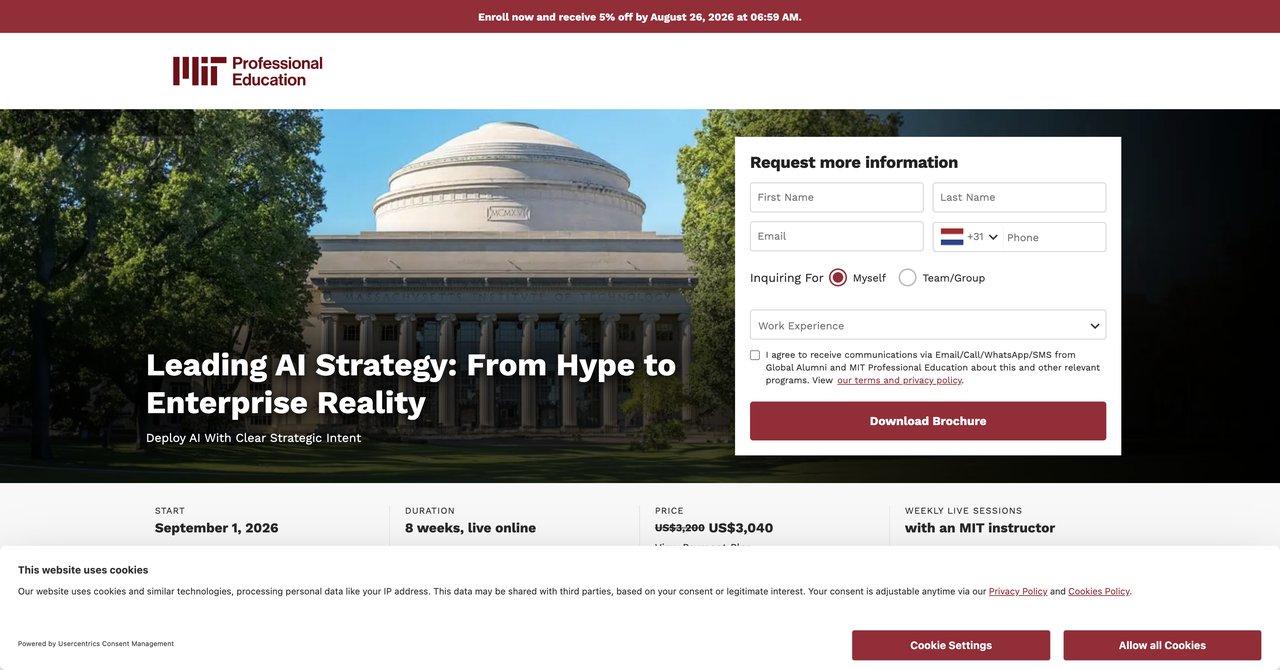
MIT Professional Education offers a live online course called "Leading AI Strategy: From Hype to Enterprise Reality." This one is for mid-to-senior leaders who are tired of all the industry noise around generative AI and want a grounded view. The premise is that AI is often overhyped, so the course tries to revise it to something pragmatic. It considers AI as an operational resource, not a silver bullet. You'll look at actual costs, failure points, and what makes an AI project stop working in a big company-not just the success stories that are usually told at trade shows.
The live online format is structured with a hands-on capstone project. That means you're not just watching videos and nodding along. You will apply what you learn about integration to your own organizational context. It's not the kind of thing you can power through in a weekend. You'll need time and focus.
Key Topics Covered
AI cost modeling, failure points in real-world deployments, how to evaluate AI as a practical operational resource, evidence-based strategy integration, and organizational design. There's a strong emphasis on separating hype from achievable business value.
Target Audience and Skill Level
The course is explicitly designed for mid-to-senior leaders. That means you should have some strategic decision-making authority in your organization. While it does not assume high technical depth, it does assume that you are coming in with some understanding of why AI matters and that you want a serious analysis rather than a theoretical overview.
Pros
- Live online format with hands-on capstone project
- Evaluates AI as a practical operational resource, not hype
- Evidence-based approach to integrating AI into strategy
- Designed for mid-to-senior leaders
Cons
- Price not listed on page, which makes budgeting difficult
- Advanced level may assume prior AI knowledge
Who Would Benefit Most
This is for IT leadership who have seen three or four "transformational" AI initiatives get stuck in pilot mode and now want to understand why. If you need a hard, structured way to evaluate whether a specific AI project is worth investing, and you prefer learning with live interaction from professors and peers, this is solid. It's particularly strong for those who want a pragmatic reality-check rather than another glossy overview.
Visit the official course page here: Leading AI Strategy at MIT Professional Education
Course 3: Leading the AI-Driven Organization by MIT Sloan Executive Education
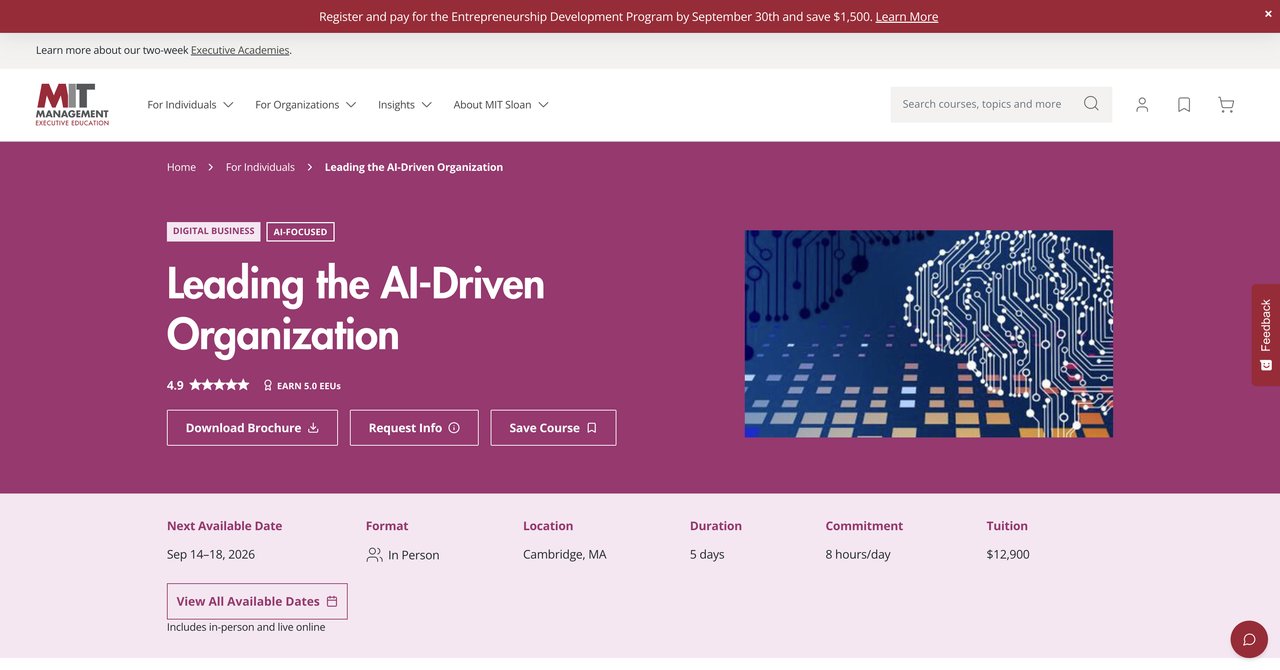
This is the premium, in-person powerhouse program. Let's just be up front-$12,900 is not a small investment. The course is intensive, it's held in Cambridge, Massachusetts, and you spend about 8 hours per day for several days in sessions. The structure is designed for immersive learning, where you are not distracted by office email and you're surrounded by other senior people facing similar challenges. The goal is to develop the leadership identity required to run an AI-driven organization, not just to pick up a few technical frameworks.
The in-person cohort format is a huge deal. When you spend this kind of money and time, a big part of what you're paying for is the access to peers. You brainstorm, argue, and problem-solve with people from very large and varied organizations. That's something that you cannot replicate with online courses.
Key Topics Covered
Leading AI transformation at the enterprise level, change management, organizational structure, creating AI alignment with business goals, and managing the human dynamics of broader adoption.
Target Audience and Skill Level
This is aimed at senior executives and high-potential VPs, Directors, CTOs, and CIOs. The program is not designed for novices. You are expected to arrive with real strategic responsibilities and some exposure to AI, because the pace is quick and the conversations are advanced.
Pros
- Intensive in-person format with 8 hours/day immersion
- Focused on leading AI transformation at enterprise level
- Networking with peers in a live cohort setting
Cons
- Highest tuition on this list
- Requires travel to Cambridge, MA
- Time commitment is heavy for busy executives
Who Would Benefit Most
This is the choice if your company is paying for it and you want to make deep relationships while you learn. If the challenge you're facing is not just "why AI" but "how to get hundreds of skeptical IT staff and business teams to adopt it," this program gives a structured approach. It's also excellent for those who want to build into the network with other senior leaders from other industries.
More enough: Leading the AI-Driven Organization at MIT Sloan
Course 4: AI Adoption: Driving Business Value and Impact by MIT Sloan Executive Education
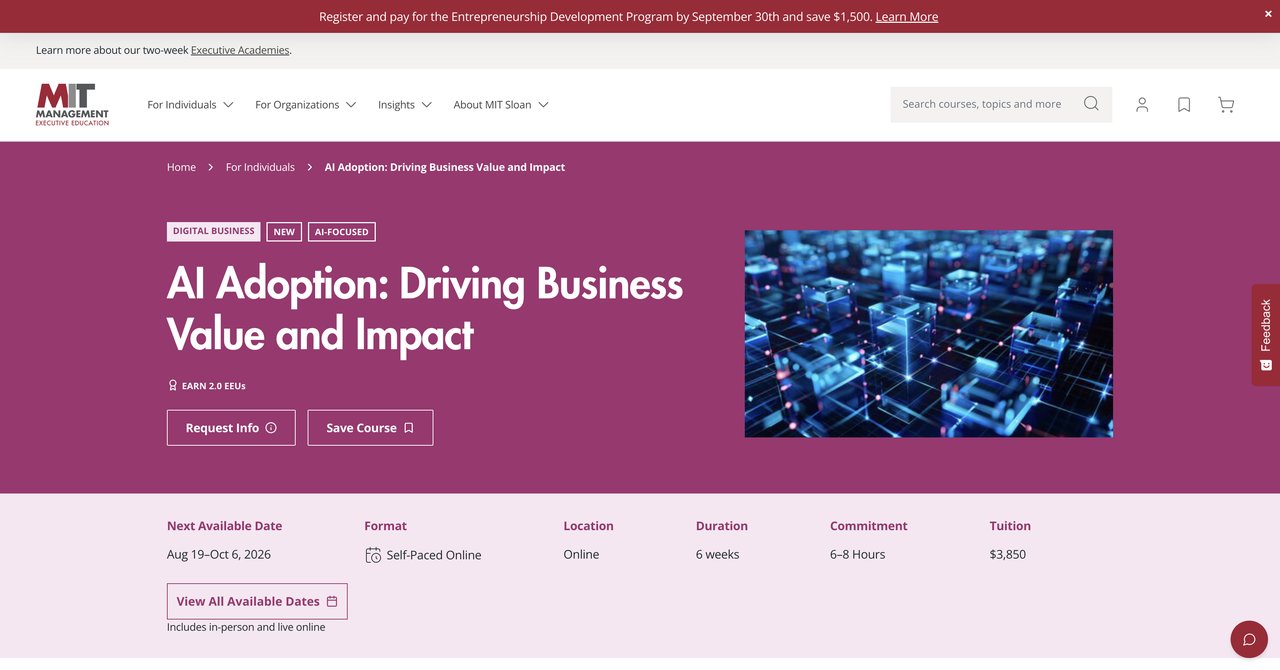
At $3,850, this course hits the mid-range price point, but the content is fairly specialized. It is focused on what happens after you've decided to implement AI: the thorny problem of adoption. The program is designed to be practical for those with strategic decision-making authority, which means it translates to a range of business challenges. You'll work on mapping specific AI solution to business pain points, overcoming organizational resistance, and pumping the brakes.
The program emphasizes "sustainable co-creation practices," basically how to bring humans and AI together in the workplace so that AI expands capability, not replaces effort in a destructive way. For a VP of IT, this is the practical daily challenge. You may need to know how to bring your engineers and IT operations staff along, while process owners in finance or supply chain start to stress out about job changes.
Key Topics Covered
Mapping AI to the right business challenges, overcoming barriers with the adoption, stakeholder communication, co-creation between human teams and AI models, and measuring business value through the adoption process.
Target Audience and Skill Level
The course targets mid-to-senior leaders. It requires strategic decision authority, but not a deep technical background. It's for those who are in the middle of an AI transformation, not those curious about AI.
Pros
- Designed for mid-to-senior leaders with strategic authority
- Focuses on mapping AI to business challenges and overcoming adoption barriers
- Emphasizes sustainable co-creation practices that amplify human capability
Cons
- No formal rating available
- Significant tuition investment
Who Would Benefit Most
If you are days into implementing a major AI project and the resistance is getting heavier, this program is helpful. Specifically, for a VP of IT who reports to C-suite and leads product development and operations, the practical adoption angle is easier than pure strategy. It is very useful for anyone about to launch a large-scale AI-Powered change in their organization.
More info: AI Adoption at MIT Sloan
Course 5: Deploying AI for Strategic Impact by MIT xPRO & MIT CSAIL
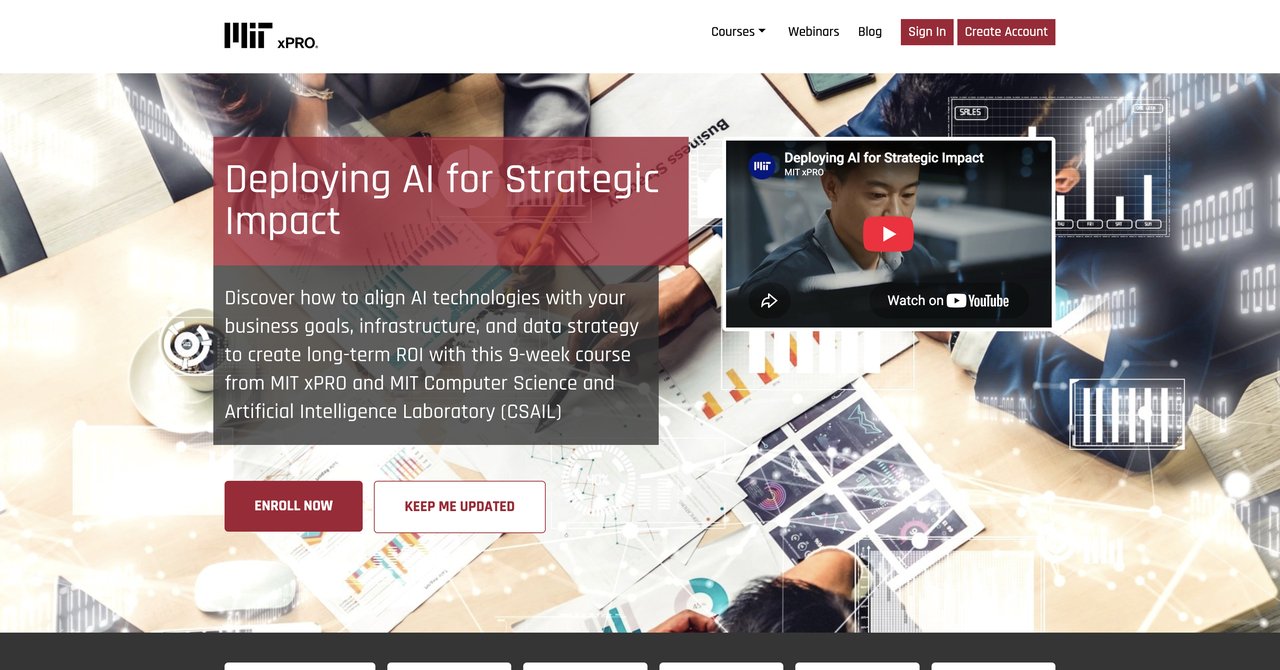
MIT xPRO and MIT CSAIL (Computer Science and Artificial Intelligence Laboratory) co-developed this course. You're getting the official stamp of the people who work on the technologies that you're trying to learn. The course length is 4-6 weeks (it's not that easy to find an exact weekly number), and at $3,950 it's a fairly substantial investment of time and money. The value comes from the CSAIL connection-this is not just business or theoretical strategy; it's anchored in what's actually happening in AI R&D.
The content covers a broad strategic view-how to align AI with your business goals, what AI infrastructure to invest in, and how to think about data strategy to realize long-term ROI. It is designed to give you a language to speak confidently when you present investment cases to the CFO or the board.
Key Topics Covered
The alignment of AI with specific business goals, AI infrastructure planning, data strategy for long-term ROI, and AI "language" for executives making investment decisions.
Target Audience and Skill Level
This is for leaders who have strategic responsibility and who may or may not come from a deeply technical background. The depth comes from the CSAIL contributions, which provides a strong technical foundation. It assumes you can allocate 4-6 hours per week for study.
Pros
- Co-developed with MIT CSAIL
- Covers alignment of AI with business goals, infrastructure, and data strategy for long-term ROI
- Provides frameworks and language for confident AI investment decisions
Cons
- No rating available
- Requires 4-6 hours per week commitment
Who Would Benefit Most
For a VP of IT who is part of the roadmaps around infrastructure and data platforms, this course is a high-value fit. It lives between pure strategy and applied technical architecture. If you need to speak both languages and you want the CSAIL prestige that opens doors in meetings, it's worth the money.
Deploying AI for Strategic Impact at MIT xPRO
Course 6: AI Essentials: Accelerating Impactful Adoption by MIT Sloan Executive Education
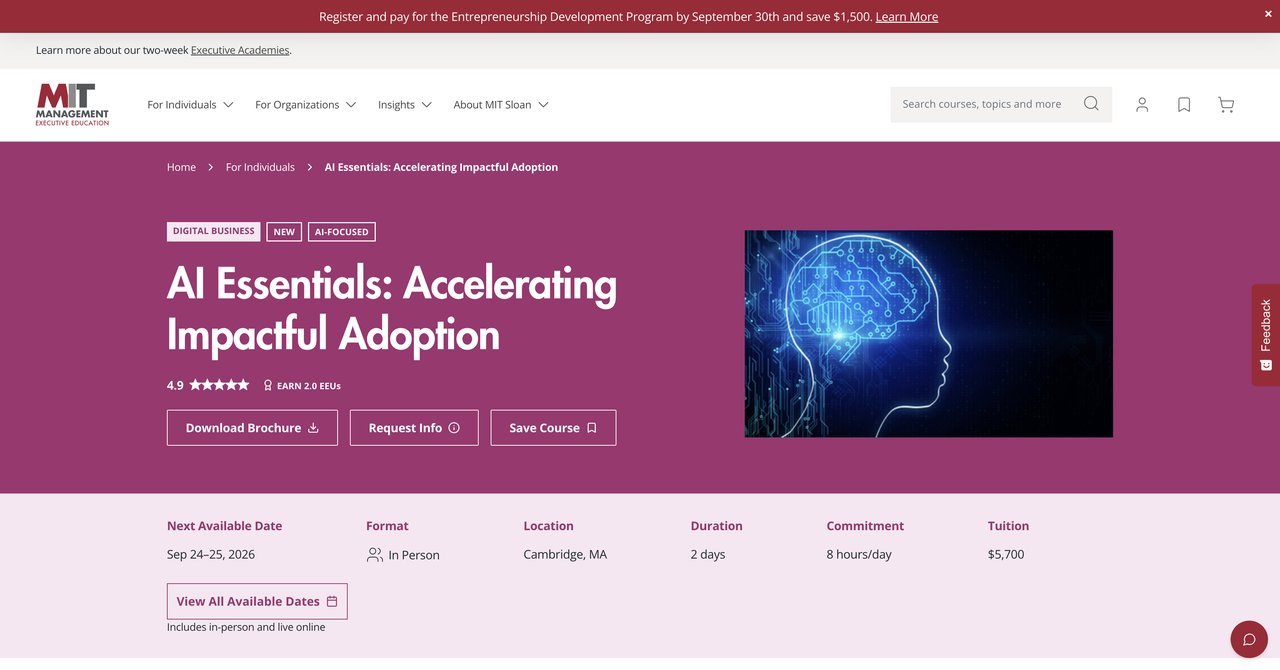
This course is positioned as a way to bridge the gap for non-technical leader. It costs $5,700, which is more than you'd pay for many online platforms, but less than the immersive $12,900 program. The "Essentials" name is actually a signal of the level. It's for VPs who know they don't need to become machine learning engineers but absolutely need to understand the terms, the options, and the practical paths to adoption within their teams.
The focus is on building fluency among non-technical folks. You get a clear, accessible understanding of the main AI technologies-from classic machine learning to today's generative models-so that when you enter a room full of data engineers, you're not lost. More practical thing is, it's about applying those frameworks to drive adoption in your specific organization.
Key Topics Covered
AI literacy for non-technical leader, explanation of main AI technologies, strategic frameworks for driving adoption, and common elements to implementation.
Target Audience and Skill Level
It's specifically designed for those without deep technical background. For VPs of IT who have technical depth, this might feel a little bit lighter on the technical side. But it's still a great communication tool for those with non-technical stakeholders or cross-functional peers.
Pros
- Emphasizes AI literacy for non-technical leaders
- Clear, accessible understanding of AI technologies
- Strategic frameworks for driving adoption
Cons
- Short duration may not cover deep technical detail
- No rating available
Who Would Benefit Most
If you are a VP in an IT role who is comfortable with the technical side but needs to bring non-technical peers along-the COO, the HR head, or the VP of Sales-this is a good one for you to bring back in a digested format, or to tell your peers about. It's less about making you a better tech and more about making your messaging and strategy clear.
Course 7: Chief Technology and AI Officer (AI-CTO) Program by WatSPEED (University of Waterloo) with upGrad
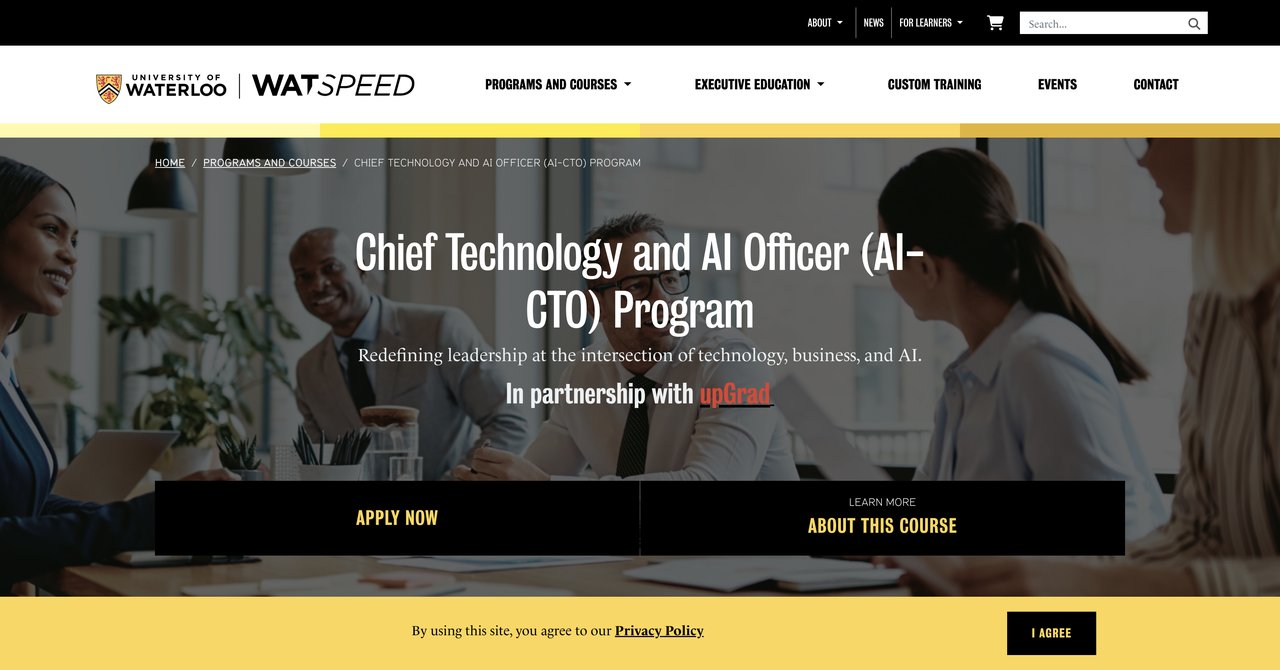
This is not a casual learning experience. The program runs for 25 weeks, which makes it the longest on this list. It's a serious commitment, structured for executives with at least 8 years of experience. The target isn't just learning or solving today's problem. It's about preparing someone to be a Chief Technology and AI Officer, with command over both the deeper technical matters and the softer strategic parts like finance and org design.
The course curriculum combines exactly those two threads, you get technical mastery around AI at the same level as the engineering decisions you'd lay down, but you also get the financial language-revenue, ROI, risk-that you need in front of the board. The University of Waterloo's reputation for engineering gives this credibility, but it shouldn't be underestimated. It will ask a lot of your time.
Key Topics Covered
Deep technical AI, financial and organizational strategy, revenue and risk assessment for the board, and leadership communication the C-suite sits.
Target Audience and Skill Level
The level is for experienced technology leaders with a minimum of 8+ years of experience. If you are an operational VP looking to up-level to a C-level position, this is a direct route, but it's a significant commitment.
Pros
- Combines deep technical mastery with strategic, financial, and organizational fluency
- Covers revenue, risk, and ROI language for the board
- Designed for 8+ years of experience
Cons
- Longest duration on this list (25 weeks)
- Price not listed
Who Would Benefit Most
This is for VPs who are strategically positioning for the top job. If you're already a VP of IT or a Director of Engineering and your career plan involves becoming a CTO or a Chief AI Officer, this program builds the right combination of skills. It's a marathon, not a sprint, and the time commitment is a big red flag for some. But the potential for advancement and the depth of study makes it a wise career move.
Course 8: AI for Executives: The Basics by Coursera
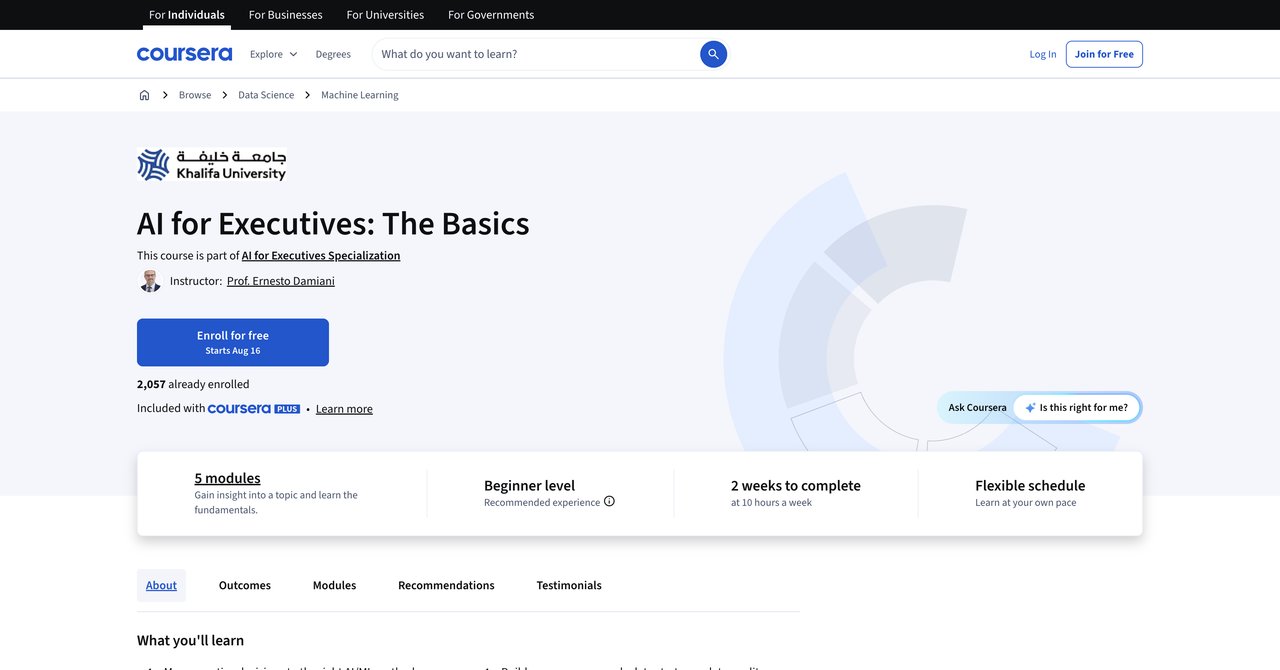
Coursera offers a very accessible way to get started-it's free to audit. That means you can watch all the videos without paying anything, though you won't get project assessment or a certificate unless you pay for a subscription. This course is exactly what it says: a basics course. It's designed to map executive decisions to AI/ML methods, so you learn what each type of AI problem looks like and what type of model is appropriate, without coding or technical details.
It also covers an important topic that is often avoided in exec courses: data governance. You get a data strategy that includes the messy stuff, like data quality, anonymity, and privacy issues. They also help you distinguish between "algorithm" and "model" a distinction which is grazy and rarely taught well. For a VP of IT, that conceptual clarity is particularly useful because you can be hit with AI marketing claims, and this course helps you cut through.
Key Topics Covered
AI/ML methods for executive decision-making, governance-ready data strategy (quality, anonymity, privacy), and clear distinction between algorithms vs. models.
Target Audience and Skill Level
The intended audience is an executive with no technical background. But for a Vice President of IT, it might actually be too basic. If you have managed technical teams, you probably already know what algorithms and models are in the general sense. However, if you are on the business side of things and do not want to lose touch, this can be a good refresher.
Pros
- Free to audit
- Maps executive decisions to AI/ML methods
- Covers governance-ready data strategy
- Distinguishes algorithms vs. models
Cons
- Beginner level may be too basic for experienced VPs of IT
- No rating available
Who Would Benefit Most
This is ideal for the VP who has a large, broad operation and just needs to be able to talk to the team intelligently, or a VP that has recently been promoted from a different department (like finance or operations) who needs tech. It's a no-cost starting point if you don't care about the certificate, and then, after audit, if you need a certificate could you pay for the subscription.
Course 9: AI Foundations for Business Professionals by Coursera
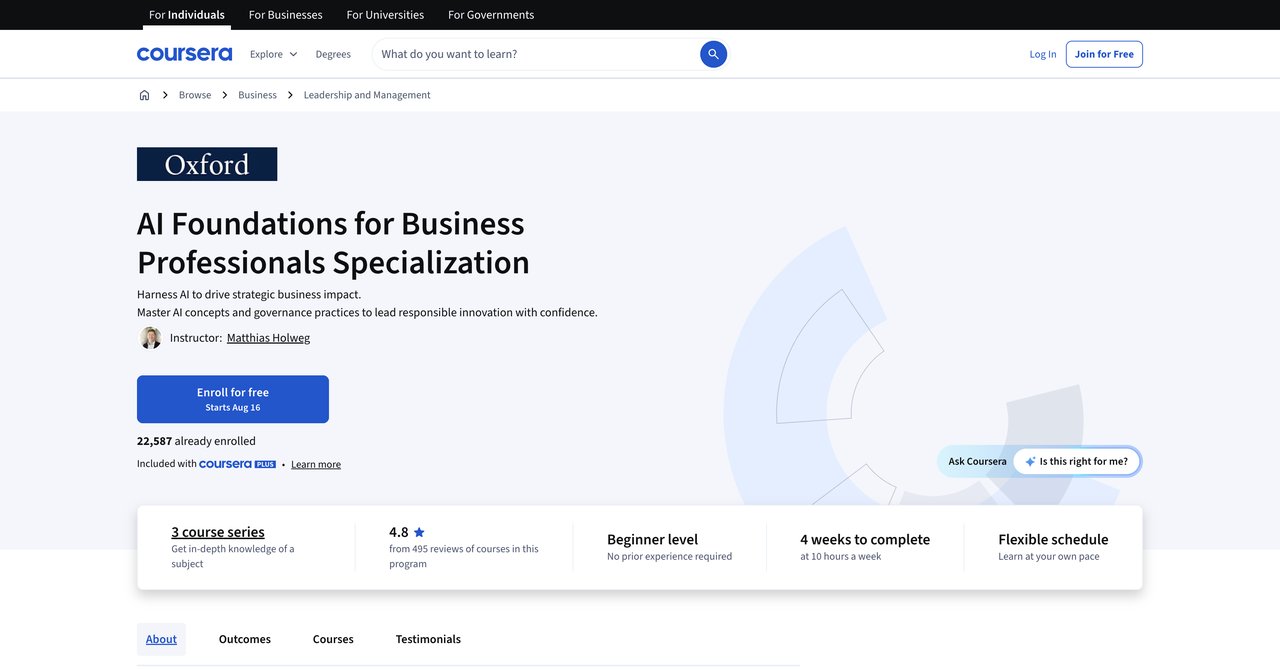
Finally, we have this multi-course specialization, also on Coursera. It goes a bit deeper than the "Basics"-the name is serious because it covers more ground. It includes the exploratory world of generative and agentic AI. This means you will learn about large language models and autonomous AI agents, and not just your child. In addition, the specialization includes a module focused on AI governance, which is a concern that is often under-learnt. The goal is not just to tell you what AI can do, but to have a framework for how to assess, deploy, and even spin it back on the table fairly.
It is structured as a multi-course specialization, which means that you can accumulate P-level certificate in chunks. It's designed to be accessible but not as shallow as just the basic. It is a step up but is still beginner to intermediate.
Key Topics Covered
Generative AI fundamentals, agentic AI (AI agents that act), governance, real-world applications, risk assessment, and strategies for integration.
Target Audience and Skill Level
Designed for business professionals, including non-technical. While the content includes generative and agentic AI, no code is required. You need a bit of time, but you can be going at your own pace.
Pros
- Covers generative and agentic AI plus AI governance
- Real-world AI applications
- Critically assesses opportunities and risks
- Develops strategic integration insights
Cons
- Beginner level
- No rating available
Who Would Benefit Most
This is a better buy time to spend for a VP who needs a solid grasp of the modern AI landscape-generative, agentic-but who does not need deep technical depth. The inclusion of governance makes it valuable because they will be set in discussions about policies. For a more affordable option that has more depth than the single "Basics" course, this is your best bet.
AI Foundations for Business Professionals on Coursera
Final Recommendations for Vice Presidents of IT
With so many choices, it's easy to get tangled up. Here's the honest summary.
Best Overall Value and Breadth: Complete AI Training stands out because of its scope. For a flat subscription fee, you get every course across every role, all the certifications, and the content updates. There is no other provider in this comparison where you get a full library plus certs for a price that is between $8.25 and $29 a month. If you are already to be in a role where you are expected to be conversant in every aspect of AI (technical, governance, strategy) and the idea of paying for a single certified course that you could finish finle doesn't suit you, that's a hard option to beat. It might not have the brand cachet of a university, but the coverage is just as wide and your wallet won't hurt.
For Big-Hud Culture and Network: The MIT intensive (Course 3) is the one to pick. It's expensive, it's in-person, and it can change the way you make decisions. The 8 hours a day and the connections you make are the reasons you pay money. If you can expense it, put it on the company card and go.
For Leadership Improvement: The MIT Sloan "AI Adoption" course (Course 4) is about leading people through change, not just technical alignment. If your pain is in the org-soaking, that course explains how to move decent and increase buy-in.
For Technical Due Diligence: The MIT xPRO / CSAIL program (Course 5) is your ticket if you need to get into the work of infrastructure and data strategy for long-term ROI. It's deeper than other exec courses and includes research and implementation language.
For Career Transition to C-Suite. The WatSPEED / Waterloo Chief AI-CTO Program (Course 7) is the most comprehensive route available. It's 25 weeks, so it will dominate your calendar, but for someone who is finished aiming the VP seat and wants the "chief" title, that's roundhouse giving you exactly that foundation.
For Zero Budget: The Coursera options are useful to get you started. The "AI for Executives" is a good start, and the "AI Foundations for Business Professionals" goes deeper. You really to pay for the certificate if you want a paper piece, but you can learn the concepts for free. They don't come close to the depth and influence of the MIT programs or the breadth of Complete AI.
The decision really comes down to your goal. Are you looking for a comprehensive personal library to keep growing as the AI world shifts? Pick Complete AI Training. Are you looking for an executive network and a week of total focus? Go to MIT. Do you want to unlock the biggest title in your career? The WatSPEED 25-week program is long, but at the end, you're the most prepared of the group. All in all, the needs are different here, and the best choice is the one that fits your situation, not just a cooler brand name.