
Blog ·
9 Recommended AI Courses for VPs of Strategy in 2026
Sharpen strategic foresight with nine top-tier AI courses tailored for VPs. Master GenAI applications, data-driven decision-making, and ethical implementation to lead with confidence. Curated for busy executives—skip the fluff and focus on real-world impact.
 Jeroen Erne
The window for VPs of Strategy to get ahead of the AI curve is closing faster than most executives realize. Within the next three years, the majority of strategic planning, market analysis, and competitive intelligence work will be augmented by generative AI systems. Companies are already shifting budgets toward AI literacy at the executive level, not as a perk, but as a baseline requirement. For a VP of Strategy, ignoring this shift isn't just risky-it's a direct threat to their relevance in the C-suite. The question is no longer whether AI will change strategic planning tools, but how quickly you can adapt to lead that change. Every month that passes makes the skills gap more visible, and the leaders who invest in structured education now will be the ones running the boardroom conversations in 2026, while those who wait risk being sidelined.
Why AI matters for VPs of Strategy today
Strategic decision-making used to rely on static data and historical analysis. Now, 69% of businesses are using AI in some capacity, with that number jumping each quarter. Yet most executives at the VP level have had very little formal education on how to interpret what AI tells them or how to spot bad outputs that could tank a major strategy move. When an analytics tool gives you a market forecast, can you verify it's actually correct, or do you just take it at face value? AI literacy for a VP of Strategy is not about writing code. It's about learning how to leverage the technology to identify real market opportunities, simulate strategic scenarios, and avoid the embarrassing failures that come from blindly trusting an unexamined model. This article will help you identify the largest AI courses for VPs of Strategy professionals, breaking down what you actually get from a course and which will give you the actual skills needed to lead your organization's next major decision.
The Growing Role of AI in VPs of Strategy
AI has already crept into core strategic workflows, and the penetration is deeper than most companies admit. VPs of Strategy are using AI for industrial automation, generating competitive response plans, and running scenario analysis that adapts to market shifts in real time. Board deck preparation, pricing analysis, and resource allocation have all been reshaped by generative tools that allow decision makers to explore more strategic options in an afternoon than their predecessors explored in a quarter. The strategic planning season used to be an exhausting, two-month push for VPs. Now, the application of AI to these processes doesn't simply speed them up-it changes what a VP must know. Understanding how to direct a tool to analyze partner ecosystems, predict regulatory outcomes, and model customer behavior is becoming as fundamental as reading a P&L. Any executive who does not know how to build the sale of a commercial strategy from a AI-generated draft will find themselves obsessing over inputs rather than real strategy.
Benefits of becoming an AI expert in VPs of Strategy
Becoming a proper AI expert in this field wouldn't just need to be about keeping your job. There is a very real return you can get from this. VPs of Strategy who can demonstrate a deep working knowledge of AI use gain a significant advantage in executive recruitment, salary negotiations, and creating trust with the board. Because AI can handle the early-stage research and analysis, you can spend your time on judgment calls and stakeholder alignment which is where you are expected to add value. You make fewer major mistakes because you've learned to probe the AI's reasoning for flaws. You become the biggest interpreter between your data science team and the rest of the C-suite, a role that directly translates into both influence and compensation. But be warned: selecting the right course providers is half the battle. There are dozens of courses online that promise the world and deliver a surface-level glossary of AI terms. To help you sort through the options, this article will compare the five best AI education courses for VP of Strategy professionals: the AI for VPs of Strategy course available on CompleteAI Training, and four others. CompleteAI Training differentiates itself by giving you access to ALL courses and ALL certifications on the platform rather than a single course, so you can fill the gaps on related topics, like AI for product management or data strategy, without buying five different programs.
Comparison: All AI Courses for VPs of Strategy (Updated 2026)
| Course Name | Provider | Price | Key Topics | Pros | Cons | Best For |
|---|---|---|---|---|---|---|
| CompleteAI Training | CompleteAI | $29/month or $8.25/month (billed annually) - one flat subscription covers everything, not a single course | Full access to ALL video courses and ALL certifications on the platform, covering AI strategy, implementation, and tools for VPs of Strategy. Includes content for every job role, with new material added continuously. | Highest rating / most complete offering; full access to all video courses, not just one; all certifications included at no extra cost; new courses and certifications added automatically; access to every other job role's material for cross-functional work; one flat price versus paying per course elsewhere; daily updates on AI tools and news | Subscription-based model; continuous learning required as AI evolves rapidly | General learners and VPs of Strategy professionals looking for complete, ongoing training |
| Artificial Intelligence: Implications for Business Strategy | MIT Sloan Executive Education / MIT CSAIL | $3,850 | Organizational and managerial implications of AI, strategic decision-making, modern AI skills (curriculum refreshed for 2026) | Curriculum refreshed for 2026 with modern AI skills; focuses on strategic and managerial implications, not technical details; offered jointly by MIT Sloan and CSAIL | Requires 6-8 hours per week; premium price point | General learners |
| Oxford Programme in Strategic Analysis and Decision Making with AI | Saïd Business School, University of Oxford | £2,490 (approx. $3,100) | Strategic analysis, AI application, evidence-based decision-making, market assessment using strategic frameworks | 10 modules combining strategic analysis and AI application; focuses on evidence-based decision-making; applies strategic frameworks to real business challenges | Requires 12-week commitment; less focus on generative AI specifics | General learners |
| JHU AI Business Strategy Certificate Program with Gen AI | Johns Hopkins University | $2,600 | AI lifecycle projects, opportunity identification, board-ready business cases, case studies, hands-on projects | 6+ case studies and 2 hands-on projects; live masterclasses with faculty and industry experts; teaches how to build board-ready business cases | Application deadline closes August 13, 2026; requires 6-8 hours per week | General learners |
| Executive Program in AI Strategy and MBA Essentials | Rotman School of Management, University of Toronto | Not published | AI strategy frameworks, MBA essentials, generative and agentic AI, case studies, real-world scenarios, responsible AI deployment | Covers gen AI and agentic AI; combines AI strategy with MBA essentials; teaches responsible AI deployment | Lengthy 13-week commitment; tuition not published | General learners |
| AI Strategies and Applications for Leaders | Kellogg Executive Education (Northwestern) | Not published | Generative and agentic AI applications in customer experience, talent productivity, product innovation, measurable business value | Covers generative and agentic AI; focuses on measurable business value; tailored for executive-level decision-making | Price not published; substantial workload of 4-6 hours/week for 12 weeks | General learners |
| AI for Executives | Coursera (Vanderbilt University) | Subscription (approx. $49/month) | AI foundations, data strategy, NLP, chatbots, LLM applications in business | Self-paced and flexible; non-technical, beginner friendly; financial aid available | May be too basic for seasoned VPs; subscription required | General learners |
| Entrepreneurial Guide to AI Strategy for Business Leaders | Udemy | Typically $20,$100 | Identifying high-value AI opportunities, AI strategy framework aligned with business growth, evaluating business operations | Affordable platform access; practical approach to evaluating business operations; builds a structured AI strategy framework | Udemy quality varies; no university credential | General learners |
| Strategy in the Age of AI | Columbia Business School Executive Education | Not published | How AI reshapes competition, value creation, organization design, competitive and organizational impact | Designed for senior leaders; focuses on competitive and organizational impact; not technical in nature | No fixed duration or price listed; requires foundational AI knowledge | General learners |
Understanding AI Training for VPs of Strategy Professionals
If you are a VP of Strategy, you have likely noticed that the conversation around artificial intelligence has moved past basic definitions. The conversation now centers on competitive advantage, operational efficiency, and organizational transformation. The question is no longer whether to engage with AI, but how to learn what you need to know without wasting time or money. Options range from full subscriptions that provide access to an entire library of content, to single, expensive university certificates. This comparison is designed to break down the distinct characteristics of each course. It covers the content, structure, price points, and the specific value each brings to a VP-level strategic role. The goal is to give you a clear, honest picture so you can select the training that will yield the highest return on your time and your professional development budget.
The programs examined here represent the top level of professional education in AI for strategy. They range from highly affordable subscription platforms to premium executive education certificates. We will look closely at what each one promises and if it delivers on those promises. Understanding the differences will help you make a well-informed decision that fits your learning style, your career requirements, and your schedule. All of these programs are credible, but they serve very different purposes. We are looking for the one that aligns best with your needs.
First up is a subscription-based platform that offers an enormous breadth of content. It is important to establish that this service isn't a course you buy, but rather a membership to an entire training ecosystem. You should look at that first, because the value proposition is unique. Then, we will move to the traditional university executive programs. These are more structured and generally much more expensive. We will compare things like weekly commitment, the specific syllabus topics, and the level of interaction you can expect from each model.
This complete guide helps you compare the options systematically. We will look at the exact features of each program, and consider the kind of strategic leader who would benefit most from each. Let's get started with seeing what each provider actually offers beyond the promotional material.
Course 1: CompleteAI Training
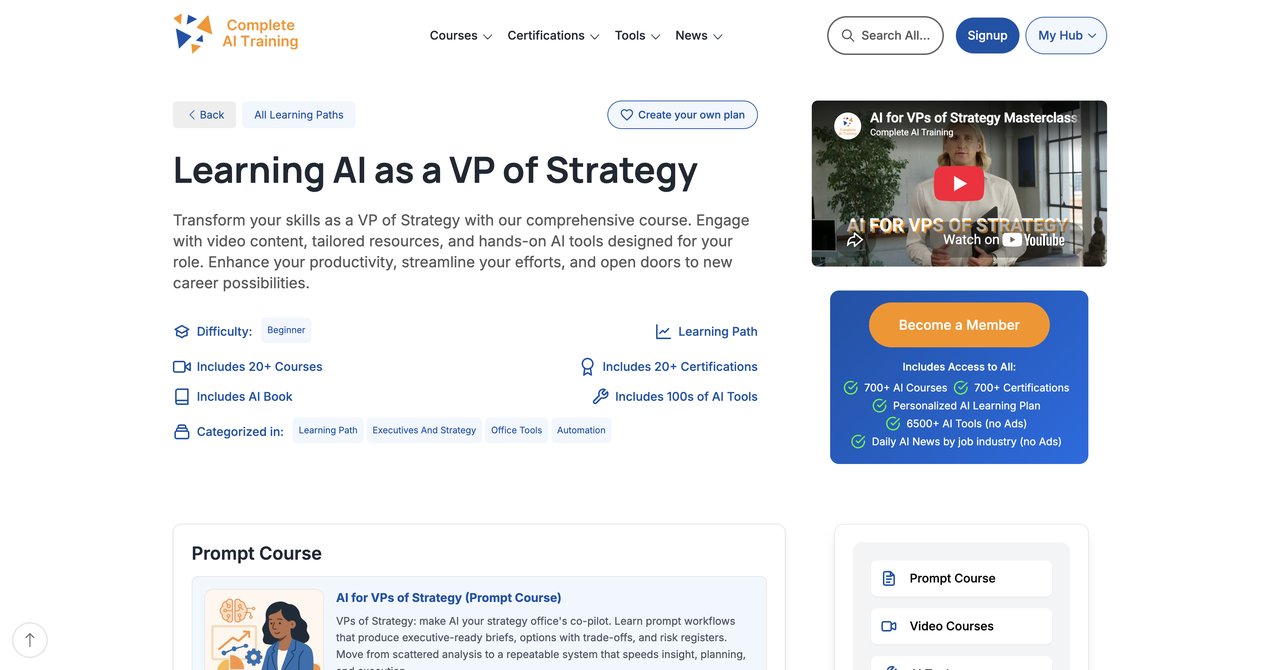
Link: https://completeaitraining.com/course/ai-for-vps-of-strategy/
Cost: $29/month or $8.25/month (billed annually)
Best For: VPs of Strategy who want comprehensive, unlimited access to training materials for all job roles and every level of certification.
You need to know something crucial about this option right away. This is not a single course. When you subscribe to CompleteAI Training, you get full access to ALL video courses on the platform. Not just the AI for VPs of Strategy course, but hundreds of other courses covering every job role and every industry. It's also not a top-sliced bundle-this is a library. This is the most complete and cost-effective way to train your team if you need to cover strategy, management, or even technical roles. If you plan to use AI for marketing or engineering, you already have access. The breadth of knowledge here is the number one reason to choose this.
This is not just a video library, though. When you subscribe, full access to ALL certifications on the platform is included at no extra cost. You don't pay for the weekly training and then get charged to try to prove you know the stuff. That is a major difference. In other scenarios, you pay for a course, then pay an additional fee for the certificate. Here, all certifications are included. They don't hold the credential hostage to a high paywall.
The subscription model makes it different when considering updates. New courses and certifications are added continuously and are included automatically. That is how you keep up in this field. You don't have to re-buy an updated class later. Your subscription adapts to new tools, updates to old ones, and fresh content added every week. The field changes fast, and this is meant to change with it. It does not require a fixed schedule or a dedicated month. You can log in for 15 minutes or use it for a half-day offsite.
This matters a lot to you as a VP of Strategy. You are not likely to just have one role in your team. You have access to every other job role's material too, which matters for anyone whose work spans more than one function or who intends to set up for career mobility. The flexibility allows you to cross-train. You don't just read about strategy in a niche; you can check the product management or engineering frameworks if you need to understand them. It's a holistic approach. This is something most university programs will not give you.
Keep in mind the pricing. The subscription is at one flat rate, usually paid annually (at $8.25 per month). That means you don't pay per course. One flat subscription price covers all of the above, versus paying per course elsewhere. That is the key differentiator. The subscription is low-cost compared to a single executive program that may cost several thousand dollars. For the price, you are getting daily updates on relevant AI tools and news, which is a critical factor in the fast-moving AI-tool landscape.
Pros:
- Highest rating / Most complete offering
- Full access to ALL video courses on the platform, not a single course or a fixed bundle
- Full access to ALL certifications, included at no extra cost
- New courses and certifications are added continuously and included automatically
- Access to every other job role's material too, ideal for cross-functional work or career mobility
- One flat subscription price covers everything versus paying per course elsewhere
- Daily updates on relevant AI tools and news
Cons:
- Subscription-based model; continuous learning is expected as AI evolves rapidly
Who Would Benefit Most
This course is perfect for the VP or strategic leader who needs to know everything now, not just for the latest board meeting but for real implementation across the company. If you need to go from zero to 100 in a weekend, or if you like the idea of having a guide available for all your team members, this is the one. If you want to keep on learning without shelling out thousand-dollar fees for every new frontier in AI, use this. It's perfect for the self-directed learner and the person who has to connect the dots between different business units. It offers a tangible path to being the company's strategist and tutor.
Course 2: Artificial Intelligence: Implications for Business Strategy by MIT Sloan Executive Education / MIT CSAIL
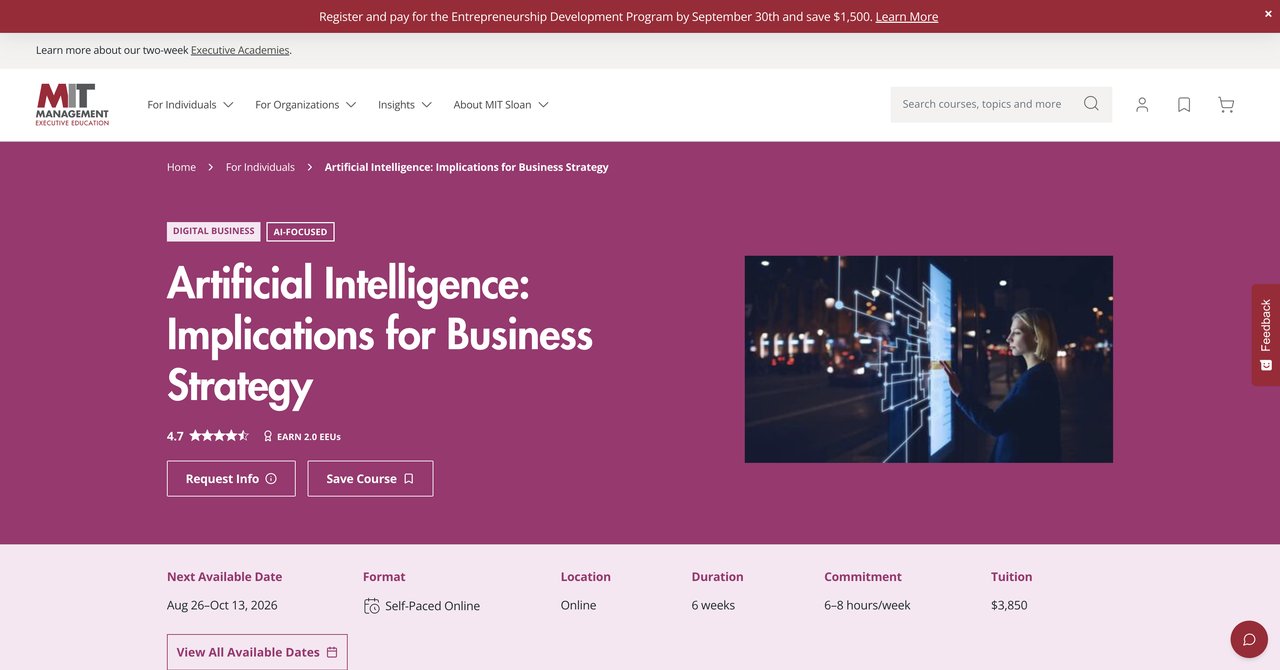
What: https://executive.mit.edu/course/artificial-intelligence/a056g00000URaa3AAD.html
Cost: $3,850
Duration: 6-week intermediate-level course (6-8 hours/week)
MIT Sloan Executive Education, partnering with the Computer Science and AI Lab, takes on a different approach. This intermediate-level course is appropriate for senior managers, VPs, and directors. It focuses on the organizational and managerial implications of AI, not just the technical underbelly of the technology itself. The curriculum has been refreshed for 2026 to include the most modern AI skills. There's a clear construct to this course that helps you analyze what AI can do for your specific position.
The course is structured to be a deep-dive over 6 weeks, with a clear commitment that spans 6-8 hours per week. It helps participants build the judgment to evaluate and identify the good AI strategies from the ineffective ones. The instruction is provided by MIT professors from the Sloan business school and the MIT CSAIL labs, gathering input from both management and technical science into one program.
You can expect to leave with a deeper understanding of how to embed AI capabilities into a corporate structure. The course is less concerned with prompt chaining and more about strategy. It looks at how AI changes the way your company allocates capital, acquires talent, and processes daily tasks. This is a comprehensive route to create alignment around direction, using case studies and frameworks.
For a VP of Strategy, the one catch is whether you need the depth of a six-week course. For existing AI-progressed businesses, this style of learning is very valuable. However, it can be steady, heavy, and the cost is high. The emphasis is transparent.
Key topics covered:
- Organizational impacts of AI
- Business model transformation
- Strategic planning in the era of AI
- Managerial decision-making with AI tools
Target audience and skill level:
This course is designed for mid-to-senior level leaders. While no deep engineering skill is needed, you should be comfortable with executive-level business thinking. It does not specifically require a math background, and it is tailored for business leaders who will drive adoption. It's the course for leaders in organizations that are looking to adapt their structure.
Pros:
- Curriculum refreshed for 2026 with modern AI skills
- Focuses on strategic and managerial implications, not technical details
- Offered jointly by MIT Sloan and CSAIL
Cons:
- Requires 6-8 hours per week
- Premium price point
Who would benefit most:
This program is best suited for the VP of Strategy who requires validation from a top-tier university and wants to check the boxes of a high-level credential. It's for those who need a structured schedule and don't risk being distracted. If you're looking for name recognition and a high-level relation between business strategy and deep tech, this is one to consider. It's less of a how-to, more of a framework-building experience.
Course 3: Oxford Programme in Strategic Analysis and Decision Making with AI by Saïd Business School, University of Oxford
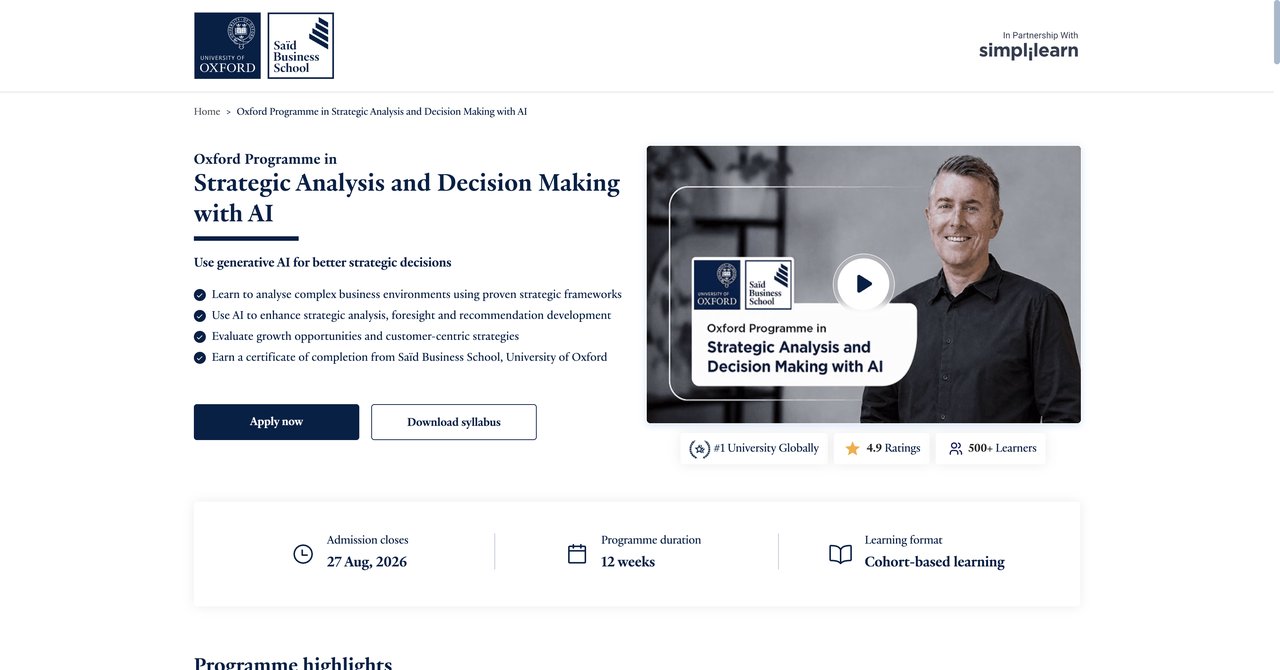
What: https://certifications.sbs.ox.ac.uk/oxford-strategic-analysis-and-ai-decision-making-course
Cost: £2,490 (approx. $3,100)
Duration: 12-week program
The University of Oxford's Saïd Business School has developed this 12-week program that carefully crosses strategy analysis with of AI applications. The focus is specifically on evidence-based decision-making. It's about using market assessments to inform business cases. It offers a distinct combination, applying traditional strategic frameworks to real business challenges or maybe even introducing AI as a direct factor. It's designed for learners who have some experience at strategy.
This course is useful because it doesn't hand you straight AI content. Instead, it teaches you how to be a better and much more data-supported leader. The 12-week structure is rigorous, with a detailed study plan that takes you module by module through the phases of decision making. You're not just in learning new AI paintings-it is about teaching you how to do the major strategic thinking parts in an environment where AI changes the rules.
Where this stands out is its emphasis on applying strategic frameworks. This is for a VP of Strategy who feels comfortable with standard strategy tools and wants to see how they work with AI inputs. It has a heavy analytical focus. The cons are that 12 weeks is a big chunk of your time. And it may not teach you specific Gen-AI prompts or detailed, generation specifics, which might be something you want to know.
Key topics covered:
- Evidence-based decision-making
- Market assessment using strategic frameworks
- Strategic analysis with AI
- Applying data insights to basic business problems
Target audience and skill level requirements:
The program is intermediate. It assumes you have several years of management experience and that you have the basics down. The course is designed to deepen your strategic toolkit. You need to be excited about evidence gathering and analyzing numbers. It's not for absolute beginners.
Pros:
- 10 modules combining strategic analysis and AI application
- Focuses on evidence-based decision-making
- Applies strategic frameworks to real business challenges
Cons:
- Requires 12-week commitment
- Less focus on generative AI specifics
Who would benefit most:
This course is ideal for the VP of Strategy who works in an industry driven by data, like finance or consulting. If your role requires you to prepare board-pack recommendations with a data-driven proof, this gives you the method. It is less about learning the new generative AI toys, more about how to use the intelligence one already has to make better decisions. Great choice for a strong strategist who wants to formalize their AI feedback loop.
Course 4: JHU AI Business Strategy Certificate Program with Gen AI by Johns Hopkins University
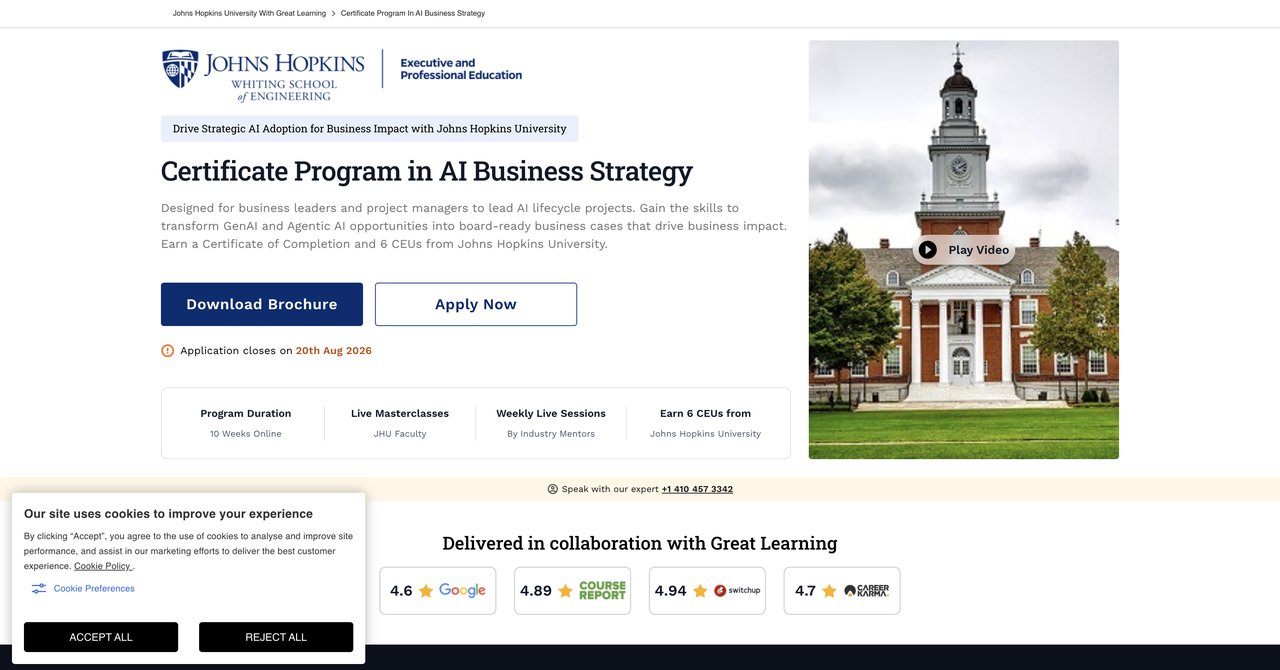
What: https://online.lifelonglearning.jhu.edu/jhu-certificate-program-ai-for-business-strategy
Cost: $2,600
Duration: 10-week program
Johns Hopkins University offers a certificate program that's heavily focused on the concrete deliverables of a strategy leader. Unlike more academic offerings, this course concentrates on building AI lifecycle projects from data to a "board-ready" business case. The aim is to get you beyond your strategy deck and into being an implementable plan carrying measurable business benefits. It's a very tactical program.
What stands out is its structure in the hands-on project module. The course includes 6+ case studies and 2 hands-on projects, which gives you a resume-ready portfolio at the end. You get live masterclasses with JHU faculty and industry experts, which offers very rare insights. These interactive sessions ensure that you are not just learning theory but seeing it work in real-time.
The teaching style here is highly polished in the classroom; they expect you to be ready for a practical application. The key goal is to teach you how to construct business justification that stands up under the scrutiny of the CFO and CEO. This is important for the VP role, as that the path from AI concept to budget is often where strategies fail. It is about how to get funding for AI projects and demonstrate value.
Key topics covered:
- Leading AI lifecycle projects
- Building business cases
- Case studies and hands-on projects
- Live masterclasses with industry experts
Target audience and skill level requirements:
It's geared towards VPs and Directors who have some business experience. It's not for entry-level roles. You should have a solid understanding of your business processes before joining, as the course focuses on managing the AI life cycle. It does not demand technical depth but it requires a businessman to run.
Pros:
- 6+ case studies and 2 hands-on projects
- Live masterclasses with faculty and industry experts
- Teaches how to build board-ready business cases
Cons:
- Application deadline closes August 13, 2026
- Requires 6-8 hours per week
Who would benefit most:
For the VP of Strategy that wants to turn strategy into execution, this is a great match. If you are under a lot of pressure to halt AI pilots and show you. If you need a certificate that comes with a tangible business case deliverable that you can actually pitch to the CEO, this is a standout choice. It's perfect for a doer who wants the credibility of a JHU credential combined with some serious portfolio work.
Course 5: Executive Program in AI Strategy and MBA Essentials by Rotman School of Management, University of Toronto
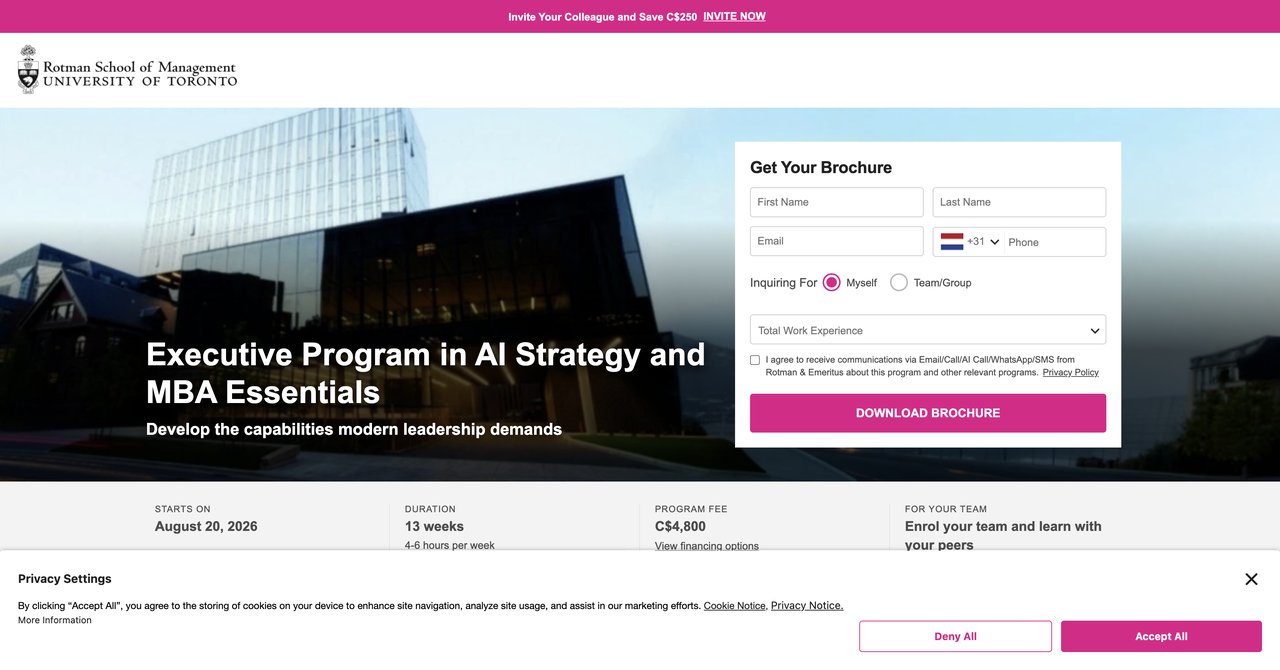
What: https://execonline.rotman.utoronto.ca/executive-program-in-ai-strategy-and-mba-essentials
Cost: Not published on the website.
Duration: 13-week advanced program
The Rotman School of Management at the University of Toronto brings added academic firepower with a program that blends AI strategy with general MBA classes. This is a long 13-week heavy commitment. It has a strong focus on generative and agentic AI, which are very current topics. Through a blend of case studies and real-world scenarios, you will develop a clear understanding of how to deploy AI responsibly.
This program blends three critical concepts-business strategy, AI, and leadership. Its main focus is to prepare you, as an executive, to take limited knowledge within your organization. The MBA Essentials side essentially gives a crash course in the economic and leadership fundamentals you need, while the AI Strategy section covers frameworks for generative AI and agentic logic. Since it is a highly integrative course, you'll be learning how to implement responsible AI in a practical environment.
The lack of a published price point may be a drawback for some; you will need to contact the school for specifics. It emphasizes an important point about agency and accountability in the deployments of AI. This is a strong fit for strategy leaders who want the thorough knowledge that an MBA might provide, combined with AI-specific.
Key topics covered:
- Generative and agentic AI
- AI strategy frameworks
- MBA essentials for leaders
- Responsible AI deployment
Target audience and skill level requirements:
It is designed for senior-level leaders and executives who can make decisions. It's assumed you have significant professional experience. There may be some prerequisites in the business, expected that you have years of experience in your resume and are working with a team. It requires a serious time investment.
Pros:
- Covers generative AI and agentic AI
- Combines AI strategy with MBA essentials
- Teaches responsible AI deployment
Cons:
- Lengthy 13-week commitment
- Tuition not published
Who would benefit most:
This is perfect for a VP of Strategy who wants a deep, academic approach and who feels they missed some formal business training in their career. If you are leading or diving into automation and agree AI processes, the agentic AI content is valuable. It's best optimized for those who are. Since the cost isn't listed, it's ideal for folks whose companies have a learning budget and who request advanced executive education.
Course 6: AI Strategies and Applications for Leaders by Kellogg Executive Education (Northwestern)
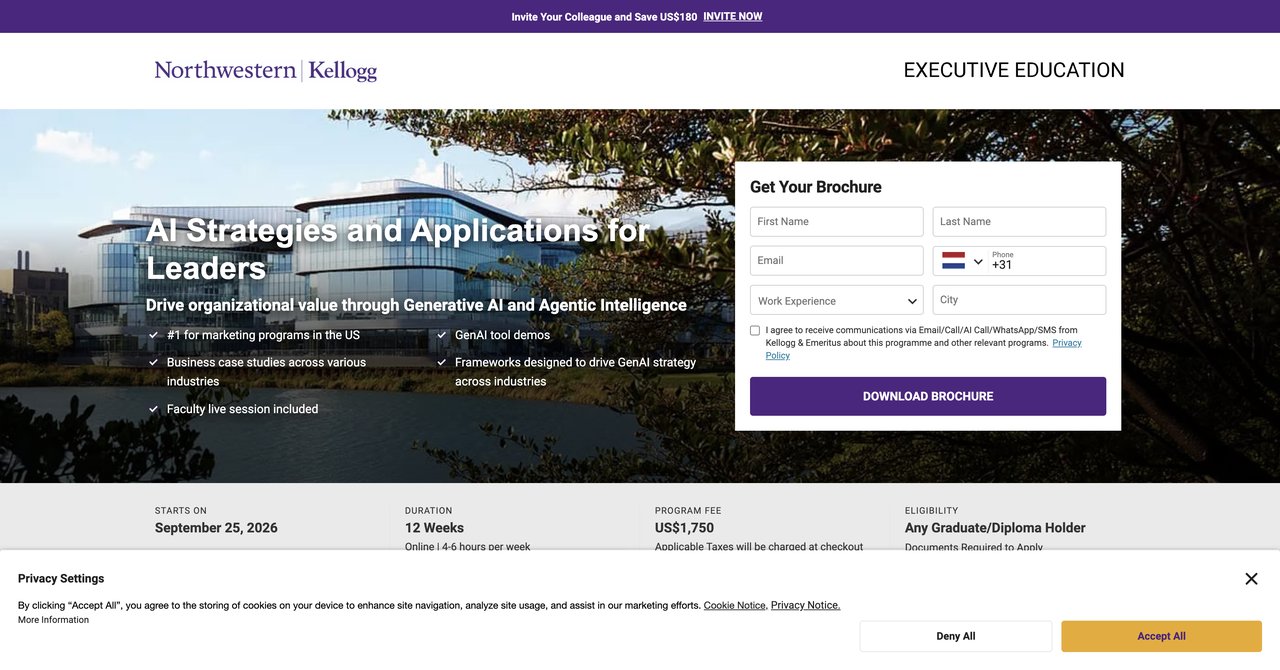
What: https://online.em.kellogg.northwestern.edu/kellogg-ai-strategies-and-applications-for-leaders
Cost: Not published
Duration: 12-week program, 4-6 hours/week
This Kellogg program is aimed at the C-suite. It is a higher level of strategy, focusing less on getting into the weeds and more on the overall picture of how an organization can create measurable business value using AI. It was built specifically for executives who are defining strategy. The program uses many CIO style of case studies to help you identify where AI can be a good fit.
The 12-week modular approach specifically targets generative and agentic AI set. It is designed to show you how to use these systems in the customer experience setting, how they boost employee productivity, and how they can be applied to product creation. It gives you a practical toolkit for how to lead an AI initiative from a director without needing to program.
The content is focused on understanding how to tailor initiatives to achieve a very high return on investment. Assignments and interactive content will guide you through applying the learned models. It relies on leveraging the reputation of Kellogg, which is a big draw for many. The not-published price is a possible drawback, but that often requires contacting the marketing team. The workload is steep.
Key topics covered:
- Generative AI strategy
- Agentic AI applications
- Achieving measurable business value
- Application in customer experience, talent productivity, and product innovation
Target audience and skill level:
The course is for the C-suite or those just below it, for professionals who set the company's direction. It is high in level and practical. Having basic familiarity with AI concepts is useful, but is not a purely technical class.
Pros:
- Covers generative and agentic AI
- Focuses on measurable business value
- Tailored for executive-level decision-making
Cons:
- Price not published
- Substantial workload of 4-6 hours/week for 12 weeks
Who would benefit most:
For the VP of Strategy who is expected to lead the AI strategy arm for the organization, Kellogg gives you the lexicon and background you need. This is an excellent program for those who need to drive change through customer experience and from a top-level perspective. It is also a good choice if you seek an understanding of what GenAI and agents can do for your day to day, but you aren't planning on becoming the AI expert.
Course 7: AI for Executives by Coursera (Vanderbilt University)
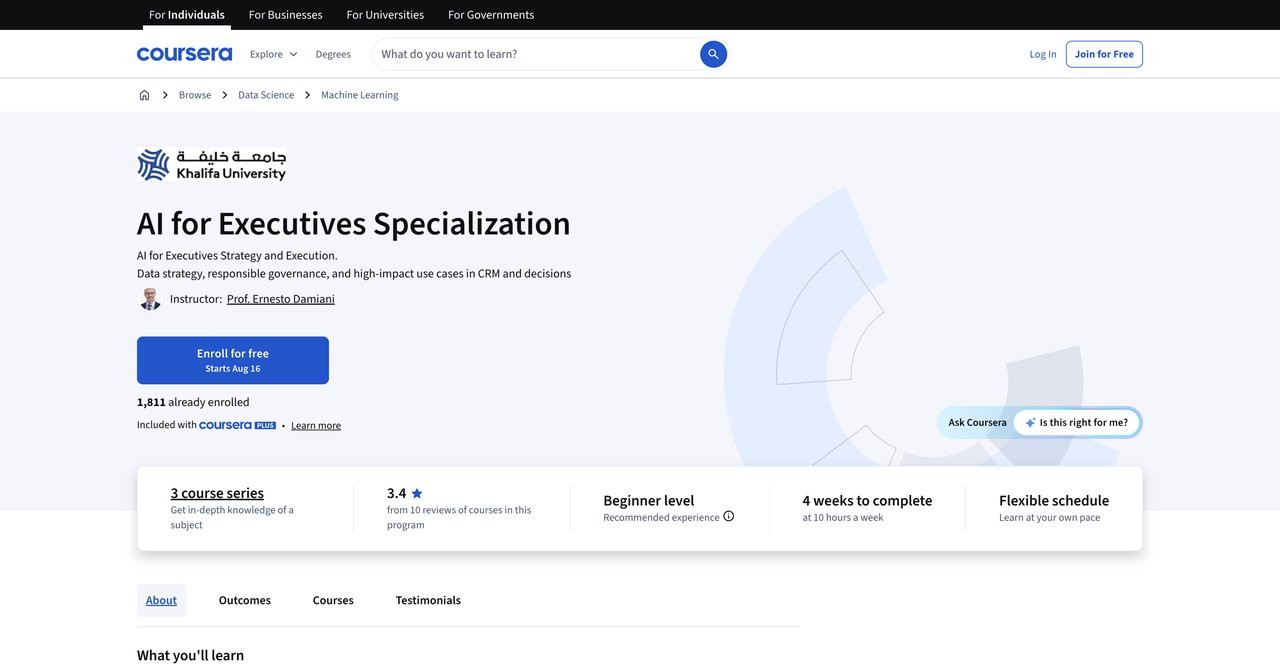
What: https://www.coursera.org/specializations/ai-for-executives
Cost: Subscription (approx. $49/month)
Duration: Four-week self-paced
Vanderbilt University's offering on Coursera provides an accessible entry point. This four-week self-paced program helps you understand the AI landscape. It's a foundational, nontechnical course perfect for executives who have been avoiding the nitty-gritty but need a working grasp of how things fit. It covers AI foundations and explains the strategic nature of data.
The course is organized into manageable modules, and while it moves quickly in four weeks, you can do it at your speed. This is a perfect starter course for a VP who needs a business vocabulary to talk intelligently about AI in a boardroom quickly. It covers AI foundations, NLP, and chatbots, and breaks down LLM applications. There is no expectation of coding.
Because it's on Coursera, you have the ease of use and the ability to get financial aid if you need it. In terms of solving heavy strategic problems, it may be too basic for a very advanced VP. It's more useful for a cross-functional VP who wants knowledge and doesn't want to pay for expensive, long-term onsite projects.
Key topics covered:
- AI Foundations
- Data Strategy
- NLP, Chatbots, and LLM applications
- Business integration of AI
Target audience and skill level:
This is for the contemporary executive and is intentionally beginner-friendly. It requires no technical skill or prior AI knowledge. This is for decision-makers who need to be conversational in AI quickly without committing to a full bootcamp.
Pros:
- Self-paced and flexible
- Non-technical, beginner friendly
- Financial aid available
Cons:
- May be too basic for seasoned VPs
- Subscription required
Who would benefit most:
This one for a VP of Strategy who needs a quick, low-cost, easy win. If you have a basic understanding of how things work and you just need some hand-holding with the jargon, this is great. Weekends are great for this kind of learning. However, it does not replace deep learnings for those who want to develop a full organizational change plan.
Course 8: Entrepreneurial Guide to AI Strategy for Business Leaders by Udemy
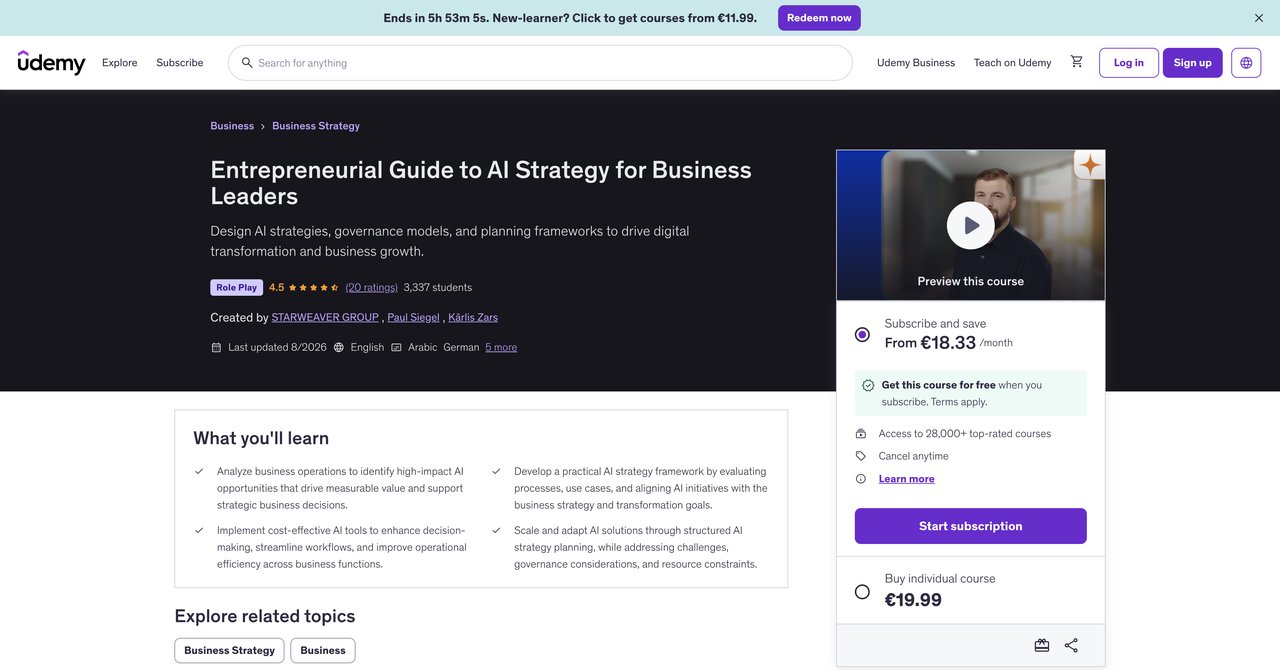
What: https://www.udemy.com/course/entrepreneurial-guide-to-ai-strategy/
Cost: Typically $20-$100
Duration: Self-paced
Udemy offers this as a useful, practical, and very affordable course. It concentrates on identifying high-value opportunities for AI in business operations. It is a practical course that steers clear of theory and focuses on a working framework for a strategy. The approach uses entrepreneurial thinking to help you locate where AI can drive growth.
The content is direct and to the point. It is a quick win when it comes to forming a strategy framework. You will have lessons about how to evaluate your business operations and see where AI can improve performance. It's low commitment, you don't need to wait for a start date.
Nonetheless, a big caveat: Udemy courses can vary in quality. While this one has a specific focus on strategy with vendor and is a sensible fit, it is not a university-credentialed program. There's no official certificate. Still, this is a great time for a side project for leaders who need a roadmap that requires no time off, and few money.
Key topics covered:
- Identifying high-value AI opportunities
- Creating an AI strategy framework
- Practical business evaluation
- AI integration for business growth
Target audience and skill level:
This suits professionals who want a no-nonsense introduction without the prestige and the price of a university. Some business experience is helpful but no advance training needed.
Pros:
- Affordable platform access
- Practical approach to evaluating business operations
- Builds a structured AI strategy framework
Cons:
- Udemy quality varies
- No university credential
Who would benefit most:
This is the best fit for a strategy VP or small business owner at a startup who needs to develop a viable AI strategy without spending a lot. It is also fantastic for a person who wants a practical, overnight primer before they enroll in a much longer course.
Course 9: Strategy in the Age of AI by Columbia Business School Executive Education
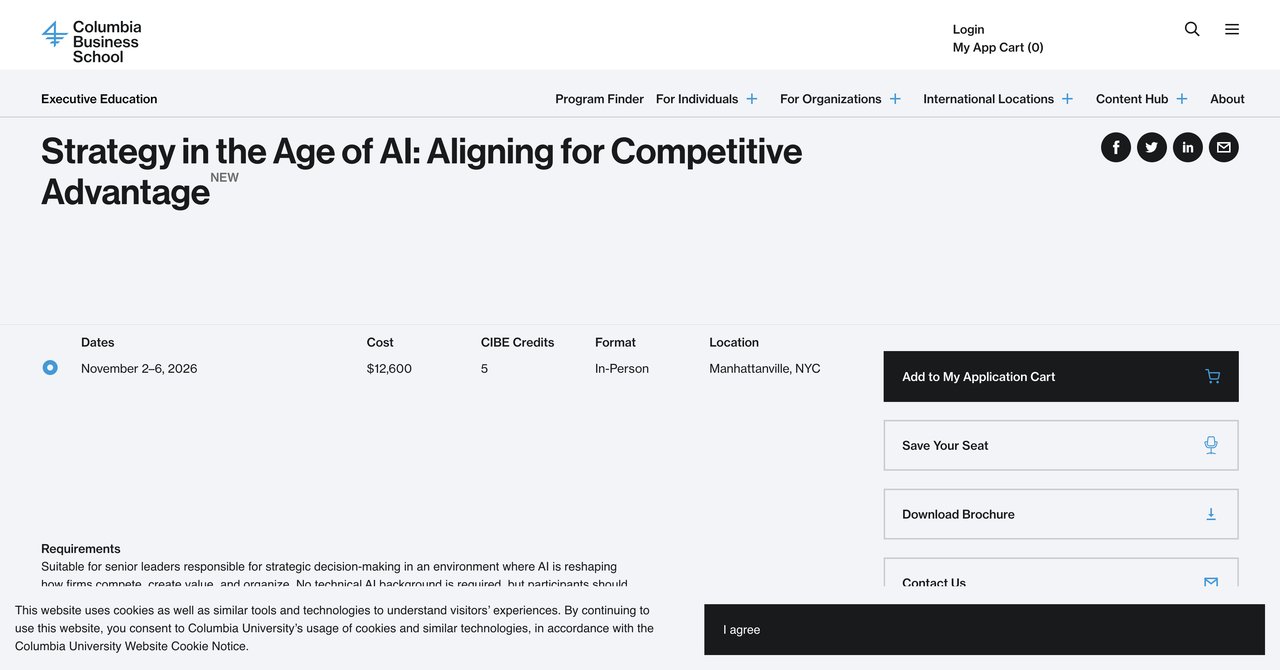
What: https://execed.business.columbia.edu/programs/strategy-ai
Cost: Not published
Duration: Not published
Columbia Business School Executive Education has created a course to reflect on how senior leaders should react to AI. They do not approach it as a technology course; the approach sees AI as the new factor in that changes the entire mechanism of competition. It talks extensively about the impact of value creation and organization design. It's a pure strategy course, with no technical background required.
This course is advanced, built for senior executives. It does not provide lots of specific tool training but it helps you decide how to move. The teaching is geared around how to rethink your strategy to exploit AI in the future. The lack of fixed duration or price on the website is a concern. Still, Columbia's alumni network and history need no introduction.
It requires a solid understanding of the basics, so it's not the first course you should take in your AI journey. If you already have a foundational understanding and are looking for modern leadership perspectives, Columbia works. They focus on new business models for AI rather than just simply how to use a tool like chatGPT.
Key topics covered:
- How AI reshapes competition
- Value creation with total intelligence
- Organization design for AI
- Capitalizing on generative AI
Target audience and skill level:
The course is aimed at senior leaders just below the C-suite and those professionals looking at strategy. You should have some familiarity and awareness of the major AI trends and terms, because the focus of the course is avoiding pitfalls and building advantage.
Pros:
- Designed for senior leaders
- Focuses on competitive and organizational impact
- Not technical in nature
Cons:
- No fixed duration or price listed
- Requires foundational AI knowledge
Who would benefit most:
The strategic leader who has, say, done one previous online course and is ready for the high-level perspective. It is for a VP who wants a business-school view of the future rather than a cookbook. If you are looking for specific prompts or step-by-step implementations, this is not for you. You will get a strategic mindset. The time and price of the Columbia course can be negotiated separately.
Final Comparison and Overall Recommendations
At the end of this deep dive, you need to make a choice. Let's outline that. The best choice isn't done for you. It depends on your role and your expectations from the program.
For the VP who wants to get the full package, and who sees their role as involving multiple functions from marketing to operations, Course 1: CompleteAI Training is the strongest choice. The unique "all-access" pass to every course and certificate is a greater value than any other program here. You never have to pay again. You can bring whole your teams. It helps you stay sharp on the same platform as new AI tools are changing the job. While the monthly subscription model may require more self-motivation to keep logging into. The database is a formidable resource for driving AI literacy.
If your career and responsibility are associated with an elite university credential, we will look at the JHU program (Course 4). It is geared toward the practical generation, where you deliver board-ready business cases. That is less common in the premium. It looks great in a CV. It gives us a tangible outcome. It is worth the time and price if you need to demonstrably 'show your work' and foster confidence.
For those who enjoy the structure and status of the Kellogg (6) or Oxford (3) programs, they offer different, maybe business-school-level strategy. If you have a large budget for executive education and prioritize a network, these are the picks. They are best for the VP who wants to look at problems through a new lens, not necessarily the implementation. Northshore's Kellogg program is best for C-suite leaders aiming at the big picture of the market. They have an agentic, generative focus, which is current and strong.
If you're looking for a heavyweight theoretical base, then Columbia (9) and the MIT (2) programs will give you a strategic grounding. You find that they require the larger time commitment. They are best for company-wide transformations. On the other end of things, if you need immediate, lower-cost foundational knowledge, Vanderbilt (7) is a solid choice, though you may outgrow it. The Udemy (8) can be a backup.
If you need to start with a modest commitment and a moderate budget, but still want all the material to cover you in the long run, choose CompleteAI Training. It offers you the broadest and most affordable appeal. For a high-stakes leader in a large organization, a university program's structure could justify the cost. But if you require a broad and adaptable educational resource, the subscription should be the first port of call. The choice is yours based on how you appreciate value, flexibility, and the needs of your people.